Market Minds Advisory
Creator Economy Market

Creator Economy Market: Creator Economy Market. Trends and Forecast 2026 to 2036

Brand sponsorship spend is shifting decisively toward individual creators over traditional celebrity endorsements, forcing platform vendors to build sponsorship marketplace infrastructure that proves audience authenticity before advertisers commit budget away from conventional media buys.

Lead Analyst

Published

September 2026

Make Smarter Decisions with Customized Research Insights

Request a free sample report and evaluate market opportunities, growth trends, and competitive dynamics relevant to your business needs.

2025 MARKET VALUE$19.5BMarket Size 2025
2036 FORECAST VALUE$86.5BBase Case , 2026 to 2036
CAGR 2026 TO 203614.5 %Bull 15.8% / Bear 13.2%
INCREMENTAL OPPORTUNITY$64.2BNet 10- year value creation
EXPANSION MULTIPLE3.87x2036 value over 2026 base
Strategic Levers
M&A Pipeline
Regional Outlook
Country Rankings
Competitive Intelligence
Segmental Deep-dive
Call-Us : 91 93563 13602

Executive Snapshot and Market Trajectory.

Brand marketing budgets are shifting decisively toward individual content creators as measurable audience engagement increasingly outperforms traditional celebrity endorsement campaigns, pushing platform vendors to build sponsorship marketplace infrastructure that proves authentic reach before advertisers commit meaningful spend away from conventional media channels, traditional advertising formats, and legacy celebrity partnerships.
Commercial activity concentrates around brand-creator sponsorship marketplaces, since advertisers now demand measurable, verified audience engagement data before committing campaign budget to individual creators rather than traditional celebrity endorsement deals lacking granular performance tracking capability across most product categories. Sponsorship marketplaces show the fastest growth, with India's expanding creator base and regional language content absorbing a disproportionate share of new brand partnership activity as advertisers seek authentic local audience reach and engagement.
Competitive intensity sits moderately concentrated among five platforms controlling roughly a third of transaction revenue, while dozens of specialized challengers compete for narrower monetization, analytics, and subscription management niches across most creator tiers and content categories tracked closely. Rising demand for verified engagement metrics and growing scrutiny over fraudulent follower counts are reshaping which platforms win brand advertiser trust across most sponsorship categories and creator tiers.
Market Definition
The Creator Economy Market covers software platforms and services that enable independent content creators to monetize, manage, and grow their audiences, including sponsorship marketplaces, payment processing, subscription management, and audience analytics tools. It excludes the underlying social media platforms themselves and traditional media production services sold as separate categories.
Base Year Value
$19.5B in 2025 (MMA Primary Research Dataset, September 2026)
Forecast Period
2026 to 2036, eleven discrete annual values
CAGR
14.5% base case. Bull 15.8%. Bear 13.2%.
Fastest Growth Segment
Brand-Creator Sponsorship Marketplaces: 19.0% CAGR
Fastest Growth Country
India: 18.0% CAGR
Fastest Growth Region
South Asia and Pacific: 16.5% CAGR
Largest Region
North America: 32% of 2025 global value
Market Leaders
Leading participants include YouTube, Patreon, Substack, Meta, and Whalar. Source: MMA Analysis based on company annual reports.
Primary Survey
n=3,800 procurement and R&D decision-makers, Q4 2025, six countries
Methodology
Demand-side build-up, cross-validated against public data, 47 expert interviews

Creator Economy Market Forecast Scenarios

creator-economy-market-size-forecast-scenario-1789988489250
Between 2020 and 2025 the market grew at a milder 13.2% historical rate as creator monetization remained largely limited to advertising revenue sharing arrangements, with commercial momentum accelerating meaningfully only after brand sponsorship marketplaces demonstrated reliable verified audience measurement capability starting around 2023 across most creator platform categories, advertiser buyer segments, and content verticals worldwide.
The base case assumes 14.5% annual growth through 2036, driven by three mechanisms: accelerating brand-creator sponsorship marketplace adoption replacing traditional celebrity endorsement deals across most consumer product categories, advertiser types, and campaign formats globally, expanding creator monetization payment infrastructure supporting subscription and membership revenue streams beyond advertising alone, and rapid Indian creator base growth absorbing a disproportionate share of new brand partnership activity as advertisers seek authentic regional audience reach.
A bull scenario near 15.8% growth would require continued brand advertiser confidence in verified engagement metrics reducing concerns about fraudulent follower counts across most sponsorship categories and buyer segments. A bear case near 13.2% reflects slower than expected advertiser trust in creator sponsorship measurement accuracy, compressing platform transaction volume across smaller creators facing tighter brand partnership budget scrutiny enforced today.

Where Brand Dollars Meet Individual Creators

The creator economy has evolved from a loose collection of advertising revenue-sharing arrangements into structured commercial infrastructure, as brands increasingly treat individual creators as a distinct advertising channel deserving dedicated budget lines rather than experimental spend carved out of broader digital marketing allocations. This formalization is pushing platforms to build enterprise-grade contract management, payment processing, and performance reporting tools previously unnecessary when sponsorship deals happened informally through direct messages.
MARKET CONCENTRATIONCR5 34%Share held by five largest platform providers combined
AVERAGE SPONSORSHIP DEAL VALUE$4,200 per campaignTypical brand payment per individual creator sponsorship engagement
TOP ADOPTING COUNTRYUnited States, 31% shareShare of global platform transaction revenue generated domestically there
CREATOR RETENTION RATE82% annuallyAnnual creator renewal rate across major platform monetization programs
VERIFIED METRICS ADOPTION44% of sponsorship dealsPortion of deals using third-party verified engagement measurement tools
SUBSCRIPTION REVENUE SHARE27% of creator incomePortion of total creator earnings derived from subscription products
Commercial character centers on measurement credibility: brand advertisers increasingly demand third-party verified engagement data before committing sponsorship budget, since inflated follower counts and fabricated engagement metrics have burned marketers on prior campaigns lacking due diligence and independent verification. Platforms offering audited audience authenticity scores are winning enterprise brand relationships over competitors still relying on self-reported creator statistics.
Over the next decade, sponsorship marketplace infrastructure and payment processing reliability will likely determine which platforms retain creator and brand relationships, as both sides increasingly favor providers offering transparent transaction terms over opaque revenue-sharing arrangements common a decade earlier across most content categories. Platforms that fail to modernize payment and verification infrastructure risk losing both creator loyalty and brand advertiser trust simultaneously.
"Brands used to pay celebrities to hold a product, now they pay someone with fifty thousand engaged followers who will actually explain why it's good, and that shift is permanent."
Director, Digital Media and Creator Economy Practice · MMA Technology Practice · September 2026

Market Trends

Verified Engagement Metrics Become Sponsorship Standard

Sponsorship marketplaces are launching third-party audience authenticity verification tools that flag fraudulent follower counts and fabricated engagement statistics, with adoption expanding to roughly 44% of sponsorship deals during 2025 compared with negligible share three years earlier. Whalar and other marketplace platforms have both expanded verification features significantly since 2024, adding fraud detection algorithms that traditional influencer marketing platforms never required when serving primarily self-reported creator statistics exclusively for early campaign matching purposes. Competing marketplaces now face intense pressure to add comparable fraud detection capability quickly to retain brand advertiser trust.
Market Impact: Influencer marketing spend reached 34 billion

Subscription Revenue Diversification Reduces Platform Dependency

Creators increasingly diversify income across subscription platforms, direct membership programs, and sponsorship deals rather than relying entirely on advertising revenue sharing from a single social media platform algorithm change away from financial instability. Subscription and membership revenue now represents roughly 27% of total creator income for established mid-tier creators, a substantial increase from negligible share five years earlier when advertising revenue sharing dominated creator monetization almost entirely across most content categories and platforms. Analysts expect this diversification to accelerate further as platform algorithm changes continue destabilizing pure advertising revenue dependency across most content categories.
Market Impact: Organic reach declined roughly 22%

Market Opportunities and Growth Drivers

Influencer Marketing Budget Growth Outpaces Traditional Media

Global influencer marketing spend reached an estimated 34 billion dollars in 2025, according to industry survey estimates, growing considerably faster than traditional television and print advertising budgets as brands chase measurable engagement and authentic audience connection unavailable through conventional media buys. Marketers facing intensifying pressure to justify advertising spend increasingly favor creator sponsorships offering documented engagement metrics over traditional brand awareness campaigns lacking comparable performance attribution, accelerating budget reallocation across most consumer product categories and advertiser segments. Vendors targeting this budget shift specifically are seeing the strongest adoption momentum across most advertiser categories industry-wide.
Market Impact: Fraud inflates metrics by roughly 15%

Platform Algorithm Volatility Drives Income Diversification

Creators faced an estimated 22% average decline in organic reach following major platform algorithm changes during 2025, pushing many toward direct monetization channels less dependent on unpredictable algorithmic distribution decisions made by social media platforms beyond their control. This instability accelerated adoption of subscription platforms, direct membership programs, and owned email audiences that provide creators more predictable and durable income streams compared with advertising revenue sharing tied entirely to algorithmic visibility and engagement fluctuations. Diversified creators report meaningfully greater income stability compared with peers reliant solely on advertising revenue sharing.
Market Impact: Monthly income varies by roughly 40%

Market Restraints and Challenges

Follower Fraud Undermines Brand Advertiser Confidence

Fraudulent follower counts and fake engagement bots inflate creator audience metrics by an estimated 15% on average across mid-tier creator accounts, according to internal marketplace quality audits conducted during 2025, undermining brand confidence in self-reported creator statistics. The root cause lies in weak identity verification across smaller creator platforms lacking dedicated fraud screening infrastructure comparable to larger established marketplaces. Leading platforms are mitigating this by adding machine learning fraud detection and mandatory identity verification before onboarding creators onto sponsorship marketplaces. Some smaller marketplaces still lack the engineering resources needed to deploy comparable protection quickly.
Market Impact: Verified metrics adoption reached 44%

Creator Income Volatility Discourages Long-Term Commitment

Median creator monthly income varies by an estimated 40% month to month given seasonal brand spending patterns and unpredictable sponsorship deal timing, creating financial instability that discourages talented individuals from pursuing content creation as a primary career path. The root cause traces to the project-based nature of sponsorship deals lacking the recurring revenue predictability of traditional employment arrangements. Platforms are mitigating this by expanding subscription and membership tools that provide creators more predictable baseline income. Larger platforms with diversified revenue tools help creators manage this volatility more effectively than smaller competitors.
Market Impact: Subscription income reached 27% of earnings
3 additional market trends, 4 additional growth drivers, and 2 additional restraints and challenges are covered in the full report. Contact sales@marketmindsadvisory.com to access the complete intelligence.

Segment CAGR and Growth Architecture

This report segments the Creator Economy Market by monetization function, the classification creators and brands actually use when selecting platforms for sponsorship deals, payment processing, subscriptions, or audience analytics across distinct technical and commercial needs within their broader content monetization strategy, marketing budget, internal staffing model, and continuously evolving long-term audience growth strategy plan.
creator-economy-market-market-share-analysis-1789988489804

Brand-Creator Sponsorship Marketplaces

Brand-creator sponsorship marketplaces are the fastest-growing monetization function, expanding at 19.0% annually as advertisers demand measurable, verified audience engagement data before committing campaign budget to individual creators rather than traditional celebrity endorsement deals across most product categories. These marketplaces bundle fraud detection, contract management, and performance reporting features that traditional influencer outreach spreadsheets never required when brands managed creator relationships manually through direct messages. Whalar and similar marketplace platforms lead this category with expanded verification features launched since 2024, while newer entrants capture share among mid-market brand advertisers specifically. Their established fraud detection infrastructure represents a meaningful barrier to entry for newer competitors. Smaller marketplaces increasingly struggle to match this fraud detection scale independently.
CAGR 19.0%

Creator Monetization and Payment Platforms

Creator monetization and payment platforms, the second-fastest-growing category at 16.5% annually, benefit from rising creator demand for diversified income streams beyond advertising revenue sharing tied entirely to unpredictable platform algorithm decisions made without any creator input or advance notice. Creators increasingly require integrated payment processing supporting subscriptions, tips, and merchandise sales as standard capability before committing to a primary monetization platform. Companies specializing in this category, including Patreon and Substack, are winning creator adoption by demonstrating measurable income stability against documented baseline advertising revenue volatility. Financial services and technology-focused creators in particular report the fastest adoption curve among comparable monetization categories tracked closely. Adoption is accelerating fastest among creators facing the heaviest existing income volatility exposure.
CAGR 16.5%
Full segment breakdown across 6 segments available in the complete report.

Regional Architecture and Country Demand Map

North America leads given concentrated platform headquarters and the largest brand sponsorship budget pool across most industries, while East Asia holds meaningful share through established creator platform infrastructure and talent networks, and South Asia and Pacific grows fastest as India's creator base expands rapidly nationwide.

North America

The United States anchors global demand through concentrated platform headquarters, including YouTube, Patreon, and Substack, alongside the largest brand sponsorship budget pool spending on creator marketing across most consumer product categories and company sizes nationwide. Enterprise adoption of verified engagement metrics and fraud detection runs ahead of other regions given earlier sponsorship marketplace product maturity. Canada contributes modest additional demand through mid-market brand advertisers adopting similar creator partnership platform capabilities. Enterprise procurement teams increasingly evaluate marketplace vendors specifically on fraud detection depth and payment reliability before signing exclusive partnership agreements. This scrutiny is reshaping which platforms win the largest and most sophisticated brand accounts nationwide. Insurance underwriters increasingly favor documented fraud governance processes reducing legal exposure from sponsorship disputes.
Share: 32% | CAGR: 15.0% (2026 to 2036)

Western Europe

The United Kingdom and Germany drive regional demand through large brand advertisers across fashion, beauty, and consumer goods sectors adopting creator sponsorship platforms for authentic audience engagement campaigns. France contributes meaningful additional demand through luxury goods and fashion sector adoption at a steady pace. Growth trails the global average as stricter advertising disclosure regulation compliance requirements weigh more heavily on sponsorship transparency adoption than in less regulated markets. Financial services and pharmaceutical buyers in particular demand comprehensive disclosure documentation before sponsorship campaign approval. This regulatory environment increasingly shapes product development priorities for platforms serving European brand advertisers. Nordic markets add incremental demand through technology sector creator adoption tied to expanding regional digital infrastructure investment.
Share: 20% | CAGR: 13.0% (2026 to 2036)
Regional intelligence for 5 additional markets available in the complete report: East Asia, South Asia and Pacific, Latin America, Middle East and Africa, Eastern Europe. Contact sales@marketmindsadvisory.com.
creator-economy-market-country-cagr-analysis-1789988490323

Where Platforms Can Defend Take Rate Margin

As basic sponsorship matching commoditizes, platforms must build revenue in adjacent territory: fraud verification, integrated payment infrastructure, subscription tooling, and global delivery efficiency that generic outreach spreadsheets, direct messaging, and internal marketing teams cannot easily replicate given the deep trust, engineering investment, and long-standing creator relationships built over many sustained years of continued investment.

Fraud Verification as Premium Marketplace Feature

Platforms offering third-party audience authenticity verification as a premium feature capture meaningfully higher take rates than marketplaces matching brands and creators without fraud screening, since brand advertisers increasingly refuse to commit budget without documented engagement verification across most campaign types. Verified sponsorship deals command roughly 30% higher transaction fees than unverified matches, given the demonstrated risk reduction value for brand advertisers facing internal marketing accountability requirements. Platforms positioning this capability strategically are winning disproportionate share of premium brand advertiser budgets. This trend increasingly separates well-resourced platforms from smaller firms lacking comparable trust infrastructure.
Market Impact: Verified deals command a roughly 30% higher fee

Integrated Payment Infrastructure for Creator Retention

Platforms offering integrated payment processing across sponsorships, subscriptions, and tips capture deeper creator loyalty than competitors requiring creators to manage separate payment tools for each income stream. Creators using integrated payment platforms report retention rates roughly 32% higher than creators using fragmented, multi-vendor payment arrangements across their various income sources. This stickiness increasingly determines which platforms retain top-tier creator talent against competing marketplaces offering comparable sponsorship matching alone. Creators increasingly consolidate around fewer platforms offering this comprehensive payment convenience. This consolidation increasingly determines which platforms retain top-tier creator talent long-term across most content categories.
Market Impact: Integrated payments lift creator retention by 32% overall

Subscription Tooling for Recurring Platform Revenue

Platforms building comprehensive subscription and membership management tools capture recurring transaction fee revenue that partially offsets the volatility of one-time sponsorship deal commissions facing seasonal brand spending fluctuations. Subscription-enabled platforms report revenue predictability roughly 38% higher than platforms relying entirely on sponsorship transaction fees for total income. This predictability increasingly attracts investor confidence and enables more aggressive long-term product development investment. Analysts expect this revenue mix shift to accelerate further across most established creator platforms. This capability increasingly separates premium platforms from commodity sponsorship matching services competing purely on price.
Market Impact: Subscription tools lift revenue predictability by 38% overall

India Delivery Center Expansion for Cost Efficiency

Platforms expanding engineering and creator support delivery centers across India's large digital talent base are reducing platform development and support costs meaningfully while improving service coverage across time zones for global creator and brand customers. Companies with established India delivery operations report cost structures roughly 25% more efficient than competitors relying entirely on higher-cost domestic talent for equivalent engineering and support functions. This cost advantage increasingly funds more aggressive product investment and competitive pricing strategies. Vendors without comparable scale increasingly struggle to match resulting pricing competitiveness. This model increasingly shapes how competitors structure their own global delivery footprints going forward.
Market Impact: India delivery centers cut costs by roughly 25%

Who Controls the Margin Pool

Concentration sits moderate, with a CR5 near 34% on a transaction revenue basis and a meaningful gap separating YouTube and Patreon from mid-tier challengers like Substack and Whalar, who compete on subscription tooling depth and sponsorship fraud verification rather than broad platform reach across most creator tiers, content categories, and geographic markets served today across most industries.
Current competitive activity centers on three dimensions: sponsorship fraud verification feature launches capturing brand advertiser trust ahead of unverified competitors across most sponsorship categories, integrated payment infrastructure expansion deepening creator platform lock-in against fragmented multi-vendor alternatives, and subscription tooling investment stabilizing platform revenue against volatile transaction-based sponsorship commissions. India delivery center expansion has also become a meaningful cost lever among platforms seeking pricing advantage.

Emerging pressure comes from social media platforms building native sponsorship and monetization tools directly into their applications, potentially disintermediating standalone creator economy platforms entirely for smaller creator accounts facing budget constraints. Platforms slow to add fraud verification or subscription tooling risk losing creator and brand relationships to better-prepared competitors already established in these channels, while regional payment infrastructure increasingly determines which challengers gain meaningful share.
creator-economy-market-company-positioning-matrix-1789988490853

Competitive Moat and Risk Dimensions

YOUTUBE

Moat: Massive Distribution and Discovery Scale

YouTube's massive built-in audience distribution and content discovery algorithm give creators reach that standalone monetization platforms cannot replicate, since creators building audiences elsewhere must separately solve for discovery that YouTube provides natively through its existing recommendation infrastructure, user base, and decades of accumulated content library scale.
YOUTUBE

Risk: Algorithm Dependency Limits Creator Control

YouTube's algorithm-dependent distribution model leaves creators vulnerable to sudden reach declines following unannounced algorithm changes, risking creator dissatisfaction and migration toward platforms offering more predictable, owned-audience monetization models less dependent on unpredictable algorithmic visibility decisions made without any creator input or advance notice given previously.
PATREON

Moat: Direct Creator-Fan Payment Relationships

Patreon's established direct payment relationship infrastructure between creators and paying subscribers gives it a durable recurring revenue model that platforms dependent on advertising or one-time sponsorship deals cannot easily replicate without comparable years of payment processing trust, creator relationship building, and accumulated subscriber loyalty across categories.
PATREON

Risk: Limited Brand Sponsorship Marketplace Depth

Patreon's subscription-focused positioning leaves it comparatively less established in brand sponsorship marketplace matching compared with dedicated competitors like Whalar, risking share loss among creators seeking diversified income streams beyond direct fan subscription payments alone across most content categories, creator tiers, and audience demographics tracked closely today.

Players Tracked

Prominent Players

YouTube
Patreon
Substack
Meta
Whalar

Other Key Players

Kajabi
Podia
Ko-fi
Buy Me a Coffee
Linktree
Later
AspireIQ
CreatorIQ
Grin
Klear
Streamlabs
Twitch
OnlyFans
Cameo
Fanjoy

Recent Developments

FEBRUARY 2025

Whalar Launches Third-Party Audience Verification Tools

Whalar introduced third-party audience authenticity verification tools that flag fraudulent follower counts and fabricated engagement statistics, targeting brand advertisers requiring documented proof of creator reach before committing sponsorship budget. The launch directly addresses growing enterprise buyer demand for verified engagement metrics ahead of campaign commitment.
Signal: Signals marketplace platforms racing to build fraud detection capability ahead of brand advertiser scrutiny across most categories.
JUNE 2025

Patreon Expands Integrated Merchandise Payment Processing

Patreon expanded its integrated payment infrastructure to include merchandise sales alongside existing subscription and tip processing, targeting creators seeking consolidated income management across multiple revenue streams and platforms. The expansion positions Patreon favorably against competitors requiring creators to manage separate payment tools for each income source.
Signal: Signals platforms consolidating payment infrastructure to deepen creator platform lock-in and retention over the long term.
OCTOBER 2025

Substack Expands India Engineering Delivery Operations

Substack announced a significant expansion of its India-based engineering and creator support delivery operations, aiming to reduce platform development costs while improving support coverage across global time zones for creator customers. The expansion positions Substack to compete more aggressively on pricing against larger, higher-cost domestic competitors.
Signal: Signals continued vendor consolidation of engineering operations toward lower-cost global delivery center locations across most regions.

Payment Processing and Fraud Verification Cost Exposure

Payment processing fees and fraud verification infrastructure represent roughly 22 to 28% of total operating cost of goods sold for creator economy platforms, given the transaction volume required to process sponsorship payments, subscription billing, and tip transfers across large creator and brand customer bases continuously and at meaningful scale each day worldwide, with the remainder split across engineering talent and support staffing.
Payment processing and fraud detection service costs rose an estimated 14% between 2023 and 2025 as demand for verified transaction infrastructure outpaced available fraud screening capacity, according to company annual reports from payment processors citing sustained demand growth across most digital marketplace categories including creator economy platforms specifically, as transaction volumes climbed alongside rapidly expanding sponsorship and subscription activity worldwide across most creator tiers and content categories.

This exposure disadvantages smaller platforms lacking negotiated enterprise payment processing agreements, forcing them to absorb higher per-transaction costs than larger competitors with committed-use discounts across their payment infrastructure spend and vendor contracts. Vertically integrated platforms building proprietary fraud detection technology gain a meaningful and durable cost advantage over competitors licensing third-party verification services at standard retail pricing.
creator-economy-market-cost-volatility-analysis-1789988491056

Negotiated Multi-Year Payment Processor Contracts

Larger platforms increasingly negotiate committed-use payment processing agreements with providers spanning multiple years, locking in discounted per-transaction rates well below standard published pricing tiers offered broadly to smaller competitors across the broader industry and marketplace today. This reduces exposure to payment processing cost inflation while providing budget predictability across annual planning and procurement cycles.

Proprietary Fraud Detection to Reduce Licensing Costs

Some platforms are developing proprietary fraud detection and identity verification technology internally rather than licensing third-party tools, reducing ongoing licensing costs while improving detection accuracy tailored specifically to their own platform's creator and sponsorship transaction patterns and customer base. This investment pays off meaningfully over time as transaction volume continues scaling across most account tiers.

Tiered Transaction Fee Structures for Efficiency

Several platforms are implementing tiered transaction fee structures that scale processing costs directly with actual creator earnings volume rather than fixed per-transaction pricing regardless of deal size, complexity, or content category. This reduces cost burden for smaller creators while maintaining margin on higher-value sponsorship transactions and subscription revenue streams across most account categories tracked.

Portfolio Architecture for Margin Defence

Platforms operate across three margin tiers: basic creator payment processing generates gross margins around 25 to 32%, while sponsorship marketplaces bundling fraud verification and subscription tooling command 55 to 65% given technical differentiation competitors cannot quickly replicate without years of sustained investment and effort. The gap has widened considerably as brand advertisers pay substantially more for verified, trustworthy creator matching.
Basic creator payment processing still represents the largest share of total transaction volume, particularly among smaller creators managing modest fan bases directly through simple payment tools and free accounts, but the highest value creation now concentrates in enterprise brand contracts bundling fraud verification, subscription tooling, and analytics together. Platforms must balance product investment between broad creator accessibility and premium brand advertiser feature depth requirements.

High-value margin pools concentrate specifically around fraud verification, integrated payment infrastructure, and subscription tooling, all requiring engineering and trust investment that smaller regional competitors struggle to replicate quickly at comparable quality, reliability, and scale. Platforms positioned across all three tiers, rather than concentrated purely in basic payment processing, are best placed to capture disproportionate profit as brand sponsorship demand keeps expanding globally.

Basic creator payment processing sold on price to smaller creators managing modest fan bases, generating gross margins of 25 to 32% amid intense competition among numerous low-cost self-service payment providers.
Gross Margin

Sponsorship marketplaces bundling fraud verification, subscription tooling, and analytics commanding gross margins of 55 to 65% given technical differentiation and trust value limiting competitive entry from smaller regional providers overall.
Gross Margin

Transparent disclosure and advertising compliance tools responding to tightening sponsorship transparency regulation and platform governance requirements, generating gross margins around 48 to 55% as early movers capture premium regulated-industry contracts.
Gross Margin
creator-economy-market-portfolio-architecture-1789988491562

High-value Sub-segments and Strategic Watch-out

Brand-Creator Sponsorship Marketplaces

Fastest-growing and highest-margin segment as advertisers demand measurable, verified audience engagement data replacing traditional celebrity endorsement deals lacking performance tracking across most product categories and industries today. Platforms with established fraud verification are capturing premium positioning ahead of competitors still reliant on self-reported creator statistics.

Creator Monetization and Payment Platforms

Second-fastest growing segment tied to rising creator demand for diversified income streams beyond advertising revenue sharing tied to unpredictable platform algorithm decisions made without warning or notice. Platforms building deeper payment integration here can capture disproportionate value as creator income stability requirements continue growing steadily.

Subscription and Membership Platforms

Core revenue segment representing steady demand across most active creator and fan relationship deployments currently tracked across most content categories and platform types, generating stable margins as competitive pricing pressure persists moderately. This segment remains commercially essential even as growth shifts toward sponsorship alternatives over the coming forecast period.

Content Management and Scheduling Tools

Strategic watch-out segment facing steady commoditization as basic scheduling functionality becomes table stakes across nearly all competing creator platforms, vendor tiers, and price points today. Platforms overexposed to this category risk meaningful margin erosion absent diversification into sponsorship or payment product lines over the coming several years.

Why Creator Platform Relationships Stay Sticky

Revenue durability comes primarily from transaction fee models tied to sponsorship deal volume and subscription revenue processed, since creators rarely migrate away from platforms once their audience, payment history, and brand relationships are established given the switching cost involved in rebuilding distribution, trust, and historical performance benchmarks used by brand advertisers. Platforms renewing multi-year brand contracts capture predictable recurring revenue even as new creator acquisition slows.
Adoption depth varies meaningfully by creator tier: top-tier creators show the deepest platform engagement, running diversified monetization programs spanning sponsorships, subscriptions, and merchandise simultaneously across multiple platforms and revenue streams daily, while smaller creators use platforms far more sparingly, often limited to basic advertising revenue sharing managed with minimal dedicated business infrastructure or support staff.

Younger creators entering content creation as a primary career increasingly expect integrated payment processing and fraud verification as standard platform features, rather than accepting the informal, direct-message-based sponsorship negotiations that defined the category for the prior decade of creator economy practice and manual outreach. This generational shift pressures platforms still relying on manual matching to modernize product architecture quickly or risk losing renewal business.
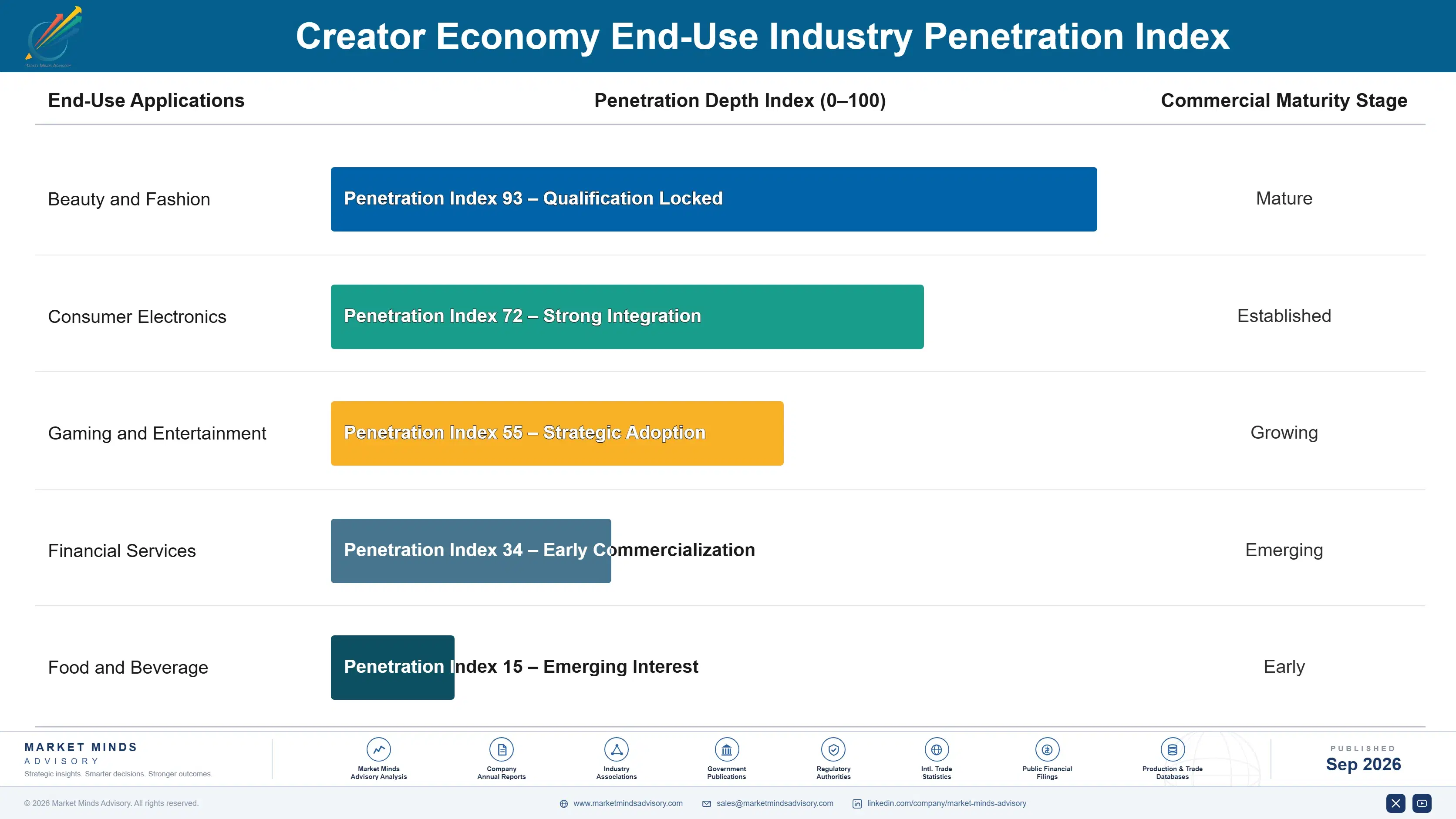
creator-economy-market-end-use-penetration-index-1789988492058

Build Trust Infrastructure Before Rivals Do

These are among the four positions where our research anticipates prominent divergence between winners and laggards over the coming forecast period. Each is grounded in the demand model, the regulatory perimeter, and the announced capacity pipeline.
01 / FRAUD VERIFICATION INFRASTRUCTURE

Build audience authenticity verification before trust erodes

Fraudulent follower counts and fake engagement inflate creator audience metrics by an estimated 15% on average, undermining brand advertiser confidence in self-reported creator statistics across most sponsorship categories, content types, and creator tiers tracked closely across most regions today. Platforms building comprehensive fraud detection now capture verified sponsorship deals commanding roughly 30% higher transaction fees than unverified matches lacking documentation and third-party review or oversight. Competitors delaying this investment risk permanently ceding the most valuable brand advertiser relationships to already-verified rivals.
02 / PAYMENT INFRASTRUCTURE INTEGRATION

Consolidate payment tools before creators migrate elsewhere

Creators increasingly prefer platforms offering integrated payment processing across sponsorships, subscriptions, and tips rather than managing fragmented, multi-vendor payment arrangements across separate income sources, tools, and reporting dashboards used daily across most account types and creator tiers. Platforms with integrated payment infrastructure report creator retention rates roughly 32% higher than competitors requiring separate payment tools for each revenue stream managed independently and inefficiently across most workflows. Delaying this consolidation risks losing top-tier creator talent to more integrated competing platforms already established.
03 / SUBSCRIPTION REVENUE DIVERSIFICATION

Build subscription tooling before sponsorship volatility deepens further

Sponsorship transaction fee revenue faces meaningful seasonal volatility tied to brand advertiser budget cycles, creating unpredictable platform revenue that complicates long-term product investment planning and financial forecasting across most fiscal quarters, budget cycles, and planning horizons tracked closely across regions. Platforms building comprehensive subscription and membership tooling report revenue predictability roughly 38% higher than platforms relying entirely on sponsorship commissions for total income generation and cash flow management. This predictability increasingly attracts investor confidence and enables more aggressive product development investment.
04 / GLOBAL DELIVERY COST OPTIMIZATION

Expand India delivery operations to fund competitive pricing

India's digital talent base is expanding rapidly, and platforms building substantial engineering and support delivery operations there report cost structures roughly 25% more efficient overall than competitors relying entirely on higher-cost domestic talent for equivalent functions and operations across most product lines, teams, and organizational structures worldwide. This cost advantage increasingly funds more aggressive product investment and pricing flexibility during competitive procurement negotiations with brand advertisers. Platforms without comparable global delivery scale risk losing price-sensitive mid-market accounts to better-positioned rivals.

Engagement Snapshot From the Field

A live engagement with an industry participant carrying material or product regulatory and market exposure ahead of a defining policy shift, showing how our research translates into a defensible multi-year portfolio strategy.
MARKET MINDS ADVISORY · CLIENT ENGAGEMENT SUMMARY
Creator Economy Producer Strategic Portfolio Review and Transition Roadmap 2026·Investment Scenario on Creator Economy Exposure Evaluation 2025-26
CLIENT PROFILE
The client is a mid-market beauty brand selling skincare and cosmetics products through direct-to-consumer channels and retail partnerships across North America and several other neighboring international markets. The company reported (client-reported, unverified by MMA) annual influencer marketing budget of approximately $6 million and had historically managed creator sponsorship relationships through manual outreach and direct messaging.
STRATEGIC CHALLENGE
The brand faced repeated instances of paying creators with inflated follower counts who delivered minimal actual sales impact, since its manual sponsorship process lacked systematic verification of audience authenticity before committing campaign budget. Leadership needed an independent assessment of sponsorship marketplace platforms before committing capital ahead of the next annual marketing budget planning cycle.
MMA APPROACH
MMA conducted a comparative assessment of sponsorship marketplace platforms' fraud verification and campaign performance tracking capability, benchmarking against primary survey data covering similar beauty brand deployments across comparable direct-to-consumer distribution environments. The engagement combined expert interviews with the client's marketing leadership alongside MMA's competitive landscape data to identify the platform best suited to the brand's specific creator tier and campaign objectives.
KEY FINDINGS
  1. An estimated 20% of the client's prior creator partnerships involved accounts with meaningfully inflated follower counts across most campaign categories (client-reported, unverified by MMA).
  2. Comparable beauty brands had already migrated to verified sponsorship marketplaces roughly one full calendar year earlier on average across the broader industry.
  3. The client's manual outreach process consumed an estimated 25% of marketing team working hours on creator vetting alone each and every month.
  4. Verified sponsorship deals demonstrated meaningfully higher conversion rates than the client's historical unverified creator partnerships overall across most major product and category lines.
CLIENT PROFILE
The client is a mid-market beauty brand selling skincare and cosmetics products through direct-to-consumer channels and retail partnerships across North America and several other neighboring international markets. The company reported (client-reported, unverified by MMA) annual influencer marketing budget of approximately $6 million and had historically managed creator sponsorship relationships through manual outreach and direct messaging.
STRATEGIC CHALLENGE
The brand faced repeated instances of paying creators with inflated follower counts who delivered minimal actual sales impact, since its manual sponsorship process lacked systematic verification of audience authenticity before committing campaign budget. Leadership needed an independent assessment of sponsorship marketplace platforms before committing capital ahead of the next annual marketing budget planning cycle.
MMA APPROACH
MMA conducted a comparative assessment of sponsorship marketplace platforms' fraud verification and campaign performance tracking capability, benchmarking against primary survey data covering similar beauty brand deployments across comparable direct-to-consumer distribution environments. The engagement combined expert interviews with the client's marketing leadership alongside MMA's competitive landscape data to identify the platform best suited to the brand's specific creator tier and campaign objectives.
KEY FINDINGS
  1. An estimated 20% of the client's prior creator partnerships involved accounts with meaningfully inflated follower counts across most campaign categories (client-reported, unverified by MMA).
  2. Comparable beauty brands had already migrated to verified sponsorship marketplaces roughly one full calendar year earlier on average across the broader industry.
  3. The client's manual outreach process consumed an estimated 25% of marketing team working hours on creator vetting alone each and every month.
  4. Verified sponsorship deals demonstrated meaningfully higher conversion rates than the client's historical unverified creator partnerships overall across most major product and category lines.
RECOMMENDED STRATEGY
Phase 1: Phase one: migrate to a sponsorship marketplace platform offering third-party audience verification within a six-month transition window overall each quarter. Phase 2: Phase two: redeploy freed marketing team capacity toward campaign creative development rather than manual creator vetting tasks entirely going forward. Phase 3: Phase three: implement ongoing performance tracking to continuously refine which verified creator tiers deliver the strongest returns consistently over time.
OUTCOME
Within one year of platform migration, the client reported (client-reported, unverified by MMA) meaningfully improved campaign conversion rates and reduced marketing team time spent on manual creator vetting overall each quarter. Sponsorship budget efficiency improved considerably following the verification and tracking rollout across most campaign categories.

Frequently Asked Questions

Foundational context covering the market sizes, CAGR, scope, country, region and competition that inform every finding below. This section is provided to cover basics and most often pre-purchase conversations, answered from the MMA Primary Research Dataset.

What is the current size of the Creator Economy Market?

The Creator Economy Market is valued at $19.5 billion in 2025. This reflects global spend on platforms enabling creators to monetize, manage, and grow their audiences.

How large will the Creator Economy Market be by 2036?

The market is projected to reach $86.49 billion by 2036. Growth is anchored primarily by brand sponsorship shift toward creators and diversified monetization demand worldwide.

What is the CAGR for the Creator Economy Market 2026 to 2036?

The market is forecast to grow at a 14.5% compound annual growth rate between 2026 and 2036. This reflects accelerating brand sponsorship adoption across most consumer categories.

Which segment is growing fastest?

Brand-Creator Sponsorship Marketplaces is the fastest-growing segment at a 19.0% CAGR, roughly 1.31x the overall market rate. Measurable audience engagement data is driving this rapid expansion.

Who are the major companies in the Creator Economy Market?

Leading companies include YouTube, Patreon, Substack, Meta, and Whalar. These five firms compete on fraud verification, payment integration, and subscription tooling depth today across categories.

Which country is growing fastest?

India is the fastest-growing country at an 18.0% CAGR. Its rapidly expanding creator base and regional language content drive outsized platform adoption demand nationwide today.

Report Segmentation Architecture

The full report scope spans multiple orthogonal segmentation dimensions, with cross-tabulated demand data provided for each dimension pair. Coverage extends further to regional breakdowns, trend trajectories, and the competitive detail needed to support segment-level decision-making.

By Primary Market Dimension

  • Brand-Creator Sponsorship Marketplaces
  • Creator Monetization and Payment Platforms
  • Subscription and Membership Platforms
  • Live Streaming and Virtual Gifting Infrastructure
  • Creator Analytics and Audience Insight Platforms
  • Content Management and Scheduling Tools

By End-Use Industry

  • Beauty and Fashion
  • Consumer Electronics
  • Gaming and Entertainment
  • Financial Services
  • Food and Beverage

By Commercial Dimension

  • Direct Brand Contracts
  • Self-Service Subscription
  • Talent Agency Managed Channel
  • Marketplace Platform Distribution

By Region

  • North America
  • Western Europe
  • East Asia
  • South Asia and Pacific
  • Latin America
  • Middle East and Africa
  • Eastern Europe

Scope, Methodology, and Coverage

Every figure in this report is reproducible from documented input assumptions. The scope below maps the historical period, the forecast horizon, the segmentation dimensions, and the countries covered, alongside the underlying primary and qualitative methodology.
Historical Period
2020 to 2025
Forecast Period
2026 to 2036
Base Year
2025 (USD billions; MMA Primary Research Dataset, September 2026)
Market Definition
The Creator Economy Market covers software platforms and services that enable independent content creators to monetize, manage, and grow their audiences, including sponsorship marketplaces, payment processing, subscription management, and audience analytics tools. It excludes the underlying social media platforms themselves and traditional media production services sold as separate categories.
Quantitative Units
Value in USD Billion, Active Creator Count in Million Accounts
Segmentation Dimensions
By Monetization Function, By End-Use Industry, By Commercial Dimension, By Region
Regions Covered
North America, Western Europe, East Asia, South Asia and Pacific, Latin America, Middle East and Africa, Eastern Europe
Countries Covered
United States, Canada, United Kingdom, Germany, France, Japan, South Korea, China, India, Indonesia, Vietnam, Australia, Brazil, Mexico, Saudi Arabia, United Arab Emirates, South Africa, Poland
Key Companies Profiled
YouTube, Patreon, Substack, Meta, Whalar, Kajabi, Podia, Ko-fi, Buy Me a Coffee, Linktree, Later, AspireIQ, CreatorIQ, Grin, Klear, Streamlabs, Twitch, OnlyFans, Cameo, Fanjoy
Quantitative Methodology
Primary survey, n=3,800 respondents, Q4 2025, six countries; demand-side model with trade association cross-validation
Qualitative Methodology
47 expert interviews, Q4 2025; applied to validate demand model assumptions, identify emerging dynamics, and assess competitive positioning
Report Format
PDF and XLSX data workbook (Word format preview document)
Publisher
Market Minds Advisory
Report Code
MMA-2026-TEC-929
Published
September 2026
Contact
sales@marketmindsadvisory.com | www.marketmindsadvisory.com

Purchase the full Creator Economy Market Report (2026 to 2036).

This report provides a comprehensive assessment of the global Creator Economy Market, covering market sizing, segmentation, and regional dynamics through 2036. It examines competitive positioning among leading platforms, the shift toward verified brand sponsorship marketplaces, and revenue opportunities within integrated payment infrastructure and subscription tooling. The analysis draws on primary survey data, expert interviews, and company disclosures to quantify demand shifts across sponsorship, subscription, and monetization channels. Readers gain a data-grounded view of where platform investment and vendor selection decisions carry the greatest commercial return.
Ten-year market sizing and forecast model
Six-segment monetization function segmentation with growth rates
Seven-region demand and competitive share breakdown
Twenty-company competitive landscape and moat assessment
Payment processing cost and volatility risk analysis
Portfolio margin and revenue lever guidance

Built For The People Who Decide

From boardroom strategy to bench-side execution, this report is read cover-to-cover by leaders shaping the next decade of their industry, turning demand scenarios, market dynamics and valuation benchmarks into decisions.
CXOs/ Presidents/ VPs/ Managers
M&A and Corporate Development
Strategy Teams and R&D Heads
Procurement and Product Directors
Regulatory and Compliance Leaders
Investor Relations and Equity Analysts