Market Minds Advisory
Crashworthy Aircraft Seats Market

Crashworthy Aircraft Seats Market: Crashworthy Aircraft Seats: Dynamic Testing, Occupant Variability And The Sixteen G Requirement Nobody Can Simulate Away

Every crashworthy seat has to survive a sled test with an instrumented dummy aboard, and no amount of simulation has yet persuaded any authority anywhere to skip the actual impact.

Lead Analyst

Published

September 2026

Make Smarter Decisions with Customized Research Insights

Request a free sample report and evaluate market opportunities, growth trends, and competitive dynamics relevant to your business needs.

2025 MARKET VALUE$0.6BMarket Size 2025
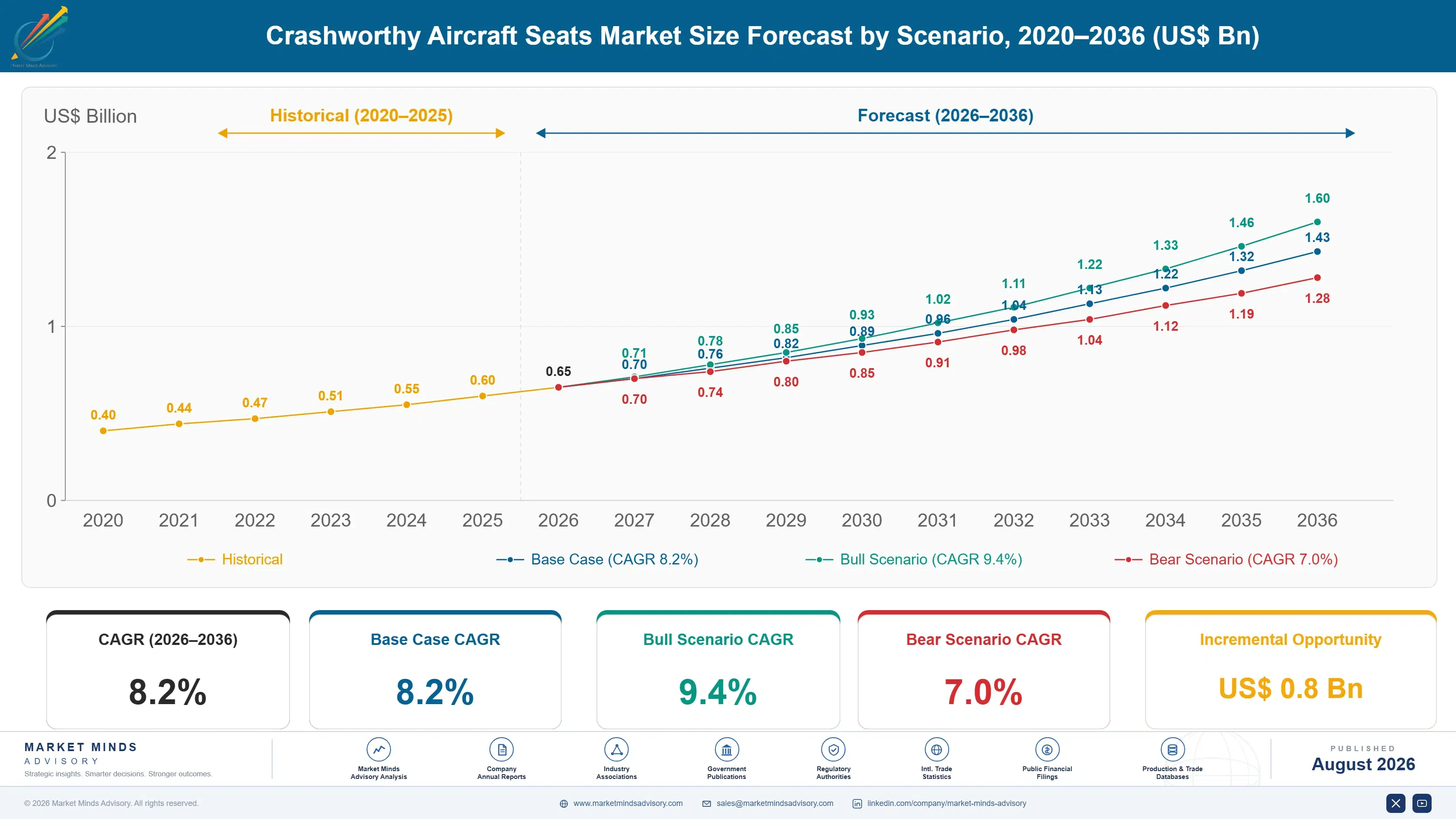
2036 FORECAST VALUE$1.4BBase Case , 2026 to 2036
CAGR 2026 TO 20368.2 %Bull 9.4% / Bear 7.0%
INCREMENTAL OPPORTUNITY$0.8BNet 10- year value creation
EXPANSION MULTIPLE2.20x2036 value over 2026 base
Strategic Levers
M&A Pipeline
Regional Outlook
Country Rankings
Competitive Intelligence
Segmental Deep-dive
Call-Us : 91 93563 13602

Executive Snapshot and Market Trajectory.

A seat is qualified by being destroyed. Dynamic sled testing with an instrumented dummy is the only accepted evidence, simulation supports it and does not replace it, and every configuration change means going back to the track again. Nobody anywhere certifies a seat on a model.
Rotorcraft energy absorbing seats grow fastest at 12.3%, because crash resistance requirements written for military helicopters have moved into civil rotorcraft production and the stroking mechanisms involved are a different engineering problem from a fixed wing seat. Occupant weight ranges have also widened considerably since the test standards were written, which several authorities have begun addressing directly. Standards written decades ago no longer describe the people who are actually sitting in these seats.
Concentration is high at 63% and the barrier is test evidence rather than manufacturing. A qualified seat carries dynamic test data specific to its structure, its attachment and its occupant restraint, and repeating that for a new entrant costs years. Nobody has entered this market seriously in a very long time. Evidence generated for one design transfers to no other design however similar the two may happen to look.
Market Definition
Revenue from aircraft seats designed and certified to dynamic crashworthiness standards, covering commercial passenger crashworthy seats, flight crew and cabin crew seats, rotorcraft energy absorbing seats, military transport and troop seating, seat structure, restraint and energy absorbing components, and dynamic testing, qualification and certification services. Excludes non-crashworthy legacy seating, cabin interior monuments and galleys, in-flight entertainment fitted to seats, and automotive or rail seating regardless of test standard.
Base Year Value
$0.6B in 2025 (MMA Primary Research Dataset, August 2026)
Forecast Period
2026 to 2036, eleven discrete annual values
CAGR
8.2% base case. Bull 9.4%. Bear 7.0%.
Fastest Growth Segment
Rotorcraft Energy Absorbing Seats: 12.3% CAGR
Fastest Growth Country
India: 10.2% CAGR
Fastest Growth Region
South Asia and Pacific: 10.2% CAGR
Largest Region
North America: 29% of 2025 global value
Market Leaders
Safran Seats, Collins Aerospace, Martin-Baker, Ipeco Holdings and Geven lead on crashworthy aircraft seat revenue. Source: company annual reports and MMA Primary Research Dataset, July 2026.
Primary Survey
n=3,800 procurement and R&D decision-makers, Q4 2025, six countries
Methodology
Demand-side build-up, cross-validated against public data, 47 expert interviews

Crashworthy Aircraft Seats Market Forecast Scenarios

crashworthy-aircraft-seats-market-size-forecast-scenario-1788164611240
The 2020 to 2025 period was shaped by regulation and by delivery rates in roughly equal measure. Commercial seat deliveries collapsed with production and recovered slowly, while rotorcraft crash resistance requirements applying to newly manufactured aircraft created demand that had nothing to do with build rates. Occupant weight range questions moved from academic discussion into rulemaking. Revenue compounded near 6.9%, carried substantially by rotorcraft and crew seating.
Three mechanisms carry the base case. Rotorcraft crash resistance obligations continue applying across new civil production regardless of type certificate age. Occupant variability work is obliging requalification of seat and restraint combinations tested against narrower assumptions. And cabin densification keeps producing configuration changes, each of which requires fresh dynamic testing rather than an engineering assessment. None of the three depends on aircraft delivery rates recovering any further than they already have.
The bull catalyst is authorities accepting validated simulation in place of some sled testing, which would cut qualification cost and time sharply and open configuration flexibility nobody currently has. The bear risk is the opposite: a widened occupant weight requirement applied retrospectively would invalidate test evidence across a large installed base with no straightforward route to requalify it.

Qualified By Being Destroyed

There is no theoretical route to a certified seat. A structure has to be accelerated on a sled at 16 g with an instrumented dummy strapped into it, and the injury criteria have to be met in the test rather than in a model. Simulation has become genuinely good and supports the process without replacing it, because no authority accepts a seat certified on analysis alone.
MARKET CONCENTRATION CR563%Share of crashworthy seat revenue held by leading suppliers
DYNAMIC TEST ACCELERATION16 gForward impact pulse a certified passenger seat must survive
QUALIFICATION TEST COSTUSD 340,000Typical spend on a single seat configuration test programme
CONFIGURATION TEST CYCLE14 monthsTypical period from design freeze to completed dynamic qualification
CRASHWORTHY PREMIUM3.1 timesCost against a comparable seat without energy absorbing structure
AFTERMARKET REVENUE SHARE35%Portion of revenue from refurbishment and spares rather than delivery
That single fact governs the commercial structure. A qualification programme costs around USD 340,000 per configuration and runs roughly 14 months from design freeze, and a configuration change means going back to the track. Cabin densification produces configuration changes constantly, which is why airlines pressing for a slightly different pitch are asking for something considerably more expensive than they generally understand it to be.
The parts of this market that grow fastest are the ones regulation is actively reshaping. Rotorcraft crash resistance requirements moved from military practice into civil production, and energy absorbing seats that stroke under load cost roughly 3.1 times a conventional equivalent. Occupant weight distributions have meanwhile shifted well beyond the assumptions the original test standards were written against, and authorities have started saying so.
"The industry has spent twenty years building simulation good enough to predict a sled test almost exactly, and it still runs the sled test. That is not conservatism for its own sake, it is what happens when the failure mode is somebody's spine."
Director, Aircraft Interiors and Safety Practice · MMA Aerospace Interiors and Safety Systems Practice · August 2026

Market Trends

Occupant Weight Assumptions Have Fallen Behind The Population

Dynamic test standards were written against occupant weight distributions that no longer describe the travelling public, and several authorities have moved that observation from discussion into active rulemaking. Widening the required range obliges requalification of seat and restraint combinations tested against narrower assumptions, which is dynamic testing rather than paperwork. Suppliers who anticipated the change and tested across a broader range hold evidence competitors will have to generate at roughly USD 340,000 per configuration. Population data moved faster than the standards written against it, which is nobody's fault and everybody's problem.
Market Impact: Costs 3.1 times conventional seats
Simulation Improved Without Replacing Any Physical Testing

Finite element modelling now predicts sled test outcomes closely enough that suppliers use it to avoid failed tests rather than to avoid testing, and no authority has accepted analysis alone as certification evidence. The commercial effect is that simulation reduces the number of tests needed rather than the requirement to run them. Suppliers with mature modelling capability pass on fewer attempts, which matters considerably when each attempt costs six figures and fourteen months of programme time. Better modelling has made the testing cheaper without making any of it optional at all.
Market Impact: Runs 14 months per change

Market Opportunities and Growth Drivers

Rotorcraft Crash Resistance Moved Into Civil Production

Requirements that newly manufactured rotorcraft incorporate crash resistant occupant protection apply regardless of when the type certificate was issued, which brought energy absorbing seating into civil helicopter production across the board. Stroking seats that collapse under vertical load at a controlled rate cost roughly 3.1 times conventional equivalents. Manufacturers building decades-old designs suddenly required seats those certificates never contemplated, and the engineering is genuinely different from fixed wing crashworthy design. Operators pay the premium without much argument, because the accident record that produced the rule is the one they fly against.
Market Impact: Requires an actual 16 g test

Cabin Densification Generates Constant Requalification Work

Airlines changing pitch, adding rows or altering monument positions produce configuration changes that require fresh dynamic testing rather than an engineering assessment, because the test evidence is specific to the installed geometry. Each programme runs around 14 months and costs six figures. Airlines pressing for small layout changes rarely appreciate what they are actually asking for, and suppliers who explain the cost early avoid arguments later that damage the relationship considerably. A quotation and a fourteen month test programme are very different answers to what sounds like the same request.
Market Impact: Holds concentration at 63%

Market Restraints and Challenges

Physical Testing Cannot Be Compressed Or Substituted

A certified seat requires an actual sled test at a 16 g pulse with an instrumented dummy, and no authority has accepted simulation in place of it despite modelling that predicts outcomes closely. The root cause is that injury criteria involve human tolerance rather than structural behaviour alone. Commercially it fixes qualification cost and schedule regardless of engineering maturity. Mitigation runs through modelling to reduce failed attempts, family qualification covering configuration ranges, and shared test programmes across related seat variants. No amount of engineering maturity shortens a programme that has to end on a track.
Market Impact: Costs USD 340,000 per configuration

Test Evidence Barriers Have Excluded New Entrants Entirely

A qualified seat carries dynamic test data specific to its structure, attachment and restraint, and a new entrant must generate all of it at roughly USD 340,000 per configuration before any revenue arrives. The root cause is that evidence is not transferable between designs however similar they appear. Commercially it produces concentration at 63% with almost no movement in decades. Mitigation runs through component and structure supply to incumbents, refurbishment work, and regional programmes with lower configuration counts. Nobody has entered this market seriously in a very long time, and the reason is arithmetic.
Market Impact: Reduces attempts per 14 month cycle
4 additional market trends, 3 additional growth drivers, and 2 additional restraints and challenges are covered in the full report. Contact sales@marketmindsadvisory.com to access the complete intelligence.

Segment CAGR and Growth Architecture

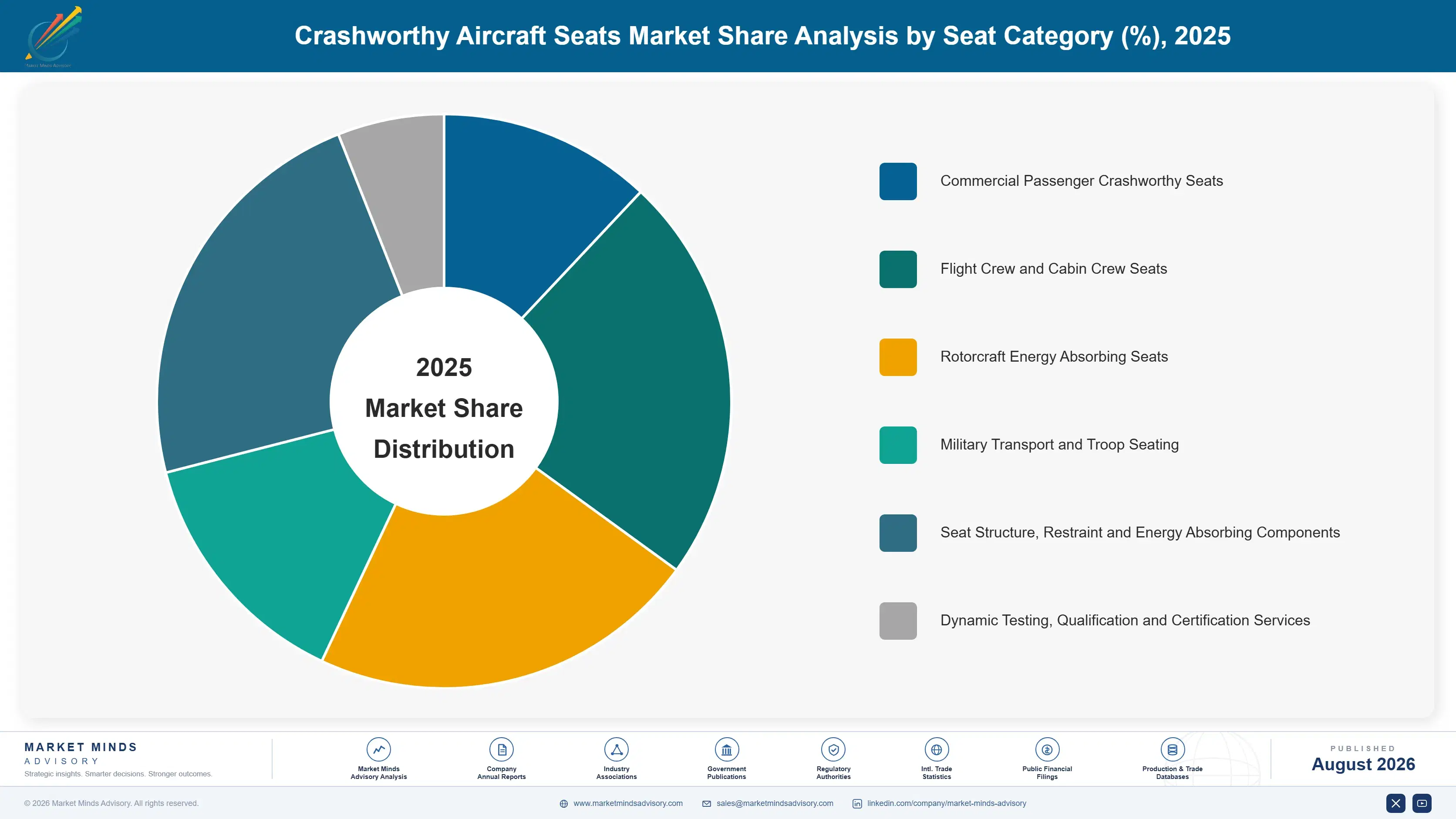
Segmentation follows seat category, since each carries a different test standard, occupant assumption and certification path even though the manufacturing looks broadly similar. Six categories describe the market completely, from commercial passenger seating where densification drives requalification through to rotorcraft energy absorbing seats where the regulation and the growth are effectively the same thing.
crashworthy-aircraft-seats-market-market-share-analysis-1788164611799

Rotorcraft Energy Absorbing Seats

The fastest category grows at 12.3%, half again the market rate of 8.2%, and regulation rather than any engineering advance explains all of it. Requirements that newly manufactured rotorcraft carry crash resistant occupant protection apply regardless of type certificate age, which put energy absorbing seating into civil helicopter production overnight. A stroking seat that collapses under vertical load at a controlled rate costs roughly 3.1 times a conventional equivalent, and the engineering involved is genuinely different from fixed wing crashworthy design rather than a variation on it. Manufacturers building decades-old airframes suddenly needed seats the original certificates had never contemplated at any point. The premium is accepted without much argument anywhere.
CAGR 12.3%

Flight Crew and Cabin Crew Seats

Crew seating grows at 10.1% on requirements that are more demanding than passenger seating and considerably less discussed. A flight crew seat must position an occupant precisely against controls and displays while surviving the same dynamic pulse, and it must do so across an occupant range that is wider than the passenger assumption rather than narrower. Cabin crew seats fold, stow and mount to structure that varies by aircraft. Configuration counts are lower than in passenger seating, which makes qualification cost per unit delivered considerably higher and keeps the supplier base narrower than anywhere else in this market. Comparable test cost against far fewer units is the whole commercial story here.
CAGR 10.1%
Full segment breakdown across 6 segments available in the complete report.

Regional Architecture and Country Demand Map

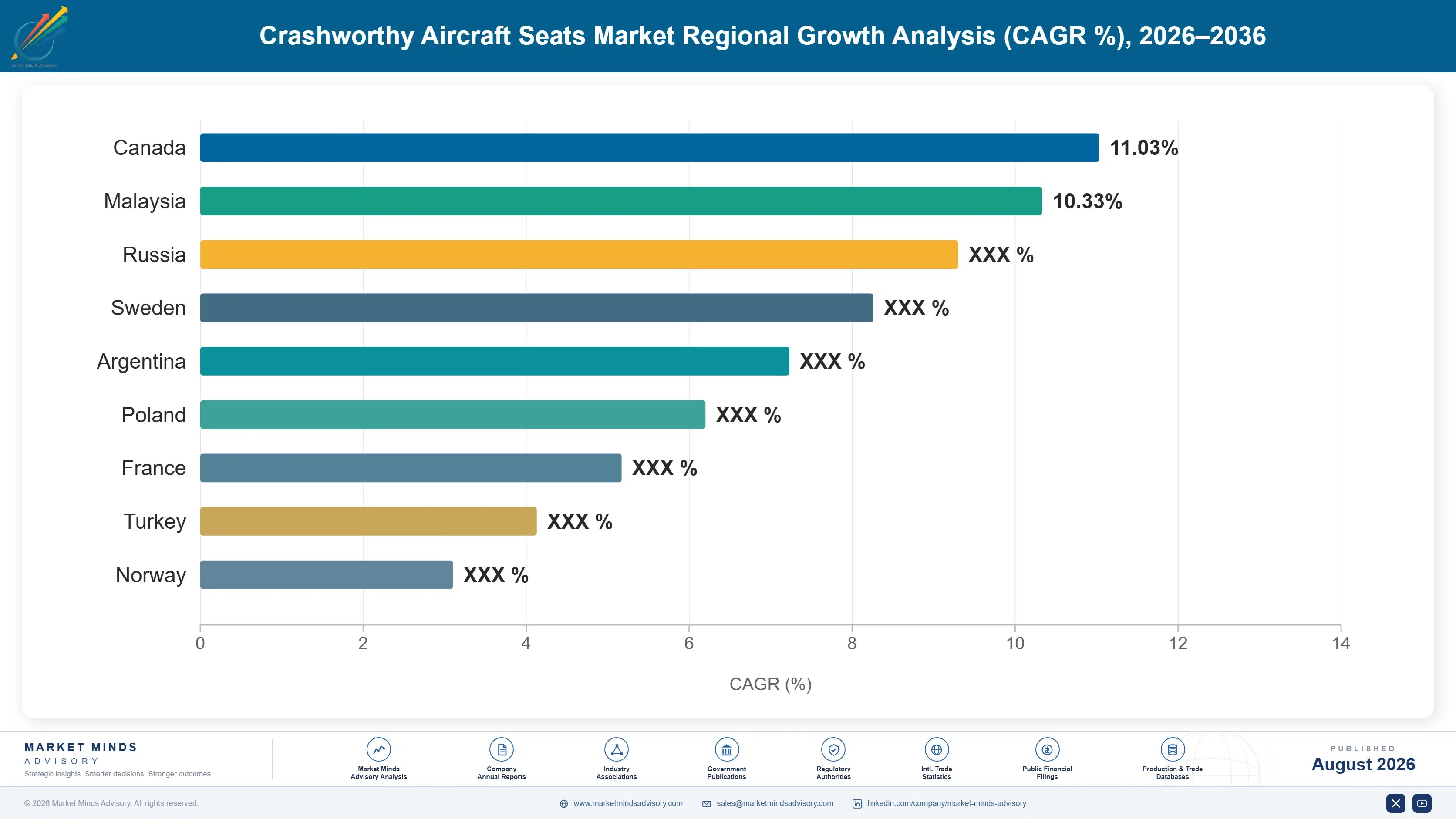
Crashworthy seat capability follows certification authority relationships and programme participation rather than aircraft operation. Western Europe and North America hold most qualification evidence, with East Asia expanding on manufacture and South Asia growing fastest from a developing base. Test facility access matters more than it appears.

North America

The largest share at 29% rests on rotorcraft crash resistance requirements that originated here and on the deepest crew seating capability anywhere. Military crashworthiness standards developed decades ago after post-crash injury analysis remain the technical foundation for civil requirements everywhere else. Dynamic test facilities are concentrated here, which matters because test slot availability constrains qualification programmes more often than engineering does. Occupant weight rulemaking has advanced further here than in any other jurisdiction. Test slot availability is a genuinely underrated constraint, because a programme waiting for a sled burns schedule that nobody quoted for and that no amount of engineering readiness recovers once it has been lost to the queue.
Share: 29% | CAGR: 8.6% (2026 to 2036)

Western Europe

Commercial passenger seat design authority concentrates heavily here, with Safran holding positions across a very large share of narrowbody and widebody cabins alongside specialist crew seat suppliers. European authorities have engaged occupant variability questions in parallel with their American counterparts rather than following them. Test facility capacity is adequate but not generous, and suppliers frequently book slots long before a design is frozen. Densification-driven requalification work is heaviest here because the airlines press hardest on layout. Densification pressure produces more requalification work here than anywhere, and airlines pressing for a slightly different pitch are asking for a programme rather than a drawing change, which they discover at the quotation stage.
Share: 26% | CAGR: 6.6% (2026 to 2036)
Regional intelligence for 5 additional markets available in the complete report: East Asia, South Asia and Pacific, Latin America, Middle East and Africa, Eastern Europe. Contact sales@marketmindsadvisory.com.
crashworthy-aircraft-seats-market-country-cagr-analysis-1788164612314

Where Crashworthy Seat Margin Sits

Four levers work on test evidence position, qualification efficiency and configuration discipline rather than on seat design, which rarely separates suppliers meaningfully. Family qualification, occupant range anticipation, refurbishment capture and simulation maturity each address something a supplier can act on immediately. None of the four requires a better seat than anybody else already builds today.

Qualify Seat Families Rather Than Individual Configurations

A test programme costs around USD 340,000 per configuration and runs 14 months, and suppliers qualifying each layout independently pay repeatedly for evidence that a properly structured family approach would have covered once. Authorities accept family qualification where the configuration range is defined and substantiated rigorously at the outset. The engineering discipline required is real and the saving across a cabin programme is considerable. Most suppliers still test configuration by configuration because that is how they have always done it. Habit is an expensive way to organise a certification programme.
Market Impact: Avoids USD 340,000 on each separate seat configuration

Test Across Wider Occupant Ranges Before Required

Occupant weight distributions have moved well beyond the assumptions original standards were written against, and authorities have taken that from discussion into rulemaking across several jurisdictions. Suppliers testing across a broader range now hold evidence competitors will have to generate later at 340,000 dollars per configuration and fourteen months apiece. The additional cost at the time of an existing programme is modest. The cost of doing it afterwards, against a rule with a compliance date attached, is not modest at all. A rule with a compliance date attached removes every option.
Market Impact: Anticipates a full 14 month requalification programme later

Capture Refurbishment On Your Own Installed Seats

Refurbishment and spares carry 35% of market revenue, and an operator recovering a cabin places that work wherever an approved shop offers capacity and price. Suppliers ceding it to independent refurbishers surrender margin on seats they designed and certified themselves. Authorised networks with parts control typically recover 13 to 19 percent of the value leaking outward. The relationship already exists through the original delivery, which makes this considerably easier than winning new cabin work against an incumbent. Nobody has to win a new competition to start doing this work at all.
Market Impact: Recovers roughly 16% of the leaking refurbishment value

Build Simulation Maturity To Reduce Failed Attempts

Modelling does not replace the sled test and it does reduce how many attempts a programme needs, which matters when each attempt costs six figures and consumes months of schedule. Suppliers with mature correlation between model and test pass on fewer runs and quote shorter programmes as a result. The capability takes 3 years to build properly against accumulated test data nobody else holds. It compounds, since every test performed improves the model that reduces the next programme's attempts. A supplier three years into this holds an advantage nobody buys quickly.
Market Impact: Cuts failed test attempts over roughly 3 years

Who Controls the Margin Pool

Concentration is high at around 63% across the five largest participants measured on crashworthy seat revenue, and the barrier producing it is test evidence rather than manufacturing capability. A qualified seat carries dynamic data specific to its structure, attachment and restraint, none of which transfers between designs. Several capable seat manufacturers hold no crashworthy position at all for exactly that reason. Manufacturing was never the barrier.
Competition runs on qualification breadth, test evidence depth and configuration flexibility. Qualification breadth decides how many programmes a supplier can address without new testing. Evidence depth decides how quickly it can respond to a rule change or a layout request. Configuration flexibility decides whether an airline pressing for a small change gets a quotation or a fourteen month programme. The order rarely changes.

Pressure is arriving from regulation rather than from competitors. Occupant range rulemaking will oblige requalification across evidence generated under narrower assumptions, which resets part of the barrier that protects incumbents and briefly opens a window. Rankings will shift toward suppliers who tested wider ranges early and hold mature simulation, since one avoids the requalification and the other reduces what it costs.
crashworthy-aircraft-seats-market-company-positioning-matrix-1788164612834

Competitive Moat and Risk Dimensions

SAFRAN SEATS

Moat: Cabin scale with qualification breadth

Safran Seats holds passenger seating positions across a very large share of narrowbody and widebody cabins, and accumulated qualification evidence lets it answer layout requests that would send a narrower competitor back to the track. Scale across programmes spreads test cost that smaller suppliers carry against far fewer deliveries. Airline relationships reach beyond any single aircraft type.
SAFRAN SEATS

Risk: Exposure to occupant range rulemaking

A broad installed configuration base tested against narrower occupant assumptions is precisely what widened requirements would oblige requalifying, and the scale that helps commercially widens that exposure considerably. Each affected configuration carries its own test cost and schedule. Suppliers with fewer configurations face a smaller requalification bill in absolute terms.
MARTIN-BAKER

Moat: Energy absorbing and crew depth

Martin-Baker holds crew and energy absorbing seat capability built on decades of occupant protection engineering that transfers directly into rotorcraft crash resistance work now growing at 12.3%. Test evidence in stroking and vertical load attenuation is difficult to replicate and took decades to accumulate. Crew configuration counts are low, which suits a supplier organised around evidence rather than volume.
MARTIN-BAKER

Risk: Limited commercial passenger presence

Commercial passenger seating is the largest revenue block in this market and is dominated by suppliers with cabin scale and airline relationships built over decades of programme work. Entering it means competing on configuration breadth rather than on occupant protection depth. Rotorcraft and crew volumes are smaller and considerably more dependent on individual programme timing.

Players Tracked

Prominent Players

Safran Seats
Collins Aerospace
Martin-Baker
Ipeco Holdings
Geven

Other Key Players

Recaro Aircraft Seating
Adient Aerospace
Expliseat
HAECO Cabin Solutions
Jamco Corporation
STELIA Aerospace Interiors
Acro Aircraft Seating
Thompson Aero Seating
Pitch Aircraft Seating Systems
Sicma Aero Seat
BAE Systems Platform Solutions
Cobham Mission Systems
AMSAFE
TransDigm
Zodiac Seats

Recent Developments

OCTOBER 2020

Crash resistant occupant protection became mandatory on new rotorcraft

A statutory requirement took effect obliging newly manufactured rotorcraft to incorporate crash resistant occupant protection regardless of when the type certificate was issued, bringing energy absorbing seating into civil helicopter production across the board. This was legislative and regulatory action rather than any commercial arrangement between seat suppliers.
Signal: A military occupant protection standard became a civil production requirement without reopening a single type certificate.
JUNE 2024

Authority opened rulemaking on occupant weight range assumptions

A certification authority opened rulemaking to widen the occupant weight range against which dynamic seat testing is conducted, responding to population data showing the original assumptions no longer describe the travelling public accurately. This was a regulatory proceeding rather than any commercial transaction between the suppliers involved.
Signal: Widening occupant range invalidates test evidence rather than merely adjusting it, which means fresh sled testing.
FEBRUARY 2025

Seat supplier completed family qualification across a configuration range

A seat supplier completed a family qualification programme covering a defined range of pitch and layout configurations under a single substantiated test campaign, avoiding separate programmes for each individual arrangement within that declared range. This was a certification programme rather than any corporate transaction between participants.
Signal: Family qualification is available, considerably cheaper and still used by remarkably few suppliers in this market.

What A Certified Seat Costs

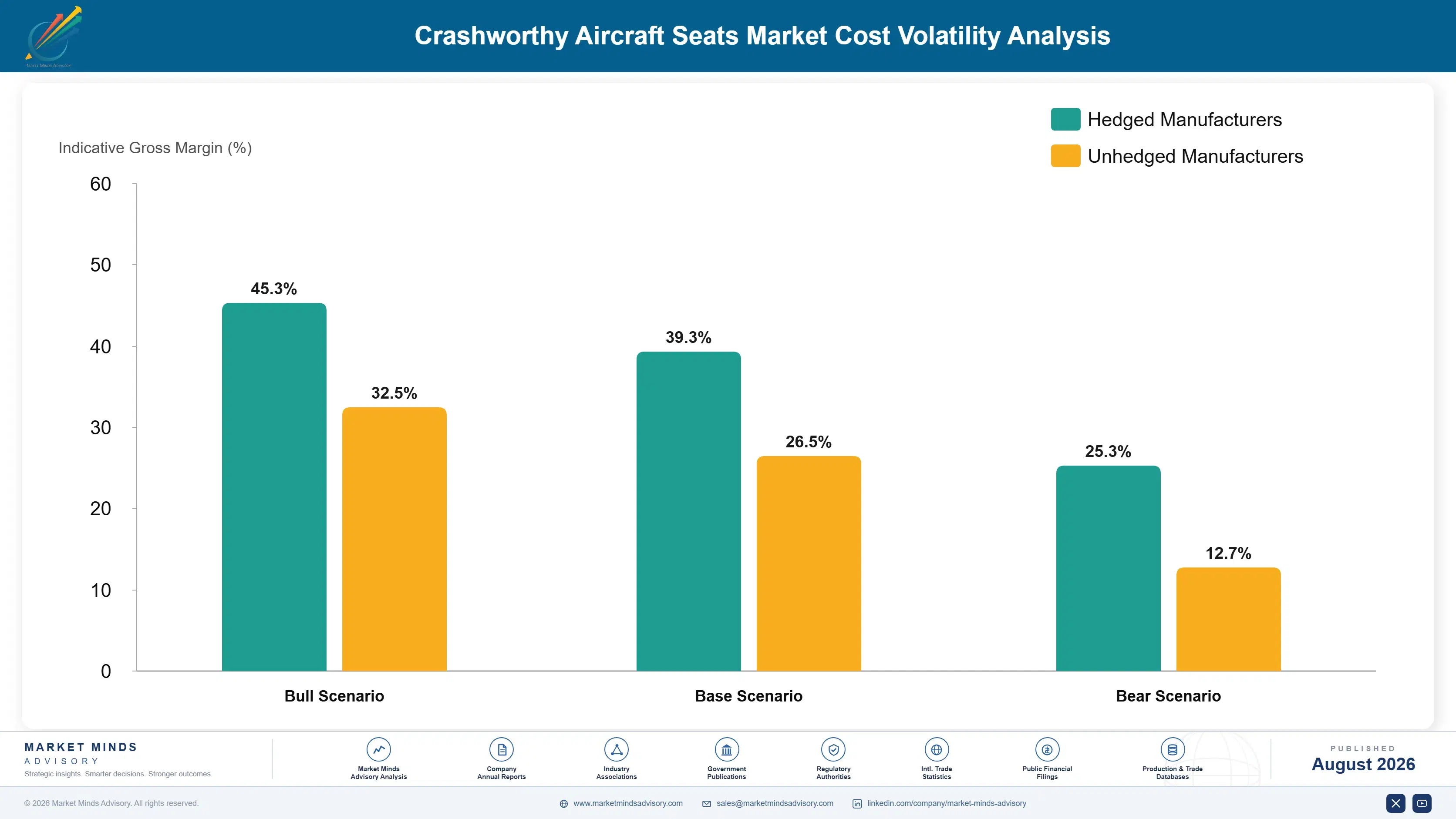
Cost divides four ways and testing dominates far more than the hardware suggests. Qualification, dynamic testing and certification amortisation absorb roughly 31% of programme cost across a seat's life, structure, machining and mechanism content near 28%, trim, foam and dress cover near 22%, and assembly with inspection the remaining 19%. Suppliers pricing on visible seat content misjudge what the evidence behind it costs.
Aerospace grade aluminium, composite and fire-blocking textile pricing moved sharply across recent years and raised seat cost accordingly, since certified materials come from qualified sources with no substitution available. Safran and Recaro have both discussed input cost and supply conditions across recent reporting periods. Test facility slot availability has been the more damaging constraint, because a programme waiting for a sled slot burns unpriced schedule.

Exposure varies by configuration count rather than by geography. Suppliers holding family qualifications spread test cost across many layouts, while those testing configuration by configuration carry it against each one individually. High-volume passenger suppliers amortise across large deliveries. Crew and rotorcraft suppliers carry comparable test cost against far fewer units, which is why those seats cost what they do and why the supplier base there is narrower.
crashworthy-aircraft-seats-market-cost-volatility-analysis-1788164613029

Family qualification spreading test cost across configurations

A test programme costs around USD 340,000 per configuration, and suppliers qualifying each layout separately pay repeatedly for evidence a family approach covers once. Authorities accept family qualification where the range is defined and substantiated rigorously from the outset. The engineering discipline is genuine, and most suppliers still test configuration by configuration purely out of habit.

Test facility slots booked ahead of design freeze

Sled facility capacity is limited and programmes routinely wait for slots, burning schedule that nobody priced into the original quotation. Booking capacity before a design is frozen costs a deposit and protects a delivery date worth considerably more than that. Suppliers who book after freezing designs are competing for slots against everybody else who did the same.

Simulation correlation reducing failed test attempts

Modelling does not replace the sled test and it does reduce how many attempts a programme needs before passing, which matters when each attempt costs six figures. Correlation between model and test improves with every test performed, so the capability compounds for suppliers who have been building it. Newer participants pay for failed attempts that mature competitors avoid entirely.

Portfolio Architecture for Margin Defence

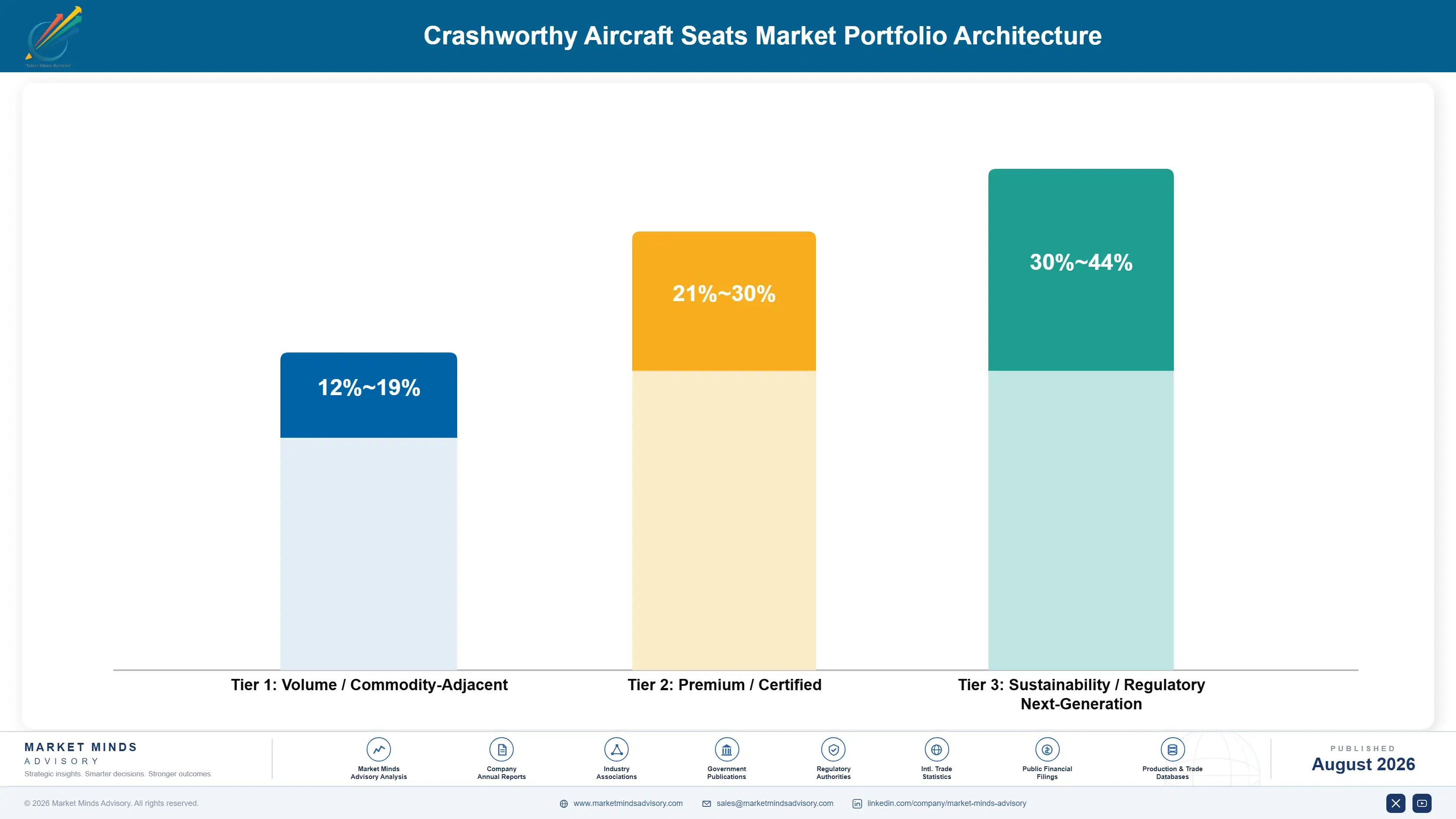
The portfolio separates by configuration count. Commercial passenger seating is the volume core: enormous delivery quantities, test cost amortised across many units, and margins reflecting competition on weight, cost and cabin appearance rather than on occupant protection engineering. It is the largest revenue block and the most contested part of this market by a considerable distance. Everybody competes here and nobody wins much.
Margin concentrates where configuration counts are low and evidence is hard. Crew seats, rotorcraft energy absorbing seats and military transport seating all carry comparable test cost against far fewer units, which raises unit price and narrows the supplier base sharply. Rotorcraft grows at 12.3% on regulation alone. Very few participants hold genuine energy absorption and stroking capability at all. Evidence is what actually separates them.

The overlooked pool is refurbishment. It carries 35% of revenue, follows seats the original supplier designed and certified, and is routinely placed with independent shops by operators who were never offered an alternative. Authorised networks recover a meaningful share of it. The relationship already exists through the original delivery and almost nobody uses it. That is revenue given away for nothing.

Volume / Commodity-Adjacent

Economy passenger seating, structure supply and trim work delivered in large quantities against airline specifications. Range spans seven points because weight, cost and delivery decide outcomes far more than any protection capability does.
Gross Margin: 12-19%

Premium / Certified

Premium cabin seating, business class suites and configuration-specific programmes with dedicated qualification. Range spans nine points because family qualification breadth varies enormously between suppliers competing for the same cabins. Breadth decides the outcome.
Gross Margin: 21-30%

Sustainability / Regulatory / Next-Generation

Rotorcraft energy absorbing seats, crew seating, military transport seating and authorised refurbishment. Range spans fourteen points because low configuration counts and service economics differ sharply within this tier. Configuration count decides everything.
Gross Margin: 30-44%
crashworthy-aircraft-seats-market-portfolio-architecture-1788164613526

High-value Sub-segments and Strategic Watch-out

Rotorcraft Energy Absorbing Seats

High value and high growth at 12.3%, mandated across newly manufactured rotorcraft regardless of type certificate age entirely. The twelve point range separates suppliers holding genuine stroking and vertical attenuation evidence from those adapting fixed wing crashworthy designs instead. Regulation created this whole line entirely by itself.
Gross Margin: 32-44%

Flight Crew and Cabin Crew Seats

High value with moderate growth at 10.1%, carrying occupant ranges wider than passenger assumptions and configuration counts that are considerably lower. The nine point range reflects how differently suppliers amortise identical test cost across very different delivery volumes. The supplier base here is genuinely narrow.
Gross Margin: 28-37%

Commercial Passenger Crashworthy Seats

The volume core and the most contested part of this market anywhere in the world. Competition runs on weight, cost and cabin appearance rather than protection engineering, and test cost amortises across quantities that make the barrier feel much lower. Protection engineering earns little here.
Gross Margin: 12-19%

Occupant Range Requalification Risk

The strategic watch-out rather than a growth pool. Widened weight requirements invalidate existing evidence rather than adjusting it, and every affected configuration carries its own test cost and fourteen month schedule to regenerate. No supplier here controls when an authority decides to widen the range.
Gross Margin: Variable

Why Qualified Positions Persist

Qualification produces annuity economics of an unusually literal kind. A seat certified into a cabin configuration ships with every aircraft built to it and generates spares and refurbishment for decades, and displacing it means a competitor generating equivalent test evidence at around USD 340,000 per configuration across roughly 14 months. Refurbishment at 35% of revenue arrives on that foundation. Nobody funds that displacement without a genuine reason to.
Stickiness varies by configuration count rather than by customer. Crew and rotorcraft positions are close to permanent, since the evidence is expensive against the volumes and nobody generates it speculatively. Passenger cabin positions turn over at each new aircraft order or cabin refresh, which happens often enough to keep it competitive. Refurbishment is the least sticky despite being profitable, because operators place it wherever capacity exists.

The buyer has changed in one respect that matters commercially. Airlines once specified a cabin and accepted the seat that fitted it. They now press for pitch and layout variations continuously, and each variation is a dynamic test programme rather than an engineering change. Suppliers who explain that early hold better relationships than those who absorb it quietly and price the consequences into something else.
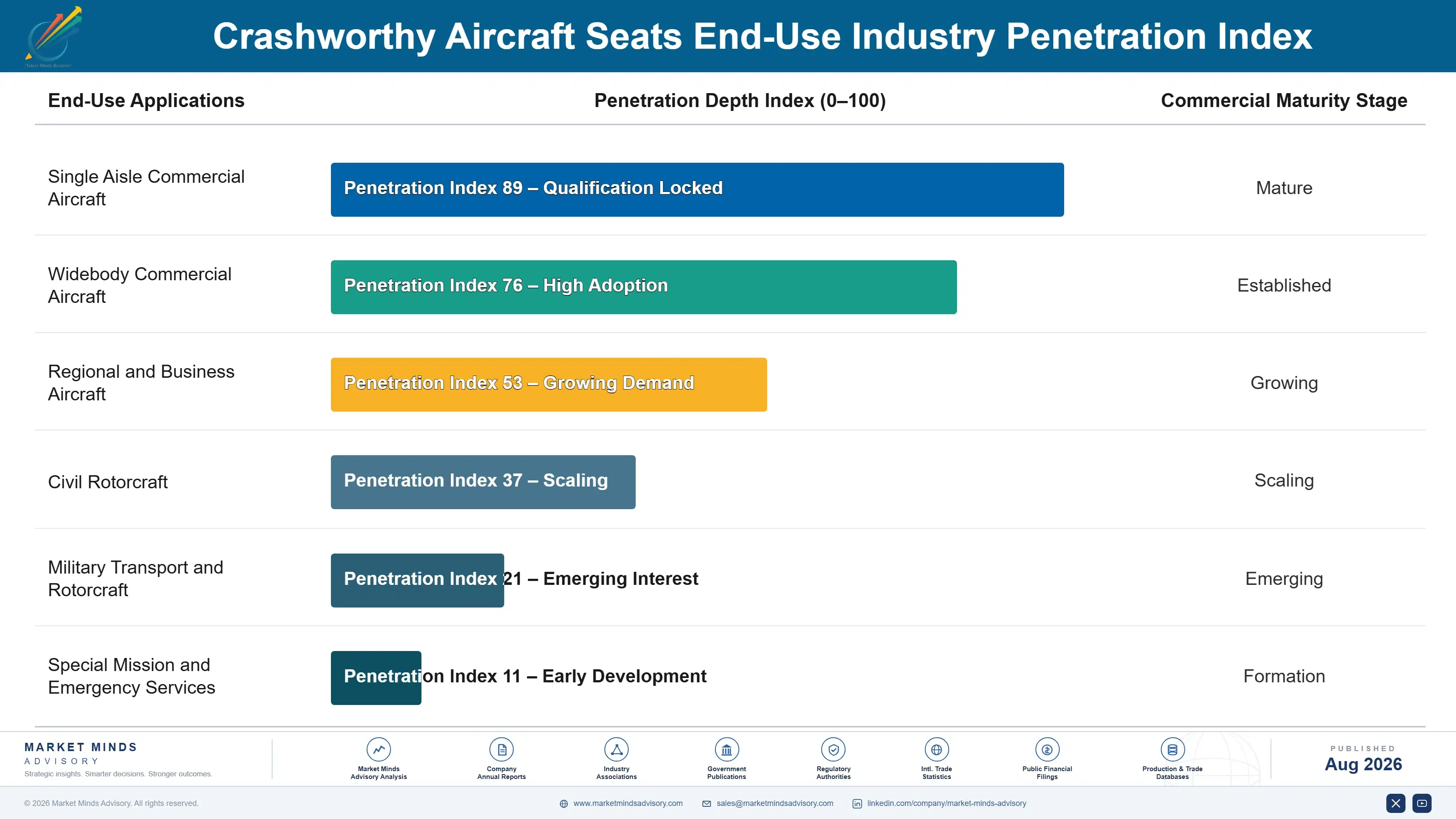
crashworthy-aircraft-seats-market-end-use-penetration-index-1788164614015

Where Seat Suppliers Should Commit

These are among the four positions where our research anticipates prominent divergence between winners and laggards over the coming forecast period. Each is grounded in the demand model, the regulatory perimeter, and the announced capacity pipeline.
01 / FAMILY QUALIFICATION DISCIPLINE

Stop paying separately for evidence one campaign covers

A single dynamic test programme costs around USD 340,000 per configuration and runs roughly fourteen months, and suppliers qualifying each layout independently pay repeatedly for evidence that a properly structured family approach would have covered within a single test campaign. Authorities do accept family qualification wherever the configuration range is defined and substantiated rigorously from the very outset of the programme. Most suppliers still test configuration by configuration, largely because that is how this work has always been organised here.
02 / OCCUPANT RANGE ANTICIPATION

Test wider now or requalify expensively later

Occupant weight distributions have already moved well beyond the assumptions that original test standards were written against, and several authorities have already taken that observation from discussion into active formal rulemaking. Suppliers testing across a broader range today already hold evidence that competitors will have to generate afterwards at full cost and fourteen months per single configuration. The additional expense inside an existing programme is genuinely modest, and the cost of doing it against a compliance date attached is not.
03 / REFURBISHMENT CHANNEL CAPTURE

Thirty-five percent of revenue placed by somebody else

Refurbishment and spares together carry 35% of market revenue on seats that the original supplier designed and certified, and operators place that work wherever an approved shop offers capacity and an acceptable price on the day. Suppliers ceding that work to independent refurbishers surrender margin on their own certified product without ever having competed for any of it. Authorised networks with genuine parts control typically recover thirteen to nineteen percent of the value currently leaking outward from them each year.
04 / SIMULATION CORRELATION DEPTH

Modelling cannot replace the test, only the failures

No authority accepts analysis in place of a sled test and none appears at all likely to soon, but mature correlation between model and test reduces how many attempts a programme needs before it finally passes. That matters enormously when each attempt costs six figures and consumes months of programme schedule that nobody had quoted for. The capability takes roughly three years to build properly against accumulated test data, and it compounds with every single test performed afterwards from then on.

Engagement Snapshot From the Field

A live engagement with an industry participant carrying material or product regulatory and market exposure ahead of a defining policy shift, showing how our research translates into a defensible multi-year portfolio strategy.
MARKET MINDS ADVISORY · CLIENT ENGAGEMENT SUMMARY
Crashworthy Aircraft Seats Producer Strategic Portfolio Review and Transition Roadmap 2026·Investment Scenario on Crashworthy Aircraft Seats Exposure Evaluation 2025-26
CLIENT PROFILE
A seat manufacturer supplying economy and premium cabin seating to three airlines alongside a small crew seat line, qualifying each cabin configuration through separate dynamic test programmes. Delivery volumes had grown steadily while margin per seat declined across four years, and management attributed the decline to airline pricing pressure rather than to anything about how it generated certification evidence.
STRATEGIC CHALLENGE
The board needed to establish how much margin was being consumed by repeated configuration testing, and whether family qualification justified the engineering discipline it required. It also faced a decision on whether to build an authorised refurbishment network, which operations leadership regarded as a service distraction and finance leadership regarded as revenue the company had simply given away.
MMA APPROACH
MMA rebuilt margin per seat by programme across four years, allocating qualification and test cost properly to the configurations that generated it. It modelled family qualification against continued individual testing across the client's actual layout range. Expert interviews with certification authorities, airlines, independent refurbishers and competing suppliers established what is accepted, what is possible and where the money goes.
KEY FINDINGS
  1. Repeated configuration testing consumed roughly twice as much margin as airline pricing pressure did, and the two had never been separated in any internal reporting at all.
  2. A properly substantiated family qualification would have covered nine of the client's eleven tested configurations in a single campaign, at a fraction of the cost incurred.
  3. Independent refurbishers were recovering the client's own certified seats at prices well above what the client charged for the spare parts consumed in that work.
  4. Two airlines interviewed would have accepted a narrower layout range had the test cost of each variation been explained to them before the specification was frozen.
CLIENT PROFILE
A seat manufacturer supplying economy and premium cabin seating to three airlines alongside a small crew seat line, qualifying each cabin configuration through separate dynamic test programmes. Delivery volumes had grown steadily while margin per seat declined across four years, and management attributed the decline to airline pricing pressure rather than to anything about how it generated certification evidence.
STRATEGIC CHALLENGE
The board needed to establish how much margin was being consumed by repeated configuration testing, and whether family qualification justified the engineering discipline it required. It also faced a decision on whether to build an authorised refurbishment network, which operations leadership regarded as a service distraction and finance leadership regarded as revenue the company had simply given away.
MMA APPROACH
MMA rebuilt margin per seat by programme across four years, allocating qualification and test cost properly to the configurations that generated it. It modelled family qualification against continued individual testing across the client's actual layout range. Expert interviews with certification authorities, airlines, independent refurbishers and competing suppliers established what is accepted, what is possible and where the money goes.
KEY FINDINGS
  1. Repeated configuration testing consumed roughly twice as much margin as airline pricing pressure did, and the two had never been separated in any internal reporting at all.
  2. A properly substantiated family qualification would have covered nine of the client's eleven tested configurations in a single campaign, at a fraction of the cost incurred.
  3. Independent refurbishers were recovering the client's own certified seats at prices well above what the client charged for the spare parts consumed in that work.
  4. Two airlines interviewed would have accepted a narrower layout range had the test cost of each variation been explained to them before the specification was frozen.
RECOMMENDED STRATEGY
Phase 1: Phase one: define and substantiate a family qualification range covering the existing layouts, and stop testing configurations individually from now on. Phase 2: Phase two: build an authorised refurbishment network with parts control across the three airline customers already supplied by the company. Phase 3: Phase three: quote configuration variations with their test cost shown explicitly rather than absorbing it silently into the seat price.
OUTCOME
The client reported margin per seat recovering 6.1 points within five quarters (client-reported, unverified by MMA). Family qualification was substantiated across nine configurations. Refurbishment revenue began from a negligible base, and one airline reduced its requested layout range after seeing the actual test cost involved.

Frequently Asked Questions

Foundational context covering the market sizes, CAGR, scope, country, region and competition that inform every finding below. This section is provided to cover basics and most often pre-purchase conversations, answered from the MMA Primary Research Dataset.

What is the current size of the Crashworthy Aircraft Seats Market?

The market is valued at USD 0.6 billion in 2025, measured as revenue from aircraft seats designed and certified to dynamic crashworthiness standards across all aircraft types.

How large will the Crashworthy Aircraft Seats Market be by 2036?

MMA forecasts USD 1.43 billion by 2036, up from USD 0.65 billion in 2026. That represents incremental revenue of USD 0.78 billion and an expansion multiple of 2.20 times.

What is the CAGR for the Crashworthy Aircraft Seats Market 2026 to 2036?

The base case CAGR is 8.2%, with a bull case of 9.4% and a bear case of 7.0%. Rotorcraft crash resistance requirements supply most of that growth.

Which segment is growing fastest?

Rotorcraft energy absorbing seats grow at 12.3%, half again the market rate of 8.2%, because crash resistant occupant protection became mandatory across newly manufactured civil helicopters.

Who are the major companies in the Crashworthy Aircraft Seats Market?

Safran Seats, Collins Aerospace, Martin-Baker, Ipeco Holdings and Geven lead on crashworthy seat revenue, holding around 63% between them across the entire crashworthy seat market.

Which country is growing fastest?

India grows fastest at 10.2%, driven by seat structure manufacture and design services expanding toward qualified production on domestic rotorcraft and military transport aircraft programmes.

Report Segmentation Architecture

The full report scope spans multiple orthogonal segmentation dimensions, with cross-tabulated demand data provided for each dimension pair. Coverage extends further to regional breakdowns, trend trajectories, and the competitive detail needed to support segment-level decision-making.

By Seat Category

  • Commercial Passenger Crashworthy Seats
  • Flight Crew and Cabin Crew Seats
  • Rotorcraft Energy Absorbing Seats
  • Military Transport and Troop Seating
  • Seat Structure, Restraint and Energy Absorbing Components
  • Dynamic Testing, Qualification and Certification Services

By End-Use Industry

  • Single Aisle Commercial Aircraft
  • Widebody Commercial Aircraft
  • Regional and Business Aircraft
  • Civil Rotorcraft
  • Military Transport and Rotorcraft
  • Special Mission and Emergency Services

By Commercial Dimension

  • Airframer Programme Supply
  • Airline Direct Specification
  • Retrofit and Cabin Refresh Programmes
  • Authorised Refurbishment Networks
  • Independent Refurbishment Providers
  • Component and Structure Supply

By Region

  • Western Europe
  • North America
  • East Asia
  • South Asia and Pacific
  • Latin America
  • Middle East and Africa
  • Eastern Europe

Scope, Methodology, and Coverage

Every figure in this report is reproducible from documented input assumptions. The scope below maps the historical period, the forecast horizon, the segmentation dimensions, and the countries covered, alongside the underlying primary and qualitative methodology.
Historical Period
2020 to 2025
Forecast Period
2026 to 2036
Base Year
2025 (USD billions; MMA Primary Research Dataset, August 2026)
Market Definition
Revenue from aircraft seats designed and certified to dynamic crashworthiness standards, spanning commercial passenger crashworthy seats, flight crew and cabin crew seats, rotorcraft energy absorbing seats, military transport and troop seating, seat structure, restraint and energy absorbing components, and dynamic testing, qualification and certification services. Airframer programme supply, airline direct specification, retrofit and cabin refresh programmes, authorised refurbishment networks, independent refurbishment providers and component supply are all included. Non-crashworthy legacy seating, cabin interior monuments and galleys, in-flight entertainment fitted to seats, and automotive or rail seating regardless of test standard are excluded.
Quantitative Units
USD billions, crashworthy seat and qualification service revenue
Segmentation Dimensions
Seat category, aircraft type, commercial supply model, region
Regions Covered
Western Europe, North America, East Asia, South Asia and Pacific, Latin America, Middle East and Africa, Eastern Europe
Countries Covered
United States, United Kingdom, France, Germany, Italy, Canada, China, Japan, South Korea, India, Australia, Brazil, Poland, United Arab Emirates
Key Companies Profiled
Safran Seats, Collins Aerospace, Martin-Baker, Ipeco Holdings, Geven, Recaro Aircraft Seating, Jamco Corporation, Acro Aircraft Seating, AMSAFE, Adient Aerospace
Quantitative Methodology
Primary survey, n=3,800 respondents, Q4 2025, six countries; demand-side model with trade association cross-validation
Qualitative Methodology
47 expert interviews, Q4 2025; applied to validate demand model assumptions, identify emerging dynamics, and assess competitive positioning
Report Format
PDF and XLSX data workbook (Word format preview document)
Publisher
Market Minds Advisory
Report Code
MMA-2026-CON-451
Published
August 2026
Contact
sales@marketmindsadvisory.com | www.marketmindsadvisory.com

Purchase the full Crashworthy Aircraft Seats Market Report (2026 to 2036).

The full report treats this as the certification evidence business it actually is rather than the furniture business it superficially resembles. It quantifies dynamic test cost and schedule against configuration counts, assesses occupant range rulemaking as a requalification liability across the installed base, and separates refurbishment from delivery economics across the supplier group. Segment analysis covers all six seat categories, with particular attention to rotorcraft energy absorbing seats where regulation and growth are effectively the same thing. Competitive assessment ranks twenty participants on crashworthy aircraft seat revenue.
Six seat category segmentation with growth rates
Dynamic test cost quantified per configuration programme
Twenty participant assessment on crashworthy seat revenue
Occupant range rulemaking assessed as requalification exposure
Family qualification savings modelled across layout ranges
Refurbishment value traced through authorised and independent channels

Built For The People Who Decide

From boardroom strategy to bench-side execution, this report is read cover-to-cover by leaders shaping the next decade of their industry, turning demand scenarios, market dynamics and valuation benchmarks into decisions.
CXOs/ Presidents/ VPs/ Managers
M&A and Corporate Development
Strategy Teams and R&D Heads
Procurement and Product Directors
Regulatory and Compliance Leaders
Investor Relations and Equity Analysts