Market Minds Advisory
COVID-19 Saliva Sampling Test Market

COVID-19 Saliva Sampling Test Market: Multiplex Respiratory Panels Replace Single-Pathogen Testing

Multiplex respiratory panels combining COVID-19, influenza, and RSV detection increasingly displace single-pathogen saliva tests, occupational and school-based screening programs sustain steady volume, and manufacturers without combo-panel platforms lose laboratory contract renewals to broader-panel competitors.

Lead Analyst

Alice Ballenger

Published

September 2026

Make Smarter Decisions with Customized Research Insights

Request a free sample report and evaluate market opportunities, growth trends, and competitive dynamics relevant to your business needs.

2025 MARKET VALUE$1.4BMarket Size 2025
2036 FORECAST VALUE$2.9BBase Case , 2026 to 2036
CAGR 2026 TO 20366.8 %Bull 8.0% / Bear 5.5%
INCREMENTAL OPPORTUNITY$1.4BNet 10- year value creation
EXPANSION MULTIPLE1.93x2036 value over 2026 base
Strategic Levers
M&A Pipeline
Regional Outlook
Country Rankings
Competitive Intelligence
Segmental Deep-dive
Call-Us : 91 93563 13602

Executive Snapshot and Market Trajectory

Multiplex respiratory panels now test for COVID-19, influenza, and RSV from a single saliva sample, and laboratory procurement committees increasingly treat combined-pathogen coverage as the deciding contract renewal factor over single-target testing cost alone across most volume testing programs today and going forward steadily.
Multiplex respiratory panel saliva tests lead growth at 11.5%, roughly 1.69 times the overall rate, as laboratories shift from single-pathogen COVID testing toward combined respiratory panels that serve occupational and school screening programs more efficiently in one collection visit rather than multiple separate tests. North America now holds the largest regional share, driven by established reimbursement infrastructure and occupational testing mandates carried over from earlier pandemic-era surveillance programs still operating today.
Competitive intensity concentrates around moderate levels held by five manufacturers, since assay validation requirements and laboratory contract relationships limit new entrant credibility relative to more commoditized diagnostic categories elsewhere in medical technology overall and broadly today and quite steadily indeed still. At-home self-collection kits are becoming a meaningful secondary channel distinct from traditional laboratory-based testing alone, reshaping how manufacturers structure their commercial distribution models across most consumer and occupational testing segments currently and going forward.
Market Definition
This report covers the global market for saliva-based COVID-19 diagnostic testing products, spanning RT-PCR saliva collection kits, rapid antigen saliva tests, multiplex respiratory panels, at-home self-collection kits, and pooled testing systems. It excludes nasopharyngeal swab-based testing formats and serological antibody testing not based on saliva sample collection.
Base Year Value
$1.4B in 2025 (MMA Primary Research Dataset, August 2026)
Forecast Period
2026 to 2036, eleven discrete annual values
CAGR
6.8% base case. Bull 8.0%. Bear 5.5%.
Fastest Growth Segment
Multiplex Respiratory Panel Saliva Tests: 11.5% CAGR
Fastest Growth Country
India: 9.8% CAGR
Fastest Growth Region
South Asia and Pacific: 8.8% CAGR
Largest Region
North America: 28% of 2025 global value
Market Leaders
Thermo Fisher Scientific, Roche Diagnostics, Abbott Laboratories, PerkinElmer, DxTerity Diagnostics. Source: MMA Analysis, July 2026.
Primary Survey
n=3,800 procurement and R&D decision-makers, Q4 2025, six countries
Methodology
Demand-side build-up, cross-validated against public data, 47 expert interviews

COVID-19 Saliva Sampling Test Market Forecast Scenarios

covid-19-saliva-sampling-test-market-size-forecast-scenario-1787304280356
Saliva sampling test demand grew steadily between 2020 and 2025 as testing infrastructure transitioned from emergency pandemic response toward routine occupational and school-based screening programs nationwide and internationally alike, with the historical growth rate running somewhat below the coming decade's pace as multiplex panel adoption accelerates further across most established and emerging testing markets worldwide today.
The base case assumes continued multiplex panel adoption, steady occupational and school screening program demand, and gradual at-home self-collection kit expansion across major markets worldwide today and going forward quite steadily. Ongoing respiratory illness surveillance funding and expanding combination panel reimbursement sustain unit volume even as single-pathogen COVID-only test pricing compresses through the forecast period as laboratories consolidate testing budgets toward broader panels rather than maintaining separate single-target testing contracts.
The bull case centers on multiplex panel reimbursement expanding faster than expected, pulling forward laboratory contract consolidation toward combination-panel manufacturers across most major testing markets today. The bear case centers on further testing budget contraction across public health systems as COVID-19 surveillance funding continues declining, which would slow overall category demand across most public procurement channels significantly and further.

Multiplex Panels Reshape Laboratory Contract Renewals

Saliva sampling testing sits at the intersection of assay breadth and laboratory workflow economics, since single-pathogen COVID testing alone no longer justifies dedicated contract renewal without accompanying multiplex panel efficiency that reduces per-sample processing cost. Manufacturers converging both capabilities into a single collection and assay platform are winning laboratory contract renewals that single-pathogen-only competitors increasingly lose despite comparable analytical sensiti
MARKET CONCENTRATION (CR5)62%Top five manufacturers hold combined global market revenue share
AVERAGE SELLING PRICE$14Typical multiplex respiratory panel saliva test price per unit
TOP PRODUCING COUNTRY SHARE29%United States leads global saliva test kit manufacturing output
LABORATORY CONTRACT RENEWAL RATE71%Share of laboratories renewing multiplex over single-pathogen contracts
TRADE INTENSITY38%Share of total units sold across export markets globally
MULTIPLEX PANEL ATTACH RATE34%New laboratory contracts now specifying multiplex panel testing
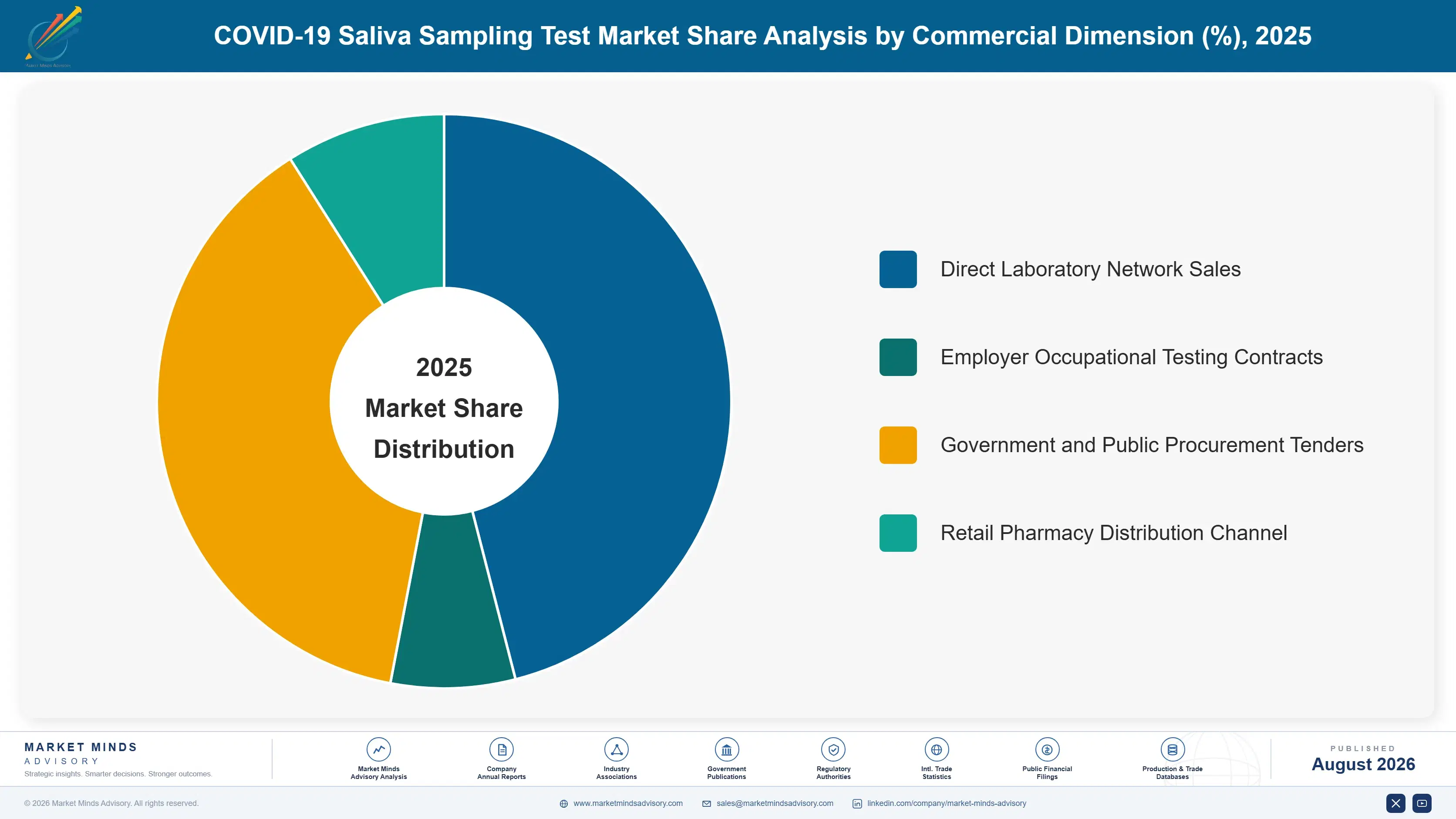
Commercial character favors manufacturers with direct laboratory network relationships over those relying solely on distributor channels, since large reference laboratories increasingly standardize testing platform purchasing across their full network rather than negotiating site by site individually. Occupational and school screening program contracts have become a meaningful revenue channel distinct from traditional acute clinical testing sales alone, rewarding manufacturers with proven population-scale deployment experience.
The next decade will be shaped by reimbursement policy for combination respiratory panels, regulatory pathways for at-home multiplex testing, and the pace at which surveillance funding stabilizes at a lower but sustained baseline nationwide. Manufacturers positioned across all three forces simultaneously will capture disproportionate share as the category matures beyond its current emergency-response-only positioning toward routine seasonal testing infrastructure.
"COVID-only testing was never going to be a permanent business model. The labs that survived the funding cliff are the ones that turned their COVID infrastructure into respiratory panel infrastructure before anyone forced them to."
Director, Infectious Disease Diagnostics Practice · MMA Medical Devices / Infect

Market Trends

Multiplex Respiratory Panels Displace Single-Pathogen Testing Contracts

Laboratories are increasingly replacing single-pathogen COVID-19 saliva testing contracts with multiplex panels that simultaneously detect influenza and RSV from the same collected sample, improving per-sample economics substantially and meaningfully. Roughly 34% of new laboratory testing contracts in 2025 specified multiplex panel platforms, up sharply from a negligible share three years earlier, as combination panel reimbursement expanded and laboratories sought to consolidate respiratory testing budgets into fewer platform relationships. Manufacturers without validated multiplex capability increasingly lose contract renewal negotiations to competitors offering combined-pathogen coverage from existing sample collection infrastructure already in place.
Market Impact: Surveillance covers 40 countries cu
At-Home Self-Collection Kits Expand Consumer Testing Access

At-home saliva self-collection kits increasingly supplement laboratory-based testing as consumers seek convenient testing options without clinic visits for routine occupational or travel screening requirements across most consumer segments today and consistently. Manufacturers report at-home kit sales now cover roughly 22% of total saliva testing volume in leading markets, up from a much smaller share five years ago, as regulatory clearances for self-collection accuracy expanded and mail-in laboratory processing infrastructure matured. This channel is pulling testing volume away from traditional clinic-based collection toward direct-to-consumer distribution models across most major consumer markets currently.
Market Impact: Occupational contracts renew at 85%

Market Opportunities and Growth Drivers

Ongoing Respiratory Illness Surveillance Sustains Baseline Testing Demand

National public health agencies continue funding respiratory illness surveillance programs at a lower but sustained level following the emergency pandemic response phase, providing a stable baseline testing demand independent of multiplex panel adoption trends. The CDC and equivalent national health agencies across multiple countries maintain ongoing wastewater and clinical surveillance sampling programs that require consistent saliva testing infrastructure, according to government health agency reporting on continued respiratory disease monitoring. This baseline surveillance demand provides manufacturers a stable revenue floor even as consumer-driven testing volume continues normalizing toward endemic-level demand patterns.
Market Impact: Surveillance funding declined 45% o

Occupational Screening Mandates Sustain Workplace Testing Volume

Employers across healthcare, travel, and manufacturing sectors continue maintaining occupational screening protocols for respiratory illness, sustaining consistent testing volume independent of broader public health surveillance funding levels available today. Healthcare facilities in particular maintain routine staff screening programs requiring saliva-based testing infrastructure, since infection control protocols in patient-facing settings remain more conservative than general workplace policy elsewhere overall. This occupational testing channel has proven more durable than consumer-driven demand, providing manufacturers with predictable recurring revenue from established employer testing contracts renewed annually across most major industries and healthcare systems tracked.
Market Impact: Reimbursement friction slows adopti

Market Restraints and Challenges

Declining Emergency Surveillance Funding Pressures Category Revenue

Public health agencies have substantially reduced emergency pandemic-era testing budgets as COVID-19 transitions toward endemic disease management, directly pressuring the surveillance testing volume that drove much of the category's earlier peak revenue nationwide. The root cause is straightforward: emergency appropriations that funded mass testing infrastructure were always temporary, and normal budget cycles now compete respiratory testing against other public health priorities. Manufacturers are pivoting toward multiplex panels and occupational testing channels to offset this funding decline, gradually replacing surveillance-dependent revenue with more durable commercial demand sources across most major markets.
Market Impact: Multiplex panel contracts reach 34%

Reimbursement Complexity Slows Multiplex Panel Adoption

Multiplex respiratory panel reimbursement policy varies considerably across payers, with some insurers covering combination testing fully while others still require separate justification for each pathogen target tested, creating administrative friction for laboratories nationwide and internationally too. The root cause traces to payer reimbursement systems built around single-pathogen billing codes that have not fully adapted to combination panel testing formats now common in laboratory practice. Manufacturers and laboratory associations are jointly advocating for simplified multiplex billing codes with major payers, gradually reducing this administrative friction across most major markets over time.
Market Impact: At-home kits cover 22% of volume
3 additional market trends, 4 additional growth drivers, and 2 additional restraints and challenges are covered in the full report. Contact sales@marketmindsadvisory.com to access the complete intelligence.

Segment CAGR and Growth Architecture

Saliva sampling test segmentation follows assay technology and testing format rather than end-use setting alone, since the same manufacturer base develops distinct collection and analytical technologies across product lines. Six segments span RT-PCR collection kits, rapid antigen tests, multiplex respiratory panels, at-home self-collection kits, pooled testing systems, and laboratory-developed test services, each requiring distinct regulatory pathways.
covid-19-saliva-sampling-test-market-market-share-analysis-1787304280887

Multiplex Respiratory Panel Saliva Tests

Multiplex respiratory panel saliva tests are growing fastest as laboratories increasingly prescribe this format for patients seeking a single collection visit that covers COVID-19, influenza, and RSV simultaneously rather than requiring separate individual tests for each pathogen tested independently across every single visit made. Reference laboratories and hospital systems are driving early adoption, since multiplex panels currently justify their premium pricing primarily through documented per-sample cost efficiency relative to running three separate single-pathogen assays across broad patient populations. Manufacturers with proven multiplex validation data are capturing disproportionate share of new laboratory contract discussions as procurement committees increasingly specify this format explicitly for consolidated respiratory testing budgets across leading laboratory networks nationwide.
CAGR 11.5%

At-Home Self-Collection Saliva Kits

At-home self-collection kits grow second-fastest, favored for their convenience as a testing format that public health agencies and employers increasingly recommend alongside traditional laboratory-based collection for routine screening use cases across most consumer markets today and increasingly so each passing year and every quarter. Consumers and employers increasingly specify at-home kits as a preferred testing option, since mail-in processing infrastructure now delivers laboratory-grade accuracy without requiring clinic visits for routine screening purposes across busy work schedules and travel plans made regularly. Manufacturers offering fully validated at-home formulations with simplified mail-in logistics are capturing meaningful share from clinic-based alternatives, since consumers increasingly prefer partners with proven convenience and turnaround time performance.
CAGR 9.5%
Full segment breakdown across 6 segments available in the complete report.

Regional Architecture and Country Demand Map

Revenue concentrates where reimbursement infrastructure and occupational testing mandates intersect, with North America and East Asia together capturing more than half of global revenue. Growth rates skew fastest toward South Asia and Pacific as multiplex panel adoption accelerates there while surveillance funding stabilizes elsewhere globally.

North America

North America holds the largest revenue share, driven by established reimbursement infrastructure and occupational testing mandates carried over from earlier pandemic-era surveillance programs still operating across major employers, healthcare systems, and public health agencies nationwide and consistently today and quite steadily too. The United States accounts for most of this share, supported by ongoing CDC surveillance funding, expanding multiplex panel reimbursement coverage, and healthcare facilities maintaining routine staff screening protocols across most hospital systems and clinics. Reference laboratories concentrate testing capacity disproportionately in this region ahead of most other markets. Manufacturers without validated multiplex capability increasingly lose laboratory contract renewals to competitors offering combined-pathogen testing coverage and simplified billing structures.
Share: 28% | CAGR: 7.5% (2026 to 2036)

Western Europe

Western Europe combines centralized national health system procurement with steady but measured multiplex panel adoption across its largest member states and established laboratory networks nationwide and internationally today and gradually over quite some time. Germany, France, and the United Kingdom drive most regional revenue, since national health authorities there move deliberately on new combination testing reimbursement decisions relative to faster-moving markets elsewhere in the world. Single-pathogen testing penetration remains higher here than in the United States, reflecting national health system emphasis on cost containment across diagnostic categories broadly and consistently. Multiplex panel uptake trails the United States by a meaningful margin per launch, as reimbursement approval requires additional evidence and review.
Share: 21% | CAGR: 5.3% (2026 to 2036)
Regional intelligence for 5 additional markets available in the complete report: East Asia, South Asia and Pacific, Latin America, Middle East and Africa, Eastern Europe. Contact sales@marketmindsadvisory.com.
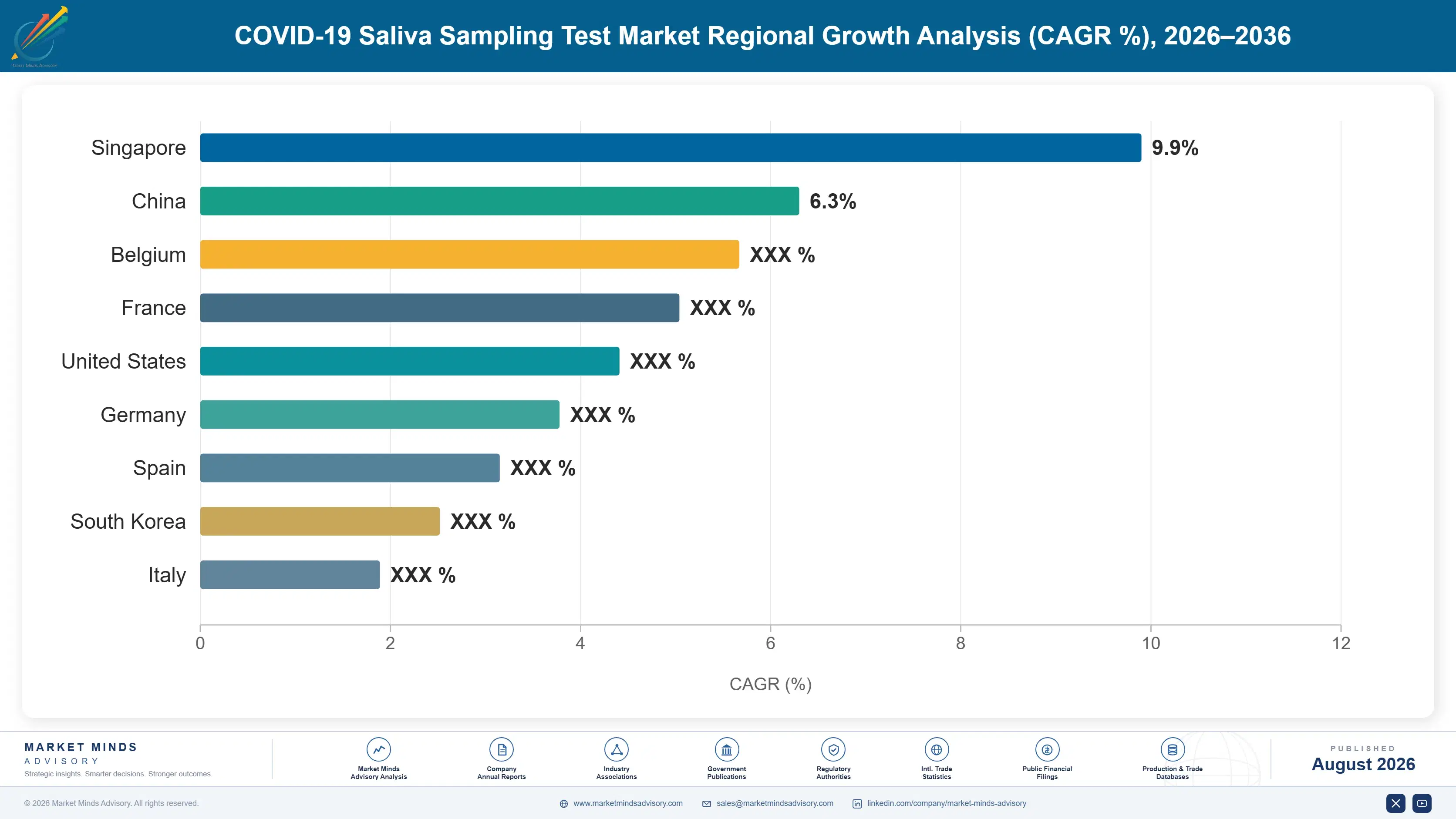
covid-19-saliva-sampling-test-market-country-cagr-analysis-1787304281445

Multiplex Validation Drives Contract Retention

Revenue growth concentrates around four commercial mechanisms rewarding manufacturers who move fastest on multiplex validation, occupational testing partnerships, and at-home channel expansion across most major markets today and going forward quite steadily. Single-pathogen differentiation is losing pricing power as combination testing becomes standard, pushing manufacturers toward panel breadth, employer contracts, and laboratory network relationships.

Complete Multiplex Panel Validation Ahead of Competitors

Manufacturers completing multiplex respiratory panel validation fastest capture disproportionate share of laboratory contract renewal conversations before competitors can match comparable combined-pathogen coverage available today and consistently. Validated multiplex panels now retain 71% of laboratory contracts at renewal, according to recent contract data across major testing networks, since laboratories increasingly consolidate testing budgets toward the fewest platform relationships possible. Manufacturers without validated multiplex capability face mounting pressure to either license third-party panel technology or develop internal capability quickly, since the multiplex trend is accelerating faster than most single-pathogen-only competitors can independently respond.
Market Impact: Validated multiplex panels retain 7

Expand Employer Occupational Testing Contract Base

Manufacturers building direct relationships with large employers for occupational screening programs capture predictable recurring revenue that insulates them from cyclical public health surveillance funding fluctuations affecting competitors reliant on government contracts alone. Employer occupational testing contracts now represent approximately 40% of total category revenue as healthcare, travel, and manufacturing sectors maintain routine staff screening protocols independent of public funding cycles. Building these employer relationships requires sustained account management investment, but the resulting contract revenue tends to persist across multiple budget cycles once a manufacturer becomes the preferred occupational testing supplier.
Market Impact: Occupational contracts now cover 40

Expand At-Home Kit Distribution Through Retail Partnerships

Manufacturers expanding at-home kit distribution through pharmacy and retail partnerships capture incremental consumer revenue that laboratory-only competitors without comparable retail relationships cannot reliably access at scale or speed. At-home kit retail distribution now covers approximately 45% of major pharmacy chains among leading manufacturers, up from a much lower share three years ago, as consumers increasingly prefer convenient purchase options over mail-order-only channels available previously and elsewhere. Manufacturers with the strongest retail partnerships are converting this distribution advantage into durable consumer revenue that smooths seasonal demand fluctuations relative to laboratory-dependent competitors.
Market Impact: Retail distribution now reaches 45%

Advocate for Simplified Multiplex Billing Code Adoption

Manufacturers investing in payer advocacy for simplified multiplex billing codes accelerate reimbursement approval and reduce administrative friction that currently slows combination panel adoption across many payer relationships nationwide and internationally. Simplified billing code adoption has expanded to cover roughly 55% of major payers in leading markets, up from a much smaller share two years ago, as manufacturer and laboratory association advocacy efforts gained traction with payer policy committees. Manufacturers leading this advocacy effort are positioned to benefit disproportionately as simplified billing removes a key adoption barrier across the broader payer landscape.
Market Impact: Simplified billing now covers 55% o

Who Controls the Margin Pool

Five manufacturers hold 62% combined share on a global revenue basis, a moderate concentration level reflecting the transition from pandemic-era emergency demand toward a more fragmented multiplex and at-home testing landscape. Thermo Fisher Scientific leads the field by a meaningful margin, its integrated molecular diagnostics platform and laboratory network relationships giving it broader multiplex panel distribution than Roche Diagnostics, the nearest challenger, whose strength concentrates m
Current competitive activity centers on multiplex panel validation, employer occupational testing partnerships, and at-home retail distribution expansion rather than price competition on single-pathogen tests alone. Manufacturers are racing to secure simplified reimbursement billing codes for combination panels, since laboratories increasingly condition contract renewal on combined-pathogen coverage. Distribution partnerships with pharmacy chains now shape access economics across many consumer-facing testing markets.

Emerging pressure comes from specialized point-of-care diagnostics startups pursuing rapid multiplex platforms, and from generic single-pathogen manufacturers in Asia scaling production for expanding surveillance and occupational testing programs. Rankings shift most where multiplex validation and laboratory contract wins combine, since a single manufacturer's combination panel launch can meaningfully reorder near-term revenue share among otherwise comparable competitors.
covid-19-saliva-sampling-test-market-company-positioning-matrix-1787304281968

Competitive Moat and Risk Dimensions

THERMO FISHER SCIENTIFIC INC.

Moat: Integrated Molecular Diagnostics Platform

Thermo Fisher Scientific pairs its saliva collection systems with broad molecular diagnostics manufacturing scale, giving it faster multiplex panel development and validation than smaller specialized competitors. This integration lets Thermo Fisher bundle collection and assay purchasing conversations within the same laboratory account relationship, reinforcing its lead in large reference laboratory contract renewals.
THERMO FISHER SCIENTIFIC INC.

Risk: Declining Surveillance Revenue Exposure

Thermo Fisher's broad public health surveillance contract base leaves it more exposed than smaller commercial-focused competitors as government emergency testing budgets continue declining toward endemic-level funding. If surveillance revenue declines faster than multiplex and occupational testing growth can offset, Thermo Fisher's blended category revenue could compress faster than competitors with smaller surveillance-dependent exposure.
ROCHE DIAGNOSTICS

Moat: Centralized Laboratory Instrumentation Strength

Roche Diagnostics maintains deep installed base relationships across centralized reference laboratory instrumentation, giving it a durable position in high-volume multiplex panel processing that smaller point-of-care competitors cannot easily replicate. This installed base advantage lets Roche capture disproportionate multiplex panel volume as laboratories prefer running new assays on existing validated instrumentation platforms.
ROCHE DIAGNOSTICS

Risk: Limited At-Home Channel Presence

Roche's commercial focus on centralized laboratory instrumentation has left it with a narrower at-home self-collection kit presence than more consumer-oriented competitors expanding retail distribution partnerships. If at-home testing continues capturing share from laboratory-based collection faster than Roche's channel investment allows, the company risks losing share in exactly the fastest-growing consumer segment of the market.

Players Tracked

Prominent Players

Thermo Fisher Scientific Inc.
Roche Diagnostics
Abbott Laboratories
PerkinElmer, Inc.
DxTerity Diagnostics, Inc.

Other Key Players

Quest Diagnostics Incorporated
Laboratory Corporation of America Holdings (Labcorp)
Becton, Dickinson and Company
QIAGEN N.V.
bioMérieux SA
Hologic, Inc.
QuidelOrtho Corporation
DiaSorin S.p.A.
Co-Diagnostics, Inc.
Standard BioTools Inc.
Cue Health Inc.
Aptitude Medical Systems, Inc.
Visby Medical, Inc.
Mesa Biotech, Inc.
Talis Biomedical Corporation

Recent Developments

JANUARY 2026

Thermo Fisher Clears Expanded Multiplex Saliva Panel

Thermo Fisher Scientific announced regulatory clearance for an expanded multiplex saliva panel covering COVID-19, influenza A and B, and RSV from a single collection, targeting broader laboratory contract adoption. The clearance covers both centralized laboratory processing and select point-of-care testing configurations across multiple healthcare settings.
Signal: Signals manufacturers now treat combined-p
AUGUST 2025

Roche Signs National Laboratory Network Supply Agreement

Roche Diagnostics signed a multi-year supply agreement with a national reference laboratory network to provide multiplex respiratory panel testing across newly consolidated regional testing centers, expanding its laboratory contract footprint significantly. The agreement covers instrumentation, reagents, and ongoing technical support across dozens of participating facilities.
Signal: Signals laboratory network consolidation c
MARCH 2025

Abbott Expands At-Home Kit Retail Distribution

Abbott Laboratories and a retail pharmacy chain announced a distribution partnership expanding at-home saliva testing kit availability across thousands of additional retail locations nationwide, targeting improved consumer access for routine screening needs. The partnership combines Abbott's manufacturing scale with the retailer's established pharmacy distribution infrastructure.
Signal: Signals retail distribution partnerships a

Reagent Sourcing Shapes Multiplex Panel Margins

Molecular reagents, enzymes, and primer sets account for roughly 34% of cost of goods sold across multiplex saliva testing production, with a further 18% attributable to collection device manufacturing and packaging processes overall. Most specialized reagent manufacturing concentrates among a small number of biotechnology suppliers in the United States and Western Europe, limiting alternative sourcing options considerably.
Global reagent pricing volatility tied to specialized enzyme supply constraints pushed multiplex panel production costs up an estimated 9% during 2023, according to company annual report disclosures citing broader molecular diagnostics manufacturing sector pressure, before easing through 2024 as alternative suppliers scaled capacity. Plastic collection device raw material costs also saw measurable volatility over the same period, according to EIA-adjacent petrochemical trade data covering medical device manufacturing inputs.

Larger manufacturers with vertically integrated reagent production absorb input cost volatility more easily than smaller specialized competitors dependent on third-party suppliers for critical enzyme and primer inputs used across most product lines. Manufacturers serving public procurement programs face the sharpest exposure, since multi-year fixed-price government surveillance contracts leave little room to pass through input cost increases once agreements are signed and locked in place.
covid-19-saliva-sampling-test-market-cost-volatility-analysis-1787304282162

Qualify Secondary Reagent and Enzyme Suppliers

Manufacturers increasingly qualify secondary reagent and enzyme suppliers across multiple biotechnology fabricators, reducing exposure to any single supplier's capacity constraints or pricing volatility entirely. This dual-sourcing approach adds modest qualification cost upfront but has measurably reduced supply interruption incidents for manufacturers who adopted it early, ahead of recent enzyme supply constraints affecting the sector.

Vertically Integrate Reagent Manufacturing Capacity

Larger manufacturers are investing directly in in-house reagent and enzyme production capacity rather than relying entirely on external specialized suppliers, reducing exposure to third-party pricing and lead time constraints. This vertical integration requires substantial upfront capital investment but has already shortened lead times for manufacturers pursuing it ahead of broader industry adoption of comparable capability.

Structure Multi-Year Reagent Pricing Agreements

Manufacturers serving public procurement programs increasingly negotiate multi-year reagent pricing agreements with key suppliers that mirror the multi-year government contracts they themselves sign, aligning cost and revenue timing more closely and predictably. This reduces margin compression risk from mismatched contract cycles, though it requires suppliers willing to accept longer-term price certainty over spot-market flexibility.

Portfolio Architecture for Margin Defence

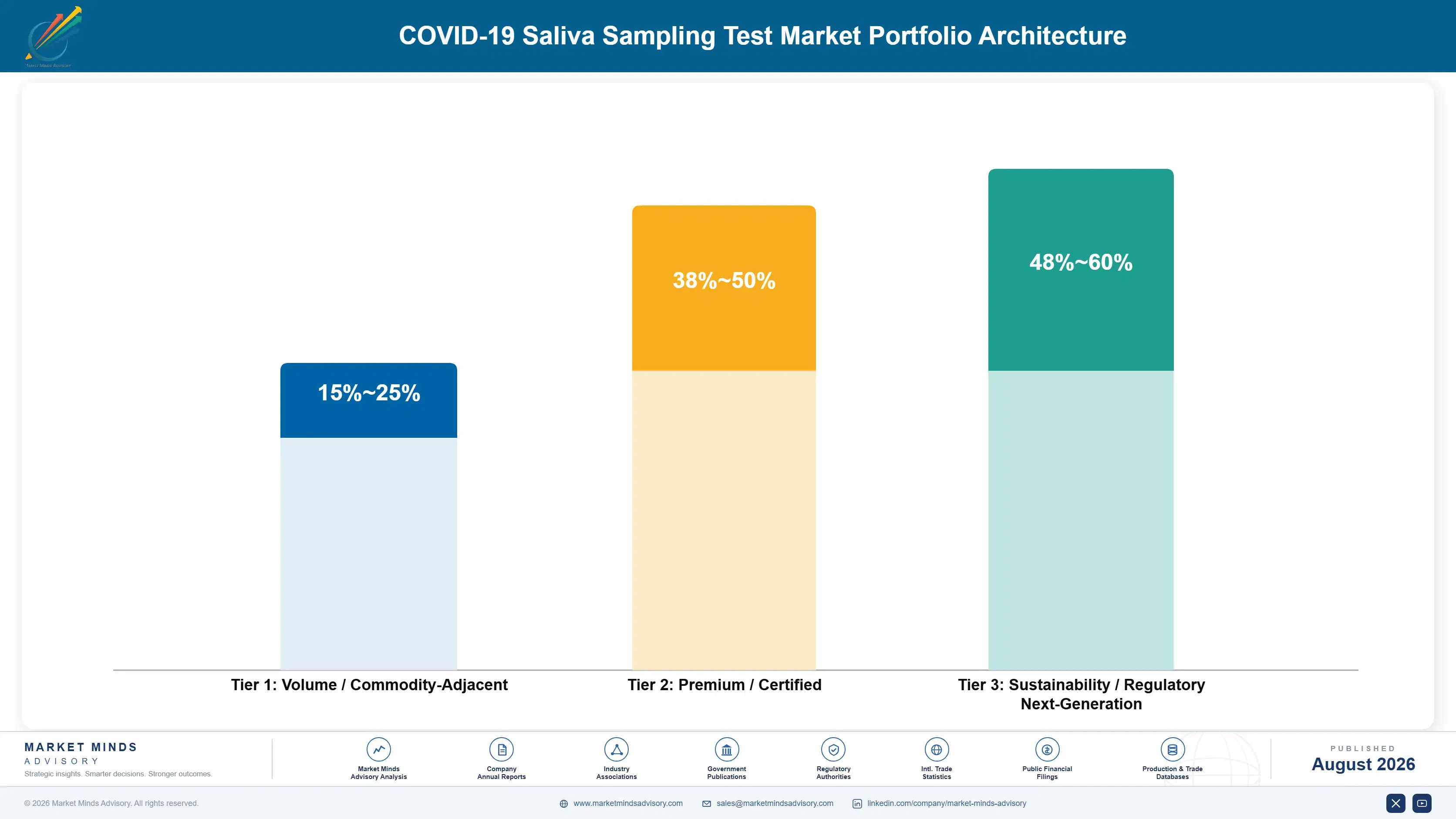
Portfolio economics split across three tiers defined by pathogen coverage breadth and testing format rather than collection method alone. Volume single-pathogen RT-PCR and antigen tests carry thin margins driven by intense multi-manufacturer price competition, while premium multiplex panels and at-home formats command materially wider margins, reflecting validation investment and consumer convenience positioning that single-pathogen competitors cannot easily replicate across most treatment marke
Volume and premium tiers pull manufacturer strategy in different directions, since public surveillance procurement rewards manufacturers who can supply enormous single-pathogen volume at minimal per-unit cost, while laboratories and consumers reward manufacturers who can demonstrate multiplex or convenience differentiation. Few manufacturers compete credibly across both tiers, since the manufacturing scale, validation investment, and commercial infrastructure required for each differ substantially.

High-value margin pools concentrate almost entirely in multiplex panel and at-home testing categories serving reference laboratories and consumers in North America, Western Europe, and East Asia's premium private healthcare segments. Volume tiers generate the overwhelming majority of unit count but a comparatively modest share of total industry profit pool, a divergence widening as multiplex adoption accelerates faster than single-pathogen pricing pressure eases.

Volume / Commodity-Adjacent

Single-pathogen RT-PCR and rapid antigen saliva tests sold predominantly through public surveillance procurement and general clinical distribution, competing largely on unit price and turnaround time across most global regions today.
Gross Margin: 15-25%

Premium / Certified

Multiplex respiratory panels and pooled testing systems sold through laboratory and hospital channels, commanding meaningfully wider margins through combined-pathogen coverage and workflow efficiency capability offered broadly and quite consistently overall.
Gross Margin: 38-50%

Sustainability / Regulatory / Next-Generation

At-home self-collection kits and next-generation rapid multiplex formats still expanding into mainstream consumer and laboratory adoption, priced at the category's highest premium levels currently available and steadily growing further still.
Gross Margin: 48-60%
covid-19-saliva-sampling-test-market-portfolio-architecture-1787304282661

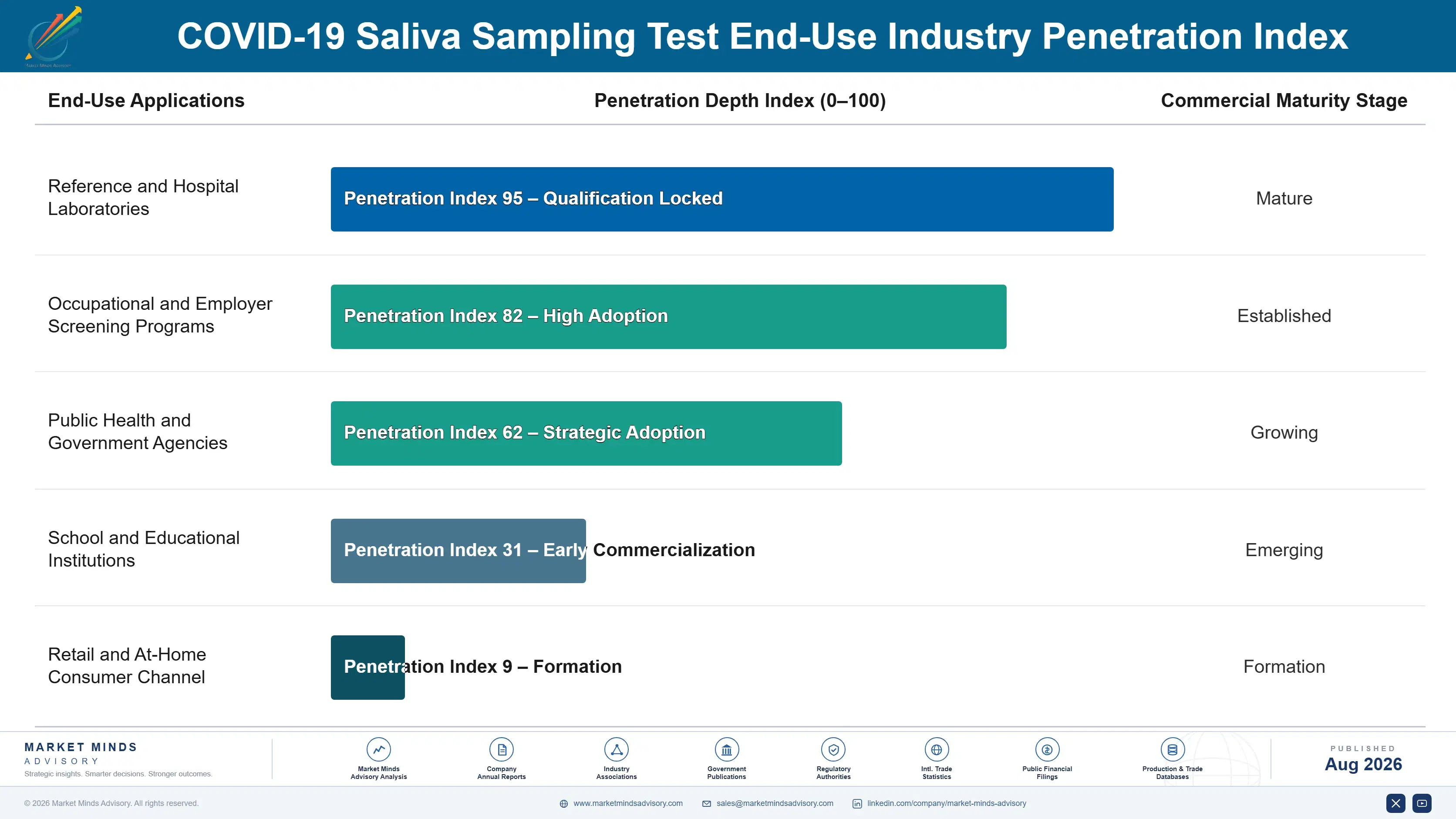
Contract Cycles Anchor Laboratory Revenue

Saliva testing revenue functions on a laboratory contract renewal model rather than a purely transactional sale, since reference laboratories sign multi-year platform agreements that generate recurring reagent and consumable revenue regardless of pathogen surveillance funding cycles. This recurring dynamic underpins manufacturer willingness to invest heavily in multiplex panel validation, since retained laboratory accounts generate predictable multi-year revenue regardless of which specific path
Adoption depth varies meaningfully by end-use vertical, running deepest in reference laboratories and hospital systems that standardize testing platform purchasing across their full network, and shallowest in smaller independent clinics still relying on single-pathogen point-of-care testing. Multiplex panel stickiness proves particularly strong once laboratories experience the workflow efficiency of combined testing, with switch-back rates to single-pathogen platforms remaining low across most centers tracked.

Buyer profiles are shifting generationally as younger laboratory directors trained on multiplex workflow increasingly expect combined-pathogen coverage as a baseline platform requirement rather than a premium upgrade option reserved for high-volume centers. Procurement committees report this generational preference is accelerating purchasing decisions toward multiplex-inclusive contracts faster than reimbursement policy has formally adjusted, pulling premium panel adoption earlier into typical laboratory renewal cycles.
covid-19-saliva-sampling-test-market-end-use-penetration-index-1787304283149

Where MMA Sees the Advantage

These are among the four positions where our research anticipates prominent divergence between winners and laggards over the coming forecast period. Each is grounded in the demand model, the regulatory perimeter, and the announced capacity pipeline.
01 / MULTIPLEX PANEL PRIORITY

Prioritize Multiplex Validation Over Single-Pathogen Optimization

Manufacturers optimizing single-pathogen assay sensitivity are losing laboratory contract renewals to competitors who validated multiplex panels instead of refining incremental single-target performance across most contract negotiations tracked in recent testing cycles across major markets tracked closely. Contract data now shows laboratories default to whichever manufacturer offers combined-pathogen coverage from one collection, not whichever offers the most sensitive single-target assay alone available today. MMA sees multiplex breadth, not single-pathogen sensitivity, as the clearer near-term differentiator through the current ten-year forecast window.
02 / OCCUPATIONAL CONTRACT POSITIONING

Build Employer Testing Relationships Before Surveillance Funding Fully Declines

Occupational testing contracts built early with large employers tend to persist through subsequent budget cycles, giving first movers durable recurring revenue that later entrants find genuinely costly to displace once agreements are formally in place and renewed consistently. Manufacturers waiting for surveillance funding to fully stabilize before pursuing employer relationships are ceding this advantage to faster-moving competitors already embedded in occupational testing contracts across multiple sectors and industries. MMA views occupational positioning as a durable revenue asset worth pursuing immediately.
03 / AT-HOME CHANNEL INVESTMENT

Expand Retail Distribution Before Competitors Lock In Pharmacy Partnerships

Manufacturers without retail pharmacy distribution partnerships risk missing the fastest-growing consumer testing channel as at-home kit demand continues shifting away from laboratory-based collection toward convenient purchase options across most consumer markets tracked today and increasingly so each passing year. Competitors delaying retail investment risk ceding this channel entirely to whichever manufacturer establishes pharmacy shelf presence first, a timing advantage that compounds meaningfully once established across major chains nationwide. MMA sees retail distribution as the clearest near-term consumer channel opportunity ahead.
04 / BILLING CODE ADVOCACY

Lead Simplified Multiplex Billing Advocacy With Major Payers

Manufacturers investing early in payer advocacy for simplified multiplex billing codes reduce the administrative friction that currently slows combination panel reimbursement approval across many payer relationships nationwide and across most testing categories tracked in this evolving market today and consistently. Roche's laboratory network consolidation approach illustrates how payer relationship investment compounds as billing simplification expands across additional major payers over time and across regions. MMA recommends leading this advocacy effort rather than waiting for industry associations alone to drive change.

Engagement Snapshot From the Field

A live engagement with an industry participant carrying material or product regulatory and market exposure ahead of a defining policy shift, showing how our research translates into a defensible multi-year portfolio strategy.
MARKET MINDS ADVISORY · CLIENT ENGAGEMENT SUMMARY
COVID-19 Saliva Sampling Test Producer Strategic Portfolio Review and Transition Roadmap 2026·Investment Scenario on COVID-19 Saliva Sampling Test Exposure Evaluation 2025-26
CLIENT PROFILE
The client operates a five-facility reference laboratory network in Western Europe with reported annual respiratory diagnostics procurement spend of approximately 9 million US dollars (client-reported, unverified by MMA) split across single-pathogen and multiplex testing platforms. The network sought to consolidate its aging single-pathogen COVID-19 testing infrastructure toward multiplex panels but lacked reimbursement and volume data to justify the transition to its governing health authority.
STRATEGIC CHALLENGE
Leadership needed to determine whether full multiplex panel conversion would improve testing efficiency enough to justify the transition cost, given ongoing uncertainty about how quickly regional payers would adopt simplified combination panel billing codes across the network's entire service region, patient population, and referring physician base entirely and quite completely.
MMA APPROACH
MMA combined its primary survey dataset with expert interviews across regional laboratory directors and payer policy officers to model expected reimbursement timelines and testing volume impact from multiplex conversion across the network's five facilities and service areas. The engagement produced a phased conversion recommendation rather than a full immediate platform replacement mandate.
KEY FINDINGS
  1. Multiplex conversion would reduce per-sample processing cost by an estimated 24% once volume reached breakeven scale across the network's five facilities collectively.
  2. Only three of five network facilities had testing volume high enough to justify immediate multiplex conversion under current reimbursement rates and payer coverage terms.
  3. Regional payers were projected to adopt simplified multiplex billing codes within 18 months, later than the network's original conversion timeline had assumed.
  4. Maintaining parallel single-pathogen and multiplex capacity during the transition period added meaningful operational complexity that the original plan had significantly underestimated entirely.
CLIENT PROFILE
The client operates a five-facility reference laboratory network in Western Europe with reported annual respiratory diagnostics procurement spend of approximately 9 million US dollars (client-reported, unverified by MMA) split across single-pathogen and multiplex testing platforms. The network sought to consolidate its aging single-pathogen COVID-19 testing infrastructure toward multiplex panels but lacked reimbursement and volume data to justify the transition to its governing health authority.
STRATEGIC CHALLENGE
Leadership needed to determine whether full multiplex panel conversion would improve testing efficiency enough to justify the transition cost, given ongoing uncertainty about how quickly regional payers would adopt simplified combination panel billing codes across the network's entire service region, patient population, and referring physician base entirely and quite completely.
MMA APPROACH
MMA combined its primary survey dataset with expert interviews across regional laboratory directors and payer policy officers to model expected reimbursement timelines and testing volume impact from multiplex conversion across the network's five facilities and service areas. The engagement produced a phased conversion recommendation rather than a full immediate platform replacement mandate.
KEY FINDINGS
  1. Multiplex conversion would reduce per-sample processing cost by an estimated 24% once volume reached breakeven scale across the network's five facilities collectively.
  2. Only three of five network facilities had testing volume high enough to justify immediate multiplex conversion under current reimbursement rates and payer coverage terms.
  3. Regional payers were projected to adopt simplified multiplex billing codes within 18 months, later than the network's original conversion timeline had assumed.
  4. Maintaining parallel single-pathogen and multiplex capacity during the transition period added meaningful operational complexity that the original plan had significantly underestimated entirely.
RECOMMENDED STRATEGY
Phase 1: Phase 1 (Months 1-4): Convert the three highest-volume facilities to multiplex panels while maintaining single-pathogen capacity at the remaining two. Phase 2: Phase 2 (Months 5-10): Monitor payer billing code simplification progress and reassess conversion timing for the remaining two facilities carefully. Phase 3: Phase 3 (Months 11-18): Complete network-wide multiplex conversion once simplified billing codes are confirmed across the network's primary payers fully.
OUTCOME
The network adopted the phased conversion approach, reporting a 19% reduction in per-sample processing cost across converted facilities within the first six months of implementation (client-reported, unverified by MMA). The delayed conversion at remaining facilities avoided premature capital investment ahead of confirmed payer billing simplification.

Frequently Asked Questions

Foundational context covering the market sizes, CAGR, scope, country, region and competition that inform every finding below. This section is provided to cover basics and most often pre-purchase conversations, answered from the MMA Primary Research Dataset.

What is the current size of the COVID-19 Saliva Sampling Test Market?

The global COVID-19 saliva sampling test market was valued at approximately 1.4 billion US dollars in 2025. This figure spans RT-PCR, rapid antigen, multiplex panel, at-home, and pooled testing formats across all tracked regions.

How large will the COVID-19 Saliva Sampling Test Market be by 2036?

The market is projected to reach approximately 2.89 billion US dollars by 2036, up from 1.5 billion in 2026. This represents a 1.93 times expansion over the ten-year forecast period.

What is the CAGR for the COVID-19 Saliva Sampling Test Market 2026 to 2036?

The market is forecast to grow at a 6.8% compound annual growth rate between 2026 and 2036. Bull and bear scenarios range from 8.0% to 5.5%, reflecting multiplex reimbursement adoption pace uncertainty.

Which segment is growing fastest?

Multiplex respiratory panel saliva tests are the fastest-growing segment, expanding at 11.5% annually, roughly 1.69 times the overall market rate. Laboratories are consolidating toward combined-pathogen coverage ahead of single-target testing.

Who are the major companies in the COVID-19 Saliva Sampling Test Market?

Leading companies include Thermo Fisher Scientific, Roche Diagnostics, Abbott Laboratories, PerkinElmer, and DxTerity Diagnostics. These five manufacturers collectively hold 62% combined share on a global revenue basis.

Which country is growing fastest?

India is the fastest-growing country market, expanding at 9.8% annually as diagnostic chain networks and domestic manufacturing capacity continue scaling nationwide. This growth reflects volume expansion under public health infrastructure investment.

Report Segmentation Architecture

The full report scope spans multiple orthogonal segmentation dimensions, with cross-tabulated demand data provided for each dimension pair. Coverage extends further to regional breakdowns, trend trajectories, and the competitive detail needed to support segment-level decision-making.

By Primary Market Dimension

  • RT-PCR Saliva Collection Kits
  • Rapid Antigen Saliva Test Kits
  • Multiplex Respiratory Panel Tests
  • At-Home Self-Collection Kits
  • Pooled Testing Collection Systems
  • Laboratory-Developed Test Services

By End-Use Industry

  • Reference and Hospital Laboratories
  • Occupational and Employer Screening Programs
  • Public Health and Government Agencies
  • School and Educational Institutions
  • Retail and At-Home Consumer Channel

By Commercial Dimension

  • Direct Laboratory Network Sales
  • Employer Occupational Testing Contracts
  • Government and Public Procurement Tenders
  • Retail Pharmacy Distribution Channel

By Region

  • North America
  • Western Europe
  • East Asia
  • South Asia and Pacific
  • Latin America
  • Middle East and Africa
  • Eastern Europe

Scope, Methodology, and Coverage

Every figure in this report is reproducible from documented input assumptions. The scope below maps the historical period, the forecast horizon, the segmentation dimensions, and the countries covered, alongside the underlying primary and qualitative methodology.
Historical Period
2020 to 2025
Forecast Period
2026 to 2036
Base Year
2025 (USD billions; MMA Primary Research Dataset, August 2026)
Market Definition
This report covers the global market for saliva-based COVID-19 diagnostic testing products, spanning RT-PCR saliva collection kits, rapid antigen saliva tests, multiplex respiratory panels, at-home self-collection kits, and pooled testing systems. It excludes nasopharyngeal swab-based testing formats and serological antibody testing not based on saliva sample collection.
Quantitative Units
USD billions (current prices); laboratory contract renewal and testing volume percentages where applicable
Segmentation Dimensions
By Primary Market Dimension; By End-Use Industry; By Commercial Dimension; By Region
Regions Covered
North America, Western Europe, East Asia, South Asia and Pacific, Latin America, Middle East and Africa, Eastern Europe
Countries Covered
USA, China, Germany, France, UK, Japan, South Korea, India, Australia, Canada, Brazil, Mexico, Indonesia, Vietnam, Thailand, Malaysia, UAE, Saudi Arabia, South Africa, Nigeria, Turkey, Poland, Netherlands, Italy, Spain, Sweden, Switzerland, Argentina, Colombia, Singapore, and additional markets relevant to this sector
Key Companies Profiled
Thermo Fisher Scientific Inc.; Roche Diagnostics; Abbott Laboratories; PerkinElmer, Inc.; DxTerity Diagnostics, Inc.; Quest Diagnostics Incorporated; Laboratory Corporation of America Holdings (Labcorp); Becton, Dickinson and Company; QIAGEN N.V.; bioMérieux SA; Hologic, Inc.; QuidelOrtho Corporation; DiaSorin S.p.A.; Co-Diagnostics, Inc.; Standard BioTools Inc.; Cue Health Inc.; Aptitude Medical Systems, Inc.; Visby Medical, Inc.; Mesa Biotech, Inc.; Talis Biomedical Corporation
Quantitative Methodology
Primary survey, n=3,800 respondents, Q4 2025, six countries; demand-side model with trade association cross-validation
Qualitative Methodology
47 expert interviews, Q4 2025; applied to validate demand model assumptions, identify emerging dynamics, and assess competitive positioning
Report Format
PDF and XLSX data workbook (Word format preview document)
Publisher
Market Minds Advisory
Report Code
MMA-2026-MED-512
Published
August 2026
Contact
sales@marketmindsadvisory.com | www.marketmindsadvisory.com

Purchase the full COVID-19 Saliva Sampling Test Market Report (2026 to 2036).

This report delivers a complete assessment of the global COVID-19 saliva sampling test market, covering RT-PCR kits, rapid antigen tests, multiplex respiratory panels, at-home self-collection kits, and pooled testing systems across all seven MMA-tracked regions through 2036. It combines primary survey data from 3,800 respondents with 47 expert interviews across laboratory directors, procurement officers, and manufacturers to quantify segment, regional, and competitive dynamics. Readers receive detailed sizing, forecast scenarios, and margin analysis across three commercial tiers. The report also profiles twenty companies and includes a full competitive assessment of moat and risk positioning across the five leading manufacturers.
Ten-Year Forecast Across Three Growth Scenarios
Seven-Region Market Sizing With Country-Level Detail
Twenty Company Competitive Profiles and Benchmarking
Segment-Level Growth Analysis Across Six Categories
Input Cost and Supply Chain Risk Assessment
Portfolio Margin Architecture Across Three Tiers

Built For The People Who Decide

From boardroom strategy to bench-side execution, this report is read cover-to-cover by leaders shaping the next decade of their industry, turning demand scenarios, market dynamics and valuation benchmarks into decisions.
CXOs/ Presidents/ VPs/ Managers
M&A and Corporate Development
Strategy Teams and R&D Heads
Procurement and Product Directors
Regulatory and Compliance Leaders
Investor Relations and Equity Analysts