Market Minds Advisory
Cosmetic Peptide Manufacturing Market

Cosmetic Peptide Manufacturing Market: Claim Dossiers, Solvent Regulation, and Recombinant Route Displacement

The peptide in a sixty dollar serum costs a few cents, which is why suppliers sell a claims dossier rather than a molecule, and why generic sequences from expired patents have not collapsed the pricing.

Lead Analyst

Alice Ballenger

Published

September 2026

Make Smarter Decisions with Customized Research Insights

Request a free sample report and evaluate market opportunities, growth trends, and competitive dynamics relevant to your business needs.

2025 MARKET VALUE$1.2BMarket Size 2025
2036 FORECAST VALUE$3.2BBase Case , 2026 to 2036
CAGR 2026 TO 20369.2 %Bull 10.5% / Bear 7.9%
INCREMENTAL OPPORTUNITY$1.9BNet 10- year value creation
EXPANSION MULTIPLE2.41x2036 value over 2026 base
Strategic Levers
M&A Pipeline
Regional Outlook
Country Rankings
Competitive Intelligence
Segmental Deep-dive
Call-Us : 91 93563 13602

Executive Snapshot and Market Trajectory

A peptide priced at several thousand dollars a kilogram contributes a few cents to a finished serum, because inclusion levels are tiny. That asymmetry is the whole commercial structure here, and it explains why branded actives still command roughly twelve times the price of the identical sequence.
Biomimetic and recombinant peptides compound at 13.8%, a full 1.50x the market rate, produced by fermentation rather than by solid-phase synthesis that consumes enormous volumes of solvents European regulators are restricting. East Asia holds the largest share at 30%, on Chinese synthesis capacity, Korean and Japanese formulation depth, and domestic brands that increasingly specify domestically produced actives. Chinese producers industrialised fermentation years ahead of everyone else.
Concentration sits at 39%, split between branded active houses selling substantiated claims and merchant peptide manufacturers selling capacity. Core patents on the sequences that built this category lapsed years ago, and Chinese suppliers offer the same molecules cheaply. What has not been copied is the clinical dossier, which is what a formulator is actually buying. Commissioning a study costs a brand far more than the ingredient ever will. Formulators optimise claims rather than ingredient cost.
Market Definition
This market covers the manufacture and supply of synthetic and biotechnologically produced peptides used as active ingredients in cosmetic and personal care formulations, spanning signal peptides, neurotransmitter-inhibiting peptides, carrier peptides, enzyme-inhibiting peptides, antimicrobial and preservative peptides, and biomimetic or recombinant peptides. Measurement is at supplier revenue for peptide actives and associated claims substantiation. Finished cosmetic products, pharmaceutical peptide therapeutics, peptide manufacturing equipment, and non-peptide cosmetic actives are excluded.
Base Year Value
$1.2B in 2025 (MMA Primary Research Dataset, August 2026)
Forecast Period
2026 to 2036, eleven discrete annual values
CAGR
9.2% base case. Bull 10.5%. Bear 7.9%.
Fastest Growth Segment
Biomimetic and Recombinant Peptides: 13.8% CAGR
Fastest Growth Country
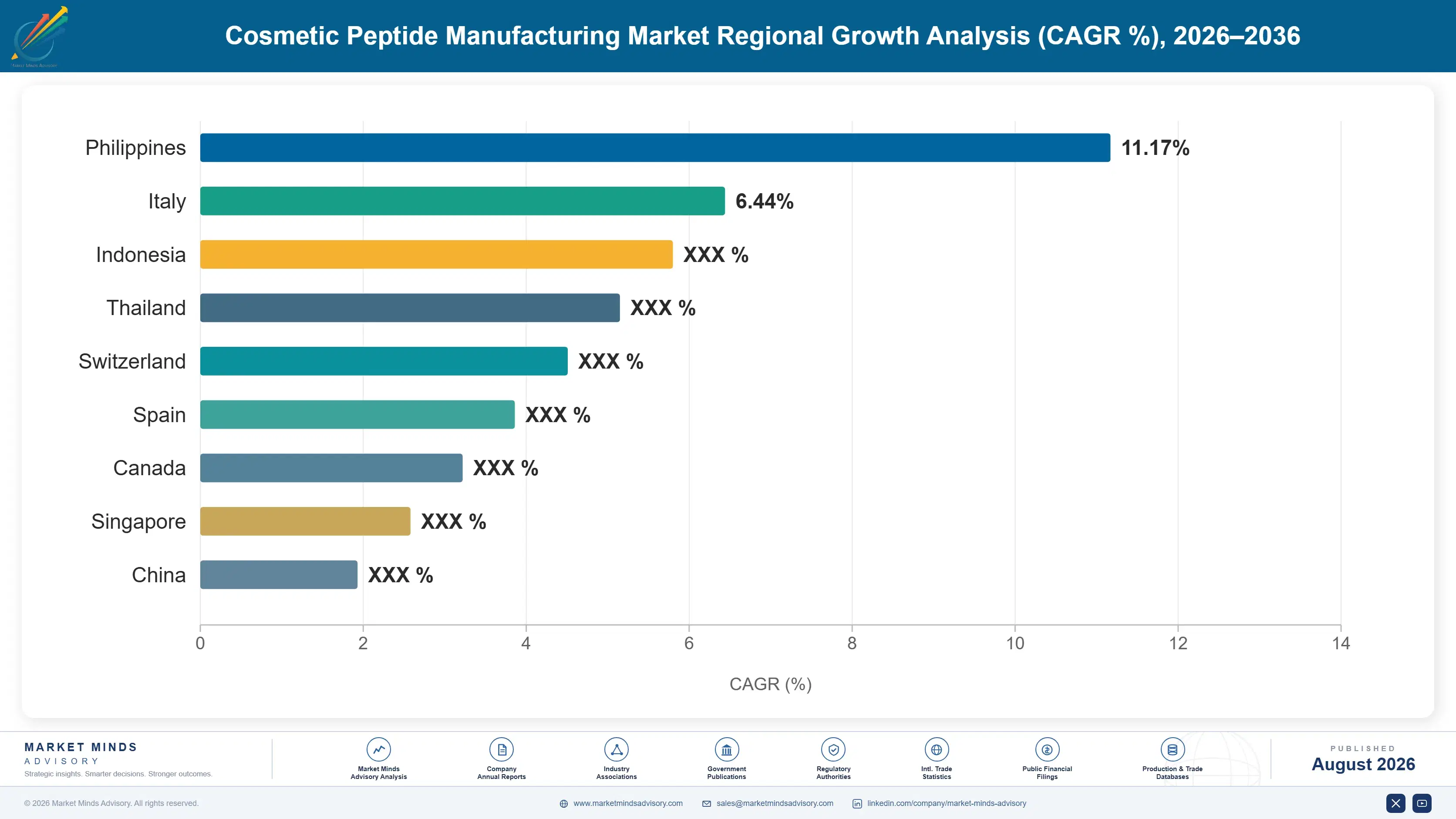
China: 16.4% CAGR
Fastest Growth Region
South Asia and Pacific: 11.4% CAGR
Largest Region
East Asia: 30% of 2025 global value
Market Leaders
Croda International, Lubrizol, Givaudan, BASF, and Bachem. Source: MMA Primary Research Dataset, July 2026.
Primary Survey
n=3,800 procurement and R&D decision-makers, Q4 2025, six countries
Methodology
Demand-side build-up, cross-validated against public data, 47 expert interviews

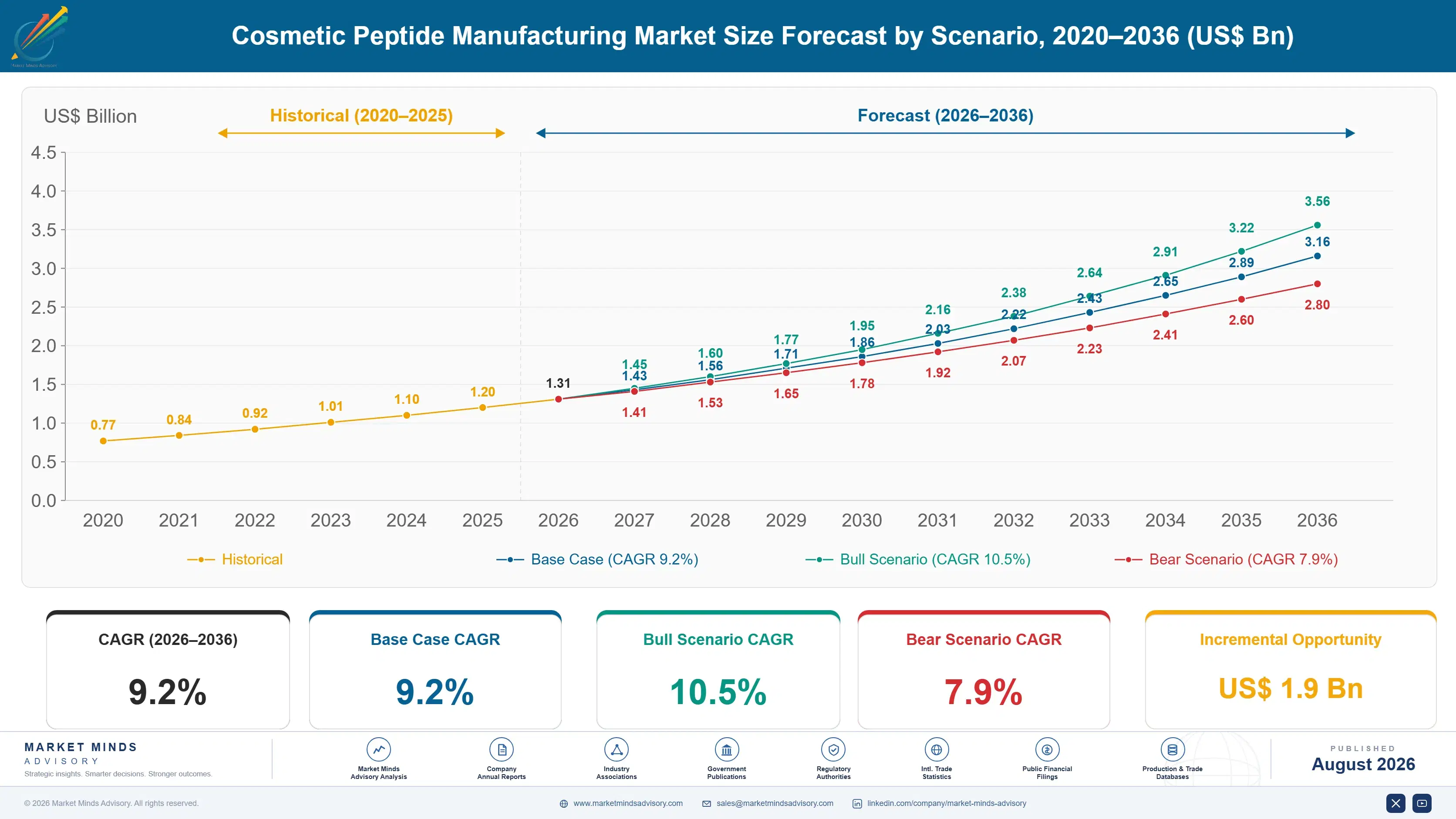
Cosmetic Peptide Manufacturing Market Forecast Scenarios

cosmetic-peptide-manufacturing-market-size-forecast-scenario-1787304235015
Growth ran at roughly 8.0% between 2020 and 2025, and two developments shaped it. Consumer interest in ingredient efficacy rose sharply as skincare buyers began reading formulation lists and asking what actually works, which favoured peptides over vaguer botanical claims. Against that, core patents expired on the sequences that built the category and Chinese suppliers entered with identical molecules at far lower prices, compressing branded pricing considerably.
Base case growth of 9.2% rests on three mechanisms. Recombinant and fermentation-derived peptides keep expanding as European solvent restrictions make solid-phase synthesis progressively harder and more expensive to operate at any scale. Chinese domestic beauty brands increasingly specify domestically produced actives, and they have built genuine formulation capability behind that preference. And claims substantiation demand rises as cosmetic regulation tightens, which favours suppliers providing dossiers over those selling molecules alone.
The bull case at 10.5% assumes recombinant production reaches cost parity with synthesis across the major sequences, which would widen the addressable formulation base considerably at lower price points. The bear case at 7.9% is a commoditisation case: if formulators accept generic sequences without supplier dossiers and substantiate claims themselves, the twelve-fold premium branded actives currently command compresses toward manufacturing cost.

Cosmetic Peptides: Dossier Value and Route Transition

The commercial logic here rests on an unusual asymmetry. A peptide costs several thousand dollars a kilogram and appears in a finished serum at concentrations measured in parts per million, so it contributes cents to a product retailing above fifty dollars. Formulators are therefore almost entirely insensitive to active cost and highly sensitive to whether the ingredient supports a claim they can print on the carton.
TOP FIVE CONCENTRATION39%Branded active houses and merchant manufacturers rarely compete directly
BRANDED ACTIVE PREMIUM12 timesPrice multiple over identical generic sequences from Asian suppliers
AVERAGE PEPTIDE PRICEUSD 4,800Blended supplier price per kilogram across cosmetic peptide grades
TYPICAL INCLUSION LEVEL2%Proportion of finished formulation occupied by peptide active solution
SYNTHESIS STEP COUNT8 stepsCoupling cycles required for a typical cosmetic peptide sequence
RECOMBINANT ROUTE SHARE17%Cosmetic peptide volume produced by fermentation rather than chemical synthesis
That is why patent expiry did not collapse the category. Core patents on the sequences that established cosmetic peptides lapsed years ago, and Chinese suppliers offer identical molecules at a fraction of branded pricing. Branded houses still command roughly twelve times that price, because what they sell is a clinical dossier, an instrumental measurement package and a marketing story that a formulator can use immediately without commissioning its own study.
Production route is where the genuine change is happening. Solid-phase synthesis consumes very large volumes of dimethylformamide and related solvents that European regulation has been restricting steadily, and generates waste on a scale that sits awkwardly with the sustainability claims cosmetic brands now make. Fermentation and recombinant expression avoid both problems entirely, and Chinese producers have industrialised that route considerably faster than Western suppliers.
"Nobody formulating a serum is optimising the cost of the peptide, because it rounds to nothing. They are buying permission to make a claim, and the supplier who hands over a finished clinical dossier has sold something the identical molecule from a Chinese catalogue cannot replace."
Director, Personal Care Ingredients and Specialty Chemicals Practice · MMA Chemi

Market Trends

Recombinant production displaces solvent-intensive solid-phase synthesis

Solid-phase peptide synthesis consumes very large volumes of dimethylformamide and N-methylpyrrolidone, both under progressive European regulatory restriction, and generates waste streams that sit uncomfortably beside the sustainability claims cosmetic brands now make routinely. Fermentation and recombinant expression produce the same or functionally equivalent sequences without either problem. Chinese producers industrialised recombinant collagen and peptide expression well ahead of Western suppliers, and roughly 17% of cosmetic peptide volume now comes through that route rather than through chemistry. Building comparable capability in Europe or North America takes years that nobody has spare, and the regulatory pressure is tightening rather than stabilising.
Market Impact: Named actives on 40% of packs
Claims dossiers become the product rather than the molecule

Cosmetic regulation across Europe and increasingly elsewhere requires substantiation for every efficacy claim, and commissioning an instrumental or clinical study costs a formulator far more than the ingredient ever will. Suppliers providing complete dossiers covering wrinkle depth, elasticity, hydration and consumer perception hand a brand something it can use immediately. That package rather than the peptide itself sustains the roughly twelve-fold premium branded actives command over identical sequences available from Asian catalogue suppliers. Chinese suppliers have now begun bundling their own study packages with generic sequences, which attacks that defence directly rather than around it.
Market Impact: Chinese demand growing at 16.4%

Market Opportunities and Growth Drivers

Ingredient-literate consumers reward demonstrable efficacy claims

Skincare buyers now read ingredient lists, follow formulation discussion online and ask what a product actually does, which has shifted brand differentiation from fragrance and packaging toward demonstrable active performance. Peptides answer that better than vague botanical positioning because published mechanism and instrumental data exist. Brands respond by naming actives on front-of-pack and by specifying branded ingredients whose recognition consumers already carry. That behaviour rewards suppliers who invest in consumer-facing ingredient brands rather than selling anonymously. Suppliers who built consumer-recognisable ingredient brands capture that behaviour, and anonymous merchant manufacturers capture none of it.
Market Impact: Generic sequences cost 12 times les

Chinese domestic brands specify domestically produced actives

Chinese skincare brands have taken substantial domestic share from international houses and increasingly formulate with actives produced within China, supported by regulatory changes that simplified domestic ingredient registration while keeping imported novel ingredient approval slow. Giant Biogene and Bloomage built integrated positions across recombinant collagen and hyaluronic acid on exactly that basis. The effect is a large formulation market that Western active suppliers reach only partially, and one growing at 16.4% annually. Western active suppliers reach only part of that formulation market, and local registration or production are the only routes into the rest.
Market Impact: Under 5% reaches viable tissue

Market Restraints and Challenges

Expired patents allow identical sequences at a fraction of price

Core patents covering palmitoyl pentapeptide and acetyl hexapeptide chemistry lapsed years ago, and Chinese catalogue suppliers now offer those exact sequences at prices far below branded actives. The root cause is that peptide synthesis is well understood and no longer difficult for a competent manufacturer. Commercial impact would be severe if formulators bought on molecule alone, and mostly they do not. Branded houses defend through clinical dossiers, stabilised complexes, delivery systems and novel sequences that carry fresh protection. Novel sequences carrying fresh patent protection are the only genuinely durable answer available here.
Market Impact: Recombinant route reaching 17% shar

Peptide penetration through skin remains poorly solved

Peptides are hydrophilic and comparatively large, and the stratum corneum is specifically designed to exclude exactly that kind of molecule, so a meaningful proportion of applied active never reaches viable tissue. The root cause is straightforward physical chemistry rather than any formulation failing. Commercial impact is persistent scepticism about topical peptide efficacy among dermatologists and increasingly among consumers. Suppliers respond with encapsulation, lipidated sequences, penetration enhancers and delivery complexes, which are considerably harder to copy than the peptide itself. Those systems are where a branded active house genuinely earns its position today.
Market Impact: Sustains roughly 12 times pricing
3 additional market trends, 4 additional growth drivers, and 2 additional restraints and challenges are covered in the full report. Contact sales@marketmindsadvisory.com to access the complete intelligence.

Segment CAGR and Growth Architecture

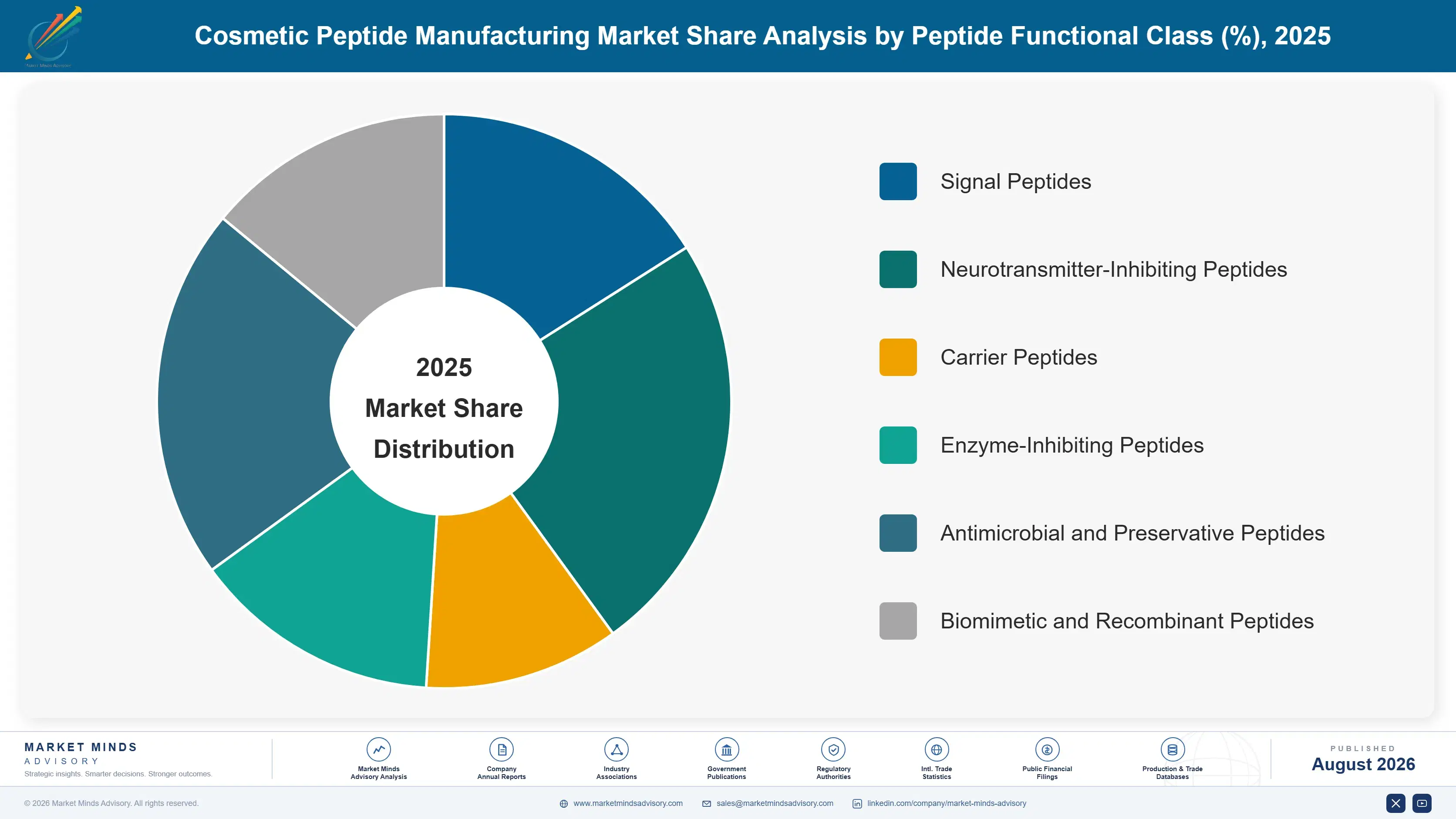
Segmentation follows peptide functional class, because mechanism determines the claim a formulator can make, the clinical evidence required to support it, the concentration used and the price the ingredient commands. Six classes cover cosmetic peptide supply without overlap. Production route, whether solid-phase synthesis or fermentation, cuts across every class and is treated as a manufacturing attribute here.
cosmetic-peptide-manufacturing-market-market-share-analysis-1787304235547

Biomimetic and Recombinant Peptides

Growing at 13.8%, a full 1.50x the market rate, these peptides are expressed through fermentation in engineered microorganisms rather than assembled by sequential chemical coupling. That avoids the dimethylformamide and related solvent consumption European regulation keeps restricting, and it removes waste volumes that sit badly against the sustainability positioning cosmetic brands now adopt routinely. Recombinant collagen fragments and biomimetic sequences dominate the segment commercially. Chinese producers industrialised the route years ahead of Western suppliers and hold a genuine manufacturing lead, which is unusual in specialty ingredients and difficult to close quickly. Chinese domestic beauty brands specify these actives preferentially, which gives the segment a formulation base that Western suppliers reach only partially.
CAGR 13.8%

Neurotransmitter-Inhibiting Peptides

Neurotransmitter-inhibiting peptides grow at 11.4% on a consumer proposition that requires no explanation: reduced expression line appearance without an injection. Acetyl hexapeptide sequences established the category and their core patents have expired, so generic supply is widely available and inexpensive. What sustains branded pricing is instrumental wrinkle depth data, consumer perception studies and formulation stability packages that a catalogue supplier does not provide. Demand has strengthened alongside the aesthetic injectable boom rather than being displaced by it, because topical products reach consumers unwilling to accept a needle. The category grew alongside the aesthetic injectable boom rather than being displaced by it, because topical products reach consumers unwilling to accept any needle.
CAGR 11.4%
Full segment breakdown across 6 segments available in the complete report.

Regional Architecture and Country Demand Map

Regional value follows formulation activity and active ingredient sourcing preference rather than cosmetic consumption, and those diverge considerably. Manufacturing capacity has concentrated in Asia while claims substantiation capability and branded active ownership remain largely European. Manufacturing and claim ownership have separated across geographies almost completely.

East Asia

East Asia takes the largest share at 30% and holds it on manufacturing and formulation together. Chinese peptide synthesis capacity around Hangzhou and Chengdu supplies both domestic and export demand at costs Western producers cannot match, and Chinese producers industrialised recombinant expression years ahead of anyone else. Domestic beauty brands have taken substantial share from international houses and increasingly specify domestically produced actives, supported by ingredient registration rules that favour local supply. Korean formulation houses are among the most technically capable anywhere and export finished products globally. Japanese demand is smaller, older and quality-driven rather than price-driven. Manufacturing scale and formulation demand reinforce each other here in a way no other region matches.
Share: 30% | CAGR: 10.4% (2026 to 2036)

Western Europe

Twenty-four per cent of value, growing at 7.8%, the slowest rate of the seven regions. The region owns the branded active franchises that defined this category, with Croda's Sederma business and Lubrizol's Lipotec operation both European, and it owns the claims substantiation capability that sustains their pricing. Cosmetic regulation here is the strictest anywhere and drives dossier requirements that suppliers elsewhere then have to meet for export. Solvent restriction under chemicals regulation is also tightest here, which pushes synthesis capacity outward while keeping formulation science, testing and brand ownership firmly in place. Claim ownership stays here while the chemistry increasingly does not, which is an uncomfortable position to hold long term.
Share: 24% | CAGR: 7.8% (2026 to 2036)
Regional intelligence for 5 additional markets available in the complete report: North America, South Asia and Pacific, Latin America, Middle East and Africa, Eastern Europe. Contact sales@marketmindsadvisory.com.
cosmetic-peptide-manufacturing-market-country-cagr-analysis-1787304236066

Where Peptide Active Value Is Captured

The molecule contributes cents to a finished product and the patents that once protected it have expired, so nothing durable is won on the sequence itself. Value accrues to whoever hands a formulator a usable claim, whoever solves delivery, and whoever can manufacture without the solvents regulators keep restricting. The sequence itself defends nothing.

Sell the substantiation dossier rather than the sequence

Commissioning instrumental and consumer studies costs a brand far more than the ingredient ever will, and cosmetic regulation increasingly requires that substantiation before any claim reaches a carton. Suppliers providing complete dossiers covering wrinkle depth, elasticity, hydration and perception hand over something immediately usable. That package rather than the molecule sustains roughly 12 times the price of identical generic sequences. Investment in clinical and instrumental testing is therefore a pricing strategy rather than a marketing cost, and most merchant manufacturers never make it. Most merchant manufacturers never make that investment at all.
Market Impact: Sustains roughly 12 times the gener

Build delivery systems competitors cannot copy from a catalogue

Peptides are hydrophilic and large, and the stratum corneum excludes exactly that kind of molecule, so under 5% of applied active typically reaches viable tissue. Encapsulation, lipidation, penetration enhancers and stabilised complexes address that and are considerably harder to reverse-engineer than a sequence anyone can synthesise. A formulator choosing between an identical peptide with and without a validated delivery system is not making a price comparison. Delivery science is where a branded active house genuinely earns its position now. A formulator choosing between identical peptides with and without validated delivery is not making a price comparison.
Market Impact: Under 5% of applied active reaches

Move production toward fermentation ahead of solvent restriction

Solid-phase synthesis depends on dimethylformamide and related solvents that European chemicals regulation keeps restricting, and the waste volumes involved contradict the sustainability positioning cosmetic brands now adopt as standard. Fermentation routes avoid both, and roughly 17% of volume already comes that way. Chinese producers industrialised recombinant expression years ahead of Western suppliers and hold a real manufacturing lead. Building or acquiring fermentation capability is a regulatory necessity dressed as a technology choice. Chinese producers industrialised the route years ahead and hold a genuine manufacturing lead that Western suppliers cannot close quickly.
Market Impact: Fermentation already covers 17% of

Register and supply into Chinese domestic formulation directly

Chinese domestic brands have taken substantial share from international houses and increasingly specify actives produced within China, supported by registration rules that make domestic ingredients considerably easier to adopt than imported novel ones. That formulation market grows at 16.4% annually and Western active suppliers reach only part of it. Local registration, local production or a genuine domestic partnership are the available routes, and all three take years. Suppliers treating China as an export destination rather than a formulation market are reaching the smaller half of it. Treating China as an export destination reaches the smaller half.
Market Impact: Chinese demand is now compounding a

Who Controls the Margin Pool

Concentration sits at 39% across the top five, measured on annual revenue from cosmetic peptide actives and associated claims substantiation, the single basis applied throughout. Croda International through Sederma and Lubrizol through Lipotec own the branded active franchises that created this category. Givaudan and BASF reach formulators through broad active ingredient portfolios, while Bachem sells peptide manufacturing capacity rather than branded ingredients, which is a completely different
Competition runs on evidence and delivery rather than on the molecule, since core patents lapsed and any competent manufacturer can produce the established sequences. Branded houses compete on dossier depth, formulation stability, delivery technology and the consumer recognition their ingredient brands carry. Merchant manufacturers compete on synthesis cost, purity and capacity, and largely serve different customers entirely.

Pressure builds from two directions. Chinese suppliers offer identical generic sequences at a fraction of branded pricing and are now adding their own substantiation packages, which attacks the dossier defence directly. Separately, recombinant production is advancing faster in China than in Europe, which threatens the manufacturing position as well as the pricing one. Rankings shift most where a supplier pairs a novel sequence with delivery technology and a complete claims package.
cosmetic-peptide-manufacturing-market-company-positioning-matrix-1787304236593

Competitive Moat and Risk Dimensions

CRODA INTERNATIONAL

Moat: Branded active recognition depth

Sederma built ingredient brands that consumers recognise on packaging, which is rare for a raw material and gives formulators a reason to specify by name rather than by sequence. Decades of accumulated clinical and instrumental data support claims a catalogue supplier cannot match, and reformulating away from a named active carries marketing consequences beyond the ingredient cost itself.
CRODA INTERNATIONAL

Risk: Expired sequence protection

The molecules underpinning the strongest franchises are no longer protected, and Chinese suppliers offer them cheaply while adding their own substantiation packages. European solvent restriction raises the cost of synthesis capacity the company operates. Recombinant production capability sits further behind Chinese competitors than the company's overall position would suggest.
BACHEM

Moat: Peptide manufacturing scale capability

Bachem operates peptide synthesis at pharmaceutical quality and scale, which very few manufacturers can match, and cosmetic supply runs across infrastructure whose principal justification is therapeutic peptide demand. That gives it cost absorption and quality credentials no cosmetic-only producer can approach, and capacity availability that matters when a formulator scales a successful product.
BACHEM

Risk: No branded active position

Selling capacity rather than branded ingredients means competing on synthesis cost against Chinese manufacturers with permanently lower operating cost bases. The company captures none of the twelve-fold premium that dossier-backed branded actives command. Recombinant routes bypass chemical synthesis entirely, which threatens the specific capability the whole position rests on.

Players Tracked

Prominent Players

Croda International
Lubrizol
Givaudan
BASF
Bachem

Other Key Players

Evonik Industries
CordenPharma
PolyPeptide Group
Ashland
Clariant
Symrise
Seppic
Chengdu Youngshe Chemical
Hangzhou Peptide Biochem
GL Biochem
Anhui Sunhere Pharmaceutical
Shaanxi Jintai Biological
Giant Biogene
Bloomage Biotechnology
Sino Lion

Recent Developments

MARCH 2025

European solvent restrictions tighten conditions for peptide synthesis operations

European chemicals regulation tightened permitted use conditions for dimethylformamide and related aprotic solvents central to solid-phase peptide synthesis, raising compliance cost and handling requirements for manufacturers operating that route within the region rather than prohibiting it outright. Compliance cost rose immediately for every European operator.
Signal: Solvent regulation is pushing peptide synt
AUGUST 2025

Giant Biogene expands recombinant collagen and peptide production capacity

Giant Biogene commissioned additional recombinant expression capacity for collagen fragments and biomimetic peptides, an organic expansion rather than an acquisition, serving Chinese domestic beauty brands that increasingly specify actives produced within China over imported equivalents. No chemical synthesis step is involved in the process at any point.
Signal: Chinese producers now hold a genuine manuf
JANUARY 2026

Chinese catalogue suppliers add clinical substantiation packages to generic sequences

Several Chinese peptide suppliers began offering instrumental and consumer study packages alongside generic sequences whose patents had expired, directly targeting the substantiation dossier that has sustained branded active pricing at many multiples of manufacturing cost. Study methodology varies considerably between the various suppliers offering them.
Signal: The substantiation dossier defence is now

Amino Acid, Solvent and Purification Exposure

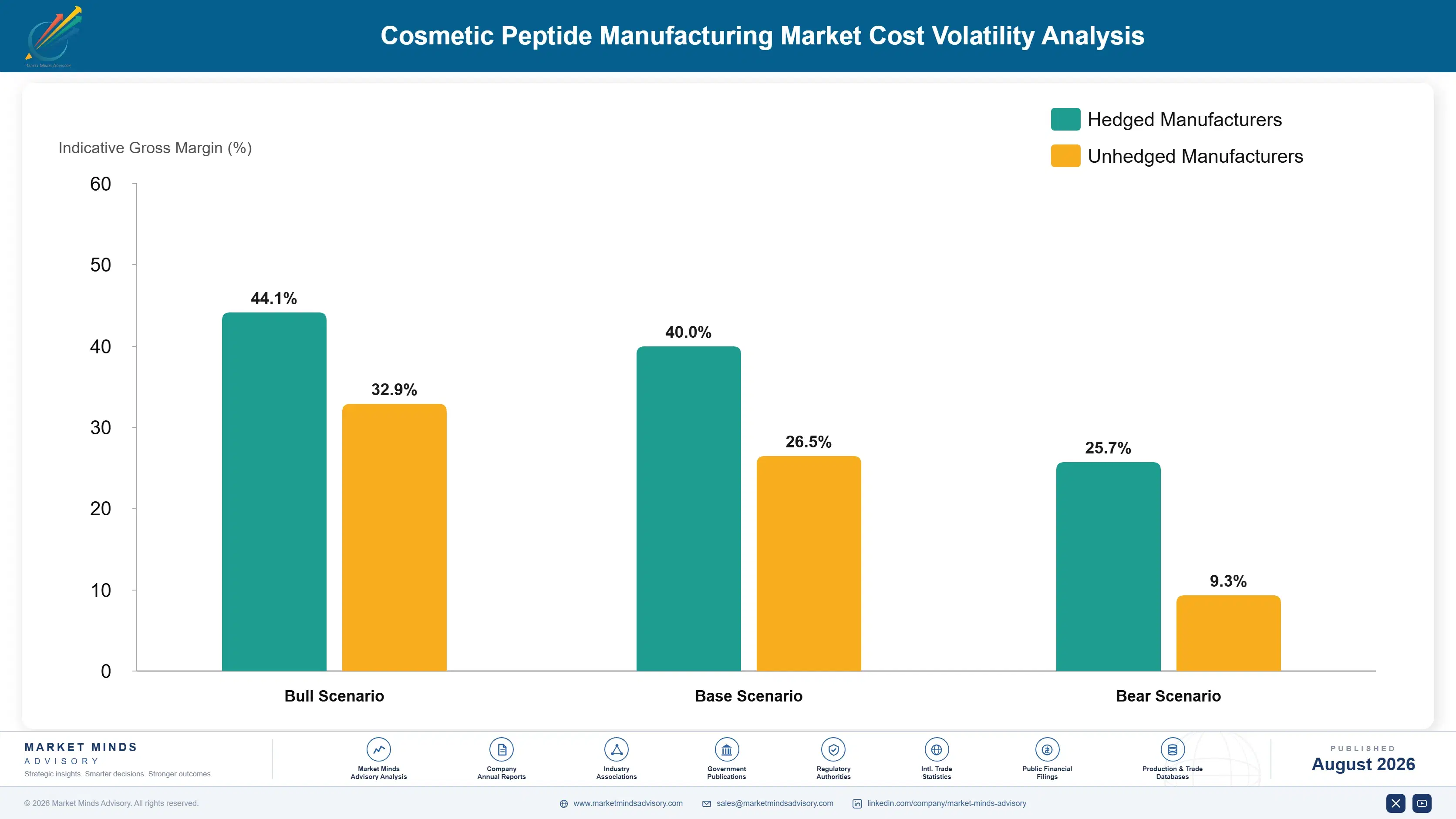
Cost structures in solid-phase synthesis are dominated by protected amino acid building blocks and by solvent consumption rather than by equipment. Protected amino acid derivatives account for roughly 33% of cost of goods, sourced predominantly from Chinese and Japanese producers. Solvents including dimethylformamide, and the purification chromatography that follows, contribute a further 27% together, and waste disposal adds materially where environmental compliance is strictest.
European solvent regulation through 2023 and 2025 illustrated the exposure. Restrictions on aprotic solvents central to peptide coupling raised handling, ventilation and disposal requirements for manufacturers operating within the region, and Bachem and PolyPeptide Group both referenced regulatory compliance and cost pressure in their reporting across those years. Cosmetic customers on annual price agreements could not absorb the increase, so margin took most of it.

The disadvantage falls on Western synthesis operators competing against both Chinese chemistry and fermentation routes simultaneously. A European plant carries solvent compliance, energy and labour costs that a Chinese facility does not, while a fermentation producer avoids the solvent question altogether. Geography compounds it directly: amino acid building blocks themselves come predominantly from Asia, so a Western manufacturer imports its principal input and then adds the highest compliance cost anywhere.
cosmetic-peptide-manufacturing-market-cost-volatility-analysis-1787304236790

Build or acquire fermentation capability rather than defending synthesis

Solvent restriction is tightening rather than stabilising, and no procurement or process improvement removes an input that regulation is progressively restricting. Fermentation routes avoid the question entirely and already supply roughly 17% of volume. Building that capability takes years, which is precisely why the decision cannot wait for the restriction to become prohibitive. Waiting makes the decision harder.

Qualify secondary protected amino acid suppliers outside single-country sourcing

Protected amino acid derivatives are the largest input cost and come predominantly from a narrow set of Asian producers. Qualifying alternative suppliers across the derivative range costs analytical and documentation work that only makes sense done once for many sequences, and it removes an exposure that has interrupted production at several manufacturers. Documentation work pays across many sequences.

Recover and recycle process solvents at the synthesis site

Solvent purchase and disposal together represent a substantial cost line that grows with every regulatory tightening. On-site distillation and recovery reduces both simultaneously and improves the waste profile that cosmetic customers increasingly ask about. Capital cost is modest against a compliance burden that is not going to ease at any point. Customers increasingly ask about it.

Portfolio Architecture for Margin Defence

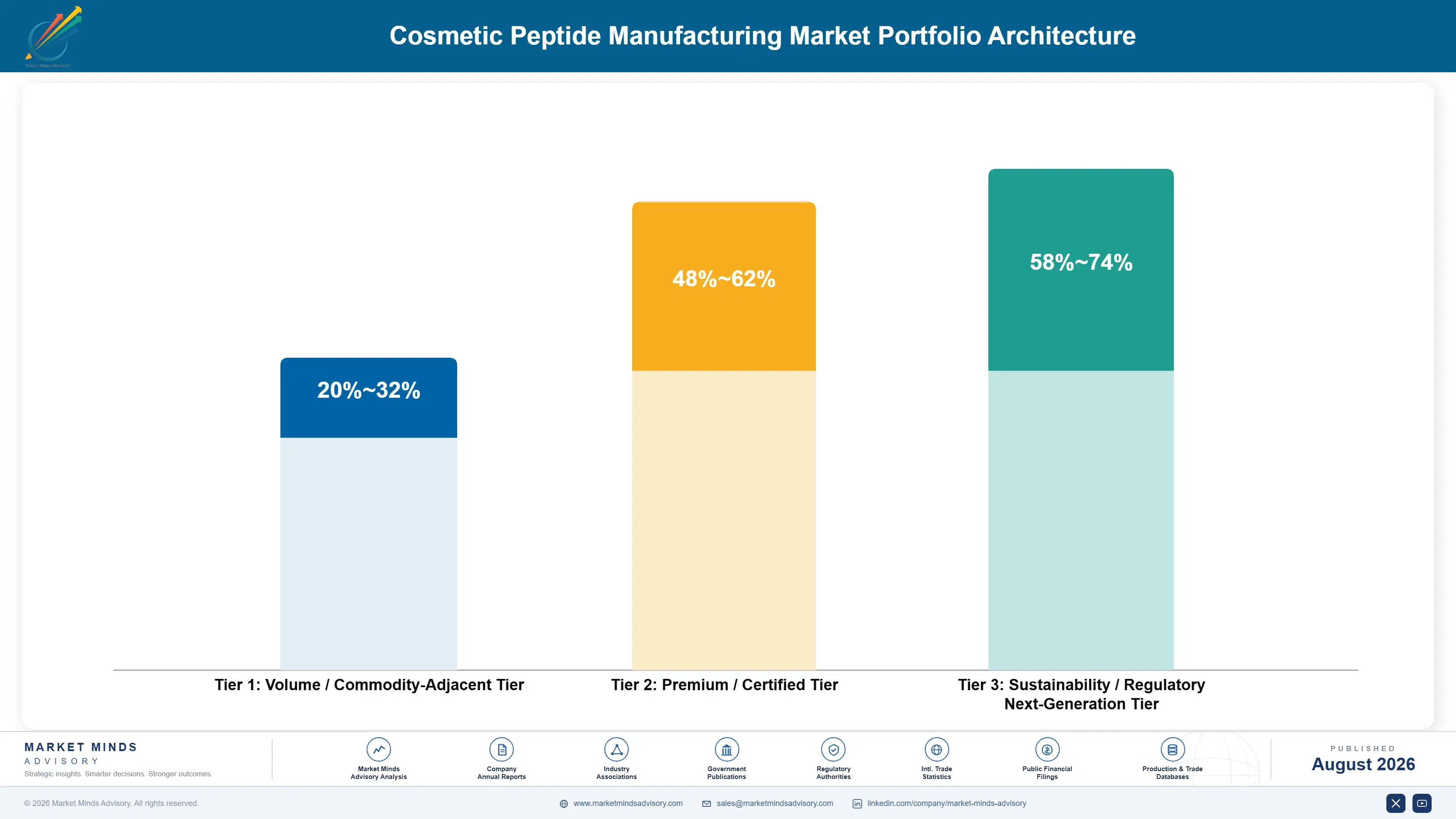
Margin architecture divides on whether a supplier sells a molecule or a claim. Generic sequences whose patents expired are supplied by many manufacturers at prices approaching synthesis cost, and nothing about them is defensible. Branded actives carrying clinical dossiers earn many times that, because the formulator is buying substantiation rather than material. Delivery-complexed and novel protected sequences earn most, since neither can be copied from a catalogue.
The volume versus premium tension is unusually clean because the two businesses barely overlap. Merchant peptide manufacturers sell tonnage into contract formulators on synthesis cost, competing directly with Chinese producers. Branded active houses sell kilograms into brand formulation teams on evidence, competing on dossier depth. Very few companies run both well, and the ones attempting it generally find the sales organisations required have almost nothing in common.

High-value pools sit where a claim needs defending or a molecule needs delivering. Novel protected sequences, encapsulated and lipidated complexes, and actives carrying complete instrumental and consumer study packages all price on what they enable rather than on what they cost. Generic expired sequences sold from an Asian catalogue sit at the opposite extreme entirely, competing on purity specification and delivered price alone.

Volume / Commodity-Adjacent Tier

Generic expired-patent sequences supplied from catalogue at prices approaching synthesis cost, where Chinese manufacturers set the floor and purity specification is the only variable a buyer actually compares. Nothing here is defensible at all.
Gross Margin: 20-32%

Premium / Certified Tier

Branded actives carrying instrumental and consumer substantiation dossiers, where the formulator buys a usable claim rather than a material and reformulating away carries marketing consequences beyond ingredient cost. Chinese suppliers are now attacking this position directly.
Gross Margin: 48-62%

Sustainability / Regulatory / Next-Generation Tier

Recombinant and fermentation-derived peptides, novel protected sequences and validated delivery complexes, protected by manufacturing route, patent position and formulation science that catalogues cannot supply. Neither the route nor the formulation science copies easily from anywhere.
Gross Margin: 58-74%
cosmetic-peptide-manufacturing-market-portfolio-architecture-1787304237292

Formulation Cycles Against Reformulation Inertia

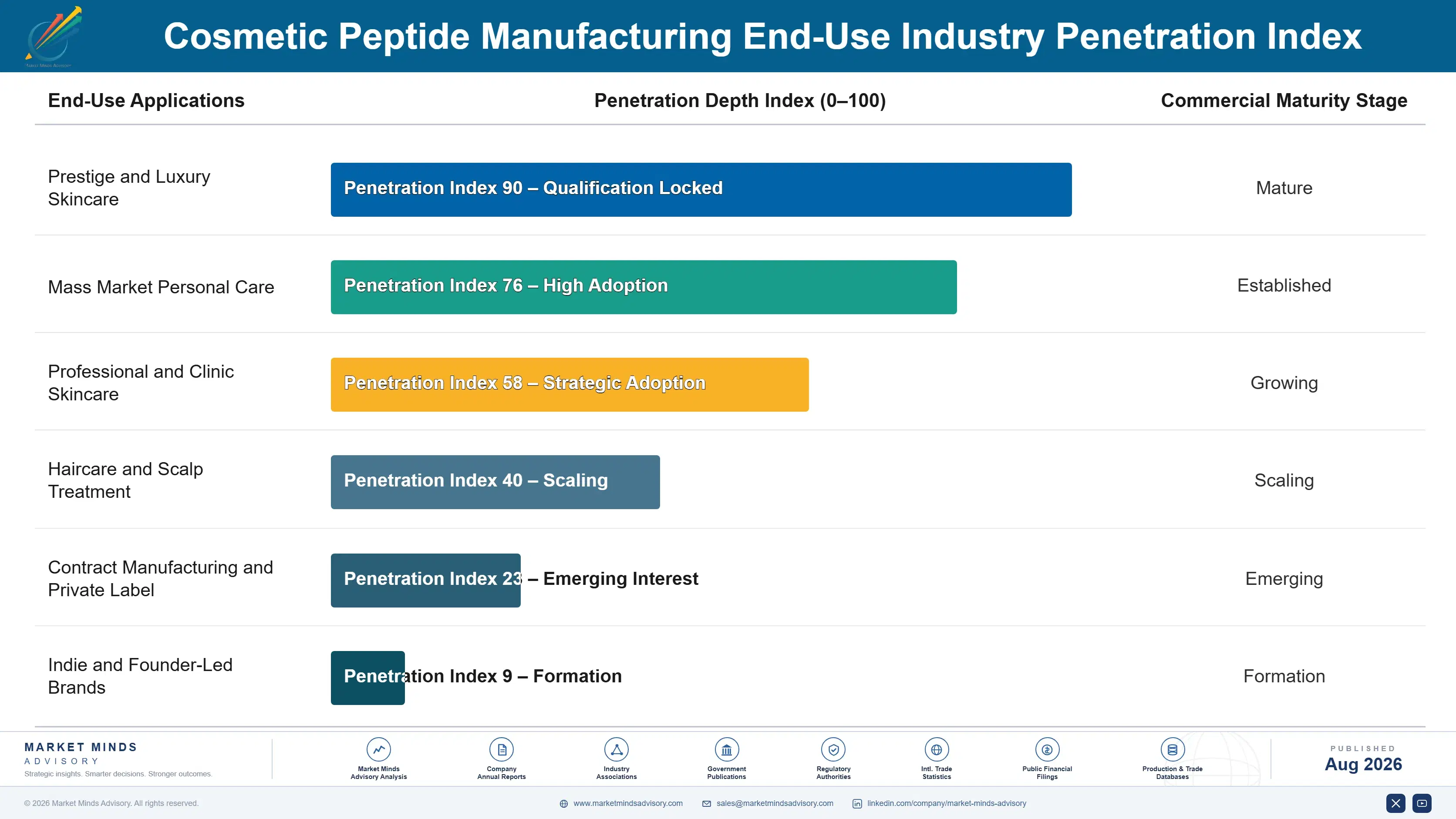
Demand attaches to formulations rather than to brands, and a formulation is written once and produced for years. A supplier whose active is specified into a successful serum receives repeat orders for as long as that product stays on shelf, which in prestige skincare is frequently a decade. Winning the specification decision is therefore worth far more than any individual order, and losing it is difficult to reverse before reformulation.
Stickiness comes from reformulation cost rather than from contract. Changing a peptide means retesting stability, repeating efficacy substantiation, potentially amending regulatory notifications and, where the ingredient is named on pack, revising packaging and marketing. That is expensive enough that formulators rarely switch for price alone, particularly when the active contributes cents to the finished product. Generic sequences supplied into private label formulations show far weaker attachment.

Buyer profiles differ sharply by customer type. Large beauty houses have formulation scientists and regulatory teams who evaluate dossiers properly and negotiate hard on supply terms. Indie and founder-led brands buy through contract manufacturers and frequently select actives on ingredient brand recognition alone. Chinese domestic brands increasingly require locally produced and registered actives regardless of what a Western supplier offers.
cosmetic-peptide-manufacturing-market-end-use-penetration-index-1787304237783

Where Peptide Supply Strategy Lands

These are among the four positions where our research anticipates prominent divergence between winners and laggards over the coming forecast period. Each is grounded in the demand model, the regulatory perimeter, and the announced capacity pipeline.
01 / DOSSIER INVESTMENT PRIORITY

Formulators buy substantiation, not the molecule itself

A peptide contributes cents to a serum retailing above fifty dollars, so formulators are almost entirely insensitive to active cost and acutely sensitive to whether the ingredient supports a claim they can print. Commissioning the instrumental and consumer studies required costs a brand far more than the ingredient ever will. Suppliers handing over complete dossiers sustain roughly twelve times the price of identical generic sequences, which makes clinical testing investment a pricing strategy rather than any kind of marketing expense.
02 / DELIVERY TECHNOLOGY DEFENCE

Sequences are copyable and delivery systems are not

Core patents on the peptides that built this whole category expired years ago and any competent manufacturer now produces them, so the molecule itself defends nothing at all. Under 5% of applied active typically reaches viable tissue, because the stratum corneum excludes hydrophilic molecules of exactly that size very effectively. Encapsulation, lipidation and stabilised delivery complexes address that and are considerably harder to reverse-engineer, which is precisely where a branded active house genuinely earns its position in this market today.
03 / PRODUCTION ROUTE TRANSITION

Solvent regulation is tightening and will not reverse

Solid-phase peptide synthesis depends on dimethylformamide and related aprotic solvents that European chemicals regulation keeps progressively restricting, and the waste volumes involved contradict the sustainability positioning that cosmetic brands now treat as entirely standard rather than optional. Fermentation routes avoid both of those problems entirely, and they already supply roughly 17% of total category volume worldwide. Chinese producers industrialised recombinant expression several years ahead of every Western supplier, and building or acquiring comparable capability takes years that almost nobody has spare.
04 / CHINESE FORMULATION ACCESS

Exporting into China reaches only half the market

Chinese domestic beauty brands have taken substantial share from international houses and increasingly specify actives produced within China, helped along by registration rules that make domestic ingredients considerably easier to adopt than any imported novel one. That domestic formulation market compounds at 16.4% annually and Western active suppliers currently reach only part of it. Local registration, local production or a genuine domestic partnership are the only routes available at all, and every one of them takes several years to establish.

Engagement Snapshot From the Field

A live engagement with an industry participant carrying material or product regulatory and market exposure ahead of a defining policy shift, showing how our research translates into a defensible multi-year portfolio strategy.
MARKET MINDS ADVISORY · CLIENT ENGAGEMENT SUMMARY
Cosmetic Peptide Manufacturing Producer Strategic Portfolio Review and Transition Roadmap 2026·Investment Scenario on Cosmetic Peptide Manufacturing Exposure Evaluation 2025-26
CLIENT PROFILE
A European specialty active ingredient supplier selling branded cosmetic peptides to prestige and mass beauty formulators across European and North American markets, with annual peptide revenue of approximately USD 88 million (client-reported, unverified by MMA). Roughly 65% came from two ingredient families whose core sequence patents had expired. The company operated solid-phase synthesis capacity within Europe and held no fermentation capability at all.
STRATEGIC CHALLENGE
Chinese suppliers were offering the client's principal sequences at a fraction of its pricing and had begun bundling their own instrumental study packages, while tightening European solvent regulation raised the operating cost of its synthesis plant. The board wanted to know whether to defend branded pricing through further clinical investment, or to redirect capital toward fermentation capability and novel protected sequences instead.
MMA APPROACH
MMA conducted 47 expert interviews across beauty house formulation scientists, contract manufacturer technical leads, regulatory affairs specialists, indie brand founders and peptide manufacturing operators in six countries. A quantitative survey of 3,800 respondents established ingredient selection criteria, reformulation triggers and claim substantiation requirements by customer type. We then modelled revenue and margin under both options against observed Chinese pricing and European regulatory trajectories.
KEY FINDINGS
  1. Formulation scientists at large beauty houses evaluated substantiation dossiers rigorously and would not adopt an active without them, regardless of how cheaply the sequence itself was available.
  2. Indie and founder-led brands selected actives on ingredient brand recognition and supplier marketing support, showing almost no capability to evaluate underlying clinical evidence independently.
  3. Reformulation cost including stability retesting, substantiation repetition and packaging revision exceeded several years of ingredient cost savings, which explained why price-driven switching was rare.
  4. Chinese study packages accompanying generic sequences were judged methodologically weaker by European regulatory specialists, but were accepted without question in several emerging market registrations.
CLIENT PROFILE
A European specialty active ingredient supplier selling branded cosmetic peptides to prestige and mass beauty formulators across European and North American markets, with annual peptide revenue of approximately USD 88 million (client-reported, unverified by MMA). Roughly 65% came from two ingredient families whose core sequence patents had expired. The company operated solid-phase synthesis capacity within Europe and held no fermentation capability at all.
STRATEGIC CHALLENGE
Chinese suppliers were offering the client's principal sequences at a fraction of its pricing and had begun bundling their own instrumental study packages, while tightening European solvent regulation raised the operating cost of its synthesis plant. The board wanted to know whether to defend branded pricing through further clinical investment, or to redirect capital toward fermentation capability and novel protected sequences instead.
MMA APPROACH
MMA conducted 47 expert interviews across beauty house formulation scientists, contract manufacturer technical leads, regulatory affairs specialists, indie brand founders and peptide manufacturing operators in six countries. A quantitative survey of 3,800 respondents established ingredient selection criteria, reformulation triggers and claim substantiation requirements by customer type. We then modelled revenue and margin under both options against observed Chinese pricing and European regulatory trajectories.
KEY FINDINGS
  1. Formulation scientists at large beauty houses evaluated substantiation dossiers rigorously and would not adopt an active without them, regardless of how cheaply the sequence itself was available.
  2. Indie and founder-led brands selected actives on ingredient brand recognition and supplier marketing support, showing almost no capability to evaluate underlying clinical evidence independently.
  3. Reformulation cost including stability retesting, substantiation repetition and packaging revision exceeded several years of ingredient cost savings, which explained why price-driven switching was rare.
  4. Chinese study packages accompanying generic sequences were judged methodologically weaker by European regulatory specialists, but were accepted without question in several emerging market registrations.
RECOMMENDED STRATEGY
Phase 1: Phase one: continue clinical investment only on sequences with remaining patent life or genuine delivery differentiation, and stop funding studies for fully generic molecules. Phase 2: Phase two: acquire fermentation capability through partnership rather than building it, given the years required and the lead Chinese producers already hold. Phase 3: Phase three: separate commercial approaches for large beauty houses and indie brands, since evidence depth and brand recognition drive them entirely differently.
OUTCOME
The client redirected approximately USD 24 million from clinical programmes on generic sequences into a fermentation partnership and two novel protected peptides (client-reported, unverified by MMA). Blended gross margin improved about six percentage points within eighteen months, and the first recombinant-route active entered customer evaluation ahead of the internal timeline it replaced.

Frequently Asked Questions

Foundational context covering the market sizes, CAGR, scope, country, region and competition that inform every finding below. This section is provided to cover basics and most often pre-purchase conversations, answered from the MMA Primary Research Dataset.

What is the current size of the Cosmetic Peptide Manufacturing Market?

The global cosmetic peptide manufacturing market was valued at USD 1.2 billion in 2025, covering signal, neurotransmitter-inhibiting, carrier, enzyme-inhibiting, antimicrobial and recombinant peptide actives. Finished cosmetic products and pharmaceutical peptide therapeutics fall outside this definition.

How large will the Cosmetic Peptide Manufacturing Market be by 2036?

MMA forecasts the market at USD 3.16 billion by 2036, expanding 2.41 times from the 2026 base of USD 1.31 billion. That represents roughly USD 1.85 billion of incremental value across the forecast decade.

What is the CAGR for the Cosmetic Peptide Manufacturing Market 2026 to 2036?

The base case compound annual growth rate is 9.2%, with a bull case of 10.5% and a bear case of 7.9%. The bear case reflects generic sequences commoditising the substantiation premium branded actives currently command.

Which segment is growing fastest?

Biomimetic and recombinant peptides grow at 13.8%, a full 1.50x the overall market rate. Fermentation production avoids the solvents European regulation keeps restricting and the waste volumes that contradict brand sustainability positioning.

Who are the major companies in the Cosmetic Peptide Manufacturing Market?

Croda International, Lubrizol, Givaudan, BASF and Bachem together hold 39% of revenue. Branded active houses and merchant peptide manufacturers operate different businesses and largely serve different customers.

Which country is growing fastest?

China grows fastest at 16.4%, as domestic beauty brands specify locally produced actives and domestic producers lead recombinant manufacturing. East Asia is the largest region at 30% of value.

Report Segmentation Architecture

The full report scope spans multiple orthogonal segmentation dimensions, with cross-tabulated demand data provided for each dimension pair. Coverage extends further to regional breakdowns, trend trajectories, and the competitive detail needed to support segment-level decision-making.

By Peptide Functional Class

  • Signal Peptides
  • Neurotransmitter-Inhibiting Peptides
  • Carrier Peptides
  • Enzyme-Inhibiting Peptides
  • Antimicrobial and Preservative Peptides
  • Biomimetic and Recombinant Peptides

By End-Use Industry

  • Prestige and Luxury Skincare
  • Mass Market Personal Care
  • Professional and Clinic Skincare
  • Haircare and Scalp Treatment
  • Contract Manufacturing and Private Label
  • Indie and Founder-Led Brands

By Commercial Dimension

  • Branded Active Ingredient Supply
  • Merchant and Catalogue Peptide Sales
  • Custom Synthesis Contracts
  • Distributor and Agent Networks
  • Claims Substantiation Service Packages
  • Licensing and Exclusivity Agreements

By Region

  • East Asia
  • Western Europe
  • North America
  • South Asia and Pacific
  • Latin America
  • Middle East and Africa
  • Eastern Europe

Scope, Methodology, and Coverage

Every figure in this report is reproducible from documented input assumptions. The scope below maps the historical period, the forecast horizon, the segmentation dimensions, and the countries covered, alongside the underlying primary and qualitative methodology.
Historical Period
2020 to 2025
Forecast Period
2026 to 2036
Base Year
2025 (USD billions; MMA Primary Research Dataset, August 2026)
Market Definition
This market comprises the manufacture and supply of synthetic and biotechnologically produced peptides used as active ingredients in cosmetic and personal care formulations, measured at supplier revenue across branded active supply, merchant catalogue sales, custom synthesis contracts and distributor channels, including the claims substantiation packages supplied alongside them. Coverage spans signal peptides including palmitoyl pentapeptide sequences, neurotransmitter-inhibiting peptides including acetyl hexapeptide sequences, carrier peptides including copper tripeptide complexes, enzyme-inhibiting peptides, antimicrobial and preservative peptides, and biomimetic or recombinant peptides including collagen fragments produced by fermentation. Finished cosmetic and personal care products, pharmaceutical and therapeutic peptides, peptide synthesis equipment and reagents, non-peptide cosmetic actives including retinoids, acids and botanical extracts, protein hydrolysates sold as bulk ingredients, and injectable aesthetic products fall outside scope.
Quantitative Units
USD billions (current prices); peptide tonnage by functional class; price per kilogram by grade; recombinant route share of volume; formulation inclusion levels
Segmentation Dimensions
By Peptide Functional Class; By End-Use Industry; By Commercial Dimension; By Region
Regions Covered
East Asia, Western Europe, North America, South Asia and Pacific, Latin America, Middle East and Africa, Eastern Europe
Countries Covered
China, South Korea, Japan, Taiwan, Germany, France, United Kingdom, Spain, Italy, Switzerland, Netherlands, United States, Canada, Mexico, India, Australia, Indonesia, Thailand, Vietnam, Brazil, Argentina, Colombia, Chile, Saudi Arabia, United Arab Emirates, Israel, South Africa, Poland, Czechia, Hungary, and additional markets relevant to cosmetic ingredient supply analysis
Key Companies Profiled
Croda International, Lubrizol, Givaudan, BASF, Bachem, Evonik Industries, CordenPharma, PolyPeptide Group, Ashland, Clariant, Symrise, Seppic, Chengdu Youngshe Chemical, Hangzhou Peptide Biochem, GL Biochem, Anhui Sunhere Pharmaceutical, Shaanxi Jintai Biological, Giant Biogene, Bloomage Biotechnology, Sino Lion
Quantitative Methodology
Primary survey, n=3,800 respondents, Q4 2025, six countries; demand-side model with trade association cross-validation
Qualitative Methodology
47 expert interviews, Q4 2025; applied to validate demand model assumptions, identify emerging dynamics, and assess competitive positioning
Report Format
PDF and XLSX data workbook (Word format preview document)
Publisher
Market Minds Advisory
Report Code
MMA-2026-CHM-199
Published
August 2026
Contact
sales@marketmindsadvisory.com | www.marketmindsadvisory.com

Purchase the full Cosmetic Peptide Manufacturing Market Report (2026 to 2036).

The full MMA report examines a category where the molecule costs almost nothing and the claim costs a great deal, quantifying how substantiation dossiers sustain pricing on sequences that expired patents left freely available. It sizes six peptide functional classes and seven regions to 2036, modelling tonnage, pricing by grade and recombinant route share separately so that volume and value trajectories can be distinguished. Competitive assessment covers twenty suppliers on one consistent revenue basis. Input cost exposure is traced through protected amino acids, restricted solvents and purification. Four commercial levers and a strategic verdict close the report, grounded in 47 expert interviews and a 3,800-respondent survey.
Six peptide functional classes sized separately to 2036
Claims dossier premium quantified against generic sequence pricing
Recombinant route displacement modelled against solvent regulation
Twenty suppliers assessed on one consistent basis
Chinese domestic formulation access mapped by registration pathway
Anonymised client engagement with tested strategic recommendations

Built For The People Who Decide

From boardroom strategy to bench-side execution, this report is read cover-to-cover by leaders shaping the next decade of their industry, turning demand scenarios, market dynamics and valuation benchmarks into decisions.
CXOs/ Presidents/ VPs/ Managers
M&A and Corporate Development
Strategy Teams and R&D Heads
Procurement and Product Directors
Regulatory and Compliance Leaders
Investor Relations and Equity Analysts