Market Minds Advisory
Cosmetic Ingredients For Hair Removal Market

Cosmetic Ingredients For Hair Removal Market: Cosmetic Ingredients For Hair Removal Market: A Ninety Year Old Chemistry, The Smell It Cannot Escape and Claims Nobody Controlled For, 2026 to 2036

The active chemistry has not changed since the 1930s. Every innovation claim in this category is about masking the smell, calming the irritation, or improving the after-feel of a reducing agent nobody replaced.

Lead Analyst

Published

September 2026

Make Smarter Decisions with Customized Research Insights

Request a free sample report and evaluate market opportunities, growth trends, and competitive dynamics relevant to your business needs.

2025 MARKET VALUE$1.2BMarket Size 2025
2036 FORECAST VALUE$2.3BBase Case , 2026 to 2036
CAGR 2026 TO 20365.8 %Bull 7.0% / Bear 4.6%
INCREMENTAL OPPORTUNITY$1.0BNet 10- year value creation
EXPANSION MULTIPLE1.77x2036 value over 2026 base
Strategic Levers
M&A Pipeline
Regional Outlook
Country Rankings
Competitive Intelligence
Segmental Deep-dive
Call-Us : 91 93563 13602

Executive Snapshot and Market Trajectory.

Thioglycolate at high pH remains the only cosmetic chemistry that breaks keratin fast enough to sell, and it entered commercial use in the 1930s. Everything since has been about disguising it, calming it, or apologising for it. Nobody has yet managed to replace the reducing salt itself.
Sugaring and natural paste systems grow at 8.7%, half again the market rate of 5.8%, which is awkward for suppliers because a traditional sugaring paste contains three household inputs and needs almost nothing anybody sells. Post-depilatory soothing and inhibitor actives follow at 7.9%. Thioglycolate reducing agents grow slowest of anything covered here. Wax base resins and polymers grow at 6.1% as salon waxing recovers across Latin America.
South Asia and Pacific holds 26% of demand on Indian cream volume alone. Masking systems absorb around 19% of formulation cost because mercaptan release is chemically unavoidable rather than a formulation defect. And roughly 17% of published inhibitor studies used a concurrent control arm, which has not slowed the premium those actives command. Indian country growth of 11.2% leads every market covered here, and no other country comes close on volume.
Market Definition
This market covers ingredients formulated into cosmetic hair removal products, including thioglycolate reducing agents, keratin softening and conditioning agents, wax base resins and polymers, sugaring and natural paste systems, fragrance and malodour masking systems, and post-depilatory soothing and inhibitor actives. It excludes laser and intense pulsed light devices, razors and blades, epilator appliances, prescription hair reduction drug products, and hair growth promoting formulations.
Base Year Value
$1.2B in 2025 (MMA Primary Research Dataset, September 2026)
Forecast Period
2026 to 2036, eleven discrete annual values
CAGR
5.8% base case. Bull 7.0%. Bear 4.6%.
Fastest Growth Segment
Sugaring And Natural Paste Systems: 8.7% CAGR
Fastest Growth Country
India: 11.2% CAGR
Fastest Growth Region
South Asia and Pacific: 7.9% CAGR
Largest Region
South Asia and Pacific: 26% of 2025 global value
Market Leaders
Croda International, BASF, Ashland, Clariant, and Evonik Industries lead the field. Source: MMA Primary Research Dataset, July 2026.
Primary Survey
n=3,800 procurement and R&D decision-makers, Q4 2025, six countries
Methodology
Demand-side build-up, cross-validated against public data, 47 expert interviews

Cosmetic Ingredients For Hair Removal Market Forecast Scenarios

cosmetic-ingredients-for-hair-removal-market-size-forecast-scenario-1790016741329
Growth from 2020 to 2025 ran at 4.8% and came almost entirely from geography rather than chemistry. Indian and Southeast Asian volume expanded as depilatory creams moved from urban pharmacy to mass distribution, while Western European and North American cream volume was flat to declining as device-based removal took share at the premium end of the category.
The base case at 5.8% rests on three mechanisms. Indian and Chinese mass distribution keeps adding cream volume at prices that support ingredient demand without supporting much margin. Salon waxing recovers and grows in Latin America and the Middle East, which pulls wax resin and post-treatment volume with it. And premium soothing and inhibitor actives keep attaching to formulations that would otherwise compete on price alone. None of the three requires the primary chemistry to change.
The bull case at 7.0% depends on somebody producing a genuinely lower-odour reducing system, which would reset a category that has apologised for its smell for ninety years. The bear case at 4.6% is sugaring: it grows at 8.7% and a traditional paste needs sugar, lemon, and water. Ingredient suppliers capture almost nothing from that shift.

Ninety Years Of Disguising One Molecule

Calcium and potassium thioglycolate at pH above twelve break the disulphide bonds holding keratin together, and nothing else available to a cosmetic formulator does it in the five to ten minutes a consumer will tolerate. That chemistry arrived in the 1930s and has not been displaced. Enzymatic alternatives, reducing sugars, and various proprietary systems have all been tried and none works fast enough at a price anybody will pay.
TOP FIVE CONCENTRATION44%Share of ingredient revenue held by the leading suppliers
MASKING SYSTEM COST19%Share of formulation cost spent hiding the reducing agent
INHIBITOR CLAIM SUPPORT17%Inhibitor studies published with a genuine concurrent control arm
IRRITATION COMPLAINT RATE21%Users reporting stinging or redness after standard cream use
CORE CHEMISTRY AGE1930sDecade the dominant reducing chemistry entered commercial cosmetic use
SUGARING PASTE INPUTS3Household inputs a traditional sugaring paste actually requires
The consequence is a category where the mechanism and the problem are the same variable. High pH breaks the hair and high pH irritates the skin, so about 21% of users report stinging or redness. Thioglycolate degrades to mercaptans, which smell exactly as unpleasant as the chemistry suggests, and masking systems absorb roughly 19% of formulation cost without ever fully working.
Where the category found room to charge is at the edges. Post-depilatory soothing actives calm the irritation the active caused. Inhibitor actives promise slower regrowth, though only about 17% of published studies used a concurrent control arm, and the premium holds anyway. Both grow well ahead of the reducing agent itself, which tells you where value has migrated.
"Nothing in the active chemistry has changed in ninety years and the whole industry has quietly agreed not to say so. Every launch describes a breakthrough and every one of them is a fragrance, a soothing agent, or a texture change wrapped around the same reducing salt."
Practice Director, Personal Care Ingredients and Formulation Chemistry · MMA Chemicals and Materials Practice · September 2026

Market Trends

Value Migrates Away From The Active Itself

Thioglycolate reducing agents grow at 3.6%, slower than anything else covered, while post-depilatory soothing and inhibitor actives grow at 7.9% and masking systems at 6.8%. The active is a commodity salt available from a dozen producers and priced accordingly. The margin now sits in what surrounds it: the fragrance that hides the smell, the soothing agent that addresses the irritation the pH created, and the claim that regrowth will slow down. A supplier holding only the reducing salt is therefore selling into the one part of the formulation where price is the entire conversation.
Market Impact: Country grows at 11.2%
Sugaring Grows And Suppliers Capture Little

Sugaring and natural paste systems grow at 8.7%, the fastest of the six segments, on natural positioning and lower irritation than either creams or hot wax. The commercial problem is that a traditional paste contains sugar, lemon juice, and water. Suppliers can sell stabilised commercial pastes, texture modifiers, and preservative systems into the salon channel, but the ingredient content per treatment is a fraction of what a depilatory cream carries. Suppliers who treat the segment as commercially uninteresting are ceding the channel that is taking the volume, which is a decision worth making deliberately rather than by default.
Market Impact: Regions grow at 6.2%

Market Opportunities and Growth Drivers

Indian Mass Distribution Adds Volume At Scale

India grows at 11.2%, faster than any country covered, as depilatory creams move from urban pharmacy shelves into mass distribution reaching several hundred thousand additional outlets. Unit prices are low and ingredient margin is thin, but volume at that scale supports considerable absolute demand. South Asia and Pacific now holds 26% of the world market on that basis, and Indian formulators specify locally sourced thioglycolate wherever quality permits it. Western suppliers competing there on the active alone have found the cost gap unbridgeable, and the ones doing well sell softening and masking chemistry into the same formulations instead.
Market Impact: Affects 21% of users

Salon Waxing Recovery Pulls Resin Demand

Latin American and Middle Eastern salon channels grow at 6.2% and 6.0% respectively, and salon waxing consumes considerably more ingredient per treatment than home cream use. Wax base resins, polymers, and oils grow at 6.1% on that recovery. Professional channels also specify post-depilatory products as part of the service protocol rather than as an optional purchase, which attaches soothing actives to volume that home users frequently skip. Sugaring is taking share inside that channel rather than from it, which changes the ingredient mix without reducing the treatment count. Professional buyers also requalify far less often than mass market brands do.
Market Impact: Only 17% used controls

Market Restraints and Challenges

The Mechanism And The Irritation Share One Variable

Around 21% of users report stinging or redness, and the root cause is that pH above twelve is what breaks keratin and also what damages skin barrier lipids. There is no formulation route that keeps the first and removes the second. Suppliers respond with buffered release systems, with barrier lipids formulated alongside the active, and with shorter contact time protocols, all of which reduce irritation somewhat and reduce efficacy in proportion. The only approach that separates the two is barrier lipid chemistry formulated to survive the pH rather than applied after it, and that is genuinely difficult to do well.
Market Impact: Actives grow at 3.6%

Inhibitor Claims Rest On Uncontrolled Evidence

Only about 17% of published hair growth inhibitor studies used a concurrent control arm, and the root cause is that the category grew through cosmetic claim substantiation standards rather than clinical ones. Commercially the exposure is real: a regulator taking interest would remove a premium that supports considerable formulation margin. Suppliers are commissioning controlled trials and narrowing claim language toward measured regrowth density rather than any subjective assessment. Effect sizes in the properly controlled studies are modest but real, which makes this a claim quality problem rather than an efficacy one.
Market Impact: Segment grows at 8.7%
3 additional market trends, 4 additional growth drivers, and 2 additional restraints and challenges are covered in the full report. Contact sales@marketmindsadvisory.com to access the complete intelligence.

Segment CAGR and Growth Architecture

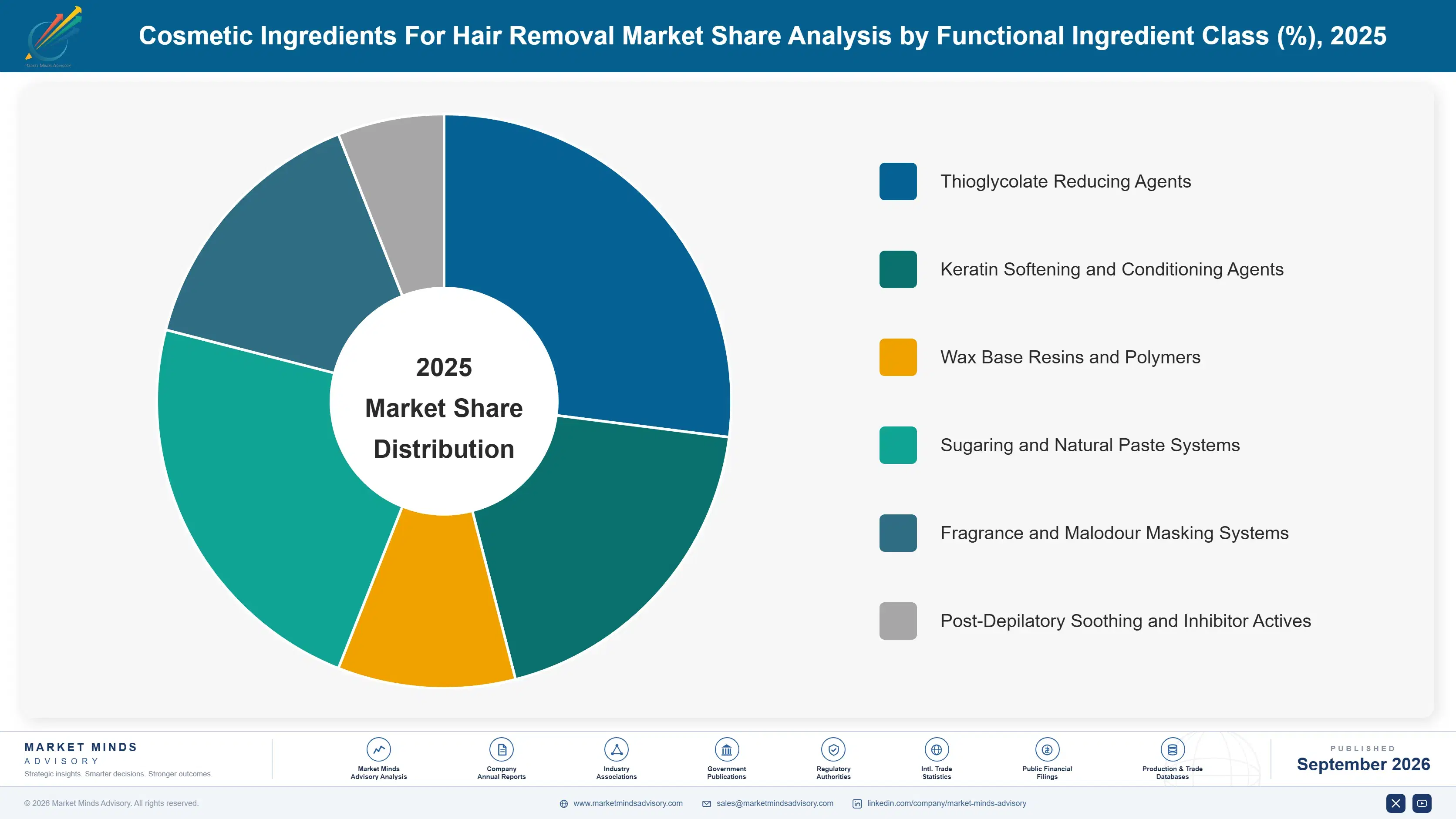
Segmentation follows functional ingredient class across six categories: thioglycolate reducing agents, keratin softening and conditioning agents, wax base resins and polymers, sugaring and natural paste systems, fragrance and malodour masking systems, and post-depilatory soothing and inhibitor actives. Removal format, channel, and regional regulatory status sit as separate dimensions. Removal technology and device based methods fall outside the defined scope entirely.
cosmetic-ingredients-for-hair-removal-market-market-share-analysis-1790016741869

Sugaring And Natural Paste Systems

Sugaring grows at 8.7%, half again the market rate of 5.8%, on natural positioning and genuinely lower irritation than either high pH cream or hot wax. The commercial difficulty is that the traditional paste is sugar, lemon, and water, so the ingredient opportunity is narrow by construction. Where suppliers do earn is in stabilised commercial pastes that hold texture across temperature and humidity, in preservative systems for a high sugar substrate, and in the polymer modifiers that let a paste be applied cold. Salon channels take almost all of that volume. Value per treatment stays well below what a depilatory cream carries, so the segment grows the market's volume considerably faster than it grows supplier revenue.
CAGR 8.7%

Post-Depilatory Soothing And Inhibitor Actives

Post-depilatory actives grow at 7.9% by addressing the damage the primary chemistry caused and by promising something the primary chemistry cannot deliver. Soothing systems built on barrier lipids, panthenol, and anti-inflammatory botanicals have a defensible technical basis given a 21% irritation complaint rate. Inhibitor actives are a weaker proposition: only around 17% of published studies used a concurrent control arm, and effect sizes in those that did are modest. The premium holds regardless, and it is where much of the category margin now sits. Soothing systems that survive the working pH rather than being applied afterwards command a materially different price, and very few suppliers can actually formulate them. That gap is where the segment's growth concentrates.
CAGR 7.9%
Full segment breakdown across 6 segments available in the complete report.

Regional Architecture and Country Demand Map

Regional shares reflect where hair removal products are manufactured and formulated rather than where ingredients are synthesised. Three regions sit outside the standard bands, for reasons named in their own paragraphs and summarised below for operator review. Removal method mix varies sharply by region and is described in each paragraph.

South Asia and Pacific

At 26% this sits far above the standard band, and the justification is that India is the largest depilatory cream market on earth by unit volume with no close competitor. Growth of 7.9% leads the seven regions and Indian country growth of 11.2% leads every market covered. Mass distribution has taken creams well beyond the urban pharmacy base that once defined the category. Southeast Asian manufacture adds a smaller but faster growing share, and local thioglycolate sourcing is now common wherever the quality supports it. Western suppliers competing on the active alone have found the cost gap unbridgeable and now sell softening and masking chemistry instead. No other country comes close on unit volume.
Share: 26% | CAGR: 7.9% (2026 to 2036)

East Asia

Chinese formulation and contract manufacture account for the bulk of regional demand, with Japanese and Korean brands contributing higher value work in low irritation and post-treatment systems. Growth of 6.7% runs above the world rate. Japanese suppliers hold particular strength in masking chemistry, which matters more here than in most regions because tolerance for mercaptan odour is notably low. Chinese producers supply thioglycolate at prices that set the world floor for the active itself. Korean formulation leads the region on low irritation systems and post-treatment protocols, with several concepts subsequently adopted by Western brands. Regional regulatory requirements on claim substantiation are tightening steadily, which favours suppliers holding measured evidence over those holding a marketing position.
Share: 24% | CAGR: 6.7% (2026 to 2036)
Regional intelligence for 5 additional markets available in the complete report: Western Europe, North America, Latin America, Middle East and Africa, Eastern Europe. Contact sales@marketmindsadvisory.com.
cosmetic-ingredients-for-hair-removal-market-country-cagr-analysis-1790016742396

Where Ingredient Suppliers Still Earn

Four commercial moves matter in a category whose active is a commodity salt nobody has replaced in ninety years. Each accepts that fact rather than pretending otherwise, and each addresses something the primary chemistry created: the smell, the irritation, the thin claim, or the sugaring problem. None of them requires replacing the active, which has proven impossible.

Sell Masking As Performance Not Fragrance

Masking systems absorb around 19% of formulation cost and mercaptan release is chemically unavoidable rather than a defect anybody can formulate out. Suppliers positioning malodour control as a measured performance specification, with headspace data rather than a fragrance brief, report specification retention 2.4 times higher. The distinction matters commercially because a fragrance is switched on price at every review and a measured odour reduction specification is not. Building the headspace measurement capability costs modestly and moves the component out of the line item where it gets shopped every year. That is exactly the point.
Market Impact: Raises specification retention rates to 2.4 times higher

Formulate Barrier Lipids Alongside The Active

Roughly 21% of users report stinging or redness because pH above twelve breaks keratin and skin barrier lipids alike. Suppliers offering barrier lipid systems formulated to survive that pH rather than added after it report complaint rates falling to between 9% and 13%. This is genuine formulation work rather than a soothing cream sold separately, and it defends a position that a commodity active supplier simply cannot occupy. Most soothing systems fail because they were formulated for neutral pH and added to something well above twelve, where they simply do not survive.
Market Impact: Cuts user complaint rates to between 9 and 13%

Commission Controlled Trials On Inhibitor Claims

Only about 17% of published hair growth inhibitor studies used a concurrent control arm, which leaves a premium resting on evidence a regulator could dismantle. Suppliers commissioning properly controlled regrowth density trials report price realisation 1.8 times higher than uncontrolled equivalents and, more usefully, hold the claim when scrutiny arrives. The trial costs a fraction of the revenue the claim currently supports across a supplier portfolio. Effect sizes in the controlled work are modest but real, which is a considerably better position than a large claimed effect nobody measured against anything.
Market Impact: Raises achieved price realisation to 1.8 times higher

Build A Sugaring Position Before It Matters

Sugaring grows at 8.7% and a traditional paste needs three household inputs, so the segment threatens ingredient demand rather than creating it. Suppliers building stabilised paste systems, high sugar preservation, and cold application polymers report capturing 4.5 times more ingredient value per treatment than the traditional preparation allows. Ignoring the segment because it looks unattractive is how a supplier arrives late to the channel that took the volume. Cold application polymers and high sugar preservation are the two technical problems worth solving, and both are tractable in a way replacing thioglycolate never was.
Market Impact: Captures 4.5 times more ingredient value per treatment

Who Controls the Margin Pool

Concentration is low. Five suppliers hold 44% of ingredient revenue, measured consistently on that basis across all participants, and the remainder spreads widely across specialty actives houses, fragrance suppliers, wax and resin producers, and Chinese and Indian thioglycolate manufacturers. The gap between leaders and challengers is narrow, because the active is long off patent and the surrounding chemistry is broadly available.
Competition currently turns on three dimensions: soothing and barrier formulation depth, which addresses the irritation the primary chemistry causes; malodour control measured as performance rather than sold as fragrance; and claim substantiation on inhibitor actives, where evidence quality varies enormously across the field. Price still decides wherever a specification names a percentage of the active, which describes a substantial share of mass market enquiries and almost none of the professional ones.

Pressure builds from two directions at once. Chinese and Indian producers set the floor on the active and are moving up into masking and softening chemistry. Sugaring grows fastest and consumes least. Rankings will shift toward suppliers holding soothing formulation depth and defensible claim evidence rather than any position in the reducing agent. The suppliers most exposed are mid-sized producers holding volume chemistry without either capability.
cosmetic-ingredients-for-hair-removal-market-company-positioning-matrix-1790016742922

Competitive Moat and Risk Dimensions

CRODA INTERNATIONAL

Moat: Soothing And Barrier Depth

Established positions across barrier lipids, botanical soothing actives, and post-treatment systems sit exactly where the category's margin has migrated. That portfolio addresses irritation the primary chemistry causes and is considerably harder for a commodity active producer to assemble than any position in thioglycolate itself. The claim evidence attached to those actives compounds the position further.
CRODA INTERNATIONAL

Risk: Limited Primary Chemistry Position

Strength in surrounding actives leaves the reducing agent conversation to somebody else, which means a formulator's first supplier call goes elsewhere. Whoever holds the active holds the relationship at specification stage, and being the second call is a materially weaker place to sell from. Closing that gap means either acquiring a primary position or accepting it permanently.
BASF

Moat: Scale Across Both Ends

Breadth spanning primary chemistry, softening agents, and specialty actives lets a single supplier answer the whole formulation rather than one part of it. That reduces the formulator's qualification burden materially and puts the supplier in the conversation at brief stage rather than at purchase order stage.
BASF

Risk: Commodity Exposure At Scale

The volume end of this portfolio competes directly against Chinese and Indian producers whose cost base cannot be matched from European or American assets. Defending that volume on service rather than price works until the challenger adds technical service, which several have now started doing. Indian producers in particular have added formulation support at pace over recent years.

Players Tracked

Prominent Players

Croda International
BASF
Ashland
Clariant
Evonik Industries

Other Key Players

Lubrizol
Solvay
Stepan Company
Innospec
Seppic
Gattefosse
Lonza
Symrise
Givaudan
Nikko Chemicals
Sino Lion
Vantage Specialty Chemicals
Lipoid Kosmetik
Bruno Bock
Arkema

Recent Developments

FEBRUARY 2026

Croda Publishes Controlled Regrowth Density Data On Inhibitor Actives

Croda International released regrowth density measurements from a concurrent controlled study on its hair growth inhibitor range, addressing an evidence gap that has left much of the category's premium resting on uncontrolled observation. The control arm data was published in full rather than merely summarised in the release.
Signal: Claim evidence quality is becoming a competitive dimension in its own right. Published control data now differentiates.
SEPTEMBER 2025

Bruno Bock Expands Thioglycolate Production Capacity In Germany

Bruno Bock completed an organic capacity expansion at its German thioglycolate site, funded internally with no partner involved, citing European formulator preference for regional supply over lower cost Asian sourcing on quality consistency grounds. The expansion targets pharmaceutical grade consistency rather than additional tonnage at commodity specification levels.
Signal: Regional supply security is being priced above unit cost by European formulators. Consistency now separates regional supply.
JUNE 2025

Ashland Acquires Specialty Sugaring Paste Systems Business

Ashland completed an acquisition of a specialty sugaring systems business holding cold application polymer technology, buying a position in the fastest growing segment where traditional preparation leaves almost nothing for an ingredient supplier. The transaction was an outright acquisition rather than a joint venture or stake.
Signal: Suppliers are buying into sugaring rather than waiting for it to matter. The fastest segment is being bought.

What The Formulation Costs

Three input groups dominate. Thioglycolic acid and its calcium and potassium salts run 30% to 38% of cost of goods sold in cream formats, and the eight-point range separates Asian from European sourcing. Fragrance and masking systems take 22% to 30%, which is extraordinary for a component that hides rather than performs. Wax base resins, oils, and polymers account for 18% to 26% in professional formats.
Thioglycolic acid pricing moved through 2024 and 2025 as chloroacetic acid and sulphur intermediate availability tightened, and American Chemistry Council statistics documented the underlying movements across the period. Several ingredient producers described the resulting margin compression in their annual reports. Natural wax and rosin inputs followed an entirely separate agricultural and forestry cycle over the same window, with pine rosin availability the binding constraint. Masking system inputs tracked fragrance sector pricing separately again.

The competitive disadvantage mechanism runs through masking cost rather than active cost. A supplier without measured odour control capability competes on the active alone, where Chinese and Indian producers hold a cost position that European and American assets cannot match. Exposure varies by portfolio breadth rather than manufacturing scale, and specialty houses with masking depth are better protected than commodity producers.
cosmetic-ingredients-for-hair-removal-market-cost-volatility-analysis-1790016743119

Contract Thioglycolic Acid Against Intermediate Cycles

Chloroacetic acid and sulphur intermediates are consumed by sectors far larger than cosmetic hair removal, so pricing follows cycles this category cannot influence in any direction. Contracting ahead of those movements rather than reacting to them removes most of the exposure and secures allocation when larger sectors compete for the same streams. Allocation matters more than price.

Treat Masking As Specification Rather Than Fragrance

Malodour control absorbs around a fifth of formulation cost and is switched on price whenever it sits in the fragrance line of a specification. Written as a measured headspace performance requirement instead, it becomes a technical qualification that a competitor cannot displace with a cheaper quotation at the next review. Headspace data costs little and changes everything commercially.

Source Rosin And Natural Waxes On Separate Cycles

Pine rosin and natural wax inputs follow forestry and agricultural availability that has no relationship to the petrochemical intermediates driving active cost. Holding both supply positions independently, with separate contracting calendars, prevents a single procurement approach from carrying exposure to two entirely unrelated markets. Rosin availability has been the binding constraint in each recent tight period.

Portfolio Architecture for Margin Defence

Margin follows distance from the active. Thioglycolate salts compete close to commodity terms against Asian producers of identical chemistry. Softening agents and wax resins earn moderately on formulation compatibility. Measured malodour control systems earn better because the performance is specified rather than preferred, and soothing, barrier, and evidenced inhibitor actives earn most of all. The spread between bottom and top tier is unusually wide.
The tension between volume and premium runs through how the brief arrives. A specification naming a percentage of calcium thioglycolate is purchasing work won on price and freight. A brief describing a low irritation cream with controlled odour and a defensible regrowth claim is a development project, and the supplier who can answer all three parts holds the formulation for its commercial life.

High-value pools concentrate in post-treatment care, in measured odour control, and in evidenced inhibitor claims, all of which exist because the primary chemistry created problems it cannot solve. Where the brief is a mass market cream at an Indian or Chinese price point, the active is the product and everything else is trimmed to whatever the cost target permits. Professional salon formulations sit closer to the premium end throughout.

Volume / Commodity-Adjacent

Thioglycolate salts, basic alkaline systems, and standard wax bases supplied against a named percentage. The ten-point range reflects feedstock position and freight rather than any capability a formulator would pay a premium for.
Gross Margin: 22% to 32%

Premium / Certified

Softening systems, specialty wax and resin blends, and measured malodour control supplied with formulation support and headspace data. The twelve-point range separates genuine performance specification from fragrance sold with a technical sheet attached.
Gross Margin: 38% to 50%

Sustainability / Regulatory / Next-Generation

Barrier lipid systems surviving high pH, controlled trial evidenced inhibitor actives, and stabilised cold application sugaring polymers. The fourteen-point range reflects evidence quality and formulation depth, neither of which can be assembled quickly.
Gross Margin: 54% to 68%
cosmetic-ingredients-for-hair-removal-market-portfolio-architecture-1790016743621

High-value Sub-segments and Strategic Watch-out

Evidenced Inhibitor Active Systems

Highest value in the category and the most exposed, since only around 17% of published studies used a concurrent control arm. The fourteen-point range reflects evidence quality, which varies more widely here than anywhere else covered. Suppliers holding properly controlled data are protected and the rest are not.
Gross Margin: 56% to 70%

High pH Barrier Lipid Systems

High value addressing a 21% irritation complaint rate with genuine formulation work rather than a separate soothing cream. The twelve-point range reflects whether the lipid system actually survives the pH it is formulated into. Most soothing systems on the market were formulated for neutral pH conditions.
Gross Margin: 48% to 60%

Measured Malodour Control Systems

Volume core absorbing around 19% of formulation cost, defensible only when written as measured headspace performance. The twelve-point range separates specified performance from fragrance, and the difference is entirely commercial rather than technical. Headspace measurement is what moves it out of the fragrance line entirely.
Gross Margin: 40% to 52%

Commodity Thioglycolate Salts

The strategic watch-out. Chinese and Indian producers set the floor, the chemistry is ninety years old, and specifications name a percentage. The ten-point range reflects feedstock position and freight alone, with nothing else defending it. Freight and feedstock position are the only remaining sources of advantage.
Gross Margin: 20% to 30%

How This Demand Repeats

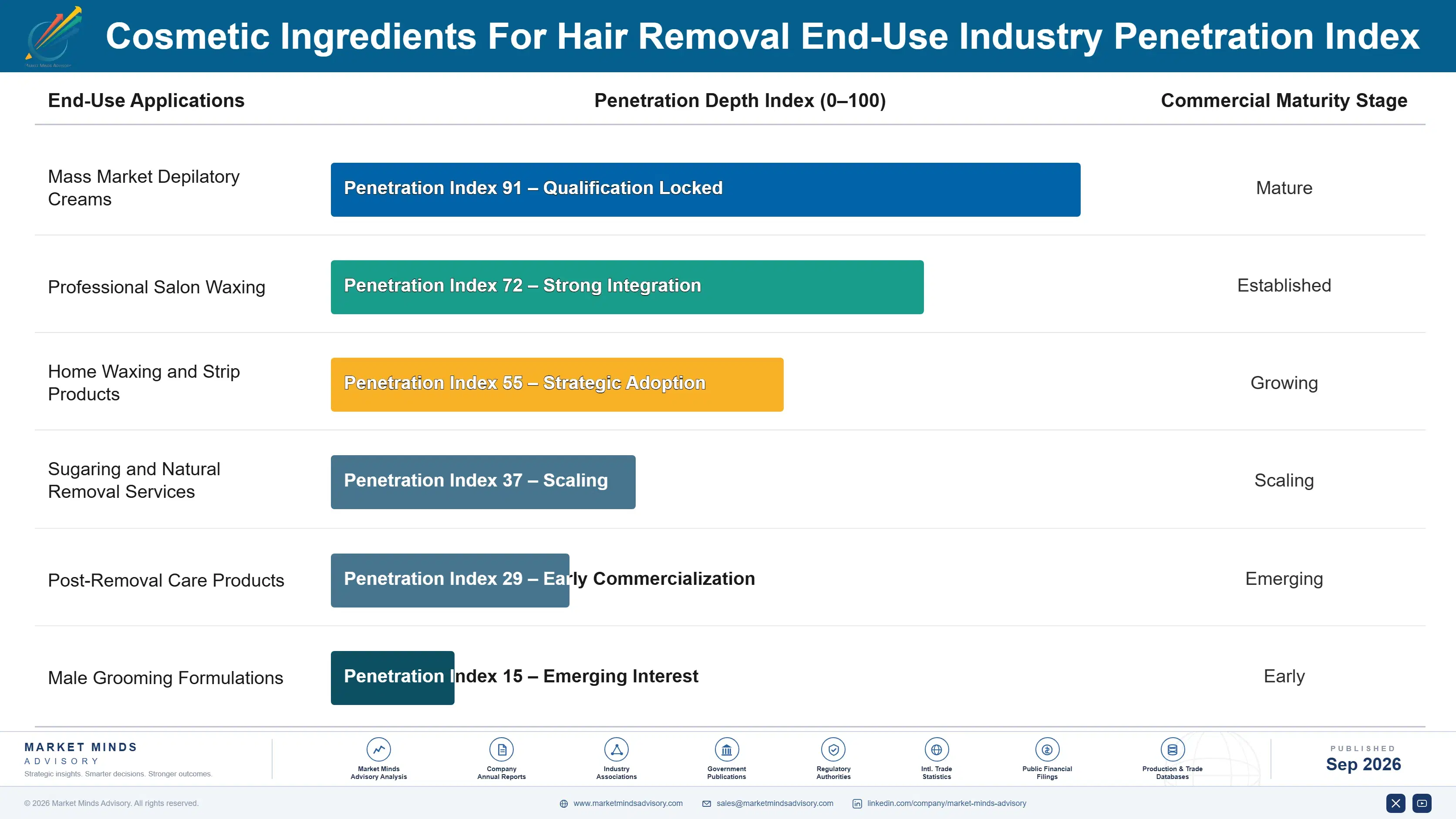
Revenue locks in at formulation approval and then follows the finished product's commercial life, which in mass market hair removal runs four to seven years and considerably longer in professional salon systems. Requalifying an active means repeating stability, irritation, and efficacy testing at a cost far exceeding any unit price difference, so incumbency holds firmly once a formulation ships at scale.
Attachment depth follows which part of the formulation a supplier holds. A soothing or inhibitor active named by trade name with supporting claim evidence is effectively locked, because the claim belongs to the evidence and the evidence belongs to the supplier. A percentage of calcium thioglycolate is filled by whoever quotes lowest at the next review, with no technical conversation involved. The difference between those two positions is the whole commercial argument.

The buyer is shifting toward formulation and regulatory functions as claim scrutiny tightens and as irritation becomes a review point rather than an accepted cost. A team asked to deliver a low irritation cream with controlled odour and a defensible regrowth claim needs three capabilities at once, and a supplier arriving with a competitive active price is answering none of them.
cosmetic-ingredients-for-hair-removal-market-end-use-penetration-index-1790016744115

Where This Market Rewards

These are among the four positions where our research anticipates prominent divergence between winners and laggards over the coming forecast period. Each is grounded in the demand model, the regulatory perimeter, and the announced capacity pipeline.
01 / MALODOUR PERFORMANCE SPECIFICATION

Sell the measurement not the fragrance

Masking systems absorb around 19% of formulation cost, and mercaptan release is chemically unavoidable rather than a defect any formulator can remove. Suppliers positioning odour control as a measured headspace specification rather than a fragrance brief report specification retention 2.4 times higher than those selling it as scent. A fragrance is switched on price at every review, and a technical qualification is not switched at all, and building the headspace measurement capability costs modestly against the revenue it protects across an entire supplier portfolio.
02 / BARRIER FORMULATION DEPTH

The mechanism and the damage share one variable

Roughly 21% of users report stinging or redness, because pH above twelve breaks keratin bonds and skin barrier lipids by the same route. Suppliers offering barrier lipids formulated to survive that pH rather than applied afterwards report complaint rates falling to between 9% and 13%. This is real formulation work that a commodity active producer cannot replicate by adding a soothing cream to the range, because most soothing systems on the market were formulated for neutral conditions and simply do not survive the working pH.
03 / CLAIM EVIDENCE DISCIPLINE

A premium resting on uncontrolled observation

Only about 17% of published hair growth inhibitor studies used a concurrent control arm, which leaves considerable category margin resting on evidence that would not survive close scrutiny. Suppliers commissioning properly controlled regrowth density trials report price realisation 1.8 times higher and keep the claim when a regulator asks. The trial costs a small fraction of the revenue that claim currently supports across a portfolio, and modest measured effects are a considerably stronger commercial position than large claimed ones nobody controlled for.
04 / SUGARING CHANNEL POSITIONING

Fastest growth consumes the least ingredient

Sugaring grows at 8.7%, ahead of everything else covered, and a traditional paste requires three household inputs that no supplier sells. Suppliers building stabilised paste systems, high sugar preservation, and cold application polymers capture 4.5 times more ingredient value per treatment than traditional preparation permits. Dismissing the segment as commercially unattractive is precisely how a supplier misses the channel taking the volume, and cold application polymers plus high sugar preservation are the two technical problems actually worth solving here, and both are tractable.

Engagement Snapshot From the Field

A live engagement with an industry participant carrying material or product regulatory and market exposure ahead of a defining policy shift, showing how our research translates into a defensible multi-year portfolio strategy.
MARKET MINDS ADVISORY · CLIENT ENGAGEMENT SUMMARY
Cosmetic Ingredients For Hair Removal Producer Strategic Portfolio Review and Transition Roadmap 2026·Investment Scenario on Cosmetic Ingredients For Hair Removal Exposure Evaluation 2025-26
CLIENT PROFILE
A mass market personal care manufacturer with depilatory revenue near USD 210 million (client-reported, unverified by MMA) across South Asian and Middle Eastern markets. Consumer complaints about odour and skin stinging had risen for three consecutive years while volume kept growing, and the technical team had run two reformulations without moving either measure. Volume growth had masked the problem internally.
STRATEGIC CHALLENGE
Both reformulations had reduced active concentration to address irritation, which lengthened contact time and worsened the odour complaints. Nobody had established whether the two problems could be separated, or whether the fragrance brief was capable of addressing a mercaptan release that concentration reduction was actually increasing. Both complaint categories were being tracked as a single quality signal.
MMA APPROACH
MMA measured headspace mercaptan concentration and skin barrier response across the client formulations and six competitor benchmarks, mapped complaint text against measured values, and modelled outcomes under barrier lipid addition, masking system change, and buffered release rather than concentration reduction. Complaint verbatims were coded independently of the measured data to avoid anchoring the analysis on the client's existing interpretation.
KEY FINDINGS
  1. Reducing active concentration had lengthened contact time by nearly four minutes, which raised total mercaptan release and worsened odour complaints rather than improving anything.
  2. Skin stinging correlated with barrier lipid depletion rather than with active concentration, so the reformulation direction had been addressing the wrong variable entirely.
  3. The existing fragrance system was specified as a scent preference and had never been measured against headspace mercaptan concentration at any point.
  4. Two benchmark competitors used barrier lipids formulated to survive high pH, and both scored materially better on stinging at higher active concentration.
CLIENT PROFILE
A mass market personal care manufacturer with depilatory revenue near USD 210 million (client-reported, unverified by MMA) across South Asian and Middle Eastern markets. Consumer complaints about odour and skin stinging had risen for three consecutive years while volume kept growing, and the technical team had run two reformulations without moving either measure. Volume growth had masked the problem internally.
STRATEGIC CHALLENGE
Both reformulations had reduced active concentration to address irritation, which lengthened contact time and worsened the odour complaints. Nobody had established whether the two problems could be separated, or whether the fragrance brief was capable of addressing a mercaptan release that concentration reduction was actually increasing. Both complaint categories were being tracked as a single quality signal.
MMA APPROACH
MMA measured headspace mercaptan concentration and skin barrier response across the client formulations and six competitor benchmarks, mapped complaint text against measured values, and modelled outcomes under barrier lipid addition, masking system change, and buffered release rather than concentration reduction. Complaint verbatims were coded independently of the measured data to avoid anchoring the analysis on the client's existing interpretation.
KEY FINDINGS
  1. Reducing active concentration had lengthened contact time by nearly four minutes, which raised total mercaptan release and worsened odour complaints rather than improving anything.
  2. Skin stinging correlated with barrier lipid depletion rather than with active concentration, so the reformulation direction had been addressing the wrong variable entirely.
  3. The existing fragrance system was specified as a scent preference and had never been measured against headspace mercaptan concentration at any point.
  4. Two benchmark competitors used barrier lipids formulated to survive high pH, and both scored materially better on stinging at higher active concentration.
RECOMMENDED STRATEGY
Phase 1: Phase one: restore active concentration to shorten contact time, and add a barrier lipid system formulated to survive the working pH. Phase 2: Phase two: rewrite the masking requirement as measured headspace performance rather than a scent preference, and requalify suppliers against it. Phase 3: Phase three: measure complaint categories separately in future reviews rather than treating odour and stinging as one signal. Track each against measured values rather than complaint volume alone.
OUTCOME
Stinging complaints fell by roughly half within two quarters and odour complaints by around a third (client-reported, unverified by MMA). Active concentration went up rather than down. The measured masking specification is now standard across the manufacturer's entire personal care portfolio. Two subsequent launches used the same measured specification from the outset.

Frequently Asked Questions

Foundational context covering the market sizes, CAGR, scope, country, region and competition that inform every finding below. This section is provided to cover basics and most often pre-purchase conversations, answered from the MMA Primary Research Dataset.

What is the current size of the Cosmetic Ingredients For Hair Removal Market?

The market was worth USD 1.2 billion in 2025 and stands at USD 1.3 billion in 2026. Value covers ingredients formulated into cosmetic hair removal products at supplier selling price.

How large will the Cosmetic Ingredients For Hair Removal Market be by 2036?

MMA forecasts USD 2.3 billion by 2036, an increase of USD 1.0 billion across the forecast period. That represents 1.77 times the 2026 base of USD 1.3 billion.

What is the CAGR for the Cosmetic Ingredients For Hair Removal Market 2026 to 2036?

The base case compound annual growth rate is 5.8%, with a bull case at 7.0% and a bear case at 4.6%. Historical growth from 2020 to 2025 ran at 4.8%.

Which segment is growing fastest?

Sugaring and natural paste systems grow at 8.7%, half again the market rate of 5.8%. The awkward part is that a traditional paste needs only three household inputs.

Who are the major companies in the Cosmetic Ingredients For Hair Removal Market?

Croda International, BASF, Ashland, Clariant, and Evonik Industries lead the field. Together they hold 44% of ingredient revenue, with Chinese and Indian producers setting the floor on active pricing.

Which country is growing fastest?

India grows at 11.2%, as depilatory creams move from urban pharmacy shelves into mass distribution reaching several hundred thousand additional retail outlets. It is already the largest cream market by volume.

Report Segmentation Architecture

The full report scope spans multiple orthogonal segmentation dimensions, with cross-tabulated demand data provided for each dimension pair. Coverage extends further to regional breakdowns, trend trajectories, and the competitive detail needed to support segment-level decision-making.

By Functional Ingredient Class

  • Thioglycolate Reducing Agents
  • Keratin Softening and Conditioning Agents
  • Wax Base Resins and Polymers
  • Sugaring and Natural Paste Systems
  • Fragrance and Malodour Masking Systems
  • Post-Depilatory Soothing and Inhibitor Actives

By End-Use Industry

  • Mass Market Depilatory Creams
  • Professional Salon Waxing
  • Home Waxing and Strip Products
  • Sugaring and Natural Removal Services
  • Post-Removal Care Products
  • Male Grooming Formulations

By Commercial Dimension

  • Global Brand Direct Supply
  • Contract Manufacturer Supply
  • Specialty Ingredient Distribution
  • Professional Salon Brand Supply
  • Regional and Local Brand Supply
  • Claim Substantiation Services

By Region

  • South Asia and Pacific
  • East Asia
  • Western Europe
  • North America
  • Latin America
  • Middle East and Africa
  • Eastern Europe

Scope, Methodology, and Coverage

Every figure in this report is reproducible from documented input assumptions. The scope below maps the historical period, the forecast horizon, the segmentation dimensions, and the countries covered, alongside the underlying primary and qualitative methodology.
Historical Period
2020 to 2025
Forecast Period
2026 to 2036
Base Year
2025 (USD billions; MMA Primary Research Dataset, September 2026)
Market Definition
This market covers ingredients formulated into cosmetic hair removal products, across thioglycolate reducing agents, keratin softening and conditioning agents, wax base resins and polymers, sugaring and natural paste systems, fragrance and malodour masking systems, and post-depilatory soothing and inhibitor actives. It excludes laser and intense pulsed light devices, razors and blades, epilator appliances, prescription hair reduction drug products, and hair growth promoting formulations.
Quantitative Units
USD billions, revenue at supplier selling price
Segmentation Dimensions
Functional ingredient class, end-use application, commercial dimension, region
Regions Covered
South Asia and Pacific, East Asia, Western Europe, North America, Latin America, Middle East and Africa, Eastern Europe
Countries Covered
India, Indonesia, Thailand, Vietnam, Philippines, Australia, China, Japan, South Korea, Taiwan, Germany, France, United Kingdom, Italy, Spain, Netherlands, Poland, Czechia, United States, Canada, Mexico, Brazil, Argentina, Colombia, Chile, Saudi Arabia, United Arab Emirates, Turkey, Egypt, South Africa
Key Companies Profiled
Croda International, BASF, Ashland, Clariant, Evonik Industries, Lubrizol, Solvay, Stepan Company, Innospec, Seppic, Gattefosse, Lonza, Symrise, Givaudan, Nikko Chemicals, Sino Lion, Vantage Specialty Chemicals, Lipoid Kosmetik, Bruno Bock, Arkema
Quantitative Methodology
Primary survey, n=3,800 respondents, Q4 2025, six countries; demand-side model with trade association cross-validation
Qualitative Methodology
47 expert interviews, Q4 2025; applied to validate demand model assumptions, identify emerging dynamics, and assess competitive positioning
Report Format
PDF and XLSX data workbook (Word format preview document)
Publisher
Market Minds Advisory
Report Code
MMA-2026-CHM-461
Published
September 2026
Contact
sales@marketmindsadvisory.com | www.marketmindsadvisory.com

Purchase the full Cosmetic Ingredients For Hair Removal Market Report (2026 to 2036).

The full report sizes the cosmetic hair removal ingredients market across six functional classes, seven regions, and thirty countries, with forecasts to 2036 under base, bull, and bear cases. It quantifies how much formulation cost goes to masking an unavoidable odour, examines the evidence base behind hair growth inhibitor claims, and traces where margin has migrated as the primary chemistry stayed unchanged. Competitive analysis covers twenty participants evaluated consistently on ingredient revenue, with detailed treatment of soothing formulation depth and claim substantiation quality. Cost structure and sourcing exposure are analysed throughout. Primary research includes 3,800 survey responses and 47 expert interviews.
Six functional ingredient classes sized and forecast separately
Twenty participants evaluated on ingredient revenue consistently
Masking system cost quantified as formulation share
Inhibitor claim evidence quality assessed across published studies
Irritation complaint rates mapped against formulation approach
Sugaring ingredient capture opportunity sized by channel

Built For The People Who Decide

From boardroom strategy to bench-side execution, this report is read cover-to-cover by leaders shaping the next decade of their industry, turning demand scenarios, market dynamics and valuation benchmarks into decisions.
CXOs/ Presidents/ VPs/ Managers
M&A and Corporate Development
Strategy Teams and R&D Heads
Procurement and Product Directors
Regulatory and Compliance Leaders
Investor Relations and Equity Analysts