Market Minds Advisory
Corrugated Fiberboard Market

Corrugated Fiberboard Market: Containerboard Supply, E-Commerce Packaging, and Sustainable Fiber Substitution

Containerboard producers are racing to right-size packaging for e-commerce fulfillment while recycled fiber content climbs under tightening sustainability mandates, reshaping a mature material category most buyers never think twice about.

Lead Analyst

Bilal Shaikh

Published

September 2026

Make Smarter Decisions with Customized Research Insights

Request a free sample report and evaluate market opportunities, growth trends, and competitive dynamics relevant to your business needs.

2025 MARKET VALUE$145.0BMarket Size 2025
2036 FORECAST VALUE$237.9BBase Case , 2026 to 2036
CAGR 2026 TO 20364.6 %Bull 5.8% / Bear 3.4%
INCREMENTAL OPPORTUNITY$86.2BNet 10- year value creation
EXPANSION MULTIPLE1.57x2036 value over 2026 base
Strategic Levers
M&A Pipeline
Regional Outlook
Country Rankings
Competitive Intelligence
Segmental Deep-dive
Call-Us : 91 93563 13602

Executive Snapshot and Market Trajectory

Corrugated fiberboard remains the default packaging substrate for e-commerce fulfillment and industrial shipping, even as recycled fiber content requirements and right-sized box engineering push producers toward more sophisticated converting operations than the category commanded a decade ago across nearly every major market worldwide. today.
China's massive containerboard production base and domestic e-commerce packaging demand anchor global volume, with Nine Dragons Paper and other Chinese integrated producers scaling capacity faster than most Western competitors. Recycled and sustainable fiber board is capturing a widening share of specification requirements as brand owners face mounting pressure to reduce virgin fiber use across their packaging supply chains, reshaping procurement decisions at nearly every major consumer goods company.
No single producer commands outright pricing power despite meaningful consolidation, including International Paper's acquisition of DS Smith completed in early 2025, because containerboard pricing remains cyclical and tied to pulp input costs that no individual company controls. Vertically integrated producers spanning mill and converting operations are capturing disproportionate margin versus pure converters buying board on the open market, and buyers should expect continued consolidation activity across the sector well into the next several years.
Market Definition
The corrugated fiberboard market covers the production of corrugated board material, comprising linerboard and fluted medium layers bonded together, used as the primary substrate for shipping cartons and industrial packaging. It excludes finished folding carton board and solid fiberboard products sold as separate packaging material categories.
Base Year Value
$145.0B in 2025 (MMA Primary Research Dataset, August 2026)
Forecast Period
2026 to 2036, eleven discrete annual values
CAGR
4.6% base case. Bull 5.8%. Bear 3.4%.
Fastest Growth Segment
E-Commerce Optimized and Right-Sized Packaging: 7.5% CAGR
Fastest Growth Country
China: 6.8% CAGR
Fastest Growth Region
South Asia and Pacific: 6.6% CAGR
Largest Region
East Asia: 43% of 2025 global value
Market Leaders
Smurfit WestRock plc, International Paper Company, Packaging Corporation of America, Nine Dragons Paper (Holdings) Limited, Mondi Group. Source: MMA Analysis based on company annual reports.
Primary Survey
n=3,800 procurement and R&D decision-makers, Q4 2025, six countries
Methodology
Demand-side build-up, cross-validated against public data, 47 expert interviews

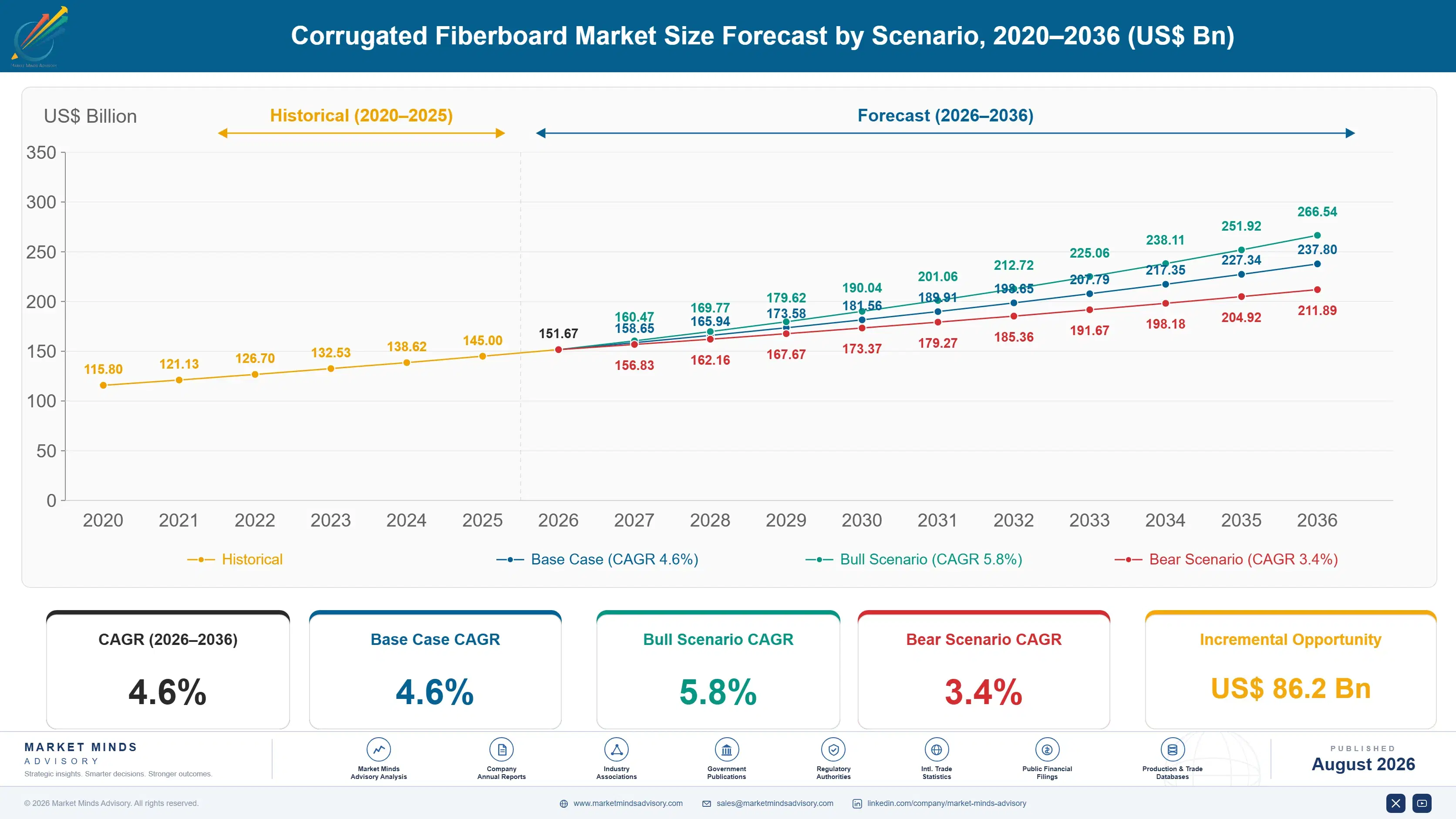
Corrugated Fiberboard Market Forecast Scenarios

corrugated-fiberboard-market-size-forecast-scenario-1787548793677
Between 2020 and 2025 corrugated fiberboard demand grew steadily as e-commerce fulfillment volume surged well past pre-pandemic projections, though the sharpest volatility came from containerboard pricing swings tied to pulp and recycled fiber input costs that whipsawed producer margins across several consecutive years of the period, particularly in North America and Western Europe today. overall.
The base case assumes three commercial mechanisms drive growth beyond overall packaging volume alone: continued e-commerce fulfillment growth requiring right-sized and protective packaging engineering, rising recycled and sustainable fiber content specification as brand owners face mounting sustainability pressure, and China's continued containerboard capacity expansion anchoring the largest share of global supply. Together these forces keep the market growing modestly faster than industrial production growth alone would suggest. Producers investing across all three mechanisms simultaneously are outpacing narrower competitors considerably.
The bull case rests on plastic-to-fiber substitution accelerating faster than currently forecast as retailers and regulators push packaging away from single-use plastics toward recyclable fiber alternatives. The bear case centers on containerboard overcapacity in China depressing global pricing even as underlying volume demand continues growing steadily. Producers positioned for both scenarios simultaneously hold the strongest long-term outlook across the industry.

Containerboard Economics and Fiber Cycle Dynamics

Corrugated fiberboard economics hinge on mill-level integration rather than converting scale alone, since producers who own both containerboard mills and box-converting operations capture margin that pure converters buying board on the open market cannot access, particularly during periods of tight containerboard supply. Suppliers without this integration increasingly struggle to defend margin during periods of tight board supply and rising input costs.
TOP PRODUCER SHAREChina, 31%Share of global containerboard production concentrated domestically today
MARKET CONCENTRATIONCR5 34%Combined share held by the five largest global producers
AVERAGE SELLING PRICE$480-720 per tonneTypical containerboard price range across major grade tiers
RECYCLED FIBER CONTENT45-90%Typical recycled fiber share across containerboard grade tiers
PULP INPUT COST SHARE48% of COGSVirgin and recycled fiber share of total production cost
CAPACITY UTILIZATION84%Average utilization rate across major global containerboard mills
The commercial character of the market splits between commodity single-wall board, which competes largely on price and consistent supply, and specialty recycled, right-sized, and retail-ready packaging, where brand owners negotiate directly on sustainability credentials and fulfillment efficiency rather than pure cost. Producers straddling both tiers run distinctly different sales and manufacturing organizations to manage this divide effectively. Few producers manage both segments equally well without meaningful internal friction between teams.
Over the next decade, e-commerce packaging engineering, recycled fiber mandates, and China's continued capacity expansion will decide which producers retain their current market positions and which lose ground to more vertically integrated competitors. The pace of specification change is accelerating each successive year across nearly every major consumer goods category. Companies positioned across multiple dynamics simultaneously hold the strongest long-term competitive outlook.
"Nobody gets excited about a cardboard box until their supply chain runs out of one. Then suddenly it's the only conversation the procurement team wants to have."
Director, Packaging Materials Practice · MMA Packaging Materials and Containerboard Practice · August 2026

Market Trends

Right-Sized E-Commerce Fulfillment Packaging Engineering Adoption

Major online retailers are pushing corrugated packaging suppliers toward algorithmically right-sized boxes that minimize void fill and dimensional weight shipping charges, a shift that requires considerably more sophisticated design and converting capability than standard commodity box production. Several large fulfillment operators have deployed automated box-sizing equipment on their own packaging lines, forcing corrugated suppliers to deliver custom board specifications on shorter lead times than the industry historically operated under. Producers with established design engineering teams and automated converting capability are winning disproportionate share of this higher-value fulfillment packaging business, while commodity converters remain confined to standard box formats.
Market Impact: Adds 8.2B units demand by 2030
Recycled Fiber Content Mandates Reshaping Specification

Extended producer responsibility regulations across the European Union and several US states are pushing brand owners to specify higher recycled fiber content in corrugated packaging, accelerating a shift that was already underway due to voluntary corporate sustainability commitments among major consumer goods companies. Producers with established recycled fiber sourcing networks and de-inking capability are winning specification wins ahead of competitors still reliant primarily on virgin kraft linerboard. The shift is meaningfully changing procurement criteria at major retailers, who increasingly screen suppliers on recycled content percentage during vendor qualification reviews. Momentum keeps building.
Market Impact: Adds 3.4 points to substitution growth

Market Opportunities and Growth Drivers

Sustained Global E-Commerce Fulfillment Volume Growth

Global e-commerce parcel volume continues expanding across both developed and developing markets, each shipped package requiring corrugated packaging that has become the default substrate for online retail fulfillment given its combination of protective strength, recyclability, and relatively low cost compared to alternative materials. Major online retailers are increasingly specifying custom-branded corrugated packaging as part of the unboxing customer experience, adding incremental value beyond pure protective function. Producers with automated converting capability and design engineering support are capturing disproportionate share of this fulfillment-driven demand growth as retailers scale operations across new fulfillment center locations.
Market Impact: Cuts global pricing 8-14% per cycle

Plastic Packaging Substitution Regulatory Pressure Rising

Regulatory bans and taxes on single-use plastic packaging across the European Union, several US states, and increasingly parts of Asia are pushing brand owners to substitute corrugated fiber packaging for plastic in applications ranging from retail display to protective void fill material. This substitution trend directly expands the addressable corrugated fiberboard market into applications where plastic previously dominated on cost grounds alone. Producers with molded fiber and specialty converting capability are capturing disproportionate share of this substitution-driven demand as brand owners redesign packaging specifications across their product portfolios. Momentum keeps building steadily.
Market Impact: Raises processing cost 6-10% yearly

Market Restraints and Challenges

Chinese Containerboard Overcapacity Depressing Global Pricing

Chinese containerboard capacity additions have outpaced domestic demand growth in recent years, creating overcapacity that pressures global pricing as producers export surplus volume into international markets at competitive prices, squeezing margin for producers in other regions who cannot match Chinese cost structures. The root cause is aggressive capacity investment by Chinese producers pursuing scale and market share ahead of demand growth materializing as forecast. Producers in other regions are mitigating the impact by concentrating on specialty and higher-value packaging segments where Chinese commodity board competes less directly on pure price.
Market Impact: Cuts shipping costs $0.40-0.90 per box

Recycled Fiber Quality and Supply Constraints

Recycled fiber supply quality has degraded as collection systems mix increasingly contaminated material streams, forcing producers to invest in more sophisticated de-inking and cleaning processes to meet rising recycled content specifications while maintaining board strength performance requirements. The root cause is that recycling collection infrastructure was not originally designed for the fiber purity levels that current sustainability mandates now demand. Producers are mitigating the constraint through direct partnerships with waste management companies and investment in advanced sorting technology at their own facilities. Investors are watching this dynamic closely across the wider industry.
Market Impact: Adds 12-18% recycled content by 2030
4 additional market trends, 3 additional growth drivers, and 3 additional restraints and challenges are covered in the full report. Contact sales@marketmindsadvisory.com to access the complete intelligence.

Segment CAGR and Growth Architecture

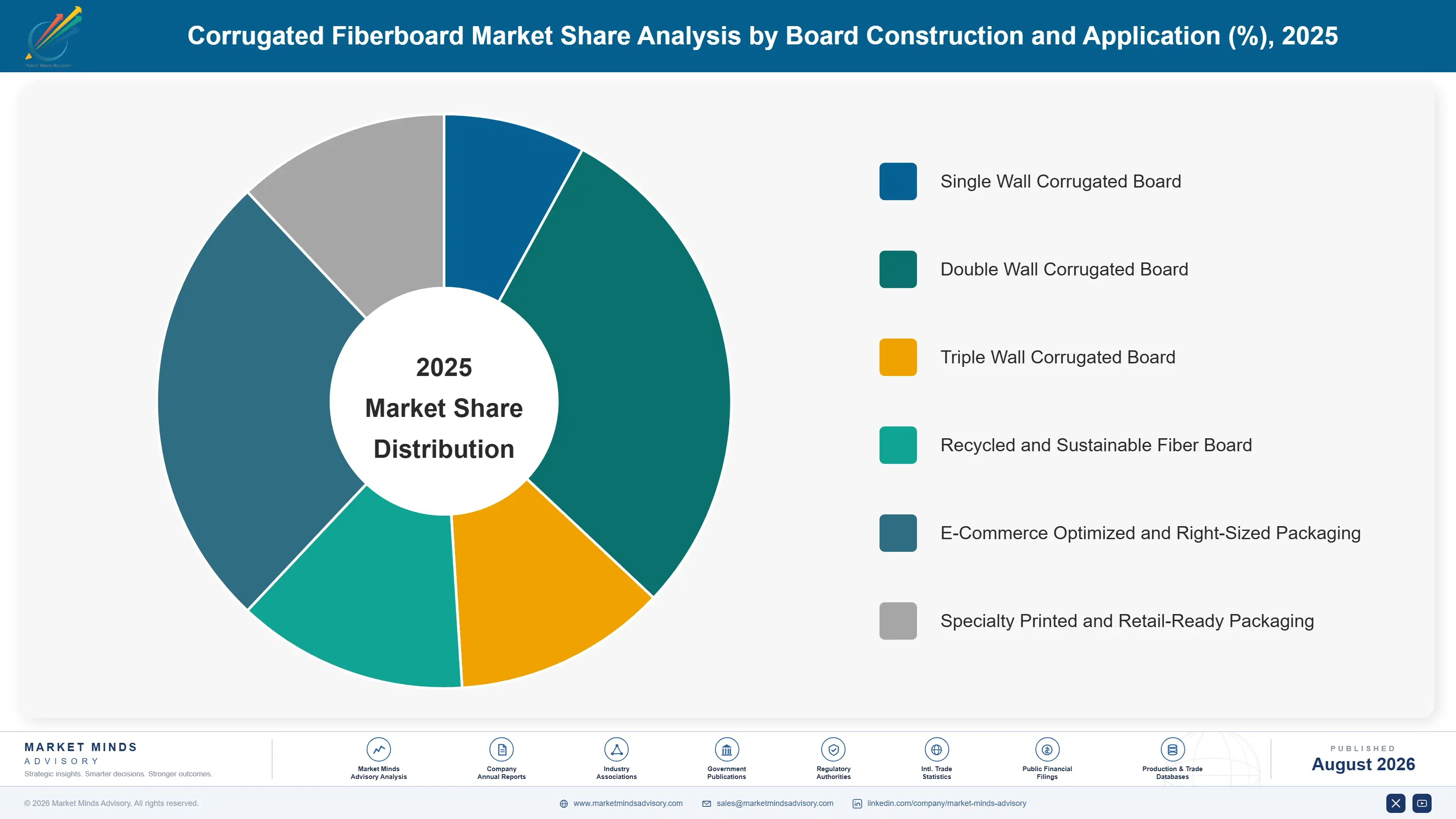
Segmentation follows board construction and application type, the dimension brand owners specify against when awarding packaging supply contracts, rather than by distribution channel or box size, both of which sit outside this defined market scope and belong instead to adjacent commercial and channel-level analysis kept entirely separate from this market report and its scope.
corrugated-fiberboard-market-market-share-analysis-1787548794211

E-Commerce Optimized and Right-Sized Packaging

E-commerce optimized and right-sized packaging uses algorithmic design software to minimize box dimensions and void fill relative to shipped product size, reducing dimensional weight shipping charges that increasingly dominate fulfillment cost structures for major online retailers. Producers are advancing this capability earliest with the largest fulfillment operators, where shipping cost savings from optimized packaging can reach meaningful scale across billions of annual shipments. Companies need sophisticated design engineering software and automated converting equipment capable of producing custom specifications on considerably shorter lead times than standard commodity box production requires. Pricing commands a premium over standard packaging, and the segment is pulling capital investment toward automated converting technology across nearly every major producer's expansion roadmap today.
CAGR 7.5%

Recycled and Sustainable Fiber Corrugated Board

Recycled and sustainable fiber corrugated board uses post-consumer and post-industrial recovered fiber rather than virgin kraft pulp, meeting rising sustainability specification requirements from brand owners facing mounting pressure to reduce virgin fiber use across their packaging supply chains. Regulatory mandates across the European Union and several US states are accelerating adoption well ahead of purely voluntary corporate sustainability commitments. Producers need established recycled fiber sourcing networks and de-inking capability that differ meaningfully from virgin kraft pulp processing. Gross margin on this segment benefits from growing specification requirements, making it a priority investment area for producers seeking to escape commodity board pricing pressure entirely across the industry. Companies succeeding here are increasingly favored in vendor qualification reviews.
CAGR 6.5%
Full segment breakdown across 6 segments available in the complete report.

Regional Architecture and Country Demand Map

East Asia's massive containerboard manufacturing base, anchored overwhelmingly by China, accounts for the largest share of global corrugated fiberboard supply, while North America and Western Europe carry the richest specialty and sustainable packaging content value per tonne across their established consumer goods markets. overall. today.

North America

US and Canadian containerboard production remains anchored by vertically integrated producers spanning mill and converting operations, with e-commerce fulfillment packaging driving the fastest content value growth even as overall box volume tracks broader industrial production trends. Packaging Corporation of America and International Paper's expanded footprint following the DS Smith acquisition give the region substantial domestic supply capability. Sustainability mandates from major retailers are pushing recycled fiber content specification higher across nearly every major consumer packaged goods category. Regional growth trails East Asia given the region's already mature and consolidated containerboard industry structure. Canadian converting operations largely mirror US specification requirements given shared retail and logistics supply chains. Growth stays modest.
Share: 22% | CAGR: 3.3% (2026 to 2036)

Western Europe

Germany and the wider European Union anchor regional demand through some of the world's strictest extended producer responsibility regulations, which are accelerating recycled fiber content specification well ahead of most other global markets. Mondi Group and Smurfit WestRock's European operations represent the region's most established vertically integrated producers, both increasingly focused on sustainability-certified packaging as regulatory pressure intensifies. Plastic-to-fiber substitution is proceeding faster here than in most other regions given regulatory bans on single-use plastic packaging. Growth remains moderate given the region's already mature packaging market. France and the Netherlands contribute meaningful volume through mid-market converting operations serving regional consumer goods brands. Producer margins remain healthy across most established converting operations.
Share: 18% | CAGR: 3.1% (2026 to 2036)
Regional intelligence for 5 additional markets available in the complete report: East Asia, South Asia and Pacific, Latin America, Middle East and Africa, Eastern Europe. Contact sales@marketmindsadvisory.com.
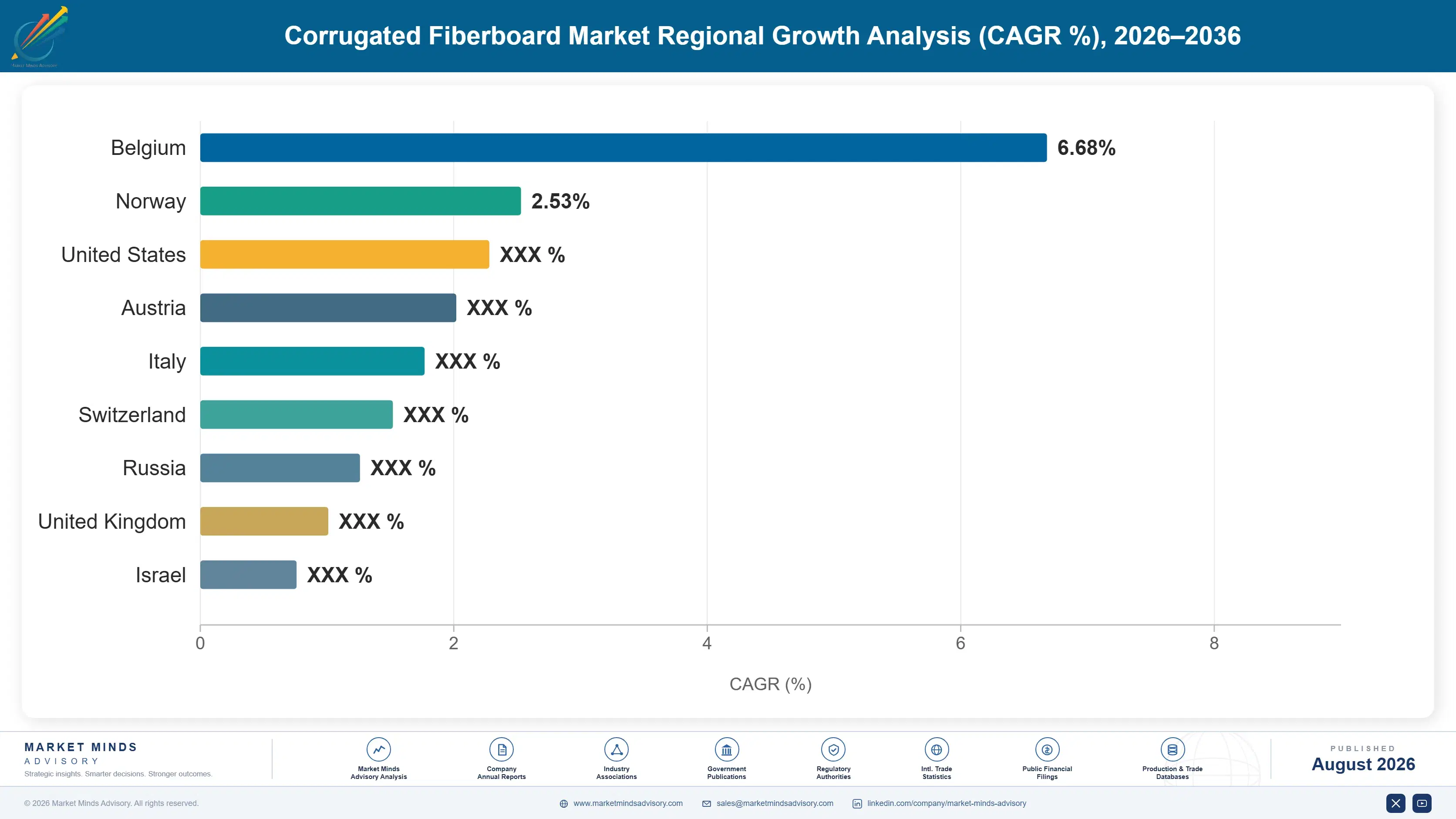
corrugated-fiberboard-market-country-cagr-analysis-1787548794729

Where Board Producers Can Defend Margin

Producers facing commodity pricing pressure on standard containerboard have four realistic paths to defend and expand margin without waiting for overall packaging volume alone to drive growth across every market they currently serve, plan to enter, or hope eventually to win business in over the coming years. ahead of competitors moving more slowly across the industry.

Investing in E-Commerce Right-Sizing Design Capability

Producers that invest in algorithmic box-sizing design software and automated converting equipment can capture premium pricing from fulfillment operators seeking to cut shipping costs by $0.40-0.90 per box through reduced dimensional weight charges. The capability requires meaningful upfront investment in design engineering talent and converting automation, but producers who move early are securing multi-year fulfillment packaging contracts that competitors entering later struggle to match given the technical development timeline involved. Dimensional weight shipping charges continue rising across nearly every major fulfillment network operating today. Momentum keeps building steadily across the industry.
Market Impact: Adds \$0.40-0.90 per box in yearly savings today

Recycled Fiber Sourcing and De-Inking Capacity

Building recycled fiber sourcing networks and de-inking capability ahead of regulatory deadlines positions producers to win specification wins on the 12-18% recycled content growth expected by 2030 before compliance becomes mandatory across major markets. Early movers are already capturing recycled-content specifications on premium consumer packaged goods programs, a qualification laggard producers cannot easily match without dedicated fiber sourcing investment and established de-inking process capability built well ahead of formal regulatory requirements taking effect. Suppliers without this credibility are increasingly screened out during early retailer sustainability evaluation rounds conducted each purchasing cycle.
Market Impact: Secures new 12-18% recycled content contracts widely today

Pursuing Vertical Mill-to-Converting Integration Now Broadly

Acquiring or building converting capacity to complement existing containerboard mill operations, rather than selling board wholesale to independent converters, lets producers capture the full margin chain from pulp through finished packaging. This strategy requires substantial capital investment but insulates producers from the margin compression that pure board sellers face during periods of oversupply, protecting profitability across market cycles considerably better than non-integrated competitors facing 8-14% pricing swings each downturn. Producers succeeding at full integration are capturing outsized share of industry margin. This margin advantage compounds meaningfully across successive market cycles for producers who invest early.
Market Impact: Protects producer margin during 8-14% price swings overall

China and Southeast Asia Capacity Expansion

Establishing or expanding manufacturing capacity in China and Southeast Asia, where containerboard demand continues growing at roughly 6% annually, gives producers access to the fastest unit volume growth remaining in the global market. Domestic Chinese producers already hold considerable incumbency here, so global producers need genuinely competitive local cost structures and manufacturing footprint to win contracts rather than exporting Western pricing assumptions into a considerably more price-sensitive competitive environment. These relationships typically require years of local relationship building before formal supply and distribution agreements are finalized with major regional customers.
Market Impact: Captures share of a 6% Asia growth pool

Who Controls the Margin Pool

The five largest global corrugated fiberboard producers hold roughly one-third of production volume on a capacity basis, a moderate concentration that leaves meaningful room for regional producers, particularly across China, to compete on proximity to feedstock and customers. The gap between vertically integrated leaders and pure converters is widening as mill-to-box integration increasingly determines margin resilience.
Current competitive activity centers on three dimensions: e-commerce right-sizing design capability that determines fulfillment packaging readiness, recycled fiber sourcing investment ahead of regulatory deadlines, and vertical mill-to-converting integration that protects margin across pricing cycles. Producers investing across all three simultaneously are pulling ahead of narrowly focused competitors. Companies betting on just one of these dimensions increasingly find themselves outpaced by more diversified rivals across the industry.

Emerging pressure is coming from Chinese domestic producers scaling capacity to serve both export markets and China's own massive e-commerce packaging demand, threatening established Western producers' historical hold on specialty packaging premiums. Rankings are most likely to shift among mid-tier producers lacking either vertical integration or recycled fiber capability, both of which are becoming necessary rather than optional for long-term survival. Suppliers slow to invest in these capabilities risk losing relevance within the next several years.
corrugated-fiberboard-market-company-positioning-matrix-1787548795245

Competitive Moat and Risk Dimensions

SMURFIT WESTROCK PLC

Moat: Broadest Global Integration Scale

Smurfit WestRock's combination of mill and converting operations spanning North America, Europe, and Latin America following the Smurfit Kappa and WestRock merger gives it the broadest vertically integrated footprint of any global producer, letting it serve multinational brand owners from a single qualified relationship. Few competitors can match this operational breadth today.
SMURFIT WESTROCK PLC

Risk: Post-Merger Integration Execution Risk

Smurfit WestRock's massive scale following its recent merger creates real execution risk as it consolidates overlapping mill and converting operations across multiple continents, a complexity that smaller, more focused competitors do not face to the same degree. Smurfit WestRock continues investing meaningfully to manage this complexity effectively.
INTERNATIONAL PAPER COMPANY

Moat: Deep Transatlantic Reach

International Paper's acquisition of DS Smith gives it substantial European converting capacity to complement its established North American mill network, positioning it as one of the few producers with genuine transatlantic scale and customer reach across both regions simultaneously. Investors particularly value this durable transatlantic market position.
INTERNATIONAL PAPER COMPANY

Risk: Integration and Cultural Alignment Risk

International Paper's rapid expansion through the DS Smith acquisition introduces execution uncertainty as it integrates a European operation with different customer relationships and operational practices, risking management attention diverted from core commercial priorities. International Paper is dedicating meaningful resources to smooth this transition over time.

Players Tracked

Prominent Players

Smurfit WestRock plc
International Paper Company
Packaging Corporation of America
Nine Dragons Paper (Holdings) Limited
Mondi Group

Other Key Players

Georgia-Pacific LLC
Oji Holdings Corporation
Lee & Man Paper Manufacturing Ltd.
Rengo Co. Ltd.
Stora Enso Oyj
Cascades Inc.
Graphic Packaging International LLC
Pratt Industries Inc.
Sonoco Products Company
Klabin S.A.
Saica Group
VPK Packaging Group
Greif Inc.
Nampak Ltd.
Shanying International Holdings Co. Ltd.

Recent Developments

JANUARY 2025

International Paper Completes DS Smith Acquisition

International Paper Company completed its acquisition of DS Smith Plc, creating one of the world's largest integrated containerboard and corrugated packaging producers with substantially expanded European converting capacity and customer relationships across the continent. The transaction reflects continued sector-wide consolidation as producers pursue vertically integrated scale.
Signal: Confirms consolidation is accelerating as producers seek vertically integrated scale across multiple continents and product lines.
AUGUST 2025

Smurfit WestRock Expands Right-Sizing Design Capability

Smurfit WestRock announced expansion of its algorithmic box-sizing design software and automated converting equipment across several North American facilities, targeting fulfillment packaging contracts with major e-commerce retailers seeking to cut dimensional weight shipping costs. The expansion directly targets fulfillment operators reporting rising dimensional weight shipping costs.
Signal: Shows established producers investing heavily in design engineering capability well ahead of confirmed retailer demand today.
MARCH 2026

Nine Dragons Paper Expands Recycled Fiber Capacity

Nine Dragons Paper announced expansion of recycled fiber sourcing and de-inking capacity at its Chinese facilities, targeting rising domestic and export demand for sustainable containerboard grades ahead of tightening environmental regulation across the region. The expansion reflects growing regulatory pressure on Chinese containerboard producers specifically.
Signal: Indicates Chinese producers are proactively investing in sustainability capability to defend their export competitiveness broadly indeed.

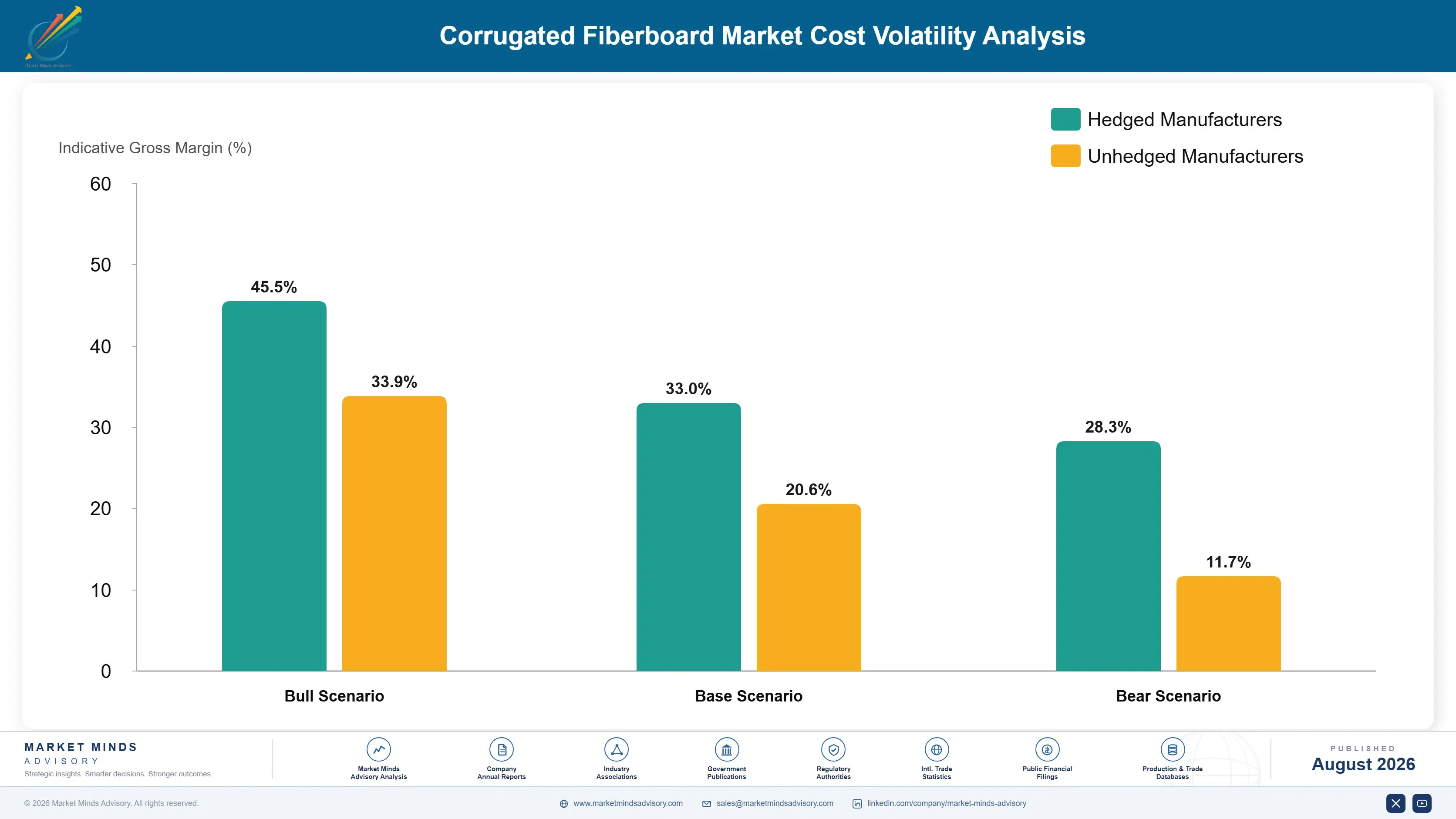
Pulp and Fiber Feedstock Cost Exposure

Virgin kraft pulp and recycled fiber together account for roughly forty-eight percent of corrugated fiberboard production cost, with pricing tied to global pulp market cycles and, increasingly, recycled fiber collection and quality dynamics that vary considerably by region and municipal recycling infrastructure maturity. Regional shortages in any single fiber component can meaningfully delay entire production runs and raise landed costs across nearly every converting operation.
Pulp prices spiked meaningfully during the 2021 to 2022 global supply chain disruption tracked widely across the paper and packaging industry, forcing several converters to renegotiate fixed-price brand owner contracts mid-cycle or absorb margin compression they had not budgeted for entering those multi-year sourcing agreements several years earlier. The shortage reshaped how producers now negotiate feedstock contracts, with multi-year commitments increasingly replacing spot purchasing common in earlier years.

Larger vertically integrated producers with direct mill ownership absorb pulp price volatility far better than smaller regional converters dependent on open-market board purchases, a gap in supply chain control that is slowly reshaping which producers can maintain reliable customer pricing during periods of tight fiber availability. Regional variation in exposure is widening as a result of these differing capabilities across the industry.
corrugated-fiberboard-market-cost-volatility-analysis-1787548795440

Vertical Mill Ownership Integration

Owning containerboard mills directly, rather than purchasing board on the open market, gives converters control over pulp sourcing decisions and insulates them from the margin volatility independent converters face during periods of tight fiber supply and rising pulp costs. Larger producers increasingly pursue this path given their capital access and negotiating leverage with major fiber suppliers.

Diversified Recycled Fiber Sourcing

Qualifying recycled fiber suppliers across multiple geographic regions and municipal recycling programs reduces exposure to any single collection system disruption, giving procurement teams alternative sourcing options during periods of tight regional fiber availability. Smaller producers without comparable relationships struggle to secure similar diversification terms across regions. This diversification requires meaningful upfront qualification investment across each new supplier relationship.

Index-Linked Brand Owner Contract Clauses

Negotiating pulp price index clauses into multi-year brand owner sourcing contracts lets producers pass through a defined share of raw material volatility rather than absorbing the full swing themselves, a structure larger producers have increasingly standardized. This structure is becoming standard practice across the industry as producers seek pricing stability. Producers without this protection increasingly absorb full volatility themselves.

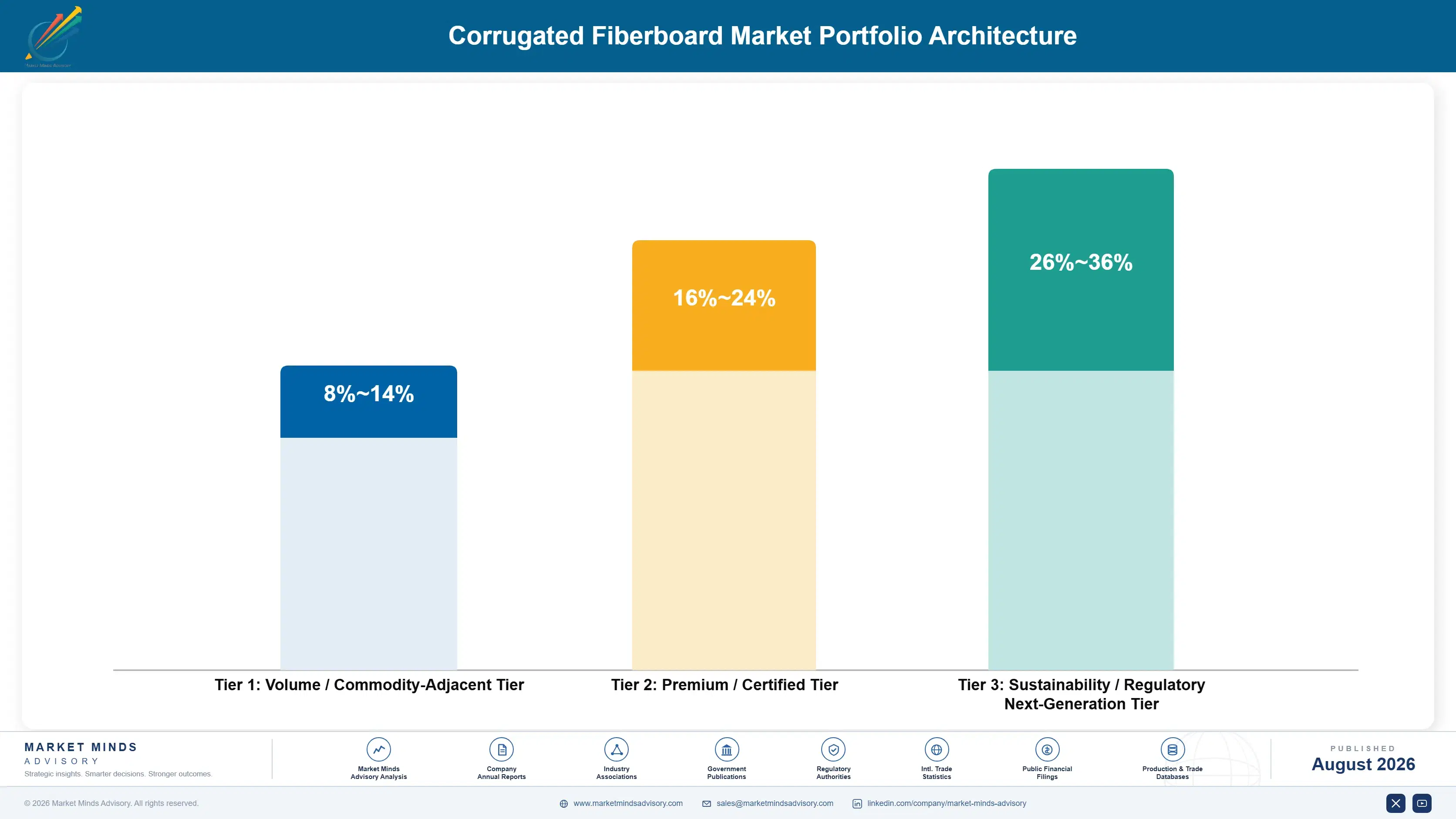
Portfolio Architecture for Margin Defence

Corrugated fiberboard producers organize their portfolios across three tiers separated primarily by design sophistication and sustainability certification rather than by customer size alone, with gross margin climbing sharply from commodity single-wall board toward right-sized e-commerce and certified recycled packaging commanding genuine technical differentiation. The gap between the lowest and highest tier has widened considerably as fulfillment optimization becomes a genuine qualification requirement for the industry's fastest-growing programs.
The volume-versus-premium tension is intensifying as commodity box demand competes almost entirely on cost while premium fulfillment and sustainable packaging customers pay considerably more for design and certification, forcing producers to run fundamentally different manufacturing and commercial organizations under a single corporate roof. Producers that fail to separate these two operating models organizationally often see margin erosion bleed from the volume tier into programs that should command premium pricing.

High-value margin pools concentrate overwhelmingly in right-sized e-commerce and certified recycled packaging programs, both of which command qualification barriers that commodity converters cannot easily cross without meaningful capital investment and multi-year design or sourcing capability development. Producers building both capabilities simultaneously are positioning themselves to capture a disproportionate share of the industry's fastest-growing margin pool.

Volume / Commodity-Adjacent Tier

Standard single-wall corrugated board sold primarily on cost and consistent supply across mainstream industrial and retail shipping applications facing steady commodity pricing pressure. Margins remain thin and continue narrowing further each year across most producing regions.
Gross Margin: 8-14%

Premium / Certified Tier

Recycled and sustainability-certified board with proven fiber content credentials, commanding higher pricing on brand-sensitive consumer packaged goods programs specifying certification. Programs here run at meaningful and growing commercial scale worldwide.
Gross Margin: 16-24%

Sustainability / Regulatory / Next-Generation Tier

Right-sized e-commerce and specialty printed packaging meeting the newest fulfillment and regulatory requirements, commanding the steepest qualification barriers and richest margin pools. Demand for this tier keeps rising steadily each successive quarter.
Gross Margin: 26-36%
corrugated-fiberboard-market-portfolio-architecture-1787548795936

High-value Sub-segments and Strategic Watch-out

Right-Sized E-Commerce Packaging

Highest-value, fastest-growing segment as fulfillment operators specify algorithmic box sizing to cut dimensional weight shipping costs, pulling capital investment away from commodity production across nearly every major producer's roadmap this decade. Investment keeps accelerating across nearly every major producer platform available today. Suppliers ignoring this shift risk losing relevance.
Gross Margin: 28-36%

Recycled and Sustainable Fiber Board

High-value, moderate-growth segment expanding steadily as regulatory mandates approach, offering producers a durable margin premium tied to certification rather than volume scale alone across qualifying programs each successive year. Momentum is building steadily across most major developed consumer markets each year. Suppliers here enjoy meaningful pricing power.
Gross Margin: 18-24%

Standard Single-Wall Industrial Board

The volume core of the market, carrying thin but stable margin across the largest share of global shipping and industrial packaging demand, essential to producer fixed-cost absorption even as growth concentrates elsewhere. Producers rely on it for baseline fixed-cost coverage across their broader portfolios. Volume remains substantial.
Gross Margin: 8-14%

Chinese Overcapacity Pricing Pressure

Strategic watch-out segment where Chinese containerboard overcapacity depresses global commodity pricing, pressuring producer portfolios broadly across every region competing directly on price with Chinese exports. Producers exposed here face the sharpest long-term margin erosion risk overall. Diversification into specialty grades offers the clearest available hedge against this pressure.
Gross Margin: 4-10%

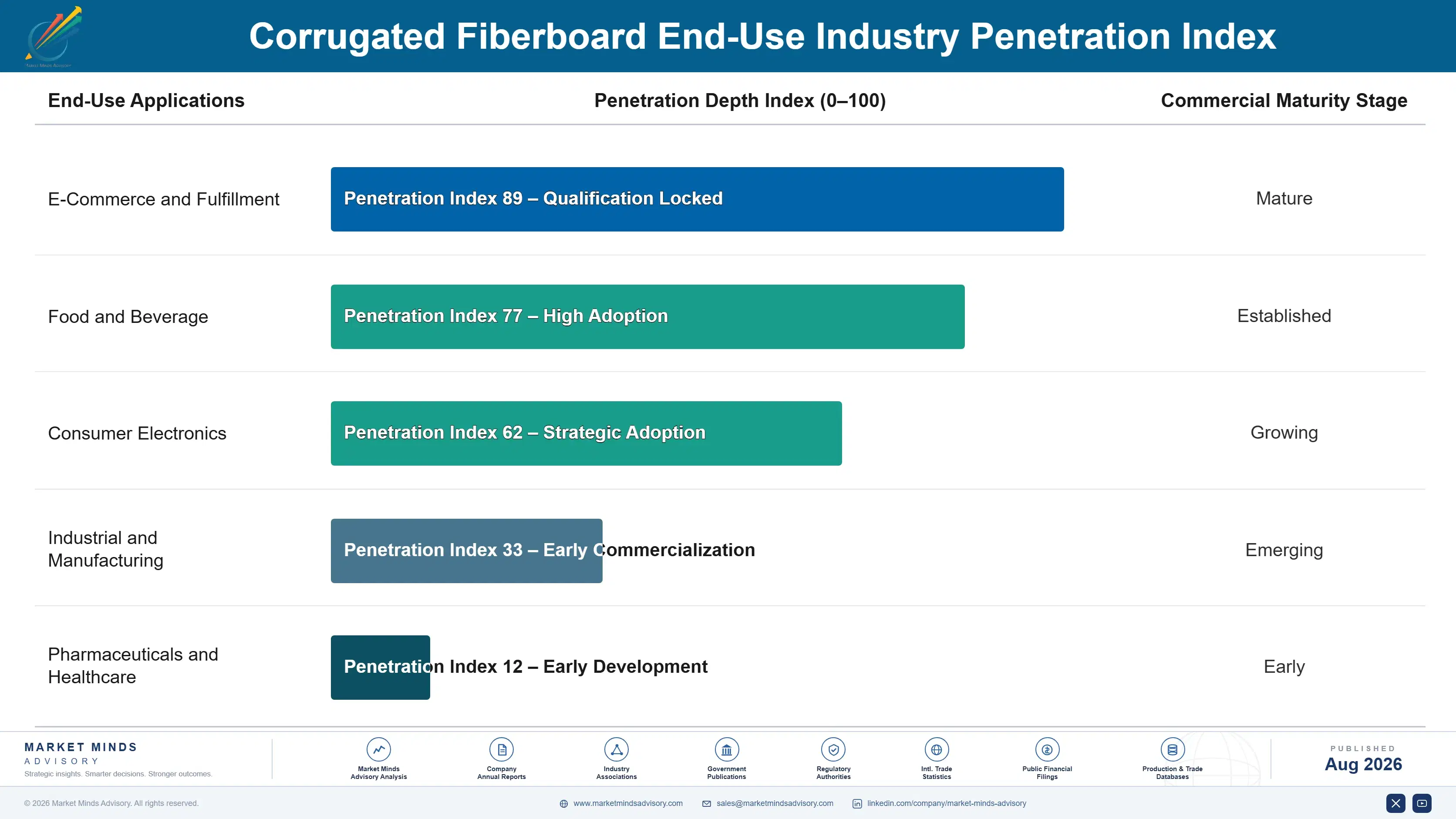
Fulfillment Cycles and Specification Depth

Corrugated fiberboard demand behaves like an annuity anchored to brand owner packaging specification cycles rather than one-off transactions: once a producer wins design-in on a given product line's packaging, it typically holds that relationship for the full multi-year product lifecycle, giving qualified producers predictable revenue visibility across several years. Winning that initial design slot is disproportionately valuable relative to its upfront bidding cost.
Adoption depth varies sharply by end-use vertical. E-commerce fulfillment operators specify the deepest engineering requirements, including right-sized dimensional optimization, while standard industrial shipping applications rely on established commodity specifications largely unchanged for decades. Consumer packaged goods customers sit in between, requiring consistent print and structural quality without the extensive optimization e-commerce customers demand. Mid-market platforms sit between these extremes, adopting optimization selectively rather than across every product line offered.

A generational shift in customer profile is underway as sustainability-focused brand owners, an increasingly influential procurement category, drive recycled fiber specification and certification requirements that traditional industrial shipping customers never needed. Established industrial customers continue operating under long-standing supply relationships largely unchanged across multiple decades of packaging procurement history. Suppliers positioned across both dynamics simultaneously hold the strongest long-term competitive position in the industry today.
corrugated-fiberboard-market-end-use-penetration-index-1787548796421

Where Producers Should Invest Next

These are among the four positions where our research anticipates prominent divergence between winners and laggards over the coming forecast period. Each is grounded in the demand model, the regulatory perimeter, and the announced capacity pipeline.
01 / E-COMMERCE DESIGN INVESTMENT

Build right-sizing design capability before fulfillment operators standardize elsewhere

Producers lacking algorithmic box-sizing design capability are ceding the fastest-growing, highest-margin segment of the market to better-equipped competitors across nearly every major e-commerce fulfillment program launched this decade. Design capability raises unit pricing meaningfully above standard commodity board, giving early movers a durable revenue advantage over slower-moving rivals still confined to commodity volume and thinning margins. Waiting for fulfillment operators to specify this capacity unprompted means missing qualification windows on the flagship programs defining the industry's remaining growth entirely across every region.
02 / RECYCLED FIBER CAPABILITY

Secure recycled sourcing and de-inking capacity before regulatory deadlines tighten further

Regulatory deadlines for recycled content specification are approaching faster than many mid-tier producers have prepared for, and qualification slots on premium brand programs are already filling among early movers with established de-inking capacity built well ahead of the formal compliance schedule across major markets. Producers that wait until compliance becomes mandatory will find themselves requalifying under time pressure while competitors already hold the relevant program positions locked in for years to come. Early investment here protects both margin and existing customer relationships.
03 / VERTICAL INTEGRATION STRATEGY

Pursue mill-to-converting integration before margin compression accelerates further

Producers without vertical integration remain exposed to margin compression during periods of containerboard oversupply, and those relying purely on open-market board purchases risk losing profitability that integrated competitors capture across the full value chain from pulp through finished packaging. Producers pursuing integration early are securing supply certainty and cost advantage that unintegrated converters increasingly cannot match across nearly every major product category. Suppliers delaying this investment risk losing competitive position entirely as consolidation continues reshaping the wider industry landscape today.
04 / CHINA AND ASIA EXPANSION

Build China and Southeast Asia manufacturing presence before domestic rivals dominate further

China's containerboard demand is growing considerably faster than any other major market, and producers relying solely on Western manufacturing footprints are missing the fastest unit volume growth available globally today across nearly every packaging segment. Direct manufacturing presence requires genuinely competitive local cost structures rather than exported Western pricing assumptions built for a fundamentally different competitive environment entirely. Producers succeeding here capture a disproportionate share of the industry's best remaining growth opportunity over the coming several years and well beyond into the next decade.

Engagement Snapshot From the Field

A live engagement with an industry participant carrying material or product regulatory and market exposure ahead of a defining policy shift, showing how our research translates into a defensible multi-year portfolio strategy.
MARKET MINDS ADVISORY · CLIENT ENGAGEMENT SUMMARY
Corrugated Fiberboard Producer Strategic Portfolio Review and Transition Roadmap 2026·Investment Scenario on Corrugated Fiberboard Exposure Evaluation 2025-26
CLIENT PROFILE
The client is a regional corrugated fiberboard converter with production facilities across two countries, serving established industrial shipping and consumer packaged goods customers with standard single-wall and double-wall board, reporting annual revenue in the low hundreds of millions and a workforce spanning production, design, and commercial functions (client-reported, unverified by MMA). across its established markets.
STRATEGIC CHALLENGE
The client was losing long-term supply contracts to competitors offering right-sized e-commerce packaging design capability it had not yet developed, while simultaneously facing margin pressure on its standard board business from lower-cost Chinese exports undercutting aggressively on price across multiple regional accounts. Both dynamics threatened the client's longer-term competitive position considerably.
MMA APPROACH
MMA conducted a facility-by-facility competitive benchmarking exercise across the client's active and prospective customer relationships, combined with primary interviews among procurement decision-makers at fulfillment operators and consumer goods customers, to identify which specific capability gaps were costing contracts and quantify the investment case for closing them. before finalizing recommendations for the leadership team.
KEY FINDINGS
  1. Roughly fifty percent of lost contract bids over the prior two years traced directly to missing right-sizing design capability rather than price alone.
  2. Fulfillment operator procurement teams ranked recycled content certification as a rising qualification criterion, moving from optional to expected within roughly two years.
  3. Chinese competitors had captured meaningful share of new standard board contracts the client had not successfully defended in bidding. across two major regional markets specifically.
  4. E-commerce fulfillment customers represented a growing share of new contract volume the client had been systematically excluded from due to design limitations.
CLIENT PROFILE
The client is a regional corrugated fiberboard converter with production facilities across two countries, serving established industrial shipping and consumer packaged goods customers with standard single-wall and double-wall board, reporting annual revenue in the low hundreds of millions and a workforce spanning production, design, and commercial functions (client-reported, unverified by MMA). across its established markets.
STRATEGIC CHALLENGE
The client was losing long-term supply contracts to competitors offering right-sized e-commerce packaging design capability it had not yet developed, while simultaneously facing margin pressure on its standard board business from lower-cost Chinese exports undercutting aggressively on price across multiple regional accounts. Both dynamics threatened the client's longer-term competitive position considerably.
MMA APPROACH
MMA conducted a facility-by-facility competitive benchmarking exercise across the client's active and prospective customer relationships, combined with primary interviews among procurement decision-makers at fulfillment operators and consumer goods customers, to identify which specific capability gaps were costing contracts and quantify the investment case for closing them. before finalizing recommendations for the leadership team.
KEY FINDINGS
  1. Roughly fifty percent of lost contract bids over the prior two years traced directly to missing right-sizing design capability rather than price alone.
  2. Fulfillment operator procurement teams ranked recycled content certification as a rising qualification criterion, moving from optional to expected within roughly two years.
  3. Chinese competitors had captured meaningful share of new standard board contracts the client had not successfully defended in bidding. across two major regional markets specifically.
  4. E-commerce fulfillment customers represented a growing share of new contract volume the client had been systematically excluded from due to design limitations.
RECOMMENDED STRATEGY
Phase 1: Phase 1 (Months 1-6): Build algorithmic box-sizing design capability and pilot a right-sized packaging solution for one qualifying customer. customer relationship directly. Phase 2: Phase 2 (Months 6-14): Secure recycled fiber sourcing agreements with regional suppliers to strengthen certification credentials. across its two operating facilities. Phase 3: Phase 3 (Months 14-24): Pursue vertical integration with a regional mill to protect margin against feedstock cost volatility. across its European operations.
OUTCOME
Within eighteen months of implementation, the client reported winning qualification on two additional fulfillment packaging supply contracts, alongside a measurable improvement in bid win rate on sustainability-scored sourcing evaluations across its regional customer base and several new prospective accounts secured through the revised strategy (client-reported, unverified by MMA).

Frequently Asked Questions

Foundational context covering the market sizes, CAGR, scope, country, region and competition that inform every finding below. This section is provided to cover basics and most often pre-purchase conversations, answered from the MMA Primary Research Dataset.

What is the current size of the Corrugated Fiberboard Market?

The global corrugated fiberboard market is valued at approximately $145.0 billion in 2025. Growth is concentrated in right-sized e-commerce packaging and China's dominant containerboard manufacturing base.

How large will the Corrugated Fiberboard Market be by 2036?

The market is projected to reach approximately $237.9 billion by 2036 under the base case scenario. This reflects roughly 1.57 times expansion from 2026 levels.

What is the CAGR for the Corrugated Fiberboard Market 2026 to 2036?

The base case CAGR is 4.6% over the forecast period. Bull and bear scenarios range from 5.8% down to 3.4% depending on Chinese overcapacity dynamics.

Which segment is growing fastest?

E-Commerce Optimized and Right-Sized Packaging is the fastest-growing segment at a 7.5% CAGR, roughly 1.63 times the overall market rate. Recycled and Sustainable Fiber Corrugated Board follows closely at 6.5%.

Who are the major companies in the Corrugated Fiberboard Market?

Leading producers include Smurfit WestRock, International Paper Company, Packaging Corporation of America, Nine Dragons Paper, and Mondi Group. Together they hold roughly one-third of global production volume.

Which country is growing fastest?

China leads global growth at a 6.8% CAGR, driven by its dominant containerboard manufacturing base and massive domestic e-commerce packaging demand. Domestic producers continue scaling capacity alongside this surge.

Report Segmentation Architecture

The full report scope spans multiple orthogonal segmentation dimensions, with cross-tabulated demand data provided for each dimension pair. Coverage extends further to regional breakdowns, trend trajectories, and the competitive detail needed to support segment-level decision-making.

By Board Construction and Application

  • Single Wall Corrugated Board
  • Double Wall Corrugated Board
  • Triple Wall Corrugated Board
  • Recycled and Sustainable Fiber Board
  • E-Commerce Optimized and Right-Sized Packaging
  • Specialty Printed and Retail-Ready Packaging

By End-Use Industry

  • E-Commerce and Fulfillment
  • Food and Beverage
  • Consumer Electronics
  • Industrial and Manufacturing
  • Pharmaceuticals and Healthcare

By Commercial Sourcing Dimension

  • Direct Brand Owner Contracts
  • Fulfillment Operator Agreements
  • Distributor and Wholesale Supply
  • Spot Market Purchasing

By Region

  • North America
  • Western Europe
  • East Asia
  • South Asia and Pacific
  • Latin America
  • Middle East and Africa
  • Eastern Europe

Scope, Methodology, and Coverage

Every figure in this report is reproducible from documented input assumptions. The scope below maps the historical period, the forecast horizon, the segmentation dimensions, and the countries covered, alongside the underlying primary and qualitative methodology.
Historical Period
2020 to 2025
Forecast Period
2026 to 2036
Base Year
2025 (USD billions; MMA Primary Research Dataset, August 2026)
Market Definition
The corrugated fiberboard market covers the production of corrugated board material, comprising linerboard and fluted medium layers bonded together, used as the primary substrate for shipping cartons and industrial packaging. It excludes finished folding carton board and solid fiberboard products sold as separate packaging material categories.
Quantitative Units
USD billions (current prices); production volume in million tonnes where applicable
Segmentation Dimensions
By Board Construction and Application; By End-Use Industry; By Commercial Sourcing Dimension; By Region
Regions Covered
North America, Western Europe, East Asia, South Asia and Pacific, Latin America, Middle East and Africa, Eastern Europe
Countries Covered
USA, China, Germany, France, UK, Japan, South Korea, India, Australia, Canada, Brazil, Mexico, Indonesia, Vietnam, Thailand, Malaysia, UAE, Saudi Arabia, South Africa, Nigeria, Turkey, Poland, Netherlands, Italy, Spain, Sweden, Switzerland, Argentina, Colombia, Singapore, and additional markets relevant to this sector
Key Companies Profiled
Smurfit WestRock plc, International Paper Company, Packaging Corporation of America, Nine Dragons Paper (Holdings) Limited, Mondi Group, Georgia-Pacific LLC, Oji Holdings Corporation, Lee & Man Paper Manufacturing Ltd., Rengo Co. Ltd., Stora Enso Oyj, Cascades Inc., Graphic Packaging International LLC, Pratt Industries Inc., Sonoco Products Company, Klabin S.A., Saica Group, VPK Packaging Group, Greif Inc., Nampak Ltd., Shanying International Holdings Co. Ltd.
Quantitative Methodology
Primary survey, n=3,800 respondents, Q4 2025, six countries; demand-side model with trade association cross-validation
Qualitative Methodology
47 expert interviews, Q4 2025; applied to validate demand model assumptions, identify emerging dynamics, and assess competitive positioning
Report Format
PDF and XLSX data workbook (Word format preview document)
Publisher
Market Minds Advisory
Report Code
MMA-2026-PAC-119
Published
August 2026
Contact
sales@marketmindsadvisory.com | www.marketmindsadvisory.com

Purchase the full Corrugated Fiberboard Market Report (2026 to 2036).

The full report delivers a comprehensive analysis of the global corrugated fiberboard market, including detailed segmentation by board construction and application, regional demand forecasts across all seven MMA-tracked geographies, and competitive benchmarking of the twenty leading producers profiled. It includes primary survey data from three thousand eight hundred respondents and forty-seven expert interviews conducted in the fourth quarter of 2025. Buyers receive producer capability matrices, fiber cost sensitivity models, and fulfillment sourcing cycle analysis. The full ten-year forecast spans 2026 through 2036 across every major regional market.
Ten-year quantitative forecast model spanning 2026-2036
Seven-region demand breakdown with growth drivers
Twenty-company competitive benchmarking profiles included in full
Primary survey and expert interview data
Pulp and fiber cost sensitivity analysis
Fulfillment packaging sourcing cycle and mapping analysis

Built For The People Who Decide

From boardroom strategy to bench-side execution, this report is read cover-to-cover by leaders shaping the next decade of their industry, turning demand scenarios, market dynamics and valuation benchmarks into decisions.
CXOs/ Presidents/ VPs/ Managers
M&A and Corporate Development
Strategy Teams and R&D Heads
Procurement and Product Directors
Regulatory and Compliance Leaders
Investor Relations and Equity Analysts