Market Minds Advisory
Corrugated Fanfold Market

Corrugated Fanfold Market: Void Space Regulation, Machine Specification Control, and Freight Cube Economics

European regulation will cap empty space in e-commerce parcels at half the box from 2030, which turns right-sized packaging from a freight saving into a compliance requirement with a date attached.

Lead Analyst

Bilal Shaikh

Published

September 2026

Make Smarter Decisions with Customized Research Insights

Request a free sample report and evaluate market opportunities, growth trends, and competitive dynamics relevant to your business needs.

2025 MARKET VALUE$3.8BMarket Size 2025
2036 FORECAST VALUE$9.6BBase Case , 2026 to 2036
CAGR 2026 TO 20368.8 %Bull 10.1% / Bear 7.5%
INCREMENTAL OPPORTUNITY$5.5BNet 10- year value creation
EXPANSION MULTIPLE2.33x2036 value over 2026 base
Strategic Levers
M&A Pipeline
Regional Outlook
Country Rankings
Competitive Intelligence
Segmental Deep-dive
Call-Us : 91 93563 13602

Executive Snapshot and Market Trajectory

Fanfold board exists because a box-making machine needs a continuous supply rather than pre-cut blanks. That inverts the usual corrugated relationship: the equipment manufacturer writes the board specification, and a paper mill that cannot meet it does not get to quote at all. Eligibility is settled before any commercial conversation.
E-flute and micro-flute constructions compound at 13.2%, a full 1.50x the market rate, because thinner board fits more length onto a pallet, cuts inbound freight and suits the small parcels that dominate e-commerce volume. Western Europe holds the largest share at 28%, above the band MMA normally applies, because packaging waste regulation is capping void space with a firm deadline that no other region has set.
Concentration sits at 41%, with Smurfit Westrock leading on paper and Packsize leading through the installed machine base that decides which board can be used. Right-sizing cuts parcel dimensional charges by roughly 24%, and that freight saving comfortably exceeds the premium fanfold carries over ordinary sheet board. Suppliers who cannot demonstrate that arithmetic end up defending a tonne price against ordinary sheet board, which is an argument nobody in this category wins.
Market Definition
This market covers corrugated board supplied in continuous fanfolded form for automated on-demand box making and right-sizing systems, spanning single wall B-flute, C-flute, E-flute and micro-flute constructions, BC and EB double wall grades, and triple wall or heavy duty fanfold. Measurement is at converter revenue for fanfold board supplied to end users and equipment providers. Pre-cut corrugated blanks and sheet board, box-making machinery itself, protective void fill materials, and non-corrugated packaging substrates are excluded.
Base Year Value
$3.8B in 2025 (MMA Primary Research Dataset, August 2026)
Forecast Period
2026 to 2036, eleven discrete annual values
CAGR
8.8% base case. Bull 10.1%. Bear 7.5%.
Fastest Growth Segment
E-Flute and Micro-Flute Single Wall: 13.2% CAGR
Fastest Growth Country
India: 14.2% CAGR
Fastest Growth Region
South Asia and Pacific: 11.2% CAGR
Largest Region
Western Europe: 28% of 2025 global value
Market Leaders
Smurfit Westrock, International Paper, Mondi, Packsize, and Oji Holdings. Source: MMA Primary Research Dataset, July 2026.
Primary Survey
n=3,800 procurement and R&D decision-makers, Q4 2025, six countries
Methodology
Demand-side build-up, cross-validated against public data, 47 expert interviews

Corrugated Fanfold Market Forecast Scenarios

corrugated-fanfold-market-size-forecast-scenario-1787304229207
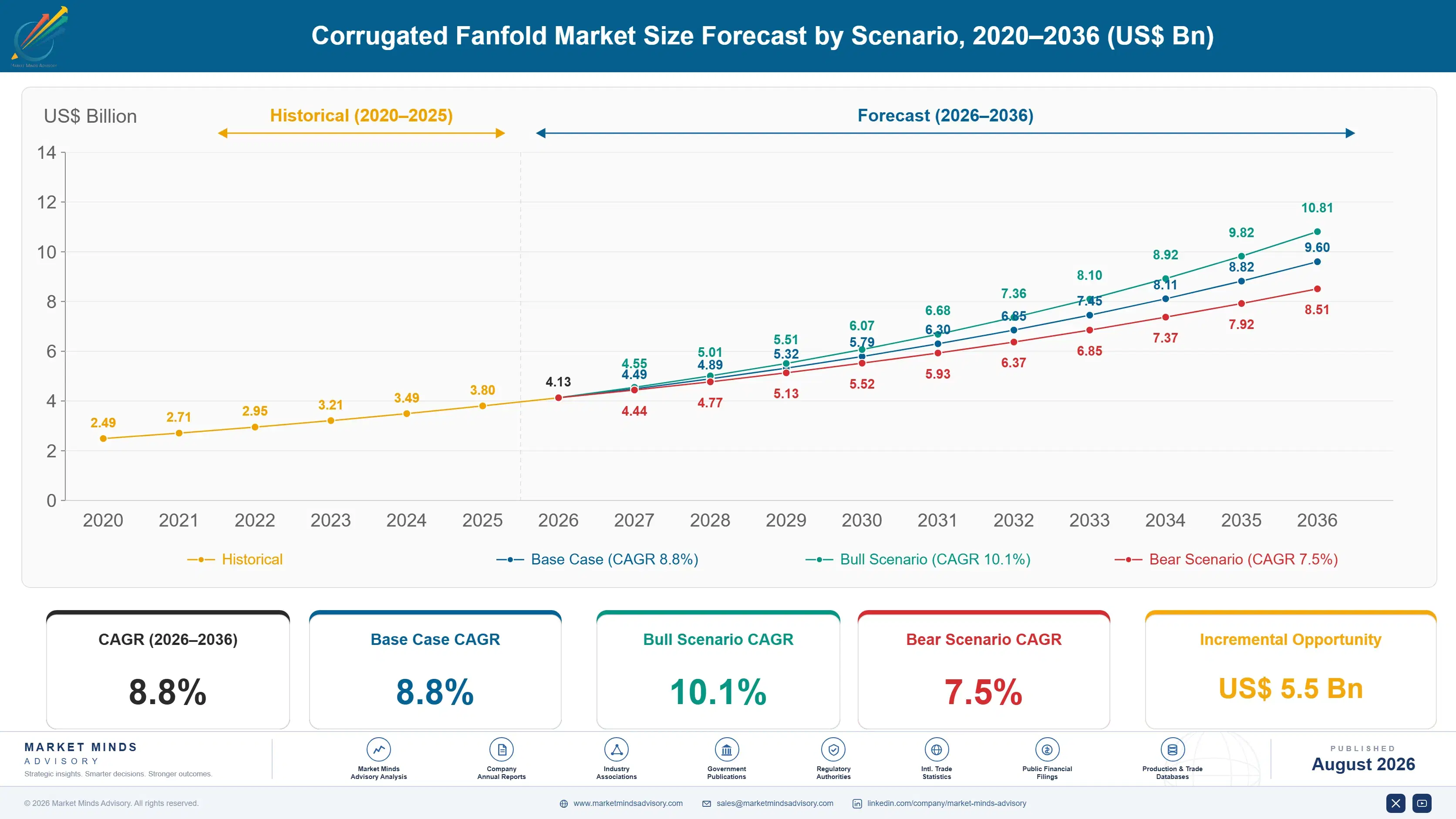
Growth ran at roughly 7.6% between 2020 and 2025, and parcel volume drove it before regulation did anything. E-commerce expansion through 2020 and 2021 overwhelmed fulfilment operations that were shipping small items in oversized boxes, and carrier dimensional weight pricing made that habit expensive very quickly. Right-sizing machinery installations accelerated on freight economics alone, and fanfold board volume followed each installation directly.
Base case growth of 8.8% rests on three mechanisms. European packaging waste regulation caps e-commerce void space from 2030, which converts right-sizing from an efficiency choice into a compliance obligation across a very large fulfilment base. Carrier dimensional weight pricing keeps tightening independently of any regulation. And micro-flute constructions keep taking share because thinner board reduces inbound freight and pallet handling for the operator buying it. None of the three requires parcel volume to accelerate.
The bull case at 10.1% assumes other jurisdictions follow the European void space approach, which several packaging authorities have signalled interest in without committing. The bear case at 7.5% is an installation case: box-making machinery is capital equipment with a long payback, and a downturn in fulfilment investment slows machine placement directly, which slows fanfold volume growth with a two-year lag behind it.

Fanfold Board: Machine Specification and Cube Economics

The supply relationship in this market runs backwards compared with ordinary corrugated. A converter normally sells boxes to a brand owner who specifies dimensions and print. Here a machine manufacturer specifies caliper tolerance, moisture content, score geometry and stack presentation, and any board failing those requirements jams equipment running continuously in a fulfilment centre. The equipment installed base therefore decides who is even eligible to supply.
TOP FIVE CONCENTRATION41%Integrated paper producers competing alongside equipment-led board suppliers
VOID SPACE REDUCTION52%Empty volume eliminated when right-sizing replaces standard carton selection
BOARD PRICE PER TONNEUSD 780Blended fanfold price including conversion, scoring and stacking operations
MACHINE INSTALLED BASE9,200 unitsAutomated box making systems operating across tracked fulfilment networks
FREIGHT COST SAVING24%Parcel dimensional charge reduction achieved through right-sized carton production
CHANGEOVER DOWNTIME8 minutesTypical interval to swap a fanfold stack on running equipment
Freight rather than material cost drives every purchasing decision. Right-sizing eliminates roughly 52% of void volume in a typical e-commerce parcel, which cuts carrier dimensional charges by around 24% and raises trailer fill on outbound loads. Fanfold board costs more per tonne than ordinary sheet because of the additional conversion, scoring and stacking, and that premium disappears entirely against the freight saving within the first months of operation.
European regulation has now added a compliance layer above the economics. Packaging waste rules cap empty space in e-commerce parcels from 2030, which converts right-sizing from an optional efficiency measure into an obligation for anybody shipping into the region at scale. That deadline is already shaping machinery investment decisions being taken now, because a fulfilment network cannot retrofit thousands of packing stations in a final year.
"Nobody buys fanfold because it is cheaper board, because it is not. They buy it because the alternative is shipping air across a continent at a carrier's dimensional rate, and from 2030 in Europe because shipping that air will simply not be permitted."
Director, Packaging Systems and Fulfilment Materials Practice · MMA Packaging Pr

Market Trends

European void space regulation converts right-sizing into compliance

Packaging waste rules across the European Union cap empty space in e-commerce and transport packaging from 2030, which makes right-sized carton production a legal requirement rather than an efficiency choice for anyone shipping into the region at volume. Fulfilment networks cannot retrofit thousands of packing stations in a final year, so machinery investment decisions are being taken now against that deadline. No other jurisdiction has set a comparable limit, which is why European fanfold penetration already leads every other region considerably. Board contracts are being awarded alongside machinery installation, and those arrangements typically run three to five years.
Market Impact: Cuts dimensional charges 24%
Micro-flute constructions displace heavier board across small parcels

E-flute and micro-flute board is thinner, so considerably more running length fits on a pallet and inbound freight per square metre of packaging falls accordingly. Most e-commerce parcels are small and light and never needed the compression strength that heavier flutes provide, which was always a legacy of a supply chain built around pre-cut cartons. Operators switching flute grade reduce warehouse storage, handling and changeover frequency at once, and board suppliers who cannot run micro-flute on fanfold equipment lose those accounts. Holding caliper tolerance on thin fanfold requires corrugator control that a great many converters simply do not possess today.
Market Impact: Removes 2 manual packing steps

Market Opportunities and Growth Drivers

Carrier dimensional weight pricing penalises oversized parcels directly

Parcel carriers charge on whichever is greater, actual weight or a volumetric calculation, and successive revisions to the divisor have made oversized boxes progressively more expensive to ship. A fulfilment operation packing small items into standard cartons is paying for air on every parcel, at rates that compound across millions of shipments annually. Right-sizing cuts that dimensional charge by roughly 24%, which pays back box-making machinery within a period most operations finance comfortably. That payback period sits comfortably within the capital approval thresholds most fulfilment operations apply to packing equipment.
Market Impact: Tolerances within 0.1 millimetres

Labour scarcity pushes fulfilment operations toward packing automation

Manual packing requires an operator to select a carton, position the item, add void fill and close the box, and fulfilment centres across developed markets cannot recruit reliably for that work at wages the operation can support. Automated box making removes the carton selection decision and the void fill step entirely, cutting labour per parcel substantially. That argument has driven machinery adoption independently of freight or regulation, and every installed machine converts to continuous fanfold consumption. Every machine installed on that argument converts to continuous fanfold consumption for the equipment's whole service life.
Market Impact: Demand lags investment by 2 years

Market Restraints and Challenges

Machine specification limits which suppliers can qualify at all

Automated box makers require board within narrow caliper, moisture and score geometry tolerances, because material outside them jams equipment running continuously across a shift. The root cause is that these machines were engineered around specific board characteristics rather than to accept whatever a mill produces. Commercial impact is that an operator's equipment choice determines its eligible supplier list, and independent converters must qualify to each machine standard separately. Suppliers respond by seeking formal approval from equipment manufacturers and by investing in tighter process control. Qualification takes months rather than weeks to complete properly.
Market Impact: Caps void space at 50%

Machinery capital cycles gate how fast board volume can grow

Fanfold consumption follows the installed base of box-making equipment almost exactly, and that equipment is capital expenditure with a payback period measured in years rather than months. The root cause is that no operator buys fanfold without a machine to run it through. Commercial impact is that board demand growth lags fulfilment capital investment by roughly two years and falls with it during any downturn. Board suppliers respond by supporting equipment financing arrangements and by bundling material contracts with machine placement. Nothing a board supplier does shortens a customer's capital approval cycle.
Market Impact: Micro-flute growing at 13.2%
3 additional market trends, 4 additional growth drivers, and 2 additional restraints and challenges are covered in the full report. Contact sales@marketmindsadvisory.com to access the complete intelligence.

Segment CAGR and Growth Architecture

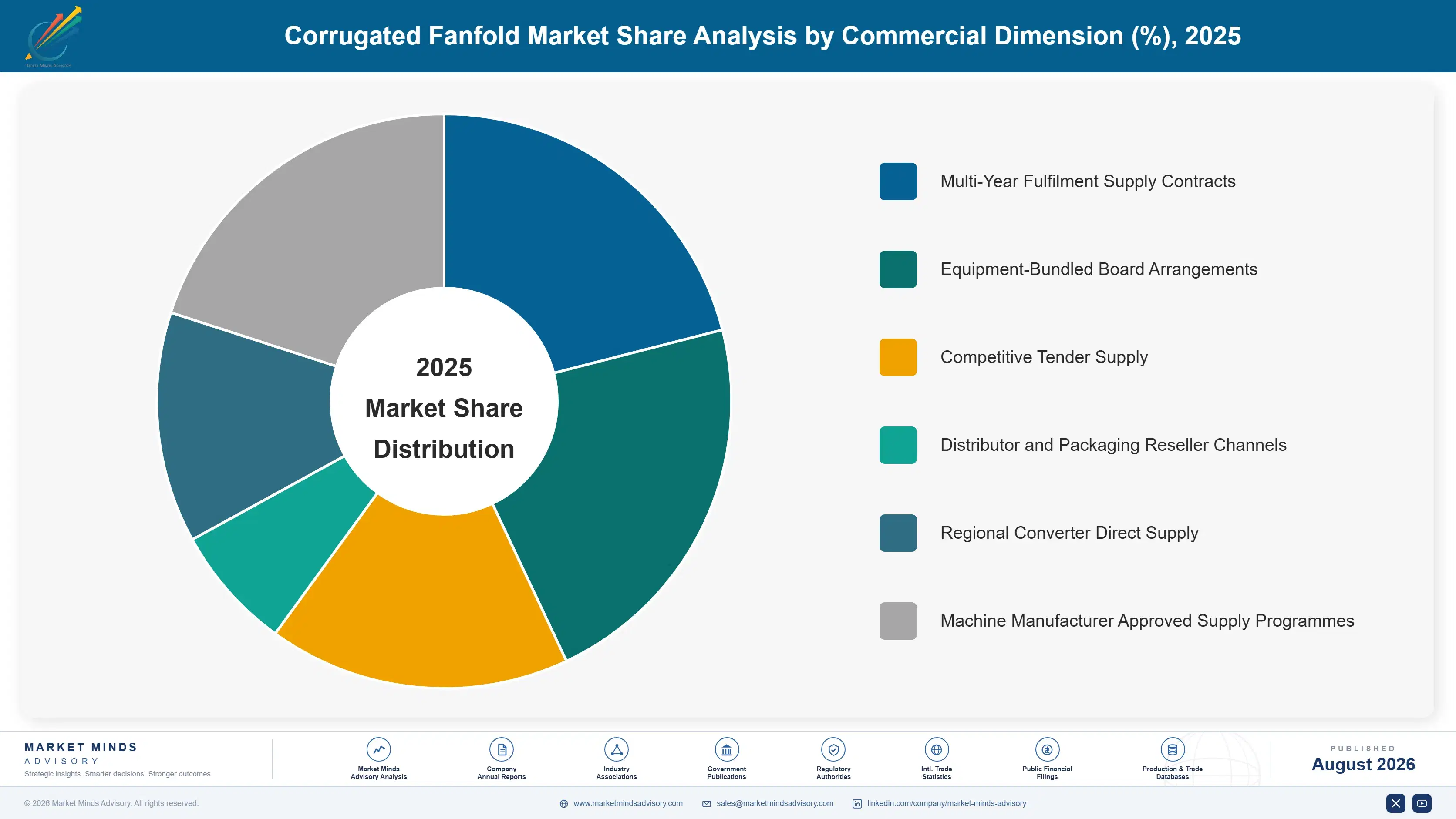
Segmentation follows board construction and flute profile, because construction determines the compression strength available, the running length per pallet, the machine settings required and the parcel types the material can serve. Six constructions cover fanfold supply without overlap. Recycled content and barrier coating vary within every construction and are treated as material attributes rather than as separate segments here.
corrugated-fanfold-market-market-share-analysis-1787304229743

E-Flute and Micro-Flute Single Wall

Growing at 13.2%, a full 1.50x the market rate, thinner flute constructions fit substantially more running length onto a pallet than heavier grades, which reduces inbound freight per square metre of packaging produced and cuts warehouse storage and handling at the same time. Most e-commerce parcels are small and light and never required the compression strength that heavier flutes were designed to deliver. Changeover frequency falls because a single stack runs longer. Board suppliers unable to hold caliper tolerance on thin fanfold grades find themselves excluded from exactly the accounts growing fastest. Margins here run several points above standard constructions, precisely because the qualified supplier field is so much smaller.
CAGR 13.2%

B-Flute Single Wall

B-flute fanfold grows at 10.4% as the workhorse construction for general merchandise parcels that need more protection than micro-flute offers without the cost and pallet inefficiency of double wall. It handles the majority of mixed-basket e-commerce shipments and most machine platforms run it as a default setting. Recycled content grades have penetrated furthest here, since compression requirements are moderate and recovered fibre performs adequately. Competition is correspondingly sharper than in thinner or heavier grades, and delivered price rather than technical qualification decides a growing proportion of these contracts. Volume is the largest of any construction and the margin is correspondingly the thinnest across the whole category. Machine qualification is widely held here, which is why price decides so much.
CAGR 10.4%
Full segment breakdown across 6 segments available in the complete report.

Regional Architecture and Country Demand Map

Regional value follows automated packing equipment density and regulatory pressure rather than parcel volume alone. Regions with high fulfilment automation and firm void space rules consume disproportionate fanfold volume against their share of parcels shipped. Equipment density rather than parcel count is the variable that matters here.

Western Europe

Western Europe holds the largest share at 28%, above the band MMA normally applies. Note: this share is stated out of band because European packaging waste regulation caps e-commerce void space from 2030 and no other jurisdiction has set a comparable requirement, which has driven fanfold penetration well beyond what parcel volume alone would produce. German, Dutch and Nordic fulfilment operations adopted right-sizing earliest. Packsize, Panotec and CMC are all European equipment manufacturers and shaped board specifications from here. Growth at 7.4% is the slowest of the seven regions precisely because penetration is already deepest and the remaining conversion base is smaller. Compliance rather than freight economics now drives the remaining conversions across the region.
Share: 28% | CAGR: 7.4% (2026 to 2036)

North America

Twenty-six per cent of value, growing at 9.0%. Adoption here was driven entirely by economics rather than regulation, because parcel carriers revised dimensional weight divisors repeatedly and made oversized shipping expensive years before any packaging rule existed. Large fulfilment operators installed box-making equipment at scale on freight savings alone. Labour scarcity in fulfilment centres added a second argument that operators found equally persuasive. Integrated producers including Smurfit Westrock and International Paper supply most board, and the absence of a void space regulation means the conversion runway here remains considerably longer than Europe's. Freight arithmetic alone carried adoption here for years before any regulator became involved. The conversion runway ahead here is considerably longer than Europe's remaining base.
Share: 26% | CAGR: 9.0% (2026 to 2036)
Regional intelligence for 5 additional markets available in the complete report: East Asia, South Asia and Pacific, Latin America, Middle East and Africa, Eastern Europe. Contact sales@marketmindsadvisory.com.
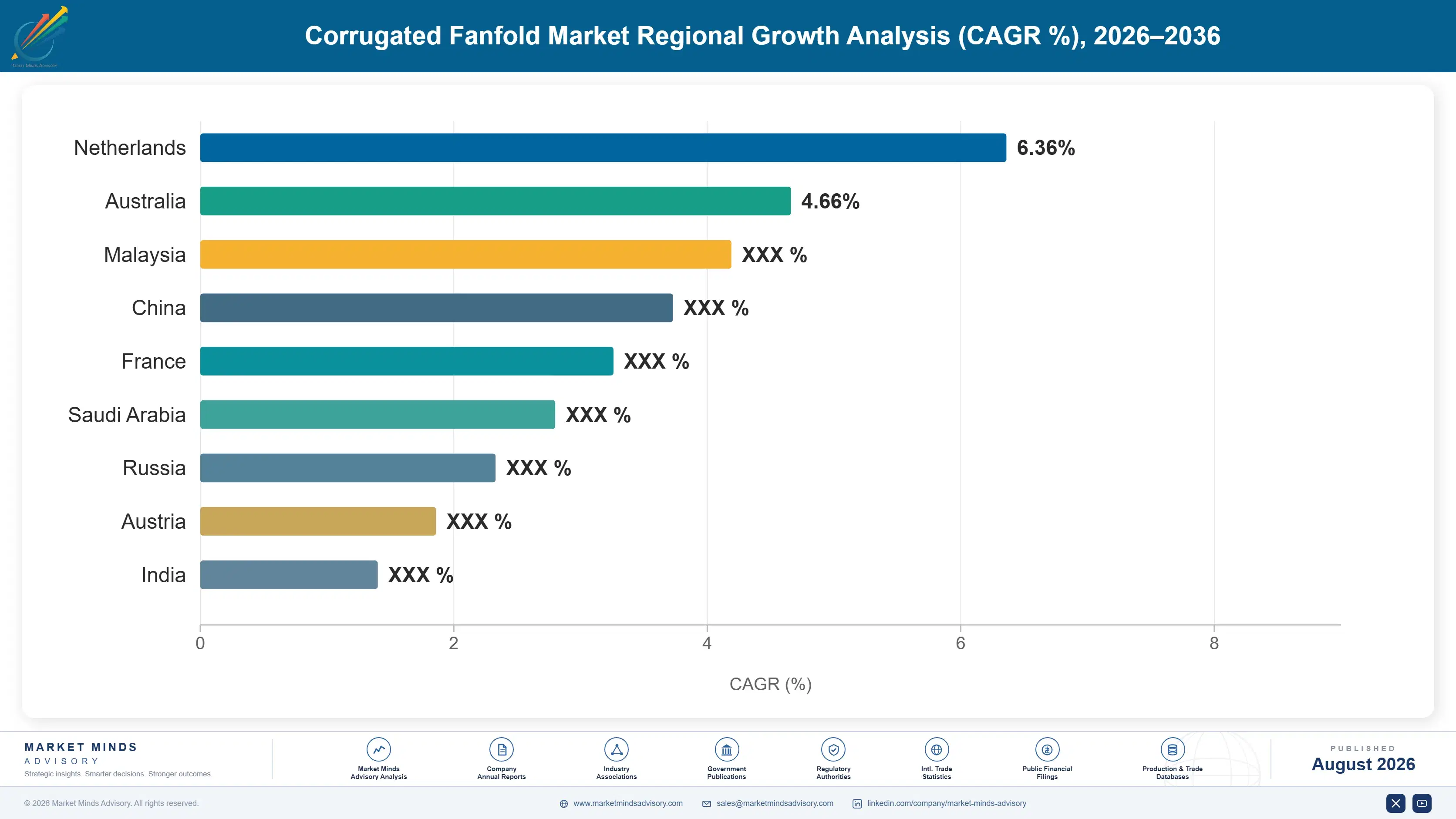
corrugated-fanfold-market-country-cagr-analysis-1787304230260

Where Fanfold Board Value Is Won

The machine writes the specification and the freight bill justifies the purchase, so neither the tonne price nor the mill relationship decides these contracts. Value accrues to whoever qualifies against equipment standards, whoever can run the thinnest grades reliably, and whoever arrives before the compliance deadline forces a decision. Tonne price settles almost nothing.

Qualify formally against every major equipment specification

Automated box makers require board within caliper tolerances measured in tenths of a millimetre, plus controlled moisture and score geometry, because material outside those limits jams equipment running continuously through a shift. An operator's machine choice therefore fixes its eligible supplier list before any commercial conversation begins. Converters holding formal approval across the major platforms can quote on every account, and those holding none compete for nothing. Qualification requires process control investment that mills serving conventional sheet markets have rarely needed. Approval across all 4 major platforms is what opens the whole addressable account base.
Market Impact: Tolerances are held within 0.1 mill

Sell freight arithmetic rather than board price per tonne

Fanfold costs more per tonne than ordinary sheet because of the conversion, scoring and stacking involved, and every procurement conversation starts there unless the supplier redirects it. Right-sizing eliminates roughly 52% of void volume and cuts carrier dimensional charges by around 24%, which exceeds the entire board premium within months of operation. Suppliers presenting delivered parcel cost rather than material cost win the argument consistently. Presenting a price per tonne against sheet board loses it every time. Presenting a price per tonne against sheet board loses it every single time.
Market Impact: Cuts carrier dimensional charges by

Build capability in micro-flute before the accounts convert

Thin flute grades fit far more running length per pallet, reduce inbound freight and suit the small parcels that dominate e-commerce, and the segment compounds at 13.2% against a much slower category. Holding caliper tolerance on thin fanfold is genuinely harder than on heavier constructions and requires corrugator control that many converters lack. Suppliers unable to run those grades reliably are excluded from precisely the accounts growing fastest, and the capability cannot be assembled after a customer has already switched. Accounts lost on capability do not return at the next tender.
Market Impact: Micro-flute grades are compounding

Position ahead of the European void space compliance deadline

Packaging waste regulation caps e-commerce void space from 2030, and no fulfilment network can retrofit thousands of packing stations in a final year, so machinery and board decisions are being made now. Suppliers engaging operators during that planning window secure multi-year board contracts alongside equipment installation. Those waiting until the deadline approaches will find specifications written, machines installed and supply already committed. This is a defined window rather than an open-ended opportunity. Board contracts awarded alongside installations typically run three to five years, so an account lost during this window stays lost well past the deadline itself.
Market Impact: Compliance obligation begins from 2

Who Controls the Margin Pool

Concentration sits at 41% across the top five, measured on annual revenue from fanfold corrugated board supplied to end users and equipment providers, the single basis applied throughout. Smurfit Westrock and International Paper lead through integrated paper and conversion scale. Mondi follows on European capacity, Oji Holdings on Asian supply, and Packsize occupies an unusual position, selling board alongside the machines that created demand for it.
Competition runs on qualification before it runs on price. An operator's equipment fixes the eligible supplier list, so converters compete first for formal approval against machine specifications and only afterwards on delivered cost. Micro-flute capability is the second dimension and it separates suppliers sharply, because holding caliper tolerance on thin fanfold requires corrugator control many converters simply do not have. Delivered logistics economics form the third.

Pressure builds from two directions. Equipment manufacturers including Packsize and Panotec influence board sourcing directly through specification and increasingly supply material themselves, which puts them between converters and their customers. Separately, regional converters in Asia and Latin America are qualifying to machine standards and competing on delivered cost. Rankings shift most where a converter secures approval across every major platform rather than serving one equipment base.
corrugated-fanfold-market-company-positioning-matrix-1787304230785

Competitive Moat and Risk Dimensions

SMURFIT WESTROCK

Moat: Integrated fibre and conversion scale

Smurfit Westrock controls containerboard production and conversion across a very large footprint on both sides of the Atlantic, which gives it fibre security, cost absorption through paper price cycles and the geographic coverage large fulfilment networks need from a single supplier. Multi-site supply into a national operation is difficult for a regional converter to replicate at comparable service levels.
SMURFIT WESTROCK

Risk: Equipment specification dependence

Board eligibility is decided by machine manufacturers rather than by the paper producer, so scale confers no automatic access to an account running equipment the company has not qualified against. Packsize and comparable equipment suppliers increasingly supply board themselves. Micro-flute fanfold requires corrugator control that legacy sheet-focused assets do not always deliver.
PACKSIZE

Moat: Machine base specification control

Packsize built the installed base of on-demand box making systems that created fanfold demand, and each machine runs board to specifications the company defines. That places it upstream of every converter competing to supply its customers, and it converts an equipment sale into an enduring influence over material sourcing across the machine's operating life.
PACKSIZE

Risk: Capital cycle exposure

Machine placement is capital expenditure with multi-year payback, and fulfilment investment slows sharply during any downturn, which delays board volume growth behind it. Competing equipment manufacturers write their own specifications and lock converters differently. The company lacks the integrated fibre position that protects paper producers through containerboard price cycles.

Players Tracked

Prominent Players

Smurfit Westrock
International Paper
Mondi
Packsize
Oji Holdings

Other Key Players

Nippon Paper Industries
Rengo
Cascades
Sonoco Products
Pratt Industries
Georgia-Pacific
Saica Group
Hinojosa Packaging
Palm Group
Progroup
VPK Group
Panotec
CMC Machinery
Nine Dragons Paper
Klabin

Recent Developments

FEBRUARY 2025

European packaging regulation confirms void space limits for e-commerce shipments

European packaging and packaging waste rules confirmed maximum empty space ratios for e-commerce and transport packaging taking effect from 2030, giving fulfilment operators a fixed deadline against which to plan packing station automation and board supply arrangements across their networks. No comparable requirement exists elsewhere.
Signal: A dated compliance requirement converts ri
JULY 2025

Packsize widens board supply arrangements alongside equipment placements

Packsize extended board supply arrangements offered alongside its on-demand box making systems, an organic commercial expansion rather than an acquisition, positioning the equipment manufacturer between independent converters and the fulfilment operators running its machines. Independent converters were not consulted on the specifications applied. Board margins moved accordingly.
Signal: Equipment manufacturers are now moving int
JANUARY 2026

Indian converters secure qualification against major fanfold equipment specifications

Several Indian corrugated converters obtained formal qualification against major automated box making equipment specifications, an organic process control investment rather than any licensing arrangement, opening domestic fulfilment accounts that had previously required imported board. Imported board had previously been the only qualified option. Freight cost fell substantially.
Signal: Qualification rather than any underlying d

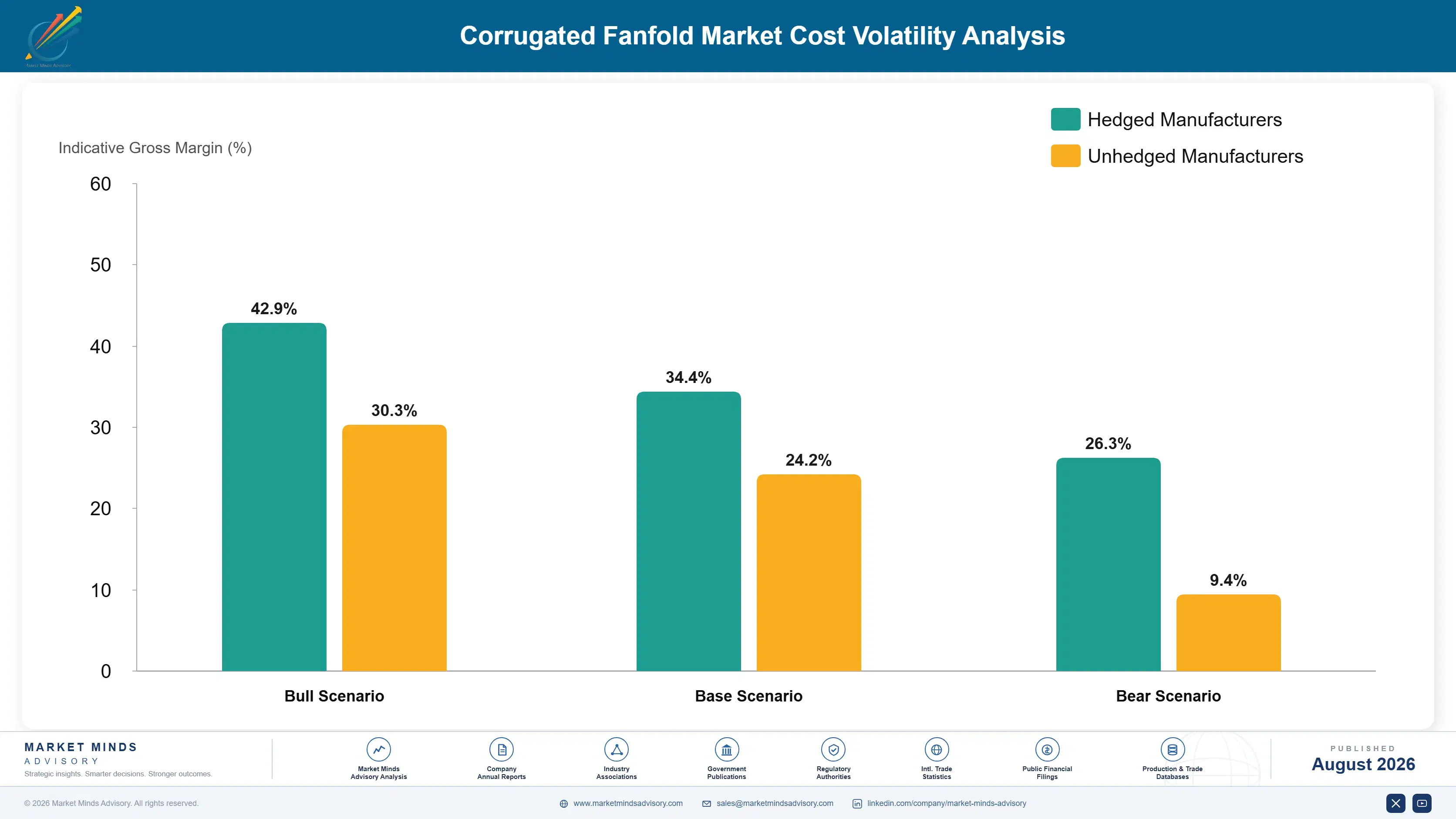
Containerboard, Starch and Conversion Exposure

Cost structures are dominated by fibre, as they are across all corrugated packaging. Containerboard, comprising kraftliner facings and fluting medium, accounts for roughly 62% of fanfold cost of goods, sourced from integrated mills or purchased on a market that prices on published indices. Starch adhesive, energy for corrugating and drying, and the additional conversion, scoring and stacking that fanfold requires make up most of the balance.
The 2021 to 2023 containerboard cycle demonstrated the exposure. Recovered fibre and kraftliner prices moved sharply as demand outran capacity and then reversed, and Smurfit Kappa and Mondi both documented containerboard price volatility and its margin effect in their annual reporting across those years. Fanfold contracts written annually with fulfilment operators could not be repriced mid-term, so converters absorbed the movement in both directions. Neither direction helped anybody.

The disadvantage falls hardest on non-integrated converters buying containerboard on the open market. An integrated producer transfers paper internally through the cycle while a merchant converter pays index pricing and cannot pass it through within a contract year. Geography compounds it: European corrugating and drying energy costs exceed Asian and North American levels materially, in a product carrying conversion cost that ordinary sheet board does not.
corrugated-fanfold-market-cost-volatility-analysis-1787304230982

Write containerboard index linkage into annual fanfold supply contracts

Fixed annual pricing transferred the whole containerboard cycle onto converters during the last movement, in both directions. Narrow indexation tied to published kraftliner and recovered fibre benchmarks removes that exposure. Fulfilment operators accept it more readily than a general escalator, because the underlying index data is external, published and clearly outside any converter's influence.

Secure fibre position through integration or long-term mill agreements

Merchant converters buying containerboard at index pricing carry an exposure integrated producers simply do not, and that gap widens during every tight cycle. Long-term supply agreements with defined volume and pricing mechanics are the practical alternative to integration, and they matter more in fanfold than in sheet because contracts run longer. Contract length makes it matter more.

Improve corrugator control to run thin grades without waste

Micro-flute fanfold is the fastest-growing construction and the hardest to run within tolerance, so converters lacking process control either decline the business or generate waste that erodes the margin entirely. Investment in caliper and moisture control pays through qualification access as much as through yield, which is the larger commercial benefit. Yield improvement is the smaller benefit.

Portfolio Architecture for Margin Defence

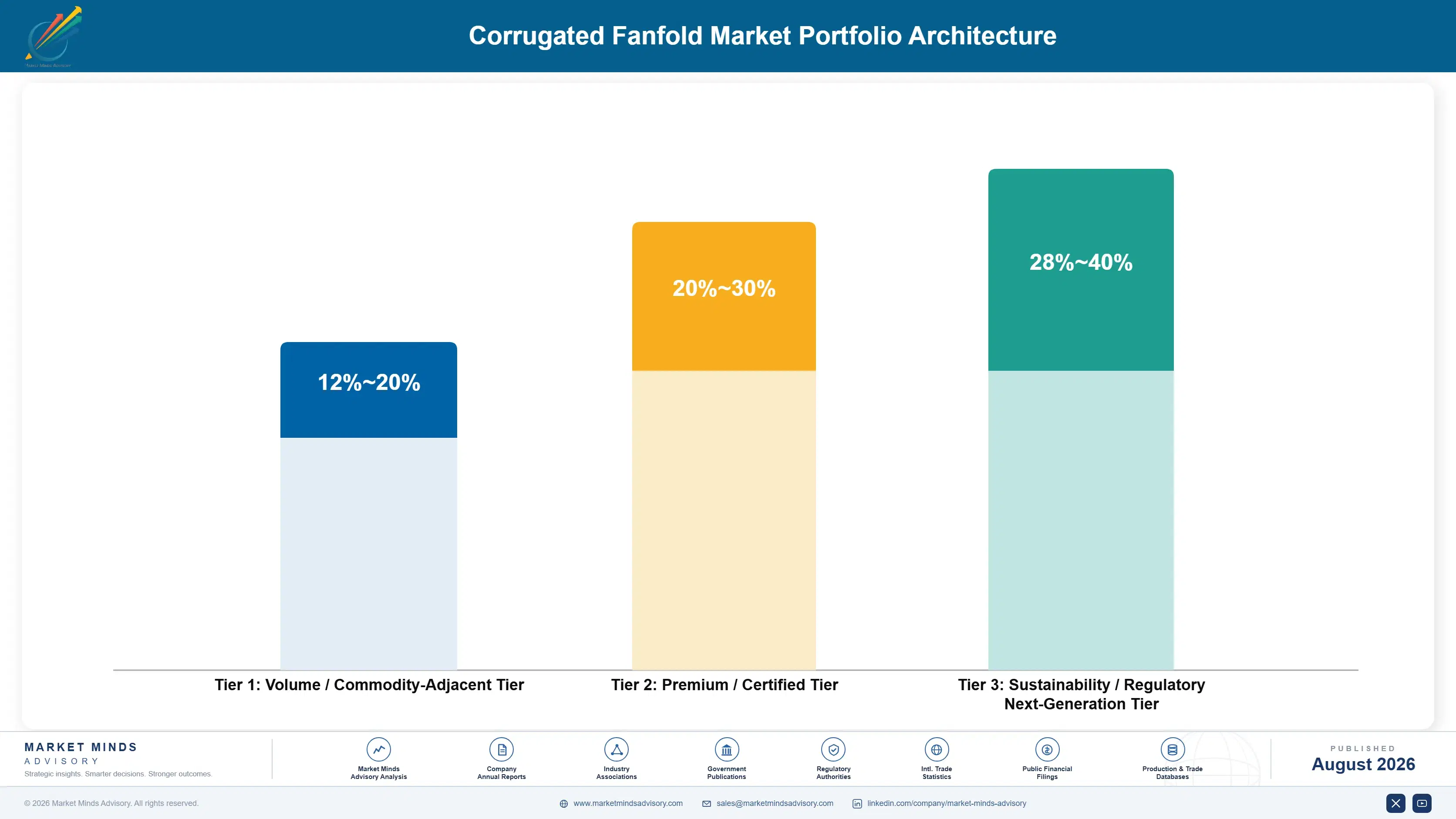
Margin architecture divides on qualification difficulty rather than on board grade. Standard B-flute and C-flute fanfold is produced by many qualified converters and competes largely on delivered cost, since machine approval is widely held. Micro-flute and thin constructions earn more because tolerance requirements exclude converters lacking corrugator control. Bundled material and equipment arrangements earn most, because the supplier sits inside the operator's capital decision rather than outs
The volume versus premium tension runs between commodity fulfilment supply and specification-constrained grades. High-volume general merchandise packing consumes enormous B-flute tonnage at thin margins against many qualified competitors. Thin flute and heavy duty constructions consume less and price better, because fewer converters can hold the tolerances or the compression specifications. Most converters treat all fanfold as one business and price it accordingly, which leaves value uncollected.

High-value pools sit where a converter is inside the operator's decision rather than quoting against it. Equipment-bundled supply arrangements, multi-site national contracts with service commitments, and qualification-restricted thin grades all price on availability and capability rather than on tonne cost. Standard single wall fanfold supplied into a competitive tender sits at the opposite extreme, decided almost entirely on delivered price.

Volume / Commodity-Adjacent Tier

Standard B-flute and C-flute fanfold supplied into competitive tenders where many converters hold machine qualification and delivered cost decides the award, with recycled content grades competing hardest of all. Fibre position is the only real defence.
Gross Margin: 12-20%

Premium / Certified Tier

Micro-flute and thin single wall constructions requiring caliper tolerances that exclude converters without corrugator process control, plus double wall grades where compression specification restricts the qualified supplier field. Qualified supplier numbers are far smaller here.
Gross Margin: 20-30%

Sustainability / Regulatory / Next-Generation Tier

Equipment-bundled board arrangements, multi-site national service contracts and compliance-driven supply secured during the European deadline planning window. Best margins available and the least exposed to competitive tender. The supplier sits inside the capital decision.
Gross Margin: 28-40%
corrugated-fanfold-market-portfolio-architecture-1787304231477

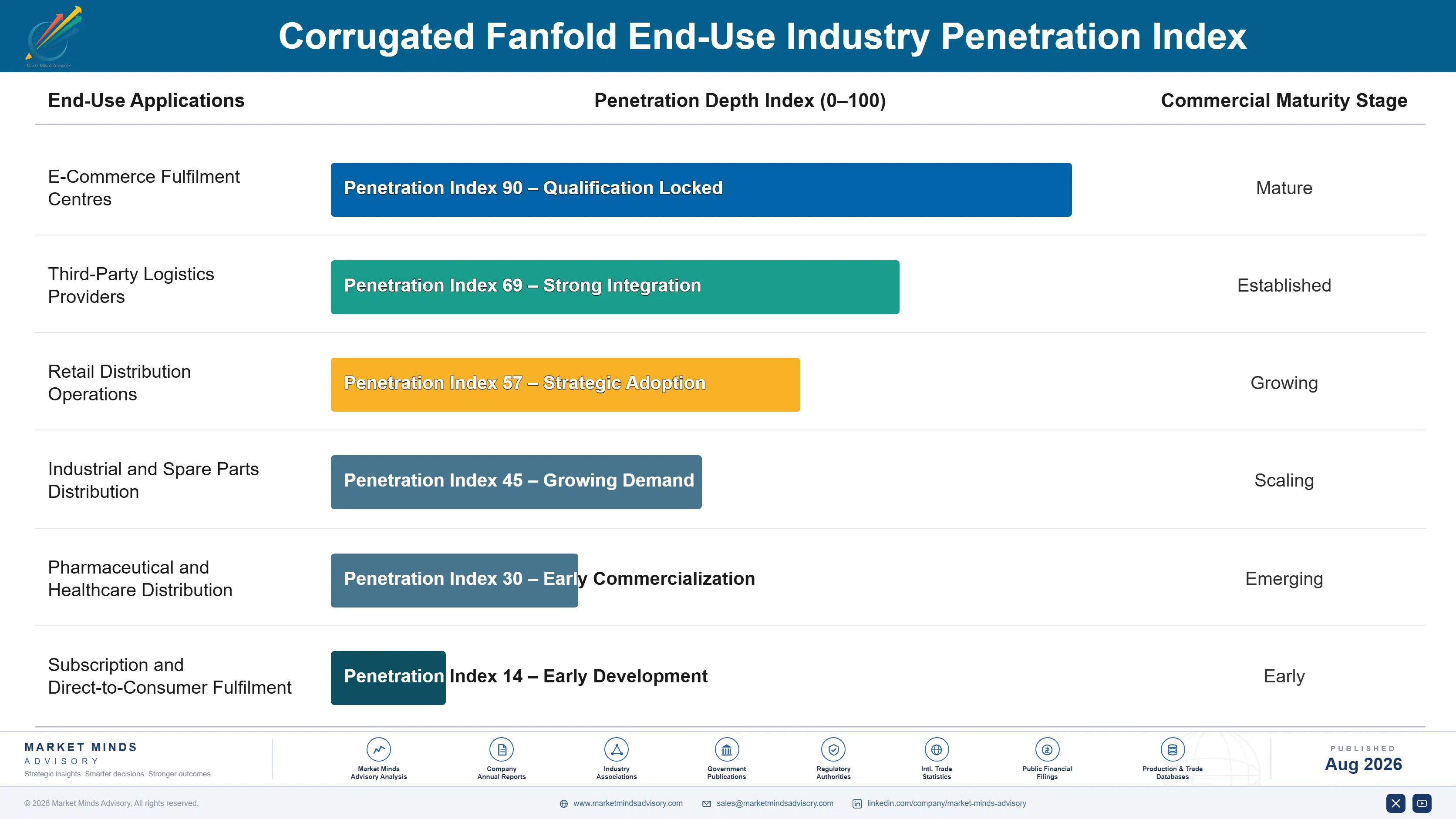
Consumption Following Installed Machine Base

Fanfold consumption tracks the installed base of box-making equipment almost mechanically. A machine placed in a fulfilment centre runs continuously through operating shifts and consumes board at a predictable rate for its whole service life, which typically runs beyond a decade. Board demand therefore grows in steps as equipment is installed rather than smoothly with parcel volume.
Stickiness comes from qualification rather than from contract. A converter approved against an operator's equipment and running reliably within tolerance is difficult to displace, because a jam on a packing line during peak season costs far more than any board price difference could save. Operators change supplier when service fails rather than when price moves. Standard grades in multi-supplier accounts show considerably weaker attachment and turn on annual tender.

Buyer profiles have moved toward operations rather than procurement. A decade ago packaging buyers negotiated corrugated tonnage on price against published indices. Today fulfilment engineering and operations teams specify board against machine requirements, evaluate on line uptime and waste, and involve procurement only once technical eligibility is settled. Suppliers organised around commodity packaging selling find the conversation now starts with a machine manual.
corrugated-fanfold-market-end-use-penetration-index-1787304231966

Where Fanfold Strategy Must Land

These are among the four positions where our research anticipates prominent divergence between winners and laggards over the coming forecast period. Each is grounded in the demand model, the regulatory perimeter, and the announced capacity pipeline.
01 / EQUIPMENT QUALIFICATION PRIORITY

The machine manufacturer decides who is allowed to quote

Automated box makers require board within caliper tolerances measured in tenths of a millimetre alongside tightly controlled moisture content and score geometry, because anything falling outside those limits jams equipment that runs continuously through an entire shift. An operator's machine choice therefore fixes its entire eligible supplier list before any commercial conversation happens at all. Converters holding formal approval across every major platform can quote on every available account, while those holding none are competing for precisely nothing at all.
02 / FREIGHT ARGUMENT FRAMING

Never let procurement compare tonne price against sheet

Fanfold genuinely costs more per tonne than ordinary sheet board because of the conversion, scoring and stacking it requires, and every procurement discussion begins there unless the supplier deliberately redirects it somewhere better. Right-sizing eliminates roughly 52% of void volume and cuts carrier dimensional charges by around 24%, which exceeds the entire board premium within months of operation. Suppliers presenting delivered parcel cost rather than material cost win that argument consistently, and those presenting tonne price lose it every time.
03 / THIN GRADE CAPABILITY

Micro-flute capability cannot be built after losing accounts

Thin flute constructions compound at 13.2% against a considerably slower category, because more running length fits per pallet and most e-commerce parcels never needed heavier compression strength in the first place. Holding caliper tolerance on thin fanfold demands corrugator process control that a great many converters simply do not possess today. Suppliers unable to run those grades reliably are excluded from exactly the accounts growing fastest, and the capability takes considerably longer to build than a customer takes to switch away.
04 / COMPLIANCE WINDOW TIMING

European specifications are being written right now

Packaging waste regulation caps e-commerce void space from 2030, and no fulfilment network can possibly retrofit thousands of packing stations in a single final year, so machinery and board supply decisions across the region are being taken during this present planning period. Suppliers engaging those operators today secure multi-year board supply contracts alongside the equipment installation and service commitments themselves. Those waiting until the deadline actually approaches will find specifications written, machines installed and material supply already fully committed elsewhere.

Engagement Snapshot From the Field

A live engagement with an industry participant carrying material or product regulatory and market exposure ahead of a defining policy shift, showing how our research translates into a defensible multi-year portfolio strategy.
MARKET MINDS ADVISORY · CLIENT ENGAGEMENT SUMMARY
Corrugated Fanfold Producer Strategic Portfolio Review and Transition Roadmap 2026·Investment Scenario on Corrugated Fanfold Exposure Evaluation 2025-26
CLIENT PROFILE
An independent European corrugated converter supplying sheet board and pre-cut cases to industrial and retail customers across three national markets, with annual revenue of approximately USD 310 million (client-reported, unverified by MMA). Fanfold represented under 4% of volume and was supplied opportunistically rather than strategically. The company held formal qualification against one automated box making platform and none of the others operating in its markets.
STRATEGIC CHALLENGE
Fulfilment customers were installing right-sizing equipment ahead of the European void space deadline and awarding multi-year board contracts alongside those installations, and the client was being excluded from tenders on qualification grounds rather than on price or service. The board needed to decide whether to invest in process control and multi-platform qualification, or to concentrate on defending its existing sheet and case business instead.
MMA APPROACH
MMA conducted 47 expert interviews across fulfilment engineering leads, packaging operations managers, box making equipment manufacturers, corrugated converters and packaging regulatory specialists in six countries. A quantitative survey of 3,800 respondents established supplier selection criteria, switching triggers and specification requirements across fulfilment operations. We then modelled revenue and margin under both options against observed equipment installation rates and the regulatory compliance timetable.
KEY FINDINGS
  1. Fulfilment engineering leads selected board suppliers from equipment manufacturer approved lists exclusively, and none would evaluate an unqualified converter on price or service terms.
  2. Board contracts were being awarded alongside machinery installation and typically ran three to five years, so accounts lost during this window would not return before the compliance deadline.
  3. Micro-flute grades carried materially better margins than standard constructions because qualified supplier numbers were far smaller, and demand was growing considerably faster.
  4. Operators cited packing line stoppages rather than board price as the reason for changing supplier, and no surveyed operation had switched primarily on cost in three years.
CLIENT PROFILE
An independent European corrugated converter supplying sheet board and pre-cut cases to industrial and retail customers across three national markets, with annual revenue of approximately USD 310 million (client-reported, unverified by MMA). Fanfold represented under 4% of volume and was supplied opportunistically rather than strategically. The company held formal qualification against one automated box making platform and none of the others operating in its markets.
STRATEGIC CHALLENGE
Fulfilment customers were installing right-sizing equipment ahead of the European void space deadline and awarding multi-year board contracts alongside those installations, and the client was being excluded from tenders on qualification grounds rather than on price or service. The board needed to decide whether to invest in process control and multi-platform qualification, or to concentrate on defending its existing sheet and case business instead.
MMA APPROACH
MMA conducted 47 expert interviews across fulfilment engineering leads, packaging operations managers, box making equipment manufacturers, corrugated converters and packaging regulatory specialists in six countries. A quantitative survey of 3,800 respondents established supplier selection criteria, switching triggers and specification requirements across fulfilment operations. We then modelled revenue and margin under both options against observed equipment installation rates and the regulatory compliance timetable.
KEY FINDINGS
  1. Fulfilment engineering leads selected board suppliers from equipment manufacturer approved lists exclusively, and none would evaluate an unqualified converter on price or service terms.
  2. Board contracts were being awarded alongside machinery installation and typically ran three to five years, so accounts lost during this window would not return before the compliance deadline.
  3. Micro-flute grades carried materially better margins than standard constructions because qualified supplier numbers were far smaller, and demand was growing considerably faster.
  4. Operators cited packing line stoppages rather than board price as the reason for changing supplier, and no surveyed operation had switched primarily on cost in three years.
RECOMMENDED STRATEGY
Phase 1: Phase one: invest in caliper and moisture process control sufficient to qualify against the three remaining major equipment platforms operating across the client's markets. Phase 2: Phase two: build micro-flute running capability deliberately, since qualified supplier numbers there are smallest and demand growth is fastest across the category. Phase 3: Phase three: engage fulfilment operators during machinery planning rather than at tender, because board contracts are awarded alongside equipment installation decisions.
OUTCOME
The client completed qualification against two further platforms within fourteen months and secured three multi-year fulfilment contracts alongside equipment installations (client-reported, unverified by MMA). Fanfold reached roughly an eighth of volume within two years at margins several points above its sheet business, and no contract was lost to price competition during that period.

Frequently Asked Questions

Foundational context covering the market sizes, CAGR, scope, country, region and competition that inform every finding below. This section is provided to cover basics and most often pre-purchase conversations, answered from the MMA Primary Research Dataset.

What is the current size of the Corrugated Fanfold Market?

The global corrugated fanfold market was valued at USD 3.8 billion in 2025, covering single wall, double wall and heavy duty fanfold board for automated box making systems. Pre-cut blanks and machinery fall outside this definition.

How large will the Corrugated Fanfold Market be by 2036?

MMA forecasts the market at USD 9.61 billion by 2036, expanding 2.33 times from the 2026 base of USD 4.13 billion. That represents roughly USD 5.48 billion of incremental value across the forecast decade.

What is the CAGR for the Corrugated Fanfold Market 2026 to 2036?

The base case compound annual growth rate is 8.8%, with a bull case of 10.1% and a bear case of 7.5%. The bear case reflects slower fulfilment capital investment delaying box making equipment installation.

Which segment is growing fastest?

E-flute and micro-flute single wall grades grow at 13.2%, a full 1.50x the overall market rate. Thinner board fits more running length per pallet and suits the small parcels dominating e-commerce volume.

Who are the major companies in the Corrugated Fanfold Market?

Smurfit Westrock, International Paper, Mondi, Packsize and Oji Holdings together hold 41% of revenue. Equipment manufacturers occupy an unusual position, writing the board specifications that determine which converters can supply at all.

Which country is growing fastest?

India grows fastest at 14.2%, as e-commerce platforms build automated fulfilment capacity from a low base and skip manual packing entirely. Western Europe remains the largest region at 28% of value.

Report Segmentation Architecture

The full report scope spans multiple orthogonal segmentation dimensions, with cross-tabulated demand data provided for each dimension pair. Coverage extends further to regional breakdowns, trend trajectories, and the competitive detail needed to support segment-level decision-making.

By Board Construction

  • B-Flute Single Wall
  • C-Flute Single Wall
  • E-Flute and Micro-Flute Single Wall
  • BC Double Wall
  • EB Double Wall
  • Triple Wall and Heavy Duty

By End-Use Industry

  • E-Commerce Fulfilment Centres
  • Third-Party Logistics Providers
  • Retail Distribution Operations
  • Industrial and Spare Parts Distribution
  • Pharmaceutical and Healthcare Distribution
  • Subscription and Direct-to-Consumer Fulfilment

By Commercial Dimension

  • Multi-Year Fulfilment Supply Contracts
  • Equipment-Bundled Board Arrangements
  • Competitive Tender Supply
  • Distributor and Packaging Reseller Channels
  • Regional Converter Direct Supply
  • Machine Manufacturer Approved Supply Programmes

By Region

  • Western Europe
  • North America
  • East Asia
  • South Asia and Pacific
  • Latin America
  • Middle East and Africa
  • Eastern Europe

Scope, Methodology, and Coverage

Every figure in this report is reproducible from documented input assumptions. The scope below maps the historical period, the forecast horizon, the segmentation dimensions, and the countries covered, alongside the underlying primary and qualitative methodology.
Historical Period
2020 to 2025
Forecast Period
2026 to 2036
Base Year
2025 (USD billions; MMA Primary Research Dataset, August 2026)
Market Definition
This market comprises corrugated board manufactured and supplied in continuous fanfolded form for use in automated on-demand box making and right-sizing equipment, measured at converter revenue across multi-year fulfilment contracts, equipment-bundled arrangements, competitive tenders and distributor channels. Coverage spans single wall B-flute, C-flute, E-flute and micro-flute fanfold constructions, BC and EB double wall fanfold grades, triple wall and heavy duty fanfold, and the recycled content and coated variants of each, supplied to e-commerce fulfilment operations, third-party logistics providers, retail distribution and industrial packing operations. Pre-cut corrugated blanks, sheet board supplied for conventional case making, automated box making machinery and its spare parts, void fill materials including air pillows, paper and foam, protective mailers and flexible packaging, and containerboard sold as paper rather than converted board fall outside scope.
Quantitative Units
USD billions (current prices); fanfold tonnage by construction; price per tonne by grade; installed box making machine base; running length per pallet
Segmentation Dimensions
By Board Construction; By End-Use Industry; By Commercial Dimension; By Region
Regions Covered
Western Europe, North America, East Asia, South Asia and Pacific, Latin America, Middle East and Africa, Eastern Europe
Countries Covered
Germany, Netherlands, United Kingdom, France, Italy, Spain, Sweden, Denmark, Belgium, United States, Canada, Mexico, China, Japan, South Korea, Taiwan, India, Australia, Singapore, Malaysia, Vietnam, Brazil, Argentina, Chile, Colombia, Saudi Arabia, United Arab Emirates, South Africa, Poland, Czechia, Hungary, Romania, and additional markets relevant to fulfilment packaging analysis
Key Companies Profiled
Smurfit Westrock, International Paper, Mondi, Packsize, Oji Holdings, Nippon Paper Industries, Rengo, Cascades, Sonoco Products, Pratt Industries, Georgia-Pacific, Saica Group, Hinojosa Packaging, Palm Group, Progroup, VPK Group, Panotec, CMC Machinery, Nine Dragons Paper, Klabin
Quantitative Methodology
Primary survey, n=3,800 respondents, Q4 2025, six countries; demand-side model with trade association cross-validation
Qualitative Methodology
47 expert interviews, Q4 2025; applied to validate demand model assumptions, identify emerging dynamics, and assess competitive positioning
Report Format
PDF and XLSX data workbook (Word format preview document)
Publisher
Market Minds Advisory
Report Code
MMA-2026-PAC-206
Published
August 2026
Contact
sales@marketmindsadvisory.com | www.marketmindsadvisory.com

Purchase the full Corrugated Fanfold Market Report (2026 to 2036).

The full MMA report treats equipment specification as the commercial gate it actually is, and traces how a dated European compliance requirement converts right-sizing from an efficiency choice into an obligation. It sizes six board constructions and seven regions to 2036, modelling installed machine base, fanfold tonnage and pricing by grade separately so that equipment-driven step growth can be distinguished from parcel volume. Competitive assessment covers twenty converters and equipment suppliers on one consistent revenue basis. Input cost exposure is traced through containerboard pricing, energy and conversion. Four commercial levers and a strategic verdict close the report, grounded in 47 expert interviews and a 3,800-respondent survey.
Six board constructions sized separately to 2036
Installed machine base modelled against fanfold consumption rates
European void space compliance timetable mapped by market
Twenty suppliers assessed on one consistent basis
Freight cube savings quantified against board price premium
Anonymised client engagement with tested strategic recommendations

Built For The People Who Decide

From boardroom strategy to bench-side execution, this report is read cover-to-cover by leaders shaping the next decade of their industry, turning demand scenarios, market dynamics and valuation benchmarks into decisions.
CXOs/ Presidents/ VPs/ Managers
M&A and Corporate Development
Strategy Teams and R&D Heads
Procurement and Product Directors
Regulatory and Compliance Leaders
Investor Relations and Equity Analysts