Market Minds Advisory
Corrugated Bubble Wrap Market

Corrugated Bubble Wrap Market: E-Commerce Protective Packaging and Sustainable Cushioning Through 2036

Plastic packaging bans are forcing fulfillment centres to swap air pillows and foam for corrugated bubble formats that recycle in a standard cardboard stream, even as custom sizing pushes packaging cost higher.

Lead Analyst

Bilal Shaikh

Published

August 2026

Make Smarter Decisions with Customized Research Insights

Request a free sample report and evaluate market opportunities, growth trends, and competitive dynamics relevant to your business needs.

2025 MARKET VALUE$2.8BMarket Size 2025
2036 FORECAST VALUE$5.8BBase Case , 2026 to 2036
CAGR 2026 TO 20366.8 %Bull 8.0% / Bear 5.7%
INCREMENTAL OPPORTUNITY$2.8BNet 10- year value creation
EXPANSION MULTIPLE1.93x2036 value over 2026 base
Strategic Levers
M&A Pipeline
Regional Outlook
Country Rankings
Competitive Intelligence
Segmental Deep-dive
Call-Us : 91 93563 13602

Executive Snapshot and Market Trajectory

E-commerce fulfillment centres are swapping plastic air pillows and foam inserts for corrugated bubble formats that recycle in a standard cardboard stream, driven as much by looming plastic packaging regulation as by any cost advantage. That single material substitution is reshaping which packaging vendors win fulfillment contracts right now.
Biodegradable and recyclable corrugated bubble packaging is pulling ahead of every other product category, growing at nearly twice the market's blended rate as retailers respond to tightening plastic packaging regulation across major consumer markets worldwide. East Asia now holds the largest single regional share, reflecting China's enormous e-commerce shipment volume and its position as the world's largest corrugated packaging manufacturing base by a wide margin.
A fragmented group of packaging majors, WestRock, International Paper, Sealed Air, DS Smith, and Mondi among them, compete for large fulfillment contracts, while a long tail of regional converters serves smaller e-commerce sellers on price alone rather than sustainability credentials. Extended producer responsibility packaging regulation and e-commerce fulfillment automation requirements are both shaping which formats retailers ultimately standardise on for the next decade of shipment volume across every major fulfillment network worldwide.
Market Definition
The corrugated bubble wrap market covers corrugated cardboard packaging products that integrate bubble cushioning material, including bubble mailers, bubble-lined boxes, and bubble wrap rolls used for void-fill within corrugated shipping containers. It excludes standalone plastic bubble wrap sold without a corrugated component and excludes general corrugated boxes sold without integrated cushioning.
Base Year Value
$2.8B in 2025 (MMA Primary Research Dataset, August 2026)
Forecast Period
2026 to 2036, eleven discrete annual values
CAGR
6.8% base case. Bull 8.0%. Bear 5.7%.
Fastest Growth Segment
Biodegradable and Recyclable Corrugated Bubble Packaging: 12.4% CAGR
Fastest Growth Country
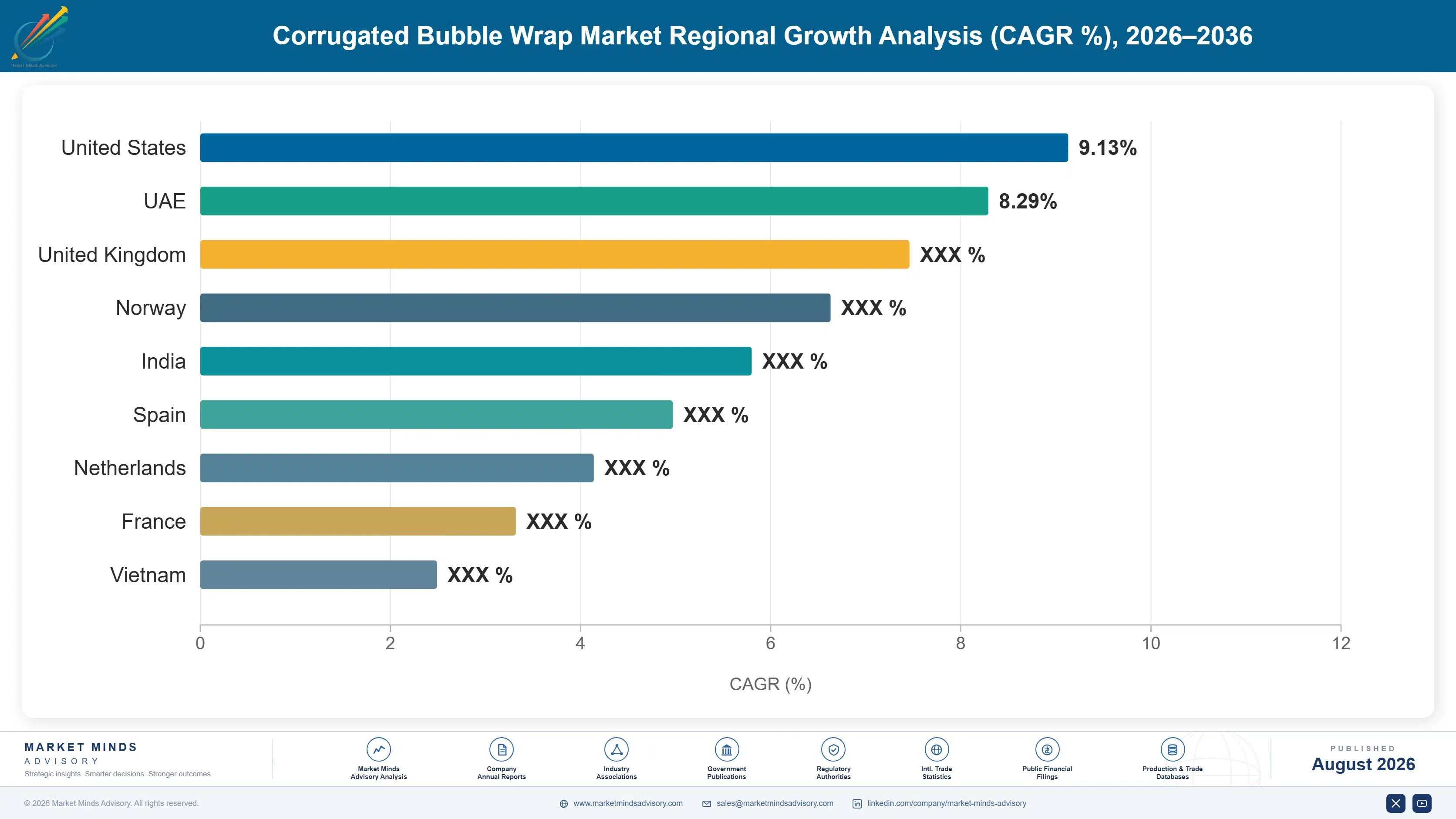
India: 10.2% CAGR
Fastest Growth Region
South Asia and Pacific: 8.8% CAGR
Largest Region
East Asia: 30% of 2025 global value
Market Leaders
WestRock Company, International Paper Company, Sealed Air Corporation, DS Smith plc, Mondi Group. Source: MMA Analysis based on company annual reports.
Primary Survey
n=3,800 procurement and R&D decision-makers, Q4 2025, six countries
Methodology
Demand-side build-up, cross-validated against public data, 47 expert interviews

Corrugated Bubble Wrap Market Forecast Scenarios

corrugated-bubble-wrap-market-size-forecast-scenario-1787304070933
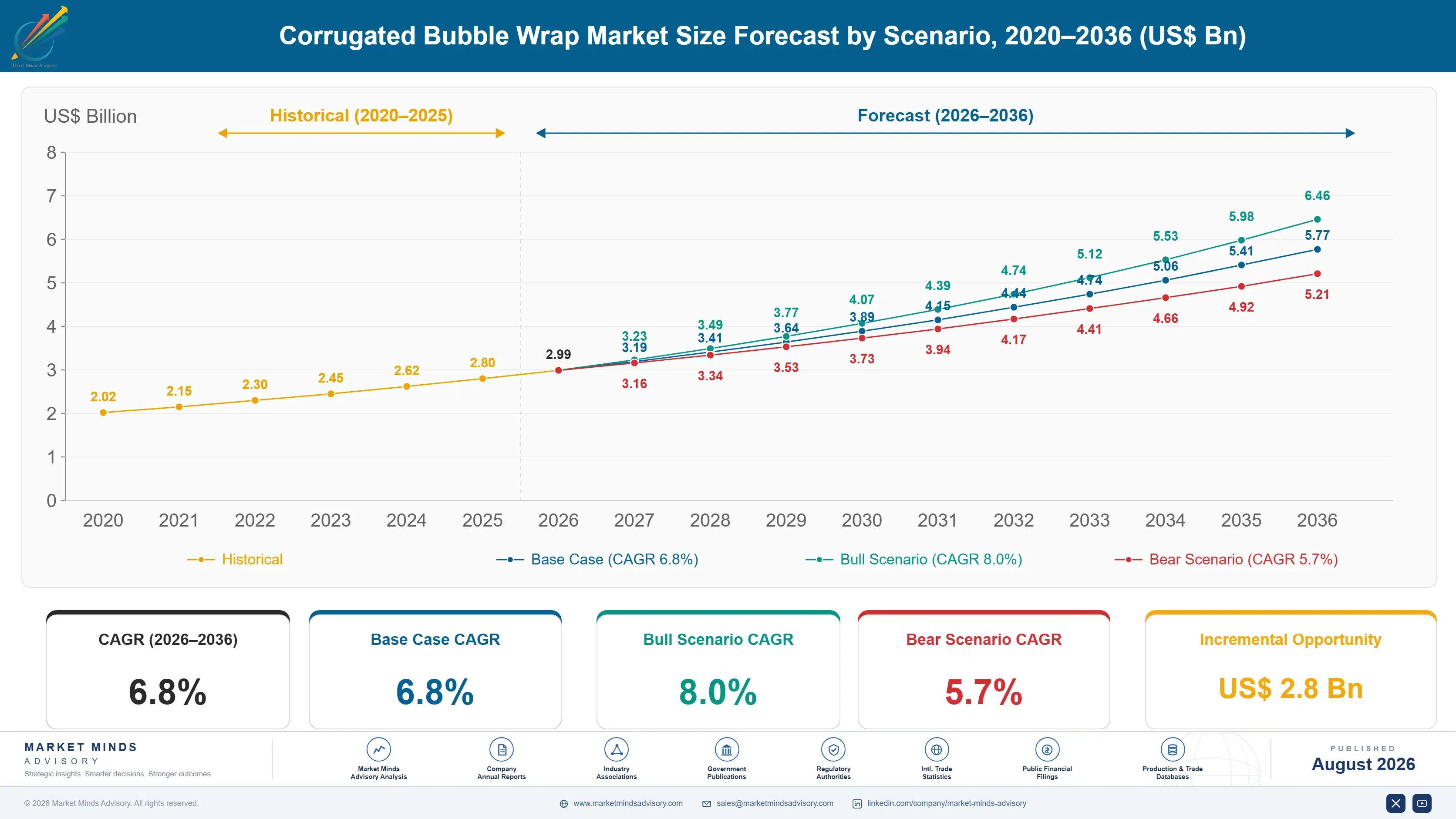
Between 2020 and 2025 the market grew steadily as e-commerce shipment volume expanded sharply during pandemic-era online shopping growth and stayed elevated afterward, a trend reinforced once retailers began facing plastic packaging regulation that pushed them toward recyclable cushioning formats. Corrugated bubble packaging volume across the MMA-tracked fulfillment network sample rose meaningfully across that five-year stretch, concentrated heavily among large e-commerce sellers.
The base case through 2036 rests on three mechanisms: continued e-commerce shipment volume growth sustaining demand for protective packaging across every major consumer category and geography tracked, extended producer responsibility regulation pushing retailers away from plastic-only cushioning formats toward recyclable corrugated alternatives that clear compliance audits more easily, and packaging makers bundling custom-fit die-cutting services with recurring supply contracts that lock in multi-year fulfillment centre relationships rather than one-off bulk orders.
A bull scenario turns on faster regulatory implementation of plastic packaging restrictions across more national markets, pulling conversion forward at retailers currently using cheaper plastic alternatives that still clear existing rules. The bear case is continued price sensitivity among smaller e-commerce sellers who prioritise the lowest-cost cushioning option regardless of recyclability, slowing premium format adoption well below current industry expectations.

Where Commodity Mailers Meet Custom Sustainable Packaging

Corrugated bubble packaging spans a wide format spectrum, from a several-cent standard mailer sold in bulk to fulfillment centres to a custom die-cut box engineered for a specific product's dimensions and shipping profile down to the millimetre. That spread means blended average selling price tells you almost nothing about where the actual commercial opportunity and margin concentration genuinely sit across the full format continuum, and treating this as one undifferentiated packaging category m
MARKET CONCENTRATIONCR5 34%top five packaging makers hold roughly a third combined share
AVERAGE SELLING PRICE$0.42 per unitblended price spanning mailer, box, and roll formats
TOP PRODUCING COUNTRYChina, 24% shareleads global corrugated packaging manufacturing and export volume
CAPACITY UTILISATION78%converters running comfortably below peak available production throughput
TRADE INTENSITY31% cross-bordershare of finished packaging units shipped across national borders
FEEDSTOCK COST SHARE48% of COGSrecycled paperboard and resin inputs within total unit cost
Standard bubble mailers remain a scale business won on paperboard cost and delivery reliability, where converters compete mostly on price and freight logistics to distribution centres located near major shipping hubs. Custom-fit and sustainable formats behave completely differently, priced on engineering service and regulatory compliance documentation, and sold through direct relationships with large e-commerce retailers and brand sustainability teams rather than general wholesale distribution, a sales motion closer to industrial engineering than commodity paper supply.
Over the next decade, extended producer responsibility regulation, e-commerce fulfillment automation requirements, and rising shipment volume in fast-growing Asian markets will keep reshaping who competes profitably at each end of this format spectrum.
"Nobody switches packaging format because bubble mailers stopped protecting products. They switch because a regulator or a sustainability audit forced the question, and that is a compliance sale now, not a packaging sale."
Director, Packaging and Sustainable Materials Practice · MMA Packaging Practice

Market Trends

Retailers Convert to Recyclable Formats for Compliance

Retailers are converting fulfillment centres away from plastic air pillows and foam inserts specifically to clear extended producer responsibility packaging audits that increasingly penalise non-recyclable cushioning materials at the point of sale. Roughly 41% of major United States fulfillment operators reported converting at least one distribution centre to corrugated bubble formats in 2025, up from under 15% three years earlier, largely driven by regulatory compliance pressure rather than cost savings alone. Packaging makers are responding by designing bubble cushioning that separates cleanly from the corrugated shell during recycling, since single-stream recyclability increasingly decides which format a fulfillment centre adopts first.
Market Impact: 26% rise in shipment volume tracked
Fulfillment Automation Drives Custom-Fit Packaging Demand

E-commerce fulfillment automation is pushing retailers toward custom-fit corrugated bubble packaging sized precisely to each shipped item, since automated packing lines run far more efficiently with standardised, pre-sized formats than with generic boxes requiring manual void-fill and adjustment. Roughly 34% of large e-commerce fulfillment centres surveyed by MMA reported adopting automated packaging sizing systems in 2025, a figure expected to climb steadily as automation capital costs continue falling across the industry. Manufacturers are responding by offering on-demand die-cutting services co-located near major fulfillment hubs to cut delivery lead time meaningfully.
Market Impact: Saves roughly $0.08 per shipment

Market Opportunities and Growth Drivers

Rising E-Commerce Shipment Volume Drives Packaging Demand

Global e-commerce shipment volume keeps climbing as online retail penetration continues expanding across nearly every consumer category tracked, from apparel to electronics to grocery delivery and beyond into new categories each year. Shipment volume across the MMA-tracked fulfillment network sample rose roughly 26% since 2021, a trend logistics associations expect to continue as online retail penetration keeps rising in both developed and emerging markets alike. Each incremental shipment requires protective packaging, multiplying corrugated bubble demand directly alongside the underlying e-commerce volume growth rather than trailing it as a lagging indicator.
Market Impact: Adds cost of $0.05 to 0.15

Regulatory Fees Make Recyclable Formats Cost-Competitive

Extended producer responsibility regulation is expanding to more jurisdictions each year and imposing real financial penalties on retailers using non-recyclable packaging materials, creating a direct cost incentive to convert well beyond any voluntary sustainability commitment made previously by brand teams. Compliance analysis shows retailers switching to recyclable corrugated bubble formats save an estimated $0.08 per shipment in avoided extended producer responsibility fees versus continuing with plastic-based cushioning, a figure that scales meaningfully across millions of annual shipments processed through a single large fulfillment network operating at national scale each year.
Market Impact: Cited by 37% of consumers surveyed

Market Restraints and Challenges

Premium Format Cost Deters Smaller Sellers

Custom-fit and biodegradable corrugated bubble formats carry meaningfully higher unit costs than standard plastic-lined mailers, creating persistent price resistance among cost-conscious smaller e-commerce sellers who lack the shipment volume to justify premium packaging investment right now. The root cause is that biodegradable cushioning materials still rely on a narrower, less mature supplier base than conventional plastic bubble film, keeping input costs elevated across the industry. Manufacturers are responding by scaling biodegradable material production to bring costs down and by offering tiered pricing that rewards larger-volume commitments with meaningfully better unit economics over time.
Market Impact: 41% of US operators now converted

Inconsistent Recycling Infrastructure Undermines Messaging Efforts

Recycling infrastructure for mixed-material corrugated bubble packaging remains inconsistent across municipalities, meaning a product marketed as recyclable may not actually be processed as such in every region where it ultimately ships to end customers. Roughly 37% of consumers surveyed by MMA reported confusion about whether their local recycling program accepts corrugated bubble packaging at all, undermining the sustainability messaging retailers rely on to justify premium pricing at the point of sale. Manufacturers are responding with clearer on-package recycling instructions and industry-wide labelling standardisation efforts led by major national trade associations.
Market Impact: 34% of centres adopted automated si
3 additional market trends, 2 additional growth drivers, and 4 additional restraints and challenges are covered in the full report. Contact sales@marketmindsadvisory.com to access the complete intelligence.

Segment CAGR and Growth Architecture

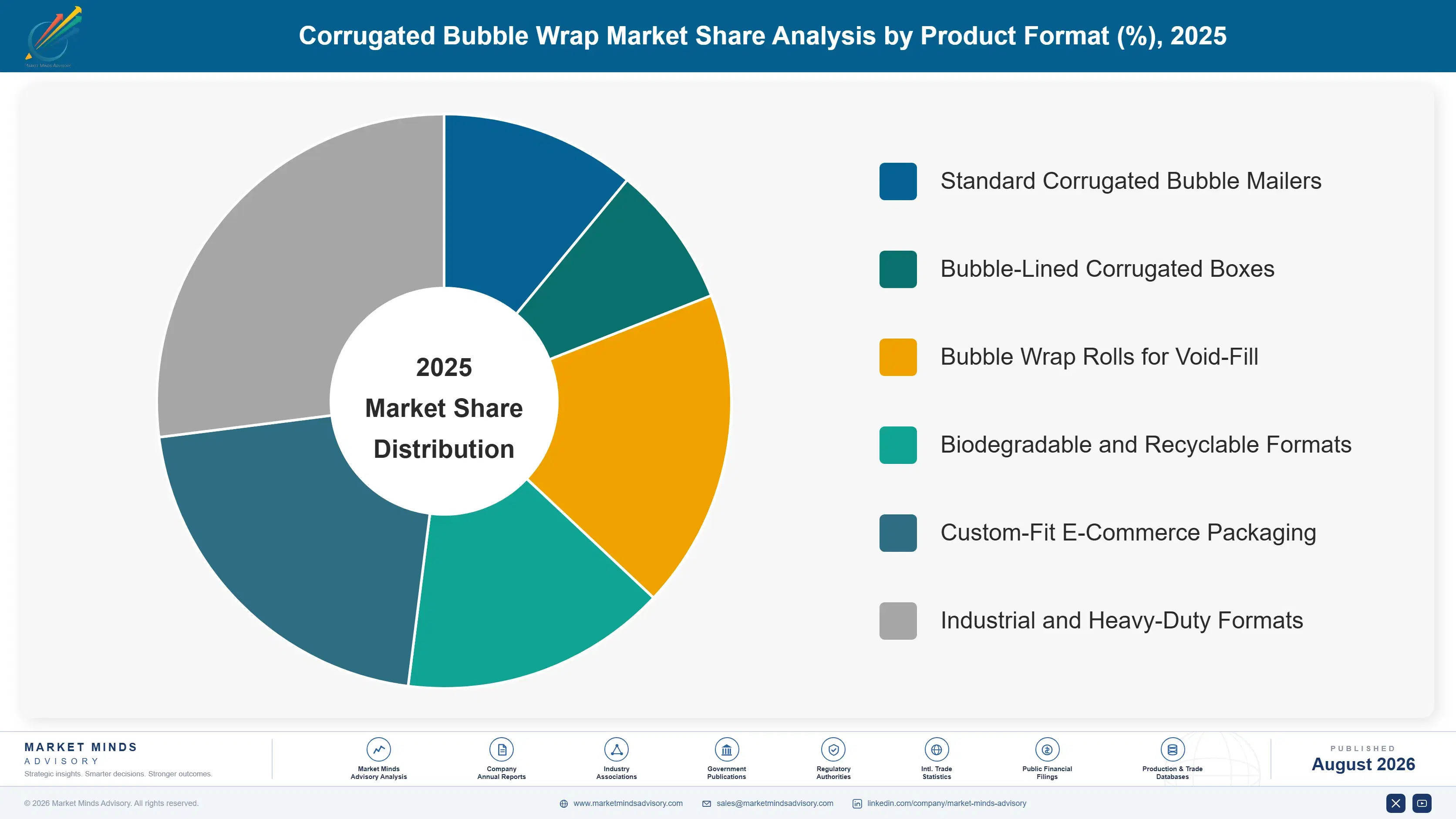
Segmentation follows product format, the dimension fulfillment centres and brand packaging teams themselves use to specify purchase, since mailers, bubble-lined boxes, and void-fill rolls each demand distinct converting equipment, sizing engineering, and regulatory compliance documentation that rarely overlap with one another in daily procurement practice across most fulfillment operations studied closely in this entire report.
corrugated-bubble-wrap-market-market-share-analysis-1787304071470

Biodegradable and Recyclable Corrugated Bubble Packaging

Biodegradable and recyclable corrugated bubble packaging is the fastest-growing product category today, adopted specifically by retailers facing extended producer responsibility regulation that penalises non-recyclable cushioning materials at the point of sale. These formats use plant-based or paper-based cushioning that separates cleanly from the corrugated shell during standard recycling processes, avoiding the mixed-material contamination that disqualifies conventional plastic-lined mailers from single-stream recycling programs. Growth concentrates among large retailers with dedicated sustainability teams and the shipment volume to justify premium material costs, while smaller sellers remain slower to convert given the price premium relative to conventional alternatives still widely available on the open market today across most regions studied closely here in this report.
CAGR 12.4%

Custom-Fit Corrugated Bubble Packaging

Custom-fit e-commerce corrugated bubble packaging is the second-fastest category, propelled directly by fulfillment centre automation that runs far more efficiently with precisely sized packaging than with generic formats requiring manual adjustment on the line. These packages are engineered to a specific product's dimensions using on-demand die-cutting technology, minimising void space and reducing both material waste and shipping cost per unit shipped across the entire fulfillment operation. Purchasing decisions increasingly happen at the moment a retailer invests in automated packaging lines rather than as a standalone material decision, giving equipment integration considerable influence over which packaging vendors succeed in this specific channel going forward into the next annual contract renewal cycle.
CAGR 10.6%
Full segment breakdown across 6 segments available in the complete report.

Regional Architecture and Country Demand Map

East Asia holds the largest single share, reflecting China's enormous e-commerce shipment volume and its position as the world's largest corrugated packaging manufacturing base. South Asia and the Pacific is growing fastest as e-commerce logistics infrastructure expands from a comparatively small installed base across the region.

North America

United States fulfillment centres carry the highest custom-fit packaging penetration globally, driven by aggressive automation investment across major e-commerce operators and tightening extended producer responsibility regulation at the state level across California, Oregon, and several other states. Recyclable format adoption has expanded steadily since 2023, though smaller regional retailers still lag the large national operators given the capital cost of converting packaging lines to new equipment. Canadian fulfillment operations trail US adoption by several years, largely due to slower state-level regulatory pressure translating into coordinated national policy. Standard bubble mailers remain the dominant format across smaller sellers throughout the region regardless of these premium dynamics playing out at the high end.
Share: 26% | CAGR: 7.0% (2026 to 2036)

Western Europe

German and French packaging regulation was among the earliest to impose extended producer responsibility fees on non-recyclable materials, pushing local converters toward recyclable corrugated formats faster than most other developed markets managed to move. United Kingdom retailers favour centrally negotiated packaging contracts with major converters, concentrating purchasing among fewer suppliers than the more fragmented US market currently allows for at present. Italian and Spanish e-commerce operators have been slower to adopt custom-fit automation given smaller average fulfillment centre scale relative to Northern Europe's larger operations. Premium sustainable format makers concentrate marketing spend here given the region's stringent regulatory environment and high compliance scrutiny relative to most emerging markets tracked worldwide.
Share: 19% | CAGR: 5.3% (2026 to 2036)
Regional intelligence for 5 additional markets available in the complete report: East Asia, South Asia and Pacific, Latin America, Middle East and Africa, Eastern Europe. Contact sales@marketmindsadvisory.com.
corrugated-bubble-wrap-market-country-cagr-analysis-1787304071995

Where Packaging Margin Actually Concentrates

Margin in corrugated bubble packaging concentrates wherever a converter can attach automated sizing service and regulatory compliance documentation to its product, not wherever unit volume alone is largest. Four commercial moves separate makers capturing durable custom and sustainable margin from those still competing on commodity mailer price alone against interchangeable regional converters with little differentiation.

Co-Locating Converting Facilities Near Fulfillment Hubs

Co-locating on-demand die-cutting facilities near major fulfillment hubs lets a converter serve automated packaging lines with same-day custom-fit inventory that distant suppliers cannot match on lead time or reliability. Manufacturers with hub-adjacent converting facilities report retention rates roughly 35% higher than those serving fulfillment centres from distant regional plants, since automated packing lines cannot tolerate the inventory buffer distant suppliers require to manage lead-time risk. That proximity advantage becomes self-reinforcing as fulfillment centres design their automation systems around a specific supplier's sizing capability, making the relationship progressively harder for a rival to dislodge once established.
Market Impact: Lifts retention rates by roughly 35

Funding Compliance Documentation to Defend Premium Pricing

Funding regulatory compliance documentation that proves recyclability under extended producer responsibility frameworks gives a converter a defensible basis for premium pricing that competitors without comparable documentation cannot match quickly or cheaply. Manufacturers with published compliance data report retailer switching costs roughly 40% higher than those selling undocumented recyclable claims, since retailers increasingly require audit-ready documentation before approving any packaging change at all, regardless of the underlying material's actual performance in the field. That documentation advantage compounds as more jurisdictions tighten enforcement of existing extended producer responsibility rules each and every year.
Market Impact: Lifts switching costs by roughly 40

Securing Direct Multi-Year E-Commerce Supply Agreements

Securing multi-year supply agreements directly with large e-commerce operators, rather than selling through general wholesale distribution, converts a fragmented sales cycle into predictable, high-volume revenue that smooths capacity planning considerably across multiple fiscal years of operation and investment. Converters with direct e-commerce contracts report unit pricing roughly 15% above wholesale distribution rates, but the volume commitment and reduced customer acquisition cost more than compensate for the apparent discount versus one-off wholesale transactions handled through a distributor intermediary each contract cycle across the calendar year, easing budget forecasting considerably for finance teams.
Market Impact: Commands a 15% pricing premium over

Expanding Biodegradable Capacity Ahead of Regulation

Expanding biodegradable material production capacity ahead of regulatory deadlines positions a converter to capture premium pricing during the specific window when compliant supply remains scarce relative to sudden regulatory-driven demand spikes across an entire national market and its many retail participants scrambling to comply. Manufacturers that invested early in biodegradable capacity report list prices roughly 22% above competitors still ramping up production when new regulation takes effect, a premium that compresses once broader industry capacity eventually catches up to demand across the sector and its many regional participants worldwide today.
Market Impact: Supports a full 22% list price prem

Who Controls the Margin Pool

Concentration sits low at CR5 34%, evaluated on global packaging revenue across all format categories, the basis that best captures scale across commodity mailer lines and premium custom sustainable formats alike. WestRock and International Paper lead on manufacturing scale specifically, while the gap down to mid-tier regional converters is narrower than the headline CR5 figure alone suggests.
Competitive activity now runs across three fronts simultaneously. Premium sustainable format makers compete on regulatory compliance documentation and automated sizing integration, since that combination increasingly decides which converter a large retailer standardises on. Commodity mailer makers compete mainly on paperboard cost and freight logistics, where price still dominates purchasing decisions among smaller sellers. A third front has opened around fulfillment automation integration, as converters increasingly compete for co-location partnerships near major distribution hubs.

Emerging pressure is coming from Chinese converters scaling biodegradable material production fast enough to threaten the premium tier that Western sustainability specialists have held since regulation first took effect. Rankings could shift meaningfully if any commodity mailer major invests seriously in automated sizing and compliance documentation rather than continuing to compete on price alone, since their existing distribution relationships would give them an advantage premium specialists currently lack.
corrugated-bubble-wrap-market-company-positioning-matrix-1787304072521

Competitive Moat and Risk Dimensions

WESTROCK COMPANY

Moat: Integrated Paperboard Manufacturing Scale

WestRock's vertically integrated paperboard mills and converting facilities give it a cost advantage on commodity mailer production that smaller converters sourcing paperboard externally cannot match, anchoring its position across the volume tier of the market for years to come. That integration depth also supports faster capacity expansion when demand shifts unexpectedly.
WESTROCK COMPANY

Risk: Commodity Segment Margin Pressure

WestRock's revenue still concentrates heavily in commodity mailer formats facing persistent price competition from regional converters undercutting on cost alone. Any acceleration toward premium sustainable formats without comparable investment would leave its volume base increasingly exposed to margin erosion over the coming years across every major region served.
SEALED AIR CORPORATION

Moat: Cushioning Material Science Depth

Sealed Air's decades of protective packaging material science, extending well beyond corrugated formats into broader cushioning technology, give it an engineering depth that newer sustainable format entrants cannot replicate quickly across comparable product breadth or accumulated patent portfolio built over several decades of dedicated research.
SEALED AIR CORPORATION

Risk: Plastic Legacy Brand Association Risk

Sealed Air's historical association with plastic bubble wrap could slow its credibility transition toward recyclable formats among sustainability-focused buyers who associate the brand more closely with the plastic products it built its original reputation on decades ago across most major consumer markets served worldwide today.

Players Tracked

Prominent Players

WestRock Company
International Paper Company
Sealed Air Corporation
DS Smith plc
Mondi Group

Other Key Players

Smurfit Kappa Group
Packaging Corporation of America
Pratt Industries
Sonoco Products Company
Georgia-Pacific LLC
Nefab Group
Storopack Hans Reichenecker GmbH
Signode Industrial Group
Pregis LLC
Ranpak Holdings Corp.
Cascades Inc.
Orora Limited
Huhtamaki Oyj
Stora Enso Oyj
Uline Inc.

Recent Developments

FEBRUARY 2025

Sealed Air Launches Biodegradable Bubble Cushioning Material

Sealed Air launched a next-generation biodegradable bubble cushioning material designed for integration into corrugated packaging formats, targeting retailers facing extended producer responsibility compliance deadlines across several major markets. The launch was an organic product introduction rather than an acquisition, reflecting continued internal investment in sustainable materials.
Signal: Biodegradable cushioning technology is bec
JUNE 2025

DS Smith Signs Major E-Commerce Fulfillment Supply Agreement

DS Smith signed a multi-year supply agreement with a major e-commerce fulfillment operator to provide custom-fit corrugated bubble packaging across its distribution network. The agreement is a commercial supply contract rather than a joint venture or acquisition, securing volume ahead of anticipated automation-driven demand growth over the coming years.
Signal: Large e-commerce operators are increasingl
OCTOBER 2025

Mondi Group Acquires Recyclable Packaging Materials Developer

Mondi Group acquired a specialty recyclable packaging materials developer to expand its sustainable corrugated bubble portfolio beyond its existing paperboard product lines into adjacent cushioning territory and specialty coatings. The transaction was structured as a full acquisition rather than a licensing arrangement or minority equity stake.
Signal: Paperboard incumbents are acquiring their

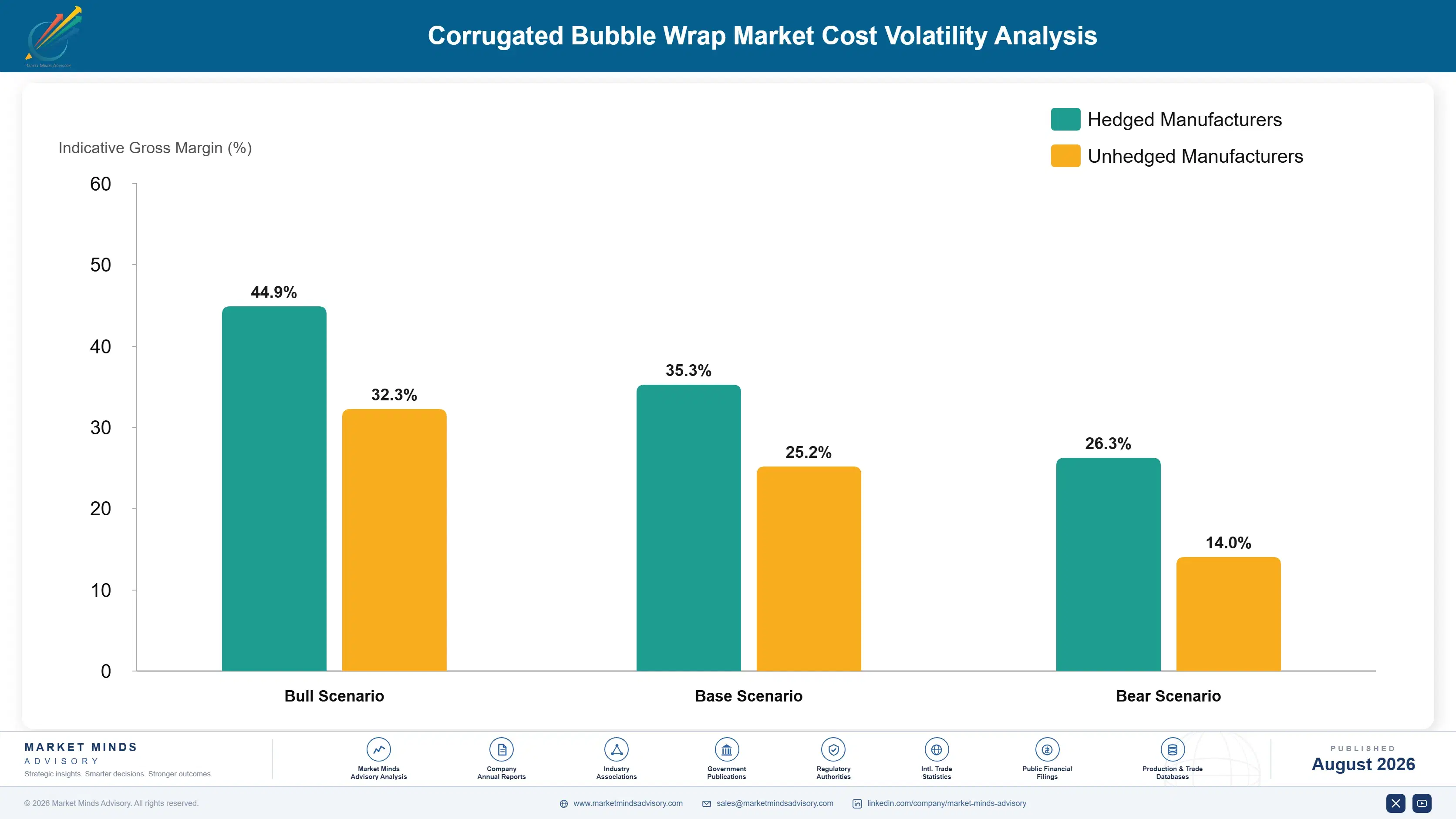
Recycled Paperboard and Resin Exposure

Recycled paperboard and specialty resin inputs account for roughly 48% of total unit production cost, sourced mainly from paper mills and specialty resin producers in the United States, Germany, and China who supply most of the industry's qualified volume. Biodegradable cushioning material adds a second, growing cost layer specific to sustainable format production sold at increasing scale.
WestRock Company's 2024 annual report cited elevated costs for recycled paperboard and specialty resin inputs as a meaningful drag on packaging margins, tracing much of it to pulp and paper supply disruptions that lingered from 2022 into 2023. Paperboard prices rose double digits at the peak of that disruption before partially easing through 2024, and several converters reported extending supplier qualification to additional paperboard producers to reduce single-source dependency going forward.

Smaller regional converters without diversified paperboard sourcing absorb these cost swings directly, a disadvantage that compounds for challengers concentrated in a single country's supply base. Established majors with diversified, multi-region sourcing can smooth these swings across a broader supplier base, while biodegradable format makers carry the added exposure of sourcing both specialty paperboard and novel cushioning materials simultaneously.
corrugated-bubble-wrap-market-cost-volatility-analysis-1787304072716

Qualifying Multiple Paperboard Suppliers Across Regions

Extending supplier qualification to additional paperboard producers across the United States, Germany, and China reduces reliance on any single supplier's capacity or pricing power. Several converters accelerated this diversification after 2022's disruption exposed how concentrated their sourcing had become across too few qualified vendors regionally, adding redundancy across multiple countries and several newly qualified sources.

Long-Term Paperboard and Resin Supply Contracts

Locking in multi-year supply agreements with paperboard and resin manufacturers protects production schedules from shortages that periodically affect the broader pulp and paper supply chain and its many contract mills. This approach requires forecasting demand further out than converters traditionally have, but it has paid off reliably during past shortage episodes across the wider industry.

Vertical Integration Into Paperboard Manufacturing

Owning paperboard production rather than outsourcing it reduces exposure to supplier pricing swings and gives converters priority access during periods of tight capacity across the sector. The approach requires significant capital but has paid off for majors that invested early, insulating margins better than pure converters eventually managed to achieve across comparable product lines.

Portfolio Architecture for Margin Defence

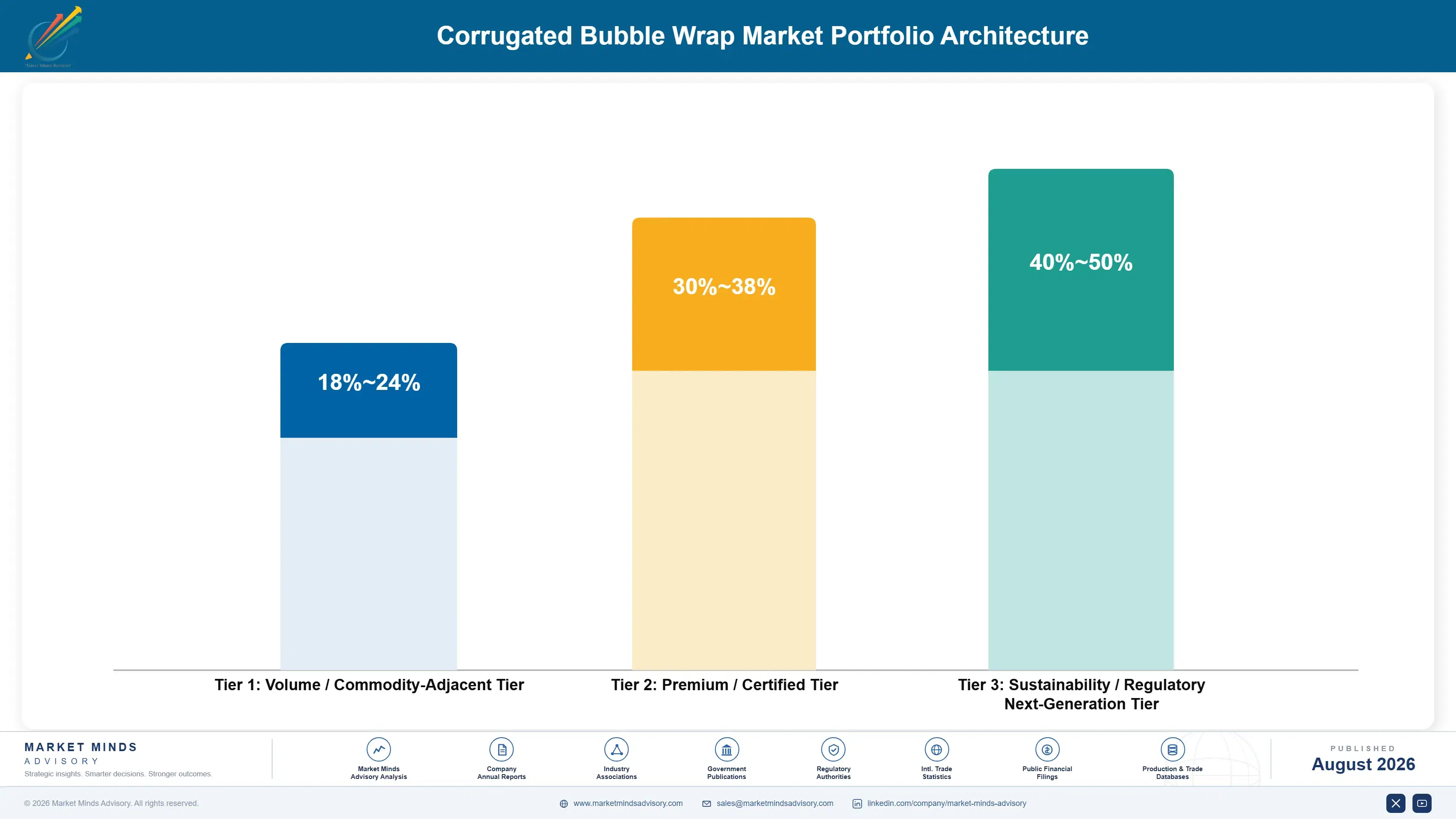
Three margin tiers coexist within this single packaging category. Volume-grade standard mailers run thin margins set largely by wholesale distributor purchasing contracts and direct price competition among many regional converters competing almost entirely on cost. Certified bubble-lined boxes sit meaningfully higher, while custom-fit and biodegradable formats command the richest margin of the three because engineering service and regulatory compliance barriers keep competition genuinely thin an
The volume-versus-premium tension shows up clearly in capital allocation. Converters that keep reinvesting in standard mailer production capacity are chasing a shrinking margin pool relative to those redirecting capital toward custom-fit and sustainable platforms, even though standard mailers still generate meaningful unit volume for most companies today. Boards increasingly favour the specialty side when allocating the next dollar of capital investment, despite its smaller current revenue base.

High-value margin pools concentrate specifically in custom-fit formats integrated with fulfillment automation and in biodegradable formats carrying published compliance documentation across multiple regulatory jurisdictions. Everything else in the portfolio behaves closer to a commodity paper product than a differentiated packaging solution, priced on distribution reach rather than engineering value, and that gap shows no sign of narrowing soon.

Volume / Commodity-Adjacent Tier

Standard bubble mailers sold through wholesale distributor purchasing contracts, priced largely on distribution reach and delivery reliability rather than material differentiation of any kind, with thin room to compete on anything else meaningfully.
Gross Margin: 18-24%

Premium / Certified Tier

Bubble-lined boxes carrying quality certification and standardised sizing protocols, sold at a real, defensible premium over unbranded mailer alternatives across most major markets studied closely in this entire report today.
Gross Margin: 30-38%

Sustainability / Regulatory / Next-Generation Tier

Custom-fit and biodegradable corrugated bubble formats with compliance documentation, requiring sustained engineering investment that thins the competitive field sharply and protects incumbent pricing for years at a stretch each product cycle.
Gross Margin: 40-50%
corrugated-bubble-wrap-market-portfolio-architecture-1787304073219

Automation-Anchored Fulfillment Loyalty

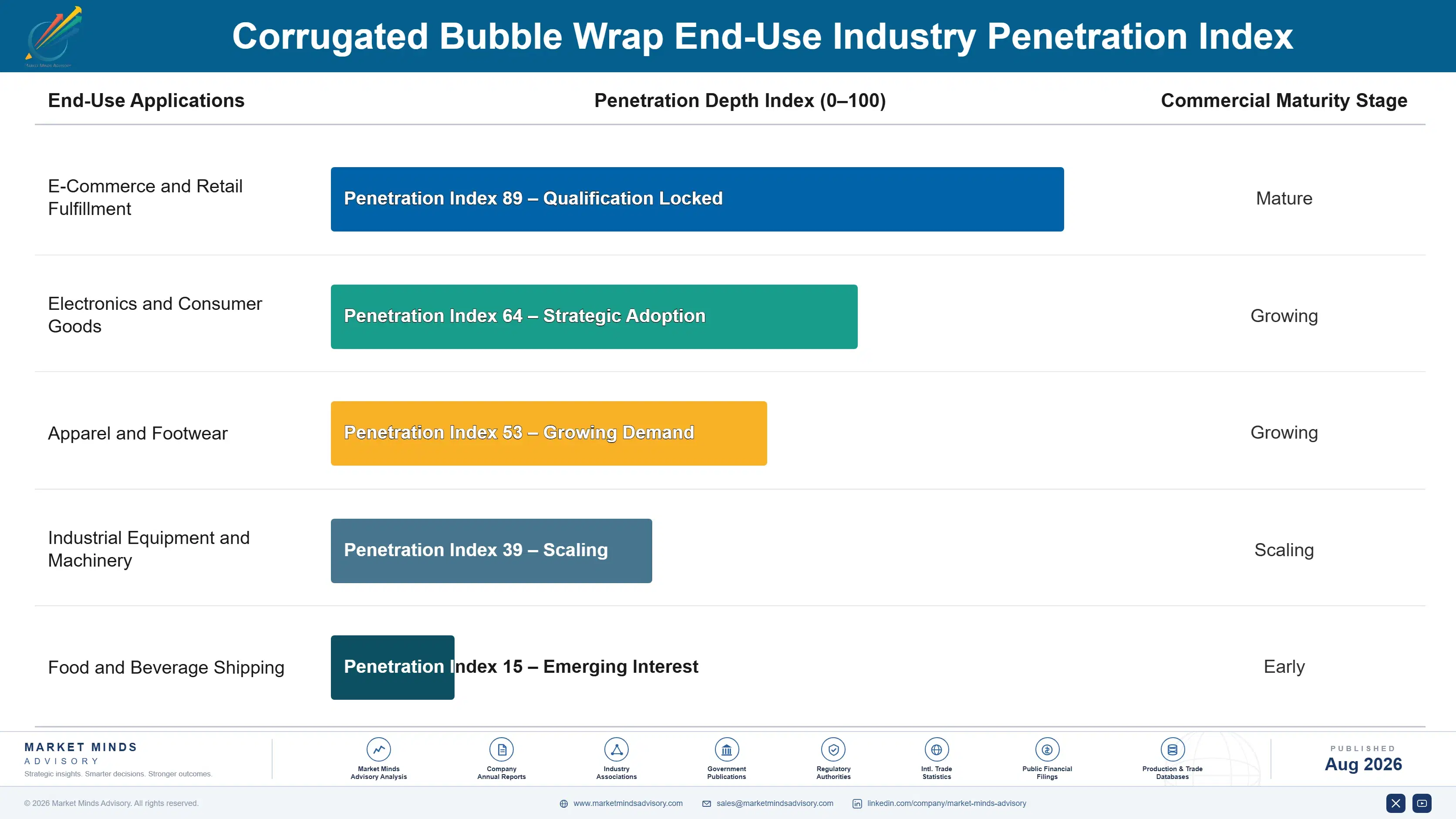
Corrugated bubble packaging is not a subscription business by default, but automated fulfillment integration increasingly behaves like one. Once a fulfillment centre designs its packing lines around a specific supplier's sizing system, switching costs run high enough that repeat purchasing continues for years without a full vendor re-evaluation each cycle.
Adoption depth varies sharply by retailer type. Large e-commerce operators, once integrated with a specific converter's automated sizing system, rarely switch unless quality or lead-time support genuinely slips, since retooling packing lines carries real disruption cost. Smaller sellers without automation investment behave completely differently, remaining on standard mailers far longer since no comparable integration investment has been made. Compliance documentation depth increasingly separates sticky accounts from price-sensitive ones across most markets tracked.

A generational shift is underway in who specifies packaging purchases. Decisions once made almost entirely by procurement officers chasing lowest delivered cost are increasingly shaped by sustainability and operations directors who weight compliance documentation and automation integration well above unit price alone. That shift favours converters who invested early in engineering and compliance capability over those still competing purely on paperboard price today.
corrugated-bubble-wrap-market-end-use-penetration-index-1787304073716

Where Packaging Margin Concentrates

These are among the four positions where our research anticipates prominent divergence between winners and laggards over the coming forecast period. Each is grounded in the demand model, the regulatory perimeter, and the announced capacity pipeline.
01 / SUSTAINABLE FORMAT INVESTMENT PRIORITY

Prioritise biodegradable formats over commodity mailer expansion.

Extended producer responsibility regulation is pushing retailers toward recyclable packaging faster than commodity mailer makers can realistically catch up on compliance documentation and material science, which means investment made today captures demand that standard mailers cannot reach at comparable margin. Converters that keep expanding commodity capacity are chasing a shrinking margin pool relative to those building biodegradable platforms instead. Compliance documentation itself functions as a moat, since a rival cannot simply undercut price once a retailer has already committed to a specific compliant supplier.
02 / FULFILLMENT AUTOMATION STRATEGY

Build automated sizing integration before competitors close the gap.

Winning large e-commerce contracts increasingly requires automated packaging sizing integration, not just competitive paperboard pricing on its own merits or freight logistics alone. Converters that invest early in this integration infrastructure build a durable advantage that outlasts any single product cycle or short-term price competition from smaller rivals entering the category over time and across multiple contract renewal cycles. Underinvesting here cedes the richest margin tier of the market to whichever competitor solves the automation problem first for a given fulfillment account.
03 / REGIONAL MARKET ENTRY

Enter East Asian and South Asian markets ahead of infrastructure build-out.

East Asia already leads on manufacturing scale and e-commerce shipment volume, and South Asia and the Pacific is growing fastest as e-commerce logistics infrastructure expands from a comparatively small installed base across the wider region today. Converters without local distributor relationships risk missing multi-year fulfillment contracts already being awarded to early movers with established local presence and retailer trust built over years of steady engagement. Establishing regional converting capability now positions a manufacturer well ahead of the next wave of e-commerce logistics investment across these fast-growing markets.
04 / COMPLIANCE DOCUMENTATION STRATEGY

Fund recyclability documentation before enforcement scrutiny intensifies.

Extended producer responsibility enforcement is tightening across more jurisdictions each year, and converters who fund compliance documentation early earn retailer trust that undocumented recyclable claims alone cannot replicate at comparable cost or credibility. Waiting until enforcement scrutiny intensifies further means competing for credibility against converters who built this evidence years earlier and already hold retailer relationships and audit mindshare. Building that documentation foundation now, rather than reacting once audits become routine, is the cheaper path by a wide margin over time.

Engagement Snapshot From the Field

A live engagement with an industry participant carrying material or product regulatory and market exposure ahead of a defining policy shift, showing how our research translates into a defensible multi-year portfolio strategy.
MARKET MINDS ADVISORY · CLIENT ENGAGEMENT SUMMARY
Corrugated Bubble Wrap Producer Strategic Portfolio Review and Transition Roadmap 2026·Investment Scenario on Corrugated Bubble Wrap Exposure Evaluation 2025-26
CLIENT PROFILE
The client is a twelve-facility regional e-commerce fulfillment operator in the southeastern United States serving mid-market apparel and electronics retailers. The operator reported annual packaging spend of approximately $16 million (client-reported, unverified by MMA) and was evaluating whether to standardise on a single custom-fit corrugated bubble supplier across all twelve facilities rather than the fragmented multi-vendor approach it had used historically.
STRATEGIC CHALLENGE
The operator's twelve facilities used four different packaging suppliers with inconsistent sizing standards, overlapping compliance documentation gaps, and no unified automation integration, creating inconsistent sell-through data and duplicated inventory costs that made chain-wide efficiency reporting to client retailers nearly impossible to assemble accurately or quickly each fiscal quarter across the operation.
MMA APPROACH
MMA benchmarked four incumbent packaging suppliers on compliance documentation quality, automation integration compatibility, and total cost per shipment across all twelve facilities involved. The engagement combined supplier interviews with facility-level shipment data analysis to model the total cost and operational impact of standardising on a single vendor network-wide across every location.
KEY FINDINGS
  1. One supplier's automated sizing integration cut manual packing time by roughly 42% versus the operator's current blended average across all facilities tracked.
  2. Standardising on a single supplier would reduce annual compliance documentation costs by an estimated $290,000 across all twelve facilities combined each year.
  3. Two incumbent suppliers lacked sufficient regional converting capacity to reliably support all twelve facilities without meaningful lead-time risk during peak volume periods.
  4. Bundled procurement combined with automation integration could lower blended per-shipment packaging cost by roughly 16% network-wide within the first full fiscal year.
CLIENT PROFILE
The client is a twelve-facility regional e-commerce fulfillment operator in the southeastern United States serving mid-market apparel and electronics retailers. The operator reported annual packaging spend of approximately $16 million (client-reported, unverified by MMA) and was evaluating whether to standardise on a single custom-fit corrugated bubble supplier across all twelve facilities rather than the fragmented multi-vendor approach it had used historically.
STRATEGIC CHALLENGE
The operator's twelve facilities used four different packaging suppliers with inconsistent sizing standards, overlapping compliance documentation gaps, and no unified automation integration, creating inconsistent sell-through data and duplicated inventory costs that made chain-wide efficiency reporting to client retailers nearly impossible to assemble accurately or quickly each fiscal quarter across the operation.
MMA APPROACH
MMA benchmarked four incumbent packaging suppliers on compliance documentation quality, automation integration compatibility, and total cost per shipment across all twelve facilities involved. The engagement combined supplier interviews with facility-level shipment data analysis to model the total cost and operational impact of standardising on a single vendor network-wide across every location.
KEY FINDINGS
  1. One supplier's automated sizing integration cut manual packing time by roughly 42% versus the operator's current blended average across all facilities tracked.
  2. Standardising on a single supplier would reduce annual compliance documentation costs by an estimated $290,000 across all twelve facilities combined each year.
  3. Two incumbent suppliers lacked sufficient regional converting capacity to reliably support all twelve facilities without meaningful lead-time risk during peak volume periods.
  4. Bundled procurement combined with automation integration could lower blended per-shipment packaging cost by roughly 16% network-wide within the first full fiscal year.
RECOMMENDED STRATEGY
Phase 1: Phase 1 (Months 1 to 2): Finalise supplier selection and negotiate a network-wide multi-year supply and integration agreement package terms. Phase 2: Phase 2 (Months 3 to 6): Roll out standardised packaging and automation integration across all twelve facilities in staged waves. Phase 3: Phase 3 (Months 7 to 9): Consolidate compliance documentation reporting and renegotiate supplier contracts using the unified network volume data.
OUTCOME
The operator completed supplier standardisation across ten of twelve facilities within eight months and reported a 14% reduction in blended packaging cost per shipment (client-reported, unverified by MMA), alongside meaningfully faster packing line throughput network-wide following the switch to a single integrated supplier system overall.

Frequently Asked Questions

Foundational context covering the market sizes, CAGR, scope, country, region and competition that inform every finding below. This section is provided to cover basics and most often pre-purchase conversations, answered from the MMA Primary Research Dataset.

What is the current size of the Corrugated Bubble Wrap Market?

The global corrugated bubble wrap market was valued at approximately $2.8 billion in 2025. This spans standard mailers, bubble-lined boxes, and custom-fit sustainable packaging formats.

How large will the Corrugated Bubble Wrap Market be by 2036?

The market is projected to reach approximately $5.77 billion by 2036. Growth is led by biodegradable and custom-fit formats rather than legacy standard mailers alone.

What is the CAGR for the Corrugated Bubble Wrap Market 2026 to 2036?

The market is expected to grow at a compound annual growth rate of 6.8% across the forecast period. Bull and bear scenarios range from roughly 5.7% to 8.0% depending on regulatory implementation.

Which segment is growing fastest?

Biodegradable and recyclable corrugated bubble packaging is the fastest-growing segment, expanding at nearly twice the market's blended rate. Custom-fit corrugated bubble packaging follows as the second-fastest segment.

Who are the major companies in the Corrugated Bubble Wrap Market?

Leading participants include WestRock, International Paper, Sealed Air, DS Smith, and Mondi. Assessments are based on global packaging revenue tracked across all format categories today.

Which country is growing fastest?

India is the fastest-growing country tracked, driven by rapid e-commerce shipment volume expansion across metro and tier-two cities. Its growth rate sits well above the region's already elevated average.

Report Segmentation Architecture

The full report scope spans multiple orthogonal segmentation dimensions, with cross-tabulated demand data provided for each dimension pair. Coverage extends further to regional breakdowns, trend trajectories, and the competitive detail needed to support segment-level decision-making.

By Product Format

  • Standard Corrugated Bubble Mailers
  • Bubble-Lined Corrugated Boxes
  • Bubble Wrap Rolls for Void-Fill
  • Biodegradable and Recyclable Formats
  • Custom-Fit E-Commerce Packaging
  • Industrial and Heavy-Duty Formats

By End-Use Industry

  • E-Commerce and Retail Fulfillment
  • Electronics and Consumer Goods
  • Apparel and Footwear
  • Industrial Equipment and Machinery
  • Food and Beverage Shipping

By Commercial Dimension

  • Direct E-Commerce Supply Agreements
  • Wholesale Distributor Channels
  • Automated Fulfillment Integration Contracts
  • Retail Sustainability Partnerships

By Region

  • North America
  • Western Europe
  • East Asia
  • South Asia and Pacific
  • Latin America
  • Middle East and Africa
  • Eastern Europe

Scope, Methodology, and Coverage

Every figure in this report is reproducible from documented input assumptions. The scope below maps the historical period, the forecast horizon, the segmentation dimensions, and the countries covered, alongside the underlying primary and qualitative methodology.
Historical Period
2020 to 2025
Forecast Period
2026 to 2036
Base Year
2025 (USD billions; MMA Primary Research Dataset, August 2026)
Market Definition
The corrugated bubble wrap market covers corrugated cardboard packaging products that integrate bubble cushioning material, including bubble mailers, bubble-lined boxes, and bubble wrap rolls used for void-fill within corrugated shipping containers. It excludes standalone plastic bubble wrap sold without a corrugated component and excludes general corrugated boxes sold without integrated cushioning.
Quantitative Units
USD billions (current prices); units of packaging products shipped annually
Segmentation Dimensions
By Product Format; By End-Use Industry; By Commercial Dimension; By Region
Regions Covered
North America, Western Europe, East Asia, South Asia and Pacific, Latin America, Middle East and Africa, Eastern Europe
Countries Covered
USA, China, Germany, France, UK, Japan, South Korea, India, Australia, Canada, Brazil, Mexico, Indonesia, Vietnam, Thailand, Malaysia, UAE, Saudi Arabia, South Africa, Nigeria, Turkey, Poland, Netherlands, Italy, Spain, Sweden, Switzerland, Argentina, Colombia, Singapore, and additional markets relevant to this sector
Key Companies Profiled
WestRock Company, International Paper Company, Sealed Air Corporation, DS Smith plc, Mondi Group, Smurfit Kappa Group, Packaging Corporation of America, Pratt Industries, Sonoco Products Company, Georgia-Pacific LLC, Nefab Group, Storopack Hans Reichenecker GmbH, Signode Industrial Group, Pregis LLC, Ranpak Holdings Corp., Cascades Inc., Orora Limited, Huhtamaki Oyj, Stora Enso Oyj, Uline Inc.
Quantitative Methodology
Primary survey, n=3,800 respondents, Q4 2025, six countries; demand-side model with trade association cross-validation
Qualitative Methodology
47 expert interviews, Q4 2025; applied to validate demand model assumptions, identify emerging dynamics, and assess competitive positioning
Report Format
PDF and XLSX data workbook (Word format preview document)
Publisher
Market Minds Advisory
Report Code
MMA-2026-PAC-112
Published
August 2026
Contact
sales@marketmindsadvisory.com | www.marketmindsadvisory.com

Purchase the full Corrugated Bubble Wrap Market Report (2026 to 2036).

The full report delivers a complete quantitative and qualitative assessment of the global corrugated bubble wrap market across standard, custom-fit, and biodegradable product categories. It includes detailed segmentation by product format, end-use industry, and commercial channel, alongside country-level sizing across thirty-plus individual markets worldwide. Competitive profiling covers twenty companies assessed on global packaging revenue, with primary research drawn from MMA's expert interview program and its quantitative industry survey. Buyers receive fully editable data files supporting internal strategic planning, investment screening, and supplier qualification decisions each quarter.
Segment-level sizing and 2026 to 2036 forecasts
Full seven-region breakdown with country-level detail
Twenty-company competitive revenue benchmarking data set
Editable data tables delivered in Excel format
Primary survey and expert interview findings included
Quarterly market update subscription option available

Built For The People Who Decide

From boardroom strategy to bench-side execution, this report is read cover-to-cover by leaders shaping the next decade of their industry, turning demand scenarios, market dynamics and valuation benchmarks into decisions.
CXOs/ Presidents/ VPs/ Managers
M&A and Corporate Development
Strategy Teams and R&D Heads
Procurement and Product Directors
Regulatory and Compliance Leaders
Investor Relations and Equity Analysts