Market Minds Advisory
Corporate Wellness Solution Market

Corporate Wellness Solution Market: Corporate Wellness Solution Market. Mental Health Investment Reshapes Employer Benefits

Rising employer healthcare costs and expanding mental health benefit mandates are pushing companies toward integrated digital wellness platforms, as insurers reward measurable participation data with lower premium adjustments that self-insured employers increasingly demand.

Lead Analyst

Published

September 2026

Make Smarter Decisions with Customized Research Insights

Request a free sample report and evaluate market opportunities, growth trends, and competitive dynamics relevant to your business needs.

2025 MARKET VALUE$58.5BMarket Size 2025
2036 FORECAST VALUE$175.4BBase Case , 2026 to 2036
CAGR 2026 TO 203610.5 %Bull 11.8% / Bear 9.2%
INCREMENTAL OPPORTUNITY$110.8BNet 10- year value creation
EXPANSION MULTIPLE2.71x2036 value over 2026 base
Strategic Levers
M&A Pipeline
Regional Outlook
Country Rankings
Competitive Intelligence
Segmental Deep-dive
Call-Us : 91 93563 13602

Executive Snapshot and Market Trajectory.

Employers are shifting wellness budgets away from generic fitness perks toward measurable mental health and chronic disease management programs that insurers actually reward with lower premium adjustments tied to documented participation rates and clinically verified outcomes data collected across enrolled employee populations.
Self-insured employers, who bear healthcare costs directly rather than through fixed premiums, are the primary commercial force behind platform adoption, since every dollar spent on effective prevention reduces claims exposure the following plan year. Mental health and behavioral coaching has become the fastest-growing program category as anxiety and burnout claims rise across white-collar workforces, while adoption concentrates heavily among large technology and financial services employers with sophisticated in-house benefits teams and dedicated budget authority.
Competition has fragmented across point-solution vendors covering fitness, mental health, nutrition, and financial wellness separately, alongside a smaller group of platform aggregators trying to consolidate these into single dashboards employers actually want to manage. Regulatory pressure is building: expanding US mental health parity enforcement and new state pay transparency laws push employers to document wellness program equity across demographic groups, adding compliance reporting features vendors previously treated as optional add-ons.
Market Definition
This market covers digital and hybrid corporate wellness platforms and services purchased by employers to support employee mental, physical, and financial health, including fitness tracking, behavioral coaching, biometric screening, and employee assistance programs. It excludes general health insurance products and personal consumer wellness apps purchased directly by individuals rather than through an employer benefits program.
Base Year Value
$58.5B in 2025 (MMA Primary Research Dataset, September 2026)
Forecast Period
2026 to 2036, eleven discrete annual values
CAGR
10.5% base case. Bull 11.8%. Bear 9.2%.
Fastest Growth Segment
Mental Health and Behavioral Coaching Platforms: 16.0% CAGR
Fastest Growth Country
India: 17.5% CAGR
Fastest Growth Region
South Asia and Pacific: 12.5% CAGR
Largest Region
North America: 38% of 2025 global value
Market Leaders
Virgin Pulse, Wellhub, Headspace Health, Calm Business, Limeade
Primary Survey
n=3,800 procurement and R&D decision-makers, Q4 2025, six countries
Methodology
Demand-side build-up, cross-validated against public data, 47 expert interviews

Corporate Wellness Solution Market Forecast Scenarios

corporate-wellness-solution-market-size-forecast-scenario-1788677525739
Corporate wellness spending grew steadily from 2020 through 2025 as remote and hybrid work arrangements normalized digital-first benefit delivery, with mental health program adoption accelerating sharply after 2021 amid well-documented rises in employee burnout, anxiety claims, and voluntary turnover across knowledge-worker industries facing persistently tight labor markets and rising recruitment costs throughout most of the historical period.
The base case assumes continued self-insured employer expansion, deeper integration between wellness platforms and existing health insurance claims data, and growing employer willingness to fund mental health coaching as a retention tool rather than a discretionary perk that gets cut during budget tightening. Vendors consolidating point solutions into unified platforms capture disproportionate new contract value as procurement teams tire of managing five or six separate vendor relationships and reporting formats simultaneously across their organization.
A bull scenario assumes expanded US mental health parity enforcement forces broader employer investment across previously underserved mid-market segments that have lagged large-employer adoption; a bear scenario assumes a corporate cost-cutting cycle treats wellness budgets as discretionary spend, delaying renewals and shrinking per-employee program budgets sharply across employer segments already facing margin pressure and hiring freezes.

Where Mental Health Investment Meets Claims Reduction

Corporate wellness has evolved from a discretionary employee perk into a measured cost-containment tool that self-insured employers track directly against actual healthcare claims data over time. The shift toward outcomes-based program design reflects growing employer sophistication about which interventions genuinely reduce costs versus which simply improve satisfaction survey scores without moving underlying claims trends in any measurable direction.
MARKET CONCENTRATION (CR5)38%Fragmented market spread widely across many competing point-solution vendors
AVERAGE PER-EMPLOYEE PROGRAM COST$180/yearAnnual spend varies widely by employer program depth
ENTERPRISE EMPLOYER ADOPTION SHARE62%Large enterprise employers lead adoption well over smaller companies
PROGRAM RENEWAL RATE78%Annual contract renewal rate among enterprise employer customers
MENTAL HEALTH SPEND SHARE31%Growing share of total wellness budget allocated annually
AVERAGE CONTRACT LENGTH2.3 yearsTypical multi-year commitment length seen among enterprise buyers
Mental health investment now commands a disproportionate share of new program budget, driven by documented increases in anxiety, depression, and burnout diagnoses across white-collar workforces since 2021. Vendors that can demonstrate clinical outcomes rather than simple engagement metrics are winning larger, longer contracts as procurement teams increasingly demand hard evidence before committing multi-year budget to any single wellness platform provider.
Platform consolidation is reshaping vendor selection too, as employers tire of managing five or six separate point solutions with incompatible reporting formats and fragmented employee experiences across different login portals. The vendors best positioned combine fitness, mental health, and financial wellness under one unified data layer, giving benefits teams a single dashboard rather than a stack of disconnected tools that nobody on staff fully trusts or actively uses.
"Wellness vendors selling engagement metrics alone are losing renewals to competitors who can show a claims trend line moving in the right direction. That is the entire negotiation now."
Practice Lead, Employee Benefits and Health Technology · MMA Corporate Wellness Software Platforms and Employee Health Program Services Practice · September 2026

Market Trends

Mental Health Coaching Displaces Generic Fitness Perks

Employers are reallocating wellness budget away from generic fitness stipends and step-count challenges toward structured mental health coaching and therapy access, reflecting a documented 34 percent rise in employee-reported burnout since 2021 across major US employer surveys. Behavioral health vendors that pair licensed therapist access with self-guided coaching content are winning larger enterprise contracts than fitness-only point solutions ever secured. This reallocation now shapes how benefits teams justify budget internally year over year, not a temporary pandemic-era response that fades once labor markets loosen and hiring pressure eases across major industries.
Market Impact: 65 percent of large employers self-insure
Claims Data Integration Enables Outcomes-Based Vendor Pricing

Wellness platforms increasingly integrate directly with employer health insurance claims data to measure actual cost impact rather than relying on self-reported engagement surveys alone, a capability that was barely available industry-wide five years ago. This integration lets vendors offer outcomes-based pricing models tying a portion of contract value to demonstrated claims reduction, appealing to finance teams skeptical of wellness spending that never showed measurable financial return in prior budget cycles. Roughly 22 percent of new enterprise contracts now include at least a partial outcomes-based pricing component this year, up from almost none before.
Market Impact: New parity rules added in 2023

Market Opportunities and Growth Drivers

Self-Insured Employer Growth Expands Addressable Market

The share of US employers self-insuring health benefits rather than purchasing fixed-premium plans has risen steadily, now covering roughly 65 percent of covered workers at firms above 500 employees, according to Kaiser Family Foundation survey data. Self-insured employers bear healthcare costs directly, giving them immediate financial incentive to invest in prevention programs that reduce claims the following plan year rather than treating wellness as pure discretionary spend that gets cut first. This shift in insurance financing broadens the addressable customer base considerably beyond what a purely premium-based insurance market would ever support on its own.
Market Impact: Adds 6 to 9 months evaluation

State Mental Health Parity Enforcement Expands Coverage Mandates

Expanding enforcement of mental health parity requirements at both federal and state levels is forcing employers to document that mental health benefits are administered no more restrictively than medical or surgical benefits, creating compliance obligations that favor comprehensive wellness platforms over narrow point solutions. Several states have introduced additional parity enforcement mechanisms since 2023, adding audit and reporting requirements employers previously could largely avoid without meaningful penalty. Vendors offering built-in compliance documentation and audit trail features are capturing budget that would otherwise fund only clinical services directly, shifting procurement priorities across many mid-market employer accounts.
Market Impact: Cuts participation 25 to 35 percent

Market Restraints and Challenges

Measuring Wellness Program ROI Remains Genuinely Difficult

Employers routinely struggle to isolate a wellness program's actual effect on healthcare claims from confounding factors like workforce demographic shifts, general medical cost inflation, and self-selection bias among program participants who tend to be healthier to begin with. The root cause is a lack of standardized measurement methodology across the vendor landscape, with each platform reporting outcomes using its own metrics that are hard to compare. Some vendors now fund independent third-party outcomes studies to address buyer skepticism directly, though these studies remain costly and are not yet standard practice industry-wide.
Market Impact: Burnout claims up 34 percent

Employee Data Privacy Concerns Limit Program Participation

Employees frequently distrust employer-sponsored mental health and biometric screening programs, worried that sensitive health data could influence promotion, compensation, or termination decisions even where legal protections technically exist. This root distrust suppresses participation rates well below what program sponsors originally project, undermining both outcomes measurement and per-employee cost justification. The commercial impact shows up directly in lower utilization-based pricing tiers than vendors initially forecast. Some vendors now route sensitive data through independent third-party administrators specifically to wall it off from employer access entirely, a mitigation increasingly required by newer vendor contracts today.
Market Impact: 22 percent of contracts now outcomes-based
3 additional market trends, 4 additional growth drivers, and 2 additional restraints and challenges are covered in the full report. Contact sales@marketmindsadvisory.com to access the complete intelligence.

Segment CAGR and Growth Architecture

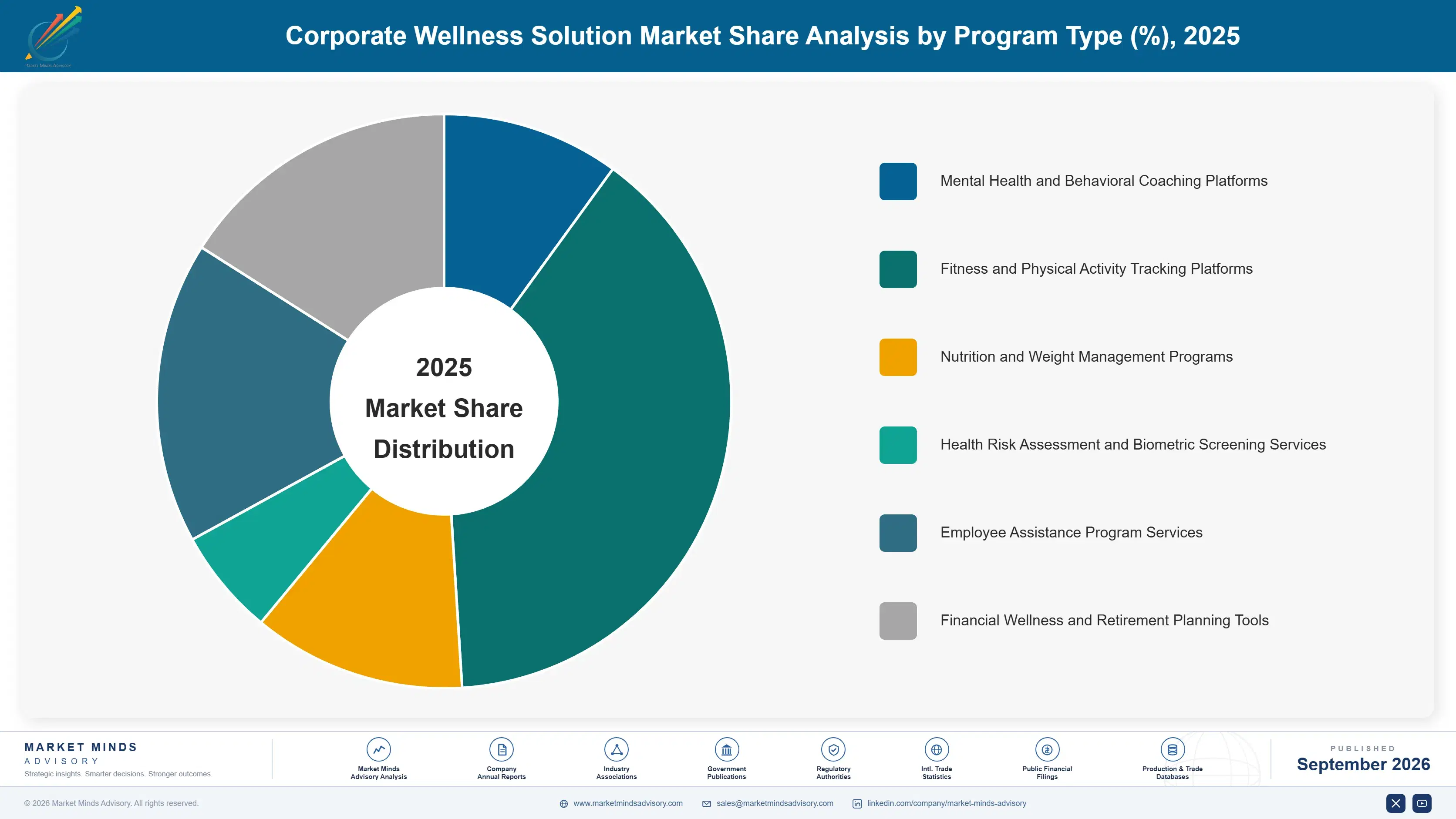
Corporate wellness solutions segment by core program type, spanning mental health coaching, fitness and physical activity tracking, nutrition and weight management, biometric health screening, employee assistance services, and financial wellness planning tools, each addressing a distinct dimension of employee health that employers increasingly purchase as separate but related budget lines within one overall benefits strategy.
corporate-wellness-solution-market-market-share-analysis-1788677526284

Mental Health and Behavioral Coaching Platforms

Mental health and behavioral coaching platforms combine licensed therapist access, self-guided coaching content, and crisis intervention services into subscription-based programs sold directly to employers on a per-employee-per-month basis. Growth reflects documented increases in anxiety and burnout diagnoses across white-collar workforces since 2021, alongside expanding mental health parity enforcement that pushes employers to invest at parity with physical health spending. Vendors like Headspace Health and Calm Business have expanded clinical partnerships to offer licensed therapy referrals directly within their platforms, moving beyond self-guided meditation content toward genuine clinical care coordination that commands materially higher per-employee pricing than earlier wellness app generations ever achieved, particularly among large technology and financial services employers with sophisticated benefits budgets.
CAGR 16.0%

Financial Wellness and Retirement Planning Tools

Financial wellness and retirement planning tools help employees manage debt, budgeting, and retirement savings decisions through employer-sponsored platforms often bundled with existing 401k administration services. Growth is driven by employer recognition that financial stress measurably reduces workplace productivity and contributes to burnout, making financial wellness a legitimate complement to mental health investment rather than a standalone niche benefit few employers prioritized previously. Vendors increasingly bundle student loan repayment assistance and emergency savings tools alongside traditional retirement planning content, reflecting shifting workforce demographics as younger employees prioritize debt management over long-term retirement contributions during early career years when cash flow constraints matter more immediately than distant retirement horizons that feel abstract by comparison.
CAGR 13.0%
Full segment breakdown across 6 segments available in the complete report.

Regional Architecture and Country Demand Map

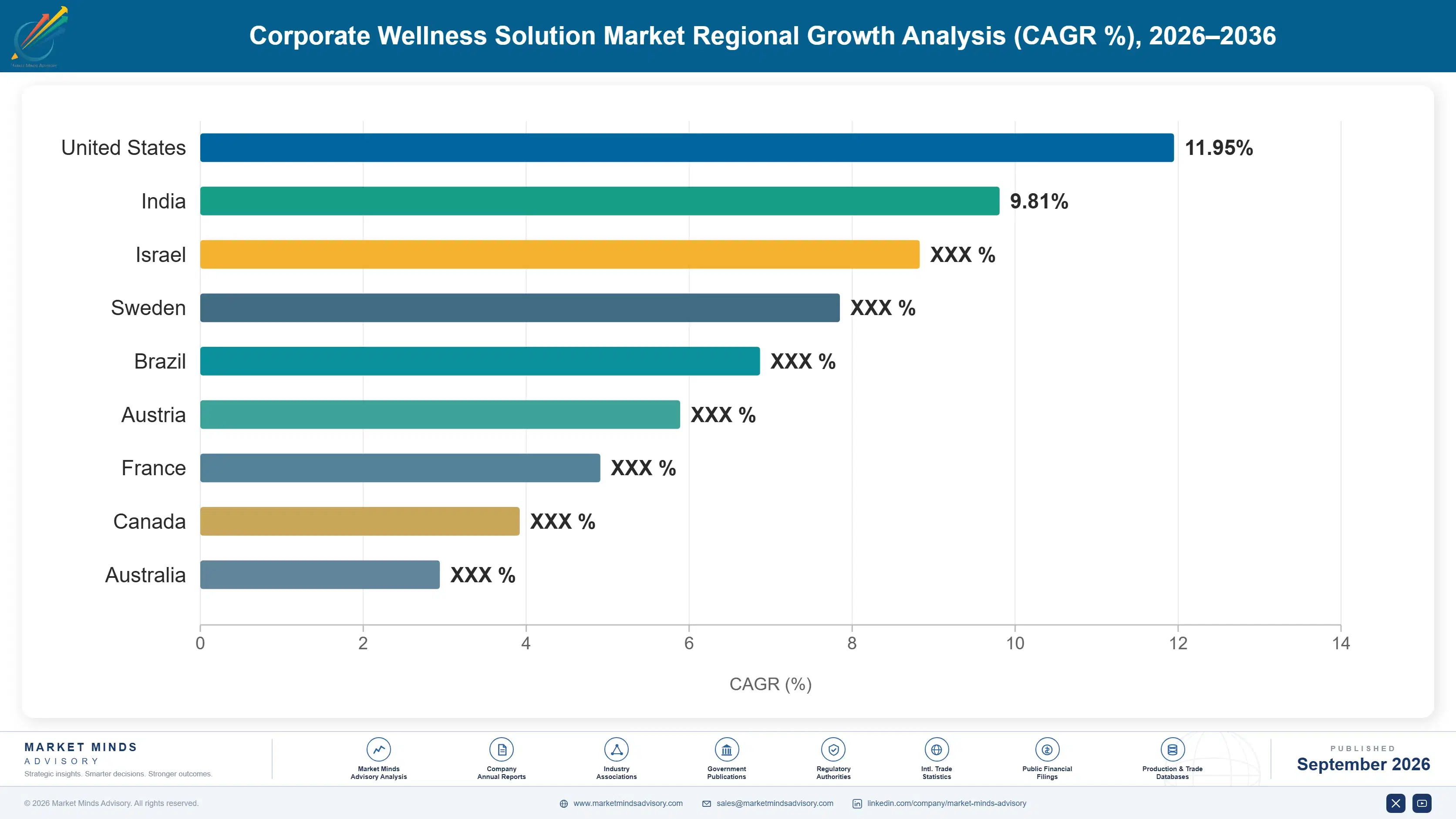
North America dominates given the uniquely American self-insured employer healthcare financing structure, while East Asia and South Asia and Pacific post the fastest regional growth as corporate benefits programs expand rapidly across large IT, technology, and business services employers competing intensely for scarce skilled talent.

North America

North America's outsized 38 percent share, above the standard regional band, reflects a genuinely unique commercial structure: employer-sponsored health insurance and widespread self-insurance among large US companies create direct financial incentive to fund wellness programs that reduce claims costs, an incentive structure that barely exists in countries with universal public healthcare. Roughly 65 percent of large US employers self-insure, giving benefits teams immediate budget authority over prevention spending tied to measurable claims outcomes. Canada's smaller, publicly-insured system contributes modestly less demand per capita than the US, though large Canadian employers increasingly mirror American program design. Mental health parity enforcement adds further momentum, pushing US employers to document benefit equity that vendors increasingly help automate.
Share: 38% | CAGR: 10.0% (2026 to 2036)

Western Europe

Universal public healthcare across most Western European countries removes the direct claims-reduction incentive that drives US employer adoption, so wellness programs here function more as talent retention tools than cost-containment mechanisms. German and Dutch employers lead regional adoption, often bundling mental health coaching into existing occupational health frameworks required under national labor law. UK employers increasingly cite the National Health Service's long mental health referral waiting times as justification for private employer-sponsored coaching access, a distinctly local driver rarely seen elsewhere. French employers face fewer regulatory pushes toward wellness investment, keeping adoption more concentrated among multinational corporations with globally standardized benefits policies than domestic mid-market companies with tighter budget constraints.
Share: 19% | CAGR: 9.0% (2026 to 2036)
Regional intelligence for 5 additional markets available in the complete report: East Asia, South Asia and Pacific, Latin America, Middle East and Africa, Eastern Europe. Contact sales@marketmindsadvisory.com.
corporate-wellness-solution-market-country-cagr-analysis-1788677526798

Outcomes-Based Pricing Margin Expansion Paths

Corporate wellness vendors capture the strongest margin expansion not from adding new point solutions but from proving measurable claims impact directly, since employers increasingly refuse to renew contracts that cannot demonstrate a genuine financial return beyond simple engagement metrics tracked in isolation from actual healthcare cost trends across multiple successive annual budget planning cycles.

Pricing Contracts Against Demonstrated Claims Reduction

Vendors offering outcomes-based pricing, where a portion of contract value ties directly to measured claims reduction, now command 15 to 20 percent higher total contract value than flat per-employee-per-month pricing alone. This requires deep claims data integration most point solutions lack entirely, giving platform vendors with existing insurer partnerships a durable competitive advantage over narrower competitors. Roughly 22 percent of new enterprise contracts already include some outcomes-based component, up sharply from almost none five years ago, and finance teams increasingly demand it before approving any multi-year renewal budget request going forward into next year.
Market Impact: Adds 15 to 20 percent to contract value

Bundling Mental Health Coaching With Compliance Reporting

Vendors that bundle mental health parity compliance documentation alongside coaching services capture budget that would otherwise require a wholly separate compliance software purchase entirely, adding 10 to 15 percent to average contract value across the entire account. Benefits teams facing expanding audit requirements since 2023 increasingly prefer a single vendor covering both clinical service delivery and regulatory documentation, rather than managing two separate procurement relationships and reconciling inconsistent reporting formats between competing vendors every single audit cycle, which consumes considerable internal staff time and dedicated compliance budget each fiscal year.
Market Impact: Adds 10 to 15 percent to contract value

Expanding Financial Wellness Into Retirement Plan Administration

Vendors that extend financial wellness coaching into actual 401k plan administration capture recurring assets-under-management fee revenue in addition to per-employee subscription pricing, a substantially larger and considerably stickier revenue pool than coaching content alone could ever provide on its own merits. This cross-sell strategy typically lifts total account revenue by 25 to 35 percent once retirement administration is added, and switching costs rise considerably once an employer's retirement plan data lives inside a vendor's platform rather than sitting with a wholly separate administrator entirely, discouraging future vendor changes for years.
Market Impact: Lifts total account revenue 25 to 35 percent

Consolidating Point Solutions Into Single Enterprise Platforms

Vendors capable of replacing five or six separate point solutions with one unified platform capture the entire consolidated contract value rather than competing for a single line item alone, typically increasing per-employer revenue by 40 to 60 percent compared to a standalone fitness or mental health offering sold in isolation to a single buyer. Procurement teams increasingly favor this consolidation to reduce vendor management overhead and unify fragmented reporting, giving platform aggregators a durable pricing advantage rooted in switching cost over narrow specialists who never expanded meaningfully beyond their original founding category or core competency.
Market Impact: Increases per-employer revenue 40 to 60 percent yearly

Who Controls the Margin Pool

Corporate wellness remains a fragmented market with a cr5 of just 38 percent, reflecting a category built from many originally single-purpose point solutions rather than a naturally consolidated industry. Virgin Pulse and Wellhub lead on enterprise account count, but the gap to challengers like Headspace Health and Calm Business has narrowed sharply as clinical mental health credibility becomes the primary purchase criterion rather than platform breadth alone.
Current competitive activity centers on platform consolidation, as vendors acquire adjacent point solutions to offer employers a single integrated dashboard rather than a stack of disconnected tools. Outcomes-based pricing pilots are spreading quickly as finance teams demand measurable claims impact before approving renewals. Several vendors have also begun forming direct partnerships with health insurers to access claims data more efficiently than building proprietary integration pipelines independently.

Emerging pressure comes from insurer-owned wellness platforms bundled directly into health plan offerings, threatening to disintermediate standalone vendors entirely for smaller employers who prefer a single insurance relationship. Point solutions focused narrowly on financial wellness or biometric screening face the most direct consolidation pressure from platform aggregators. Rankings among today's top five look reasonably durable through 2030, but mid-tier challengers could merge or disappear before then.
corporate-wellness-solution-market-company-positioning-matrix-1788677527374

Competitive Moat and Risk Dimensions

VIRGIN PULSE

Moat: Largest Enterprise Account Base

Virgin Pulse holds the largest enterprise employer account base in the industry, built over more than a decade of acquisitions consolidating fitness, incentive, and health coaching point solutions into one platform that competitors assembling similar breadth from scratch would need years and considerable capital to replicate credibly.
VIRGIN PULSE

Risk: Integration Complexity From Acquisitions

Years of acquiring separate point solutions has left Virgin Pulse managing a more technically fragmented backend than newer, natively unified competitors, creating integration friction that occasionally shows up in employer complaints about inconsistent user experience across different acquired product modules within the same overall platform environment today.
WELLHUB

Moat: Global Fitness Network Access

Wellhub's core value proposition rests on an extensive network of gym and fitness studio partnerships spanning dozens of countries, a network effect that took years to build and that a new entrant attempting global expansion would need substantial capital and time to approach at comparable scale.
WELLHUB

Risk: Thinner Mental Health Credibility

Wellhub's fitness network origins give it less clinical mental health credibility than specialists like Headspace Health, potentially limiting its ability to win the mental health coaching budget share that increasingly drives new enterprise contract growth across the broader corporate wellness category overall, a gap it is actively trying to close.

Players Tracked

Prominent Players

Virgin Pulse
Wellhub
Headspace Health
Calm Business
Limeade

Other Key Players

Vitality Group
Sprout at Work
Wellable
Grokker
Marino Wellness
Wellsource
WebMD Health Services
Sonic Boom Wellness
EXOS
League Inc.
Sharecare
SmartDollar
BrightPlan
Origin
Truworth Wellness

Recent Developments

FEBRUARY 2026

Virgin Pulse Acquires Financial Wellness Platform

Virgin Pulse acquired a financial wellness coaching platform to add debt management and retirement planning tools to its existing fitness and mental health offerings, extending its platform breadth further into a category increasingly demanded by enterprise employers seeking to consolidate multiple wellness vendors into one unified account relationship.
Signal: Signals continued industry consolidation toward comprehensive platforms covering every major wellness program category available in the market today.
OCTOBER 2025

Headspace Health Launches Outcomes-Based Pricing Pilot

Headspace Health introduced an outcomes-based pricing pilot program tying a portion of enterprise contract value to measured reductions in employee mental health related claims, responding directly to finance team demands for demonstrated return on wellness investment rather than engagement metrics that finance teams increasingly distrust and discount.
Signal: Signals growing vendor willingness to tie contract pricing directly to measurable claims outcomes rather than engagement.
MAY 2025

Wellhub Signs Direct Health Insurer Data Partnership

Wellhub signed a data-sharing partnership with a major national health insurer to access de-identified claims data for outcomes measurement without building proprietary integration pipelines independently, a capability gap that had previously limited its ability to compete against platform vendors with existing insurer relationships already established over many years.
Signal: Signals insurer partnerships becoming a critical capability gap separating platform leaders from smaller mid-tier challengers today.

Clinical Staffing and Content Costs

Licensed clinician staffing, including therapists and behavioral coaches available for one-on-one sessions, accounts for roughly 40 to 45 percent of cost of goods sold for platforms offering direct clinical services, sourced primarily through contracted networks of licensed mental health professionals rather than full-time employment relationships across most vendor operating models used throughout the industry today.
Clinician availability tightened sharply during 2021 and 2022 as pandemic-driven demand for mental health services outpaced the supply of licensed therapists nationally, a shortage documented in American Psychological Association workforce surveys tracking practitioner availability and reported wait times across the profession. Vendors responded by expanding coaching-tier offerings, which use less credentialed staff, to absorb demand that licensed clinicians alone could not physically serve within reasonable waiting periods.

Smaller vendors lacking scale to build proprietary clinician networks face higher per-session costs than platform leaders who negotiate volume-based contracts directly with clinician staffing agencies and licensed practice groups. This gives larger vendors a durable cost advantage on clinical service delivery specifically, even though technology and content development costs scale similarly across vendors of nearly any size operating within this competitive category currently.
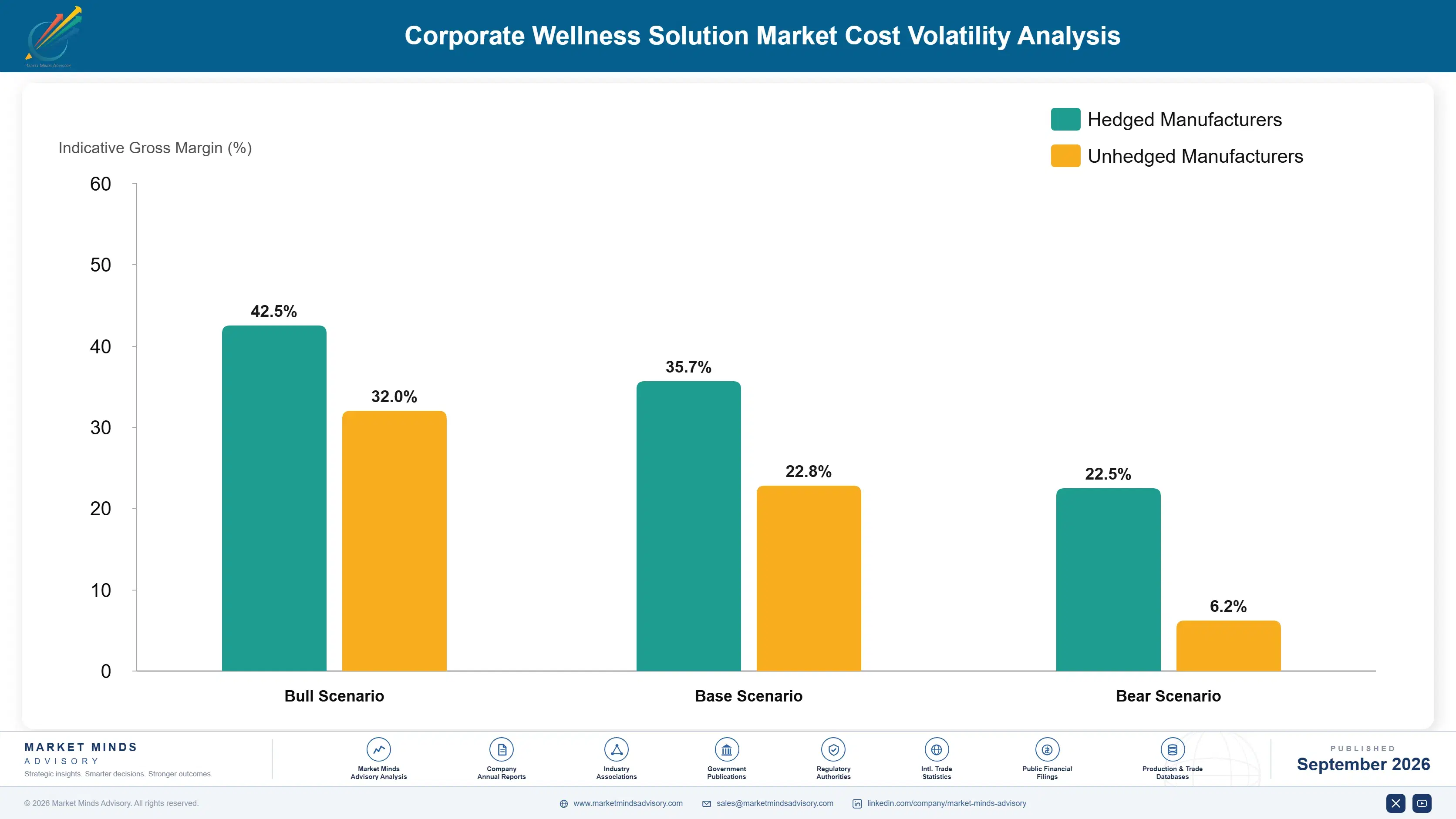
corporate-wellness-solution-market-cost-volatility-analysis-1788677527569

Expanding Coaching-Tier Service Offerings

Vendors increasingly route lower-acuity mental health needs to less credentialed coaches rather than licensed therapists, reducing average per-session cost while reserving scarce licensed clinician capacity for cases genuinely requiring clinical intervention and diagnosis under appropriate professional supervision protocols mandated by state licensing boards and major health insurance payer requirements across the entire country today.

Building Proprietary Clinician Networks

Larger vendors are building direct contracted clinician networks rather than relying entirely on third-party staffing agencies, trading upfront network development cost for materially lower long-term per-session pricing and more predictable clinician availability during periods of surging service demand across enterprise employer accounts nationwide throughout every calendar quarter of the full fiscal year ahead each time.

Using Asynchronous Content to Supplement Live Sessions

Vendors increasingly supplement live coaching sessions with asynchronous self-guided content, including recorded exercises and structured programs, reducing the total number of live clinician hours required per employee while maintaining program engagement and measurable outcomes across the entire enrolled population served by a given employer account throughout each program year continuously and quite reliably indeed.

Portfolio Architecture for Margin Defence

Corporate wellness vendors operate across three margin tiers, from standardized fitness and engagement point solutions sold at volume to premium clinical mental health and financial wellness services commanding substantially better economics. Tier separation reflects clinical credentialing depth and outcomes measurement sophistication rather than raw technology cost differences, since a basic step-tracking app and a licensed therapy platform share similar underlying software infrastructure.
Volume tension is sharpest in fitness and engagement solutions, where price-sensitive mid-market employers push toward standardized per-employee-per-month pricing while vendors would prefer premium clinical add-ons instead. Large enterprise employers behave oppositely, valuing clinical credibility and demonstrated outcomes over unit price, which is why the highest-value revenue pools concentrate in mental health coaching and financial wellness rather than commodity fitness tracking.

Compliance-driven demand, particularly mental health parity documentation, sits between these extremes: growing quickly but priced closer to standard tiers than premium clinical services, since compliance-focused buyers remain cost-conscious even as regulatory mandates guarantee steady purchase volume. Vendors positioned across all three tiers simultaneously capture the broadest addressable revenue base, though few manage the operational complexity of serving such differently motivated buyer segments well.

Volume / Commodity-Adjacent

Standardized fitness tracking and generic engagement point solutions sold at scale to price-sensitive mid-market employers with minimal customization requirements or clinical service depth built into the core product offering itself.
Gross Margin: 22 to 30%

Premium / Certified

Licensed clinical mental health coaching and financial wellness services requiring credentialed staff, extensive compliance documentation, and demonstrated clinical outcomes justifying substantially higher enterprise pricing than commodity fitness alternatives could ever command in the market.
Gross Margin: 42 to 52%

Sustainability / Regulatory / Next-Generation

Compliance-driven mental health parity documentation and emerging outcomes-based pricing programs serving regulatory-driven demand at margins between commodity and premium clinical tiers, growing steadily as audit enforcement expands nationwide each year.
Gross Margin: 35 to 45%
corporate-wellness-solution-market-portfolio-architecture-1788677528069

High-value Sub-segments and Strategic Watch-out

Mental Health Coaching Platforms

Mental health coaching combines high growth with premium clinical pricing, representing the clearest high-value high-growth opportunity as employers reallocate budget from generic fitness perks toward measurable behavioral health outcomes tracked directly against actual healthcare claims trend data over successive multi-year enterprise budget planning cycles ahead.
Gross Margin: high

Financial Wellness and Retirement Tools

Financial wellness combines strong margins with steady growth tied to retirement plan administration cross-selling, representing a high-value moderate-growth pool anchored by sticky assets-under-management revenue rather than pure subscription pricing alone, which improves long-term revenue predictability considerably for vendors managing large enterprise accounts nationwide each year.
Gross Margin: high

Fitness and Engagement Point Solutions

Standardized fitness tracking forms the volume core of the market, generating steady revenue at compressed margins as mid-market employers maintain basic program participation without committing to deeper clinical service investment, even as unit pricing faces continuous downward competitive pressure nationwide from newer market entrants each year.
Gross Margin: moderate

Insurer-Owned Bundled Wellness Platforms

Insurer-owned wellness platforms bundled directly into health plan offerings represent the clearest strategic watch-out, since they threaten to disintermediate standalone vendors entirely for smaller employers preferring a single consolidated insurance relationship over multiple separate vendor contracts and billing arrangements handled each fiscal year going forward.
Gross Margin: uncertain

Retention Economics of Wellness Contracts

Corporate wellness platforms generate meaningful annuity revenue through multi-year employer contracts averaging 2.3 years, since switching vendors mid-cycle requires re-onboarding employees and rebuilding claims data integration pipelines that took considerable months to establish properly the first time. Vendors that demonstrate measurable outcomes within the first renewal cycle convert this into multi-cycle relationships worth considerably more than any single contract term alone.
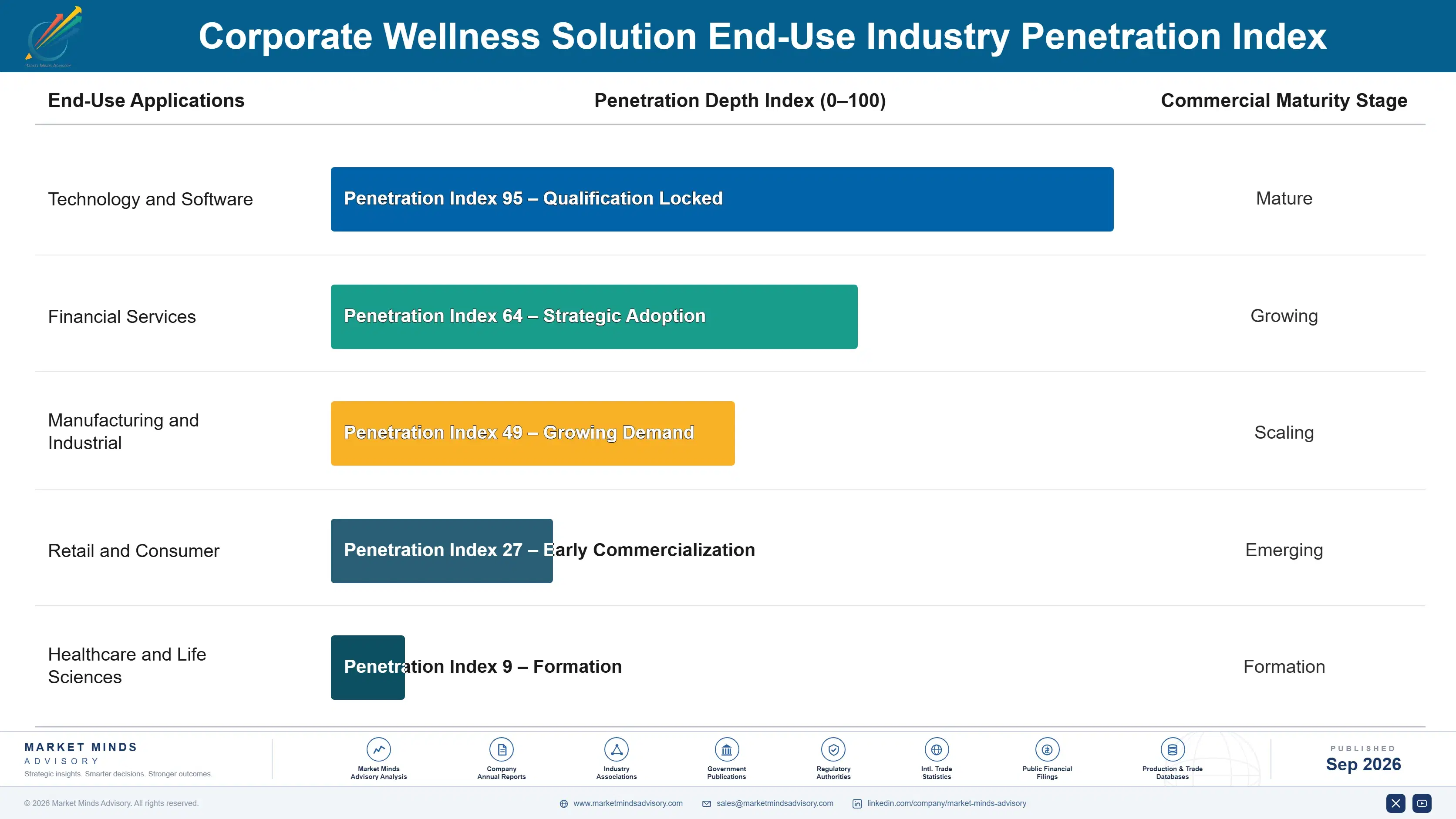
Adoption stickiness varies sharply by end-use vertical. Technology and financial services employers show the deepest engagement, integrating wellness platforms into broader benefits and HR technology stacks that make switching costly and disruptive to daily operations. Manufacturing and retail employers show markedly shallower adoption, often limited to basic biometric screening required for insurance premium discounts rather than comprehensive mental health or financial wellness investment across their broader workforce.

Buyer profiles are shifting generationally as younger HR and benefits leaders, having personally experienced burnout culture firsthand during their own careers, increasingly champion mental health investment over the generic fitness perks that dominated benefits strategy a decade ago. This generational shift favors vendors offering clinically credible mental health services over vendors whose value proposition rests primarily on gamified engagement and step-count competition features from an earlier era.
corporate-wellness-solution-market-end-use-penetration-index-1788677528556

Where MMA Sees the Opportunity

These are among the four positions where our research anticipates prominent divergence between winners and laggards over the coming forecast period. Each is grounded in the demand model, the regulatory perimeter, and the announced capacity pipeline.
01 / CLINICAL OUTCOMES STRATEGY

Invest in demonstrable claims outcomes over engagement metrics

Employers increasingly refuse to renew contracts that cannot show a real claims trend improvement, so vendors clinging to engagement-based value propositions will lose renewal negotiations to competitors with genuine outcomes data. Building this capability requires deep insurer claims data integration that takes years to establish credibly, meaning vendors should start now rather than waiting for finance teams to demand it during a renewal cycle already underway. This is the single clearest differentiator separating winners from laggards over the coming decade.
02 / MENTAL HEALTH INVESTMENT PRIORITY

Prioritize mental health coaching over legacy fitness offerings

Mental health coaching is growing at 16.0 percent versus the market's 10.5 percent overall rate, roughly 1.52 times faster, reflecting a genuine reallocation of employer budget rather than a temporary pandemic-era spike that fades over time as labor markets ease. Vendors still built primarily around fitness tracking and step-count challenges risk becoming the next generation's fax machine: functional but increasingly irrelevant to what enterprise buyers actually prioritize today. Building clinical credibility now, before competitors fully establish it, protects long-term relevance and pricing power for years to come.
03 / PLATFORM CONSOLIDATION POSITIONING

Build toward consolidated platforms rather than remaining a point solution

Procurement teams increasingly favor single vendors covering fitness, mental health, and financial wellness under one dashboard rather than juggling five or six disconnected point solutions with inconsistent reporting formats across teams. Narrow specialists face a genuine strategic choice: acquire adjacent capabilities, partner with platform aggregators, or accept a shrinking addressable market as consolidation accelerates steadily across the broader industry landscape over the next several years. Waiting too long to decide risks losing negotiating leverage entirely to better-capitalized competitors already moving decisively toward consolidation.
04 / REGULATORY COMPLIANCE READINESS

Build compliance documentation capability ahead of expanding audits

Expanding mental health parity enforcement since 2023 is forcing employers to document benefit equity in ways many still cannot do without dedicated software support built specifically for this exact compliance purpose. Vendors that build audit-ready compliance reporting directly into their platforms capture budget that would otherwise fund a separate compliance software purchase entirely, adding real contract value well beyond core clinical service delivery alone. This capability gap will only widen further as state-level enforcement mechanisms continue expanding steadily across the country in coming years.

Engagement Snapshot From the Field

A live engagement with an industry participant carrying material or product regulatory and market exposure ahead of a defining policy shift, showing how our research translates into a defensible multi-year portfolio strategy.
MARKET MINDS ADVISORY · CLIENT ENGAGEMENT SUMMARY
Corporate Wellness Solution Producer Strategic Portfolio Review and Transition Roadmap 2026·Investment Scenario on Corporate Wellness Solution Exposure Evaluation 2025-26
CLIENT PROFILE
The client is a mid-sized US technology company with approximately 3,200 employees, self-insured for health benefits and managing six separate wellness point solutions across fitness, mental health, nutrition, and financial wellness (client-reported, unverified by MMA). Annual wellness spending totaled roughly 4.2 million dollars, split across vendors with inconsistent reporting formats and no unified outcomes measurement across the entire benefits portfolio.
STRATEGIC CHALLENGE
Leadership could not determine which of its six wellness vendors were actually reducing healthcare claims versus simply generating engagement metrics that looked good in quarterly reports but showed no connection to cost trends. The benefits team needed an independent assessment of consolidation options before the next renewal cycle, given mounting internal pressure to justify wellness spending against rising overall healthcare premium costs.
MMA APPROACH
MMA conducted a comparative outcomes assessment across all six existing vendors, correlating each program's participation data against the client's actual healthcare claims trends over the prior three years. The engagement included interviews with three platform aggregator vendors capable of full consolidation, evaluating technical migration complexity, employee re-enrollment risk, and realistic multi-year total cost of ownership scenarios.
KEY FINDINGS
  1. Only two of six existing vendors showed measurable correlation with reduced claims costs; the remaining four contributed engagement data with no clear cost impact (client-reported, unverified by MMA).
  2. Consolidating to a single platform aggregator was projected to reduce total wellness spend by 18 percent while improving reporting consistency across the entire benefits program significantly.
  3. Employee re-enrollment risk during consolidation was lower than initially feared, since most employees already used fewer than two of the six point solutions regularly.
  4. The client's mental health vendor showed the strongest outcomes correlation, reinforcing internal leadership's instinct to prioritize that budget line during the coming renewal cycle.
CLIENT PROFILE
The client is a mid-sized US technology company with approximately 3,200 employees, self-insured for health benefits and managing six separate wellness point solutions across fitness, mental health, nutrition, and financial wellness (client-reported, unverified by MMA). Annual wellness spending totaled roughly 4.2 million dollars, split across vendors with inconsistent reporting formats and no unified outcomes measurement across the entire benefits portfolio.
STRATEGIC CHALLENGE
Leadership could not determine which of its six wellness vendors were actually reducing healthcare claims versus simply generating engagement metrics that looked good in quarterly reports but showed no connection to cost trends. The benefits team needed an independent assessment of consolidation options before the next renewal cycle, given mounting internal pressure to justify wellness spending against rising overall healthcare premium costs.
MMA APPROACH
MMA conducted a comparative outcomes assessment across all six existing vendors, correlating each program's participation data against the client's actual healthcare claims trends over the prior three years. The engagement included interviews with three platform aggregator vendors capable of full consolidation, evaluating technical migration complexity, employee re-enrollment risk, and realistic multi-year total cost of ownership scenarios.
KEY FINDINGS
  1. Only two of six existing vendors showed measurable correlation with reduced claims costs; the remaining four contributed engagement data with no clear cost impact (client-reported, unverified by MMA).
  2. Consolidating to a single platform aggregator was projected to reduce total wellness spend by 18 percent while improving reporting consistency across the entire benefits program significantly.
  3. Employee re-enrollment risk during consolidation was lower than initially feared, since most employees already used fewer than two of the six point solutions regularly.
  4. The client's mental health vendor showed the strongest outcomes correlation, reinforcing internal leadership's instinct to prioritize that budget line during the coming renewal cycle.
RECOMMENDED STRATEGY
Phase 1: Phase one: consolidate four low-performing point solutions into a single platform aggregator within the current fiscal year without major disruption. Phase 2: Phase two: retain the two highest-performing vendors as standalone contracts while integrating their data into the new consolidated reporting dashboard. Phase 3: Phase three: implement outcomes-based pricing terms with all retained vendors ahead of the next full renewal cycle beginning eighteen months later.
OUTCOME
The client began vendor consolidation within three months of the engagement's conclusion and reported early indications of improved reporting consistency across retained programs (client-reported, unverified by MMA). Full financial outcomes from the consolidation effort were not yet available for independent verification at the time of publication.

Frequently Asked Questions

Foundational context covering the market sizes, CAGR, scope, country, region and competition that inform every finding below. This section is provided to cover basics and most often pre-purchase conversations, answered from the MMA Primary Research Dataset.

What is the current size of the Corporate Wellness Solution Market?

The global corporate wellness solution market is valued at 58.5 billion dollars in 2025, the report's base year. This reflects employer spending on fitness, mental health, financial wellness, and biometric screening programs combined across all categories.

How large will the Corporate Wellness Solution Market be by 2036?

MMA projects the market will reach 175.44 billion dollars by 2036, a 2.71 times expansion from 2026's forecast value. Growth is driven mainly by mental health investment and self-insured employer expansion.

What is the CAGR for the Corporate Wellness Solution Market 2026 to 2036?

The market is forecast to grow at a 10.5 percent compound annual rate between 2026 and 2036. Bull and bear scenarios range from 11.8 percent to 9.2 percent depending on employer budget cycles.

Which segment is growing fastest?

Mental health and behavioral coaching platforms lead at a 16.0 percent CAGR, roughly 1.52 times the overall market rate. Demand is driven by rising burnout diagnoses and expanding parity enforcement.

Who are the major companies in the Corporate Wellness Solution Market?

Virgin Pulse, Wellhub, Headspace Health, Calm Business, and Limeade lead the market on enterprise account count and platform breadth. Together they hold a combined cr5 of 38 percent.

Which country is growing fastest?

India leads at a 17.5 percent forecast CAGR, driven by intense talent competition across the country's large IT services and business process outsourcing sectors. This outpaces the broader South Asia and Pacific average.

Report Segmentation Architecture

The full report scope spans multiple orthogonal segmentation dimensions, with cross-tabulated demand data provided for each dimension pair. Coverage extends further to regional breakdowns, trend trajectories, and the competitive detail needed to support segment-level decision-making.

By Program Type

  • Mental Health and Behavioral Coaching Platforms
  • Fitness and Physical Activity Tracking Platforms
  • Nutrition and Weight Management Programs
  • Health Risk Assessment and Biometric Screening Services
  • Employee Assistance Program Services
  • Financial Wellness and Retirement Planning Tools

By End-Use Industry

  • Technology and Software
  • Financial Services
  • Manufacturing and Industrial
  • Retail and Consumer
  • Healthcare and Life Sciences

By Commercial Dimension

  • Self-Insured Employer Direct Purchase
  • Insurance Carrier Bundled Offering
  • Platform Aggregator Consolidated Sales
  • Broker and Benefits Consultant Channel

By Region

  • North America
  • Western Europe
  • East Asia
  • South Asia and Pacific
  • Latin America
  • Middle East and Africa
  • Eastern Europe

Scope, Methodology, and Coverage

Every figure in this report is reproducible from documented input assumptions. The scope below maps the historical period, the forecast horizon, the segmentation dimensions, and the countries covered, alongside the underlying primary and qualitative methodology.
Historical Period
2020 to 2025
Forecast Period
2026 to 2036
Base Year
2025 (USD billions; MMA Primary Research Dataset, September 2026)
Market Definition
This market covers digital and hybrid corporate wellness platforms and services purchased by employers to support employee mental, physical, and financial health, including fitness tracking, behavioral coaching, biometric screening, and employee assistance programs. It excludes general health insurance products and personal consumer wellness apps purchased directly by individuals rather than through an employer benefits program.
Quantitative Units
USD billions (current prices); per-employee-per-month pricing where applicable
Segmentation Dimensions
By Program Type; By End-Use Industry; By Commercial Dimension; By Region
Regions Covered
North America, Western Europe, East Asia, South Asia and Pacific, Latin America, Middle East and Africa, Eastern Europe
Countries Covered
USA, China, Germany, France, UK, Japan, South Korea, India, Australia, Canada, Brazil, Mexico, Indonesia, Vietnam, Thailand, Malaysia, UAE, Saudi Arabia, South Africa, Nigeria, Turkey, Poland, Netherlands, Italy, Spain, Sweden, Switzerland, Argentina, Colombia, Singapore, and additional markets relevant to this sector
Key Companies Profiled
Virgin Pulse, Wellhub, Headspace Health, Calm Business, Limeade, Vitality Group, Sprout at Work, Wellable, Grokker, Marino Wellness, Wellsource, WebMD Health Services, Sonic Boom Wellness, EXOS, League Inc., Sharecare, SmartDollar, BrightPlan, Origin, Truworth Wellness
Quantitative Methodology
Primary survey, n=3,800 respondents, Q4 2025, six countries; demand-side model with trade association cross-validation
Qualitative Methodology
47 expert interviews, Q4 2025; applied to validate demand model assumptions, identify emerging dynamics, and assess competitive positioning
Report Format
PDF and XLSX data workbook (Word format preview document)
Publisher
Market Minds Advisory
Report Code
MMA-2026-HLT-163
Published
September 2026
Contact
sales@marketmindsadvisory.com | www.marketmindsadvisory.com

Purchase the full Corporate Wellness Solution Market Report (2026 to 2036).

The full report delivers a comprehensive assessment of the global corporate wellness solution market across program type, end-use industry, and commercial channel dimensions through 2036. It includes detailed competitive profiles of twenty companies, seven regional demand analyses, and input cost risk modeling tied to licensed clinician staffing availability and pricing. Analysts receive segment-level CAGR forecasts, portfolio margin benchmarking, and a strategic verdict section identifying where near-term investment should concentrate across the industry. The report also includes an anonymized client case study illustrating real-world vendor consolidation strategy decisions in practice.
Seven-region demand and CAGR growth forecasts
Twenty-company competitive profiling and moat analysis
Six-dimension segmentation with detailed growth rates
Clinician staffing input cost risk modeling
Portfolio margin tier benchmarking analysis framework
Anonymized client vendor consolidation case study

Built For The People Who Decide

From boardroom strategy to bench-side execution, this report is read cover-to-cover by leaders shaping the next decade of their industry, turning demand scenarios, market dynamics and valuation benchmarks into decisions.
CXOs/ Presidents/ VPs/ Managers
M&A and Corporate Development
Strategy Teams and R&D Heads
Procurement and Product Directors
Regulatory and Compliance Leaders
Investor Relations and Equity Analysts