Market Minds Advisory
Corporate Event Planner Market

Corporate Event Planner Market: Corporate Event Planner Market. Hybrid Production Demands Reshape Corporate Meeting Budgets

Hybrid production budgets are quietly replacing the simple banquet-hall booking as the largest line item in corporate meeting spend, forcing planners to master streaming logistics few agencies mastered five years ago.

Lead Analyst

Published

September 2026

Make Smarter Decisions with Customized Research Insights

Request a free sample report and evaluate market opportunities, growth trends, and competitive dynamics relevant to your business needs.

2025 MARKET VALUE$4.6BMarket Size 2025
2036 FORECAST VALUE$9.1BBase Case , 2026 to 2036
CAGR 2026 TO 20366.4 %Bull 7.6% / Bear 5.2%
INCREMENTAL OPPORTUNITY$4.2BNet 10- year value creation
EXPANSION MULTIPLE1.86x2036 value over 2026 base
Strategic Levers
M&A Pipeline
Regional Outlook
Country Rankings
Competitive Intelligence
Segmental Deep-dive
Call-Us : 91 93563 13602

Executive Snapshot and Market Trajectory.

Corporate event planning has shifted from a logistics function into a measurable brand and revenue driver boards now scrutinize directly. Chief marketing officers increasingly treat event budgets like any other measurable marketing channel, demanding attribution data planners were never previously asked to provide at this level of detail.
Hybrid and virtual production services are growing fastest as companies demand measurable engagement data from remote attendees, while incentive travel planning consolidates a separate but adjacent luxury-adjacent budget line concentrated in North America and the Gulf's expanding convention infrastructure. Corporate clients increasingly request post-event engagement dashboards as a standard contract deliverable, a requirement that barely existed five years ago and now separates sophisticated agencies from smaller competitors.
Dozens of boutique agencies compete against a handful of large full-service firms now bundling event technology platforms into broader planning contracts, and rising client demand for measurable return on event spend is starting to separate agencies with genuine data capability from those still selling on relationships alone. Event technology platforms integrating registration, streaming, and analytics into one system are becoming the default expectation rather than an optional upsell most agencies previously charged extra to provide.
Market Definition
This report defines the Corporate Event Planner Market as third-party planning, production, and technology services for corporate meetings, conferences, incentive travel, and product launches. It excludes venue ownership, catering operations, and internal in-house event staff not offered as an external service.
Base Year Value
$4.6B in 2025 (MMA Primary Research Dataset, September 2026)
Forecast Period
2026 to 2036, eleven discrete annual values
CAGR
6.4% base case. Bull 7.6%. Bear 5.2%.
Fastest Growth Segment
Hybrid and Virtual Event Production Services: 9.8% CAGR
Fastest Growth Country
United Arab Emirates: 10.6% CAGR
Fastest Growth Region
South Asia and Pacific: 8.4% CAGR
Largest Region
North America: 30% of 2025 global value
Market Leaders
BCD Meetings & Events, Cvent, CWT Meetings & Events, Freeman, and MCI Group. Source: MMA Analysis based on company disclosures and managed event volume estimates.
Primary Survey
n=3,800 procurement and R&D decision-makers, Q4 2025, six countries
Methodology
Demand-side build-up, cross-validated against public data, 47 expert interviews

Corporate Event Planner Market Forecast Scenarios

corporate-event-planner-market-size-forecast-scenario-1789986747527
Between 2020 and 2025 the market went through a genuine near-collapse and recovery cycle, contracting sharply during pandemic lockdowns before rebounding at roughly 5.6% annually as companies rediscovered the value of in-person relationship building. Recovery was uneven across regions, with North America and the Gulf rebounding faster than Western Europe. Contracting sharply at first, the sector then recovered its full pre-pandemic revenue base by roughly 2023.
MMA's base case assumes 6.4% annual growth through 2036, anchored to three mechanisms: expanding hybrid production budgets as companies permanently retain remote attendee options, rising demand for measurable engagement analytics that justify event spend to cost-conscious finance departments, and steady consolidation of boutique agencies into full-service firms. Full-service firms demonstrating measurable return on investment are winning larger, multi-year contracts. Boutique agencies unable to demonstrate similar analytics increasingly lose out on the largest enterprise contracts.
The bull case rests on incentive travel budgets recovering fully to pre-pandemic levels as companies compete harder for talent retention through experiential rewards. The bear case centers on prolonged corporate travel budget caution, with finance departments treating large gatherings as discretionary spend cut first during any slowdown. That risk is most acute for mid-size companies without protected event budgets.

From Banquet Bookings to Measurable Engagement Platforms

Corporate event planning has moved from a support function booking banquet halls to a measured brand and engagement discipline finance departments now scrutinize line by line. Agencies have layered on streaming production, attendee analytics, and post-event engagement scoring, turning a logistics service into a technology-enabled offering clients renew based on measurable results rather than relationship alone. Chief marketing officers now sit in vendor selection meetings once belonging entirely to procurement teams.
AVERAGE MANAGEMENT FEE12%Typical planning fee charged as share of total event budget
CLIENT RETENTION RATE76%Share of corporate clients renewing their annual planning contract
TOP PRODUCING COUNTRY SHARE24%United States share of global managed corporate event spend
HYBRID EVENT ADOPTION RATE58%Share of large corporate events including a remote option
AVERAGE CONTRACT VALUE$340,000Typical annual value of a full-service planning agency contract
PLANNING LEAD TIME7 monthsTypical advance booking window for a major corporate conference
Pricing now varies sharply by service depth. Basic logistics-only contracts charge modest flat fees, while full-service agencies bundling technology platforms and analytics command percentage-of-budget fees that scale with event complexity, and clients increasingly upgrade after a poorly measured event convinces finance that analytics are worth paying for. Incentive travel programs occupy a distinct premium tier entirely, priced closer to luxury hospitality than standard conference logistics.
Large full-service firms are acquiring boutique regional agencies rather than building capability in-house, buying specialized destination knowledge and existing client relationships rather than technology alone. That consolidation pattern is starting to squeeze independent boutique agencies that lack the scale to invest in comparable measurement platforms their larger competitors now offer as standard. Independent agencies that survive increasingly specialize in a niche larger competitors overlook.
"Nobody renews a contract because the venue had nice lighting. They renew because someone can prove the event moved a pipeline number."
Director, Corporate Services and Events Practice · MMA Technology Practice · September 2026

Market Trends

Hybrid Production Becomes the Default Event Format

Companies are permanently retaining remote attendee options rather than treating hybrid production as a temporary pandemic-era accommodation, forcing agencies to build streaming and broadcast capability into their standard service offering rather than an occasional add-on. This shift accelerated sharply once finance departments realized remote options expand attendance at a fraction of per-attendee travel cost, a realization that reshaped budget conversations across nearly every industry vertical. Roughly 58% of large corporate events now include a formal remote attendance component, a figure that continues rising steadily each year as production quality improves.
Market Impact: Incentive travel budgets rose 15%

Engagement Analytics Become a Standard Contract Deliverable

Corporate clients increasingly demand measurable post-event engagement data as a baseline contract requirement rather than an optional add-on service agencies once charged separately for providing. This shift reflects broader finance department pressure to justify event spend against measurable business outcomes rather than subjective satisfaction surveys that dominated the industry for decades. Agencies lacking dedicated analytics capability increasingly lose competitive bids to full-service firms that can demonstrate concrete engagement metrics tied directly to attendee behavior and follow-up conversion rates. Some agencies now employ dedicated data analysts purely to build these dashboards for enterprise clients demanding them.
Market Impact: In-person meeting frequency rose over 20%

Market Opportunities and Growth Drivers

Talent Retention Pressure Drives Incentive Travel Budget Growth

Companies competing for skilled talent in tight labor markets are expanding incentive travel budgets as a retention tool, recognizing that experiential rewards carry meaningfully more perceived value per dollar spent than equivalent cash bonuses distributed through payroll. Human resources departments increasingly co-fund these programs alongside sales and marketing budgets, a cross-departmental financing arrangement that barely existed a decade ago. Agencies specializing in incentive travel report meaningfully stronger contract renewal rates than those focused purely on standard conference logistics work. Some agencies now maintain dedicated destination specialists purely to serve this growing incentive travel demand.
Market Impact: Budget cuts hit 18% of contracts

Return-to-Office Mandates Boost In-Person Meeting Frequency

Companies rolling out return-to-office mandates are simultaneously increasing spending on in-person internal meetings and team-building events, treating structured gatherings as a tool for rebuilding workplace culture eroded during years of remote work. This trend has proven particularly strong among large technology and financial services firms reversing earlier remote-first policies established during the pandemic. Agencies report growing demand specifically for shorter, more frequent internal events rather than the large annual conferences that historically dominated corporate calendars. Some agencies have hired dedicated internal-events specialists purely to serve this growing frequency of smaller corporate gatherings.
Market Impact: Venue costs rose over 12%

Market Restraints and Challenges

Corporate Travel Budget Caution Limits Discretionary Spend

Finance departments increasingly treat large in-person gatherings as discretionary spend subject to immediate cuts during any hint of economic uncertainty, unlike fixed operating costs that survive budget review cycles largely untouched. The root cause is that event spend rarely appears on a balance sheet as a measurable asset, making it an easy target during cost-cutting exercises regardless of demonstrated prior return. The commercial impact is unpredictable revenue for agencies dependent on large annual conferences. Some agencies are responding by shifting toward smaller, more frequent events that are harder to cancel entirely.
Market Impact: Remote options now reach 58%

Venue and Travel Cost Inflation Squeezes Agency Margins

Venue rental rates and business travel costs have risen faster than the fees agencies can pass through to increasingly price-sensitive corporate clients, compressing margins on fixed-fee contracts signed before cost increases materialized. The root cause is that many agencies still price contracts a year or more in advance, leaving no mechanism to adjust for inflation that occurs between signing and event execution. The commercial impact is thinner margins on legacy contracts specifically. Some agencies now build inflation escalation clauses directly into new multi-year agreements to address this. Clients have generally accepted these clauses given broader awareness of recent cost volatility.
Market Impact: Analytics demand rose to 70%
3 additional market trends, 4 additional growth drivers, and 3 additional restraints and challenges are covered in the full report. Contact sales@marketmindsadvisory.com to access the complete intelligence.

Segment CAGR and Growth Architecture

The market spans six categories organized by service type, from hybrid production through internal meeting coordination. Growth concentrates in categories combining measurable technology deliverables with premium experiential budgets, while standard logistics categories grow slowest. Conference management and product launch categories occupy the pricing middle, while internal meeting coordination and event technology round out the remaining categories at lower margins.
corporate-event-planner-market-market-share-analysis-1789986748066

Hybrid and Virtual Event Production Services

Hybrid and Virtual Event Production Services bundle streaming production, remote attendee platforms, and engagement analytics into a single managed offering, growing at roughly 9.8% annually as companies permanently retain remote attendance options. Adoption started among large technology companies with existing streaming infrastructure, but falling production costs have pulled mid-size companies into the category over the past two years. The segment increasingly competes on measurable engagement data rather than production quality alone, since finance departments now demand attribution before renewing contracts. Vendors that can document measurable engagement lift hold a durable pricing advantage over rivals still selling purely on production quality alone. Several vendors now publish third-party audited engagement benchmarks specifically to reassure enterprise buyers evaluating multiple competing production firms.
CAGR 9.8%

Incentive Travel and Corporate Retreat Planning

Incentive Travel and Corporate Retreat Planning pairs destination expertise with luxury hospitality negotiation, growing at roughly 8.1% annually as companies expand experiential rewards for talent retention purposes. This segment carries the highest average contract value of any category because it substitutes for cash compensation rather than simply organizing a meeting. Human resources departments increasingly co-fund these programs alongside sales incentive budgets, a cross-departmental financing pattern that barely existed a decade ago. Retention in this segment consistently outperforms standard conference contracts, since a poorly executed retreat carries meaningfully higher reputational risk for the sponsoring department. Destination selection increasingly weighs sustainability credentials, since several large corporate clients now screen proposed venues against internal environmental policies before approving budgets.
CAGR 8.1%
Full segment breakdown across 6 segments available in the complete report.

Regional Architecture and Country Demand Map

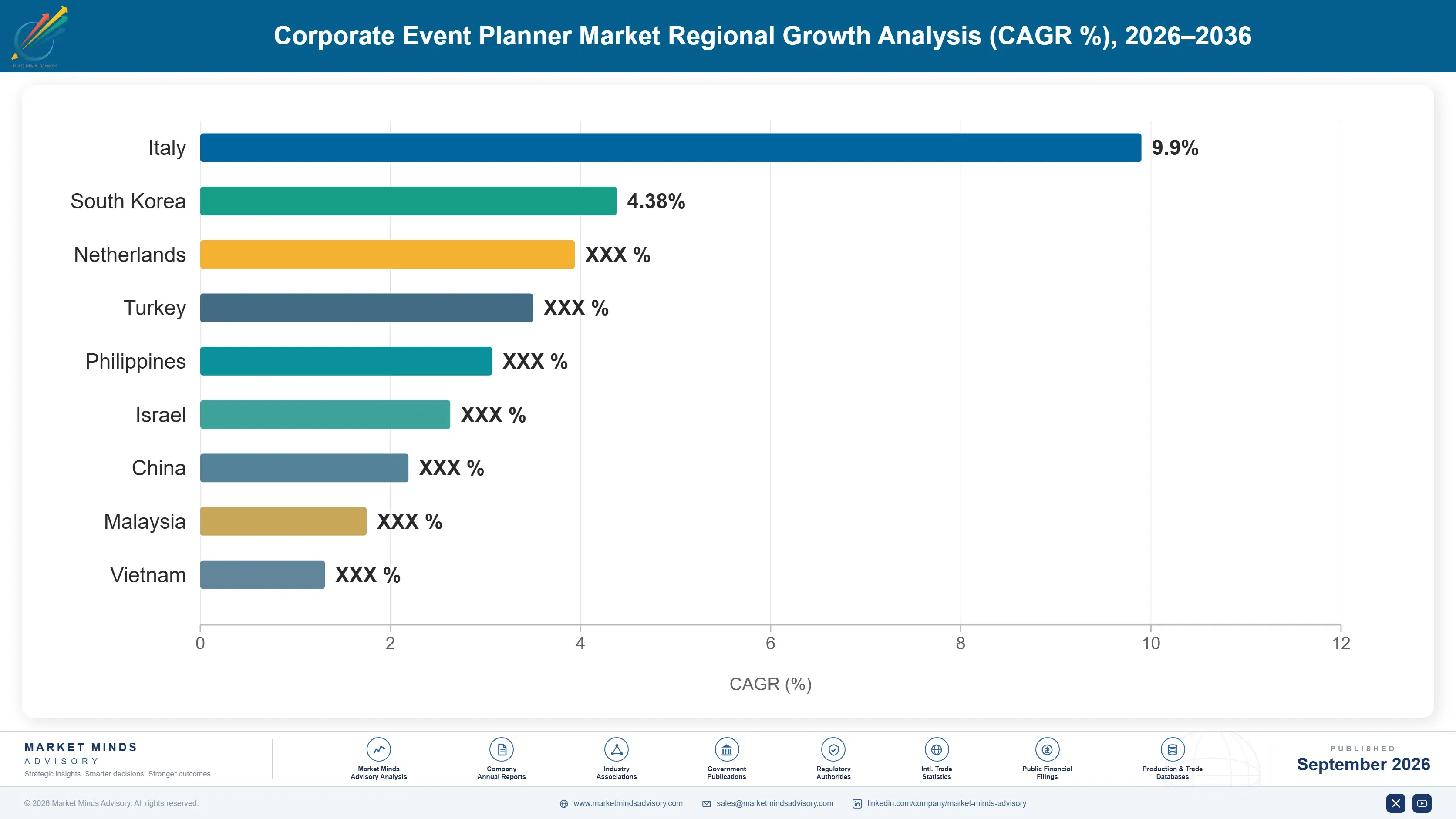
North America leads on corporate meeting spend concentration and headquarters density, while South Asia and Pacific grows fastest as India's expanding corporate sector adopts formal event planning services at a rapidly accelerating pace. East Asia follows closely as technology firms expand corporate conference and product launch spending regionally.

North America

North America holds the largest managed event spend, supported by the world's highest concentration of corporate headquarters and the deepest existing agency infrastructure of any region. The United States hosts most of the category's largest full-service firms, whose scale advantages let them bundle technology platforms other regions' agencies still charge separately for. Incentive travel programs, particularly strong here, add meaningful premium contract value few other markets currently match. Growth trails the global rate slightly since the corporate meeting market here is already largely mature, leaving mostly incremental analytics and hybrid upgrades as remaining addressable demand. Canadian agencies are also emerging as a modest secondary growth pocket within the broader region.
Share: 30% | CAGR: 7.0% (2026 to 2036)

Western Europe

Western Europe's trade fair and exhibition tradition, particularly strong in Germany, supports a steady base of large-scale conference management contracts distinct from North America's more corporate-meeting-focused demand. The United Kingdom and France add meaningful incentive travel and product launch demand concentrated among consumer goods and pharmaceutical companies headquartered in the region. Regulatory attention to sustainability disclosure here is somewhat stricter than in North America, pushing agencies to build carbon accounting into standard event proposals. Growth trails the global average as the region's corporate meeting market matures more slowly than faster-growing markets elsewhere. Scandinavia's smaller but affluent corporate sector is emerging as a modest secondary growth pocket within the region. Nordic sustainability standards are increasingly influencing broader regional agency practices.
Share: 22% | CAGR: 4.9% (2026 to 2036)
Regional intelligence for 5 additional markets available in the complete report: East Asia, South Asia and Pacific, Latin America, Middle East and Africa, Eastern Europe. Contact sales@marketmindsadvisory.com.
corporate-event-planner-market-country-cagr-analysis-1789986748579

Analytics Capability Commands Premium Contract Value

Standard logistics fees are thin and falling, pushing agencies to build recurring revenue around analytics and technology platform capability clients actually value. Hybrid production, incentive travel, and measurable engagement services now generate most incremental revenue. Agencies that diversify beyond one-off event fees into these channels post materially stronger long-term retention. Enterprise clients value this diversified capability over one-off logistics work.

Enterprise Engagement Analytics Subscription Programs Nationwide

Agencies are building dedicated data teams to offer standalone engagement analytics subscriptions that clients can purchase independent of any single event, proving attribution data justifies recurring platform fees beyond one-time production work. Analytics subscriptions now generate roughly 14% of total agency revenue, up from near zero four years ago, and carry meaningfully lower churn than one-off event contracts since the ongoing data relationship deepens client dependence. Several leading agencies have publicly disclosed analytics pipeline growth exceeding 20% year over year as more clients sign on. This growth trend shows no signs of slowing across the broader enterprise events industry.
Market Impact: Analytics subscriptions now reach roughly 14% of revenue

Premium Incentive Travel Upgrade Pathway Programs

Agencies increasingly design upgrade paths that convert standard conference clients into premium incentive travel programs after demonstrating measurable engagement lift from a well-executed hybrid event. These premium programs now command roughly triple the average per-attendee fee and represent the fastest-growing revenue segment within existing client relationships. Destination specialists also generate valuable client insight agencies use to refine which clients are likeliest to upgrade toward experiential rewards. Roughly 3 in 10 clients who try a premium incentive travel package upgrade permanently within their first renewal cycle. Agencies view this recurring premium relationship as more durable than standard conference contracts alone.
Market Impact: Premium programs now command roughly 3x standard fees

White-Label Event Technology Platform Licensing Programs

Some agencies now license their proprietary registration and streaming technology platforms directly to corporate clients' internal events teams, a distribution channel that bypasses full-service production fees entirely. Early licensing deals report meaningfully higher margin than comparable full-service production contracts, since the underlying software development cost is already covered by the agency's own platform investment. Clients value gaining platform control without building comparable technology in-house from scratch. Roughly 2 in 5 licensing clients report measurably faster internal event setup after adopting the platform directly. Agencies increasingly treat this licensing channel as a genuine second business line.
Market Impact: Platform licensing revenue now grows roughly 22% yearly

Sustainability Certification Advisory Service Programs Nationwide

Some agencies now offer paid sustainability certification advisory services helping corporate clients measure and reduce event carbon footprint for internal environmental, social, and governance reporting requirements. This advisory revenue remains small but carries extremely high margin since the measurement methodology is already built for internal agency operations purposes. Corporate sustainability teams increasingly view certified agencies as essential partners they cannot otherwise assemble independently. Roughly 1 in 4 advisory clients expand into a full sustainability certification package within their first year. That expansion pattern makes advisory services a genuinely durable revenue growth path.
Market Impact: Sustainability advisory now adds roughly 5% of revenue

Who Controls the Margin Pool

The market is fragmented, with a cr5 of roughly 22%, reflecting a category of boutique regional agencies where no single vendor has achieved decisive scale. The leading full-service firm holds a meaningful but not dominant lead over its nearest challenger, with technology-forward entrants closing the gap through measurable analytics capability. The gap is measured in enterprise contract retention rather than raw event count, since buyers increasingly research analytics capability before signing.
Current competition centers on analytics platform announcements, incentive travel program expansion, and hybrid production capability, with agencies racing to demonstrate measurable engagement return before rivals establish similar credibility. Several firms are also acquiring smaller boutique agencies purely to absorb destination expertise and existing client relationships, and some now run dedicated sales teams purely to capture subscription revenue. International expansion into East Asia and the Gulf has become a visible proxy battleground for investor confidence in this category.

Emerging pressure comes from event technology platform vendors moving upstream into full-service production, threatening to erode traditional agencies' differentiation entirely. Rankings could shift meaningfully if a well-capitalized technology platform bundles comparable production capability into an existing enterprise software relationship. Traditional agencies bring destination expertise and vendor relationships that technology-first entrants still lack.
corporate-event-planner-market-company-positioning-matrix-1789986749108

Competitive Moat and Risk Dimensions

BCD MEETINGS & EVENTS

Moat: Enterprise Client Relationship Depth

BCD Meetings & Events holds the deepest enterprise client relationships of any full-service firm, having built out dedicated account teams for multinational clients across several years of sustained global expansion. Competitors attempting to displace this depth face years of relationship-building lead time before reaching comparable enterprise account penetration.
BCD MEETINGS & EVENTS

Risk: Planner Staffing Wage Exposure

BCD's cost structure depends heavily on skilled planner staffing, exposing margins to wage inflation in a tight events talent market. Rising planner salaries in several key markets could compress unit economics faster than fee increases can offset without risking client churn. Some regional markets have already seen planner turnover rise noticeably as competing agencies bid up compensation.
CVENT

Moat: Proprietary Event Technology Platform

Cvent built its brand around proprietary event technology software rather than pure production services, creating a differentiated recurring-revenue positioning that traditional full-service agencies cannot easily replicate. That software-first focus has attracted direct platform licensing partnerships with several major agencies. Agencies licensing this platform view it as a measurable retention driver worth paying recurring fees for directly.
CVENT

Risk: On-Site Execution Control Gap

Cvent's software-centric model carries less direct control over on-site execution quality than full-service competitors managing every logistics detail themselves. Execution failures at client events using its platform could damage trust in ways pure technology metrics do not fully capture. A single high-profile execution failure could trigger client scrutiny that full-service competitors largely avoid by design.

Players Tracked

Prominent Players

BCD Meetings & Events
Cvent
CWT Meetings & Events
Freeman
MCI Group

Other Key Players

George P. Johnson
Encore Global
Maritz Global Events
ITA Group
RX Global
Informa Markets
Clarion Events
Access Destination Services
ATPI Corporate Travel
HelmsBriscoe
Emerald Expositions
Global DMC Partners
BI Worldwide
Tarsus Group
Questex

Recent Developments

FEBRUARY 2026

BCD Meetings & Events announced an expanded analytics partnership with a major enterprise software provider, integrating engagement scoring directly into corporate clients' existing customer relationship management dashboards. The agreement extends a pilot program launched the prior year and reflects growing enterprise confidence in measurable event return on investment data.
Signal: Enterprise software integration is steadily becoming a meaningful proxy battleground for analytics credibility right now industry-wide.
OCTOBER 2025

Freeman acquired a smaller regional exhibition services provider, absorbing its existing installation crews and client base in the Midwest. The deal expands Freeman's geographic coverage into several states where it previously had limited direct presence, consolidating a fragmented regional competitor landscape further. Leadership expects this to accelerate its roadmap.
Signal: Consolidation of smaller regional exhibition providers is clearly accelerating as larger firms seek broader geographic reach.
MAY 2025

MCI Group entered a joint venture with a Gulf-based convention authority to co-develop dedicated event infrastructure supporting the region's expanding international conference calendar. The partnership marks MCI's first meaningful infrastructure investment beyond its established planning services. Both organizations expect the new venue infrastructure to open within roughly two years.
Signal: International expansion into the Gulf increasingly relies on local infrastructure partnerships for genuinely successful market entry.

Venue and Travel Cost Exposure

Venue rental and business travel together represent roughly fifty percent of total event cost of goods, with the remainder split between production technology and staffing. Most large venue capacity is concentrated in a small number of major convention cities, and airline capacity for group travel is similarly concentrated among a handful of major carriers. This concentration means a venue closure can ripple through budgets within a single planning cycle.
A 2025 airline capacity reduction, documented in a major carrier's annual report, forced several agencies to rebook group travel at roughly twenty percent higher fares, temporarily squeezing margins on fixed-fee contracts signed before the increase. Larger agencies with pre-negotiated group rates largely avoided the disruption entirely, widening the competitive gap. The episode pushed affected agencies to diversify carrier relationships and build more flexible group booking agreements.

Smaller agencies without volume purchasing power face materially higher per-attendee travel and venue costs than the largest firms, a disadvantage that compounds over multi-year contracts signed at fixed rates. Agencies concentrated in North America face comparatively less currency risk than those pricing across multiple international currencies simultaneously. That gap is why smaller agencies increasingly seek acquisition by larger firms rather than compete independently.
corporate-event-planner-market-cost-volatility-analysis-1789986749305

Diversified Multi-Carrier Group Travel Agreements

Larger agencies are negotiating group travel agreements across multiple airline carriers rather than relying on a single preferred partner, reducing exposure to any one carrier's capacity or pricing changes. This diversification adds modest coordination cost upfront but meaningfully shortens recovery time during future disruptions. Several agencies have already qualified alternate carriers as part of this broader diversification push.

Multi-Year Venue Rate Lock Agreements

Agencies with sufficient client volume are negotiating multi-year venue rate agreements that lock in favorable pricing ahead of demand spikes in major convention cities. Smaller agencies lacking this leverage remain more exposed to spot market price swings during periods of tight venue availability. These agreements typically span two to three years and are increasingly bundled with priority booking access.

Inflation Escalation Clause Standardization

Agencies are standardizing inflation escalation clauses across new multi-year client contracts, allowing fee adjustments when venue and travel costs rise beyond an agreed threshold. This standardization shortens contract renegotiation cycles and simplifies budget forecasting considerably for both parties involved. Clients have generally accepted these clauses given broader awareness of recent cost volatility across the events industry.

Portfolio Architecture for Margin Defence

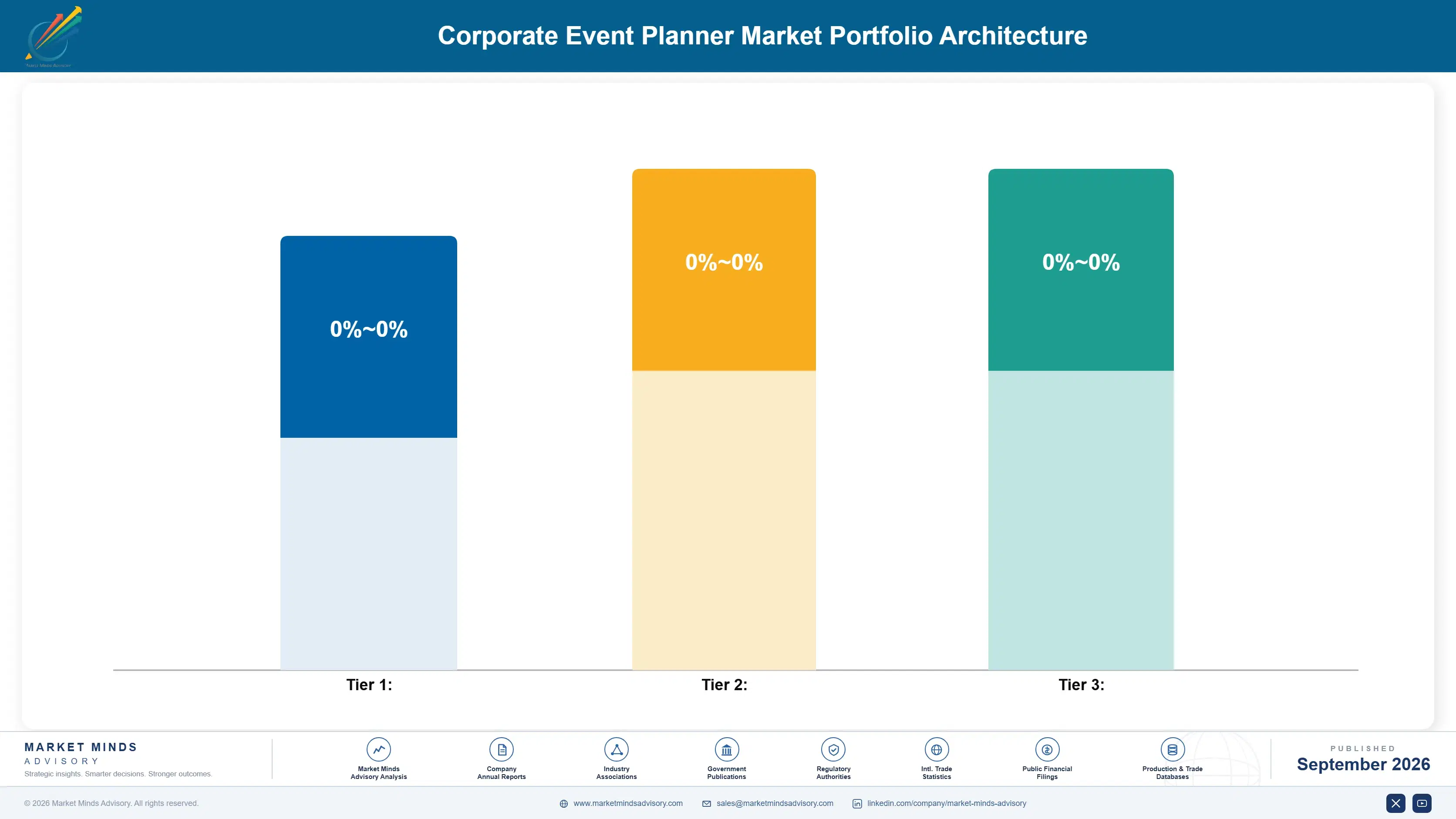
The market splits across three tiers by margin structure. Volume tier standard logistics contracts carry thin margins typical of commodity services, while premium tiers bundling analytics and incentive travel command substantially higher margins closer to consulting businesses than logistics vendors. Sustainability and next-generation tiers, built around certified carbon accounting and technology licensing, are still small but carry the highest long-term margin potential of the three.
Volume and premium tiers pull the market in opposite directions commercially. Volume growth depends on standard conference bookings holding steady, while premium growth depends on convincing finance departments that measurable engagement data justifies a higher fee. Most established agencies now run both tiers under a single brand, using standard clients as a funnel that converts a share into premium upgrades after a well-executed hybrid event.

High-value margin pools concentrate almost entirely in the incentive travel and analytics subscription tiers, where agencies capture both a service fee and a lower acquisition cost through recurring enterprise relationships rather than one-off bids. Volume tier logistics contracts generate the bulk of total client count but contribute proportionally less to profitability, making it valuable mainly as a funnel into higher-margin offerings.

Basic conference and meeting logistics sold at thin margins comparable to commodity services, competing primarily on price and reliable execution rather than measurable outcomes. Churn risk is highest here since switching costs are minimal and price comparison across agencies is straightforward for cost-conscious clients.
Gross Margin

Incentive travel and analytics-bundled tiers commanding meaningfully higher margins, priced closer to a consulting relationship than standard logistics, sustained by demonstrated retention advantages. Retention outperforms volume tier clients by a wide margin, since replacing a trusted travel partner is far more disruptive than swapping vendors.
Gross Margin

Certified carbon accounting and technology licensing offerings carrying the highest long-term margin potential, dependent on measurement methodology that remains costly for smaller agencies to assemble. Adoption remains gradual as enterprise clients demand multi-year measurement evidence before committing to broader licensing expansion across additional business units.
Gross Margin
corporate-event-planner-market-portfolio-architecture-1789986749815

High-value Sub-segments and Strategic Watch-out

Hybrid and Virtual Event Production Services

The fastest-growing and highest-value segment, benefiting directly from permanent hybrid attendance policies and expanding analytics demand that continue to widen its addressable enterprise client base substantially. Vendors documenting measurable engagement lift are best positioned to capture enterprise analytics dollars ahead of competitors still building comparable evidence.

Incentive Travel and Corporate Retreat Planning

A high-value, moderate-growth segment anchored by talent retention budgets and strong client loyalty, expanding steadily as companies expand experiential rewards for competitive labor markets. This segment carries the category's highest average contract value and the lowest churn of any tier currently tracked across all agencies today.

Conference and Trade Show Management Services

The volume core of the market, generating the largest client count at thinner margins, competing mainly on execution reliability and straightforward flat-fee pricing rather than differentiated analytics depth. Falling standardization costs are the main lever pulling mid-size companies into this segment for the first time.

Event Technology and Registration Platform Services

A strategic watch-out segment facing pressure from full-service agencies building comparable technology in-house, as software vendors increasingly move upstream into direct production competition. Standalone technology vendors without a production services arm of their own face genuine pressure to partner up soon or be quietly acquired.

Loyalty Built on Proof, Not Habit

The annuity economics here differ from typical subscription software because renewal depends on discrete annual budget cycles rather than continuous daily engagement. Renewal requires sustained proof that the prior event demonstrably moved a business outcome, not on habitual usage patterns the way consumer software typically retains subscribers. Agencies win renewals by producing measurable data that reassures the budget owner. Not by attendee daily engagement the way consumer apps optimize.
Adoption stickiness varies sharply by end-use vertical. Technology and financial services companies show the deepest engagement, since they already budget significant marketing spend toward measurable brand events, while smaller companies churn more readily once a budget-constrained year forces cuts. Incentive travel subscriptions show the opposite pattern, tied closely to talent retention budgets that expand and contract with labor market competitiveness.

A generational shift is underway in who initiates these purchases. Younger marketing and human resources leaders, comfortable evaluating vendors on data rather than relationships, increasingly select agencies based on published engagement benchmarks rather than a predecessor's long-standing relationship, favoring agencies with strong analytics capability. That cohort is more willing to switch agencies if a competitor demonstrates better outcomes. Brand loyalty here is considerably weaker than among the earliest wave of clients.
corporate-event-planner-market-end-use-penetration-index-1789986750303

Where Proof Beats Relationship Alone

These are among the four positions where our research anticipates prominent divergence between winners and laggards over the coming forecast period. Each is grounded in the demand model, the regulatory perimeter, and the announced capacity pipeline.
01 / ENTERPRISE ANALYTICS POSITIONING

Build measurable engagement data before finance departments demand it

Analytics is becoming the single largest lever separating category leaders from the rest of the field, more so than relationship depth or venue selection ever were in this market's earlier years. Agencies that invest early in dedicated data capability, building genuine measurement infrastructure rather than relying on client-supplied satisfaction surveys, are locking in multi-year enterprise contracts that competitors cannot easily displace once signed and renewed annually. Agencies still selling purely on relationships risk permanent disadvantage as roughly a fifth of bids already require documented engagement metrics industry-wide.
02 / INCENTIVE TRAVEL EXPANSION

Convert standard clients into premium incentive travel relationships

Incentive travel programs carry the highest margins and the lowest churn in this category by a wide margin, outperforming standard conference contracts on nearly every retention metric agencies track internally today. The strongest commercial opportunity available right now is converting existing standard clients into incentive travel relationships after demonstrating measurable engagement lift from a well-executed hybrid event. Agencies without a credible, established destination network will increasingly struggle to capture this upgrade revenue regardless of how sophisticated their underlying analytics platform actually is in practice.
03 / TECHNOLOGY PLATFORM DEFENSE STRATEGY

Build proprietary technology before software vendors move upstream

Event technology vendors moving upstream into full-service production represent a genuine existential risk for traditional agencies dependent purely on logistics execution as their differentiation from software-first competitors. Agencies that build or license proprietary registration and analytics platforms early lock in recurring technology revenue that software-first competitors cannot easily replicate without years of destination relationship-building work of their own. Agencies without a credible technology strategy risk losing enterprise contracts entirely as software vendors continue maturing their own production capability over time.
04 / REGIONAL DIVERSIFICATION STRATEGY

Diversify carrier and venue sourcing to defend margin

Venue and travel cost concentration leaves smaller agencies disproportionately exposed to pricing changes from a small number of dominant airline carriers and convention cities that control most global capacity today. Agencies that diversify sourcing earlier or negotiate multi-year rate agreements recover faster from price shocks and maintain pricing stability that reassures cost-sensitive clients considering their first multi-year contract commitment. This positioning matters more with each new venue market entry as cost intensity keeps rising across an increasingly international and complex client base.

Engagement Snapshot From the Field

A live engagement with an industry participant carrying material or product regulatory and market exposure ahead of a defining policy shift, showing how our research translates into a defensible multi-year portfolio strategy.
MARKET MINDS ADVISORY · CLIENT ENGAGEMENT SUMMARY
Corporate Event Planner Producer Strategic Portfolio Review and Transition Roadmap 2026·Investment Scenario on Corporate Event Planner Exposure Evaluation 2025-26
CLIENT PROFILE
The client is a mid-size enterprise software company planning its first major annual user conference after years of smaller internal gatherings, evaluating agencies for a multi-year planning relationship. Leadership had never previously managed a vendor selection process of this scale. The company had grown rapidly through several acquisitions and lacked a unified event playbook across its newly combined sales and marketing teams.
STRATEGIC CHALLENGE
Marketing leadership needed to select an agency from a crowded field without internal expertise to evaluate competing analytics claims or production capability. A wrong choice risked locking the company into a costly multi-year contract that failed to deliver measurable attendee engagement as promised. Board members were also concerned about committing significant budget to an unproven vendor relationship without independent validation.
MMA APPROACH
MMA analysts benchmarked five leading agencies against a consistent commercially relevant basis covering documented engagement analytics, hybrid production capability, and existing enterprise client references. Analysts also interviewed reference clients directly to validate agency marketing claims independently before finalizing a recommendation. This cross-referencing surfaced meaningful discrepancies between agency-reported outcomes and what comparable enterprise clients had actually experienced.
KEY FINDINGS
  1. Only two of five evaluated agencies had independently verifiable engagement analytics credible enough to support internal budget planning decisions. The remaining three agencies relied primarily on client-supplied satisfaction surveys rather than independently verified engagement data.
  2. Hybrid production capability varied enormously across agencies, with the strongest candidate offering in-house streaming rather than subcontracted vendors. That in-house capability translated directly into faster turnaround and fewer coordination failures during live production.
  3. Agency pricing models diverged sharply between flat annual retainers and per-event percentage-of-budget fee structures. The flat retainer ultimately proved more predictable given the company's growing and increasingly unpredictable event calendar.
  4. Two agencies lacked prior experience with enterprise software companies specifically, requiring a longer onboarding period. Onboarding gaps would have required weeks of additional preparation before either agency could execute confidently.
CLIENT PROFILE
The client is a mid-size enterprise software company planning its first major annual user conference after years of smaller internal gatherings, evaluating agencies for a multi-year planning relationship. Leadership had never previously managed a vendor selection process of this scale. The company had grown rapidly through several acquisitions and lacked a unified event playbook across its newly combined sales and marketing teams.
STRATEGIC CHALLENGE
Marketing leadership needed to select an agency from a crowded field without internal expertise to evaluate competing analytics claims or production capability. A wrong choice risked locking the company into a costly multi-year contract that failed to deliver measurable attendee engagement as promised. Board members were also concerned about committing significant budget to an unproven vendor relationship without independent validation.
MMA APPROACH
MMA analysts benchmarked five leading agencies against a consistent commercially relevant basis covering documented engagement analytics, hybrid production capability, and existing enterprise client references. Analysts also interviewed reference clients directly to validate agency marketing claims independently before finalizing a recommendation. This cross-referencing surfaced meaningful discrepancies between agency-reported outcomes and what comparable enterprise clients had actually experienced.
KEY FINDINGS
  1. Only two of five evaluated agencies had independently verifiable engagement analytics credible enough to support internal budget planning decisions. The remaining three agencies relied primarily on client-supplied satisfaction surveys rather than independently verified engagement data.
  2. Hybrid production capability varied enormously across agencies, with the strongest candidate offering in-house streaming rather than subcontracted vendors. That in-house capability translated directly into faster turnaround and fewer coordination failures during live production.
  3. Agency pricing models diverged sharply between flat annual retainers and per-event percentage-of-budget fee structures. The flat retainer ultimately proved more predictable given the company's growing and increasingly unpredictable event calendar.
  4. Two agencies lacked prior experience with enterprise software companies specifically, requiring a longer onboarding period. Onboarding gaps would have required weeks of additional preparation before either agency could execute confidently.
RECOMMENDED STRATEGY
Phase 1: Select the agency with the strongest verified analytics capability and negotiate a flat annual retainer rather than percentage-of-budget pricing. This narrows the field before deeper commercial review. Phase 2: Launch with a single mid-size regional event before committing to the full annual flagship conference planned. This limits exposure while generating data to validate capabilities. Phase 3: Require quarterly engagement reporting and build a renegotiation clause if analytics benchmarks are not consistently met. This protects the company if real-world engagement diverges from the agency's initial pitch.
OUTCOME
The company selected its preferred agency and launched a regional pilot event in early 2026, reporting strong attendee engagement scores within the first quarter. Leadership credited the independent agency comparison with avoiding a costly premature commitment to the full flagship conference. The pilot's flat-fee structure also meant the company faced minimal financial exposure during this initial evaluation period.

Frequently Asked Questions

Foundational context covering the market sizes, CAGR, scope, country, region and competition that inform every finding below. This section is provided to cover basics and most often pre-purchase conversations, answered from the MMA Primary Research Dataset.

What is the current size of the Corporate Event Planner Market?

The Corporate Event Planner Market reached roughly 4.6 billion dollars in 2025. Rising hybrid production demand and incentive travel recovery are driving continued agency growth.

How large will the Corporate Event Planner Market be by 2036?

MMA projects the market will reach approximately 9.09 billion dollars by 2036. That represents roughly 1.86 times its 2026 value, driven by analytics and hybrid production expansion.

What is the CAGR for the Corporate Event Planner Market 2026 to 2036?

The market is projected to grow at a 6.4% compound annual rate between 2026 and 2036. Hybrid production and incentive travel spending both support this sustained growth pace.

Which segment is growing fastest?

Hybrid and Virtual Event Production Services are growing fastest, at roughly 9.8% annually, about 1.53 times the overall market rate. Engagement analytics demand is the primary driver behind this pace.

Who are the major companies in the Corporate Event Planner Market?

BCD Meetings & Events, Cvent, CWT Meetings & Events, Freeman, and MCI Group lead the market. Together these five companies hold roughly 22% combined share on a managed event volume basis.

Which country is growing fastest?

The United Arab Emirates is growing fastest, at roughly 10.6% annually, as aggressive government investment in convention infrastructure draws international corporate events previously held elsewhere.

Report Segmentation Architecture

The full report scope spans multiple orthogonal segmentation dimensions, with cross-tabulated demand data provided for each dimension pair. Coverage extends further to regional breakdowns, trend trajectories, and the competitive detail needed to support segment-level decision-making.

By Primary Market Dimension

  • Hybrid and Virtual Event Production Services
  • Incentive Travel and Corporate Retreat Planning
  • Conference and Trade Show Management Services
  • Product Launch and Brand Activation Events
  • Internal Meeting and Training Event Coordination
  • Event Technology and Registration Platform Services

By End-Use Industry

  • Technology and Software Companies
  • Financial Services and Insurance
  • Pharmaceutical and Healthcare Companies
  • Manufacturing and Industrial Companies
  • Consumer Goods and Retail Companies

By Commercial Dimension

  • Direct Enterprise Agency Contracts
  • Analytics Subscription Channels
  • Technology Platform Licensing Channels
  • Destination Management Partnership Channels

By Region

  • North America
  • Western Europe
  • East Asia
  • South Asia and Pacific
  • Latin America
  • Middle East and Africa
  • Eastern Europe

Scope, Methodology, and Coverage

Every figure in this report is reproducible from documented input assumptions. The scope below maps the historical period, the forecast horizon, the segmentation dimensions, and the countries covered, alongside the underlying primary and qualitative methodology.
Historical Period
2020 to 2025
Forecast Period
2026 to 2036
Base Year
2025 (USD billions; MMA Primary Research Dataset, September 2026)
Market Definition
This report defines the Corporate Event Planner Market as third-party planning, production, and technology services for corporate meetings, conferences, incentive travel, and product launches. It excludes venue ownership, catering operations, and internal in-house event staff not offered as an external service.
Quantitative Units
USD billions, managed event counts, and percentage share
Segmentation Dimensions
Service type, end-use industry, and commercial dimension
Regions Covered
North America, Western Europe, East Asia, South Asia and Pacific, Latin America, Middle East and Africa, Eastern Europe
Countries Covered
United States, United Arab Emirates, Germany, China, India, Brazil, and 21 additional countries
Key Companies Profiled
BCD Meetings & Events, Cvent, CWT Meetings & Events, Freeman, MCI Group, and 15 additional companies
Quantitative Methodology
Primary survey, n=3,800 respondents, Q4 2025, six countries; demand-side model with trade association cross-validation
Qualitative Methodology
47 expert interviews, Q4 2025; applied to validate demand model assumptions, identify emerging dynamics, and assess competitive positioning
Report Format
PDF and XLSX data workbook (Word format preview document)
Publisher
Market Minds Advisory
Report Code
MMA-2026-TEC-229
Published
September 2026
Contact
sales@marketmindsadvisory.com | www.marketmindsadvisory.com

Purchase the full Corporate Event Planner Market Report (2026 to 2036).

This report gives agency leadership and enterprise procurement teams a complete view of the Corporate Event Planner Market through 2036. It covers segment-level growth, regional demand shifts, and competitive positioning across hybrid production, incentive travel, and conference management service lines. Input cost exposure and margin architecture are analyzed in detail, with particular attention to how venue and travel cost volatility is reshaping vendor pricing and consolidation across every major regional market. Readers get actionable guidance on where to concentrate commercial investment over the next decade of analytics-driven growth.
Ten-year global revenue and event volume forecasts
Seven-region demand, pricing, and adoption breakdown
Competitive benchmarking across the top twenty agencies
Venue and travel cost exposure and mitigation guidance
Segment-level margin architecture and pricing tier analysis
Anonymized client agency selection engagement case study

Built For The People Who Decide

From boardroom strategy to bench-side execution, this report is read cover-to-cover by leaders shaping the next decade of their industry, turning demand scenarios, market dynamics and valuation benchmarks into decisions.
CXOs/ Presidents/ VPs/ Managers
M&A and Corporate Development
Strategy Teams and R&D Heads
Procurement and Product Directors
Regulatory and Compliance Leaders
Investor Relations and Equity Analysts