Market Minds Advisory
Corn and Callus Remover Market

Corn and Callus Remover Market: Medicated Pads Meet Electric Foot Care

Electric callus removal devices now sell alongside decades-old salicylic acid pads on the same drugstore shelf, but the medicated plaster format still carries most of global foot-care volume despite the device category's faster growth rate.

Lead Analyst

Alice Ballenger

Published

September 2026

Make Smarter Decisions with Customized Research Insights

Request a free sample report and evaluate market opportunities, growth trends, and competitive dynamics relevant to your business needs.

2025 MARKET VALUE$1.1BMarket Size 2025
2036 FORECAST VALUE$1.8BBase Case , 2026 to 2036
CAGR 2026 TO 20364.6 %Bull 5.8% / Bear 3.4%
INCREMENTAL OPPORTUNITY$0.7BNet 10- year value creation
EXPANSION MULTIPLE1.57x2036 value over 2026 base
Strategic Levers
M&A Pipeline
Regional Outlook
Country Rankings
Competitive Intelligence
Segmental Deep-dive
Call-Us : 91 93563 13602

Executive Snapshot and Market Trajectory

Corn and callus remover is a mature category splitting quietly between decades-old medicated pads and a small but faster-growing electric device segment, a shift that matters more to margin than to overall category size right now across nearly every major consumer market tracked. Retailers are already reallocating shelf space accordingly.
Professional callus removal devices grow fastest at 8.4%, roughly 1.83 times the overall rate, as consumers increasingly prefer reusable electric tools over disposable medicated pads for routine foot care maintenance at home. North America holds the largest regional share at 28%, anchored by established drugstore distribution and long-standing brand recognition, while Western Europe follows closely on comparable retail infrastructure and mature consumer adoption. Brand density here keeps the premium mix wider than most peers.
Competitive intensity stays moderate: five manufacturers control just over half of revenue, led by Scholl's Wellness Company and Bayer through decades of accumulated brand equity and pharmacy distribution relationships that private-label competitors still struggle to match. Aging populations and rising diabetic foot care awareness keep expanding demand across nearly every major consumer healthcare market, forcing manufacturers to carry broader safety and efficacy documentation than store-brand alternatives typically provide.
Market Definition
The corn and callus remover market covers over-the-counter medicated pads, plasters, liquid and gel treatments, foot creams, protective cushions, and electric or manual callus removal devices used for at-home foot corn and callus care. It excludes prescription podiatric treatments and in-clinic professional podiatry services.
Base Year Value
$1.1B in 2025 (MMA Primary Research Dataset, August 2026)
Forecast Period
2026 to 2036, eleven discrete annual values
CAGR
4.6% base case. Bull 5.8%. Bear 3.4%.
Fastest Growth Segment
Professional Callus Removal Devices: 8.4% CAGR
Fastest Growth Country
China: 7.6% CAGR
Fastest Growth Region
South Asia and Pacific: 6.6% CAGR
Largest Region
North America: 28% of 2025 global value
Market Leaders
Scholl's Wellness Company, Bayer, Perrigo, Reckitt Benckiser, Medline Industries. Source: MMA Analysis based on company annual reports.
Primary Survey
n=3,800 procurement and R&D decision-makers, Q4 2025, six countries
Methodology
Demand-side build-up, cross-validated against public data, 47 expert interviews

Corn and Callus Remover Market Forecast Scenarios

corn-and-callus-remover-market-size-forecast-scenario-1787304512102
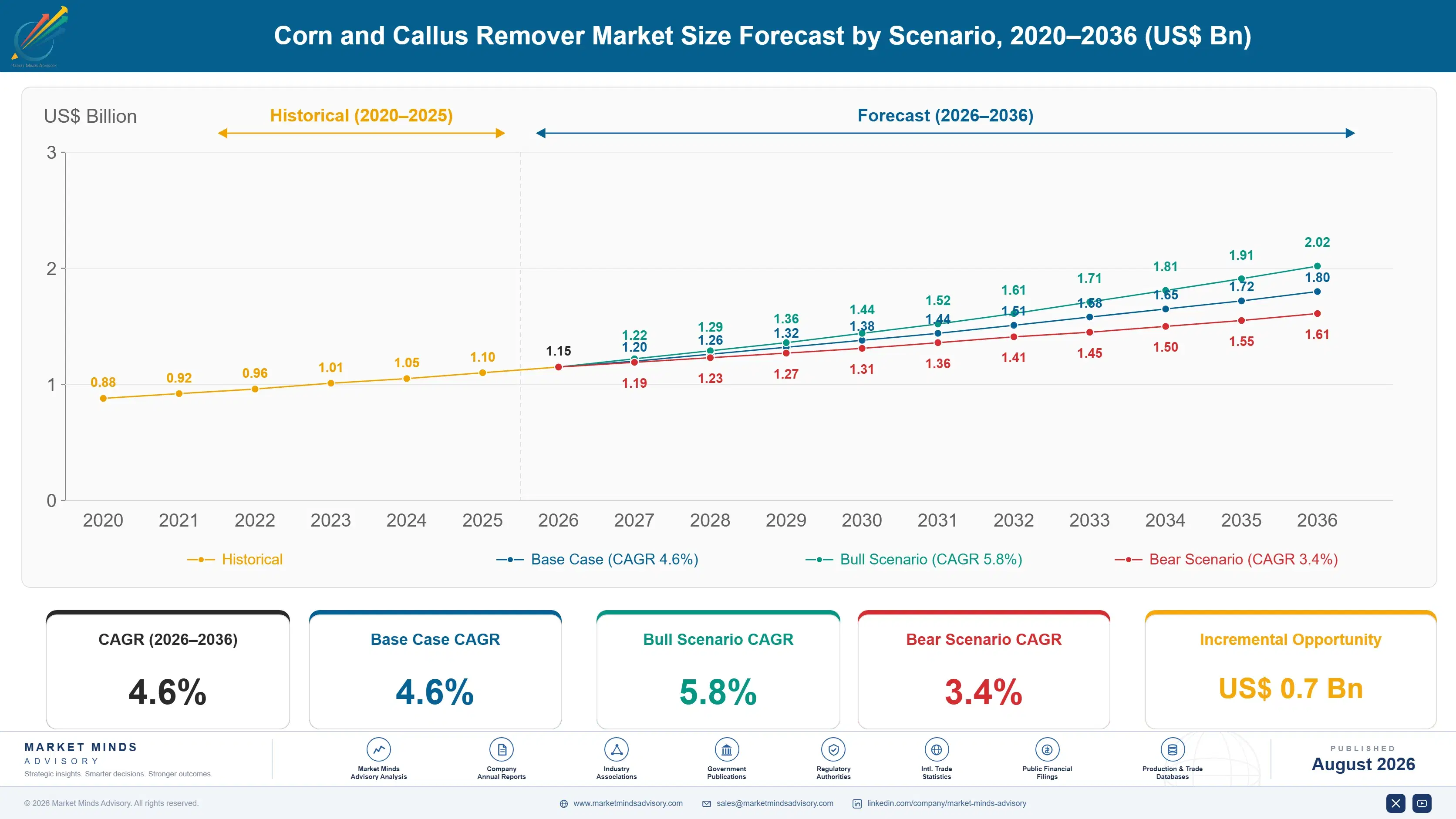
Between 2020 and 2025 the market grew at roughly 4.3% annually, a slow but steady pace typical of a mature consumer healthcare category where medicated pad formulations have changed little over several decades of retail presence. Electric device penetration during this window remained modest, leaving growth to track largely established pad-format replacement demand across most major retail markets tracked.
The base case carries the market to 4.6% annual growth through three commercial mechanisms working together. First, electric callus removal devices keep expanding as consumers increasingly prefer reusable tools over disposable pad replacement cycles. Second, aging populations across major markets keep sustaining steady replacement demand for medicated treatment formats. Third, China's expanding drugstore and e-commerce retail infrastructure keeps converting rising consumer awareness into direct purchase volume nationwide. Reimbursement is not typically a factor, but retail shelf economics keep shaping category expansion.
The bull case, 5.8%, assumes accelerated device category adoption and e-commerce retail expansion pulls forward purchase volume faster than currently modeled across major consumer markets worldwide. The bear case, 3.4%, assumes private-label price competition and slowing replacement cycles keep category growth closer to flat across most mature retail markets tracked closely in this review overall.

Where Medicated Pads Meet Electric Foot Care

Three forces converge on this mature category simultaneously. Electric callus removal devices keep expanding as consumers increasingly prefer reusable tools over disposable pad replacement cycles. Aging populations across major markets keep sustaining steady replacement demand for medicated treatment formats. And China's expanding drugstore and e-commerce retail infrastructure keeps converting rising consumer awareness into direct purchase volume nationwide across its retail network.
MARKET CONCENTRATIONCR5: 52%Top five manufacturers control just over half of revenue
AVERAGE RETAIL PRICEUSD 4 to 35 per unitPrices vary sharply between disposable pads and electric devices
TOP SALES COUNTRYUnited States: 24% of retail salesEstablished drugstore distribution and brand recognition drive volume here
PRIVATE-LABEL PENETRATION31% of unit volumeShare of category volume sold under retailer store-brand labels
ACTIVE INGREDIENT COST SHARE22% of COGSSalicylic acid and adhesive materials dominate production cost structure
PRODUCT REPLACEMENT CYCLE2 weeks to 3 yearsCycle varies sharply between disposable pads and durable electric devices
Commercially, this market behaves like a slow-moving consumer healthcare category layered onto steady demographic replacement demand. Manufacturers compete on brand trust and retail shelf placement as much as on formulation, since consumers rarely switch from a familiar drugstore brand without a specific reason to try an alternative. That brand loyalty increasingly separates established manufacturers from newer private-label and direct-to-consumer competitors across nearly every major retail market tracked here.
Over the next decade expect continued but modest expansion beyond pad-only treatment into device-assisted formats. China's retail infrastructure will keep anchoring incremental regional volume growth across its expanding e-commerce channel. And brand trust built through decades of retail presence, more than raw formulation innovation alone, will increasingly determine which manufacturers consumers actually purchase at the shelf going forward.
"This category will never be exciting, but a reusable device that replaces forty boxes of pads over its lifetime is quietly reshaping the unit economics anyway."
Director, Consumer Health and OTC Personal Care Practice · MMA Healthcare Practi

Market Trends

Consumers Shift Toward Reusable Electric Devices

Consumers increasingly purchase reusable electric callus removal devices rather than replenishing disposable medicated pads on a recurring basis, a requirement that has converted at-home foot care from a purely consumable purchase into a durable-goods specification decision for a growing share of buyers. This shift addresses a genuine cost and convenience preference, since a single device can replace dozens of pad boxes over its working life while delivering comparable or better results for many users. Several manufacturers have expanded electric device lines with interchangeable roller heads, positioning reusability as the category's clearest incremental growth driver.
Market Impact: Adds 14% share via aging demand
Retailers Expand Private-Label Foot Care Lines

Major pharmacy and mass-retail chains increasingly expand private-label foot care lines positioned directly against established brands, converting shelf space allocation into a direct competitive pressure point rather than a background retail dynamic. This shift addresses a genuine price sensitivity among category buyers, since corn and callus treatment is viewed by many consumers as a commodity purchase where brand premium delivers limited perceived additional benefit. Several retailers have expanded store-brand formulations matching national brand active ingredient concentrations, positioning price parity as a durable competitive pressure across the broader OTC foot care industry worldwide.
Market Impact: Anchors 19% of regional retail volu

Market Opportunities and Growth Drivers

Aging Populations Sustain Steady Replacement Demand

Healthcare and consumer markets worldwide keep serving aging populations with higher corn and callus prevalence, converting steady replacement purchase demand into a durable, if modest, growth driver independent of any single manufacturer's product cycle. This creates demand that spans nearly every major consumer market simultaneously, since foot skin conditions requiring treatment rise predictably with age regardless of geography or income level tracked in this review. Manufacturers increasingly design formulations specifically for sensitive and diabetic-adjacent skin, converting what was once a single-formulation category into a broader differentiated product line across the wider consumer healthcare system worldwide.
Market Impact: Cuts brand premium by 21%

China's Retail Infrastructure Expansion Anchors Regional Demand

China's continued expansion of drugstore chains and e-commerce retail infrastructure keeps converting rising consumer awareness directly into purchase volume capable of serving both established urban retail networks and increasingly lower-tier city populations nationwide. Domestic Chinese manufacturers increasingly supply medicated pads and basic devices that previously relied on imported Western and Japanese brands, giving the country meaningful production self-sufficiency and expanding distribution capability across its retail network. This capacity buildout gives China outsized influence over regional demand growth, since Chinese retail expansion decisions convert directly into category purchase volume at meaningful scale.
Market Impact: Limits category growth to roughly 4

Market Restraints and Challenges

Private-Label Price Competition Compresses Brand Margins

Store-brand alternatives now match national brand formulations at meaningfully lower price points, a limitation that leaves established manufacturers unable to sustain historical price premiums despite continued brand recognition among a meaningful share of buyers. The root cause is competitive: retailers control shelf placement and increasingly favor their own private-label formulations that carry higher margin for the retailer than national brand products. The impact falls hardest on mid-tier national brands lacking the marketing scale of category leaders, since they compete against both premium brands and private label simultaneously. Some manufacturers are responding with device formats private label has not matched.
Market Impact: Cuts repeat pad purchases by 26%

Slow Category Innovation Limits Growth Ceiling

Core medicated pad formulations have changed little over several decades, a limitation that keeps overall category growth modest even as adjacent consumer healthcare categories post considerably faster expansion rates driven by genuine product innovation. The root cause is largely regulatory and economic: salicylic acid formulation changes require renewed safety documentation that manufacturers have limited financial incentive to pursue for a low-margin, price-sensitive category. The impact falls hardest on manufacturers relying entirely on pad-format products, since they compete in the category's slowest-growing segment. Some manufacturers are responding by shifting research investment toward the device segment instead.
Market Impact: Shifts 31% of volume
3 additional market trends, 4 additional growth drivers, and 3 additional restraints and challenges are covered in the full report. Contact sales@marketmindsadvisory.com to access the complete intelligence.

Segment CAGR and Growth Architecture

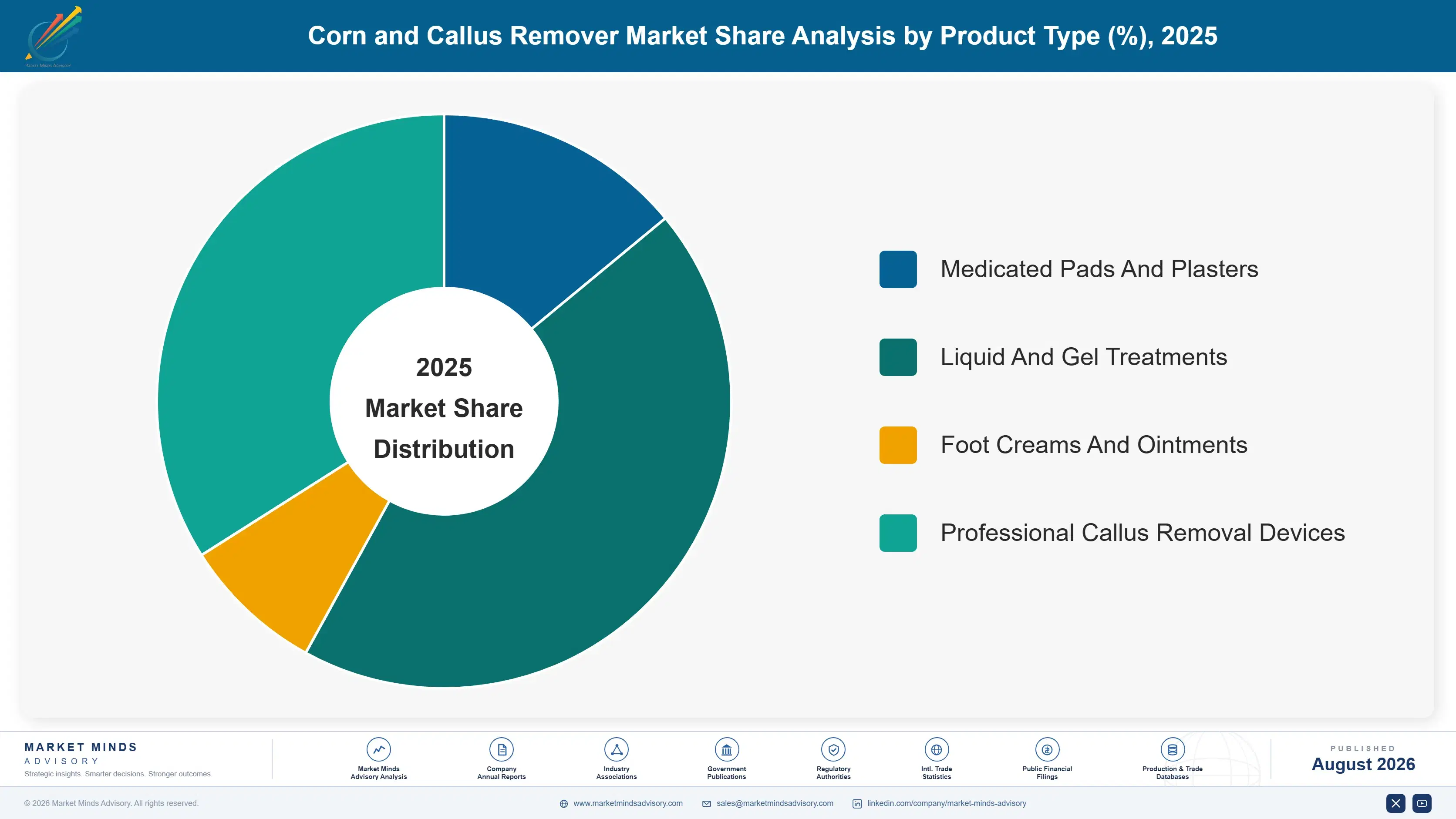
Segmentation follows product type, the single classification logic that determines formulation, delivery mechanism, and retail placement. Medicated pads, liquid treatments, creams, and electric devices each carry distinct commercial properties, so commercial position tracks product type rather than treatment indication alone across every manufacturer profiled in this review. across every manufacturer and product line profiled here.
corn-and-callus-remover-market-market-share-analysis-1787304512633

Professional Callus Removal Devices

Professional callus removal devices grow fastest at 8.4%, roughly 1.83 times the overall market rate, as consumers increasingly prefer reusable electric tools over disposable medicated pads for routine foot care maintenance at home. This product type uses rotating abrasive roller heads powered by battery or rechargeable motors to mechanically remove hardened skin without chemical treatment. Emjoi and Scholl's Wellness Company lead this segment's device development, while Implus and Spenco compete on price positioning and roller head durability. Growing consumer preference for reusable, chemical-free treatment continues expanding this segment's addressable base considerably beyond its original niche origins across mass retail and e-commerce channels alike. Retail placement continues broadening across mass-market and e-commerce channels.
CAGR 8.4%

Liquid And Gel Treatments

Liquid and gel treatments grow second-fastest at 6.8%, about 1.48 times the overall rate, as consumers increasingly prefer targeted application formats that avoid the adhesive skin irritation some users experience with medicated pad formats directly. This product type delivers concentrated salicylic acid or urea-based formulations through a brush-on or dropper applicator, allowing more precise treatment of individual corns and calluses. Bayer and Perrigo lead this segment's formulation development, while PediFix and Alterna compete on applicator design and treatment speed. Growing consumer preference for precision application continues expanding this segment's addressable population considerably beyond its original niche origins across pharmacy and mass retail channels. Retail placement continues expanding across pharmacy and mass-market channels nationwide.
CAGR 6.8%
Full segment breakdown across 6 segments available in the complete report.

Regional Architecture and Country Demand Map

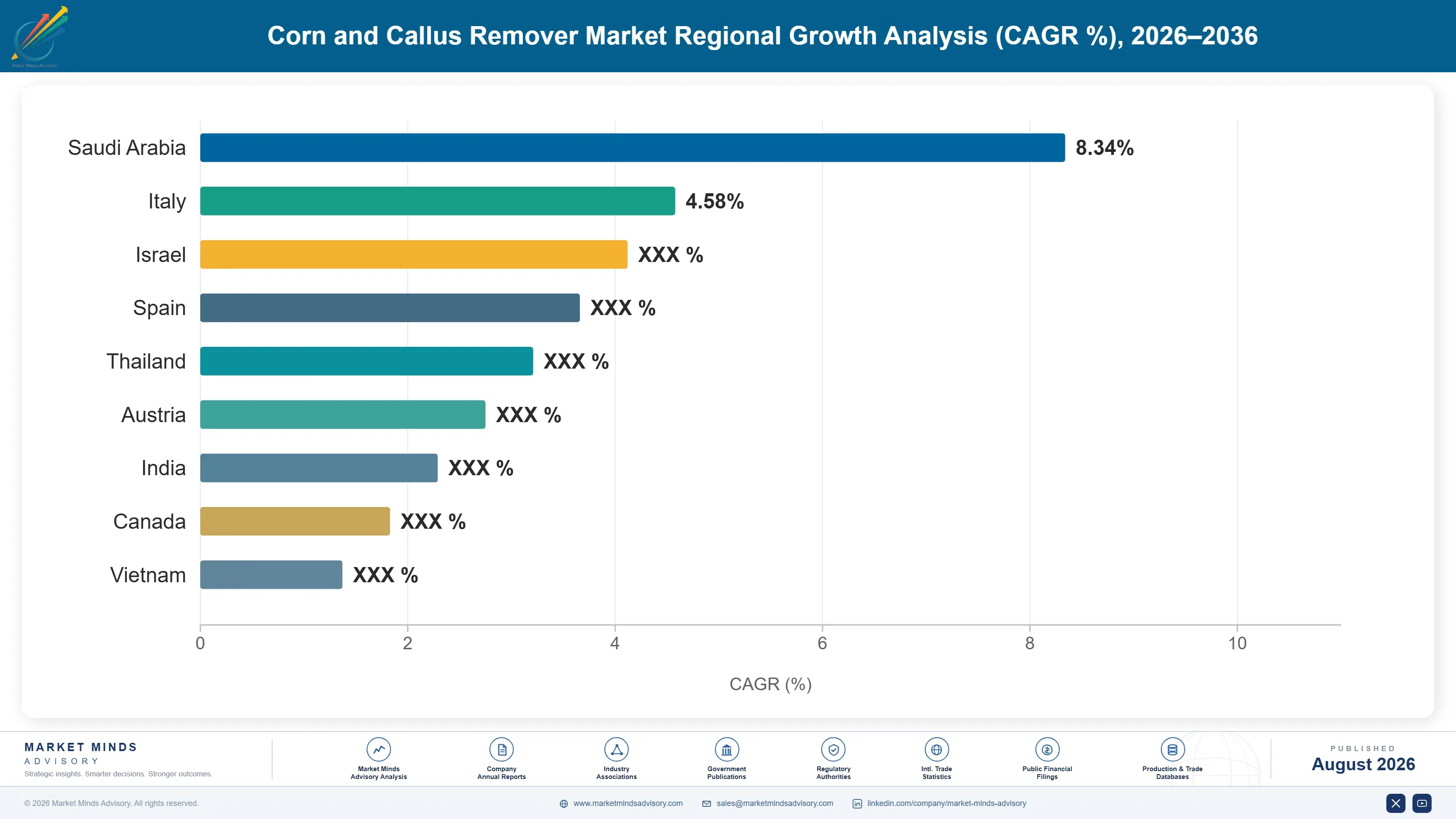
North America leads at 28% of the total, anchored by established drugstore distribution and long-standing brand recognition. Western Europe follows closely on comparable retail infrastructure, while the remaining five regions complete global distribution across every major consumer market tracked. across nearly every product category tracked in this review.

North America

The United States and Canada anchor North America's 28% share through established drugstore distribution and long-standing brand recognition, a combination that positions this region as the origin market for nearly every major national brand tracked in this review. The United States hosts the region's largest pharmacy and mass-retail distribution infrastructure, with Scholl's Wellness Company and Medline's American operations serving both drugstore and e-commerce channels nationwide. Canada's comparable retail system adds incremental demand beyond American volume specifically. Growth of 5.2% reflects steady device category adoption more than any single new product launch alone. Brand loyalty density across this region's retail channel keeps its premium product mix wider than most others tracked here.
Share: 28% | CAGR: 5.2% (2026 to 2036)

Western Europe

Germany, the United Kingdom, and France anchor Western Europe's 24% share through established pharmacy retail systems and mature consumer adoption operating under some of the world's strictest cosmetic and OTC product labeling standards. Bayer and Reckitt Benckiser's core European operations serve both domestic pharmacy networks and export markets across the continent. Southern European markets contribute meaningful pad-format demand beyond the core German and British base. Growth of 3.1%, the softest pace among the seven regions tracked, reflects this underlying market maturity rather than weakening underlying consumer demand overall across the region. Italy and Spain's pharmacy retail systems contribute additional demand beyond the core base. Belgium and the Netherlands contribute additional demand across their national pharmacy systems too.
Share: 24% | CAGR: 3.1% (2026 to 2036)
Regional intelligence for 5 additional markets available in the complete report: East Asia, South Asia and Pacific, Latin America, Middle East and Africa, Eastern Europe. Contact sales@marketmindsadvisory.com.
corn-and-callus-remover-market-country-cagr-analysis-1787304513141

How Foot Care Brands Can Defend Retail Margin

Margin increasingly depends on device category positioning and direct-to-consumer relationship depth rather than raw pad pricing alone, as private label erodes traditional shelf-price premiums. The four levers below target bundling, subscription, and retail partnership revenue that foot care manufacturers have left underexploited, converting a commodity pad sale into a longer, more defensible consumer relationship over time.

Bundle Replacement Roller Heads Into Device Subscriptions

Manufacturers increasingly bundle replacement roller heads into recurring subscription programs alongside electric device sales, capturing consumable revenue that manufacturers without subscription programs leave on the table since one-time device buyers often forget to repurchase compatible replacement heads independently. This subscription model captures 11% to 17% incremental revenue beyond the initial device sale, since buyers increasingly value manufacturers who simplify ongoing maintenance rather than requiring a separate purchase decision each time. Building this capability requires investment in direct-to-consumer subscription infrastructure, and the margin differential justifies the added cost. Buyers favor manufacturers with proven subscription track records over untested competitors.
Market Impact: Generates 11% to 17% recurring subs

Offer Extended Device Warranty And Skin Safety Guarantees

Manufacturers increasingly offer extended device warranties and skin safety guarantees that cover motor failure and irritation concerns beyond the standard return policy, capturing premium pricing that manufacturers without extended guarantees leave on the table since risk-averse buyers pay meaningfully more for documented reliability assurance on a device applied directly to skin. Buyers pay 7% to 13% more for devices backed by extended guarantees than for equivalent products without comparable coverage, since guarantee-backed protection directly reduces the buyer's perceived purchase risk. This reputation compounds into durable brand advantage over successive purchase cycles.
Market Impact: Commands 7% to 13% higher unit pric

Guarantee Multi-Year Retail Shelf Placement Agreements

Manufacturers increasingly negotiate guaranteed multi-year shelf placement agreements with strategic pharmacy and mass-retail customers, capturing distribution loyalty that manufacturers without placement guarantees leave on the table since retailers require dependable product supply and marketing support for category planning amid genuine private-label competitive pressure. Scholl's Wellness Company and Bayer both report that placement guarantees directly determine which retail contracts they can even secure, independent of unit pricing alone. Building this capability requires investment exceeding $2 million per program, but manufacturers who commit early lock in shelf space before private-label competitors expand further.
Market Impact: Secures retail contracts each worth

Expand Direct To Consumer Online Channels Broadly

Retail margin compression from private-label competition has grown steep enough that direct-to-consumer e-commerce channels, bypassing traditional pharmacy retail margins entirely, increasingly beat wholesale distribution economics even at meaningfully higher marketing and fulfillment cost per unit. Manufacturers building direct e-commerce capability in China, the United States, and Western Europe, rather than relying entirely on wholesale distribution, capture roughly 18% higher margin per unit while also gathering consumer data that matters increasingly to future product development. This shift requires upfront marketing investment, but manufacturers who move early capture share from wholesale-dependent competitors.
Market Impact: Captures roughly 18% higher margin

Who Controls the Margin Pool

Five manufacturers control just over half of global revenue, a moderately concentrated picture reflecting brand equity and retail distribution scale private-label competitors still struggle to replicate. Scholl's Wellness Company and Bayer lead on scale, though Scholl's leads pad-format brand recognition while Bayer leads international distribution reach. Revenue, the basis used here, favors manufacturers with the broadest documented retail shelf presence.
Competitive activity runs across three dimensions. Manufacturers race to expand electric device lines before private label matches the format at lower price points. Direct-to-consumer subscription and warranty offerings have become a differentiator, as brand-loyal buyers increasingly prefer manufacturers who can guarantee ongoing product reliability. Chinese domestic manufacturers are winning standard-range pad and cream specification deals that once belonged primarily to established Western and Japanese suppliers.

Pressure is building from two directions that could reshuffle rankings within the decade. Private-label retail brands, still largely absent from the global key player list, are scaling formulation quality to match national brands at meaningfully lower price points across nearly every major market. Specialized electric device makers, outside the established pad-format franchise, are proving that documented reusability can command consumer loyalty conventional pad manufacturers struggle to match, forcing established players toward deeper device investment.
corn-and-callus-remover-market-company-positioning-matrix-1787304513663

Competitive Moat and Risk Dimensions

SCHOLL'S WELLNESS COMPANY

Moat: Deepest Brand Recognition Legacy

Scholl's Wellness Company holds the deepest brand recognition of any manufacturer in this category, built on more than a century of accumulated consumer trust and pharmacy retail relationships across nearly every major market. That legacy converts directly into preferred shelf placement and lower customer acquisition cost than newer entrants can achieve without comparable brand history.
SCHOLL'S WELLNESS COMPANY

Risk: Narrower Electric Device Presence

Scholl's core strength in pad-format products leaves it less positioned to capture the fastest-growing electric device segment compared with competitors who built dedicated device development capability earlier in the category's transition. This gap could limit its addressable volume over the coming decade of growth. This constraint could pressure long-term category leadership meaningfully.
BAYER AG

Moat: Broadest International Distribution Reach

Bayer holds one of the broadest international distribution networks of any manufacturer, spanning pharmacy and mass-retail channels across nearly every major consumer healthcare market built on decades of accumulated regulatory and logistics investment. That specialization converts directly into faster market entry for new formulations across geographies where smaller competitors lack comparable infrastructure.
BAYER AG

Risk: Exposure To Private-Label Substitution

Bayer's core strength in broad distribution leaves it more exposed than device-focused rivals to private-label substitution in the pad-format segment where formulation differentiation has narrowed considerably. This exposure could pressure long-term revenue diversification meaningfully across mature retail markets. Bayer's diversified portfolio somewhat cushions this exposure across other business segments.

Players Tracked

Prominent Players

Scholl's Wellness Company
Bayer AG
Perrigo Company plc
Reckitt Benckiser Group plc
Medline Industries, LP

Other Key Players

Implus LLC
Church and Dwight Co., Inc.
Beiersdorf AG
PediFix, Inc.
Emjoi, Inc.
Spenco Medical Corporation
Silipos, Inc.
Alva-Amco Pharmacal Companies, Inc.
Apothecary Products, LLC
Tender Corporation
Eduard Gerlach GmbH
Alterna LLC
Walgreens Boots Alliance, Inc.
CVS Health Corporation
Sisu Pharma Pty Ltd

Recent Developments

MARCH 2025

Scholl's Wellness Company Expands Electric Device Manufacturing In The United States

Scholl's Wellness Company expanded electric callus removal device production capacity at an existing American facility, aiming to meet growing demand from mass-retail and e-commerce customers. The expansion added meaningful annual capacity without requiring an entirely new greenfield manufacturing site, ahead of the anticipated device category demand increase nationwide.
Signal: Signals established brand manufacturers ar
JULY 2025

Bayer Signs Distribution Agreement With A Chinese E-Commerce Platform

Bayer signed a multi-year distribution agreement with a major Chinese e-commerce platform to supply medicated pad and device products across several retail categories. The agreement was structured as a direct distribution arrangement, not a joint venture or equity investment, ahead of a planned retail-driven demand ramp across the region.
Signal: Signals established manufacturers are secu
NOVEMBER 2025

Perrigo Acquires A Regional Electric Device Specialist

Perrigo completed the acquisition of a regional electric callus removal device technology specialist, adding roller head engineering capability to its existing treatment portfolio. The transaction was a full acquisition, not a licensing or minority equity investment arrangement. The specialist brought device technology Perrigo previously lacked internally.
Signal: Signals established manufacturers are cons

What Actually Drives Foot Care Product Cost

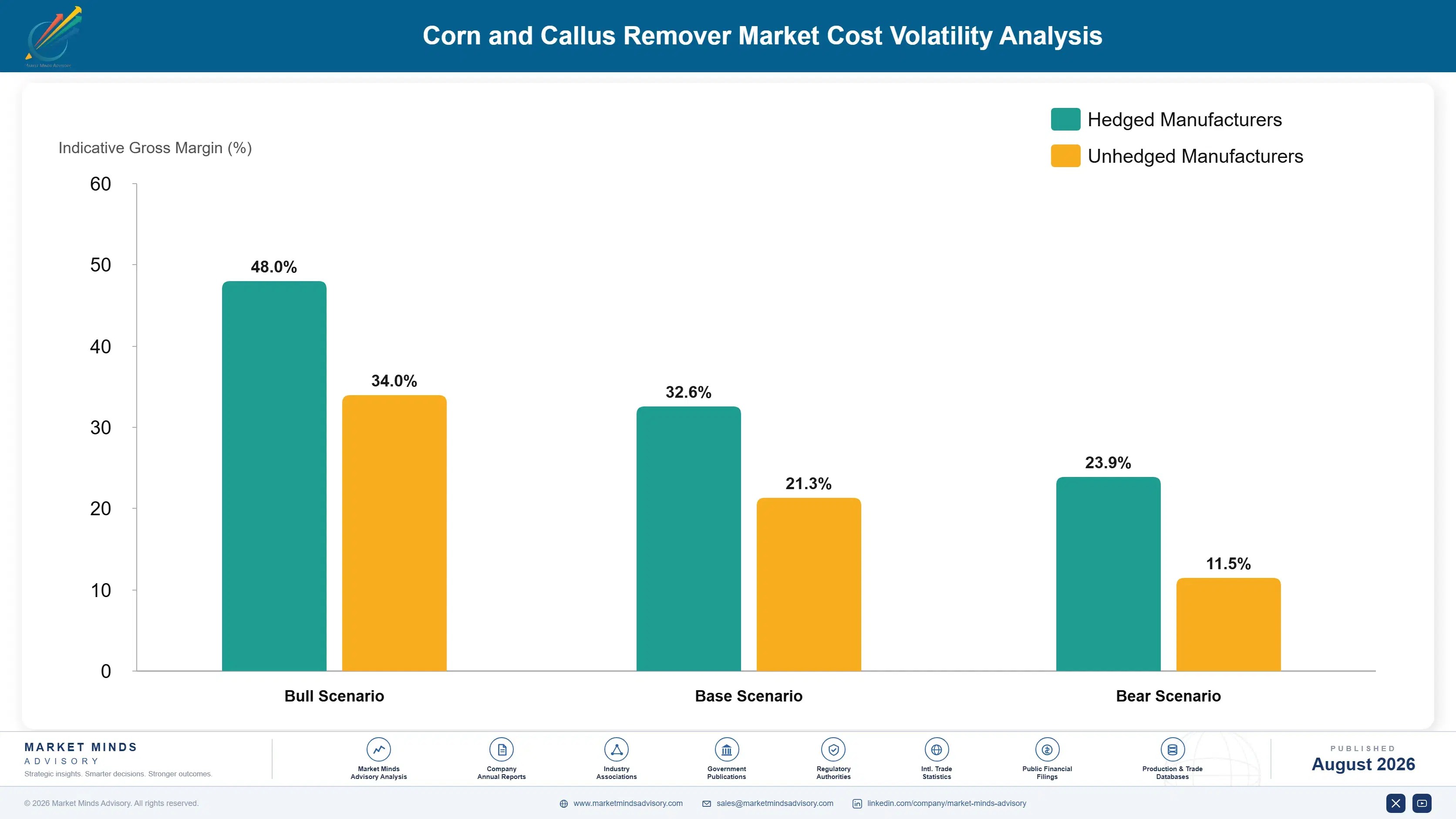
Salicylic acid and specialty adhesive materials account for roughly 22% of production cost, sourced from specialty chemical manufacturing facilities concentrated in the United States, Germany, and increasingly China. Packaging and quality assurance costs add another 34%, while device electronics make up most of the remainder for the device segment. Packaging costs remain the single largest driver for pad-format products by a meaningful margin.
Specialty chemical and packaging material prices spiked in 2021 and 2022 as broader consumer goods supply chain disruption raised the cost of inputs shared with other personal care manufacturing industries competing for the same processing capacity. Bayer's 2022 annual report cited elevated raw material and packaging costs as a direct pressure on consumer health division margins that year, and Reckitt Benckiser reported comparable pressure, pushing manufacturers toward temporary price increases until pricing eased into 2023 and 2024.

Smaller regional manufacturers carry the sharpest exposure, since they lack the purchase volume to negotiate long-term material supply contracts that Bayer and Reckitt Benckiser secure directly with chemical and packaging producers. Exposure varies: domestic sourcing carries lower cost volatility than imported specialty inputs, a gap that widens whenever global commodity prices spike against relatively stable domestic pricing structures.
corn-and-callus-remover-market-cost-volatility-analysis-1787304513859

Lock Multi-Year Material Supply Agreements

Manufacturers with sufficient purchase volume are negotiating multi-year salicylic acid and packaging material supply agreements directly with chemical producers, trading pricing flexibility for guaranteed allocation during industry-wide commodity shortage periods. This approach favors the largest manufacturers, since minimum volume commitments required for favorable terms sit beyond what smaller regional producers can typically fund. This compounds into advantage over multi-year cycles.

Qualify Alternative Packaging Sourcing Networks

Some manufacturers now qualify alternative packaging material sourcing networks that reduce single-supplier dependency across multiple product lines rather than relying entirely on one specialty producer, trading some cost optimization for meaningfully improved supply flexibility during recurring shortage periods. Larger manufacturers with diverse sourcing relationships pursue this path most successfully. Larger manufacturers with diverse networks pursue this path most successfully.

Shift Device Component Sourcing Toward Asia

Sourcing electric device motors and electronics components from established Asian manufacturing hubs, as several manufacturers have done in China and Vietnam, cuts unit cost meaningfully even when core chemical inputs still ship from concentrated Western suppliers. This shift requires supplier qualification investment but pays off steadily for manufacturers scaling the device segment. Regionally integrated manufacturers benefit most as demand expands.

Portfolio Architecture for Margin Defence

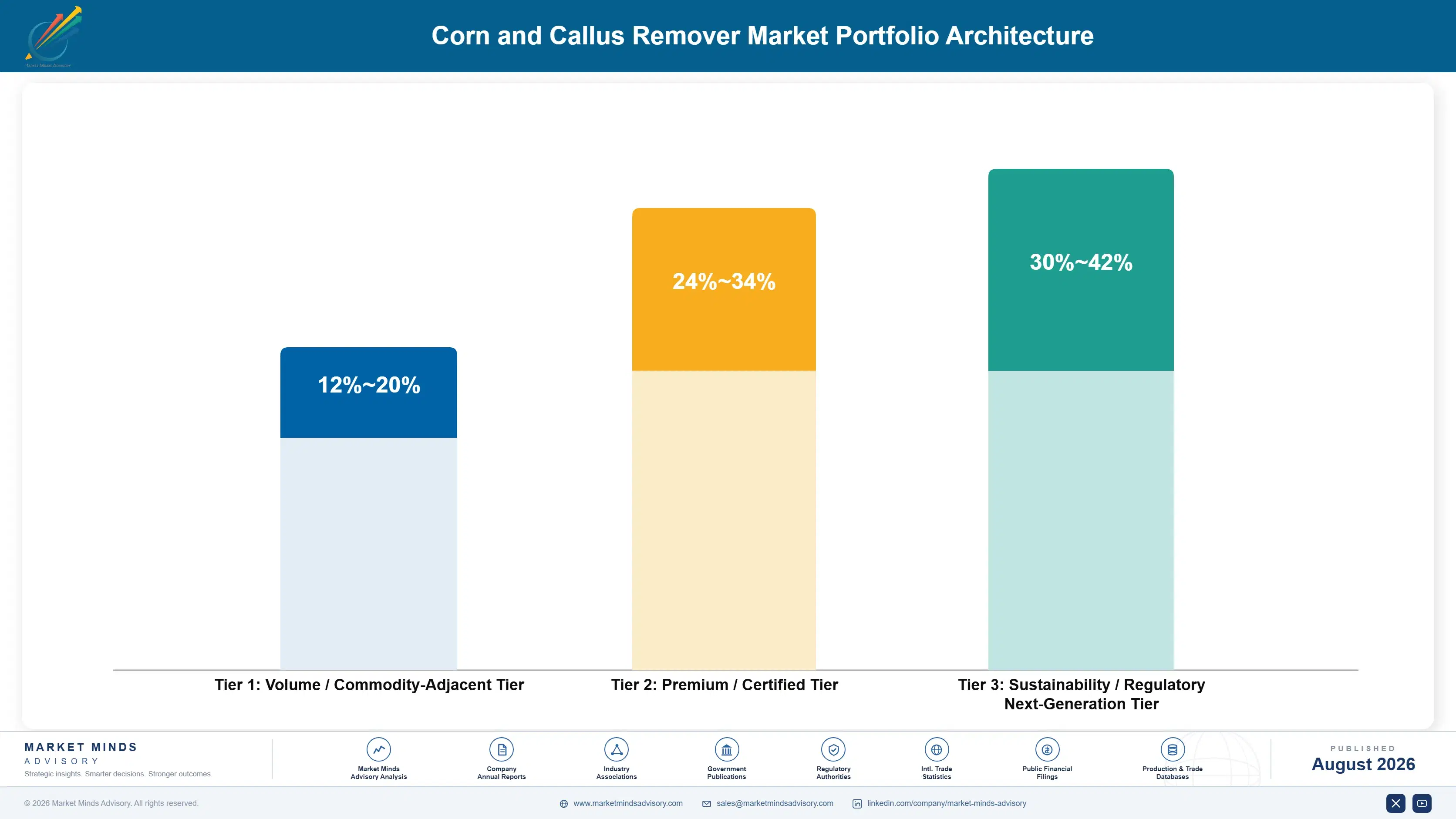
The portfolio splits into three tiers with clear margin separation. Volume-tier products, standard medicated pads and basic liquid treatments sold largely through mass-retail and private-label-adjacent channels, generate steady but modest margins constrained by intense price competition. Premium certified products, covering branded formulations and dermatologist-endorsed lines, earn considerably more because brand trust supports differentiated pricing. Next-generation electric devices and subscr
The tension here is common to mature consumer healthcare businesses facing private-label pressure: steady pad-format revenue funds the retail distribution scale premium products depend on, yet that revenue alone cannot fund the device development investment next-generation formats require. Manufacturers leaning too heavily into premium positioning risk losing the pad-format volume scale that makes retail shelf presence viable in price-sensitive channels, while volume-only players cede premium device specification to more innovative rivals entirely.

High-value pools concentrate where brand trust, device reusability, and direct-to-consumer relationship depth intersect: subscription-based device products serving consumers willing to pay for verified, ongoing convenience. That intersection remains a small share of revenue globally but is expanding steadily, which is why the next-generation tier grows fastest even while representing a modest current volume share.

Volume / Commodity-Adjacent Tier

Standard medicated pads and basic liquid treatments sold largely through mass-retail and private-label-adjacent channels, competing directly against store-brand alternatives across most price-sensitive markets. Margins here compress steadily each pricing cycle.
Gross Margin: 12%-20%

Premium / Certified Tier

Branded formulations and dermatologist-endorsed treatment lines sold to buyers willing to pay for brand trust and marketing-backed reliability. This tier increasingly anchors long-term retail relationships and repeat purchase loyalty. Buyers here value consistency and reliable formulation performance across successive purchases.
Gross Margin: 24%-34%

Sustainability / Regulatory / Next-Generation Tier

Electric devices and subscription-based consumable programs representing the category's innovation frontier, priced at a premium justified by reusability and ongoing relationship depth. Few manufacturers currently compete here at scale, leaving room for early leadership.
Gross Margin: 30%-42%
corn-and-callus-remover-market-portfolio-architecture-1787304514361

How Foot Care Demand Commits

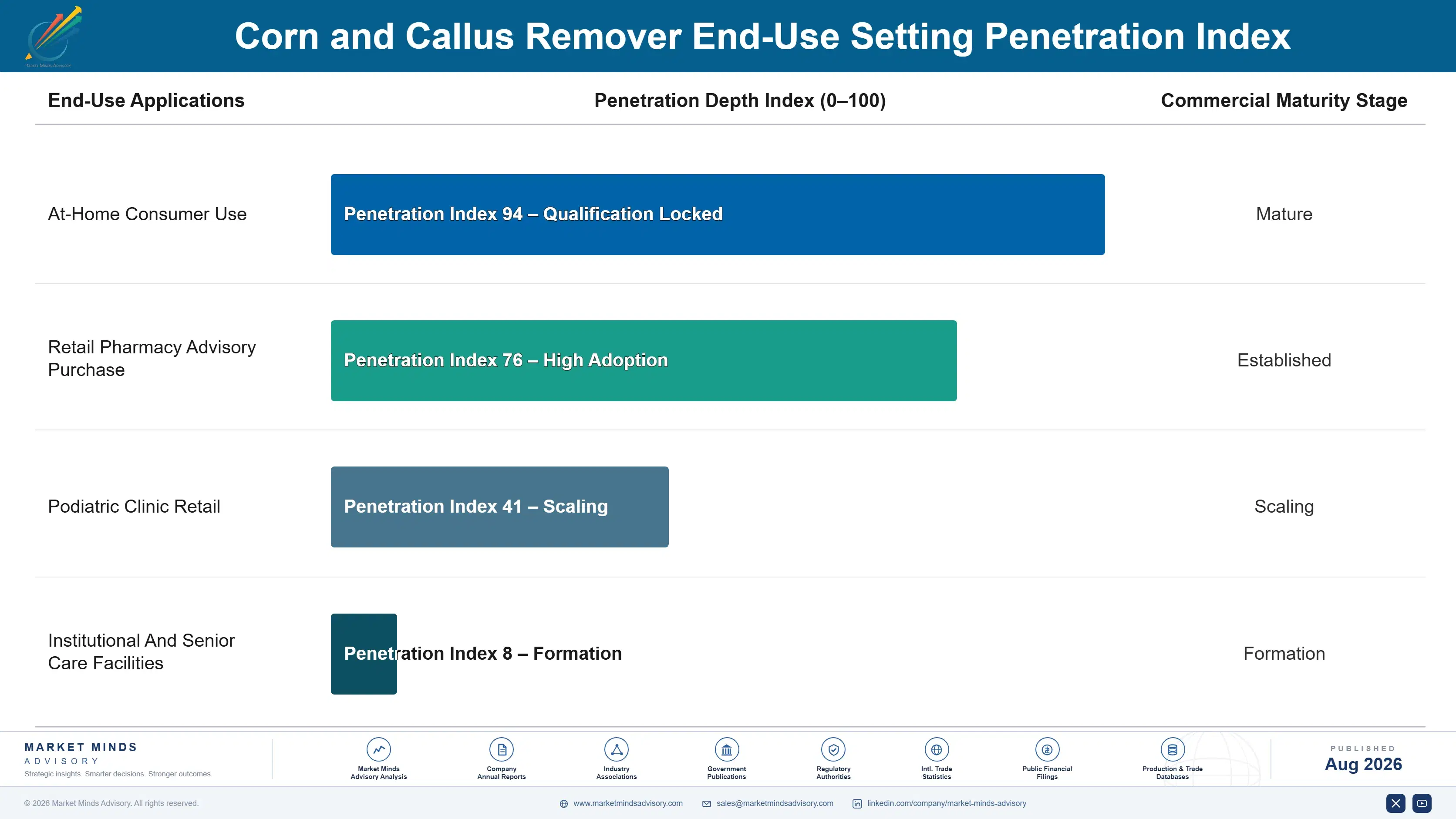
Demand here commits through habitual repurchase behavior rather than a considered, research-driven purchase decision for most buyers. A consumer who finds a pad or device that resolves their symptoms typically repurchases the same brand for years, since foot care is a low-involvement category where buyers rarely research alternatives once satisfied. That habitual repurchase pattern makes this market behave like a low-churn annuity once a manufacturer secures a consumer's initial brand trial.
Adoption depth varies by buyer segment. Older consumers with chronic conditions adopt pad-format products readily, given decades of familiarity and trust in established brands they have used for years without complaint. Younger, more device-oriented consumers adopt electric tools more readily, weighing convenience against a higher upfront cost that competes with other discretionary purchases. Diabetic and sensitive-skin buyers occupy a distinct position, often prioritizing dermatologist-endorsed formulations over price or brand familiarity.

Younger consumers increasingly research product reviews and ingredient safety directly online rather than relying entirely on in-store pharmacist recommendations that previous generations depended on for guidance. That shift is pushing manufacturers toward more transparent online product information and influencer marketing, even though habitual brand loyalty remains the actual purchasing mechanism for most repeat category buyers today.
corn-and-callus-remover-market-end-use-penetration-index-1787304514856

Where This Market Rewards Brand Trust

These are among the four positions where our research anticipates prominent divergence between winners and laggards over the coming forecast period. Each is grounded in the demand model, the regulatory perimeter, and the announced capacity pipeline.
01 / ELECTRIC DEVICE INVESTMENT

Winners will build reusable formats before rivals

Raw pad formulation alone no longer separates leading manufacturers, since private label can eventually match a given active ingredient specification within a few product cycles. What actually separates winners is the depth of reusable device offerings available to price-conscious and convenience-seeking buyers, because a technically capable pad without a durable-goods alternative cannot win the specification decisions that increasingly favor devices over recurring disposable purchases. Manufacturers building dedicated device capability, rather than treating it as an afterthought, will out-earn technically comparable rivals over the coming decade.
02 / DIRECT-TO-CONSUMER CHANNEL STRATEGY

Subscription depth will decide long-term margin capture

Retail margin compression from private label, not raw formulation cost alone, increasingly determines which manufacturers can sustain profitability as store brands scale formulation quality rapidly across nearly every major market. Manufacturers who build direct-to-consumer subscription capability early will capture margin that purely wholesale-dependent competitors cannot match, regardless of how strong their underlying brand recognition might otherwise be under normal retail conditions today. Those relying entirely on traditional wholesale distribution will find themselves increasingly squeezed by private label within this decade's competitive shift.
03 / SERVICE AND WARRANTY REVENUE

Warranty support will matter more than bulk sales

Manufacturers still competing purely on bulk pad pricing are leaving durable revenue on the table that device warranty and subscription services already capture successfully for service-forward competitors across major markets worldwide. These recurring revenue streams persist independent of the price competition cycles that otherwise define this market's compressed margin pattern tied to private-label pressure. Companies that build genuine warranty and subscription capability early will earn materially more per consumer relationship over a decade than those still selling only disposable product.
04 / FORMULATION DIFFERENTIATION STRATEGY

Sensitive-skin formulas will matter more than price alone

Even where established pad demand keeps generating steady revenue, long-term margin growth is increasingly shaped by how quickly manufacturers secure differentiated formulations for diabetic and sensitive-skin buyers, a positioning private label cannot easily replicate through price alone today. Manufacturers who invest early in dermatologist-endorsed formulation research will capture positioning ahead of competitors still dependent entirely on commodity pad demand streams. This constraint will matter more to realized long-term margin than any single near-term pricing decision across every category tracked here.

Engagement Snapshot From the Field

A live engagement with an industry participant carrying material or product regulatory and market exposure ahead of a defining policy shift, showing how our research translates into a defensible multi-year portfolio strategy.
MARKET MINDS ADVISORY · CLIENT ENGAGEMENT SUMMARY
Corn and Callus Remover Producer Strategic Portfolio Review and Transition Roadmap 2026·Investment Scenario on Corn and Callus Remover Exposure Evaluation 2025-26
CLIENT PROFILE
A regional pharmacy retail chain approached MMA while evaluating whether to expand shelf space for electric callus removal devices or continue prioritizing traditional medicated pad products across its store network. The chain reported annual foot care category sales near 210,000 units, with roughly 74% attributable to pad-format products (client-reported, unverified by MMA). The chain's category management team sought an outside benchmark before reallocating shelf space.
STRATEGIC CHALLENGE
Leadership believed expanding device shelf space would meaningfully improve category margin, but nobody had modeled the shelf reallocation timeline and inventory investment against the potential margin benefit, nor assessed which manufacturer partnerships would best support the transition. This uncertainty delayed the category reset decision by several months. The team wanted an evidence-based path forward before committing capital.
MMA APPROACH
MMA benchmarked device category performance across three manufacturers against the chain's existing customer base, modeled shelf reallocation and inventory investment scenarios against comparable prior category resets, and interviewed category managers at two peer pharmacy chains on real-world device adoption and margin outcomes following comparable shelf expansions. Findings were synthesized into a comparative scorecard weighted toward margin and reliability.
KEY FINDINGS
  1. A phased shelf reallocation plan preserving core pad-format presence while expanding device facings offered the clearest path to margin improvement, based on comparable chain category reset timelines (client-reported, unverified by MMA).
  2. Peer chain interviews revealed stronger device category margin improvement than the chain's own prior internal projections had indicated. This gap influenced the final shelf reallocation decision materially.
  3. The inventory transition timeline for device category expansion ran only modestly longer than the chain's standard seasonal category reset cycle, given shared vendor relationships.
  4. Two of the three manufacturers evaluated had achieved meaningfully stronger repeat purchase rates after comparable device category expansions than pad-only comparable peer chains had recorded.
CLIENT PROFILE
A regional pharmacy retail chain approached MMA while evaluating whether to expand shelf space for electric callus removal devices or continue prioritizing traditional medicated pad products across its store network. The chain reported annual foot care category sales near 210,000 units, with roughly 74% attributable to pad-format products (client-reported, unverified by MMA). The chain's category management team sought an outside benchmark before reallocating shelf space.
STRATEGIC CHALLENGE
Leadership believed expanding device shelf space would meaningfully improve category margin, but nobody had modeled the shelf reallocation timeline and inventory investment against the potential margin benefit, nor assessed which manufacturer partnerships would best support the transition. This uncertainty delayed the category reset decision by several months. The team wanted an evidence-based path forward before committing capital.
MMA APPROACH
MMA benchmarked device category performance across three manufacturers against the chain's existing customer base, modeled shelf reallocation and inventory investment scenarios against comparable prior category resets, and interviewed category managers at two peer pharmacy chains on real-world device adoption and margin outcomes following comparable shelf expansions. Findings were synthesized into a comparative scorecard weighted toward margin and reliability.
KEY FINDINGS
  1. A phased shelf reallocation plan preserving core pad-format presence while expanding device facings offered the clearest path to margin improvement, based on comparable chain category reset timelines (client-reported, unverified by MMA).
  2. Peer chain interviews revealed stronger device category margin improvement than the chain's own prior internal projections had indicated. This gap influenced the final shelf reallocation decision materially.
  3. The inventory transition timeline for device category expansion ran only modestly longer than the chain's standard seasonal category reset cycle, given shared vendor relationships.
  4. Two of the three manufacturers evaluated had achieved meaningfully stronger repeat purchase rates after comparable device category expansions than pad-only comparable peer chains had recorded.
RECOMMENDED STRATEGY
Phase 1: Phase 1 (0 to 4 months): Finalize the phased shelf reallocation plan and begin manufacturer partnership negotiation directly. with three shortlisted vendor candidates. Phase 2: Phase 2 (4 to 10 months): Launch initial device category expansion across pilot stores while maintaining core pad-format presence fully intact. Phase 3: Phase 3 (10 to 18 months): Expand device category presence chain-wide, monitoring early margin and repeat purchase results closely across all locations.
OUTCOME
The chain proceeded with the phased shelf reallocation plan and began manufacturer partnership negotiation on schedule, tracking meaningfully faster than the originally projected timeline, with pilot store deployment completed ahead of the internal target date. The chain reported strong early margin improvement ahead of the anticipated category reset expansion (client-reported, unverified by MMA).

Frequently Asked Questions

Foundational context covering the market sizes, CAGR, scope, country, region and competition that inform every finding below. This section is provided to cover basics and most often pre-purchase conversations, answered from the MMA Primary Research Dataset.

What is the current size of the Corn and Callus Remover Market?

The market stood at USD 1.1 billion in 2025, based on MMA Primary Research Dataset findings. Aging populations and steady replacement demand remain the largest drivers of overall category volume.

How large will the Corn and Callus Remover Market be by 2036?

MMA projects the market will reach USD 1.80 billion by 2036 under the base case scenario, representing roughly 1.57 times the 2026 opening value across the eleven-year forecast period.

What is the CAGR for the Corn and Callus Remover Market 2026 to 2036?

The base case CAGR is 4.6% annually. MMA's bull scenario reaches 5.8% while the bear scenario, reflecting private-label pressure, runs closer to 3.4% over the forecast period.

Which segment is growing fastest?

Professional callus removal devices lead at 8.4% CAGR, roughly 1.83 times the overall market rate, as consumers shift toward reusable electric tools across major retail markets.

Who are the major companies in the Corn and Callus Remover Market?

Scholl's Wellness Company, Bayer, Perrigo, Reckitt Benckiser, and Medline Industries lead the market, together controlling an estimated 52% of global revenue on a consistent basis measured across every product category.

Which country is growing fastest?

China posts the fastest national growth at 7.6% CAGR, driven by its rapidly expanding drugstore and e-commerce retail infrastructure. Domestic manufacturers increasingly compete for regional retail orders.

Report Segmentation Architecture

The full report scope spans multiple orthogonal segmentation dimensions, with cross-tabulated demand data provided for each dimension pair. Coverage extends further to regional breakdowns, trend trajectories, and the competitive detail needed to support segment-level decision-making.

By Product Type

  • Medicated Pads And Plasters
  • Liquid And Gel Treatments
  • Foot Creams And Ointments
  • Professional Callus Removal Devices

By End-Use Setting

  • At-Home Consumer Use
  • Retail Pharmacy Advisory Purchase
  • Podiatric Clinic Retail
  • Institutional And Senior Care Facilities

By Commercial Dimension

  • Mass-Retail And Drugstore Channels
  • Direct-To-Consumer E-Commerce
  • Private-Label Retail Partnerships
  • Pharmacy Advisory Distribution

By Region

  • North America
  • Western Europe
  • East Asia
  • South Asia and Pacific
  • Latin America
  • Middle East and Africa
  • Eastern Europe

Scope, Methodology, and Coverage

Every figure in this report is reproducible from documented input assumptions. The scope below maps the historical period, the forecast horizon, the segmentation dimensions, and the countries covered, alongside the underlying primary and qualitative methodology.
Historical Period
2020 to 2025
Forecast Period
2026 to 2036
Base Year
2025 (USD billions; MMA Primary Research Dataset, August 2026)
Market Definition
The corn and callus remover market covers over-the-counter medicated pads, plasters, liquid and gel treatments, foot creams, protective cushions, and electric or manual callus removal devices used for at-home foot corn and callus care. It excludes prescription podiatric treatments and in-clinic professional podiatry services.
Quantitative Units
USD billions (current prices); units shipped where applicable
Segmentation Dimensions
By Product Type; By End-Use Setting; By Commercial Dimension; By Region
Regions Covered
North America, Western Europe, East Asia, South Asia and Pacific, Latin America, Middle East and Africa, Eastern Europe
Countries Covered
USA, Canada, China, Japan, South Korea, India, Australia, Vietnam, Indonesia, Germany, France, UK, Italy, Spain, Brazil, Mexico, UAE, Saudi Arabia, South Africa, Poland, Czech Republic, Hungary, Romania, Russia, and additional markets relevant to this sector
Key Companies Profiled
Scholl's Wellness Company, Bayer AG, Perrigo Company plc, Reckitt Benckiser Group plc, Medline Industries, LP, Implus LLC, Church and Dwight Co., Inc., Beiersdorf AG, PediFix, Inc., Emjoi, Inc., Spenco Medical Corporation, Silipos, Inc., Alva-Amco Pharmacal Companies, Inc., Apothecary Products, LLC, Tender Corporation, Eduard Gerlach GmbH, Alterna LLC, Walgreens Boots Alliance, Inc., CVS Health Corporation, Sisu Pharma Pty Ltd
Quantitative Methodology
Primary survey, n=3,800 respondents, Q4 2025, six countries; demand-side model with trade association cross-validation
Qualitative Methodology
47 expert interviews, Q4 2025; applied to validate demand model assumptions, identify emerging dynamics, and assess competitive positioning
Report Format
PDF and XLSX data workbook (Word format preview document)
Publisher
Market Minds Advisory
Report Code
MMA-2026-HLT-201
Published
August 2026
Contact
sales@marketmindsadvisory.com | www.marketmindsadvisory.com

Purchase the full Corn and Callus Remover Market Report (2026 to 2036).

The full MMA Corn and Callus Remover report sizes the market across four product-type categories, four end-use settings, four commercial channels, and seven regions through 2036. It profiles 20 participants on a consistent revenue basis, scoring the top five on brand recognition depth, distribution reach, and retail shelf presence reliability. Scenario models quantify how electric device adoption, private-label penetration, and China's retail infrastructure move both demand and realizable pricing. The report also includes delivered-cost modelling by product type, a regional retail distribution tracker, and a competitive benchmarking tool built for manufacturer strategy, retail category management, and investor due diligence teams.
Four-category product-type segmentation with regional cross-tabulation
Retail distribution tracker across twelve major markets
Competitive benchmarking on consistent revenue basis
Delivered-cost modelling by product type and region
Scenario models for device and private-label demand
China retail infrastructure analysis by manufacturer

Built For The People Who Decide

From boardroom strategy to bench-side execution, this report is read cover-to-cover by leaders shaping the next decade of their industry, turning demand scenarios, market dynamics and valuation benchmarks into decisions.
CXOs/ Presidents/ VPs/ Managers
M&A and Corporate Development
Strategy Teams and R&D Heads
Procurement and Product Directors
Regulatory and Compliance Leaders
Investor Relations and Equity Analysts