Market Minds Advisory
Copper Foil Market

Copper Foil Market: Battery-Grade Scale-Up and the Fight for Ultra-Thin Capacity

Electric vehicle battery capacity expansion, high-speed data center circuit board demand, and tightening ultra-thin foil qualification standards are pulling copper foil producers into a two-track market where battery-grade and PCB-grade economics increasingly diverge.

Lead Analyst

Bilal Shaikh

Published

September 2026

Make Smarter Decisions with Customized Research Insights

Request a free sample report and evaluate market opportunities, growth trends, and competitive dynamics relevant to your business needs.

2025 MARKET VALUE$14.8BMarket Size 2025
2036 FORECAST VALUE$41.4BBase Case , 2026 to 2036
CAGR 2026 TO 20369.8 %Bull 11.1% / Bear 8.5%
INCREMENTAL OPPORTUNITY$25.1BNet 10- year value creation
EXPANSION MULTIPLE2.55x2036 value over 2026 base
Strategic Levers
M&A Pipeline
Regional Outlook
Country Rankings
Competitive Intelligence
Segmental Deep-dive
Call-Us : 91 93563 13602

Executive Snapshot and Market Trajectory

Copper foil has split into two distinct businesses under one material category. Battery-grade ultra-thin foil for lithium-ion cells is scaling far faster than PCB-grade foil, and producers unable to serve both are increasingly forced to choose which buyer base to prioritize with new capacity.
Electric vehicle battery capacity additions across China, South Korea, and increasingly Europe and North America are pulling ultra-thin foil into multi-year supply agreements, while high-speed data center and AI server circuit boards are lifting demand for low-profile PCB-grade foil. China alone accounts for well over a third of global production capacity, anchored by its dominant battery cell manufacturing base, and Southeast Asian assembly hubs are adding further PCB-grade demand as electronics supply chains diversify further.
Competitive intensity centers on thickness and surface roughness qualification rather than price alone, since battery cell makers and advanced PCB fabricators both specify tight tolerances that take many months to qualify. South Korean and Japanese producers hold the deepest ultra-thin technical positions, while Chinese capacity has scaled fastest on standard-grade volume, and persistent copper price volatility continues to compress conversion margins across the entire foil production industry.
Market Definition
This market covers electrodeposited and rolled copper foil produced for use in printed circuit boards, lithium-ion battery anode current collectors, and electromagnetic shielding applications. It excludes bulk copper wire, copper cathode, and copper alloy products not processed into foil form.
Base Year Value
$14.8B in 2025 (MMA Primary Research Dataset, August 2026)
Forecast Period
2026 to 2036, eleven discrete annual values
CAGR
9.8% base case. Bull 11.1%. Bear 8.5%.
Fastest Growth Segment
Ultra-Thin Lithium Battery Copper Foil: 14.2% CAGR
Fastest Growth Country
China: 12.7% CAGR
Fastest Growth Region
South Asia and Pacific: 11.9% CAGR
Largest Region
East Asia: 30% of 2025 global value
Market Leaders
Wason Group, Nan Ya Plastics Corporation, Furukawa Electric Co. Ltd., SK Nexilis, Mitsui Mining & Smelting Co. Ltd. Source: MMA Analysis based on company annual reports.
Primary Survey
n=3,800 procurement and R&D decision-makers, Q4 2025, six countries
Methodology
Demand-side build-up, cross-validated against public data, 47 expert interviews

Copper Foil Market Forecast Scenarios

copper-foil-market-trends-size-forecast-scenario-1787310764505
Copper foil demand accelerated sharply through 2020 to 2025 as lithium-ion battery capacity additions outpaced the more mature PCB-grade foil market. The market grew at an estimated 8.6% historical CAGR across the period, with battery-grade volume growth consistently outrunning PCB-grade growth in every year after 2021. PCB-grade demand grew more modestly, tracking broader electronics production cycles rather than a single dominant growth driver.
The base case assumes 9.8% CAGR through 2036, driven by three mechanisms. First, global electric vehicle battery cell capacity additions keep pulling ultra-thin foil into long-term supply contracts well past 2030. Second, AI server and data center circuit board demand lifts high-frequency, low-profile PCB-grade foil consumption faster than traditional consumer electronics ever did. Third, sodium-ion and next-generation battery chemistries under development are expected to sustain rather than replace copper foil current collector demand.
The bull case (11.1% CAGR) assumes faster-than-expected Western battery gigafactory ramp-ups pull additional ultra-thin foil capacity investment forward. The bear case (8.5% CAGR) reflects the risk that electric vehicle demand growth slows in key markets and that thinner solid-state battery designs eventually reduce foil thickness requirements per cell faster than expected. Either scenario keeps ultra-thin foil the primary swing factor.

Two-Track Demand Between Batteries and Circuit Boards

Battery-grade and PCB-grade copper foil now behave as two functionally distinct product lines sharing a common feedstock. Battery-grade foil requires thickness down to six microns with tight uniformity tolerances, while PCB-grade foil optimizes for surface roughness and adhesion rather than extreme thinness, and the two production processes increasingly diverge in required equipment. Producers serving both product lines with shared assets increasingly find specifications pulling equipment design
CR5 CONCENTRATION45%share held by the top five global producers
AVERAGE SELLING PRICE$8-22/kgrange spanning standard PCB to ultra-thin battery grades
TOP PRODUCING COUNTRY SHAREChina, 38%share of global copper foil production capacity today
CAPACITY UTILIZATION76%average operating rate across qualified battery-grade production lines
TRADE INTENSITY34%of finished foil volume crossing borders before final use
FEEDSTOCK COST SHARE58% of COGSrefined copper cathode input cost share of total
Qualification cycles now shape competitive position more than raw capacity. Battery cell makers test new foil suppliers for six to twelve months before qualifying a production line, and switching an already-qualified supplier carries real yield risk that most cell makers avoid unless forced by supply shortage or major price gaps. This dynamic rewards producers with disciplined qualification pipelines and penalizes those that treat every customer relationship as interchangeable.
Over the next decade, two forces will determine winners. Continued electric vehicle battery capacity growth will keep favoring producers with proven ultra-thin technical capability, while AI-driven data center circuit board demand growth adds a second, largely independent growth vector for PCB-grade foil sellers. Few suppliers serve both demand vectors well, since the required technical skill sets increasingly diverge.
"People still talk about copper foil as one market, but a battery-grade six-micron foil line and a PCB-grade eighteen-micron line barely compete for the same customer anymore. The interesting question is which producers can actually run both well."
Director, Battery Materials and Electronics Practice · MMA Chemicals and Materia

Market Trends

Ultra-Thin Foil Thickness Keeps Declining Toward Four Microns

Leading battery-grade foil producers, including SK Nexilis and Wason Group, have pushed commercial production toward four-and-a-half to five micron thickness, down from the six to eight micron foil that dominated lithium-ion cells only a few years ago. Thinner foil increases cell-level energy density by reducing inactive material mass, a priority for electric vehicle makers chasing longer range targets. Producing foil this thin at commercial yield requires tightly controlled electrodeposition line speed and current density, a capability that took leading producers years of process refinement to achieve reliably at scale, and remains a meaningful technical barrier for newer entrants.
Market Impact: Adds 1.4 million tons battery-grade
AI Server Demand Lifts High-Frequency PCB Foil

Data center operators building AI training and inference infrastructure require circuit boards capable of handling much higher signal frequencies than traditional servers, driving demand for low-profile, low-roughness copper foil that minimizes signal loss at these frequencies. Foil producers including Circuit Foil Luxembourg and Furukawa Electric have expanded dedicated high-frequency foil production lines to serve this demand, which commands a meaningful pricing premium over standard PCB-grade foil. This demand pool has grown largely independent of the smartphone and consumer electronics cycles that traditionally drove PCB-grade foil volume, giving producers serving it a second, less cyclical revenue stream.
Market Impact: Adds 9% carrier foil segment volume

Market Opportunities and Growth Drivers

Global EV Battery Gigafactory Capacity Additions Continue

Battery cell manufacturers including CATL, LG Energy Solution, and Samsung SDI continue commissioning new gigafactory capacity across China, South Korea, Europe, and North America, with each new production line requiring qualified ultra-thin copper foil supply locked in well ahead of cell production start dates. This capacity buildout has made electric vehicle battery cells the single largest end-use driver of copper foil demand growth, overtaking printed circuit boards in total volume terms within the past several years. Foil producers that secure early supply agreements tied to new gigafactory commissioning schedules gain multi-year revenue visibility that PCB-grade foil sales rarely provide.
Market Impact: Cuts margin 6% in volatile quarters

Advanced Packaging Drives Carrier Foil Demand

Semiconductor advanced packaging techniques, including panel-level packaging and fan-out wafer-level packaging, require specialized carrier copper foil to support ultra-thin dielectric layers during manufacturing before the carrier is removed. Growing AI chip and high-performance computing packaging volume has increased demand for this specialized foil category faster than traditional semiconductor packaging growth rates would suggest. Producers serving this niche typically maintain close technical collaboration with packaging equipment makers and semiconductor foundries, creating switching costs similar to those seen in battery-grade qualification relationships. Panel-level packaging adoption is expected to keep expanding this demand pool well ahead of broader semiconductor unit growth.
Market Impact: Delays ramp by 12 months

Market Restraints and Challenges

Copper Price Volatility Compresses Conversion Margins

Refined copper cathode, the primary feedstock, is priced on volatile global exchange markets that foil producers cannot fully control, and while most supply agreements pass through metal cost, the conversion margin itself faces pressure whenever copper prices spike sharply within a contract period before pricing formulas can reset. This volatility has squeezed smaller producers without long-term metal hedging programs during recent periods of rapid copper price movement, forcing some to delay planned capacity expansions until pricing stabilized. Producers with sophisticated hedging desks and diversified customer bases have weathered these swings more comfortably than smaller regional players.
Market Impact: Lifts battery-grade ASP 18% versus

Ultra-Thin Foil Yield Challenges Limit Capacity Ramp

Producing foil below five microns at commercial yield remains genuinely difficult, and new production lines frequently run below target yield for the first year or more of operation while operators refine electrodeposition process parameters. This yield ramp challenge has slowed how quickly announced ultra-thin capacity actually reaches full qualified output, creating persistent gaps between announced and realized battery-grade supply in industry capacity trackers. Producers are addressing this through closer technical collaboration with equipment makers and by hiring experienced process engineers away from competitors who have already solved similar yield challenges.
Market Impact: Adds 11% high-frequency foil demand
3 additional market trends, 4 additional growth drivers, and 3 additional restraints and challenges are covered in the full report. Contact sales@marketmindsadvisory.com to access the complete intelligence.

Segment CAGR and Growth Architecture

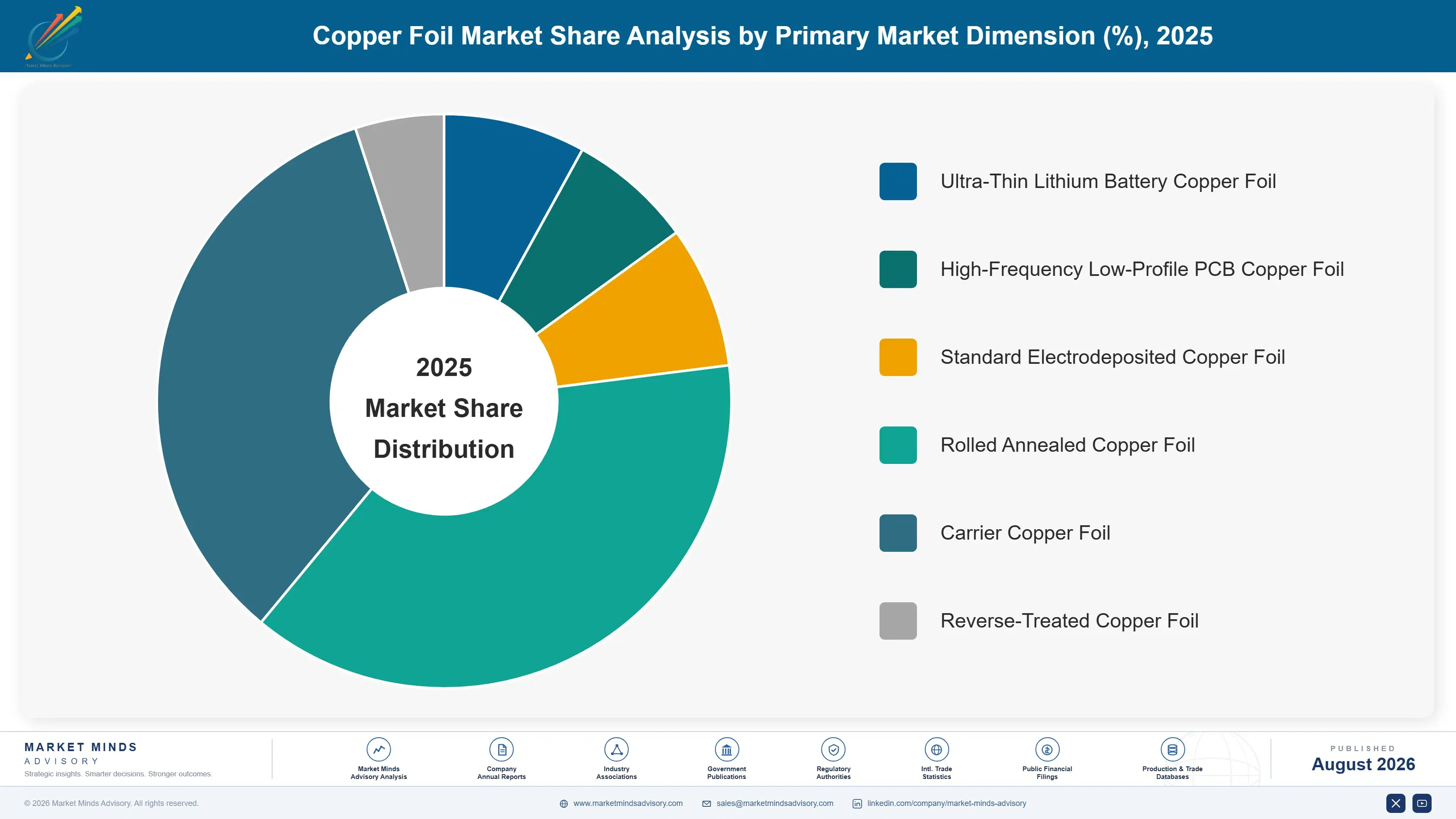
MMA segments this market by product type and application grade, the classification battery cell makers and PCB fabricators use when specifying foil for qualification. This lens separates ultra-thin battery-grade foil, standard PCB-grade foil, and specialty categories by thickness and surface specification rather than end application alone. This structure keeps commercial economics for the two buyer bases analytically distinct.
copper-foil-market-trends-market-share-analysis-1787310765073

Ultra-Thin Lithium Battery Copper Foil

Ultra-thin lithium battery copper foil is the fastest-growing segment by a wide margin, expanding in direct proportion to global electric vehicle and energy storage battery cell capacity additions. Producers pushing thickness toward four-and-a-half microns command meaningful pricing premiums over standard six-micron foil, since thinner foil directly improves cell-level energy density, a priority metric for electric vehicle range competition. SK Nexilis, Wason Group, and Iljin Materials hold the deepest technical positions in this segment, having invested years in electrodeposition process refinement to achieve commercial yield at these thicknesses. Qualification cycles with major battery cell makers typically run six to twelve months, creating durable supply relationships once established that new entrants find difficult to displace even with competitive pricing.
CAGR 14.2%

High-Frequency Low-Profile PCB Copper Foil

High-frequency low-profile PCB copper foil demand is expanding faster than the broader PCB-grade foil base, driven by AI server and data center circuit board requirements that traditional consumer electronics applications never demanded at this scale. This foil minimizes surface roughness to reduce signal loss at the higher frequencies AI training and inference hardware requires, commanding a meaningful premium over standard PCB-grade foil used in conventional electronics. Furukawa Electric and Circuit Foil Luxembourg maintain strong positions in this segment given established technical relationships with printed circuit board fabricators serving data center customers. Growth here is largely independent of smartphone and consumer electronics demand cycles that historically dominated PCB-grade foil volume. Growth here compounds independently of battery demand cycles.
CAGR 11.4%
Full segment breakdown across 6 segments available in the complete report.

Regional Architecture and Country Demand Map

East Asia dominates global copper foil production and consumption given its heavy concentration of both battery cell manufacturing and printed circuit board fabrication capacity, led decisively by China. North America and Europe are building new battery-grade capacity to serve their own expanding domestic gigafactory demand.

North America

United States battery gigafactory announcements tied to federal manufacturing incentive programs have driven a wave of new domestic copper foil capacity investment, since qualified foil supply was previously almost entirely imported from Asia. Several producers have announced or begun constructing battery-grade foil facilities in the southeastern United States, close to the region's growing cluster of electric vehicle and battery cell plants. Canada contributes through mining and refined copper cathode supply rather than significant foil conversion capacity of its own. PCB-grade foil demand remains tied to a smaller domestic circuit board manufacturing base, with a growing share serving AI server and data center hardware. Domestic capacity remains well short of demand, keeping the region reliant on Asian imports for qualified supply.
Share: 24% | CAGR: 9.2% (2026 to 2036)

Western Europe

Germany and France anchor European battery gigafactory capacity, and several copper foil producers have announced or begun constructing domestic battery-grade foil facilities to reduce reliance on Asian imports for this strategically sensitive material category. European Union battery regulation increasingly favors regional content sourcing, adding policy support behind these domestic capacity investments even where production costs remain higher than in Asia. PCB-grade foil demand is comparatively modest, tied to a smaller regional circuit board manufacturing base that has continued shrinking relative to Asian production over recent years. Growth trails the global average as European battery capacity additions, while significant, remain smaller in absolute scale than Chinese and South Korean gigafactory buildout.
Share: 21% | CAGR: 8.2% (2026 to 2036)
Regional intelligence for 5 additional markets available in the complete report: East Asia, South Asia and Pacific, Latin America, Middle East and Africa, Eastern Europe. Contact sales@marketmindsadvisory.com.
copper-foil-market-trends-country-cagr-analysis-1787310765586

Where Copper Foil Producers Can Expand Margins

Producers create outsized value not from standard foil tonnage but from ultra-thin technical qualification, feedstock hedging discipline, and long-term battery cell maker relationships. The levers below identify where margin expands fastest, moving beyond commodity-thickness sales toward qualified ultra-thin supply, carrier foil specialization, and hedged feedstock positioning. This favors producers investing ahead of visible qualification demand signals.

Ultra-Thin Qualification Commands Premium Market Pricing

Foil producers that achieve reliable commercial yield below five microns capture meaningfully higher realized pricing than standard six-to-eight micron PCB-grade foil, often 2 to 3 times the price per kilogram for equivalent volume, because thinner foil directly improves battery cell energy density in a way buyers value highly. This qualification requires years of electrodeposition process refinement and significant capital investment in precision line control equipment, but producers that achieve it gain access to the fastest-growing and highest-margin segment of the entire market well ahead of slower-moving competitors. Several producers have captured outsized share of new gigafactory contracts this way.
Market Impact: Adds 250 to 350 basis points gross

Copper Hedging Programs Stabilize Conversion Margin

Producers with sophisticated copper price hedging programs, using futures contracts and formula-based customer pricing that resets frequently, protect conversion margin far more effectively than producers relying on simple cost pass-through clauses that lag actual metal price movement. This capability requires dedicated treasury expertise and strong banking relationships, but it insulates a meaningful share of gross margin from copper price swings that can move by 15% or more within a single quarter during volatile trading periods. Smaller regional producers without this capability remain more exposed to margin compression during sharp price movements.
Market Impact: Cuts margin volatility by roughly 1

Battery Cell Maker Joint Qualification Partnerships

Producers that invest early in joint qualification programs with battery cell makers, embedding technical staff to co-develop foil specifications for next-generation cell designs, secure supply relationships that persist for the full production life of a battery platform once qualified. Qualification with a major cell maker typically takes 6 to 12 months but results in multi-year supply commitments that are difficult for competitors to displace, since requalifying an alternative foil supplier carries real yield risk that most cell makers avoid absorbing without strong cause. This approach also gives producers early visibility into next-generation cell design requirements.
Market Impact: Secures 6 to 12 month qualification

Carrier Foil Specialization for Advanced Packaging

Producers building dedicated carrier foil capacity for semiconductor advanced packaging applications access a smaller but faster-growing and less commoditized demand pool than standard PCB-grade foil, tied to AI chip and high-performance computing packaging volume growth rather than broader electronics cycles. This specialization requires close technical collaboration with packaging equipment makers and semiconductor foundries. Producers serving this niche typically capture 2 to 3 times standard PCB-grade foil pricing for comparable volume, with demand growing independent of broader consumer electronics cycles. Established relationships built through years of joint technical work give incumbents a durable edge over new entrants lacking equivalent track records.
Market Impact: Adds 4 to 6 percentage points of ma

Who Controls the Margin Pool

CR5 stands at 45%, reflecting a market split between battery-grade specialists and larger diversified metals producers. The gap between the top five and smaller regional Chinese producers is widest in ultra-thin battery-grade technical capability, where qualification barriers protect leaders far more than in standard PCB-grade foil. This dynamic has persisted given the capital intensity of matching ultra-thin capability.
Competition currently plays out across three dimensions: ultra-thin thickness reduction races among battery-grade leaders, capacity expansion timed to gigafactory commissioning schedules across multiple regions, and carrier foil specialization for advanced semiconductor packaging among a smaller group of technically differentiated producers. Chinese producers compete primarily on standard-grade volume and price, where qualification barriers remain lower than in ultra-thin battery applications. European producers pursue gigafactory-adjacent capacity as a separate strategy from pure cost competition.

Emerging pressure comes from two directions. Chinese producers are closing the ultra-thin technology gap with Korean and Japanese leaders faster than expected, narrowing what was once a clear technical hierarchy. Western battery-grade entrants, backed by gigafactory localization incentives, could also reorder regional supply relationships if they achieve qualified yield faster than established Asian producers currently expect. Neither trend is likely to reorder the top five within a few years.
copper-foil-market-trends-company-positioning-matrix-1787310766105

Competitive Moat and Risk Dimensions

WASON GROUP

Moat: Leading Chinese Ultra-Thin Capacity

Wason has built the largest ultra-thin battery-grade production base among Chinese producers, achieving commercial yield at thicknesses that took years of process refinement to reach reliably. This scale and technical depth gives Wason preferred supplier status with several major Chinese and export-oriented battery cell makers.
WASON GROUP

Risk: Geographic Production Concentration Risk

Wason's production remains heavily concentrated within China, leaving it more exposed than diversified competitors to any future trade restrictions or tariff measures affecting Chinese battery material exports to Western markets. Diversifying production geographically would require years of new facility qualification with export-market battery customers. This exposure has become a more prominent boardroom concern in recent years.
SK NEXILIS

Moat: Deepest Ultra-Thin Technical Position

SK Nexilis holds industry-leading thickness and yield performance below five microns, backed by SK Group's broader battery materials investment and close integration with SK On's battery cell manufacturing roadmap. This technical depth, built over years of dedicated research investment, remains difficult for competitors to fully replicate.
SK NEXILIS

Risk: High Capital Intensity of Expansion

SK Nexilis's overseas capacity expansion, including facilities in Poland and Malaysia, requires substantial ongoing capital investment during a period when battery demand growth in some Western markets has moderated from earlier forecasts. This capital intensity leaves less flexibility to scale back investment quickly if demand growth disappoints.

Players Tracked

Prominent Players

Wason Group
Nan Ya Plastics Corporation
Furukawa Electric Co. Ltd.
SK Nexilis
Mitsui Mining & Smelting Co. Ltd.

Other Key Players

Circuit Foil Luxembourg S.A.
Doosan Corporation
Iljin Materials Co. Ltd.
Fukuda Metal Foil & Powder Co. Ltd.
Guangdong Jiayuan Technology Co. Ltd.
Hunan Zhongchuang High Speed Rail New Material Co. Ltd.
Jiangxi Copper Corporation
Shengyi Technology Co. Ltd.
Tongling Nonferrous Metals Group
Yunnan Copper Industry Co. Ltd.
Rogers Corporation
Wieland Group
LS Mtron Ltd.
Chang Chun Petrochemical Co. Ltd.
Hitachi Metals Ltd.

Recent Developments

APRIL 2025

SK Nexilis Commissions Battery-Grade Foil Facility in Malaysia

SK Nexilis announced commissioning of a new battery-grade copper foil production facility in Malaysia, part of a broader strategy to diversify manufacturing beyond South Korea and serve battery cell customers across Southeast Asia. The facility targets ultra-thin foil grades consistent with SK Nexilis's existing technical specifications.
Signal: Confirms leading producers are diversifyin
SEPTEMBER 2025

Wason Group Expands Ultra-Thin Capacity at Jiangxi Complex

Wason Group announced completion of a capacity expansion at its Jiangxi production complex, adding qualified ultra-thin battery-grade capacity to serve growing Chinese and export battery cell demand. The expansion follows several years of yield improvement work at thicknesses below five microns. The facility targets thicknesses below five microns.
Signal: Signals Chinese producers are closing the
JANUARY 2026

Furukawa Electric and a Data Center Fabricator Sign Supply Agreement

Furukawa Electric signed a multi-year supply agreement with a major printed circuit board fabricator covering high-frequency, low-profile copper foil for AI server and data center applications. The agreement secures forward volume for Furukawa at negotiated pricing ahead of anticipated AI infrastructure buildout. The agreement reflects growing AI infrastructure demand.
Signal: Signals PCB-grade foil producers are incre

Refined Copper Feedstock Exposure

Refined copper cathode accounts for roughly 58% of cost of goods sold across copper foil production, with pricing tied directly to global copper exchange markets rather than foil-specific supply dynamics. Producers without sophisticated hedging programs face direct exposure to metal price swings within contract pricing reset periods. Larger producers with formal hedging programs manage this exposure far more effectively than smaller regional players operating without one.
Copper prices spiked sharply during 2024, documented in company annual reports across the sector, as electric vehicle battery demand and broader energy transition metal demand pulled global copper markets tighter than in prior years. Several foil producers reported compressed conversion margins during the spike, since customer pricing formulas reset on a lag relative to spot copper price movement, illustrating how directly feedstock volatility can affect near-term profitability.

This exposure disadvantages smaller regional producers relative to larger competitors with sophisticated treasury and hedging capability, widening margin gaps during volatile pricing periods that are difficult to close through efficiency gains alone. Producers without formal hedging programs absorb volatility directly in margin, while larger integrated players like Mitsui Mining and Smelting hedge exposure through diversified metal sourcing and financial instruments.
copper-foil-market-trends-cost-volatility-analysis-1787310766299

Copper Futures Hedging Programs

Producers with dedicated treasury functions use copper futures contracts to lock in feedstock costs ahead of production runs, reducing exposure to spot price volatility. This approach requires sophisticated financial expertise but has become increasingly standard among larger producers following recent volatile pricing periods. Larger producers with dedicated finance teams have adopted this discipline most consistently across recent volatile trading periods.

Frequent Pricing Formula Resets With Customers

Several producers have renegotiated customer contracts to reset copper-linked pricing formulas monthly rather than quarterly, reducing the lag between metal cost movement and realized customer pricing. This shift protects conversion margin more effectively during periods of rapid price movement. Customers have generally accepted these terms given the mutual benefit of reduced pricing uncertainty on both sides of the relationship.

Scrap Copper Recovery Reduces Cathode Dependence

Producers recovering and reprocessing copper scrap generated during foil production reduce dependence on purchased cathode for a portion of total feedstock needs, insulating that share of output from cathode price swings. This approach also supports sustainability positioning increasingly valued by battery cell customers. Producers with established scrap recovery infrastructure report meaningfully lower blended feedstock costs than peers lacking this capability.

Portfolio Architecture for Margin Defence

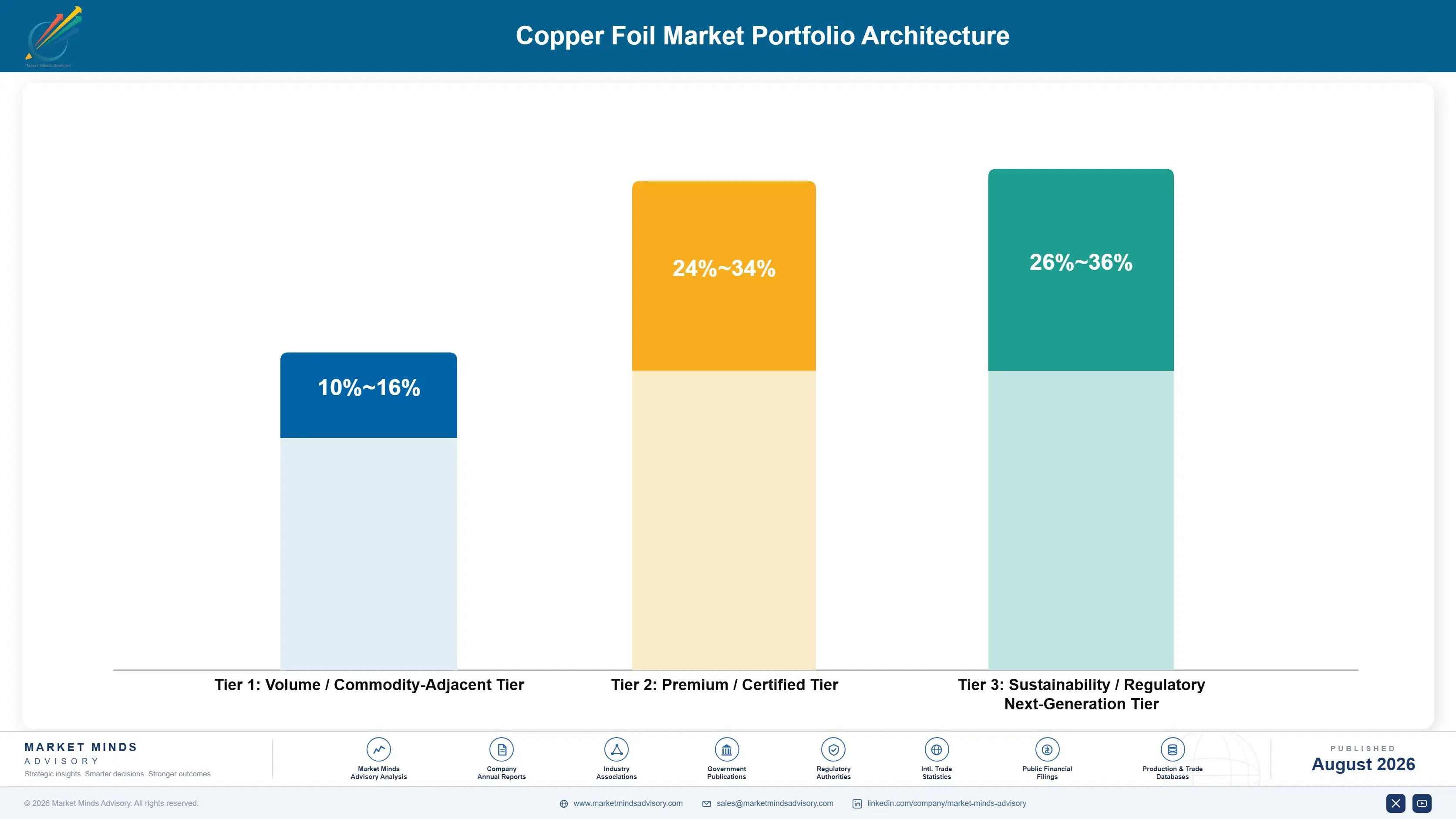
MMA organizes this market into three tiers by thickness specification and margin profile. The volume tier covers standard PCB-grade foil sold into conventional electronics manufacturing, competing primarily on price and feedstock cost position. The premium tier covers qualified ultra-thin battery-grade and high-frequency PCB foil commanding higher margins through technical qualification barriers. The sustainability tier captures carrier foil and specialty packaging applications still scaling tow
Volume tier producers compete on price and copper cost position with thin margins, while premium tier suppliers protect pricing power through qualification barriers that keep new entrants out for years. This creates real tension inside diversified producers, since capital allocated to sustaining standard capacity competes directly with capital needed to fund ultra-thin process development, and most large producers now favor the latter given superior long-term returns.

The highest-value pools concentrate in ultra-thin battery-grade foil below five microns and carrier foil for advanced semiconductor packaging, where technical qualification barriers and durable customer relationships combine to support the strongest pricing power in the entire market. High-frequency PCB foil for AI infrastructure is emerging as a further high-value pool. Standard PCB-grade foil remains the largest tier by volume but weakest on margin.

Volume / Commodity-Adjacent Tier

Standard PCB-grade copper foil sold into conventional electronics and industrial applications, competing primarily on price and copper feedstock cost position with limited technical differentiation between suppliers. Feedstock cost position and scale dominate competitiveness in this tier.
Gross Margin: 10-16%

Premium / Certified Tier

Qualified ultra-thin battery-grade and high-frequency PCB-grade foil commanding higher margins through technical qualification barriers and multi-year customer supply relationships with battery cell makers and PCB fabricators. Suppliers here typically hold multi-year qualified customer contracts.
Gross Margin: 24-34%

Sustainability / Regulatory / Next-Generation Tier

Carrier foil for advanced semiconductor packaging and recycled-content foil positioned ahead of tightening sustainability requirements, commanding premium pricing from technically demanding early-adopter customers. Scale remains modest today but growth here outpaces the rest of the market by a wide margin.
Gross Margin: 26-36%
copper-foil-market-trends-portfolio-architecture-1787310766803

High-value Sub-segments and Strategic Watch-out

Ultra-Thin Battery Foil Below Five Microns

This segment combines the highest technical barriers in the market with the fastest unit growth, as electric vehicle battery makers push toward thinner foil for energy density gains. Producers with proven yield at these thicknesses hold a durable and difficult-to-replicate advantage. New entrants need years to reach comparable yield.
Gross Margin: 28-38%

Carrier Foil for Advanced Semiconductor Packaging

AI chip and high-performance computing packaging growth supports strong pricing power and steady rather than cyclical demand, since volumes are tied to semiconductor packaging investment cycles rather than broader consumer electronics demand swings. Established relationships with packaging equipment makers provide meaningful protection against new entrants lacking equivalent technical depth.
Gross Margin: 26-34%

Standard PCB-Grade Copper Foil

The largest volume base by tonnage, this segment covers standard-grade foil sold into conventional circuit board manufacturing, where competition is driven mostly by price and copper cost position rather than technical differentiation. Integrated producers with strong copper cost positions consistently outcompete smaller merchant sellers lacking scale advantages.
Gross Margin: 8-14%

Chinese Ultra-Thin Capacity Buildout

Chinese producers are scaling ultra-thin capacity aggressively and closing the technical gap with Korean and Japanese leaders faster than expected, a trajectory worth monitoring closely by established producers over the coming several years. Established Korean and Japanese producers are watching this trajectory closely as Chinese cost and yield keep improving.
Gross Margin: 10-16%

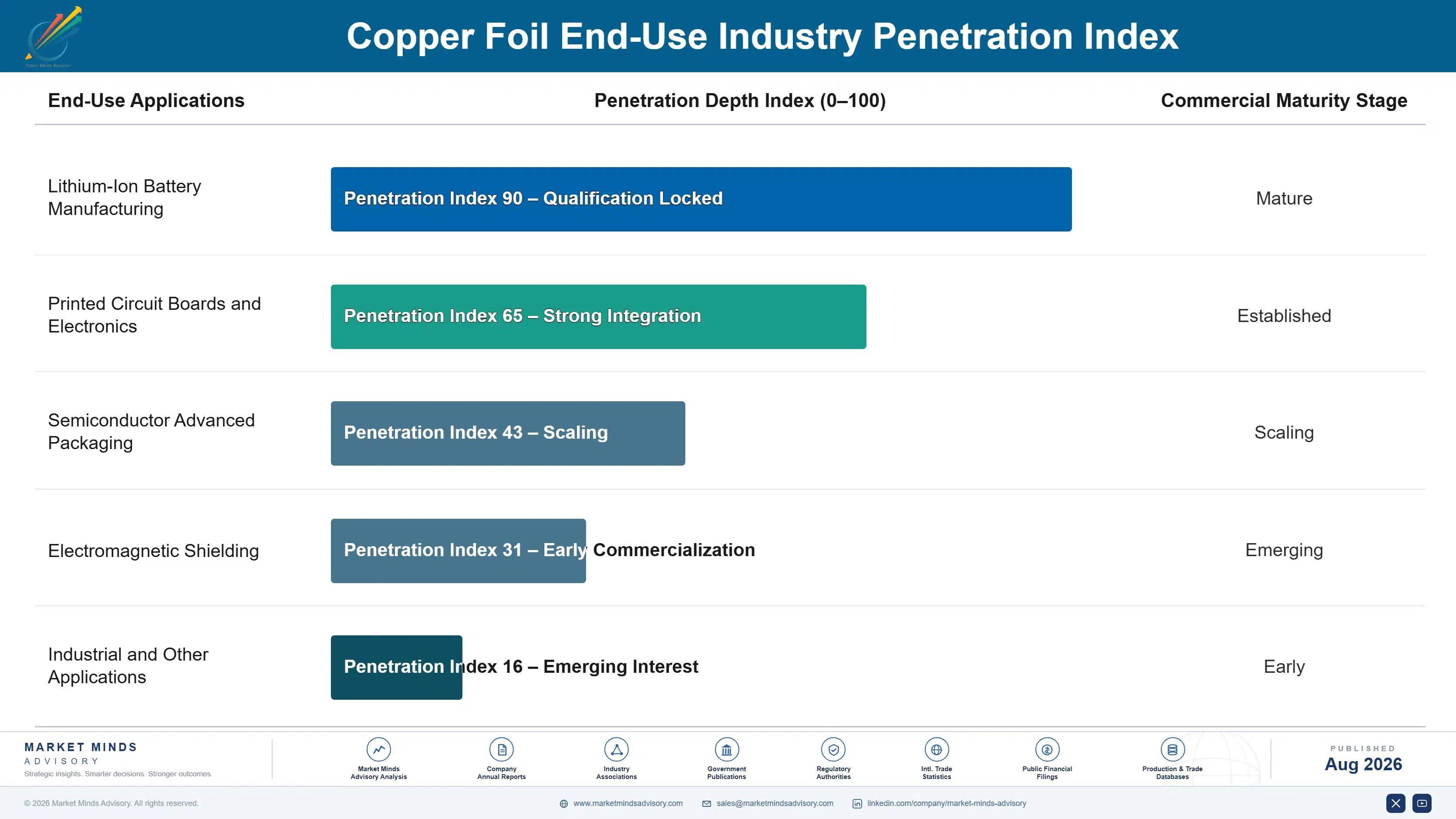
Qualification Depth Across Buyer Types

Once a foil supplier is qualified into a battery cell production line or PCB fabrication process, that relationship typically persists for the full production life of the platform, since requalifying an alternative supplier carries real yield risk that most manufacturers avoid absorbing without strong cause. This creates durable, low-churn revenue characteristics once qualification is achieved, distinct from the more transactional early qualification-seeking phase. Merchant relationships without
Adoption depth varies sharply by vertical. Battery cell makers show the deepest stickiness, since foil specification changes require extensive cell-level requalification testing that most manufacturers avoid mid-platform. PCB fabricators show moderate stickiness tied to board design cycles. Consumer electronics customers show the least stickiness of the three, since product redesigns occur frequently and reopen sourcing decisions more often than long-lived battery platforms ever do.

Buyer profiles are shifting generationally as battery cell makers increasingly weigh supply chain geographic diversification, not just price and technical performance, as an explicit qualification criterion. This shift favors producers with multi-region production capability over single-country suppliers, a consideration barely present in sourcing decisions before recent trade policy volatility affected battery material supply chains. This shift is still early but already visible in supplier selection criteria.
copper-foil-market-trends-end-use-penetration-index-1787310767288

Where MMA Sees the Opportunity

These are among the four positions where our research anticipates prominent divergence between winners and laggards over the coming forecast period. Each is grounded in the demand model, the regulatory perimeter, and the announced capacity pipeline.
01 / ULTRA-THIN CAPACITY INVESTMENT

Invest in Sub-Five-Micron Yield Ahead of Demand Growth

Ultra-thin battery-grade foil below five microns commands the strongest pricing power in the entire market, and producers that achieve reliable commercial yield at this thickness now position themselves ahead of continued electric vehicle battery capacity growth through 2036. Qualification with major cell makers typically takes six to twelve months but produces multi-year supply relationships that are difficult for competitors to displace afterward. Waiting until yield challenges are fully solved elsewhere risks ceding this high-margin segment to producers who invested in process refinement earlier and absorbed the technical risk first.
02 / GEOGRAPHIC CAPACITY DIVERSIFICATION

Diversify Production Beyond Single-Country Concentration

Trade policy volatility affecting battery material supply chains has made geographic concentration a genuine commercial risk rather than a purely theoretical one. Producers with production concentrated in a single country carry exposure that diversified competitors like SK Nexilis increasingly do not face to the same degree. Building qualified capacity in a second region requires years of facility construction and customer requalification, but producers that start this process now will hold a durable advantage when the next trade disruption eventually arrives.
03 / COPPER HEDGING DISCIPLINE

Build Sophisticated Copper Price Hedging Capability

Recent copper price volatility demonstrated how quickly feedstock cost swings can compress conversion margins regardless of underlying demand strength across battery and PCB end markets. Producers without dedicated treasury and hedging capability carry persistent margin exposure that larger integrated competitors do not face to the same degree during volatile pricing periods. Building this capability requires financial expertise investment, but it provides a durable margin advantage across full copper price cycles rather than only during the calmer pricing periods most producers plan around.
04 / AI INFRASTRUCTURE POSITIONING

Build Dedicated High-Frequency Foil Capacity for AI Servers

AI server and data center circuit board demand for high-frequency, low-profile foil is growing largely independent of traditional consumer electronics cycles that have historically driven PCB-grade foil volume. This creates a genuinely new and less cyclical demand pool for producers willing to invest in dedicated capacity. Producers that build technical relationships with data center circuit board fabricators now, ahead of continued AI infrastructure buildout, stand to capture a disproportionate share of this growing segment before competition intensifies further over the next several years.

Engagement Snapshot From the Field

A live engagement with an industry participant carrying material or product regulatory and market exposure ahead of a defining policy shift, showing how our research translates into a defensible multi-year portfolio strategy.
MARKET MINDS ADVISORY · CLIENT ENGAGEMENT SUMMARY
Copper Foil Producer Strategic Portfolio Review and Transition Roadmap 2026·Investment Scenario on Copper Foil Exposure Evaluation 2025-26
CLIENT PROFILE
The client is a mid-scale Asian copper foil producer generating approximately $480 million in annual revenue (client-reported, unverified by MMA) from a mix of standard PCB-grade foil and smaller ultra-thin battery-grade production. The company operates two production facilities and was evaluating a major capacity expansion decision amid rapidly growing battery-grade demand and uncertain PCB-grade growth prospects.
STRATEGIC CHALLENGE
The client needed to decide whether to commit approximately $220 million (client-reported, unverified by MMA) to new ultra-thin battery-grade capacity, requiring years of yield development, or to expand its more familiar standard PCB-grade capacity where returns were lower but technical risk was substantially reduced and better understood internally. Either path carried real opportunity cost given limited available capital.
MMA APPROACH
MMA's advisory team conducted primary interviews with battery cell maker procurement leads and reviewed comparable ultra-thin capacity ramp timelines from established producers to assess realistic yield development risk and demand growth visibility. The analysis built a phased capacity recommendation that balanced technical risk against the meaningfully higher margin potential of ultra-thin battery-grade production.
KEY FINDINGS
  1. Interview data indicated battery cell maker demand for qualified new ultra-thin suppliers would grow at least 20% annually through 2030, exceeding the client's initial planning assumption of 12%.
  2. Comparable ultra-thin capacity ramp timelines from three established producers averaged 16 months to reach target yield, longer than the client's original 10-month planning assumption for the new line.
  3. Standard PCB-grade capacity expansion offered a faster and lower-risk path to incremental revenue but delivered gross margins roughly half those available in qualified ultra-thin battery-grade production.
  4. A phased approach, committing initial capital to a smaller pilot ultra-thin line before full-scale expansion, reduced downside risk while preserving the option to scale quickly once yield targets were achieved.
CLIENT PROFILE
The client is a mid-scale Asian copper foil producer generating approximately $480 million in annual revenue (client-reported, unverified by MMA) from a mix of standard PCB-grade foil and smaller ultra-thin battery-grade production. The company operates two production facilities and was evaluating a major capacity expansion decision amid rapidly growing battery-grade demand and uncertain PCB-grade growth prospects.
STRATEGIC CHALLENGE
The client needed to decide whether to commit approximately $220 million (client-reported, unverified by MMA) to new ultra-thin battery-grade capacity, requiring years of yield development, or to expand its more familiar standard PCB-grade capacity where returns were lower but technical risk was substantially reduced and better understood internally. Either path carried real opportunity cost given limited available capital.
MMA APPROACH
MMA's advisory team conducted primary interviews with battery cell maker procurement leads and reviewed comparable ultra-thin capacity ramp timelines from established producers to assess realistic yield development risk and demand growth visibility. The analysis built a phased capacity recommendation that balanced technical risk against the meaningfully higher margin potential of ultra-thin battery-grade production.
KEY FINDINGS
  1. Interview data indicated battery cell maker demand for qualified new ultra-thin suppliers would grow at least 20% annually through 2030, exceeding the client's initial planning assumption of 12%.
  2. Comparable ultra-thin capacity ramp timelines from three established producers averaged 16 months to reach target yield, longer than the client's original 10-month planning assumption for the new line.
  3. Standard PCB-grade capacity expansion offered a faster and lower-risk path to incremental revenue but delivered gross margins roughly half those available in qualified ultra-thin battery-grade production.
  4. A phased approach, committing initial capital to a smaller pilot ultra-thin line before full-scale expansion, reduced downside risk while preserving the option to scale quickly once yield targets were achieved.
RECOMMENDED STRATEGY
Phase 1: Phase 1 (Months 1-6): Commission a smaller pilot ultra-thin production line to validate yield targets before committing full expansion capital. Phase 2: Phase 2 (Months 7-16): Refine electrodeposition process parameters to reach target commercial yield while beginning battery cell maker qualification discussions. Phase 3: Phase 3 (Months 17-24): Scale full ultra-thin capacity expansion based on confirmed yield performance and secured customer qualification agreements from initial pilot line results.
OUTCOME
The client's pilot line reached target yield within 14 months, faster than the comparable industry average, and the company proceeded with full-scale expansion supported by qualification agreements with two major battery cell makers. The client reported that blended gross margins improved by an estimated 9 percentage points (client-reported, unverified by MMA) within the first full year of expanded ultra-thin production.

Frequently Asked Questions

Foundational context covering the market sizes, CAGR, scope, country, region and competition that inform every finding below. This section is provided to cover basics and most often pre-purchase conversations, answered from the MMA Primary Research Dataset.

What is the current size of the Copper Foil Market?

The Copper Foil Market was valued at $14.8 billion in 2025. MMA projects it will reach $16.25 billion in 2026 as battery-grade and PCB-grade demand both continue expanding.

How large will the Copper Foil Market be by 2036?

MMA forecasts the market will reach $41.39 billion by 2036, up from $16.25 billion in 2026. That represents a 2.55 times expansion over the ten-year forecast window.

What is the CAGR for the Copper Foil Market 2026 to 2036?

The market is projected to grow at a 9.8% CAGR between 2026 and 2036. MMA's bull and bear scenarios range from 11.1% to 8.5% depending on battery gigafactory buildout pace.

Which segment is growing fastest?

Ultra-Thin Lithium Battery Copper Foil is the fastest-growing segment, expanding at a 14.2% CAGR, roughly 1.45 times the overall market rate as electric vehicle battery capacity keeps expanding.

Who are the major companies in the Copper Foil Market?

Wason Group, Nan Ya Plastics, Furukawa Electric, SK Nexilis, and Mitsui Mining and Smelting lead the market, together holding an estimated 45% of global production capacity.

Which country is growing fastest?

China is the fastest-growing country market, expanding at an estimated 12.7% CAGR as battery cell and printed circuit board manufacturing capacity both continue rapid expansion.

Report Segmentation Architecture

The full report scope spans multiple orthogonal segmentation dimensions, with cross-tabulated demand data provided for each dimension pair. Coverage extends further to regional breakdowns, trend trajectories, and the competitive detail needed to support segment-level decision-making.

By Primary Market Dimension

  • Ultra-Thin Lithium Battery Copper Foil
  • High-Frequency Low-Profile PCB Copper Foil
  • Standard Electrodeposited Copper Foil
  • Rolled Annealed Copper Foil
  • Carrier Copper Foil
  • Reverse-Treated Copper Foil

By End-Use Industry

  • Lithium-Ion Battery Manufacturing
  • Printed Circuit Boards and Electronics
  • Semiconductor Advanced Packaging
  • Electromagnetic Shielding
  • Industrial and Other Applications

By Commercial Dimension

  • Qualified Long-Term Battery Supply
  • Merchant PCB-Grade Sales
  • Advanced Packaging Technical Supply
  • Distribution and Trading

By Region

  • North America
  • Western Europe
  • East Asia
  • South Asia and Pacific
  • Latin America
  • Middle East and Africa
  • Eastern Europe

Scope, Methodology, and Coverage

Every figure in this report is reproducible from documented input assumptions. The scope below maps the historical period, the forecast horizon, the segmentation dimensions, and the countries covered, alongside the underlying primary and qualitative methodology.
Historical Period
2020 to 2025
Forecast Period
2026 to 2036
Base Year
2025 (USD billions; MMA Primary Research Dataset, August 2026)
Market Definition
This report covers electrodeposited and rolled copper foil produced for use in printed circuit boards, lithium-ion battery anode current collectors, and electromagnetic shielding applications. It excludes bulk copper wire, copper cathode, and copper alloy products not processed into foil form.
Quantitative Units
USD billions (current prices); metric tons of production capacity where applicable
Segmentation Dimensions
By Product Type and Application Grade; By End-Use Industry; By Commercial Dimension; By Region
Regions Covered
North America, Western Europe, East Asia, South Asia and Pacific, Latin America, Middle East and Africa, Eastern Europe
Countries Covered
USA, China, Germany, France, UK, Japan, South Korea, India, Australia, Canada, Brazil, Mexico, Indonesia, Vietnam, Thailand, Malaysia, UAE, Saudi Arabia, South Africa, Nigeria, Turkey, Poland, Netherlands, Italy, Spain, Sweden, Switzerland, Argentina, Colombia, Singapore, and additional markets relevant to this sector
Key Companies Profiled
Wason Group, Nan Ya Plastics Corporation, Furukawa Electric Co. Ltd., SK Nexilis, Mitsui Mining & Smelting Co. Ltd., Circuit Foil Luxembourg S.A., Doosan Corporation, Iljin Materials Co. Ltd., Fukuda Metal Foil & Powder Co. Ltd., Guangdong Jiayuan Technology Co. Ltd., Hunan Zhongchuang High Speed Rail New Material Co. Ltd., Jiangxi Copper Corporation, Shengyi Technology Co. Ltd., Tongling Nonferrous Metals Group, Yunnan Copper Industry Co. Ltd., Rogers Corporation, Wieland Group, LS Mtron Ltd., Chang Chun Petrochemical Co. Ltd., Hitachi Metals Ltd.
Quantitative Methodology
Primary survey, n=3,800 respondents, Q4 2025, six countries; demand-side model with trade association cross-validation
Qualitative Methodology
47 expert interviews, Q4 2025; applied to validate demand model assumptions, identify emerging dynamics, and assess competitive positioning
Report Format
PDF and XLSX data workbook (Word format preview document)
Publisher
Market Minds Advisory
Report Code
MMA-2026-CHM-103
Published
August 2026
Contact
sales@marketmindsadvisory.com | www.marketmindsadvisory.com

Purchase the full Copper Foil Market Report (2026 to 2036).

The full Copper Foil Market report delivers ten-year forecasts across all seven regions, six product segments, and the full competitive landscape of twenty profiled producers. It includes detailed analysis of ultra-thin qualification economics, copper feedstock hedging strategies, and demand drivers spanning battery cells, printed circuit boards, and advanced semiconductor packaging. Buyers receive segment-level margin benchmarking across the volume, premium, and sustainability tiers identified in this summary. The report also includes primary survey data from 3,800 respondents and 47 expert interviews conducted in the fourth quarter of 2025, supporting every demand and pricing assumption in the forecast.
Ten-year regional and segment-level forecast models
Competitive profiles covering twenty foil producers
Ultra-thin qualification economics and yield analysis
Copper feedstock hedging and cost risk modeling
Portfolio margin benchmarking across three commercial tiers
Primary survey and expert interview data appendix

Built For The People Who Decide

From boardroom strategy to bench-side execution, this report is read cover-to-cover by leaders shaping the next decade of their industry, turning demand scenarios, market dynamics and valuation benchmarks into decisions.
CXOs/ Presidents/ VPs/ Managers
M&A and Corporate Development
Strategy Teams and R&D Heads
Procurement and Product Directors
Regulatory and Compliance Leaders
Investor Relations and Equity Analysts