Market Minds Advisory
Cooling Tower Rental Market

Cooling Tower Rental Market: Bridging Planned Outages, Turnarounds, and Emergency Process Cooling

Refinery turnarounds, power plant outages, and data centre expansions cannot wait for permanent cooling capacity, and the rental fleets bridging that gap book out further each year than owners plan for.

Lead Analyst

David Horsley

Published

September 2026

Make Smarter Decisions with Customized Research Insights

Request a free sample report and evaluate market opportunities, growth trends, and competitive dynamics relevant to your business needs.

2025 MARKET VALUE$1.4BMarket Size 2025
2036 FORECAST VALUE$2.9BBase Case , 2026 to 2036
CAGR 2026 TO 20366.8 %Bull 8.0% / Bear 5.7%
INCREMENTAL OPPORTUNITY$1.4BNet 10- year value creation
EXPANSION MULTIPLE1.93x2036 value over 2026 base
Strategic Levers
M&A Pipeline
Regional Outlook
Country Rankings
Competitive Intelligence
Segmental Deep-dive
Call-Us : 91 93563 13602

Executive Snapshot and Market Trajectory

Cooling tower rental has shifted from an emergency-only backstop to a planned line item in turnaround and outage budgets, because refineries, power plants, and data centres now book temporary cooling capacity months ahead rather than scrambling once a unit fails. Fleet owners increasingly convert that predictability into longer rental terms.
Commercial demand concentrates around refinery and petrochemical turnarounds, power plant planned outages, and data centre expansion projects, where downtime cost per hour dwarfs the rental fee many times over. Hybrid and adiabatic rental units are genuinely pulling ahead of standard mechanical-draft towers as water-scarce regions restrict evaporative cooling permits. North America leads deployment volume on Gulf Coast turnaround density, with East Asia close behind on data centre and manufacturing expansion.
Competitive character splits between diversified equipment rental majors bundling cooling into wider fluid and climate-control fleets and specialist temporary cooling providers selling technical depth over breadth. Regulatory pressure is lighter here than in most industrial equipment categories, but water permitting is not: several water-stressed jurisdictions now require water-use plans before approving a temporary evaporative cooling installation, pushing operators toward hybrid units that need less makeup water.
Market Definition
The cooling tower rental market covers the short-term and long-term lease of packaged, field-erected, and hybrid cooling towers, together with the delivery, installation, and technician services bundled into a rental contract, for temporary process cooling in power generation, refining, petrochemicals, data centres, and manufacturing. It excludes permanent cooling tower equipment sales and general HVAC repair and maintenance services not tied to a rented temporary cooling unit.
Base Year Value
$1.4B in 2025 (MMA Primary Research Dataset, August 2026)
Forecast Period
2026 to 2036, eleven discrete annual values
CAGR
6.8% base case. Bull 8.0%. Bear 5.7%.
Fastest Growth Segment
Hybrid and Adiabatic Rental Units: 10.5% CAGR
Fastest Growth Country
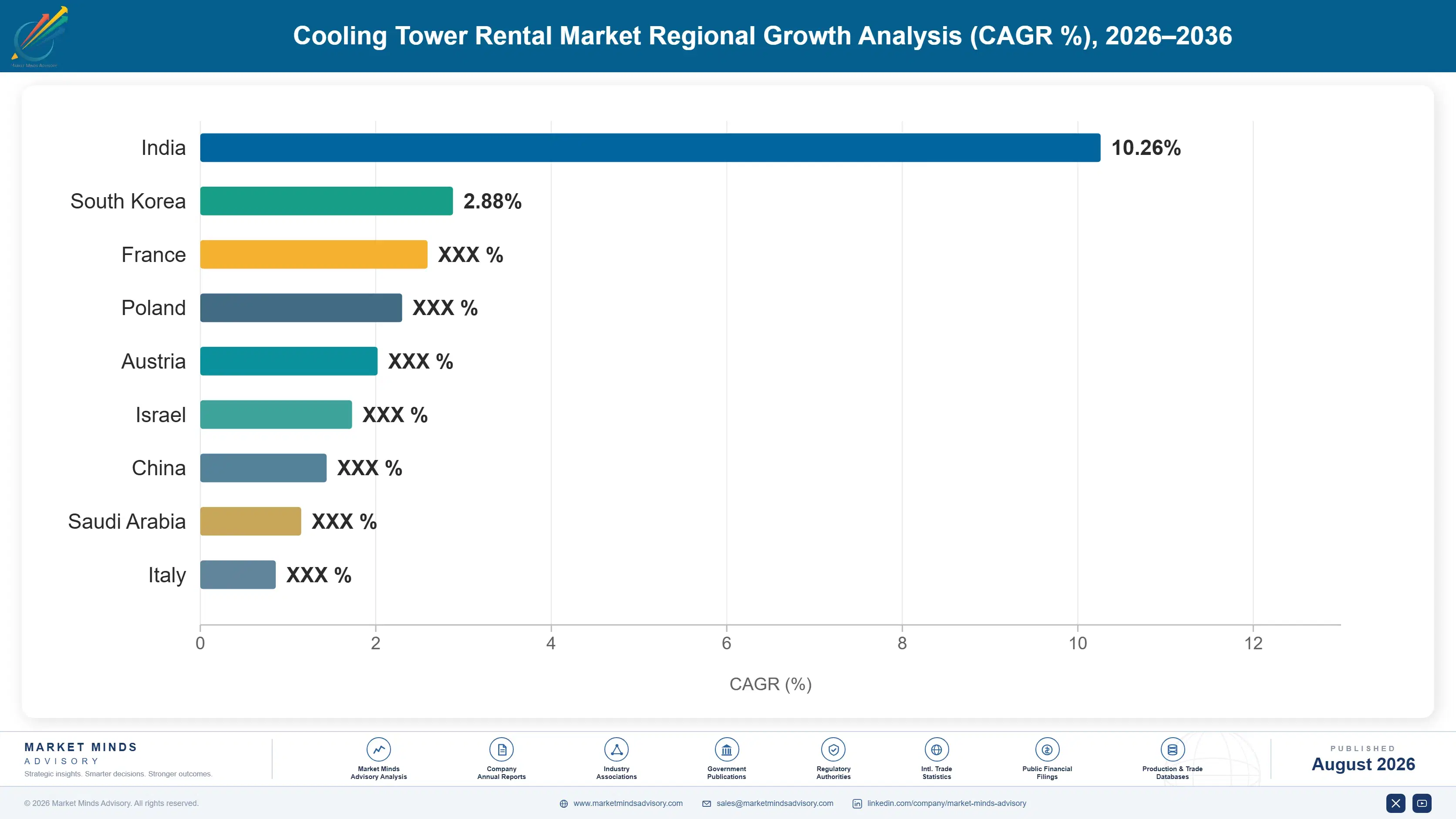
India: 9.6% CAGR
Fastest Growth Region
South Asia and Pacific: 8.8% CAGR
Largest Region
North America: 30% of 2025 global value
Market Leaders
Aggreko Limited, United Rentals, Sunbelt Rentals, Carrier Rental Systems, ICS Cool Energy. Source: MMA Analysis based on company annual reports.
Primary Survey
n=3,800 procurement and R&D decision-makers, Q4 2025, six countries
Methodology
Demand-side build-up, cross-validated against public data, 47 expert interviews

Cooling Tower Rental Market Forecast Scenarios

cooling-tower-rental-market-size-forecast-scenario-1787302057372
Between 2020 and 2025 the market grew at a 6.0% historical CAGR, anchored by refinery turnaround demand that held steady even through the pandemic-era maintenance deferrals many other industrial categories experienced. Growth was event-driven rather than continuous: fleets sat idle between contracted outages. Data centre and hybrid unit demand only gained real momentum from 2023 onward.
The base case carries the market to a 6.8% CAGR through 2036 on three mechanisms. First, refinery and petrochemical turnaround schedules keep generating predictable, recurring rental demand that fleet owners can plan capacity against years in advance. Second, data centre construction multiplies temporary cooling needs during commissioning and load-testing phases before permanent chillers come fully online. Third, water permitting restrictions in drought-affected regions push operators toward hybrid and adiabatic rental units rather than standard evaporative towers, a higher-value rental category.
The bull case reaches 8.0% if data centre construction continues accelerating faster than currently modelled, pulling commissioning-phase rental demand forward across a compressed build schedule. The bear case falls to 5.7% if refinery turnaround activity slows as several ageing facilities permanently close, removing a historically reliable and recurring source of rental demand from the fleet utilisation base.

Why Temporary Cooling Became A Planned Budget Line

Three forces converge on temporary cooling capacity at once. Refinery and petrochemical turnaround schedules generate predictable, recurring demand that fleet owners can plan capacity investment against years ahead of time. Data centre construction multiplies commissioning-phase cooling needs before permanent chillers arrive on site. And water permitting restrictions in drought-affected regions push operators toward hybrid and adiabatic units that consume far less makeup water than standard evap
MARKET CONCENTRATIONCR5: 34%Diversified rental majors and specialists split a third of revenue
AVERAGE RENTAL RATEUSD 8,000 to 45,000 per monthPricing spans small packaged units to large field-erected systems
TOP PRODUCING COUNTRY SHAREUSA: 24% of fleet capacityGulf Coast turnaround density concentrates fleet assets regionally
FLEET UTILISATION RATE62 to 70%Seasonal turnaround scheduling drives meaningful utilisation swings annually
INPUT COST SHARE25 to 32% of COGSSteel and fill media dominate fleet acquisition cost spending
AVERAGE RENTAL DURATION6 to 16 weeksTurnaround-linked contracts run longer than emergency dispatch jobs
Commercially, the market behaves like specialised industrial infrastructure rather than generic equipment rental. Buyers specify by thermal duty, water chemistry compatibility, and noise restrictions rather than by price alone, because an undersized unit during a live turnaround can extend downtime that costs far more than the entire rental fee. That specification discipline protects margin for fleet owners with genuine thermal engineering depth and keeps generic equipment rental generalists from moving into technically demanding turnaround contracts.
Over the next decade, water efficiency becomes the real differentiator. Hybrid and adiabatic units are closing the utilisation gap with standard mechanical-draft towers as permitting authorities tighten water-use restrictions. Fleet owners that invest in hybrid capacity now, rather than standard towers alone, will capture the water-stressed regional contracts that increasingly dominate new turnaround and data centre business.
"Nobody plans a turnaround around the cooling tower until the year they cannot get one, and that year is arriving faster than most operators expect as fleets in the Gulf Coast book out further in advance every season."
Director, Industrial Rental and Process Cooling Practice · MMA Industrial Equipm

Market Trends

Water Permitting Restrictions Push Fleets Toward Hybrid Units

Water-stressed jurisdictions across the American Southwest, parts of southern Europe, and expanding regions of India now require documented water-use assessments before approving even a temporary evaporative cooling installation, a permitting step that can add weeks to project timelines for standard mechanical-draft towers. Hybrid and adiabatic units, which combine dry and wet cooling modes to cut makeup water consumption by more than half compared with conventional towers, increasingly clear these permitting reviews faster because reviewers already recognise the reduced water-use profile. Fleet owners including Aggreko and ICS Cool Energy have expanded hybrid unit inventory specifically to serve these faster-clearing, higher-margin contracts.
Market Impact: Recurs every 3-5 years per unit

Data Centre Commissioning Multiplies Temporary Cooling Demand

Hyperscale and colocation data centre operators increasingly rent temporary cooling capacity during construction commissioning and load-testing phases, when permanent chiller and cooling tower systems are not yet fully operational but IT load testing must proceed on schedule. A single large data centre commissioning project can require several megawatts of temporary cooling capacity for weeks or months before permanent equipment passes final acceptance testing. United Rentals and Carrier Rental Systems have both built dedicated data centre account teams specifically to capture this commissioning-phase rental window, which recurs at every new facility a hyperscaler builds.
Market Impact: Adds 2-5 MW demand per site

Market Opportunities and Growth Drivers

Refinery Turnaround Schedules Generate Predictable Recurring Demand

Refineries and petrochemical plants schedule major turnarounds on multi-year cycles, typically every three to five years per unit, and every turnaround requires temporary cooling capacity to maintain process cooling while permanent towers are inspected, repaired, or replaced. That scheduling predictability lets fleet owners book capacity against confirmed turnaround calendars years in advance, unlike most rental categories that depend on unplanned breakdowns for demand. Gulf Coast refining capacity generates a dense, overlapping calendar of turnarounds that keeps regional fleets running near full utilisation for extended stretches, and operators increasingly negotiate multi-year framework agreements guaranteeing availability across their full schedule.
Market Impact: Raises peak-season rates 20-30%

Data Centre Construction Multiplies Commissioning-Phase Rental Windows

Global data centre construction has accelerated sharply as cloud and artificial intelligence workloads expand, and every new facility needs temporary cooling capacity during the commissioning window between building completion and permanent chiller acceptance testing. Developers increasingly build temporary cooling into their construction schedule as a standard line item rather than an emergency contingency, since a delayed IT load test because of insufficient cooling capacity can push a facility's revenue-generating go-live date back by weeks. That shift has turned data centre construction into a recurring, forecastable demand channel that several large fleet owners now staff for specifically.
Market Impact: Adds 2-4 weeks to remote mobilisati

Market Restraints and Challenges

Fleet Availability Bottlenecks During Overlapping Turnaround Seasons

Spring and fall turnaround seasons concentrate refinery maintenance into narrow windows, and when multiple large turnarounds overlap regionally, fleet owners run short of the largest field-erected units precisely when demand peaks, the root cause being that building additional fleet inventory requires lead times of many months that cannot be compressed for a sudden spike. That scarcity forces operators to book a year ahead or pay premium rates for last-minute availability, straining planning at smaller refiners without dedicated turnaround teams. Larger fleet owners respond by pre-positioning units ahead of known seasons and offering framework agreements that lock in capacity early.
Market Impact: Cuts makeup water use over 50%

Transport And Crane Logistics Limit Field-Erected Deployment Speed

Large field-erected temporary cooling towers require oversized-load trucking permits and heavy crane mobilisation that can take weeks to arrange in regions with limited specialised transport infrastructure, the root cause being that few trucking and crane operators maintain equipment capable of handling the largest rental units on short notice. That bottleneck is most acute in remote industrial regions and during emergency dispatch situations where a plant cannot wait for standard scheduling lead times. Fleet owners are responding by pre-qualifying regional transport partners ahead of turnaround season and by expanding smaller modular units that require standard trucking rather than specialised logistics.
Market Impact: Adds 4-8 weeks of rental
3 additional market trends, 3 additional growth drivers, and 2 additional restraints and challenges are covered in the full report. Contact sales@marketmindsadvisory.com to access the complete intelligence.

Segment CAGR and Growth Architecture

Segmentation follows rental solution type, the single commercial logic that determines deployment speed, water consumption, and contract structure. Modular packaged units, field-erected systems, emergency rapid-response fleets, long-term lease arrangements, hybrid and adiabatic units, and ancillary pump and piping packages each serve a genuinely quite distinct operational need and are evaluated consistently throughout this report.
cooling-tower-rental-market-market-share-analysis-1787302057901

Hybrid and Adiabatic Rental Units

Hybrid and adiabatic rental units grow fastest at 10.5%, about 1.54 times the market's 6.8% overall rate, as water permitting restrictions in drought-affected regions push operators toward equipment that cuts makeup water consumption by more than half compared with conventional evaporative towers. These units combine dry and wet cooling modes, switching automatically based on ambient conditions and water availability, which lets operators maintain thermal performance while meeting increasingly strict water-use permitting requirements. Aggreko and ICS Cool Energy have both expanded hybrid inventory specifically to serve permitting-constrained regions where standard towers face slower approval or outright water-use restrictions. Adoption is concentrated first in the American Southwest and southern Europe, spreading into South Asia as Indian water authorities tighten permitting.
CAGR 10.5%

Emergency Rapid-Response Rental Fleets

Emergency rapid-response rental fleets grow second-fastest at 9.0%, driven by operators increasingly building emergency cooling access into their risk management planning rather than scrambling to locate available equipment only after an unplanned outage begins. Rather than the standard multi-week booking lead time for planned turnarounds, these fleets maintain pre-positioned units and dedicated logistics partnerships that guarantee deployment within days of a confirmed emergency, a capability that commands a meaningful premium over standard planned rental rates. United Rentals and Sunbelt Rentals have both expanded regional pre-positioning specifically to capture this faster-growing, premium-priced emergency segment. Adoption is fastest among power generation and continuous-process manufacturing operators where unplanned downtime cost per hour is highest.
CAGR 9.0%
Full segment breakdown across 6 segments available in the complete report.

Regional Architecture and Country Demand Map

Global demand concentrates where turnaround density and data centre construction run deepest. North America leads on Gulf Coast refining density, East Asia follows on data centre and manufacturing expansion, and Western Europe trails both despite a mature industrial base. South Asia and Pacific is closing the gap fastest.

North America

The United States Gulf Coast anchors regional demand through the densest concentration of refining and petrochemical capacity anywhere in the world, generating an overlapping calendar of turnarounds that keeps regional fleets running near full utilisation across most of the year. Data centre construction across Texas, Virginia, and the Pacific Northwest adds a fast-growing second demand layer, with hyperscale operators increasingly booking commissioning-phase cooling months ahead of building completion. United Rentals and Aggreko both hold deep incumbency in North American industrial rental contracts, bundling cooling into wider fluid and climate-control fleet relationships. Canada contributes a smaller layer through oil sands processing and mining operations. Growth of 7.8% tracks turnaround and data centre construction pace more than any single seasonal event.
Share: 30% | CAGR: 7.8% (2026 to 2036)

Western Europe

Germany, France, and the Netherlands anchor demand through established refining and chemical processing capacity that requires regular turnaround-linked temporary cooling, though several ageing refineries have closed permanently in recent years, capping the region's underlying growth. ICS Cool Energy and Andrews Sykes both hold genuine home-market advantage across European turnaround contracts, competing on technical depth against larger diversified rental generalists. Water permitting has tightened noticeably in southern member states, pushing operators toward hybrid units even where mandates remain less strict than in parts of the American Southwest. Growth of 5.3% reflects capacity closures directly, sitting below the global rate despite the region's genuinely deep industrial base. Poland adds a smaller adjacent demand layer, though at a scale below Germany's base.
Share: 20% | CAGR: 5.3% (2026 to 2036)
Regional intelligence for 5 additional markets available in the complete report: East Asia, South Asia and Pacific, Latin America, Middle East and Africa, Eastern Europe. Contact sales@marketmindsadvisory.com.
cooling-tower-rental-market-country-cagr-analysis-1787302058427

Where Temporary Cooling Fleet Owners Can Defend Margin

Rental budgets are shifting earlier into turnaround and construction planning cycles and toward hybrid units that clear permitting faster. The four levers below capture revenue before a peak season begins rather than during a scramble, and each rewards fleet owners who can prove availability credibly across a customer's full multi-site portfolio. That shift rewards owners proving availability early.

Sell Multi-Year Framework Agreements Ahead Of Turnaround Seasons

Refiners increasingly want guaranteed fleet access locked in years before a confirmed turnaround date rather than competing for available capacity during a seasonal crunch, when premium rates apply and preferred equipment may already be booked elsewhere. Fleet owners that sell multi-year framework agreements covering a customer's full turnaround calendar capture recurring revenue that a single-event rental never provides, and framework customers rarely shop competitively once the relationship is established. Aggreko reports that framework agreement customers generate order values roughly 25% higher over a multi-year horizon than comparable one-off turnaround rentals booked individually.
Market Impact: Lifts multi-year framework contract

Expand Hybrid Unit Inventory For Water-Stressed Regions

Standard evaporative towers increasingly face slower permitting or outright water-use restrictions in drought-affected jurisdictions, while hybrid and adiabatic units clear the same review process faster because they consume far less makeup water. Fleet owners that expand hybrid inventory ahead of demand capture the fastest-growing, highest-margin rental category before competitors catch up, and early movers in a given region often become the default choice once local permitting authorities recognise their track record. ICS Cool Energy has reported utilisation on hybrid units running 12 to 18% above its standard fleet average in permitting-constrained markets.
Market Impact: Runs fleet utilisation 12-18% above

Build Dedicated Data Centre Commissioning Account Teams

Hyperscale data centre operators need temporary cooling coordinated precisely against a construction schedule that shifts constantly, and generalist rental account managers unfamiliar with data centre commissioning timelines struggle to keep pace with that coordination burden. Fleet owners that build dedicated data centre account teams capture repeat business across every new facility a hyperscaler builds, since the customer relationship compounds project after project rather than resetting with each new site. Carrier Rental Systems has pursued exactly this structure since 2023, converting single-site wins into standing multi-site commissioning relationships. That coordination advantage compounds with every additional facility a hyperscaler builds over time.
Market Impact: Secures repeat orders across 10+ ne

Pre-Position Fleet Assets Ahead Of Known Seasonal Demand

Turnaround seasons are predictable years in advance, yet fleet owners that fail to pre-position equipment regionally still lose bids to competitors who can mobilise faster once the seasonal crunch arrives and transport logistics tighten considerably. Positioning units near known turnaround-dense regions before the season begins captures premium last-minute bookings that reactive fleet owners cannot fulfil in time, and it reduces the oversized-load transport risk that delays deployment for competitors starting from farther away. United Rentals has expanded regional staging yards specifically along the Gulf Coast to capture this advantage. That advantage has cut mobilisation time by roughly 40%.
Market Impact: Cuts fleet mobilisation time by rou

Who Controls the Margin Pool

Concentration sits at CR5 34%, moderate for a category split between diversified equipment rental majors and specialist temporary cooling providers. Aggreko and United Rentals lead on fleet breadth, bundling cooling into wider industrial rental relationships, while the gap to specialists like ICS Cool Energy and Andrews Sykes is more about reach than depth. All participants are assessed on one consistent basis, temporary cooling rental revenue.
Current competitive activity runs across three dimensions. Fleet investment concentrates on hybrid and adiabatic units to capture water-permitting-constrained contracts. Account structure focuses on dedicated data centre and multi-year framework relationships rather than one-off site rentals. And logistics investment centres on regional pre-positioning ahead of known turnaround seasons, a shift that rewards operators with genuine multi-region staging capability.

Emerging pressure comes from regional specialists in East Asia and South Asia scaling behind local data centre and refining buildout, winning price-sensitive standard unit business that incumbents once assumed was theirs. Rankings will shift toward owners who combine hybrid capacity with proven multi-site delivery, since that is what large refiners now specify. Standard-fleet-only operators without a credible hybrid roadmap face the sharpest erosion ahead.
cooling-tower-rental-market-company-positioning-matrix-1787302059021

Competitive Moat and Risk Dimensions

AGGREKO LIMITED

Moat: Global fleet scale and reach

Aggreko operates one of the largest temporary power and cooling fleets globally, giving it the regional staging depth to guarantee availability across multi-country turnaround and emergency contracts that smaller regional specialists cannot realistically match on their own. That scale advantage compounds as customers standardise vendor relationships across their full facility portfolio.
AGGREKO LIMITED

Risk: Premium pricing invites undercutting

Aggreko's scale advantage carries a pricing premium that regional specialists and diversified rental generalists increasingly undercut on standard packaged unit business, particularly in East Asian and South Asian markets where domestic fleet owners have scaled fast enough to compete credibly on price alone. That undercutting pressure is most acute in East Asian and South Asian markets specifically.
UNITED RENTALS

Moat: Bundled fluid solutions platform

United Rentals sells temporary cooling as part of a wider fluid solutions and climate control equipment platform that many industrial customers already rent from for other equipment categories, making it the default choice for customers who prefer a single consolidated rental vendor relationship across multiple equipment types.
UNITED RENTALS

Risk: Thinner specialist thermal expertise

United Rentals's platform breadth sometimes trades off against the deep thermal engineering specialisation that the largest and most technically demanding turnaround projects genuinely require, leaving room for specialist competitors to win the most complex individual contracts on technical merit even where United Rentals holds the broader account relationship.

Players Tracked

Prominent Players

Aggreko Limited
United Rentals
Sunbelt Rentals (Ashtead Group)
Carrier Rental Systems
ICS Cool Energy

Other Key Players

Herc Holdings Inc.
Xylem Rental Solutions
Trane Rental Services (Trane Technologies)
Johnson Controls
Andrews Sykes Group
CoolSys Inc.
SPX Cooling Tech (Marley)
Evapco Inc.
Baltimore Aircoil Company
Delta Cooling Towers Inc.
Thermal Care Inc.
Modine Manufacturing Company
Mee Industries Inc.
Airedale International Air Conditioning
Cooling Tower Depot Inc.

Recent Developments

MAY 2025

United Rentals expands temporary cooling tower fleet

United Rentals announced a significant expansion of its temporary cooling tower and fluid solutions fleet, adding hybrid and adiabatic units to serve water-permitting-constrained regions. This was an organic fleet investment rather than an acquisition, extending United Rentals's coverage into a faster-growing rental category directly. across multiple regions.
Signal: Diversified rental majors are investing in
JANUARY 2025

Aggreko acquires Middle East temporary cooling specialist

Aggreko completed the acquisition of a regional temporary cooling and power specialist serving petrochemical and construction customers across the Gulf states. The deal brought established regional fleet assets and customer relationships in-house, expanding Aggreko's Middle East cooling footprint considerably beyond its prior direct presence. across the Gulf states region.
Signal: Regional acquisitions are becoming the pre
AUGUST 2025

Sunbelt Rentals signs supply agreement with turnaround contractor

Sunbelt Rentals entered a multi-year supply agreement to provide temporary cooling capacity across a major refinery turnaround contractor's full project calendar. The agreement was a commercial supply contract, not a joint venture or equity transaction, covering fleet access across multiple confirmed turnaround dates. through the contractor's full project pipeline.
Signal: Multi-year framework agreements with turna

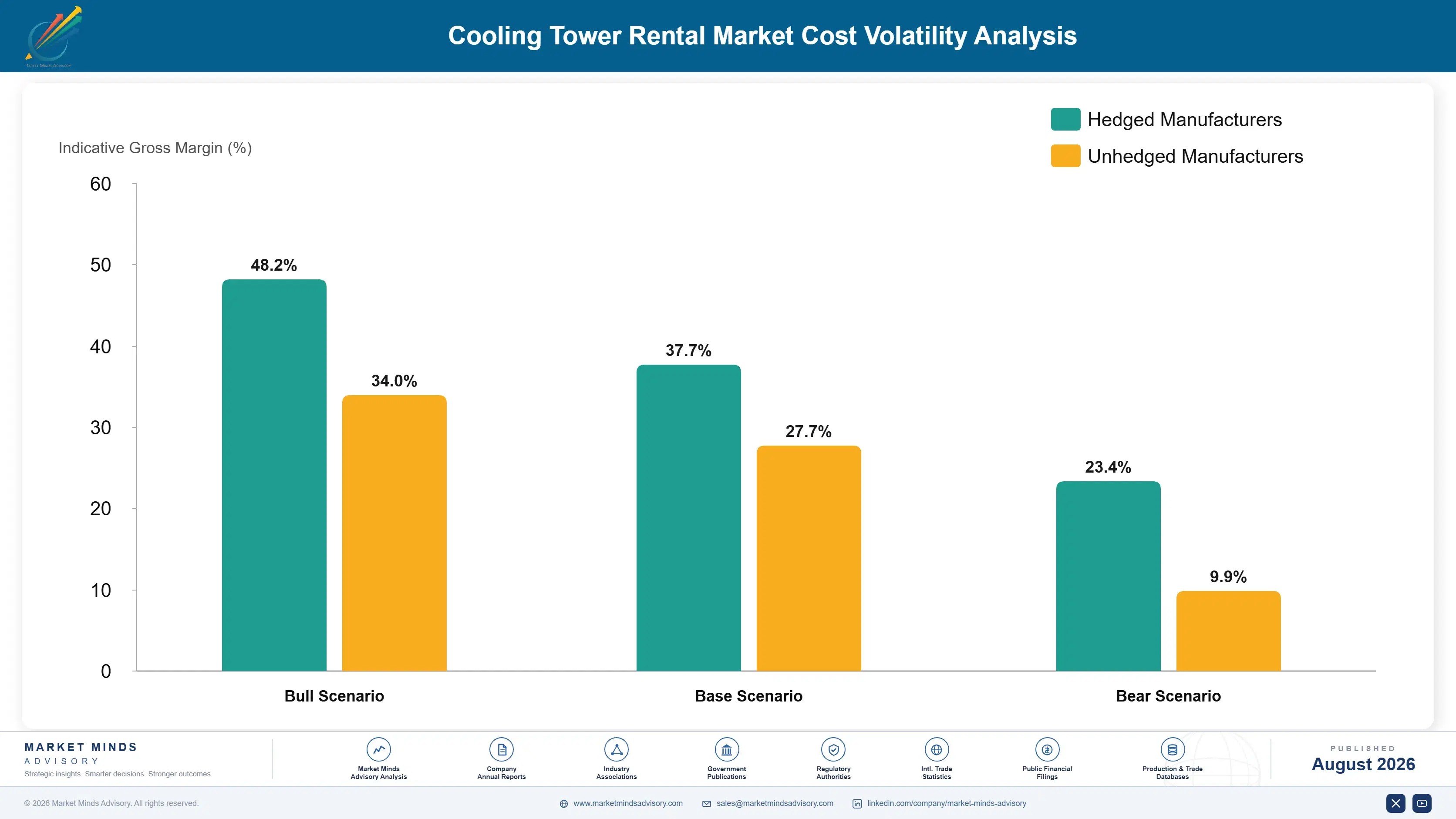
Steel, Fill Media, And Transport Cost Exposure

Steel structural components and PVC or polypropylene fill media used in fleet construction run 25 to 32% of COGS, sourced from domestic steel producers and specialised fill media manufacturers that also supply the permanent cooling tower OEM market. Diesel fuel for transport and pumping equipment adds a further 15 to 20%, with labour and water treatment chemicals accounting for the remainder.
The steel price spike running through 2021 and 2022 hit fleet acquisition cost directly, since new cooling tower units depend on structural steel pricing that moved sharply during that period alongside broader construction material inflation. United Rentals's 2022 Annual Report disclosed elevated fleet acquisition costs, attributing part of the pressure to steel and component inflation. The EIA also recorded diesel prices reaching multi-year highs across 2022, raising transport cost for every mobilisation.

Exposure varies sharply by player type. Large diversified rental majors like Aggreko and United Rentals carry enough purchasing scale to negotiate favourable steel and fill media contracts, while smaller regional specialists depend on spot market purchasing and absorb price spikes directly into thin margins. Geography matters, since operators transporting units long distances to remote sites face higher diesel exposure than fleets serving dense regional corridors.
cooling-tower-rental-market-cost-volatility-analysis-1787302059364

Lock Steel And Fill Media Supply Through Multi-Year Contracts

Fixed-volume, multi-year procurement contracts with steel and fill media suppliers smooth fleet acquisition costs across price cycles. Several fleet owners moved a majority of their steel purchasing onto contract pricing rather than spot markets after the 2021 spike exposed their exposure directly. That shift has meaningfully reduced spot-market exposure across the industry's largest fleet acquisitions.

Hedge Diesel Exposure Against Transport Fuel Futures

Fleet operators running continuous seasonal mobilisation can lock a meaningful share of expected diesel burn through fuel futures and surcharges passed through to customers. This does not eliminate cost volatility but removes the quarter-to-quarter unpredictability that complicates turnaround-season budgeting considerably. That approach trades some upside during price dips for real protection against sharper spikes.

Shift Fleet Mix Toward Hybrid Units To Reduce Water Chemical Cost

Hybrid and adiabatic units require materially less water treatment chemical dosing than standard evaporative towers, giving fleet owners a durable way to cut input cost volatility over time simply by shifting fleet composition as permitting authorities favour lower-water-use equipment. That shift also reduces exposure to future water treatment chemical disruption considerably over the full forecast period.

Portfolio Architecture for Margin Defence

The portfolio splits into three tiers with real margin separation, and the gap between tiers has widened as water permitting turns hybrid capacity into a genuine differentiator rather than an add-on feature. Volume-tier standard packaged units compete on price against generic equipment rental fleets and earn modestly. Premium field-erected and framework-contracted fleets earn considerably more because they solve a genuine capacity-guarantee problem that customers cannot engineer around cheaply.
The tension is between fleet-wide utilisation and per-contract margin. Operators renting dozens of standard units across a broad customer base push hard on unit price, while refiners and hyperscalers standardising on multi-year framework agreements pay for guaranteed availability and technical consistency rather than negotiating down to the last dollar on every booking. Fleet owners serving both buyer types run different sales motions under one brand.

High-value pools concentrate in hybrid and adiabatic units sold with multi-year framework agreements and dedicated account management, where switching cost is highest and price sensitivity lowest. Legacy standard packaged unit rental remains large in volume but persistently thin in margin, as customers treat it as a commodity booking rather than a differentiated one, and few fleet owners change that perception.

Volume / Commodity-Adjacent Tier

Standard packaged units rented into short-term and emergency bookings, priced against generic equipment rental alternatives. Margin stays thin because customers negotiate primarily on daily or weekly rate rather than performance.
Gross Margin: 18-28%

Premium / Certified Tier

Field-erected systems and multi-year framework-contracted fleets sold into refiners and industrial customers standardising turnaround-linked capacity. Customers pay for guaranteed availability rather than for equipment alone. Delivery timelines and technical consistency matter as much as the equipment specification itself.
Gross Margin: 34-46%

Sustainability / Regulatory / Next-Generation Tier

Hybrid and adiabatic units sold into water-permitting-constrained regions and data centre commissioning contracts. Margin reflects both permitting scarcity and premium pricing for reduced water consumption. Few fleet owners currently combine both elements convincingly at meaningful commercial scale.
Gross Margin: 42-56%
cooling-tower-rental-market-portfolio-architecture-1787302060202

Turnaround-Anchored Recurring Fleet Demand

Demand behaves like an annuity once a customer signs a multi-year framework agreement, because turnaround schedules recur every 3 to 5 years per unit and rarely end with a single project. That recurring cycle, plus the underlying emergency and expansion rental demand it does not capture, gives fleet owners a predictable revenue tail well beyond the original contract, converting a one-time booking into an ongoing account relationship across a customer's full asset base.
Adoption depth varies sharply by end-use vertical. Refiners and petrochemical operators adopt fastest and deepest, since turnaround schedules make cooling capacity needs immediately visible years in advance. Data centre developers follow closely behind on commissioning-phase demand. Power generation and manufacturing adopt more selectively, often relying on emergency dispatch rather than planned framework agreements for their less predictable maintenance schedules.

Buyer profiles are shifting generationally. Procurement once sat with plant maintenance managers booking individual rentals; it now increasingly involves turnaround planning and capital project teams who specify multi-year fleet access before a single unit is booked. That shift moves the real purchasing decision earlier into the capital planning cycle and rewards fleet owners who can prove multi-site availability credibly.
cooling-tower-rental-market-end-use-penetration-index-1787302061080

Where Temporary Cooling Value Concentrates

These are among the four positions where our research anticipates prominent divergence between winners and laggards over the coming forecast period. Each is grounded in the demand model, the regulatory perimeter, and the announced capacity pipeline.
01 / HYBRID FLEET POSITIONING

Hybrid Capacity Now Decides Long-Run Category Position

Hybrid and adiabatic rental units are growing at 10.5%, about 1.54 times the market's 6.8% overall rate, and that gap is widening as water permitting authorities tighten review of standard evaporative towers. Fleet owners still anchored on conventional units alone risk losing the fastest-clearing, highest-margin permitting-constrained contracts to rivals with expanded hybrid inventory already staged regionally. The window to build credible hybrid capacity is closing within this forecast period, not the next one, and early movers are already locking in multi-year framework relationships that latecomers will struggle to displace.
02 / FRAMEWORK AGREEMENT STRATEGY

Multi-Year Framework Agreements Are Becoming Table Stakes

Refiners increasingly refuse to compete for capacity during a seasonal turnaround crunch, preferring to lock in guaranteed fleet access years ahead through framework agreements that smaller fleet owners struggle to match at comparable scale. Suppliers who sell multi-year frameworks covering a customer's full turnaround calendar capture recurring revenue and pricing power that a single-event rental simply cannot provide. Those relying purely on spot bookings will find themselves squeezed out of the largest, most predictable turnaround contracts entirely, regardless of their underlying fleet quality or price.
03 / DATA CENTRE CHANNEL GROWTH

Commissioning-Phase Demand Will Outgrow Standard Turnaround Rentals

Data centre construction is generating a recurring, forecastable rental demand channel that scales with every new facility a hyperscaler builds, concentrating real purchasing power in a small number of dedicated commissioning account relationships that generalist rental teams struggle to coordinate effectively. Fleet owners who build dedicated data centre account teams capture repeat business project after project rather than resetting the relationship at every new site. Those without that dedicated coordination capability risk losing this fastest-growing channel entirely to better-organised, more responsive competitors.
04 / REGIONAL FLEET POSITIONING

East Asian And South Asian Scale Will Keep Pressuring Global Pricing

China and India's expanding data centre and refining buildout has scaled domestic fleet owners fast enough to win price-sensitive standard packaged unit tenders that global incumbents once assumed were theirs by default, and that pricing pressure is starting to spread across broader regional procurement decisions as well. Fleet owners competing purely on price against fast-scaling regional entrants will struggle to hold margin over any meaningful time horizon. The more durable response is competing on hybrid capacity and framework depth, categories where regional entrants still visibly lag behind global incumbents.

Engagement Snapshot From the Field

A live engagement with an industry participant carrying material or product regulatory and market exposure ahead of a defining policy shift, showing how our research translates into a defensible multi-year portfolio strategy.
MARKET MINDS ADVISORY · CLIENT ENGAGEMENT SUMMARY
Cooling Tower Rental Producer Strategic Portfolio Review and Transition Roadmap 2026·Investment Scenario on Cooling Tower Rental Exposure Evaluation 2025-26
CLIENT PROFILE
A Gulf Coast refining operator running three large processing units approached MMA after a previous turnaround suffered a multi-day extension caused by inadequate temporary cooling capacity. The client reported annual refining throughput revenue near USD 6.2 billion, with unplanned turnaround extensions costing several million dollars per day in lost production capacity (client-reported, unverified by MMA). Leadership wanted a repeatable capacity planning process before the next scheduled turnaround.
STRATEGIC CHALLENGE
The client had historically booked temporary cooling capacity roughly two months before each turnaround, well inside the typical booking window for guaranteed large-unit availability during peak Gulf Coast turnaround season. The previous extension traced directly to a fleet owner substituting smaller units after the client's preferred large field-erected system was already committed elsewhere. The board wanted assurance it would not repeat.
MMA APPROACH
MMA benchmarked the client's booking timeline against regional fleet availability patterns across the full Gulf Coast turnaround calendar, identifying exactly when competing refiners typically locked in the largest field-erected units. We modelled the cost of a multi-year framework agreement against continuing with individual event-by-event bookings, and assessed three fleet owner candidates on regional staging depth and framework contract terms specifically.
KEY FINDINGS
  1. The client's two-month booking window sat well inside the window when the largest field-erected units were already committed to competitors who had booked six months or more in advance.
  2. A multi-year framework agreement covering the client's full three-unit turnaround calendar priced below the aggregate cost of individual bookings once regional staging and mobilisation savings were included.
  3. Two of three fleet owners evaluated could guarantee large-unit availability across the client's full calendar; the third could not commit capacity that far in advance regardless of price offered.
  4. Formalising the framework agreement shortened the client's internal turnaround planning cycle by several weeks, since capacity no longer needed re-confirmation ahead of each individual event (client-reported, unverified by MMA).
CLIENT PROFILE
A Gulf Coast refining operator running three large processing units approached MMA after a previous turnaround suffered a multi-day extension caused by inadequate temporary cooling capacity. The client reported annual refining throughput revenue near USD 6.2 billion, with unplanned turnaround extensions costing several million dollars per day in lost production capacity (client-reported, unverified by MMA). Leadership wanted a repeatable capacity planning process before the next scheduled turnaround.
STRATEGIC CHALLENGE
The client had historically booked temporary cooling capacity roughly two months before each turnaround, well inside the typical booking window for guaranteed large-unit availability during peak Gulf Coast turnaround season. The previous extension traced directly to a fleet owner substituting smaller units after the client's preferred large field-erected system was already committed elsewhere. The board wanted assurance it would not repeat.
MMA APPROACH
MMA benchmarked the client's booking timeline against regional fleet availability patterns across the full Gulf Coast turnaround calendar, identifying exactly when competing refiners typically locked in the largest field-erected units. We modelled the cost of a multi-year framework agreement against continuing with individual event-by-event bookings, and assessed three fleet owner candidates on regional staging depth and framework contract terms specifically.
KEY FINDINGS
  1. The client's two-month booking window sat well inside the window when the largest field-erected units were already committed to competitors who had booked six months or more in advance.
  2. A multi-year framework agreement covering the client's full three-unit turnaround calendar priced below the aggregate cost of individual bookings once regional staging and mobilisation savings were included.
  3. Two of three fleet owners evaluated could guarantee large-unit availability across the client's full calendar; the third could not commit capacity that far in advance regardless of price offered.
  4. Formalising the framework agreement shortened the client's internal turnaround planning cycle by several weeks, since capacity no longer needed re-confirmation ahead of each individual event (client-reported, unverified by MMA).
RECOMMENDED STRATEGY
Phase 1: Phase 1 (0 to 2 months): Negotiate a multi-year framework agreement covering all three units' confirmed turnaround calendar with a fleet owner offering guaranteed large-unit availability. Phase 2: Phase 2 (2 to 6 months): Formalise a standard booking timeline requiring capacity confirmation at least six months ahead of each scheduled turnaround. Phase 3: Phase 3 (6 to 24 months): Review framework performance against each completed turnaround and renegotiate terms ahead of the agreement's renewal date.
OUTCOME
The client signed a three-year framework agreement and completed its next scheduled turnaround without any cooling-related extension, avoiding a reported repeat of the prior multi-day delay. The formalised booking timeline has since been adopted across the client's broader maintenance planning function beyond just cooling equipment (client-reported, unverified by MMA).

Frequently Asked Questions

Foundational context covering the market sizes, CAGR, scope, country, region and competition that inform every finding below. This section is provided to cover basics and most often pre-purchase conversations, answered from the MMA Primary Research Dataset.

What is the current size of the Cooling Tower Rental Market?

The market was valued at USD 1.4 billion in 2025. Demand is concentrated in refinery turnarounds and data centre commissioning, where downtime cost dwarfs the rental fee.

How large will the Cooling Tower Rental Market be by 2036?

The market is projected to reach USD 2.90 billion by 2036, an expansion multiple of 1.93 times its 2026 value. Hybrid units and data centre demand drive most of that growth.

What is the CAGR for the Cooling Tower Rental Market 2026 to 2036?

The base case CAGR is 6.8%, with a bull case of 8.0% and a bear case of 5.7%. The range reflects uncertainty around refinery closures and data centre build pace.

Which segment is growing fastest?

Hybrid and adiabatic rental units grow fastest at 10.5%, about 1.54 times the overall market rate. Water permitting restrictions are pushing operators away from standard evaporative towers.

Who are the major companies in the Cooling Tower Rental Market?

Aggreko, United Rentals, Sunbelt Rentals, Carrier Rental Systems, and ICS Cool Energy lead the market. Concentration sits at CR5 34%, moderate for a category split between generalists and specialists.

Which country is growing fastest?

India grows fastest at 9.6%, driven by tightening water permitting and expanding refining capacity. The United States remains the largest market by fleet capacity and revenue.

Report Segmentation Architecture

The full report scope spans multiple orthogonal segmentation dimensions, with cross-tabulated demand data provided for each dimension pair. Coverage extends further to regional breakdowns, trend trajectories, and the competitive detail needed to support segment-level decision-making.

By Rental Solution Type

  • Modular Packaged Rental Units
  • Field-Erected Temporary Cooling Towers
  • Emergency Rapid-Response Rental Fleets
  • Long-Term Lease Cooling Systems
  • Hybrid and Adiabatic Rental Units
  • Ancillary Pump and Piping Rental Packages

By End-Use Industry

  • Refining and Petrochemicals
  • Power Generation
  • Data Centres and Colocation
  • Mining and Metals Processing
  • Food and Beverage Manufacturing

By Commercial Dimension

  • Turnaround and Planned Outage Contracts
  • Emergency Dispatch Bookings
  • Multi-Year Framework Agreements
  • Commissioning and Construction-Phase Rentals

By Region

  • North America
  • Western Europe
  • East Asia
  • South Asia and Pacific
  • Latin America
  • Middle East and Africa
  • Eastern Europe

Scope, Methodology, and Coverage

Every figure in this report is reproducible from documented input assumptions. The scope below maps the historical period, the forecast horizon, the segmentation dimensions, and the countries covered, alongside the underlying primary and qualitative methodology.
Historical Period
2020 to 2025
Forecast Period
2026 to 2036
Base Year
2025 (USD billions; MMA Primary Research Dataset, August 2026)
Market Definition
The cooling tower rental market comprises the short-term and long-term lease of packaged, field-erected, and hybrid cooling towers, together with the delivery, installation, and technician services bundled into a rental contract, for temporary process cooling across power generation, refining, petrochemicals, data centres, and manufacturing. Permanent cooling tower equipment sales are excluded, as is general HVAC repair and maintenance service not tied to a rented temporary cooling unit.
Quantitative Units
USD billions (current prices); rented fleet capacity in tonnes of refrigeration and contract-weeks where applicable
Segmentation Dimensions
By Rental Solution Type; By End-Use Industry; By Commercial Dimension; By Region
Regions Covered
North America, Western Europe, East Asia, South Asia and Pacific, Latin America, Middle East and Africa, Eastern Europe
Countries Covered
USA, China, Germany, France, UK, Japan, South Korea, India, Australia, Canada, Brazil, Mexico, Indonesia, Vietnam, Thailand, Malaysia, UAE, Saudi Arabia, South Africa, Nigeria, Turkey, Poland, Netherlands, Italy, Spain, Sweden, Switzerland, Argentina, Colombia, Singapore, and additional markets relevant to this sector
Key Companies Profiled
Aggreko Limited, United Rentals, Sunbelt Rentals (Ashtead Group), Carrier Rental Systems, ICS Cool Energy, Herc Holdings Inc., Xylem Rental Solutions, Trane Rental Services (Trane Technologies), Johnson Controls, Andrews Sykes Group, CoolSys Inc., SPX Cooling Tech (Marley), Evapco Inc., Baltimore Aircoil Company, Delta Cooling Towers Inc., Thermal Care Inc., Modine Manufacturing Company, Mee Industries Inc., Airedale International Air Conditioning, Cooling Tower Depot Inc.
Quantitative Methodology
Primary survey, n=3,800 respondents, Q4 2025, six countries; demand-side model with trade association cross-validation
Qualitative Methodology
47 expert interviews, Q4 2025; applied to validate demand model assumptions, identify emerging dynamics, and assess competitive positioning
Report Format
PDF and XLSX data workbook (Word format preview document)
Publisher
Market Minds Advisory
Report Code
MMA-2026-CON-103
Published
August 2026
Contact
sales@marketmindsadvisory.com | www.marketmindsadvisory.com

Purchase the full Cooling Tower Rental Market Report (2026 to 2036).

The full MMA Cooling Tower Rental report sizes the market across six rental solution types, five end-use industries, four commercial dimensions, and seven regions through 2036. It profiles twenty participants on a consistent temporary cooling rental revenue basis, scoring each on fleet breadth, hybrid capacity, and multi-site framework delivery capability. Scenario models quantify how refinery turnaround scheduling, data centre construction pace, and regional water permitting move both demand and realised rental pricing. The report also includes delivered-cost modelling by rental solution type and a framework-agreement benchmarking tool built for procurement, turnaround planning, and capital project teams.
Rental solution type cost and utilisation benchmarking
Water permitting exposure comparison by region
Turnaround calendar and framework agreement tracker
Data centre commissioning demand forecasting model
Component and fuel supply chain risk screen
Regional fleet staging and mobilisation cost model

Built For The People Who Decide

From boardroom strategy to bench-side execution, this report is read cover-to-cover by leaders shaping the next decade of their industry, turning demand scenarios, market dynamics and valuation benchmarks into decisions.
CXOs/ Presidents/ VPs/ Managers
M&A and Corporate Development
Strategy Teams and R&D Heads
Procurement and Product Directors
Regulatory and Compliance Leaders
Investor Relations and Equity Analysts