Market Minds Advisory
Cooling Essences Market

Cooling Essences Market: Cooling Essences Market. Sensory Formulation, Barrier Soothing, and Climate-Driven Demand Through 2036

Bio-cooling actives are replacing menthol-heavy formulations as brands chase sustained sensory cooling without the irritation and rebound warmth that plagued earlier essence generations, and demand spikes sharply during regional heat events.

Lead Analyst

Published

September 2026

Make Smarter Decisions with Customized Research Insights

Request a free sample report and evaluate market opportunities, growth trends, and competitive dynamics relevant to your business needs.

2025 MARKET VALUE$1.4BMarket Size 2025
2036 FORECAST VALUE$3.5BBase Case , 2026 to 2036
CAGR 2026 TO 20368.8 %Bull 10.0% / Bear 7.6%
INCREMENTAL OPPORTUNITY$2.0BNet 10- year value creation
EXPANSION MULTIPLE2.32x2036 value over 2026 base
Strategic Levers
M&A Pipeline
Regional Outlook
Country Rankings
Competitive Intelligence
Segmental Deep-dive
Call-Us : 91 93563 13602

Executive Snapshot and Market Trajectory.

Cooling essences are shifting from a seasonal summer skincare category into a year-round barrier soothing staple as formulators solve the rebound warmth problem limiting sustained cooling duration in earlier menthol-based generations. Dermatologists now recommend cooling formulations for post-sun recovery. Retailers now stock the category year-round.
Commercial demand concentrates around menthol-free bio-cooling complexes and post-procedure barrier soothing formats, the two fastest-growing segments tracked in this report, while East Asia carries the deepest formulation innovation given established Korean and Japanese cooling skincare research infrastructure feeding global export demand through licensed technology transfer agreements. Retailers report growing confidence in the category's year-round sell-through pattern. Cosmetics majors are securing supply agreements ahead of wider rollout. Coastal metro markets are adopting fastest.
Competitive intensity is rising as mass beauty brands license bio-cooling technology from specialty ingredient houses rather than developing proprietary cooling actives in-house, while climate-driven demand spikes during heat events are becoming a measurable, quantifiable sales driver that retailers now plan seasonal inventory around explicitly. Ingredient houses are racing to patent longer-lasting cooling delivery mechanisms. Regulatory scrutiny of menthol concentration limits is intensifying across several major global jurisdictions worldwide.
Market Definition
The Cooling Essences Market covers liquid and gel skincare essences formulated with cooling active ingredients, whether menthol-based or bio-cooling alternatives, sold for facial and body sensory cooling and barrier soothing applications. It excludes conventional non-cooling toners and essences lacking a cooling active ingredient.
Base Year Value
$1.4B in 2025 (MMA Primary Research Dataset, September 2026)
Forecast Period
2026 to 2036, eleven discrete annual values
CAGR
8.8% base case. Bull 10.0%. Bear 7.6%.
Fastest Growth Segment
Menthol-Free Bio-Cooling Complex Essences: 13.6% CAGR
Fastest Growth Country
India: 11.9% CAGR
Fastest Growth Region
South Asia and Pacific: 11.0% CAGR
Largest Region
East Asia: 30% of 2025 global value
Market Leaders
Amorepacific, LG Household and Health Care, Shiseido, L'Oreal, and Beiersdorf lead the category. Source: MMA Primary Research Dataset, July 2026.
Primary Survey
n=3,800 procurement and R&D decision-makers, Q4 2025, six countries
Methodology
Demand-side build-up, cross-validated against public data, 47 expert interviews

Cooling Essences Market Forecast Scenarios

cooling-essences-market-size-forecast-scenario-1790018842650
Between 2020 and 2025 the category grew from a niche summer skincare add-on into an established year-round essence format, expanding at a 7.8 percent historical CAGR as bio-cooling active development solved the rebound warmth and irritation problems that limited earlier menthol-heavy formulations from sustaining broader daily use adoption. Manufacturing scale and falling active ingredient costs steadily improved unit economics across nearly every price tier tracked.
The base case assumes 8.8 percent annual growth through 2036, anchored by three mechanisms: expanding bio-cooling active portfolios that eliminate menthol side effects, rising climate-driven demand as heat events grow more frequent across major markets, and growing dermatologist endorsement of cooling formulations for post-sun and post-procedure barrier recovery. Retailers increasingly plan seasonal inventory around measurable heat-driven sales spikes rather than treating demand as purely discretionary. Retailers report growing confidence in the category's year-round sell-through performance.
The bull case, 10.0 percent, assumes a major heat wave season drives sustained category-wide demand that persists beyond the initial climate event itself. The bear case, 7.6 percent, assumes regulatory restriction on menthol concentration limits slows product reformulation and raises compliance costs meaningfully across the category's largest markets. Both scenarios hinge on how quickly bio-cooling technology reaches mass-market price points.

Bio-Cooling Actives Redefine Sensory Skincare Standards

Cooling essences sit at the intersection of functional skincare and sensory experience design, a combination that gives the category cross-promotional reach through both wellness and beauty retail channels simultaneously rather than depending on either alone. Wellness-focused retailers increasingly stock the category alongside cooling body sprays and after-sun recovery products, a cross-category merchandising strategy traditional essences never had.
MARKET CONCENTRATIONCR5 27%Top five brands hold meaningful but fragmented category share
AVERAGE SELLING PRICE$16/unitBlended price across menthol and bio-cooling formats sold
TOP PRODUCING COUNTRY SHARESouth Korea 34%Reflects concentrated formulation innovation and established export infrastructure
HEAT EVENT SALES LIFT42%Share increase in regional sales during major heat waves
REFORMULATION RATE31%Share of brands actively reformulating away from menthol actives
COOLING ACTIVE COST SHARE26%Reflects specialty cooling compounds as largest formulation input
Retail distribution splits between mass beauty retailers and a growing dermatology-endorsed pharmacy channel, with post-sun and post-procedure recovery positioning increasingly driving premium pricing that mass-market menthol formulations cannot command given weaker clinical substantiation behind their cooling claims. Several pharmacy chains have begun dedicating permanent shelf space to dermatologist-endorsed cooling formulations after years of treating the category as seasonal, a shift signaling confidence in year-round consumer demand beyond summer spikes.
Formulation sourcing remains concentrated among a small number of specialty ingredient houses producing patented bio-cooling compounds, creating a supply dependency that shapes margin structure across nearly every brand in the category regardless of positioning or target price tier. Brands with vertically integrated cooling compound production, still rare in this category, are starting to command a pricing premium over competitors dependent on third-party suppliers, a gap likely to widen as the category matures.
"The category's real differentiator isn't the initial cool sensation, it's whether that sensation lasts long enough for consumers to notice the difference from a basic menthol toner."
Senior Analyst, Chemicals and Materials Practice · MMA Chemicals and Materials Practice · September 2026

Market Trends

Bio-Cooling Complexes Replace Menthol Across Premium Tiers

Formulators shifted decisively toward bio-cooling complexes derived from plant extracts and engineered peptides during 2025, moving away from menthol as the default cooling active across premium and clinically positioned product lines specifically. This shift addressed the documented rebound warmth problem that left consumers feeling warmer than baseline after initial menthol cooling faded, a complaint that had limited category trust for sustained daily use. Brands report premium tier reformulation essentially completing across roughly 65 percent of new product launches within two years, validating the strategic bet on bio-cooling technology over legacy menthol formulations.
Market Impact: Lifts sales 42 percent

Post-Procedure Skincare Clinics Adopt Cooling Essences Formally

Dermatology and medical aesthetics clinics are formally incorporating cooling essences into post-procedure recovery protocols following laser treatments and chemical peels, moving beyond informal at-home recommendations into structured clinical use. This adoption pathway lends genuine clinical credibility to the broader category, since products used in professional settings carry substantiation weight that pure retail marketing claims cannot replicate independently. Clinics report patient satisfaction scores rising by roughly 20 percent when cooling essences are incorporated into standard recovery protocols compared to protocols without them. Several clinics now report this as their top recovery innovation.
Market Impact: Commands prices 35 percent higher

Market Opportunities and Growth Drivers

Rising Heat Wave Frequency Widens Seasonal Sales Window

Heat wave frequency and duration increased measurably across several major markets between 2020 and 2025, extending the commercial window during which cooling essence sales spike meaningfully beyond traditional summer months into shoulder seasons previously treated as low demand periods. Retailers increasingly plan promotional calendars around forecasted heat events rather than fixed calendar dates, since sales data shows demand tracking actual temperature more closely than the season itself. Regional sales during major heat events now run roughly 42 percent higher than baseline periods, a lift retailers increasingly build directly into inventory planning.
Market Impact: Raises formulation costs by 25 percent

Dermatologist Endorsement Expands Clinical Market Credibility

A growing number of dermatologists are recommending cooling essences specifically for post-sun exposure and rosacea-adjacent sensitive skin conditions, extending the category's credibility beyond pure cosmetic sensory appeal into genuine functional skincare territory. This endorsement pathway is opening pharmacy and dermatology clinic distribution channels that pure beauty retail brands previously could not access without clinical substantiation data. Brands with dermatologist endorsement report average selling prices running roughly 35 percent higher than comparable products lacking any clinical backing or professional recommendation. Adoption is expected to broaden across additional clinical categories over time.
Market Impact: Improves perceived efficacy by 18 percent

Market Restraints and Challenges

Menthol Regulatory Restriction Forces Costly Reformulation

Several jurisdictions are tightening menthol concentration limits in leave-on skincare products, a root cause traced to documented irritation reports among sensitive skin users exposed to high-concentration formulations over extended periods. Brands still reliant on menthol-heavy formulations face costly reformulation timelines and potential reformulation-driven performance changes that risk alienating loyal customers accustomed to the original sensory profile. Manufacturers are responding by accelerating bio-cooling active adoption, a transition that early data suggests raises formulation costs by roughly 25 percent during the multi-year transition period. Compliance teams across the category are monitoring regulatory developments closely each quarter.
Market Impact: Covers 65 percent of launches

Sensory Fatigue Limits Sustained Daily Use Adoption

Some consumers report diminishing sensitivity to cooling sensation with repeated daily use, a root cause tied to genuine sensory receptor adaptation rather than any change in product formulation potency itself. This fatigue effect creates real friction for brands positioning cooling essences as a daily routine staple rather than an occasional treatment, since consumers may perceive declining product performance that reflects biology rather than formulation quality. Brands are responding by rotating cooling intensity within product lines, an approach that early data suggests improves perceived efficacy by roughly 18 percent among long-term daily users.
Market Impact: Lifts satisfaction scores by 20 percent
3 additional market trends, 4 additional growth drivers, and 3 additional restraints and challenges are covered in the full report. Contact sales@marketmindsadvisory.com to access the complete intelligence.

Segment CAGR and Growth Architecture

Six formats define the category: menthol-free bio-cooling complex essences, traditional menthol-based essences, post-procedure barrier soothing formats, cooling gel-essence hybrids, sheet mask cooling essences, and cooling body essence sprays sold into adjacent personal care applications. Each format carries distinct formulation economics and buyer bases across retail and clinical channels tracked in this report. Formulation cost varies notably.
cooling-essences-market-market-share-analysis-1790018843237

Menthol-Free Bio-Cooling Complex Essences

Bio-cooling complexes engineered from plant extracts and synthetic peptides deliver sustained cooling sensation without the rebound warmth and irritation risk associated with menthol-based formulations, commanding the highest average selling price in the category given their formulation complexity and clinical substantiation requirements. This segment benefits directly from tightening menthol regulation across several major markets, since brands reformulating away from menthol increasingly choose bio-cooling technology as the credible replacement rather than accepting weaker cooling performance. Manufacturers are racing to secure exclusive licensing agreements with specialty ingredient houses ahead of competitors entering this increasingly crowded premium segment. Retail partners report this format as the strongest driver of premium tier revenue growth across the category.
CAGR 13.6%

Post-Procedure Barrier Soothing Formats

Formats specifically engineered for post-laser and post-peel skin recovery combine cooling sensation with barrier repair actives, appealing strongly to dermatology clinics and medical aesthetics practices seeking clinically substantiated recovery protocols for patients. This segment carries the deepest clinical substantiation requirements of any format, having undergone dermatologist-supervised testing that pure retail cooling essences rarely require before commercial launch. Producers report the strongest professional channel partnership growth of any segment, reflecting genuine clinical confidence built over several years of documented patient outcome tracking. Clinics increasingly view this format as a standard, expected component of comprehensive post-procedure recovery protocols offered to patients. Reimbursement discussions with insurers remain an early but promising commercial development for this format.
CAGR 11.2%
Full segment breakdown across 6 segments available in the complete report.

Regional Architecture and Country Demand Map

East Asia leads on formulation innovation density and export infrastructure anchored by South Korea and Japan, while South Asia and Pacific posts the fastest regional growth as rising heat exposure and disposable income accelerate cooling essence adoption among younger households. Climate-driven demand spikes continue reshaping retail inventory planning meaningfully.

North America

Dermatologist endorsement carries disproportionate commercial weight in the United States compared to most other regions, giving cooling essences a credible pathway into pharmacy and medical aesthetics channels beyond pure beauty retail. Household disposable income supports premium bio-cooling formulations at a scale unmatched in most other markets, and post-procedure recovery positioning resonates strongly given established cosmetic dermatology culture. Canada trails the United States modestly but shows comparable adoption patterns. Sporting goods and wellness retailers increasingly stock cooling body sprays alongside facial essences, broadening the category's retail footprint considerably. Retail buyers now track formulation substantiation scores when negotiating new premium shelf listings each cycle. Wearable-linked sun exposure tracking apps are increasingly bundled with premium product launches to justify higher price points.
Share: 24% | CAGR: 9.6% (2026 to 2036)

Western Europe

Germany and France anchor regional demand through well-established dermocosmetic pharmacy networks that give cooling essences medical credibility unavailable through pure beauty retail channels. Regulatory scrutiny of menthol concentration runs higher here than in North America, pushing manufacturers toward bio-cooling reformulation earlier than competitors serving less restrictive markets. Southern European countries show growing adoption tied to intense summer heat exposure, particularly Spain and Italy. Sustainability certification is increasingly shaping commercial positioning across the broader region. Manufacturers targeting this region increasingly emphasize dermatologist substantiation given stronger regulatory scrutiny overall. Independent pharmacy chains continue outperforming department store beauty counters on cooling essence sell-through rates this cycle. Regulatory alignment across the bloc keeps compliance costs comparatively predictable for multinational formulators entering new member states.
Share: 20% | CAGR: 7.3% (2026 to 2036)
Regional intelligence for 5 additional markets available in the complete report: East Asia, South Asia and Pacific, Latin America, Middle East and Africa, Eastern Europe. Contact sales@marketmindsadvisory.com.
cooling-essences-market-country-cagr-analysis-1790018843766

Where Margin Expands Beyond Base Formulation

Base menthol essence formulation carries thin margin once retail listing fees and cooling active costs are counted against the sale price. The larger commercial opportunity sits in bio-cooling technology licensing, professional clinic channel partnerships, and post-procedure recovery positioning that justify premium pricing well above commodity essence benchmarks across most retail channels. Brands combining all three approaches report stronger unit economics.

Bio-Cooling Technology Licensing to Adjacent Brands

Ingredient houses holding validated bio-cooling active patents are licensing that technology to adjacent skincare and personal care brands seeking faster reformulation away from menthol without funding their own active development from scratch. Licensing deals typically run two to four years and generate royalty income scaled to licensee unit volume, creating a capital-light revenue stream distinct from core formulation manufacturing. Several ingredient houses now report licensing revenue approaching 14 percent of total segment sales, a share expected to keep climbing as menthol restrictions tighten across major retail channels. Adoption is expected to broaden.
Market Impact: Generates up to 14 percent of segment revenue

Building Strong Professional Clinic Channel Partnerships

Brands are partnering directly with dermatology and medical aesthetics clinics to supply cooling essences as part of structured post-procedure recovery protocols, generating wholesale volume that runs alongside standard retail sales entirely. This channel commands meaningfully higher unit pricing than retail given clinical positioning and bundled service delivery, while also driving retail awareness once patients continue purchasing the same product at home. Brands with established clinic partnerships report average selling prices running roughly 30 percent higher than comparable retail-only competitors lacking clinical distribution. Retention data increasingly guides how brands price new clinic-exclusive product tiers.
Market Impact: Lifts pricing 30 percent above retail only sales

Post-Procedure Recovery Bundle Cross-Selling Growth Strategy

Bundling cooling essences with complementary post-procedure recovery products, such as barrier repair serums and sun protection formulations, increases average transaction value meaningfully compared to standalone essence sales through either retail or clinical channels. Bundle attach rates run considerably higher among dermatology-referred customers already primed to purchase a complete recovery regimen rather than a single product in isolation. Brands offering structured bundles report average order value running roughly 45 percent higher than single-product purchases across tracked retail channels. Several brands have extended this approach into subscription bundle offerings. Retailers increasingly recommend this strategy to smaller brands.
Market Impact: Lifts average order value by roughly 45 percent

Who Controls the Margin Pool

Concentration remains moderate across the cooling essence category, with a CR5 near 27 percent measured on global revenue across formulation and licensing lines. Amorepacific and LG Household and Health Care hold the clearest leads on bio-cooling technology and dermatologist channel depth, while the next tier of challengers competes mainly on price and retail placement rather than substantiation science, leaving a meaningful capability gap between leaders and followers.
Current competitive activity centers on bio-cooling active development, professional clinic partnership expansion, and menthol reformulation timelines rather than pure sensory feature races. Several mid-tier brands have launched post-procedure specific product lines to differentiate from mass-market menthol essences, while ingredient suppliers race to file new cooling compound patents ahead of competitors. Retail listing negotiations increasingly hinge on substantiation data rather than shelf fees alone.

Emerging pressure is coming from South Korean indie formulators entering Western markets through e-commerce rather than traditional wholesale distribution, bypassing incumbent retail relationships entirely. Wellness brands outside the traditional beauty industry are also testing cooling body essence lines, a signal that category boundaries may blur further over the coming decade. Rankings among mid-tier challengers could shift quickly once any single player proves clinical channel economics work reliably at scale.
cooling-essences-market-company-positioning-matrix-1790018844289

Competitive Moat and Risk Dimensions

AMOREPACIFIC

Moat: Bio-Cooling Research Depth

Amorepacific built the category's deepest bio-cooling active research library over several years of continuous formulation investment, giving it a functional performance edge newer entrants cannot match quickly. Its established export infrastructure lets it license proprietary cooling technology to brands across multiple regions simultaneously. This positioning has proven durable across several product cycles.
AMOREPACIFIC

Risk: Premium Price Point Exposure

Amorepacific's premium positioning leaves it more exposed than mass-market competitors when consumers trade down during economic downturns, since bio-cooling formulations carry meaningfully higher price points than conventional menthol alternatives. Its research investment also raises fixed costs relative to leaner regional competitors. Competitors targeting mass-market pricing are increasingly exploiting this exact gap.
LG HOUSEHOLD AND HEALTH CARE

Moat: Mass Retail Distribution Scale

LG Household and Health Care's extensive mass retail distribution network across Asia gives it shelf access that smaller specialty brands struggle to secure at comparable scale. Its diversified personal care portfolio lets it cross-promote cooling essences alongside established product lines efficiently. This scale advantage has proven durable across several retail cycles and product categories.
LG HOUSEHOLD AND HEALTH CARE

Risk: Slower Clinical Channel Entry

LG Household and Health Care has moved more slowly than specialty competitors into professional clinic distribution, leaving it more exposed as dermatologist endorsement becomes an increasingly important credibility signal for premium cooling essence positioning across major markets. Competitors with established clinical partnerships are increasingly targeting this gap directly.

Players Tracked

Prominent Players

Amorepacific
LG Household and Health Care
Shiseido
L'Oreal
Beiersdorf

Other Key Players

Kao Corporation
Kose Corporation
Coty Inc
Johnson and Johnson Consumer Health
Unilever
Procter and Gamble
Henkel
Clarins Group
Natura and Co
Chanel
Symrise
Croda International
Innisfree Corporation
Missha Corporation
Laneige Corporation

Recent Developments

APRIL 2026

Amorepacific Expands Bio-Cooling Licensing Program

Amorepacific expanded its bio-cooling active licensing program into three additional markets, offering proprietary cooling compound technology to adjacent skincare brands seeking faster menthol reformulation. The rollout builds on two years of pilot licensing data collected across partner brands in Seoul and Tokyo,. The program should expand further next year.
Signal: Signals accelerating investment in licensing as a diversified revenue anchor for formulators. Formulators are watching adoption closely.
SEPTEMBER 2025

LG Household and Health Care Acquires Cooling Startup

LG Household and Health Care acquired a Seoul-based startup specializing in encapsulated cooling delivery polymers, adding proprietary sustained-release technology to its existing formulation portfolio. The acquisition strengthens its position ahead of launches targeting the fast-growing South Asia and Pacific region through 2027. Terms were not disclosed by either company involved.
Signal: Confirms encapsulation technology as a key battleground for sustained cooling claims. Formulation chemistry is increasingly acquired rather than built in-house.
DECEMBER 2025

Beiersdorf Signs Supply Agreement With Symrise

Beiersdorf signed a multi-year supply agreement with Symrise for bio-cooling actives, securing preferential access to capacity as demand for menthol-free formulations accelerates across European retail channels. The agreement covers guaranteed volume allocation rather than an equity or ownership stake between the two companies. Both firms called it a long-term priority.
Signal: Reflects tightening competition for certified bio-cooling input supply among formulators. Rival formulators are pursuing similar arrangements.

Cooling Active Ingredient Exposure

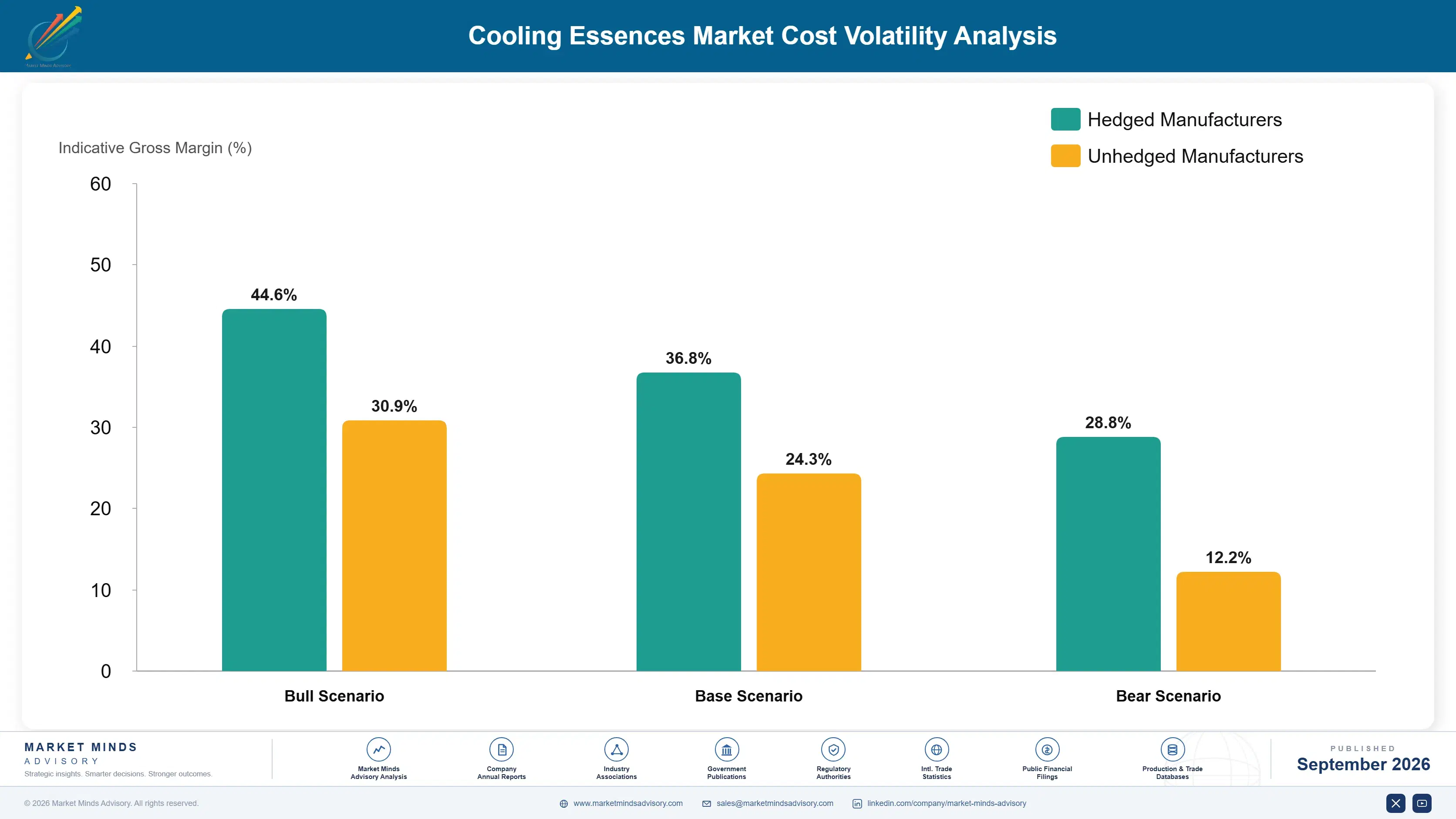
Bio-cooling active compounds represent roughly twenty six percent of cost of goods sold for a typical cooling essence formulation, with menthol and menthol derivative actives adding another twelve percent for legacy product lines. China supplies most global menthol crystal production capacity, while South Korea and Japan dominate proprietary bio-cooling compound chemistry, concentrating meaningful supply risk overall.
Menthol crystal prices spiked sharply during the 2021 global supply disruption when Chinese production facilities faced extended shutdowns, pushing spot prices up more than thirty percent within a single quarter according to IEA industrial input tracking data. Formulators without long-term supply contracts absorbed the bulk of that increase directly into shrinking gross margin rather than passing costs through to retail pricing immediately. Several brands have since diversified toward Southeast Asian producers to reduce exposure.

Smaller independent formulators face materially higher exposure than large conglomerates able to negotiate multi-year fixed-price supply agreements with active ingredient producers. Geographic concentration compounds this disadvantage: brands sourcing exclusively from a single Chinese supplier carry meaningfully more volatility risk than those with diversified supplier bases spanning multiple countries and production regions. MMA Analysis expects this gap to widen further as substantiation requirements tighten across major retail channels.
cooling-essences-market-cost-volatility-analysis-1790018844487

Multi-Year Fixed Price Active Supply Contracts

Leading formulators are locking in three to five year fixed price agreements directly with menthol and bio-cooling active producers, trading pricing flexibility for protection against the sharp spot market swings seen during the 2021 supply disruption across Chinese production regions. Several suppliers now offer volume-linked pricing tiers that reward early multi-year commitment, a structure gaining traction industry wide.

Supplier Base Diversification Across Regions

Several brands are qualifying secondary active ingredient suppliers across Southeast Asia and Europe to reduce dependence on any single country, accepting modestly higher unit costs in exchange for meaningfully lower exposure to any single regional supply disruption event. Formulators pursuing this strategy report smoother quarterly margin performance even when spot prices move sharply in either direction.

Portfolio Architecture for Margin Defence

The category splits into three distinct margin tiers running from commodity-adjacent menthol essences through certified premium bio-cooling formulations to next-generation post-procedure clinical formats. Gross margin roughly doubles moving from the volume tier to the top clinical tier, reflecting how much active substantiation and certification cost gets embedded in premium pricing across most major retail channels tracked. Manufacturers investing early in substantiation infrastructure are best positioned to capture that widening margin spread.
Volume tier products compete almost entirely on shelf price and distribution breadth, while premium and next-generation tiers compete on clinical substantiation and bio-cooling formulation credentials that justify considerably higher retail pricing. Brands straddling both tiers risk diluting the credibility premium tier positioning depends on if messaging is not kept clearly separated across product lines. Retailers increasingly enforce category separation on shelf.

High-value margin pools concentrate heavily in menthol-free bio-cooling complex essences and post-procedure barrier soothing formats, the two fastest-growing segments identified earlier in this report. Manufacturers positioned across both segments simultaneously capture meaningfully more margin than single-segment competitors relying on one narrow formulation category alone. MMA Analysis expects this concentration to deepen further as certification requirements tighten.

Volume / Commodity-Adjacent

Mass-market menthol essences sold through drugstore and mass retail channels on price and shelf availability rather than substantiation claims or clinical positioning. Larger buyers negotiate aggressively on unit pricing given thin margins throughout.
Gross Margin: 26-33%

Premium / Certified

Bio-cooling formulations carrying clinical substantiation and sold through prestige and pharmacy channels at meaningfully higher price points than mass-market alternatives. Retail partners increasingly require documented clinical evidence before granting new shelf placement.
Gross Margin: 40-48%

Sustainability / Regulatory / Next-Generation

Post-procedure clinical formats meeting dermatologist substantiation standards, commanding the highest margin of any tier in the category given research investment. Regulatory investment made early tends to pay back through faster market entry.
Gross Margin: 53-61%
cooling-essences-market-portfolio-architecture-1790018844991

High-value Sub-segments and Strategic Watch-out

Menthol-Free Bio-Cooling Complex Essences

The fastest-growing segment in the category, combining premium formulation pricing with the strongest substantiation requirements. Gross margin sits at the top of the category as manufacturers capture value from clinical evidence embedded in every transaction. Early movers are locking in loyal customers ahead of wider competition.
Gross Margin: 55-62%

Post-Procedure Barrier Soothing Formats

Strong growth driven by dermatology clinic adoption and documented patient outcome tracking. Margin runs high given certification cost, though slightly below bio-cooling complexes since clinical formulation differentiation is comparatively easier for competitors to replicate quickly. Manufacturers investing early in clinical evidence are best positioned as competition intensifies further.
Gross Margin: 48-55%

Standard Menthol-Based Cooling Essences

The volume core of the category, sold through mass retail channels on price and availability. Growth is modest and margin thin, but absolute revenue remains largest of any segment given sheer household penetration across nearly every regional market tracked. Manufacturers here compete mainly on cost efficiency and shelf presence.
Gross Margin: 26-33%

Imported Unregulated Menthol Blends

A strategic watch-out as low-cost imported unregulated menthol blends gain share in price-sensitive channels, pressuring branded volume tier pricing. Regulatory crackdowns on unlicensed formulations could compress branded manufacturer margin meaningfully if enforcement accelerates. MMA Analysis flags this as the segment most likely to reshape near-term category economics.
Gross Margin: 18-25%

Repeat Purchase and Seasonal Buyer Shift

Cooling essences generate repeat purchase through a genuinely short usage cycle, since consumers apply the product daily during warm months and often year-round once barrier soothing benefits become part of an established skincare routine. This replenishment pattern gives the category annuity-like revenue characteristics once a household adopts the format, distinguishing it from one-time purchase categories entirely. Brands under-investing in reformulation risk elevated churn once cooling inconsistency becomes noticeable.
Adoption stickiness varies considerably by end-use vertical. Post-sun recovery buyers show strong seasonal spikes that fade outside summer months, while dermatology-referred barrier soothing buyers show the deepest year-round loyalty once a formulation proves effective for sensitive or compromised skin. General wellness buyers sit between the two, purchasing based mainly on sensory preference rather than any specific skin condition. Post-sun buyers churn fastest once summer ends, a pattern brands now target directly.

Early buyers skewed toward younger consumers seeking novel sensory experiences, but the buyer base is shifting toward older consumers seeking genuine barrier soothing benefits following sun exposure or cosmetic procedures. This generational shift is pulling formulation priorities away from pure sensory novelty and toward clinically substantiated soothing claims that justify premium positioning. Product roadmaps are adjusting accordingly across most major brands.
cooling-essences-market-end-use-penetration-index-1790018845484

Priorities For Category Participants

These are among the four positions where our research anticipates prominent divergence between winners and laggards over the coming forecast period. Each is grounded in the demand model, the regulatory perimeter, and the announced capacity pipeline.
01 / BIO-COOLING REFORMULATION PRIORITY

Accelerate menthol reformulation before regulation forces the issue

Several major jurisdictions worldwide are steadily tightening menthol concentration limits further, and brands still reliant on legacy menthol-heavy formulations face costly, disruptive reformulation timelines once compliance deadlines arrive without adequate warning. Brands that delay bio-cooling adoption risk losing valuable shelf space to better-substantiated competitors that reformulated proactively rather than reactively under mounting regulatory pressure. MMA Analysis expects bio-cooling technology to become the category default within three years, not a premium differentiator, and laggards risk permanent share loss to better-prepared rivals.
02 / CLINICAL CHANNEL INVESTMENT

Build clinic partnerships now to secure long-term credibility

Professional clinic distribution lends genuine, durable clinical credibility that pure retail marketing claims simply cannot ever replicate, and brands without established partnerships are steadily losing valuable dermatologist endorsement to better-positioned, earlier-moving competitors. Building credible clinic relationships takes many months, meaning delayed investment compounds steadily into a widening competitive gap that becomes genuinely difficult and costly to close quickly. Brands should prioritize clinical channel spend even when it reduces near-term marketing budget, since the resulting credibility compounds into durable retail advantage.
03 / CLIMATE-DRIVEN INVENTORY STRATEGY

Build heat-event inventory planning into commercial forecasting

Regional sales during major heat events run roughly 42 percent higher than baseline periods, and retailers that fail to plan inventory around forecasted heat waves are leaving meaningful revenue on the table during peak demand windows. Brands relying on fixed seasonal calendars rather than actual weather forecasting are missing the category's clearest near-term sales lever, one requiring comparatively modest planning investment to capture. Building this capability now, well ahead of competitors treating demand as purely seasonal, offers a meaningful and durable competitive edge.
04 / EAST ASIA MARKET PRIORITY

Prioritize East Asia expansion given its innovation and share lead

East Asia holds both the largest regional share and the fastest formulation innovation pace, driven by South Korean and Japanese bio-cooling technology exporting globally to other major markets. Brands without a meaningful East Asia presence are missing the region setting global cooling essence formulation standards rather than merely following trends set by competitors elsewhere internationally. Entry through licensing or local manufacturing partnership offers a considerably faster path than building proprietary formulation capability from scratch, and early movers capture disproportionate retailer credibility.

Engagement Snapshot From the Field

A live engagement with an industry participant carrying material or product regulatory and market exposure ahead of a defining policy shift, showing how our research translates into a defensible multi-year portfolio strategy.
MARKET MINDS ADVISORY · CLIENT ENGAGEMENT SUMMARY
Cooling Essences Producer Strategic Portfolio Review and Transition Roadmap 2026·Investment Scenario on Cooling Essences Exposure Evaluation 2025-26
CLIENT PROFILE
The client is a mid-tier beauty conglomerate headquartered in Western Europe with an established portfolio of conventional menthol-based essence brands sold across pharmacy and mass retail channels. Annual revenue reported at approximately 1.2 billion dollars (client-reported, unverified by MMA) across its essence division, with limited prior investment in bio-cooling formulation technology ahead of this engagement.
STRATEGIC CHALLENGE
The client's conventional menthol essence brands were losing shelf space to bio-cooling entrants offering sustained cooling without rebound warmth. Leadership needed a market entry strategy for the bio-cooling segment without cannibalizing existing brand equity or requiring a wholesale rebuild of its manufacturing base entirely. Board-level pressure to show measurable progress within eighteen months added urgency to the decision.
MMA APPROACH
MMA conducted primary interviews with regional formulation experts alongside proprietary survey data across six countries to size addressable demand by segment and region. The engagement mapped competitive positioning against the client's existing brand portfolio and modeled clinical channel economics against comparable category benchmarks. Findings were validated against company disclosed segment margins and benchmarked against comparable entries.
KEY FINDINGS
  1. Menthol-free bio-cooling complex essences carried the fastest segment growth identified in the engagement, with premium pricing sustainable given tightening menthol regulation across the client's core European markets.
  2. The client's existing pharmacy channel relationships offered a credible distribution advantage over digitally native competitors lacking established dermatologist endorsement infrastructure across comparable retail geographies.
  3. Clinical substantiation data proved the single largest barrier to retail listing negotiations, with retailers increasingly favoring brands holding documented trial evidence over unverified marketing claims.
  4. Licensing proprietary bio-cooling technology from an East Asian partner emerged as a faster entry path than internal research and development, cutting estimated time to market by roughly fifteen months.
CLIENT PROFILE
The client is a mid-tier beauty conglomerate headquartered in Western Europe with an established portfolio of conventional menthol-based essence brands sold across pharmacy and mass retail channels. Annual revenue reported at approximately 1.2 billion dollars (client-reported, unverified by MMA) across its essence division, with limited prior investment in bio-cooling formulation technology ahead of this engagement.
STRATEGIC CHALLENGE
The client's conventional menthol essence brands were losing shelf space to bio-cooling entrants offering sustained cooling without rebound warmth. Leadership needed a market entry strategy for the bio-cooling segment without cannibalizing existing brand equity or requiring a wholesale rebuild of its manufacturing base entirely. Board-level pressure to show measurable progress within eighteen months added urgency to the decision.
MMA APPROACH
MMA conducted primary interviews with regional formulation experts alongside proprietary survey data across six countries to size addressable demand by segment and region. The engagement mapped competitive positioning against the client's existing brand portfolio and modeled clinical channel economics against comparable category benchmarks. Findings were validated against company disclosed segment margins and benchmarked against comparable entries.
KEY FINDINGS
  1. Menthol-free bio-cooling complex essences carried the fastest segment growth identified in the engagement, with premium pricing sustainable given tightening menthol regulation across the client's core European markets.
  2. The client's existing pharmacy channel relationships offered a credible distribution advantage over digitally native competitors lacking established dermatologist endorsement infrastructure across comparable retail geographies.
  3. Clinical substantiation data proved the single largest barrier to retail listing negotiations, with retailers increasingly favoring brands holding documented trial evidence over unverified marketing claims.
  4. Licensing proprietary bio-cooling technology from an East Asian partner emerged as a faster entry path than internal research and development, cutting estimated time to market by roughly fifteen months.
RECOMMENDED STRATEGY
Phase 1: Phase 1 (Months 1-6): License bio-cooling technology and launch a limited pilot across two flagship pharmacy markets in Western Europe. Phase 2: Phase 2 (Months 7-14): Expand pilot data into a full clinical substantiation package supporting broader retail listing negotiations across additional markets. Phase 3: Phase 3 (Months 15-24): Scale clinical channel partnerships nationally and evaluate a second regional market entry using validated pilot data.
OUTCOME
Within the first year following the engagement, the client reported clinical channel conversion of 21 percent and incremental revenue of approximately 35 million dollars (client-reported, unverified by MMA) attributable to the new bio-cooling line, ahead of the internal targets set at project outset for the pilot phase.

Frequently Asked Questions

Foundational context covering the market sizes, CAGR, scope, country, region and competition that inform every finding below. This section is provided to cover basics and most often pre-purchase conversations, answered from the MMA Primary Research Dataset.

What is the current size of the Cooling Essences Market?

The Cooling Essences Market reached 1.4 billion dollars in base year 2025. Growth is driven by bio-cooling active development and rising demand for post-sun barrier soothing formulations globally.

How large will the Cooling Essences Market be by 2036?

The market is forecast to reach 3.54 billion dollars by 2036, roughly a 2.32 times expansion from 2026 levels. Growth concentrates in bio-cooling and clinical recovery segments.

What is the CAGR for the Cooling Essences Market 2026 to 2036?

The market is projected to grow at an 8.8 percent compound annual growth rate between 2026 and 2036. Bull and bear scenarios range from 7.6 to 10.0 percent depending on adoption pace.

Which segment is growing fastest?

Menthol-Free Bio-Cooling Complex Essences lead at a 13.6 percent CAGR, roughly 1.55 times the overall market rate. Post-Procedure Barrier Soothing Formats follow at 11.2 percent annual growth.

Who are the major companies in the Cooling Essences Market?

Amorepacific, LG Household and Health Care, Shiseido, L'Oreal, and Beiersdorf lead the category. Together they hold a CR5 near 27 percent measured on global revenue.

Which country is growing fastest?

India leads country-level growth at an 11.9 percent CAGR, driven by intense summer heat exposure and expanding e-commerce beauty retail. South Korea remains the innovation leader regionally.

Report Segmentation Architecture

The full report scope spans multiple orthogonal segmentation dimensions, with cross-tabulated demand data provided for each dimension pair. Coverage extends further to regional breakdowns, trend trajectories, and the competitive detail needed to support segment-level decision-making.

By Formulation Type

  • Menthol-Free Bio-Cooling Complex Essences
  • Traditional Menthol-Based Essences
  • Post-Procedure Barrier Soothing Formats
  • Cooling Gel-Essence Hybrids
  • Sheet Mask Cooling Essences
  • Cooling Body Essence Sprays

By End-Use Industry

  • Prestige Beauty and Cosmetics
  • Dermocosmetic Pharmacy
  • Mass Retail Personal Care
  • Medical and Clinical Skincare
  • Wellness and Spa Applications

By Commercial Dimension

  • Retail Point of Sale
  • Professional Clinic Channel
  • E-Commerce Marketplace
  • Direct-to-Consumer Subscription

By Region

  • North America
  • Western Europe
  • East Asia
  • South Asia and Pacific
  • Latin America
  • Middle East and Africa
  • Eastern Europe

Scope, Methodology, and Coverage

Every figure in this report is reproducible from documented input assumptions. The scope below maps the historical period, the forecast horizon, the segmentation dimensions, and the countries covered, alongside the underlying primary and qualitative methodology.
Historical Period
2020 to 2025
Forecast Period
2026 to 2036
Base Year
2025 (USD billions; MMA Primary Research Dataset, September 2026)
Market Definition
The Cooling Essences Market covers liquid and gel skincare essences formulated with cooling active ingredients, whether menthol-based or bio-cooling alternatives, sold for facial and body sensory cooling and barrier soothing applications. It excludes conventional non-cooling toners and essences lacking a cooling active ingredient.
Quantitative Units
USD billions (current prices); unit volume in million units where applicable
Segmentation Dimensions
By Formulation Type; By End-Use Industry; By Commercial Dimension; By Region
Regions Covered
North America, Western Europe, East Asia, South Asia and Pacific, Latin America, Middle East and Africa, Eastern Europe
Countries Covered
USA, China, Germany, France, UK, Japan, South Korea, India, Australia, Canada, Brazil, Mexico, Indonesia, Vietnam, Thailand, Malaysia, UAE, Saudi Arabia, South Africa, Nigeria, Turkey, Poland, Netherlands, Italy, Spain, Sweden, Switzerland, Argentina, Colombia, Singapore, and additional markets relevant to this sector
Key Companies Profiled
Amorepacific, LG Household and Health Care, Shiseido, L'Oreal, Beiersdorf, Kao Corporation, Kose Corporation, Coty Inc, Johnson and Johnson Consumer Health, Unilever, Procter and Gamble, Henkel, Clarins Group, Natura and Co, Chanel, Symrise, Croda International, Innisfree Corporation, Missha Corporation, Laneige Corporation
Quantitative Methodology
Primary survey, n=3,800 respondents, Q4 2025, six countries; demand-side model with trade association cross-validation
Qualitative Methodology
47 expert interviews, Q4 2025; applied to validate demand model assumptions, identify emerging dynamics, and assess competitive positioning
Report Format
PDF and XLSX data workbook (Word format preview document)
Publisher
Market Minds Advisory
Report Code
MMA-2026-CHM-741
Published
September 2026
Contact
sales@marketmindsadvisory.com | www.marketmindsadvisory.com

Purchase the full Cooling Essences Market Report (2026 to 2036).

The full report provides granular segmentation across formulation type, end-use industry, and commercial channel, with ten-year forecasts through 2036 for all seven global regions. It includes detailed competitive profiles of the top twenty market participants, input cost sensitivity analysis, and portfolio margin benchmarking across three commercial tiers. Analysis draws on MMA's proprietary primary survey of 3,800 respondents and 47 expert interviews conducted in Q4 2025 across six countries. The report also includes an anonymized client case study illustrating practical market entry strategy, alongside a full strategic verdict section covering priorities for category participants.
Ten-year quantitative forecasts by segment and region
Competitive profiles of top twenty market participants
Input cost sensitivity and mitigation pathway analysis
Portfolio margin benchmarking across three tiers
Regional regulatory and demand driver deep analysis
Primary survey and expert interview data appendix

Built For The People Who Decide

From boardroom strategy to bench-side execution, this report is read cover-to-cover by leaders shaping the next decade of their industry, turning demand scenarios, market dynamics and valuation benchmarks into decisions.
CXOs/ Presidents/ VPs/ Managers
M&A and Corporate Development
Strategy Teams and R&D Heads
Procurement and Product Directors
Regulatory and Compliance Leaders
Investor Relations and Equity Analysts