Market Minds Advisory
Cooling Agents Market

Cooling Agents Market: Cooling Agents Market: The Oral Nicotine Engine Nobody Names, A Crop Price That Moves Alone and Briefs That Confuse Intensity With Duration, 2026 to 2036

Roughly a quarter of volume now goes to oral nicotine pouches, and almost every supplier deck files it under oral care. Natural menthol meanwhile follows an Indian crop cycle that synthetic supply does not.

Lead Analyst

Published

September 2026

Make Smarter Decisions with Customized Research Insights

Request a free sample report and evaluate market opportunities, growth trends, and competitive dynamics relevant to your business needs.

2025 MARKET VALUE$1.8BMarket Size 2025
2036 FORECAST VALUE$3.9BBase Case , 2026 to 2036
CAGR 2026 TO 20367.4 %Bull 8.6% / Bear 6.2%
INCREMENTAL OPPORTUNITY$2.0BNet 10- year value creation
EXPANSION MULTIPLE2.05x2036 value over 2026 base
Strategic Levers
M&A Pipeline
Regional Outlook
Country Rankings
Competitive Intelligence
Segmental Deep-dive
Call-Us : 91 93563 13602

Executive Snapshot and Market Trajectory.

About 23% of volume now goes to oral nicotine pouches and modern oral products, and supplier presentations almost universally record it as oral care. The growth engine of this category is one most participants prefer not to name aloud. It is legal and ordinary, and the silence hurts forecasting.
WS-series synthetic carboxamide coolants grow at 11.1%, half again the market rate of 7.4%, because they deliver long duration cooling without the sharp burst and rapid fade that menthol produces. Novel TRPM8 agonist coolants follow at 9.8% and remain on patent, which matters because 71% of category volume already uses expired chemistry. Natural menthol grows slowest of anything covered. Menthol itself is losing share on price volatility.
East Asia holds 31% of demand across oral care, confectionery, and beverage formulation. Natural menthol comes overwhelmingly from a single Indian growing region and swung 58% peak to trough across one recent crop cycle, while synthetic supply moved on an entirely separate petrochemical path. Around 44% of briefs still specify cooling without distinguishing intensity from duration. Intensity and duration are separately tunable and most formulators never explore that. Blends solve it.
Market Definition
This market covers physiological cooling sensate ingredients used in oral care, confectionery, beverage, oral nicotine, and personal care formulation, including natural menthol and mint extracts, synthetic menthol, menthyl ester coolants, WS-series synthetic carboxamide coolants, menthol acetal and ketal derivatives, and novel TRPM8 agonist coolants. It excludes warming and heating sensates, refrigeration and cooling equipment, cooling textiles, industrial coolants, and pharmaceutical analgesic drug products.
Base Year Value
$1.8B in 2025 (MMA Primary Research Dataset, September 2026)
Forecast Period
2026 to 2036, eleven discrete annual values
CAGR
7.4% base case. Bull 8.6%. Bear 6.2%.
Fastest Growth Segment
WS-Series Synthetic Carboxamide Coolants: 11.1% CAGR
Fastest Growth Country
India: 12.4% CAGR
Fastest Growth Region
South Asia and Pacific: 9.4% CAGR
Largest Region
East Asia: 31% of 2025 global value
Market Leaders
Symrise, Givaudan, Takasago International, BASF, and DSM-Firmenich lead the field. Source: MMA Primary Research Dataset, July 2026.
Primary Survey
n=3,800 procurement and R&D decision-makers, Q4 2025, six countries
Methodology
Demand-side build-up, cross-validated against public data, 47 expert interviews

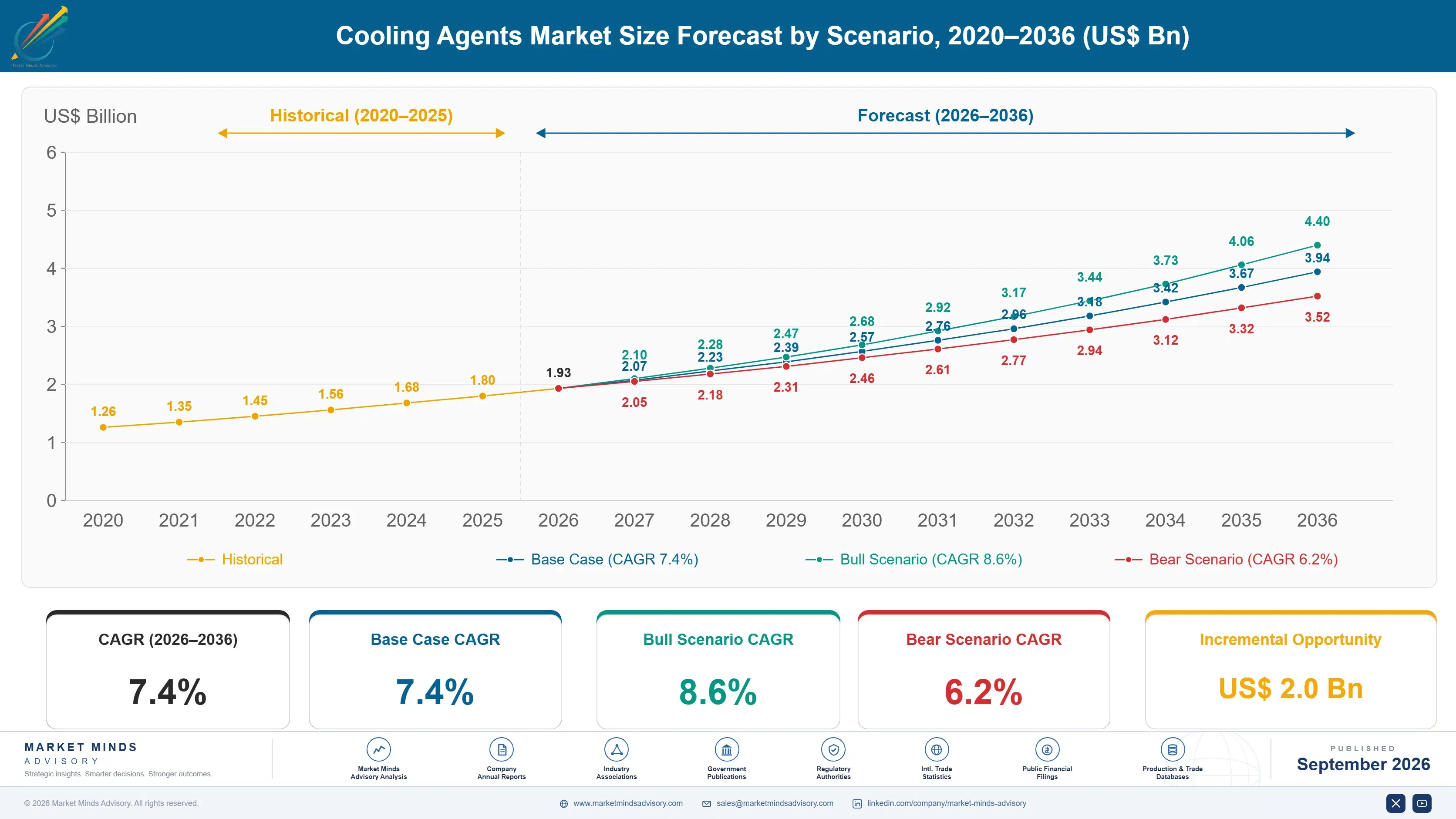
Cooling Agents Market Forecast Scenarios

cooling-agents-market-size-forecast-scenario-1790016720541
Growth from 2020 to 2025 ran at 6.3% and its composition changed sharply mid-period. Menthol cigarette bans in the European Union and several other jurisdictions removed a large block of demand, and rather than disappearing it relocated into oral nicotine pouches, which consume synthetic coolants at considerably higher inclusion rates. Oral care and confectionery volume grew steadily throughout on Asian expansion.
The base case at 7.4% rests on three mechanisms. Oral nicotine pouch penetration keeps rising in North America and the Nordics at inclusion rates well above chewing gum. Asian oral care and mouth freshener volume expands on distribution reach rather than on any premium effect. And formulators keep migrating from menthol toward WS-series chemistry to escape a crop price they cannot forecast or hedge. Nothing in the base case assumes a new chemistry class reaches broad clearance.
The bull case at 8.6% depends on novel TRPM8 agonists reaching broad food and oral care clearance, which would give suppliers an on-patent position in a category where 71% of volume is off patent. The bear case at 6.2% is regulatory: a jurisdiction restricting characterising cooling flavours in oral nicotine would remove roughly 23% of demand rather than relocate it again.

The Growth Nobody Puts In The Deck

Menthol has been the reference cooling molecule for a century and it has two problems a formulator eventually runs into. It is intense and it is brief, peaking hard and fading within a couple of minutes. And it is an agricultural product from Mentha arvensis grown largely in one Indian belt, so its price follows planting decisions made by farmers with no interest in confectionery. One recent crop cycle moved 58% peak to trough.
TOP FIVE CONCENTRATION62%Share of category revenue held by the leading suppliers
ORAL NICOTINE SHARE23%Volume going to pouches and modern oral nicotine products
NATURAL MENTHOL SWING58%Peak to trough movement across one recent crop cycle
SINGLE ORIGIN CONCENTRATION78%Natural menthol originating from a single Indian growing belt
BRIEF SPECIFICATION GAP44%Briefs specifying cooling without distinguishing intensity from perceived duration
OFF PATENT VOLUME71%Volume using chemistries whose composition patents have already expired
The WS-series carboxamides solved the first problem. WS-23 is mild and lasts, WS-3 sits between, and blends can be tuned across a duration curve that menthol alone cannot reach. They also solved the second problem incidentally, being synthetic. What they did not solve is patent position: 71% of category volume now uses chemistry whose composition patents expired long ago, and Chinese and Indian producers make it competently.
Then there is the part the presentations handle carefully. Roughly 23% of volume goes to oral nicotine pouches, at inclusion rates several times those of chewing gum, and this is where a disproportionate share of recent growth actually came from. Menthol cigarette bans did not destroy that demand. They moved it into a format consuming more coolant per unit.
"Every deck in this category shows oral care growth and every one of them is describing nicotine pouches with the label filed off. It is a perfectly legal, perfectly ordinary business, and the reluctance to say so plainly makes the demand forecasting considerably worse than it needs to be."
Practice Director, Sensory Actives and Flavour Ingredients · MMA Chemicals and Materials Practice · September 2026

Market Trends

Oral Nicotine Rewrote The Demand Base Quietly

Around 23% of category volume now goes to oral nicotine pouches and modern oral products, at inclusion rates several times those of conventional chewing gum. Menthol cigarette bans across the European Union and several other jurisdictions did not remove that demand. They relocated it into a format consuming more coolant per unit than the one it replaced. Suppliers report the volume under oral care in public documents, which makes published category growth harder to interpret than it looks. Forecasting suffers accordingly. The concentration risk is rarely stated either. Nobody quantifies it publicly either.
Market Impact: Country grows at 12.4%

Formulators Migrate Away From A Crop Price

Natural menthol grows at 4.9%, slowest of the six segments, while synthetic and WS-series chemistry takes share on price predictability rather than on performance. Around 78% of natural menthol originates from a single Indian growing belt, and one recent crop cycle swung 58% peak to trough on planting decisions no formulator can forecast. A confectionery business cannot run an annual cost plan against that. Migration to synthetic coolants is therefore a procurement decision dressed as a formulation one, and it has been running steadily for a decade. Sensory panels rarely detect the swap.
Market Impact: Covers 44% of briefs

Market Opportunities and Growth Drivers

Asian Oral Care Distribution Adds Volume Continuously

India grows at 12.4%, faster than any country covered, on oral care and mouth freshener distribution reaching well beyond the urban base that once defined those categories. East Asia holds 31% of world demand across oral care, confectionery, and beverages. Chinese toothpaste volume alone consumes considerable coolant tonnage at modest unit prices. This is volume growth rather than value growth, and suppliers competing there on menthol alone find the margin thin, since local producers hold both the crop and the synthesis. Suppliers doing well there sell blends and application development rather than tonnage against a certificate of analysis.
Market Impact: Covers 71% of volume

Duration Tuning Becomes A Paid Capability

Roughly 44% of briefs still specify cooling as a single property, when intensity and perceived duration are separate and independently tunable. A menthol burst that fades in two minutes and a WS-23 plateau that holds for fifteen are both cooling. Suppliers able to design a specific curve rather than quote a coolant against a percentage report considerably better specification retention. Blends are where that capability lives, and blend formulation is genuinely difficult to reverse engineer from a finished product. That difficulty is the whole defence. Very few suppliers can actually design to a stated curve.
Market Impact: Risks 23% of demand

Market Restraints and Challenges

Most Volume Sits On Expired Composition Patents

About 71% of category volume uses chemistries whose composition patents expired years ago, and the root cause is simply that the WS-series was developed in the 1970s. Chinese and Indian producers make WS-3 and WS-23 to acceptable specification at prices Western assets cannot match. Commercially this compresses margin on the fastest growing segment in the market, which is an uncomfortable combination. Suppliers respond with blend formulation, with application development depth, and with novel TRPM8 agonists that carry live patent protection. Only the last of those three produces a genuinely defensible margin position.
Market Impact: Accounts for 23% of volume

Regulatory Exposure Concentrates In One Application

Roughly 23% of demand depends on oral nicotine, and the root cause is that menthol cigarette restriction pushed volume into a format regulators are now examining in turn. Several jurisdictions are considering characterising flavour rules that would cover cooling sensates directly. Commercially the exposure is concentrated rather than spread, so a single ruling would remove demand rather than relocate it. Suppliers are broadening into oral care, beverage, and personal care applications, and diversifying customer bases away from a narrow group of buyers. None of that happens quickly enough to matter if a ruling lands soon.
Market Impact: Natural grows at 4.9%
4 additional market trends, 3 additional growth drivers, and 2 additional restraints and challenges are covered in the full report. Contact sales@marketmindsadvisory.com to access the complete intelligence.

Segment CAGR and Growth Architecture

Segmentation follows cooling chemistry class across six categories: natural menthol and mint extracts, synthetic menthol, menthyl ester coolants, WS-series synthetic carboxamide coolants, menthol acetal and ketal derivatives, and novel TRPM8 agonist coolants. End-use application, delivery format, and patent status are treated as separate dimensions rather than folded into this hierarchy. Warming and heating sensates fall outside the scope entirely.
cooling-agents-market-market-share-analysis-1790016721470

WS-Series Synthetic Carboxamide Coolants

WS-series carboxamides grow at 11.1%, half again the market rate of 7.4%, on a duration profile menthol cannot reach and a price that does not follow an Indian crop cycle. WS-23 gives a mild plateau lasting many minutes, WS-3 a stronger mid-range effect, and blends tune between them across a curve a formulator can specify precisely. Oral nicotine pouches consume the chemistry at inclusion rates several times chewing gum levels, which is where a large part of the recent growth actually originated. The commercial difficulty is patent status. Composition protection expired long ago and Asian producers supply competently at prices Western assets cannot match. Blend formulation is the only defence that consistently holds against that price floor.
CAGR 11.1%

Novel TRPM8 Agonist Coolants

Novel TRPM8 agonists grow at 9.8% from a small base and matter disproportionately, because they are the only meaningful part of this category still carrying live composition patents. The receptor target is the same one menthol hits, but newer molecules reach it with cleaner sensory profiles, less bitterness at effective dose, and duration curves that go beyond what WS-23 delivers. Regulatory clearance is the constraint rather than chemistry: food and oral care approvals move slowly and vary by jurisdiction, which limits how quickly volume can build. Suppliers holding cleared novel agonists occupy the only defensible margin position left in the market. Volumes remain small and grow against clearance timetables rather than against demand.
CAGR 9.8%
Full segment breakdown across 6 segments available in the complete report.

Regional Architecture and Country Demand Map

Regional shares reflect where cooling agents are formulated into finished products rather than where menthol is grown or synthesised. One region sits outside the standard bands, for the reason named in its own paragraph and summarised below for operator review. Application mix varies sharply by region.

East Asia

Chinese toothpaste and mouthwash manufacture consumes more coolant tonnage than any other single application worldwide, at unit prices that keep regional value below its volume weight. Growth of 8.4% runs above the world rate. Japanese and Korean confectionery and oral care work at the higher value end, specifying blends with designed duration curves rather than single coolants against a percentage. Chinese producers also supply WS-series chemistry competently and set much of the world price floor on off patent grades. Regional oral nicotine demand is small but growing from a negligible base. Formulation authority sits mostly with local manufacturers rather than with international brand owners. That limits how much value an international supplier can capture here.
Share: 31% | CAGR: 8.4% (2026 to 2036)

North America

Oral nicotine pouches account for a larger share of regional coolant demand than anywhere else covered, and inclusion rates run several times those of chewing gum. Growth of 8.1% is second fastest of the seven regions and would be slower without that application. Confectionery and oral care demand is mature and grows with population rather than penetration. Regulatory attention is the concentrated risk: characterising flavour rulings apply here first and hardest, and a restriction covering cooling sensates would remove demand rather than move it. Suppliers with narrow customer bases in the pouch category carry that exposure directly. Beverage applications add a modest and steady base. Blend formulation depth is what separates suppliers holding premium positions.
Share: 22% | CAGR: 8.1% (2026 to 2036)
Regional intelligence for 5 additional markets available in the complete report: Western Europe, South Asia and Pacific, Latin America, Middle East and Africa, Eastern Europe. Contact sales@marketmindsadvisory.com.
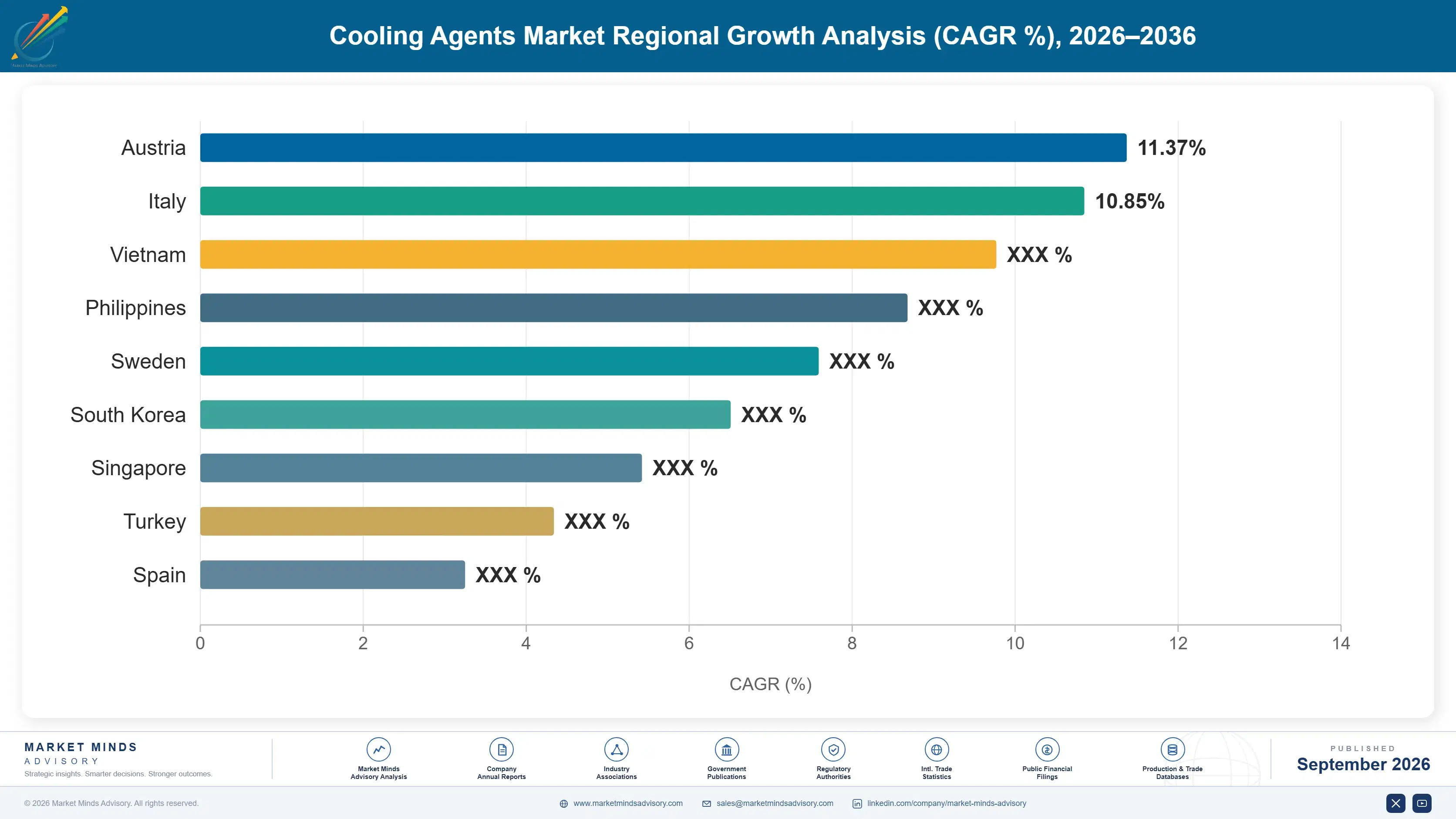
cooling-agents-market-country-cagr-analysis-1790016722290

Where Coolant Suppliers Still Earn

Four commercial moves matter in a category where most of the volume sits on expired patents and a quarter of the demand comes from an application nobody names. Each addresses a specific weakness: the patent position, the crop exposure, the specification gap, or the concentration risk. None of the four requires a new molecule to be invented.

Design Duration Curves Rather Than Quote Coolants

Around 44% of briefs specify cooling as a single property when intensity and perceived duration are separately tunable. Suppliers designing a specific curve through blend formulation report specification retention 2.7 times higher than those quoting a named coolant against a percentage. A blend is genuinely hard to reverse engineer from a finished product, so the position holds through procurement reviews that a single commodity coolant never survives. This is the most reliable defence available against the Asian price floor. It also moves the conversation from procurement to formulation, which changes who decides.
Market Impact: Raises specification retention rates to 2.7 times higher

Sell Crop Insulation As The Product

Around 78% of natural menthol comes from a single Indian growing belt and one recent cycle swung 58% peak to trough. Suppliers presenting synthetic and WS-series migration as cost predictability rather than as a formulation change report conversion rates 3.2 times higher with procurement buyers. Finance directors understand an unforecastable input line considerably better than they understand a sensory profile, and they are the ones who authorise reformulation budgets. Blind panels rarely detect the substitution at matched concentration, which removes the sensory objection before it is raised. The natural claim appears on fewer packs than anybody assumes.
Market Impact: Raises procurement conversion rates to 3.2 times higher

Push Novel Agonists Through Clearance Early

About 71% of category volume uses off patent chemistry, and novel TRPM8 agonists are the only part carrying live composition protection. Suppliers taking novel molecules through food and oral care clearance ahead of demand report price realisation 2.4 times higher than on WS-series equivalents. Clearance timelines run years rather than months and vary by jurisdiction, so starting when a customer asks means arriving after the opportunity closed. Novel agonists also reach cleaner sensory profiles with less bitterness at effective dose, which is a genuine formulation advantage rather than only a patent one. Both arguments are worth making together.
Market Impact: Raises achieved price realisation to 2.4 times higher

Broaden Beyond The One Concentrated Application

Roughly 23% of demand rests on oral nicotine, where a single characterising flavour ruling would remove volume rather than relocate it as menthol restriction did. Suppliers holding balanced positions across oral care, beverage, confectionery, and personal care report earnings volatility 1.9 times lower through regulatory events. The application is legitimate and growing, and concentrating a book in it is a decision worth taking deliberately rather than by drift. Oral care, beverage, and personal care applications all absorb the same chemistry at lower inclusion rates but with no comparable regulatory overhang. Building those positions takes years.
Market Impact: Cuts overall earnings volatility to 1.9 times lower

Who Controls the Margin Pool

Concentration is moderately high. Five suppliers hold 62% of category revenue, measured consistently on that basis across all participants, and the leader group carries genuine advantages in synthetic menthol assets and blend formulation depth. The challenger group divides into Western flavour houses without menthol synthesis and Indian and Chinese producers holding crop, extraction, or off patent carboxamide capacity at low cost. That second group is growing faster than the first and competing on cost rather than capability.
Competition currently turns on three dimensions: blend formulation capability, which decides whether duration curves can be designed rather than approximated; synthetic menthol asset ownership, which insulates a supplier and its customers from the Indian crop cycle; and regulatory clearance progress on novel TRPM8 agonists, where the only live patent positions in the category sit.

Pressure comes from two directions simultaneously. Asian producers set the world floor on off patent WS-series grades and are adding application support. Regulatory attention on cooling in oral nicotine is building. Rankings will shift toward suppliers holding cleared novel chemistry and diversified application books rather than volume positions in commodity coolants. Suppliers holding only off patent volume face the hardest position, since neither patent nor cost defends them.
cooling-agents-market-company-positioning-matrix-1790016723135

Competitive Moat and Risk Dimensions

SYMRISE

Moat: Synthetic Menthol Asset Ownership

Operating one of the largest synthetic menthol plants anywhere gives both a cost position and something more valuable commercially, which is the ability to offer customers a menthol supply that does not follow Indian planting decisions. Around 78% of natural menthol comes from one growing belt, and insulation from that is a genuine selling proposition to procurement.
SYMRISE

Risk: Oral Nicotine Concentration Exposure

A substantial book in oral nicotine carries regulatory risk that is concentrated rather than spread across applications. A characterising flavour ruling covering cooling sensates would remove that demand rather than relocate it, which is a materially different outcome from the menthol cigarette restrictions that created the opportunity in the first place.
TAKASAGO INTERNATIONAL

Moat: Novel Agonist Clearance Position

Depth in novel TRPM8 agonist chemistry and in the regulatory clearance work those molecules require gives access to the only live composition patents left in a category where 71% of volume is off patent. Clearance timelines run years, so a position established now cannot be matched by a competitor starting today.
TAKASAGO INTERNATIONAL

Risk: Narrow Commodity Volume Base

Strength at the novel end leaves comparatively little presence in the WS-series volume that funds application development elsewhere in the field. Novel agonist volumes remain small and grow against clearance timetables rather than demand, which makes revenue harder to plan than a commodity book of equivalent margin would be.

Players Tracked

Prominent Players

Symrise
Givaudan
Takasago International
BASF
DSM-Firmenich

Other Key Players

International Flavors and Fragrances
Mane
Robertet
T Hasegawa
Ogawa and Company
Sensient Technologies
Silverline Chemicals
Bhagat Aromatics
Agson Global
Arora Aromatics
KM Chemicals
Anhui Fengle Perfume and Flavour
Hindustan Mint and Agro Products
Vinayak Ingredients India
Privi Speciality Chemicals

Recent Developments

JANUARY 2026

Takasago Secures Food Clearance For Novel TRPM8 Agonist

Takasago International obtained food and oral care clearance in two major jurisdictions for a novel TRPM8 agonist carrying live composition protection. The molecule delivers longer duration than WS-23 with materially less bitterness at effective dose. Clearance in further jurisdictions is understood to be in progress.
Signal: Live patent positions are becoming the only defensible margin in a mostly off patent field. Clearance timing decides.
AUGUST 2025

Symrise Expands Synthetic Menthol Capacity At Holzminden

Symrise completed an organic capacity expansion of synthetic menthol production at its German site, funded internally with no partner involved. Management cited customer demand for supply insulated from Indian crop volatility rather than any shortage of tonnage. Contracted volumes at fixed annual pricing were offered alongside.
Signal: Customers are paying for price predictability rather than for the molecule itself. Asset ownership converts crop risk into plan.
APRIL 2025

Givaudan Signs Long Term Indian Mint Oil Supply Agreement

Givaudan entered a multi-year supply agreement with Indian mint oil producers covering contracted volumes across several crop cycles. The arrangement is a supply agreement rather than a joint venture, acquisition, or equity investment of any kind. Contracted volumes span several crop cycles at agreed floors.
Signal: Crop exposure is being contracted rather than eliminated by the natural focused suppliers. Contracting smooths without removing exposure.

What Cooling Chemistry Costs

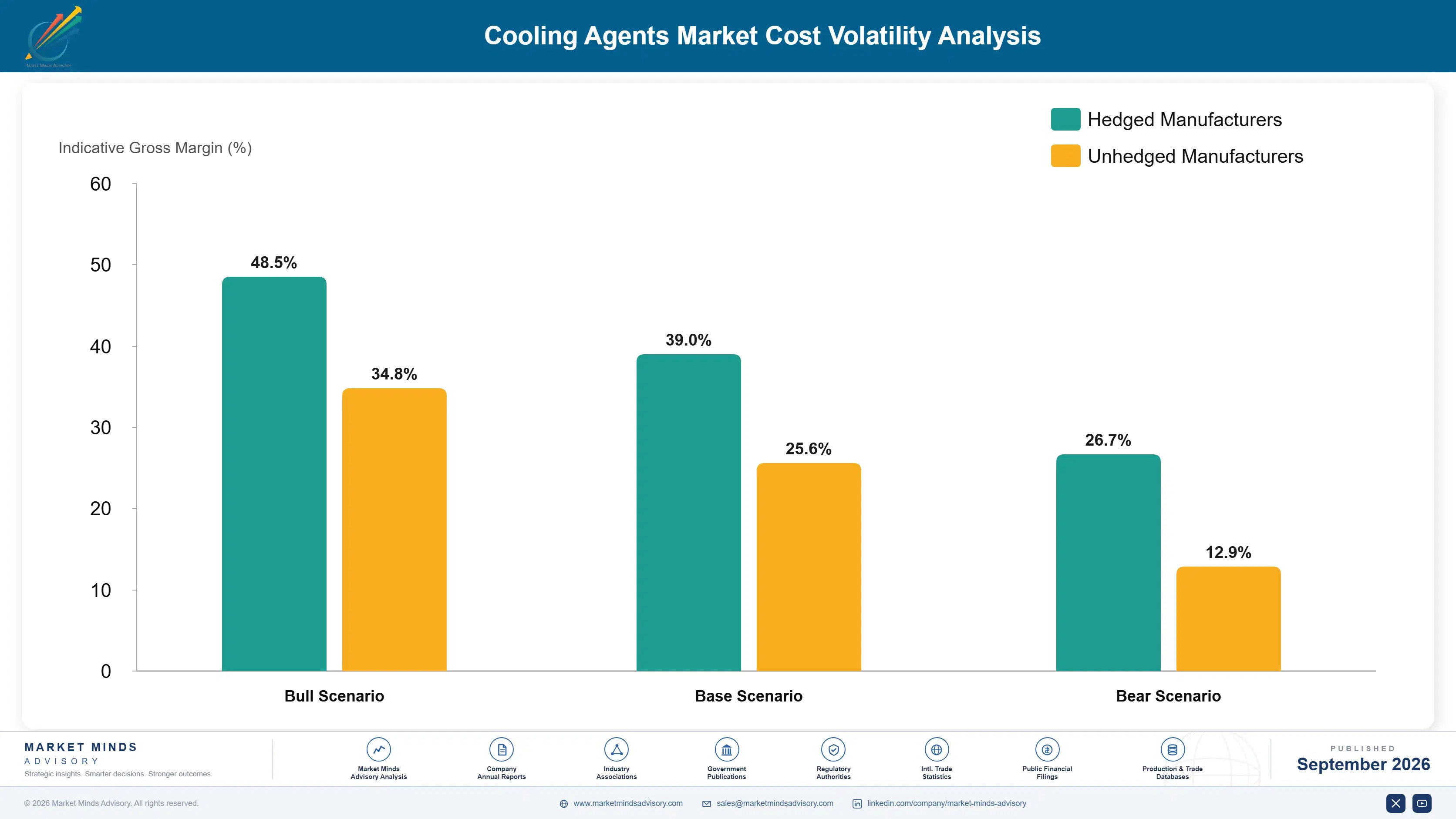
Three input groups dominate cost. Menthol feedstock runs 34% to 42% of cost of goods sold, and the eight-point range separates natural crop sourcing from synthetic routes built on citral or m-cresol. Synthesis, purification, and crystallisation take 26% to 34%. Regulatory clearance, patent licensing, and application development add 16% to 24%, which is heavy but concentrated at the novel agonist end of a portfolio.
Natural menthol pricing swung roughly 58% peak to trough across one recent crop cycle as Indian planting decisions in the Uttar Pradesh mint belt shifted acreage between mint and competing crops, and United States Department of Agriculture mint statistics documented comparable volatility in the American crop. Several flavour houses described the resulting cost pressure in their annual reports. Synthetic routes moved on unrelated petrochemical cycles.

The competitive disadvantage mechanism runs through supply predictability rather than unit cost. A supplier without synthetic capacity passes crop volatility straight to a customer who cannot plan against it, and loses the account to whoever can quote a stable annual price. Exposure varies by asset ownership rather than by scale, so a mid-sized supplier owning synthesis is better placed than a larger one buying crop menthol on the open market.
cooling-agents-market-cost-volatility-analysis-1790016723429

Own Or Contract Synthetic Menthol Capacity

Natural menthol follows Indian planting decisions that no formulator can forecast and no financial instrument reliably hedges at the volumes involved here. Synthetic capacity, whether owned or contracted on long term terms, converts an unpredictable input line into a plannable one, and procurement buyers value that considerably more than they value the origin story.

Contract Crop Volume Across Multiple Cycles

Suppliers committed to natural positioning cannot escape the crop and should stop trying to trade it opportunistically. Multi-year contracted volume across several growing cycles smooths the swing without eliminating it, and secures allocation in the tight years when spot buyers find there is simply nothing available at any price. Spot buyers find nothing in tight years.

Start Clearance Work Before Demand Appears

Food and oral care clearance for novel agonists runs years rather than months and varies by jurisdiction in both timing and requirement. Beginning the work when a customer asks for the molecule guarantees arriving after the opportunity has closed, so the regulatory spend has to precede the commercial case rather than follow it. Spend precedes the case.

Portfolio Architecture for Margin Defence

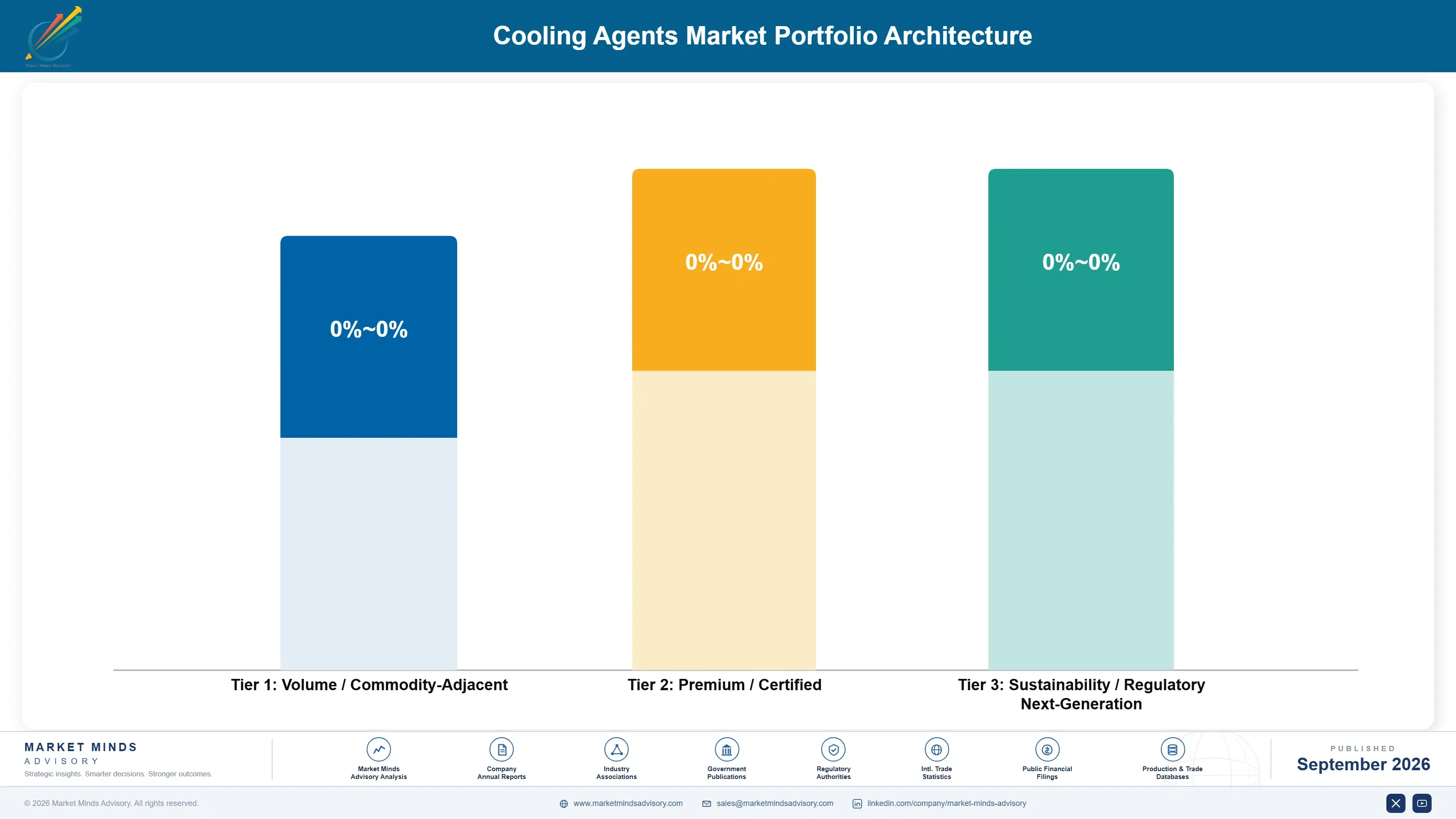
Margin follows patent status and formulation depth rather than cooling performance. Natural and synthetic menthol compete close to commodity terms. Off patent WS-series grades earn a little better on quality consistency and application support. Designed blends earn considerably more because they cannot be reverse engineered, and cleared novel TRPM8 agonists earn most of all, holding the only live composition protection in the category.
The tension between volume and premium runs through how the brief arrives. A specification naming a percentage of WS-23 is a purchasing exercise decided on price and certificate of analysis. A brief describing a target duration curve, an intensity ceiling, and a bitterness limit is a development project, and the supplier who designs the blend holds the formulation for its commercial life without further contest.

High-value pools concentrate in designed blends for oral nicotine and premium oral care, and in cleared novel agonists across every application. Where the brief is a Chinese toothpaste or an Indian mouth freshener at a mass price point, the coolant is a commodity input and local producers hold both the crop and the synthesis at costs Western assets cannot approach.

Volume / Commodity-Adjacent

Natural and synthetic menthol and off patent WS-series grades supplied against a named percentage and a certificate of analysis. The ten-point range reflects asset ownership and feedstock route rather than any capability a formulator would pay a premium to obtain.
Gross Margin: 24% to 34%

Premium / Certified

Menthyl esters, acetal and ketal derivatives, and standard coolant blends supplied with application support and sensory profiling data. The twelve-point range separates genuine blend formulation competence from suppliers reselling single coolants with a technical data sheet attached.
Gross Margin: 40% to 52%

Sustainability / Regulatory / Next-Generation

Cleared novel TRPM8 agonists and designed duration curve blends built to a specified intensity and bitterness limit. The sixteen-point range reflects patent status and clearance breadth, both of which take years to establish and cannot be bought quickly.
Gross Margin: 58% to 74%
cooling-agents-market-portfolio-architecture-1790016724236

High-value Sub-segments and Strategic Watch-out

Cleared Novel TRPM8 Agonists

Highest value in the category and the only part holding live composition patents while 71% of volume sits off patent. The sixteen-point range reflects clearance breadth across jurisdictions, since approvals arrive at different times in different markets. Volumes grow against clearance timetables rather than against demand.
Gross Margin: 60% to 76%

Designed Duration Curve Blends

High value because a blend cannot be reverse engineered from a finished product the way a single coolant can. The fourteen-point range reflects genuine formulation depth against suppliers approximating a curve with two components and optimism. Two components and optimism does not produce a specifiable curve.
Gross Margin: 48% to 62%

Off Patent WS-Series Grades

Volume core and the fastest growing chemistry in the market, which makes the margin position uncomfortable rather than reassuring. The twelve-point range separates quality consistency and application support from producers competing on price and certificate alone. Fastest growth and thinnest defence is an awkward pairing commercially.
Gross Margin: 30% to 42%

Natural Menthol And Mint Extracts

The strategic watch-out. Growth is slowest of the six segments, 78% of supply comes from one Indian belt, and one cycle moved 58%. The ten-point range reflects contracting discipline rather than any technical differentiation. Blind panels cannot reliably distinguish it from synthetic at matched concentration anyway.
Gross Margin: 22% to 32%

How This Demand Repeats

Revenue locks in at formulation approval and follows the finished product's commercial life, which in oral care and confectionery runs five to eight years and considerably longer in established gum and toothpaste lines. Requalifying a coolant means repeating sensory panel work, stability testing, and in regulated applications a clearance review, at a cost far exceeding any unit price difference on the ingredient itself.
Attachment depth follows what the specification names. A designed blend identified by trade name is effectively locked, because no competitor can match a curve they cannot decompose. A percentage of WS-23 is filled by whichever of a dozen producers quotes lowest at the next review, and the formulation team is rarely consulted about it at all. That distinction decides the whole commercial position.

The buyer is shifting toward procurement in commodity grades and toward formulation in designed blends, which pulls the category in two directions simultaneously. Finance directors authorise migration away from crop exposure because they understand an unforecastable input line. Formulation teams authorise blend work because they understand duration curves. A supplier needs both conversations and most run only one of them.
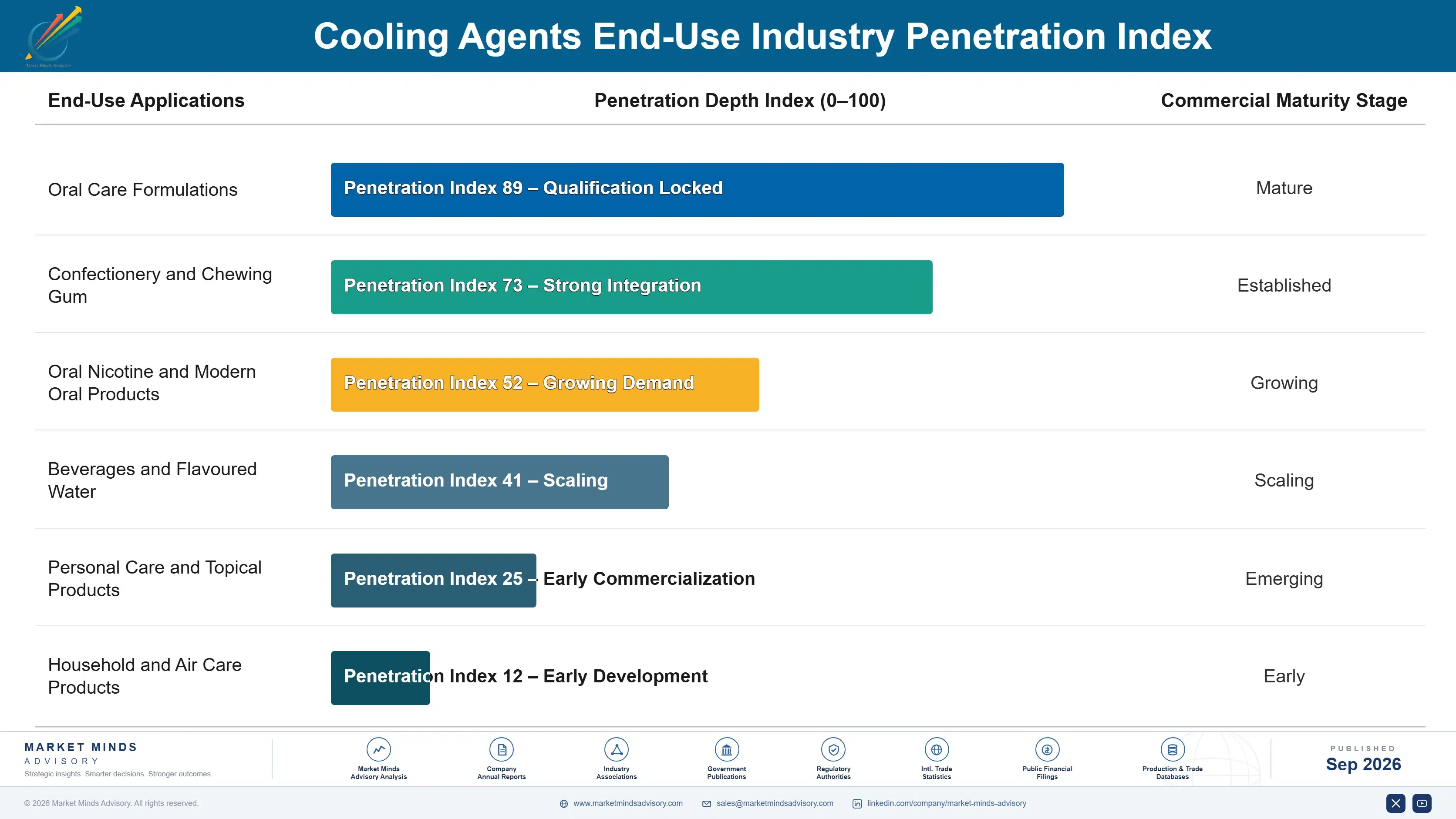
cooling-agents-market-end-use-penetration-index-1790016724979

Where This Market Rewards

These are among the four positions where our research anticipates prominent divergence between winners and laggards over the coming forecast period. Each is grounded in the demand model, the regulatory perimeter, and the announced capacity pipeline.
01 / DURATION CURVE DESIGN

Intensity and duration are separate properties

Around 44% of briefs still specify cooling as one property, when intensity and perceived duration can be tuned independently through blend formulation to a degree most formulators never explore. Suppliers designing a specific curve rather than quoting a named coolant against a percentage report specification retention 2.7 times higher than the field. A blend cannot be reverse engineered from a finished product, which makes it the most reliable defence available against the Asian price floor, and it moves the conversation from procurement to formulation, which changes who actually decides.
02 / CROP EXPOSURE INSULATION

Sell predictability to the finance director

Roughly 78% of natural menthol comes from a single Indian growing belt, and one recent crop cycle moved 58% from peak to trough on planting decisions no formulator can forecast or hedge. Suppliers presenting synthetic migration as cost predictability rather than as a sensory change report conversion rates 3.2 times higher with procurement buyers. Finance directors authorise reformulation budgets and they understand an unplannable input line far better than a duration curve, and blind panels rarely detect the substitution at matched concentration in any case.
03 / CLEARANCE TIMING DISCIPLINE

Patents expired on most of this

About 71% of category volume uses chemistry whose composition patents lapsed years ago, leaving novel TRPM8 agonists as the only genuinely defensible margin position anywhere in the market. Suppliers taking novel molecules through food and oral care clearance ahead of demand report price realisation 2.4 times higher than on WS-series equivalents. Clearance runs years and varies by jurisdiction, so starting when a customer asks means arriving well after the opportunity closed, and the novel molecules also carry cleaner sensory profiles with less bitterness at dose.
04 / APPLICATION CONCENTRATION MANAGEMENT

A quarter rests on one ruling

Roughly 23% of demand comes from oral nicotine, where a characterising flavour ruling covering cooling sensates would remove volume rather than relocate it the way menthol cigarette restriction did in 2020. Suppliers holding balanced books across oral care, beverage, confectionery, and personal care report earnings volatility 1.9 times lower through regulatory events. The application is legitimate and growing, and concentration in it deserves a deliberate decision rather than accumulating quietly by drift, and building alternative application positions takes years that a ruling will not allow.

Engagement Snapshot From the Field

A live engagement with an industry participant carrying material or product regulatory and market exposure ahead of a defining policy shift, showing how our research translates into a defensible multi-year portfolio strategy.
MARKET MINDS ADVISORY · CLIENT ENGAGEMENT SUMMARY
Cooling Agents Producer Strategic Portfolio Review and Transition Roadmap 2026·Investment Scenario on Cooling Agents Exposure Evaluation 2025-26
CLIENT PROFILE
An international confectionery manufacturer with mint and gum revenue near USD 640 million (client-reported, unverified by MMA) across twenty-two markets. Coolant input cost had moved unpredictably for four consecutive years, forcing three unplanned price adjustments, and procurement had concluded that supplier margin was the cause rather than anything upstream of it. Nobody had checked whether that conclusion was correct.
STRATEGIC CHALLENGE
The business specified natural menthol across its premium range on a marketing position established two decades earlier, and nobody had tested whether consumers could actually detect the difference. Annual cost planning had become guesswork, and the sensory team and procurement team had not held a joint conversation about it. Neither team had seen the other's data.
MMA APPROACH
MMA traced coolant cost movements against Indian mint acreage and crop pricing, ran blind sensory comparisons of natural against synthetic and blended alternatives across three product formats, and modelled cost variance under natural, synthetic, and designed blend specifications over a five-year planning horizon. Packaging claims were audited across all twenty-two markets alongside the sensory work.
KEY FINDINGS
  1. Coolant cost variance tracked Indian mint acreage almost exactly, with supplier margin explaining a negligible share of the movement the procurement team had attributed to it.
  2. Blind panels could not reliably distinguish natural menthol from synthetic at matched concentration in any of the three formats tested across the range.
  3. A designed blend using WS-23 and menthyl lactate outperformed the incumbent natural specification on measured duration while costing less per unit produced.
  4. The natural claim appeared on packaging in only four of the twenty-two markets, and consumer research showed it drove purchase in none of them.
CLIENT PROFILE
An international confectionery manufacturer with mint and gum revenue near USD 640 million (client-reported, unverified by MMA) across twenty-two markets. Coolant input cost had moved unpredictably for four consecutive years, forcing three unplanned price adjustments, and procurement had concluded that supplier margin was the cause rather than anything upstream of it. Nobody had checked whether that conclusion was correct.
STRATEGIC CHALLENGE
The business specified natural menthol across its premium range on a marketing position established two decades earlier, and nobody had tested whether consumers could actually detect the difference. Annual cost planning had become guesswork, and the sensory team and procurement team had not held a joint conversation about it. Neither team had seen the other's data.
MMA APPROACH
MMA traced coolant cost movements against Indian mint acreage and crop pricing, ran blind sensory comparisons of natural against synthetic and blended alternatives across three product formats, and modelled cost variance under natural, synthetic, and designed blend specifications over a five-year planning horizon. Packaging claims were audited across all twenty-two markets alongside the sensory work.
KEY FINDINGS
  1. Coolant cost variance tracked Indian mint acreage almost exactly, with supplier margin explaining a negligible share of the movement the procurement team had attributed to it.
  2. Blind panels could not reliably distinguish natural menthol from synthetic at matched concentration in any of the three formats tested across the range.
  3. A designed blend using WS-23 and menthyl lactate outperformed the incumbent natural specification on measured duration while costing less per unit produced.
  4. The natural claim appeared on packaging in only four of the twenty-two markets, and consumer research showed it drove purchase in none of them.
RECOMMENDED STRATEGY
Phase 1: Phase one: migrate the premium range to a designed blend specification, retaining natural menthol only in the four markets where the claim appears on pack. Phase 2: Phase two: contract remaining natural volume across multiple crop cycles rather than buying opportunistically against spot pricing each year. Agree floors ahead of planting decisions. Phase 3: Phase three: hold joint sensory and procurement reviews annually so cost exposure and specification decisions stop being made in separate rooms.
OUTCOME
Coolant cost variance fell by roughly two thirds within four quarters and no unplanned price adjustment was required (client-reported, unverified by MMA). Measured cooling duration improved across the premium range. Joint sensory and procurement review is now standard practice across the manufacturer's whole portfolio. The premium range held its consumer scores throughout.

Frequently Asked Questions

Foundational context covering the market sizes, CAGR, scope, country, region and competition that inform every finding below. This section is provided to cover basics and most often pre-purchase conversations, answered from the MMA Primary Research Dataset.

What is the current size of the Cooling Agents Market?

The market was worth USD 1.8 billion in 2025 and stands at USD 1.9 billion in 2026. Value covers physiological cooling sensate ingredients at supplier selling price.

How large will the Cooling Agents Market be by 2036?

MMA forecasts USD 3.9 billion by 2036, an increase of USD 2.0 billion across the forecast period. That represents 2.05 times the 2026 base of USD 1.9 billion.

What is the CAGR for the Cooling Agents Market 2026 to 2036?

The base case compound annual growth rate is 7.4%, with a bull case at 8.6% and a bear case at 6.2%. Historical growth from 2020 to 2025 ran at 6.3%.

Which segment is growing fastest?

WS-series synthetic carboxamide coolants grow at 11.1%, half again the market rate of 7.4%. They deliver duration menthol cannot reach and a price no crop cycle moves.

Who are the major companies in the Cooling Agents Market?

Symrise, Givaudan, Takasago International, BASF, and DSM-Firmenich lead the field. Together they hold 62% of category revenue, with Indian and Chinese producers setting the off patent price floor.

Which country is growing fastest?

India grows at 12.4%, on oral care and mouth freshener distribution reaching well beyond its urban base. It is also the dominant natural menthol growing origin worldwide.

Report Segmentation Architecture

The full report scope spans multiple orthogonal segmentation dimensions, with cross-tabulated demand data provided for each dimension pair. Coverage extends further to regional breakdowns, trend trajectories, and the competitive detail needed to support segment-level decision-making.

By Cooling Chemistry Class

  • Natural Menthol and Mint Extracts
  • Synthetic Menthol
  • Menthyl Ester Coolants
  • WS-Series Synthetic Carboxamide Coolants
  • Menthol Acetal and Ketal Derivatives
  • Novel TRPM8 Agonist Coolants

By End-Use Industry

  • Oral Care Formulations
  • Confectionery and Chewing Gum
  • Oral Nicotine and Modern Oral Products
  • Beverages and Flavoured Water
  • Personal Care and Topical Products
  • Household and Air Care Products

By Commercial Dimension

  • Global Brand Direct Supply
  • Contract Manufacturer Supply
  • Flavour House Intermediate Supply
  • Specialty Ingredient Distribution
  • Designed Blend Development Contracts
  • Regulatory Clearance Support Services

By Region

  • East Asia
  • North America
  • Western Europe
  • South Asia and Pacific
  • Latin America
  • Middle East and Africa
  • Eastern Europe

Scope, Methodology, and Coverage

Every figure in this report is reproducible from documented input assumptions. The scope below maps the historical period, the forecast horizon, the segmentation dimensions, and the countries covered, alongside the underlying primary and qualitative methodology.
Historical Period
2020 to 2025
Forecast Period
2026 to 2036
Base Year
2025 (USD billions; MMA Primary Research Dataset, September 2026)
Market Definition
This market covers physiological cooling sensate ingredients used in oral care, confectionery, beverage, oral nicotine, and personal care formulation, across natural menthol and mint extracts, synthetic menthol, menthyl ester coolants, WS-series synthetic carboxamide coolants, menthol acetal and ketal derivatives, and novel TRPM8 agonist coolants. It excludes warming and heating sensates, refrigeration and cooling equipment, cooling textiles, industrial coolants, and pharmaceutical analgesic drug products.
Quantitative Units
USD billions, revenue at supplier selling price
Segmentation Dimensions
Cooling chemistry class, end-use application, commercial dimension, region
Regions Covered
East Asia, North America, Western Europe, South Asia and Pacific, Latin America, Middle East and Africa, Eastern Europe
Countries Covered
China, Japan, South Korea, Taiwan, India, Indonesia, Thailand, Vietnam, Australia, United States, Canada, Mexico, Germany, France, United Kingdom, Italy, Spain, Netherlands, Switzerland, Sweden, Norway, Poland, Czechia, Brazil, Argentina, Colombia, Saudi Arabia, United Arab Emirates, Turkey, South Africa
Key Companies Profiled
Symrise, Givaudan, Takasago International, BASF, DSM-Firmenich, International Flavors and Fragrances, Mane, Robertet, T Hasegawa, Ogawa and Company, Sensient Technologies, Silverline Chemicals, Bhagat Aromatics, Agson Global, Arora Aromatics, KM Chemicals, Anhui Fengle Perfume and Flavour, Hindustan Mint and Agro Products, Vinayak Ingredients India, Privi Speciality Chemicals
Quantitative Methodology
Primary survey, n=3,800 respondents, Q4 2025, six countries; demand-side model with trade association cross-validation
Qualitative Methodology
47 expert interviews, Q4 2025; applied to validate demand model assumptions, identify emerging dynamics, and assess competitive positioning
Report Format
PDF and XLSX data workbook (Word format preview document)
Publisher
Market Minds Advisory
Report Code
MMA-2026-CHM-471
Published
September 2026
Contact
sales@marketmindsadvisory.com | www.marketmindsadvisory.com

Purchase the full Cooling Agents Market Report (2026 to 2036).

The full report sizes the cooling agents market across six chemistry classes, seven regions, and thirty countries, with forecasts to 2036 under base, bull, and bear cases. It quantifies how much demand actually comes from oral nicotine rather than the oral care heading it is reported under, traces natural menthol price volatility against Indian crop acreage, and maps patent status across the chemistry classes. Competitive analysis covers twenty participants evaluated consistently on category revenue, with detailed treatment of blend formulation depth and novel agonist clearance progress. Cost structure and application concentration risk are analysed throughout. Primary research includes 3,800 survey responses and 47 expert interviews.
Six cooling chemistry classes sized and forecast separately
Twenty participants evaluated on category revenue consistently
Oral nicotine demand separated from oral care reporting
Natural menthol volatility traced against Indian crop acreage
Patent status mapped across every chemistry class
Novel agonist clearance progress assessed by jurisdiction

Built For The People Who Decide

From boardroom strategy to bench-side execution, this report is read cover-to-cover by leaders shaping the next decade of their industry, turning demand scenarios, market dynamics and valuation benchmarks into decisions.
CXOs/ Presidents/ VPs/ Managers
M&A and Corporate Development
Strategy Teams and R&D Heads
Procurement and Product Directors
Regulatory and Compliance Leaders
Investor Relations and Equity Analysts