Market Minds Advisory
Convertible Roof Control Unit Market

Convertible Roof Control Unit Market: Electric Motors Replace Hydraulics

Automakers are replacing hydraulic convertible roof actuation with electric motor systems and software-defined diagnostics, raising per-vehicle electronic content even as overall convertible body style production stays essentially flat across most markets.

Lead Analyst

David Horsley

Published

September 2026

Make Smarter Decisions with Customized Research Insights

Request a free sample report and evaluate market opportunities, growth trends, and competitive dynamics relevant to your business needs.

2025 MARKET VALUE$0.6BMarket Size 2025
2036 FORECAST VALUE$1.1BBase Case , 2026 to 2036
CAGR 2026 TO 20365.8 %Bull 6.9% / Bear 4.7%
INCREMENTAL OPPORTUNITY$0.5BNet 10- year value creation
EXPANSION MULTIPLE1.76x2036 value over 2026 base
Strategic Levers
M&A Pipeline
Regional Outlook
Country Rankings
Competitive Intelligence
Segmental Deep-dive
Call-Us : 91 93563 13602

Executive Snapshot and Market Trajectory

Convertible roof control units are gaining electronic content even as overall convertible vehicle production stays flat, since automakers are replacing hydraulic actuation with electric motor systems and adding diagnostic software that legacy mechanical designs never required. Only a handful of suppliers serve both eras of technology well.
Western Europe holds the largest regional share, reflecting the concentration of premium convertible platforms from German and Italian automakers that dominate this body style globally. Diagnostic and calibration software is growing fastest of any segment as automakers add over-the-air update capability and predictive fault detection to roof control systems. China is growing fastest of any single country, driven by expanding luxury convertible imports and rising premium vehicle ownership.
The competitive field is moderately concentrated, with the top five suppliers holding roughly half of global supply, led by specialized roof systems integrators alongside broader automotive mechatronics suppliers. Suppliers capable of full electric motor conversion are pulling ahead of pure hydraulic component specialists as automakers redesign next-generation platforms. Rankings could shift meaningfully as pure hydraulic specialists lose ground to suppliers offering both motor and software capability under one integrated platform contract relationship.
Market Definition
The convertible roof control unit market covers electronic control units, hydraulic and electric actuation modules, position and latch sensors, motor drive systems, and diagnostic software specifically designed for automatic convertible soft-top and retractable hardtop roof operation. It excludes the roof fabric and hardtop panels themselves and general vehicle body control modules not specific to roof actuation.
Base Year Value
$0.6B in 2025 (MMA Primary Research Dataset, August 2026)
Forecast Period
2026 to 2036, eleven discrete annual values
CAGR
5.8% base case. Bull 6.9%. Bear 4.7%.
Fastest Growth Segment
Diagnostic and Calibration Software: 9.6% CAGR
Fastest Growth Country
China: 7.3% CAGR
Fastest Growth Region
South Asia and Pacific: 7.8% CAGR
Largest Region
Western Europe: 26% of 2025 global value
Market Leaders
Webasto Group, Magna International, Valeo, Inalfa Roof Systems, and Brose Fahrzeugteile lead global supply. Source: MMA Analysis based on company annual reports.
Primary Survey
n=3,800 procurement and R&D decision-makers, Q4 2025, six countries
Methodology
Demand-side build-up, cross-validated against public data, 47 expert interviews

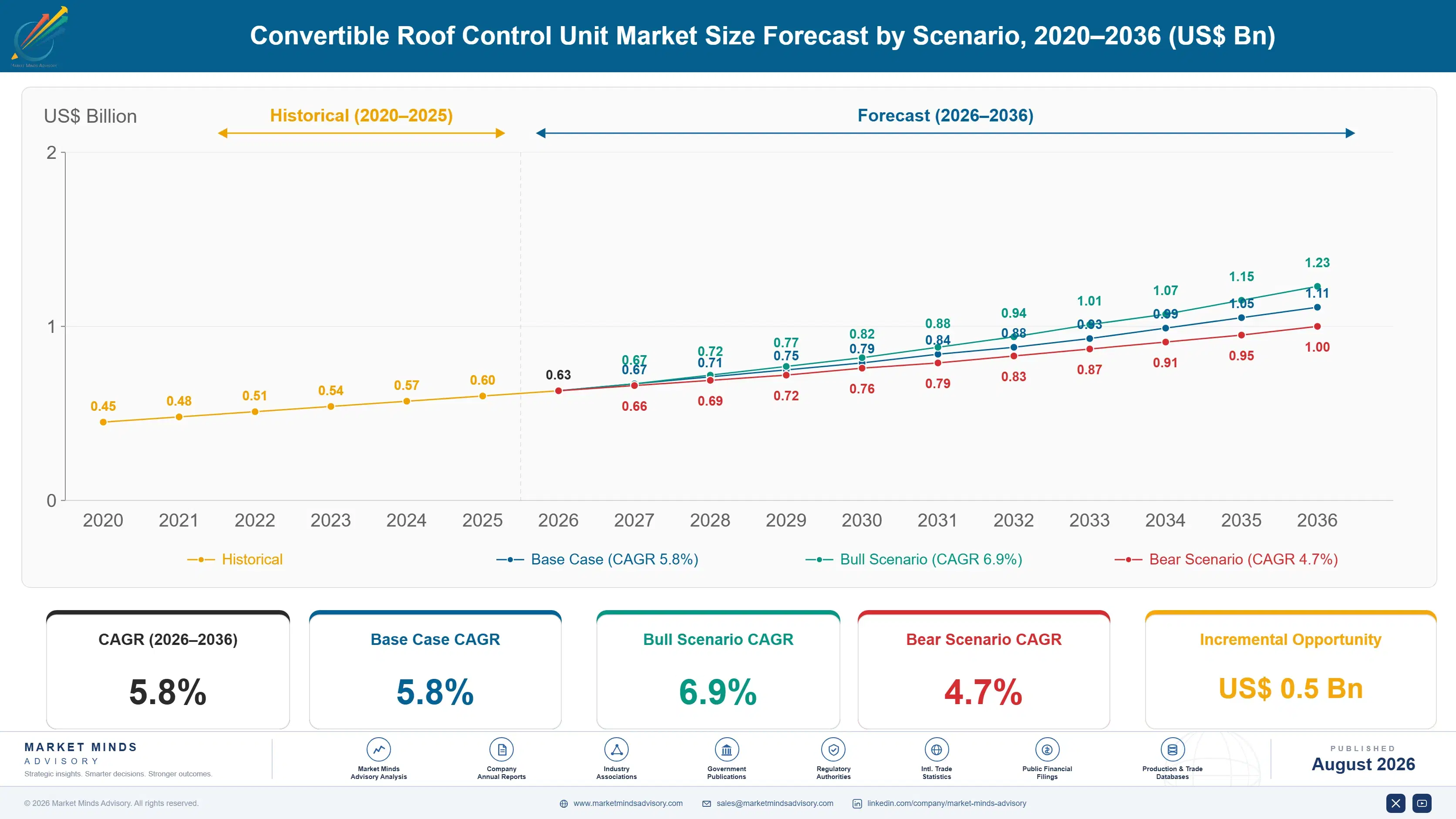
Convertible Roof Control Unit Market Forecast Scenarios

convertible-roof-control-unit-market-size-forecast-scenario-1787549603209
Between 2020 and 2025, convertible roof control unit demand grew at an estimated 5.0% annually as premium automakers added electronic content to new convertible platforms even as overall convertible unit production remained essentially flat through the period. Webasto and Magna both expanded electric motor drive system production to meet growing demand for hydraulic-to-electric conversion programs.
MMA's base case projects 5.8% annual growth to 2036 on three mechanisms: continued replacement of hydraulic actuation with electric motor systems that reduce weight and improve reliability, growing adoption of diagnostic and calibration software enabling over-the-air updates and predictive maintenance, and steady premium convertible platform renewal cycles among German and Italian luxury automakers. Chinese luxury vehicle imports are adding a fourth, smaller growth channel through expanding premium ownership. Software licensing revenue is emerging as a meaningful fifth contributor to overall category growth.
A bull catalyst comes from faster-than-expected electric motor conversion across additional mainstream convertible platforms beyond the premium segment. The bear risk is platform discontinuation: if automakers continue reducing convertible model offerings in favor of SUV and crossover body styles, unit volume could decline faster than rising electronic content per vehicle can offset. Suppliers are hedging by diversifying into broader closure system electronics.

Rising Content Offsets Flat Unit Volume

Convertible roof control units occupy a peculiar corner of automotive electronics: low unit volume relative to mainstream vehicle systems, yet rising technical sophistication as automakers electrify what was historically a purely hydraulic and mechanical system. That combination keeps per-unit pricing elevated even as overall convertible production stays flat. Few categories combine such modest volume with such rapidly expanding sophistication.
MARKET CONCENTRATION52%Top five suppliers hold roughly half of global supply
AVERAGE UNIT PRICE$340/vehicleReflects combined control unit and actuation hardware pricing
TOP PRODUCING COUNTRYGermanyLargest global concentration of premium convertible platform production
CAPACITY UTILIZATION64%Low platform volume constrains overall production scale planning
FEEDSTOCK COST SHARE36% of COGSElectric motors and semiconductor sensors dominate input cost
WARRANTY CLAIM RATE4.2%Share of units requiring service within the warranty period
Commercially, the shift from hydraulic to electric actuation is redrawing which suppliers win new platform contracts. Automakers increasingly specify electric motor systems for weight reduction and reliability improvement, favoring suppliers with proven motor control software over legacy hydraulic component specialists. Suppliers straddling both technologies serve platforms still transitioning between generations. Suppliers that fail to make this transition risk losing platform contracts to competitors already fluent in electric motor control fundamentals.
Over the next decade, expect software and electric motor content to matter more than raw actuation hardware volume, since most margin upside comes from diagnostic capability and motor control sophistication rather than growth in convertible unit production itself. Suppliers investing in software-defined roof control are best positioned to capture this shift. Suppliers still concentrated primarily on hydraulic hardware risk losing the highest-margin part of future platform contracts to better-prepared rivals.
"Convertible tops used to be pure hydraulics and cables. Now the control unit talks to the rest of the car, updates itself over the air, and tells the dealer exactly which sensor is about to fail. The roof didn't change. Everything underneath it did."
Director, Automotive Mechatronics and Closure Systems Practice · MMA Automotive Mechatronics and Closure Systems Practice · August 2026

Market Trends

Electric Motors Replace Hydraulic Actuation Systems

Automakers are increasingly redesigning convertible roof platforms around electric motor actuation rather than traditional hydraulic pump systems, seeking weight reduction, faster operation cycles, and improved long-term reliability compared with hydraulic fluid and seal maintenance requirements. Webasto and Magna have both expanded electric motor drive system production capacity over the past two years specifically to serve this conversion trend. At least a dozen major convertible platforms have converted from hydraulic to electric actuation since 2023, and suppliers report electric systems now command meaningfully higher content value per vehicle than legacy hydraulic equivalents.
Market Impact: Sustains 6%+ premium platform growth
Over-the-Air Diagnostic Software Gains Rapid Adoption

Automakers are increasingly equipping convertible roof control units with diagnostic and calibration software supporting over-the-air updates and predictive fault detection, extending the software-defined vehicle trend beyond powertrain and infotainment into mechanical closure systems. Valeo and Continental have both expanded software development investment specifically targeting this roof control application. At least several major premium platforms have added over-the-air roof diagnostic capability since 2023, and automakers report this capability meaningfully reduces warranty service visits by catching failures before they strand a vehicle. Automakers view this software layer as a meaningful differentiator across increasingly commoditized closure system hardware.
Market Impact: Grows Chinese demand 12%+ annually

Market Opportunities and Growth Drivers

Premium Platform Renewal Cycles Sustain Demand

German and Italian luxury automakers continue renewing their convertible platform lineups on regular multi-year cycles, sustaining steady demand for roof control unit redesigns even as overall convertible unit volume remains flat across the broader market. Industry data show premium automakers have launched several major convertible platform refreshes since 2023, each incorporating updated control unit architecture. Suppliers report these renewal cycles provide predictable, multi-year revenue visibility that partially offsets the category's otherwise flat unit volume trajectory. Automakers report these renewal programs increasingly bundle software and motor upgrades into a single redesign package.
Market Impact: Cuts mainstream convertible output 4%+ yearly

Rising Chinese Luxury Vehicle Ownership Expands Demand

Expanding premium vehicle ownership across China continues driving growing demand for imported and domestically assembled luxury convertible platforms, a category that barely registered as meaningful regional volume just a decade ago. Trade data show luxury vehicle imports into China have grown considerably over the past several years, directly supporting convertible roof control unit demand growth. Suppliers report this Chinese demand increasingly justifies dedicated regional technical support and localized component sourcing investment. Suppliers expect this Chinese growth trend to continue outpacing broader regional demand for the foreseeable future. Regional distributors are expanding accordingly.
Market Impact: Extends warranty investigation by 20%+

Market Restraints and Challenges

Declining Convertible Body Style Popularity Limits Volume

Overall convertible body style production continues losing share to SUV and crossover platforms across most major automotive markets, and the root cause is shifting consumer preference toward vehicles offering greater practicality, cargo space, and all-weather capability that convertibles inherently cannot match. This lasting preference shift caps the addressable unit volume for roof control systems regardless of how much electronic content each unit carries. Suppliers dependent primarily on mainstream convertible platforms face the steepest volume exposure. Suppliers are mitigating this by concentrating investment on premium platforms where convertible demand remains comparatively resilient.
Market Impact: Commands 25%+ higher content value

Complex Software Integration Raises Warranty Risk

Adding over-the-air diagnostic and calibration software to convertible roof control units introduces new software integration failure modes that purely mechanical or hydraulic systems never presented, and the root cause is that software-defined roof systems must now interface reliably with broader vehicle electronic architecture that varies considerably across automaker platforms. This integration complexity has increased warranty claim investigation time and occasionally produces intermittent faults that are difficult to reproduce and diagnose conclusively. Suppliers serving multiple automaker platforms face the steepest integration testing burden. Suppliers are mitigating this by investing in expanded simulation testing before software deployment to production vehicles.
Market Impact: Cuts warranty visits 15%+ each
3 additional market trends, 4 additional growth drivers, and 3 additional restraints and challenges are covered in the full report. Contact sales@marketmindsadvisory.com to access the complete intelligence.

Segment CAGR and Growth Architecture

The convertible roof control unit market is segmented by component type, the classification that determines technical complexity, supplier specialization, and platform integration requirements: electronic control units, hydraulic actuation modules, position sensors, electric motor drive systems, wiring harness systems, and diagnostic software each serve distinct functional roles. Upstream feedstock and downstream aftermarket services sit in separate discussions.
convertible-roof-control-unit-market-market-share-analysis-1787549603762

Diagnostic and Calibration Software

Diagnostic and calibration software is the fastest-growing segment as automakers extend over-the-air update and predictive maintenance capability from powertrain systems into convertible roof closure electronics. Valeo and Continental both dominate this segment through established automotive software development expertise that smaller mechanical component specialists struggle to replicate quickly. Automakers increasingly specify software by documented fault prediction accuracy and update deployment reliability rather than accepting generic diagnostic claims, reflecting growing platform electronic sophistication. Development costs remain meaningfully above traditional hardware-only control units, but the resulting warranty cost reduction and premium positioning more than compensate suppliers with genuine automotive software capability. Buyers increasingly expect documented cybersecurity testing before approving over-the-air update deployment across production fleets.
CAGR 9.6%

Electric Motor Drive Systems

Electric motor drive systems are scaling quickly as automakers redesign convertible platforms to replace hydraulic actuation with lighter, more reliable electric alternatives across successive platform generations. Webasto and Magna both maintain established motor control and mechanical integration capability that hydraulic-only specialists have not developed. Automakers increasingly specify motor systems by documented cycle life and operating speed rather than accepting generic actuator claims, reflecting growing platform engineering sophistication. Pricing commands a meaningful premium over legacy hydraulic pump modules, reflecting the specialized motor control and software integration engineering required. Buyers increasingly request multi-cycle durability testing data before finalizing large-scale platform sourcing agreements with any single supplier. This documentation burden favors larger, more established motor engineering suppliers.
CAGR 8.4%
Full segment breakdown across 6 segments available in the complete report.

Regional Architecture and Country Demand Map

Western Europe clearly leads the entire global convertible roof control unit market by overall regional share, reflecting the deep concentration of premium convertible platforms from German and Italian automakers, while North America follows closely on the strength of its large domestic convertible buyer base nationwide.

Western Europe

Germany anchors regional demand through its globally dominant premium automaker base, with Mercedes-Benz, BMW, and Porsche all maintaining extensive convertible platform lineups that require sophisticated roof control systems. Webasto, headquartered in Germany, maintains particularly strong regional manufacturing and technical support infrastructure built around decades of roof systems specialization. Italy's luxury and sports car manufacturers, including Ferrari and Lamborghini, add further meaningful premium demand at the highest price points in the category. Regional growth trails other regions because the premium convertible platform base here is already comparatively mature relative to faster-expanding luxury vehicle markets elsewhere. France's smaller domestic automaker convertible programs add modest incremental component demand as well. The Netherlands adds modest additional component distribution volume regionally.
Share: 26% | CAGR: 4.3% (2026 to 2036)

North America

The United States drives most of the region's demand through its large convertible buyer base spanning both premium imports and domestic platforms like the Ford Mustang convertible and Chevrolet Corvette. Magna International maintains extensive domestic manufacturing and engineering infrastructure supplying both domestic and import automaker customers simultaneously. Canada's smaller automotive manufacturing sector contributes modest additional component production. Growth here is accelerating as domestic automakers accelerate electric motor conversion programs across their convertible platform lineups. Employer and consumer discretionary spending on premium leisure vehicles continues supporting stable regional convertible ownership rates. Suppliers increasingly maintain dedicated engineering teams supporting both domestic and imported premium convertible platform customers simultaneously across major metropolitan production centers.
Share: 25% | CAGR: 6.3% (2026 to 2036)
Regional intelligence for 5 additional markets available in the complete report: East Asia, South Asia and Pacific, Latin America, Middle East and Africa, Eastern Europe. Contact sales@marketmindsadvisory.com.
convertible-roof-control-unit-market-country-cagr-analysis-1787549604275

Where Suppliers Can Capture Margin

Margin capture in convertible roof control units increasingly depends on software and electric motor conversion capability rather than raw hydraulic component manufacturing volume alone. Suppliers that can deliver documented diagnostic accuracy, proven motor control reliability, and faster platform integration support are commanding meaningfully better pricing than suppliers competing purely on standard hydraulic hardware cost.

Investing in Over the Air Diagnostic Software

Suppliers that develop diagnostic and calibration software supporting over-the-air updates are capturing premium pricing from automakers seeking to extend software-defined vehicle capability into closure systems. Valeo's expanded diagnostic platform, launched in 2024, reportedly commands a 20 to 30 percent price premium over hardware-only equivalent control units of comparable specification. Suppliers without dedicated software development capability are increasingly partnering with automotive software specialists to offer comparable functionality. Purchasing committees at leading automakers now routinely request this specific software capability before finalizing supplier agreements. Few competitors can match this depth of software integration expertise quickly.
Market Impact: Commands a 20 to 30 percent price premium

Electric Motor Conversion Engineering Support Program

Suppliers that offer dedicated engineering support for automakers converting existing hydraulic platforms to electric motor actuation are capturing premium positioning among automakers pursuing this transition without in-house motor control expertise. Webasto's conversion engineering support reportedly reduces automaker platform redesign timelines by 25 to 35 percent compared with automakers managing conversion independently. Building this support capability requires sustained motor control engineering investment over multiple years. Automakers increasingly cite this speed advantage when selecting among otherwise comparable qualified suppliers for redesign programs. That speed advantage compounds across multiple redesign cycles over time.
Market Impact: Cuts redesign timelines by 25 to 35 percent

Predictive Fault Detection Algorithm Development Program

Suppliers that develop predictive fault detection algorithms capable of identifying roof system failures before they strand a vehicle are capturing premium pricing from automakers seeking to reduce warranty costs and improve customer satisfaction. Predictive-capable control units reportedly command a 15 to 25 percent price premium over standard reactive diagnostic equivalent units. This algorithm development requires sustained field data collection and analysis investment over multiple years. Automakers increasingly view this predictive capability as central when evaluating competing control unit suppliers. That trust compounds meaningfully across successive platform generations. Few competitors can match this depth.
Market Impact: Commands a 15 to 25 percent price premium

Regional Technical Support Infrastructure Expansion Program

Suppliers that establish dedicated regional technical support infrastructure in expanding luxury vehicle markets like China are capturing premium positioning among automakers seeking localized platform integration support without relying entirely on centralized European engineering teams. Suppliers with established regional presence reportedly secure new platform contracts 20 to 30 percent faster than suppliers relying on remote support arrangements. This expansion requires meaningful capital investment in regional facilities and technical staffing. Automakers increasingly favor suppliers with established regional presence over those relying entirely on remote engineering support. Later entrants rarely close this relationship gap quickly.
Market Impact: Secures contracts 20 to 30 percent faster overall

Who Controls the Margin Pool

Five suppliers hold roughly half of global supply on a production-volume basis, reflecting a market led by specialized roof systems integrators with decades of mechanical engineering heritage alongside broader automotive mechatronics suppliers expanding into electric motor and software capability. The gap between suppliers offering full electric conversion and software integration versus those remaining purely hydraulic-focused is widening as platform redesigns accelerate. That widening gap makes conversion capability and software readiness disproportionately important competitive differentiators here.
Current competitive activity centers on three fronts: over-the-air diagnostic software development to extend software-defined vehicle capability into closure systems, electric motor conversion engineering support to help automakers transition away from hydraulic actuation, and regional technical support expansion to serve growing Chinese luxury vehicle demand. Webasto and Valeo have both announced meaningful investment in these fronts over the past two years.

Emerging pressure is coming from broader automotive mechatronics suppliers with strong existing motor control and software capability applying that expertise to roof control systems, threatening the specialized position traditional roof systems integrators have historically held. Rankings could shift meaningfully over the next several years if these broader suppliers successfully translate their existing capability into dedicated convertible roof platform contracts.
convertible-roof-control-unit-market-company-positioning-matrix-1787549604793

Competitive Moat and Risk Dimensions

WEBASTO GROUP

Moat: Deepest Roof Systems Engineering Heritage

Webasto Group maintains the deepest roof systems engineering heritage in the industry, built through decades of dedicated convertible and sunroof mechanism development across successive automaker platform generations. That heritage gives Webasto trusted-supplier relationships with premium automakers that newer, more generalist competitors cannot easily replicate. Competitors rarely match this depth of accumulated trust.
WEBASTO GROUP

Risk: Narrower Portfolio Beyond Roof Systems

Webasto Group's concentrated focus on roof and closure systems limits its diversification relative to broader automotive mechatronics competitors that can absorb platform volume fluctuations across a wider product portfolio. A sustained convertible platform discontinuation trend could disproportionately affect Webasto relative to more diversified rivals. Diversified rivals absorb such swings more comfortably.
VALEO

Moat: Strong Automotive Software Development Capability

Valeo has built strong automotive software development capability across multiple vehicle systems, giving it a meaningful advantage in extending diagnostic and calibration software into convertible roof control applications. That capability lets Valeo win contracts specifically on software sophistication rather than competing purely on mechanical hardware terms.
VALEO

Risk: Limited Specialized Roof Mechanism Expertise

Valeo's broader automotive electronics focus means it lacks the decades of specialized roof mechanism engineering depth that dedicated roof systems integrators like Webasto have accumulated. Automakers seeking the deepest available mechanical engineering expertise may still prefer specialized competitors over Valeo's broader systems approach. This gap could widen as platforms grow more complex.

Players Tracked

Prominent Players

Webasto Group
Magna International
Valeo
Inalfa Roof Systems
Brose Fahrzeugteile

Other Key Players

ZF Friedrichshafen
Continental AG
Mitsuba Corporation
Inteva Products
Kuster Holding
Stabilus
Hi-Lex Corporation
Aisin Corporation
Denso Corporation
Kiekert AG
U-Shin Ltd
Minda Corporation
Hella GmbH
Kostal Group
WITTE Automotive

Recent Developments

MARCH 2024

Webasto Launches Electric Motor Conversion Support Program

Webasto Group launched a dedicated engineering support program in March 2024 helping automakers convert existing hydraulic convertible roof platforms to electric motor actuation, responding to growing automaker interest in weight reduction and reliability improvement across next-generation platform redesigns. Automakers welcomed the program as a meaningful step toward reducing conversion risk.
Signal: Signals established suppliers are investing well ahead of confirmed electric conversion demand across future platform generations.
SEPTEMBER 2023

Valeo Expands Diagnostic Software Platform

Valeo expanded its diagnostic and calibration software platform in September 2023 to support over-the-air updates and predictive fault detection specifically for convertible roof control applications, extending its existing software-defined vehicle capability into closure system electronics. Early customer feedback has been broadly positive across pilot programs.
Signal: Signals broader automotive electronics suppliers are entering specialized roof control territory as software becomes a differentiator.
JANUARY 2025

Magna Announces Chinese Technical Support Center

Magna International announced a new regional technical support center in China in January 2025, targeting faster platform integration support for automakers serving the country's rapidly expanding luxury convertible vehicle market and growing premium vehicle ownership base. Industry observers view the move as strategically significant for future growth.
Signal: Signals suppliers are increasingly prioritizing regional presence in China ahead of continued luxury vehicle demand growth.

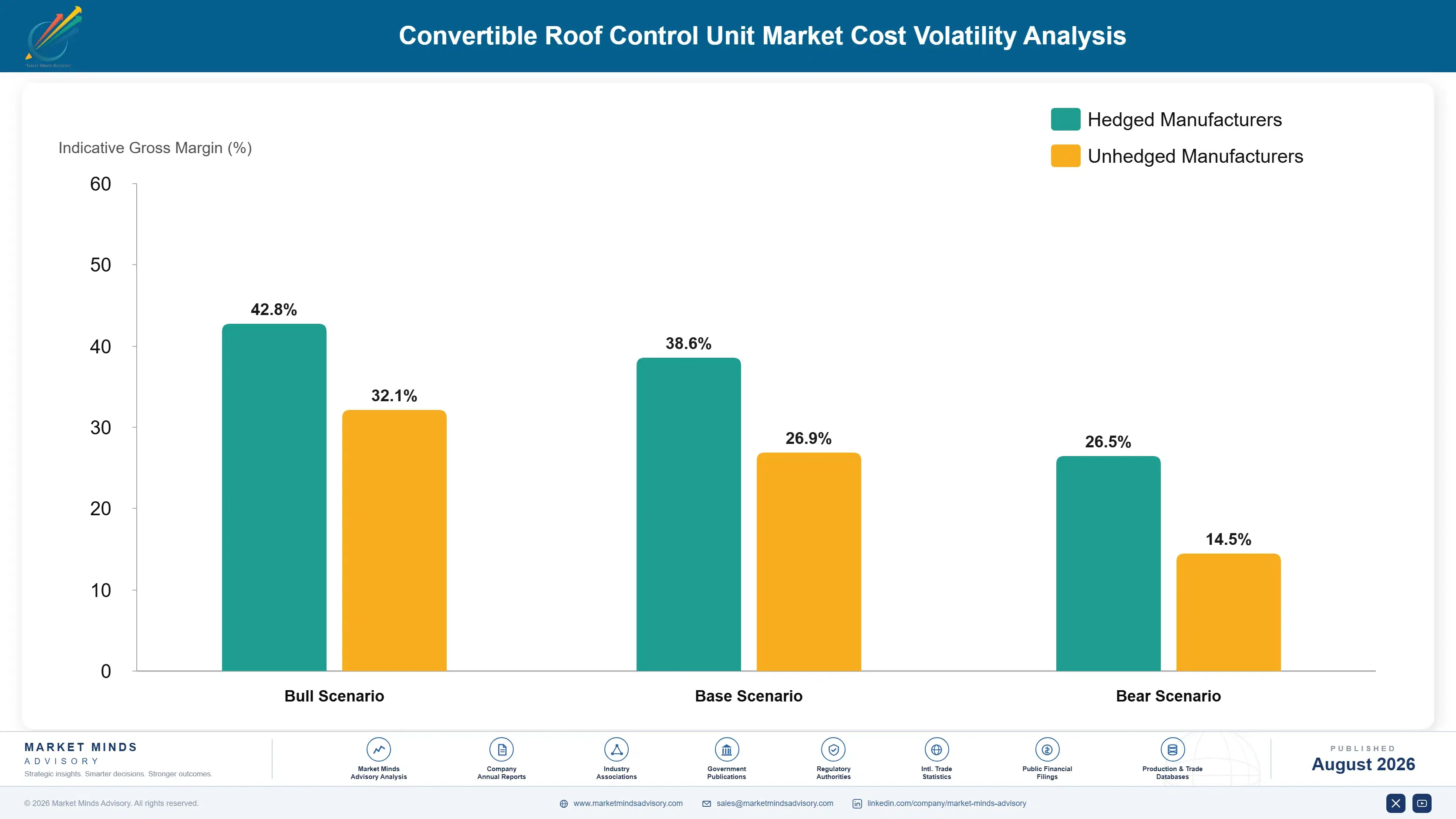
Electric Motor and Sensor Cost Exposure

Electric motors and semiconductor-based position sensors together account for roughly thirty-six percent of total production cost, reflecting the accelerating shift from hydraulic components toward electric actuation and expanding sensor content within modern control units. Motor component costs track broader automotive electric motor supply chains, while semiconductor sensor costs track the same component markets affecting the broader automotive electronics industry. Suppliers report this split is shifting as electric content expands.
Semiconductor component prices rose meaningfully during 2021 and 2022 following broader automotive chip supply chain disruption, according to industry trade reporting and supplier investor disclosures, increasing control unit production costs across the industry. Suppliers without long-term semiconductor supply agreements faced the steepest cost increases, since automotive-grade component qualification requires extended validation before substitution becomes possible. Several suppliers reported similar cost trends in subsequent quarterly earnings disclosures publicly.

Smaller suppliers relying on open-market component purchases carry meaningfully more cost exposure than larger, vertically integrated manufacturers like Webasto or Magna, which can shift sourcing across multiple qualified suppliers when one underperforms. This exposure disadvantage compounds for suppliers competing on price against integrated competitors with deeper sourcing relationships and greater negotiating scale across their broader automotive component portfolios.
convertible-roof-control-unit-market-cost-volatility-analysis-1787549604988

Diversify Semiconductor Sensor Sourcing

Larger suppliers are qualifying semiconductor sensor supply from multiple sources simultaneously rather than relying on a single supplier, reducing the odds that one disruption cuts total component availability. This diversification adds procurement complexity but has measurably reduced cost volatility for suppliers that implemented it before the 2021 to 2022 price increases. Smaller suppliers often lack scale to negotiate comparable terms.

Negotiate Long-Term Motor Supply Agreements

Suppliers are negotiating longer-term supply agreements with electric motor producers, reducing exposure to spot market price volatility affecting the broader automotive electric motor manufacturing sector. This approach requires meaningful working capital commitment but has kept production costs more stable for adopters. Smaller suppliers often lack the negotiating leverage to secure comparable long-term contract terms.

Standardize Motor and Sensor Platforms Across Programs

Suppliers are standardizing electric motor and sensor component specifications across multiple automaker platform programs, achieving procurement scale that individual platform-specific sourcing cannot match. This approach requires upfront engineering investment but has improved overall cost resilience for suppliers that pursued it. This approach also improves cost predictability across multiple simultaneous platform programs. Larger suppliers benefit most from this approach.

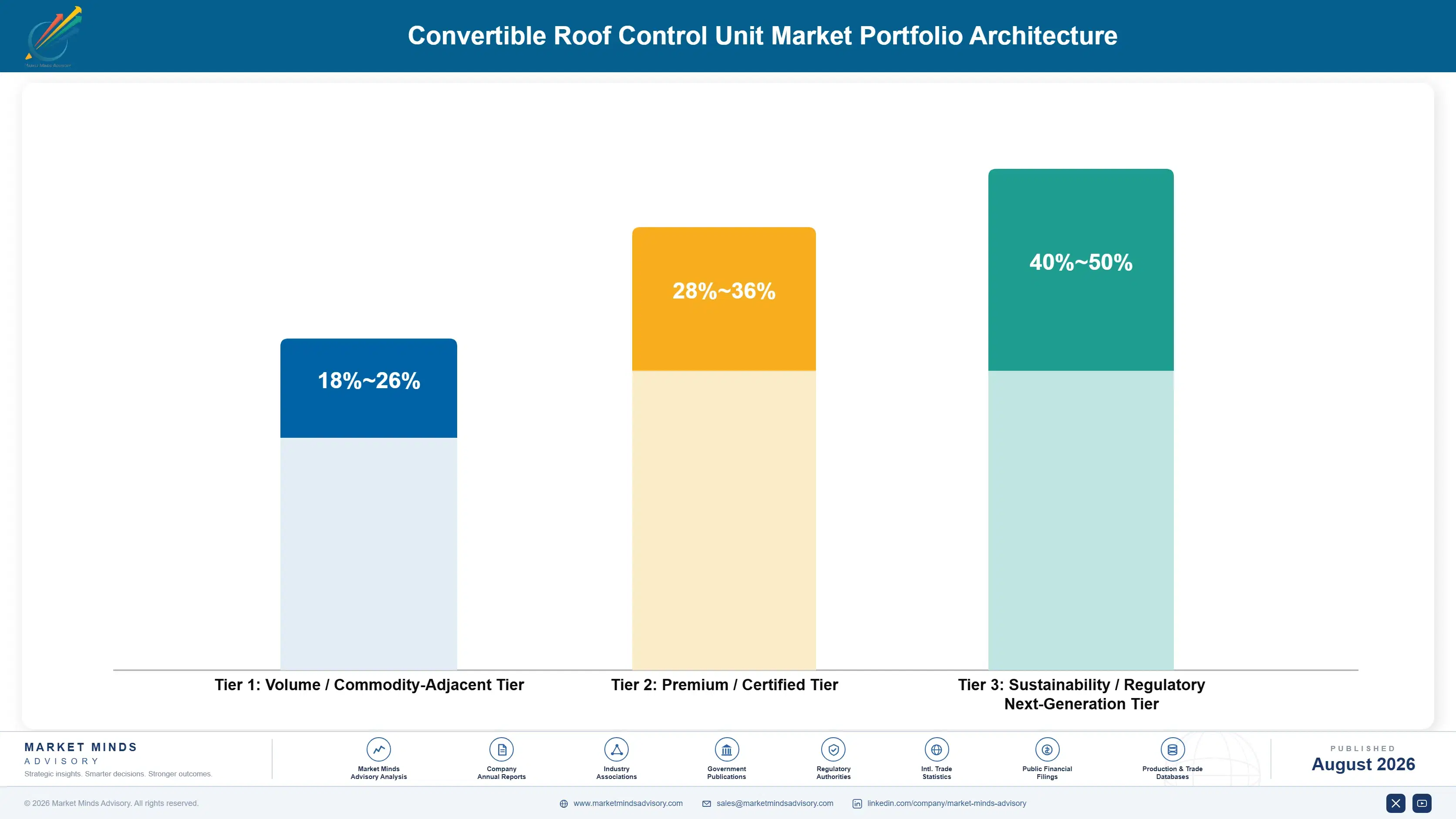
Portfolio Architecture for Margin Defence

Suppliers in this market operate a three-tier portfolio spanning standard hydraulic control units sold largely on established reliability into legacy platform customers, electric motor drive systems commanding premium pricing from automakers pursuing platform conversion, and software-integrated diagnostic systems positioned for the highest-margin premium platform accounts. Gross margins vary meaningfully across these tiers, from modest levels on standard hydraulic units to well above forty percent on fully software-integrated systems.
The volume versus premium tension is intensifying as more suppliers chase electric motor and software margins, but standard hydraulic control units still represent meaningful shipped volume on legacy platforms still in production and remain necessary for suppliers maintaining existing customer relationships. Suppliers that abandon hydraulic support too quickly risk losing legacy platform contracts to competitors willing to maintain both technology paths.

High-value margin pools concentrate specifically in software-integrated systems sold to premium platform accounts and in electric motor drive systems sold to automakers converting from hydraulic actuation. Standard hydraulic units remain a meaningful legacy volume anchor but carry thinner margins as platform conversion accelerates industry-wide. Manufacturers positioned only in the middle premium tier increasingly face pressure from both higher-margin and lower-cost directions simultaneously.

Volume / Commodity-Adjacent Tier

Standard hydraulic control units sold primarily on established reliability into legacy platform customers not yet converted to electric actuation. Buyer familiarity and established reliability track record dominate purchasing decisions at this level of the market.
Gross Margin: 18-26%

Premium / Certified Tier

Electric motor drive systems sold into automakers converting from hydraulic actuation, commanding premium pricing through documented reliability and weight reduction. Buyers select suppliers here mainly based on documented reliability data and conversion engineering support quality.
Gross Margin: 28-36%

Sustainability / Regulatory / Next-Generation Tier

Software-integrated diagnostic and calibration systems positioned for premium platform accounts paying the category's highest per-unit prices available. Purchasing decisions here center on software capability and diagnostic accuracy rather than raw hardware cost alone.
Gross Margin: 40-50%
convertible-roof-control-unit-market-portfolio-architecture-1787549605487

High-value Sub-segments and Strategic Watch-out

Software-Integrated Diagnostic Systems

Software-integrated systems are capturing the highest margins in the category as automakers extend software-defined vehicle capability into closure systems, and established suppliers are accelerating development investment to defend this premium positioning against emerging competition. Automakers increasingly drive purchasing preference toward suppliers with proven software track records.
Gross Margin: 40-50%

Electric Motor Drive Systems

Electric motor systems are gaining share as automakers convert from hydraulic actuation, though specialized motor control engineering remains concentrated among a small number of established roof systems suppliers. Growing conversion demand continues to strengthen interest in this transitional technology approach. Expect continued conversion investment across the industry.
Gross Margin: 28-36%

Standard Hydraulic Control Units

Standard hydraulic units sold into legacy platform customers remain a meaningful volume anchor, supported by established relationships but facing steady conversion pressure toward electric alternatives. Established brand loyalty continues sustaining steady replacement demand within this legacy segment. Expect gradual erosion as platform conversion accelerates further.
Gross Margin: 18-26%

Discontinued Mainstream Convertible Platforms

Control units for discontinued mainstream convertible platforms face shrinking addressable demand as automakers exit this body style in favor of SUV and crossover alternatives, a segment suppliers should actively deprioritize. Suppliers still active in this space face shrinking addressable demand each year. Expect further declines as SUVs dominate.
Gross Margin: 8-14%

Platform Cycle Meets Software Renewal Demand

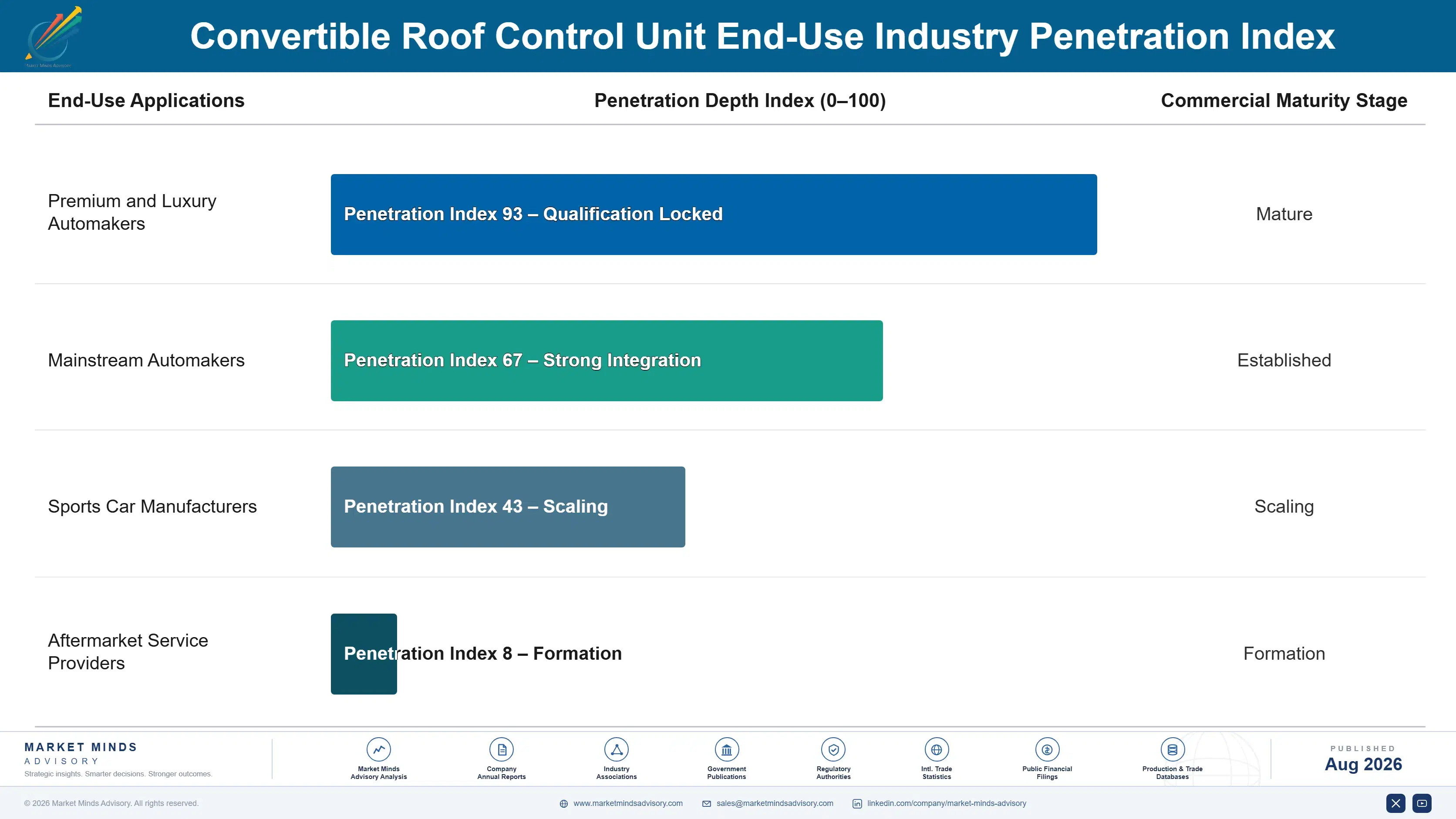
Convertible roof control units behave like a platform-cycle relationship rather than a recurring consumable business, because a supplier winning a platform contract typically retains that business for the full multi-year production run before the next redesign cycle opens competitive bidding. That structure gives incumbent suppliers durable, multi-year revenue visibility once a platform contract is won, though it also means losing a bid locks a competitor out until the next full redesign cycle.
Adoption depth varies sharply by end-use vertical. Premium German and Italian automakers adopt new electric motor and software capability relatively quickly given their technology leadership positioning, while mainstream automakers with smaller convertible programs move more cautiously, waiting for proven reliability data before committing to platform conversion investment. Sports car manufacturers fall somewhere between these two extremes, balancing brand-driven technology leadership against smaller platform development budgets.

Generational buyer shifts are visible mainly among newer platform engineering teams at automakers pursuing software-defined vehicle strategies, who increasingly favor suppliers offering integrated diagnostic capability, while legacy platform teams remain anchored to established hydraulic suppliers they have used successfully across previous vehicle generations. This generational divide will likely widen further as software-defined vehicle strategies expand across additional automaker platform portfolios.
convertible-roof-control-unit-market-end-use-penetration-index-1787549605976

Where Roof Control Value Concentrates

These are among the four positions where our research anticipates prominent divergence between winners and laggards over the coming forecast period. Each is grounded in the demand model, the regulatory perimeter, and the announced capacity pipeline.
01 / SOFTWARE DEVELOPMENT INVESTMENT

Invest in diagnostic software ahead of platform conversion

Automakers are extending software-defined vehicle capability into closure systems, and suppliers with diagnostic and calibration software are capturing this premium demand fastest. Valeo has already demonstrated meaningful commercial traction with its expanded diagnostic platform, confirming genuine automaker demand exists for this capability. MMA recommends suppliers without comparable software development capability invest in it now, before established competitors further consolidate relationships with automakers pursuing software-defined platform strategies across additional vehicle lines and future generations of premium platforms currently under development across several major automaker programs.
02 / ELECTRIC MOTOR CONVERSION SUPPORT

Build conversion engineering support ahead of platform redesigns

Automakers continue converting convertible platforms from hydraulic to electric motor actuation, and suppliers offering dedicated conversion engineering support are winning these transition contracts fastest. Webasto has already demonstrated meaningful commercial traction through its conversion support program, confirming genuine automaker demand for this specialized engineering assistance. MMA recommends suppliers without comparable support capability invest in it now, before established competitors further consolidate this fast-growing transition opportunity across additional automaker platform programs still awaiting conversion decisions over the next several years of platform planning.
03 / PREDICTIVE DIAGNOSTIC ALGORITHM DEVELOPMENT

Develop predictive algorithms ahead of warranty cost pressure

Automakers face growing pressure to reduce warranty costs through predictive fault detection rather than reactive diagnostic approaches, and suppliers with documented predictive algorithm capability are capturing this demand fastest. Early movers in predictive diagnostic technology are positioned to define the reliability standard other competitors will eventually need to match. MMA recommends suppliers without predictive capability invest in algorithm development now, while this advantage remains underdeveloped across much of the supplier base competing across both premium and mainstream vehicle segments industry-wide.
04 / CHINESE MARKET EXPANSION STRATEGY

Expand Chinese technical support ahead of demand acceleration

Chinese luxury vehicle ownership continues expanding rapidly, and suppliers with established regional technical support infrastructure are winning new platform contracts faster than suppliers relying on remote European engineering support. Magna has already demonstrated meaningful commercial traction through its new regional support center, confirming genuine automaker demand for localized integration assistance. MMA recommends suppliers without Chinese regional presence invest in it now, before established competitors further consolidate this fast-growing luxury vehicle market across additional Chinese cities and neighboring luxury vehicle markets.

Engagement Snapshot From the Field

A live engagement with an industry participant carrying material or product regulatory and market exposure ahead of a defining policy shift, showing how our research translates into a defensible multi-year portfolio strategy.
MARKET MINDS ADVISORY · CLIENT ENGAGEMENT SUMMARY
Convertible Roof Control Unit Producer Strategic Portfolio Review and Transition Roadmap 2026·Investment Scenario on Convertible Roof Control Unit Exposure Evaluation 2025-26
CLIENT PROFILE
The client is a mid-sized European automotive Tier 1 supplier generating an estimated seventy million dollars in annual revenue from convertible roof systems (client-reported, unverified by MMA), historically focused on hydraulic actuation components for several premium automaker platforms. The client faced a decision about whether to invest in electric motor conversion capability ahead of an upcoming platform redesign cycle.
STRATEGIC CHALLENGE
A major automaker customer indicated it was evaluating electric motor actuation for its next-generation convertible platform, creating competitive pressure for the client to develop comparable capability or risk losing the platform contract to a competitor already offering electric conversion engineering support within the available redesign timeline. Losing the platform contract would have meaningfully reduced the client's overall revenue base within a single fiscal year.
MMA APPROACH
MMA conducted a structured evaluation of electric motor conversion investment options, benchmarking required engineering capability, capital investment, and development timeline against the client's existing hydraulic component business and the automaker's platform redesign schedule. The engagement included direct comparison against competing suppliers already offering electric conversion capability. Findings were presented directly to the client's executive leadership team for final investment decision-making.
KEY FINDINGS
  1. The automaker customer's electric motor specification required control software and motor integration expertise that the client's existing hydraulic-focused engineering team did not currently possess internally.
  2. Partnering with a specialized motor control technology provider reduced required development timeline by roughly eight months compared with building capability entirely in-house from scratch.
  3. Two competing suppliers had already begun offering electric conversion capability to the same automaker customer, creating meaningful competitive urgency for the client's decision.
  4. The client's investment in conversion capability reportedly secured the platform contract renewal and preserved an estimated sixty percent of its existing hydraulic component revenue base (client-reported, unverified by MMA).
CLIENT PROFILE
The client is a mid-sized European automotive Tier 1 supplier generating an estimated seventy million dollars in annual revenue from convertible roof systems (client-reported, unverified by MMA), historically focused on hydraulic actuation components for several premium automaker platforms. The client faced a decision about whether to invest in electric motor conversion capability ahead of an upcoming platform redesign cycle.
STRATEGIC CHALLENGE
A major automaker customer indicated it was evaluating electric motor actuation for its next-generation convertible platform, creating competitive pressure for the client to develop comparable capability or risk losing the platform contract to a competitor already offering electric conversion engineering support within the available redesign timeline. Losing the platform contract would have meaningfully reduced the client's overall revenue base within a single fiscal year.
MMA APPROACH
MMA conducted a structured evaluation of electric motor conversion investment options, benchmarking required engineering capability, capital investment, and development timeline against the client's existing hydraulic component business and the automaker's platform redesign schedule. The engagement included direct comparison against competing suppliers already offering electric conversion capability. Findings were presented directly to the client's executive leadership team for final investment decision-making.
KEY FINDINGS
  1. The automaker customer's electric motor specification required control software and motor integration expertise that the client's existing hydraulic-focused engineering team did not currently possess internally.
  2. Partnering with a specialized motor control technology provider reduced required development timeline by roughly eight months compared with building capability entirely in-house from scratch.
  3. Two competing suppliers had already begun offering electric conversion capability to the same automaker customer, creating meaningful competitive urgency for the client's decision.
  4. The client's investment in conversion capability reportedly secured the platform contract renewal and preserved an estimated sixty percent of its existing hydraulic component revenue base (client-reported, unverified by MMA).
RECOMMENDED STRATEGY
Phase 1: Phase 1 (Weeks 1 to 4): Benchmark motor control technology partners against engineering capability, cost, and development timeline requirements. and existing engineering capability gaps Phase 2: Phase 2 (Weeks 5 to 9): Validate conversion economics against the automaker's platform redesign schedule and specification requirements. and the automaker's redesign schedule Phase 3: Phase 3 (Weeks 10 to 16): Finalize technology partnership, complete engineering integration, and secure platform contract renewal. ahead of the platform deadline
OUTCOME
The client successfully developed electric motor conversion capability and secured renewal of its platform contract with the automaker customer (client-reported, unverified by MMA). The successful transition also positioned the client to pursue additional conversion contracts with other automaker customers. The successful renewal also strengthened the client's standing among other automakers evaluating conversion-capable suppliers.

Frequently Asked Questions

Foundational context covering the market sizes, CAGR, scope, country, region and competition that inform every finding below. This section is provided to cover basics and most often pre-purchase conversations, answered from the MMA Primary Research Dataset.

What is the current size of the Convertible Roof Control Unit Market?

The global convertible roof control unit market is valued at approximately $0.58 billion in 2025. Growth is driven by rising electronic content per vehicle even as overall convertible production remains flat.

How large will the Convertible Roof Control Unit Market be by 2036?

MMA projects the market will reach approximately $1.08 billion by 2036, roughly 1.8 times its 2026 base value. Diagnostic and calibration software will account for a growing share of that expansion.

What is the CAGR for the Convertible Roof Control Unit Market 2026 to 2036?

The market is expected to grow at a compound annual growth rate of 5.8% between 2026 and 2036. Bull and bear scenarios range from 4.7% to 6.9% depending on platform conversion pace.

Which segment is growing fastest?

Diagnostic and calibration software is the fastest-growing segment, expanding at roughly 9.6% annually, about 1.7 times the overall market rate. Over-the-air update capability is the primary driver.

Who are the major companies in the Convertible Roof Control Unit Market?

Webasto Group, Magna International, Valeo, Inalfa Roof Systems, and Brose Fahrzeugteile lead global supply. The top five suppliers together hold roughly half of global supply.

Which country is growing fastest?

China is growing fastest, driven by expanding luxury convertible imports and rising premium vehicle ownership across major Chinese cities. Regional technical support investment is reinforcing this growth.

Report Segmentation Architecture

The full report scope spans multiple orthogonal segmentation dimensions, with cross-tabulated demand data provided for each dimension pair. Coverage extends further to regional breakdowns, trend trajectories, and the competitive detail needed to support segment-level decision-making.

By Component Type

  • Electronic Control Units
  • Hydraulic Actuation Modules
  • Position and Latch Sensors
  • Electric Motor Drive Systems
  • Wiring Harness Systems
  • Diagnostic and Calibration Software

By End-Use Industry

  • Premium and Luxury Automakers
  • Mainstream Automakers
  • Sports Car Manufacturers
  • Aftermarket Service Providers

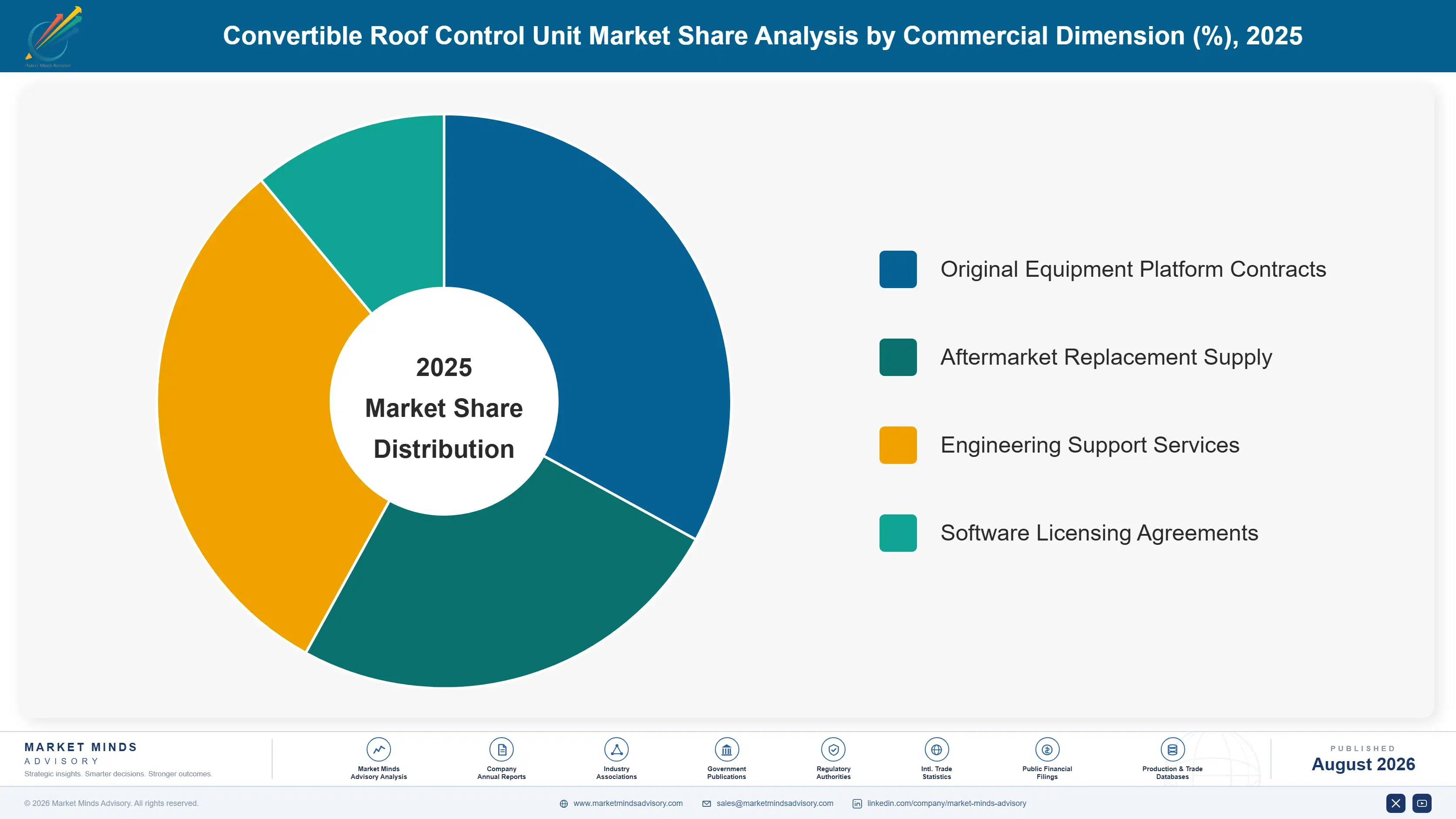
By Commercial Dimension

  • Original Equipment Platform Contracts
  • Aftermarket Replacement Supply
  • Engineering Support Services
  • Software Licensing Agreements

By Region

  • North America
  • Western Europe
  • East Asia
  • South Asia and Pacific
  • Latin America
  • Middle East and Africa
  • Eastern Europe

Scope, Methodology, and Coverage

Every figure in this report is reproducible from documented input assumptions. The scope below maps the historical period, the forecast horizon, the segmentation dimensions, and the countries covered, alongside the underlying primary and qualitative methodology.
Historical Period
2020 to 2025
Forecast Period
2026 to 2036
Base Year
2025 (USD billions; MMA Primary Research Dataset, August 2026)
Market Definition
The convertible roof control unit market covers electronic control units, hydraulic and electric actuation modules, position and latch sensors, motor drive systems, and diagnostic software specifically designed for automatic convertible soft-top and retractable hardtop roof operation. It excludes the roof fabric and hardtop panels themselves and general vehicle body control modules not specific to roof actuation.
Quantitative Units
USD billions (current prices); thousand units produced annually where applicable
Segmentation Dimensions
By Component Type; By End-Use Industry; By Commercial Dimension; By Region
Regions Covered
North America, Western Europe, East Asia, South Asia and Pacific, Latin America, Middle East and Africa, Eastern Europe
Countries Covered
USA, Canada, Germany, Italy, France, UK, Japan, South Korea, China, Australia, India, Singapore, Brazil, Mexico, Argentina, UAE, Saudi Arabia, South Africa, Poland, Russia, Czech Republic, Hungary, and additional markets relevant to this sector
Key Companies Profiled
Webasto Group, Magna International, Valeo, Inalfa Roof Systems, Brose Fahrzeugteile, ZF Friedrichshafen, Continental AG, Mitsuba Corporation, Inteva Products, Kuster Holding, Stabilus, Hi-Lex Corporation, Aisin Corporation, Denso Corporation, Kiekert AG, U-Shin Ltd, Minda Corporation, Hella GmbH, Kostal Group, WITTE Automotive
Quantitative Methodology
Primary survey, n=3,800 respondents, Q4 2025, six countries; demand-side model with trade association cross-validation
Qualitative Methodology
47 expert interviews, Q4 2025; applied to validate demand model assumptions, identify emerging dynamics, and assess competitive positioning
Report Format
PDF and XLSX data workbook (Word format preview document)
Publisher
Market Minds Advisory
Report Code
MMA-2026-AUT-305
Published
August 2026
Contact
sales@marketmindsadvisory.com | www.marketmindsadvisory.com

Purchase the full Convertible Roof Control Unit Market Report (2026 to 2036).

This report delivers a complete assessment of the global convertible roof control unit market across all major component types, end-use industries, and geographic regions through 2036. It includes competitive profiling of twenty companies, segmentation distinguishing control units, actuation modules, sensors, motor systems, and diagnostic software, and regional demand modeling across all seven MMA-covered geographies. Buyers will find quantified forecasts for market size, segment growth, and regional CAGR alongside analysis of electric motor conversion economics, software integration risk, and semiconductor cost exposure. A dedicated revenue lever framework identifies four specific commercial actions suppliers can take to capture margin as software and electric content expands.
Twenty-company competitive profiling with moat and risk analysis
Seven-region demand model with justified share and CAGR bands
Component-type segmentation across six MECE categories
Quantified revenue lever framework for margin capture strategies
Electric motor and semiconductor sensor cost exposure analysis
Anonymized case study on electric motor conversion strategy

Built For The People Who Decide

From boardroom strategy to bench-side execution, this report is read cover-to-cover by leaders shaping the next decade of their industry, turning demand scenarios, market dynamics and valuation benchmarks into decisions.
CXOs/ Presidents/ VPs/ Managers
M&A and Corporate Development
Strategy Teams and R&D Heads
Procurement and Product Directors
Regulatory and Compliance Leaders
Investor Relations and Equity Analysts