Market Minds Advisory
Converted Flexible Packaging Market

Converted Flexible Packaging Market: Value Added Sits In The Press, Not The Polymer

A commercial reading of flexible converting operations, where substrate cost passes straight through and the only earnings a converter keeps are whatever the printing, laminating, and pouch-making steps genuinely add.

Lead Analyst

Bilal Shaikh

Published

September 2026

Make Smarter Decisions with Customized Research Insights

Request a free sample report and evaluate market opportunities, growth trends, and competitive dynamics relevant to your business needs.

2025 MARKET VALUE$68.4BMarket Size 2025
2036 FORECAST VALUE$123.3BBase Case , 2026 to 2036
CAGR 2026 TO 20365.5 %Bull 6.6% / Bear 4.3%
INCREMENTAL OPPORTUNITY$51.1BNet 10- year value creation
EXPANSION MULTIPLE1.71x2036 value over 2026 base
Strategic Levers
M&A Pipeline
Regional Outlook
Country Rankings
Competitive Intelligence
Segmental Deep-dive
Call-Us : 91 93563 13602

Executive Snapshot and Market Trajectory

A converter buys film and sells a printed, laminated, sealed thing. The polymer passes through at whatever the market charges. What the business actually earns is the value the press, the laminator, and the pouch machine put on top, and that number is smaller than most people assume.
The market stands at USD 68.4 billion in 2025 and reaches USD 123.26 billion by 2036 at a 5.5% CAGR. Coating and barrier application grows fastest at 10.2%, about 1.85 times the overall rate, as converters replace laminated layers with coatings that satisfy recyclability criteria. East Asia holds 29% of value on food processing volume, while India posts the quickest national growth at 9.6%. Equipment decides that shift.
Fragmentation is extreme, with the top five holding roughly 17% of converting value added because presses are widely available and geography limits how far converted film travels. Two forces pull against each other. Design-for-recycling rules keep pushing work toward coating and mono-material construction that requires new equipment, while brand owner procurement runs reverse auctions on price per thousand impressions that treat every press as interchangeable. Neither of those forces cares about press utilisation.
Market Definition
The converted flexible packaging market covers the value added by conversion operations applied to flexible substrates, spanning printing, lamination, coating and barrier application, pouch and bag making, and slitting and finishing. It is measured as converting value added and service revenue rather than delivered pack price. Substrate, resin, foil, and paper purchased as raw material, the finished flexible pack sized as a format market elsewhere, rigid and corrugated packaging, filling and sealing machinery, and label converting sold separately from the pack are excluded.
Base Year Value
$68.4B in 2025 (MMA Primary Research Dataset, August 2026)
Forecast Period
2026 to 2036, eleven discrete annual values
CAGR
5.5% base case. Bull 6.6%. Bear 4.3%.
Fastest Growth Segment
Coating and Barrier Application: 10.2% CAGR
Fastest Growth Country
India: 9.6% CAGR
Fastest Growth Region
South Asia and Pacific: 7.7% CAGR
Largest Region
East Asia: 29% of 2025 global value
Market Leaders
Amcor, Constantia Flexibles, Mondi, Huhtamaki, ProAmpac. Source: MMA Analysis based on company annual reports.
Primary Survey
n=3,800 procurement and R&D decision-makers, Q4 2025, six countries
Methodology
Demand-side build-up, cross-validated against public data, 47 expert interviews

Converted Flexible Packaging Market Forecast Scenarios

converted-flexible-packaging-market-size-forecast-scenario-1787332046171
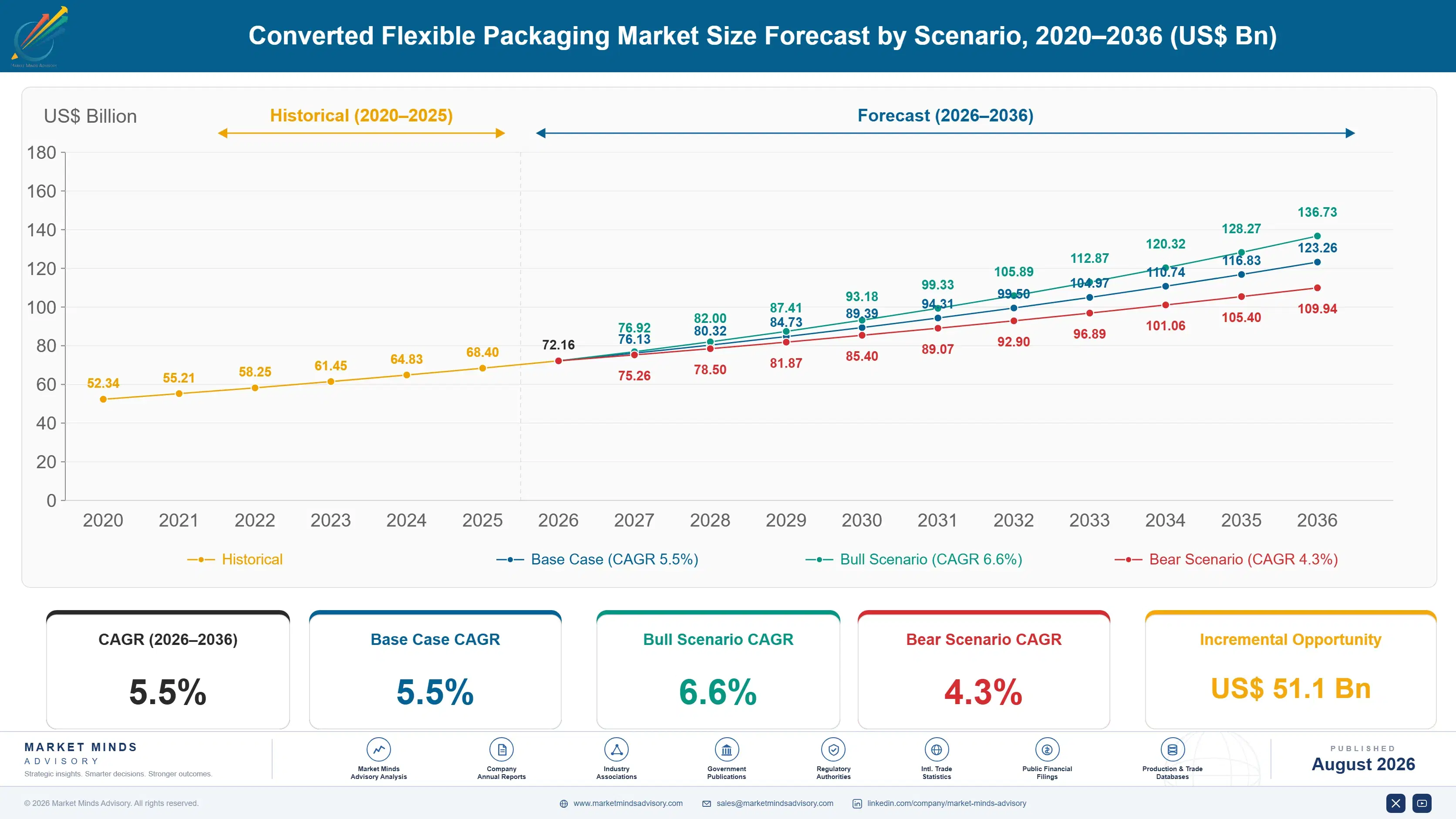
Growth from 2020 to 2025 compounded near 4.4%, and substrate pricing rather than converting activity produced most of the reported movement. Resin and energy costs rose steeply through 2022, and because converters quote delivered prices, revenue rose while value added barely moved. Volume was flat to modest across the window. What changed was equipment demand, as design-for-recycling rules began forcing coating and mono-material investment.
Three mechanisms carry the base case to 5.5%. First, coating displacing lamination, which shifts work from a mature process step onto equipment few converters currently hold. Second, short-run and digital printing, where changeover time rather than press speed decides the economics and conventional gravure cannot compete profitably. Third, emerging market converting capacity, which adds genuinely new value added rather than relocating existing work between competitors in mature markets. Neither is quick.
The bull case at 6.6% assumes coating and mono-material conversion accelerates and digital printing captures short-run work at scale, both of which raise value added per square metre. The bear case at 4.3% assumes reverse auctions keep compressing conversion margin toward pure machine time, brand owners delay recyclability investment until deadlines bind, and overcapacity in conventional printing persists across mature markets all decade.

What The Press Adds Is All You Get To Keep

Demand rests on three foundations. Brand owner pack volume provides the base, since converting activity tracks filled units almost exactly. Specification complexity provides the value, because a nine-colour laminated pouch carries far more conversion content than a two-colour printed film. And geography provides the protection, since converted film travels only 400 to 800 kilometres economically and that radius is the only genuine barrier most converters have.
MARKET CONCENTRATIONCR5: 17%Among the most fragmented converting industries in any sector
VALUE ADDED SHAREAbout 38%Conversion value added against delivered flexible pack price
PRESS CHANGEOVER TIME20 to 60 minutesDowntime between jobs on conventional flexible printing equipment
PRESS UTILISATIONAbout 71%Running rate across conventional flexible printing capacity today
COATING LINE INVESTMENT3 to 5 yearsPayback period on a new barrier coating installation
SERVICE RADIUS400 to 800 kilometresEconomic delivery distance for converted flexible roll material
Commercially the point that gets missed is where the money actually sits. Conversion is roughly 38% of delivered pack price and the substrate is most of the rest, which means a converter quoting delivered prices is passing through a cost it does not control while competing on a margin it barely influences. Press utilisation near 71% tells the rest of the story about industry capacity.
The next decade turns on equipment rather than commercial skill. Design-for-recycling criteria are moving work from lamination toward coating, which few converters hold at scale and which pays back over three to five years. Digital printing is taking the short-run end where 20 to 60 minute changeovers make conventional presses uneconomic. Coating and barrier work at 10.2% growth is where value added per square metre genuinely rises.
"Converters keep telling customers about their press capability and then quoting a delivered price that buries it under resin cost. If you sell the substrate you are a trader with a printing press attached, and the reverse auction will find you out eventually."
Director, Flexible Converting and Print Operations Practice · MMA Packaging / Fl

Market Trends

Coating Displaces Lamination Under Recyclability Criteria

Design-for-recycling rules reject multi-layer laminates that combine polymer families, and the practical alternative is applying a thin barrier coating to a single-polymer substrate instead of laminating a second film to it. That moves work off laminators, which most converters have, and onto coating lines, which most do not. Coating and barrier application grows at 10.2% against a market at 5.5% for exactly that reason. A coating line pays back over three to five years and runs slower than lamination, so the investment case depends on winning the specification rather than the volume.
Market Impact: Complex packs add 3 process steps
Digital Printing Takes The Short-Run Work Conventional Presses Lose

Conventional gravure and flexographic changeover runs 20 to 60 minutes, which makes any short run uneconomic and pushes converters toward the long commodity work where reverse auctions live. Digital presses remove changeover almost entirely, opening seasonal, regional, promotional, and test-market runs that nobody else can quote profitably. Those jobs carry considerably better conversion margin because the competitive field is thin. Press utilisation across the conventional base sits near 71%, which tells you the capacity problem is in exactly the segment digital does not address. Digital does not fix the long-run capacity problem.
Market Impact: Economic radius spans 800 kilometre

Market Opportunities and Growth Drivers

Specification Complexity Raises Conversion Content Per Pack

A nine-colour laminated pouch with a resealable closure and a matte lacquer carries several times the conversion content of a two-colour printed film, and brand owners keep adding elements because shelf differentiation is one of the few marketing levers left. Every additional print station, lamination pass, and finishing operation adds value added the converter keeps rather than substrate cost it passes through. This is the cleanest growth in the category and it depends on brand behaviour rather than on any regulation or technology change. Nothing regulatory or technological is driving it at all.
Market Impact: Conversion is 38% of pack price

Geography Protects Converters From Distant Competition

Converted flexible material travels only 400 to 800 kilometres economically, because printed roll stock is bulky, damages in handling, and carries lead time expectations measured in days rather than weeks. That radius is the only real barrier most converters have, and it explains why the top five hold just 17% of value added in an industry with no technology moat. It also means overcapacity is regional rather than global, so a converter can be short of work while presses stand idle a thousand kilometres away. It is protection nobody earned and nobody can extend.
Market Impact: Utilisation sits near 71%

Market Restraints and Challenges

Reverse Auctions Reduce Conversion To Machine Time

Brand owner procurement runs price per thousand impressions comparisons that treat every press as interchangeable, which strips print quality, colour management, and technical service out of the evaluation entirely. The root cause is that conversion is only about 38% of delivered pack price, so procurement negotiates hard on the part it can compare while the substrate passes through unexamined. Commercially this drives conversion margin toward machine time plus overhead. Converters mitigate by quoting conversion separately from substrate, holding capabilities competitors lack, and reaching packaging development rather than purchasing. The substrate passes through entirely unexamined.
Market Impact: Coating grows at 10.2% annually

Conventional Print Overcapacity Persists Across Mature Markets

Press utilisation near 71% across conventional flexible printing means capacity exceeds demand in most mature markets, and a gravure press has a working life measured in decades with almost no alternative use. The root cause is that presses were installed for a volume trajectory that flattened and nobody scraps a functioning asset. Commercially this guarantees somebody will always quote below cost to fill a shift. Converters mitigate through consolidation, deliberate capacity retirement, mix shift into coating and digital, and refusing work that only covers variable cost. Almost nobody actually does the last one.
Market Impact: Changeover runs 20 to 60 minutes
4 additional market trends, 3 additional growth drivers, and 2 additional restraints and challenges are covered in the full report. Contact sales@marketmindsadvisory.com to access the complete intelligence.

Segment CAGR and Growth Architecture

Segmentation follows conversion process step, a single classification describing the operation applied to the substrate. Each step carries its own equipment, changeover economics, skill requirement, and value added per square metre, so commercial position tracks the process rather than the finished format. End-use industry and commercial model appear separately within the framework as their own distinct dimensions.
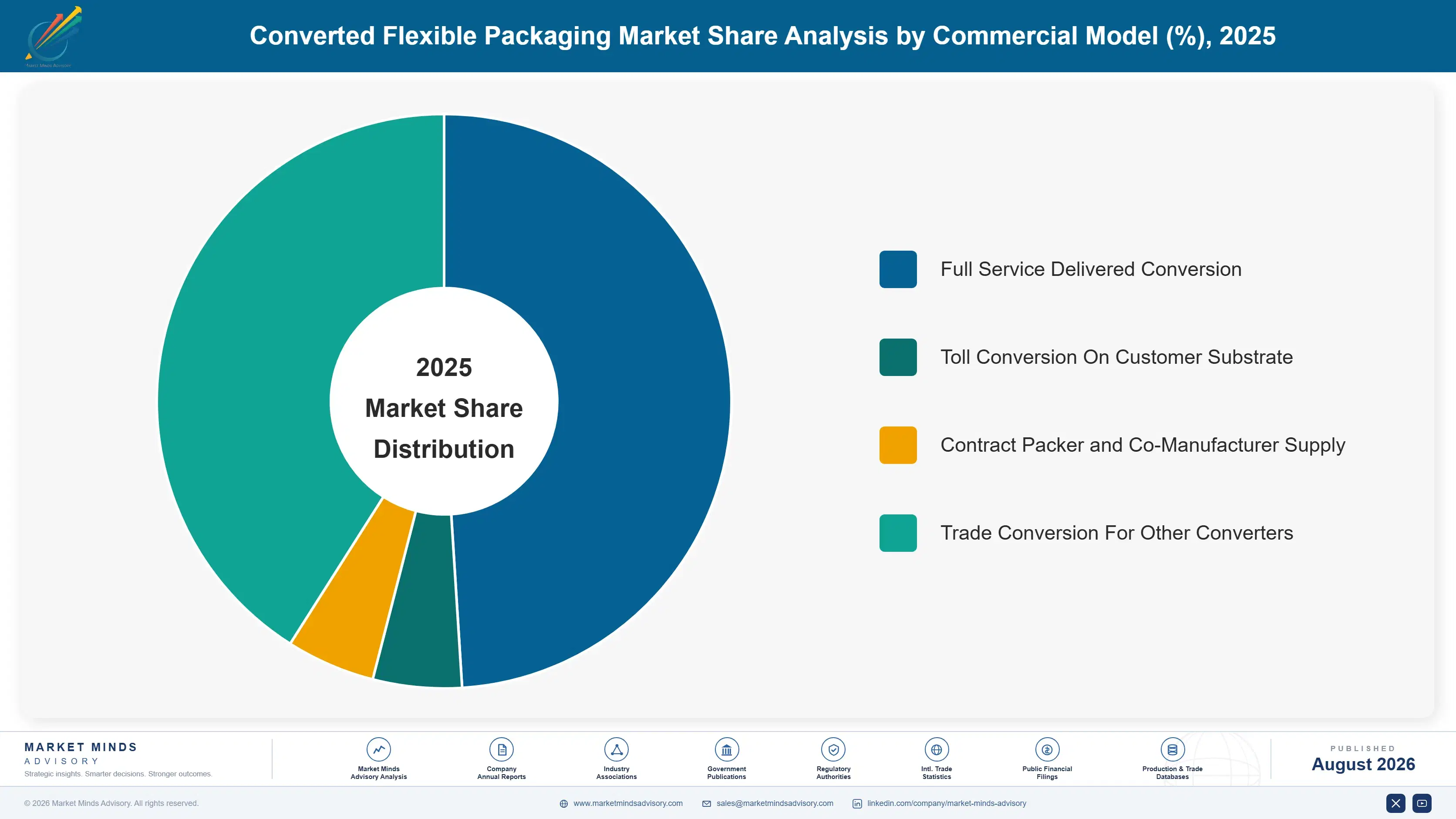
converted-flexible-packaging-market-market-share-analysis-1787332046711

Coating and Barrier Application

Coating and barrier application grows fastest at 10.2%, about 1.85 times the overall 5.5% rate, and recyclability criteria rather than any performance improvement drive all of it. Applying a thin inorganic or dispersion barrier to a single-polymer substrate satisfies design rules that a laminate combining polymer families cannot, so work moves off laminators onto coating lines. Most converters hold laminating capacity and comparatively few hold coating at scale, which is precisely why value added per square metre is higher here. Lines run slower than lamination and pay back over three to five years, so the case rests on winning specifications rather than chasing volume. Equipment scarcity is the whole advantage here.
CAGR 10.2%

Printing

Printing grows at 5.2%, close to the market rate, and it is where almost all the conversion capacity and almost all the pricing pressure sit together. Gravure suits very long runs, flexographic covers the middle, and digital is taking the short-run end that 20 to 60 minute changeovers make uneconomic on conventional presses. Utilisation near 71% across the conventional base means somebody is always willing to quote below full cost to fill a shift. Value added per square metre rises sharply with colour count and finishing complexity, which is the only part of printing economics a converter genuinely controls. Everything else about printing economics gets decided by somebody other than the converter.
CAGR 5.2%
Full segment breakdown across 5 segments available in the complete report.

Regional Architecture and Country Demand Map

Converting capacity sits close to filling operations because printed roll stock travels badly, so this distribution follows packaged goods production rather than consumption. East Asia leads on processing volume, while South Asia and Pacific grows quickest as new capacity is installed rather than reallocated. Radius rather than scale limits reach.

North America

North America holds 25% of value added on a large packaged food base and pet food volumes that have converted to complex pouch formats faster than any other category. Conversion content per pack is high here, since brand owners specify colour counts and finishing that raise value added rather than substrate weight. Resin availability is better and cheaper than anywhere given domestic gas-based ethylene, which makes the substrate pass-through less painful than it is in Europe. Press overcapacity in conventional printing is real and consolidation has been steady. Growth of 5.1% reflects specification complexity rising faster than volume across the region. Conversion content per pack rather than volume is the story.
Share: 25% | CAGR: 5.1% (2026 to 2036)

Western Europe

Design criteria rather than demand define converting priorities here. Western Europe holds 23% of value added, with packaging regulation pushing work from lamination toward coating and mono-material construction on a fixed timetable, which is driving equipment investment that mature volume growth alone would never justify. Energy costs since 2022 have disadvantaged European coating and lamination against Asian and American operations on the same work. Press utilisation is the lowest of any region and capacity retirement has lagged what the volume trajectory required. Growth of 4.0% is the slowest of the seven, reflecting flat volumes against genuine regulatory investment need. Capacity retirement rather than new investment is the harder decision facing most boards.
Share: 23% | CAGR: 4.0% (2026 to 2036)
Regional intelligence for 5 additional markets available in the complete report: East Asia, South Asia and Pacific, Latin America, Middle East and Africa, Eastern Europe. Contact sales@marketmindsadvisory.com.
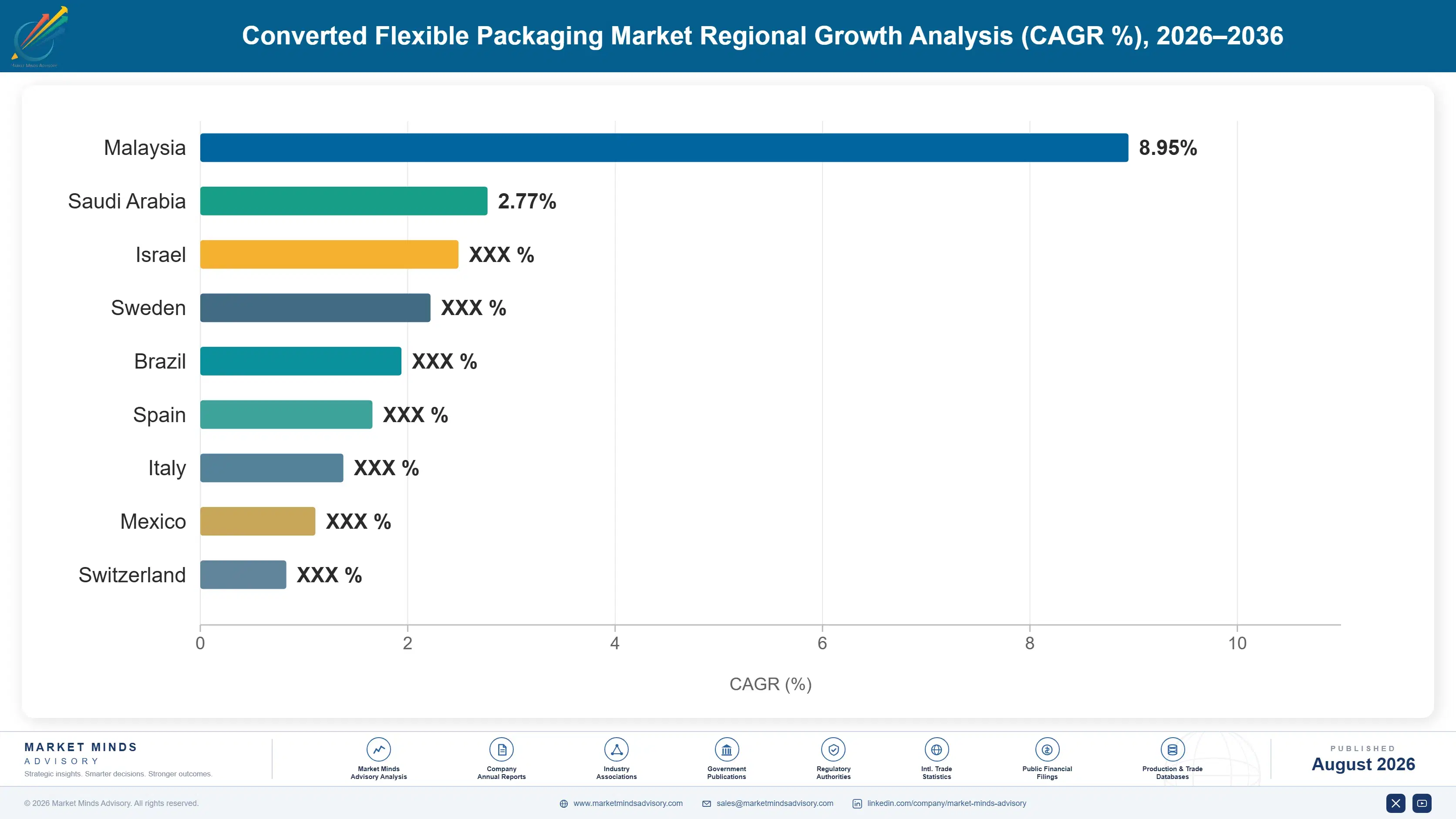
converted-flexible-packaging-market-country-cagr-analysis-1787332047221

Where Converting Value Added Is Defended

Quoting a delivered price buries conversion under substrate cost and hands procurement a number it will compress every year. The four moves below separate what a converter controls from what it merely passes on: pricing conversion separately, buying coating capability, taking short-run work conventional presses cannot, and retiring capacity deliberately. None of the four is a price concession.

Quote Conversion Separately From The Substrate

Conversion is roughly 38% of delivered pack price and substrate is most of the rest, so a converter quoting one delivered number is competing on a margin it influences while carrying a cost it does not. Separating the two puts the substrate on an indexed pass-through and exposes conversion value where print quality, colour management, and technical service can actually be argued. Procurement resists the split precisely because it removes the comparison they prefer. That resistance is the clearest evidence it works. Every year of delay compresses conversion margin further still.
Market Impact: Conversion is only about 38% of pac

Buy Coating Capability Before Customers Requalify

Design-for-recycling criteria are moving work from lamination to coating, and coating grows at 10.2% against a market at 5.5% for that single reason. Most converters hold laminating capacity and few hold coating at scale, which is exactly why value added per square metre is higher. A line pays back over three to five years and runs slower than lamination, so the case rests on being qualified when a brand owner rewrites the structure rather than on filling the machine. Arriving after requalification means quoting into somebody else's specification. Requalification happens once per structure.
Market Impact: Coating lines pay back in 3 to 5 ye

Take The Short Runs Conventional Presses Cannot Quote

Changeover of 20 to 60 minutes makes short runs uneconomic on gravure and flexographic presses, which pushes the entire industry toward long commodity work where utilisation near 71% guarantees somebody quotes below full cost. Digital printing removes changeover and opens seasonal, regional, promotional, and test-market runs almost nobody else can price profitably. The competitive field there is thin and the conversion margin reflects it. Digital investment is substantial but it reaches work the conventional base cannot serve at any price. Nobody is running a reverse auction on a 20,000 metre promotional job.
Market Impact: Digital removes the 20 to 60 minute

Retire Conventional Capacity Instead Of Filling It

A gravure press has a working life measured in decades and almost no alternative use, so utilisation near 71% across mature markets means someone will always quote below full cost to fill a shift. Deliberately retiring the least competitive presses rather than chasing volume to load them is the only move that improves industry economics, and it improves the retiring converter's economics first. It is also the hardest decision to take, which is precisely why so few competitors will make it. The board that acts first captures most of the benefit.
Market Impact: Utilisation near 71% signals real o

Who Controls the Margin Pool

Fragmentation is extreme: the top five hold roughly 17% of converting value added, because presses are widely available and the service radius limits reach. The gap between leaders and challengers is coating and finishing capability rather than print quality, which is broadly held across the industry. All participants here are assessed on one basis, conversion value added and service revenue from flexible converting operations, excluding substrate resale, finished pack format value, and machiner
Competition runs along four lines. First, coating and barrier capability, since recyclability criteria are moving work there and few hold it at scale. Second, changeover economics, because short-run work is the only segment not under reverse auction pressure. Third, colour and finishing depth, which raises value added per square metre. Fourth, service radius density, as converted roll stock travels only a few hundred kilometres economically.

Pressure is building from two directions. Conventional print overcapacity in mature markets guarantees somebody quotes below full cost, and consolidation has not removed capacity fast enough to fix it. Meanwhile coating requirements demand equipment most converters do not hold. Rankings should favour converters with coating capability and short-run capacity over those defending conventional press utilisation on delivered price alone.
converted-flexible-packaging-market-company-positioning-matrix-1787332047736

Competitive Moat and Risk Dimensions

AMCOR

Moat: Coating capability and technical depth

Amcor holds coating and barrier application capability across multiple sites at a scale very few converters match, which matters as recyclability criteria move work off laminators. Its materials science depth lets it develop structures rather than simply run specifications a brand owner supplies. Multinational footprint also lets global customers standardise conversion across regions, which the service radius otherwise prevents.
AMCOR

Risk: Conventional capacity and price exposure

A substantial installed base of conventional printing and laminating capacity faces the same utilisation problem as everybody else in mature markets. Regional converters undercut consistently on straightforward printed work where global consistency earns no premium at all. Substrate cost pass-through also means reported revenue moves on resin markets rather than on anything the conversion business actually did.
CONSTANTIA FLEXIBLES

Moat: European coating and mono-material work

Constantia has invested ahead of European design deadlines in coating and mono-material conversion, which positions it well as brand owners requalify structures across their portfolios. Strength in pharmaceutical and food applications where barrier and compliance both matter supports genuinely defensible conversion pricing. European manufacturing proximity delivers the service response that filling operations require inside the radius.
CONSTANTIA FLEXIBLES

Risk: European cost base and utilisation

European energy and conversion costs sit well above Asian and American operations on comparable work, which limits competitiveness outside the region entirely. Press utilisation across European conventional capacity is the lowest of any region and capacity retirement has lagged. Private equity ownership also creates pressure toward near-term margin that competes with the coating investment the strategy actually requires.

Players Tracked

Prominent Players

Amcor
Constantia Flexibles
Mondi
Huhtamaki
ProAmpac

Other Key Players

Sealed Air
Berry Global
Sonoco Products
Coveris
Uflex
Wipak
Toppan Holdings
Dai Nippon Printing
Winpak
TC Transcontinental
Printpack
Glenroy
Schur Flexibles
Clondalkin Group
Bischof und Klein

Recent Developments

JANUARY 2025

Coating line investment accelerates across European converters

Several converters committed to new barrier coating capacity as design-for-recycling criteria pushed brand owners to requalify laminated structures onto single-polymer substrates. These were organic capacity investments rather than acquisitions or joint ventures, and they address a process step most converters have historically outsourced or avoided entirely.
Signal: Coating capability is now becoming a quali
JULY 2024

Digital flexible printing installations widen beyond trial use

Digital press installations moved from pilot and sampling work into commercial short-run production across food, beverage, and personal care converting. These were equipment purchases rather than corporate transactions, and they target the runs that 20 to 60 minute conventional changeovers make permanently unprofitable to quote.
Signal: Short-run work is the one segment where re
MARCH 2024

Converter consolidation continues without removing press capacity

Further consolidation among mid-sized flexible converters proceeded across mature markets, with acquirers retaining most acquired printing capacity rather than closing it. These were acquisitions rather than capacity rationalisation programmes, and utilisation across the conventional base consequently improved very little. Regional pricing dynamics consequently changed very little indeed.
Signal: Consolidation that keeps every acquired pr

Substrate, Inks, Adhesives, Energy, Plates

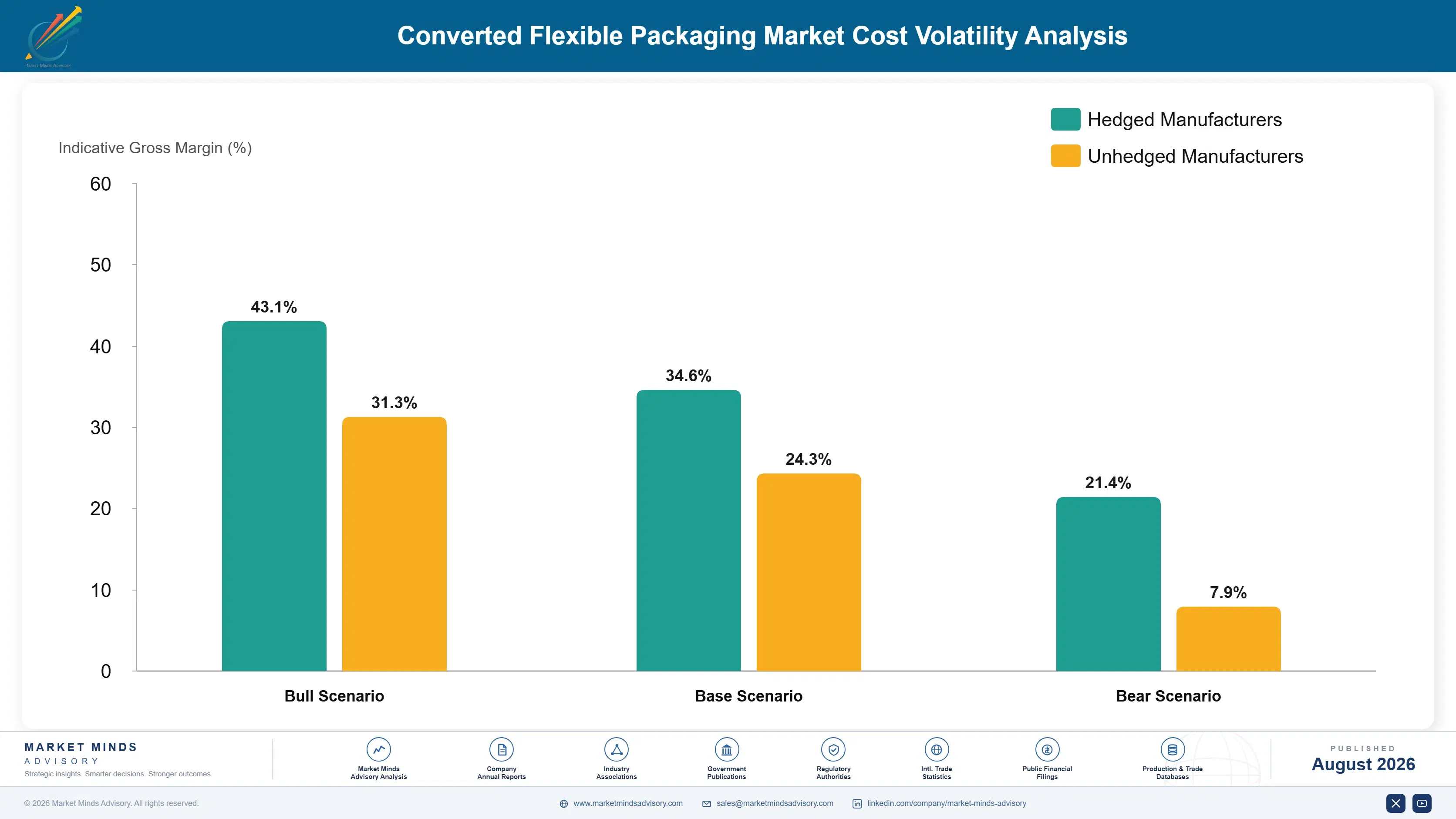
Because this market is measured as value added, the cost sheet covers what conversion consumes rather than the substrate passing through. Inks, coatings, and lacquers run 22% to 30% of conversion cost, adhesives and solvents 12% to 18%, and energy for drying, curing, and lamination 14% to 21%. Plates and cylinders add 8% to 13%, and direct labour a further 18% to 24% by automation level.
The 2022 European energy crisis hit conversion economics harder than the substrate discussion suggested, since drying and curing cannot be run cold. IEA analysis recorded European industrial gas at several times prior-year levels, and Amcor and Mondi both disclosed energy cost pressure across that reporting period. Solvent and ink pricing rose alongside it on petrochemical feedstock, and converters on annual contracts recovered neither quickly. Recovery took years.

Exposure separates by energy position and process route rather than by scale. A converter running solvent-based lamination carries far more drying energy per square metre than one using solventless routes, and the gap widened enormously when gas prices moved. Geography compounds it, since European drying energy costs multiples of Asian and American equivalents on identical work, which is why some structures are no longer economic in Europe.
converted-flexible-packaging-market-cost-volatility-analysis-1787332047930

Convert solvent-based lamination to solventless or coating

Solvent-based lamination consumes drying energy that solventless adhesive and coating routes largely avoid, and energy is a fifth of conversion cost. The equipment change is substantial and requires requalification of every affected structure with the brand owner. It also cuts solvent purchase, abatement load, and regulatory exposure, which makes the case stronger than the energy saving alone suggests.

Price conversion on indexed energy where customers permit

Drying and curing energy runs 14% to 21% of conversion cost and moves monthly on markets no converter influences, while conversion contracts typically hold for a year. Indexing that element separately converts the swing into a mechanical adjustment. Brand owners resist it more firmly than substrate indexation, which they already accept, so it usually only lands on technically differentiated work.

Extend plate and cylinder life through better handling

Plates and cylinders are 8% to 13% of conversion cost and their life depends heavily on storage, cleaning, and handling discipline rather than on purchase quality. Extending life across a large repeat-job library removes real cost with no capital required at all. It also cuts changeover risk, since a damaged cylinder discovered at make-ready costs press time nobody planned for.

Portfolio Architecture for Margin Defence

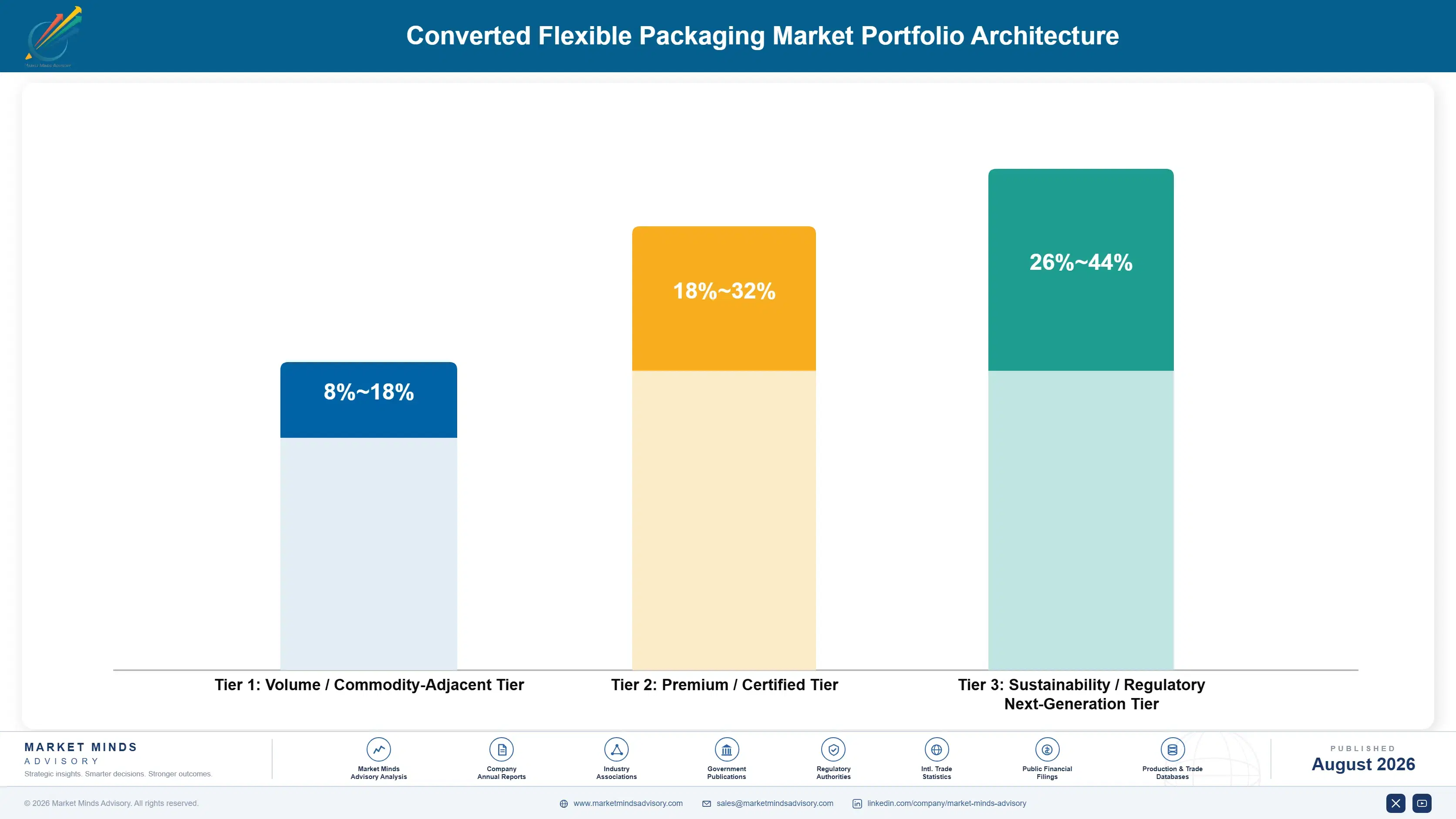
The portfolio splits into three tiers with different economics. Long-run conventional printing forms the volume tier, where reverse auctions compare price per thousand impressions and utilisation near 71% guarantees somebody quotes low. Complex multi-colour and finishing work earns more because colour management and registration narrow the field. Coating, barrier application, and digital short-run price against capability rather than against a competing press quotation.
The tension runs between long-run printing that fills presses and specialist work that earns the return. Conventional long runs keep expensive presses loaded, cover the fixed cost of gravure and flexographic capacity, and maintain the relationships through which specialist work arrives. Yet they compete against every converter inside the service radius on machine time. Converters handling this well accept thin long-run margin for utilisation while directing capital toward coating and digital capability.

High-value pools concentrate where equipment or skill limits competition: barrier coating on single-polymer substrates, digital short-run production, nine-colour work with demanding registration and finishing, and structures a converter developed rather than received as a specification. All four escape the price per impression comparison. Long-run two-colour film sits at the other end, where every press within a few hundred kilometres quotes the identical job.

Volume / Commodity-Adjacent Tier

Long-run conventional printing and simple lamination sold on price per thousand impressions. The range is wide because energy position and press vintage separate converters enormously at identical quoted conversion rates.
Gross Margin: 8-18%

Premium / Certified Tier

Multi-colour work with demanding registration, specialist finishing, and pharmaceutical or food contact qualified conversion. The range is wide because colour and finishing capability varies sharply and qualification depth protects some work far better than others.
Gross Margin: 18-32%

Sustainability / Regulatory / Next-Generation Tier

Barrier coating on mono-material substrates, digital short-run production, and solventless conversion routes. The range is wide because coating capacity is scarce while digital still carries unrecovered equipment cost at most installations.
Gross Margin: 26-44%
converted-flexible-packaging-market-portfolio-architecture-1787332048420

High-value Sub-segments and Strategic Watch-out

Coating and Barrier Application

High value and high growth at 10.2%, the fastest process step, because recyclability criteria move work off laminators onto lines few converters hold at scale. Payback runs three to five years and throughput is lower than lamination, so specification wins matter more than volume. Volume matters less than specification wins.
Gross Margin: 26-44%

Pouch and Bag Making

High value with solid growth at 6.4%, driven by rigid-to-flexible conversion in pet food, coffee, and household products. Tooling and format qualification protect the work reasonably well, though the machinery is widely available to anyone willing to buy it. Anyone willing to buy the machine can compete.
Gross Margin: 20-34%

Printing

The volume core by a wide margin, growing at 5.2% and carrying almost all the industry capacity and almost all the pricing pressure together. Utilisation near 71% means somebody always quotes below full cost, and colour count is the only economics a converter controls. Colour count is the only lever.
Gross Margin: 8-18%

Lamination

The strategic watch-out, growing at 3.4% as design-for-recycling criteria push structures toward coating instead. The installed laminating base is very large, widely held, and now facing a slow decline that consolidation will not reverse. Solventless routes preserve some of this work, though certainly not the growth.
Gross Margin: 12-24%

How Converting Positions Actually Hold

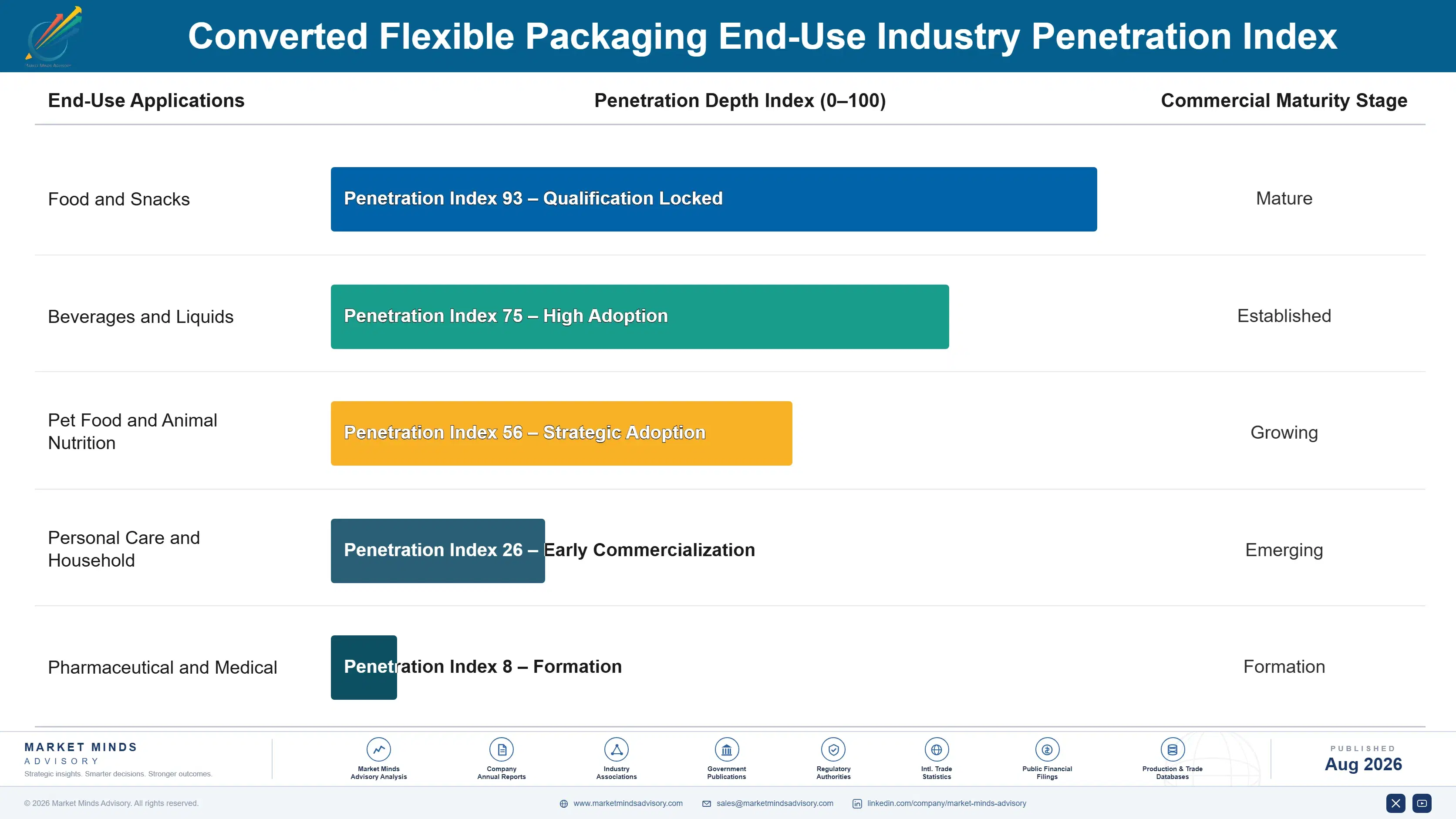
Demand commits at structure qualification and repeats as scheduled print runs. A converter approved on a structure has passed colour matching, seal integrity, shelf life, and frequently a filling line trial, and requalifying an alternative risks a line stoppage worth far more than any conversion saving. That protects incumbents reasonably. The genuine competitive moments are recyclability requalification, a new pack launch, and the annual tender where procurement compares price per impression.
Stickiness varies by qualification depth and colour complexity. Pharmaceutical and medical conversion sticks hardest, since regulatory submissions reference the specific structure and converter. Complex multi-colour brand work sticks through colour standards and approval history. Coating work sticks through equipment scarcity rather than qualification. Long-run two-colour film sticks least, moving at every tender to whichever press inside the radius quotes lowest that quarter.

Buyer profiles have moved from packaging technologists specifying on performance toward procurement running reverse auctions and sustainability teams applying design criteria. The reverse auction did real damage by treating conversion as machine time. Design criteria now pull the other way, since a structure that fails recyclability cannot be bought at any conversion price, which restores technical conversations that had been reduced to price per impression for years.
converted-flexible-packaging-market-end-use-penetration-index-1787332048909

Our Call On Flexible Converting

These are among the four positions where our research anticipates prominent divergence between winners and laggards over the coming forecast period. Each is grounded in the demand model, the regulatory perimeter, and the announced capacity pipeline.
01 / SUBSTRATE PASS-THROUGH DISCIPLINE

Stop quoting a number you do not control

Conversion is roughly 38% of delivered pack price and the substrate is most of the remainder, so a converter quoting a single delivered figure competes on the margin it influences while carrying a cost it cannot. Separating the two puts substrate on indexed pass-through and exposes conversion value where print quality and technical service can actually be argued. Procurement resists the split precisely because it removes the comparison they prefer, which is the clearest available evidence that the split actually works.
02 / COATING CAPABILITY PURCHASE

Recyclability rules are moving the work, not the volume

Design-for-recycling criteria push structures off laminates and onto coated single-polymer substrates, which is why coating grows at 10.2% against a market at 5.5%. Most converters hold laminating capacity and comparatively few hold coating at scale, and that scarcity is exactly where value added per square metre sits. A line pays back over three to five years and runs slower than lamination, so the case rests on being qualified when a brand owner rewrites the structure rather than on filling the machine.
03 / SHORT-RUN POSITION BUILDING

Digital reaches work conventional presses cannot price

Changeover of 20 to 60 minutes makes short runs uneconomic on conventional presses, which drives the whole industry toward the long commodity work where utilisation near 71% guarantees somebody quotes below full cost. Digital removes that changeover and opens seasonal, regional, promotional, and test-market runs that very few competitors can price profitably at all today. The field there is thin and conversion margin reflects it, which is the one part of this industry not yet under any reverse auction pressure at all.
04 / CAPACITY RETIREMENT COURAGE

Filling the press is what keeps prices down

A gravure press runs for decades with almost no alternative use, so utilisation near 71% across mature markets means somebody will always quote below full cost simply to load a shift. Retiring the least competitive presses rather than chasing volume to fill them is the only move that genuinely improves industry economics, and it improves the retiring converter's own numbers first. It is also the hardest decision any board takes, which is precisely why so few competitors will ever make it.

Engagement Snapshot From the Field

A live engagement with an industry participant carrying material or product regulatory and market exposure ahead of a defining policy shift, showing how our research translates into a defensible multi-year portfolio strategy.
MARKET MINDS ADVISORY · CLIENT ENGAGEMENT SUMMARY
Converted Flexible Packaging Producer Strategic Portfolio Review and Transition Roadmap 2026·Investment Scenario on Converted Flexible Packaging Exposure Evaluation 2025-26
CLIENT PROFILE
A mid-size flexible converter with roughly USD 310 million in annual revenue engaged MMA after four consecutive years of margin decline despite volume growth. The client reported quoting delivered prices on every job, press utilisation of about 66%, no coating capability, and conversion margin it could not separate from substrate movement in its own accounts (client-reported, unverified by MMA).
STRATEGIC CHALLENGE
Volume was growing while earnings fell, and management could not establish whether the problem was pricing, mix, or simply resin cost passing through unhelpfully. Two large customers had moved to reverse auctions on price per thousand impressions. The board needed to know which work was actually profitable before investing in either coating capability or another conventional press.
MMA APPROACH
MMA rebuilt job-level profitability on conversion value added rather than delivered revenue, which the client's accounts had never separated. We examined which jobs recovered full press cost and which only covered variable cost. We then tested what proportion of the customer base would face recyclability requalification within three years, since that determines whether coating capability is a growth investment or a defensive one.
KEY FINDINGS
  1. Roughly 34% of jobs recovered only variable press cost, and all of them had been won through reverse auction or matched against an auction price (client-reported, unverified by MMA).
  2. Conversion margin had been broadly stable for four years while delivered margin fell, which meant resin pass-through rather than pricing explained the reported decline.
  3. About 58% of customer volume faced recyclability requalification inside three years, and the client held no coating capability to compete for any of it.
  4. Two idle conventional presses were absorbing fixed cost that job-level pricing had been spreading across profitable work, disguising the true position (client-reported, unverified by MMA).
CLIENT PROFILE
A mid-size flexible converter with roughly USD 310 million in annual revenue engaged MMA after four consecutive years of margin decline despite volume growth. The client reported quoting delivered prices on every job, press utilisation of about 66%, no coating capability, and conversion margin it could not separate from substrate movement in its own accounts (client-reported, unverified by MMA).
STRATEGIC CHALLENGE
Volume was growing while earnings fell, and management could not establish whether the problem was pricing, mix, or simply resin cost passing through unhelpfully. Two large customers had moved to reverse auctions on price per thousand impressions. The board needed to know which work was actually profitable before investing in either coating capability or another conventional press.
MMA APPROACH
MMA rebuilt job-level profitability on conversion value added rather than delivered revenue, which the client's accounts had never separated. We examined which jobs recovered full press cost and which only covered variable cost. We then tested what proportion of the customer base would face recyclability requalification within three years, since that determines whether coating capability is a growth investment or a defensive one.
KEY FINDINGS
  1. Roughly 34% of jobs recovered only variable press cost, and all of them had been won through reverse auction or matched against an auction price (client-reported, unverified by MMA).
  2. Conversion margin had been broadly stable for four years while delivered margin fell, which meant resin pass-through rather than pricing explained the reported decline.
  3. About 58% of customer volume faced recyclability requalification inside three years, and the client held no coating capability to compete for any of it.
  4. Two idle conventional presses were absorbing fixed cost that job-level pricing had been spreading across profitable work, disguising the true position (client-reported, unverified by MMA).
RECOMMENDED STRATEGY
Phase 1: Phase 1 (0 to 6 months): Separate substrate from conversion in every quotation and restate internal reporting on conversion value added only. Phase 2: Phase 2 (6 to 20 months): Retire the two idle presses and commit that capital to a barrier coating line instead of additional print capacity. Phase 3: Phase 3 (20 to 32 months): Requalify with the customers facing recyclability deadlines while competitors are still outsourcing coating work.
OUTCOME
The client exited the loss-making auction work, retired both idle presses, and reported conversion margin up roughly 4 points within two years on modestly lower volume. The coating line qualified with three customers ahead of their requalification deadlines, and separating substrate from conversion ended the reverse auction comparison on most accounts (client-reported, unverified by MMA).

Frequently Asked Questions

Foundational context covering the market sizes, CAGR, scope, country, region and competition that inform every finding below. This section is provided to cover basics and most often pre-purchase conversations, answered from the MMA Primary Research Dataset.

What is the current size of the Converted Flexible Packaging Market?

The market is valued at USD 68.4 billion in 2025, measured as conversion value added across printing, lamination, coating, pouch making, and finishing. Substrate purchased as raw material and finished pack format value are excluded.

How large will the Converted Flexible Packaging Market be by 2036?

The market is forecast to reach USD 123.26 billion by 2036 in the base case, about 1.71 times the 2026 level. That represents incremental value of roughly USD 51.10 billion across the decade.

What is the CAGR for the Converted Flexible Packaging Market 2026 to 2036?

The market grows at a 5.5% CAGR in the base case, with bull and bear scenarios at 6.6% and 4.3%. The spread turns mainly on coating conversion pace and reverse auction pricing pressure.

Which segment is growing fastest?

Coating and barrier application grows fastest at 10.2%, about 1.85 times the overall rate, as recyclability criteria move work off laminators. Pouch and bag making follows at 6.4%.

Who are the major companies in the Converted Flexible Packaging Market?

Leading converters include Amcor, Constantia Flexibles, Mondi, Huhtamaki, and ProAmpac. Fragmentation is extreme, with the top five holding roughly 17% of converting value added across the industry.

Which country is growing fastest?

India grows fastest at a 9.6% CAGR, as converting capacity is installed rather than reallocated and specification complexity rises. China and Indonesia follow on packaged food volume.

Report Segmentation Architecture

The full report scope spans multiple orthogonal segmentation dimensions, with cross-tabulated demand data provided for each dimension pair. Coverage extends further to regional breakdowns, trend trajectories, and the competitive detail needed to support segment-level decision-making.

By Conversion Process Step

  • Printing
  • Lamination
  • Coating and Barrier Application
  • Pouch and Bag Making
  • Slitting and Finishing

By End-Use Industry

  • Food and Snacks
  • Beverages and Liquids
  • Pet Food and Animal Nutrition
  • Personal Care and Household
  • Pharmaceutical and Medical

By Commercial Model

  • Full Service Delivered Conversion
  • Toll Conversion On Customer Substrate
  • Contract Packer and Co-Manufacturer Supply
  • Trade Conversion For Other Converters

By Region

  • North America
  • Western Europe
  • East Asia
  • South Asia and Pacific
  • Latin America
  • Middle East and Africa
  • Eastern Europe

Scope, Methodology, and Coverage

Every figure in this report is reproducible from documented input assumptions. The scope below maps the historical period, the forecast horizon, the segmentation dimensions, and the countries covered, alongside the underlying primary and qualitative methodology.
Historical Period
2020 to 2025
Forecast Period
2026 to 2036
Base Year
2025 (USD billions; MMA Primary Research Dataset, August 2026)
Market Definition
The converted flexible packaging market comprises the value added by conversion operations applied to flexible substrates, valued as conversion revenue and service income retained by converters rather than as delivered pack price. It spans printing across gravure, flexographic, and digital processes, lamination including solvent-based and solventless routes, coating and barrier application, pouch and bag making, and slitting and finishing operations, together with the plate and cylinder work, colour management, and technical qualification supplied alongside them. Film, foil, paper, and resin purchased as raw substrate, the finished flexible pack sized as a converted format market elsewhere in the MMA series, rigid containers and corrugated transit packaging, filling, forming and sealing machinery, pressure-sensitive and sleeve label converting sold separately from the pack, and waste film recycling operations are excluded.
Quantitative Units
USD billions (current prices); converted volume in billion square metres and press hours where applicable
Segmentation Dimensions
By Conversion Process Step; By End-Use Industry; By Commercial Model; By Region
Regions Covered
North America, Western Europe, East Asia, South Asia and Pacific, Latin America, Middle East and Africa, Eastern Europe
Countries Covered
USA, China, Germany, France, UK, Italy, Spain, Netherlands, Poland, Japan, South Korea, India, Australia, Canada, Brazil, Mexico, Indonesia, Vietnam, Thailand, Malaysia, UAE, Saudi Arabia, Egypt, South Africa, Nigeria, Kenya, Turkey, Sweden, Argentina, Colombia, and additional markets relevant to this sector
Key Companies Profiled
Amcor, Constantia Flexibles, Mondi, Huhtamaki, ProAmpac, Sealed Air, Berry Global, Sonoco Products, Coveris, Uflex, Wipak, Toppan Holdings, Dai Nippon Printing, Winpak, TC Transcontinental, Printpack, Glenroy, Schur Flexibles, Clondalkin Group, Bischof und Klein
Quantitative Methodology
Primary survey, n=3,800 respondents, Q4 2025, six countries; demand-side model with trade association cross-validation
Qualitative Methodology
47 expert interviews, Q4 2025; applied to validate demand model assumptions, identify emerging dynamics, and assess competitive positioning
Report Format
PDF and XLSX data workbook (Word format preview document)
Publisher
Market Minds Advisory
Report Code
MMA-2026-PAC-323
Published
August 2026
Contact
sales@marketmindsadvisory.com | www.marketmindsadvisory.com

Purchase the full Converted Flexible Packaging Market Report (2026 to 2036).

The full MMA Converted Flexible Packaging report sizes conversion value added across five process steps, five end-use industries, four commercial models, and seven regions through 2036. It profiles 20 converters on a consistent basis of conversion value added and service revenue, scoring each on coating capability, changeover economics, colour and finishing depth, and service radius density. Scenario models quantify how design-for-recycling requalification, reverse auction pricing, and digital short-run adoption move both volume and achievable conversion margin by process step. The report also includes value added benchmarking against delivered pack price, press utilisation estimates by region, coating capacity mapping across converters, and job-level profitability analysis separating substrate from conversion.
Five-process and four-model conversion value added sizing to 2036
Twenty-converter benchmark on conversion value added and service revenue
Value added benchmarking against delivered flexible pack price
Press utilisation estimates by region and printing process
Coating and barrier capacity mapping across major converters
Job-level profitability analysis separating substrate from conversion

Built For The People Who Decide

From boardroom strategy to bench-side execution, this report is read cover-to-cover by leaders shaping the next decade of their industry, turning demand scenarios, market dynamics and valuation benchmarks into decisions.
CXOs/ Presidents/ VPs/ Managers
M&A and Corporate Development
Strategy Teams and R&D Heads
Procurement and Product Directors
Regulatory and Compliance Leaders
Investor Relations and Equity Analysts