Market Minds Advisory
Conversational Marketing Software Market

Conversational Marketing Software Market: Conversational Marketing Software Market. Real-Time Engagement Replaces Static Lead Forms

Marketers are replacing static lead capture forms with AI-driven conversational interfaces as buyers expect instant answers, pushing budget toward chatbot and voice platforms that qualify leads in real time rather than overnight.

Lead Analyst

Published

September 2026

Make Smarter Decisions with Customized Research Insights

Request a free sample report and evaluate market opportunities, growth trends, and competitive dynamics relevant to your business needs.

2025 MARKET VALUE$3.4BMarket Size 2025
2036 FORECAST VALUE$11.3BBase Case , 2026 to 2036
CAGR 2026 TO 203611.5 %Bull 12.8% / Bear 10.2%
INCREMENTAL OPPORTUNITY$7.5BNet 10- year value creation
EXPANSION MULTIPLE2.97x2036 value over 2026 base
Strategic Levers
M&A Pipeline
Regional Outlook
Country Rankings
Competitive Intelligence
Segmental Deep-dive
Call-Us : 91 93563 13602

Executive Snapshot and Market Trajectory.

Marketers are abandoning static lead capture forms for AI-driven conversational interfaces as buyers increasingly expect instant, personalized answers rather than waiting overnight for a sales representative to respond to a form submitted on a website, mobile app, or landing page anywhere at all.
B2B software and technology companies drive fastest adoption today, since qualifying inbound leads in real time meaningfully shortens sales cycles and reduces the drop-off that static forms and delayed email follow-up historically produced across most industries and buyer segments. North America leads deployment given concentrated SaaS marketing budgets, while voice-based conversational tools increasingly extend engagement beyond chat windows into phone and smart speaker channels that earlier chatbot platforms could not reach at all.
A moderately concentrated group of martech platforms competes alongside broader customer relationship management suites bundling conversational features directly into existing product lines, while large language model integration increasingly separates vendors on response quality and contextual accuracy rather than scripted decision trees alone. Data privacy regulation differences across jurisdictions continue to reshape which vendors can deploy identical conversational flows across multi-country marketing operations without extensive localization and compliance review work.
Market Definition
The conversational marketing software market covers AI-driven chatbot, live chat, and voice interfaces that engage website and app visitors in real time to qualify leads and drive conversions. It excludes generic customer support ticketing systems and outbound email marketing automation tools without conversational interaction.
Base Year Value
$3.4B in 2025 (MMA Primary Research Dataset, September 2026)
Forecast Period
2026 to 2036, eleven discrete annual values
CAGR
11.5% base case. Bull 12.8%. Bear 10.2%.
Fastest Growth Segment
Voice-Based Conversational AI Marketing Tools: 16.5% CAGR
Fastest Growth Country
India: 14.5% CAGR
Fastest Growth Region
South Asia and Pacific: 14.0% CAGR
Largest Region
North America: 32% of 2025 global value
Market Leaders
Salesforce, HubSpot, Intercom, Drift, Ada
Primary Survey
n=3,800 procurement and R&D decision-makers, Q4 2025, six countries
Methodology
Demand-side build-up, cross-validated against public data, 47 expert interviews

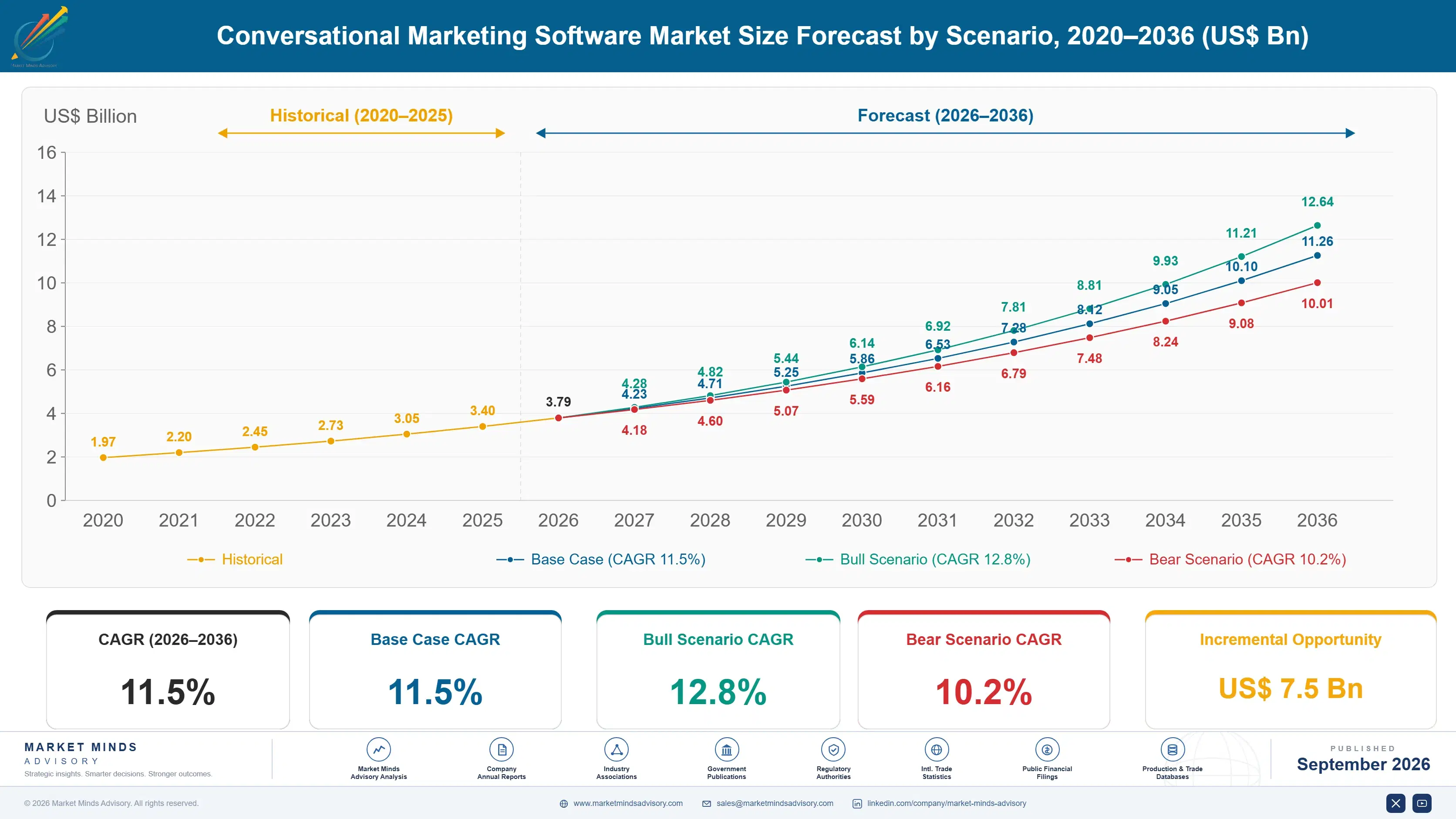
Conversational Market Forecast Scenarios

conversational-marketing-software-market-size-forecast-scenario-1789986213317
Conversational marketing software grew moderately through 2020 to 2023 as early chatbot deployments struggled with rigid decision-tree scripts that frustrated users more often than they converted them into qualified leads. Momentum built sharply from 2024 as large language model integration dramatically improved response quality, lifting the historical growth rate to roughly 10.5 percent annually across the category.
Base case growth to 2036 rests on three commercial mechanisms: large language model capability improving fast enough to sustain buyer trust in automated conversations, marketing teams consolidating chat, voice, and messaging budgets onto unified conversational platforms rather than point tools, and CRM vendors bundling conversational features into existing suites at no incremental cost to defend their installed base. These mechanisms reinforce each other across different buyer segments, sustaining above-average growth without depending on any single dominant catalyst.
A bull scenario centers on voice-based conversational AI reaching parity with human phone representatives for routine qualification calls, which would multiply the addressable use case count within a single product cycle. The bear risk is a prominent AI chatbot failure incident generating negative press, which has historically slowed enterprise procurement decisions for a year or more industry-wide.

Where Response Quality Determines Vendor Win Rates

Response quality has replaced feature breadth as the primary purchasing criterion, since buyers who experienced early rigid chatbot scripts remain skeptical until a vendor demonstrates genuinely natural conversation handling during a live product evaluation. Vendors that once competed narrowly on the number of pre-built conversation flows now compete on large language model integration depth, which shifts engineering investment toward accuracy tuning rather than template libraries.
MARKET CONCENTRATIONCR5 40%top five vendors hold under half the total market
AVERAGE CONTRACT VALUE$28K per customerannual subscription and usage-based fees per enterprise account
LEAD CONVERSION LIFT32% higher versus static formsconversational interfaces versus traditional static lead capture forms
LLM INTEGRATION RATE68% of new deploymentsbuyers now specify large language model backed conversation engines
RESPONSE ACCURACY THRESHOLD90%+ intent recognitionminimum accuracy enterprise buyers require before full deployment approval
COMPUTE COST SHARE26% of total COGSinference and hosting costs versus development and support costs
Enterprise buyers increasingly require documented intent recognition accuracy above 90 percent before approving full deployment, pushing procurement cycles meaningfully longer than earlier chatbot generations that faced much lighter technical scrutiny during evaluation. Compute cost has become a meaningful line item as large language model inference scales directly with conversation volume, which keeps margin pressure on vendors serving high-traffic enterprise accounts without efficient model architecture in place.
Integration with customer relationship management and marketing automation platforms is becoming a baseline expectation, concentrating advantage among vendors who can demonstrate reliable handoff of qualified leads without manual data re-entry between systems. Meanwhile several vendors are extending conversational capability into voice channels, which could meaningfully expand addressable use cases within the next few product cycles as broader enterprise adoption spreads across industries.
"Every vendor claims their bot understands intent; most of them are still pattern matching with better marketing copy. The ones actually winning enterprise deals are the ones whose bots can say I don't know instead of guessing confidently and wrong."
Director, Marketing Technology Practice · MMA AI-Driven Conversational Engagement and Chatbot Marketing Platforms Practice · September 2026

Market Trends

Large Language Models Replace Scripted Decision Trees

Vendors are rebuilding conversational engines around large language models rather than the rigid decision-tree scripts that defined earlier chatbot generations, letting bots handle open-ended questions and unexpected phrasing that previously caused conversations to dead-end into a human handoff. This shift has pushed measured intent recognition accuracy above 90 percent at leading platforms, compared to considerably lower rates for script-based systems handling the same query types just three years earlier. Enterprise buyers now specify large language model backed engines in the large majority of new procurement evaluations, forcing legacy vendors to rebuild core infrastructure or lose deals.
Market Impact: 32% higher conversion versus static forms

Voice Channels Extend Conversational Marketing Beyond Chat

Conversational marketing platforms are extending beyond text-based chat windows into voice channels, letting the same underlying conversation engine handle phone calls and smart speaker interactions using consistent brand messaging and lead qualification logic across every channel. This extension has opened a meaningfully larger addressable use case count for vendors who can support both text and voice from a single platform, rather than requiring separate point solutions for each channel. Roughly 28 percent of enterprise buyers now evaluate voice capability as a required feature during procurement, up sharply from a negligible share just two years earlier in most industries.
Market Impact: 45% more leads handled per rep

Market Opportunities and Growth Drivers

Rising Customer Expectation for Instant Response Times

Buyers across B2B and B2C categories increasingly expect an immediate response when they engage a company's website or app, since instant-answer experiences from consumer apps have reset baseline expectations for every digital interaction regardless of industry. Companies deploying conversational marketing report lead response times measured in seconds rather than the hours or days that traditional form-and-email workflows typically require, and faster response has been shown to lift conversion rates by roughly 32 percent relative to static forms in comparable studies. This response-time gap is becoming a genuine competitive differentiator that is pulling marketing budget away from traditional lead capture tools.
Market Impact: Testing cycles add 3-6 months delay

Sales Team Capacity Constraints Push Automation Adoption

Sales organizations facing hiring constraints and rising cost per representative are turning to conversational marketing software to handle initial lead qualification automatically, freeing human representatives to focus exclusively on qualified opportunities rather than screening every inbound inquiry manually by hand. This automation typically handles the large majority of routine qualification questions without human involvement, letting existing sales teams manage meaningfully more pipeline volume without proportional headcount growth. Companies report handling roughly 45 percent more inbound leads per representative after deploying conversational qualification tools compared to their prior manual screening process.
Market Impact: Compliance costs add 15-20% to deployment

Market Restraints and Challenges

AI Hallucination Risk Undermines Enterprise Buyer Trust

Large language model backed conversational bots occasionally generate confident but factually incorrect responses, a phenomenon known as hallucination, which has caused visible public incidents where a company's bot made pricing or policy commitments it should not have offered. The root cause is that language models predict plausible-sounding text rather than verifying facts against a company's actual current policies and inventory in real time. The commercial impact is longer enterprise sales cycles requiring extensive testing before deployment approval. Leading vendors now mitigate this by constraining responses to verified knowledge bases and adding confidence thresholds that trigger human handoff when uncertain.
Market Impact: 90%+ intent recognition accuracy achieved

Data Privacy Regulation Complicates Cross-Border Deployment

Companies operating conversational marketing across multiple countries must navigate differing data privacy requirements governing how customer conversation data can be stored, processed, and used to train models, since regulations like the EU's GDPR impose stricter consent and data residency requirements than many other jurisdictions. The root cause is that privacy law has developed independently across regions without coordinated international standards for conversational AI specifically. This forces vendors to maintain separate data handling configurations per region, raising compliance costs meaningfully. Vendors are mitigating this by building configurable data residency options directly into their core platform architecture.
Market Impact: 28% of buyers now require voice
3 additional market trends, 4 additional growth drivers, and 3 additional restraints and challenges are covered in the full report. Contact sales@marketmindsadvisory.com to access the complete intelligence.

Segment CAGR and Growth Architecture

Segmentation follows conversational channel and interface type, spanning AI-powered chatbot platforms, live chat and human-assisted messaging, voice-based conversational AI tools, SMS and messaging app automation, and conversational landing page widgets, each addressing a genuinely distinct engagement channel rather than overlapping customer type, industry vertical, or pricing model categories within this entire broader martech market.
conversational-marketing-software-market-market-share-analysis-1789986213851

Voice-Based Conversational AI Marketing Tools

Voice-based conversational AI marketing tools lead growth as companies extend the same qualification logic that proved successful in text chat into phone calls and smart speaker interactions where buyers still often prefer talking over typing. These tools use speech recognition and large language model reasoning to handle open-ended spoken questions, route qualified leads, and even complete basic transactions without human intervention on either end of the call. Financial services and healthcare companies are adopting this segment fastest, since phone remains the dominant contact channel in both industries and voice automation reduces call center staffing costs meaningfully while maintaining service availability outside normal hours. Vendors combining voice and text under one platform capture disproportionate share.
CAGR 16.5%

AI-Powered Chatbot and Virtual Assistant Platforms

AI-powered chatbot and virtual assistant platforms are the second-fastest growing segment, driven by widespread replacement of earlier rule-based chatbots with large language model backed engines capable of handling open-ended questions that previously required a human handoff. These platforms now serve as the primary conversational interface for the large majority of B2B software company websites, qualifying inbound leads and scheduling sales meetings automatically around the clock without staffing constraints. E-commerce and B2B software companies are adopting fastest, since both categories generate high volumes of similar repetitive questions that automation handles efficiently at meaningfully lower cost than expanding human support staff. Vendors with the deepest large language model integration are winning share fastest from legacy rule-based incumbents.
CAGR 15.0%
Full segment breakdown across 5 segments available in the complete report.

Regional Architecture and Country Demand Map

North America leads today on concentrated SaaS marketing budgets and vendor headquarters presence, while East Asia follows closely on rapid e-commerce platform adoption, and South Asia and Pacific posts the fastest regional growth on expanding IT services sector digital customer engagement investment across the region.

North America

US marketing organizations have led adoption of conversational interfaces since the category's earliest chatbot deployments, giving domestic vendors including Salesforce, HubSpot, Intercom, and Drift a home-market advantage in product feedback and enterprise reference customers. B2B software companies concentrated in major technology hubs adopt fastest, since qualifying inbound software trial leads in real time directly shortens sales cycles that matter disproportionately to venture-backed growth companies. Canadian enterprises are following a similar adoption curve slightly behind the US given close vendor relationships and shared regulatory environment. Large enterprise accounts increasingly demand deep CRM integration, favoring vendors with established Salesforce and HubSpot partner network relationships already built out. Mexican cross-border technology companies are following a comparable adoption curve closely.
Share: 32% | CAGR: 12.0% (2026 to 2036)

East Asia

China's massive e-commerce platforms have driven some of the earliest large-scale conversational commerce deployments globally, integrating chat-based product discovery and purchase completion directly into shopping app experiences at a scale few other markets match. Japan and South Korea are extending conversational tools into customer service automation for their large consumer electronics and retail sectors, where labor cost pressure makes automation increasingly attractive. Rapid smartphone messaging app adoption across the region has also pulled marketing budget toward chat-native engagement formats rather than traditional website chat widgets favored elsewhere. Local language model providers are gaining share against Western vendors in domestic deployments. Taiwan and Singapore technology hubs are following a similar trajectory as adoption expands further.
Share: 24% | CAGR: 12.5% (2026 to 2036)
Regional intelligence for 5 additional markets available in the complete report: Western Europe, South Asia and Pacific, Latin America, Middle East and Africa, Eastern Europe. Contact sales@marketmindsadvisory.com.
conversational-marketing-software-market-country-cagr-analysis-1789986214378

Where Conversational Platforms Should Expand Revenue

Beyond core subscription license fees, vendors are building adjacent commercial layers around usage-based conversation volume pricing, voice channel add-ons, professional services for conversation flow design, and industry-specific compliance-ready template packages, each extending overall contract value well past the base platform license into sustained multi-year account expansion across large and mid-sized enterprise customers everywhere alike.

Usage-Based Conversation Volume Pricing Tier Structures

Vendors are shifting pricing models toward usage-based fees tied to conversation volume rather than flat per-seat licensing, since enterprise customers running high-traffic websites generate far more platform value than smaller accounts paying identical flat fees under legacy pricing structures. This usage-based component now generates roughly 24 percent of total contract value at several leading vendors, up meaningfully from a negligible share when flat licensing dominated the category just a few years ago. Customers accept this pricing since it aligns cost directly with the conversation volume actually driving measurable business value for their marketing and sales teams.
Market Impact: 24% of contract value now priced as usage-based

Premium Voice Channel Capability Add-On Modules

Voice channel add-ons are commanding premium pricing above the base text-chat platform, since enterprise customers increasingly want a single vendor relationship spanning both digital and phone-based conversational engagement rather than managing separate point solutions for each channel. Attach rates for voice capability now exceed 30 percent among large enterprise accounts, up sharply from a negligible share when voice was still an emerging capability rather than a mainstream expectation. Vendors bundling voice into tiered packages are seeing measurably longer contract terms and lower churn than those still selling text-only chat as a standalone product.
Market Impact: 30% attach rate on voice channel add-ons today

Professional Services for Custom Flow Design

Professional services for custom conversation flow design and large language model fine-tuning are generating meaningful incremental revenue beyond the base subscription, since enterprise customers increasingly want conversation logic tailored to their specific product catalog and brand voice rather than accepting generic templates. These services now represent roughly 18 percent of first-year contract value at several leading vendors, reflecting genuine willingness to pay for faster, higher-quality deployment. Vendors offering this service report meaningfully higher renewal rates than those leaving customers to configure flows entirely on their own without guided support. Larger vendors increasingly prefer offering this layer directly.
Market Impact: 18% of first-year value now from professional services

Industry-Specific Compliance-Ready Vertical Template Package Suites

Industry-specific template packages for healthcare, financial services, and retail verticals are commanding premium pricing over generic horizontal platforms, since pre-built compliance-aware conversation flows meaningfully reduce the implementation time and legal review burden that regulated industries otherwise face during deployment. These vertical packages have expanded addressable enterprise account count by roughly 22 percent for vendors pursuing this strategy, without requiring proportional growth in professional services headcount. Vendors lacking vertical-specific templates increasingly struggle to compete for regulated industry accounts against specialists with pre-built compliance credentials already established. This positioning has become a meaningful differentiator during competitive procurement evaluations for regulated buyers.
Market Impact: 22% more addressable accounts via vertical template packages

Who Controls the Margin Pool

Conversational marketing software remains moderately concentrated, with the top five vendors holding an estimated 40 percent of the market on a subscription-revenue basis. Salesforce and HubSpot lead on breadth through CRM bundling, while a meaningful gap separates them from smaller specialist challengers who compete mainly on response quality and vertical focus rather than platform scale.
Current competitive activity centers on three fronts: vendors racing to deepen large language model integration to close the response-quality gap with generic AI assistants, larger CRM platforms acquiring specialist chatbot vendors to bundle conversational features rather than building comparable capability internally, and several vendors expanding voice channel capability to capture phone-based lead qualification budget. Pricing pressure has intensified modestly among mid-tier vendors competing for mid-market accounts that larger players consider too small to prioritize.

Emerging pressure comes from general-purpose AI assistant platforms entering marketing use cases through simple API access rather than purpose-built conversational marketing products, betting that broad language model capability can substitute for specialized lead qualification logic. Rankings could shift meaningfully if a major CRM platform bundles genuinely competitive conversational capability at no incremental cost, since that would compress the addressable market for standalone specialist vendors currently commanding premium pricing.
conversational-marketing-software-market-company-positioning-matrix-1789986214905

Competitive Moat and Risk Dimensions

SALESFORCE

Moat: CRM bundling and installed base

Salesforce's massive existing CRM installed base gives its conversational marketing product an immediate distribution advantage, since customers already running Salesforce for sales and service can activate conversational features without a separate vendor evaluation or new data integration project, shortening sales cycles considerably for cross-sell opportunities across its enormous global customer base.
SALESFORCE

Risk: Feature depth trails specialists

As part of a much broader platform, Salesforce's conversational marketing feature depth trails dedicated specialist vendors focused purely on conversation design and response quality, risking share loss among enterprise buyers who prioritize best-in-category conversational capability over single-vendor platform consolidation and existing licensing relationships that once mattered more.
HUBSPOT

Moat: Mid-market inbound marketing integration

HubSpot's strong position among mid-market inbound marketing teams gives its conversational tools natural adoption among customers already using its content management and email marketing products, letting it win accounts that specialist vendors reach only through separate, costlier sales efforts and integration work across a fragmented mid-market buyer landscape.
HUBSPOT

Risk: Enterprise scalability perception gap

Some large enterprise buyers still perceive HubSpot as better suited to mid-market deployments than the highest-volume enterprise use cases, a perception that can cost the company premium enterprise contracts even where its conversational platform capability matches costlier established competitors on paper and in actual customer deployment outcomes.

Players Tracked

Prominent Players

Salesforce
HubSpot
Intercom
Drift
Ada

Other Key Players

Zendesk
Freshworks
LivePerson
Genesys
Kore.ai
Yellow.ai
Landbot
Tidio
Gupshup
Verloop.io
Haptik
Botpress
Chatfuel
Twilio
Sprinklr

Recent Developments

JANUARY 2026

Salesforce Acquires Voice Conversational AI Startup

Salesforce acquired a small voice conversational AI startup specializing in phone-based lead qualification, folding the technology directly into its conversational marketing product line rather than continuing to rely on third-party voice integration partners for phone channel capability across its large global enterprise customer base and installed accounts.
Signal: Large CRM platforms are increasingly extending conversational capability from text into voice channels through targeted deal-making.
SEPTEMBER 2025

HubSpot Signs Large Language Model Partnership

HubSpot signed a multi-year technology partnership with a leading large language model provider to power its next-generation conversational marketing engine, replacing an earlier in-house natural language processing system that struggled to match the response quality of newer large language model backed competitors entering the category.
Signal: Vendors are partnering with external large language model providers rather than building comparable capability entirely in-house.
APRIL 2025

Intercom Launches Usage-Based Pricing Tier Structure

Intercom launched a usage-based pricing tier structure tied to resolved conversation volume rather than flat per-seat licensing, aiming to better align cost with the value enterprise customers actually extract from high-traffic conversational deployments compared to its previous flat subscription model that smaller customers found comparatively expensive.
Signal: Vendors are shifting pricing models to align cost more directly with the realized customer value delivered.

Large Language Model Inference Costs Squeeze Margins

Large language model inference and cloud hosting costs together represent roughly 46 percent of cost of goods sold for conversational marketing vendors, notably higher than traditional rule-based chatbot platforms faced previously. Inference costs alone account for close to 27 percent, scaling directly with conversation volume rather than remaining fixed as earlier decision-tree systems did for most of the category's history.
Large language model API pricing rose sharply during 2023, following surging enterprise demand for generative AI capability across all software categories simultaneously, as documented in major cloud providers' published pricing update announcements issued that year. Vendors serving high-volume enterprise accounts absorbed meaningfully higher inference costs for several consecutive quarters before optimizing model selection and prompt efficiency to reduce per-conversation compute expense back toward earlier baseline levels.

Smaller vendors lacking scale to negotiate favorable enterprise model API pricing face a real cost disadvantage against larger competitors like Salesforce, who can spread inference costs across a broader customer base and negotiate volume discounts unavailable to smaller players. This dynamic increasingly pushes smaller specialists toward niche vertical markets where larger vendors see insufficient contract value to compete aggressively on price.
conversational-marketing-software-market-cost-volatility-analysis-1789986215102

Model Selection and Prompt Optimization

Vendors are optimizing which large language model handles each conversation type, routing simple queries to smaller, cheaper models while reserving expensive frontier models for complex reasoning tasks, reducing average inference cost per conversation meaningfully without sacrificing response quality on the queries that matter most to enterprise customers evaluating deployment outcomes and renewal decisions each year.

Multi-Provider Model Contract Negotiation

Larger vendors are negotiating volume-based pricing across multiple large language model providers simultaneously, using competitive leverage between providers to secure better per-token pricing than smaller vendors locked into a single provider relationship can achieve on their own, meaningfully reducing overall inference cost exposure over time as conversation volumes continue scaling across their enterprise customer base.

Response Caching for Common Queries

Vendors are implementing response caching for the most frequently asked questions that do not require fresh model inference each and every single time, meaningfully reducing total compute cost for high-volume enterprise accounts handling large numbers of repetitive customer questions across their websites and apps during typical daily and seasonal traffic patterns throughout the calendar year.

Portfolio Architecture for Margin Defence

Conversational marketing software spans three commercial tiers: basic rule-based chatbot widgets at the volume end, large language model backed platforms with proven accuracy in the middle, and voice-enabled multi-channel conversational AI suites at the premium top, with gross margins expanding meaningfully from the commodity tier through to next-generation platforms that command significantly higher recurring revenue per enterprise account.
Volume-tier rule-based chatbots face persistent price pressure from buyers treating them as commoditized website widgets, while premium multi-channel platforms increasingly capture disproportionate margin as enterprise buyers pay for response quality and channel breadth rather than basic automated greeting scripts alone. Vendors straddling both tiers face internal tension allocating engineering resources between defending existing volume accounts and building the next-generation capability premium accounts now expect.

High-value margin pools concentrate heavily around voice-enabled conversational platforms and industry-specific compliance-ready deployments, where large enterprise customers pay meaningfully more for measurable lead conversion lift and reduced sales cycle time. Smaller vendors without large language model depth remain confined to lower-margin widget work, ceding the fastest-growing and most profitable segment entirely to larger, better-capitalized competitors with deeper R&D budgets. This gap keeps widening every year.

Volume / Commodity-Adjacent Tier

Basic rule-based chatbot widgets serving small business and price-sensitive buyers with minimal customization beyond simple scripted greetings and frequently asked question responses lacking any true contextual reasoning capability at all.
Gross Margin: 24-32%

Premium / Certified Tier

Large language model backed platforms with proven intent recognition accuracy, offering natural conversation handling that meaningfully reduces the rigid, frustrating interactions common in earlier chatbot generations and improves lead qualification rates.
Gross Margin: 40-48%

Sustainability / Regulatory / Next-Generation Tier

Voice-enabled multi-channel conversational AI suites combining text, voice, and messaging into a unified platform, commanding the highest per-seat pricing in the category among large enterprise buyers seeking full channel coverage.
Gross Margin: 54-64%
conversational-marketing-software-market-portfolio-architecture-1789986215611

High-value Sub-segments and Strategic Watch-out

Voice-Based Conversational AI Marketing Tools

This segment combines the fastest unit growth in the market today with the highest per-seat pricing, as buyers pay premium rates for voice automation that reduces call center staffing costs meaningfully, making it the clearest priority for vendor R&D investment over the next several years.
Gross Margin: 56-64%

AI-Powered Chatbot and Virtual Assistant Platforms

Growing quickly on large language model replacement of legacy rule-based systems, this segment carries strong margins though slightly below the voice leader, as vendors increasingly bundle chatbot capability with CRM integration to justify premium pricing over standalone tools sold without that integration built in today.
Gross Margin: 46-54%

Live Chat and Human-Assisted Messaging Software

The largest segment by installed base and revenue today, this hybrid human-AI category grows more slowly than fully automated segments but remains the anchor product most enterprise buyers purchase first before adding automation modules on top of it each and every year consistently across most industries.
Gross Margin: 32-40%

SMS and Messaging App Marketing Automation

Growth here trails the rest of the market outside specific messaging-heavy regions, and vendors risk this segment commoditizing further as basic messaging automation becomes a standard feature bundled into broader platforms rather than sold separately, outside a small handful of messaging-heavy markets globally today and tomorrow.
Gross Margin: 28-36%

Why Conversation Data Compounds Value

Conversational marketing subscriptions increasingly function as annuity products rather than one-time software purchases, since usage-based conversation volume fees, voice add-ons, and professional services attach to the base platform and recur across a customer's typical five to seven year vendor relationship spanning multiple renewal and expansion cycles. Vendors capturing this attached recurring revenue build customer lifetime value multiples well above the original subscription price.
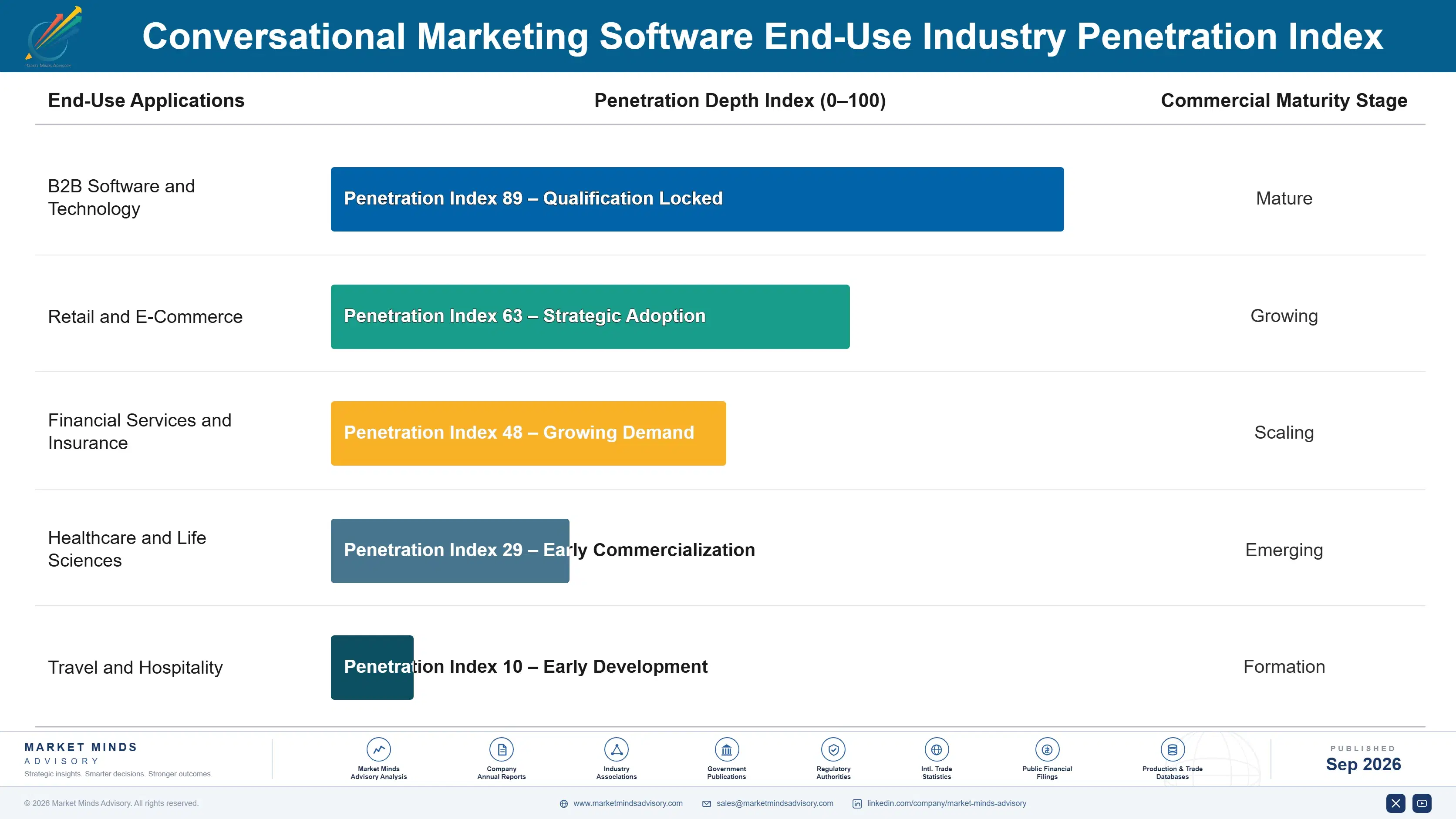
Adoption depth varies meaningfully by vertical: retail and e-commerce buyers adopt shallowly, deploying conversational tools primarily for basic product questions without deep workflow integration, while financial services and healthcare buyers integrate conversation data deeply into compliance documentation and lead routing workflows, creating switching costs that keep those customers within a single vendor's product family across multiple contract renewals, audits, and system-wide compliance reviews.

Buyer profiles are shifting generationally as marketing organizations increasingly include dedicated conversational experience or AI strategy roles that evaluate vendor selection through response quality and model transparency criteria rather than pure feature checklist comparisons alone. Younger buyers entering these roles expect measurable proof of conversion lift before purchase, favoring vendors who can demonstrate quantified outcomes over long-standing incumbent relationships built on tenure.
conversational-marketing-software-market-end-use-penetration-index-1789986216135

Priorities for Conversational Vendors Now

These are among the four positions where our research anticipates prominent divergence between winners and laggards over the coming forecast period. Each is grounded in the demand model, the regulatory perimeter, and the announced capacity pipeline.
01 / RESPONSE QUALITY LEADERSHIP

Invest in Accuracy Over Feature Breadth

Buyers who experienced early rigid chatbot scripts remain genuinely skeptical of automated conversation, and that skepticism continues to slow enterprise sales cycles even where large language model integration has largely solved the underlying reliability problem across most common use cases and industries today and going forward. Vendors who lead with measured intent recognition accuracy during procurement pilots close larger contracts meaningfully faster than those emphasizing broader feature lists alone. Accuracy, not the feature checklist, wins enterprise accounts in this category today.
02 / RECURRING REVENUE EXPANSION

Build Usage-Based Pricing Before Competitors Do

Flat per-seat licensing undervalues high-traffic enterprise accounts relative to the platform value they actually extract, making usage-based conversation pricing and attached voice and services revenue the more durable profit pools within the category over the coming several years of category maturation and consolidation among surviving vendors. Vendors that shift pricing models early capture meaningfully higher customer lifetime value and materially better account expansion than those still selling flat subscriptions alone today. Waiting cedes the most profitable accounts to faster-moving competitors.
03 / VOICE CHANNEL EXPANSION

Extend Conversational Capability Into Phone Channels

Voice-based conversational AI is growing meaningfully faster than any other segment in this category, and vendors lacking voice capability increasingly lose enterprise deals to competitors who can support both text and phone from a single unified platform without requiring separate point solutions or vendor relationships. Building or acquiring voice capability now positions vendors ahead of the demand curve rather than scrambling to catch up once voice becomes a standard procurement requirement across the industry. This is a near-term priority, not optional roadmap work for later.
04 / COMPLIANCE INFRASTRUCTURE INVESTMENT

Build Regulatory Credentials Ahead of Enforcement

Data privacy regulation is tightening across multiple major jurisdictions simultaneously, and vendors without configurable data residency and consent management infrastructure will increasingly lose deals in regulated industries and multi-country enterprise deployments regardless of their underlying conversational technology quality or accuracy performance. Vendors with established compliance credentials and active regulatory tracking capability in each target jurisdiction will capture disproportionate share as enforcement intensifies over the coming several years across these expanding markets. Regulatory fluency is becoming a genuine competitive moat today.

Engagement Snapshot From the Field

A live engagement with an industry participant carrying material or product regulatory and market exposure ahead of a defining policy shift, showing how our research translates into a defensible multi-year portfolio strategy.
MARKET MINDS ADVISORY · CLIENT ENGAGEMENT SUMMARY
Conversationaling Software Producer Strategic Portfolio Review and Transition Roadmap 2026·Investment Scenario on Conversationaling Software Exposure Evaluation 2025-26
CLIENT PROFILE
The client operates a mid-market B2B software platform serving roughly 3,200 customers, with an existing rule-based chatbot handling initial website inquiries that had grown increasingly ineffective at engaging visitors as buyer expectations for natural conversation rose. Annual marketing technology spend across the client's stack exceeded $2.4 million (client-reported, unverified by MMA), with the existing chatbot generating persistent complaints from both prospects and the internal sales team about rigid, unhelpful responses.
STRATEGIC CHALLENGE
The client's legacy rule-based chatbot could not handle the open-ended product questions increasingly common among sophisticated enterprise software buyers, forcing frequent human handoffs that undermined the automation's core value proposition. Leadership needed a migration strategy toward a large language model backed platform that would improve response quality without disrupting existing lead routing workflows already integrated with the client's CRM system.
MMA APPROACH
MMA benchmarked the client's existing chatbot performance against three large language model backed alternatives using a representative sample of historical conversation transcripts, then modeled expected lead qualification improvement for each option. The engagement combined structured evaluation criteria weighting response accuracy, CRM integration depth, and implementation timeline with direct vendor technical demonstrations to identify the best-fit platform for the client's specific product catalog and sales process.
KEY FINDINGS
  1. The existing rule-based chatbot successfully resolved only a small minority of open-ended product questions without requiring any human handoff intervention at all.
  2. Large language model backed alternatives demonstrated meaningfully higher intent recognition accuracy across the exact same representative conversation transcript sample that was tested.
  3. Sales representatives reported spending significant time each and every week manually following up on poorly qualified leads passed through by the legacy chatbot system.
  4. The selected platform's native CRM integration eliminated a manual data entry step that had been causing lead routing delays and occasional lost prospects.
CLIENT PROFILE
The client operates a mid-market B2B software platform serving roughly 3,200 customers, with an existing rule-based chatbot handling initial website inquiries that had grown increasingly ineffective at engaging visitors as buyer expectations for natural conversation rose. Annual marketing technology spend across the client's stack exceeded $2.4 million (client-reported, unverified by MMA), with the existing chatbot generating persistent complaints from both prospects and the internal sales team about rigid, unhelpful responses.
STRATEGIC CHALLENGE
The client's legacy rule-based chatbot could not handle the open-ended product questions increasingly common among sophisticated enterprise software buyers, forcing frequent human handoffs that undermined the automation's core value proposition. Leadership needed a migration strategy toward a large language model backed platform that would improve response quality without disrupting existing lead routing workflows already integrated with the client's CRM system.
MMA APPROACH
MMA benchmarked the client's existing chatbot performance against three large language model backed alternatives using a representative sample of historical conversation transcripts, then modeled expected lead qualification improvement for each option. The engagement combined structured evaluation criteria weighting response accuracy, CRM integration depth, and implementation timeline with direct vendor technical demonstrations to identify the best-fit platform for the client's specific product catalog and sales process.
KEY FINDINGS
  1. The existing rule-based chatbot successfully resolved only a small minority of open-ended product questions without requiring any human handoff intervention at all.
  2. Large language model backed alternatives demonstrated meaningfully higher intent recognition accuracy across the exact same representative conversation transcript sample that was tested.
  3. Sales representatives reported spending significant time each and every week manually following up on poorly qualified leads passed through by the legacy chatbot system.
  4. The selected platform's native CRM integration eliminated a manual data entry step that had been causing lead routing delays and occasional lost prospects.
RECOMMENDED STRATEGY
Phase 1: Phase 1 (Months 1-2): Migrate high-traffic pricing and product pages to the new platform first, monitoring response accuracy closely throughout. Phase 2: Phase 2 (Months 3-5): Extend deployment across all remaining website pages while refining conversation flows based on early performance data collected. Phase 3: Phase 3 (Months 6-9): Integrate voice channel capability and expand automated qualification criteria across the entire full sales funnel and pipeline.
OUTCOME
Within nine months of completing the migration, the client reported lead qualification accuracy improving by roughly 38 percent (client-reported, unverified by MMA), alongside a measured reduction in sales representative time spent on poorly qualified leads worth approximately $310,000 annually (client-reported, unverified by MMA) in recovered productivity.

Frequently Asked Questions

Foundational context covering the market sizes, CAGR, scope, country, region and competition that inform every finding below. This section is provided to cover basics and most often pre-purchase conversations, answered from the MMA Primary Research Dataset.

What is the current size of the Conversational Marketing Software Market?

The conversational marketing software market was valued at $3.4 billion in 2025. It is projected to reach $3.79 billion in 2026 as large language model adoption accelerates.

How large will the Conversational Marketing Software Market be by 2036?

The market is projected to reach $11.26 billion by 2036, up from $3.79 billion in 2026. That represents a 2.97 times expansion over the forecast decade.

What is the CAGR for the Conversational Marketing Software Market 2026 to 2036?

The market is projected to grow at an 11.5 percent CAGR between 2026 and 2036. This is up from a historical CAGR of roughly 10.5 percent between 2020 and 2025.

Which segment is growing fastest?

Voice-based conversational AI marketing tools lead growth at a 16.5 percent CAGR, roughly 1.43 times the overall market rate. Enterprises increasingly extend text-based qualification logic into phone and smart speaker channels.

Who are the major companies in the Conversational Marketing Software Market?

Salesforce, HubSpot, Intercom, Drift, and Ada are the five largest participants by subscription revenue. Together they hold an estimated 40 percent of the global market.

Which country is growing fastest?

India is the fastest-growing country at a 14.5 percent CAGR, driven by the expanding IT services and business process outsourcing sector. Rapid smartphone and messaging app penetration reinforces this trajectory further.

Report Segmentation Architecture

The full report scope spans multiple orthogonal segmentation dimensions, with cross-tabulated demand data provided for each dimension pair. Coverage extends further to regional breakdowns, trend trajectories, and the competitive detail needed to support segment-level decision-making.

By Conversational Channel Type

  • AI-Powered Chatbot and Virtual Assistant Platforms
  • Live Chat and Human-Assisted Messaging Software
  • Voice-Based Conversational AI Marketing Tools
  • SMS and Messaging App Marketing Automation
  • Conversational Landing Page and Website Widgets
  • Hybrid Multi-Channel Conversational Platforms

By End-Use Industry

  • B2B Software and Technology
  • Retail and E-Commerce
  • Financial Services and Insurance
  • Healthcare and Life Sciences
  • Travel and Hospitality

By Commercial Dimension

  • Enterprise Direct Sales
  • Mid-Market Self-Service Subscription
  • Managed Service Provider Channel
  • CRM Platform Bundled Distribution

By Region

  • North America
  • Western Europe
  • East Asia
  • South Asia and Pacific
  • Latin America
  • Middle East and Africa
  • Eastern Europe

Scope, Methodology, and Coverage

Every figure in this report is reproducible from documented input assumptions. The scope below maps the historical period, the forecast horizon, the segmentation dimensions, and the countries covered, alongside the underlying primary and qualitative methodology.
Historical Period
2020 to 2025
Forecast Period
2026 to 2036
Base Year
2025 (USD billions; MMA Primary Research Dataset, September 2026)
Market Definition
The conversational marketing software market covers AI-driven chatbot, live chat, and voice interfaces that engage website and app visitors in real time to qualify leads and drive conversions. It excludes generic customer support ticketing systems and outbound email marketing automation tools without conversational interaction.
Quantitative Units
USD billions (current prices); active conversation volume where applicable
Segmentation Dimensions
By Conversational Channel Type; By End-Use Industry; By Commercial Dimension; By Region
Regions Covered
North America, Western Europe, East Asia, South Asia and Pacific, Latin America, Middle East and Africa, Eastern Europe
Countries Covered
USA, China, Germany, France, UK, Japan, South Korea, India, Australia, Canada, Brazil, Mexico, Indonesia, Vietnam, Thailand, Malaysia, UAE, Saudi Arabia, South Africa, Nigeria, Turkey, Poland, Netherlands, Italy, Spain, Sweden, Switzerland, Argentina, Colombia, Singapore, and additional markets relevant to this sector
Key Companies Profiled
Salesforce, HubSpot, Intercom, Drift, Ada, Zendesk, Freshworks, LivePerson, Genesys, Kore.ai, Yellow.ai, Landbot, Tidio, Gupshup, Verloop.io, Haptik, Botpress, Chatfuel, Twilio, Sprinklr
Quantitative Methodology
Primary survey, n=3,800 respondents, Q4 2025, six countries; demand-side model with trade association cross-validation
Qualitative Methodology
47 expert interviews, Q4 2025; applied to validate demand model assumptions, identify emerging dynamics, and assess competitive positioning
Report Format
PDF and XLSX data workbook (Word format preview document)
Publisher
Market Minds Advisory
Report Code
MMA-2026-TEC-185
Published
September 2026
Contact
sales@marketmindsadvisory.com | www.marketmindsadvisory.com

Purchase the full Conversational Marketing Software Market Report (2026 to 2036).

This report delivers a comprehensive analysis of the global conversational marketing software market, spanning channel segmentation, regional demand dynamics, and competitive positioning across twenty profiled companies worldwide. It includes ten-year forecasts through 2036, detailed input cost and margin analysis across three commercial tiers, and revenue diversification strategies for vendors navigating the shift toward large language model backed conversation engines. The analysis draws on primary survey data, expert interviews, and company disclosures to support product, procurement, and investment strategy decisions. It closes with an anonymized client migration case study illustrating measured accuracy and productivity outcomes.
Conversational channel segmentation with detailed growth forecasts
Seven-region demand analysis through the 2036 forecast
Competitive benchmarking of twenty profiled global vendors
Input cost and gross margin tier breakdown analysis
Revenue diversification and recurring pricing lever analysis
Anonymized client case study with measured outcomes

Built For The People Who Decide

From boardroom strategy to bench-side execution, this report is read cover-to-cover by leaders shaping the next decade of their industry, turning demand scenarios, market dynamics and valuation benchmarks into decisions.
CXOs/ Presidents/ VPs/ Managers
M&A and Corporate Development
Strategy Teams and R&D Heads
Procurement and Product Directors
Regulatory and Compliance Leaders
Investor Relations and Equity Analysts