Market Minds Advisory
Conversation Intelligence Software Market

Conversation Intelligence Software Market: Conversation Intelligence Software Market. AI-Driven Call Analysis Reshapes Revenue Team Coaching

Sales leaders demanding proof that coaching investments actually move quota attainment while large language models make transcript analysis nearly free are colliding fast enough to turn call recording into a board-level metric.

Lead Analyst

Published

September 2026

Make Smarter Decisions with Customized Research Insights

Request a free sample report and evaluate market opportunities, growth trends, and competitive dynamics relevant to your business needs.

2025 MARKET VALUE$2.8BMarket Size 2025
2036 FORECAST VALUE$16.5BBase Case , 2026 to 2036
CAGR 2026 TO 203617.5 %Bull 18.8% / Bear 16.2%
INCREMENTAL OPPORTUNITY$13.2BNet 10- year value creation
EXPANSION MULTIPLE5.02x2036 value over 2026 base
Strategic Levers
M&A Pipeline
Regional Outlook
Country Rankings
Competitive Intelligence
Segmental Deep-dive
Call-Us : 91 93563 13602

Executive Snapshot and Market Trajectory.

Sales leaders are demanding hard evidence that coaching programs actually improve quota attainment, pushing revenue operations teams toward AI-driven call analysis that can quantify coaching impact rather than relying on manager intuition alone. This shift is reshaping how sales organizations evaluate and budget for enablement technology broadly.
Large language model advances are pulling budget away from basic call recording and keyword-spotting tools as vendors deliver genuinely useful deal risk scoring and coaching recommendations, and South Asian technology sales organizations are adopting conversation intelligence fastest given the region's rapidly scaling outbound sales operations. Customer success teams are separately driving demand as renewal risk detection extends conversation analysis beyond pure sales calls into ongoing account management interactions.
A handful of established platforms still dominate enterprise conversation intelligence contracts, but a wave of specialist AI-native entrants is competing on model sophistication rather than integration breadth, changing who counts as a credible competitor. Data privacy regulations governing recorded customer conversations are forcing vendors to navigate a genuinely more complex compliance landscape than simple call recording ever required. Vendors combining both model quality and workflow integration increasingly win the largest multi-year enterprise renewal contracts.
Market Definition
This report covers software platforms that record, transcribe, and analyze sales and customer service conversations using artificial intelligence to generate coaching insights, deal risk scores, and performance analytics, measured on a global software revenue basis. It excludes basic call recording infrastructure without analytical capability and general customer relationship management software not centered on conversation analysis.
Base Year Value
$2.8B in 2025 (MMA Primary Research Dataset, September 2026)
Forecast Period
2026 to 2036, eleven discrete annual values
CAGR
17.5% base case. Bull 18.8%. Bear 16.2%.
Fastest Growth Segment
AI-Generated Coaching and Deal Risk Analytics: 24.0% CAGR
Fastest Growth Country
India: 24.5% CAGR
Fastest Growth Region
South Asia and Pacific: 19.8% CAGR
Largest Region
North America: 32% of 2025 global value
Market Leaders
Gong, Chorus (ZoomInfo), Salesloft, Clari, Outreach
Primary Survey
n=3,800 procurement and R&D decision-makers, Q4 2025, six countries
Methodology
Demand-side build-up, cross-validated against public data, 47 expert interviews

Conversation Intelligence Software Market Forecast Scenarios

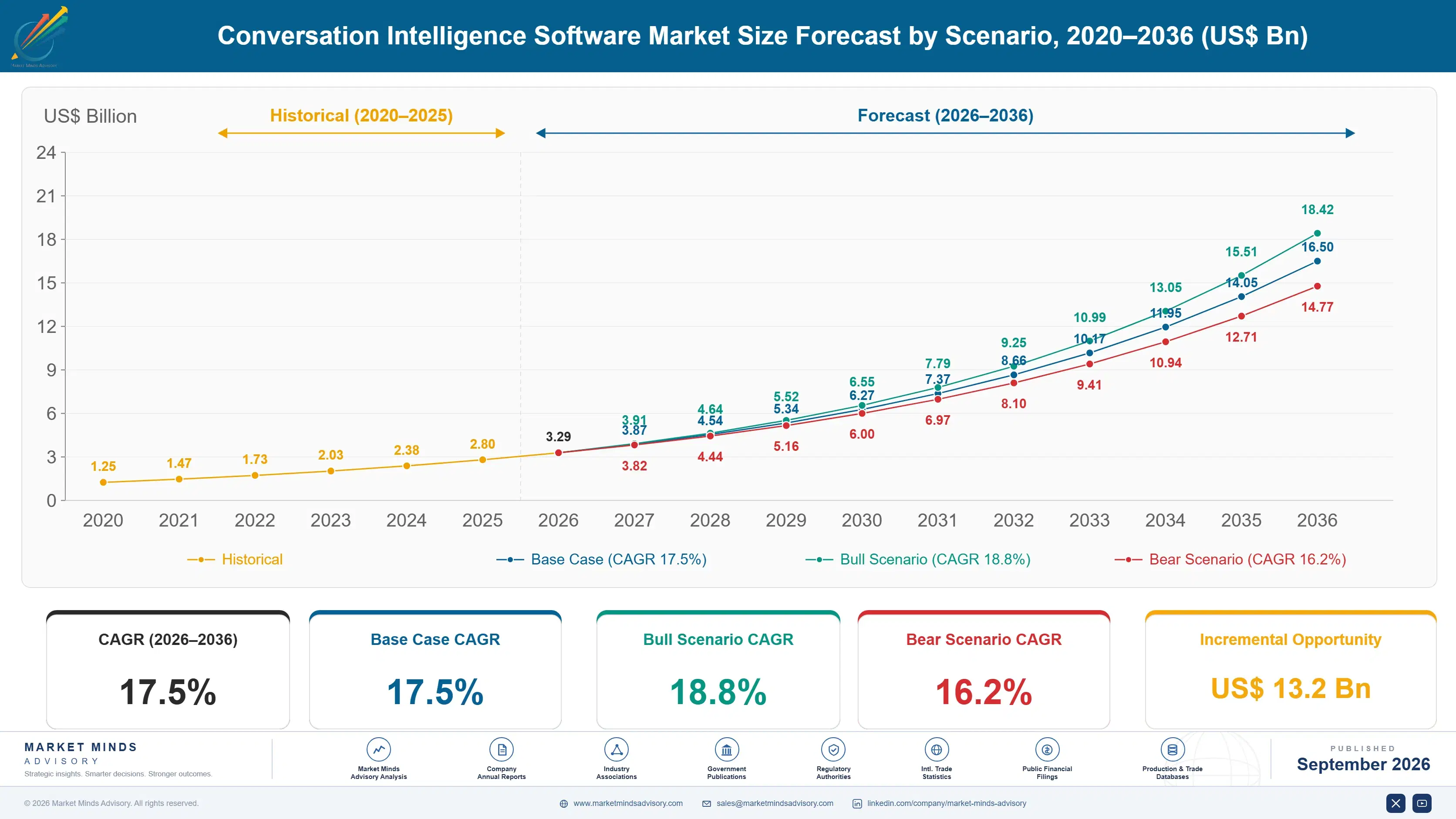
conversation-intelligence-software-market-size-forecast-scenario-1788419007456
Between 2020 and 2025 the conversation intelligence software market grew at roughly 16.0 percent annually as remote and hybrid sales models forced organizations to replace in-person coaching observation with recorded call analysis. Growth accelerated sharply once large language models made genuinely useful coaching recommendations and deal risk scoring commercially viable rather than basic transcript search alone.
The base case assumes continued rapid expansion as three commercial mechanisms compound: sales organizations extend conversation intelligence coverage from top-of-funnel sales calls into customer success and renewal conversations, artificial intelligence coaching recommendations mature enough to influence real-time seller behavior during live calls rather than only post-call review, and vendors bundle deal risk scoring directly into revenue forecasting workflows that sales leadership already relies upon. Vendors respond by building dedicated data science teams rather than treating analysis as a secondary feature layered onto recording infrastructure.
The bull case centers on artificial intelligence coaching accuracy reaching a threshold where sales leaders trust automated recommendations over manager judgment for routine coaching decisions, accelerating adoption sharply. The bear case centers on increasing employee privacy pushback against comprehensive conversation monitoring, prompting regulatory restrictions that limit recording scope and slow platform expansion into new conversation types.

Conversation Intelligence Becomes a Revenue Platform

Conversation intelligence vendors are no longer selling call recording software, they are selling a revenue performance platform, and that shift is rewriting who counts as a credible supplier to a large sales organization. A vendor without genuinely predictive AI coaching capability cannot win a contract that now requires demonstrating measurable quota attainment improvement.
MARKET CONCENTRATION40% CR5Top five vendors hold a modest share of platform revenue
AVERAGE SEAT LICENSE COST$1,200 per user annuallyPrice varies widely between basic and AI-enhanced coaching tiers
TOP ADOPTION COUNTRY SHAREUnited States, 44% of platform revenueSingle country accounts for largest share of platform subscription spending
AI COACHING FEATURE PENETRATION58% of new deploymentsShare of new implementations including automated coaching recommendation features
DEAL RISK SCORING ADOPTION35% of enterprise customersPortion of large customers actively using automated deal risk analytics
AVERAGE CONTRACT LENGTHTwo years per enterprise dealTypical duration of a conversation intelligence platform service agreement
Vendors that historically sold basic transcription and keyword search are being squeezed out unless they build genuinely predictive coaching and deal risk capability, since sales leaders increasingly demand actionable recommendations rather than raw searchable transcripts alone. Several smaller vendors have already exited direct enterprise sales entirely, choosing instead to license their transcription engine technology wholesale to larger platforms that already own the customer relationship.
Revenue forecasting and customer relationship management platform vendors are bundling basic conversation analysis as a feature within broader sales platforms, competing directly with dedicated conversation intelligence specialists that never built full pipeline management capability. Sales leaders increasingly evaluate vendors on coaching recommendation accuracy almost as closely as raw transcription quality, a criterion that barely mattered in procurement decisions a decade ago when searchable call recordings were considered a sufficient feature set.
"Recording the call was never the hard part, everyone could do that for years. Telling a manager which specific sentence lost the deal is the part nobody could do until now."
Practice Lead, Revenue Operations Technology · MMA Enterprise Sales and Customer Experience Analytics Software Practice · September 2026

Market Trends

Large Language Models Enable Genuinely Actionable Coaching

Advances in large language model reasoning capability are letting conversation intelligence platforms generate specific, actionable coaching recommendations tied to individual moments in a call rather than generic aggregate performance scores. Vendors report coaching recommendation acceptance rates among sales managers reaching over 70 percent, up sharply from a small minority when recommendations were generic and templated rather than call-specific. This capability shift is turning conversation intelligence from a passive analytics dashboard into an active coaching tool that managers actually use during one-on-one sessions. Vendors slow to reach this recommendation quality threshold risk losing renewal contracts to faster-moving AI-native competitors.
Market Impact: Over 70 percent of teams remote
Deal Risk Scoring Integrates Into Revenue Forecasting

Conversation intelligence platforms are increasingly feeding deal risk signals directly into revenue forecasting workflows, letting sales leadership see which pipeline deals show conversational warning signs before they slip or stall entirely. Forecast accuracy improvements of 20 percent or more are reported by sales organizations that integrated conversation-derived risk signals into their forecasting process, a meaningful gain given how much revenue planning depends on forecast reliability. This integration is pulling conversation intelligence budget out of pure sales enablement categories and into revenue operations infrastructure spending. Revenue operations leaders increasingly treat this integration as a baseline requirement rather than an advanced feature.
Market Impact: Acquisition costs rose 60 percent

Market Opportunities and Growth Drivers

Remote Selling Permanence Eliminates In-Person Coaching Observation

Sales organizations that shifted to remote and hybrid selling models during the pandemic have largely kept those arrangements permanently, eliminating the in-person call shadowing that managers historically relied upon to observe and coach seller behavior directly. Over 70 percent of enterprise sales organizations now operate primarily remote or hybrid selling teams, creating a durable, lasting requirement for recorded conversation analysis as the primary coaching mechanism rather than a temporary pandemic-era stopgap measure. This shift has made conversation intelligence platforms functionally mandatory infrastructure rather than an optional enhancement for distributed sales teams.
Market Impact: Opt-out rates can reach 25 percent

Rising Customer Acquisition Costs Demand Better Sales Efficiency

Rising customer acquisition costs across most enterprise software categories are pushing sales leadership to extract more revenue from existing sales headcount rather than simply hiring more representatives, directly increasing demand for tools that improve individual seller performance and win rates. Customer acquisition costs have risen by roughly 60 percent over the past five years in several major enterprise software categories, making per-seller productivity improvement a board-level priority rather than a secondary operational concern. Conversation intelligence platforms directly address this pressure by identifying specific behaviors that separate top performers from the rest of the sales team.
Market Impact: Rollout can take 6 months

Market Restraints and Challenges

Employee Privacy Concerns Limit Recording Scope

Sales representatives and customer service agents are increasingly pushing back against comprehensive conversation monitoring, viewing continuous AI analysis of their calls as invasive surveillance rather than a helpful coaching tool. The root cause is that early deployments often emphasized manager oversight and compliance monitoring over genuine employee benefit, creating lasting distrust that newer, employee-friendly framing has struggled to overcome. This forces organizations to limit recording scope or offer opt-out provisions that reduce platform coverage and data quality. Vendors mitigate this by redesigning interfaces to emphasize self-service coaching benefits directly to sales representatives rather than framing it around manager oversight.
Market Impact: Acceptance rates reach over 70 percent

Integration Complexity Slows Full Enterprise Rollout

Large enterprises running multiple communication platforms across phone, video conferencing, and messaging channels face genuine integration complexity connecting all conversation sources into a single analysis platform. The underlying cause is that enterprise sales organizations often accumulated disparate communication tools over years without central coordination, creating a fragmented technical environment that resists straightforward integration. This forces vendors to build and maintain integrations across a wide range of third-party platforms, adding ongoing engineering cost that smaller vendors struggle to sustain. Vendors are mitigating this by prioritizing integration with the most widely used platforms first rather than pursuing comprehensive coverage immediately.
Market Impact: Forecast accuracy improves 20 percent
3 additional market trends, 4 additional growth drivers, and 3 additional restraints and challenges are covered in the full report. Contact sales@marketmindsadvisory.com to access the complete intelligence.

Segment CAGR and Growth Architecture

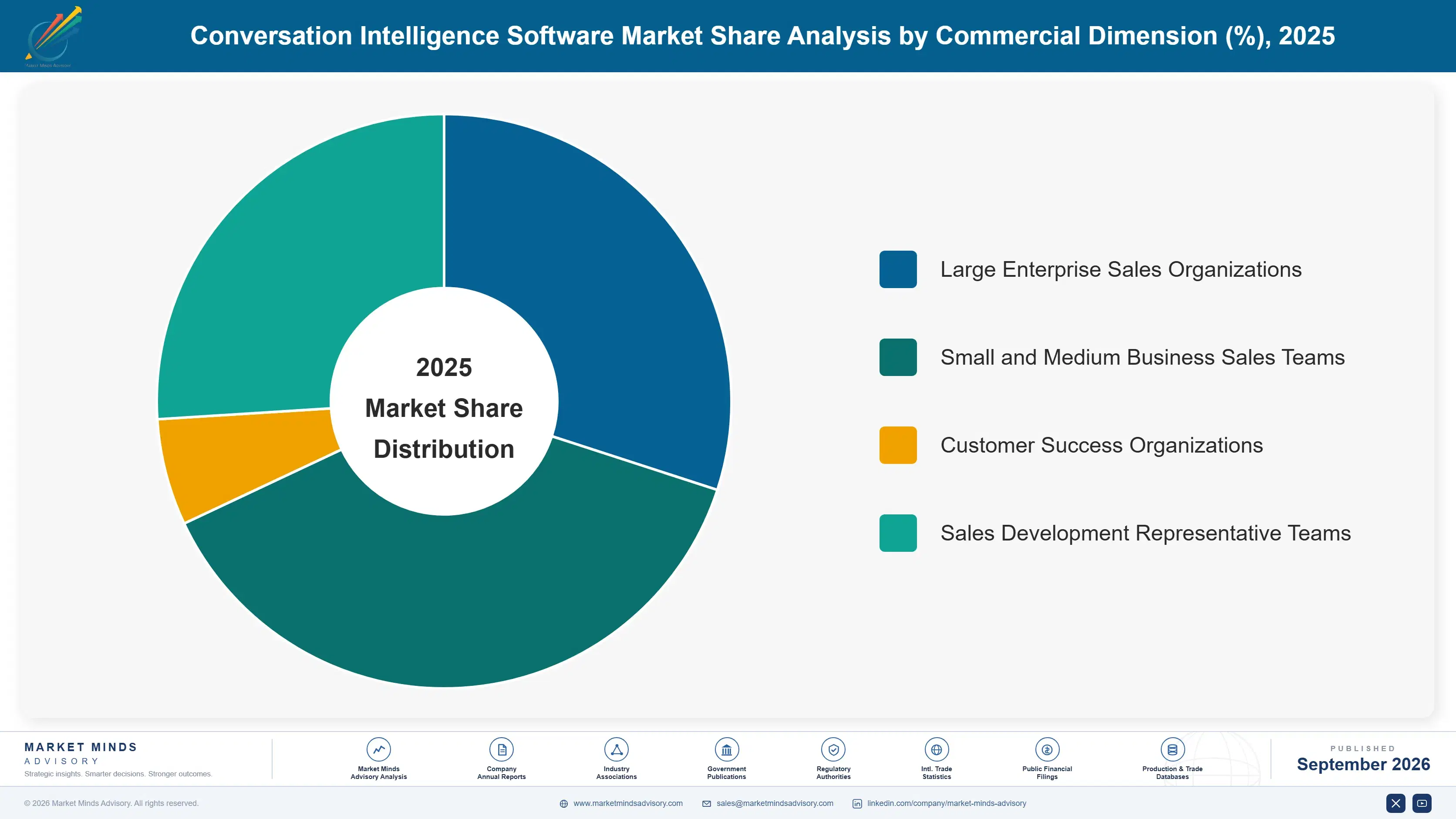
The conversation intelligence software market splits across five technology-defined segments spanning analysis depth, application area, and AI capability used across sales and customer success organizations. AI-generated coaching and deal risk analytics lead growth as large language models mature, while basic call recording and transcription tools still represent the largest installed base by seat count across smaller sales organizations worldwide.
conversation-intelligence-software-market-market-share-analysis-1788419007992

AI-Generated Coaching and Deal Risk Analytics

AI-generated coaching and deal risk analytics use large language model reasoning to generate specific, actionable recommendations tied to individual call moments and to score pipeline deals for warning signs before they slip, moving well beyond passive transcript search into active performance management. This capability requires substantial investment in model training and validation against real sales outcomes, a barrier that favors vendors with large proprietary conversation datasets accumulated over years of customer usage. Growth here outpaces every other segment because sales leaders increasingly demand actionable insight rather than raw searchable data, and only sophisticated AI models can deliver recommendations specific enough to change seller behavior. Vendors with the deepest proprietary datasets are capturing the largest share of new enterprise contracts.
CAGR 24.0%

Basic Call Recording and Transcription Tools

Basic call recording and transcription tools remain the largest segment by installed seat count, covering the foundational recording, storage, and keyword search capability that most sales organizations adopted years before advanced AI coaching became commercially viable. This tooling predates the current AI coaching boom and continues serving smaller organizations that lack budget or use case sophistication to justify premium AI-enhanced tiers. Growth here is comparatively modest since these organizations face less complex coaching needs, with most new spending going toward incremental storage and search feature additions rather than a full platform upgrade to advanced analytics. Vendors serving this segment compete primarily on price and ease of setup rather than the analytical sophistication that differentiates AI-enhanced platforms.
CAGR 8.0%
Full segment breakdown across 6 segments available in the complete report.

Regional Architecture and Country Demand Map

North America leads global platform revenue on the strength of key vendor headquarters concentration and mature enterprise sales technology adoption, while East Asia holds a strong secondary share tied to regional enterprise digitization. South Asia and Pacific grows fastest as India's technology sales sector scales rapidly.

North America

Vendor headquarters concentration defines North America's share more than raw seat count alone. Gong, Salesloft, Clari, and Outreach all book the majority of their global platform revenue through United States entities, reflecting the region's outsized concentration of enterprise software sales organizations that represent the core buyer base for this category. Large technology companies headquartered domestically continue driving substantial demand as their outbound and inbound sales teams scale to serve growing enterprise customer bases. Canada's smaller enterprise software sector follows a similar adoption pattern, concentrated among a handful of major national technology companies. Enterprise buyers here increasingly bundle conversation intelligence procurement decisions together with broader revenue operations and forecasting platform selection.
Share: 32% | CAGR: 18.5% (2026 to 2036)

Western Europe

Western Europe's growth trails the global rate mainly because enterprise sales organizations here have historically invested more conservatively in sales technology relative to North American counterparts, favoring proven tools over rapid AI feature adoption. Germany and France continue showing steady demand tied to expanding enterprise software sectors in both countries. The United Kingdom's technology sector, particularly its substantial fintech and enterprise software base, drives meaningful regional demand tied to competitive sales performance pressure in crowded software categories. France and the Nordic countries are following a more gradual adoption path, tied to their comparatively smaller enterprise software sales headcount relative to Germany and the United Kingdom. The Netherlands has also emerged as a notable regional technology hub.
Share: 19% | CAGR: 16.2% (2026 to 2036)
Regional intelligence for 5 additional markets available in the complete report: East Asia, South Asia and Pacific, Latin America, Middle East and Africa, Eastern Europe. Contact sales@marketmindsadvisory.com.
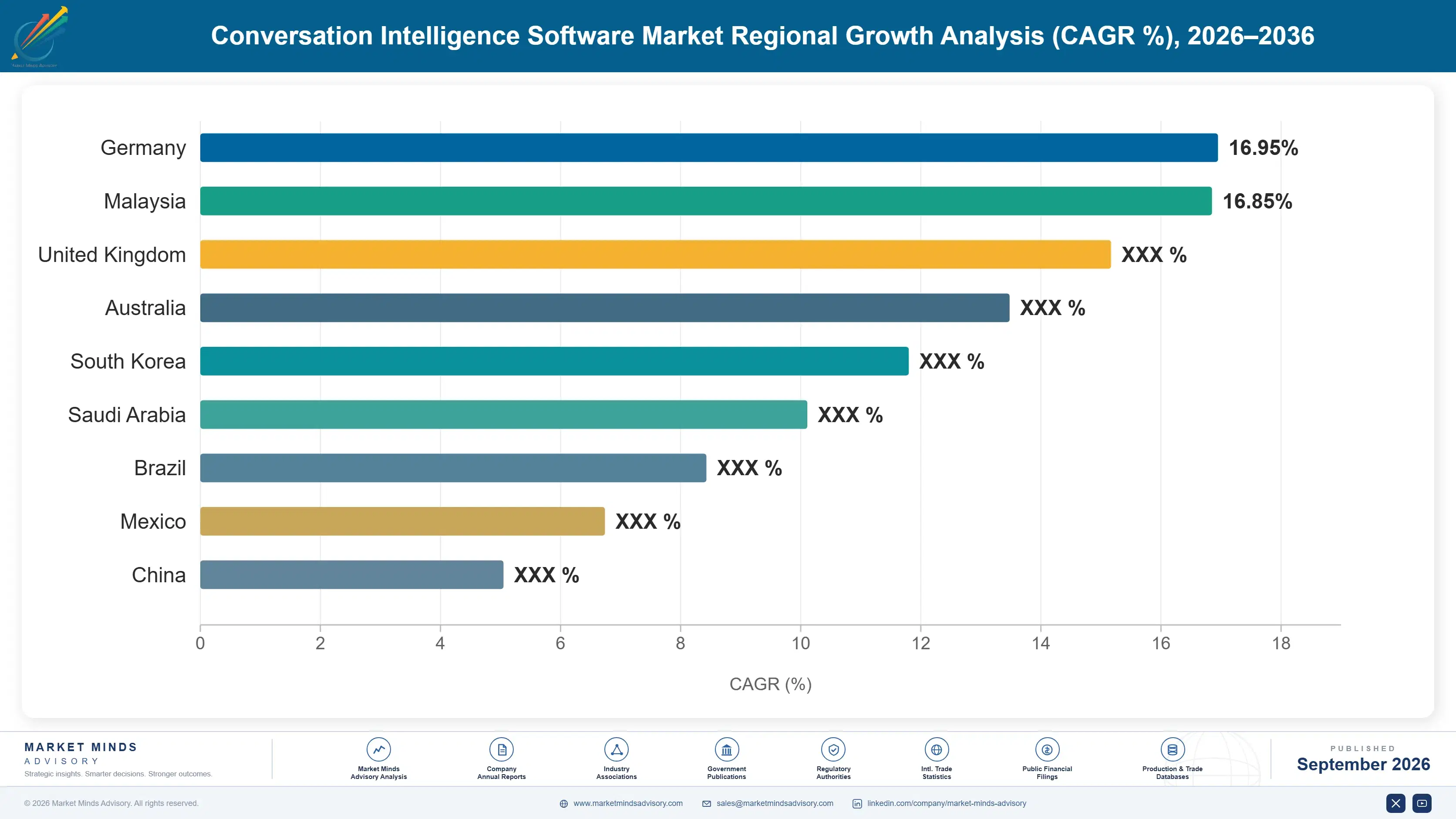
conversation-intelligence-software-market-country-cagr-analysis-1788419008507

Where Platform Vendors Can Still Add Margin

Commoditizing basic recording and transcription features and thinning per-seat licensing margins are pushing vendors toward adjacent revenue lines that ride on top of the same sales organization relationship rather than the platform subscription itself. Four levers stand out as genuinely additive to core revenue rather than cannibalistic of it, each drawing on data or expertise the vendor already has.

Selling Certified Sales Methodology Coaching Content

Vendors with deep conversation data can partner with established sales methodology providers to embed certified coaching frameworks directly into the platform, capturing licensing revenue from methodology content rather than pure software functionality alone. This partnership model gives sales organizations a turnkey coaching program rather than requiring them to build custom coaching criteria internally from scratch. Vendors offering this capability command content licensing fees running roughly 10 to 15 percent of the base platform contract value annually. Building these methodology partnerships requires sales credibility most pure software vendors historically never developed internally.
Market Impact: License fees add 10 to 15 percent yearly

Providing Revenue Forecasting Accuracy Consulting Services

Vendors with expertise translating conversation risk signals into forecast accuracy improvements can sell consulting services helping revenue operations teams build and calibrate forecasting models around this data. This model captures value from customers who want implementation guidance without committing to a lengthy internal data science hiring process. Vendors offering this service report consulting revenue reaching 5 to 8 percent of total company revenue within two years of launching the offering commercially. Regulatory scrutiny of forecasting model methodology is rising in publicly traded customer organizations, requiring careful documentation practices. each time.
Market Impact: Consulting revenue reaches 5 to 8 percent share

Selling Customer Success and Renewal Risk Modules

Vendors that extend conversation analysis beyond sales calls into customer success and renewal conversations can charge a premium module fee for this expanded coverage, capturing revenue from a genuinely separate use case and buyer within the same enterprise account. This expansion has proven especially valuable to subscription software companies where renewal revenue represents a larger share of total revenue than new sales. Vendors offering this module report attach rates above 25 percent among existing sales-focused customers expanding into customer success coverage. Building this expanded coverage requires customer success domain expertise most sales-focused vendors historically never developed.
Market Impact: Attach rates now exceed a 25 percent mark

Offering Custom AI Model Training for Enterprise Accounts

Vendors that build dedicated data science teams can offer large enterprise customers custom AI model training tuned to their specific industry terminology and sales methodology, capturing premium revenue beyond the standard platform subscription. This capability has proven especially valuable to enterprises in specialized industries where generic language models underperform on industry-specific terminology and objection patterns. Vendors offering this capability report custom training engagements reaching over 500,000 dollars for the largest enterprise accounts annually. Building this custom training capability requires data science talent most vendors must recruit or acquire externally. at scale.
Market Impact: Engagements now reach well over 500,000 dollars each

Who Controls the Margin Pool

Global platform revenue concentrates modestly, with the top five vendors holding roughly 40 percent share on a platform revenue basis, the consistent yardstick applied throughout this assessment. Gong and Salesloft lead the enterprise category, though Clari's forecasting-first scale gives it a distinct competitive position built on revenue operations depth rather than pure conversation analysis breadth. The gap between these leaders and mid-tier challengers remains narrow enough that near-term ranking changes look plausible.
Current activity centers on AI coaching capability expansion and forecasting integration rather than price competition on basic recording. Vendors are racing to extend large language model reasoning across coaching, deal risk, and forecasting simultaneously, since enterprise buyers increasingly refuse to purchase point solutions covering only one use case. Several mid-tier players have pursued data science team acquisitions specifically to close the AI capability gap with established leaders.

Emerging pressure comes from AI-native entrants built entirely around modern large language model architecture, competing with established platforms carrying older technical foundations. Ranking shifts are most likely in the mid-tier, where vendors lacking advanced AI capability risk losing enterprise contracts to faster-moving specialists. The very top of the market remains comparatively unsettled, unlike more mature enterprise software categories.
conversation-intelligence-software-market-company-positioning-matrix-1788419009033

Competitive Moat and Risk Dimensions

GONG

Moat: Largest Proprietary Conversation Dataset

Gong's early market entry and broad customer base have accumulated one of the largest proprietary conversation datasets in the category, directly improving AI model training quality that newer entrants cannot easily replicate without comparable scale. Newer entrants must accumulate years of customer conversation volume to reach comparable model training quality.
GONG

Risk: Premium Pricing Limits Mid-Market Reach

Gong's premium pricing strategy caps its addressable volume among smaller mid-market sales teams where lower-cost competitors offering comparable core features are capturing budget-conscious buyers that Gong cannot reach at its current price positioning. Closing this gap would require introducing lower-tier pricing that could cannibalize existing enterprise contract value.
CLARI

Moat: Deep Revenue Forecasting Integration

Clari's origins in revenue forecasting software give it deeper integration with pipeline management and forecasting workflows than pure conversation intelligence competitors, appealing to revenue operations leaders who prioritize forecast accuracy. This integration depth makes Clari a natural fit for revenue operations teams prioritizing forecast reliability above all else.
CLARI

Risk: Narrower Conversation Analysis Depth

Clari's conversation analysis capability trails pure-play specialists like Gong in raw call-level coaching depth, risking share loss on contracts where coaching sophistication matters more to the buyer than forecasting integration. Closing this gap would require dedicating more engineering resources specifically to conversation analysis rather than forecasting.

Players Tracked

Prominent Players

Gong
Chorus (ZoomInfo)
Salesloft
Clari
Outreach

Other Key Players

Substrata
Avoma
Jiminny
Kaia AI
Balto
Refract
Voiceops
Modjo
Attention
Dooly
Momentum
Fireflies.ai
Rilla
Observe.AI
Convin

Recent Developments

JANUARY 2026

Gong Launches Real-Time In-Call Coaching Assistant

Gong launched a real-time in-call coaching assistant that surfaces talking points and objection handling suggestions to sales representatives during live calls rather than only in post-call review, extending its product beyond retrospective analysis. The assistant uses the same underlying model trained on Gong's extensive proprietary conversation dataset.
Signal: Real-time coaching during live calls is becoming a competitive differentiator rather than a future roadmap item.
SEPTEMBER 2025

Clari Acquires Deal Risk Analytics Startup

Clari completed the acquisition of a smaller deal risk analytics startup, adding specialized conversation-based risk scoring capability to its existing forecasting platform rather than building this capability entirely from scratch internally. Financial terms of the acquisition were not disclosed publicly by either company involved in the deal.
Signal: Acquisition is proving faster than internal development for vendors racing to close AI capability gaps quickly.
APRIL 2025

Salesloft Wins Multi-Year Enterprise Contract in India

Salesloft secured a multi-year enterprise platform contract with a major Indian technology company, expanding its presence in a market central to the region's fastest-growing conversation intelligence demand and sales technology adoption. The contract includes multi-year licensing terms covering several thousand individual sales seats across the company.
Signal: Technology sector sales organizations are becoming a primary channel for winning meaningful platform volume. broadly across the region.

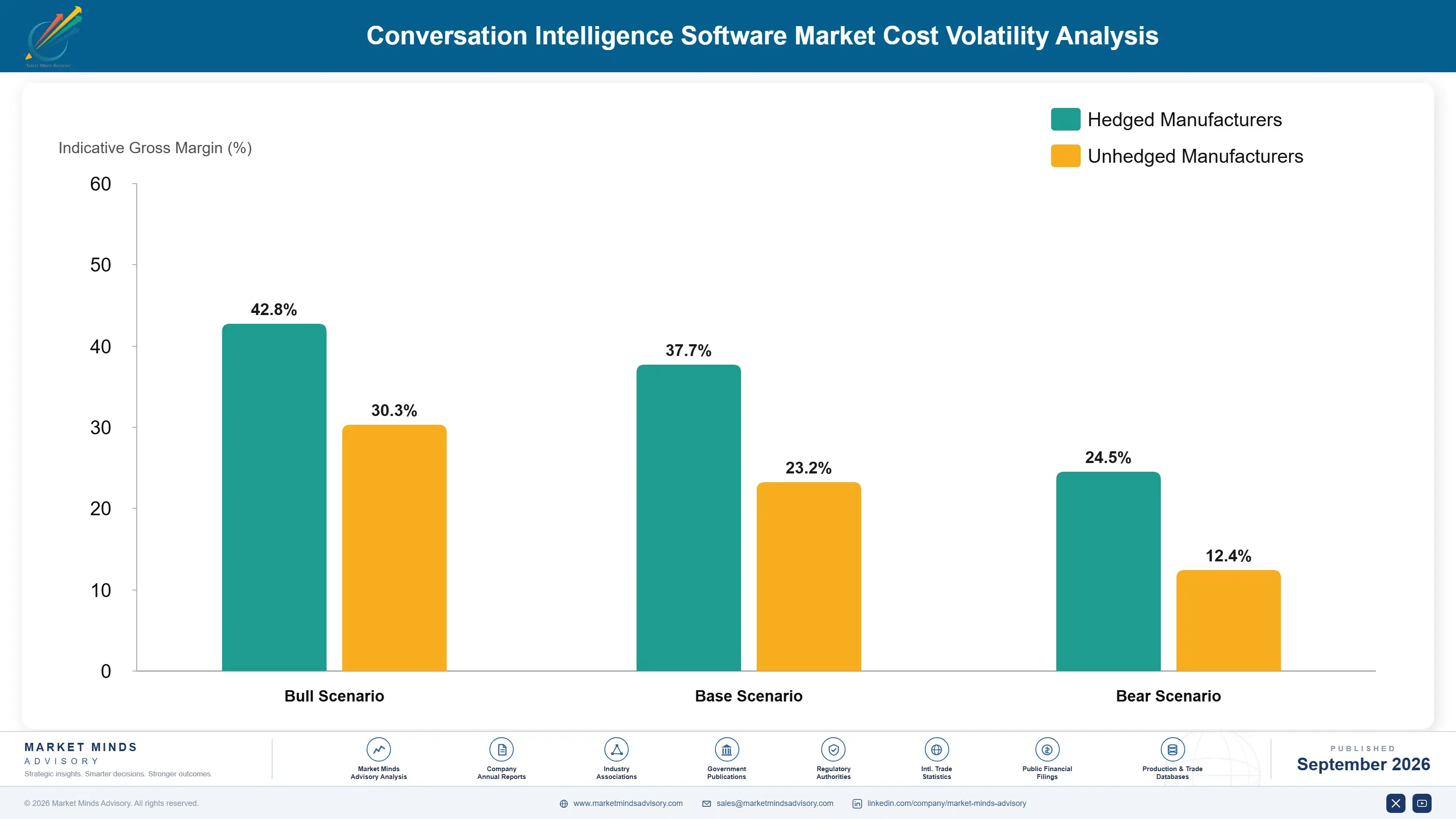
Cloud Infrastructure and AI Model Cost Exposure

Cloud hosting and large language model inference costs account for roughly 30 to 38 percent of a typical conversation intelligence vendor's cost of goods sold, sourced primarily from major hyperscale cloud providers and foundation model suppliers. Engineering and data science talent costs add a further 32 to 38 percent, reflecting the specialized nature of applied AI product development.
A 2023 large language model API pricing restructuring by a major foundation model provider, documented in that provider's own public pricing disclosures, increased inference costs for several conversation intelligence vendors processing large call transcript volumes. Gong's investor communications similarly referenced rising AI compute cost as a factor in its pricing strategy review, prompting several vendors across the category to optimize model usage or migrate workloads between providers.

Smaller vendors face a genuine disadvantage here because they lack the negotiating position to secure favorable enterprise AI inference pricing that larger competitors with greater committed spend can access. Vendors based in regions with a smaller domestic AI engineering talent pool face additional exposure, since they must compete globally for scarce applied machine learning expertise against better-funded competitors. This dynamic particularly affects vendors headquartered outside major AI research hubs.
conversation-intelligence-software-market-cost-volatility-analysis-1788419009228

Multi-Model Cost Arbitrage Strategies

Vendors are increasingly routing different analysis tasks across multiple foundation model providers to optimize cost and performance, avoiding single-vendor lock-in while reducing exposure to any single provider's pricing decisions over time. This approach requires sophisticated routing infrastructure most smaller vendors have not yet built internally at scale. Legal review of data residency clauses adds further time to this process.

In-House Fine-Tuned Model Development

Building smaller, fine-tuned models optimized specifically for conversation analysis tasks reduces dependence on expensive general-purpose foundation model APIs for routine processing, a strategy several vendors have adopted to control inference cost. Building these smaller models requires machine learning expertise most vendors must recruit or develop over time. Time-to-market for these models remains a genuine ongoing challenge industry-wide.

Long-Term Committed Use Cloud Discounts

Locking in multi-year committed use discount agreements with cloud providers secures meaningfully lower unit pricing than on-demand rates, trading some flexibility for cost predictability that helps vendors plan margin more reliably across budget cycles. Vendors combine this with usage forecasting models to avoid over-committing spend beyond projected customer growth. Renewal negotiations require careful advance planning to avoid coverage gaps.

Portfolio Architecture for Margin Defence

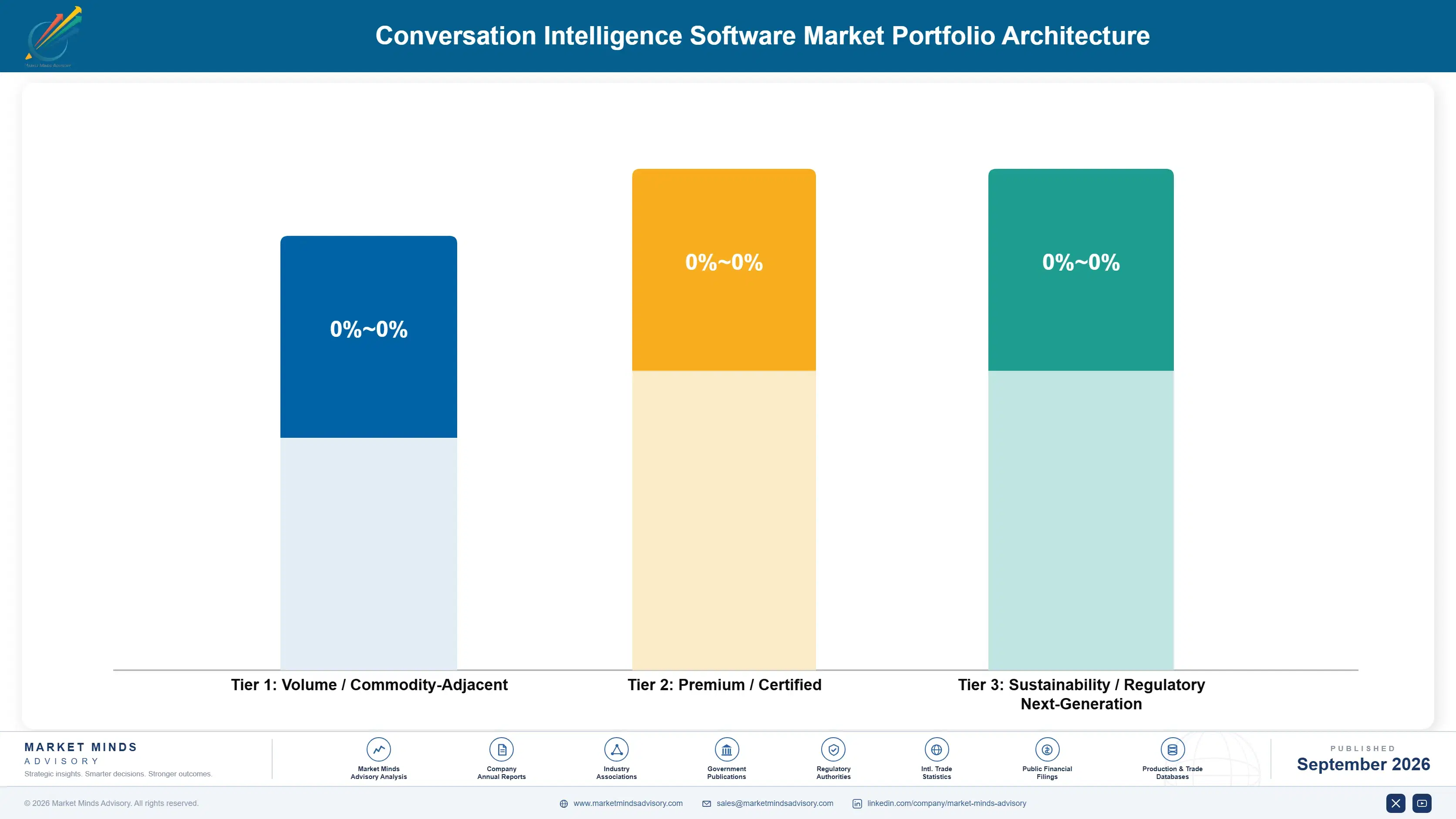
Conversation intelligence vendors operate across a widening tier structure as basic recording commoditizes and higher-margin AI coaching and analytics services concentrate pricing power elsewhere in the stack. Volume-tier basic transcription now carries gross margins compressed by increasing competition, while premium AI-enhanced platforms retain meaningfully stronger pricing. Portfolio strategy increasingly determines profitability more than raw seat count growth.
The tension between chasing seat count and defending premium AI positioning defines strategic choice across the industry. Vendors competing purely on per-seat price find margin eroding faster than their cost base can adjust, while vendors segmenting customers by AI coaching and forecasting integration uptake are protecting margin even as basic licensing fees compress across the broader market. This divergence is reshaping how vendors allocate engineering investment across their enterprise base.

High-value margin pools concentrate in certified methodology content, forecasting consulting, and custom AI model training sold as standalone offerings rather than bundled features. These pools grow faster than core licensing revenue because they scale with data and expertise a vendor already owns rather than requiring incremental seat sales, making them the most defensible source of margin expansion available today. Vendors without such a plan risk the commodity tier over time.

Volume / Commodity-Adjacent

Basic call recording and transcription software sold to price-sensitive small sales teams where per-seat pricing is the primary purchase driver and switching cost remains modest. Sales teams in this tier churn readily toward whichever vendor offers the lowest visible per-seat price.
Gross Margin: 10 to 16%

Premium / Certified

AI-enhanced coaching platforms bundled with certified methodology content and dedicated account management for large enterprises that value insight quality over marginal cost savings. These enterprises typically sign multi-year contracts, reducing acquisition cost per dollar of recurring revenue.
Gross Margin: 24 to 34%

Sustainability / Regulatory / Next-Generation

Custom AI model training, forecasting consulting, and customer success risk modules built to meet emerging revenue operations demands ahead of competitors, commanding premium pricing while scarce. Vendors here often price on a subscription basis tied to service scope rather than pure seat count.
Gross Margin: 28 to 40%
conversation-intelligence-software-market-portfolio-architecture-1788419009729

High-value Sub-segments and Strategic Watch-out

Certified Sales Methodology Coaching Content

High-value, high-growth pool as sales organizations pay premium pricing for turnkey coaching frameworks, rewarding vendors who build effective content partnerships earliest with durable multi-year contracts locked in ahead of rivals. Vendors absent from this capability risk losing the largest enterprise contracts entirely to faster-moving specialists.

Revenue Forecasting Accuracy Consulting

High-value, moderate-growth pool constrained by the limited number of consultants with genuine forecasting expertise, but delivering strong margin once a vendor has built a credible consulting practice and reputation. Expansion here depends heavily on how quickly a vendor can build a credible consulting reputation in a competitive field.

Basic Call Recording and Transcription

Volume core segment carrying the bulk of installed seats but facing steady margin compression as AI-enhanced platforms and commoditized pricing erode differentiation across most basic offerings. Consolidation among smaller recording-only vendors is likely as scale becomes the primary way to defend margin. thins out considerably.

Customer Success and Renewal Risk Expansion

Strategic watch-out segment where shifting subscription economics and renewal-driven revenue models could rapidly change the competitive map, rewarding vendors with flexible multi-use-case coverage already built. A sudden shift in subscription economics in any single major industry could reroute meaningful demand quickly. quite suddenly and unexpectedly.

Recurring Revenue Across the Sales Cycle

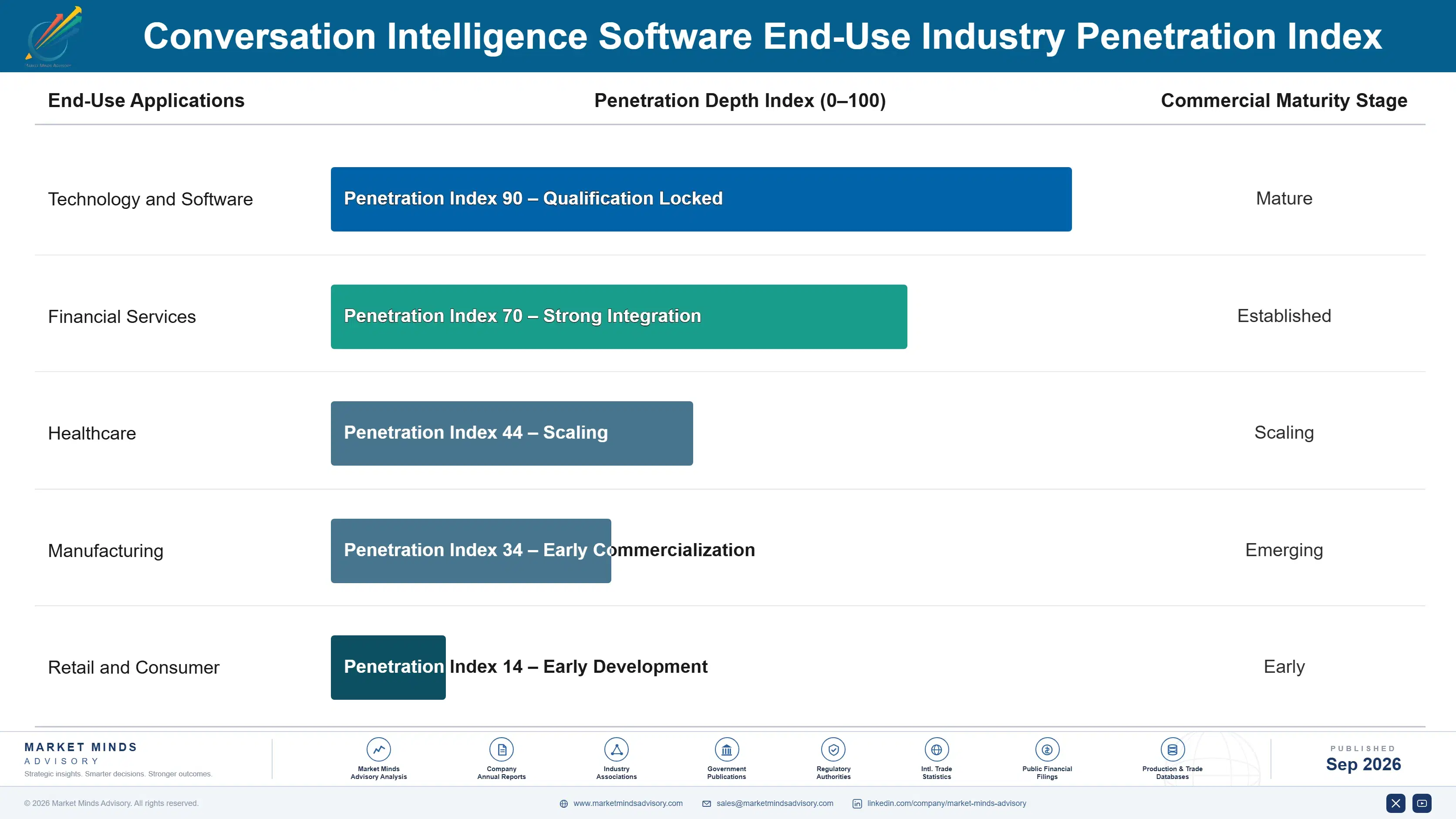
Platform revenue behaves like an annuity once a sales organization integrates conversation intelligence into daily workflow and manager coaching rituals, since switching vendors requires re-training managers and losing historical performance benchmarks, a cost most organizations avoid unless service quality deteriorates. This stickiness means vendors earn recurring revenue across every sales representative for years after deployment, with almost no incremental sales cost.
Adoption depth varies sharply by end-use vertical. Technology and software sales organizations adopt AI coaching features quickly since competitive sales performance directly affects revenue growth targets, while traditional industries with longer sales cycles integrate more slowly due to cultural resistance stretching adoption timelines past several years. Customer success teams sit at a different pace, since renewal-focused analysis remains a newer use case than pure sales coaching.

Buyer profiles are shifting generationally as newer sales leaders, trained on data-driven management principles rather than pure intuition-based coaching, replace an older generation comfortable with informal call shadowing and manual performance reviews. Younger sales leaders expect conversation data to integrate directly with broader revenue operations platforms from day one, treating a standalone recording tool as an outdated concept. This turnover is accelerating adoption of integrated, AI-driven coaching tools faster than pricing would predict.
conversation-intelligence-software-market-end-use-penetration-index-1788419010220

Where MMA Sees the Real Bets

These are among the four positions where our research anticipates prominent divergence between winners and laggards over the coming forecast period. Each is grounded in the demand model, the regulatory perimeter, and the announced capacity pipeline.
01 / AI COACHING PRIORITY

Build genuinely actionable AI coaching before differentiation narrows

Vendors offering only generic performance dashboards are already losing meaningful contracts to rivals whose AI generates specific, call-level coaching recommendations consistently. This gap clearly widens every quarter a vendor delays investment, since enterprise buyers increasingly treat actionable coaching as a baseline procurement requirement rather than a premium feature reserved for the largest deals. MMA firmly views coaching specificity as the clearest predictor of which vendors defend premium pricing over the next several years, more so than raw transcription accuracy alone.
02 / FORECASTING INTEGRATION BUILD

Integrate deal risk signals directly into revenue forecasting workflows

Revenue operations leaders increasingly evaluate vendors on forecasting accuracy improvement nearly as closely as they evaluate raw coaching quality, making forecasting integration a genuine procurement advantage rather than a nice-to-have addition. Vendors without this capability are ceding contracts to rivals who can demonstrate measurable forecast accuracy gains across live production deployments already running today. MMA firmly expects the forecasting-integration gap to widen further still as more and more customers gain real experience comparing vendor performance data directly across many deployments.
03 / USE CASE EXPANSION STRATEGY

Extend conversation analysis into customer success and renewals

Customer success and renewal conversations clearly represent a genuinely underserved use case relative to the heavily contested sales coaching segment, rewarding vendors who expand into this new territory early and quite decisively indeed. Vendors building dedicated renewal risk capability now are positioning well ahead of the broader industry shift toward comprehensive subscription-economics-driven revenue models entirely. MMA very firmly regards early expansion here as a meaningfully lower risk than simply waiting for the use case to mature and competition to intensify.
04 / PROPRIETARY DATA ADVANTAGE

Accumulate proprietary conversation data before competitors close the gap

Vendors with the largest proprietary conversation datasets hold a genuine, durable advantage in AI model training quality that newer entrants cannot easily replicate without comparable customer scale and years of accumulated history. Vendors that delay building this genuine data advantage risk permanently ceding model quality leadership entirely to earlier, faster-moving competitors already active in the category. MMA very strongly and clearly advises treating data accumulation as a standing strategic priority rather than a passive byproduct of normal, everyday business operations.

Engagement Snapshot From the Field

A live engagement with an industry participant carrying material or product regulatory and market exposure ahead of a defining policy shift, showing how our research translates into a defensible multi-year portfolio strategy.
MARKET MINDS ADVISORY · CLIENT ENGAGEMENT SUMMARY
Conversation Intelligence Software Producer Strategic Portfolio Review and Transition Roadmap 2026·Investment Scenario on Conversation Intelligence Software Exposure Evaluation 2025-26
CLIENT PROFILE
The client is a mid-sized software-as-a-service company operating a 120-person outbound sales team across three regional offices, facing inconsistent quota attainment and high new-hire ramp time. Its existing coaching process relied entirely on manual call shadowing by sales managers, covering only a small fraction of total calls made weekly. The company had never previously deployed any AI-driven sales coaching technology at scale.
STRATEGIC CHALLENGE
The company faced rising customer acquisition costs and flat win rates despite continued sales headcount growth, with leadership unable to identify which specific behaviors separated top performers from the rest of the team. Leadership needed a data-driven coaching program deployable within one fiscal quarter across all three offices. Executive sponsorship required demonstrating measurable ramp time improvement quickly.
MMA APPROACH
MMA conducted a win-loss analysis alongside interviews with sales leadership and top-performing representatives, then benchmarked three conversation intelligence vendors against AI coaching capability and integration complexity with the existing sales technology stack. The engagement produced a phased rollout plan prioritizing new-hire onboarding first, sequenced to demonstrate ramp time improvement before broader deployment.
KEY FINDINGS
  1. Top-performing representatives asked discovery questions at nearly double the rate of the median-performing representative on the team. across the entire sales organization overall.
  2. New-hire ramp time to full quota attainment averaged over nine months, well above the company's internal target of six months. company-wide against internal expectations.
  3. Two of three vendors evaluated already offered pre-built integrations with the company's existing customer relationship management platform. smoothly and without additional custom engineering.
  4. Manual call shadowing covered less than 10 percent of total calls made weekly, leaving most coaching opportunities entirely unaddressed. historically before the new program began.
CLIENT PROFILE
The client is a mid-sized software-as-a-service company operating a 120-person outbound sales team across three regional offices, facing inconsistent quota attainment and high new-hire ramp time. Its existing coaching process relied entirely on manual call shadowing by sales managers, covering only a small fraction of total calls made weekly. The company had never previously deployed any AI-driven sales coaching technology at scale.
STRATEGIC CHALLENGE
The company faced rising customer acquisition costs and flat win rates despite continued sales headcount growth, with leadership unable to identify which specific behaviors separated top performers from the rest of the team. Leadership needed a data-driven coaching program deployable within one fiscal quarter across all three offices. Executive sponsorship required demonstrating measurable ramp time improvement quickly.
MMA APPROACH
MMA conducted a win-loss analysis alongside interviews with sales leadership and top-performing representatives, then benchmarked three conversation intelligence vendors against AI coaching capability and integration complexity with the existing sales technology stack. The engagement produced a phased rollout plan prioritizing new-hire onboarding first, sequenced to demonstrate ramp time improvement before broader deployment.
KEY FINDINGS
  1. Top-performing representatives asked discovery questions at nearly double the rate of the median-performing representative on the team. across the entire sales organization overall.
  2. New-hire ramp time to full quota attainment averaged over nine months, well above the company's internal target of six months. company-wide against internal expectations.
  3. Two of three vendors evaluated already offered pre-built integrations with the company's existing customer relationship management platform. smoothly and without additional custom engineering.
  4. Manual call shadowing covered less than 10 percent of total calls made weekly, leaving most coaching opportunities entirely unaddressed. historically before the new program began.
RECOMMENDED STRATEGY
Phase 1: Phase 1 (Months 1-2): deploy the platform for new-hire onboarding cohorts across all three regional offices. immediately upon program approval. Phase 2: Phase 2 (Months 3-4): extend coverage to the full existing sales team based on new-hire program results. systematically and thoroughly. Phase 3: Phase 3 (Month 5): integrate deal risk scoring directly into the weekly sales pipeline review process. formally and quite completely.
OUTCOME
The company completed new-hire program deployment within seven weeks, ahead of the eight-week target (client-reported, unverified by MMA). New-hire ramp time to full quota attainment declined measurably within two quarters of full rollout (client-reported, unverified by MMA). The company has since expanded the program to two additional sales teams (client-reported, unverified by MMA).

Frequently Asked Questions

Foundational context covering the market sizes, CAGR, scope, country, region and competition that inform every finding below. This section is provided to cover basics and most often pre-purchase conversations, answered from the MMA Primary Research Dataset.

What is the current size of the Conversation Intelligence Software Market?

The Conversation Intelligence Software Market reached 2.8 billion dollars in 2025, the report's base year for all forecast calculations. This figure covers AI-driven sales and customer service call analysis platforms globally.

How large will the Conversation Intelligence Software Market be by 2036?

The market is projected to reach 16.5 billion dollars by 2036, roughly 5.02 times its 2026 starting value. That growth reflects large language model advances and expanding renewal risk analytics adoption.

What is the CAGR for the Conversation Intelligence Software Market 2026 to 2036?

The market is forecast to grow at a 17.5 percent compound annual rate between 2026 and 2036. Bull and bear scenarios range from 18.8 percent to 16.2 percent respectively.

Which segment is growing fastest?

AI-generated coaching and deal risk analytics lead growth at 24.0 percent CAGR, roughly 1.37 times the overall market rate. Large language model advances are driving this expansion across most platforms.

Who are the major companies in the Conversation Intelligence Software Market?

Gong, Chorus, Salesloft, Clari, and Outreach lead the market on a platform revenue basis. Together these five vendors hold roughly 40 percent combined market share.

Which country is growing fastest?

India leads country-level growth at 24.5 percent CAGR, driven by its rapidly scaling technology sales sector and expanding outbound sales operations centers. Domestic software companies are accelerating adoption further.

Report Segmentation Architecture

The full report scope spans multiple orthogonal segmentation dimensions, with cross-tabulated demand data provided for each dimension pair. Coverage extends further to regional breakdowns, trend trajectories, and the competitive detail needed to support segment-level decision-making.

By Primary Market Dimension

  • AI-Generated Coaching and Deal Risk Analytics
  • Basic Call Recording and Transcription
  • Real-Time In-Call Assistance
  • Customer Success and Renewal Analysis
  • Revenue Forecasting Integration

By End-Use Industry

  • Technology and Software
  • Financial Services
  • Healthcare
  • Manufacturing
  • Retail and Consumer

By Commercial Dimension

  • Large Enterprise Sales Organizations
  • Small and Medium Business Sales Teams
  • Customer Success Organizations
  • Sales Development Representative Teams

By Region

  • North America
  • Western Europe
  • East Asia
  • South Asia and Pacific
  • Latin America
  • Middle East and Africa
  • Eastern Europe

Scope, Methodology, and Coverage

Every figure in this report is reproducible from documented input assumptions. The scope below maps the historical period, the forecast horizon, the segmentation dimensions, and the countries covered, alongside the underlying primary and qualitative methodology.
Historical Period
2020 to 2025
Forecast Period
2026 to 2036
Base Year
2025 (USD billions; MMA Primary Research Dataset, September 2026)
Market Definition
This report covers software platforms that record, transcribe, and analyze sales and customer service conversations using artificial intelligence to generate coaching insights, deal risk scores, and performance analytics, measured on a global software revenue basis. It excludes basic call recording infrastructure without analytical capability and general customer relationship management software not centered on conversation analysis.
Quantitative Units
USD billions, global market size and forecast
Segmentation Dimensions
Product/technology type, end-use industry, commercial/customer dimension, region
Regions Covered
North America, Western Europe, East Asia, South Asia and Pacific, Latin America, Middle East and Africa, Eastern Europe
Countries Covered
United States, China, Germany, France, United Kingdom, Japan, South Korea, India, Canada, Brazil, Mexico, Indonesia, Vietnam, Thailand, Malaysia, United Arab Emirates, Saudi Arabia, South Africa, Nigeria, Turkey, Poland, Netherlands, Italy, Spain, Sweden, Switzerland, Argentina, Colombia, Australia, Singapore, and additional markets relevant to this sector
Key Companies Profiled
Gong, Chorus (ZoomInfo), Salesloft, Clari, Outreach, Substrata, Avoma, Jiminny, Kaia AI, Balto, Refract, Voiceops, Modjo, Attention, Dooly, Momentum, Fireflies.ai, Rilla, Observe.AI, Convin
Quantitative Methodology
Primary survey, n=3,800 respondents, Q4 2025, six countries; demand-side model with trade association cross-validation
Qualitative Methodology
47 expert interviews, Q4 2025; applied to validate demand model assumptions, identify emerging dynamics, and assess competitive positioning
Report Format
PDF and XLSX data workbook (Word format preview document)
Publisher
Market Minds Advisory
Report Code
MMA-2026-TEC-137
Published
September 2026
Contact
sales@marketmindsadvisory.com | www.marketmindsadvisory.com

Purchase the full Conversation Intelligence Software Market Report (2026 to 2036).

This report delivers a comprehensive analysis of the global Conversation Intelligence Software Market, covering market sizing, segmentation, and regional dynamics through 2036. It profiles the competitive landscape across twenty leading vendors, benchmarked on a consistent platform revenue basis. Regional analysis spans all seven major world regions, quantifying share and growth rate differences driven by technology, sales, and AI adoption factors. The report also examines revenue diversification strategies, input cost exposure, and portfolio economics shaping vendor profitability. A dedicated case study illustrates practical implementation lessons for sales organizations pursuing coaching platform rollouts.
Ten-year market size and CAGR forecast through 2036
Five-segment MECE market breakdown with growth rates
Seven-region share and growth rate analysis
Twenty-company competitive benchmarking on platform revenue basis
Revenue diversification strategy analysis across four commercial levers
Anonymized client implementation case study with outcomes

Built For The People Who Decide

From boardroom strategy to bench-side execution, this report is read cover-to-cover by leaders shaping the next decade of their industry, turning demand scenarios, market dynamics and valuation benchmarks into decisions.
CXOs/ Presidents/ VPs/ Managers
M&A and Corporate Development
Strategy Teams and R&D Heads
Procurement and Product Directors
Regulatory and Compliance Leaders
Investor Relations and Equity Analysts