

Market Minds Advisory
Contrast-Enhanced Ultrasound (CEUS) Market

Contrast-Enhanced Ultrasound (CEUS) Market: Microbubble Imaging Reaches Point-of-Care Practice

Radiologists are adopting microbubble contrast agents to characterize liver and renal lesions without the radiation or nephropathy risk of CT, converting a niche radiology add-on into a first-line diagnostic pathway across expanding point-of-care settings nationwide.

Lead Analyst

Alice Ballenger

Published

September 2026

Make Smarter Decisions with Customized Research Insights

Request a free sample report and evaluate market opportunities, growth trends, and competitive dynamics relevant to your business needs.

2025 MARKET VALUE$1.6BMarket Size 2025
2036 FORECAST VALUE$4.3BBase Case , 2026 to 2036
CAGR 2026 TO 20369.6 %Bull 10.9% / Bear 8.3%
INCREMENTAL OPPORTUNITY$2.5BNet 10- year value creation
EXPANSION MULTIPLE2.46x2036 value over 2026 base
Strategic Levers
M&A Pipeline
Regional Outlook
Country Rankings
Competitive Intelligence
Segmental Deep-dive
Call-Us : 91 93563 13602

Executive Snapshot and Market Trajectory

Contrast-enhanced ultrasound is moving from a specialist radiology technique into a first-line diagnostic pathway as microbubble agents let clinicians characterize liver and renal lesions without CT's radiation or nephropathy risk. Reimbursement expansion is the immediate catalyst behind that shift, reshaping departmental protocols faster than most manufacturers expected.
CEUS contrast agents lead every other category on growth as expanding liver lesion protocols pull volume steadily away from CT and MRI follow-up scans. China has become the fastest-growing country, driven by rapid point-of-care adoption and expanding hepatology screening programs. North America still commands the largest share of spending given its concentration of academic radiology centers running CEUS protocols. Liver imaging remains the largest application tracked here.
Competitive character remains concentrated among a small group of contrast agent and ultrasound platform manufacturers, evaluated consistently on a revenue basis across agents, transducers, and software combined rather than on installed unit counts alone. Regulatory momentum favors the category directly: expanding label indications for pediatric and renal applications are pushing hospitals to adopt CEUS protocols well ahead of typical replacement cycles, a dynamic few competing manufacturers have fully priced into their roadmaps yet.
Market Definition
The CEUS market covers microbubble contrast agents, CEUS-capable ultrasound transducers and platforms, quantification and perfusion analysis software, and point-of-care CEUS systems used for diagnostic lesion characterization and perfusion assessment. It excludes conventional non-contrast diagnostic ultrasound systems and excludes CT and MRI contrast agents not used in ultrasound-guided procedures.
Base Year Value
$1.6B in 2025 (MMA Primary Research Dataset, August 2026)
Forecast Period
2026 to 2036, eleven discrete annual values
CAGR
9.6% base case. Bull 10.9%. Bear 8.3%.
Fastest Growth Segment
CEUS Contrast Agents: 12.8% CAGR
Fastest Growth Country
China: 13.1% CAGR
Fastest Growth Region
South Asia and Pacific: 11.7% CAGR
Largest Region
North America: 28% of 2025 global value
Market Leaders
Bracco Imaging S.p.A., GE HealthCare Technologies Inc., Koninklijke Philips N.V., Canon Medical Systems Corporation, Lantheus Holdings, Inc. Source: MMA Analysis based on company annual reports.
Primary Survey
n=3,800 procurement and R&D decision-makers, Q4 2025, six countries
Methodology
Demand-side build-up, cross-validated against public data, 47 expert interviews

Contrast-Enhanced Ultrasound (CEUS) Market Forecast Scenarios

contrast-enhanced-ultrasound-ceus-market-size-forecast-scenario-1787303975892
CEUS adoption grew unevenly between 2020 and 2025. Early pandemic disruption slowed elective imaging volume through 2021, then expanding liver lesion characterization guidelines and new pediatric label approvals accelerated growth, lifting historical growth to an estimated 8.3% compound rate across the period. That guideline expansion took longer to translate into routine hospital practice than most manufacturers initially expected it would.
The base case assumes 9.6% annual growth through 2036, anchored on three mechanisms. First, expanding reimbursement coverage for CEUS liver and renal lesion characterization keeps pulling radiology departments away from CT follow-up imaging toward contrast ultrasound. Second, growing point-of-care ultrasound adoption in emergency and critical care settings keeps opening new clinical use cases beyond traditional radiology departments. Third, quantification and perfusion analysis software keeps upgrading existing ultrasound platforms, creating recurring software revenue beyond agent sales alone.
A bull case builds if pediatric and cardiac CEUS indications expand faster than currently expected, pushing growth toward 10.9% as label expansions open new procedure volume. The bear risk is reimbursement policy lag: if payer coverage for CEUS procedures fails to keep pace with expanding clinical guidelines, adoption could slow well below expectations, capping growth near 8.3%.

From Specialist Add-On to First-Line Lesion Pathway

CEUS is shifting from a specialist radiology technique reserved for ambiguous CT findings into a first-line diagnostic pathway for liver and renal lesion characterization, as microbubble agents give clinicians real-time perfusion data without radiation exposure or contrast-nephropathy risk. Reimbursement expansion, not technology alone, is what is converting pilot adoption into routine departmental protocol across most participating hospital systems today.
MARKET CONCENTRATION54% CR5Five manufacturers hold just over half of category revenue
AVERAGE SELLING PRICE$95 per contrast agent doseBlended price across microbubble agent formulations and package sizes
LEADING APPLICATION SHARELiver imaging, 58%One clinical application still dominates total procedure volume overall
INSTALLED BASE UTILISATION48%CEUS-capable transducers run below their full diagnostic protocol capacity
REIMBURSEMENT COVERAGE RATE61% of proceduresPayer coverage still trails clinical guideline adoption in most markets
INPUT COST SHARE29% of agent COGSSpecialized lipid shell and gas core materials dominate production cost
Manufacturers compete less on agent stability alone than on demonstrated diagnostic accuracy and quantification software depth, since hospitals increasingly specify platforms with validated perfusion analysis capability over agents sold as a standalone commodity product. Manufacturing remains concentrated in Italy, the United States, and Japan, while China's domestic agent production is expanding rapidly to serve its own growing point-of-care ultrasound base and rising domestic procedure volume.
The next decade will be shaped by two forces pulling in the same direction: expanding reimbursement coverage finally catching up with clinical guideline recommendations, and point-of-care ultrasound adoption spreading CEUS capability beyond academic radiology departments into emergency and community practice. Both push investment toward broader label indications even as smaller hospitals weigh agent cost against still-developing reimbursement clarity in several regional markets, a tension likely to persist for years.
"CT gave radiologists a shadow. CEUS gives them a live perfusion map, without the dye that scares nephrologists. That is the whole adoption story."
Director, Diagnostic Imaging and Contrast Media Practice · MMA Medical Devices P

Market Trends

Liver Lesion Characterization Guidelines Expand Reimbursed Use

Radiology societies across major markets have expanded formal clinical guidelines recommending CEUS as a first-line or confirmatory tool for characterizing indeterminate liver lesions found on routine imaging, reducing reliance on CT and MRI follow-up scans that carry radiation dose or gadolinium exposure concerns for at-risk patients. This is converting CEUS from a problem-solving tool used only after ambiguous CT findings into a standard first-line pathway integrated directly into hepatology and oncology imaging protocols at leading centers. Manufacturers with validated quantification software supporting these guideline pathways are capturing disproportionate share of new academic and community hospital adoption as guideline recognition expands.
Market Impact: Avoids 1.4M CT referrals

Point-of-Care Ultrasound Adoption Extends CEUS Beyond Radiology

Portable and cart-based point-of-care ultrasound systems capable of CEUS protocols are extending contrast ultrasound use beyond dedicated radiology departments into emergency medicine, critical care, and community hospital settings that previously lacked the specialized equipment required for contrast imaging. This is opening genuinely new procedure volume in trauma and acute abdominal assessment, where rapid bedside lesion characterization avoids transport delays associated with CT scheduling. Manufacturers with compact, CEUS-capable point-of-care platforms are capturing disproportionate share of this expanding acute care adoption as emergency department protocols increasingly specify contrast-capable equipment across a growing number of participating hospital networks.
Market Impact: Adds 340,000 annual pediatric CEUS

Market Opportunities and Growth Drivers

Radiation and Nephrotoxicity Avoidance Drives Referral Growth

Clinicians increasingly favor CEUS over CT and MRI for patients with renal impairment or radiation exposure concerns, particularly pediatric patients and those requiring repeated follow-up imaging for chronic liver conditions, since microbubble agents carry neither ionizing radiation nor the nephrotoxicity risk associated with iodinated or gadolinium-based contrast media. This referral pattern is becoming self-reinforcing as radiologists build confidence in CEUS diagnostic accuracy through repeated clinical use across expanding patient populations. Manufacturers supporting radiologist training programs are capturing disproportionate share of this referral growth as clinician familiarity continues to build across major hospital systems and community practices alike.
Market Impact: Limits coverage to 61%

Expanding Pediatric and Renal Label Indications Open New Volume

Regulatory approval of pediatric CEUS indications in major markets, alongside expanding renal lesion characterization labels, is opening new procedure volume among patient populations where radiation avoidance carries particular clinical weight and where CT and MRI often require sedation that CEUS avoids entirely. This is converting pediatric radiology departments into a genuinely new adopter segment rather than an afterthought application for contrast ultrasound equipment. Manufacturers with approved pediatric-specific dosing protocols are capturing disproportionate share of this emerging segment as more children's hospitals adopt CEUS as standard practice for common pediatric imaging indications nationwide.
Market Impact: Extends timelines 8 to 12 months

Market Restraints and Challenges

Reimbursement Lag Limits Adoption in Several Markets

Payer reimbursement for CEUS procedures continues trailing clinical guideline recommendations in several major markets, creating genuine financial friction for hospitals evaluating whether to invest in CEUS-capable equipment and staff training against uncertain procedure-level reimbursement recognition. The root cause is that reimbursement schedules in many health systems were built around CT and MRI billing codes and have not fully incorporated CEUS as an equivalent diagnostic pathway despite comparable or superior clinical accuracy in several indications. Radiology societies are mitigating this by publishing cost-effectiveness data directly to payers, arguing that CEUS adoption reduces downstream CT utilization enough to offset any incremental gap.
Market Impact: Adds 22% liver volume

Operator Training Requirements Constrain Rollout Pace

CEUS requires specialized sonographer and radiologist training beyond standard diagnostic ultrasound competency, since accurate lesion characterization depends heavily on real-time image interpretation skill that develops only through repeated supervised practice with contrast agents. The underlying cause is that CEUS diagnostic accuracy is more operator-dependent than CT or MRI, where image acquisition is largely standardized regardless of the technologist performing the scan. Manufacturers are mitigating this training gap by offering structured certification programs and remote proctoring support, helping community hospitals build CEUS competency without requiring extended on-site training from specialized academic centers.
Market Impact: Adds 19% to point-of-care volume
3 additional market trends, 3 additional growth drivers, and 2 additional restraints and challenges are covered in the full report. Contact sales@marketmindsadvisory.com to access the complete intelligence.

Segment CAGR and Growth Architecture

MMA segments the market by product and technology type, the classification radiology departments and manufacturers use when specifying equipment and comparing agent formulations across competing procurement decisions. This avoids blending upstream agent chemistry with the downstream clinical application categories that define how CEUS is actually purchased and used across every major hospital decision made today.
contrast-enhanced-ultrasound-ceus-market-market-share-analysis-1787303976426

CEUS Contrast Agents

CEUS contrast agents, the microbubble formulations administered intravenously to enable real-time perfusion imaging, remain the fastest-growing category as expanding liver and renal lesion characterization guidelines pull procedure volume directly into recurring agent consumption. Growth concentrates wherever reimbursement coverage intersects with radiologist training depth, particularly across North America and increasingly China's rapidly expanding point-of-care ultrasound base. Bracco Imaging and Lantheus Holdings have each expanded agent manufacturing capacity substantially, recognizing that consistent supply reliability, not just diagnostic accuracy, decides which manufacturer captures a hospital's long-term procurement relationship. At a 12.8% forecast CAGR, roughly 1.3 times the market average, this segment is pulling investment toward agent production capacity faster than any other category.
CAGR 12.8%

Quantification and Perfusion Analysis Software

Quantification and perfusion analysis software, applying automated time-intensity curve analysis to CEUS image sequences, tracks reimbursement guideline expansion more directly than any other segment, making validated software capability a disproportionate growth driver for this category specifically. GE HealthCare and Philips lead on installed base scale, while newer entrants increasingly compete on software validation depth and integration with existing radiology reporting systems rather than raw imaging hardware alone. Demand here is tied more closely to guideline adoption pace than to overall procedure volume alone, since quantification software adds diagnostic confidence radiologists increasingly require before relying on CEUS for treatment decisions. This segment's growth trajectory now depends heavily on how quickly radiology societies formally endorse quantitative CEUS reporting standards.
CAGR 11.4%
Full segment breakdown across 5 segments available in the complete report.

Regional Architecture and Country Demand Map

North America commands the largest share of spending given its concentration of academic radiology centers running CEUS protocols, while China's rapid ultrasound adoption and South Asia and Pacific's expanding screening programs anchor the fastest-growing regional pipelines. Western Europe and Latin America contribute steady, gradually expanding demand.

North America

The United States anchors regional demand through its dense concentration of academic radiology centers that pioneered CEUS liver lesion protocols and its expanding pediatric CEUS adoption at major children's hospitals. Canada contributes a smaller, steadily growing demand base benefiting from proximity to the same contrast agent suppliers and shared radiology society guideline development. Broader private payer reimbursement recognition and stronger radiologist training infrastructure give the region durable procedure volume even as growth moderates relative to faster-growing emerging markets. Growth stays healthy but trails East Asia and South Asia and Pacific because the region's largest academic centers have already completed much of their initial protocol adoption and staff training, and Mexico's referral relationships add further momentum.
Share: 28% | CAGR: 8.8% (2026 to 2036)

Western Europe

Italy anchors both regional contrast agent manufacturing depth and clinical adoption, home to the sector's largest agent producer and radiologists whose early CEUS research shaped current European guideline recommendations. Germany and France follow with steady procedure volume tied to national health systems increasingly recognizing CEUS as reimbursable first-line practice. Regulatory pressure compounds adoption directly: European Medicines Agency guidance and national radiology society endorsements are pushing hospitals toward CEUS protocols for renal and liver characterization ahead of most other global markets. Growth trails East Asia and South Asia and Pacific because the region's mature radiology base is expanding procedure volume more slowly than newer market entrants. The United Kingdom contributes smaller but steadily growing demand of its own.
Share: 22% | CAGR: 7.9% (2026 to 2036)
Regional intelligence for 5 additional markets available in the complete report: East Asia, South Asia and Pacific, Latin America, Middle East and Africa, Eastern Europe. Contact sales@marketmindsadvisory.com.
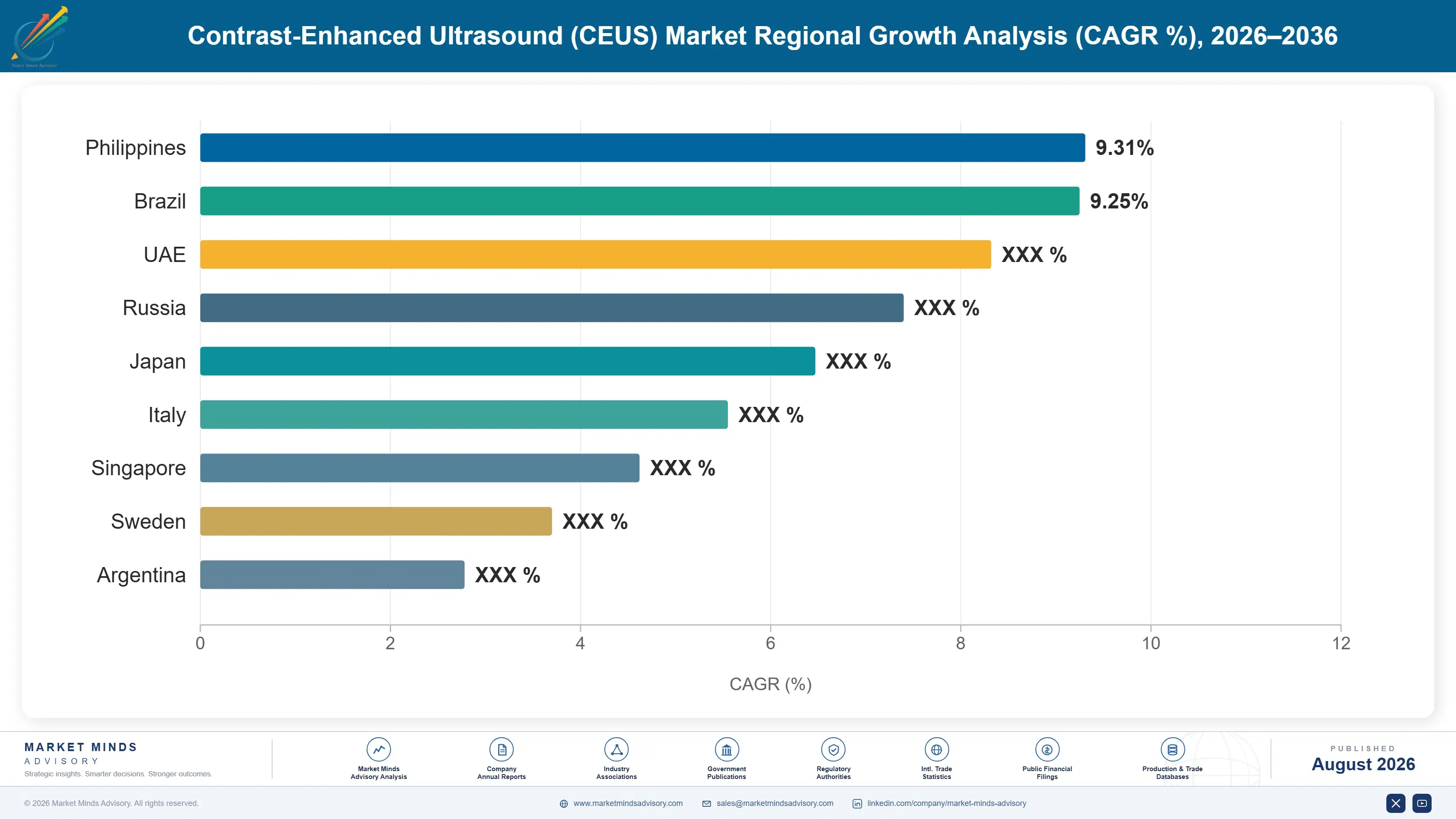
contrast-enhanced-ultrasound-ceus-market-country-cagr-analysis-1787303977164

Where CEUS Manufacturers Actually Capture Margin

Standard contrast agent sales increasingly compete on price alone as more manufacturers enter the category, so the companies protecting margin monetize the software and training layer: quantification analysis, radiologist certification, and long-term supply agreements. The four levers below reflect where MMA's interviews with radiology procurement teams show real, sustained willingness to pay a premium across every major decision.

Quantification and Perfusion Software Licensing Programs

Radiology departments increasingly require validated time-intensity curve analysis software before adopting CEUS as a formal reporting pathway, and manufacturers that invest in rigorous clinical validation are converting what used to be a purely agent purchasing decision into a recurring software licensing relationship commanding meaningful premium pricing over unenhanced imaging platforms. This is becoming the primary differentiator in CEUS platform procurement, where hospitals increasingly select vendors based on software validation depth rather than agent chemistry alone, and MMA interviews suggest validated quantification platforms capture roughly 27% higher recurring revenue per installed system across the category overall today.
Market Impact: Adds 27 percent higher recurring so

Radiologist Certification and Training Partnership Programs

Contrast agent manufacturers increasingly bundle structured certification training alongside agent supply agreements rather than selling contrast media as a standalone commodity purchase, since diagnostic accuracy and consistent technique meaningfully affect hospital-reported outcomes and continued procedure volume. Manufacturers offering integrated certification partnerships capture meaningfully higher lifetime account value than agent-only suppliers, worth roughly 24% more per hospital relationship over a multi-year supply agreement, since training investment builds procedural loyalty that pure agent pricing cannot replicate. Adoption of these bundled training partnerships continues accelerating as more community hospitals add CEUS capability across their imaging departments each quarter.
Market Impact: Adds 24 percent higher lifetime acc

Long-Term Contrast Agent Supply Agreement Programs

Hospitals increasingly sign multi-year contrast agent supply agreements guaranteeing consistent product availability and predictable per-dose pricing throughout an extended procurement relationship, converting what used to be a series of individual purchase orders into predictable recurring revenue worth roughly 21% of a manufacturer's forward account revenue across the agreement term. Manufacturers offering these agreements gain visibility into future demand that supports continued manufacturing investment, while hospitals gain protection against agent shortages and price volatility on formulations purchased at high recurring volume each procurement cycle across their departments and affiliated imaging centers.
Market Impact: Locks in supply revenue for 3 to 5

Point-of-Care Platform Bundling With Contrast Agents

Manufacturers offering bundled point-of-care ultrasound platforms preconfigured for CEUS protocols alongside contrast agent supply capture recurring device and consumable revenue while simultaneously deepening customer relationships that make competitive displacement more difficult for rivals without comparable integrated platform offerings available today across the category. For hospitals expanding CEUS into emergency and critical care settings, the value proposition is faster deployment without separate platform and agent procurement processes across multiple departments. Early adopters report platform bundling attach rates approaching 31% among first-time community hospital buyers, growing steadily each year across the broader category.
Market Impact: Reaches nearly 31 percent bundling

Who Controls the Margin Pool

CR5 sits at 54%, reflecting a category moderately consolidated among a small group of contrast agent and ultrasound platform manufacturers, evaluated here on a revenue basis across agents, transducers, and quantification software combined. Bracco Imaging and GE HealthCare lead on category revenue scale, with a meaningful gap separating them from smaller challengers, including Philips and Canon Medical, each strong in specific segments rather than universally. Smaller manufacturers increasingly s
Current activity centers on three dimensions: quantification software validation depth, radiologist training and certification partnership capability, and long-term agent supply agreement structuring for large hospital systems. Manufacturers lacking CEUS-capable transducer platforms are increasingly partnering with contrast agent suppliers rather than losing procurement tenders on missing-capability grounds alone across the industry.

Emerging pressure comes from Chinese domestic contrast agent manufacturers expanding aggressively on price into mid-tier hospital segments historically dominated by Western agent suppliers. If Chinese manufacturers continue converting domestic scale into export competitiveness, expect rankings among the next several challengers to shift by 2030, as lower-cost entrants displace slower-moving incumbents across price-sensitive hospital segments worldwide. Established leaders have limited time to respond before meaningful share shifts occur across the category.
contrast-enhanced-ultrasound-ceus-market-company-positioning-matrix-1787303978055

Competitive Moat and Risk Dimensions

BRACCO IMAGING S.P.A.

Moat: Pioneer Agent Manufacturing Scale

Bracco's decades of contrast agent manufacturing history and its role shaping early European CEUS guideline development give it supply reliability and clinical credibility that newer entrants cannot quickly replicate regardless of technical investment committed. That accumulated clinical relationship depth increasingly functions as a competitive moat for hospital procurement decisions specifically.
BRACCO IMAGING S.P.A.

Risk: Platform Integration Competitive Gap

Bracco's focus on contrast agent manufacturing leaves it more exposed than platform-integrated competitors to hospitals seeking a single vendor relationship spanning both agents and CEUS-capable ultrasound hardware. Closing this gap requires either platform partnerships or direct hardware investment competing against established imaging equipment manufacturers with deeper hardware engineering resources already in place.
GE HEALTHCARE TECHNOLOGIES INC.

Moat: Integrated Platform and Software Depth

GE HealthCare's broad, integrated ultrasound platform spanning quantification software and CEUS-capable hardware gives it switching-cost advantages that agent-only vendors cannot easily replicate across a hospital's full radiology program. That combined platform breadth makes GE HealthCare the default vendor for hospitals seeking a single integrated procurement relationship spanning imaging hardware and software.
GE HEALTHCARE TECHNOLOGIES INC.

Risk: Agent Supply Dependence on Partners

GE HealthCare depends on third-party contrast agent supply relationships rather than manufacturing agents directly, leaving it more exposed than vertically integrated competitors to agent shortages or pricing changes outside its direct control. Managing this requires deepening supplier partnerships or pursuing direct agent manufacturing investment over time, an expensive path competitors with existing chemistry expertise can pursue faster.

Players Tracked

Prominent Players

Bracco Imaging S.p.A.
GE HealthCare Technologies Inc.
Koninklijke Philips N.V.
Canon Medical Systems Corporation
Lantheus Holdings, Inc.

Other Key Players

Siemens Healthineers AG
Samsung Medison Co., Ltd.
Mindray Medical International Limited
Hitachi, Ltd.
Esaote S.p.A.
SonoScape Medical Corp.
Chison Medical Technologies Co., Ltd.
Fujifilm Holdings Corporation
Toshiba Medical Systems Corporation
GLYCON Medical Ltd.
Trisonics Corporation
Supersonic Imagine SA
Butterfly Network, Inc.
Konica Minolta, Inc.
Alliance Pharma plc

Recent Developments

FEBRUARY 2025

Bracco Imaging Expands Pediatric CEUS Label Indication

Bracco Imaging announced expanded regulatory approval for pediatric CEUS use of its flagship microbubble agent across additional major markets, broadening addressable procedure volume beyond its established adult liver imaging base. The approval targets children's hospitals seeking radiation-free alternatives for common pediatric imaging indications nationwide this year.
Signal: Signals Bracco prioritizing pediatric segm
JUNE 2025

GE HealthCare Launches Updated Quantification Software Platform

GE HealthCare announced commercial launch of an updated perfusion quantification software platform supporting automated time-intensity curve analysis across a broader range of compatible installed ultrasound hardware, targeting hospitals seeking validated reporting pathways. The launch follows favorable clinical validation data published recently across several academic centers worldwide.
Signal: Signals GE HealthCare prioritizing softwar
OCTOBER 2025

Mindray Signs Distribution Agreement With Chinese Hospital Network

Mindray Medical signed a distribution agreement with a major Chinese hospital network operator, securing access to established procurement relationships ahead of continued domestic point-of-care ultrasound expansion nationwide. The agreement covers CEUS-capable platform supply, staff training, and long-term service access across the network's growing hospital portfolio this year.
Signal: Signals domestic Chinese manufacturers act

Lipid Shell and Perfluorocarbon Gas Costs

Specialized lipid shell materials and perfluorocarbon gas cores together account for roughly 29% of CEUS contrast agent cost of goods sold, making these inputs the dominant cost driver in the category ahead of general formulation and sterile fill-finish labor. These materials require specialized pharmaceutical-grade manufacturing capacity, with cost structure varying by required purity specification and the underlying gas sourcing availability.
Perfluorocarbon gas costs spiked through 2023 as broader specialty pharmaceutical demand absorbed available purification capacity faster than new capacity could be added, according to company disclosures citing constrained fill-finish availability across several major suppliers. Manufacturers without long-term supply agreements or in-house purification capability saw costs rise faster than they could pass through to fixed-price hospital contract pricing signed before the spike occurred across the industry supply chain.

Smaller manufacturers without established fill-finish relationships or long-term supply agreements absorb input cost volatility directly into thin margins, while larger players like Bracco Imaging and Lantheus use existing pharmaceutical supply chain relationships to insulate margins from raw material cost swings. Manufacturers newly entering the category without comparable established supply relationships carry meaningfully greater cost exposure than incumbents who capture more of the value chain themselves across the broader category.
contrast-enhanced-ultrasound-ceus-market-cost-volatility-analysis-1787303978365

Long-Term Gas and Lipid Supply Agreements

The largest manufacturers are locking multi-year perfluorocarbon gas and lipid shell supply agreements directly with specialty chemical partners rather than competing for spot capacity, securing priority access and more predictable pricing across major production programs and forecast cycles ahead, reinforcing the scale advantages already present across the category and its narrow specialty supply base overall.

Vertical Integration Into Fill-Finish Manufacturing

Larger manufacturers are investing directly in in-house sterile fill-finish capability rather than relying entirely on third-party contract manufacturers, capturing more of the value chain and reducing exposure to specialty capacity price swings across the category's highest-volume agent lines. This trend continues strengthening steadily each year as demand for validated CEUS agents keeps expanding across every major regional market tracked.

Component Sourcing Diversification Strategies

Manufacturers are diversifying gas and lipid component sourcing across multiple specialty chemical partners rather than depending on a single supplier, reducing exposure to specific fill-finish capacity disruptions that have affected particular component categories during recent volatility episodes. This diversification has become standard practice among the category's larger manufacturers over the past several procurement cycles industry-wide.

Portfolio Architecture for Margin Defence

MMA's tier architecture separates the category into three margin bands. Volume and commodity-adjacent standard liver imaging agents compete on price against widely available generic-adjacent formulations and carry thin margin, premium and certified quantification-validated agents and platforms carry higher margin on documented diagnostic accuracy evidence and software capability, and sustainability-linked next-generation formulations, including pediatric-approved and multi-organ agents, command
The tension between volume and premium plays out most visibly among community hospitals, who want quantification software and broader label indications at closer to standard agent pricing. That up-tier migration remains slow given how many community hospitals still evaluate reimbursement return cautiously before committing further procurement resources. Manufacturers that fail to bundle these services risk losing share to more capable rivals.

High-value margin pools concentrate in large academic hospital system agreements bundled with quantification software licensing, training programs, and long-term supply agreements, where recurring software and certification-attach revenue increasingly outweighs the margin earned on any individual agent dose sale alone. That concentration is pulling investment steadily toward software capability and training coordination rather than incremental manufacturing capacity expansion alone across the category.

Volume / Commodity-Adjacent Tier

Standard liver imaging contrast agents sold primarily on price against widely available generic-adjacent formulations, serving cost-sensitive hospitals and smaller radiology centers where gross margin stays thin and competition is driven almost entirely by landed cost.
Gross Margin: 14%-18%

Premium / Certified Tier

Quantification-validated agents and CEUS platforms specified by hospitals requiring documented diagnostic accuracy evidence, software capability, and long-term supply agreements, commanding meaningfully higher margin on demonstrated performance achieved across every major procurement market worldwide today.
Gross Margin: 27%-32%

Sustainability / Regulatory / Next-Generation Tier

Pediatric-approved and multi-organ agents positioned for hospitals chasing broader indication coverage and radiation-avoidance advantage, where regulatory approval depth and clinical evidence support the category's highest margin overall across most major markets today.
Gross Margin: 34%-40%
contrast-enhanced-ultrasound-ceus-market-portfolio-architecture-1787303979246

Reimbursement-Anchored Procedure Economics

An agent sale is rarely a single transaction for the largest academic hospital accounts. Quantification software licensing, radiologist certification programs, and long-term supply agreements convert what used to be a one-time contrast purchase into a relationship spanning years of procedure volume. Manufacturers that capture the software and training attachment at first sale retain more lifetime value per customer than those competing on agent price alone.
Adoption depth varies sharply by hospital type. Large academic radiology departments convert fastest and most completely, standardizing entire imaging protocols onto certified, proven agents once guideline recognition and reimbursement clarity align, making them the highest-value account type despite competitive pricing negotiated across the relationship. Smaller community hospitals convert more slowly, often relying on referral relationships with academic centers for years before adopting in-house CEUS capability directly.

A generational shift in radiologists is compounding the guideline-driven shift. Younger radiologists entering practice increasingly expect CEUS as standard diagnostic capability, a training expectation an older generation of radiologists, who trained primarily on CT and MRI-first pathways, rarely required as rigorously. That shift is accelerating premium-tier adoption even among hospitals that have not yet faced direct reimbursement pressure to adopt CEUS protocols nearby.
contrast-enhanced-ultrasound-ceus-market-end-use-penetration-index-1787303980113

What Matters Most Through 2036

These are among the four positions where our research anticipates prominent divergence between winners and laggards over the coming forecast period. Each is grounded in the demand model, the regulatory perimeter, and the announced capacity pipeline.
01 / REIMBURSEMENT ADVOCACY INVESTMENT

Fund payer cost-effectiveness data before guideline gaps widen

Reimbursement lag remains the single largest friction point limiting broader CEUS adoption, and manufacturers investing in payer-facing cost-effectiveness data are already capturing disproportionate share of hospital procurement decisions ahead of full guideline recognition. Manufacturers that fund this advocacy now will secure preferred-vendor status with major hospital systems before competitors catch up on the payer relationship investment required. Continuing to treat reimbursement advocacy as a secondary concern risks ceding the fastest-growing academic hospital segment to rivals already building those payer relationships today.
02 / QUANTIFICATION SOFTWARE VALIDATION

Deepen validated software pathways ahead of the next guideline cycle

Quantification software validation increasingly decides purchasing decisions as much as agent chemistry itself, and manufacturers that deepen validated software pathways will capture disproportionate share of installed base upgrades as hospitals seek diagnostic confidence without full protocol replacement. Manufacturers that invest in rigorous, validated software now will build switching costs that protect installed base better than competitors relying on agent pricing alone. This software investment requires sustained development spending years before any single guideline cycle fully rewards that patient positioning choice.
03 / RECURRING TRAINING REVENUE CAPTURE

Bundle certification and supply into every large hospital agreement

Certification training and long-term supply agreements already generate meaningfully higher recurring revenue than standard agent sales, yet many manufacturers still sell these as separate negotiations rather than a default part of every quote presented to large hospital system buyers. Manufacturers that make training and supply attachment the default, requiring buyers to actively opt out rather than opt in, will capture materially more lifetime value per customer than competitors treating these services as an afterthought. This remains underexploited by every manufacturer outside the two largest players active in the category.
04 / CHINESE MANUFACTURING COMPETITION

Diversify toward certified segments ahead of continued Chinese price pressure

Chinese domestic contrast agent manufacturers continue expanding aggressively into mid-tier hardware and agent segments, and manufacturers overly dependent on undifferentiated agent sales into price-sensitive markets face real margin compression risk across the forecast period covered in this report. Manufacturers that diversify toward certified, differentiated software and training sales in segments less exposed to Chinese agent competition will protect margin better than competitors continuing to compete primarily on undifferentiated commodity-grade agent price. This repositioning requires sustained investment in certification well before oversupply pressure fully materializes in each affected market.

Engagement Snapshot From the Field

A live engagement with an industry participant carrying material or product regulatory and market exposure ahead of a defining policy shift, showing how our research translates into a defensible multi-year portfolio strategy.
MARKET MINDS ADVISORY · CLIENT ENGAGEMENT SUMMARY
Contrast-Enhanced Ultrasound (CEUS) Producer Strategic Portfolio Review and Transition Roadmap 2026·Investment Scenario on Contrast-Enhanced Ultrasound (CEUS) Exposure Evaluation 2025-26
CLIENT PROFILE
The client is a regional academic hospital system operating 6 hospitals and a network of affiliated imaging centers, with an established hepatology program and a stated goal of expanding CEUS adoption beyond its flagship academic center into affiliated community facilities. Annual diagnostic imaging procurement spend exceeds $18 million (client-reported, unverified by MMA), concentrated across contrast agents, platforms, and training.
STRATEGIC CHALLENGE
The client faced a rollout sequencing decision balancing CEUS protocol expansion against limited radiologist training capacity and uncertain reimbursement recognition across its affiliated community facilities. Leadership needed a structured evaluation framework weighing diagnostic accuracy benefits against training investment and payer coverage uncertainty across its diverse facility network before committing further capital.
MMA APPROACH
MMA conducted a structured evaluation of the client's facility-level readiness against reimbursement coverage data across its payer mix, benchmarked vendor-reported diagnostic accuracy claims against MMA's proprietary contrast imaging performance database, and facilitated reference site visits with comparable academic health systems. The engagement combined primary interviews with practicing radiologists alongside independent reimbursement data verification across multiple facility types.
KEY FINDINGS
  1. Two of the client's six facilities lacked sonographers with sufficient CEUS training experience to support planned protocol expansion within the original rollout timeline.
  2. The client's payer mix showed meaningfully higher reimbursement recognition for CEUS liver procedures than for renal procedures across its entire service area.
  3. Prioritizing liver protocol rollout first reduced projected CT follow-up referral volume by an estimated 24% at the flagship facility alone, per MMA's model.
  4. Reimbursement variation across the client's affiliated facilities emerged as a meaningfully underestimated financial planning risk factor requiring further detailed analysis before expansion.
CLIENT PROFILE
The client is a regional academic hospital system operating 6 hospitals and a network of affiliated imaging centers, with an established hepatology program and a stated goal of expanding CEUS adoption beyond its flagship academic center into affiliated community facilities. Annual diagnostic imaging procurement spend exceeds $18 million (client-reported, unverified by MMA), concentrated across contrast agents, platforms, and training.
STRATEGIC CHALLENGE
The client faced a rollout sequencing decision balancing CEUS protocol expansion against limited radiologist training capacity and uncertain reimbursement recognition across its affiliated community facilities. Leadership needed a structured evaluation framework weighing diagnostic accuracy benefits against training investment and payer coverage uncertainty across its diverse facility network before committing further capital.
MMA APPROACH
MMA conducted a structured evaluation of the client's facility-level readiness against reimbursement coverage data across its payer mix, benchmarked vendor-reported diagnostic accuracy claims against MMA's proprietary contrast imaging performance database, and facilitated reference site visits with comparable academic health systems. The engagement combined primary interviews with practicing radiologists alongside independent reimbursement data verification across multiple facility types.
KEY FINDINGS
  1. Two of the client's six facilities lacked sonographers with sufficient CEUS training experience to support planned protocol expansion within the original rollout timeline.
  2. The client's payer mix showed meaningfully higher reimbursement recognition for CEUS liver procedures than for renal procedures across its entire service area.
  3. Prioritizing liver protocol rollout first reduced projected CT follow-up referral volume by an estimated 24% at the flagship facility alone, per MMA's model.
  4. Reimbursement variation across the client's affiliated facilities emerged as a meaningfully underestimated financial planning risk factor requiring further detailed analysis before expansion.
RECOMMENDED STRATEGY
Phase 1: Phase 1 (Months 1 to 4): Complete facility-level readiness assessment and prioritize liver protocol rollout at the two best-positioned community facilities. Phase 2: Phase 2 (Months 5 to 10): Deploy structured sonographer certification training while tracking diagnostic accuracy against flagship center baseline metrics. Phase 3: Phase 3 (Months 11 to 18): Expand renal protocol adoption and complete rollout across remaining facilities pending validated liver protocol results.
OUTCOME
The client's first two community facilities achieved measurable reductions in CT follow-up referral volume within eight months of protocol launch (client-reported, unverified by MMA), supporting the phased expansion plan that had originally motivated the readiness assessment engagement. The remaining four facilities are scheduled for phased CEUS rollout over the following eighteen months.

Frequently Asked Questions

Foundational context covering the market sizes, CAGR, scope, country, region and competition that inform every finding below. This section is provided to cover basics and most often pre-purchase conversations, answered from the MMA Primary Research Dataset.

What is the current size of the Contrast-Enhanced Ultrasound (CEUS) Market?

MMA estimates the global CEUS market at $1.6 billion in 2025. Growth concentrates in contrast agents and quantification software, driven by expanding liver lesion characterization guidelines and reimbursement recognition.

How large will the Contrast-Enhanced Ultrasound (CEUS) Market be by 2036?

MMA forecasts the market reaching $4.30 billion by 2036, up from $1.75 billion in 2026. That represents roughly a 2.46 times expansion over the full ten-year forecast period covered.

What is the CAGR for the Contrast-Enhanced Ultrasound (CEUS) Market 2026 to 2036?

MMA's base case forecasts a 9.6% compound annual growth rate, with a bull case of 10.9% and a bear case of 8.3% depending on reimbursement expansion timing.

Which segment is growing fastest?

CEUS contrast agents lead at a 12.8% CAGR, roughly 1.3 times the overall market rate, as expanding liver lesion characterization guidelines pull volume away from CT and MRI follow-up scans.

Who are the major companies in the Contrast-Enhanced Ultrasound (CEUS) Market?

Bracco Imaging, GE HealthCare, Philips, Canon Medical, and Lantheus Holdings lead the category, together holding an estimated 54% combined share on a revenue basis worldwide across agents and platforms.

Which country is growing fastest?

China leads at an estimated 13.1% CAGR, outpacing the global average as rapid point-of-care ultrasound adoption and expanding hepatology screening programs continue growing faster than any comparable economy.

Report Segmentation Architecture

The full report scope spans multiple orthogonal segmentation dimensions, with cross-tabulated demand data provided for each dimension pair. Coverage extends further to regional breakdowns, trend trajectories, and the competitive detail needed to support segment-level decision-making.

By Product and Technology Type

  • CEUS Contrast Agents
  • CEUS-Capable Transducers and Platforms
  • Quantification and Perfusion Analysis Software
  • Point-of-Care CEUS Systems
  • Agent Delivery and Injection Devices

By End-Use Application

  • Liver and Hepatobiliary Imaging
  • Renal and Genitourinary Imaging
  • Cardiac and Vascular Imaging
  • Pediatric Imaging

By Commercial Dimension

  • Direct Hospital Procurement
  • Academic Health System Agreements
  • Long-Term Agent Supply Contracts
  • Point-of-Care Distributor Channels

By Region

  • North America
  • Western Europe
  • East Asia
  • South Asia and Pacific
  • Latin America
  • Middle East and Africa
  • Eastern Europe

Scope, Methodology, and Coverage

Every figure in this report is reproducible from documented input assumptions. The scope below maps the historical period, the forecast horizon, the segmentation dimensions, and the countries covered, alongside the underlying primary and qualitative methodology.
Historical Period
2020 to 2025
Forecast Period
2026 to 2036
Base Year
2025 (USD billions; MMA Primary Research Dataset, August 2026)
Market Definition
The CEUS market covers microbubble contrast agents, CEUS-capable ultrasound transducers and platforms, quantification and perfusion analysis software, and point-of-care CEUS systems used for diagnostic lesion characterization and perfusion assessment. It excludes conventional non-contrast diagnostic ultrasound systems and excludes CT and MRI contrast agents not used in ultrasound-guided procedures.
Quantitative Units
USD billions (current prices); contrast agent dose volume and annual procedure counts where applicable
Segmentation Dimensions
By Product and Technology Type; By End-Use Application; By Commercial Dimension; By Region
Regions Covered
North America, Western Europe, East Asia, South Asia and Pacific, Latin America, Middle East and Africa, Eastern Europe
Countries Covered
USA, China, Italy, Germany, France, UK, Japan, South Korea, India, Australia, Canada, Brazil, Mexico, Indonesia, Vietnam, Thailand, UAE, Saudi Arabia, South Africa, Nigeria, Turkey, Poland, Netherlands, Spain, Sweden, Switzerland, Argentina, Colombia, Singapore, and additional markets relevant to this sector
Key Companies Profiled
Bracco Imaging S.p.A., GE HealthCare Technologies Inc., Koninklijke Philips N.V., Canon Medical Systems Corporation, Lantheus Holdings, Inc., Siemens Healthineers AG, Samsung Medison Co., Ltd., Mindray Medical International Limited, Hitachi, Ltd., Esaote S.p.A., SonoScape Medical Corp., Chison Medical Technologies Co., Ltd., Fujifilm Holdings Corporation, Toshiba Medical Systems Corporation, GLYCON Medical Ltd., Trisonics Corporation, Supersonic Imagine SA, Butterfly Network, Inc., Konica Minolta, Inc., Alliance Pharma plc
Quantitative Methodology
Primary survey, n=3,800 respondents, Q4 2025, six countries; demand-side model with trade association cross-validation
Qualitative Methodology
47 expert interviews, Q4 2025; applied to validate demand model assumptions, identify emerging dynamics, and assess competitive positioning
Report Format
PDF and XLSX data workbook (Word format preview document)
Publisher
Market Minds Advisory
Report Code
MMA-2026-MED-103
Published
August 2026
Contact
sales@marketmindsadvisory.com | www.marketmindsadvisory.com

Purchase the full Contrast-Enhanced Ultrasound (CEUS) Market Report (2026 to 2036).

The full CEUS Market report delivers granular five-year and ten-year forecasts across all five product segments, hospital reimbursement tracking by region, and vendor benchmarking drawn from MMA's proprietary contrast imaging equipment database. It includes detailed profiles of all twenty companies covered here, extended regional analysis across every major hospital market, and a guideline tracker spanning liver, renal, and pediatric label approvals worldwide. Subscribers receive quarterly data refreshes through the full forecast period. Buyers also gain direct analyst access for engagement-specific questions throughout the subscription term and beyond.
Reimbursement coverage tracker by region and payer
Ten-year segment-level forecasts across all product types
Vendor benchmarking data across agents and software
Guideline and label expansion tracking module
Twenty-company competitive profiles with moat analysis
Quarterly data refresh access throughout subscription

Built For The People Who Decide

From boardroom strategy to bench-side execution, this report is read cover-to-cover by leaders shaping the next decade of their industry, turning demand scenarios, market dynamics and valuation benchmarks into decisions.
CXOs/ Presidents/ VPs/ Managers
M&A and Corporate Development
Strategy Teams and R&D Heads
Procurement and Product Directors
Regulatory and Compliance Leaders
Investor Relations and Equity Analysts