Market Minds Advisory
Continuous Peripheral Nerve Block Catheter Market

Continuous Peripheral Nerve Block Catheter Market: Opioid-Sparing Protocols Reshape Surgical Recovery

Ambulatory surgery centers and hospital anesthesia departments across major surgical markets are qualifying expanded continuous nerve block catheter protocols as opioid-sparing recovery pathways pull perioperative pain management investment forward faster than most anesthesia providers anticipated.

Lead Analyst

Alice Ballenger

Published

September 2026

Make Smarter Decisions with Customized Research Insights

Request a free sample report and evaluate market opportunities, growth trends, and competitive dynamics relevant to your business needs.

2025 MARKET VALUE$1.1BMarket Size 2025
2036 FORECAST VALUE$2.8BBase Case , 2026 to 2036
CAGR 2026 TO 20368.7 %Bull 10.0% / Bear 7.4%
INCREMENTAL OPPORTUNITY$1.6BNet 10- year value creation
EXPANSION MULTIPLE2.30x2036 value over 2026 base
Strategic Levers
M&A Pipeline
Regional Outlook
Country Rankings
Competitive Intelligence
Segmental Deep-dive
Call-Us : 91 93563 13602

Executive Snapshot and Market Trajectory

Ambulatory surgery centers and hospital anesthesia departments are qualifying expanded continuous nerve block catheter protocols, and that shift is happening considerably faster than most anesthesia providers anticipated as opioid-sparing recovery pathways pull perioperative pain management investment forward across every major surgical market today, across nearly every surgical specialty.
North America anchors global demand, home to the deepest ambulatory surgery center infrastructure in the world, as Teleflex Incorporated, B. Braun Melsungen AG, and ICU Medical Inc compete for the same hospital contracts across an expanding procedure base. Continuous interscalene and brachial plexus block catheters are the fastest-growing category, smaller than femoral catheter volume but the preferred specification as shoulder surgery intensifies. Anesthesiologists trained on ultrasound-guided placement increasingly treat interscalene catheters as routine orthopedic protocol.
Five suppliers, Teleflex Incorporated, B. Braun Melsungen AG, ICU Medical Inc, Avanos Medical Inc, and Pajunk GmbH, hold roughly 46 percent of global continuous peripheral nerve block catheter revenue, a moderate concentration reflecting an industry still populated by specialized regional anesthesia device makers. Tightening opioid-reduction protocols and expanding ambulatory surgery volume are pulling catheter specification forward across nearly every major hospital anesthesia roadmap, as suppliers accelerate elastomeric pump investment nationwide.
Market Definition
The continuous peripheral nerve block catheter market covers catheter sets, elastomeric and electronic infusion pump systems, and securement accessories used to deliver extended perineural local anesthetic infusion for perioperative and post-surgical pain management. It excludes single-shot nerve block needles placed without catheter insertion, epidural catheters used specifically for obstetric or neuraxial anesthesia, and general-purpose intravenous catheter systems not designed for perineural infusion.
Base Year Value
$1.1B in 2025 (MMA Primary Research Dataset, August 2026)
Forecast Period
2026 to 2036, eleven discrete annual values
CAGR
8.7% base case. Bull 10.0%. Bear 7.4%.
Fastest Growth Segment
Continuous Interscalene and Brachial Plexus Block Catheters: 13.5% CAGR
Fastest Growth Country
China: 11.9% CAGR
Fastest Growth Region
South Asia and Pacific: 10.7% CAGR
Largest Region
North America: 31% of 2025 global value
Market Leaders
Teleflex Incorporated, B. Braun Melsungen AG, ICU Medical Inc, Avanos Medical Inc, Pajunk GmbH. Source: MMA Analysis based on company annual reports and investor filings.
Primary Survey
n=3,800 procurement and R&D decision-makers, Q4 2025, six countries
Methodology
Demand-side build-up, cross-validated against public data, 47 expert interviews

Continuous Peripheral Nerve Block Catheter Market Forecast Scenarios

continuous-peripheral-nerve-block-catheter-market-size-forecast-scenario-1787306890666
Continuous peripheral nerve block catheter demand grew steadily from 2020 through 2025 as elective surgical volumes recovered from pandemic-era disruptions and opioid-reduction protocols expanded across major hospital systems worldwide. The category grew at roughly a 7.8 percent historical compound rate as anesthesia departments began qualifying expanded ambulatory surgery center catheter protocols. Growth accelerated meaningfully across the final two years of the period.
MMA's base case assumes 8.7 percent compound growth through 2036, anchored in three mechanisms. First, expanding ambulatory surgery center volume across major healthcare systems is pulling continuous catheter demand forward across an increasing number of procedure categories. Second, opioid-reduction protocols and enhanced recovery after surgery pathways are favouring extended regional anesthesia over systemic opioid analgesia. Third, rising shoulder and knee arthroplasty volume is extending demand into applications that historically relied on single-shot blocks alone.
A bull scenario near 10.0 percent follows if ambulatory surgery center catheter protocol adoption accelerates ahead of scheduled reimbursement expansion timelines across major producing regions. The bear case near 7.4 percent materialises if hospital capital budgets tighten enough that catheter-based regional anesthesia adoption is constrained, extending anesthesia provider reliance on single-shot blocks and systemic analgesia longer than expected.

Ambulatory Surgery Centers Reshape Regional Anesthesia Standards

Continuous peripheral nerve block catheters have moved from a niche academic anesthesia technique into a specification-sensitive ambulatory surgery center standard faster than most anesthesiologists expected, reshaping how device suppliers plan validated catheter and pump investment. Procedures that would have relied on single-shot blocks or systemic opioids a decade ago are increasingly evaluated on documented recovery outcomes and patient satisfaction because surgeons and hospital administrato
MARKET CONCENTRATION46%Five suppliers hold a moderate combined global share
AVERAGE CATHETER SYSTEM COST$145/procedureReflects a standard continuous catheter kit fill today
NORTH AMERICA ADOPTION SHARE31%Deepest ambulatory surgery center infrastructure found worldwide today
POLYMER COST SHARE29%Specialty catheter polymer and pump component sourcing dominates cost
ELASTOMERIC PUMP ADOPTION RATE38%Share of procedures using disposable elastomeric infusion pump systems
CATHETER DWELL DURATION2-5 daysTypical duration of a standard perineural catheter placement
Commercial activity concentrates in femoral and interscalene catheter placements, where catheter design reliability and pump dosing precision give the five largest suppliers durable advantages on large hospital and ambulatory surgery center contracts. Interscalene and brachial plexus catheters remain a smaller but fast-scaling category, increasingly specified directly by orthopedic shoulder surgery volume. Popliteal and paravertebral catheters round out demand across lower-limb and thoracic surgical applications.
The next decade will be shaped less by incremental catheter material refinement than by how fast suppliers can qualify electronic pump systems at ambulatory surgery center cost parity. Suppliers that can bundle catheter kits with programmable pump platforms capture disproportionate share of new hospital and ambulatory surgery center contracts.
"A continuous nerve block catheter used to be a specialty technique reserved for academic hospitals. Now an ambulatory surgery center sends patients home with a pump the size of a smartphone."
Director, Regional Anesthesia and Pain Management Practice · MMA Regional Anesth

Market Trends

Ambulatory Surgery Centers Standardize Continuous Catheter Protocols for Same-Day Discharge

Ambulatory surgery centers across major surgical markets increasingly specify continuous peripheral nerve block catheters as a replacement for extended hospital-based systemic opioid analgesia, making catheter-based regional anesthesia a growing default for same-day discharge orthopedic and soft-tissue procedures rather than a discretionary upgrade centers can defer indefinitely. Centers with the broadest catheter adoption report that documented recovery outcomes and patient satisfaction scores have become factors cited in new surgeon referral decisions, ahead of raw kit cost. Teleflex Incorporated and B. Braun Melsungen AG both report that center orders have grown faster than inpatient orders across their major accounts.
Market Impact: Sustains a 54% protocol-linked dema
Electronic and Programmable Pump Adoption Expands Catheter Precision

Anesthesia departments across major producing regions continue to expand electronic and programmable pump adoption behind rising demand for individualized dosing precision that fixed-flow elastomeric pumps cannot fully provide, extending catheter demand into procedure volume that previously relied on manual bolus dosing alone. Hospitals serving high-growth orthopedic surgery markets report that pump specification requirements are typically driven more by dosing precision needs than by discretionary purchasing preferences. ICU Medical Inc and Avanos Medical Inc both report that programmable pump orders are a growing share of their catheter business today, and both suppliers expect that share to keep expanding each year.
Market Impact: Adds 9pp to addressable arthroplast

Market Opportunities and Growth Drivers

Opioid-Reduction Protocols Sustain Baseline Catheter Demand

Opioid-reduction protocols and enhanced recovery after surgery pathways across major healthcare systems continue to sustain continuous peripheral nerve block catheter demand regardless of broader hospital capital spending cycles, since every procedure requiring extended regional analgesia represents committed catheter demand tied to clinical protocol rather than discretionary purchasing. Hospitals managing high orthopedic surgery volumes report that catheter specification requirements are typically driven more by protocol compliance than by discretionary capital preferences. This protocol-linked demand gives catheter suppliers unusually predictable baseline revenue compared with other medical device categories that depend more heavily on discretionary capital equipment cycles.
Market Impact: Raises dislodgement-related failure

Rising Arthroplasty Volume Broadens Addressable Market

Rising knee and shoulder arthroplasty volume across major surgical markets continues to expand demand for continuous catheter-based regional anesthesia, and expanded procedure volume increasingly makes extended catheter placement accessible and necessary for surgeons that historically relied exclusively on single-shot blocks due to lower awareness of catheter-based alternatives. Hospitals serving high-arthroplasty-volume markets report that catheter specification decisions now weigh documented recovery time as heavily as upfront kit cost. National joint replacement registries increasingly track catheter-based anesthesia as a distinct recovery pathway, giving surgeons published outcome data to justify converting additional procedures. Suppliers report more reliable volume forecasting.
Market Impact: Limits smaller-facility expansion p

Market Restraints and Challenges

Catheter Dislodgement Risk Squeezes Clinical Confidence

Continuous peripheral nerve block catheters face persistent dislodgement and migration risk that securement accessory innovation does not fully eliminate, and the root cause of the clinical concern is a mechanical constraint: catheter fixation technology has not advanced fast enough to match rising ambulatory discharge volume, leaving care teams exposed to premature catheter failure during home-based infusion periods. That constraint slows how quickly anesthesia departments can extend catheter protocols to lower-acuity outpatient settings, forcing some centers to retain patients longer than clinically necessary. Suppliers including Pajunk GmbH are mitigating the constraint by expanding integrated securement and stabilization systems.
Market Impact: Cuts opioid consumption by 32%

Reimbursement Complexity Limits Smaller Facility Adoption

Continuous catheter reimbursement coding requires extensive documentation that many smaller ambulatory surgery centers cannot generate against thin billing staff budgets, and the root cause of the constraint is a genuine evidentiary issue: payer coverage policy for extended regional anesthesia has expanded documentation requirements faster than many smaller centers can resource, raising the compliance bar for continued reimbursement. That constraint slows how quickly smaller centers can match the reimbursement record larger hospital systems provide, forcing smaller centers to extend limited-scope catheter use beyond preferred timelines. Suppliers including B. Braun Melsungen AG mitigate this by expanding shared billing support programmes.
Market Impact: Expands programmable pump adoption
3 additional market trends, 4 additional growth drivers, and 2 additional restraints and challenges are covered in the full report. Contact sales@marketmindsadvisory.com to access the complete intelligence.

Segment CAGR and Growth Architecture

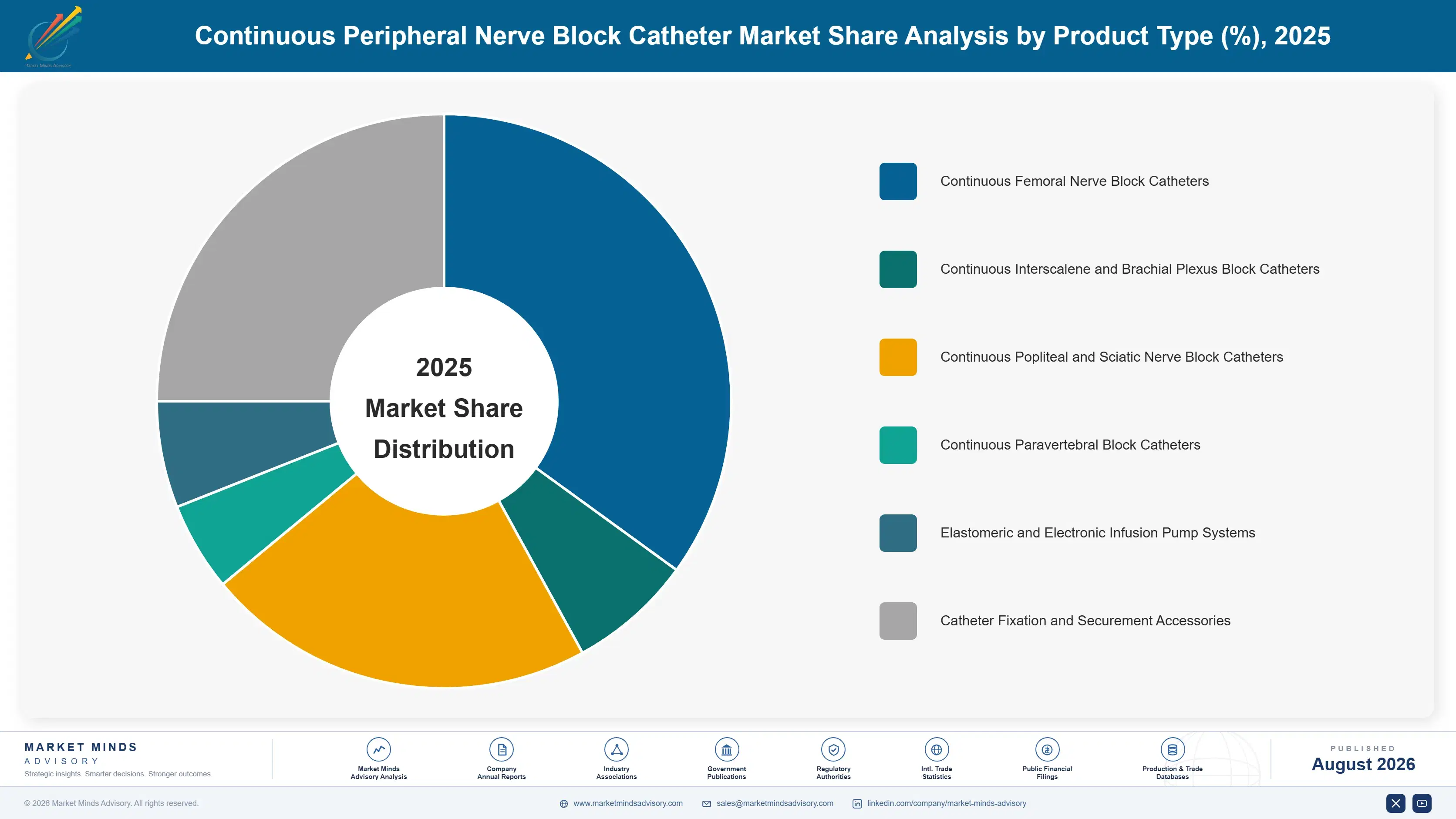
MMA segments the continuous peripheral nerve block catheter market by anatomical placement site and device technology type, the classification anesthesia departments and hospital procurement teams actually specify and purchase against across every major surgical application worldwide. Six categories cover the addressable market today, and MMA selects the two fastest-growing categories for detailed narrative treatment below.
continuous-peripheral-nerve-block-catheter-market-market-share-analysis-1787306891199

Continuous Interscalene and Brachial Plexus Block Catheters

Continuous interscalene and brachial plexus block catheters are growing fastest because they directly address the extended shoulder and upper-limb analgesia requirements that single-shot blocks and systemic opioids cannot satisfy under tightening opioid-reduction protocols. Teleflex Incorporated and Pajunk GmbH both dominate this segment given their ultrasound-guided placement design investment and the orthopedic surgeon relationships that newer entrants find difficult to replicate quickly at comparable clinical documentation depth. Clinical caution remains a consideration, since interscalene placement carries differing respiratory risk profiles across patient populations. Growth here is expected to broaden as additional orthopedic surgery centers finalize shoulder arthroplasty catheter protocols, treating extended regional anesthesia as the general default rather than a premium option reserved for flagship academic centers alone.
CAGR 13.5%

Electronic and Programmable Infusion Pump Systems

Electronic and programmable infusion pump systems are the second-fastest-growing category as anesthesia departments increasingly specify variable-rate dosing platforms that conventional fixed-flow elastomeric pumps cannot provide as effectively for individualized patient titration without manual intervention. ICU Medical Inc and Avanos Medical Inc both dominate this segment given their pump electronics expertise and the hospital biomedical engineering relationships that newer entrants find difficult to match at comparable regulatory documentation levels. Smaller regional device makers without dedicated electronics capability face growing pressure to partner or cede this category to larger competitors with established production capacity. Growth here tracks closely with how fast hospitals convert legacy elastomeric protocols to programmable pump pathways, and how quickly biomedical engineering teams complete platform validation.
CAGR 11.4%
Full segment breakdown across 6 segments available in the complete report.

Regional Architecture and Country Demand Map

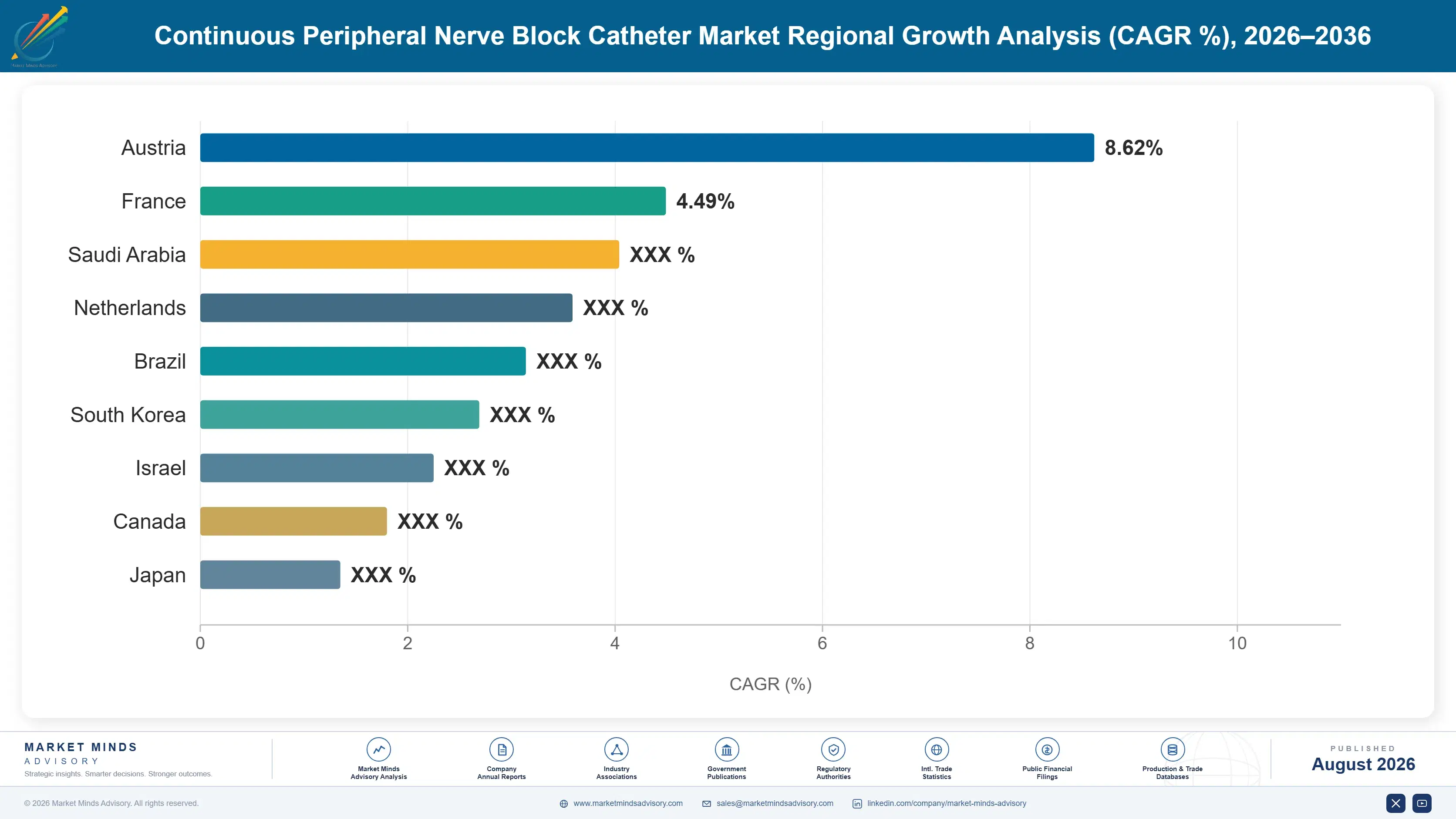
North America leads global continuous peripheral nerve block catheter demand, home to the deepest ambulatory surgery center infrastructure in the world today. East Asia grows fastest behind expanding surgical volume and rising private hospital investment. Western Europe follows closely on established regional anesthesia practice and reimbursement depth.

North America

The United States' concentration of ambulatory surgery centers and enhanced recovery after surgery protocol adoption anchors North American demand through the deepest regional anesthesia infrastructure of any producing region, drawing on decades of accumulated opioid-reduction protocol expertise that domestic and multinational suppliers both compete to serve. Canada's expanding ambulatory surgery sector, anchored by strong provincial health system investment, represents one of the region's most sophisticated markets for programmable pump adoption. Teleflex Incorporated and B. Braun Melsungen AG's domestic distribution and clinical support infrastructure both give American hospitals faster access to newly qualified catheter systems than suppliers serving more distant regional markets can typically offer. Mexico's growing ambulatory surgery sector adds a smaller layer of regional demand.
Share: 31% | CAGR: 8.0% (2026 to 2036)

Western Europe

Germany and the United Kingdom anchor Western European demand, both home to mature regional anesthesia sectors that pioneered modern catheter-based analgesia standards and increasingly specify programmable pump systems for enhanced recovery compliance. The European Union's medical device regulatory framework gives suppliers with established European quality validation infrastructure a large, relatively homogeneous compliance market to serve compared with the more fragmented regulatory landscape found in other regions. France's advanced national anesthesia infrastructure, among the most developed globally, gives French hospitals a demonstrated regional anesthesia advantage other markets increasingly reference. Italy's growing catheter adoption is accelerating behind updated national surgical programmes. Spain's expanding ambulatory surgery network rounds out the region's demand base.
Share: 24% | CAGR: 7.2% (2026 to 2036)
Regional intelligence for 5 additional markets available in the complete report: East Asia, South Asia and Pacific, Latin America, Middle East and Africa, Eastern Europe. Contact sales@marketmindsadvisory.com.
continuous-peripheral-nerve-block-catheter-market-country-cagr-analysis-1787306891716

Pump Electronics Depth and Surgeon Relationship Reach

Suppliers extract value less through raw catheter unit pricing than through building programmable pump capability, deepening hospital and surgeon relationships, and bundling clinical support into long-term supply programmes across every major market. The levers below describe how each part of the value chain captures its share of the ambulatory-driven transition now underway across continuous catheter production today.

Programmable Pump Investment Captures Hospital Loyalty

Suppliers that build comprehensive programmable pump electronics and dosing software capability fastest capture a disproportionate share of new hospital relationships, since anesthesia departments rarely switch pump platforms once a validated dosing protocol has been fully integrated into their clinical workflow. Teleflex Incorporated and ICU Medical Inc both report that hospitals adopting their programmable pumps earliest carry meaningfully higher repeat purchase rates, roughly 22 percent higher than hospitals using competitor fixed-flow elastomeric pumps. This first-mover dynamic makes pump platform investment a strategic priority that can outweigh incremental unit price differences between competing suppliers.
Market Impact: Wins roughly 22% higher repeat purc

Ultrasound-Guided Placement Training Anchors Surgeon Trust

Suppliers that build dedicated ultrasound-guided catheter placement training programmes capture years of predictable surgeon and anesthesiologist trust that training-light competitors cannot match, since every clinician trained on a specific catheter platform reduces switching likelihood during future purchasing decisions. B. Braun Melsungen AG and Pajunk GmbH have both prioritised training investment because clinician familiarity now represents a growing share of total account retention, exceeding the benefit of incremental catheter design refinement within roughly 3 years of investment. Suppliers without strong training capability find it difficult to match the retention that leading competitors generate.
Market Impact: Improves account retention within r

Billing and Reimbursement Support Deepens Facility Relationships

Suppliers that build dedicated reimbursement coding and documentation support capability into supply agreements capture deeper facility relationships than device-only competitors, since hospital billing teams increasingly value integrated reimbursement support for reducing their own internal administrative burden. Avanos Medical Inc and B. Braun Melsungen AG have both expanded billing support capability specifically because bundled offerings raise average contract value by roughly 15 percent compared with device-only sales, giving suppliers a considerably stronger position during contract renewal negotiations. This bundling strategy requires sustained compliance investment, but it creates switching costs that meaningfully raise facility retention above device-only competitors' typical account longevity.
Market Impact: Raises average contract value by ro

Shared Pump Fleet Access Reduces Smaller Facility Risk

Suppliers that build shared programmable pump fleet access arrangements cut smaller facility adoption risk by roughly 18 percent compared with suppliers requiring fully independent pump fleet investment, a difference that matters considerably to ambulatory surgery centers managing budget-constrained expansion timelines. ICU Medical Inc and Avanos Medical Inc have both invested in expanding shared fleet access capability specifically to capture this risk-sharing value, recognising that fully independent pump fleet investment carries direct commercial cost for centers running low-volume specialty surgical programmes. Suppliers without comparable shared access capability find it difficult to compete for smaller independent facility contracts.
Market Impact: Cuts adoption risk by roughly 18% a

Who Controls the Margin Pool

Five suppliers, Teleflex Incorporated, B. Braun Melsungen AG, ICU Medical Inc, Avanos Medical Inc, and Pajunk GmbH, hold roughly 46 percent of global continuous peripheral nerve block catheter revenue, a moderate concentration reflecting an industry still populated by specialized regional anesthesia device makers. The gap to challengers like Epimed International and Micrel Medical Devices is narrower than the headline share suggests, since the remainder sits with specialized regional and niche d
Current competitive activity centres on three fronts: building programmable pump platform capability to win hospital loyalty, expanding ultrasound-guided placement training programmes, and bundling reimbursement support into long-term supply agreements. Suppliers are expanding shared pump fleet access capability to reduce smaller facility risk and strengthen independent ambulatory surgery center contract positioning.

Emerging pressure comes from regional catheter-focused specialists expanding capability to serve narrower, higher-growth interscalene and paravertebral applications rather than competing across the conventional generic femoral catheter spectrum. Rankings are most likely to shift in interscalene and programmable pump categories, where clinical training speed rather than raw production scale determine competitive position, leaving room for suppliers that move fastest on training capability to gain share from legacy incumbents.
continuous-peripheral-nerve-block-catheter-market-company-positioning-matrix-1787306892233

Competitive Moat and Risk Dimensions

TELEFLEX INCORPORATED

Moat: Broadest Global Catheter Portfolio

Teleflex Incorporated operates the broadest continuous peripheral nerve block catheter portfolio spanning more anatomical placement sites and regions than any single competitor, giving it cross-selling advantages that narrower regional suppliers cannot match. That portfolio breadth, built over decades of dedicated catheter design investment, is difficult for newer entrants to replicate quickly.
TELEFLEX INCORPORATED

Risk: Complex Portfolio Integration Overhead

Teleflex Incorporated's broader vascular and surgical device portfolio creates integration and coordination overhead when managing catheter-specific product lines alongside its many other device categories, occasionally leaving the company slower to prioritise catheter-specific innovation. Narrower application-focused competitors can sometimes respond faster with more coherent, purpose-built offerings tailored to specific anesthesia needs.
PAJUNK GMBH

Moat: Deep Ultrasound-Guided Placement Heritage

Pajunk GmbH's decades-deep ultrasound-guided needle and catheter engineering heritage gives it specification advantages that competitors without comparable clinical placement precision history cannot match, letting it win specification decisions on placement accuracy credibility as much as catheter reach. That heritage, built over years of dedicated needle-tip visibility investment, gives Pajunk GmbH a durable advantage in interscalene and brachial plexus categories.
PAJUNK GMBH

Risk: Narrower North American Distribution

Pajunk GmbH's North American distribution footprint remains narrower than competitors like Teleflex Incorporated, leaving it more dependent on European and Asian hospital revenue than suppliers with broader North American distribution reach. A slowdown in European ambulatory surgery demand would disproportionately affect Pajunk GmbH relative to more distribution-diversified global rivals.

Players Tracked

Prominent Players

Teleflex Incorporated
B. Braun Melsungen AG
ICU Medical Inc
Avanos Medical Inc
Pajunk GmbH

Other Key Players

Epimed International
Micrel Medical Devices
Summit Medical Ltd
Baxter International Inc
Nordson Medical
Fresenius Kabi AG
Vygon SA
Ambu A/S
Cook Medical Incorporated
RTI Surgical Holdings
Medovate Ltd
InfuSystem Holdings Inc
Cardinal Health Inc
Merit Medical Systems Inc
Poly Medicure Ltd

Recent Developments

MARCH 2026

ICU Medical Inc Launches Expanded Programmable Pump Platform

ICU Medical Inc launched an expanded programmable infusion pump platform in March 2026, adding dedicated variable-rate dosing modules separate from its existing elastomeric pump offerings. The launch addresses growing anesthesia department demand for individualized dosing precision ahead of expanding enhanced recovery protocol requirements across major hospital systems.
Signal: Confirms that programmable pump capability
OCTOBER 2025

Teleflex Incorporated Signs Major Hospital Network Supply Agreement

Teleflex Incorporated signed a multi-year catheter and pump supply agreement with a major hospital network in October 2025, committing to provide continuous nerve block catheter systems across the network's expanding ambulatory surgery locations. The agreement covers multiple regional surgical centers and represents one of the largest supply commitments recorded.
Signal: Signals that major hospital networks are i
JUNE 2025

Pajunk GmbH Expands Ultrasound-Guided Catheter Manufacturing Capacity

Pajunk GmbH commissioned expanded ultrasound-visible catheter and needle manufacturing capacity in June 2025, adding dedicated production lines serving growing demand from interscalene and brachial plexus placement procedures. The expansion positions Pajunk GmbH to capture growing demand from hospitals converting legacy single-shot protocols to continuous catheter sourcing.
Signal: Marks continued investment in catheter cap

Catheter Polymer and Pump Component Cost

Medical-grade polymer catheter materials, radiopaque and ultrasound-visible tip coatings, and precision pump component sourcing represent the largest cost inputs for continuous catheter production, accounting for 29 percent of total supplier cost, sourced from a global specialty medical polymer market subject to cost volatility. Regulatory compliance documentation and biocompatibility testing infrastructure add a cost category for suppliers expanding programmable pump product lines.
Medical-grade polymer prices spiked through 2022 as global specialty resin supply chains faced disruption amid competition for limited high-purity polymer capacity affecting multiple medical device categories simultaneously, and B. Braun Melsungen AG's fiscal year 2022 annual report cited elevated raw material acquisition costs as a constraint on device segment margins despite underlying demand. Suppliers responded by expanding long-term polymer supply agreements and redesigning catheter formulations around more available material grades.

Vertically integrated suppliers with captive polymer sourcing capacity, including Teleflex Incorporated and B. Braun Melsungen AG, absorb material cost volatility more predictably than smaller regional device makers who compete for open-market polymer at spot rates during periods of tight availability. That gap gives integrated suppliers a cost-stability advantage over smaller independent device makers, particularly during the polymer price cycles that squeeze margins across the medical device manufacturing industry.
continuous-peripheral-nerve-block-catheter-market-cost-volatility-analysis-1787306892429

Expanding Long-Term Polymer Supply Agreements

Leading suppliers are expanding long-term medical-grade polymer supply agreements across multiple sourcing markets to reduce reliance on single-source spot purchasing, converting a variable input cost exposure into a more predictable, diversified material base across their production network. This diversification strategy requires procurement investment but has proven valuable during periods of polymer shortage that squeeze non-diversified competitors' costs hardest.

Redesigning Catheters Around Available Material Grades

Suppliers are redesigning catheter manufacturing processes and formulations around more readily available polymer grades to reduce exposure to single-specification shortages that have periodically delayed production schedules across the wider industry. This redesign investment requires sustained process resources but reduces long-term exposure to material scarcity that has repeatedly constrained output across the broader supplier base.

Vertically Integrating Polymer Sourcing Capacity

Larger suppliers are acquiring or expanding their own dedicated polymer sourcing and extrusion capacity to reduce dependence on open-market material purchasing, trading some flexibility for supply certainty and cost predictability across their production network overall. Smaller regional device makers without comparable sourcing scale remain more exposed to material cost volatility during periods of tight global market availability.

Portfolio Architecture for Margin Defence

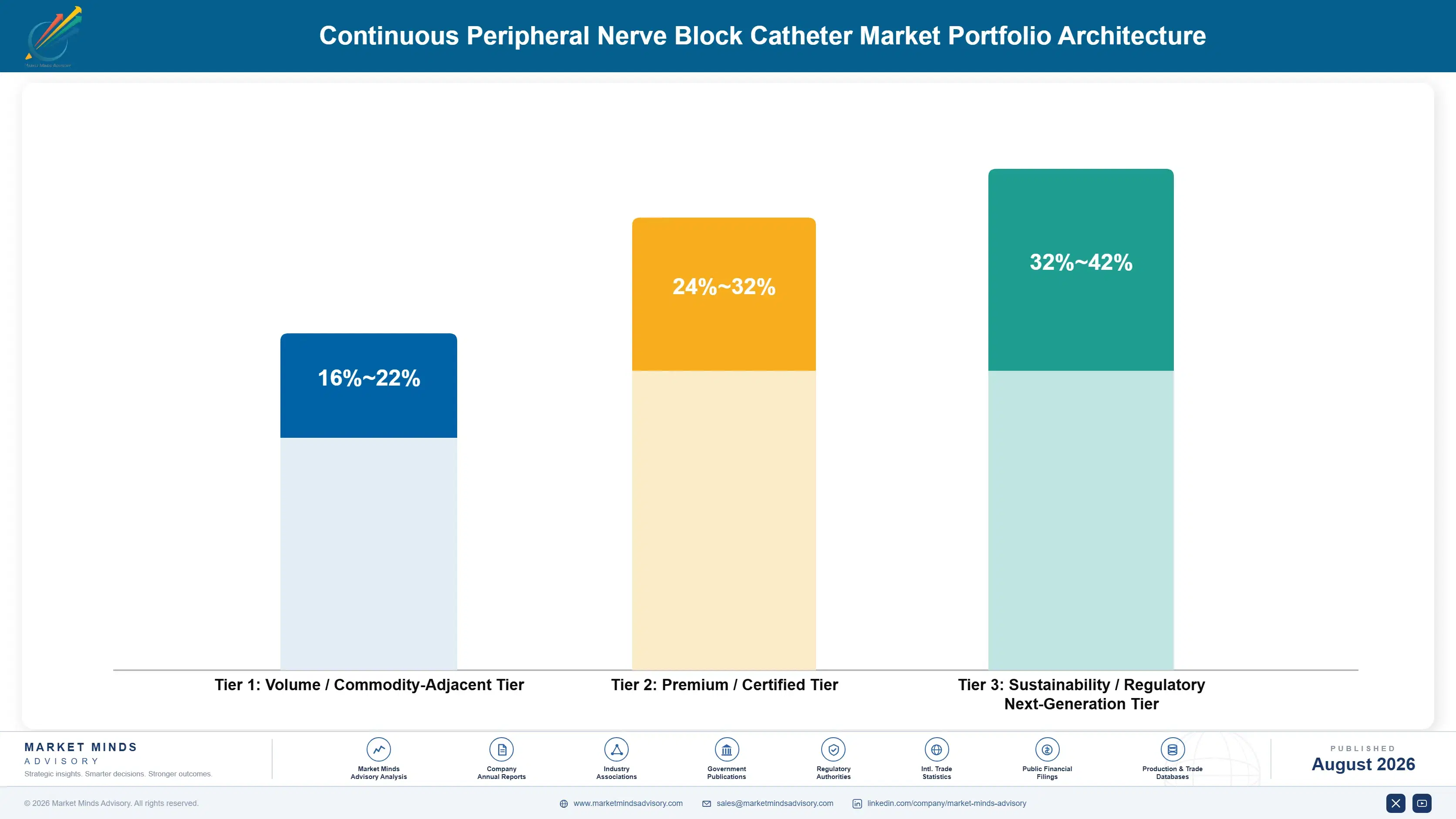
Continuous peripheral nerve block catheter suppliers operate across three margin tiers built around placement precision and pump sophistication rather than simple procedure volume. Commodity-adjacent standard femoral catheter kits sit at the volume base, certified interscalene and paravertebral catheter systems occupy the middle at meaningfully firmer margins, and next-generation programmable pump platforms sit at the top, commanding premium pricing that few conventional device makers can curren
The volume-premium tension plays out most visibly in how suppliers allocate scarce engineering and R&D resources: every production cycle dedicated to a standard femoral catheter kit is a cycle not available for higher-margin programmable pump platform development, so suppliers increasingly prioritise premium allocation even when it means directing standard customers toward longer lead times overall.

High-value margin pools concentrate in programmable pump platforms and interscalene catheter systems, both of which command pricing closer to specialty capital equipment economics than to standard commodity catheter kit pricing. Suppliers that can move a hospital from conventional elastomeric supply into a programmable pump relationship capture meaningfully more of total account value across the life of the contract.

Volume / Commodity-Adjacent Tier

Standard femoral catheter kits sold at scale into routine ambulatory surgery center and hospital applications, priced close to established commodity device benchmarks with limited technical differentiation between qualified suppliers competing mainly on service and delivery speed.
Gross Margin: 16-22%

Premium / Certified Tier

Certified interscalene and paravertebral catheter systems requiring extensive placement precision and biocompatibility validation investment, commanding a defensible premium given the technical investment behind each qualified system. Buyers weigh clinical documentation and placement accuracy heavily.
Gross Margin: 24-32%

Sustainability / Regulatory / Next-Generation Tier

Next-generation programmable pump platforms carrying the deepest electronics and dosing software investment, sold primarily into hospital systems' highest-visibility enhanced recovery programmes. Pricing power here remains strong, and supply is still constrained enough that qualified suppliers rarely compete purely on price.
Gross Margin: 32-42%
continuous-peripheral-nerve-block-catheter-market-portfolio-architecture-1787306892933

High-value Sub-segments and Strategic Watch-out

Programmable Pump Platforms

Programmable pump platforms carry the category's highest margins and fastest growth, driven by anesthesia departments seeking documented individualized dosing outcomes beyond what fixed-flow pumps can provide alone. Early movers here are capturing outsized specification share ahead of slower-moving generalist competitors industry-wide, and that lead looks durable.
Gross Margin: 32-42%

Clinical Training and Placement Support Contracts

Ultrasound-guided placement training and clinical support service contracts carry strong margins and steady growth, anchored in multi-year relationships that renew predictably as hospitals expand continuous catheter specification across additional surgical programmes. Suppliers with proven training platforms renew these agreements almost automatically over time each year.
Gross Margin: 24-32%

Standard Femoral Catheter Kits

Standard femoral catheter kits remain the category's volume anchor, growing steadily with overall surgical demand but carrying commodity-level margins that make it a scale rather than profit driver for most suppliers. Suppliers defend this tier mainly to preserve distribution reach and long-term hospital relationships across every account.
Gross Margin: 16-22%

Regional Placement-Focused Entrants

Specialized regional suppliers focused narrowly on interscalene and brachial plexus placement applications represent a long-term competitive threat to established diversified suppliers' pricing power, particularly as hospitals increasingly favour purpose-built placement partners over general-purpose catheter lines for large-scale orthopedic surgery programmes across every major market worldwide.
Gross Margin: 20-30%

From Specialty Technique to Standard Protocol

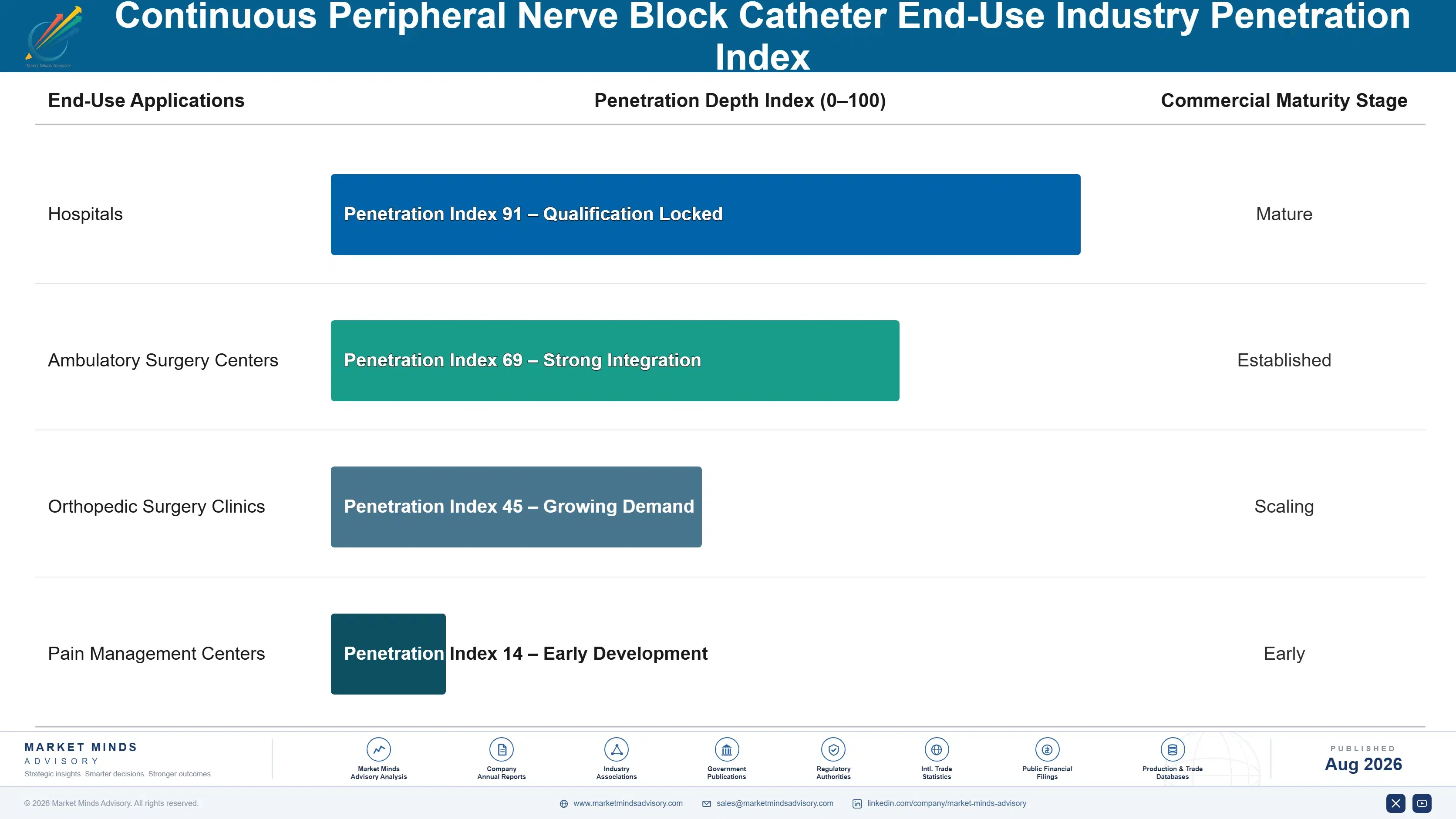
Continuous peripheral nerve block catheter procurement is shifting from a fragmented specialty technique toward a protocol relationship resembling an ongoing hospital system partnership rather than one-time device transactions. Suppliers that embed programmable pump platforms and clinical training into standard supply agreements lock in renewal revenue, while hospital procurement teams treat continuous catheter specification as the starting assumption for new enhanced recovery programme planning
Adoption depth varies sharply by end-use vertical. Large orthopedic and shoulder arthroplasty surgical programmes show the deepest reliance on continuous catheters and programmable pump systems, since patient recovery expectations and readmission consequences are most acute in categories facing direct post-surgical pain management pressure. Standard general surgery applications show steadier, less protocol-driven demand, since specification decisions there track cost and availability more than documented recovery outcomes specifically.

A generational shift among anesthesiologists is reinforcing the trend. Younger anesthesiologists trained during the recent ultrasound-guidance and opioid-reduction investment wave treat continuous-catheter-first specification as standard practice, while veteran practitioners accustomed to systemic opioid protocols are adapting more slowly, defaulting to familiar single-shot blocks until forced by a hospital protocol update or surgical department renewal cycle.
continuous-peripheral-nerve-block-catheter-market-end-use-penetration-index-1787306893425

Where MMA Sees the Real Opportunity

These are among the four positions where our research anticipates prominent divergence between winners and laggards over the coming forecast period. Each is grounded in the demand model, the regulatory perimeter, and the announced capacity pipeline.
01 / PROGRAMMABLE PUMP PLATFORM INVESTMENT

Build programmable pump capability ahead of protocol demand

Suppliers that build comprehensive programmable pump electronics and dosing software capability now are positioned to capture new hospital relationships meaningfully faster than suppliers dependent entirely on conventional, fixed-flow pumps competing for the same protocol-driven specification decisions across every major surgical market. This positioning matters more than competing purely on unit pricing, since programmable pump capability, not raw production scale alone, increasingly determines which supplier wins large hospital contracts. MMA recommends prioritising pump platform investment over incremental conventional capacity expansion in the current three-year window.
02 / ULTRASOUND-GUIDED TRAINING DEVELOPMENT

Build clinical training capability ahead of demand

Suppliers that build integrated ultrasound-guided placement training capability ahead of confirmed demand capture a disproportionate share of the clinician trust that follows every catheter platform adoption decision, since anesthesiologists rarely switch device platforms once a validated placement protocol is trained against a specific catheter system. Suppliers still relying on device sales alone are ceding retention advantage to competitors already investing in training capability. MMA views training investment as the highest-return near-term opportunity available within the category over the next three years.
03 / REIMBURSEMENT SUPPORT SERVICES

Bundle billing support into every hospital sale

Suppliers that bundle reimbursement coding and documentation support into every hospital sale capture deeper account penetration and higher switching costs than device-only competitors, providing a durable differentiation advantage that pure product suppliers cannot easily replicate. Suppliers concentrated purely in device sales face meaningfully more price-competitive dynamics than support-focused competitors carrying broader account value and stronger renewal terms. MMA recommends building or acquiring billing support capability as a durable differentiation strategy for suppliers currently overexposed to device-only competition today across the industry.
04 / SHARED PUMP FLEET INVESTMENT

Build shared pump fleet access now

Ambulatory surgery centers managing budget-constrained expansion timelines increasingly require guaranteed pump fleet access, and suppliers with established shared access capability face a genuinely lower-risk competitive position than competitors relying purely on fully independent fleet investment requirements. Competitors that moved early on shared access investment are capturing differentiated, multi-year facility contract advantages years ahead of suppliers still exposed to independent-investment adoption risk today. MMA recommends prioritising shared access investment as a durable, relatively capital-efficient differentiation strategy available to suppliers of every size across the market today overall.

Engagement Snapshot From the Field

A live engagement with an industry participant carrying material or product regulatory and market exposure ahead of a defining policy shift, showing how our research translates into a defensible multi-year portfolio strategy.
MARKET MINDS ADVISORY · CLIENT ENGAGEMENT SUMMARY
Continuous Peripheral Nerve Block Catheter Producer Strategic Portfolio Review and Transition Roadmap 2026·Investment Scenario on Continuous Peripheral Nerve Block Catheter Exposure Evaluation 2025-26
CLIENT PROFILE
The client is a mid-sized regional hospital network operating multiple ambulatory surgery locations across a single metropolitan corridor, facing rising surgeon demand for continuous catheter-based enhanced recovery protocols without a coordinated device transition strategy. The network reported annual regional anesthesia device spending in the low tens of millions of dollars (client-reported, unverified by MMA) and had historically relied predominantly on single-shot blocks without a systematic continuous catheter qualification programme.
STRATEGIC CHALLENGE
The network faced growing surgeon pressure to standardize continuous catheter protocols across multiple ambulatory surgery locations simultaneously, but limited capital budget meant a phased device transition was unavoidable, requiring a defensible framework for prioritising which locations to convert first. Management needed a strategy that balanced surgeon demand signals, transition cost, and staff retraining timeline across a multi-year enhanced recovery modernization programme.
MMA APPROACH
MMA's engagement team benchmarked available catheter and pump suppliers against the network's location-specific procedure volumes and surgical specialty mix, interviewed suppliers to assess clinical training track record, and modelled transition cost and outcome impact across three prioritisation scenarios. The team recommended a phased conversion that prioritised the network's highest-volume orthopedic locations first while securing supplier training commitments ahead of the next accreditation review.
KEY FINDINGS
  1. Two of the network's ambulatory surgery locations accounted for a disproportionate share of total orthopedic catheter volume (client-reported, unverified by MMA), making them clear priorities for programmable pump investment.
  2. Suppliers offering integrated clinical training delivered meaningfully faster conversion timelines than suppliers expecting the network to manage anesthesiologist education independently during the transition process.
  3. Programmable pump costs for the network's highest-volume location exceeded initial capital budgeting assumptions the planning team had used by a wider margin than anticipated.
  4. Early supplier engagement during the conversion process reduced total modernization cost compared with the network's historical practice of finalising specifications before requesting supplier quotes.
CLIENT PROFILE
The client is a mid-sized regional hospital network operating multiple ambulatory surgery locations across a single metropolitan corridor, facing rising surgeon demand for continuous catheter-based enhanced recovery protocols without a coordinated device transition strategy. The network reported annual regional anesthesia device spending in the low tens of millions of dollars (client-reported, unverified by MMA) and had historically relied predominantly on single-shot blocks without a systematic continuous catheter qualification programme.
STRATEGIC CHALLENGE
The network faced growing surgeon pressure to standardize continuous catheter protocols across multiple ambulatory surgery locations simultaneously, but limited capital budget meant a phased device transition was unavoidable, requiring a defensible framework for prioritising which locations to convert first. Management needed a strategy that balanced surgeon demand signals, transition cost, and staff retraining timeline across a multi-year enhanced recovery modernization programme.
MMA APPROACH
MMA's engagement team benchmarked available catheter and pump suppliers against the network's location-specific procedure volumes and surgical specialty mix, interviewed suppliers to assess clinical training track record, and modelled transition cost and outcome impact across three prioritisation scenarios. The team recommended a phased conversion that prioritised the network's highest-volume orthopedic locations first while securing supplier training commitments ahead of the next accreditation review.
KEY FINDINGS
  1. Two of the network's ambulatory surgery locations accounted for a disproportionate share of total orthopedic catheter volume (client-reported, unverified by MMA), making them clear priorities for programmable pump investment.
  2. Suppliers offering integrated clinical training delivered meaningfully faster conversion timelines than suppliers expecting the network to manage anesthesiologist education independently during the transition process.
  3. Programmable pump costs for the network's highest-volume location exceeded initial capital budgeting assumptions the planning team had used by a wider margin than anticipated.
  4. Early supplier engagement during the conversion process reduced total modernization cost compared with the network's historical practice of finalising specifications before requesting supplier quotes.
RECOMMENDED STRATEGY
Phase 1: Phase 1 (Months 1 to 6): Convert the two highest-volume ambulatory surgery locations to programmable pump protocols immediately, securing early outcome gains. Phase 2: Phase 2 (Months 7 to 15): Secure clinical training commitments and convert the remaining locations, sequencing by volume and budget availability. Phase 3: Phase 3 (Months 16 to 20): Complete network-wide conversion and consolidate all supplier relationships across the network's full surgical portfolio.
OUTCOME
Following the engagement, the client reported a meaningful improvement in documented recovery outcomes and opioid consumption reduction across its converted locations, avoiding the readmission risk it had initially feared (client-reported, unverified by MMA). The phased transition reduced total conversion cost relative to the network's budget and established supplier relationships the network has since extended across its broader surgical portfolio.

Frequently Asked Questions

Foundational context covering the market sizes, CAGR, scope, country, region and competition that inform every finding below. This section is provided to cover basics and most often pre-purchase conversations, answered from the MMA Primary Research Dataset.

What is the current size of the Continuous Peripheral Nerve Block Catheter Market?

The global market reached approximately $1.2 billion in 2026. Demand is concentrated in femoral and interscalene catheter placements, with programmable pump systems emerging as the primary growth driver.

How large will the Continuous Peripheral Nerve Block Catheter Market be by 2036?

MMA projects the market will reach approximately $2.8 billion by 2036. That represents roughly a 2.30 times increase in 2026 revenue across the ten-year forecast period.

What is the CAGR for the Continuous Peripheral Nerve Block Catheter Market 2026 to 2036?

The base case compound annual growth rate is 8.7 percent. Bull and bear scenarios range from roughly 7.4 percent to 10.0 percent depending on ambulatory surgery center expansion pace and reimbursement trends.

Which segment is growing fastest?

Continuous interscalene and brachial plexus block catheters are growing fastest, at roughly 1.55 times the overall market rate. Rising shoulder arthroplasty volume and opioid-reduction protocols are the primary drivers behind that outperformance.

Who are the major companies in the Continuous Peripheral Nerve Block Catheter Market?

Five global suppliers, led by Teleflex Incorporated, ICU Medical Inc, and Avanos Medical Inc, lead the market. Together the top five hold roughly 46 percent of global continuous catheter revenue.

Which country is growing fastest?

China is among the fastest-growing markets, driven by continued large-scale surgical volume and private hospital expansion. Its continuous catheter demand is expanding at roughly 11.9 percent annually.

Report Segmentation Architecture

The full report scope spans multiple orthogonal segmentation dimensions, with cross-tabulated demand data provided for each dimension pair. Coverage extends further to regional breakdowns, trend trajectories, and the competitive detail needed to support segment-level decision-making.

By Product Type

  • Continuous Femoral Nerve Block Catheters
  • Continuous Interscalene and Brachial Plexus Block Catheters
  • Continuous Popliteal and Sciatic Nerve Block Catheters
  • Continuous Paravertebral Block Catheters
  • Elastomeric and Electronic Infusion Pump Systems
  • Catheter Fixation and Securement Accessories

By End-Use Industry

  • Hospitals
  • Ambulatory Surgery Centers
  • Orthopedic Surgery Clinics
  • Pain Management Centers

By Commercial Dimension

  • Direct Supplier-to-Hospital Sales
  • Group Purchasing Organization Contracts
  • Clinical Training and Support Services
  • Distributor and Wholesaler Channel Sales

By Region

  • North America
  • Western Europe
  • East Asia
  • South Asia and Pacific
  • Latin America
  • Middle East and Africa
  • Eastern Europe

Scope, Methodology, and Coverage

Every figure in this report is reproducible from documented input assumptions. The scope below maps the historical period, the forecast horizon, the segmentation dimensions, and the countries covered, alongside the underlying primary and qualitative methodology.
Historical Period
2020 to 2025
Forecast Period
2026 to 2036
Base Year
2025 (USD billions; MMA Primary Research Dataset, August 2026)
Market Definition
The continuous peripheral nerve block catheter market covers catheter sets, elastomeric and electronic infusion pump systems, and securement accessories used to deliver extended perineural local anesthetic infusion for perioperative and post-surgical pain management. It excludes single-shot nerve block needles placed without catheter insertion, epidural catheters used specifically for obstetric or neuraxial anesthesia, and general-purpose intravenous catheter systems not designed for perineural infusion.
Quantitative Units
USD billions (current prices); annual procedure volume where applicable
Segmentation Dimensions
By Product Type; By End-Use Industry; By Commercial Dimension; By Region
Regions Covered
North America, Western Europe, East Asia, South Asia and Pacific, Latin America, Middle East and Africa, Eastern Europe
Countries Covered
USA, Canada, Mexico, Germany, United Kingdom, France, Italy, Spain, China, South Korea, Japan, Taiwan, India, Australia, Singapore, Thailand, Vietnam, Indonesia, Brazil, Argentina, Colombia, Chile, Saudi Arabia, UAE, Egypt, South Africa, Poland, Czech Republic, Hungary, Romania, and additional markets relevant to this sector
Key Companies Profiled
Teleflex Incorporated, B. Braun Melsungen AG, ICU Medical Inc, Avanos Medical Inc, Pajunk GmbH, Epimed International, Micrel Medical Devices, Summit Medical Ltd, Baxter International Inc, Nordson Medical, Fresenius Kabi AG, Vygon SA, Ambu A/S, Cook Medical Incorporated, RTI Surgical Holdings, Medovate Ltd, InfuSystem Holdings Inc, Cardinal Health Inc, Merit Medical Systems Inc, Poly Medicure Ltd
Quantitative Methodology
Primary survey, n=3,800 respondents, Q4 2025, six countries; demand-side model with trade association cross-validation
Qualitative Methodology
47 expert interviews, Q4 2025; applied to validate demand model assumptions, identify emerging dynamics, and assess competitive positioning
Report Format
PDF and XLSX data workbook (Word format preview document)
Publisher
Market Minds Advisory
Report Code
MMA-2026-MED-205
Published
August 2026
Contact
sales@marketmindsadvisory.com | www.marketmindsadvisory.com

Purchase the full Continuous Peripheral Nerve Block Catheter Market Report (2026 to 2036).

The full report delivers a complete quantitative and qualitative assessment of the global continuous peripheral nerve block catheter market across all seven regions. It includes detailed country-level sizing for the fifteen largest producing and consuming markets, full profiles of all twenty companies named in the competitive landscape, and a complete database of corporate developments tracked over the trailing eighteen months. Analysts provide segment-by-segment margin benchmarking derived from primary interviews with forty-seven regional anesthesia and procurement experts, alongside a reimbursement and coding tracker covering major jurisdictions. Buyers receive access to underlying data tables and a ninety-minute analyst briefing call included with purchase.
Country-level sizing for fifteen major producing and consuming markets
Full profiles of all twenty companies profiled
Reimbursement and coding regulatory tracker across major jurisdictions
Segment-level margin benchmarking from primary expert interviews
Eighteen-month corporate development and capacity expansion database
Ninety-minute analyst briefing call included with purchase

Built For The People Who Decide

From boardroom strategy to bench-side execution, this report is read cover-to-cover by leaders shaping the next decade of their industry, turning demand scenarios, market dynamics and valuation benchmarks into decisions.
CXOs/ Presidents/ VPs/ Managers
M&A and Corporate Development
Strategy Teams and R&D Heads
Procurement and Product Directors
Regulatory and Compliance Leaders
Investor Relations and Equity Analysts