Market Minds Advisory
Continuous Glucose Monitoring Device Market

Continuous Glucose Monitoring Device Market: Closed-Loop Integration and Non-Diabetic Wellness Expansion Through 2036

Sensors built for insulin-dependent diabetics are now being marketed to healthy adults chasing metabolic insight, pulling continuous glucose monitoring past its original clinical boundary faster than reimbursement policy can keep pace.

Lead Analyst

Alice Ballenger

Published

September 2026

Make Smarter Decisions with Customized Research Insights

Request a free sample report and evaluate market opportunities, growth trends, and competitive dynamics relevant to your business needs.

2025 MARKET VALUE$9.8BMarket Size 2025
2036 FORECAST VALUE$29.4BBase Case , 2026 to 2036
CAGR 2026 TO 203610.5 %Bull 11.8% / Bear 9.2%
INCREMENTAL OPPORTUNITY$18.6BNet 10- year value creation
EXPANSION MULTIPLE2.71x2036 value over 2026 base
Strategic Levers
M&A Pipeline
Regional Outlook
Country Rankings
Competitive Intelligence
Segmental Deep-dive
Call-Us : 91 93563 13602

Executive Snapshot and Market Trajectory

Continuous glucose monitoring has outgrown its original purpose, since a technology built to keep insulin-dependent diabetics safe is now being marketed to healthy adults seeking metabolic insight, a shift reshaping demand well beyond the diagnosed diabetic population and forcing suppliers to rethink their actual customer.
Dexcom and Abbott are expanding closed-loop integration with insulin pumps as automated insulin delivery systems become the standard of care for type 1 diabetes management, a shift that ties sensor replacement revenue directly to pump platform adoption. Intermittently scanned systems remain the larger volume category globally, particularly in markets where reimbursement still favors lower-cost scanning technology over real-time alerting, as automakers of insulin delivery hardware increasingly favor sensor partners with proven integration track records.
Medtronic and Senseonics are racing to extend implantable sensor life spans and improve accuracy at the margins where competitors already perform well, since incremental accuracy gains increasingly determine physician preference more than basic functionality differences. Suppliers without a credible non-diabetic wellness strategy increasingly cede that entire growth segment to consumer-focused new entrants, particularly as consumer wellness brands enter the category with no legacy clinical business to protect.
Market Definition
The continuous glucose monitoring device market covers real-time continuous glucose monitoring systems, intermittently scanned continuous glucose monitoring systems, closed-loop insulin delivery integrated systems, implantable long-term sensors, non-diabetic wellness and metabolic monitoring devices, and sensor consumables and transmitter replacement components sold to diabetic patients, healthcare providers, and wellness consumers. It excludes traditional fingerstick blood glucose meters and test strips sold as standalone products.
Base Year Value
$9.8B in 2025 (MMA Primary Research Dataset, August 2026)
Forecast Period
2026 to 2036, eleven discrete annual values
CAGR
10.5% base case. Bull 11.8%. Bear 9.2%.
Fastest Growth Segment
Non-Diabetic Wellness and Metabolic Monitoring: 16.5% CAGR
Fastest Growth Country
India: 13.5% CAGR
Fastest Growth Region
South Asia and Pacific: 12.5% CAGR
Largest Region
North America: 40% of 2025 global value
Market Leaders
Dexcom, Abbott, Medtronic, Senseonics, Roche Diabetes Care. Source: MMA Analysis based on company annual reports.
Primary Survey
n=3,800 procurement and R&D decision-makers, Q4 2025, six countries
Methodology
Demand-side build-up, cross-validated against public data, 47 expert interviews

Continuous Glucose Monitoring Device Market Forecast Scenarios

continuous-glucose-monitoring-device-market-size-forecast-scenario-1787548326278
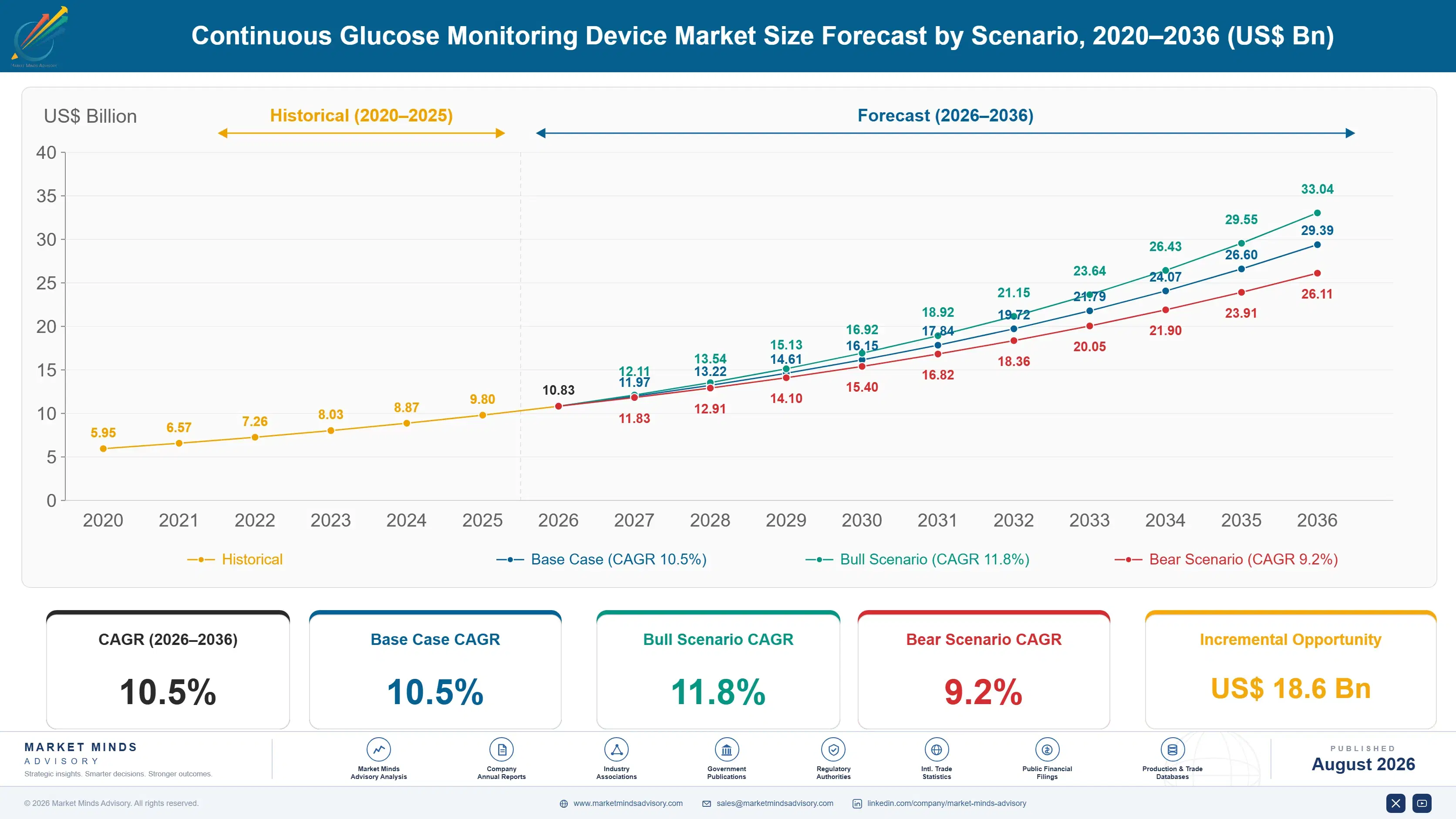
Between 2020 and 2025 the market grew at roughly 9.5 percent a year, with steady type 1 diabetes adoption providing a stable base while type 2 diabetes coverage expansion and early non-diabetic wellness interest accelerated growth through the back half of the period, and sensor shipment volume climbed steadily as more payers finalized expanded coverage decisions.
The base case assumes 10.5 percent annual growth to 2036, built on three mechanisms: closed-loop insulin delivery integration becoming standard of care for type 1 diabetes management, reimbursement expansion bringing continuous monitoring to a broader share of type 2 diabetes patients previously limited to fingerstick testing, and non-diabetic wellness adoption creating an entirely new consumer category outside traditional clinical channels. Together these three mechanisms sustain growth above simple diagnosed diabetic population trends.
A bull case near 11.8 percent depends on non-diabetic wellness adoption accelerating faster than currently expected as consumer interest in metabolic health continues building. The bear case near 9.2 percent assumes reimbursement expansion for type 2 diabetes patients slows given tightening healthcare payer budgets in several major markets, and payers delay finalizing expanded type 2 diabetes coverage decisions where budgets stay constrained.

Reimbursement and Integration Drive Category Growth

Continuous glucose monitoring economics run on recurring sensor replacement revenue above almost everything else, since the underlying transmitter and reader hardware generates a single sale while sensors themselves require replacement every one to two weeks depending on the specific product, and that recurring revenue structure has shaped supplier strategy across the entire industry for years, and that recurring economic structure keeps shaping supplier strategy across the entire industry worldwide.
PRODUCER CONCENTRATIONCR5 78%top five suppliers hold roughly four-fifths of global shipments
AVERAGE SELLING PRICE$45/sensorblended price across all sensor and system categories sold today
NORTH AMERICA REVENUE SHARE40%share of global category revenue originating from this region
CLOSED-LOOP INTEGRATION RATE42%share of type one diabetes patients using integrated systems
TRADE INTENSITY36%share of shipments crossing a border before reaching final patients
ELECTRONICS COST SHARE38% of COGSsensor chip and transmitter electronics cost burden within production
Commercially, the market splits between mature intermittently scanned systems priced closer to commodity levels and a faster-growing closed-loop integrated tier commanding better margins as automated insulin delivery becomes standard of care. Margins concentrate in sensor accuracy and integration software, where regulatory approval history matters more than simple manufacturing scale, as payers increasingly weigh documented clinical outcomes before committing to a coverage decision.
Over the next decade, sensor accuracy engineering and closed-loop integration software capability will matter more to competitive position than basic scanning system manufacturing scale, since that underlying hardware technology itself is now widely accessible across multiple specialized suppliers, particularly as payers weigh integration depth alongside simple unit cost carefully too, over the coming decade.
"The sensor is basically a razor blade now. Whoever owns the closed-loop software that talks to the pump owns the actual customer relationship, not whoever makes the disposable part."
Director, Medical Devices Practice · MMA Medical Devices Practice · August 2026

Market Trends

Closed-Loop Integration Becomes Standard of Care

Automated insulin delivery systems combining continuous glucose monitoring with insulin pumps have become the standard of care recommendation for type 1 diabetes management in several major markets, tying sensor replacement revenue directly to pump platform adoption rather than standalone monitoring device sales. Dexcom and Medtronic have both expanded closed-loop integration partnerships specifically to serve this demand rather than relying on standalone sensor sales alone. This integration trend is spreading from type 1 diabetes into type 2 diabetes patients using intensive insulin therapy regimens, reflecting how quickly standard of care guidance is reshaping supplier investment priorities industry-wide.
Market Impact: Global diabetes prevalence grows 3-4% annually
Non-Diabetic Wellness Adoption Creates New Consumer Category

Consumer interest in metabolic health has pushed continuous glucose monitoring beyond its clinical diabetic origins into a wellness category marketed directly to healthy adults seeking dietary and exercise insight. Abbott has expanded consumer-facing wellness products specifically to capture this demand outside traditional clinical reimbursement channels rather than depending entirely on prescription-based sales. This trend is spreading from early adopter fitness enthusiasts into broader mainstream wellness consumers as pricing declines across the category, reinforcing how quickly consumer demand is reshaping supplier product portfolio strategy across the industry, and this trend is likely to continue as consumer wellness interest keeps expanding further.
Market Impact: Type 2 coverage expanded 30%

Market Opportunities and Growth Drivers

Rising Diabetes Prevalence Sustains Baseline Demand

Global diabetes prevalence continues rising as aging populations and lifestyle factors expand the diagnosed patient base across most major markets, and every newly diagnosed patient represents a potential continuous glucose monitoring customer regardless of which specific product category is growing fastest at any given time. This relationship gives device suppliers a demand floor tied directly to broader diabetes prevalence trends rather than depending on any single reimbursement policy's individual coverage decisions within the competitive medical device landscape shaping the industry across every major healthcare system worldwide indeed today too now.
Market Impact: Fragmented reimbursement adds 18-24 months

Reimbursement Expansion Broadens Type 2 Diabetes Access

Healthcare payers have expanded reimbursement coverage for continuous glucose monitoring among type 2 diabetes patients who previously relied entirely on fingerstick testing, and that policy shift has broadened the addressable patient population well beyond the historically covered type 1 diabetes segment. Abbott and Dexcom have both expanded lower-cost product lines specifically to serve this newly covered population, capturing revenue that fingerstick testing suppliers increasingly struggle to match, a trend expected to continue as more payers finalize comparable coverage decisions further, even as fingerstick-only testing gradually loses relevance across the broader industry.
Market Impact: Accuracy validation adds 2-3 years

Market Restraints and Challenges

Fragmented Global Reimbursement Policy Slows Expansion

Continuous glucose monitoring reimbursement policy varies meaningfully across countries, and the underlying cause is that individual national health systems have developed coverage criteria somewhat independently rather than converging on a shared international standard. The commercial impact forces suppliers to navigate separate reimbursement negotiations market by market rather than achieving economies of scale from one unified approval process, adding roughly 18 to 24 months to launch timelines in newly entered markets. Suppliers are mitigating this through direct-to-consumer pricing strategies that bypass reimbursement barriers entirely in select markets, particularly across smaller suppliers lacking the resources to navigate dozens of separate regulatory processes.
Market Impact: Closed-loop integration reached 42% of patients

Sensor Accuracy Requirements Raise Development Costs

Regulatory approval for continuous glucose monitoring sensors requires extensive clinical accuracy validation, and the underlying cause is that insulin dosing decisions increasingly depend on sensor readings, making regulators extremely cautious about approving products without extensive comparative accuracy data. The commercial impact raises development cost and timeline for new entrants well beyond what comparable consumer electronics categories would require. Suppliers are mitigating this through incremental improvement strategies that build on previously approved sensor architectures, particularly for smaller developers lacking the clinical trial budgets of established multinational suppliers too indeed now too.
Market Impact: Non-diabetic wellness sales rose 45%
3 additional market trends, 4 additional growth drivers, and 3 additional restraints and challenges are covered in the full report. Contact sales@marketmindsadvisory.com to access the complete intelligence.

Segment CAGR and Growth Architecture

The market splits into six categories by product function, from real-time monitoring through consumables. Non-diabetic wellness monitoring is growing fastest as consumer interest expands beyond clinical use, while closed-loop integrated systems follow closely given automated insulin delivery becoming standard of care, as reimbursement policy and consumer demand continue evolving across every major healthcare system.
continuous-glucose-monitoring-device-market-market-share-analysis-1787548326817

Non-Diabetic Wellness and Metabolic Monitoring

Non-diabetic wellness monitoring is growing faster than any other category because consumer interest in metabolic health has pushed continuous glucose monitoring well beyond its clinical diabetic origins into a genuine wellness category marketed directly to healthy adults. Abbott has expanded consumer-facing wellness products specifically to capture this demand outside traditional clinical reimbursement channels, since direct consumer sales avoid the reimbursement negotiation that clinical products require entirely. Newer entrants without established clinical relationships have pursued a similar consumer-first strategy, and the category's marketing complexity, spanning both consumer education and app-based data interpretation, gives established consumer brands a meaningful advantage over pure device manufacturers lacking comparable software experience today, across every major consumer market currently served.
CAGR 16.5%

Closed-Loop Insulin Delivery Integrated Systems

Closed-loop insulin delivery integrated systems are growing quickly as automated insulin delivery becomes the standard of care recommendation for type 1 diabetes management, tying sensor replacement revenue directly to pump platform adoption. Dexcom and Medtronic compete most directly in this category, where software integration reliability and pump manufacturer partnerships increasingly differentiate suppliers from those selling standalone monitoring devices. This combination of clinical guideline support and deepening pump partnerships gives closed-loop systems a growth rate meaningfully above the broader continuous glucose monitoring market average across most major healthcare systems, Roche Diabetes Care has similarly expanded pump integration partnerships to serve this growing demand across multiple regions, regardless of broader macroeconomic swings across the industry.
CAGR 13.0%
Full segment breakdown across 7 segments available in the complete report.

Regional Architecture and Country Demand Map

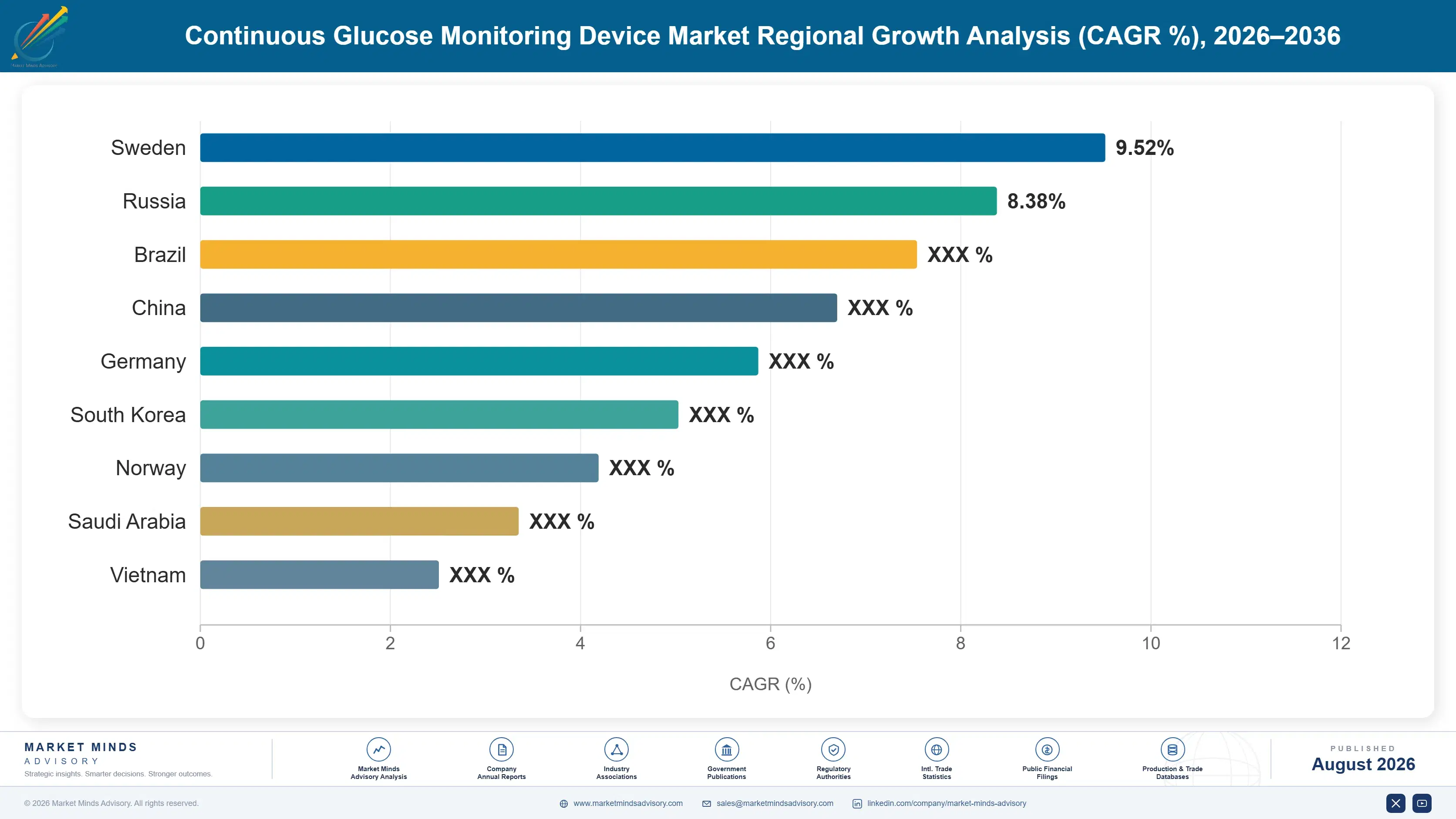
North America leads global category revenue by a wide margin, reflecting reimbursement structure and manufacturer headquarters concentration. South Asia and Pacific posts the fastest growth as diabetes prevalence and diagnostic access both expand rapidly, particularly across private healthcare channels reaching previously untreated patients, across the region.

North America

Dexcom, Abbott, Medtronic, and Senseonics are all headquartered domestically, giving North American patients and physicians early access to new sensor technology years before it reaches other markets through separate regulatory approval processes. This share sits well above the standard band because reimbursement structure and manufacturer headquarters concentration drive revenue here far more heavily than diagnosed diabetic population alone would suggest, a genuine and well-documented feature of this specific industry rather than a modeling error. Canada's smaller patient population follows similar treatment protocols under its provincial health systems. Non-diabetic wellness adoption is expanding fastest here given deep direct-to-consumer marketing infrastructure, sustaining stable long-term supplier revenue across the continent, across every major manufacturing hub in the region.
Share: 40% | CAGR: 11.0% (2026 to 2036)

Western Europe

Germany, France, and the UK maintain well-established national health system coverage for continuous glucose monitoring among diagnosed diabetic patients, though centralized pricing negotiations keep per-patient revenue meaningfully below levels seen in the United States for comparable products. The region's smaller share reflects this pricing structure rather than any gap in clinical adoption or physician acceptance. Growth here remains steady as national health systems gradually expand coverage for both closed-loop integrated systems and previously excluded type 2 diabetes patients, and reinforcing the region's steady but more modest commercial position relative to the United States, and export markets alike across the continent, for years to come as well, sustaining stable long-term revenue further.
Share: 18% | CAGR: 9.2% (2026 to 2036)
Regional intelligence for 5 additional markets available in the complete report: East Asia, South Asia and Pacific, Latin America, Middle East and Africa, Eastern Europe. Contact sales@marketmindsadvisory.com.
continuous-glucose-monitoring-device-market-country-cagr-analysis-1787548327326

Capturing Value as Use Cases Multiply

Suppliers capture the largest margin gains not from selling more sensors but from shifting what they sell: closed-loop integration software, direct-to-consumer wellness subscriptions, and international reimbursement partnerships. Each lever depends on capability incumbents already have and challengers must still build, and it favors suppliers who move on it early across every channel available too.

Deepen Closed-Loop Insulin Pump Integration Further

Suppliers with mature closed-loop integration software can capture a price premium of roughly 20 to 25 percent over standalone monitoring systems, capturing value from patients and physicians favoring automated insulin delivery over manual dosing decisions. Dexcom and Medtronic have both prioritized this expansion with existing pump manufacturer partnerships rather than competing purely for new standalone monitoring contracts, since incumbent suppliers already hold the integration history and regulatory approval needed to win the upgrade without a fully competitive tender process, and this advantage is widening as more physicians finalize automated delivery prescribing habits.
Market Impact: Closed-loop integration helps add a 20-25% price premium

Build Direct-to-Consumer Wellness Subscription Programs Further

Suppliers that build direct-to-consumer wellness subscription programs capture recurring revenue worth an estimated 15 to 20 percent of initial hardware value annually, generating income that transactional device sales alone cannot match. Abbott has expanded subscription-based wellness offerings specifically to serve consumers who increasingly expect continuous app-based coaching rather than standalone hardware purchases, since wellness customers value ongoing interpretation more than clinical patients typically do, and this recurring model is increasingly viewed as essential across the broader wellness category as competition intensifies further across every major regional market today now indeed.
Market Impact: Wellness subscriptions help add a 15-20% revenue share

Partner With International Reimbursement Advocates Further

Suppliers that partner with local reimbursement advocacy organizations in fragmented international markets capture earlier access to newly covered patient populations before competitors establish comparable regulatory relationships, expanding the addressable market by an estimated 12 percent beyond markets with established coverage. Roche Diabetes Care has expanded reimbursement partnership programs specifically to capture this early access advantage, since physicians typically continue prescribing the brand established at initial coverage approval across every major regional market currently pursuing expanded coverage decisions, and this early access advantage compounds meaningfully over each patient's multi-year treatment relationship.
Market Impact: Reimbursement partnerships help expand addressable markets by 12%

Who Controls the Margin Pool

Concentration sits very high at a CR5 near 78 percent, reflecting an industry where regulatory approval history and clinical accuracy validation create substantial barriers against new entrants. Dexcom holds the clearest leadership position given its deep physician relationships and closed-loop integration partnerships across multiple pump manufacturers. The gap between Dexcom and Abbott is narrower in intermittently scanned categories than in real-time closed-loop integration.
Current competitive activity centers on closed-loop integration expansion and non-diabetic wellness product development, as suppliers race to serve both clinical patients and consumer wellness markets simultaneously. Medtronic and Senseonics have both expanded implantable sensor life spans, while Roche Diabetes Care continues developing reimbursement partnerships to differentiate from competitors focused purely on established markets, particularly in consumer wellness distribution.

Emerging pressure comes from Chinese and other regional device makers scaling technical capability rapidly within their large domestic diabetic populations, a trajectory that could eventually support competition beyond basic scanning systems into precision real-time monitoring. Rankings could shift meaningfully over the next decade if domestic suppliers close the remaining accuracy and certification gap that currently protects established multinational suppliers, reshaping the industry's cost structure meaningfully over time.
continuous-glucose-monitoring-device-market-company-positioning-matrix-1787548327855

Competitive Moat and Risk Dimensions

DEXCOM

Moat: Deep Pump Integration Partnerships

Dexcom's established partnerships with multiple insulin pump manufacturers give it closed-loop integration reach that newer entrants still need to build from scratch, letting it capture the highest-margin automated delivery segment across several competing pump platforms simultaneously, and reinforcing its position as the preferred choice for multi-platform automated delivery programs.
DEXCOM

Risk: Limited Wellness Consumer Presence

Dexcom's focus remains concentrated on clinical diabetic patients rather than the non-diabetic wellness segment where Abbott has built stronger consumer brand recognition, potentially ceding a fast-growing category to a competitor with deeper consumer marketing experience, particularly as consumer brands accelerate their wellness marketing investment faster than currently projected.
ABBOTT

Moat: Consumer Wellness Brand Strength

Abbott has invested early in consumer-facing wellness branding and direct-to-consumer distribution, positioning it favorably with healthy adults seeking metabolic insight who increasingly represent a meaningful growth category beyond traditional clinical channels, as more retailers formalize distribution partnerships for direct consumer access, across every major consumer market currently served.
ABBOTT

Risk: Narrower Closed-Loop Presence

Abbott's closed-loop insulin pump integration remains less developed than Dexcom's established partnerships, meaning it captures less of the automated delivery segment that increasingly commands premium pricing among type 1 diabetes patients, as Dexcom extends its integration relationships across multiple additional pump platforms, across multiple additional pump manufacturers over time.

Players Tracked

Prominent Players

Dexcom
Abbott
Medtronic
Senseonics
Roche Diabetes Care

Other Key Players

Ypsomed
Insulet Corporation
Tandem Diabetes Care
Ascensia Diabetes Care
LifeScan
GlySens Incorporated
Nemaura Medical
Movano Health
Know Labs
Biolinq
Metronom Health
PercuSense
Waveform Technologies
Sinocare
Medtrum Technologies

Recent Developments

MARCH 2025

Dexcom announced an expansion of its closed-loop integration partnerships with an additional insulin pump manufacturer, adding capacity specifically to serve patients seeking automated insulin delivery across several new pump platforms entering commercial availability, and reinforcing its position as a preferred supplier for automated insulin delivery programs.
Signal: Signals supplier confidence that closed-loop demand will sustain long-term integration partnership growth broadly toda too now.
SEPTEMBER 2025

Abbott entered a distribution agreement with a major consumer retail chain to expand direct-to-consumer wellness sensor availability across several new markets, reinforcing its position in a category increasingly valued for consumer accessibility, and extending its reach beyond traditional pharmacy channels into mainstream retail distribution, signaling broader accessibility ambitions.
Signal: Confirms consumer wellness demand increasingly drives distribution strategy beyond traditional clinical channels toda too now here.
JANUARY 2026

Medtronic launched an extended-wear implantable sensor with improved accuracy at extended wear durations, aimed at reducing replacement frequency for patients seeking longer-term monitoring solutions across multiple therapy types, and reinforcing its position as a leader in extended-wear sensor technology development, reinforcing its regional leadership position.
Signal: Signals competitive shift toward extended sensor life spans rather than replacement frequency alone toda too now.

Sensor Chip and Enzyme Component Exposure

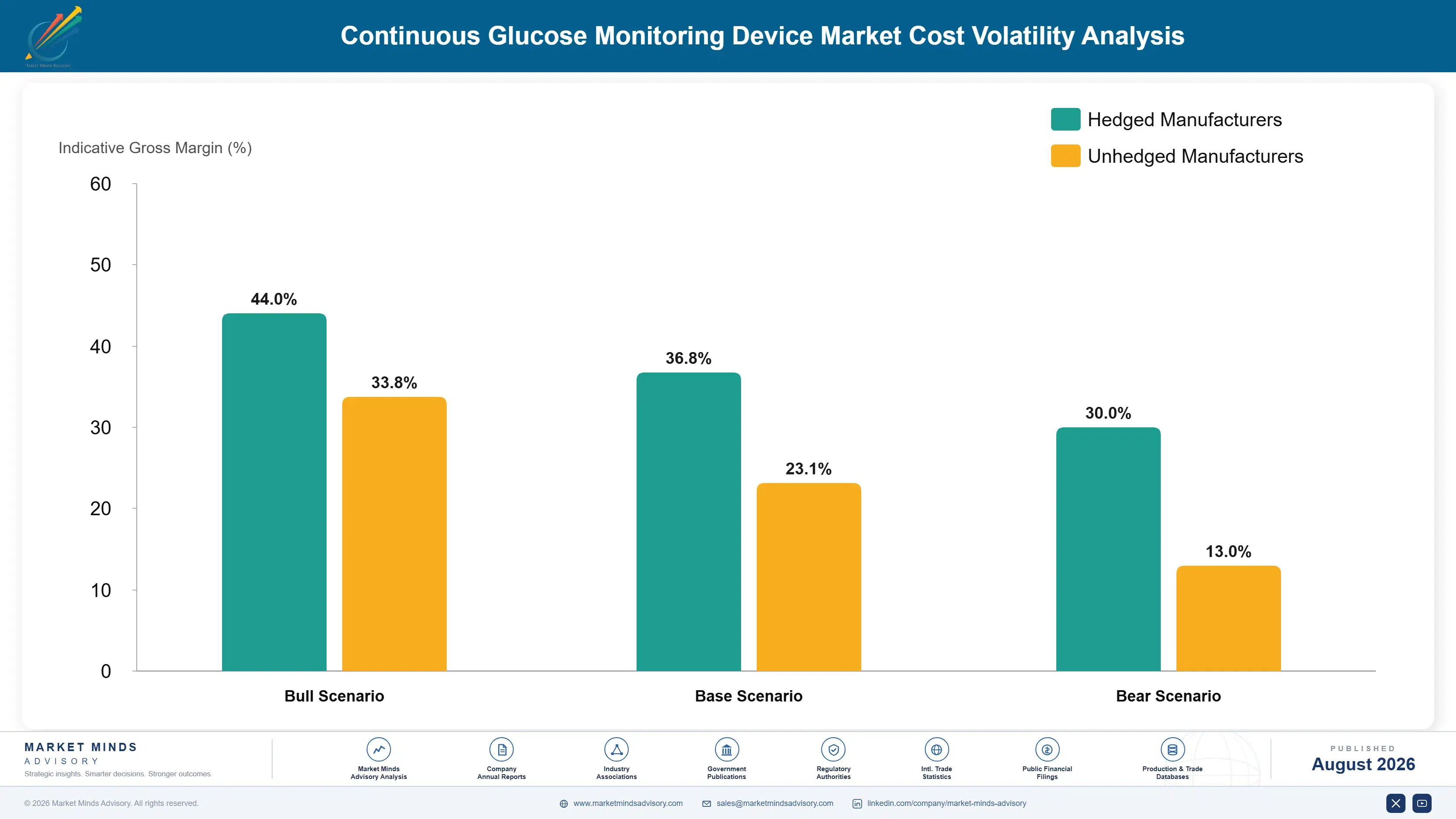
Sensor chips, transmitter electronics, and enzyme coating chemistry together represent roughly 38 percent of cost of goods sold for continuous glucose monitoring manufacturers, sourced from a concentrated group of specialty semiconductor and biochemical suppliers whose own pricing cycles directly influence device contract pricing across the broader supply chain, particularly during periods of tight global semiconductor capacity utilization.
Semiconductor component prices rose meaningfully during a 2021 to 2022 supply disruption tied to pandemic-era manufacturing bottlenecks, according to industry semiconductor pricing reports, and that shortage passed through to sensor contract pricing within roughly two to three quarters as manufacturers renegotiated terms with healthcare payer customers already committed to reimbursement schedules. Manufacturers without long-term semiconductor supply agreements absorbed the sharpest cost increases during that period, across the broader supply chain.

Smaller device manufacturers without diversified semiconductor and enzyme sourcing absorb price volatility directly in margin, while larger diversified manufacturers with broader procurement relationships smooth pricing for their downstream healthcare customers instead. That gap in resilience increasingly determines which manufacturers can offer multi-year fixed-price contracts that large healthcare payers now require, given the scale of their reimbursement contract footprint.
continuous-glucose-monitoring-device-market-cost-volatility-analysis-1787548328060

Long-Term Semiconductor Supply Agreements

Manufacturers are securing sensor chips and transmitter components through multi-year contracts with fabricators rather than relying on spot-market purchases, smoothing cost volatility during periods when broader electronics demand pushes chip prices higher than budgeted across a given production cycle today, helping preserve stable margins even when broader electronics demand elsewhere tightens overall capacity indeed.

Diversified Enzyme Coating Sourcing

Manufacturers are securing enzyme coating chemistry through multiple biochemical suppliers rather than relying on a single source, smoothing cost volatility during regional supply disruptions that periodically affect specific biochemical manufacturing facilities and their surrounding markets globally today, and helping manufacturers maintain delivery schedules even when a single supplier faces unexpected capacity constraints indeed too.

In-House Manufacturing Investment

Larger manufacturers are building in-house sensor chip manufacturing capability rather than relying entirely on external suppliers, reducing dependence on capacity that periodically becomes constrained during periods of high industry-wide semiconductor demand across the broader market, an approach increasingly valued by manufacturers seeking to avoid dependence on any single external fabricator each cycle too now.

Portfolio Architecture for Margin Defence

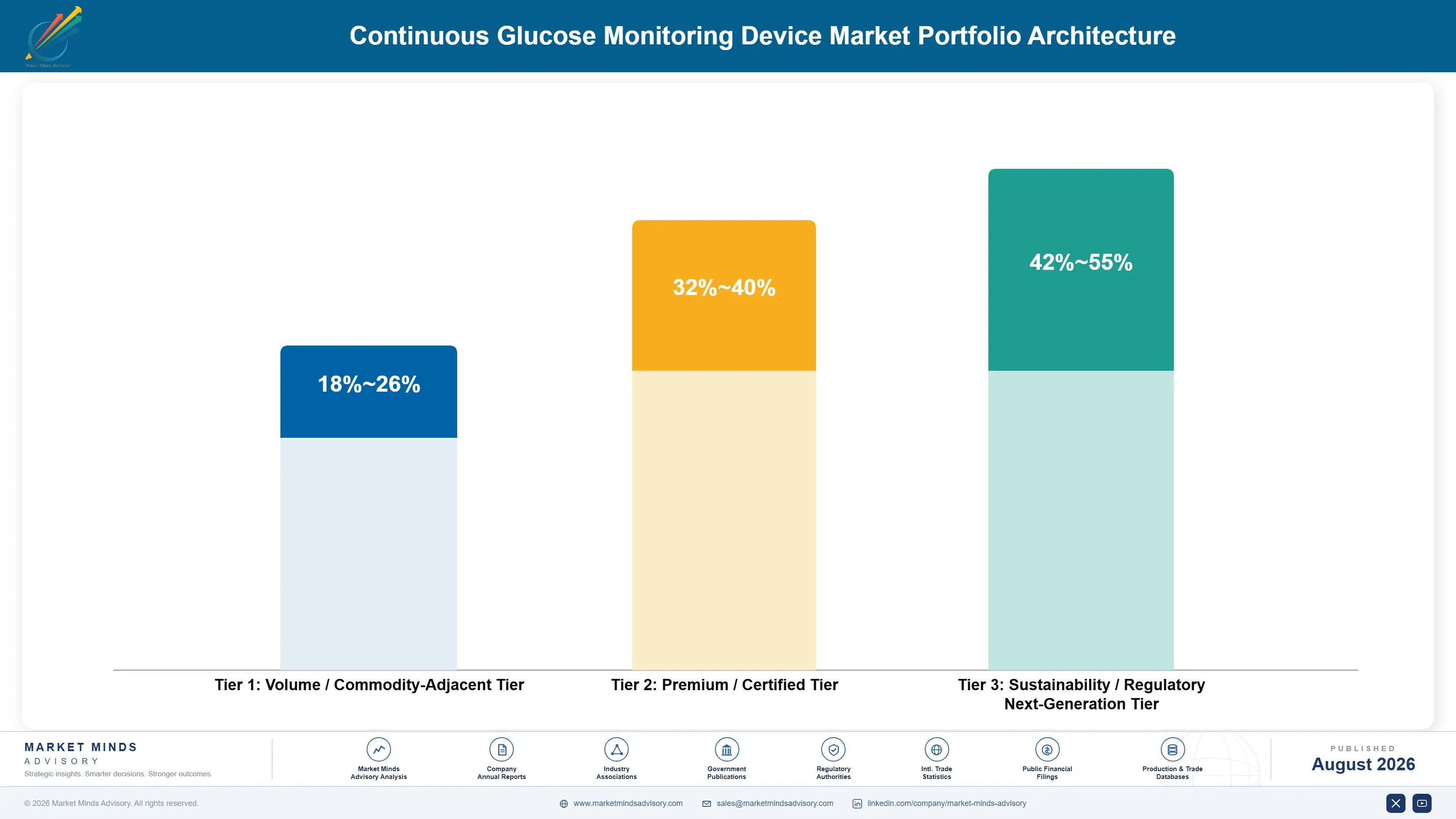
The market splits across three tiers: intermittently scanned systems sold at established pricing against broad reimbursement coverage, real-time monitoring and closed-loop systems sold with integration support at a premium, and an emerging tier of non-diabetic wellness products commanding the highest margins as direct-to-consumer sales bypass reimbursement entirely, reflecting how quickly the underlying technology mix within the industry keeps shifting toward automation.
Volume sits predominantly in the intermittently scanned tier, where established reimbursement coverage generates steady recurring revenue but comparatively modest margin expansion given long-established pricing structures. Premium tension is sharpest in closed-loop integrated systems, where software integration and automated delivery command substantially better economics than standalone scanning, pulling supplier investment toward capacity serving both tiers, as more payers finalize their coverage decisions for emerging technology.

High-value margin pools concentrate in closed-loop integrated systems and non-diabetic wellness subscriptions sold to patients and consumers pursuing automated delivery and metabolic insight respectively, a category still smaller in absolute volume than intermittently scanned systems but growing considerably faster and attracting disproportionate research investment each year, a pattern likely to continue strengthening as more suppliers finalize their own consumer wellness roadmaps.

Volume / Commodity-Adjacent Tier

Established intermittently scanned continuous glucose monitoring systems sold under long-term reimbursement contracts, competing primarily on established treatment relationships and physician trust, reflecting the established treatment relationships that make switching therapy genuinely difficult for physicians.
Gross Margin: 18%-26%

Premium / Certified Tier

Real-time monitoring and closed-loop integrated systems sold with documented integration software and clinical accuracy validation, commanding a premium over standard scanning systems, as automated delivery guidance continues expanding steadily across an expanding set of healthcare systems.
Gross Margin: 32%-40%

Sustainability / Regulatory / Next-Generation Tier

Non-diabetic wellness and metabolic monitoring products tied to direct-to-consumer subscription models, sold into the category's highest-margin arrangements currently available in the market, as more consumers seek documented metabolic insight over standard clinical monitoring costs.
Gross Margin: 42%-55%
continuous-glucose-monitoring-device-market-portfolio-architecture-1787548328561

High-value Sub-segments and Strategic Watch-out

Non-Diabetic Wellness Subscriptions

Non-diabetic wellness subscriptions command the category's highest margins and are growing fastest as consumers increasingly favor documented metabolic insight over standalone clinical monitoring each purchasing cycle currently underway, and suppliers with established consumer brands are capturing the bulk of this expanding demand now too now.

Closed-Loop Integrated Systems

Closed-loop integrated systems sold into automated insulin delivery contracts command steady premium pricing on integration value, growing reliably as standard of care guidance continues expanding across additional regional healthcare systems worldwide, a combination increasingly viewed as the established standard rather than an optional upgrade now.

Established Intermittently Scanned Systems

The largest revenue pool by far, established scanning systems generate steady revenue for incumbent suppliers but offer little margin expansion room given long-established reimbursement pricing structures across most markets, leaving suppliers to compete mainly on physician trust and established reimbursement relationships and beyond too now.

Domestic Chinese Device Manufacturers

Domestic Chinese device manufacturers scaling technical capability could challenge multinational suppliers on cost within their home market over the next decade, a shift worth monitoring closely going forward, particularly if domestic certification capability matures faster than currently anticipated by most industry observers too indeed now.

Treatment Cycles and Physician Loyalty

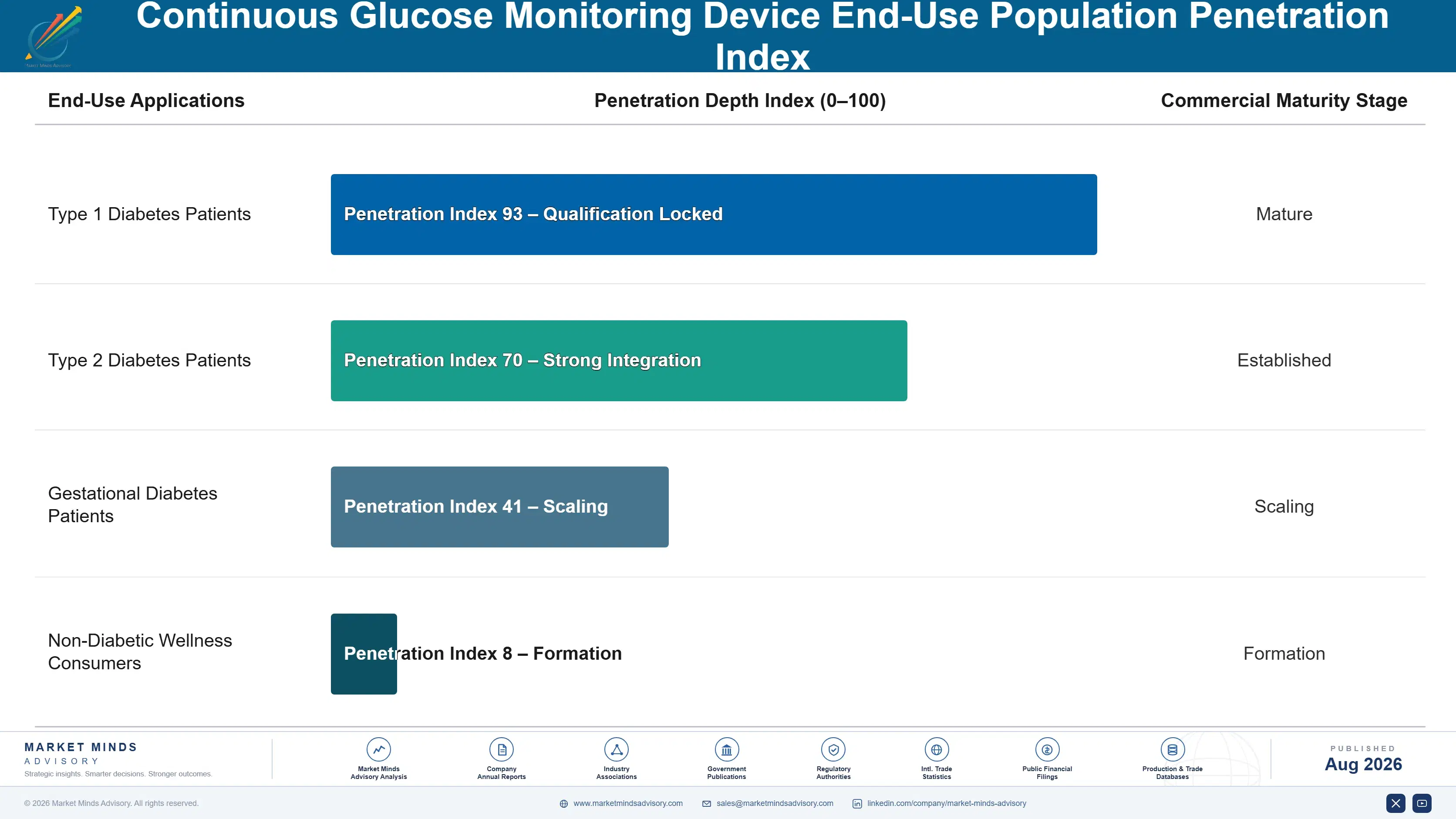
Original prescribing demand behaves like an annuity once a physician establishes a specific supplier's sensor as the standard monitoring regimen for a diagnosed patient, since switching suppliers requires clinical justification that most physicians avoid unless accuracy issues emerge, giving incumbent suppliers durable multi-year revenue once they establish the initial treatment relationship and demonstrate consistent accuracy, across every major healthcare system worldwide.
Adoption depth varies by segment: patients on closed-loop integrated systems show the deepest supplier stickiness given the scale of pump integration testing required, while patients using basic intermittently scanned systems switch suppliers more readily since switching costs are lower and requalification requirements correspondingly less demanding relative to total treatment complexity involved, particularly where treatment specifications rotate more frequently across shorter product upgrade cycles.

A generational shift among younger endocrinologists toward treating continuous glucose monitoring data as a core clinical decision input rather than a supplementary tool is pulling supplier selection earlier into treatment planning decisions, giving software-capable suppliers a seat at the table that basic hardware-only vendors historically never had, reshaping how care teams weigh software capability against simple hardware price today overall indeed.
continuous-glucose-monitoring-device-market-end-use-penetration-index-1787548329053

Positioning as Use Cases Multiply

These are among the four positions where our research anticipates prominent divergence between winners and laggards over the coming forecast period. Each is grounded in the demand model, the regulatory perimeter, and the announced capacity pipeline.
01 / CLOSED-LOOP INTEGRATION INVESTMENT

Deepen pump integration ahead of automated delivery standard of care

Closed-loop integration already commands a 20 to 25 percent premium, and suppliers without proven pump partnerships cannot access the contracts Dexcom and Medtronic increasingly dominate as automated delivery becomes standard of care. Building this capability now, even at substantial engineering investment, positions a supplier to capture the highest-margin category before more physicians finalize their prescribing habits around automated systems. Suppliers who wait risk permanent exclusion from contracts requiring years of integration history to win across every regional market too indeed.
02 / WELLNESS SUBSCRIPTION EXPANSION

Build consumer wellness subscriptions to capture new demand

Wellness subscriptions add an estimated 15 to 20 percent recurring revenue, and Abbott already demonstrates this advantage through direct-to-consumer branding that bypasses reimbursement negotiation entirely. Suppliers without comparable consumer wellness capability miss revenue from healthy adults seeking metabolic insight outside clinical channels. Building this capability now secures long-term consumer relationships before competitors formalize comparable subscription offerings across the wellness category across the broader wellness market and beyond across every major regional segment as well indeed too overall here now indeed.
03 / INTERNATIONAL REIMBURSEMENT PARTNERSHIPS

Partner with reimbursement advocates to reach fragmented markets

Reimbursement partnerships help expand addressable markets by 12 percent, since many international markets operate under fragmented coverage criteria that individual suppliers struggle to navigate alone. This gap is widening as diabetes prevalence spreads without correspondingly faster reimbursement policy convergence. Suppliers building local advocacy partnerships now will reach a broader patient base as coverage expands beyond currently well-established markets across the industry as adoption spreads further across every regional market currently served today indeed too overall now here too indeed now.
04 / INDIAN MARKET LOCALIZATION

Localize distribution in India before domestic suppliers mature

India's continuous glucose monitoring market is growing at roughly 13.5 percent annually, and rising diabetes prevalence combined with expanding private healthcare infrastructure is expanding demand faster than most global markets. Suppliers who build local distribution partnerships now can secure long-term patient relationships before domestic distributors capture the bulk of new demand growth entirely. Early localization secures market position before this fast-growing market matures and consolidates further around domestic leaders and pricing dynamics continue evolving further too indeed too now here.

Engagement Snapshot From the Field

A live engagement with an industry participant carrying material or product regulatory and market exposure ahead of a defining policy shift, showing how our research translates into a defensible multi-year portfolio strategy.
MARKET MINDS ADVISORY · CLIENT ENGAGEMENT SUMMARY
Continuous Glucose Monitoring Device Producer Strategic Portfolio Review and Transition Roadmap 2026·Investment Scenario on Continuous Glucose Monitoring Device Exposure Evaluation 2025-26
CLIENT PROFILE
A regional health plan covering a large population of type 2 diabetes patients engaged MMA to guide a coverage expansion strategy after facing pressure from physicians and patient advocacy groups to extend continuous glucose monitoring benefits beyond the historically covered type 1 population. The plan's annual diabetes management spend exceeded 45 million dollars (client-reported, unverified by MMA), making coverage policy design a material decision for its senior medical leadership team.
STRATEGIC CHALLENGE
The plan lacked clear cost-effectiveness data justifying expanded coverage for type 2 diabetes patients not using intensive insulin therapy, creating uncertainty about how to structure eligibility criteria without significantly expanding its diabetes management budget beyond sustainable levels, threatening a meaningful share of the plan's chronic disease management budget planning across the network.
MMA APPROACH
MMA benchmarked comparable health plan coverage expansions against documented outcome data, modeled the long-term cost offset against reduced complication rates and hospitalization, and structured a phased eligibility expansion framework sequenced around measurable clinical milestones, drawing on comparable coverage expansions adopted at similarly sized regional health plans elsewhere across the plan's broader provider network.
KEY FINDINGS
  1. Expanding coverage to a defined patient subgroup reduced hospitalization rates measurably within the first year, exceeding the medical leadership team's original outcome projections.
  2. Long-term cost modeling showed coverage expansion could offset complication-related spending within several years, strengthening the plan's long-term financial sustainability significantly across the plan's broader population.
  3. A phased eligibility rollout across three patient tiers avoided the budget disruption an immediate full expansion would have created, keeping policyholder communication clear throughout the transition period.
  4. Physician engagement during policy design proved as valuable to plan adoption as the eligibility criteria themselves, giving medical leadership confidence to expand the framework further.
CLIENT PROFILE
A regional health plan covering a large population of type 2 diabetes patients engaged MMA to guide a coverage expansion strategy after facing pressure from physicians and patient advocacy groups to extend continuous glucose monitoring benefits beyond the historically covered type 1 population. The plan's annual diabetes management spend exceeded 45 million dollars (client-reported, unverified by MMA), making coverage policy design a material decision for its senior medical leadership team.
STRATEGIC CHALLENGE
The plan lacked clear cost-effectiveness data justifying expanded coverage for type 2 diabetes patients not using intensive insulin therapy, creating uncertainty about how to structure eligibility criteria without significantly expanding its diabetes management budget beyond sustainable levels, threatening a meaningful share of the plan's chronic disease management budget planning across the network.
MMA APPROACH
MMA benchmarked comparable health plan coverage expansions against documented outcome data, modeled the long-term cost offset against reduced complication rates and hospitalization, and structured a phased eligibility expansion framework sequenced around measurable clinical milestones, drawing on comparable coverage expansions adopted at similarly sized regional health plans elsewhere across the plan's broader provider network.
KEY FINDINGS
  1. Expanding coverage to a defined patient subgroup reduced hospitalization rates measurably within the first year, exceeding the medical leadership team's original outcome projections.
  2. Long-term cost modeling showed coverage expansion could offset complication-related spending within several years, strengthening the plan's long-term financial sustainability significantly across the plan's broader population.
  3. A phased eligibility rollout across three patient tiers avoided the budget disruption an immediate full expansion would have created, keeping policyholder communication clear throughout the transition period.
  4. Physician engagement during policy design proved as valuable to plan adoption as the eligibility criteria themselves, giving medical leadership confidence to expand the framework further.
RECOMMENDED STRATEGY
Phase 1: Phase 1 (Months 1-4): Extend coverage to the highest-risk patient subgroup identified through claims data, the group carrying the highest documented complication risk. Phase 2: Phase 2 (Months 5-9): Expand eligibility across two additional patient risk tiers with continued monitoring, validating outcome data before completing the full expansion. Phase 3: Phase 3 (Months 10-12): Complete rollout and finalize physician communication materials for the plan, closing out the expansion on schedule and within budget.
OUTCOME
The plan completed its phased coverage expansion within the recommended twelve-month window and reported measurably reduced hospitalization rates across its expanded patient population (client-reported, unverified by MMA), strengthening its competitive position against plans still limiting coverage to type 1 diabetes patients across its broader chronic disease management portfolio.

Frequently Asked Questions

Foundational context covering the market sizes, CAGR, scope, country, region and competition that inform every finding below. This section is provided to cover basics and most often pre-purchase conversations, answered from the MMA Primary Research Dataset.

What is the current size of the Continuous Glucose Monitoring Device Market?

The global continuous glucose monitoring device market was valued at approximately $9.8 billion in 2025. Closed-loop integrated systems already account for a meaningful share of category value.

How large will the Continuous Glucose Monitoring Device Market be by 2036?

MMA projects the market will reach approximately $29.39 billion by 2036, roughly 2.71 times its 2026 value. Non-diabetic wellness adoption drives much of this growth.

What is the CAGR for the Continuous Glucose Monitoring Device Market 2026 to 2036?

The market is projected to grow at a 10.5 percent compound annual rate between 2026 and 2036. Bull and bear scenarios range from 9.2 to 11.8 percent.

Which segment is growing fastest?

Non-diabetic wellness and metabolic monitoring is the fastest-growing segment at a 16.5 percent CAGR, well above the overall market rate. Consumer metabolic health interest drives this expansion.

Who are the major companies in the Continuous Glucose Monitoring Device Market?

Leading suppliers include Dexcom, Abbott, Medtronic, Senseonics, and Roche Diabetes Care. Together they hold a CR5 near 78 percent of global shipments of global shipment volume today.

Which country is growing fastest?

India posts the fastest national growth at roughly 13.5 percent, driven by rising diabetes prevalence and expanding private healthcare infrastructure. Consumer purchasing power continues supporting this rising demand.

Report Segmentation Architecture

The full report scope spans multiple orthogonal segmentation dimensions, with cross-tabulated demand data provided for each dimension pair. Coverage extends further to regional breakdowns, trend trajectories, and the competitive detail needed to support segment-level decision-making.

By Product Type

  • Real-Time Continuous Glucose Monitoring Systems
  • Intermittently Scanned Continuous Glucose Monitoring Systems
  • Closed-Loop Insulin Delivery Integrated Systems
  • Implantable Long-Term Sensors
  • Non-Diabetic Wellness and Metabolic Monitoring
  • Sensor Consumables and Transmitter Replacement Components

By End-Use Population

  • Type 1 Diabetes Patients
  • Type 2 Diabetes Patients
  • Gestational Diabetes Patients
  • Non-Diabetic Wellness Consumers

By Commercial Dimension

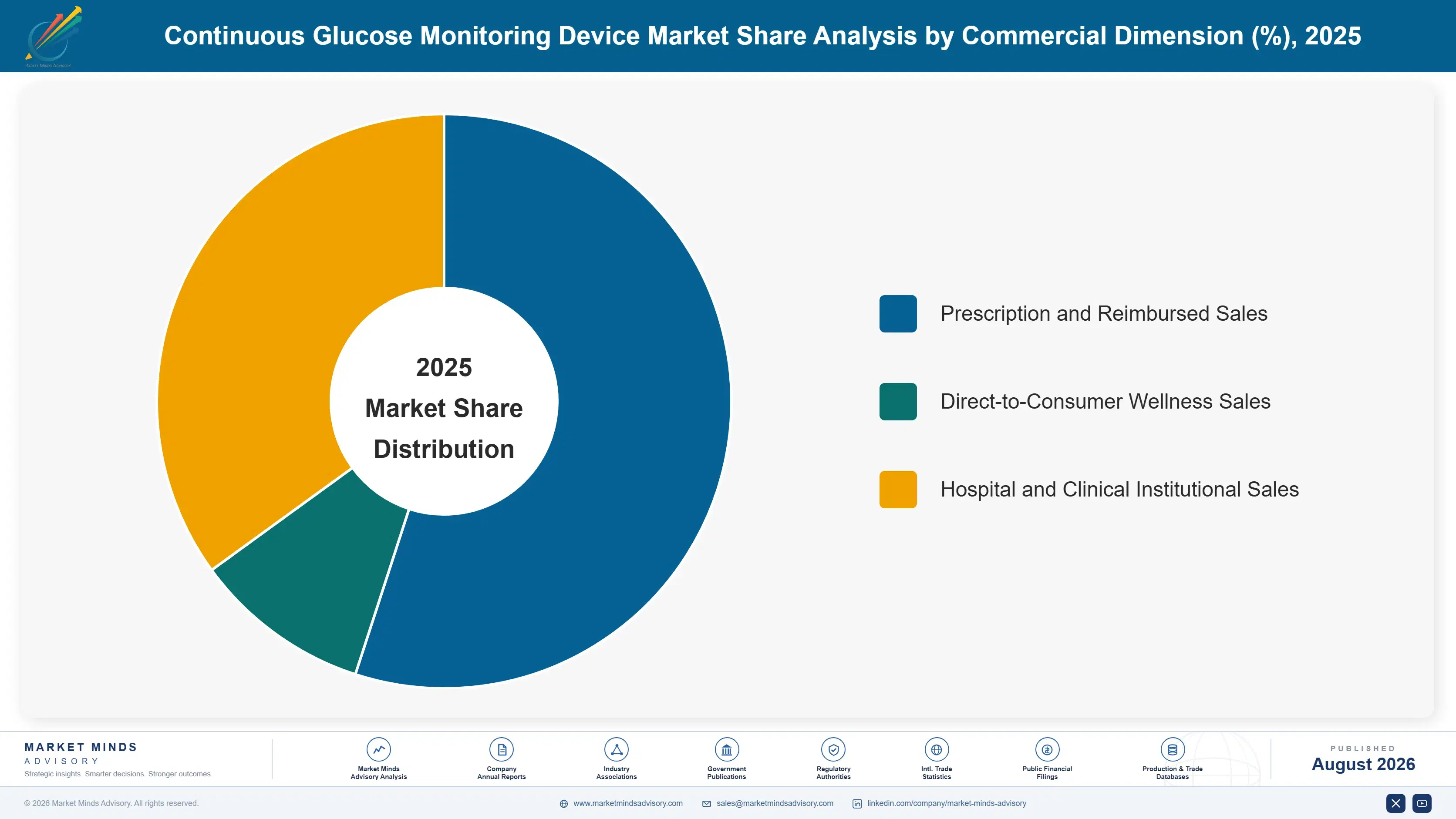
  • Prescription and Reimbursed Sales
  • Direct-to-Consumer Wellness Sales
  • Hospital and Clinical Institutional Sales

By Region

  • North America
  • Western Europe
  • East Asia
  • South Asia and Pacific
  • Latin America
  • Middle East and Africa
  • Eastern Europe

Scope, Methodology, and Coverage

Every figure in this report is reproducible from documented input assumptions. The scope below maps the historical period, the forecast horizon, the segmentation dimensions, and the countries covered, alongside the underlying primary and qualitative methodology.
Historical Period
2020 to 2025
Forecast Period
2026 to 2036
Base Year
2025 (USD billions; MMA Primary Research Dataset, August 2026)
Market Definition
The continuous glucose monitoring device market covers real-time continuous glucose monitoring systems, intermittently scanned continuous glucose monitoring systems, closed-loop insulin delivery integrated systems, implantable long-term sensors, non-diabetic wellness and metabolic monitoring devices, and sensor consumables and transmitter replacement components sold to diabetic patients, healthcare providers, and wellness consumers. It excludes traditional fingerstick blood glucose meters and test strips sold as standalone products.
Quantitative Units
USD billions (current prices); unit volume for sensor shipment detail
Segmentation Dimensions
By Product Type; By End-Use Population; By Commercial Dimension; By Region
Regions Covered
North America, Western Europe, East Asia, South Asia and Pacific, Latin America, Middle East and Africa, Eastern Europe
Countries Covered
USA, Canada, Germany, France, UK, Japan, China, South Korea, India, Australia, Brazil, Mexico, UAE, Saudi Arabia, South Africa, Poland, Czech Republic, Hungary, Slovakia, Italy, Spain, Netherlands, Sweden, and additional markets relevant to this sector
Key Companies Profiled
Dexcom, Abbott, Medtronic, Senseonics, Roche Diabetes Care, Ypsomed, Insulet Corporation, Tandem Diabetes Care, Ascensia Diabetes Care, LifeScan, GlySens Incorporated, Nemaura Medical, Movano Health, Know Labs, Biolinq, Metronom Health, PercuSense, Waveform Technologies, Sinocare, Medtrum Technologies
Quantitative Methodology
Primary survey, n=3,800 respondents, Q4 2025, six countries; demand-side model with trade association cross-validation
Qualitative Methodology
47 expert interviews, Q4 2025; applied to validate demand model assumptions, identify emerging dynamics, and assess competitive positioning
Report Format
PDF and XLSX data workbook (Word format preview document)
Publisher
Market Minds Advisory
Report Code
MMA-2026-MED-101
Published
August 2026
Contact
sales@marketmindsadvisory.com | www.marketmindsadvisory.com

Purchase the full Continuous Glucose Monitoring Device Market Report (2026 to 2036).

The full Continuous Glucose Monitoring Device Market report delivers a comprehensive 2026 to 2036 forecast across six product categories, seven regions, and twenty profiled companies active in this sector. It includes detailed segmentation by end-use population, sensor component cost modeling, and competitive benchmarking measured against a single consistent shipment volume basis throughout. Analysts document the closed-loop integration and wellness expansion trends reshaping supplier positioning across the industry. Buyers receive full access to the underlying data tables, regional breakouts, and a customizable Excel model built for scenario planning.
2026-2036 volume and value forecasts by segment
Six-category product type breakdown and detailed analysis
Seven-region market sizing and share detail
Twenty-company competitive profiles and full benchmarking
Sensor and enzyme component cost sensitivity modeling
Editable Excel forecast workbook with scenario toggles

Built For The People Who Decide

From boardroom strategy to bench-side execution, this report is read cover-to-cover by leaders shaping the next decade of their industry, turning demand scenarios, market dynamics and valuation benchmarks into decisions.
CXOs/ Presidents/ VPs/ Managers
M&A and Corporate Development
Strategy Teams and R&D Heads
Procurement and Product Directors
Regulatory and Compliance Leaders
Investor Relations and Equity Analysts