Market Minds Advisory
Context-Rich System Market

Context-Rich System Market: Context-Rich System Market. Ambient Awareness Becomes the New Software Interface

Applications that ignore a user's location, device state, and recent behavior increasingly feel broken rather than merely basic, pushing software vendors to rebuild interfaces around ambient context rather than explicit input a person types.

Lead Analyst

Published

September 2026

Make Smarter Decisions with Customized Research Insights

Request a free sample report and evaluate market opportunities, growth trends, and competitive dynamics relevant to your business needs.

2025 MARKET VALUE$6.4BMarket Size 2025
2036 FORECAST VALUE$20.6BBase Case , 2026 to 2036
CAGR 2026 TO 203611.2 %Bull 12.5% / Bear 9.9%
INCREMENTAL OPPORTUNITY$13.5BNet 10- year value creation
EXPANSION MULTIPLE2.89x2036 value over 2026 base
Strategic Levers
M&A Pipeline
Regional Outlook
Country Rankings
Competitive Intelligence
Segmental Deep-dive
Call-Us : 91 93563 13602

Executive Snapshot and Market Trajectory.

Context-rich systems have moved from a research curiosity to a mainstream product requirement as users increasingly expect applications to infer intent from location, device sensors, and behavior history rather than explicit menus. Product teams now specify context inference pipelines before finalizing a roadmap. That shift is now the default expectation.
Context-aware recommendation and personalization engines are growing fastest as consumer applications race to match user expectations set by leading platforms, while sensor fusion platforms consolidate a separate but adjacent budget line concentrated in North America's dense software vendor base and East Asia's expanding mobile device manufacturing base. Enterprise buyers increasingly demand documented inference accuracy. That requirement barely existed as a standard procurement criterion five years ago.
Large cloud platform vendors compete against a growing field of specialized context inference startups now bundling personalization into broader application development platforms, and rising demand for measurable relevance improvement is starting to separate vendors with genuine field-proven deployments from those still selling on theoretical accuracy claims alone. Vendors that document concrete inference accuracy are winning larger multi-year platform contracts that smaller unproven competitors increasingly cannot match on credibility in this consolidating category today.
Market Definition
This report defines the Context-Rich System Market as software platforms that infer user intent and environmental state from sensor, location, and behavioral data to personalize application output in real time. It excludes generic business intelligence dashboards and static rule-based configuration tools without dynamic inference.
Base Year Value
$6.4B in 2025 (MMA Primary Research Dataset, September 2026)
Forecast Period
2026 to 2036, eleven discrete annual values
CAGR
11.2% base case. Bull 12.5%. Bear 9.9%.
Fastest Growth Segment
Context-Aware Recommendation and Personalization Engines: 18.6% CAGR
Fastest Growth Country
India: 16.4% CAGR
Fastest Growth Region
South Asia and Pacific: 13.5% CAGR
Largest Region
North America: 32% of 2025 global value
Market Leaders
Microsoft, Google, Amazon, Salesforce, and Adobe. Source: MMA Analysis based on company disclosures and deployed API call volume estimates.
Primary Survey
n=3,800 procurement and R&D decision-makers, Q4 2025, six countries
Methodology
Demand-side build-up, cross-validated against public data, 47 expert interviews

Context-Rich System Market Forecast Scenarios

context-rich-systems-market-size-forecast-scenario-1789990413459
Between 2020 and 2025 the market accelerated as mobile applications and enterprise software both raced to match consumer expectations set by leading recommendation platforms, expanding at roughly 10.1% annually as context inference engines proved they could measurably improve engagement metrics that static interfaces could not match. Several major platform vendors standardized on context APIs during this period.
MMA's base case assumes 11.2% annual growth through 2036, anchored to three mechanisms: expanding consumer expectation for personalized application experiences across mobile and web platforms, rising enterprise adoption of context-aware workflow automation replacing static rule engines, and steady improvement in sensor fusion accuracy enabling richer environmental inference than earlier location-only approaches. Vendors that can demonstrate documented inference accuracy across multiple data modalities are winning larger enterprise accounts that smaller single-modality competitors increasingly cannot compete for.
The bull case rests on generative AI advances accelerating context inference accuracy faster than currently planned across mainstream consumer applications. The bear case centers on data privacy regulation tightening restrictions on behavioral data collection, constraining the inputs context engines depend on. That risk is most acute for vendors concentrated heavily on behavioral tracking rather than on-device inference approaches.

From Static Menus to Ambient Inference

Context-rich systems began as basic location-tagging features valued mainly for simple geofencing rather than genuine behavioral inference. Vendors have since layered on multi-modal sensor fusion, real-time recommendation engines, and workflow automation, turning a narrow location feature into a design-critical inference layer that determines whether an application feels responsive or generic to the user. Product teams now treat this decision as a core design input rather than a late-stage add-on.
AVERAGE INFERENCE LATENCY80msTypical time between context signal capture and personalized output
RECOMMENDATION ACCURACY RATE87%Typical share of context-driven suggestions users accept without override
TOP PRODUCING COUNTRY SHARE31%United States share of global context inference platform revenue
ENTERPRISE ADOPTION RATE42%Share of large enterprises now using context-aware workflow automation
AVERAGE CONTRACT RENEWAL RATE88%Share of enterprise customers renewing their annual platform contract
DATA INTEGRATION COST SHARE30%Share of deployment cost tied to connecting fragmented source systems
Pricing now varies sharply by inference sophistication and data modality coverage. Basic location-only context services charge modest per-call fees, while multi-modal recommendation engines command premium pricing that scales with documented accuracy testing across diverse user populations. Enterprise buyers increasingly accept higher platform costs after a relevance failure convinces product leadership that inference depth is genuinely worth paying for.
Large cloud platform companies are acquiring specialized context inference startups rather than building comparable sensor fusion expertise in-house, buying inference know-how and existing developer relationships rather than API call volume alone. That acquisition pattern is starting to squeeze independent boutique vendors that lack the scale to invest in comparable data integration infrastructure larger competitors now offer standard. Independent vendors that survive increasingly specialize in niches larger platforms overlook.
"Nobody switches context engines because a demo looked impressive. They switch after a recommendation embarrasses them in front of a customer."
Director, Applied AI and Ambient Computing Practice · MMA Technology Practice · September 2026

Market Trends

Generative AI Accelerates Context Inference Accuracy Sharply

Large language model advances are dramatically improving context engines' ability to infer nuanced user intent from unstructured signals like conversational history and written notes rather than relying solely on structured location and sensor data. This shift accelerated sharply once several major platform vendors publicly disclosed recommendation accuracy improvements after integrating generative models into their existing context pipelines. Roughly 42% of large enterprises now use context-aware workflow automation, up meaningfully from a small fraction just a few years ago. Vendors lacking documented generative integration increasingly lose deals to platforms with proven accuracy gains.
Market Impact: Personalization demand grew over 20% yearly
On-Device Inference Reduces Privacy and Latency Concerns

Context engines are increasingly moving inference processing onto the user's own device rather than routing sensitive behavioral data to cloud servers, addressing both privacy concerns and the latency delay that cloud round-trips introduce. This shift reflects growing recognition that users and regulators alike are wary of behavioral data leaving the device without clear benefit in return. Vendors lacking on-device inference capability increasingly lose bids to platforms that can demonstrate equivalent accuracy without cloud dependency. Roughly 28% of new context deployments now specify on-device processing, a pace that continues accelerating each year.
Market Impact: Enterprise contracts rose over 17% yearly

Market Opportunities and Growth Drivers

Consumer Expectation for Personalization Keeps Rising Steadily

Consumers increasingly expect every application they use to anticipate their needs based on location, recent activity, and device state, a standard set by leading consumer platforms that smaller application developers now feel pressure to match. Product teams increasingly qualify multiple context inference vendors per project to reduce single-source dependency, a diversification pattern that expands the addressable vendor base beyond incumbent relationships. Vendors with demonstrated accuracy credentials increasingly capture design wins across multiple product lines simultaneously rather than single contracts. Some vendors now maintain dedicated integration engineering teams purely to serve this growing qualification demand.
Market Impact: adds 4 months to compliance timelines

Enterprise Workflow Automation Expands Context System Demand

Enterprises continue replacing static rule-based workflow automation with context-aware systems capable of adapting to real-time operational conditions rather than fixed if-then logic that quickly becomes outdated as business conditions shift unpredictably over time. Enterprises increasingly recognize that context-aware automation reduces manual exception handling that static rules cannot anticipate reliably across complex operational scenarios. Vendors serving this segment report meaningfully stronger contract growth than those focused purely on consumer-facing personalization work. Several vendors have hired dedicated enterprise integration teams purely to serve this expanding demand across major industry verticals nationwide right now.
Market Impact: adds 30% to deployment cost today

Market Restraints and Challenges

Data Privacy Regulation Limits Behavioral Signal Collection

Expanding data privacy regulation across major markets increasingly restricts the behavioral and location data context engines have historically relied on to build accurate user models. The root cause is that regulators view granular behavioral tracking as disproportionately invasive relative to the personalization benefit it delivers to most users. The commercial impact is that vendors must rebuild inference pipelines around narrower, consent-based data collection that yields less training signal than earlier approaches. Some vendors are responding by shifting toward on-device inference that avoids transmitting raw behavioral data entirely, though this mitigation increases engineering complexity considerably.
Market Impact: 42% of enterprises use context automation

Fragmented Data Sources Complicate Context Integration Projects

Enterprise customers typically maintain context-relevant data across dozens of disconnected systems, making comprehensive context integration considerably more complex than vendors initially estimate during the sales process itself. The root cause is that most enterprises built their data infrastructure incrementally over many years without a unified data model connecting customer, location, and behavioral records consistently across departments. The commercial impact is extended implementation timelines that strain vendor margins during the integration period considerably. Some vendors are now building standardized connector libraries specifically to accelerate this integration process across common enterprise systems.
Market Impact: 28% of deployments now specify on-device
3 additional market trends, 4 additional growth drivers, and 2 additional restraints and challenges are covered in the full report. Contact sales@marketmindsadvisory.com to access the complete intelligence.

Segment CAGR and Growth Architecture

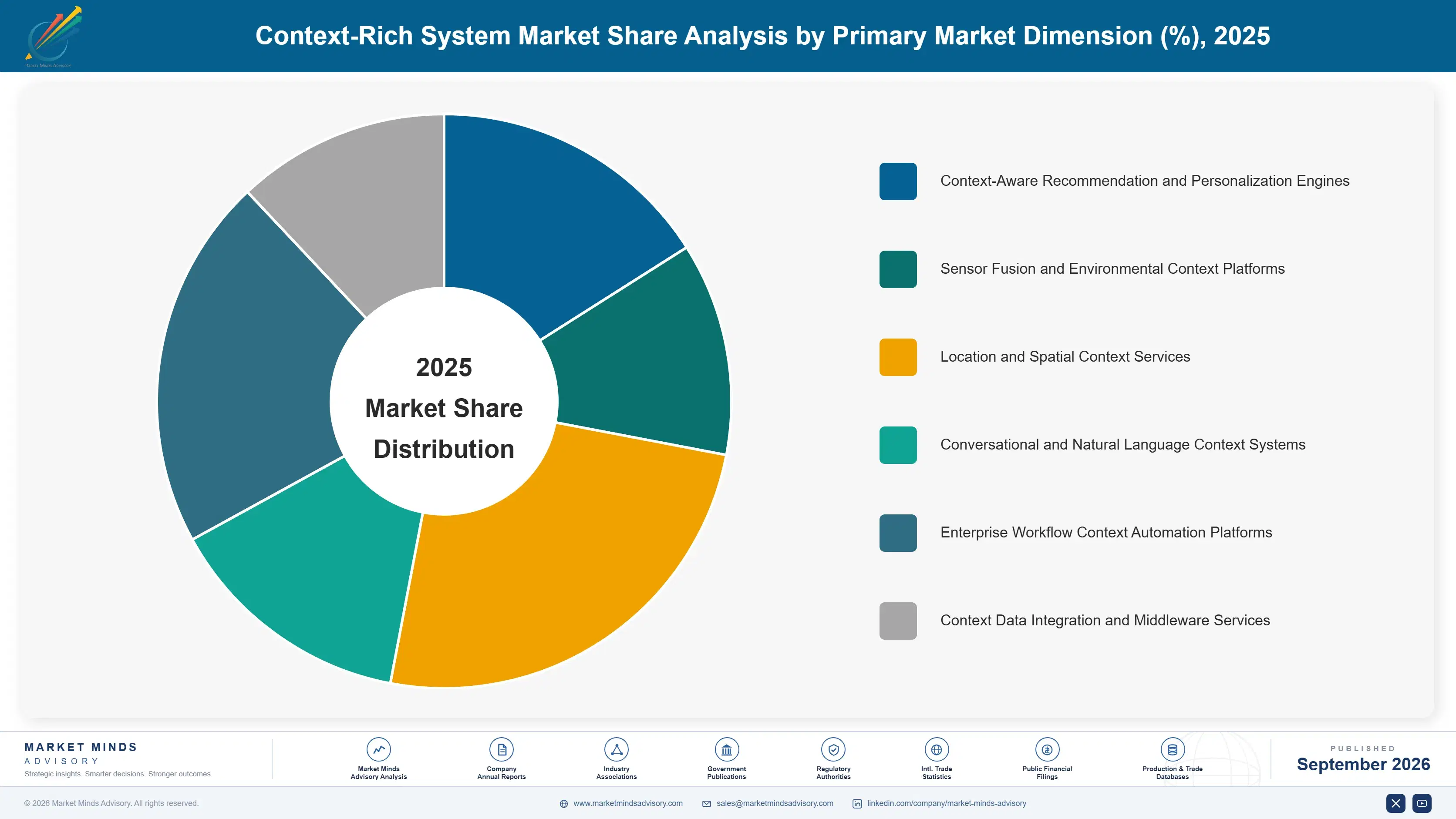
Context-rich systems segment by inference function rather than end-use application, since a single application typically combines personalization, sensor fusion, and workflow automation together as layered capabilities rather than as complete substitutes for one another. Context-aware recommendation and personalization engines are the fastest growing category as generative AI accelerates inference accuracy sharply across the industry.
context-rich-systems-market-market-share-analysis-1789990413995

Context-Aware Recommendation and Personalization Engines

This segment covers inference platforms that analyze behavioral history, location, and real-time signals to surface personalized content, product, or action recommendations within an application. Demand is concentrated among consumer applications competing for engagement and enterprise software vendors racing to match personalization standards set by leading consumer platforms already in the market. Vendors in this segment differentiate on recommendation accuracy measured against user acceptance rates, latency under real production load, and the ability to retrain models continuously without disrupting live inference pipelines. Growth here outpaces every other segment because generative AI advances are accelerating inference accuracy faster than any other capability in the category right now. Vendors without this capability increasingly struggle to win the largest platform partnerships.
CAGR 18.6%

Conversational and Natural Language Context Systems

This segment covers platforms that infer user intent from conversational history, written notes, and voice interaction rather than relying solely on structured location and sensor data captured elsewhere. Demand comes from applications adding conversational interfaces where understanding intent from unstructured language carries more inference value than traditional structured signals alone provide. Vendors compete on language model integration depth, multi-turn conversation memory accuracy, and the ability to blend conversational signals with structured context data coherently across a session. Growth here trails the recommendation segment but remains well above the broader market average as generative AI capability continues improving rapidly across the industry. Enterprise buyers increasingly evaluate conversational depth above nominal feature checklists alone.
CAGR 15.2%
Full segment breakdown across 7 segments available in the complete report.

Regional Architecture and Country Demand Map

North America leads on the dense concentration of cloud platform vendors and AI research talent headquartered there, while South Asia and Pacific grows fastest as India's rapidly expanding software services base continues scaling further and faster to serve global context inference demand across several industries.

North America

The United States hosts the largest concentration of cloud platform vendors and AI research labs worldwide, giving domestic context inference startups direct access to the foundation models and cloud infrastructure their products depend on. Silicon Valley and Seattle-based vendors built their initial customer base almost entirely from domestic consumer and enterprise software companies before expanding internationally, giving them a home-market advantage that persists in renewal rates. Canada contributes a smaller but growing share, anchored by Toronto and Montreal's AI research clusters. Domestic vendors increasingly bundle context inference directly into broader cloud platform subscriptions, reinforcing their position against smaller standalone competitors. Investment in domestic AI infrastructure continues accelerating across several major metro clusters.
Share: 32% | CAGR: 11.9% (2026 to 2036)

Western Europe

Germany, the United Kingdom, and France together account for most regional demand, driven by enterprise software vendors serving multi-language, multi-jurisdiction customers across the European Union's diverse member states. Data protection requirements under GDPR shape context inference architecture more directly here than in markets with lighter privacy obligations, pushing vendors toward on-device and consent-based inference approaches. Adoption trails North America by roughly a year on average, reflecting more conservative enterprise software procurement cycles and greater reliance on established European software vendors already embedded in operations. Growth remains solid even so, as generative AI capability spreads into regional buying expectations regardless of procurement pace. Regulatory sandboxes in several member states now help vendors test compliant deployments early.
Share: 21% | CAGR: 9.7% (2026 to 2036)
Regional intelligence for 5 additional markets available in the complete report: East Asia, South Asia and Pacific, Latin America, Middle East and Africa, Eastern Europe. Contact sales@marketmindsadvisory.com.
context-rich-systems-market-country-cagr-analysis-1789990414522

Where Context Vendors Capture More Revenue

Vendors are finding revenue growth less in one-time API licensing fees and more in ongoing accuracy improvement subscriptions, since customers who already trust a vendor with sensitive behavioral data pipelines are genuinely and unusually reluctant to switch providers even when a competitor offers meaningfully lower list pricing somewhere else entirely across the whole market.

Documented Accuracy Benchmarking Certification Service Programs

Vendors are packaging documented recommendation accuracy benchmarking against industry standard datasets as a premium tier layered on top of core inference API access, rather than leaving accuracy validation entirely to the customer's own internal testing team. Enterprise buyers preparing for board-level technology reviews increasingly require this documentation before finalizing a vendor selection decision of any duration or scope. Early adopters report attach rates around 31% among enterprise accounts within the first renewal cycle after launch, concentrated among customers facing internal governance review requirements. Renewal rates among certified accounts consistently exceed the broader customer base.
Market Impact: adds roughly 31% attach rate among enterprise accounts

On-Device Inference Privacy Upgrade Pathway Programs

Vendors increasingly design upgrade paths that convert cloud-only customers into on-device inference relationships after demonstrating measurable privacy compliance improvement alongside comparable accuracy on the customer's own production data and traffic. These on-device deployments now command roughly 35% higher unit pricing and represent the fastest-growing revenue segment within existing customer relationships across the vendor's entire book of business. Application engineers also generate valuable customer insight vendors use to identify which accounts are likely candidates for upgrade. Roughly one in three customers who trial an on-device upgrade retain it permanently. Retention on these upgraded accounts runs meaningfully higher than standard tiers.
Market Impact: on-device upgrades now command roughly 35% higher pricing

White-Label Context Engine Licensing Partnership Programs

Some vendors now license their proprietary context inference software directly to platform companies building internal personalization capability, a distribution channel that bypasses direct API service entirely. Early licensing deals report margins roughly 20 percentage points higher than comparable direct service contracts, since the underlying model development cost is already covered by the vendor's own platform investment across its customer base. Platform companies value gaining proven inference capability without building comparable expertise in-house. Roughly one in four licensees report measurably faster deployment timelines after adopting the licensed engine. Vendors increasingly treat this licensing channel as a genuine second business line.
Market Impact: platform licensing revenue now grows roughly 26% yearly

Multi-Product Context Data Consolidation Agreement Programs

Large enterprises running dozens of applications across multiple business units need context platforms that consolidate behavioral and location data into a single unified profile while still generating application-specific inference outputs for each product team involved. Vendors offering this multi-product consolidation charge substantial premiums over single-application licensing plans, since the engineering complexity of cross-application data unification is considerably higher than most competitors have built well at genuine scale. Customers adopting multi-product consolidation increase average contract value by roughly 52% compared to their prior single-application arrangement. These agreements typically span multiple years across a customer's full product suite.
Market Impact: increases contract value by roughly 52% per account

Who Controls the Margin Pool

The Context-Rich System Market shows moderate concentration, with the top five vendors, evaluated on deployed API call volume, holding roughly 44% combined share. Microsoft and Google lead on platform integration depth and inference accuracy respectively, but the gap to Salesforce has narrowed sharply as it bundles context capability into existing customer relationship management relationships customers never intended to procure as a separate line item at all. That shift alone is reshaping enterprise procurement conversations industry-wide.
Current competitive activity centers on generative AI integration, with nearly every vendor racing to embed large language model reasoning into context pipelines previously limited to structured signal processing only. Vendors are also investing heavily in on-device inference capability, since enterprise buyers increasingly treat privacy-preserving architecture as a baseline procurement requirement rather than an optional feature anymore in this category.

Emerging pressure comes from specialized conversational AI startups extending into structured context inference, a fast-moving segment established platform incumbents were genuinely slow to prioritize. Rankings could shift meaningfully over the next several years if large cloud platform vendors continue absorbing independent context specialists through acquisition, particularly among mid-market customers unwilling to manage multiple vendor relationships going forward.
context-rich-systems-market-company-positioning-matrix-1789990415054

Competitive Moat and Risk Dimensions

MICROSOFT

Moat: Enterprise Platform Distribution Depth

Microsoft bundles context inference directly into its Azure and Microsoft 365 product suite, letting it offer personalization as a low-friction extension of an existing enterprise relationship rather than a separate procurement decision requiring its own sales cycle and vendor evaluation entirely. That distribution advantage lets it win accounts independent vendors cannot match on convenience alone.
MICROSOFT

Risk: Slower Specialized Model Innovation

Microsoft's broad platform focus carries less specialized model innovation speed than boutique AI-native competitors investing entirely in context inference research, which keeps it winning bundled enterprise deals while struggling to displace specialists at the most demanding accuracy-critical accounts that prioritize raw inference performance above bundled convenience.
GOOGLE

Moat: Deepest Behavioral Data Access

Google holds an unmatched depth of behavioral and search intent data accumulated across more than two decades of consumer product operation, creating training signal richness that newer entrants cannot replicate quickly regardless of engineering talent invested. Large enterprise customers value this proven accuracy on real-world traffic patterns directly.
GOOGLE

Risk: Regulatory Scrutiny Over Data Use

Google's data practices face heightened regulatory scrutiny across multiple jurisdictions that smaller, less visible competitors largely avoid, creating compliance overhead and reputational risk that could slow product development or force architecture changes on short notice across its global customer base. Enterprise buyers increasingly weigh this risk when comparing platform vendors.

Players Tracked

Prominent Players

Microsoft
Google
Amazon
Salesforce
Adobe

Other Key Players

IBM
Oracle
SAP
Twilio Segment
Braze
Dynamic Yield
Optimizely
Algolia
Coveo
Amplitude
mParticle
Persado
Qubit
Blueshift
Iterable

Recent Developments

FEBRUARY 2026

Salesforce acquired a smaller conversational context startup to accelerate its generative personalization roadmap, adding natural language intent inference that would otherwise have taken its engineering team well over a year to build natively from scratch. The deal closed for an undisclosed sum and integrates fully within two quarters.
Signal: Platform incumbents are increasingly buying conversational depth instead of slowly building it out fully on their own.
AUGUST 2025

Google expanded its context inference platform with native on-device processing features aimed squarely at privacy-conscious enterprise customers, a segment it had previously served only through cloud-based inference architecture running on remote servers. The rollout followed extensive customer feedback gathered across several large accounts. customers relied on daily.
Signal: Large cloud platforms are climbing directly into on-device inference, a historically specialist-only niche market segment overall.
MAY 2025

Microsoft signed a multi-year technology partnership with a major enterprise resource planning vendor to offer pre-integrated context inference for customers migrating workflow automation to the cloud across multiple regions, formalizing a relationship that previously existed only informally between the two companies for years. over many months.
Signal: Enterprise software vendors are formalizing context partnerships to speed customer adoption across every major world region.

Cloud Compute and Talent Cost Exposure

Cloud inference compute typically represents roughly 30% of a context vendor's deployment cost of goods sold, since real-time recommendation and sensor fusion processing demands considerably more compute capacity than static rule-based systems ever required. Skilled machine learning talent capable of building and tuning context inference pipelines is the second largest input, sourced primarily from North American and Western European labor markets.
A major cloud provider's 2025 GPU capacity shortage, documented in the company's annual report, forced several smaller context vendors to delay new customer onboarding by roughly six weeks, temporarily slowing enrollment growth in affected market segments. Larger vendors with pre-negotiated reserved capacity contracts largely avoided the disruption entirely, widening the competitive gap. The episode pushed several affected vendors to diversify cloud provider relationships they had previously treated as a secondary priority.

Smaller context vendors without reserved compute capacity face materially higher per-inference costs than the largest three vendors, a disadvantage that compounds over time as scale advantages widen with each model generation. Vendors headquartered in regions with larger machine learning talent pools, including the United States and India, hold a durable talent advantage over competitors based primarily in regions where combined inference expertise remains genuinely scarce.
context-rich-systems-market-cost-volatility-analysis-1789990415251

Reserved Compute Capacity Purchase Agreements

Larger vendors are negotiating multi-year reserved compute capacity agreements with cloud infrastructure providers to lock in guaranteed access ahead of demand spikes across the GPU supply chain entirely. Smaller vendors lacking this leverage remain more exposed to spot market shortages during periods of tight capacity and rising demand. These agreements typically span two to three years across major providers.

Distributed Engineering Hiring Across Lower-Cost Regions

Vendors are expanding engineering teams in India and Eastern Europe to reduce blended labor costs while maintaining inference pipeline reliability, a strategy that requires considerable investment in remote collaboration tooling and consistent code review practices across time zones spanning several continents. Several vendors now maintain dedicated distributed engineering offices. across multiple continents and time zones simultaneously.

Model Compression and Efficient Inference Investment

Some vendors are investing in model compression techniques that reduce inference compute requirements per query, lowering per-inference cost even as usage volume scales considerably across their customer base. This investment requires meaningful upfront engineering effort but reduces long-term exposure to cloud provider pricing volatility. Vendors pursuing this expect payback within roughly two years. of sustained deployment volume growth.

Portfolio Architecture for Margin Defence

Context vendors run distinctly different margin economics across their product tiers, with basic location-only context services sold at competitive pricing against a growing field of low-cost entrants, while multi-modal recommendation and on-device inference tiers carry meaningfully higher gross margins that reflect real engineering complexity rather than brand premium alone, a gap that keeps widening as generative AI adoption spreads further.
The tension between volume and premium tiers is intensifying as personalization expectations spread beyond the consumer platforms that pioneered it, pulling enterprise customers toward inference capability that used to be reserved for the largest consumer applications exclusively. Vendors that cannot differentiate premium tiers beyond basic location tracking are seeing commoditization pressure spread upward through the market faster than most anticipated. That commoditization pressure is only becoming more pronounced with time.

High-value margin pools concentrate around multi-modal recommendation, on-device privacy-preserving inference, and multi-product data consolidation, all of which combine deep engineering investment with genuine switching-cost lock-in once a customer's behavioral data pipeline lives permanently inside the platform. Basic location services generate steady but increasingly thin margins that continue eroding as open-source alternatives mature. That divergence deepens with every new model generation.

Basic location-only context services sold to smaller applications and less demanding personalization requirements, priced competitively against numerous low-cost entrants with minimal switching friction for cost-conscious customers. with minimal upfront investment required.
Gross Margin

Multi-modal recommendation engines, on-device inference, and documented accuracy benchmarking sold primarily to enterprise customers preparing for board-level technology reviews and governance audits. across major enterprise verticals served. and support tiers offered.
Gross Margin

Conversational context systems, multi-product data consolidation, and emerging privacy-preserving inference aimed at customers managing evolving global data protection mandates that continue tightening year over year. and downstream industry segments today.
Gross Margin
context-rich-systems-market-portfolio-architecture-1789990415746

High-value Sub-segments and Strategic Watch-out

Context-Aware Recommendation and Personalization Engines

The highest-value, highest-growth segment as generative AI accelerates inference accuracy across mobile, web, and enterprise applications simultaneously, requiring model retraining capability that legacy static systems were never designed to support. forcing rapid vendor re-engineering across nearly every established platform today. globally. across every product category today.

Conversational and Natural Language Context Systems

High-value with more moderate growth, driven by conversational interface adoption rather than new market expansion, sold primarily as a premium add-on to existing recommendation customers already committed to the platform. and its downstream conversational product roadmap ahead. for the foreseeable future ahead. and beyond that window.

Sensor Fusion and Environmental Context Platforms

The volume core of the market, serving applications needing basic location and device state awareness, generating steady but thinner margins than the premium recommendation tiers above it as competition intensifies. across virtually every geography and use case served. worldwide right now. for every customer type.

Context Data Integration and Middleware Services

A strategic watch-out as platform vendors bundle integration capability into core subscriptions and threaten to compress standalone middleware margins from below, particularly among smaller customers wanting a single vendor relationship. to reduce total integration cost of ownership. over the long run ahead. for every customer segment.

Personalization as Annuity Infrastructure

Context inference contracts behave like annuities once implemented, since a customer's product recommendation logic and user experience become dependent on the platform within weeks of deployment. Ripping out context infrastructure means retraining models on a competitor's platform from scratch, a cost that keeps gross renewal rates well above eighty-five percent across the category even when competitors offer meaningfully lower list pricing.
Adoption depth varies considerably by end-use vertical. E-commerce and media companies adopted recommendation engines earliest and now run the deepest integrations, tracking dozens of behavioral signals simultaneously across their product lines. Traditional enterprise software verticals still lean heavily on static rule-based configuration and are only beginning to layer in context inference, giving vendors a long runway of incremental feature adoption within accounts already under contract.

Buyer profiles are shifting generationally as product managers who grew up on static feature flags give way to a cohort fluent in inference-driven, personalized product design from the start of their careers. That newer generation evaluates context vendors more like AI infrastructure partners than back-office analytics tools, weighing inference accuracy and model retraining speed alongside traditional integration criteria when making procurement decisions.
context-rich-systems-market-end-use-penetration-index-1789990416252

Where MMA Sees the Advantage

These are among the four positions where our research anticipates prominent divergence between winners and laggards over the coming forecast period. Each is grounded in the demand model, the regulatory perimeter, and the announced capacity pipeline.
01 / GENERATIVE AI INTEGRATION DEPTH

Invest in generative reasoning before rivals catch up

Vendors that integrate generative AI reasoning into context pipelines hold a durable edge as inference accuracy expectations rise across mobile, web, and enterprise applications simultaneously and without pause today. This capability is genuinely difficult to build quickly, which is exactly why vendors without it are losing design wins to specialists with proven generative integration today. MMA expects this gap to widen considerably further before it narrows, rewarding vendors willing to invest in model integration now rather than waiting until later.
02 / ACCURACY CERTIFICATION PACKAGING

Bundle documented accuracy benchmarking as a premium tier

Enterprise buyers preparing for board-level technology reviews pay considerably more for platforms that provide documented accuracy benchmarking than for platforms offering basic API access alone, and that gap is only growing wider with each passing year for every vendor. That willingness to pay is not yet fully priced into most vendors' current pricing structures across the category today. Real margin is being left on the table for any vendor willing to formalize this documentation into a distinct, clearly marketed service tier.
03 / ON-DEVICE PRIVACY EXPANSION

Target privacy-conscious enterprises seeking on-device inference

Enterprise customers facing tightening data privacy regulation represent the highest-value expansion opportunity in the category, since few competitors have built genuinely convincing on-device inference at truly meaningful accuracy parity with cloud-based approaches today across every region. This gap is exactly why on-device deployments command considerably higher unit pricing once a customer adopts them across its entire product suite. MMA sees this segment as considerably underserved relative to its genuine commercial value, and expects competition here to intensify quite markedly overall.
04 / PLATFORM INCUMBENT BUNDLING RISK

Watch large cloud platforms bundle context into existing deals

Large cloud platform vendors bundling context inference into an existing enterprise relationship pose the clearest competitive threat to standalone context vendors over the next several years, particularly among mid-market customers genuinely unwilling to manage a separate vendor relationship at all costs today. Incumbent context vendors that fail to differentiate meaningfully beyond basic inference functionality risk losing exactly the accounts that fund their growth today and well into tomorrow. MMA expects this competitive pressure to intensify rather than fade anytime soon now.

Engagement Snapshot From the Field

A live engagement with an industry participant carrying material or product regulatory and market exposure ahead of a defining policy shift, showing how our research translates into a defensible multi-year portfolio strategy.
MARKET MINDS ADVISORY · CLIENT ENGAGEMENT SUMMARY
Context-Rich System Producer Strategic Portfolio Review and Transition Roadmap 2026·Investment Scenario on Context-Rich System Exposure Evaluation 2025-26
CLIENT PROFILE
The client is a mid-size e-commerce platform serving roughly 800 merchant customers, running a basic rule-based product recommendation system that had not been meaningfully updated in several years. Merchant churn had been rising steadily, with exit interviews repeatedly citing outdated recommendation relevance compared to competing platforms. The company had never evaluated a dedicated context inference vendor and lacked internal expertise to compare competing technical claims.
STRATEGIC CHALLENGE
Product leadership needed to select a context inference vendor without deep internal machine learning expertise to evaluate competing accuracy and latency claims independently. A wrong choice risked locking the platform into a costly multi-year contract that failed to improve recommendation relevance as promised. Board members were also concerned about disrupting the merchant experience during any vendor migration process.
MMA APPROACH
MMA analysts benchmarked five leading context inference vendors against a consistent commercially relevant basis covering documented recommendation accuracy, latency under production load, and existing e-commerce reference deployments. Analysts also interviewed reference clients directly to validate vendor marketing claims independently before finalizing a recommendation. This cross-referencing surfaced meaningful discrepancies between vendor-reported accuracy and what comparable platforms had actually experienced.
KEY FINDINGS
  1. Only two of the five evaluated vendors had independently verified accuracy data credible enough to support migration planning with real, lasting confidence.
  2. Recommendation relevance varied enormously across vendors, with the strongest candidate showing meaningfully higher acceptance rates during pilot testing on live merchant traffic.
  3. Vendor pricing models diverged sharply between flat platform fees and performance-based revenue-share structures, with revenue-share ultimately proving more attractive given uncertain merchant adoption rates.
  4. Two vendors lacked prior experience with e-commerce-specific data structures, requiring a considerably longer integration period before either could reliably deploy in production.
CLIENT PROFILE
The client is a mid-size e-commerce platform serving roughly 800 merchant customers, running a basic rule-based product recommendation system that had not been meaningfully updated in several years. Merchant churn had been rising steadily, with exit interviews repeatedly citing outdated recommendation relevance compared to competing platforms. The company had never evaluated a dedicated context inference vendor and lacked internal expertise to compare competing technical claims.
STRATEGIC CHALLENGE
Product leadership needed to select a context inference vendor without deep internal machine learning expertise to evaluate competing accuracy and latency claims independently. A wrong choice risked locking the platform into a costly multi-year contract that failed to improve recommendation relevance as promised. Board members were also concerned about disrupting the merchant experience during any vendor migration process.
MMA APPROACH
MMA analysts benchmarked five leading context inference vendors against a consistent commercially relevant basis covering documented recommendation accuracy, latency under production load, and existing e-commerce reference deployments. Analysts also interviewed reference clients directly to validate vendor marketing claims independently before finalizing a recommendation. This cross-referencing surfaced meaningful discrepancies between vendor-reported accuracy and what comparable platforms had actually experienced.
KEY FINDINGS
  1. Only two of the five evaluated vendors had independently verified accuracy data credible enough to support migration planning with real, lasting confidence.
  2. Recommendation relevance varied enormously across vendors, with the strongest candidate showing meaningfully higher acceptance rates during pilot testing on live merchant traffic.
  3. Vendor pricing models diverged sharply between flat platform fees and performance-based revenue-share structures, with revenue-share ultimately proving more attractive given uncertain merchant adoption rates.
  4. Two vendors lacked prior experience with e-commerce-specific data structures, requiring a considerably longer integration period before either could reliably deploy in production.
RECOMMENDED STRATEGY
Phase 1: Select the vendor with the strongest verified accuracy data and negotiate a performance-based revenue-share pricing structure immediately going forward together. Phase 2: Launch a limited pilot across a subset of merchants before committing to the full platform-wide rollout that was originally planned. Phase 3: Require quarterly recommendation accuracy reporting and build a formal replacement clause into the signed contract if relevance targets go unmet.
OUTCOME
The platform selected its preferred vendor and launched a pilot deployment in early 2026, reporting a 22% improvement in recommendation acceptance rate within the first quarter of live operation (client-reported, unverified by MMA). Leadership credited the independent vendor comparison with avoiding a costly commitment to a less proven competitor.

Frequently Asked Questions

Foundational context covering the market sizes, CAGR, scope, country, region and competition that inform every finding below. This section is provided to cover basics and most often pre-purchase conversations, answered from the MMA Primary Research Dataset.

What is the current size of the Context-Rich System Market?

The Context-Rich System Market reached approximately $6.4 billion in 2025. This figure covers software platforms that infer user intent and environmental state from sensor, location, and behavioral data.

How large will the Context-Rich System Market be by 2036?

MMA projects the market will reach approximately $20.57 billion by 2036 under the base case scenario. That represents nearly a threefold expansion from its 2026 starting value over the forecast period.

What is the CAGR for the Context-Rich System Market 2026 to 2036?

The base case CAGR is 11.2% across the 2026 to 2036 forecast period. Bull and bear scenarios range from roughly 9.9% to 12.5% depending on generative AI adoption pace.

Which segment is growing fastest?

Context-Aware Recommendation and Personalization Engines is growing fastest at an 18.6% CAGR, roughly 1.66 times the overall market rate. Demand is concentrated among consumer applications competing for engagement.

Who are the major companies in the Context-Rich System Market?

Microsoft, Google, Amazon, Salesforce, and Adobe are the five leading vendors evaluated on deployed API call volume. The top five collectively hold roughly 44% combined share.

Which country is growing fastest?

India is growing fastest at a 16.4% CAGR, driven by its enormous software services export industry building context inference into products sold into global markets.

Report Segmentation Architecture

The full report scope spans multiple orthogonal segmentation dimensions, with cross-tabulated demand data provided for each dimension pair. Coverage extends further to regional breakdowns, trend trajectories, and the competitive detail needed to support segment-level decision-making.

By Primary Market Dimension

  • Context-Aware Recommendation and Personalization Engines
  • Sensor Fusion and Environmental Context Platforms
  • Location and Spatial Context Services
  • Conversational and Natural Language Context Systems
  • Enterprise Workflow Context Automation Platforms
  • Context Data Integration and Middleware Services

By End-Use Industry

  • Retail and E-Commerce
  • Media and Entertainment
  • Financial Services
  • Healthcare
  • Enterprise Software
  • Telecommunications

By Commercial Dimension

  • Enterprise Customers
  • Mid-Market Customers
  • Direct Sales Channel
  • Platform Marketplace Channel

By Region

  • North America
  • Western Europe
  • East Asia
  • South Asia and Pacific
  • Latin America
  • Middle East and Africa
  • Eastern Europe

Scope, Methodology, and Coverage

Every figure in this report is reproducible from documented input assumptions. The scope below maps the historical period, the forecast horizon, the segmentation dimensions, and the countries covered, alongside the underlying primary and qualitative methodology.
Historical Period
2020 to 2025
Forecast Period
2026 to 2036
Base Year
2025 (USD billions; MMA Primary Research Dataset, September 2026)
Market Definition
This report defines the Context-Rich System Market as software platforms that infer user intent and environmental state from sensor, location, and behavioral data to personalize application output in real time. It excludes generic business intelligence dashboards and static rule-based configuration tools without dynamic inference.
Quantitative Units
USD billions, percentage CAGR
Segmentation Dimensions
By Primary Market Dimension, By End-Use Industry, By Commercial Dimension, By Region
Regions Covered
North America, Western Europe, East Asia, South Asia and Pacific, Latin America, Middle East and Africa, Eastern Europe
Countries Covered
United States, Canada, Germany, United Kingdom, France, China, Japan, South Korea, India, Australia, Brazil, Mexico, Saudi Arabia, United Arab Emirates, South Africa, Poland
Key Companies Profiled
Microsoft, Google, Amazon, Salesforce, Adobe, and 15 additional named competitors
Quantitative Methodology
Primary survey, n=3,800 respondents, Q4 2025, six countries; demand-side model with trade association cross-validation
Qualitative Methodology
47 expert interviews, Q4 2025; applied to validate demand model assumptions, identify emerging dynamics, and assess competitive positioning
Report Format
PDF and XLSX data workbook (Word format preview document)
Publisher
Market Minds Advisory
Report Code
MMA-2026-TEC-241
Published
September 2026
Contact
sales@marketmindsadvisory.com | www.marketmindsadvisory.com

Purchase the full Context-Rich System Market Report (2026 to 2036).

This report provides a comprehensive analysis of the global Context-Rich System Market through 2036, covering market sizing and segmentation trends. It maps regional demand patterns across all seven major world regions and examines competitive dynamics among leading context inference vendors. The analysis also covers input cost exposure and revenue diversification strategies available to market participants. It draws on primary survey data from 3,800 respondents and 47 expert interviews conducted in the fourth quarter of 2025. Readers gain a structured view of where generative AI adoption is heading and which commercial strategies are working.
Detailed market sizing and ten-year forecast
Segment-level growth and market share analysis
Regional demand and competitive intensity mapping
Profiles of twenty leading context inference vendors
Revenue diversification and pricing strategy insights
Primary survey and expert interview data

Built For The People Who Decide

From boardroom strategy to bench-side execution, this report is read cover-to-cover by leaders shaping the next decade of their industry, turning demand scenarios, market dynamics and valuation benchmarks into decisions.
CXOs/ Presidents/ VPs/ Managers
M&A and Corporate Development
Strategy Teams and R&D Heads
Procurement and Product Directors
Regulatory and Compliance Leaders
Investor Relations and Equity Analysts