Market Minds Advisory
Content Delivery Network Industry Analysis in Korea

Content Delivery Network Industry Analysis in Korea: Content Delivery Network Industry Analysis in Korea: Service Classes, Network Usage Fees and Edge Economics 2026 to 2036

Korea is the only developed market where a network operator can bill a content provider for the traffic its users requested. One large streaming service left the country rather than pay.

Lead Analyst

Published

September 2026

Make Smarter Decisions with Customized Research Insights

Request a free sample report and evaluate market opportunities, growth trends, and competitive dynamics relevant to your business needs.

2025 MARKET VALUE$22.4BMarket Size 2025
2036 FORECAST VALUE$66.5BBase Case , 2026 to 2036
CAGR 2026 TO 203610.4 %Bull 11.6% / Bear 9.2%
INCREMENTAL OPPORTUNITY$41.8BNet 10- year value creation
EXPANSION MULTIPLE2.69x2036 value over 2026 base
Strategic Levers
M&A Pipeline
Regional Outlook
Country Rankings
Competitive Intelligence
Segmental Deep-dive
Call-Us : 91 93563 13602

Executive Snapshot and Market Trajectory.

Korea runs the densest consumer internet traffic per head of any large market and the most unusual rules for paying to move it. Network usage fee obligations mean delivery economics here are set partly by statute rather than entirely by contract, and that changes everything downstream from it.
The global market reaches USD 24.73 billion in 2026 and USD 66.52 billion by 2036, a 2.69 times expansion at 10.4%. Edge compute and serverless delivery grow at 15.6%, half again the market rate of 10.4%, as customers move logic to the edge rather than merely caching there. East Asia holds 34% of revenue and South Korea, the country in scope, grows at 12.8% on gaming and content export traffic together.
Five providers hold 62% of delivery and edge services revenue globally, concentrated because network footprint and peering agreements take a decade and a great deal of capital to assemble. Akamai and Cloudflare lead internationally. Inside Korea the picture is different: KT, SK Broadband and LG Uplus are simultaneously the access networks, the domestic delivery providers and the parties collecting network usage fees. That combination exists nowhere else.
Market Definition
This report analyses the content delivery network industry with South Korea as its analytical centre, sized on the global market: edge compute and serverless delivery, video streaming and live delivery, web and application acceleration, edge security and bot mitigation, API and dynamic content delivery, and software distribution. It excludes transit and backbone capacity, data centre colocation, origin cloud compute and storage, and consumer broadband access services.
Base Year Value
$22.4B in 2025 (MMA Primary Research Dataset, September 2026)
Forecast Period
2026 to 2036, eleven discrete annual values
CAGR
10.4% base case. Bull 11.6%. Bear 9.2%.
Fastest Growth Segment
Edge Compute and Serverless Delivery: 15.6% CAGR
Fastest Growth Country
South Korea: 12.8% CAGR
Fastest Growth Region
South Asia and Pacific: 12.6% CAGR
Largest Region
East Asia: 34% of 2025 global value
Market Leaders
Akamai Technologies, Cloudflare, Amazon Web Services, Fastly and KT Corporation lead on delivery and edge services revenue. Source: MMA Analysis.
Primary Survey
n=3,800 procurement and R&D decision-makers, Q4 2025, six countries
Methodology
Demand-side build-up, cross-validated against public data, 47 expert interviews

Content Delivery Network Industry Analysis in Korea Market Forecast Scenarios

content-delivery-network-industry-analysis-in-kore-size-forecast-scenario-1789985066218
Between 2020 and 2025 the global category compounded at 9.2% while pricing per terabyte fell steadily, which meant volume growth outran revenue growth throughout. In Korea the period was defined by something else entirely: a network usage fee dispute that reached the courts and the National Assembly, and ended with one large streaming platform withdrawing from the country rather than accept the terms.
The base case holds 10.4% on three mechanisms. Edge compute is converting a delivery business into an execution business, with customers running authentication, personalisation and API logic at the edge, and that segment compounds at 15.6%. Security has become inseparable from delivery, since the position that serves content is the only sensible place to stop an attack. And Korean gaming and content export traffic keeps rising on a base that already leads the world in per-capita volume.
The bull case at 11.6% assumes edge compute displaces meaningful origin workload rather than merely supplementing it, which would reprice the whole category upward. The bear case at 9.2% is continued price erosion per terabyte outrunning volume growth, plus Korean network usage fee rules spreading to other jurisdictions and pushing content providers to reduce delivery rather than pay for it.

Korea Charges For Traffic Nobody Else Bills

Korea is worth studying because it broke a rule everybody else takes for granted. In most markets a content provider pays for its own connectivity, the consumer pays for theirs, and traffic passes between networks under peering arrangements nobody bills. Korean rules and Korean courts allowed access networks to charge content providers directly for delivering traffic their own subscribers requested, which reversed the economics of the whole arrangement.
TOP FIVE CONCENTRATION62%Concentrated by network footprint and peering agreement scale
KOREAN BROADBAND PENETRATION98%Households with fixed connections across the country in scope
CACHE HIT RATIO94%Requests served from edge rather than from origin
DELIVERY PRICE PER TERABYTEUSD 4.20Blended list rate across committed volume contracts globally
EDGE ROUND TRIP LATENCY9 millisecondsMeasured from Korean metropolitan users to nearest edge
PEAK TRAFFIC CONCENTRATION38%Share of daily volume delivered inside the evening window
The consequences were immediate and measurable. One large live streaming platform reduced Korean video quality, then withdrew from the country altogether in early 2024 rather than continue paying. Others absorbed the cost or restructured how they deliver into Korea, frequently by pushing more traffic through domestic providers who are already inside the fee arrangement. That is a delivery decision made on regulatory grounds rather than technical ones.
Underneath the regulation Korea remains an exceptional technical market. Fixed broadband reaches close to every household, metropolitan users sit around 9 milliseconds from an edge, and the gaming industry generates live traffic where latency variance matters more than throughput. K-content export adds enormous outbound volume to markets that pay for it elsewhere. Very few countries combine density, latency sensitivity and export volume this way.
"Every content provider planning a Korean deployment now asks a question they ask nowhere else: what will it cost us to reach these users, and is that number negotiable. In most markets the answer is zero and nobody thinks about it."
Director, Network Infrastructure and Delivery Services Practice · MMA Technology Practice · September 2026

Market Trends

Network Usage Fees Made Delivery A Regulatory Question

Korean access networks bill content providers for traffic their own subscribers requested, an arrangement that exists nowhere else among developed markets and that Korean courts have upheld. One large live streaming platform first degraded Korean video quality and then withdrew from the country entirely in early 2024 rather than keep paying. Other providers restructured delivery to push more Korean traffic through domestic partners already inside the fee arrangement. Similar proposals have surfaced in European policy discussions without becoming law, and every content provider with international traffic is watching whether they do.
Market Impact: Users expect 9 millisecond latency
Delivery Networks Are Becoming Execution Platforms

Caching content at the edge was the original business and it is becoming the smaller half of it. Customers now run authentication, request routing, personalisation, feature flags and API logic on edge infrastructure, because a round trip to origin costs more time than the computation does. That converts a bandwidth business measured in terabytes into a compute business measured in requests, with entirely different pricing and considerably better margins. Edge compute and serverless delivery compound at 15.6% against 10.4% for the market, and the customers buying it are developers rather than infrastructure managers.
Market Impact: Security compounds at 13.4% annually

Market Opportunities and Growth Drivers

Korean Gaming Traffic Punishes Latency Variance Severely

Korean game publishers operate live service titles with concurrent player counts that make latency variance a commercial problem rather than a technical one, since a player who experiences inconsistent response leaves and does not return. Metropolitan Korean users sit around 9 milliseconds from an edge and expect it, which sets a performance floor no provider can approach with a distant point of presence. That requirement drives domestic edge investment far beyond what the population size would justify. It also makes Korea the market where delivery quality is tested hardest by ordinary consumers.
Market Impact: Pricing sits near USD 4.20

Security And Delivery Have Merged Into One Purchase

A delivery network sits in front of the origin by definition, which makes it the only sensible place to absorb a volumetric attack, filter bots or enforce access rules before traffic reaches anything that costs money to run. Customers stopped buying these separately some years ago and now evaluate a single provider on both. Edge security and bot mitigation compound at 13.4%, faster than delivery itself, and the attach rate on new delivery contracts is now the normal case rather than an upsell. Pure delivery providers without credible security have a real problem.
Market Impact: Cost the country 1 platform

Market Restraints and Challenges

Delivery Pricing Falls Faster Than Volume Rises

Blended delivery pricing has fallen for two decades and now sits around USD 4.20 per terabyte on committed contracts, while traffic volume rises faster than that but not fast enough to offset it everywhere. The root cause is that bandwidth delivery is a commodity with three or four credible large suppliers and no switching friction worth mentioning. Commercially this means a provider growing traffic 20% can still shrink in revenue. Mitigation runs through edge compute and security, which price on requests and value rather than on terabytes, and every provider knows it.
Market Impact: 1 platform withdrew from Korea

Korean Network Usage Fees Deter Foreign Traffic

Content providers delivering into Korea face charges no other developed market imposes, which changes the calculation about how much traffic to send and at what quality. The root cause is a legal position Korean courts have upheld and the National Assembly has repeatedly debated without reversing. Commercially this has already cost the country one large streaming platform outright and caused others to degrade quality or restructure delivery. Mitigation for content providers runs through domestic partners already inside the fee arrangement, which shifts revenue toward Korean providers and away from international ones.
Market Impact: Edge compute compounds at 15.6%
3 additional market trends, 4 additional growth drivers, and 2 additional restraints and challenges are covered in the full report. Contact sales@marketmindsadvisory.com to access the complete intelligence.

Segment CAGR and Growth Architecture

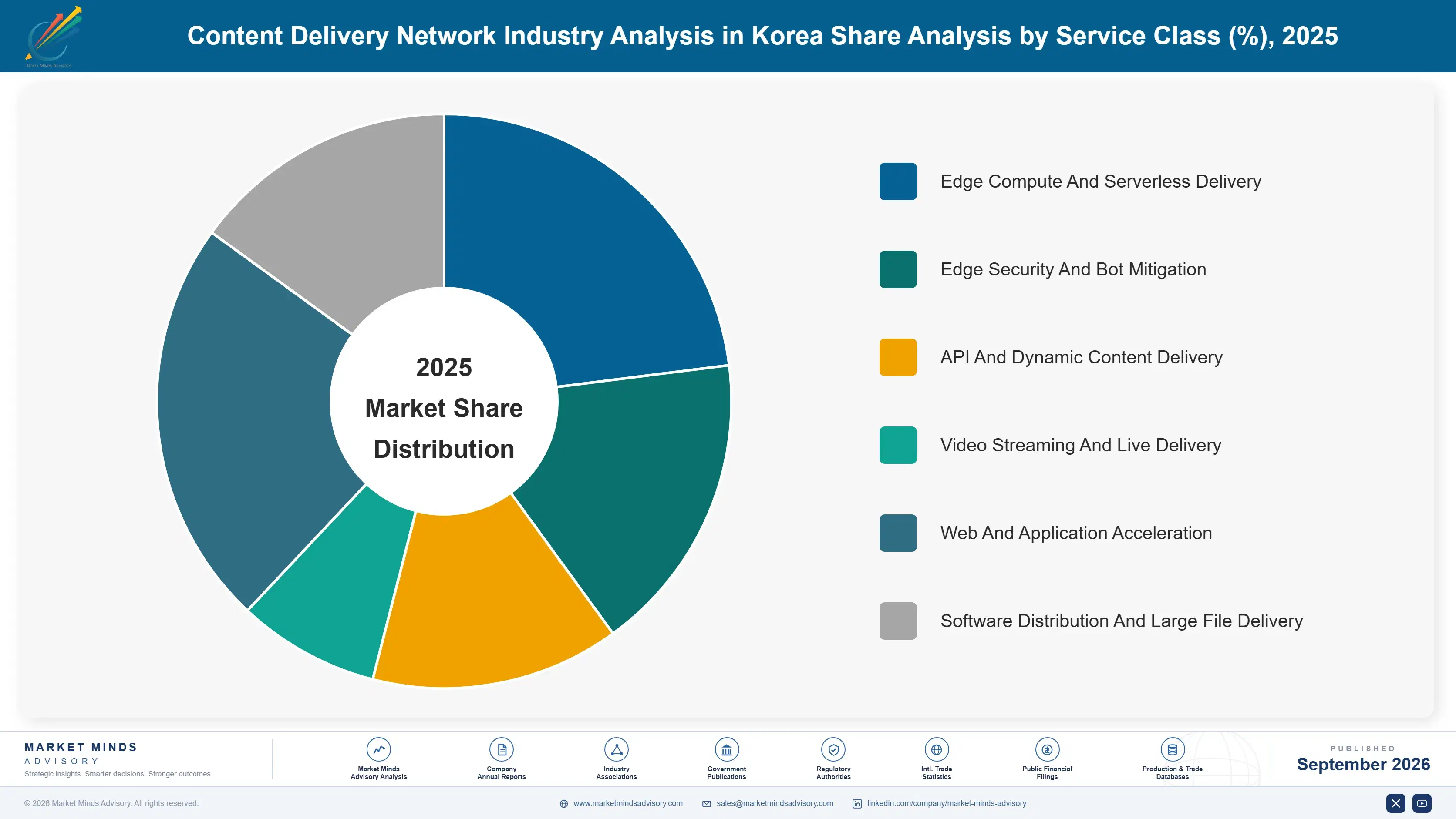
Segmentation follows service class, since what a provider executes at the edge determines how it prices and who buys it. Six classes cover the market: edge compute and serverless delivery, edge security and bot mitigation, API and dynamic content delivery, video streaming and live delivery, web and application acceleration, and software distribution. Contract structure and customer industry are separate dimensions.
content-delivery-network-industry-analysis-in-kore-market-share-analysis-1789985066811

Edge Compute and Serverless Delivery

Edge compute grows at 15.6%, half again the market rate of 10.4%, and it is quietly changing what these companies sell. Caching content was a bandwidth business priced per terabyte in a market where per-terabyte pricing has fallen for twenty years. Running authentication, request routing, personalisation and API logic at the edge is a compute business priced per request, with different economics and considerably better margins. Korean gaming and commerce customers adopt this fastest because a round trip to origin costs more latency than they can spend. The buyer is a developer rather than an infrastructure manager, and providers organised around network sales find that a difficult adjustment to make.
CAGR 15.6%

Edge Security and Bot Mitigation

Edge security grows at 13.4% and now attaches to almost every new delivery contract rather than selling separately. The logic is positional rather than technical: a delivery network already sits in front of the origin, so it is the only sensible place to absorb a volumetric attack, filter automated traffic or enforce access rules before anything expensive gets touched. Korean customers buy this heavily because gaming and commerce platforms here face sustained automated abuse at volumes that surprise operators elsewhere. Providers without credible security capability now lose delivery deals they would previously have won on price and performance, which has consolidated this market faster than anything else in the past five years.
CAGR 13.4%
Full segment breakdown across 6 segments available in the complete report.

Regional Architecture and Country Demand Map

East Asia leads at 34%, above the standard band, because this report centres on South Korea and the region carries the densest consumer traffic per head anywhere. Korea itself grows at 12.8%, faster than the regional average, on gaming and content export volume. Nowhere else looks like this.

East Asia

East Asia holds 34% of revenue, above the 30% band ceiling, and two things put it there: this report takes South Korea as its analytical centre, and the region genuinely carries the densest consumer traffic per head anywhere. Korea grows at 12.8%, faster than the regional average, on live gaming traffic and K-content export volume that reaches audiences paying for delivery in other markets. KT, SK Broadband and LG Uplus operate as access networks, domestic delivery providers and collectors of network usage fees simultaneously, a combination that exists in no other developed market. Japanese and Chinese demand adds volume on entirely separate commercial logic. That mix makes the region difficult to generalise about.
Share: 34% | CAGR: 11.6% (2026 to 2036)

North America

Twenty eight percent of revenue sits in North America, where the largest content providers and the largest delivery providers both originate. Akamai, Cloudflare, Fastly and the hyperscale cloud delivery services all sell from here into the rest of the world, and American streaming, software and commerce platforms generate the traffic that pays for it. Peering here is settlement-free by long convention, which is precisely the arrangement Korean rules departed from and which American providers now cite when arguing against similar proposals elsewhere. Growth at 9.6% sits below the global rate on a mature base with severe pricing pressure. The policy position matters more than the revenue share here, and everybody in the industry knows it.
Share: 28% | CAGR: 9.6% (2026 to 2036)
Regional intelligence for 5 additional markets available in the complete report: Western Europe, South Asia and Pacific, Latin America, Middle East and Africa, Eastern Europe. Contact sales@marketmindsadvisory.com.
content-delivery-network-industry-analysis-in-kore-country-cagr-analysis-1789985067336

How To Escape Per-Terabyte Pricing

Delivery pricing has fallen for twenty years and will keep falling, so a provider whose revenue depends on terabytes is running to stand still. Everything that matters commercially is about selling something else on the same infrastructure, or being positioned where the rules make foreign competition expensive. The levers below cover both routes properly.

Price On Requests, Not On Terabytes

Blended delivery pricing sits around USD 4.20 per terabyte and has fallen every year for two decades, which means a provider growing traffic volume can still shrink in revenue. Edge compute prices per request and per execution rather than per byte, and it compounds at 15.6% against 10.4% for the market. The infrastructure is already deployed, so the incremental cost of running customer logic on it is modest against what the capability commands. The commercial obstacle is that the buyer becomes a developer rather than an infrastructure manager, which most sales organisations here are not built to reach.
Market Impact: Escapes the USD 4.20 per terabyte trap entirely

Attach Security To Every Delivery Contract

A delivery network already sits in front of the origin, which makes it the only sensible place to absorb a volumetric attack or filter automated traffic before anything expensive is touched. Edge security compounds at 13.4%, faster than delivery itself, and it now attaches to almost every new contract rather than selling as an upsell afterwards. Korean gaming and commerce customers buy it particularly heavily because automated abuse volumes here surprise operators from elsewhere. A provider without credible security capability is now losing delivery deals it would previously have won on price and performance alone.
Market Impact: Edge security compounds at 13.4%, above delivery itself

Partner Inside The Korean Fee Arrangement

Content providers delivering into Korea face network usage charges that no other developed market imposes, and one large streaming platform withdrew from the country entirely in 2024 rather than keep paying them. The practical response for most others is to route Korean traffic through domestic providers already inside the fee arrangement, which converts a regulatory cost into a commercial partnership. That shifts revenue toward KT, SK Broadband, LG Uplus and the Korean delivery specialists and away from international providers selling directly. Any international provider without a Korean partner is quoting against a cost its competitors do not carry.
Market Impact: At least 1 platform left rather than pay

Build For Nine Millisecond Korean Expectations

Metropolitan Korean users sit around 9 milliseconds from an edge and behave as though that is normal, because for them it is. Korean live service gaming makes latency variance a commercial problem rather than a technical one, since a player who experiences inconsistent response leaves the title and does not come back. A provider serving Korea from a regional point of presence in Tokyo or Singapore cannot meet that expectation whatever its peering looks like. Domestic edge investment here exceeds what the population size justifies, and the customers require it regardless of the economics.
Market Impact: Korean users expect a 9 millisecond round trip

Who Controls the Margin Pool

Five providers hold 62% of delivery and edge services revenue globally, concentrated because network footprint and peering relationships take a decade and substantial capital to assemble. Akamai leads on enterprise delivery and security. Cloudflare leads on developer adoption and edge compute. Amazon and the other hyperscale clouds bundle delivery into broader agreements. Fastly holds a strong developer position at smaller scale. All participants are assessed on delivery and edge services revenue.
Korea competes on a different basis entirely. KT, SK Broadband and LG Uplus are the access networks, domestic delivery providers and the parties collecting network usage fees at the same time, which gives them a position no international competitor can replicate. GS Neotek and CDNetworks hold specialist domestic positions. International providers serve Korea through partnership more often than directly.

Rankings shift as the product changes underneath everybody. Delivery pricing keeps falling and edge compute keeps growing, which favours providers whose customers are developers over those selling to network procurement. The other pressure is regulatory: whether European policy adopts a Korean-style arrangement would reshape international delivery economics more than any technology change on the horizon.
content-delivery-network-industry-analysis-in-kore-company-positioning-matrix-1789985067863

Competitive Moat and Risk Dimensions

AKAMAI TECHNOLOGIES

Moat: Deployed Network Footprint

Akamai operates edge capacity inside a very large number of access networks worldwide, placed there over decades through individual agreements that a competitor cannot assemble quickly at any price. That embedded position is what allows delivery from inside the last mile rather than from a regional facility, which is the whole performance argument. Capital alone does not replicate it.
AKAMAI TECHNOLOGIES

Risk: Enterprise Sales Orientation

The company sells to network and procurement functions at large enterprises, which suited a bandwidth business and suits an edge compute business considerably less. Edge compute compounds at 15.6% and the buyer is a developer choosing a platform rather than a procurement team negotiating a contract. Competitors built around developer adoption reach that person first and cheaply.
KT CORPORATION

Moat: Access Network Ownership

KT is simultaneously the access network reaching Korean subscribers, a domestic delivery provider and a party collecting network usage fees from content providers, which is a combination no international competitor can hold. Traffic delivered through KT avoids charges that traffic delivered around it incurs. That is a commercial advantage created by regulation rather than by engineering.
KT CORPORATION

Risk: Regulation Could Reverse

The position rests on a legal arrangement the National Assembly has debated repeatedly and could change, and on international pressure that has grown since one platform left the country. A domestic advantage built on statute rather than on capability disappears the moment the statute does. The company has limited presence outside Korea to fall back on.

Players Tracked

Prominent Players

Akamai Technologies
Cloudflare
Amazon Web Services
Fastly
KT Corporation

Other Key Players

GS Neotek
CDNetworks
Naver Cloud
SK Broadband
LG Uplus
Kakao Enterprise
Google Cloud
Microsoft Azure
KINX
Gcore
Bunny.net
Tencent Cloud
Alibaba Cloud
Imperva
StackPath

Recent Developments

JANUARY 2025

Cloudflare Extends Edge Compute Runtime Across Its Network

Cloudflare extended its edge compute runtime and storage capability across its network, an organic product development rather than an acquisition. The work targets customers moving authentication, personalisation and API logic away from origin infrastructure, which converts a bandwidth relationship priced per terabyte into a compute relationship priced per request.
Signal: The business is moving from bytes delivered to code executed, which reprices everything in this category.
NOVEMBER 2024

KT Expands Domestic Edge Capacity For Korean Gaming Traffic

KT Corporation expanded domestic edge delivery capacity aimed at Korean live service gaming traffic, an organic capital investment rather than a partnership or acquisition. The build targets latency variance rather than throughput, which is the measure Korean game publishers treat as a commercial risk rather than an engineering specification.
Signal: Korean latency expectations sit far beyond what population size alone would ever justify building for at all.
APRIL 2025

Akamai Consolidates Security And Delivery Into Single Agreements

Akamai Technologies moved to selling security and delivery under consolidated customer agreements rather than as separate products, an organic commercial change rather than a transaction. The approach reflects buyers who now evaluate one provider on both, and it makes delivery-only competitors difficult to compare against on a like basis.
Signal: Bundling security with delivery removes the price comparison that a pure delivery competitor entirely depends on.

What Delivering A Terabyte Costs

Bandwidth and transit account for roughly 36% of delivery cost, purchased from carriers or exchanged under peering agreements that vary enormously by region. Edge server hardware and its depreciation add about 22%, refreshed on cycles shorter than most infrastructure. Colocation, power and cooling carry around 18%, and in Korea network usage fees add a line that exists in no other developed market.
Akamai Technologies Annual Report 2024 records network and colocation costs alongside bandwidth purchasing as the dominant delivery cost variables. Cloudflare Annual Report 2024 notes comparable pressure with a heavier weighting toward compute hardware. European energy costs through 2022 and 2023 raised colocation pricing sharply at edge locations across the continent, and providers with long colocation commitments absorbed increases they had no contractual ability to pass through to customers.

The competitive disadvantage mechanism is cache hit ratio rather than any input price. A provider serving 94% of requests from the edge buys far less origin transit than one serving 80%, on identical customer traffic, and the difference lands entirely in gross margin. Cache efficiency depends on network scale and on how many customers share the same edge, which compounds for the largest providers and punishes the smallest.
content-delivery-network-industry-analysis-in-kore-cost-volatility-analysis-1789985068065

Raise Cache Hit Ratio Before Buying More Bandwidth

Bandwidth and transit run about 36% of delivery cost, and every request served from the edge rather than fetched from origin removes that cost entirely. Moving from a mid-eighties hit ratio toward 94% cuts origin transit purchasing by a large fraction on identical customer traffic. The work is cache configuration and content strategy rather than capital.

Negotiate Energy Escalation Into Colocation Agreements

Colocation, power and cooling run around 18% of delivery cost and the 2022 European energy crisis showed how quickly that line moves. Providers with long colocation commitments absorbed increases they could not pass on to customers under existing contracts. Negotiating a symmetrical escalation clause at renewal costs nothing and removes an exposure nobody in this industry hedged.

Route Korean Traffic Through Domestic Partner Networks

Korean network usage fees add a cost line that exists in no other developed market and that an international provider carries directly. Routing that traffic through a domestic partner already inside the fee arrangement converts a regulatory charge into a partnership margin. The commercial cost is sharing revenue, and the alternative is quoting against competitors who carry nothing.

Portfolio Architecture for Margin Defence

Margin architecture separates on whether the product is measured in bytes. Software distribution and web acceleration earn least, competed as pure bandwidth against three or four credible suppliers with no switching friction at all. Video and API delivery sit in the middle. Edge compute and edge security earn most, because each prices on requests or on value rather than on terabytes and each runs on infrastructure the provider already deployed.
The volume versus premium tension is unusual because the same infrastructure serves both. An edge server delivering cached video and one running customer code are the same machine with different software on it, so there is no capacity allocation conflict. The tension is entirely commercial: a sales organisation built to negotiate bandwidth contracts with procurement cannot easily reach the developer choosing an edge compute platform.

High-value pools sit in edge compute and edge security, and both reward developer relationships rather than network scale. In Korea a third pool exists that has nothing to do with either: the regulatory position of the domestic access networks, which collects margin no capability produces. That pool is worth understanding and impossible for an international provider to enter directly.

Volume / Commodity-Adjacent

Software distribution and web application acceleration sold as pure bandwidth against several credible suppliers with no switching friction. The eight point spread separates providers with high cache hit ratios from those buying more origin transit.
Gross Margin: 34% to 42%

Premium / Certified

Video streaming, live delivery and API dynamic content sold on performance guarantees and committed volume rather than on list pricing. The ten point spread tracks contract commitment depth and regional peering quality.
Gross Margin: 48% to 58%

Sustainability / Regulatory / Next-Generation

Edge compute, serverless execution and edge security, each priced on requests or value rather than bytes and each running on infrastructure already deployed. The twelve point spread reflects how much of a provider's book has moved off per-terabyte pricing.
Gross Margin: 64% to 76%
content-delivery-network-industry-analysis-in-kore-portfolio-architecture-1789985068568

High-value Sub-segments and Strategic Watch-out

Edge Compute And Serverless Delivery

Grows at 15.6% by converting a bandwidth business priced per terabyte into a compute business priced per request. The twelve point spread reflects how far each provider has moved off byte-based pricing. The buyer is a developer, which most sales organisations here cannot reach easily.
Gross Margin: 64% to 76%

Edge Security And Bot Mitigation

Grows at 13.4% and attaches to almost every new delivery contract, because the network already sits in front of the origin. The twelve point spread reflects detection capability depth. Providers without credible security now lose delivery deals they would once have won on price alone.
Gross Margin: 64% to 76%

Video Streaming And Live Delivery

Grows at 9.6% and carries the largest traffic volume in this market, on pricing that has fallen every year for two decades. The ten point spread tracks cache hit ratio more than anything commercial. Korean network usage fees hit this segment hardest of all by far.
Gross Margin: 48% to 58%

Software Distribution And Large File Delivery

Grows at 5.2%, slowest of the six classes, and competes as pure bandwidth where price is effectively the only variable a buyer considers. The eight point spread reflects cache efficiency alone. Providers keep this business because customers expect a complete delivery range from one supplier.
Gross Margin: 34% to 42%

How Delivery Contracts Actually Work

The annuity is the committed volume contract. Customers commit to a monthly traffic floor in exchange for pricing well below list, typically over one to three years, and those commitments renew because migrating delivery is disruptive in ways the pricing difference rarely justifies. Edge compute deepens that further, since customer code running on a provider's runtime is genuinely difficult to move rather than merely inconvenient. Nobody switches delivery provider casually any more.
Adoption depth varies sharply by customer type. Streaming platforms adopt broadly and negotiate hardest, since delivery is a major cost line they measure continuously. Korean game publishers adopt deeply on latency grounds and switch rarely. Commerce platforms adopt security first and delivery second. Software distributors adopt on price alone and move whenever somebody quotes lower, which is frequently.

The buyer moved from network procurement to engineering and is now moving again toward the developer. A procurement team compared price per terabyte across three quotes. An engineering lead compares performance data and security capability. A developer picks a platform on documentation quality and how quickly something runs, and never speaks to a salesperson at all before deciding.
content-delivery-network-industry-analysis-in-kore-end-use-penetration-index-1789985069062

Where Korea Changes The Answer

These are among the four positions where our research anticipates prominent divergence between winners and laggards over the coming forecast period. Each is grounded in the demand model, the regulatory perimeter, and the announced capacity pipeline.
01 / PRICING MODEL MIGRATION

Get Revenue Off The Terabyte Meter

Blended delivery pricing sits around USD 4.20 per terabyte and has fallen every year for two decades, which means a provider growing traffic volume can still shrink in revenue terms. Edge compute prices per request and per execution rather than per byte, compounds at 15.6% against 10.4% for the market, and runs on infrastructure that is already deployed and paid for. The obstacle is commercial rather than technical, since the buyer becomes a developer choosing a platform rather than a procurement team, and most sales organisations cannot reach them.
02 / KOREAN PARTNERSHIP NECESSITY

Serve Korea Through A Domestic Partner

Korean access networks bill content providers for traffic their own subscribers requested, an arrangement that exists nowhere else among developed markets and that Korean courts have upheld repeatedly. One large live streaming platform first degraded Korean video quality and then withdrew from the country entirely in early 2024 rather than keep paying, which is clear evidence of what the charge is worth. Routing Korean traffic through a domestic provider already inside the fee arrangement converts a regulatory cost into a partnership margin, and any provider without one carries it alone.
03 / SECURITY ATTACHMENT DISCIPLINE

Never Quote Delivery Without Security Attached

A delivery network already sits in front of the origin, which makes it the only sensible place to absorb a volumetric attack or filter automated traffic before anything expensive gets touched. Edge security compounds at 13.4%, faster than delivery itself, and now attaches to almost every new contract rather than selling as an upsell somebody remembers later. Korean gaming and commerce customers buy it particularly heavily because automated abuse volumes here surprise operators from elsewhere, and a provider without credible security loses delivery deals it would once have won outright.
04 / CACHE EFFICIENCY INVESTMENT

Improve Hit Ratio Before Buying Transit

Bandwidth and transit run about 36% of delivery cost, and every request served from the edge rather than fetched from origin removes that cost from the equation entirely. A provider serving 94% of requests from the edge buys far less origin transit than one serving 80% on identical customer traffic, and the whole difference lands in gross margin. Cache efficiency depends on network scale and on how many customers share the same edge, so it compounds for the largest providers and punishes the smallest, which explains the 62% concentration here.

Engagement Snapshot From the Field

A live engagement with an industry participant carrying material or product regulatory and market exposure ahead of a defining policy shift, showing how our research translates into a defensible multi-year portfolio strategy.
MARKET MINDS ADVISORY · CLIENT ENGAGEMENT SUMMARY
Content Delivery Network Industry Analysis in Korea Producer Strategic Portfolio Review and Transition Roadmap 2026·Investment Scenario on Content Delivery Network Industry Analysis in Korea Exposure Evaluation 2025-26
CLIENT PROFILE
A Korean streaming platform serving domestic subscribers and a growing international audience for Korean content, delivering through a mix of international providers and one domestic partner. Network usage fee exposure had risen with traffic and nobody inside the company could say precisely which delivery paths incurred it. Delivery cost had become the second largest line in the operating budget.
STRATEGIC CHALLENGE
Finance wanted delivery cost reduced and engineering warned that consolidating onto the cheapest provider would raise Korean latency past what subscribers tolerate. Neither team had modelled network usage fee exposure by delivery path, so the cheapest quoted rate was not necessarily the cheapest delivered cost. A renewal decision was due within one quarter across three separate contracts.
MMA APPROACH
MMA rebuilt delivery cost by path rather than by contract, attributing network usage fee exposure to each route and adding it to the quoted rate to produce a genuinely comparable delivered cost. We modelled Korean latency by metropolitan area against each configuration, and drew on 47 expert interviews conducted in Q4 2025 with delivery providers, Korean access networks and comparable streaming operators.
KEY FINDINGS
  1. The provider quoting the lowest rate delivered the highest total cost once network usage fee exposure was attributed by path (client-reported, unverified by MMA).
  2. Roughly 3 in 10 domestic requests were being served from outside Korea, adding both latency and fee exposure that nobody had noticed.
  3. International delivery of Korean content to overseas audiences carried no network usage fee at all, which made it the segment worth consolidating on price.
  4. Raising the domestic cache hit ratio toward 94% cut origin transit and fee exposure together, delivering more saving than any contract renegotiation offered (client-reported, unverified by MMA).
CLIENT PROFILE
A Korean streaming platform serving domestic subscribers and a growing international audience for Korean content, delivering through a mix of international providers and one domestic partner. Network usage fee exposure had risen with traffic and nobody inside the company could say precisely which delivery paths incurred it. Delivery cost had become the second largest line in the operating budget.
STRATEGIC CHALLENGE
Finance wanted delivery cost reduced and engineering warned that consolidating onto the cheapest provider would raise Korean latency past what subscribers tolerate. Neither team had modelled network usage fee exposure by delivery path, so the cheapest quoted rate was not necessarily the cheapest delivered cost. A renewal decision was due within one quarter across three separate contracts.
MMA APPROACH
MMA rebuilt delivery cost by path rather than by contract, attributing network usage fee exposure to each route and adding it to the quoted rate to produce a genuinely comparable delivered cost. We modelled Korean latency by metropolitan area against each configuration, and drew on 47 expert interviews conducted in Q4 2025 with delivery providers, Korean access networks and comparable streaming operators.
KEY FINDINGS
  1. The provider quoting the lowest rate delivered the highest total cost once network usage fee exposure was attributed by path (client-reported, unverified by MMA).
  2. Roughly 3 in 10 domestic requests were being served from outside Korea, adding both latency and fee exposure that nobody had noticed.
  3. International delivery of Korean content to overseas audiences carried no network usage fee at all, which made it the segment worth consolidating on price.
  4. Raising the domestic cache hit ratio toward 94% cut origin transit and fee exposure together, delivering more saving than any contract renegotiation offered (client-reported, unverified by MMA).
RECOMMENDED STRATEGY
Phase 1: Phase one: split the delivery estate, routing all domestic traffic through the Korean partner and consolidating international delivery onto the cheapest capable provider. Phase 2: Phase two: fund cache configuration work to raise the domestic hit ratio, since that reduces transit and fee exposure at once. Phase 3: Phase three: report delivered cost by path including fee exposure in every renewal review, so quoted rates stop driving the decision.
OUTCOME
The platform split its delivery estate along domestic and international lines and funded the cache work first (client-reported, unverified by MMA). Total delivered cost fell while Korean latency improved slightly, which neither the finance nor the engineering proposal had achieved alone. Delivered cost by path now appears in every contract renewal review.

Frequently Asked Questions

Foundational context covering the market sizes, CAGR, scope, country, region and competition that inform every finding below. This section is provided to cover basics and most often pre-purchase conversations, answered from the MMA Primary Research Dataset.

What is the current size of the Content Delivery Network Industry Analysis in Korea?

Global value reaches USD 24.73 billion in 2026, measured as delivery and edge services revenue across all service classes. The 2025 base is USD 22.4 billion.

How large will the Content Delivery Network Industry Analysis in Korea be by 2036?

Delivery and edge services revenue reaches USD 66.52 billion by 2036, an increase of USD 41.79 billion over the forecast period. That represents 2.69 times expansion from 2026.

What is the CAGR for the Content Delivery Network Industry Analysis in Korea 2026 to 2036?

The base case runs at 10.4% annually, with a bull case at 11.6% if edge compute displaces origin workload and a bear case at 9.2% if per-terabyte price erosion continues outrunning volume.

Which segment is growing fastest?

Edge compute and serverless delivery grow at 15.6%, half again the market rate of 10.4%. Customers are running authentication, personalisation and API logic at the edge rather than at origin.

Who are the major companies in the Content Delivery Network Industry Analysis in Korea?

Akamai Technologies, Cloudflare, Amazon Web Services, Fastly and KT Corporation lead on delivery and edge services revenue, together holding 62%. GS Neotek and CDNetworks hold strong Korean positions.

Which country is growing fastest?

South Korea, the country in scope, grows at 12.8% on live gaming traffic and K-content export volume together. India and Indonesia grow faster globally on lower price points.

Report Segmentation Architecture

The full report scope spans multiple orthogonal segmentation dimensions, with cross-tabulated demand data provided for each dimension pair. Coverage extends further to regional breakdowns, trend trajectories, and the competitive detail needed to support segment-level decision-making.

By Service Class

  • Edge Compute And Serverless Delivery
  • Edge Security And Bot Mitigation
  • API And Dynamic Content Delivery
  • Video Streaming And Live Delivery
  • Web And Application Acceleration
  • Software Distribution And Large File Delivery

By End-Use Industry

  • Media And Streaming Platforms
  • Online Gaming And Live Services
  • Retail And Commerce
  • Financial Services
  • Software And Technology Platforms
  • Public Sector And Education

By Commercial Dimension

  • Committed Volume Contracts
  • Usage Based Self-Service
  • Hyperscale Cloud Bundling
  • Domestic Partner Reselling
  • Managed Service Provider Channel
  • Telecommunications Operator Supply

By Region

  • North America
  • Western Europe
  • East Asia
  • South Asia and Pacific
  • Latin America
  • Middle East and Africa
  • Eastern Europe

Scope, Methodology, and Coverage

Every figure in this report is reproducible from documented input assumptions. The scope below maps the historical period, the forecast horizon, the segmentation dimensions, and the countries covered, alongside the underlying primary and qualitative methodology.
Historical Period
2020 to 2025
Forecast Period
2026 to 2036
Base Year
2025 (USD billions; MMA Primary Research Dataset, September 2026)
Market Definition
This report analyses the content delivery network industry with South Korea as its analytical centre, sized on the global market: edge compute and serverless delivery, video streaming and live delivery, web and application acceleration, edge security and bot mitigation, API and dynamic content delivery, and software distribution. It excludes transit and backbone capacity, data centre colocation, origin cloud compute and storage, and consumer broadband access services.
Quantitative Units
USD millions, delivery and edge services revenue basis; terabytes delivered; cache hit ratio as a percentage; round trip latency in milliseconds; blended price per terabyte in USD.
Segmentation Dimensions
Service class; end-use industry; commercial contract model; geography across seven regions with South Korea as the analytical centre.
Regions Covered
North America, Western Europe, East Asia, South Asia and Pacific, Latin America, Middle East and Africa, Eastern Europe
Countries Covered
South Korea, Japan, China, Taiwan, India, Indonesia, Australia, United States, Canada, Mexico, Brazil, Chile, United Kingdom, Germany, France, Netherlands, Poland, Saudi Arabia, United Arab Emirates, South Africa.
Key Companies Profiled
Akamai Technologies, Cloudflare, Amazon Web Services, Fastly, KT Corporation, GS Neotek, CDNetworks, Naver Cloud, SK Broadband, LG Uplus, Kakao Enterprise, KINX, Gcore, Tencent Cloud, Alibaba Cloud.
Quantitative Methodology
Primary survey, n=3,800 respondents, Q4 2025, six countries; demand-side model with trade association cross-validation
Qualitative Methodology
47 expert interviews, Q4 2025; applied to validate demand model assumptions, identify emerging dynamics, and assess competitive positioning
Report Format
PDF and XLSX data workbook (Word format preview document)
Publisher
Market Minds Advisory
Report Code
MMA-2026-TEC-371
Published
September 2026
Contact
sales@marketmindsadvisory.com | www.marketmindsadvisory.com

Purchase the full Content Delivery Network Industry Analysis in Korea Report (2026 to 2036).

This report analyses the content delivery network industry with South Korea as its analytical centre, sized on the global market from 2026 to 2036 across six service classes, six end-use industries and seven regions. It sets out why Korean network usage fees make this the one market where delivery economics are set partly by statute, and what that cost one large streaming platform. Cost composition is sourced to company annual reports, with bandwidth and transit at 36% of delivery cost. Regional analysis explains why East Asia leads at 34% of revenue. Competitive assessment covers 20 named providers with four revenue lever analyses and an anonymised Korean streaming engagement.
Korean network usage fee economics modelled by path
Six delivery service classes sized through to 2036
Bandwidth and colocation cost composition from filings
Twenty named providers assessed on services revenue
Four revenue levers with quantified commercial impact
Anonymised Korean streaming delivery engagement included in full

Built For The People Who Decide

From boardroom strategy to bench-side execution, this report is read cover-to-cover by leaders shaping the next decade of their industry, turning demand scenarios, market dynamics and valuation benchmarks into decisions.
CXOs/ Presidents/ VPs/ Managers
M&A and Corporate Development
Strategy Teams and R&D Heads
Procurement and Product Directors
Regulatory and Compliance Leaders
Investor Relations and Equity Analysts