Market Minds Advisory
Content Curation Software Market

Content Curation Software Market: Content Curation Software Market: Generation Glut, Rights Liability and Where Selection Became Valuable 2026 to 2036

Producing content stopped being difficult, which destroyed most of the value in producing any of it. Deciding what deserves attention became the scarce capability, and that is an entirely different product.

Lead Analyst

Published

September 2026

Make Smarter Decisions with Customized Research Insights

Request a free sample report and evaluate market opportunities, growth trends, and competitive dynamics relevant to your business needs.

2025 MARKET VALUE$2.6BMarket Size 2025
2036 FORECAST VALUE$8.6BBase Case , 2026 to 2036
CAGR 2026 TO 203611.5 %Bull 12.8% / Bear 10.3%
INCREMENTAL OPPORTUNITY$5.7BNet 10- year value creation
EXPANSION MULTIPLE2.97x2036 value over 2026 base
Strategic Levers
M&A Pipeline
Regional Outlook
Country Rankings
Competitive Intelligence
Segmental Deep-dive
Call-Us : 91 93563 13602

Executive Snapshot and Market Trajectory.

Producing content stopped being difficult, and that destroyed most of the value in producing any of it. Deciding what actually deserves anybody's attention became the genuinely scarce capability instead, which is a completely different product, sold to a different buyer for entirely different reasons.
The market reaches USD 2.9 billion in 2026 and USD 8.6 billion by 2036, a 2.97 times expansion at 11.5% annually. Rights and provenance verification modules grow at 17.3%, half again the market rate of 11.5%, because publishing something without knowing where it came from has now become a genuine legal exposure. East Asia holds 27% of global spending, and India compounds fastest at 18.9% on media and commerce content operations expanding at real pace.
Five vendors hold just 29% of licence and subscription revenue, the lowest concentration in any software category that we cover anywhere, because curation capability keeps getting absorbed into adjacent platforms instead of consolidating into specialists. Contentful, Sitecore, Curata, Sprinklr and Feedly lead what remains of it. Standalone curation tools consequently face a permanent question about whether the function really belongs inside something the customer already owns anyway.
Market Definition
This report covers content curation software by function class: rights and provenance verification modules, content discovery and aggregation engines, editorial workflow and selection platforms, audience personalisation and recommendation systems, content quality and moderation tooling, and archive and reuse management systems. It excludes content creation and authoring tools, digital asset management sold as storage, social media publishing schedulers, general search engines, advertising technology platforms, and content delivery network infrastructure.
Base Year Value
$2.6B in 2025 (MMA Primary Research Dataset, September 2026)
Forecast Period
2026 to 2036, eleven discrete annual values
CAGR
11.5% base case. Bull 12.8%. Bear 10.3%.
Fastest Growth Segment
Rights And Provenance Verification Modules: 17.3% CAGR
Fastest Growth Country
India: 18.9% CAGR
Fastest Growth Region
South Asia and Pacific: 13.7% CAGR
Largest Region
East Asia: 27% of 2025 global value
Market Leaders
Contentful, Sitecore, Curata, Sprinklr and Feedly lead on content curation software licence and subscription revenue. Source: MMA Analysis.
Primary Survey
n=3,800 procurement and R&D decision-makers, Q4 2025, six countries
Methodology
Demand-side build-up, cross-validated against public data, 47 expert interviews

Content Curation Software Market Forecast Scenarios

content-curation-software-market-size-forecast-scenario-1789996459594
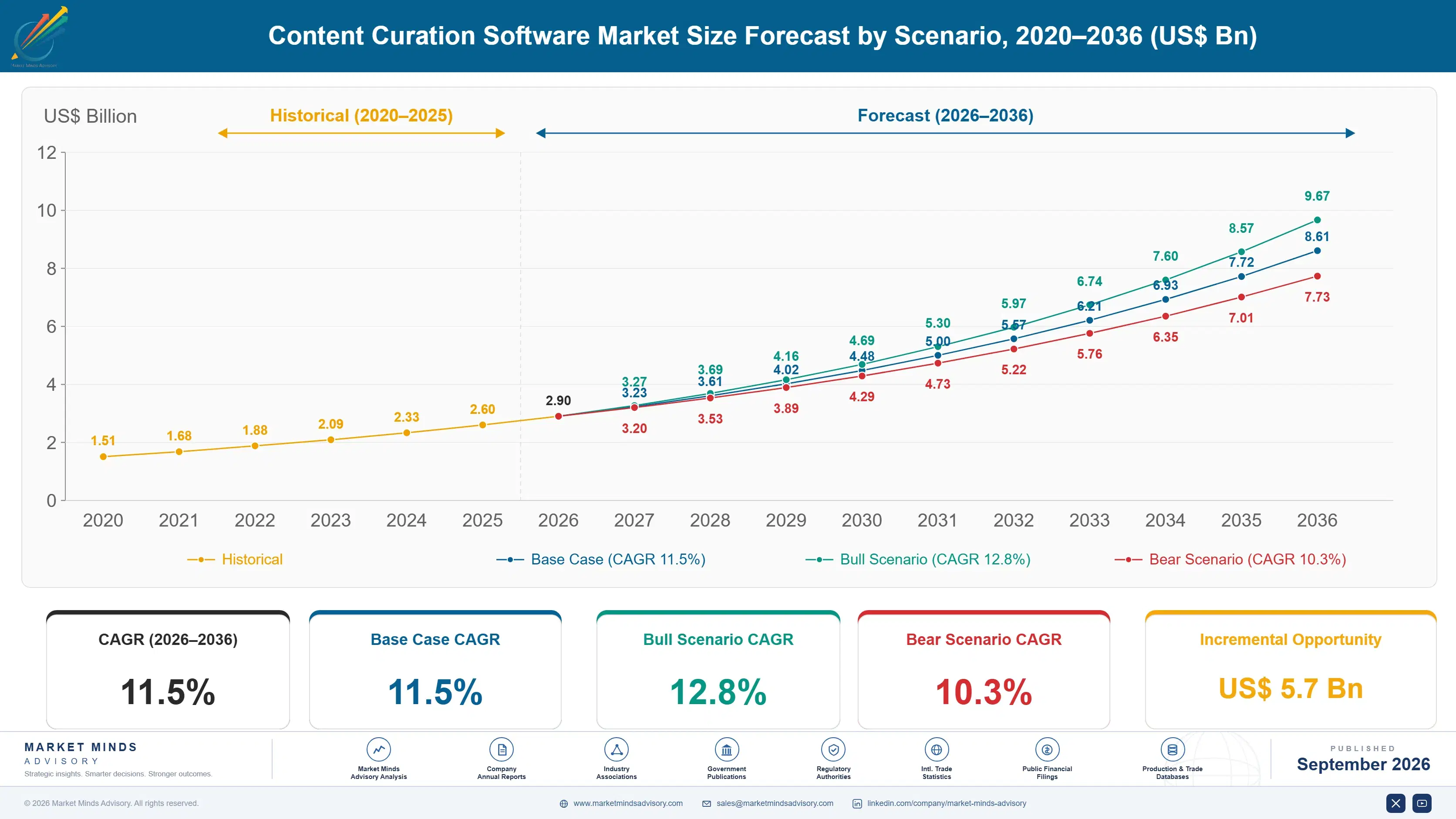
Between 2020 and 2025 the category compounded at 10.3%, and the underlying driver changed halfway through the period. Early growth came from marketing teams wanting more content than they could produce. Later growth came from the opposite problem entirely: generation tools produced more material than any organisation could review, and the bottleneck moved from creation to selection almost overnight without anybody planning for it.
The base case holds 11.5% on three mechanisms. Rights and provenance obligations keep tightening as publishers face liability for material whose origin they cannot establish. Content volume keeps rising faster than editorial headcount, which forces selection into software rather than into meetings. And commerce platforms across India and Southeast Asia keep building content operations at genuine scale, creating requirements in markets that had comparatively little published output only five years ago.
The bull case at 12.8% assumes provenance requirements become mandatory rather than advisory in more jurisdictions, which would convert a reputational concern into a compliance purchase. The bear case at 10.3% is platform absorption: content management and marketing suites keep adding curation features, and an organisation with adequate capability inside an existing platform has limited reason to buy a separate product.

Selection Became The Scarce Thing

The economics of this category inverted within about five years. When producing content was expensive, tools that helped you make more of it were valuable. Production became close to free, which made the material worth little and made deciding what deserves attention the scarce thing. That is a genuinely different product, sold to editors and compliance functions rather than to marketing teams.
TOP FIVE CONCENTRATION29%The lowest concentration across any software category we cover
UNVERIFIED PROVENANCE SHARE34%Published items whose original source cannot be established reliably
EDITORIAL REVIEW CAPACITY140 itemsMaterial a single editor can meaningfully assess each week
CONTENT VOLUME GROWTH58%Annual increase in items requiring review at typical publishers
PLATFORM ABSORPTION RATE41%Buyers whose curation runs inside a broader existing platform
REUSE DISCOVERY RATE23%Existing material found and reused rather than commissioned again
The volume arithmetic explains why software rather than headcount is the answer. A single editor can meaningfully assess around 140 items a week, and the volume requiring review at a typical publisher rises roughly 58% annually. No organisation is hiring editors at that rate. Selection either moves into software or it stops happening properly, and a great many organisations have quietly chosen the second option without admitting it.
The uncomfortable part is provenance. Around 34% of published items have origins that cannot be reliably established, which was a curiosity when everything was written by identifiable people and is a liability now. Rights and provenance verification modules grow at 17.3% against 11.5% for the market. The buyer is legal or compliance rather than editorial, and that buyer asks questions no content tool was originally designed to answer.
"For twenty years this industry sold help making more content. Then making content became trivial and the whole value proposition collapsed. What nobody in the category wants to say plainly is that their old product got commoditised by exactly the technology they now put in their marketing."
Director, Content Operations and Publishing Technology Practice · MMA Technology Practice · September 2026

Market Trends

Provenance Became A Liability Rather Than A Curiosity

Around 34% of published items have origins that cannot be reliably established, which mattered very little when everything was written by identifiable people and matters enormously now that it is not. Publishers face genuine legal exposure for material whose source they cannot demonstrate, particularly wherever rights, attribution or accuracy claims are attached to it. Rights and provenance verification modules consequently grow at 17.3% against 11.5% for the market. The buyer here sits in legal or compliance rather than in editorial, and asks questions that content tools were simply never designed to answer.
Market Impact: Reuse reaches 23% of requirements
Volume Growth Outruns Editorial Review Capacity Entirely

A single editor can meaningfully assess around 140 items each week, while the volume requiring review at a typical publisher rises roughly 58% annually as generation tools spread through every function that touches content in any way at all. No organisation anywhere in the world is hiring editorial staff at anything remotely approaching that rate. Selection either moves into software of some kind or it quietly stops happening properly altogether, and a considerable number of organisations appear to have chosen the second option without ever admitting it to anybody, including themselves.
Market Impact: India compounds at 18.9% annually

Market Opportunities and Growth Drivers

Reuse Discovery Reduces Commissioning Spend Measurably

Organisations routinely commission material that they already own, simply because nobody can find the existing version, and archive systems that surface reusable content lift the reuse rate to around 23% of total requirements. That converts directly into commissioning budget never spent, which is one of the very few genuinely measurable returns available anywhere across content operations. Archive and reuse management systems consequently grow at 12.8% as a direct result of that, and that argument lands with finance functions in a way that editorial quality claims have never once managed to.
Market Impact: Some 41% use existing platforms

Commerce Content Operations Scale In New Markets

Marketplace and commerce platforms right across India and Southeast Asia now produce product content at volumes requiring genuinely industrial selection rather than any kind of editorial judgement applied item by item. India compounds at 18.9%, faster than any other market measured anywhere, on commerce and media content operations that barely existed at this kind of scale even five years ago. Those organisations build curation into their content operations from the very start rather than retrofitting it later, which produces considerably cleaner and faster deployments than established publishers ever seem to manage.
Market Impact: Reuse saves 23% of commissioning

Market Restraints and Challenges

Adjacent Platforms Keep Absorbing The Curation Function

Around 41% of buyers already run their curation inside a content management or marketing platform they own, and those vendors keep extending capability rather than leaving the gap open for anybody else to fill. The root cause is that curation is really a feature of content operations rather than a separate discipline that anybody staffs independently. Commercially this caps the standalone market permanently. Mitigation runs through provenance verification and archive reuse, both of which platform vendors have been slow to build and which carry obligations they would rather not assume.
Market Impact: Some 34% lack verified provenance

Selection Quality Resists Any Convincing Measurement

Nobody can demonstrate that curated content performed any better than uncurated content would have, because the counterfactual does not exist and every available proxy measure is contested by somebody. The root cause is simply that content value is genuinely hard to attribute and always has been hard to attribute properly. Commercially this makes budget defence genuinely difficult in every single review cycle. Mitigation runs through reuse discovery at around 23% of requirements, which converts into commissioning spend avoided, and through provenance verification where the risk is legal rather than aesthetic.
Market Impact: Editors assess 140 items weekly
4 additional market trends, 3 additional growth drivers, and 2 additional restraints and challenges are covered in the full report. Contact sales@marketmindsadvisory.com to access the complete intelligence.

Segment CAGR and Growth Architecture

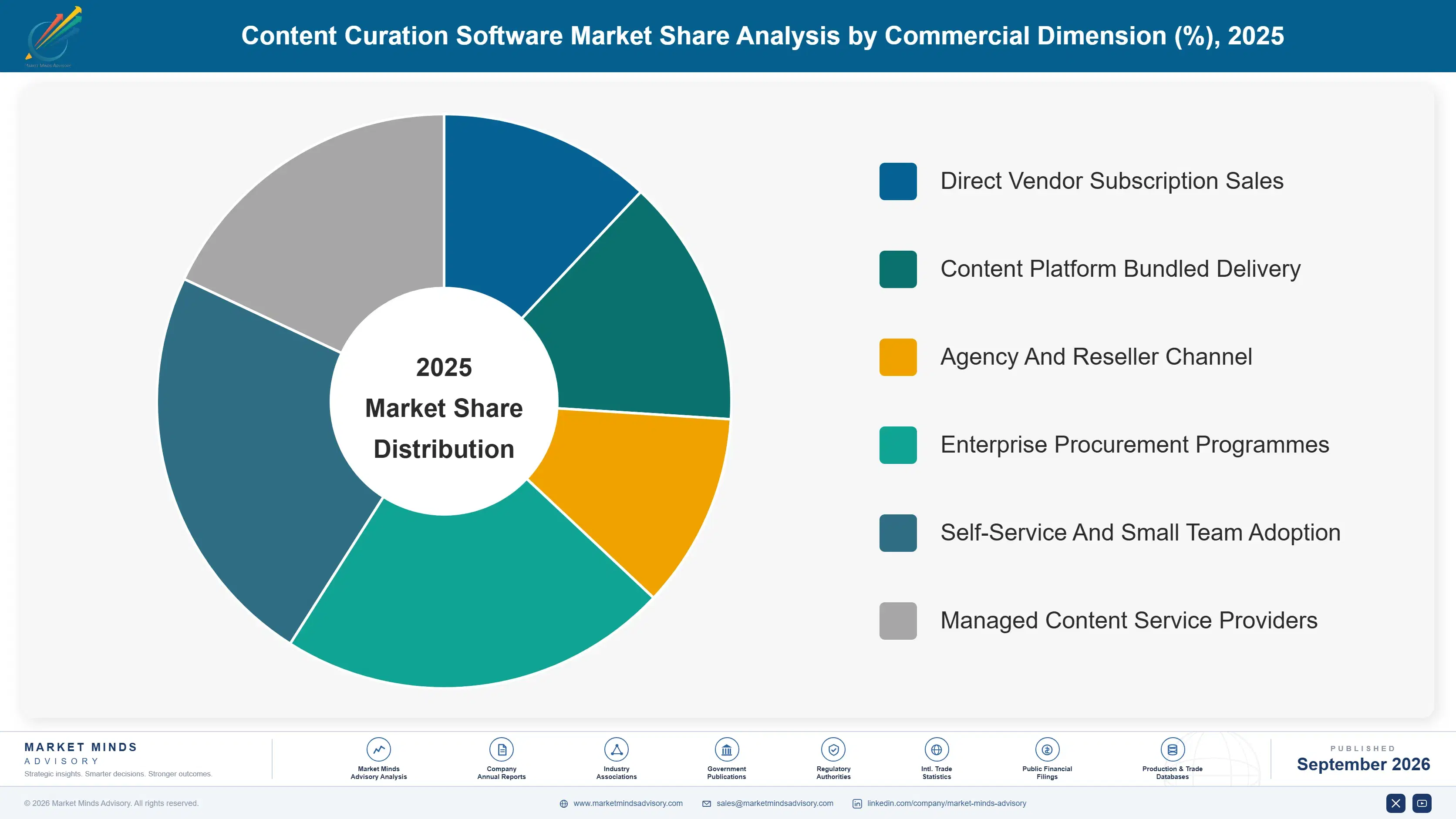
Segmentation follows function class, since each addresses a different problem and carries a different buyer inside the organisation. Six classes cover the market, spanning provenance verification, discovery and aggregation, editorial workflow, personalisation, moderation tooling and archive reuse management. Organisation type and commercial delivery route are separate dimensions handled elsewhere in this report rather than mixed into this hierarchy.
content-curation-software-market-market-share-analysis-1789996460127

Rights And Provenance Verification Modules

Rights and provenance verification modules grow at 17.3%, half again the market rate of 11.5%, because around 34% of published items have origins nobody can reliably establish and that has become a genuine legal exposure rather than a curiosity. Publishers now face genuine liability for material whose source they cannot demonstrate, particularly wherever rights, attribution or accuracy claims attach themselves to it. The buyer sits in legal or compliance rather than editorial, which makes this a risk purchase rather than a quality one. Platform vendors have been notably slow to build anything here, partly because doing so means assuming obligations they would far rather leave sitting with the customer instead.
CAGR 17.3%

Archive And Reuse Management Systems

Archive and reuse management systems compound at 12.8%, because they produce the one genuinely measurable return available anywhere in content operations budgets. Organisations routinely commission material they already own simply because nobody can find the existing version, and systems that surface reusable content lift the reuse rate to around 23% of requirements. That converts directly into commissioning budget never spent, which finance functions accept in a way that they have never once accepted editorial quality arguments. The commercial difficulty here is that any archive is only useful if somebody actually maintained the metadata, and most organisations plainly did not bother. Remediation therefore has to precede any value at most established publishers.
CAGR 12.8%
Full segment breakdown across 6 segments available in the complete report.

Regional Architecture and Country Demand Map

East Asia holds 27% of category spending, ahead of every other region, on commerce content operations and media volume running right across China, Japan and South Korea. North America follows closely behind at 25%, on publishing and corporate marketing content operations running at considerable scale.

East Asia

East Asia takes 27% of category spending, the largest regional share of all, on commerce content operations running at volumes that nowhere else in the world approaches. Chinese marketplace platforms generate product and merchant content requiring industrial selection rather than any editorial judgement applied item by item. Japanese and South Korean media organisations operate substantial archives where reuse discovery produces genuinely measurable commissioning savings. Language-specific processing requirements mean international vendors compete against domestic ones on genuine capability rather than only on price. Growth at 12.6% sits above the global rate on commerce content volume rather than on any traditional publishing demand. Domestic vendors hold much of the Chinese market outright.
Share: 27% | CAGR: 12.6% (2026 to 2036)

North America

Twenty-five percent of category spending reaches North America, where publishing, media and corporate marketing content operations together account for most of the demand. Provenance and rights exposure is treated more seriously here than anywhere else, driven by a litigation environment that makes unverified material a genuine liability rather than a reputational risk. Contentful, Sitecore, Curata and Sprinklr all hold significant regional positions across different buyer types. Platform absorption runs unusually high here, since most organisations already own a content management or marketing suite of some kind. Growth at 11.0% sits marginally below the global rate on exactly that platform absorption effect. Provenance demand is nonetheless rising faster here than anywhere.
Share: 25% | CAGR: 11.0% (2026 to 2036)
Regional intelligence for 5 additional markets available in the complete report: Western Europe, South Asia and Pacific, Latin America, Middle East and Africa, Eastern Europe. Contact sales@marketmindsadvisory.com.
content-curation-software-market-country-cagr-analysis-1789996460657

Where Curation Software Actually Sells

Production became effectively free and that destroyed the old value proposition entirely, adjacent platform vendors keep steadily absorbing the function itself, and nobody can genuinely demonstrate that curated content ever performed any better than uncurated content would have done. The four levers below follow those uncomfortable conditions rather than any argument about editorial quality.

Sell Legal Exposure Rather Than Editorial Quality

Around 34% of published items have origins that nobody can reliably establish, and publishers now face genuine legal liability for material whose source they simply cannot demonstrate when somebody eventually challenges it. That is a considerably stronger commercial argument than any claim about editorial quality, which nobody can measure and which every budget review contests vigorously. Vendors selling to editorial functions are addressing a discretionary budget and an unmeasurable benefit. Those selling instead to legal and compliance functions are addressing an obligation that somebody in the organisation is personally accountable for meeting.
Market Impact: Provenance is unverified on fully 34% of items

Build Where Platform Vendors Will Not Follow

Around 41% of buyers already run their curation inside a content management or marketing platform they own, and those vendors keep extending their capability into every adjacent gap that they happen to find. Provenance verification is the notable exception, because building it means assuming obligations that platform vendors would far rather leave sitting with the customer instead. Standalone products competing on discovery or workflow alone are competing directly against features that their customer already has. Those competing on provenance instead operate in territory that their largest competitors have deliberately avoided entering.
Market Impact: Around 41% already use an existing owned platform

Quantify Reuse Against The Commissioning Budget

Organisations routinely commission material that they already own, simply because nobody can locate the existing version, and archive systems that surface it lift reuse to around 23% of total requirements. That converts directly into commissioning budget that is never spent, which is genuinely the only measurable return available anywhere across content operations. Vendors presenting engagement metrics are offering numbers that the customer's finance function will discount heavily before the meeting even ends. Those presenting commissioning spend avoided instead offer a figure that the customer can check directly against its own ledger.
Market Impact: Reuse reaches fully 23% of all content requirements

Follow Content Operations Being Built New

Commerce and media operations right across India and Southeast Asia build curation into their content processes from the very outset rather than retrofitting it onto established workflows years afterwards. India compounds at 18.9% annually on exactly that expansion, which is happening right now at genuine commercial scale. Those deployments are considerably cleaner and faster than anything at an established publisher that carries a decade of accumulated process and unmaintained archive metadata. Vendors organised around displacing incumbent tooling at mature organisations instead face much the harder half of this whole market.
Market Impact: India alone compounds at fully 18.9% every year

Who Controls the Margin Pool

Five vendors hold just 29% of licence and subscription revenue, the lowest concentration in any software category we cover, because curation capability keeps being absorbed into adjacent platforms rather than consolidating into specialists. Contentful, Sitecore, Curata, Sprinklr and Feedly lead what remains of the specialist field. All participants here are assessed consistently on content curation software licence and subscription revenue rather than on any broader content or marketing platform business they operate.
Competition runs on provenance capability and archive quality far more than on discovery or workflow, since roughly 41% of buyers already have perfectly adequate discovery inside a platform they own. The second dimension is language coverage, because curation across several languages requires capability that single-language products cannot approximate, and which regional specialists frequently provide considerably better than the international vendors manage.

Pressure comes overwhelmingly from content management and marketing platform vendors extending into the category rather than from any other specialists competing here. Rankings shift wherever content operations are being built entirely new rather than where established publishers simply replace their existing tooling, particularly across India, Southeast Asia and the Gulf at present.
content-curation-software-market-company-positioning-matrix-1789996461182

Competitive Moat and Risk Dimensions

SPRINKLR

Moat: Multichannel Operational Breadth

Sprinklr covers content operations across many channels in one platform, which matters because customers running curation separately from publishing end up reconciling between systems manually. That breadth reaches organisations that want fewer vendors rather than better point tools. Assembling comparable coverage requires capability across publishing, engagement and analytics together, which specialists have generally not attempted to build.
SPRINKLR

Risk: Provenance Capability Gap

Broad operational platforms have been slow to build provenance verification, because doing so means assuming obligations around source claims that vendors would rather leave with their customers. That segment grows at 17.3% and its buyer sits in legal rather than in marketing. Operational breadth does not answer a question about whether published material can be legally defended.
CONTENTFUL

Moat: Structured Content Architecture

Contentful holds a position built on structured content models that make reuse discovery genuinely possible rather than merely theoretical, which matters because archives only deliver value if somebody maintained usable metadata. Customers adopting that structure early can lift reuse toward 23% of requirements where others cannot. That architectural position is difficult to retrofit later.
CONTENTFUL

Risk: Legacy Archive Limitation

Organisations with a decade of unstructured archive material cannot realise reuse benefits without remediation work nobody has budgeted for, which limits the addressable base to those who already did things properly. Established publishers are exactly the customers with the largest archives and the worst metadata. Architecture advantage helps least precisely where the archive is largest.

Players Tracked

Prominent Players

Contentful
Sitecore
Curata
Sprinklr
Feedly

Other Key Players

Adobe Experience Manager
Optimizely
Acquia
Brightspot
Storyblok
Kentico
Bynder
Aprimo
Hootsuite
Sprout Social
Scoop.it
UpContent
Anvil Content
Quuu
Nuxeo

Recent Developments

FEBRUARY 2025

Publishers Tighten Provenance Requirements On Sourced Material

Major publishing groups tightened internal requirements around establishing provenance for sourced and contributed material, an editorial governance development rather than any corporate transaction. Around 34% of published items have origins that cannot be reliably established, which exposes publishers to liability where rights, attribution or accuracy claims attach to the material.
Signal: Provenance moved from an editorial nicety to a liability question that legal functions now own entirely.
AUGUST 2024

Content Platform Vendors Extend Curation Feature Sets

Content management and marketing platform vendors extended curation and selection capability across product ranges, organic development rather than any acquisition. Around 41% of buyers already run curation inside a platform they own, which removes the reason to purchase a separate specialist product for organisations whose requirements stop at discovery.
Signal: A feature added to a platform somebody already owns removes the reason to buy anything separate.
JUNE 2025

Indian Commerce Platforms Scale Content Operations Substantially

Indian marketplace and commerce platforms scaled their content operations across product, merchant and editorial material, capacity development rather than any corporate transaction. Those organisations build curation into their content processes from the very outset rather than retrofitting it onto workflows already carrying a decade of accumulated habits.
Signal: Operations built entirely new carry no accumulated process or unmaintained metadata to work around at all.

What Curation Software Costs

Machine learning inference for classification and matching absorbs roughly 33% of vendor cost of delivery, and that share has risen as volumes grew. Content ingestion and processing infrastructure takes around 24%, driven by the sheer volume of material requiring assessment. Product engineering absorbs about 26%, concentrated in language coverage and provenance logic, and customer support takes most of the remaining balance.
Inference compute pricing rose materially through 2023 and 2024 as demand for accelerator capacity outpaced supply across every provider, and vendors on fixed subscription pricing absorbed most of that movement rather than repricing customers mid-term. Adobe Annual Report 2024 and Sprinklr Annual Report 2024 both record infrastructure and compute cost as significant operating variables. Vendors with efficient classification models managed that period considerably better than those running heavier inference per item.

The competitive disadvantage mechanism is inference efficiency rather than compute price, since every vendor buys capacity at broadly similar rates. A vendor classifying an item with a lightweight model carries far lower cost per item than one running heavy inference for the same outcome. Exposure concentrates among vendors whose accuracy depends on model size rather than on training quality, which becomes visible only when volume rises sharply.
content-curation-software-market-cost-volatility-analysis-1789996461378

Optimise Classification Models Before Buying Capacity

Inference absorbs roughly 33% of delivery cost and rises directly with content volume, which grows around 58% annually at a typical publisher. Lighter models achieving comparable accuracy reduce that cost permanently rather than temporarily. Vendors treating accuracy purely as a function of model size carry a cost structure that worsens with every single customer they add.

Tier Processing Depth By Content Importance

Not every item requires the same assessment depth, and content volume growth near 58% annually makes uniform processing genuinely unaffordable at any real scale. Routing important material through full analysis while handling routine items far more lightly cuts inference cost substantially. The discipline is product design rather than infrastructure, and it must be built in early.

Build Language Coverage Where Volume Justifies It

Product engineering absorbs around 26% of delivery cost, much of it spent extending language coverage that only pays back where content volume in that language is substantial. Prioritising by actual volume rather than by market prestige keeps that spend proportionate. Vendors adding languages for competitive appearances rather than for volume carry engineering cost against revenue that never materialises.

Portfolio Architecture for Margin Defence

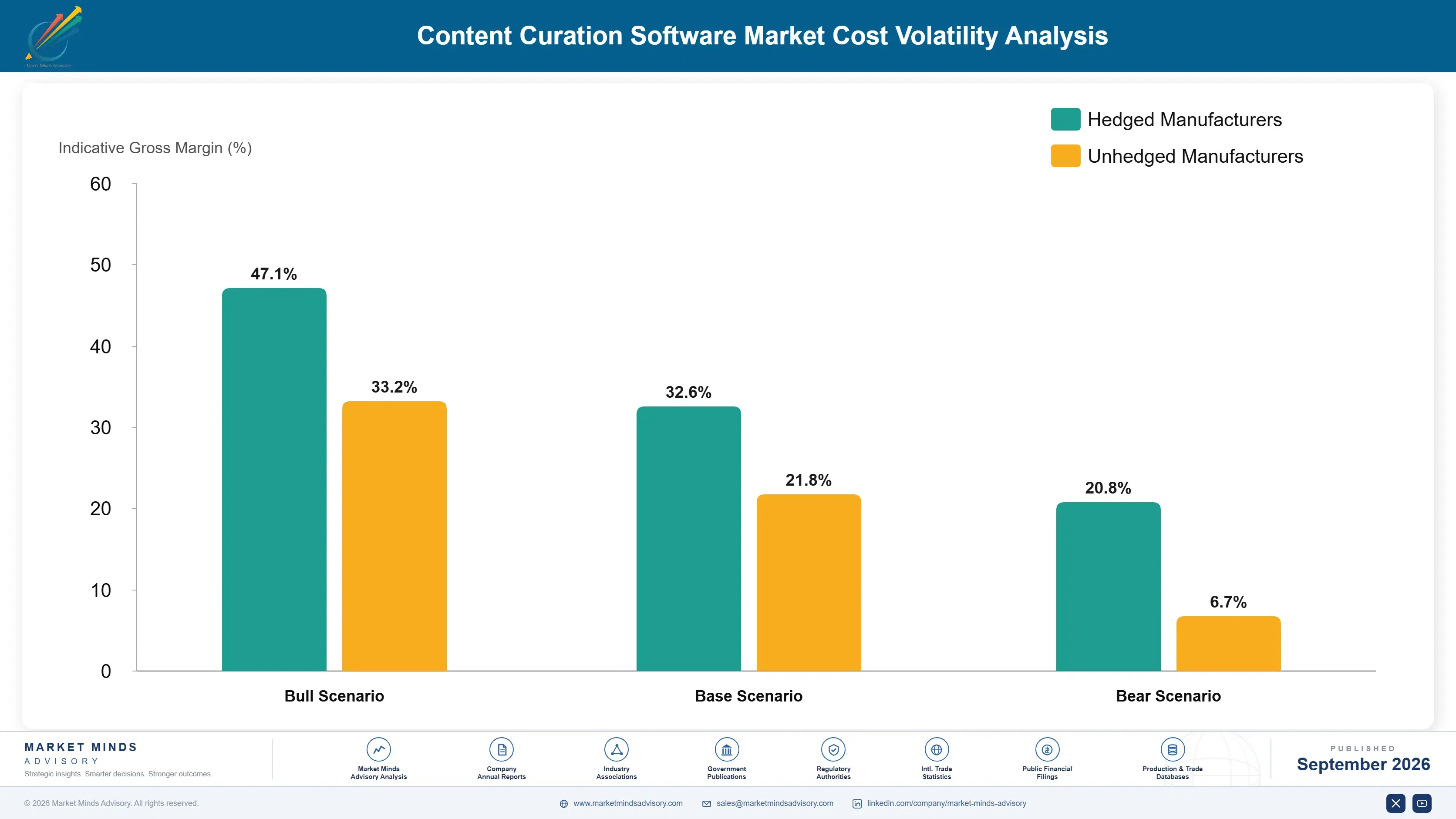
Margin architecture separates on whether platform vendors have already absorbed the function. Content discovery and aggregation engines earn least, since roughly 41% of buyers already have adequate discovery inside a platform they own. Personalisation and moderation tooling sit above on model content. Provenance verification, archive reuse management and multilingual editorial workflow earn most, because each addresses something platform vendors have been slow or unwilling to build.
The volume versus premium tension runs between features platform vendors will copy and functions they will avoid. Discovery and workflow get absorbed within a product cycle or two. Provenance verification carries obligations that platform vendors would rather leave with the customer, and archive reuse depends on metadata quality most platforms never enforced. Suppliers investing in the first category are funding their own commoditisation.

High-value pools concentrate in provenance verification and in language-specific capability, and neither is reached through general curation competence. Provenance requires rights expertise and a willingness to make source claims. Language capability requires investment per language that only pays where volume justifies it. Both are deliberate positions rather than natural extensions of a discovery product, which is why so few vendors hold either.

Volume / Commodity-Adjacent

Content discovery and aggregation engines at standard capability, where roughly 41% of buyers already have adequate function inside a platform they own and know it. The ten point spread separates vendors with efficient inference models from those running heavy processing per assessed item.
Gross Margin: 54% to 64%

Premium / Certified

Audience personalisation, content moderation tooling and editorial workflow platforms, where model quality and operational depth determine selection alongside price. The ten point spread tracks how much language coverage each vendor genuinely supports against how much it merely claims to.
Gross Margin: 66% to 76%

Sustainability / Regulatory / Next-Generation

Rights and provenance verification modules and archive reuse management systems, each addressing something adjacent platform vendors have been slow or unwilling to build for their own reasons. The twelve point spread reflects rights expertise depth and metadata structure quality together.
Gross Margin: 78% to 90%
content-curation-software-market-portfolio-architecture-1789996461878

High-value Sub-segments and Strategic Watch-out

Rights And Provenance Verification Modules

Grows at 17.3% because around 34% of published items have origins that nobody can reliably establish, and that is now a genuine liability. The twelve point spread reflects rights expertise depth. Platform vendors avoid this deliberately, since building it means assuming obligations they prefer to avoid.
Gross Margin: 78% to 90%

Archive And Reuse Management Systems

Grows at fully 12.8% by producing the one genuinely measurable return available anywhere across a content operations budget today. The twelve point spread here reflects metadata structure quality alone. Reuse reaches around 23% of requirements wherever the archive was properly maintained from the very beginning.
Gross Margin: 78% to 90%

Content Quality And Moderation Tooling

Grows at 11.9% as content volume rising around 58% annually makes manual review of everything entirely impossible at any organisation anywhere. The ten point spread here reflects underlying model accuracy depth. Regulatory pressure on published platform content adds further obligations that keep on widening steadily.
Gross Margin: 66% to 76%

Content Discovery And Aggregation Engines

Grows at only 6.4%, slowest of the six function classes, because roughly 41% of buyers already have perfectly adequate discovery inside a platform they own. The ten point spread here reflects inference processing efficiency. This is the function that platform absorption has most thoroughly commoditised already.
Gross Margin: 54% to 64%

Why Curation Choices Stick

The annuity here is accumulated metadata rather than any contract term. A curation system builds classification, tagging and provenance records across every item it processes, and none of that transfers usefully to a replacement product. Rebuilding it means reprocessing an archive that grows around 58% annually while continuing to operate. Deployments consequently persist far longer than the switching costs alone would suggest, and vendors underestimate their own position routinely.
Depth varies sharply by function. A provenance record supporting legal defence is deeply embedded, since the evidence must remain accessible for as long as the material is published. An archive with maintained structure is similarly fixed. A discovery engine surfacing external content is barely embedded at all, and roughly 41% of buyers could replace it with a platform feature tomorrow without noticing much difference in their operations.

The buyer has moved from marketing toward legal and operations, which changed what wins evaluations. A marketing function bought curation to fill a content calendar. A legal function buys provenance verification against liability exposure. An operations function buys reuse discovery against commissioning spend. Vendors whose material still addresses the content calendar are selling to a buyer who no longer holds the decision.
content-curation-software-market-end-use-penetration-index-1789996462374

What Decides Curation Purchases

These are among the four positions where our research anticipates prominent divergence between winners and laggards over the coming forecast period. Each is grounded in the demand model, the regulatory perimeter, and the announced capacity pipeline.
01 / LIABILITY BASED POSITIONING

Sell Legal Risk, Not Editorial Quality

Around 34% of all published items have origins that nobody can reliably establish, and publishers now face genuine legal liability for material whose source they simply cannot demonstrate when challenged. That is a considerably stronger commercial argument than any claim about editorial quality, which nobody can measure and every budget review contests vigorously. Vendors selling to editorial functions are addressing a discretionary budget and an unmeasurable benefit that the finance function discounts heavily on every single occasion it is presented.
02 / PLATFORM GAP TARGETING

Build Only What Platforms Will Avoid

Around 41% of buyers already run their curation inside a content management or marketing platform that they own, and those vendors keep extending capability into every adjacent gap they find. Provenance verification remains the one notable exception, because building it means assuming obligations around source claims that platform vendors would far rather leave sitting with the customer. Standalone products competing on discovery or workflow alone are competing directly against features that their own customer already owns outright and uses daily.
03 / MEASURABLE RETURN FRAMING

Count Commissioning Spend Never Incurred

Organisations routinely commission material that they already own, simply because nobody can locate the existing version, and archive systems that surface it can lift reuse to around 23% of their total requirements. That converts into commissioning budget that is simply never spent at all, which is genuinely the only measurable return available anywhere across content operations. Vendors presenting engagement metrics instead are offering numbers that the customer's own finance function will discount heavily before anybody has even finished the meeting.
04 / NEW OPERATIONS COVERAGE

Deploy Where No Habits Exist Yet

Commerce and media operations right across India and Southeast Asia now build curation into their content processes from the very outset, rather than retrofitting it onto established workflows years afterwards. India compounds at 18.9% annually on exactly that kind of expansion, which is happening at genuinely considerable commercial scale right now. Those deployments run considerably cleaner and a good deal faster than anything at an established publisher carrying a full decade of accumulated process and thoroughly unmaintained archive metadata behind it.

Engagement Snapshot From the Field

A live engagement with an industry participant carrying material or product regulatory and market exposure ahead of a defining policy shift, showing how our research translates into a defensible multi-year portfolio strategy.
MARKET MINDS ADVISORY · CLIENT ENGAGEMENT SUMMARY
Content Curation Software Producer Strategic Portfolio Review and Transition Roadmap 2026·Investment Scenario on Content Curation Software Exposure Evaluation 2025-26
CLIENT PROFILE
A publishing group operating fourteen titles across print and digital channels, facing steadily rising content volume against flat editorial headcount. A rights complaint concerning contributed material had reached the board, and nobody could establish where a meaningful share of published items had actually originated. Budget for content tooling had been declining for three consecutive years.
STRATEGIC CHALLENGE
Editorial wanted better discovery tooling to help find material genuinely worth publishing. Legal wanted provenance records following the rights complaint. Finance had already rejected two previous content tooling proposals on the grounds that nobody could demonstrate any measurable return, and was unlikely to approve a third without something considerably more concrete behind it.
MMA APPROACH
MMA sampled published items across the titles to establish what share had verifiable provenance, and separately measured how often material was commissioned when an equivalent already existed in the archive. We assessed shortlisted products on provenance capability and archive structure rather than on discovery features. Work drew on 47 expert interviews conducted in Q4 2025 with publishers and vendors.
KEY FINDINGS
  1. Around 4 in 10 sampled published items had provenance that simply could not be established from any record the group actually held anywhere.
  2. Commissioning spend on material substantially duplicating existing archive content ran to a figure that the finance function had never previously quantified at all.
  3. Three of the five shortlisted products offered strong discovery capability and effectively no provenance capability of any kind whatsoever (client-reported, unverified by MMA).
  4. The archive metadata was inconsistent enough that reuse discovery would require substantial remediation work before any tool could function properly at all.
CLIENT PROFILE
A publishing group operating fourteen titles across print and digital channels, facing steadily rising content volume against flat editorial headcount. A rights complaint concerning contributed material had reached the board, and nobody could establish where a meaningful share of published items had actually originated. Budget for content tooling had been declining for three consecutive years.
STRATEGIC CHALLENGE
Editorial wanted better discovery tooling to help find material genuinely worth publishing. Legal wanted provenance records following the rights complaint. Finance had already rejected two previous content tooling proposals on the grounds that nobody could demonstrate any measurable return, and was unlikely to approve a third without something considerably more concrete behind it.
MMA APPROACH
MMA sampled published items across the titles to establish what share had verifiable provenance, and separately measured how often material was commissioned when an equivalent already existed in the archive. We assessed shortlisted products on provenance capability and archive structure rather than on discovery features. Work drew on 47 expert interviews conducted in Q4 2025 with publishers and vendors.
KEY FINDINGS
  1. Around 4 in 10 sampled published items had provenance that simply could not be established from any record the group actually held anywhere.
  2. Commissioning spend on material substantially duplicating existing archive content ran to a figure that the finance function had never previously quantified at all.
  3. Three of the five shortlisted products offered strong discovery capability and effectively no provenance capability of any kind whatsoever (client-reported, unverified by MMA).
  4. The archive metadata was inconsistent enough that reuse discovery would require substantial remediation work before any tool could function properly at all.
RECOMMENDED STRATEGY
Phase 1: Phase one: build the business case on provenance liability and duplicate commissioning spend rather than on discovery capability finance had already rejected twice. Phase 2: Phase two: eliminate every product offering discovery without provenance, since the board level concern was legal in nature rather than editorial. Phase 3: Phase three: fund the archive metadata remediation before any deployment begins, since reuse discovery simply cannot function on inconsistent records.
OUTCOME
The group selected on provenance capability and funded metadata remediation ahead of deployment (client-reported, unverified by MMA). The business case passed finance review at the first attempt after two previous rejections. Provenance is now recorded at commissioning rather than reconstructed afterwards, which is the change that outlasted the engagement.

Frequently Asked Questions

Foundational context covering the market sizes, CAGR, scope, country, region and competition that inform every finding below. This section is provided to cover basics and most often pre-purchase conversations, answered from the MMA Primary Research Dataset.

What is the current size of the Content Curation Software Market?

Global value reaches USD 2.9 billion in 2026, measured as licence and subscription revenue across six function classes. The 2025 base for the market is USD 2.6 billion.

How large will the Content Curation Software Market be by 2036?

The market reaches USD 8.6 billion by 2036, an increase of USD 5.7 billion across the forecast period. That represents 2.97 times expansion from the 2026 base.

What is the CAGR for the Content Curation Software Market 2026 to 2036?

The base case runs at 11.5% annually, with a bull case at 12.8% if provenance requirements become mandatory in more jurisdictions and a bear case at 10.3% if platform vendors absorb more of the function.

Which segment is growing fastest?

Rights and provenance verification modules grow at 17.3%, half again the market rate of 11.5%. Publishing material without establishing its origin has become a genuine legal exposure.

Who are the major companies in the Content Curation Software Market?

Contentful, Sitecore, Curata, Sprinklr and Feedly lead on licence and subscription revenue, together holding 29%. Adobe Experience Manager, Optimizely and Bynder hold adjacent platform positions.

Which country is growing fastest?

India leads at 18.9%, on commerce and media content operations that barely existed at this scale five years ago. Indonesia and Brazil both follow behind it.

Report Segmentation Architecture

The full report scope spans multiple orthogonal segmentation dimensions, with cross-tabulated demand data provided for each dimension pair. Coverage extends further to regional breakdowns, trend trajectories, and the competitive detail needed to support segment-level decision-making.

By Function Class

  • Rights And Provenance Verification Modules
  • Archive And Reuse Management Systems
  • Content Quality And Moderation Tooling
  • Editorial Workflow And Selection Platforms
  • Audience Personalisation And Recommendation Systems
  • Content Discovery And Aggregation Engines

By End-Use Industry

  • Publishing And Media Organisations
  • Commerce And Marketplace Platforms
  • Corporate Marketing Functions
  • Education And Training Providers
  • Financial Services Communications
  • Public Sector Communications

By Commercial Dimension

  • Direct Vendor Subscription Sales
  • Content Platform Bundled Delivery
  • Agency And Reseller Channel
  • Enterprise Procurement Programmes
  • Self-Service And Small Team Adoption
  • Managed Content Service Providers

By Region

  • North America
  • Western Europe
  • East Asia
  • South Asia and Pacific
  • Latin America
  • Middle East and Africa
  • Eastern Europe

Scope, Methodology, and Coverage

Every figure in this report is reproducible from documented input assumptions. The scope below maps the historical period, the forecast horizon, the segmentation dimensions, and the countries covered, alongside the underlying primary and qualitative methodology.
Historical Period
2020 to 2025
Forecast Period
2026 to 2036
Base Year
2025 (USD billions; MMA Primary Research Dataset, September 2026)
Market Definition
This report covers content curation software by function class: rights and provenance verification modules, content discovery and aggregation engines, editorial workflow and selection platforms, audience personalisation and recommendation systems, content quality and moderation tooling, and archive and reuse management systems. It excludes content creation and authoring tools, digital asset management sold as storage, publishing schedulers, general search engines, advertising technology, and delivery network infrastructure.
Quantitative Units
USD millions, licence and subscription revenue basis; items processed; unverified provenance as a percentage of published items; editorial review capacity in items per week; content volume growth as an annual percentage; reuse rates as a percentage.
Segmentation Dimensions
Function class; end-use organisation type; commercial purchase and delivery route; geography across seven regions.
Regions Covered
North America, Western Europe, East Asia, South Asia and Pacific, Latin America, Middle East and Africa, Eastern Europe
Countries Covered
China, Japan, South Korea, India, Indonesia, Singapore, Australia, United States, Canada, Mexico, Brazil, Argentina, United Kingdom, Germany, France, Netherlands, Spain, Poland, United Arab Emirates, South Africa.
Key Companies Profiled
Contentful, Sitecore, Curata, Sprinklr, Feedly, Adobe Experience Manager, Optimizely, Acquia, Brightspot, Storyblok, Bynder, Aprimo, Hootsuite, Sprout Social, Nuxeo.
Quantitative Methodology
Primary survey, n=3,800 respondents, Q4 2025, six countries; demand-side model with trade association cross-validation
Qualitative Methodology
47 expert interviews, Q4 2025; applied to validate demand model assumptions, identify emerging dynamics, and assess competitive positioning
Report Format
PDF and XLSX data workbook (Word format preview document)
Publisher
Market Minds Advisory
Report Code
MMA-2026-TEC-811
Published
September 2026
Contact
sales@marketmindsadvisory.com | www.marketmindsadvisory.com

Purchase the full Content Curation Software Market Report (2026 to 2036).

This report sizes the global content curation software market from 2026 to 2036 across six function classes, six organisation types and seven regions. It explains why production becoming free destroyed the old value proposition and made selection the scarce capability instead. Provenance exposure at roughly 34% of published items is analysed as the force moving this purchase from editorial budgets into legal ones. Platform absorption at 41% of buyers is examined as the permanent constraint on standalone vendors, alongside reuse discovery as the only measurable return in content operations. Regional analysis explains why East Asia leads at 27% of spending.
Six function classes sized through to 2036
Provenance exposure quantified across published item volumes
Platform absorption assessed as a permanent commercial constraint
Twenty named vendors assessed on subscription revenue
Four revenue levers with quantified commercial impact
Anonymised publishing group content operations engagement documented fully

Built For The People Who Decide

From boardroom strategy to bench-side execution, this report is read cover-to-cover by leaders shaping the next decade of their industry, turning demand scenarios, market dynamics and valuation benchmarks into decisions.
CXOs/ Presidents/ VPs/ Managers
M&A and Corporate Development
Strategy Teams and R&D Heads
Procurement and Product Directors
Regulatory and Compliance Leaders
Investor Relations and Equity Analysts