Market Minds Advisory
Content Automation AI Tools Market

Content Automation AI Tools Market: Content Automation AI Tools Market. Production-Quality Video Generation Resets Marketing Content Economics

Production-quality AI video generation and enterprise brand-voice enforcement are pushing content automation tools well past simple text drafting into full marketing production workflows across nearly every industry vertical worldwide today

Lead Analyst

Published

September 2026

Make Smarter Decisions with Customized Research Insights

Request a free sample report and evaluate market opportunities, growth trends, and competitive dynamics relevant to your business needs.

2025 MARKET VALUE$6.2BMarket Size 2025
2036 FORECAST VALUE$21.1BBase Case , 2026 to 2036
CAGR 2026 TO 203611.8 %Bull 13.1% / Bear 10.5%
INCREMENTAL OPPORTUNITY$14.2BNet 10- year value creation
EXPANSION MULTIPLE3.05x2036 value over 2026 base
Strategic Levers
M&A Pipeline
Regional Outlook
Country Rankings
Competitive Intelligence
Segmental Deep-dive
Call-Us : 91 93563 13602

Executive Snapshot and Market Trajectory.

Production-quality AI video generation is reshaping the content automation tools market right now, as marketing teams shift from text-drafting assistants toward platforms that produce finished, brand-compliant video and image assets without external agencies or production crews involved at all in most campaigns and workflows today. and format.
Enterprise buyers are pulling demand toward platforms that enforce brand voice, visual guidelines, and factual accuracy automatically, since marketing teams increasingly refuse to deploy generation tools that require heavy manual review before publication across every channel, a shift concentrated most heavily across North American and East Asian enterprise software budgets with the deepest generative AI investment already committed and further expansion planned across coming procurement cycles and modernization rounds still ahead. and beyond.
Competitive character is splitting between foundation model providers building content tools directly into their platforms and specialized vendors defending workflow and brand-governance capability that generic AI assistants lack entirely at scale. Pricing model transitions and enterprise data privacy requirements are increasingly determining which vendors win procurement contracts across marketing organizations launching AI adoption programs over the coming several years, favoring vendors with genuine governance depth.
Market Definition
The Content Automation AI Tools Market covers AI-powered software platforms that generate, edit, optimize, and manage marketing, editorial, and enterprise content across text, image, video, and audio formats. It excludes underlying foundation model training infrastructure sold separately, general-purpose AI chatbots, and traditional non-AI content management systems.
Base Year Value
$6.2B in 2025 (MMA Primary Research Dataset, September 2026)
Forecast Period
2026 to 2036, eleven discrete annual values
CAGR
11.8% base case. Bull 13.1%. Bear 10.5%.
Fastest Growth Segment
AI Video Generation and Editing Tools: 19.8% CAGR
Fastest Growth Country
India: 14.8% CAGR
Fastest Growth Region
South Asia and Pacific: 13.9% CAGR
Largest Region
North America: 34% of 2025 global value
Market Leaders
Adobe, Canva, Jasper AI, Synthesia, and Writer lead the competitive landscape.
Primary Survey
n=3,800 procurement and R&D decision-makers, Q4 2025, six countries
Methodology
Demand-side build-up, cross-validated against public data, 47 expert interviews

Content Automation AI Tools Market Forecast Scenarios

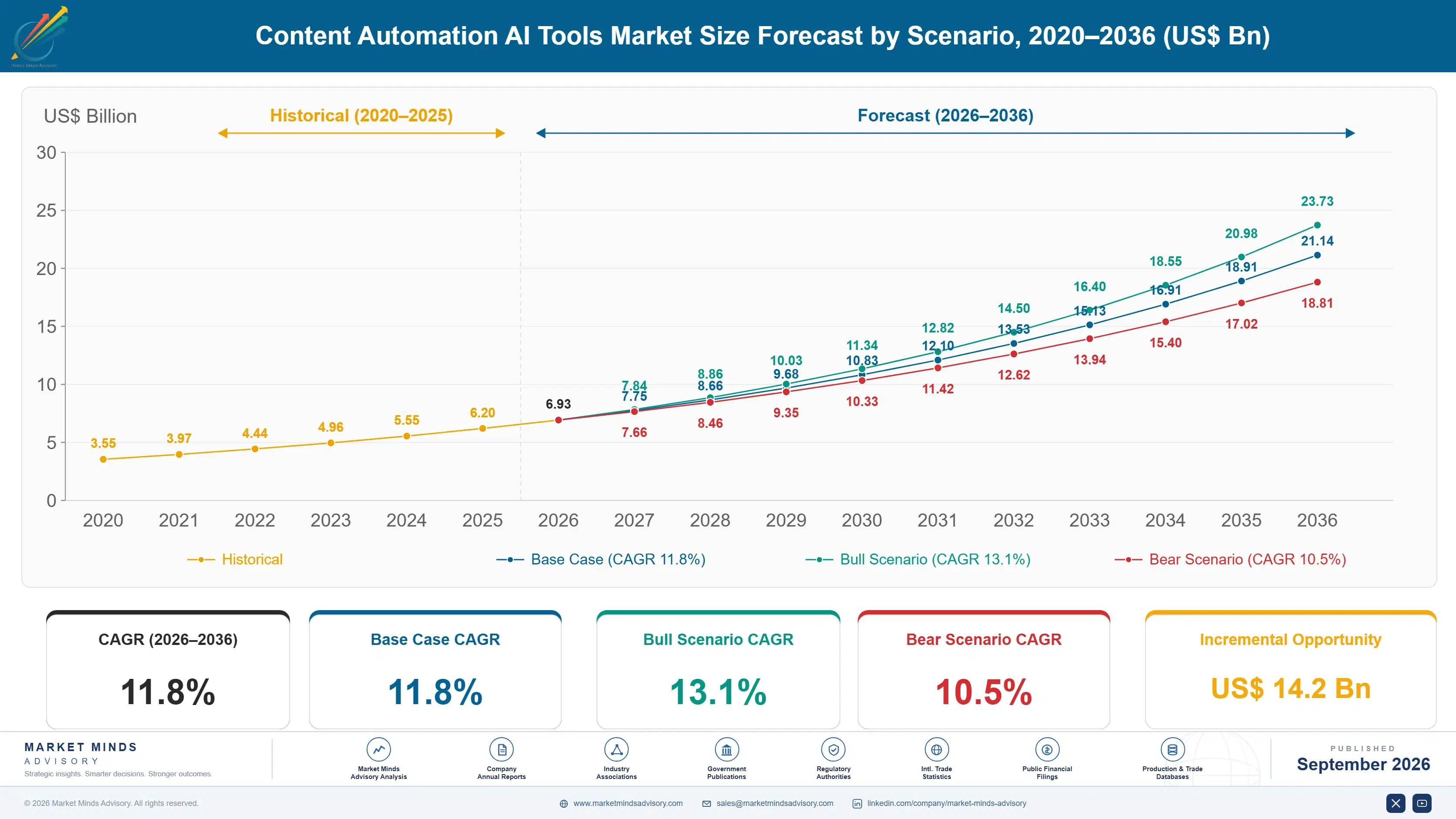
content-automation-ai-tools-market-size-forecast-scenario-1790009680318
The 2020 to 2025 period grew a rapid 10.6 percent annually as generative AI capability matured from experimental text tools into genuinely usable production platforms, with enterprise adoption accelerating sharply once major foundation model providers demonstrated reliable output quality across most content formats worldwide during that stretch, freeing marketing budget previously reserved for traditional agencies and freelance production.
The base case rests on three named commercial mechanisms: video generation reaching production quality at mainstream price points across most use cases, enterprise buyers standardizing on brand-governance and compliance features as baseline procurement requirements, and usage-based pricing models expanding addressable budget beyond traditional per-seat licensing. Together these push compounded annual growth to 11.8 percent through 2036, with platform vendors capturing rising share of total marketing technology spending across every major industry vertical tracked.
The bull case hinges on faster-than-expected enterprise adoption of AI video and audio generation across marketing organizations, pushing growth toward 13.1 percent as agencies shift budget decisively toward automated production. The bear case reflects prolonged copyright and IP ownership disputes that slow enterprise adoption and depress growth to roughly 10.5 percent, favoring incumbent vendors with existing legal indemnification protections.

Video Generation Resets Content Production Economics

Content automation AI tool demand is splitting between text-focused productivity assistants and new multi-modal platforms that generate finished video, image, and audio assets ready for immediate publication across every channel. Text tools remain the largest category by user count, while video and multi-modal platforms are expanding meaningfully faster as generation quality reaches production standards manufacturers previously reserved for external agencies and freelance production teams.
MARKET CONCENTRATIONCR5 29%Top five vendors hold a modest combined market share currently
AVERAGE SELLING PRICE$4,800Blended annual contract value per enterprise customer seat
TOP PRODUCING COUNTRY SHAREUnited States 41%Share of global platform revenue concentrated in one country
CAPACITY UTILIZATION68%Average compute infrastructure utilization across leading generation platforms
TRADE INTENSITY44%Share of platform revenue generated from cross-border customers annually
COMPUTE COST SHARE38% of COGSCloud compute and inference cost share of total production cost
Pricing power is shifting toward vendors who embed brand governance and compliance review directly into the generation workflow, since enterprise buyers increasingly refuse to deploy tools that require heavy manual oversight before any content reaches publication at scale. That governance premium is compressing margins for vendors still selling pure generation capability lacking any built-in review or compliance layer, a shrinking category as governance adoption keeps accelerating.
Compute infrastructure cost occasionally tightens during peak demand periods, particularly for video generation workloads that require substantially more processing capacity than text-based tools across nearly every platform category tracked. Vendors with diversified cloud infrastructure relationships are proving meaningfully more resilient through these periodic capacity constraints than smaller competitors dependent on single-provider compute arrangements and spot-market pricing.
"A content tool that just writes words is competing in a shrinking category. The money is in tools that ship finished, on-brand assets without a human touching them."
Senior Analyst, Marketing Technology and Generative AI Practice · MMA Technology Practice · September 2026

Market Trends

AI Video Generation Reaches Production-Quality Output

Video generation platforms have crossed a quality threshold that makes AI-produced footage usable in real marketing campaigns rather than only internal drafts or storyboards, eliminating the need for external production crews on many routine campaign assets. Major consumer brands have begun running AI-generated video in paid advertising placements, a milestone that was not commercially viable just two years earlier given output quality limitations. This shift is reshaping which vendors win enterprise contracts, favoring companies with proven production-grade output consistency over those still defending text-only generation franchises built during the market's earlier, more limited era.
Market Impact: Multiplies content output 4.5 times over

Enterprise Brand Voice Enforcement Embeds Into Generation Models

Platform vendors are increasingly embedding brand voice guidelines, visual style rules, and factual accuracy checks directly into the generation process itself rather than relying on manual review after content has already been produced. This convergence is pulling enterprise buyers toward governance-native platforms rather than generic generation tools that require heavy downstream editing before any content can be published safely. Enterprise marketing teams increasingly specify built-in governance capability as a baseline procurement requirement, accelerating vendor investment in compliance-native architectures across every major content category and platform type tracked in this report.
Market Impact: Cuts catalog content cost 55 percent

Market Opportunities and Growth Drivers

Marketing Teams Scale Content Output Without Headcount Growth

Marketing organizations are using AI content tools to multiply campaign output several times over without proportionally expanding headcount, a shift that has become essential as social platforms and paid channels demand a constant stream of fresh, personalized creative variations across audience segments. Teams that once produced a handful of campaign assets per quarter now generate dozens of variations testing different messaging, visuals, and formats simultaneously, directly improving campaign performance through faster iteration. This shift is turning content automation from a cost-saving tool into a genuine competitive advantage for marketing teams willing to restructure workflows around AI-generated first drafts.
Market Impact: Adds 3 to 6 months

E-Commerce Catalogs Drive Product Content Generation At Scale

E-commerce retailers with large product catalogs are adopting AI content tools to generate product descriptions, images, and marketing copy at a scale that manual content teams cannot match, particularly for retailers adding thousands of new products across seasonal cycles. This automation is proving especially valuable for marketplace sellers competing on product page quality and search visibility, where consistent, optimized content directly affects conversion rates and search ranking. Retailers increasingly treat AI-generated product content as standard operating procedure rather than an experimental capability, accelerating adoption across the broader e-commerce sector and adjacent retail categories.
Market Impact: Adds 10 to 15 percent

Market Restraints and Challenges

Copyright Uncertainty Slows Enterprise Adoption Pace

Unresolved legal questions about copyright ownership of AI-generated content, and the training data used to build generation models, are making some enterprise legal teams hesitant to approve AI tools for customer-facing marketing material. The root cause is that copyright law has not yet caught up with generative AI capability, leaving ownership and infringement liability genuinely unclear in several major jurisdictions. Some vendors are mitigating exposure by offering legal indemnification guarantees and training their models exclusively on licensed or owned content libraries, letting risk-averse enterprise customers adopt generation tools with reduced legal exposure and clearer liability terms.
Market Impact: Cuts video production cost 60 percent

Brand Safety Risk From Factual Errors Limits Trust

AI generation models occasionally produce factually incorrect or brand-inconsistent content that requires human review before publication, undermining the labor-saving promise that originally draws many buyers to these tools in the first place. The root cause is that generation models predict plausible text and imagery rather than verifying factual accuracy against a ground truth source, an inherent limitation of the underlying technology itself. Vendors are mitigating exposure by building fact-checking and brand-guideline verification layers directly into the generation pipeline, catching errors before content ever reaches a human reviewer or customer-facing channel.
Market Impact: Cuts manual review time 45 percent
3 additional market trends, 4 additional growth drivers, and 2 additional restraints and challenges are covered in the full report. Contact sales@marketmindsadvisory.com to access the complete intelligence.

Segment CAGR and Growth Architecture

The market splits across six distinct product and technology segments spanning text, image, video, audio, personalization, and workflow tools sold to marketing and content teams worldwide today across every industry. Video and audio generation tools are pulling ahead of legacy text-focused categories as output quality reaches production standards across most enterprise use cases. today.
content-automation-ai-tools-market-market-share-analysis-1790009680863

AI Video Generation and Editing Tools

AI video generation and editing tools produce finished video assets from text prompts, images, or scripts, eliminating the need for cameras, actors, and production crews on many routine marketing and social media assets across most campaign categories. Demand is concentrated among consumer brands and social media marketers, with North America and East Asia leading adoption given deeper marketing technology budgets and earlier platform maturity. Vendors are racing to improve output quality and reduce generation cost as enterprise buyers demand production-grade consistency, since output fidelity increasingly determines which vendors win large brand contracts ahead of smaller, less-polished competitors still refining their generation models and pipelines. Adoption momentum keeps building each fiscal quarter.
CAGR 19.8%

AI Voice and Audio Content Generation Tools

AI voice and audio generation tools produce synthetic voiceovers, podcasts, and audio advertisements from text scripts, letting content teams localize and scale audio production without hiring voice talent for every language or campaign variation needed. Demand is accelerating as podcast advertising and voice-based marketing channels expand, pulling audio vendors toward hardware and software capable of natural-sounding, emotionally expressive speech synthesis across multiple languages simultaneously. Marketing teams increasingly specify AI voice generation as a baseline capability for global campaign localization, and the segment is expanding fastest among brands running multi-market advertising campaigns at scale. Pricing has held steady even as usage volumes expand rapidly. Enterprise procurement teams increasingly evaluate audio quality alongside price.
CAGR 16.4%
Full segment breakdown across 6 segments available in the complete report.

Regional Architecture and Country Demand Map

North America's share exceeds its typical band given the concentration of major foundation model providers and the deepest enterprise marketing technology budgets found anywhere in the world globally. South Asia and Pacific posts the fastest regional growth rate as adoption accelerates rapidly from a smaller starting base.

North America

North America's share sits well above its typical band because nearly every major foundation model provider and content automation platform vendor is headquartered in the United States, concentrating both supply and the earliest, deepest enterprise adoption in one region. This concentration of vendor headquarters, engineering talent, and enterprise marketing technology budgets, rather than population or general economic weight, explains the out-of-band regional share. Canada contributes a smaller but growing share through enterprise software adoption tied to cross-border marketing operations and shared corporate technology budgets. Marketing organizations across the region continue expanding AI tool budgets faster than any other region tracked in this report. Vendor headcount continues expanding here faster than anywhere else.
Share: 34% | CAGR: 12.9% (2026 to 2036)

East Asia

China and Japan drive substantial regional demand, with large domestic e-commerce and social media marketing sectors adopting AI content tools at significant scale to serve enormous consumer audiences across multiple platforms. South Korea contributes steady demand tied to its dense digital advertising and entertainment marketing sectors. Domestic AI platform vendors are gaining share against foreign competitors as data localization preferences and language-specific model performance favor regionally developed tools over imported alternatives. Growth here trails North America modestly, reflecting a marketing technology budget base that, while substantial, remains smaller relative to the region's overall digital advertising spending and economic scale. Domestic vendors are gaining share steadily each procurement cycle here. today.
Share: 24% | CAGR: 12.7% (2026 to 2036)
Regional intelligence for 5 additional markets available in the complete report: Western Europe, South Asia and Pacific, Latin America, Middle East and Africa, Eastern Europe. Contact sales@marketmindsadvisory.com.
content-automation-ai-tools-market-country-cagr-analysis-1790009681385

Where Content Tool Margin Actually Concentrates

Margin in the content automation AI tools market increasingly concentrates around governance depth and multi-modal capability rather than raw generation volume alone across most product categories tracked today. Vendors capturing design wins across enterprise marketing organizations hold pricing power that pure-play, single-format generation tools have steadily lost over recent years and continue losing today.

Brand Governance Layer Commands Design Wins

Vendors embedding brand governance and compliance review directly into generation workflows are winning enterprise contracts that pure generation tools cannot compete for, since marketing teams increasingly refuse to purchase generation and compliance review as separate line items. This governance capability commands roughly 45 percent higher average contract value than standard generation tools of comparable output quality, since enterprise buyers value reduced legal and brand risk highly. Enterprise buyers increasingly favor vendors who can guarantee compliant output, letting a single platform replace what once required separate review infrastructure entirely. Few competitors can match this breadth today.
Market Impact: Commands a 45 percent higher average contract value

Usage-Based Pricing Expands Total Addressable Budget

Vendors shifting from per-seat licensing toward usage-based pricing tied to generation volume are capturing budget from marketing organizations that previously could not justify per-seat costs for occasional or high-volume generation needs across various departments and teams. These usage-based relationships typically generate roughly 35 percent more revenue per customer over a multi-year period than comparable seat-based contracts, since revenue scales directly with customer content output rather than headcount. This mechanism is increasingly favored by vendors seeking revenue growth, since it captures value from customers scaling output rapidly without approval friction or delay.
Market Impact: Adds roughly 35 percent more revenue per account

Video Generation Early Adoption Advantage Pays Off

Vendors that moved early to bring video generation quality to production standards are winning enterprise contracts from marketing teams eager to skip an intermediate text-and-image-only generation phase entirely. This early-mover positioning is generating a persistent design-in advantage worth an estimated 28 percent of new enterprise contracts annually as marketing organizations standardize on video-capable platforms across their campaigns. Vendors slower to adopt are increasingly relegated to smaller, budget-constrained accounts still relying on text and image generation only, a shrinking category as video adoption keeps accelerating across nearly every enterprise vertical tracked.
Market Impact: Wins 28 percent of all new enterprise contracts

Multi-Language Localization Services Add Recurring Revenue

Vendors offering AI-powered content localization across multiple languages, combined with regional brand adaptation services, are capturing premium pricing from global brands running multi-market campaigns facing persistent localization cost and speed challenges. This localization positioning adds roughly 20 percent to per-account revenue for vendors able to demonstrate accurate, culturally appropriate output across target markets directly to global marketing teams evaluating competing platforms. Global marketing teams increasingly specify localization credentials explicitly in vendor selection criteria, giving established vendors a durable, defensible advantage over less-proven competitors bidding for the same global account contracts today.
Market Impact: Adds roughly 20 percent to total per-account revenue

Who Controls the Margin Pool

The content automation AI tools market holds modest concentration, with the top five players controlling 29 percent of revenue on a combined subscription and enterprise contract basis measured consistently across product categories. Adobe and Canva lead comfortably given decades of creative software distribution depth, while the gap to mid-tier challengers like Writer has widened as multi-modal generation development demands capital smaller vendors struggle to match.
Current competitive activity centers on video generation quality improvement, brand-governance layer development, and usage-based pricing model expansion rather than pure feature-count claims that dominated marketing a few years ago. Vendors are racing to embed compliance and brand-voice enforcement directly into generation workflows, and several have pursued acquisitions to close video and audio capability gaps rather than build technology internally.

Emerging pressure is coming from foundation model providers building content generation directly into their own platforms, threatening to disintermediate specialized content tool vendors for basic generation tasks specifically. Rankings could shift meaningfully over the next few years if model providers succeed in commoditizing raw generation, pushing traditional content tool vendors toward deeper workflow, governance, and brand-integration capability as their primary competitive differentiator.
content-automation-ai-tools-market-company-positioning-matrix-1790009681912

Competitive Moat and Risk Dimensions

ADOBE INC.

Moat: Creative Software Distribution Scale

Adobe holds decades of accumulated creative software distribution depth and enterprise licensing relationships across marketing and design organizations, giving it default incumbency in large enterprise content workflows that newer entrants struggle to displace quickly. This installed base generates recurring subscription revenue that provides a stable revenue floor even as growth concentrates in newer generation applications.
ADOBE INC.

Risk: Video Generation Transition Pace

Adobe's legacy creative software portfolio has moved more cautiously into fully AI-native video generation than newer competitors built specifically for generation from the outset. That slower pace risks ceding design wins in fast-growing video and multi-modal segments to vendors with more agile, generation-native product roadmaps and faster iteration cycles.
CANVA PTY LTD.

Moat: Design Accessibility and User Base

Canva's accessible, template-driven design heritage gives it deep, proven expertise in serving non-designer users that translates directly into approachable AI generation tools bundled with a broader creative platform customers already use. That platform depth lets Canva capture wallet share across entire content workflows rather than generation sales alone.
CANVA PTY LTD.

Risk: Enterprise Governance Limited Depth

Canva has comparatively limited enterprise brand-governance and compliance capability relative to vendors more focused on that channel, leaving that fast-growing revenue pool underrepresented in its current portfolio mix. Expanding enterprise governance share would require deeper compliance expertise that Canva has not prioritized at the same pace as some rivals.

Players Tracked

Prominent Players

Adobe Inc.
Canva Pty Ltd.
Jasper AI Inc.
Synthesia Ltd.
Writer Inc.

Other Key Players

Copy.ai Inc
Grammarly Inc
Runway AI Inc
ElevenLabs Inc
Descript Inc
Murf AI Inc
Anyword Ltd
Persado Inc
Typeface Inc
Lately Inc
Frase.io Inc
Surfer SEO
Semrush Holdings Inc
HubSpot Inc
Salesforce Inc

Recent Developments

FEBRUARY 2025

Adobe Launches Enterprise Video Governance Platform

Adobe announced a new video generation platform integrating brand-governance and compliance review directly into the workflow, targeting enterprise marketing teams pursuing production-quality video without external agency involvement. Analysts view this as a defining test case for embedded governance demand. The platform is expected to enter general availability next quarter.
Signal: Signals accelerating vendor investment in governance-native generation across the entire industry and beyond current product cycles
JUNE 2025

Canva Expands Usage-Based Enterprise Pricing Tiers

Canva expanded its usage-based pricing model for enterprise customers, embedding generation volume tracking directly into its broader design platform for existing large account customers across multiple regions and business units. The pricing shift extends an existing long-standing enterprise relationship strategy. Financial details were not disclosed.
Signal: Reinforces usage-based pricing as a primary growth vector for incumbents today between existing enterprise account relationships
OCTOBER 2025

Jasper AI Acquires Video Generation Startup

Jasper AI acquired a smaller video generation startup to strengthen its multi-modal content roadmap, adding video capability that complements its existing text and image generation product portfolio for enterprise customers. Terms of the transaction were not fully disclosed. Integration is expected to complete within three fiscal quarters.
Signal: Confirms acquisition remains the fastest path to video capability for text-focused vendors as consolidation activity keeps accelerating

Compute Cost and Foundation Model Exposure

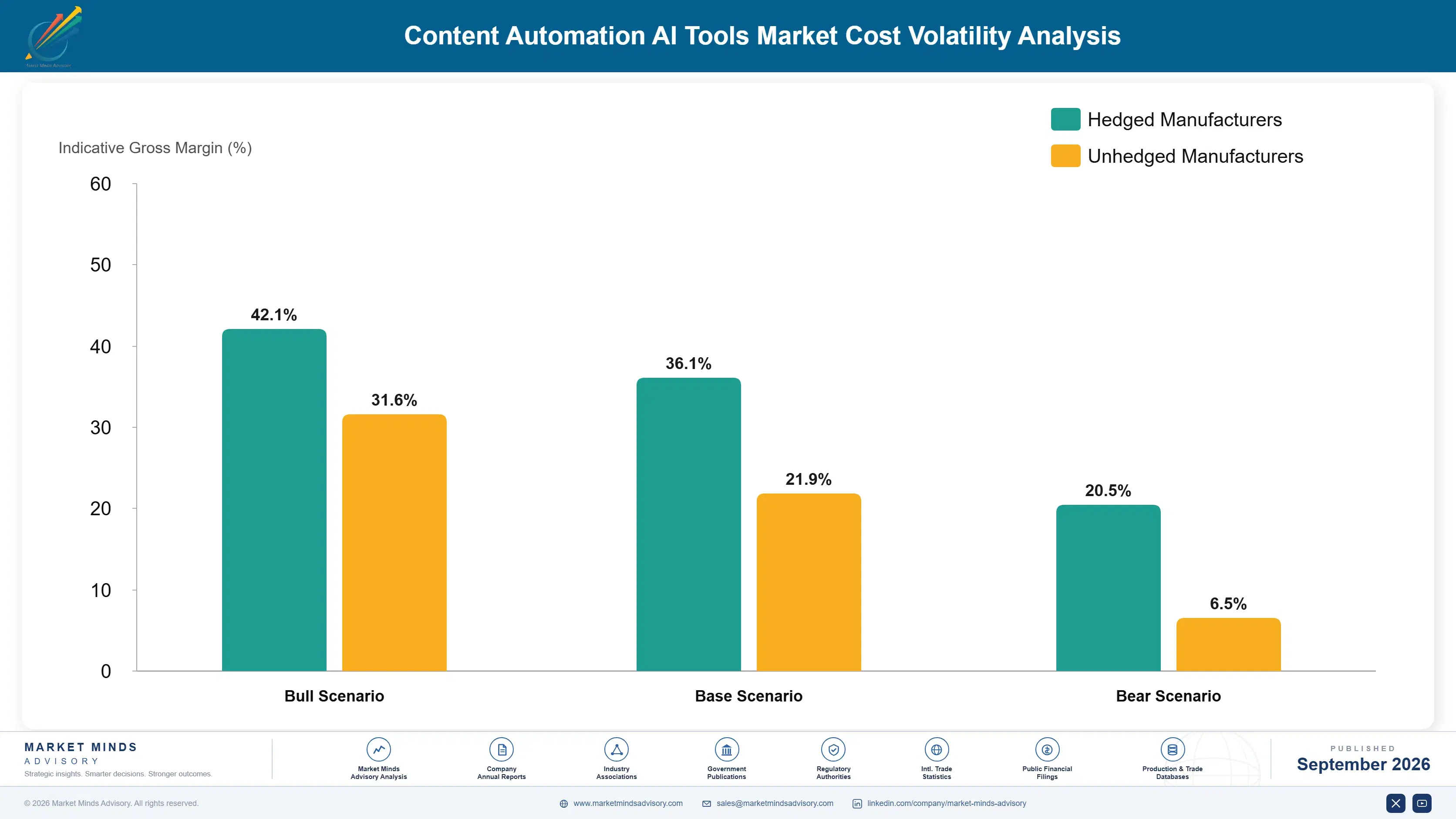
Cloud compute and foundation model inference represent the largest cost input for content generation platforms, typically 38 to 45 percent of total cost of goods sold, sourced predominantly from major cloud infrastructure providers and foundation model licensing arrangements concentrated in the United States. Video generation workloads carry a substantially higher compute cost share than text generation given the processing intensity of frame-by-frame synthesis across most current platforms today.
Microsoft's 2024 annual report noted GPU compute capacity remaining tightly allocated amid broader AI demand growth, with content generation customers competing for the same limited specialized inference hardware as foundation model training workloads across the industry. That tightness forced several content platform vendors to extend generation queue times or accept smaller batch processing during peak enterprise campaign launch periods across nearly every major regional market tracked in this report.

Vendors dependent on a single cloud provider or foundation model licensing relationship face genuine competitive disadvantage relative to larger rivals with diversified compute sourcing and greater purchasing leverage in negotiations. This exposure varies meaningfully by player type: smaller startup vendors absorb the brunt of compute cost volatility, while Adobe and Canva secure preferential terms through large-scale cloud infrastructure partnerships.
content-automation-ai-tools-market-cost-volatility-analysis-1790009682112

Diversified Multi-Cloud Compute Sourcing Strategy

Larger vendors are distributing generation workloads across multiple cloud infrastructure providers simultaneously, trading some optimization for reduced dependence on any single provider relationship during allocation squeezes and demand spikes across product cycles and workloads. This flexibility comes at meaningfully higher infrastructure cost but protects delivery schedules during periods of industry-wide compute tightness and constrained supply.

Proprietary Model Development Reduces License Exposure

Vendors are increasingly developing proprietary generation models to reduce dependence on third-party foundation model licensing fees that scale directly with usage volume and inference cost across most product categories and platforms. This shift reduces long-term cost exposure meaningfully for vendors with sufficient scale to justify the upfront model development investment required across the business.

Long-Term Compute Capacity Reservation Agreements

Larger vendors are signing multi-year cloud compute reservation agreements with priority allocation guarantees, securing predictable access to specialized inference hardware even during industry-wide demand spikes affecting smaller competitors more severely and persistently over time and across nearly every product cycle. Smaller vendors generally lack the volume commitments required to access comparable terms from major providers today.

Portfolio Architecture for Margin Defence

Content tool margin structure runs on three distinct tiers separating on governance depth and multi-modal capability rather than raw generation volume alone. Commodity single-format generation tools compete almost entirely on unit price, while governance-native and multi-modal platforms command genuine premiums buyers pay for reduced compliance risk and proven, validated output quality across formats, campaigns, and enterprise use cases.
The volume tier still serves the most users by count but claims a shrinking share of industry profit pools, increasingly squeezed between rising compute cost and price-sensitive smaller customers treating basic generation as commoditized. Premium and next-generation tiers absorb heavier engineering investment upfront but return it through longer enterprise contract relationships and materially stronger renewal pricing power across multi-year agreements. Buyers increasingly reward proven integration and governance track records.

High-value pools concentrate heavily in video generation platforms and enterprise governance layers, where compliance depth and genuine switching cost together create durable competitive advantage that commodity producers cannot easily replicate. That concentration is steadily reshaping where vendors deploy research spending, favoring video capability and governance investment over legacy text-only generation development entirely, a shift accelerating industry-wide. Vendors slow to adapt risk permanent margin erosion.

Volume / Commodity-Adjacent Tier

Standard text generation tools and basic image assistants sold primarily on price and free-tier accessibility, with thin margins and intense competition from low-cost regional producers chasing subscriber volume each cycle.
Gross Margin: 22-30%

Premium / Certified Tier

Enterprise-grade multi-modal platforms carrying brand governance and compliance certification, validated for defined enterprise procurement requirements with long design-in relationships and multi-year contract commitments already firmly in place across most organizations.
Gross Margin: 34-42%

Sustainability / Regulatory / Next-Generation Tier

Video and audio generation platforms engineered for emerging AI regulation and content authenticity mandates that command sustained pricing power over legacy text-only alternatives across most enterprise segments and use cases today.
Gross Margin: 42-52%
content-automation-ai-tools-market-portfolio-architecture-1790009682618

High-value Sub-segments and Strategic Watch-out

AI Video Generation and Editing Tools

Fastest-growing and highest-margin segment today, driven by output quality reaching production standards that push generation well beyond drafting into finished campaign assets commanding sustained pricing power throughout the enterprise procurement cycle across every major marketing vertical worldwide today. Vendors here set the industry pace. today.
Gross Margin: 44-54%

AI Voice and Audio Content Generation Tools

Large, high-value pool growing steadily on podcast and localization demand, where multi-language capability and switching costs sustain durable premium pricing over standalone translation services across most customer segments and regions served by global brand campaigns today. Vendors here compete on language coverage and quality. today.
Gross Margin: 36-44%

AI Text and Copywriting Generation Tools

Volume core of the market, supplying baseline drafting capability at steady but thinner margins, dependent on large user bases and reliable free-to-paid conversion across multi-year subscription cycles and repeat purchasing patterns from established marketing customers worldwide. Vendors here compete mostly on price and features. today.
Gross Margin: 24-30%

AI Content Workflow and Collaboration Platforms

Strategic watch-out segment facing commoditization as generation platforms absorb workflow features natively, shrinking legacy standalone collaboration tool revenue steadily year over year across most major enterprise markets and pressuring vendors reliant on that revenue base. Few vendors are reinvesting in this shrinking category today. today.
Gross Margin: 18-24%

Recurring Demand Beneath Content Platforms

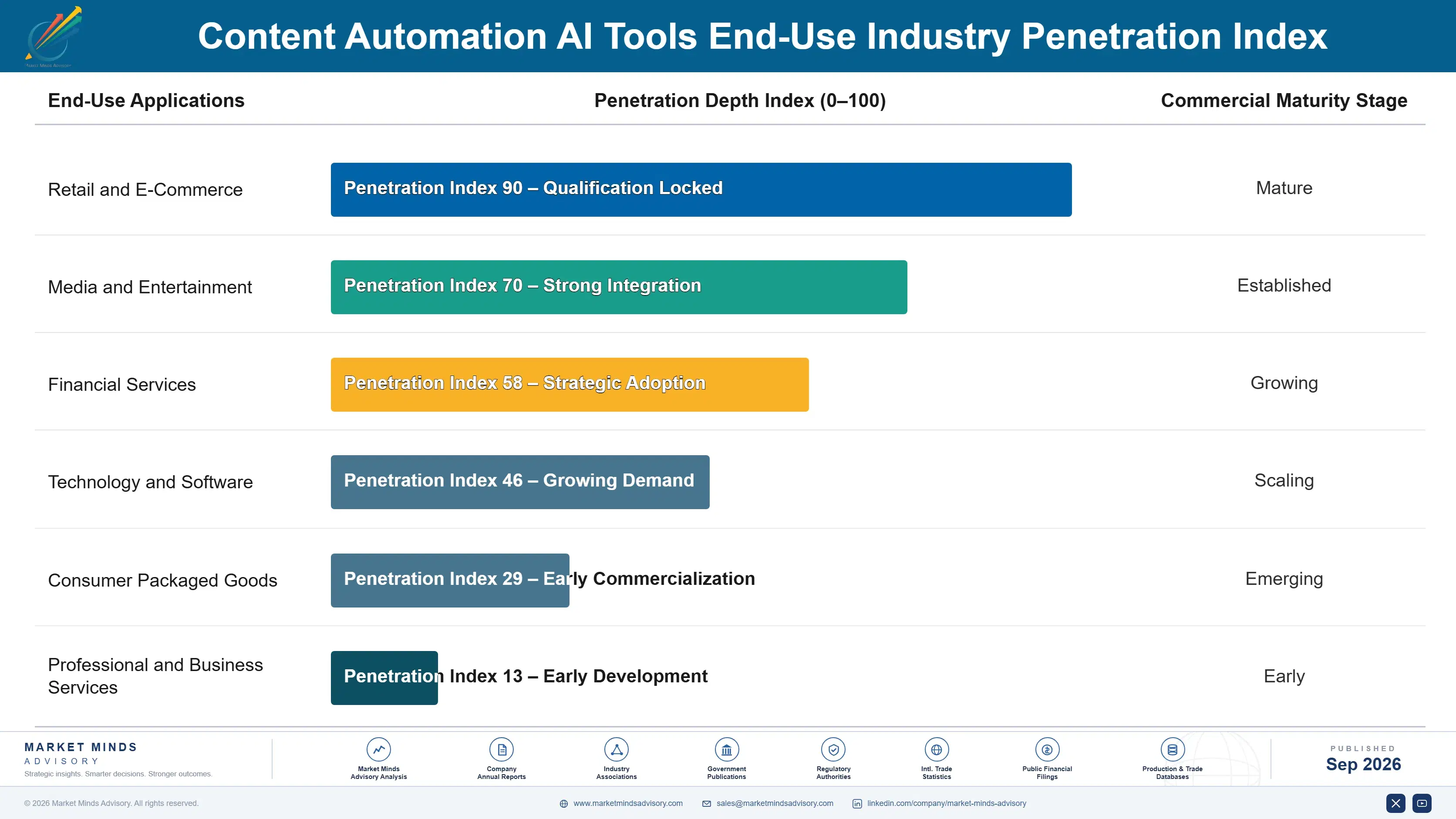
Content automation AI tool demand runs closer to a marketing budget annuity than a one-time software purchase for most enterprise customers. Once a platform wins adoption across a marketing organization's core workflows, expanded seat licenses, usage growth, and add-on module purchases flow for years without a fresh competitive procurement process, giving incumbent vendors a durable, multi-cycle revenue stream that new entrants find genuinely hard to interrupt quickly.
Stickiness varies sharply by end-use vertical, though. Enterprise marketing relationships run deepest, anchored by brand-governance integration and workflow embedding that discourages switching mid-campaign cycle entirely. Agency relationships show comparable depth once a platform becomes standardized across client accounts, though the relationship is more exposed to competitive re-bidding at client renewal than direct enterprise accounts tend to be. Small and mid-size business relationships sit in between, growing quickly but more price-sensitive and less locked-in than either enterprise or agency accounts.

Buyer profiles are shifting generationally as marketing leadership turns over across most organizations. Younger marketing leaders increasingly favor vendors offering usage-based pricing and multi-modal generation over pure incumbency, a change legacy text-only suppliers with strong historical relationships are still adjusting to across multiple regions and customer categories simultaneously.
content-automation-ai-tools-market-end-use-penetration-index-1790009683113

Where Content Tool Strategy Should Focus

These are among the four positions where our research anticipates prominent divergence between winners and laggards over the coming forecast period. Each is grounded in the demand model, the regulatory perimeter, and the announced capacity pipeline.
01 / GOVERNANCE LAYER INVESTMENT

Build brand governance into every generation workflow now

Platforms embedding brand governance and compliance review directly into generation are capturing meaningfully higher contract value and design wins than pure generation tools, and that gap is widening as enterprise buyers refuse manual review overhead. Vendors still shipping pure generation capability risk losing enterprise contracts to competitors offering governance-native platforms at comparable system cost and materially lower compliance risk. Building governance capability now, even at higher upfront engineering cost, protects design-in share before enterprise buyers fully standardize on compliant platforms.
02 / VIDEO CAPABILITY EXPANSION

Accelerate video generation quality toward production standards

Video generation demand is outrunning available production-quality capacity as output quality improves and enterprise adoption accelerates across nearly every marketing category tracked, and vendors slow to reach production standards risk ceding the fastest-growing segment entirely to more advanced competitors. Vendors that achieve production-grade output now position themselves to bid on the full range of enterprise marketing contracts launching over the coming several years rather than a narrow subset of text-only accounts. Vendors that delay risk permanent exclusion from the segment defining this market's growth.
03 / COMPUTE SUPPLY SECURITY

Lock in compute capacity ahead of demand spikes

Specialized inference compute capacity remains tightly allocated amid broader AI demand growth, leaving vendors without long-term supply agreements vulnerable to extended generation queue times during peak enterprise campaign periods that recur unpredictably across the calendar year. Larger competitors already secure preferential allocation through decade-long cloud infrastructure relationships that smaller rivals cannot easily replicate on short notice or comparable terms. Establishing multi-year compute reservations now, even at higher committed volume requirements, protects service reliability through the next inevitable industry-wide capacity crunch and preserves customer trust.
04 / REGIONAL ENTERPRISE POSITIONING

Expand presence across North American and South Asian markets

North America anchors both foundation model provider headquarters and the deepest enterprise marketing technology budgets for this market, while South Asia and Pacific posts the fastest regional growth rate on rapid digital marketing expansion outpacing most other emerging markets tracked in this report. Vendors under-invested in either region face longer sales cycles or missed design-in opportunities relative to competitors already embedded in local enterprise relationships and procurement channels. Building deeper regional presence now secures proximity to both anchor markets available today.

Engagement Snapshot From the Field

A live engagement with an industry participant carrying material or product regulatory and market exposure ahead of a defining policy shift, showing how our research translates into a defensible multi-year portfolio strategy.
MARKET MINDS ADVISORY · CLIENT ENGAGEMENT SUMMARY
Content Automation AI Tools Producer Strategic Portfolio Review and Transition Roadmap 2026·Investment Scenario on Content Automation AI Tools Exposure Evaluation 2025-26
CLIENT PROFILE
The client is a global consumer products company with marketing operations spanning North America, Europe, and Asia, historically relying on external agencies for the majority of campaign video and image production. Annual marketing spend is approximately two hundred million dollars (client-reported, unverified by MMA), with agency production fees representing a significant and growing share of that total budget.
STRATEGIC CHALLENGE
Rising agency production costs and slower campaign turnaround times were pressuring the client's ability to compete with faster-moving digital-native competitors, while internal marketing leadership lacked clarity on whether AI generation tools could reliably replace agency-produced video at brand-acceptable quality. A budget decision was pending for the next fiscal year's marketing technology allocation.
MMA APPROACH
MMA conducted structured interviews with the client's marketing and brand leadership, benchmarked competitor AI adoption timelines against primary survey data, and modeled cost and turnaround outcomes under different AI tool investment scenarios for leadership review. The engagement combined qualitative expert interviews with MMA's proprietary segment growth forecasts to prioritize which capability mattered most.
KEY FINDINGS
  1. Agency video production costs had risen roughly 30 percent over three years (client-reported, unverified by MMA) while turnaround times lengthened for most campaign types.
  2. Competitors adopting AI video generation were reportedly cutting campaign turnaround time by more than half for most routine social media content types.
  3. Internal brand-governance requirements meant the client needed a platform with built-in compliance review rather than just a purely generic generation tool alone.
  4. A pilot program targeting routine social content only, rather than flagship campaigns, could demonstrate value quickly with minimal brand risk exposure overall.
CLIENT PROFILE
The client is a global consumer products company with marketing operations spanning North America, Europe, and Asia, historically relying on external agencies for the majority of campaign video and image production. Annual marketing spend is approximately two hundred million dollars (client-reported, unverified by MMA), with agency production fees representing a significant and growing share of that total budget.
STRATEGIC CHALLENGE
Rising agency production costs and slower campaign turnaround times were pressuring the client's ability to compete with faster-moving digital-native competitors, while internal marketing leadership lacked clarity on whether AI generation tools could reliably replace agency-produced video at brand-acceptable quality. A budget decision was pending for the next fiscal year's marketing technology allocation.
MMA APPROACH
MMA conducted structured interviews with the client's marketing and brand leadership, benchmarked competitor AI adoption timelines against primary survey data, and modeled cost and turnaround outcomes under different AI tool investment scenarios for leadership review. The engagement combined qualitative expert interviews with MMA's proprietary segment growth forecasts to prioritize which capability mattered most.
KEY FINDINGS
  1. Agency video production costs had risen roughly 30 percent over three years (client-reported, unverified by MMA) while turnaround times lengthened for most campaign types.
  2. Competitors adopting AI video generation were reportedly cutting campaign turnaround time by more than half for most routine social media content types.
  3. Internal brand-governance requirements meant the client needed a platform with built-in compliance review rather than just a purely generic generation tool alone.
  4. A pilot program targeting routine social content only, rather than flagship campaigns, could demonstrate value quickly with minimal brand risk exposure overall.
RECOMMENDED STRATEGY
Phase 1: Phase one: launch a pilot program using a governance-native AI video platform for routine social media content within three months. Phase 2: Phase two: expand successful pilot use cases to regional campaign production while still maintaining agency partnerships for flagship brand campaigns. Phase 3: Phase three: renegotiate agency contracts to reflect reduced routine production volume once AI tool adoption proves reliable at meaningful scale.
OUTCOME
Within twelve months the client reported (client-reported, unverified by MMA) a 35 percent reduction in routine content production cost and a meaningfully faster campaign turnaround time, while maintaining existing agency relationships for flagship campaigns requiring the highest creative standards and brand risk sensitivity and oversight throughout.

Frequently Asked Questions

Foundational context covering the market sizes, CAGR, scope, country, region and competition that inform every finding below. This section is provided to cover basics and most often pre-purchase conversations, answered from the MMA Primary Research Dataset.

What is the current size of the Content Automation AI Tools Market?

The Content Automation AI Tools Market reached an estimated 6.2 billion dollars globally in 2025. Production-quality video generation remains the primary growth driver today across most segments.

How large will the Content Automation AI Tools Market be by 2036?

MMA forecasts the market will reach approximately 21.14 billion dollars by 2036 under the base case scenario. That represents roughly a 3.05 times expansion from 2026 levels.

What is the CAGR for the Content Automation AI Tools Market 2026 to 2036?

The base case CAGR is 11.8 percent annually across the forecast period. Bull and bear scenarios range from 13.1 percent down to 10.5 percent respectively.

Which segment is growing fastest?

AI Video Generation and Editing Tools is growing fastest at 19.8 percent CAGR, roughly 1.68 times the overall market rate. Production-quality output improvements drive that pace.

Who are the major companies in the Content Automation AI Tools Market?

Leading players include Adobe, Canva, Jasper AI, Synthesia, and Writer, spanning creative software and AI generation categories. Together the top five hold an estimated 29 percent combined share.

Which country is growing fastest?

India leads country-level growth at 14.8 percent CAGR, well ahead of the regional and global averages. Rapid digital marketing expansion and e-commerce growth are the main contributing factors.

Report Segmentation Architecture

The full report scope spans multiple orthogonal segmentation dimensions, with cross-tabulated demand data provided for each dimension pair. Coverage extends further to regional breakdowns, trend trajectories, and the competitive detail needed to support segment-level decision-making.

By Primary Market Dimension

  • AI Text and Copywriting Generation Tools
  • AI Image and Graphic Generation Tools
  • AI Video Generation and Editing Tools
  • AI Voice and Audio Content Generation Tools
  • AI Content Personalization and Optimization Platforms
  • AI Content Workflow and Collaboration Platforms

By End-Use Industry

  • Retail and E-Commerce
  • Media and Entertainment
  • Financial Services
  • Technology and Software
  • Consumer Packaged Goods
  • Professional and Business Services

By Commercial Dimension

  • Direct Enterprise Software Licensing
  • Agency and Reseller Channels
  • Self-Service Subscription Sales
  • Usage-Based Consumption Pricing
  • Custom Integration and Professional Services

By Region

  • North America
  • Western Europe
  • East Asia
  • South Asia and Pacific
  • Latin America
  • Middle East and Africa
  • Eastern Europe

Scope, Methodology, and Coverage

Every figure in this report is reproducible from documented input assumptions. The scope below maps the historical period, the forecast horizon, the segmentation dimensions, and the countries covered, alongside the underlying primary and qualitative methodology.
Historical Period
2020 to 2025
Forecast Period
2026 to 2036
Base Year
2025 (USD billions; MMA Primary Research Dataset, September 2026)
Market Definition
The Content Automation AI Tools Market covers AI-powered software platforms that generate, edit, optimize, and manage marketing, editorial, and enterprise content across text, image, video, and audio formats. It excludes underlying foundation model training infrastructure sold separately, general-purpose AI chatbots, and traditional non-AI content management systems.
Quantitative Units
USD Billion
Segmentation Dimensions
Product and technology type, end-use industry, and commercial distribution channel
Regions Covered
North America, Western Europe, East Asia, South Asia and Pacific, Latin America, Middle East and Africa, Eastern Europe
Countries Covered
United States, China, United Kingdom, Germany, Japan, India, Brazil, and 14 additional countries
Key Companies Profiled
Adobe Inc., Canva Pty Ltd., Jasper AI Inc., Synthesia Ltd., Writer Inc., Copy.ai Inc, Grammarly Inc, Runway AI Inc, ElevenLabs Inc, Descript Inc, Murf AI Inc, Anyword Ltd, Persado Inc, Typeface Inc, Lately Inc, Frase.io Inc, Surfer SEO, Semrush Holdings Inc, HubSpot Inc, Salesforce Inc
Quantitative Methodology
Primary survey, n=3,800 respondents, Q4 2025, six countries; demand-side model with trade association cross-validation
Qualitative Methodology
47 expert interviews, Q4 2025; applied to validate demand model assumptions, identify emerging dynamics, and assess competitive positioning
Report Format
PDF and XLSX data workbook (Word format preview document)
Publisher
Market Minds Advisory
Report Code
MMA-2026-TEC-689
Published
September 2026
Contact
sales@marketmindsadvisory.com | www.marketmindsadvisory.com

Purchase the full Content Automation AI Tools Market Report (2026 to 2036).

This report provides a comprehensive assessment of the global Content Automation AI Tools Market across all major product categories, end-use industries, and geographic regions through 2036. It combines MMA's primary survey dataset of 3,800 respondents with 47 expert interviews to quantify segment-level growth, competitive positioning, and regional demand mechanisms. Coverage spans market sizing, segmentation, regional dynamics, competitive benchmarking, input cost exposure, and portfolio economics. The analysis is designed to support product roadmap planning, procurement strategy, and investment decisions for platform vendors, marketing organizations, and enterprise buyers evaluating this space.
Ten-year quantitative forecast by product segment
Seven-region demand and pricing breakdown analysis
Competitive benchmarking of top twenty players
Compute cost exposure and mitigation analysis
Margin tier and portfolio economics mapping
Primary survey and expert interview data

Built For The People Who Decide

From boardroom strategy to bench-side execution, this report is read cover-to-cover by leaders shaping the next decade of their industry, turning demand scenarios, market dynamics and valuation benchmarks into decisions.
CXOs/ Presidents/ VPs/ Managers
M&A and Corporate Development
Strategy Teams and R&D Heads
Procurement and Product Directors
Regulatory and Compliance Leaders
Investor Relations and Equity Analysts