Market Minds Advisory
Contact Lens Solution Market

Contact Lens Solution Market: Disinfection Chemistry, the Daily Disposable Squeeze and the Myopia Correction Boom

A consumable category whose largest competitor is a lens that needs no solution at all, saved from decline by myopia control programmes creating reusable lens wearers faster than daily disposables remove them.

Lead Analyst

Alice Ballenger

Published

September 2026

Make Smarter Decisions with Customized Research Insights

Request a free sample report and evaluate market opportunities, growth trends, and competitive dynamics relevant to your business needs.

2025 MARKET VALUE$3.2BMarket Size 2025
2036 FORECAST VALUE$5.2BBase Case , 2026 to 2036
CAGR 2026 TO 20364.6 %Bull 5.8% / Bear 3.4%
INCREMENTAL OPPORTUNITY$1.9BNet 10- year value creation
EXPANSION MULTIPLE1.57x2036 value over 2026 base
Strategic Levers
M&A Pipeline
Regional Outlook
Country Rankings
Competitive Intelligence
Segmental Deep-dive
Call-Us : 91 93563 13602

Executive Snapshot and Market Trajectory

Lens care sells against a product that eliminates it. Every wearer who moves to daily disposables stops buying solution permanently, Growth is happening somewhere else entirely, and the category depends on it. Two decades of that migration have already run. The category depends entirely on arithmetic happening somewhere else.
Hydrogen peroxide one-step systems compound at 6.9%, exactly 1.50 times the market, as preservative sensitivity and Acanthamoeba keratitis concerns push practitioners away from multipurpose chemistry. East Asia holds 30% of global consumption, and the reason is orthokeratology: Chinese myopia control programmes have put rigid overnight lenses on millions of children, and every one of those lenses requires daily care. None of them can switch to a disposable lens.
Five companies hold 61% of the market, which is concentrated by consumable standards. Competition runs on formulation claims rather than price at the pharmacy shelf. Private label has taken meaningful share of the multipurpose tier. Regulatory burden on a solution instilled near the eye keeps casual entrants out. Peroxide and rigid lens chemistry have so far been left alone by both pressures, which is where the remaining growth sits. Competition there is clinical.
Market Definition
The market covers solutions and care products used to disinfect, clean, rinse, store and rewet contact lenses, spanning multipurpose disinfecting solutions, hydrogen peroxide one-step systems, rigid gas permeable and scleral lens care, saline and rinsing products, enzymatic cleaners and rewetting drops. Contact lenses themselves are excluded, as are dry eye pharmaceuticals, ophthalmic drugs and lens cases sold separately from a solution.
Base Year Value
$3.2B in 2025 (MMA Primary Research Dataset, August 2026)
Forecast Period
2026 to 2036, eleven discrete annual values
CAGR
4.6% base case. Bull 5.8%. Bear 3.4%.
Fastest Growth Segment
Hydrogen Peroxide One-Step Systems: 6.9% CAGR
Fastest Growth Country
India: 7.4% CAGR
Fastest Growth Region
South Asia and Pacific: 6.8% CAGR
Largest Region
East Asia: 30% of 2025 global value
Market Leaders
Alcon, Bausch and Lomb, CooperVision, Menicon, Johnson and Johnson Vision Care. Source: MMA Analysis based on company annual reports.
Primary Survey
n=3,800 procurement and R&D decision-makers, Q4 2025, six countries
Methodology
Demand-side build-up, cross-validated against public data, 47 expert interviews

Contact Lens Solution Market Forecast Scenarios

contact-lens-solution-market-size-forecast-scenario-1787307195903
Volumes fell in the mature Western markets across 2020 to 2025 while Asian volumes rose faster, and the implied 3.6% CAGR is the net of two opposing trends rather than a description of either. Pandemic-era mask wear and reduced office attendance cut lens wear noticeably in 2020 and 2021, and recovery was uneven by region.
The base case at 4.6% rests on three mechanisms. Myopia control programmes in China, Taiwan and Singapore keep adding orthokeratology wearers, who consume rigid lens care daily and cannot switch to a disposable. Practitioner preference is shifting toward peroxide disinfection on efficacy grounds, and peroxide systems carry higher shelf prices. And scleral lens fitting for irregular corneas has grown from a specialty niche into routine practice across developed markets. All three run on their own timetable.
The bull case at 5.8% depends on myopia control prescribing spreading beyond East Asia at pace, which would create reusable wearers in markets where daily disposables currently dominate. The bear case at 3.4% is straightforward: daily disposable pricing keeps falling, and each price step converts more reusable wearers who then stop buying solution entirely. Neither scenario turns on formulation science.

Selling a Consumable Against a Product Designed to Make It Unnecessary

Two forces have been pulling this category in opposite directions for twenty years. Daily disposable lenses, which require nothing beyond a bin, now account for 48% of wearers globally and considerably more in Japan, the United Kingdom and Scandinavia. Against that, myopia has become a public health concern across East Asia, and the correction methods chosen there mostly require reusable lenses and daily care.
TOP FIVE CONCENTRATION61%Combined share held by the five largest global suppliers
DAILY DISPOSABLE PENETRATION48% of wearersShare of lens wearers requiring no care product whatsoever
AVERAGE ANNUAL SPENDUSD 74 per wearerTypical yearly outlay by an active reusable lens wearer
PRIVATE LABEL SHARE23% of multipurposeRetailer own-brand penetration of the largest product tier
PRACTITIONER RECOMMENDATION WEIGHT67% of first purchasesInitial brand choice driven by the fitting practitioner directly
BOTTLE REPLACEMENT CYCLE5 weeksTypical repurchase interval for a standard multipurpose bottle
The commercial character is unusual for a consumable. First purchase is effectively prescribed: 67% of wearers buy the brand their fitting practitioner recommended, and many never reconsider. That makes practitioner detailing the primary sales channel and explains why five companies hold 61% of a category sold in supermarkets. Retail price competition operates on the repeat purchase rather than the first. Loyalty here is inherited rather than earned.
Formulation is where the argument now sits. Multipurpose solutions rely on preservatives that a growing share of wearers cannot tolerate comfortably, and their efficacy against Acanthamoeba is weaker than peroxide disinfection. Practitioners have noticed. Peroxide systems are less convenient, require a neutralising case and carry real harm risk if instilled directly, yet they keep taking share. Convenience is losing the argument.
"This is the only consumable category I follow where the incumbent lens manufacturers actively sell the product that destroys demand for their own solution line. Nobody inside these companies pretends otherwise; they simply run the two businesses on different timetables and hope Asia grows faster than the West shrinks."
Director, Ophthalmic Devices and Vision Care Practice · MMA Ophthalmic Devices a

Market Trends

Myopia Control Prescribing Creates Reusable Wearers at Scale

Chinese myopia prevalence among adolescents exceeds 70%, and the national vision protection programme launched by the Ministry of Education has driven orthokeratology fitting hard as a control method. Overnight rigid lenses reshape the cornea and must be cleaned, disinfected and stored every single day, using dedicated rigid lens chemistry rather than soft lens multipurpose solution. Taiwan and Singapore run comparable programmes. The result is a cohort of young wearers entering the category on a care regimen no disposable lens can replace, and staying for years. Fitting volumes have not yet peaked in any province.
Market Impact: Scleral wearers using 3x normal vol
Peroxide Disinfection Displaces Multipurpose on Efficacy Grounds

Acanthamoeba keratitis is rare and devastating, and multipurpose solutions perform poorly against the cyst form. Published outbreak investigations and practitioner guidance across the United Kingdom and United States have pushed fitting optometrists toward hydrogen peroxide one-step systems, which achieve far broader kill and contain no preservatives. Peroxide grew 6.9% against a market at 4.6%. The trade-off is convenience and a genuine harm risk if the solution reaches the eye unneutralised, which keeps some practitioners cautious about recommending it to less careful wearers. Guidance updates have nonetheless moved specification decisively. Cautious practitioners remain.
Market Impact: Comfort complaints driving 22% of c

Market Opportunities and Growth Drivers

Scleral Lens Fitting Moves From Specialty Into Routine Practice

Scleral lenses vault the cornea entirely and sit on the sclera, correcting keratoconus, post-surgical irregularity and severe dry eye that no soft lens addresses. Fitting has spread well beyond specialist referral centres over the past decade. These lenses require preservative-free saline for filling before insertion, dedicated rigid cleaning chemistry and daily handling, and a scleral wearer consumes several times the care product volume a standard soft lens wearer does. Roughly 11% of rigid lens care revenue now comes from scleral fitting. That share was negligible a decade ago, and fitting continues to spread into general optometric practice.
Market Impact: Daily disposables at 48% of wearers

Preservative Sensitivity Pushes Wearers Toward Peroxide and Preservative-Free

A meaningful share of reusable wearers develop intolerance to the biguanide and polyquaternium preservatives that multipurpose solutions depend on, presenting as redness, stinging on insertion and reduced wear time. Practitioners increasingly treat comfort complaints as a chemistry problem rather than a lens problem. Hydrogen peroxide neutralises to plain saline and leaves nothing behind, which is why it has become the default recommendation for sensitive wearers. Around 22% of peroxide conversions originate from a comfort complaint rather than an infection concern. Comfort complaints reach the practitioner constantly, which makes the conversion opportunity a recurring one rather than an occasional one.
Market Impact: Private label at 23% of multipurpos

Market Restraints and Challenges

Daily Disposables Remove Wearers From the Category Permanently

Every conversion to a daily disposable lens ends that wearer's solution purchasing for good, and the conversion almost never reverses. The root cause is that lens manufacturing costs have fallen far enough for daily disposables to price competitively against a reusable lens plus a year of solution. Penetration reached 48% of wearers globally and exceeds 70% in Japan. Suppliers mitigate by concentrating on rigid and specialty chemistry, where no disposable equivalent exists, and by pursuing markets where reusable wear still dominates. Neither response reverses the underlying migration, and nobody inside the category pretends it does.
Market Impact: Orthokeratology adding 9% annual we

Private Label Compresses Multipurpose Pricing at Retail

Retailer own-brand multipurpose solutions now hold 23% of that tier and sell at substantial discounts to branded equivalents. The root cause is that multipurpose chemistry is mature, off-patent and manufacturable by contract formulators to a specification that satisfies regulators. Wearers reordering a familiar product face a visible price gap on the same shelf. Suppliers mitigate by anchoring first purchase through practitioner recommendation, where 67% of brand decisions are made, and by shifting mix toward peroxide and rigid tiers private label has barely entered. Shelf price alone is not a winnable argument here.
Market Impact: Peroxide systems compounding at 6.9
3 additional market trends, 4 additional growth drivers, and 2 additional restraints and challenges are covered in the full report. Contact sales@marketmindsadvisory.com to access the complete intelligence.

Segment CAGR and Growth Architecture

Segmentation follows care product type, because disinfection chemistry determines regulatory pathway, retail price, practitioner recommendation and which lens material the product can be used with. A wearer's regimen is chosen once at fitting and rarely revisited, which makes product type the dimension along which every commercial decision in this category resolves. Nothing else explains the pricing spread.
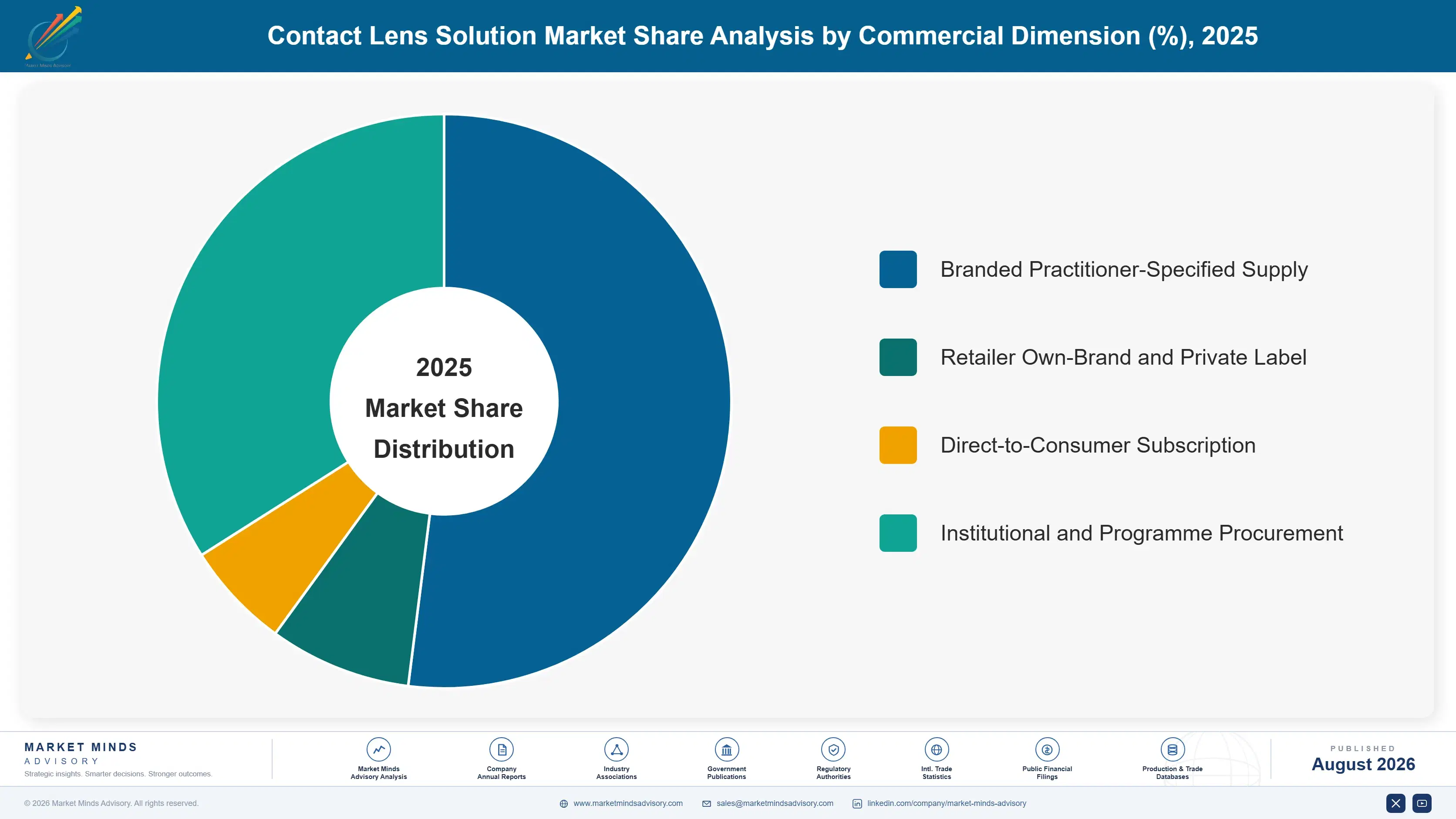
contact-lens-solution-market-market-share-analysis-1787307196476

Hydrogen Peroxide One-Step Systems

Peroxide compounds at 6.9%, exactly 1.50 times the market rate, on the strength of two arguments practitioners find hard to dismiss. It achieves far broader microbial kill than preservative-based multipurpose chemistry, including against the Acanthamoeba cyst form implicated in the worst keratitis outcomes. And it neutralises to plain saline, leaving no preservative on the lens for a sensitive eye to react to. The costs are real: a wearer must use the supplied neutralising case, cannot rinse with the solution, and risks a painful chemical injury if the regimen is misunderstood. Shelf prices sit well above multipurpose, and private label has barely entered the tier. Practitioners weigh that convenience penalty against a genuine safety argument.
CAGR 6.9%

Rigid Gas Permeable and Scleral Lens Care

Rigid lens care grows at 5.8% on two quite separate demand sources. Orthokeratology for myopia control has put overnight rigid lenses on millions of East Asian children, each requiring daily cleaning, disinfection and storage with chemistry formulated for rigid materials rather than soft. Separately, scleral lens fitting for keratoconus and severe ocular surface disease has moved from specialist referral into routine optometric practice across developed markets, and scleral wearers consume preservative-free filling saline in volume alongside conventional care. No disposable alternative exists for either application, which insulates the tier completely from the substitution pressure defining the rest of this market. Both demand sources are expanding, and neither responds to lens pricing.
CAGR 5.8%
Full segment breakdown across 6 segments available in the complete report.

Regional Architecture and Country Demand Map

Geographic distribution tracks lens modality rather than population or wealth. Regions where reusable lenses still dominate consume care products heavily, while markets that moved early to daily disposables generate lens revenue without generating any solution demand at all. Modality mix rather than wearer count is the number to read.

East Asia

East Asia takes 30% of global consumption, the largest regional share, and orthokeratology explains most of the gap to North America. Chinese adolescent myopia prevalence above 70% prompted a national vision protection programme, and overnight rigid lenses became a mainstream control method rather than a specialty fit. Each of those wearers consumes rigid lens chemistry daily for years. Japanese demand runs the opposite way, with daily disposable penetration above 70% suppressing care product volume in what remains a large lens market. Korean and Taiwanese wear patterns sit between the two, with Taiwan running its own myopia control programme. Regional growth of 6.0% is carried almost entirely by mainland Chinese paediatric fitting rather than by adult cosmetic wear.
Share: 30% | CAGR: 6.0% (2026 to 2036)

North America

North America holds 27% of the market and the highest spend per wearer, at roughly USD 74 annually. Practitioner recommendation carries unusual weight here, with 67% of wearers buying the brand their optometrist specified at fitting, which is why detailing rather than shelf pricing determines share. Daily disposable conversion has run steadily for two decades and continues, holding regional growth to 3.3%, the second slowest of the seven regions. Scleral lens fitting provides the genuine growth: keratoconus management and post-refractive-surgery correction have moved into routine optometric practice, and those wearers consume several times the normal volume. Peroxide systems have taken share faster here than in most markets on infection risk grounds.
Share: 27% | CAGR: 3.3% (2026 to 2036)
Regional intelligence for 5 additional markets available in the complete report: Western Europe, South Asia and Pacific, Latin America, Middle East and Africa, Eastern Europe. Contact sales@marketmindsadvisory.com.
contact-lens-solution-market-country-cagr-analysis-1787307196985

Playing the Hand Daily Disposables Left Behind

The strategic question in lens care is not how to grow the multipurpose tier, which is being taken from both sides by disposables and private label. It is where demand exists that no disposable lens can serve and no retailer can copy cheaply. Four such positions carry the available margin. All four sit outside the retail shelf.

Own the Orthokeratology Care Regimen in East Asia

Chinese myopia control fitting adds orthokeratology wearers at roughly 9% annually, and each is locked into daily rigid lens care for years with no disposable alternative available at any price. Winning that regimen means supplying through the fitting practice rather than the pharmacy, since the practitioner specifies the entire care system alongside the lens. Suppliers holding those positions realise gross margins some 14 to 20 points above multipurpose retail. The requirement is a dedicated paediatric fitting sales organisation, which is expensive to build and very difficult for a competitor to displace afterwards.
Market Impact: Orthokeratology fitting now growing

Convert Comfort Complaints Into Peroxide Prescriptions

Roughly 22% of peroxide conversions begin as a comfort complaint rather than an infection concern, and comfort complaints reach the practitioner constantly. A supplier that arms optometrists with a clear preservative-intolerance protocol captures that flow at the moment of decision. Peroxide carries shelf prices well above multipurpose and has seen almost no private label entry, so the mix shift is worth 12 to 18 gross margin points per converted wearer. The investment is clinical education rather than formulation, and it compounds because a converted wearer rarely returns to multipurpose chemistry.
Market Impact: Conversions worth 12 to 18 gross ma

Supply Scleral Fitting With Preservative-Free Filling Saline

Scleral lenses must be filled with preservative-free saline before insertion, every time, and a scleral wearer consumes roughly three times the care volume of a standard soft lens wearer. Fitting has moved from specialist referral into routine optometric practice, and around 11% of rigid care revenue now originates there. Unit-dose preservative-free saline is a manufacturing discipline rather than a chemistry one, requiring sterile filling capacity that most care product formulators do not hold. That barrier is the point: the tier is growing, insulated from disposables and thinly contested. Few competitors are positioned to contest it.
Market Impact: Scleral wearers consuming 3x the no

Defend First Purchase Through Practitioner Detailing

Some 67% of wearers buy the brand their fitting practitioner specified, and a large share never reconsider across years of repurchasing. That single statistic explains why five suppliers hold 61% of a category sold openly in supermarkets. Private label competes on the shelf and wins repeat purchases on price, but it cannot reach the fitting chair. Sustaining a detailing organisation costs real money against a mature tier, yet abandoning it concedes the only point in the purchase sequence where price is not the deciding factor for the wearer. That trade-off deserves an explicit decision.
Market Impact: Practitioner detailing deciding 67%

Who Controls the Margin Pool

Five suppliers hold 61% of the market measured on care product revenue, the basis used consistently throughout this section. Concentration is high for a supermarket consumable, and the explanation is regulatory: a solution instilled near the eye carries a device approval burden that discourages casual entry. Alcon and Bausch and Lomb lead, with a clear gap to the rest. Formulation claims rather than price separate them.
Competition runs on three dimensions. Practitioner detailing decides first purchase and therefore most of the installed base. Formulation claims around comfort, preservative content and disinfection efficacy decide which product a practitioner specifies. And rigid lens chemistry capability decides participation in the only tiers growing meaningfully, since orthokeratology and scleral care need formulations soft lens specialists do not hold.

Two pressures are reshaping rankings. Private label has taken 23% of the multipurpose tier and continues to advance wherever a wearer repurchases on price alone. Against that, Menicon and the Japanese specialists hold rigid lens positions that the volume leaders have historically undervalued. Rankings will shift toward whoever builds credible paediatric orthokeratology detailing in China before that cohort finishes forming. That cohort is forming now.
contact-lens-solution-market-company-positioning-matrix-1787307197530

Competitive Moat and Risk Dimensions

ALCON

Moat: Practitioner detailing and reach

Alcon fields one of the largest eye care detailing organisations in the industry, covering surgical, pharmaceutical and vision care from a single call. That reach converts directly into first-purchase share, which 67% of wearers never revisit. Opti-Free brand recognition among practitioners is unusually durable, and the surgical relationship opens fitting practices that a care-only supplier struggles to access.
ALCON

Risk: Multipurpose tier exposure

The company's care revenue concentrates in exactly the tier private label is taking, at 23% of multipurpose and rising, and which daily disposables erode from the other side. Peroxide and rigid chemistry positions are weaker than the multipurpose franchise. Defending a shrinking tier with an expensive detailing organisation gets harder each year.
BAUSCH AND LOMB

Moat: Peroxide franchise and heritage

The company holds a long-established peroxide position through the PeroxiClear and Boston lines, covering both the fastest-growing soft lens tier and rigid gas permeable care where it has been the reference brand for decades. Boston solutions are specified by name in fitting protocols worldwide, an incumbency clinical habit renews without promotional spend.
BAUSCH AND LOMB

Risk: Balance sheet and investment capacity

Carrying substantial debt from its corporate history constrains the investment available for building paediatric orthokeratology detailing in China, which is where the category's genuine growth now sits. Competitors with cleaner balance sheets can fund that organisation more freely. The rigid lens heritage is valuable but requires active commercial support in a market forming right now rather than passive brand equity.

Players Tracked

Prominent Players

Alcon
Bausch and Lomb
CooperVision
Menicon
Johnson and Johnson Vision Care

Other Key Players

Avizor
Ophtecs Corporation
Rohto Pharmaceutical
Santen Pharmaceutical
SEED Co.
Interojo
Bescon
St. Shine Optical
Ginko International
Hydron Contact Lens
Ocumed Group
Contopharma
Blanchard Contact Lenses
X-Cel Specialty Contacts
Walgreens Boots Alliance

Recent Developments

FEBRUARY 2025

Chinese myopia control fitting expands orthokeratology care demand

Paediatric orthokeratology fitting continued expanding across Chinese provincial optical chains under the national vision protection programme, lifting rigid lens care volume materially. This was organic demand growth driven by public health policy rather than any corporate transaction, and it favours suppliers holding rigid chemistry positions.
Signal: Public health policy rather than commercia
JUNE 2025

Practitioner guidance strengthens on peroxide disinfection efficacy

Optometric guidance across several developed markets moved further toward hydrogen peroxide systems for wearers at elevated keratitis risk, citing efficacy against the Acanthamoeba cyst form. These were professional guidance updates rather than regulatory actions, though they influence first-purchase specification directly at the fitting chair. Retail promotion reaches nobody there.
Signal: Disinfection efficacy has replaced conveni
OCTOBER 2025

Scleral lens fitting broadens beyond specialist referral centres

Scleral lens fitting continued moving into routine optometric practice across North America and Western Europe, expanding demand for preservative-free unit-dose filling saline. This reflects gradual practice pattern change rather than a discrete commercial event, and it rewards suppliers holding sterile unit-dose filling capacity. Most care formulators hold no such capacity.
Signal: Sterile filling capability rather than for

What Sits Inside a Care Product Bottle

Chemistry is cheap here. Preservatives, buffers, surfactants and hydrogen peroxide together account for under 12% of cost of goods, and all source from ordinary industrial chemical supply with no concentration risk worth naming. Packaging dominates instead: the bottle, the tamper-evident closure and the neutralising case for peroxide systems run roughly 29% of cost, sourced from regional polymer converters.
Resin pricing moved sharply across 2022 and 2023, and polypropylene and polyethylene feedstock cost tracked the European natural gas disruption that International Energy Agency reporting documented through that period. Bottle and case costs rose in step, and suppliers with annual retail pricing agreements absorbed the increase for several quarters before recovering it. Company annual reports covering that period disclose the margin compression in vision care consumables plainly.

The disadvantage falls unevenly. A supplier selling mainly through retail carries fixed shelf pricing agreed annually and cannot recover a mid-year input move, while one selling rigid and specialty chemistry through fitting practices reprices more freely. Regional filling capacity matters equally: solution is mostly water and expensive to ship, so anyone supplying a region from another continent carries a freight penalty on top.
contact-lens-solution-market-cost-volatility-analysis-1787307197728

Regional filling to avoid shipping water across oceans

Care solutions are largely water, which makes intercontinental freight economically absurd relative to product value. Suppliers filling within each major consuming region cut logistics cost sharply and gain currency matching alongside it. Formulation is centralised and filling localised, which is the standard structure among the leaders and a genuine barrier for smaller entrants. Replicating it takes years.

Packaging specification simplification across the product range

Bottle, closure and case together run roughly 29% of cost of goods, far more than the chemistry inside. Rationalising to common bottle geometries and closure specifications across a product range cuts tooling cost, improves converter negotiating position and shortens qualification when a supply source changes. The constraint is that peroxide systems need their own neutralising case design.

Mix shift toward tiers with practitioner-set pricing

Retail shelf prices are agreed annually and cannot absorb a mid-year input move, whereas rigid and specialty chemistry sold through fitting practices reprices with far less friction. Shifting volume toward peroxide, orthokeratology and scleral care therefore reduces input cost exposure as a side effect of a strategy already justified on growth grounds alone. The benefit is real but secondary.

Portfolio Architecture for Margin Defence

The portfolio divides on whether a disposable lens or a private label bottle can take the position. Multipurpose solutions face both and margin reflects it. Peroxide systems face private label barely and disposables not at all, since a peroxide wearer has already chosen reusable lenses deliberately. Rigid and scleral chemistry faces neither, because no disposable equivalent exists and sterile unit-dose filling deters casual entry. Substitutability explains the entire margin ladder here.
The tension is that multipurpose still carries most of the volume and therefore most of the filling line utilisation and detailing overhead. A supplier that walks away from it to chase specialty margin finds its cost per unit rising across everything else. The leaders run multipurpose defensively, protecting first purchase through the practitioner while conceding repeat purchases to price where they must. Walking away entirely is rarely the right answer.

High-value pools sit where a clinical requirement rather than a consumer preference sets the specification. Orthokeratology care, scleral filling saline and preservative-free formats for sensitive wearers all qualify. Each is specified by a practitioner, repurchased indefinitely and effectively immune to the substitution pressure defining the rest of the category. Clinical specification is the common thread.

Volume / Commodity-Adjacent Tier

Multipurpose disinfecting solutions, saline and rinsing products sold through pharmacy and grocery retail. Competes against retailer own-brand on the shelf and against daily disposable lenses that remove the wearer from the category altogether.
Gross Margin: 38-49%

Premium / Certified Tier

Hydrogen peroxide one-step systems and branded comfort-positioned formulations specified by practitioners on disinfection efficacy and preservative-free grounds. Private label entry has been minimal, and shelf prices sit well above multipurpose equivalents.
Gross Margin: 56-68%

Sustainability / Regulatory / Next-Generation Tier

Rigid gas permeable, orthokeratology and scleral lens care including preservative-free unit-dose filling saline. Sterile filling capacity and clinical specification protect the tier, and the wide margin range reflects sharply differing unit-dose and bulk economics.
Gross Margin: 62-80%
contact-lens-solution-market-portfolio-architecture-1787307198231

High-value Sub-segments and Strategic Watch-out

Orthokeratology Care Systems

Growing with a Chinese paediatric fitting cohort expanding at roughly 9% annually and locked into daily rigid care for years. No disposable alternative exists, the practitioner specifies the entire regimen, and displacing an incumbent supplier afterwards is genuinely difficult. Access runs through the fitting practice rather than retail.
Gross Margin: 66-80%

Hydrogen Peroxide One-Step Systems

Compounding at 6.9% on disinfection efficacy and preservative-free comfort arguments that practitioners increasingly find decisive. Private label has barely entered, shelf pricing holds well above multipurpose, and converted wearers rarely revert to preservative-based chemistry afterwards. The conversion moment sits with the practitioner. Practitioner education is the whole lever.
Gross Margin: 58-70%

Multipurpose Disinfecting Solutions

The volume core at 3.4%, squeezed by private label holding 23% of the tier and by daily disposables removing wearers permanently. Run to protect first purchase and filling line utilisation rather than for margin, which it no longer reliably delivers. It still carries the detailing overhead.
Gross Margin: 38-49%

Preservative-Free Unit-Dose Saline

The watch-out, growing with scleral fitting but requiring sterile unit-dose filling capacity most care formulators simply do not hold. Whoever builds that capacity captures a tier where wearers consume roughly three times normal volume and repurchase indefinitely. Sterile filling investment is the entry condition. Nobody has built it at scale.
Gross Margin: 60-78%

How Wearers Actually Repurchase

Care product demand is close to pure annuity for as long as a wearer stays in reusable lenses. A standard bottle lasts roughly five weeks, repurchase is habitual rather than considered, and the regimen was set at fitting by someone the wearer trusts. The vulnerability is not competitive switching but modality switching: a single conversation about daily disposables ends the annuity permanently, and it never resumes. Modality is the only real risk.
Depth varies sharply by wearer type. Orthokeratology and scleral wearers are the deepest, buying multiple products daily under clinical supervision with no substitute available. Peroxide wearers sit next, having chosen a specific chemistry for a specific reason. Routine soft lens wearers on multipurpose are the shallowest, repurchasing on price at whatever shelf they pass, and they are the population daily disposables and private label are both taking.

The buyer profile is splitting by age. Older reusable wearers repurchase branded solution out of long habit and practitioner loyalty. Younger wearers entering through myopia control fitting arrive on rigid regimens they cannot vary, while younger cosmetic wearers in developed markets mostly bypass the category entirely by starting on dailies.
contact-lens-solution-market-end-use-penetration-index-1787307198718

Where Lens Care Still Wins

These are among the four positions where our research anticipates prominent divergence between winners and laggards over the coming forecast period. Each is grounded in the demand model, the regulatory perimeter, and the announced capacity pipeline.
01 / MODALITY SUBSTITUTION DEFENCE

Never fight daily disposables on the tier they were built to replace

Daily disposable lenses now cover roughly 48% of all wearers globally and above 70% in Japan, and every conversion ends that wearer's solution purchasing permanently rather than temporarily. Multipurpose chemistry is precisely the tier those lenses were designed to displace, and retailer private label steadily takes whatever remains from the other side. The only genuinely defensible ground is chemistry that no disposable lens can substitute for at any price, which means rigid, orthokeratology, scleral and peroxide positions rather than the supermarket shelf.
02 / PAEDIATRIC FITTING ACCESS

The Chinese myopia cohort is the category's last large new wearer pool

Adolescent myopia prevalence above 70% has made orthokeratology a mainstream control method in China, adding wearers at roughly 9% annually who are locked into daily rigid care for years. That regimen is specified by the fitting practice rather than chosen at a pharmacy shelf, so reaching those wearers requires a dedicated paediatric detailing organisation on the ground. Building one is expensive and slow, and displacing an established competitor from a fitting practice afterwards has proved extremely difficult in commercial practice.
03 / DISINFECTION EFFICACY POSITIONING

Peroxide wins on the argument practitioners now weigh most heavily

Hydrogen peroxide systems compound at 6.9%, exactly 1.50 times the market, because they achieve far broader microbial kill including against the Acanthamoeba cyst form, and because they leave no preservative at all behind on the lens. Roughly 22% of conversions begin as a comfort complaint rather than an infection concern, which means the practitioner sees the opportunity constantly. Arming optometrists with a clear preservative intolerance protocol captures that flow at the exact moment the regimen decision is actually being made.
04 / STERILE FILLING CAPABILITY

Unit-dose saline capacity is the barrier protecting the scleral tier

Scleral lenses require preservative-free saline for filling at every insertion, and those wearers consume roughly three times the annual care volume that a standard soft lens wearer does. Around 11% of all rigid care revenue already originates there, and fitting keeps spreading steadily out of referral centres into routine optometric practice. Sterile unit-dose filling is a manufacturing discipline that most care formulators have simply never needed to build, and that capability gap is exactly why the tier remains thinly contested today.

Engagement Snapshot From the Field

A live engagement with an industry participant carrying material or product regulatory and market exposure ahead of a defining policy shift, showing how our research translates into a defensible multi-year portfolio strategy.
MARKET MINDS ADVISORY · CLIENT ENGAGEMENT SUMMARY
Contact Lens Solution Producer Strategic Portfolio Review and Transition Roadmap 2026·Investment Scenario on Contact Lens Solution Exposure Evaluation 2025-26
CLIENT PROFILE
A vision care manufacturer with roughly USD 610 million in annual lens care revenue (client-reported, unverified by MMA), weighted heavily toward branded multipurpose solutions sold through pharmacy and grocery retail across North America and Western Europe. Rigid lens chemistry represented under 8% of the portfolio (client-reported, unverified by MMA), and the company held no meaningful position in orthokeratology care in any Asian market.
STRATEGIC CHALLENGE
Multipurpose volume had declined for four consecutive years and retail pricing pressure from private label was accelerating. Management had scoped a brand relaunch and a retail promotional programme to defend shelf position. A minority view inside the commercial team argued that the tier itself was the problem and that no amount of promotional spend would reverse a modality shift.
MMA APPROACH
MMA modelled wearer flows by modality and region, separating daily disposable conversion from private label switching, which internal reporting had combined into a single volume decline number. Practitioner specification behaviour was tested through 47 expert interviews (Q4 2025) across five markets, and the Chinese orthokeratology fitting channel was mapped provincially against the client's absent commercial presence.
KEY FINDINGS
  1. Roughly two-thirds of the client's volume decline came from wearers converting to daily disposables and leaving the category entirely, not from switching to private label as management had assumed.
  2. Promotional spend tested had no measurable effect on modality conversion, because the decision was made in the fitting chair rather than at the retail shelf where the promotion appeared.
  3. The client's rigid lens chemistry was technically competitive but had no detailing support in China, where orthokeratology fitting was expanding at roughly 9% annually without them.
  4. Peroxide conversion opportunities were being lost to competitors because the client's optometrist-facing materials addressed infection risk but never addressed preservative intolerance. That gap was costing conversions weekly.
CLIENT PROFILE
A vision care manufacturer with roughly USD 610 million in annual lens care revenue (client-reported, unverified by MMA), weighted heavily toward branded multipurpose solutions sold through pharmacy and grocery retail across North America and Western Europe. Rigid lens chemistry represented under 8% of the portfolio (client-reported, unverified by MMA), and the company held no meaningful position in orthokeratology care in any Asian market.
STRATEGIC CHALLENGE
Multipurpose volume had declined for four consecutive years and retail pricing pressure from private label was accelerating. Management had scoped a brand relaunch and a retail promotional programme to defend shelf position. A minority view inside the commercial team argued that the tier itself was the problem and that no amount of promotional spend would reverse a modality shift.
MMA APPROACH
MMA modelled wearer flows by modality and region, separating daily disposable conversion from private label switching, which internal reporting had combined into a single volume decline number. Practitioner specification behaviour was tested through 47 expert interviews (Q4 2025) across five markets, and the Chinese orthokeratology fitting channel was mapped provincially against the client's absent commercial presence.
KEY FINDINGS
  1. Roughly two-thirds of the client's volume decline came from wearers converting to daily disposables and leaving the category entirely, not from switching to private label as management had assumed.
  2. Promotional spend tested had no measurable effect on modality conversion, because the decision was made in the fitting chair rather than at the retail shelf where the promotion appeared.
  3. The client's rigid lens chemistry was technically competitive but had no detailing support in China, where orthokeratology fitting was expanding at roughly 9% annually without them.
  4. Peroxide conversion opportunities were being lost to competitors because the client's optometrist-facing materials addressed infection risk but never addressed preservative intolerance. That gap was costing conversions weekly.
RECOMMENDED STRATEGY
Phase 1: Phase 1 (months 1 to 8): Cancel the retail relaunch and redirect that spend into an optometrist preservative-intolerance protocol supporting peroxide conversion. Phase 2: Phase 2 (months 8 to 20): Build paediatric orthokeratology detailing across the eight highest-fitting Chinese provinces, supplying the full rigid care regimen. Phase 3: Phase 3 (months 20 to 36): Add sterile unit-dose filling capacity to serve scleral fitting practices in North America and Western Europe.
OUTCOME
The retail relaunch was cancelled and approximately USD 24 million redirected (client-reported, unverified by MMA). Peroxide mix rose by seven percentage points within eighteen months, and Chinese rigid care revenue grew from a negligible base to a defined commercial line. Overall lens care gross margin improved by roughly four points (client-reported, unverified by MMA) despite continued multipurpose volume decline.

Frequently Asked Questions

Foundational context covering the market sizes, CAGR, scope, country, region and competition that inform every finding below. This section is provided to cover basics and most often pre-purchase conversations, answered from the MMA Primary Research Dataset.

What is the current size of the Contact Lens Solution Market?

The global market was worth USD 3.2 billion in 2025, reaching USD 3.35 billion in 2026. East Asia holds the largest regional share at 30% of consumption.

How large will the Contact Lens Solution Market be by 2036?

MMA forecasts USD 5.25 billion by 2036, an expansion multiple of 1.57 times the 2026 base. That represents roughly USD 1.9 billion of incremental value.

What is the CAGR for the Contact Lens Solution Market 2026 to 2036?

The base case compounds at 4.6% annually, with a bull case of 5.8% and a bear case of 3.4%. Historical growth from 2020 to 2025 ran at 3.6%.

Which segment is growing fastest?

Hydrogen peroxide one-step systems compound at 6.9%, exactly 1.50 times the market rate. Broader disinfection efficacy and preservative-free comfort are driving practitioner specification steadily toward them.

Who are the major companies in the Contact Lens Solution Market?

Alcon, Bausch and Lomb, CooperVision, Menicon and Johnson and Johnson Vision Care hold a combined 61% of the market. Menicon and the Japanese specialists lead in rigid lens chemistry.

Which country is growing fastest?

India compounds at 7.4%, ahead of every other national market. Low lens penetration combined with almost entirely reusable wear puts every new wearer into the care category.

Report Segmentation Architecture

The full report scope spans multiple orthogonal segmentation dimensions, with cross-tabulated demand data provided for each dimension pair. Coverage extends further to regional breakdowns, trend trajectories, and the competitive detail needed to support segment-level decision-making.

By Care Product Type

  • Multipurpose Disinfecting Solutions
  • Hydrogen Peroxide One-Step Systems
  • Rigid Gas Permeable and Scleral Lens Care
  • Saline and Rinsing Solutions
  • Enzymatic and Protein Removal Cleaners
  • Rewetting and Lubricating Drops

By End-Use Setting

  • Independent Optometric Practice
  • Optical Retail Chains
  • Pharmacy and Grocery Retail
  • Hospital and Specialist Ophthalmology
  • Online and Subscription Channels

By Commercial Dimension

  • Branded Practitioner-Specified Supply
  • Retailer Own-Brand and Private Label
  • Direct-to-Consumer Subscription
  • Institutional and Programme Procurement

By Region

  • North America
  • Western Europe
  • East Asia
  • South Asia and Pacific
  • Latin America
  • Middle East and Africa
  • Eastern Europe

Scope, Methodology, and Coverage

Every figure in this report is reproducible from documented input assumptions. The scope below maps the historical period, the forecast horizon, the segmentation dimensions, and the countries covered, alongside the underlying primary and qualitative methodology.
Historical Period
2020 to 2025
Forecast Period
2026 to 2036
Base Year
2025 (USD billions; MMA Primary Research Dataset, August 2026)
Market Definition
The market covers products used to clean, disinfect, rinse, store and rewet contact lenses, including multipurpose disinfecting solutions, hydrogen peroxide one-step systems, rigid gas permeable and scleral lens care products, saline and rinsing solutions, enzymatic cleaners and rewetting drops. Contact lenses themselves are excluded, along with prescription dry eye pharmaceuticals, ophthalmic drug products and lens cases sold independently of a solution. Sizing is measured at manufacturer revenue in current prices.
Quantitative Units
USD billions (current prices); bottle equivalents and annual spend per wearer where applicable
Segmentation Dimensions
By Care Product Type; By End-Use Setting; By Commercial Dimension; By Region
Regions Covered
North America, Western Europe, East Asia, South Asia and Pacific, Latin America, Middle East and Africa, Eastern Europe
Countries Covered
USA, China, Germany, France, UK, Japan, South Korea, India, Australia, Canada, Brazil, Mexico, Indonesia, Vietnam, Thailand, Malaysia, UAE, Saudi Arabia, South Africa, Nigeria, Turkey, Poland, Netherlands, Italy, Spain, Sweden, Switzerland, Argentina, Colombia, Singapore, and additional markets relevant to this sector
Key Companies Profiled
Alcon, Bausch and Lomb, CooperVision, Menicon, Johnson and Johnson Vision Care, Avizor, Ophtecs Corporation, Rohto Pharmaceutical, Santen Pharmaceutical, SEED Co., Interojo, Bescon, St. Shine Optical, Ginko International, Hydron Contact Lens, Ocumed Group, Contopharma, Blanchard Contact Lenses, X-Cel Specialty Contacts, Walgreens Boots Alliance
Quantitative Methodology
Primary survey, n=3,800 respondents, Q4 2025, six countries; demand-side model with trade association cross-validation
Qualitative Methodology
47 expert interviews, Q4 2025; applied to validate demand model assumptions, identify emerging dynamics, and assess competitive positioning
Report Format
PDF and XLSX data workbook (Word format preview document)
Publisher
Market Minds Advisory
Report Code
MMA-2026-MED-619
Published
August 2026
Contact
sales@marketmindsadvisory.com | www.marketmindsadvisory.com

Purchase the full Contact Lens Solution Market Report (2026 to 2036).

The full report sizes contact lens care across six product types, three commercial dimensions and seven regions, with annual forecasts to 2036 under base, bull and bear scenarios. Wearer flow modelling separates daily disposable conversion from private label switching, a distinction most internal volume reporting conflates into a single decline figure. Chinese orthokeratology fitting is mapped provincially against supplier commercial presence, identifying where the paediatric cohort is forming without established coverage. Practitioner specification behaviour is tested across five markets through primary interviews. Twenty suppliers are profiled on a consistent care product revenue basis.
Wearer flow model separating modality conversion from brand switching
Chinese orthokeratology fitting mapped by province and channel
Practitioner specification behaviour tested across five national markets
Peroxide conversion economics by wearer complaint origin
Private label penetration tracked by tier and retail format
Scleral and unit-dose saline capacity requirements assessed

Built For The People Who Decide

From boardroom strategy to bench-side execution, this report is read cover-to-cover by leaders shaping the next decade of their industry, turning demand scenarios, market dynamics and valuation benchmarks into decisions.
CXOs/ Presidents/ VPs/ Managers
M&A and Corporate Development
Strategy Teams and R&D Heads
Procurement and Product Directors
Regulatory and Compliance Leaders
Investor Relations and Equity Analysts