Market Minds Advisory
Contact-Free Sleep Monitoring Systems Market

Contact-Free Sleep Monitoring Systems Market: Measuring Sleep Without Disturbing It, and Who Pays for the Result

Wiring a patient up to fourteen separate sensors to find out how they sleep changes the way that they sleep, which is the measurement problem this entire category exists to solve.

Lead Analyst

Alice Ballenger

Published

September 2026

Make Smarter Decisions with Customized Research Insights

Request a free sample report and evaluate market opportunities, growth trends, and competitive dynamics relevant to your business needs.

2025 MARKET VALUE$1.4BMarket Size 2025
2036 FORECAST VALUE$4.4BBase Case , 2026 to 2036
CAGR 2026 TO 203611.4 %Bull 12.7% / Bear 10.1%
INCREMENTAL OPPORTUNITY$2.9BNet 10- year value creation
EXPANSION MULTIPLE2.95x2036 value over 2026 base
Strategic Levers
M&A Pipeline
Regional Outlook
Country Rankings
Competitive Intelligence
Segmental Deep-dive
Call-Us : 91 93563 13602

Executive Snapshot and Market Trajectory

A sleep study wires a patient to fourteen sensors and asks them to sleep normally, which is a contradiction the field has lived with for fifty years. Contact-free systems measure breathing and movement without touching anybody, and the first night looks like an ordinary night.
Radar and radio-frequency sensing compounds at 17.1%, a full 1.50x the market rate, because millimetre-wave chips reached consumer price points and can resolve chest wall motion from across a room. East Asia holds the largest share at 34%, on Chinese and Japanese sensor manufacturing plus elderly-care deployment at a scale nowhere else approaches. Roughly 9% of installations reach any clinical reimbursement pathway at all. Eldercare deployment runs well ahead of clinical sleep medicine.
Concentration is very low at 38%, split across consumer electronics, medical device specialists and eldercare integrators who barely compete with one another. The unresolved question is reimbursement: contact-free systems produce useful longitudinal data and almost none of it maps onto a diagnostic code that anybody will pay for. Agreement with laboratory polysomnography runs near 87%, which is adequate for screening and monitoring and insufficient to replace a diagnostic study.
Market Definition
This market covers systems that monitor sleep without any sensor contacting the body, spanning radar and radio-frequency sensing systems, under-mattress ballistocardiography sensors, acoustic and audio-based monitoring, optical and infrared video monitoring, and clinical contact-free polysomnography alternatives. Wearable sleep trackers, contact-based polysomnography and home sleep apnoea testing devices, positive airway pressure therapy equipment, mattresses and bedding, and sleep medications are excluded.
Base Year Value
$1.4B in 2025 (MMA Primary Research Dataset, August 2026)
Forecast Period
2026 to 2036, eleven discrete annual values
CAGR
11.4% base case. Bull 12.7%. Bear 10.1%.
Fastest Growth Segment
Radar and Radio-Frequency Sensing Systems: 17.1% CAGR
Fastest Growth Country
China: 14.8% CAGR
Fastest Growth Region
South Asia and Pacific: 13.8% CAGR
Largest Region
East Asia: 34% of 2025 global value
Market Leaders
ResMed, Google, Withings, Somnofy, and Emfit. Source: MMA Primary Research Dataset, July 2026.
Primary Survey
n=3,800 procurement and R&D decision-makers, Q4 2025, six countries
Methodology
Demand-side build-up, cross-validated against public data, 47 expert interviews

Contact-Free Sleep Monitoring Systems Market Forecast Scenarios

contact-free-sleep-monitoring-systems-market-size-forecast-scenario-1787307190298
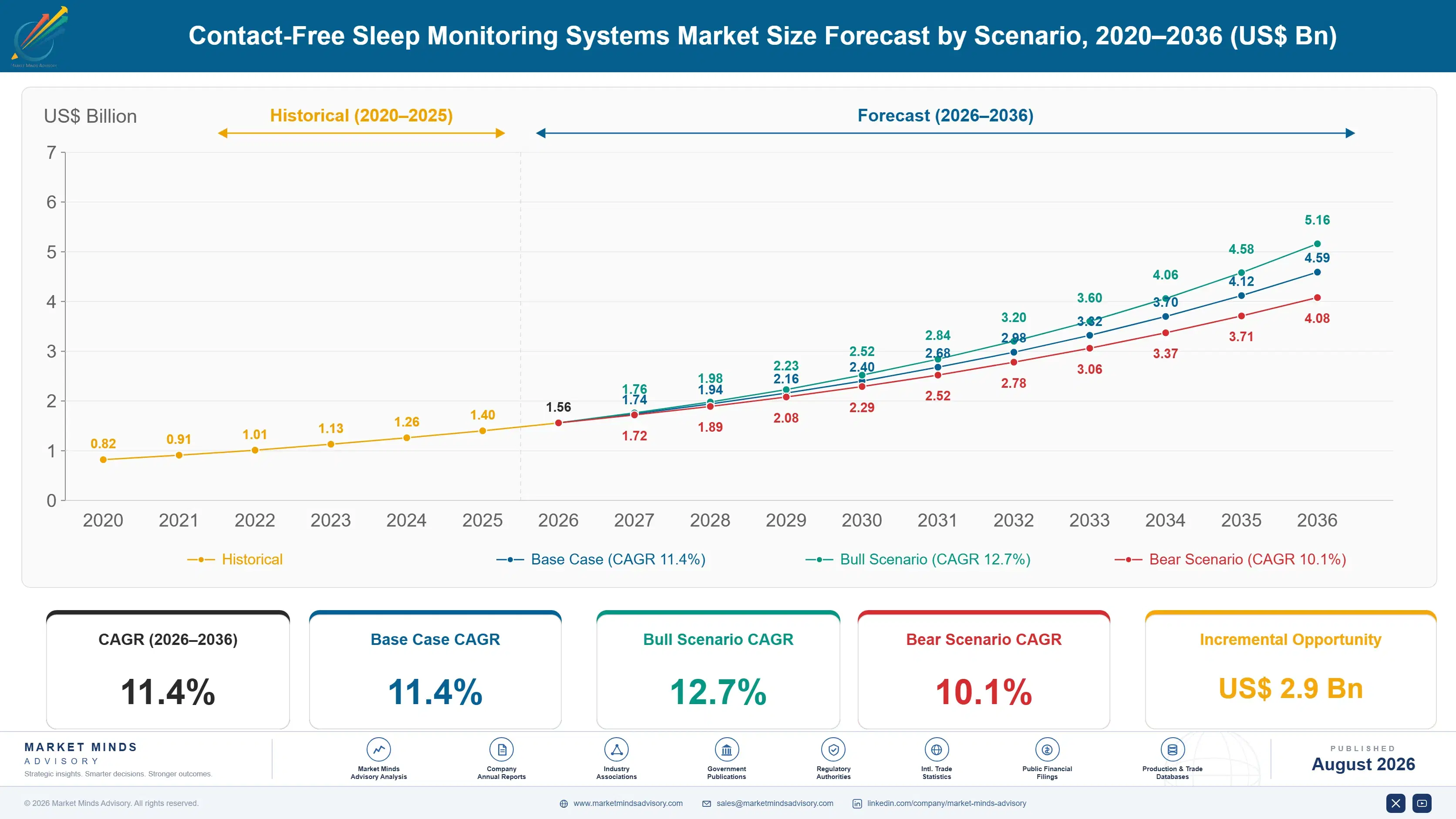
Growth ran near 10.0% from 2020 to 2025 and consumer devices carried almost all of it. Smart speakers and bedside units added sleep sensing as a feature rather than as a product, which put contact-free monitoring into millions of homes without anybody paying for it directly. Clinical adoption lagged badly, since a system producing data that no billing code recognises struggles to justify itself.
Base case growth of 11.4% rests on three mechanisms. Millimetre-wave radar components keep falling in cost, which puts clinical-grade sensing at price points that eldercare and hospital settings can absorb. Ageing-in-place programmes are funding monitoring that detects deterioration rather than diagnosing disease. And sleep apnoea screening at population scale needs something cheaper than a home test that costs a hundred dollars per night. Two of the three operate whether or not any reimbursement pathway ever emerges.
The bull case at 12.7% assumes a reimbursement pathway emerges for longitudinal sleep monitoring in chronic disease management, which would convert a consumer feature into a funded clinical service. The bear case at 10.1% reflects the opposite: contact-free data remains clinically interesting and commercially unfunded, leaving the category dependent on consumer hardware attachment and eldercare budgets.

Sleep Sensing: Unobtrusive Data, Unfunded Value

Polysomnography remains the reference standard and it has an obvious flaw that everybody in sleep medicine acknowledges. Attaching fourteen sensors to a patient in an unfamiliar room reduces sleep efficiency by roughly 23% on the first night, which is why the first night is frequently discarded. Measuring sleep by disturbing it produces data about disturbed sleep, and the field has tolerated that compromise for decades.
TOP FIVE CONCENTRATION38%Fragmented across consumer electronics, medical specialists and eldercare integrators
FIRST NIGHT EFFECT23%Sleep efficiency reduction caused by attended laboratory study conditions
RADAR MODULE COST$11Component cost of a millimetre-wave sensing module at volume
APNOEA DETECTION AGREEMENT87%Agreement with laboratory polysomnography on respiratory event indexing
REIMBURSED DEPLOYMENT SHARE9%Installations funded through a clinical reimbursement pathway today
CONTINUOUS MONITORING NIGHTS180 nightsTypical annual nights captured per installed monitoring position
Contact-free sensing removes the disturbance and gives up precision in exchange. Radar systems resolve chest wall motion and gross body movement from across a room, under-mattress sensors detect ballistocardiographic signals through the mattress, and neither touches the patient. Agreement with laboratory studies on respiratory event indexing runs near 87%, which is good enough for screening and monitoring and not good enough to replace diagnosis.
The commercial problem is that the data has no home. A system capturing 180 nights a year produces longitudinal information about breathing, movement and sleep architecture that a single diagnostic study cannot approach, and roughly 9% of installations are funded through any clinical reimbursement pathway. Everything else is bought by consumers, by eldercare operators or by researchers, all of whom value it differently.
"The technology solved the measurement problem years ago. What nobody has solved is that a sleep laboratory bills for a night and a contact-free system produces six months of data that no code describes. Until somebody gets paid for longitudinal sleep, this stays a feature on a bedside speaker rather than a clinical instrument."
Principal Analyst, Sleep Medicine and Remote Monitoring Practice · MMA Medical D

Market Trends

Millimetre-wave radar reaches consumer component pricing

Radar modules capable of resolving chest wall motion at a metre or more now cost around $11 at volume, having been laboratory instruments a decade ago. That collapse in component cost is what put contact-free sensing into consumer bedside devices and is now putting clinical-grade capability into eldercare and hospital settings that could not previously fund it. The segment compounds at 17.1% against a market rate of 11.4%, and the constraint has moved from sensor capability to what anybody will pay for the resulting data. Sensing capability now confers almost no competitive advantage at all.
Market Impact: Capturing 180 nights against two

Eldercare buys deterioration detection rather than diagnosis

Residential and home care operators are deploying contact-free monitoring to detect nocturnal deterioration, falls and breathing changes rather than to diagnose sleep disorders, which is a completely different value argument from the clinical one. The purchase competes against night staffing cost and against the consequences of an unwitnessed event, both of which an operator can quantify. That framing has produced adoption in eldercare well ahead of clinical sleep medicine, despite the technology being identical. Operators quantify the argument themselves and fund it from operating budgets. Clinical sleep medicine has never constructed a comparable funded argument.
Market Impact: Agreement reaching 87% with polysom

Market Opportunities and Growth Drivers

Longitudinal data answers questions single studies cannot

A diagnostic sleep study captures one or two nights, and sleep varies enormously between nights in ways that a single measurement cannot represent. A contact-free system capturing roughly 180 nights a year detects positional dependence, seasonal variation, therapy adherence effects and gradual deterioration that no laboratory study would ever see. Clinicians who have used the data describe it as answering different questions rather than the same questions better, which is precisely why existing diagnostic codes do not accommodate it. Remote physiologic monitoring pathways already describe continuous collection with clinician review, and they are open where sleep diagnostic codes are closed.
Market Impact: Only 9% of installations reimbursed

Screening at population scale needs a cheaper instrument

Undiagnosed sleep apnoea affects a very large share of the adult population and home sleep testing costs enough per night that no health system screens broadly with it. Contact-free systems achieving roughly 87% agreement on respiratory event indexing are not diagnostic, but they are adequate to identify who should be tested properly. That triage role suits their accuracy profile exactly, and it is the clinical application most likely to attract funding because it reduces downstream diagnostic cost. Pre-screening raises the yield of every scarce laboratory slot a service holds. Downstream diagnostic cost falls accordingly.
Market Impact: Agreement capped near 87% currently

Market Restraints and Challenges

No reimbursement code describes what these systems produce

Sleep medicine billing is built around attended and unattended diagnostic studies of defined duration, and a system producing continuous longitudinal data fits none of those descriptions. The root cause is that reimbursement codifies procedures rather than monitoring, which is how sleep services were funded from the beginning. Commercial impact is that roughly 9% of installations are clinically funded. Participants respond by pursuing remote monitoring codes, chronic care management pathways and value-based arrangements rather than diagnostic reimbursement. Monitoring codes describe what these systems actually do. Applying against the wrong architecture costs years.
Market Impact: Radar modules costing around $11

Accuracy is adequate for screening and not for diagnosis

Agreement with polysomnography on respiratory event indexing runs near 87%, which is respectable for a system touching nobody and insufficient to establish a diagnosis that leads to therapy funding. The root cause is that contact-free sensing infers respiratory effort rather than measuring airflow and oxygenation directly. Commercial impact is that these systems support rather than replace diagnostic testing. Participants respond by positioning explicitly as triage and monitoring instruments, and by combining modalities to narrow the accuracy gap. Claiming diagnostic equivalence invites a comparison these systems lose. Triage framing invites the adoption they can win.
Market Impact: Roughly 180 nights captured annuall
3 additional market trends, 4 additional growth drivers, and 2 additional restraints and challenges are covered in the full report. Contact sales@marketmindsadvisory.com to access the complete intelligence.

Segment CAGR and Growth Architecture

Five sensing modalities divide this market by physical measurement principle, which determines accuracy, cost and where each realistically deploys. The division separates approaches that infer respiration from body motion from those that capture sound or image, and their commercial positions differ far more than the underlying signals do. Privacy perception separates them commercially as much as accuracy does.
contact-free-sleep-monitoring-systems-market-market-share-analysis-1787307190834

Radar and Radio-Frequency Sensing Systems

Compounding at 17.1%, a full 1.50x the market rate, radar systems resolve chest wall motion and gross movement from a metre or more away without touching the patient or requiring a line of sight to skin. Module cost near $11 at volume put the capability into consumer bedside devices and is now reaching eldercare and hospital deployment. Privacy perception is considerably better than camera-based alternatives, which matters in bedrooms and care settings. The modality suits both consumer attachment and clinical screening, which is unusual and explains the growth. Component supply is concentrated among a few semiconductor manufacturers who allocate to automotive and consumer volumes first. Allocation during constraint follows the larger customers every time.
CAGR 17.1%

Under-Mattress Ballistocardiography Sensors

Growing at 12.6%, under-mattress sensors detect the mechanical signature of cardiac ejection and respiration transmitted through the mattress, requiring no room installation and no visible device at all. Deployment is straightforward in existing beds, which suits eldercare retrofits and hospital wards where a radar installation would require mounting and commissioning. Accuracy on respiratory events sits below radar approaches, though heart rate variability capture is generally better. Bed sharing degrades signal quality noticeably, which is a real limitation the category has not resolved. Installation simplicity is the commercial advantage: an existing bed becomes a monitored bed without mounting, commissioning or any change visible to the resident or their family. Bed sharing remains unresolved.
CAGR 12.6%
Full segment breakdown across 5 segments available in the complete report.

Regional Architecture and Country Demand Map

Regional distribution follows sensor manufacturing and eldercare deployment rather than sleep disorder prevalence, which is broadly similar across developed markets. Where ageing-in-place programmes fund monitoring, installations follow; where only clinical reimbursement exists, very little happens. Funding architecture decides deployment far more than clinical need does.

East Asia

Thirty-four per cent of global value, the largest regional position. Note: this exceeds the 22 to 30% band because Chinese and Japanese manufacturers produce the sensing modules and finished devices that supply every other region, and Japan deploys nocturnal monitoring across residential eldercare at a scale nowhere else approaches. China compounds at 14.8%, faster than any country covered, on domestic sensor manufacturing combined with smart home integration reaching very large consumer volumes. Japanese care operators buy deterioration detection against night staffing cost, which is a funded argument that clinical reimbursement has never provided. Clinical sleep medicine adoption across the region lags eldercare deployment considerably. Module manufacture and finished device assembly both concentrate here.
Share: 34% | CAGR: 12.6% (2026 to 2036)

North America

Twenty-six per cent of value, weighted toward consumer devices rather than clinical deployment. Bedside smart devices with sleep sensing reached millions of households as a feature rather than a purchase, which built awareness without building a market anybody bills for. Clinical adoption remains constrained by the absence of a reimbursement code describing longitudinal monitoring, and roughly 9% of installations are clinically funded. Sleep medicine here is a well-developed specialty with strong laboratory infrastructure, which paradoxically makes the incumbent diagnostic pathway harder to displace. Remote physiologic monitoring pathways exist here and have been little used by sleep participants, most of whom continued applying against diagnostic codes that do not describe continuous collection at all.
Share: 26% | CAGR: 10.8% (2026 to 2036)
Regional intelligence for 5 additional markets available in the complete report: Western Europe, South Asia and Pacific, Latin America, Middle East and Africa, Eastern Europe. Contact sales@marketmindsadvisory.com.
contact-free-sleep-monitoring-systems-market-country-cagr-analysis-1787307191358

Where Contact-Free Sleep Value Concentrates

The sensing problem is solved and component costs have collapsed, so nothing commercially useful comes from better measurement. Value comes from finding buyers who can already fund what this data does, and from positioning against a diagnostic pathway these systems cannot and should not try to replace. Measurement is no longer where anybody competes.

Sell deterioration detection to eldercare, not diagnosis to clinics

Care operators buy nocturnal monitoring against night staffing cost and the consequences of an unwitnessed event, both of which they quantify routinely and fund from operating budgets. Sleep clinicians buy against a reimbursement code that does not exist. The technology is identical and the commercial outcome is completely different, which is why eldercare adoption runs well ahead of clinical adoption. Participants leading with clinical sleep positioning are addressing the buyer with no money for it. Only about 9% of installations reach a clinical funding pathway, while eldercare operators fund from operating budgets without requiring any clinical evidence at all.
Market Impact: Only 9% of installations are clinic

Position explicitly as triage ahead of diagnostic testing

Agreement near 87% with polysomnography on respiratory event indexing is inadequate for diagnosis and well suited to deciding who needs a proper study. Health systems with constrained laboratory capacity value that directly, since it raises the yield of every scarce diagnostic slot. Sleep services using contact-free pre-screening reported diagnostic study positive rates rising by 30% to 40%. Claiming diagnostic equivalence invites comparison the systems lose; claiming triage utility invites adoption they win. Constrained laboratory capacity makes that yield improvement immediately valuable. Diagnostic equivalence claims invite a comparison that these systems lose on accuracy every time.
Market Impact: Positive rates rising 30% to 40% ov

Pursue monitoring codes rather than diagnostic ones

Sleep reimbursement codifies studies of defined duration and a system generating roughly 180 nights of continuous data fits none of those descriptions, which is why only 9% of installations are clinically funded. Remote physiologic monitoring and chronic care management pathways describe continuous data collection and already exist in several systems. Participants pursuing those routes rather than diagnostic equivalence reach reimbursement years earlier, because they are asking for something the payment architecture already contains. Asking for something the architecture already contains is far easier. Sleep diagnostic codes describe studies of defined duration and nothing continuous at all.
Market Impact: Roughly 180 nights captured in ever

Choose modality on privacy perception, not accuracy alone

These systems operate in bedrooms, and camera-based approaches meet resistance that radar and under-mattress sensing do not, regardless of what the data actually contains. Care home residents, families and data protection regimes all treat the modalities differently. Radar at around $11 per module now matches or exceeds optical accuracy for respiratory sensing while carrying none of the perception problem, which is why it compounds at 17.1%. Modality choice is a commercial decision rather than an engineering one. Residents, families and data protection regimes all treat the modalities differently. Radar now matches optical accuracy for respiratory sensing.
Market Impact: Radar compounding at 17.1% in each

Who Controls the Margin Pool

The top five hold 38% of the market measured on revenue from contact-free sleep monitoring systems, the basis used throughout this section. That fragmentation reflects three groups who barely compete: consumer electronics companies embedding sensing as a device feature, medical device specialists pursuing clinical positioning, and eldercare integrators selling monitoring against staffing cost. Each reaches a different buyer through a different channel entirely.
Competitive activity runs along three lines. Consumer participants are treating sleep sensing as an attachment that raises device value rather than as a business. Medical specialists are pursuing remote monitoring reimbursement pathways rather than diagnostic equivalence, having recognised which door is open. And eldercare integrators are bundling sleep monitoring into wider resident monitoring platforms where the sleep component is one signal among several.

Pressure comes from an unusual direction. Component costs have fallen far enough that sensing capability confers almost no advantage, which pushes competition toward channel access and reimbursement navigation. Rankings will shift toward participants who secure a funded pathway first, since that single achievement would convert a fragmented feature market into a clinical category with defensible positions in it. Component advantage has ceased to matter entirely.
contact-free-sleep-monitoring-systems-market-company-positioning-matrix-1787307191884

Competitive Moat and Risk Dimensions

RESMED

Moat: Sleep clinical channel established

Long-established relationships across sleep laboratories, respiratory physicians and therapy providers give the company a route into clinical sleep medicine that consumer participants cannot assemble, along with the regulatory and reimbursement experience to navigate a monitoring pathway. Existing therapy adherence data infrastructure also handles longitudinal signals of exactly the kind contact-free systems generate.
RESMED

Risk: Core business favours diagnosis

The company's therapy business depends on formally diagnosed patients reaching prescribed treatment, and a screening technology that identifies more candidates without diagnosing them sits awkwardly beside that. Contact-free monitoring that reduced polysomnography volume would also affect the clinical infrastructure through which therapy prescriptions currently flow to patients.
GOOGLE

Moat: Household reach without purchase

Radar sensing embedded in bedside consumer devices reached millions of households as a feature rather than as a purchase decision, which is distribution no medical device participant could buy at any price. That installed base generates sleep data at a scale clinical deployments cannot approach, at a marginal cost close to nothing.
GOOGLE

Risk: No clinical claim or pathway

Consumer positioning carries no diagnostic claim, no reimbursement pathway and no clinical relationship, which caps what the data can be monetised for beyond the hardware itself. Converting household reach into clinical value requires regulatory and payer work the company has shown limited appetite for, and the sleep medicine channel belongs to others.

Players Tracked

Prominent Players

ResMed
Google
Withings
Somnofy
Emfit

Other Key Players

Sleepiz
Vayyar Imaging
Xandar Kardian
Tellus
SleepScore Labs
Beddit
Murata Manufacturing
Infineon Technologies
Texas Instruments
Samsung Electronics
Huawei
Nihon Kohden
Compumedics
EarlySense
Circadia Technologies

Recent Developments

JANUARY 2021

Radar sleep sensing reaches mainstream consumer devices

Millimetre-wave radar sensing appeared in mass-market bedside consumer devices, placing contact-free sleep monitoring in households as an included feature rather than a deliberate purchase. The development was a product launch rather than any clinical or regulatory milestone, and it built category awareness far faster than clinical deployment could have.
Signal: Consumer distribution created awareness an
NOVEMBER 2022

Remote monitoring codes extended to continuous physiologic data

Reimbursement frameworks for remote physiologic monitoring were extended and clarified in several health systems, describing continuous data collection and clinician review rather than discrete diagnostic studies. This was a payment policy development rather than any device approval, and it opened a route that sleep-specific diagnostic codes never provided.
Signal: The open door is monitoring reimbursement
MAY 2024

Eldercare programmes fund nocturnal monitoring at scale

Residential care operators and ageing-in-place programmes across several markets expanded funding for contact-free nocturnal monitoring, justified against night staffing cost and unwitnessed incident consequences rather than any sleep diagnosis. These were operator and programme purchasing decisions rather than clinical or regulatory events. Sleep diagnosis played no part in the decision.
Signal: Care operators found a funded argument tha

What Actually Costs Money Here

Hardware cost has collapsed and software cost has not. Sensing modules, processing hardware and enclosures account for roughly 27% of cost of goods, with millimetre-wave radar modules near $11 at volume from a small group of semiconductor suppliers. Signal processing development, algorithm validation and clinical evidence generation absorb far more over a product lifetime than the physical device ever does.
Radar module availability tightened through 2022 as automotive and consumer applications competed for the same semiconductor capacity, and sensing device manufacturers reported extended lead times. Cloud processing and storage costs also rose against continuous overnight data streams that generate far more volume than episodic diagnostic recordings. Algorithm validation against polysomnography requires paid comparison studies that are expensive and slow to run. Validation study cost is largely fixed regardless of eventual installed base.

Exposure varies by business model rather than by geography. Consumer participants add sensing to a device already being manufactured and carry almost no incremental hardware cost, which is a position medical device participants cannot match. Clinical participants carry regulatory maintenance, validation studies and evidence generation against small installed bases. Eldercare integrators carry service and installation cost that scales with deployment rather than amortising across it.
contact-free-sleep-monitoring-systems-market-cost-volatility-analysis-1787307192079

Algorithm validation reused across deployment settings

Comparison studies against polysomnography are expensive and slow, and the same validation supports consumer, clinical and eldercare positioning if designed for it from the outset. Participants that scoped studies narrowly to one setting frequently found themselves repeating work that a broader protocol would have covered once at modest additional cost. Protocol scope should be set before the first study.

Edge processing against cloud data volume

Continuous overnight sensing generates far more raw data than episodic recording, and streaming it all to cloud processing scales cost directly with installed base. Processing at the device and transmitting only derived measures cuts that substantially, at the cost of firmware complexity and slower algorithm iteration across a deployed fleet. Fleet-wide algorithm updates become considerably slower.

Dual sourcing of radar sensing modules

Millimetre-wave module supply is concentrated among a few semiconductor manufacturers who allocate to automotive and consumer volumes first. Qualifying a second source requires signal characterisation work because module performance differs subtly, and participants that deferred it lost production windows during recent constraint periods. Substitution requires full signal characterisation, so deferring the work proves expensive.

Portfolio Architecture for Margin Defence

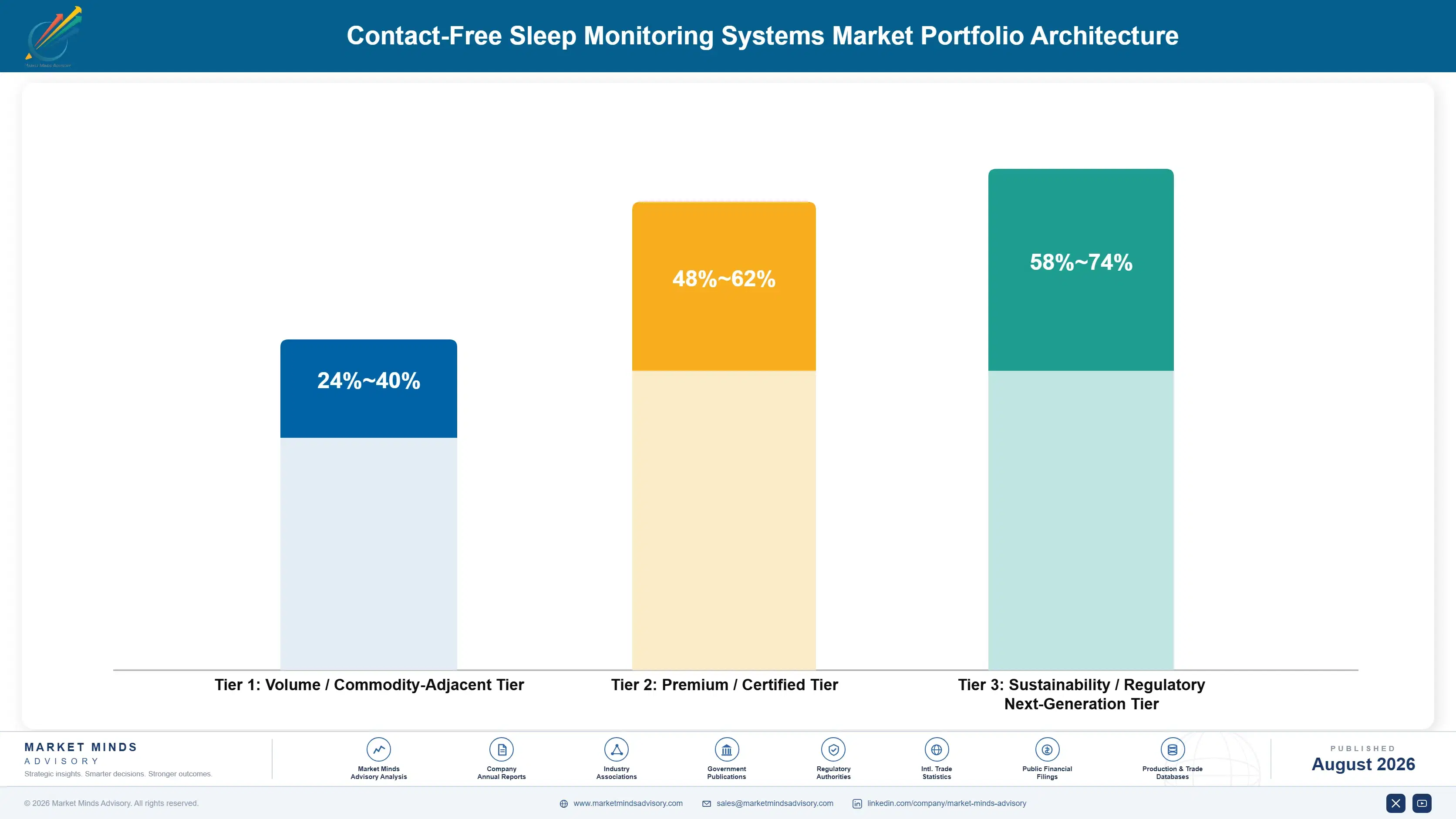
Margin architecture separates by who pays and why, not by sensing capability. Consumer devices embedding sleep sensing carry almost no incremental hardware cost against a device already being sold, so the sensing function is effectively free margin on hardware sold for other reasons. Clinical and eldercare systems carry regulatory, validation and service costs against far smaller installed bases and clear correspondingly lower.
The tension is between reach and revenue. Consumer sensing touches millions of households and monetises none of them directly, generating data at a scale no clinical deployment approaches while producing no revenue attributable to sleep at all. Clinical and eldercare deployments monetise properly and reach a tiny fraction of the same population. Nobody has bridged the two, and the bridge would require a reimbursement pathway that does not yet exist.

High-value pools concentrate where a buyer already has a budget the data fits into. Eldercare operators funding against staffing cost, health systems funding triage that raises diagnostic yield, and remote monitoring programmes with existing payment codes all sit there. Everything positioned as a diagnostic alternative competes against polysomnography on accuracy it does not have, for reimbursement it cannot obtain.

Volume / Commodity-Adjacent Tier

Consumer sleep sensing embedded in bedside devices and smart home hardware, where the function adds perceived value to a product sold for other reasons and carries almost no incremental cost.
Gross Margin: 24-40%

Premium / Certified Tier

Eldercare and residential monitoring systems sold against night staffing cost and unwitnessed incident risk, protected by installation, service relationships and integration into wider resident monitoring platforms. Operators fund this from operating budgets rather than capital.
Gross Margin: 48-62%

Sustainability / Regulatory / Next-Generation Tier

Clinical-grade contact-free systems carrying regulatory clearance and validation evidence, defended by reimbursement navigation, comparison study data and relationships across sleep medicine and respiratory specialties. Reimbursement navigation matters more than sensing performance here.
Gross Margin: 58-74%
contact-free-sleep-monitoring-systems-market-portfolio-architecture-1787307192579

High-value Sub-segments and Strategic Watch-out

Radar and Radio-Frequency Sensing

High value and the fastest growth at 17.1%, combining consumer-scale component pricing with accuracy adequate for clinical screening. Privacy perception is far better than camera alternatives, which decides modality selection in bedrooms and care settings. Module supply concentration is the one real constraint. Allocation favours larger buyers.
Gross Margin: 58-74%

Eldercare Deterioration Monitoring

High value, funded against night staffing cost rather than any clinical code, which is why adoption here runs well ahead of sleep medicine. Operators quantify the argument themselves and buy from operating budgets. Subscriptions here persist as long as residents do. Removal creates exposure nobody accepts.
Gross Margin: 48-62%

Consumer Embedded Sleep Sensing

The volume core, reaching millions of households as a device feature and monetising none of it directly. Generates data at a scale clinical deployment cannot approach while producing no attributable sleep revenue. Nobody has bridged reach and revenue yet. Reimbursement would bridge it. Nothing else would.
Gross Margin: 24-40%

Clinical Screening and Triage Systems

The strategic watch-out. Accuracy near 87% suits triage precisely, and health systems with constrained laboratory capacity value it, but only 9% of installations currently reach any clinical funding pathway. Laboratory capacity constraints make the triage argument work where it has been tried properly. Funding remains the obstacle.
Gross Margin: 56-70%

Who Installs and What Recurs

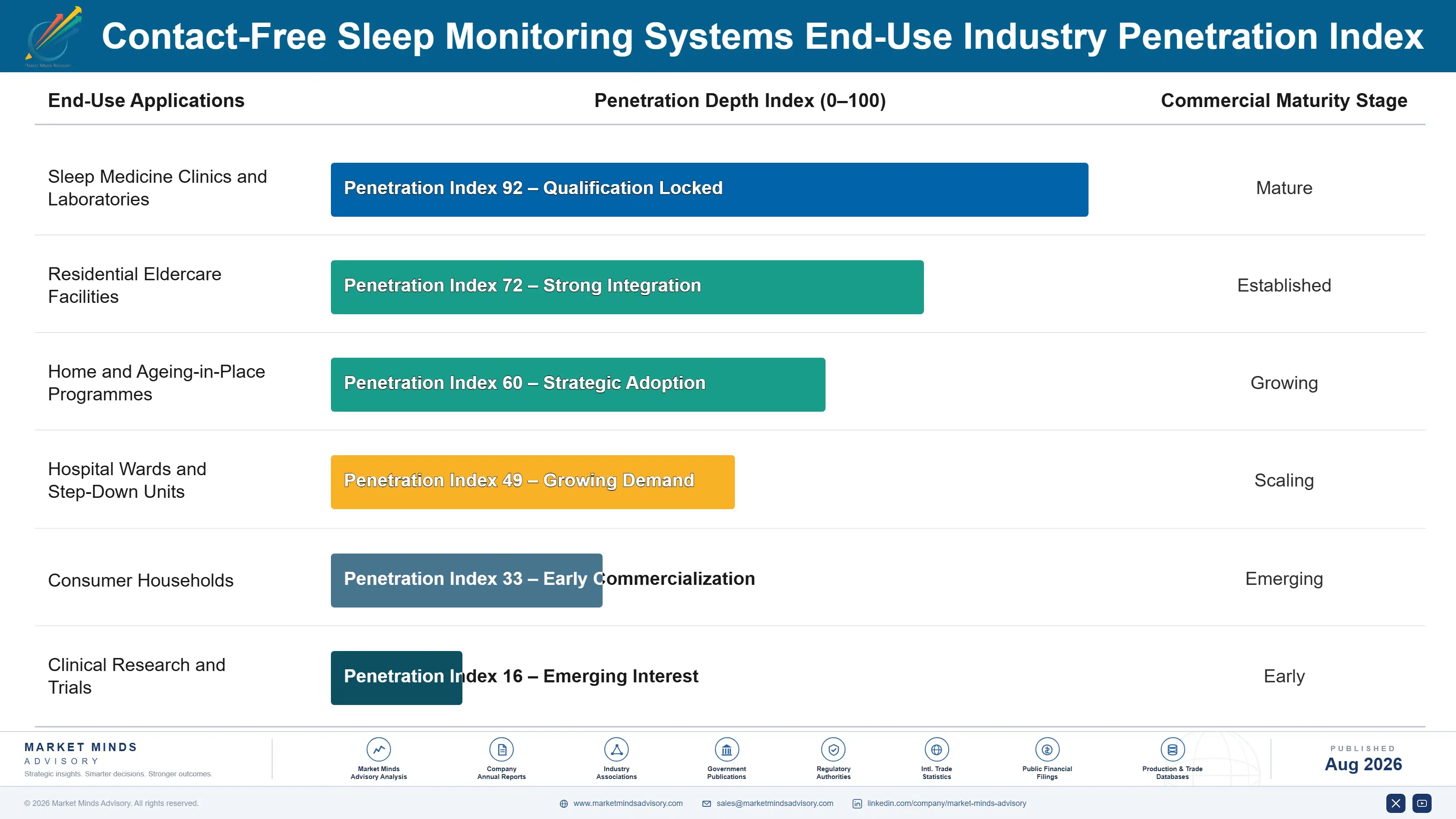
Revenue models differ so completely across this market that a single description misleads. Consumer sensing generates no recurring revenue and no attributable revenue at all, arriving as a feature on hardware sold every few years for other reasons. Eldercare deployments generate installation revenue plus a monitoring subscription that persists for as long as the resident does. Clinical systems sit between, with hardware sales and occasional service.
Persistence follows the funding source rather than clinical value. Eldercare subscriptions are extremely durable, since removing monitoring an operator has come to rely on creates exposure nobody wants to accept. Clinical deployments persist where a reimbursement pathway was found and lapse quickly where the installation depended on research funding or a pilot budget. Consumer sensing persists exactly as long as the device does and no longer.

The buying function is different in every channel, which is the central commercial difficulty. Consumer electronics product managers decide whether sensing is included at all. Care home operations directors buy against staffing and incident cost. Sleep physicians and respiratory teams buy against reimbursement that mostly does not exist. Building one commercial organisation to address all three has failed repeatedly, and the successful participants picked one.
contact-free-sleep-monitoring-systems-market-end-use-penetration-index-1787307193068

Where Value Actually Sits

These are among the four positions where our research anticipates prominent divergence between winners and laggards over the coming forecast period. Each is grounded in the demand model, the regulatory perimeter, and the announced capacity pipeline.
01 / FUNDED BUYER SELECTION

Eldercare has money; sleep clinics have codes

Care operators buy nocturnal monitoring against night staffing cost and the consequences of an unwitnessed incident, both of which they already quantify carefully and fund from operating budgets every single year. Sleep clinicians by contrast buy against a reimbursement code that simply does not describe continuous longitudinal monitoring at all. The technology deployed is entirely identical in both settings, and only roughly 9% of installations currently reach any clinical funding pathway, which tells you precisely which buyer to address first.
02 / TRIAGE POSITIONING DISCIPLINE

Claim screening utility, never diagnostic equivalence

Agreement near 87% with polysomnography on respiratory event indexing is genuinely inadequate for making a diagnosis and genuinely well suited to deciding which patients require a proper study first. Health systems operating with constrained laboratory capacity value that capability directly, and services that used contact-free pre-screening reported their own diagnostic study positive rates rising by 30% to 40%. Claiming diagnostic equivalence invites a comparison that these systems always lose, while claiming triage utility instead invites the adoption they can actually win.
03 / PAYMENT ARCHITECTURE NAVIGATION

Apply for monitoring codes, not sleep study codes

Sleep reimbursement codifies attended and unattended studies of a defined duration, and a system generating roughly 180 nights of continuous data fits none of those descriptions in any health system anywhere. Remote physiologic monitoring and chronic care management pathways already describe continuous collection with clinician review, and they already exist in several systems. Participants that pursue those particular routes rather than diagnostic equivalence reach reimbursement years earlier, simply because the payment architecture already contains what they are asking it for.
04 / MODALITY PERCEPTION CHOICE

A camera in a bedroom loses regardless of accuracy

These systems operate in bedrooms and care rooms, where camera-based approaches meet resistance from residents, families and data protection regimes that radar and under-mattress sensing never encounter. Radar modules at around $11 each now match or exceed optical accuracy for respiratory sensing while carrying none of that perception problem at all. The modality decision here is therefore a commercial one rather than an engineering one, which is precisely why radar compounds at 17.1% while optical approaches continue to lag behind.

Engagement Snapshot From the Field

A live engagement with an industry participant carrying material or product regulatory and market exposure ahead of a defining policy shift, showing how our research translates into a defensible multi-year portfolio strategy.
MARKET MINDS ADVISORY · CLIENT ENGAGEMENT SUMMARY
Contact-Free Sleep Monitoring Systems Producer Strategic Portfolio Review and Transition Roadmap 2026·Investment Scenario on Contact-Free Sleep Monitoring Systems Exposure Evaluation 2025-26
CLIENT PROFILE
A contact-free sensing developer with annual revenue near $64 million (client-reported, unverified by MMA), holding regulatory clearance for a radar-based sleep and respiratory monitoring system sold into sleep clinics and hospital wards. Revenue had grown slowly for three years despite strong clinical validation data, and leadership wanted to understand whether the constraint was product, evidence or something else entirely.
STRATEGIC CHALLENGE
The company had invested heavily in comparison studies against polysomnography and had achieved agreement figures its competitors could not match, yet clinical adoption remained limited and most installations were funded through research grants rather than operating budgets. Leadership needed to establish who could actually pay for the system and against which existing budget line.
MMA APPROACH
We mapped funding sources for every installed system, separating research grants, capital budgets and recurring operating funds. Thirty-six sleep physicians, eleven care home operations directors and nine payer medical directors were interviewed on how each would fund such a system. We modelled clinical channel persistence against an eldercare redirection using recurring revenue as the comparison.
KEY FINDINGS
  1. Sixty-one per cent of installed systems had been funded through research grants or pilot budgets, and almost none of those converted to recurring operating funding when the pilot concluded.
  2. Care home operations directors quantified night staffing and unwitnessed incident cost readily, and eight of eleven said they would fund monitoring from operating budgets without any clinical evidence at all.
  3. Payer medical directors described remote physiologic monitoring pathways as available and sleep diagnostic codes as closed, and none had been approached by the client about the former.
  4. The company's superior validation data influenced no purchasing decision examined, because the buyers who valued accuracy had no budget and the buyers with budget did not evaluate on it.
CLIENT PROFILE
A contact-free sensing developer with annual revenue near $64 million (client-reported, unverified by MMA), holding regulatory clearance for a radar-based sleep and respiratory monitoring system sold into sleep clinics and hospital wards. Revenue had grown slowly for three years despite strong clinical validation data, and leadership wanted to understand whether the constraint was product, evidence or something else entirely.
STRATEGIC CHALLENGE
The company had invested heavily in comparison studies against polysomnography and had achieved agreement figures its competitors could not match, yet clinical adoption remained limited and most installations were funded through research grants rather than operating budgets. Leadership needed to establish who could actually pay for the system and against which existing budget line.
MMA APPROACH
We mapped funding sources for every installed system, separating research grants, capital budgets and recurring operating funds. Thirty-six sleep physicians, eleven care home operations directors and nine payer medical directors were interviewed on how each would fund such a system. We modelled clinical channel persistence against an eldercare redirection using recurring revenue as the comparison.
KEY FINDINGS
  1. Sixty-one per cent of installed systems had been funded through research grants or pilot budgets, and almost none of those converted to recurring operating funding when the pilot concluded.
  2. Care home operations directors quantified night staffing and unwitnessed incident cost readily, and eight of eleven said they would fund monitoring from operating budgets without any clinical evidence at all.
  3. Payer medical directors described remote physiologic monitoring pathways as available and sleep diagnostic codes as closed, and none had been approached by the client about the former.
  4. The company's superior validation data influenced no purchasing decision examined, because the buyers who valued accuracy had no budget and the buyers with budget did not evaluate on it.
RECOMMENDED STRATEGY
Phase 1: Phase one: redirect commercial effort toward eldercare operators, who fund monitoring from operating budgets against costs they already measure themselves. Phase 2: Phase two: pursue remote physiologic monitoring reimbursement rather than sleep diagnostic codes, since that payment architecture already describes continuous collection. Phase 3: Phase three: reposition clinical messaging around triage yield rather than diagnostic accuracy, which invites adoption instead of unfavourable comparison. Comparison is the trap to avoid.
OUTCOME
Eldercare revenue reached a third of the total within a year and carried recurring subscriptions the clinical channel had never produced (client-reported, unverified by MMA). A remote monitoring reimbursement submission was filed. Clinical positioning shifted to triage, and two sleep services adopted the system for pre-screening after previously declining it.

Frequently Asked Questions

Foundational context covering the market sizes, CAGR, scope, country, region and competition that inform every finding below. This section is provided to cover basics and most often pre-purchase conversations, answered from the MMA Primary Research Dataset.

What is the current size of the Contact-Free Sleep Monitoring Systems Market?

The global market is valued at $1.35 billion in 2025, rising to $1.50 billion in 2026. East Asia holds the largest share at 34%, reflecting sensor manufacturing and eldercare deployment at scale.

How large will the Contact-Free Sleep Monitoring Systems Market be by 2036?

MMA forecasts $4.42 billion by 2036, an increase of $2.92 billion over the 2026 base and an expansion multiple of 2.95x. Radar sensing and eldercare deployment carry most of that growth.

What is the CAGR for the Contact-Free Sleep Monitoring Systems Market 2026 to 2036?

The base case compound annual growth rate is 11.4%, with a bull case at 12.7% and a bear case at 10.1%. Historical growth from 2020 to 2025 ran near 10.0%, carried almost entirely by consumer devices.

Which segment is growing fastest?

Radar and radio-frequency sensing systems compound at 17.1%, a full 1.50x the market rate. Module costs near $11 put clinical-grade capability into settings that could not previously fund it.

Who are the major companies in the Contact-Free Sleep Monitoring Systems Market?

ResMed, Google, Withings, Somnofy and Emfit together hold 38% of revenue from contact-free sleep monitoring systems. That fragmentation reflects three buyer groups that barely compete with each other.

Which country is growing fastest?

China compounds at 14.8%, faster than any other country covered, on domestic sensor manufacturing combined with smart home integration reaching very large consumer volumes. Eldercare deployment is expanding alongside it.

Report Segmentation Architecture

The full report scope spans multiple orthogonal segmentation dimensions, with cross-tabulated demand data provided for each dimension pair. Coverage extends further to regional breakdowns, trend trajectories, and the competitive detail needed to support segment-level decision-making.

By Sensing Modality

  • Radar and Radio-Frequency Sensing Systems
  • Under-Mattress Ballistocardiography Sensors
  • Acoustic and Audio-Based Monitoring
  • Optical and Infrared Video Monitoring
  • Clinical Contact-Free Polysomnography Alternatives

By End-Use Industry

  • Sleep Medicine Clinics and Laboratories
  • Residential Eldercare Facilities
  • Home and Ageing-in-Place Programmes
  • Hospital Wards and Step-Down Units
  • Consumer Households
  • Clinical Research and Trials

By Commercial Dimension

  • Consumer Electronics Embedded Supply
  • Eldercare Operator Subscriptions
  • Clinical Capital and Service Sales
  • Remote Monitoring Reimbursement
  • Research and Grant Funded Deployment
  • Distributor and Integrator Channels

By Region

  • East Asia
  • North America
  • Western Europe
  • South Asia and Pacific
  • Latin America
  • Middle East and Africa
  • Eastern Europe

Scope, Methodology, and Coverage

Every figure in this report is reproducible from documented input assumptions. The scope below maps the historical period, the forecast horizon, the segmentation dimensions, and the countries covered, alongside the underlying primary and qualitative methodology.
Historical Period
2020 to 2025
Forecast Period
2026 to 2036
Base Year
2025 (USD billions; MMA Primary Research Dataset, August 2026)
Market Definition
This market comprises systems that monitor sleep and nocturnal physiology without any sensor contacting the body, measured at manufacturer or service revenue across consumer electronics embedded supply, eldercare operator subscriptions, clinical capital and service sales, remote monitoring reimbursement, research and grant funded deployment, and distributor or integrator channels. Coverage spans radar and radio-frequency sensing systems including millimetre-wave and ultra-wideband approaches, under-mattress ballistocardiography sensors detecting cardiac and respiratory mechanics through the mattress, acoustic and audio-based monitoring analysing breathing and snoring sound, optical and infrared video monitoring, and clinical contact-free alternatives to attended polysomnography. Wrist-worn and ring-form wearable sleep trackers, contact-based polysomnography and home sleep apnoea testing devices using cannulae, belts or oximetry, positive airway pressure therapy equipment and masks, oral appliances, mattresses, bedding and sleep surfaces, sleep medications and supplements, and general home security or activity monitoring without sleep-specific measurement fall outside scope.
Quantitative Units
USD millions (current prices); systems installed by modality; monitoring positions deployed; nights captured per position; reimbursed share of installations; agreement with polysomnography; average selling price by channel
Segmentation Dimensions
By Sensing Modality; By End-Use Industry; By Commercial Dimension; By Region
Regions Covered
East Asia, North America, Western Europe, South Asia and Pacific, Latin America, Middle East and Africa, Eastern Europe
Countries Covered
China, Japan, South Korea, Taiwan, United States, Canada, Germany, Netherlands, Sweden, Denmark, Norway, France, United Kingdom, Italy, Spain, Australia, India, Singapore, Thailand, Malaysia, Brazil, Mexico, Argentina, Chile, Saudi Arabia, United Arab Emirates, Israel, South Africa, Poland, Czechia, Hungary, Romania, Turkey, and additional markets relevant to sleep and remote monitoring analysis
Key Companies Profiled
ResMed, Google, Withings, Somnofy, Emfit, Sleepiz, Vayyar Imaging, Xandar Kardian, Tellus, SleepScore Labs, Beddit, Murata Manufacturing, Infineon Technologies, Texas Instruments, Samsung Electronics, Huawei, Nihon Kohden, Compumedics, EarlySense, Circadia Technologies
Quantitative Methodology
Primary survey, n=3,800 respondents, Q4 2025, six countries; demand-side model with trade association cross-validation
Qualitative Methodology
47 expert interviews, Q4 2025; applied to validate demand model assumptions, identify emerging dynamics, and assess competitive positioning
Report Format
PDF and XLSX data workbook (Word format preview document)
Publisher
Market Minds Advisory
Report Code
MMA-2026-MED-563
Published
August 2026
Contact
sales@marketmindsadvisory.com | www.marketmindsadvisory.com

Purchase the full Contact-Free Sleep Monitoring Systems Market Report (2026 to 2036).

The full MMA report separates the three buyer groups in this market and shows why the one with the money is not the one the industry keeps addressing. It sizes five sensing modalities and seven regions to 2036, modelling systems installed, monitoring positions, nights captured, reimbursed share, polysomnography agreement and pricing by channel separately. Competitive assessment covers twenty participants on one consistent revenue basis. Cost exposure is traced through sensing modules, cloud processing and validation studies. Four commercial levers and a strategic verdict close the report, grounded in 47 expert interviews and a 3,800-respondent survey.
Five sensing modalities sized separately through 2036
Funding sources mapped across clinical, eldercare and consumer deployments
Reimbursement pathways compared for monitoring against diagnostic codes
Twenty participants assessed on one consistent revenue basis
Polysomnography agreement benchmarked by modality and setting
Anonymised developer engagement with tested channel redirection recommendations

Built For The People Who Decide

From boardroom strategy to bench-side execution, this report is read cover-to-cover by leaders shaping the next decade of their industry, turning demand scenarios, market dynamics and valuation benchmarks into decisions.
CXOs/ Presidents/ VPs/ Managers
M&A and Corporate Development
Strategy Teams and R&D Heads
Procurement and Product Directors
Regulatory and Compliance Leaders
Investor Relations and Equity Analysts