Market Minds Advisory
Consumer Finance Market

Consumer Finance Market: Point-of-Sale Credit and the Digital Underwriting Shift

Buy-now-pay-later financing is pulling point-of-sale credit away from traditional cards just as rising delinquencies force lenders to tighten underwriting, leaving consumer finance caught between explosive product innovation and genuine credit quality deterioration.

Lead Analyst

Published

September 2026

Make Smarter Decisions with Customized Research Insights

Request a free sample report and evaluate market opportunities, growth trends, and competitive dynamics relevant to your business needs.

2025 MARKET VALUE$2180MMarket Size 2025
2036 FORECAST VALUE$4225MBase Case , 2026 to 2036
CAGR 2026 TO 20366.2 %Bull 7.5% / Bear 4.9%
INCREMENTAL OPPORTUNITY$1910MNet 10- year value creation
EXPANSION MULTIPLE1.82x2036 value over 2026 base
Strategic Levers
M&A Pipeline
Regional Outlook
Country Rankings
Competitive Intelligence
Segmental Deep-dive
Call-Us : 91 93563 13602

Executive Snapshot and Market Trajectory

Consumer finance is splitting between products lenders trust and products they are still learning to price. Point-of-sale financing keeps taking share from credit cards at checkout, delinquencies are climbing across nearly every consumer credit category simultaneously, and lenders are tightening underwriting even as competition for the same borrowers intensifies.
Point-of-sale and retail financing leads growth at 11.5% annually, nearly 1.9 times the market average, as e-commerce checkout integration pulls borrowers away from revolving credit cards toward fixed-installment alternatives. Personal installment loans follow closely on digital lending platform expansion. North America holds the largest regional share at 30%, anchored by the world's deepest credit card and installment lending infrastructure anywhere in the world.
Competitive intensity concentrates around underwriting discipline and digital origination speed rather than balance sheet size alone, since alternative-data credit scoring and instant approval capability increasingly separate profitable lenders from growth-chasing ones. JPMorgan Chase and Ant Group command scale and origination breadth, but specialist lenders like Affirm and Klarna hold point-of-sale integration depth that traditional card issuers have not matched, keeping the fastest-growing checkout-linked segments genuinely contested despite consolidation pressure across the broader lending industry.
Market Definition
The consumer finance market covers lending products extended directly to individual consumers for personal, non-business use, including credit cards, personal installment loans, auto loans, point-of-sale and retail financing, student loans, and home equity lending, measured by interest and fee revenue generated across the global lending industry. It excludes commercial and business lending, mortgage lending for primary residence purchase, and peer-to-peer lending platforms that function purely as marketplaces without extending balance-sheet credit.
Base Year Value
$2180M in 2025 (MMA Primary Research Dataset, August 2026)
Forecast Period
2026 to 2036, eleven discrete annual values
CAGR
6.2% base case. Bull 7.5%. Bear 4.9%.
Fastest Growth Segment
Point-of-Sale and Retail Financing: 11.5% CAGR
Fastest Growth Country
Indonesia: 13.5% CAGR
Fastest Growth Region
South Asia and Pacific: 8.4% CAGR
Largest Region
North America: 30% of 2025 global value
Market Leaders
JPMorgan Chase & Co., Capital One Financial Corporation, American Express Company, Synchrony Financial, Ant Group. Source: MMA Analysis based on company annual reports.
Primary Survey
n=3,800 procurement and R&D decision-makers, Q4 2025, six countries
Methodology
Demand-side build-up, cross-validated against public data, 47 expert interviews

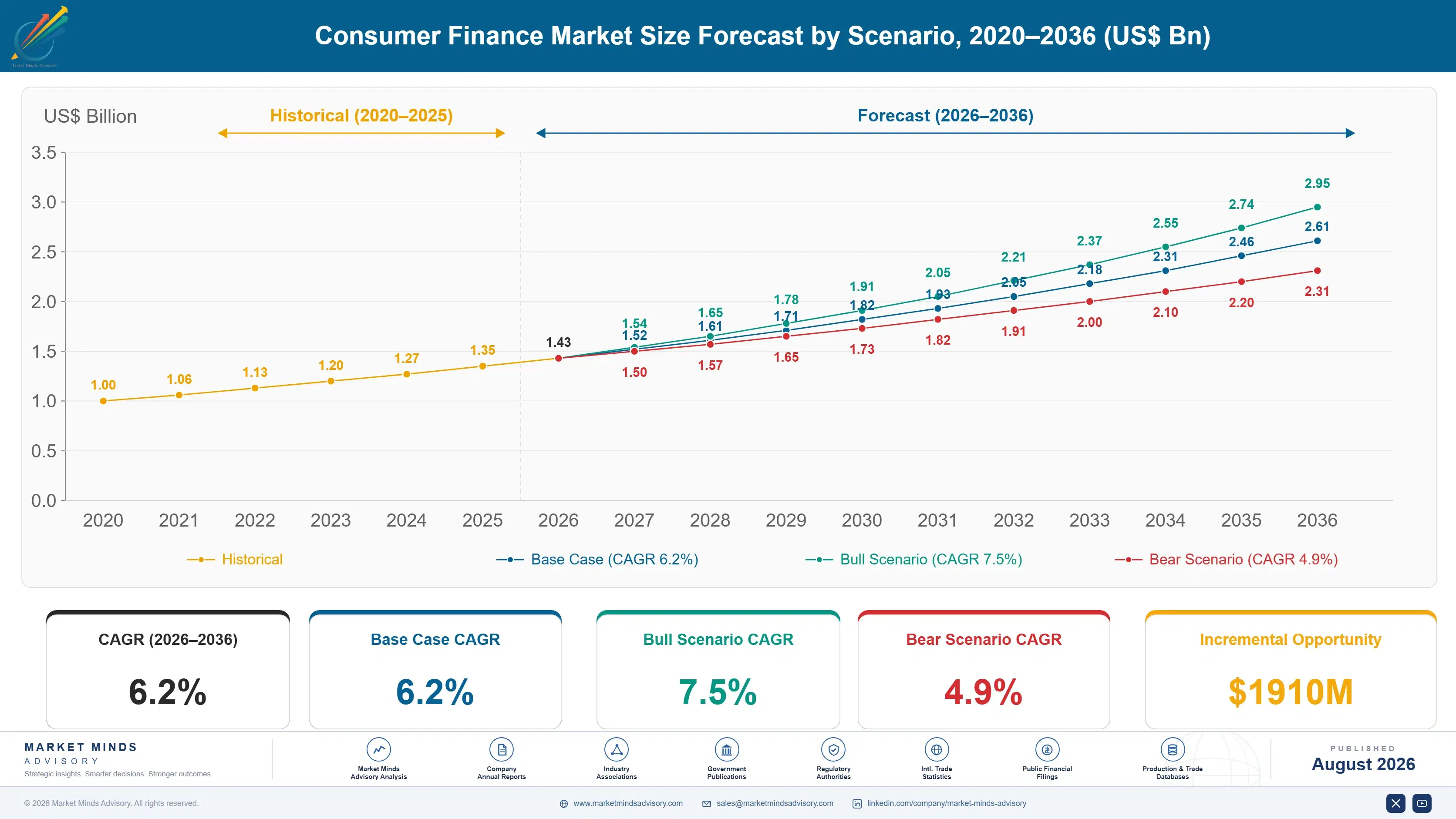
Consumer Finance Market Forecast Scenarios

consumer-finance-market-size-forecast-scenario-1787913964341
Between 2020 and 2025 the market grew at an estimated 5.5% annually, held back early by pandemic-era consumer spending contraction and elevated savings rates that reduced borrowing need, then accelerating from 2022 onward as spending normalized and point-of-sale financing adoption expanded rapidly across e-commerce checkout flows. Growth stayed concentrated in installment and point-of-sale lending through most of the period, with traditional credit card growth lagging behind.
The base case carries the market to 6.2% CAGR through 2036 on three mechanisms. Point-of-sale financing integration at e-commerce checkout keeps pulling borrowing volume away from revolving credit cards toward fixed-installment alternatives consumers increasingly prefer. Financial inclusion initiatives across emerging markets keep expanding formal credit access to previously underbanked populations. Alternative-data underwriting keeps improving approval accuracy, letting lenders extend credit profitably to borrowers traditional credit scoring would have declined outright.
The bull case reaches 7.5% if emerging market financial inclusion accelerates faster than currently projected across additional underbanked populations. The bear case falls to 4.9% if rising delinquencies force lenders to tighten underwriting standards broadly, a pattern already visible across several 2024 and 2025 consumer credit categories simultaneously across major developed markets during the current credit cycle.

Underwriting Discipline Now Separates Winners From Losers

Three forces converge on this category. Point-of-sale integration keeps redrawing where consumers actually borrow, delinquency cycles keep testing which lenders underwrote responsibly during the growth years, and alternative-data scoring keeps expanding who can access credit at all. Lenders that treat these as three separate problems are already behind the ones treating them as one connected underwriting challenge across the industry broadly.
MARKET CONCENTRATIONCR5: 16%Top five lenders hold well under a fifth of revenue
AVERAGE INTEREST YIELD18.4% APRBlended annual rate across revolving and installment products
TOP PRODUCING COUNTRYUSA: 24%Single country supplies nearly a quarter of global revenue
DIGITAL ORIGINATION SHARE58%Loans approved through fully automated digital application channels
NET CHARGE-OFF RATE4.8%Share of outstanding balances written off as uncollectible annually
ALTERNATIVE-DATA UNDERWRITING SHARE27% of volumeOriginations using non-traditional credit scoring inputs and signals
Commercial character splits sharply between mature card issuers and digital-first installment lenders. Traditional card issuers compete on rewards, brand loyalty, and revolving credit convenience in a largely saturated market, while point-of-sale and installment lenders compete on checkout integration and approval speed in a genuinely expanding borrower base. The digital tier offers faster growth, but the traditional tier commands materially better absolute revenue scale and underwriting track record.
Looking to 2036, three shifts matter most. Point-of-sale financing will keep expanding across new merchant categories regardless of who wins on price today, delinquency-driven underwriting tightening will increasingly separate disciplined lenders from growth-chasing ones, and alternative-data credit scoring will become a genuine competitive battleground as lenders compete on approval accuracy rather than marketing spend alone across most competitive segments.
"Everyone talks about buy-now-pay-later like it's a new product. It isn't. It's installment lending with better checkout software, and the lenders who forget that are the ones who will get burned when delinquencies catch up to growth."
Director, Consumer Finance and Credit Practice · MMA Financial Services and Insurance Practice · August 2026

Market Trends

Buy-Now-Pay-Later Integration Reshapes Point-of-Sale Credit Entirely

Buy-now-pay-later financing has moved from a checkout novelty into standard e-commerce infrastructure, with major platforms integrating installment financing options directly into the payment flow rather than requiring a separate application process. Affirm, Klarna, and similar providers now process transaction volume that rivals traditional store-branded credit cards at major retailers, pulling younger, digitally native shoppers away from revolving credit entirely. Retailers increasingly treat point-of-sale financing availability as a conversion-rate optimization tool rather than a purely financial product, since offering installment options at checkout measurably increases average order value and completed purchase rates across most merchant categories tested.
Market Impact: Lifts conversion rates 20% at checkout

Rising Delinquencies Prompt Broad Underwriting Tightening

Credit card and personal loan delinquency rates have climbed steadily since 2022, reaching levels not seen since the years immediately following the 2008 financial crisis, according to aggregated lender disclosures across major markets. Lenders are responding by tightening approval standards, particularly for subprime and near-prime borrowers who drove much of the post-pandemic origination growth on looser underwriting criteria. Capital One and Synchrony have both disclosed elevated provision for credit losses in recent quarterly filings, reflecting the broader industry shift from growth-focused origination toward credit quality discipline across the lending cycle.
Market Impact: Targets 1.4 billion unbanked adults

Market Opportunities and Growth Drivers

E-Commerce Growth Expands Point-of-Sale Financing Demand

Global e-commerce sales keep expanding as online retail penetration climbs across both developed and emerging markets, and every transaction represents a potential point-of-sale financing opportunity that did not exist when purchases required in-person store visits. Point-of-sale financing conversion rates run measurably higher than standard checkout completion rates, giving merchants a direct commercial incentive to offer installment options regardless of their own view on consumer lending. Shopify, Amazon, and other major e-commerce platforms have all integrated buy-now-pay-later options directly into checkout flows, embedding consumer finance into retail infrastructure at a scale that did not exist a decade ago.
Market Impact: Pushes rates to 10+ year highs

Financial Inclusion Initiatives Expand Emerging Market Access

Roughly 1.4 billion adults worldwide remain unbanked or underbanked, according to World Bank Global Findex data, representing a substantial addressable population that alternative-data underwriting and mobile-first lending platforms are increasingly able to serve profitably for the first time. Indonesia, India, and several African markets have seen rapid growth in digital consumer lending platforms that use mobile phone usage patterns and alternative data sources to underwrite borrowers traditional credit bureaus have no file on. Government-backed financial inclusion initiatives, including India's Jan Dhan Yojana banking access program, have expanded the formal banking relationships that digital lenders build credit products on top of.
Market Impact: Requires compliance in 3 major markets

Market Restraints and Challenges

Rising Interest Rates Increase Consumer Borrowing Cost

Central bank tightening cycles since 2022 have pushed benchmark interest rates to levels not seen in over a decade across major developed markets, and variable-rate consumer credit products pass that cost increase through to borrowers carrying revolving balances. The root cause is monetary policy: central banks raised rates to cool consumer demand, and higher borrowing cost is the transmission mechanism through which that policy affects household spending decisions. This has slowed credit origination growth in product categories as borrowers become rate-sensitive, for auto and home equity products. Lenders are responding with fixed-rate installment products that shield borrowers from rate volatility.
Market Impact: Rivals volume at over 10,000 retailers

Regulatory Scrutiny Of BNPL Products Intensifies

Regulators across the United States, UK, and European Union are moving to bring buy-now-pay-later products under consumer credit regulation frameworks that credit cards and installment loans have operated within, closing a gap that let BNPL providers avoid affordability checks and credit bureau reporting requirements. The root cause is an oversight gap: BNPL products emerged and scaled faster than regulators updated consumer credit frameworks to cover them. This forces BNPL providers to build compliance infrastructure, raising cost and slowing product launches in regulated markets. Providers are responding by building affordability assessment capability and credit bureau reporting integration ahead of regulatory deadlines.
Market Impact: Reaches delinquency levels since 2008 crisis
3 additional market trends, 3 additional growth drivers, and 3 additional restraints and challenges are covered in the full report. Contact sales@marketmindsadvisory.com to access the complete intelligence.

Segment CAGR and Growth Architecture

Segmentation follows product type, a single credit-structure logic spanning credit cards, personal installment loans, auto loans, point-of-sale financing, student loans, and home equity lending. Each product carries distinct repayment structure, underwriting model, and regulatory framework, so commercial position tracks how the credit is structured and how repayment risk is assessed for each individual borrower.
consumer-finance-market-market-share-analysis-1787913964881

Point-of-Sale and Retail Financing

Point-of-sale and retail financing grows fastest at 11.5% annually, nearly 1.9 times the overall market rate, as e-commerce checkout integration pulls borrowers toward fixed-installment alternatives that feel less like debt than a revolving credit card balance. These products split a purchase into a defined number of fixed payments, typically interest-free for shorter terms, with merchants often subsidizing the financing cost in exchange for higher conversion rates and larger average order values. Affirm and Klarna both compete for merchant integration partnerships that determine which financing option shoppers see at checkout, since consumers rarely seek out a specific provider independently. Regulatory scrutiny is now catching up to this segment's growth, forcing providers to build compliance infrastructure that mature lenders already operate.
CAGR 11.5%

Personal Installment Loans

Personal installment loans grow second-fastest at 8.2%, driven by digital lending platform expansion that has cut origination time from weeks to minutes for qualified borrowers. These fixed-term, fixed-payment loans serve purposes ranging from debt consolidation to major purchases, distinct from revolving credit cards in their defined repayment schedule and typically lower interest rate for qualified borrowers. Alternative-data underwriting has expanded the addressable borrower base beyond what traditional credit bureau scoring alone would approve, letting digital-first lenders serve thin-file borrowers profitably for the first time. SoFi and similar digital lenders have built substantial origination volume specifically in this category, competing on approval speed and rate transparency against traditional bank personal loan products.
CAGR 8.2%
Full segment breakdown across 6 segments available in the complete report.

Regional Architecture and Country Demand Map

North America now leads on the world's deepest credit card and installment lending infrastructure, narrowly ahead of East Asia's massive consumer credit expansion. Western Europe follows on mature regulatory frameworks, while South Asia and Pacific posts the fastest regional growth as financial inclusion initiatives expand formal credit access.

North America

The United States drives most of North America's 30% share through the world's deepest credit card penetration and installment lending infrastructure, where JPMorgan Chase, Capital One, and American Express all built massive origination scale over decades of consumer credit expansion. Point-of-sale financing adoption has grown rapidly even within this mature market, with Affirm and Klarna both building substantial merchant integration networks across major American retailers. Rising delinquency rates have pushed lenders toward tighter underwriting standards, particularly for subprime borrowers who drove much of the post-pandemic origination growth. Canada contributes a smaller, more conservatively regulated consumer credit market with lower average delinquency rates. Growth of 5.8% reflects continued point-of-sale expansion even from an already mature, saturated card market.
Share: 30% | CAGR: 5.8% (2026 to 2036)

Western Europe

The UK and Germany anchor much of Western Europe's 20% share through established consumer credit markets with strong regulatory frameworks governing lending practices. Klarna, headquartered in Sweden, built one of the world's largest buy-now-pay-later businesses from a European base before expanding globally into the United States and beyond. The EU's Consumer Credit Directive increasingly brings point-of-sale financing under regulatory frameworks comparable to traditional installment lending, closing a gap providers had previously operated within. France and the Netherlands show steady growth in digital-first personal lending platforms competing against traditional bank products. Growth of 4.6% trails the global rate, consistent with a mature market where most growth now comes from product mix shift rather than new borrower acquisition.
Share: 20% | CAGR: 4.6% (2026 to 2036)
Regional intelligence for 5 additional markets available in the complete report: East Asia, South Asia and Pacific, Latin America, Middle East and Africa, Eastern Europe. Contact sales@marketmindsadvisory.com.
consumer-finance-market-country-cagr-analysis-1787913965402

Where Consumer Finance Margin Now Concentrates

Lenders face a familiar tension: commodity credit card lending competes purely on rewards and rate, while alternative-data underwriting and point-of-sale integration increasingly carry the margin. The four moves below shift revenue toward defensible, harder-to-replicate positions instead of undifferentiated commodity lending, drawing on how leading lenders already separate legacy card economics from digital-first origination today.

Build Merchant Point-of-Sale Integration Partnerships Early

Lenders that secure direct checkout integration with major e-commerce platforms and retailers capture origination volume that generic personal loan marketing cannot match, since point-of-sale financing appears at the exact moment a consumer decides to buy. Affirm and Klarna reportedly generate 2 to 3 times higher conversion rates from checkout-embedded financing than standalone loan applications, since removing the separate application step removes the friction that causes most borrowers to abandon the process. Lenders without merchant integration capability are ceding the fastest-growing origination channel to competitors willing to invest in the technical infrastructure this category requires.
Market Impact: Captures 2 to 3 times higher conversion rates

Deploy Alternative-Data Underwriting For Thin-File Borrowers

Traditional credit bureau scoring excludes a meaningful share of potential borrowers who have limited credit history but genuine repayment capacity, and lenders that deploy alternative-data underwriting, using cash flow, mobile payment history, and other non-traditional signals, can profitably serve this population at approval rates running 20% to 35% higher than bureau-only scoring alone would support. This approach requires genuine data science investment that smaller lenders often cannot fund independently, creating a real barrier that protects the pricing power of lenders who build this capability first, ahead of competitors still relying on bureau data alone.
Market Impact: Approves 20% to 35% more thin-file borrowers overall

Expand Into Underbanked Emerging Markets Early

Roughly 1.4 billion adults worldwide remain unbanked or underbanked, and lenders building mobile-first origination capability in these markets now, ahead of full financial inclusion infrastructure maturing, capture first-mover positioning before increased competition drives up customer acquisition cost. Early movers gain regulatory relationship capital with local financial authorities and time to build the local credit risk expertise that competitors entering later cannot substitute for immediately. Lenders waiting to see how financial inclusion plays out before investing are ceding first-mover positioning in what MMA models as a multi-decade addressable market expansion worth building toward now.
Market Impact: Targets over 1.4 billion unbanked adults directly worldwide

License Credit Scoring Models To Smaller Lenders

Lenders that developed proprietary alternative-data credit scoring models ahead of competitors hold capability that smaller regional lenders now need but cannot develop independently within a reasonable timeframe. Licensing that scoring capability to non-competing regional lenders, rather than only lending directly, can generate technology licensing revenue running 2% to 5% of the licensee's loan volume at minimal marginal cost. This model is still emerging in consumer finance but mirrors licensing approaches already established in adjacent financial technology categories, and rising demand for alternative underwriting is creating exactly the concentrated need that makes licensing commercially attractive right now.
Market Impact: Generates 2% to 5% ongoing licensing revenue stream

Who Controls the Margin Pool

Concentration sits at a low 16% for the top five, evaluated on global consumer finance interest and fee revenue across all product categories. JPMorgan Chase's scale gives it the largest single share, but the gap to digital-first specialists is narrower than CR5 implies, since Ant Group, Affirm, and Klarna each hold origination technology depth diversified card issuers have not matched.
Competitive activity runs along three fronts. Point-of-sale integration drives checkout positioning, where Affirm and Klarna compete for merchant partnerships that determine which financing option shoppers see first. Alternative-data underwriting drives thin-file access, where digital-first lenders serve borrowers traditional bureau scoring would decline outright. Delinquency management drives underwriting discipline, where lenders with sophisticated risk models maintain credit quality that growth-focused competitors sacrifice during expansion cycles.

Pressure is building from rising delinquencies across nearly every consumer credit category, narrowing a growth advantage digital-first lenders built during looser underwriting years. Traditional banks are also pushing further into point-of-sale financing directly, compressing the space specialist BNPL providers once occupied alone. Rankings will likely shift toward lenders that combine underwriting discipline with checkout integration reach, since neither advantage alone secures the fastest-growing segments.
consumer-finance-market-company-positioning-matrix-1787913965922

Competitive Moat and Risk Dimensions

JPMORGAN CHASE & CO.

Moat: Massive Scale And Data Depth

Chase's decades of credit card and installment lending data give it underwriting model precision that newer entrants cannot replicate quickly, backed by a balance sheet that lets it absorb credit losses smaller lenders cannot sustain. Its integrated banking relationship with millions of consumers provides cross-sell distribution advantages pure-play lenders lack entirely.
JPMORGAN CHASE & CO.

Risk: Legacy Product Mix Exposure

Chase's revenue still depends heavily on traditional revolving credit card balances that point-of-sale financing is actively displacing among younger consumers, creating a genuine product mix risk as borrower preferences shift. Newer, more narrowly focused digital lenders can move faster to capture checkout-integrated financing than a diversified institution managing many product lines simultaneously.
ANT GROUP

Moat: Mobile-First Origination At Massive Scale

Ant Group's Huabei and Jiebei products built mobile-first lending infrastructure integrated directly into China's dominant payment platform, giving it origination scale and alternative-data depth that competitors entering China cannot easily replicate. Its position inside China's payment platform network gives it distribution advantages no foreign lender can access directly.
ANT GROUP

Risk: Regulatory Exposure Within China

Ant Group's lending business operates under close Chinese regulatory scrutiny that has previously constrained its growth and capital structure significantly, creating ongoing uncertainty about how much operational flexibility Beijing will permit going forward. International expansion remains limited compared to its domestic scale, leaving it more exposed to Chinese regulatory decisions than globally diversified competitors.

Players Tracked

Prominent Players

JPMorgan Chase & Co.
Capital One Financial Corporation
American Express Company
Synchrony Financial
Ant Group

Other Key Players

Citigroup Inc.
Discover Financial Services
Wells Fargo & Company
Bank of America Corporation
Barclays plc
Santander Consumer Finance
Ally Financial Inc.
OneMain Holdings Inc.
Navient Corporation
SLM Corporation
Affirm Holdings Inc.
Klarna Bank AB
China Construction Bank
HDFC Bank Limited
Toyota Financial Services

Recent Developments

JUNE 2025

Klarna Expands US Merchant Integration Network

Klarna announced expanded merchant integration partnerships with several major American retailers, adding checkout-embedded financing options across a broader share of US e-commerce transaction volume. The expansion was an organic commercial partnership rollout, not an acquisition or joint venture with an external company of any kind.
Signal: Signals point-of-sale financing providers are prioritizing merchant network breadth ahead of an anticipated public listing in the near term.
OCTOBER 2024

Capital One Completes Discover Financial Acquisition

Capital One completed its acquisition of Discover Financial Services, combining two major credit card issuers and creating a payment network capable of competing more directly with Visa and Mastercard. The transaction was a full acquisition, not a joint venture or minority equity investment whatsoever by any party.
Signal: Signals credit card issuers are consolidating scale to compete against both fintech entrants and payment networks.
MARCH 2025

Affirm Signs Data-Sharing Agreement With Credit Bureau

Affirm signed a data-sharing agreement with a major credit bureau to report buy-now-pay-later payment history, addressing regulatory pressure to bring BNPL products into standard credit reporting frameworks. The agreement was a commercial data-sharing arrangement, not a joint venture, acquisition, or equity investment of any kind.
Signal: Signals BNPL providers are proactively building credit reporting infrastructure ahead of formal regulatory mandates taking effect.

Cost Of Funds And Credit Loss Exposure

Cost of funds and credit loss provisioning together account for roughly 54% of gross interest and fee revenue, with credit loss provisioning alone running 22% to 32% of revenue depending on delinquency trends within a given lending cycle. Cost of funds, tied to benchmark interest rates and lender funding structure, adds another 18% to 26%, while origination and servicing technology account for the remaining share.
Central bank tightening since 2022 pushed lender funding costs higher across the consumer finance industry, compressing net interest margin for lenders that had built business models around near-zero funding costs. Capital One's fiscal year 2023 annual report disclosed elevated funding cost pressure across its consumer lending segments. Delinquency rates have risen since 2023, pushing credit loss provisioning higher as lenders tighten underwriting standards to manage risk.

Lenders without diversified funding sources absorb rate volatility more directly, while JPMorgan Chase and Capital One negotiate deposit-funded balance sheets that smooth cost volatility across larger operating scale. Digital-first lenders relying on wholesale funding carry additional exposure since capital markets funding costs move more directly with rate cycles than deposit funding does. Lenders without diversified revenue streams consistently trail on cost resilience during funding rate cycles.
consumer-finance-market-cost-volatility-analysis-1787913966117

Diversify Funding Sources Beyond Wholesale Markets

Lenders relying purely on wholesale capital markets funding face cost volatility that deposit-funded institutions largely avoid. Building or acquiring deposit-taking capability, even at higher regulatory compliance cost, secures funding cost stability independent of capital markets cycles that have nothing to do with underlying loan performance, a mismatch that has cost unprepared lenders dearly during past rate cycles.

Tighten Underwriting Ahead Of Delinquency Cycles

Securing tighter underwriting standards ahead of a delinquency cycle, rather than reacting once losses climb, is what let disciplined lenders limit the worst of the 2023 to 2024 credit deterioration while growth-focused competitors absorbed the full loss impact directly. The margin given up on marginal approvals is real, but far cheaper than absorbing losses those approvals eventually generate.

Invest In Alternative-Data Risk Modeling

Traditional bureau-only credit scoring misprices risk for borrowers with thin credit files, and lenders investing in alternative-data risk modeling can price these borrowers more accurately than competitors relying on bureau scores alone. Early investment in modeling capability compounds into a durable underwriting advantage that competitors relying on older scoring methods cannot easily replicate quickly.

Portfolio Architecture for Margin Defence

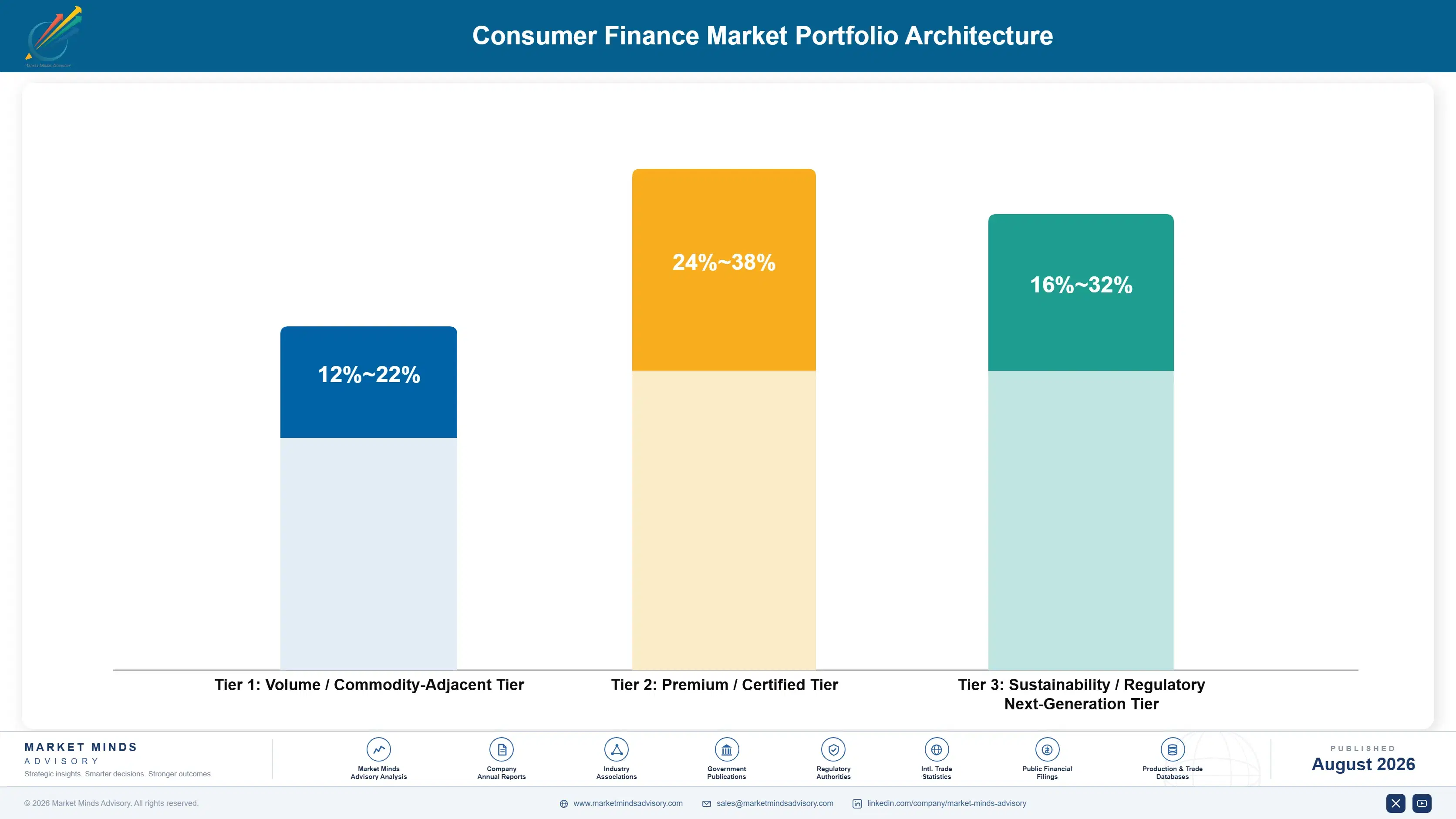
The portfolio splits into three tiers with different margin economics. Volume commodity credit card and installment lending, sold at scale to mainstream borrowers, competes on rate and rewards against a crowded field of card issuers, earning modestly. Premium point-of-sale and alternative-data underwriting products earn substantially more because checkout integration and thin-file approval capability insulate pricing from commodity comparison. Emerging market financial inclusion lending sits in a third tier carrying margins as underbanked population access drives near-term origination growth.
The tension runs between volume and underwriting specialization. Commodity card lending generates the origination volume that keeps balance sheets scaled efficiently, but margin stays thin since borrowers compare rates and rewards relentlessly across largely interchangeable products. Point-of-sale and alternative-data lending carry the opposite constraint: strong margins but a narrower addressable customer base defined by technical integration and data science capability rather than broad market access.

High-value margin pools concentrate wherever checkout integration and alternative-data underwriting combine, which is precisely why point-of-sale and thin-file specialists have historically outearned commodity card issuers despite serving a smaller addressable customer base. Emerging market financial inclusion lending carries the most immediate upside right now, driven by genuine underbanked population access rather than organic demand growth alone.

Volume / Commodity-Adjacent Tier

Standard credit card and personal installment lending sold at scale to mainstream borrowers through traditional application channels, competing primarily on rate and rewards against a crowded field of card issuers with largely interchangeable terms.
Gross Margin: 12-22%

Premium / Certified Tier

Point-of-sale financing and alternative-data underwriting products requiring merchant integration and data science depth, sold through embedded checkout partnerships where technical sophistication insulates pricing from commodity price comparison entirely across most markets.
Gross Margin: 24-38%

Sustainability / Regulatory / Next-Generation Tier

Emerging market financial inclusion lending and mobile-first underwriting products still working through market development and regulatory maturation before commercial-scale returns become fully predictable across most underbanked regions and markets broadly.
Gross Margin: 16-32%
consumer-finance-market-portfolio-architecture-1787913966616

High-value Sub-segments and Strategic Watch-out

Point-of-Sale and Retail Financing

The fastest-growing and highest-value segment, driven directly by e-commerce checkout integration displacing traditional credit cards. Affirm and Klarna both draw early advantage from merchant partnership depth, and margin expansion continues as compliance costs amortize across growing transaction volume, a pattern likely to persist for years.
Gross Margin: 24-38%

Emerging Market Financial Inclusion Lending

Strong margins on alternative-data underwriting expertise, growing steadily as mobile-first lending expands globally. Growth trails point-of-sale financing because financial inclusion infrastructure builds more gradually than the acute checkout integration wave currently forcing faster movement elsewhere in the portfolio right now across most global markets today.
Gross Margin: 16-32%

Standard Credit Card Lending

The volume core of the category, generating the bulk of origination volume at stable, moderate margins. JPMorgan Chase, Capital One, and American Express compete intensely here on rewards and brand loyalty, and while volume growth stays healthy, margin expansion is limited by established competitive dynamics.
Gross Margin: 12-22%

Subprime and Near-Prime Unsecured Lending

The strategic watch-out. Rising delinquencies threaten margin stability across this category specifically, and lenders without sophisticated alternative-data risk models face rising credit losses as underwriting standards tighten industrywide in response to deteriorating repayment performance. The wide margin range reflects credit-cycle volatility rather than a single underwriting issue.
Gross Margin: 2-20%

Repayment Cycles Lock In Borrowers

Credit products behave like annuities across the loan term, since a borrower who does not default or refinance generates recurring interest income across the full repayment schedule without any new acquisition cost. Revolving credit cards carry even longer effective relationships, since balances can persist indefinitely as long as minimum payments continue, unlike installment loans that terminate on a defined payoff date.
Adoption depth varies by product type. Credit card holders show the highest stickiness, since switching primary cards requires updating recurring payment relationships that most consumers avoid disrupting once established. Installment loan borrowers show moderate stickiness, balancing relationship continuity against periodic competitive re-shopping when a borrowing need arises. Point-of-sale financing users show the weakest stickiness, switching providers routinely based on whichever option a merchant offers at checkout, since no comparable relationship protects the incumbent lender.

Younger, digitally native borrowers treat point-of-sale financing as the default checkout option rather than a novelty, a shift installment terms have accelerated. Older borrowers weight card rewards programs and established banking relationships heavily. That generational split is reshaping lender acquisition strategy, pulling checkout integration from a nice-to-have differentiator toward an origination requirement across an increasing share of the addressable borrower base.
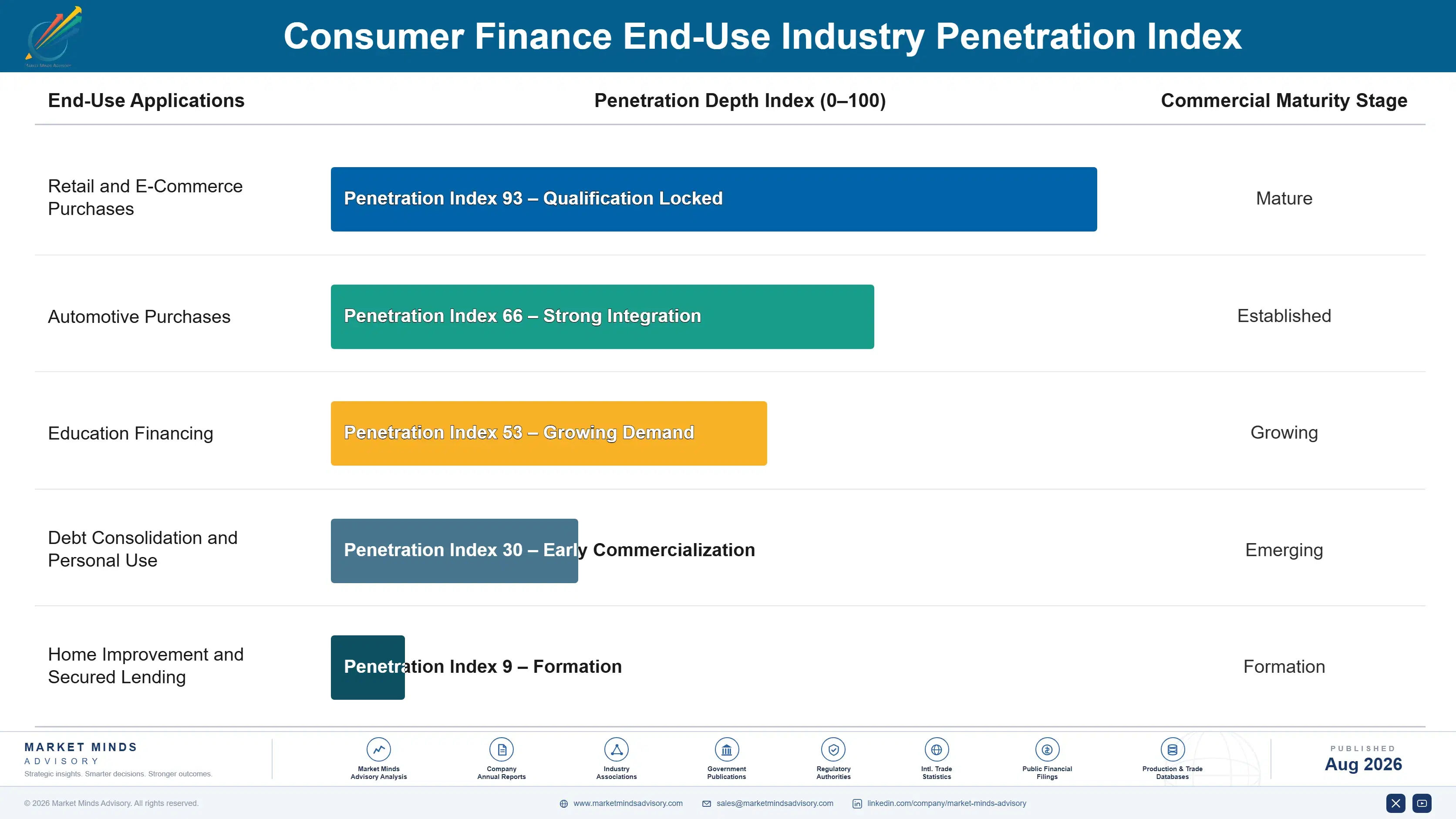
consumer-finance-market-end-use-penetration-index-1787913967106

Where MMA Sees Divergence Ahead

These are among the four positions where our research anticipates prominent divergence between winners and laggards over the coming forecast period. Each is grounded in the demand model, the regulatory perimeter, and the announced capacity pipeline.
01 / POINT-OF-SALE INTEGRATION PRIORITY

Build merchant checkout integration before saturation

E-commerce checkout integration is not slowing down, and the merchant partnership infrastructure it demands does not move for anyone, since lenders that build point-of-sale integration capture origination volume before the rest of the industry catches up and competition compresses that advantage. Companies treating checkout financing as a roadmap item rather than a build priority are solving the wrong problem for this window, since integration depth, not marketing spend, is what will separate winners from laggards over the next years. The advantage goes to whoever integrates first, not whoever advertises loudest.
02 / UNDERWRITING DISCIPLINE PRIORITY

Tighten underwriting before delinquencies force the issue

Delinquency rates are not falling on their own, and the underwriting discipline this demands does not move for anyone, which means lenders that tighten standards proactively will absorb far less credit loss than competitors waiting for regulators or rating agencies to force the correction. Companies chasing origination volume while deferring underwriting discipline are solving the wrong problem for this window, since credit quality, not growth rate, is what will separate winners from laggards over the next several years. The advantage goes to whoever prices risk accurately, not whoever grows fastest.
03 / ALTERNATIVE-DATA UNDERWRITING INVESTMENT

Build alternative-data underwriting before it becomes standard

Alternative-data underwriting is not a niche capability anymore, it is becoming the primary mechanism through which lenders serve thin-file borrowers profitably, and lenders that build this capability now, while it remains a genuine differentiator, capture pricing power that becomes far harder to establish once mainstream lenders eventually build comparable capability at scale. Waiting until alternative-data scoring becomes standard practice means competing for margin that early movers have already claimed. The lenders solving this first will define the reference standards everyone else has to match.
04 / EMERGING MARKET POSITIONING

Enter underbanked markets before competitors reach them

Roughly 1.4 billion unbanked adults represent one of the largest genuine addressable market opportunities in consumer finance today, and lenders that build affordable, mobile-first products for these borrowers now capture customer relationships years before those borrowers become profitable enough to attract deeper-pocketed competitors. Waiting for these markets to mature before entering means competing for customers that early movers have already converted into loyal, repeat-borrowing relationships. The lenders solving affordable underwriting first will define the reference products everyone else has to match.

Engagement Snapshot From the Field

A live engagement with an industry participant carrying material or product regulatory and market exposure ahead of a defining policy shift, showing how our research translates into a defensible multi-year portfolio strategy.
MARKET MINDS ADVISORY · CLIENT ENGAGEMENT SUMMARY
Consumer Finance Producer Strategic Portfolio Review and Transition Roadmap 2026·Investment Scenario on Consumer Finance Exposure Evaluation 2025-26
CLIENT PROFILE
A mid-sized regional furniture and home goods retailer approached MMA while evaluating whether to add point-of-sale financing options at checkout to compete with larger retailers already offering installment payment options. The client reported annual revenue near USD 420 million, with no prior experience evaluating financing providers or point-of-sale lending economics specifically (client-reported, unverified by MMA).
STRATEGIC CHALLENGE
Leadership saw competitors' checkout financing options driving higher average order values but had no internal framework for evaluating which provider to partner with or how the financing subsidy cost would affect overall margin, and needed to move quickly given active competitive pressure on conversion rates across all sales channels immediately.
MMA APPROACH
MMA benchmarked comparable retailers' point-of-sale financing partnerships and resulting conversion rate improvements, modeled the client's likely subsidy cost against expected conversion and average order value lift, and assessed which providers offered merchant terms best suited to the client's furniture and home goods category specifically, drawing on comparable retail sector engagements.
KEY FINDINGS
  1. Comparable furniture retailers offering point-of-sale financing saw average order values increase by roughly 35% compared to non-financed transactions across similar product categories.
  2. The subsidy cost for offering interest-free installment terms ran approximately 4% of financed transaction value, well within the client's existing gross margin structure.
  3. Two providers offered materially better merchant terms specifically for furniture and home goods, reflecting their existing category expertise and proven underwriting models.
  4. Conversion rate improvements at checkout were concentrated among larger purchase amounts, where financing availability most directly influenced the final purchase decision itself.
CLIENT PROFILE
A mid-sized regional furniture and home goods retailer approached MMA while evaluating whether to add point-of-sale financing options at checkout to compete with larger retailers already offering installment payment options. The client reported annual revenue near USD 420 million, with no prior experience evaluating financing providers or point-of-sale lending economics specifically (client-reported, unverified by MMA).
STRATEGIC CHALLENGE
Leadership saw competitors' checkout financing options driving higher average order values but had no internal framework for evaluating which provider to partner with or how the financing subsidy cost would affect overall margin, and needed to move quickly given active competitive pressure on conversion rates across all sales channels immediately.
MMA APPROACH
MMA benchmarked comparable retailers' point-of-sale financing partnerships and resulting conversion rate improvements, modeled the client's likely subsidy cost against expected conversion and average order value lift, and assessed which providers offered merchant terms best suited to the client's furniture and home goods category specifically, drawing on comparable retail sector engagements.
KEY FINDINGS
  1. Comparable furniture retailers offering point-of-sale financing saw average order values increase by roughly 35% compared to non-financed transactions across similar product categories.
  2. The subsidy cost for offering interest-free installment terms ran approximately 4% of financed transaction value, well within the client's existing gross margin structure.
  3. Two providers offered materially better merchant terms specifically for furniture and home goods, reflecting their existing category expertise and proven underwriting models.
  4. Conversion rate improvements at checkout were concentrated among larger purchase amounts, where financing availability most directly influenced the final purchase decision itself.
RECOMMENDED STRATEGY
Phase 1: Phase 1 (0 to 3 months): Select a financing provider with proven furniture and home goods category experience and negotiate merchant subsidy terms. Phase 2: Phase 2 (3 to 9 months): Launch point-of-sale financing at checkout across all channels, tracking conversion and average order value impact closely. Phase 3: Phase 3 (9 to 18 months): Optimize financing terms and promotional positioning based on validated performance data across the full product catalog.
OUTCOME
The client launched point-of-sale financing within four months, ahead of the original six-month implementation estimate, and saw average order values increase by a reported 31% within the first two quarters. The financing subsidy cost was more than offset by the incremental margin from larger completed purchases (client-reported, unverified by MMA).

Frequently Asked Questions

Foundational context covering the market sizes, CAGR, scope, country, region and competition that inform every finding below. This section is provided to cover basics and most often pre-purchase conversations, answered from the MMA Primary Research Dataset.

What is the current size of the Consumer Finance Market?

The market reached USD 2,180 billion in 2025 on a global basis, with North America holding the largest single regional share at 30%. It spans credit cards, installment loans, auto loans, and point-of-sale financing.

How large will the Consumer Finance Market be by 2036?

MMA forecasts the market will reach USD 4,225 billion by 2036, expanding roughly 1.82 times its 2026 base value. Point-of-sale financing and personal installment loans drive most of that incremental growth.

What is the CAGR for the Consumer Finance Market 2026 to 2036?

The base case CAGR runs at 6.2% annually through 2036. Bull scenarios reach 7.5% on faster financial inclusion expansion, while bear scenarios fall to 4.9% if rising delinquencies force underwriting tightening.

Which segment is growing fastest?

Point-of-sale and retail financing grows fastest at 11.5% annually, nearly 1.9 times the overall market rate. E-commerce checkout integration drives most of that acceleration industrywide.

Who are the major companies in the Consumer Finance Market?

JPMorgan Chase, Capital One, American Express, Synchrony, and Ant Group lead the market on a consistent global revenue basis. Together they hold roughly 16% of category revenue.

Which country is growing fastest?

Indonesia posts the fastest national growth at roughly 13.5% annually, driven by digital lending platforms serving previously excluded borrowers. Growth concentrates in mobile-first alternative-data lending rather than traditional credit cards.

Report Segmentation Architecture

The full report scope spans multiple orthogonal segmentation dimensions, with cross-tabulated demand data provided for each dimension pair. Coverage extends further to regional breakdowns, trend trajectories, and the competitive detail needed to support segment-level decision-making.

By Product Type

  • Credit Cards and Revolving Credit
  • Personal Installment Loans
  • Auto Loans and Vehicle Financing
  • Point-of-Sale and Retail Financing
  • Student and Education Loans
  • Home Equity and Secured Consumer Lending

By End-Use Industry

  • Retail and E-Commerce Purchases
  • Automotive Purchases
  • Education Financing
  • Debt Consolidation and Personal Use
  • Home Improvement and Secured Lending

By Commercial Dimension

  • Direct Bank and Card Issuer Lending
  • Point-of-Sale Merchant Partnerships
  • Digital-First Platform Origination
  • Alternative-Data and Thin-File Underwriting

By Region

  • North America
  • Western Europe
  • East Asia
  • South Asia and Pacific
  • Latin America
  • Middle East and Africa
  • Eastern Europe

Scope, Methodology, and Coverage

Every figure in this report is reproducible from documented input assumptions. The scope below maps the historical period, the forecast horizon, the segmentation dimensions, and the countries covered, alongside the underlying primary and qualitative methodology.
Historical Period
2020 to 2025
Forecast Period
2026 to 2036
Base Year
2025 (USD billions; MMA Primary Research Dataset, August 2026)
Market Definition
The consumer finance market covers lending products extended directly to individual consumers for personal, non-business use. It spans credit cards, personal installment loans, auto loans, point-of-sale and retail financing, student loans, and home equity lending, measured by interest and fee revenue generated across the global lending industry. It excludes commercial and business lending, mortgage lending for primary residence purchase, and peer-to-peer lending platforms that function purely as marketplaces without extending balance-sheet credit.
Quantitative Units
USD billions (current prices); loan origination volume in billions where applicable
Segmentation Dimensions
By Product Type; By End-Use Industry; By Commercial Dimension; By Region
Regions Covered
North America, Western Europe, East Asia, South Asia and Pacific, Latin America, Middle East and Africa, Eastern Europe
Countries Covered
USA, China, Germany, France, UK, Japan, South Korea, India, Australia, Canada, Brazil, Mexico, Indonesia, Vietnam, Thailand, Malaysia, UAE, Saudi Arabia, South Africa, Nigeria, Turkey, Poland, Netherlands, Italy, Spain, Sweden, Switzerland, Argentina, Colombia, Singapore, and additional markets relevant to this sector
Key Companies Profiled
JPMorgan Chase & Co., Capital One Financial Corporation, American Express Company, Synchrony Financial, Ant Group, Citigroup Inc., Discover Financial Services, Wells Fargo & Company, Bank of America Corporation, Barclays plc, Santander Consumer Finance, Ally Financial Inc., OneMain Holdings Inc., Navient Corporation, SLM Corporation, Affirm Holdings Inc., Klarna Bank AB, China Construction Bank, HDFC Bank Limited, Toyota Financial Services
Quantitative Methodology
Primary survey, n=3,800 respondents, Q4 2025, six countries; demand-side model with trade association cross-validation
Qualitative Methodology
47 expert interviews, Q4 2025; applied to validate demand model assumptions, identify emerging dynamics, and assess competitive positioning
Report Format
PDF and XLSX data workbook (Word format preview document)
Publisher
Market Minds Advisory
Report Code
MMA-2026-TEC-314
Published
August 2026
Contact
sales@marketmindsadvisory.com | www.marketmindsadvisory.com

Purchase the full Consumer Finance Market Report (2026 to 2036).

The full MMA Consumer Finance report sizes the market across six product types, five end-use categories, four commercial channels, and seven regions through 2036. It profiles 20 participants on a consistent global revenue basis, scoring leaders on underwriting discipline, point-of-sale integration, and alternative-data capability. Scenario models quantify how point-of-sale financing adoption, delinquency cycles, and financial inclusion expansion move both demand and credit quality performance across commodity and premium tiers. The report also includes delivered-cost modeling by product type, a delinquency and regulatory tracker, and a competitive positioning assessment built for underwriting, product, and risk teams.
Six-way product type segmentation with growth forecasts
Twenty-company competitive profiles on consistent revenue basis
Seven-region market sizing with country-level detail
Delinquency and regulatory compliance tracking module
Cost of funds and credit loss modeling by product type
Bull, base, and bear demand scenario forecasts

Built For The People Who Decide

From boardroom strategy to bench-side execution, this report is read cover-to-cover by leaders shaping the next decade of their industry, turning demand scenarios, market dynamics and valuation benchmarks into decisions.
CXOs/ Presidents/ VPs/ Managers
M&A and Corporate Development
Strategy Teams and R&D Heads
Procurement and Product Directors
Regulatory and Compliance Leaders
Investor Relations and Equity Analysts