

Market Minds Advisory
Consumer Durable Loans Market

Consumer Durable Loans Market: The Borrower Is Not Paying The Interest

On a zero interest instalment the brand pays the lender around 11% of ticket value. The consumer pays nothing extra and the yield arrives from somebody who never borrowed anything.

Lead Analyst

Published

September 2026

Make Smarter Decisions with Customized Research Insights

Request a free sample report and evaluate market opportunities, growth trends, and competitive dynamics relevant to your business needs.

2025 MARKET VALUE$34.8BMarket Size 2025
2036 FORECAST VALUE$95.4BBase Case , 2026 to 2036
CAGR 2026 TO 20369.6 %Bull 10.8% / Bear 8.4%
INCREMENTAL OPPORTUNITY$57.2BNet 10- year value creation
EXPANSION MULTIPLE2.50x2036 value over 2026 base
Strategic Levers
M&A Pipeline
Regional Outlook
Country Rankings
Competitive Intelligence
Segmental Deep-dive
Call-Us : 91 93563 13602

Executive Snapshot and Market Trajectory

The economics run backwards from ordinary lending. A consumer taking a zero interest instalment pays no interest at all, and the lender earns roughly 11% of ticket value from the brand or retailer that wanted the sale closed. Nothing else in lending works this way.
East Asia holds 27% of value and South Asia and Pacific 22%, the latter well above its usual band because durable financing penetration in India exceeds anywhere else by a considerable margin. Merchant-subvented zero interest instalment grows at 14.4%, half again the market rate of 9.6%, since a brand facing soft demand will fund the interest long before it will cut a headline price. A price cut is permanent and a financing offer never is.
Concentration reaches only 26% across specialist financiers, banks and checkout providers competing for the same shelf position. Average tickets run around 620 dollars over 11 months, which means acquisition cost has to be almost nothing and the loan only works if it originates inside the purchase itself. Whoever holds the shelf position at that counter holds the business, and the merchant grants that position rather than the lender earning it.
Market Definition
The market covers income earned by providers of financing for consumer durable purchases at point of sale, spanning merchant-subvented zero interest instalment, short tenor deferred payment instalment, extended tenor instalment loans, two-wheeler and small vehicle instalment finance, interest-bearing standard instalment loans, and revolving store and durable credit lines. Income comprises consumer interest, merchant subvention and fees. General-purpose credit cards, unsecured personal loans not tied to a purchase, mortgage and home equity lending, passenger car finance, and equipment leasing to businesses are excluded.
Base Year Value
$34.8B in 2025 (MMA Primary Research Dataset, August 2026)
Forecast Period
2026 to 2036, eleven discrete annual values
CAGR
9.6% base case. Bull 10.8%. Bear 8.4%.
Fastest Growth Segment
Merchant-Subvented Zero Interest Instalment: 14.4% CAGR
Fastest Growth Country
India: 11.6% CAGR
Fastest Growth Region
South Asia and Pacific: 11.8% CAGR
Largest Region
East Asia: 27% of 2025 global value
Market Leaders
Bajaj Finance, Home Credit, Klarna, Affirm, Santander Consumer Finance. Source: MMA Analysis based on disclosed consumer durable and point-of-sale financing receivables and income, company annual reports 2025.
Primary Survey
n=3,800 procurement and R&D decision-makers, Q4 2025, six countries
Methodology
Demand-side build-up, cross-validated against public data, 47 expert interviews

Consumer Durable Loans Market Forecast Scenarios

consumer-durable-loans-market-size-forecast-scenario-1787913369920
Growth from 2020 to 2025 ran at 8.4% and two forces pulled in opposite directions. Checkout instalment offerings spread rapidly across online retail and pulled in volume from consumers who would never have applied for a loan separately. Then rates rose through 2022 and 2023, compressing spreads on fixed-rate short-tenor books immediately, while several regulators reconsidered how these arrangements should be disclosed and capitalised.
The 9.6% base case rests on three mechanisms. Brands facing soft durable demand keep funding subvention rather than cutting list prices, since a discount resets a price point permanently and subvention does not. Checkout integration keeps deepening across online and offline retail. And Indian and Southeast Asian durable purchase volumes keep rising from bases where financing penetration is already high. None of the three depends on consumers paying any more at all.
The bull case at 10.8% assumes subvention budgets expand as brands defend volume through a soft cycle without touching list prices. The bear case at 8.4% is regulators tightening disclosure so that zero interest offers must show the subvention, which would make brands considerably less willing to fund arrangements whose commercial logic depends on the consumer not seeing the number.

Somebody Else Pays The Interest

Zero interest financing is not free and the consumer is simply not the one paying. The brand or retailer pays the lender a subvention of around 11% of ticket value, covering the interest the borrower never sees. That works because a discount permanently resets a price point while a financing offer does not, so a manufacturer defending volume will fund instalments long before it will cut the sticker price on anything.
FIVE-FIRM CONCENTRATION26%Share of category income held by the largest financing providers
MERCHANT SUBVENTION RATE11%Share of ticket value a brand pays the lender directly
AVERAGE TICKET SIZE620Typical financed purchase value in United States dollars
AVERAGE LOAN TENOR11 monthsRepayment period across a typical durable instalment loan
LOSS GIVEN DEFAULT96%Portion of balance unrecovered once a borrower stops paying
CHECKOUT CONVERSION UPLIFT24%Increase in completed sales when instalment options appear
Ticket sizes and tenors make the economics unforgiving. An average financed purchase runs about 620 dollars over 11 months, which leaves almost nothing to spend acquiring the borrower. The only version of this business that works originates the loan inside the purchase, at the checkout or the counter, in the seconds while somebody has already decided to buy. A separate application process destroys the unit economics entirely.
Credit behaviour is genuinely peculiar here. Default rates run lower than unsecured personal lending because tenors are short and the purchase was wanted, yet loss given default sits around 96%, since nobody repossesses a used television economically. The asset provides no recovery whatsoever. What protects the book is that people who wanted the thing enough to finance it keep paying.
"The lender's real asset is not the loan book. It is a spot on the checkout page or a desk in the corner of a showroom, and the merchant who granted that spot can grant it to somebody else next quarter without giving anybody a reason."
Director, Consumer Finance Practice · MMA Point-of-Sale Consumer Finance Practice · August 2026

Market Trends

Brands Fund Instalments Rather Than Cut Prices

A price reduction resets a product's price point permanently and invites the whole category to follow, while a subvented financing offer moves volume without touching the list price at all and can be withdrawn quietly whenever demand recovers. Brands pay around 11% of ticket value for that. Marketing budgets rather than pricing committees approve it. That segment grows at 14.4% and it grows fastest precisely when durable demand is softest. Nobody in pricing has to approve any of it, which is exactly why it all moves so very quickly here.
Market Impact: Justifies 11% against 24% uplift

Origination Moves Entirely Inside The Purchase Moment

With average tickets around 620 dollars there is almost nothing available to spend acquiring a borrower, which means the loan has to originate at the checkout or counter during the seconds after somebody decides to buy. Instalment options presented at checkout raise completed sales by roughly 24%. Any separate application process destroys the unit economics, which is why standalone consumer lenders have never made this product work at scale. A borrower who has to fill in an application somewhere else has already stopped being a borrower at all by then instead.
Market Impact: Grows Indian volume at 11.6%

Market Opportunities and Growth Drivers

Merchant Conversion Uplift Justifies The Subvention Cost

Retailers presenting instalment options at checkout report completed sales rising by around 24%, which comfortably justifies subvention at 11% of ticket value on the incremental transactions it generates. The arithmetic is straightforward and merchants run it themselves. That makes this one of very few financing products where the paying party can verify its own return directly rather than accepting a supplier's assertion about what the arrangement delivers. Nobody has to take a lender's word for anything, because the evidence sits right there right inside the retailer's own till records already.
Market Impact: Risks losing 100% of volume

Indian Durable Financing Penetration Leads The World

Financing penetration on consumer durable purchases across India exceeds any other market by a considerable margin, built through physical presence at tens of thousands of retail counters combined with pre-approved instalment cards that remove the decision from the purchase moment entirely. India grows fastest at 11.6%. The model required a decade of merchant-by-merchant expansion that nobody has replicated, and its economics depend entirely on that distribution. Nobody has replicated the ground-level expansion that built it, and nobody appears especially eager to spend the decade required to go and try either.
Market Impact: Exposes an 11% hidden charge

Market Restraints and Challenges

The Merchant Owns The Relationship, Not The Lender

Shelf position at checkout is the actual asset and the merchant grants it, which means a lender can be replaced at renewal without any customer noticing or caring at all. Root cause is that the consumer chose a product rather than a financier. Commercial impact is that a book built over years can stop growing in a quarter. Mitigation involves exclusivity terms, category tie-ups and pre-approved limits that follow the customer rather than the store. Nothing about the loan itself creates any reason for the borrower ever to return again.
Market Impact: Pays 11% of ticket value

Disclosure Rules Could Expose What Zero Interest Costs

The commercial logic of subvented financing depends partly on the consumer not seeing that somebody paid around 11% of ticket value to make the offer possible, and several regulators have questioned whether that arrangement is adequately disclosed. Root cause is genuine ambiguity about who the customer is. Commercial impact would fall on brand willingness to fund it. Mitigation involves clearer disclosure that preserves the offer, which nobody has yet designed convincingly. Nobody has yet found wording that discloses the arrangement honestly without making the brand reconsider funding it at all.
Market Impact: Raises checkout conversion 24%
4 additional market trends, 3 additional growth drivers, and 2 additional restraints and challenges are covered in the full report. Contact sales@marketmindsadvisory.com to access the complete intelligence.

Segment CAGR and Growth Architecture

Segmentation follows financing structure, since yield source, tenor and credit behaviour all differ by structure rather than by the goods being purchased. Six categories cover the market without overlap. Product category, retail channel and borrower profile are treated as separate commercial dimensions throughout this report rather than as segmentation logic in their own right.
consumer-durable-loans-market-market-share-analysis-1787913370455

Merchant-Subvented Zero Interest Instalment

Subvented instalment grows at 14.4%, half again the market rate of 9.6%, because a brand defending volume through soft demand will pay roughly 11% of ticket value to the lender rather than cut a list price it would then struggle to raise again. Marketing budgets approve these arrangements rather than pricing committees, which makes them considerably easier to fund. Growth accelerates precisely when durable demand weakens, giving this segment a counter-cyclical character almost nothing else in consumer lending shares. Nobody in pricing approves any of it, which makes these arrangements considerably faster to agree than a discount would ever be and considerably easier to withdraw once demand improves again afterwards.
CAGR 14.4%

Short Tenor Deferred Payment Instalment

Short tenor deferred arrangements grow at 12.6% by splitting a purchase across a handful of payments over weeks rather than months, funded almost entirely by merchant fees rather than by any consumer charge. Regulatory treatment has diverged sharply between jurisdictions, with several supervisors deciding these arrangements are credit and should be regulated accordingly. That reclassification adds affordability assessment and disclosure obligations to a product originally designed around having neither of them. Friction added at the checkout works directly against the conversion uplift that the entire proposition rests upon, which leaves providers implementing obligations designed to protect consumers from a product whose appeal was never having any of them at all.
CAGR 12.6%
Full segment breakdown across 6 segments available in the complete report.

Regional Architecture and Country Demand Map

Penetration follows retail structure and financing culture rather than income levels, which is why several middle-income markets finance a far higher share of durable purchases than wealthy ones do. Instalment purchasing culture varies far more between markets than income levels alone could ever really explain.

North America

Share sits at 20%, below the standard regional band, because general-purpose credit cards already carry a great deal of durable purchasing and dedicated point-of-sale financing accordingly serves a narrower role. That justification reflects substitution rather than any weakness in demand. Checkout instalment providers grew quickly through online retail and have since faced supervisory reclassification of short tenor arrangements as credit. Store card programmes remain substantial and are operated largely by a small number of specialist banks. Subvented zero interest offers are common in electronics and appliance retail without carrying the visibility they have in Asian markets, and merchants here negotiate financing arrangements on commercial terms with considerably less patience for anything resembling a partnership.
Share: 20% | CAGR: 8.4% (2026 to 2036)

Western Europe

Durable financing is well established and comparatively conservative, with instalment credit sold through both bank-owned consumer finance arms and specialist providers that have operated for decades. Consumer credit directive requirements impose affordability assessment obligations that short tenor arrangements elsewhere avoided entirely. Nordic markets adopted checkout instalment earliest and most completely. Southern European markets rely more heavily on subvented offers from brands defending volume in price-sensitive durable categories. Merchant relationships here are long-established and considerably more stable than in faster-moving markets, which reduces the risk of losing an origination channel abruptly while also making it very hard for any new entrant to displace an incumbent that has held a chain for a decade or more.
Share: 18% | CAGR: 8.0% (2026 to 2036)
Regional intelligence for 5 additional markets available in the complete report: East Asia, South Asia and Pacific, Latin America, Middle East and Africa, Eastern Europe. Contact sales@marketmindsadvisory.com.
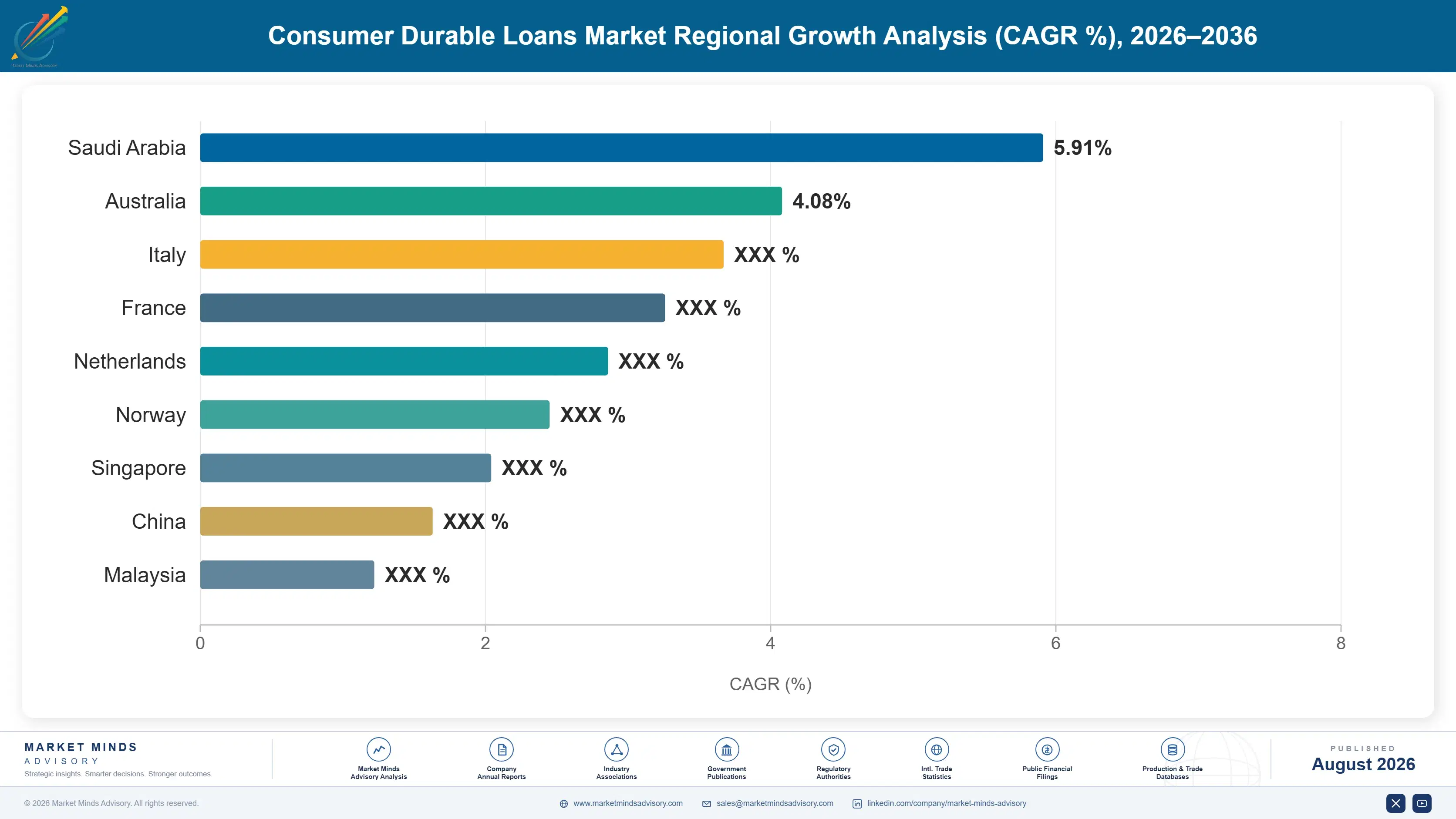
consumer-durable-loans-market-country-cagr-analysis-1787913370973

Own The Checkout Position Outright

Subvention runs 11% of ticket value, average tickets are 620 dollars over 11 months, checkout presence raises conversion 24% and loss given default reaches 96%. Four levers work on merchant economics, origination position, portability and collection rather than on consumer interest pricing, which across most of this volume happens to be simply zero anyway.

Sell Conversion Uplift Rather Than Financing Terms

Merchants presenting instalment options report completed sales rising around 24%, which they can verify themselves against subvention costing 11% of ticket value on incremental transactions. That is an arithmetic a retailer runs without help. Lenders negotiating on rate and fee structure are competing on the dimension merchants care least about, while lenders proving conversion impact on the merchant's own transaction data are answering the only question that actually decides the arrangement. Nobody needs any persuading about a number they can pull straight out of their own till system themselves instead.
Market Impact: Proves a 24% conversion uplift against 11% cost

Make The Limit Follow The Customer Everywhere

Shelf position at checkout belongs to the merchant and can be reassigned at renewal without any consumer noticing, so a book built entirely on store relationships can stop growing within a single quarter. Pre-approved limits carried by the customer across merchants convert a merchant relationship into a consumer one. Roughly 11 months of repayment history gives a lender the basis to extend that limit before anybody else has any data at all. A customer who already holds an approved limit returns without comparing anything at all on the next occasion.
Market Impact: Converts 11 months of history into portable limits

Target Categories Where Brands Defend Volume Hardest

Subvention budgets sit with brand marketing rather than pricing committees, and they expand precisely when durable demand softens, because a discount permanently resets a price point and a financing offer never does. Brands pay around 11% of ticket value accordingly. Lenders concentrating on categories with strong brand competition and weak demand capture the largest subvention pools, and those pools grow when everything else in consumer lending is contracting. Nothing else anywhere in consumer lending has a funding source that grows larger the worse that trading conditions actually get at all.
Market Impact: Captures the 11% subvention across soft demand categories

Collect Early Because Recovery Later Is Impossible

Loss given default sits near 96% because a used durable good has no repossession value worth pursuing, which means everything depends on early-stage collection before an account rolls further. Contact within the first missed payment window recovers a large share of accounts that become unrecoverable a month later. Lenders treating collection as a back office function rather than a core capability are writing off balances that better contact discipline would have saved. There is nothing at the end of this process to repossess and then sell to anybody at all.
Market Impact: Manages down a 96% loss given default severity

Who Controls the Margin Pool

Measured on disclosed consumer durable and point-of-sale financing receivables and income, the five largest providers hold a CR5 of just 26%, reflecting a market fragmented by geography and by retail relationship rather than by any capability barrier. Bajaj Finance holds the largest dedicated durable book anywhere, Home Credit carries broad emerging market presence, Klarna and Affirm hold substantial checkout positions, and Santander Consumer Finance carries established European distribution. Nobody outside that group holds both physical counter presence and online checkout integration at meaningful scale.
Three contests run at once. Physical retail competes on counter presence and merchant field relationships. Online checkout competes on integration and conversion evidence. Subvented programmes compete for brand marketing budgets directly. The three reward completely different organisations, and hardly anybody competes convincingly in more than one of them at once.

Pressure builds from supervisory reclassification of short tenor arrangements as regulated credit. Rankings shift toward whoever holds portable customer limits rather than whoever holds the most merchant contracts. A merchant contract is renewed rather than owned, and a book that took five years to build can stop growing at a renewal meeting nobody from the lender attends.
consumer-durable-loans-market-company-positioning-matrix-1787913371494

Competitive Moat and Risk Dimensions

BAJAJ FINANCE

Moat: Counter Presence At Enormous Scale

Physical presence at tens of thousands of retail counters, built merchant by merchant over more than a decade, puts the financing decision inside the purchase moment in a way no digital-only competitor reaches in physical retail. Pre-approved instalment cards then remove the decision entirely. Replicating that distribution requires the same decade of ground-level expansion.
BAJAJ FINANCE

Risk: Concentration In One Market

A position built overwhelmingly in a single national market carries direct exposure to that market's regulatory decisions, credit cycle and retail structure, none of which diversify against anything. Supervisory intervention in adjacent lending arrangements has already demonstrated how quickly domestic rules can reshape a product. Geographic concentration provides no offset at all.
KLARNA

Moat: Merchant Integration And Consumer Reach

Deep integration across online retail combined with a consumer base that arrives at checkout already holding an account produces conversion evidence merchants can verify directly, which is the argument that actually wins these arrangements. Building comparable merchant coverage requires years of integration work per platform. The consumer relationship sits partly with the provider rather than the retailer.
KLARNA

Risk: Regulatory Reclassification Adds Obligations

Supervisors deciding that short tenor deferred arrangements constitute regulated credit adds affordability assessment, disclosure and reporting obligations to a product originally designed around having none of them. Compliance cost falls on transactions with very thin economics. The friction added at checkout also works directly against the conversion uplift the whole proposition rests upon.

Players Tracked

Prominent Players

Bajaj Finance
Home Credit
Klarna
Affirm
Santander Consumer Finance

Other Key Players

Synchrony Financial
Bread Financial
Block
PayPal
Zip Co
Sezzle
HDFC Bank
ICICI Bank
TVS Credit
IDFC First Bank
BNP Paribas Personal Finance
Oney
Kredivo
Ant Group
JD Technology

Recent Developments

FEBRUARY 2025

Appliance manufacturer expands subvention programme across soft categories

A durable goods manufacturer expanded its zero interest financing programme across categories where volume had weakened, funding the subvention from brand marketing budgets rather than from any pricing adjustment at all. This was a commercial marketing decision rather than any financing transaction or partnership change.
Signal: Subvention budgets expand exactly when durable demand softens, which suits all these lenders considerably well indeed.
JULY 2025

Supervisor confirms short tenor deferred payment treated as credit

A financial supervisor confirmed that short tenor deferred payment arrangements fall within consumer credit regulation, bringing affordability assessment and disclosure obligations. This was a regulatory clarification rather than any new legislation, and providers had been anticipating it for some considerable length of time already anyway.
Signal: Compliance cost is arriving on transactions whose economics were never designed to carry any of it.
NOVEMBER 2025

Electronics retailer switches financing partner at contract renewal

A large electronics retail chain replaced its point-of-sale financing partner at contract renewal, moving several years of origination volume to a competitor. This was a commercial renewal decision rather than any acquisition, and no consumer relationship transferred with the departing provider at all, then or afterwards.
Signal: Merchant relationships are the real asset here and they get renewed rather than ever properly owned.

Funding, Losses, Distribution

Three costs consume the income. Cost of funds on short-tenor receivables, credit losses at a severity close to total, and merchant acquisition with field distribution together account for 68 to 82% of gross income at a typical provider. Funding is comparatively short-dated because tenors average 11 months, which reprices books quickly in either direction and makes fixed-rate consumer pricing genuinely uncomfortable when policy rates move against a lender mid-cycle.
Rates did exactly that. Policy rates across advanced and emerging economies rose sharply through 2022 and 2023, which IMF data documents, and fixed-rate short-tenor books repriced far slower than the funding behind them. Margins compressed immediately. Reserve Bank of India circulars on default loss guarantee arrangements separately reshaped how fintech originators and balance sheet lenders share credit risk, and Bajaj Finance Annual Report 2024 disclosures describe the resulting cost environment.

Exposure divides by funding structure and distribution ownership together. Bank-owned providers fund from deposits and hold a cost advantage that specialist financiers cannot close. Specialists funding through wholesale markets carry spread widening exactly when credit deteriorates. Providers renting merchant distribution rather than owning it carry a further exposure, since the relationship generating every loan can be reassigned at renewal.
consumer-durable-loans-market-cost-volatility-analysis-1787913371690

Match funding tenor to an eleven month asset

Average tenors of 11 months create a short-dated book that reprices quickly, and funding it with longer liabilities or leaving it exposed to floating costs both create mismatches that bite when rates move. Matched short-dated funding costs flexibility and requires more frequent refinancing. It removes the compression that hit fixed-rate books through the last rate cycle.

Own merchant distribution rather than renting shelf position

A financing arrangement renewed by a merchant every few years can be reassigned to a competitor without any consumer noticing, which puts an entire origination channel outside the lender's control. Field presence, exclusivity terms and category tie-ups all cost money and take years. They convert a rented position into something closer to an owned one.

Invest in early stage collection rather than recovery

Loss given default near 96% means nothing meaningful is recovered once an account has genuinely gone, since a used durable good has no repossession value worth pursuing at all. Early contact discipline costs operational investment in exactly the period most lenders treat as routine. It saves accounts that become entirely unrecoverable within a single further month.

Portfolio Architecture for Margin Defence

Contribution margin follows who pays the yield rather than how large the balance is. Revolving store credit lines earn modestly against funding cost and revolving behaviour. Interest-bearing standard instalment earns reasonably where consumer rates hold. Two-wheeler finance earns better on longer tenors and genuine collateral. Extended tenor loans earn well on duration. Short tenor deferred arrangements earn better on merchant fees. Subvented zero interest instalment earns best, on brand budgets rather than borrower capacity.
The tension is that the highest-margin product is funded by a party with no obligation to continue. Subvention comes from brand marketing budgets approved annually, expanded when demand softens and withdrawn without ceremony when it recovers. A lender whose economics depend on that funding is exposed to a decision made in a marketing meeting it does not attend, about a budget line it cannot see and has no ability to influence.

High-value pools sit in three places. Subvented programmes in categories where brand competition is fierce and demand is weak. Portable pre-approved limits that follow a customer between merchants rather than sitting with any single store. And early-stage collection capability, which is where a 96% loss severity is actually managed rather than merely reported afterwards.

Volume / Commodity-Adjacent

Revolving store lines and standard interest-bearing instalment competing directly against general-purpose credit. The 12-point range separates bank-owned providers funding from deposits and specialists funding through wholesale markets at wider spreads.
Gross Margin: 14-26%

Premium / Certified

Extended tenor loans and two-wheeler finance carrying longer duration and, in the latter case, collateral with genuine recovery value. The 16-point spread reflects how differently unsecured duration and secured vehicle lending perform across a credit cycle.
Gross Margin: 30-46%

Sustainability / Regulatory / Next-Generation

Subvented zero interest instalment and short tenor deferred arrangements funded by brands and merchants rather than by borrowers. The 22-point range is wide because subvention rates and merchant fee structures differ enormously between categories and markets.
Gross Margin: 42-64%
consumer-durable-loans-market-portfolio-architecture-1787913372197

High-value Sub-segments and Strategic Watch-out

Subvented Zero Interest Programmes

Highest margin and fastest growth at 14.4%, funded by brand marketing budgets that expand precisely when durable demand weakens elsewhere. The risk is that the funding party has no obligation whatsoever to continue and decides annually. And it is decided annually by somebody else entirely.
Gross Margin: 50-64%

Portable Pre-Approved Limits

Strong economics from a consumer relationship that survives any merchant switching financing partners at contract renewal. The risk is that building it requires repayment history the lender only gets after originating through merchants first. That ordering makes the whole sequence genuinely hard to escape from.
Gross Margin: 40-52%

Standard Instalment Volume

The volume core, funding the merchant relationships and field infrastructure that every higher-margin product depends upon. Providers hold it because it carries the distribution, not because the spread is worth defending. And the spread on it has never once been worth defending on its own.
Gross Margin: 16-28%

Rented Merchant Shelf Position

The strategic watch-out. Origination sits entirely on relationships the merchant renews and can reassign without notice. The risk is a book built across years stopping growth within one contract renewal cycle. Nothing whatsoever about the loan book itself protects a lender against any of that.
Gross Margin: 10-20%

Repeat Purchases, Not Repeat Loans

Annuity economics here are weaker than the volume suggests and providers consistently overstate them. Each loan runs about 11 months and then ends, generating no renewal and no continuing relationship unless the lender builds one deliberately. What recurs is the merchant, who sends new borrowers indefinitely, and the customer, who buys another durable good in a few years. Neither of those is automatic and both belong to whoever organised them.
Stickiness is almost entirely a matter of where the pre-approved limit sits. A customer with an approved limit already loaded returns to that lender at their next purchase without comparing anything at all. A customer financed once through a store and never contacted again is a stranger the following year. The difference is enormous and costs almost nothing to build, which makes the neglect remarkable.

The decision has always sat in two places and lenders keep addressing only one. The consumer picks an instalment option at checkout, largely on payment size rather than on any comparison. The merchant picks which options appear there at all, on conversion evidence and commercial terms. A lender selling only to consumers is competing for a slot somebody else already decided.
consumer-durable-loans-market-end-use-penetration-index-1787913372685

The Merchant Decides Everything

These are among the four positions where our research anticipates prominent divergence between winners and laggards over the coming forecast period. Each is grounded in the demand model, the regulatory perimeter, and the announced capacity pipeline.
01 / CONVERSION EVIDENCE SELLING

Merchants can check your claim, so let them

Retailers who present instalment options at the checkout report completed sales rising by roughly 24%, and they are able to verify that against subvention costing around 11% of ticket value using their own transaction records rather than anybody else's assertions about it. That is an arithmetic every merchant runs without any help from anybody at all. Lenders who negotiate on rate and fee structure are competing on the one dimension the paying party genuinely cares about the very least of all.
02 / LIMIT PORTABILITY BUILDING

A limit that travels outlives any merchant contract

Shelf position at the checkout belongs to the merchant, and it gets reassigned at renewal without a single consumer noticing or caring about it, so a book built purely on store relationships can simply stop growing inside a single quarter. Around 11 months of repayment history gives a lender the basis on which to extend a portable pre-approved limit before anybody else holds any data at all. That converts what was a rented position into a genuinely owned relationship instead.
03 / SUBVENTION POOL TARGETING

Brands pay most when demand is weakest

Subvention sits inside brand marketing budgets rather than with any pricing committee, and it expands precisely at the point when durable demand softens, because a price discount permanently resets a price point while a financing offer can simply be withdrawn quietly once volume recovers again. Brands end up paying around 11% of ticket value for that accordingly. Concentrating on the categories with fierce brand competition and weak demand captures pools that keep growing while everything else in consumer lending is contracting.
04 / EARLY COLLECTION DISCIPLINE

Nobody repossesses a used television for anything

Loss given default sits near 96% because a used durable good carries no repossession value at all worth the cost of pursuing it, which means that the entire outcome depends on contact during the first missed payment window rather than on any recovery afterwards. Accounts entirely recoverable in week one become wholly unrecoverable a single month later. Lenders who treat collection as back office administration rather than a core capability are writing off balances that ordinary discipline would have saved them.

Engagement Snapshot From the Field

A live engagement with an industry participant carrying material or product regulatory and market exposure ahead of a defining policy shift, showing how our research translates into a defensible multi-year portfolio strategy.
MARKET MINDS ADVISORY · CLIENT ENGAGEMENT SUMMARY
Consumer Durable Loans Producer Strategic Portfolio Review and Transition Roadmap 2026·Investment Scenario on Consumer Durable Loans Exposure Evaluation 2025-26
CLIENT PROFILE
A point-of-sale consumer finance provider operating across two European markets through electronics and appliance retail chains, with reported financing income of 148 million dollars (client-reported, unverified by MMA). Roughly 74% originated through four large retail chains. No portable customer limits existed and collection was handled by an outsourced agency from day thirty onward throughout the whole period.
STRATEGIC CHALLENGE
One of the four chains had signalled it would test alternative providers at renewal, which put roughly a fifth of origination volume at risk with no customer relationship to fall back on. Management proposed improving commercial terms to retain the contract. That defended one relationship at reduced margin while leaving the underlying dependency on rented distribution completely unchanged.
MMA APPROACH
MMA analysed origination by merchant and modelled the volume and margin consequences of losing each chain, then examined whether repayment history could support portable limits. Twenty-five expert interviews with retail category managers, brand marketing leads, collection specialists and funding providers established how these arrangements are actually renewed. The analysis treated limit portability, subvention targeting and collection timing as routes.
KEY FINDINGS
  1. Losing a single chain would remove roughly a fifth of origination immediately, and no consumer relationship existed anywhere that would survive that departure.
  2. Customers with completed repayment histories had never been contacted again, and around 38% had financed another durable purchase elsewhere within two years.
  3. Collection handover at day thirty was far too late given a 96% loss severity, and accounts contacted in the first week performed dramatically better.
  4. Subvented programmes carried substantially higher margin than interest-bearing volume, yet no dedicated effort existed to go and win brand marketing budgets at all.
CLIENT PROFILE
A point-of-sale consumer finance provider operating across two European markets through electronics and appliance retail chains, with reported financing income of 148 million dollars (client-reported, unverified by MMA). Roughly 74% originated through four large retail chains. No portable customer limits existed and collection was handled by an outsourced agency from day thirty onward throughout the whole period.
STRATEGIC CHALLENGE
One of the four chains had signalled it would test alternative providers at renewal, which put roughly a fifth of origination volume at risk with no customer relationship to fall back on. Management proposed improving commercial terms to retain the contract. That defended one relationship at reduced margin while leaving the underlying dependency on rented distribution completely unchanged.
MMA APPROACH
MMA analysed origination by merchant and modelled the volume and margin consequences of losing each chain, then examined whether repayment history could support portable limits. Twenty-five expert interviews with retail category managers, brand marketing leads, collection specialists and funding providers established how these arrangements are actually renewed. The analysis treated limit portability, subvention targeting and collection timing as routes.
KEY FINDINGS
  1. Losing a single chain would remove roughly a fifth of origination immediately, and no consumer relationship existed anywhere that would survive that departure.
  2. Customers with completed repayment histories had never been contacted again, and around 38% had financed another durable purchase elsewhere within two years.
  3. Collection handover at day thirty was far too late given a 96% loss severity, and accounts contacted in the first week performed dramatically better.
  4. Subvented programmes carried substantially higher margin than interest-bearing volume, yet no dedicated effort existed to go and win brand marketing budgets at all.
RECOMMENDED STRATEGY
Phase 1: Phase one: issue pre-approved limits to every customer with completed repayment history, since that relationship survives any merchant contract renewal. Phase 2: Phase two: bring first-stage collection in house and contact within the first missed payment window rather than at day thirty. Phase 3: Phase three: build a dedicated brand subvention capability, since those budgets expand exactly when durable goods demand is weakening most.
OUTCOME
Pre-approved limits were issued to the completed-history base and produced direct repeat origination within two quarters (client-reported, unverified by MMA). First-stage collection moved in house and early-cycle roll rates improved. A subvention team was established. The margin concession to retain the chain was reduced substantially, having originally proposed paying full price for a dependency the client had not addressed.

Frequently Asked Questions

Foundational context covering the market sizes, CAGR, scope, country, region and competition that inform every finding below. This section is provided to cover basics and most often pre-purchase conversations, answered from the MMA Primary Research Dataset.

What is the current size of the Consumer Durable Loans Market?

The market was worth 34.8 billion dollars in provider income in 2025, comprising consumer interest, merchant subvention and fees. It reaches 38.14 billion dollars in 2026.

How large will the Consumer Durable Loans Market be by 2036?

MMA forecasts 95.37 billion dollars by 2036, an increase of 57.23 billion dollars over the 2026 base. That represents an expansion multiple of 2.50 times across the forecast period.

What is the CAGR for the Consumer Durable Loans Market 2026 to 2036?

The base case compounds at 9.6% annually. The bull case reaches 10.8% if subvention budgets expand through a soft cycle, while the bear case sits at 8.4% on tighter disclosure requirements.

Which segment is growing fastest?

Merchant-subvented zero interest instalment, at 14.4%, half again the market rate of 9.6%. Brands pay around 11% of ticket value rather than cutting list prices.

Who are the major companies in the Consumer Durable Loans Market?

Bajaj Finance, Home Credit, Klarna, Affirm and Santander Consumer Finance lead on disclosed point-of-sale financing income. Concentration is only 26%, fragmented by geography and retail relationship.

Which country is growing fastest?

India at 11.6%, where durable financing penetration already exceeds any other market and counter presence plus pre-approved instalment cards created a distribution that nobody has replicated.

Report Segmentation Architecture

The full report scope spans multiple orthogonal segmentation dimensions, with cross-tabulated demand data provided for each dimension pair. Coverage extends further to regional breakdowns, trend trajectories, and the competitive detail needed to support segment-level decision-making.

By Financing Structure

  • Merchant-Subvented Zero Interest Instalment
  • Short Tenor Deferred Payment Instalment
  • Extended Tenor Instalment Loans
  • Two-Wheeler and Small Vehicle Instalment Finance
  • Interest-Bearing Standard Instalment Loans
  • Revolving Store and Durable Credit Lines

By End-Use Industry

  • Consumer Electronics Retail
  • Home Appliance Retail
  • Furniture and Home Furnishing
  • Two-Wheeler and Small Vehicle Dealers
  • Mobile Handset Distribution
  • Online Marketplace Retail

By Commercial Dimension

  • In-Store Counter Origination
  • Online Checkout Integration
  • Brand Subvention Programme Agreements
  • Pre-Approved Customer Limit Issuance
  • Retail Chain Exclusivity Contracts
  • Marketplace Platform Partnerships

By Region

  • North America
  • Western Europe
  • East Asia
  • South Asia and Pacific
  • Latin America
  • Middle East and Africa
  • Eastern Europe

Scope, Methodology, and Coverage

Every figure in this report is reproducible from documented input assumptions. The scope below maps the historical period, the forecast horizon, the segmentation dimensions, and the countries covered, alongside the underlying primary and qualitative methodology.
Historical Period
2020 to 2025
Forecast Period
2026 to 2036
Base Year
2025 (USD billions; MMA Primary Research Dataset, August 2026)
Market Definition
Scope covers income earned by providers financing consumer durable goods purchases at or around the point of sale, spanning merchant-subvented zero interest instalment arrangements, short tenor deferred payment instalment, extended tenor instalment loans, two-wheeler and small vehicle instalment finance, interest-bearing standard instalment loans, and revolving store and durable credit lines. Income is measured as consumer interest charged, merchant and brand subvention received, and fees earned on origination and servicing. General-purpose credit card lending, unsecured personal loans not tied to a specific purchase, mortgage and home equity lending, passenger car and commercial vehicle finance, equipment leasing to businesses, and rental or lease arrangements that never transfer ownership are excluded from the market size and all derived figures.
Quantitative Units
USD billions of provider income (current prices); receivables outstanding in USD billions; subvention as percentage of ticket value; average ticket size in USD; average tenor in months
Segmentation Dimensions
By Financing Structure; By End-Use Industry; By Commercial Dimension; By Region
Regions Covered
North America, Western Europe, East Asia, South Asia and Pacific, Latin America, Middle East and Africa, Eastern Europe
Countries Covered
India, China, USA, Brazil, Indonesia, Germany, UK, Mexico, Japan, France, Vietnam, Poland, Italy, South Africa, United Arab Emirates
Key Companies Profiled
Bajaj Finance, Home Credit, Klarna, Affirm, Santander Consumer Finance, Synchrony Financial, Bread Financial, Block, PayPal, Zip Co, Sezzle, HDFC Bank, ICICI Bank, TVS Credit, IDFC First Bank, BNP Paribas Personal Finance, Oney, Kredivo, Ant Group, JD Technology
Quantitative Methodology
Primary survey, n=3,800 respondents, Q4 2025, six countries; demand-side model with trade association cross-validation
Qualitative Methodology
47 expert interviews, Q4 2025; applied to validate demand model assumptions, identify emerging dynamics, and assess competitive positioning
Report Format
PDF and XLSX data workbook (Word format preview document)
Publisher
Market Minds Advisory
Report Code
MMA-2026-TEC-191
Published
August 2026
Contact
sales@marketmindsadvisory.com | www.marketmindsadvisory.com

Purchase the full Consumer Durable Loans Market Report (2026 to 2036).

The full report runs to 180 pages and covers all six financing structure segments, seven regions and 20 profiled providers in detail. It includes the complete segment CAGR set, regional analysis of financing penetration against retail structure, and modelling of subvented programme economics against interest-bearing alternatives. Company profiles carry evaluation on disclosed consumer durable and point-of-sale financing receivables and income, with moat and risk assessment for the top five providers. The competitive section extends to 14 tracked commercial, regulatory and merchant relationship developments across 2024 and 2025. Primary research inputs include a quantitative survey of 3,800 respondents and 47 expert interviews conducted in Q4 2025.
Six financing structure segments with individual CAGR forecasts
Seven regions compared on penetration against retail structure
Twenty provider profiles on consistent financing income basis
Fourteen tracked commercial and regulatory developments with commercial interpretation
Subvention economics modelled against interest-bearing alternatives
Merchant relationship dependency quantified across origination channels

Built For The People Who Decide

From boardroom strategy to bench-side execution, this report is read cover-to-cover by leaders shaping the next decade of their industry, turning demand scenarios, market dynamics and valuation benchmarks into decisions.
CXOs/ Presidents/ VPs/ Managers
M&A and Corporate Development
Strategy Teams and R&D Heads
Procurement and Product Directors
Regulatory and Compliance Leaders
Investor Relations and Equity Analysts