Market Minds Advisory
Consumer Communication Services Market

Consumer Communication Services Market: Consumer Communication Services Market. Bundled Connectivity and 5G Upgrade Cycles Reset Carrier Revenue Economics

5G upgrade cycles and converged connectivity bundling are pushing consumer communication services well past standalone voice and messaging plans into integrated household subscription models across most developed and emerging markets worldwide today

Lead Analyst

Published

September 2026

Make Smarter Decisions with Customized Research Insights

Request a free sample report and evaluate market opportunities, growth trends, and competitive dynamics relevant to your business needs.

2025 MARKET VALUE$145.0BMarket Size 2025
2036 FORECAST VALUE$237.8BBase Case , 2026 to 2036
CAGR 2026 TO 20364.6 %Bull 5.8% / Bear 3.4%
INCREMENTAL OPPORTUNITY$86.1BNet 10- year value creation
EXPANSION MULTIPLE1.57x2036 value over 2026 base
Strategic Levers
M&A Pipeline
Regional Outlook
Country Rankings
Competitive Intelligence
Segmental Deep-dive
Call-Us : 91 93563 13602

Executive Snapshot and Market Trajectory.

Converged connectivity bundling is reshaping the consumer communication services market right now, as carriers combine mobile, broadband, and streaming entitlements into single household subscriptions that raise average revenue per account across most developed and emerging markets and subscriber segments today. and format. and type. and scale. today. and reach.
5G upgrade cycles are pulling revenue toward premium data plans and device financing programs, since carriers increasingly monetize network capacity investment through tiered speed and data allowance packages across their subscriber base, a shift concentrated most heavily across East Asian and North American subscriber bases with the deepest 5G infrastructure investment already committed and further expansion planned across coming years and device replacement cycles still ahead.
Competitive character is splitting between carrier incumbents defending legacy standalone voice and messaging plan franchises and newer entrants building converged, bundled subscription platforms for household customers at meaningful scale across regions and price tiers. Churn management and bundling depth are increasingly determining which providers retain subscriber share across markets undergoing intensifying price competition over the coming several years, favoring providers with genuine bundling breadth, retention discipline, and network reliability. today.
Market Definition
The Consumer Communication Services Market covers voice, messaging, data, and converged connectivity subscription services delivered by telecom operators and communication platform providers to individual and household consumers. It excludes enterprise and business communication services, network equipment sales, and downstream streaming content licensing unrelated to core connectivity subscriptions.
Base Year Value
$145.0B in 2025 (MMA Primary Research Dataset, September 2026)
Forecast Period
2026 to 2036, eleven discrete annual values
CAGR
4.6% base case. Bull 5.8%. Bear 3.4%.
Fastest Growth Segment
Converged and Bundled Household Subscription Services: 8.6% CAGR
Fastest Growth Country
India: 7.4% CAGR
Fastest Growth Region
South Asia and Pacific: 6.6% CAGR
Largest Region
East Asia: 29% of 2025 global value
Market Leaders
AT&T, Verizon Communications, China Mobile, Deutsche Telekom, and NTT Docomo lead the competitive landscape.
Primary Survey
n=3,800 procurement and R&D decision-makers, Q4 2025, six countries
Methodology
Demand-side build-up, cross-validated against public data, 47 expert interviews

Consumer Communication Services Market Forecast Scenarios

consumer-communication-services-market-size-forecast-scenario-1790011626642
The 2020 to 2025 period grew a steady 4.1 percent annually as carriers gradually monetized 5G network buildout through premium data plans, though subscriber growth in mature markets remained largely saturated, with revenue expansion coming primarily from average revenue per account increases across most developed markets during that stretch rather than new subscriber acquisition alone.
The base case rests on three named commercial mechanisms: converged bundling raising average revenue per household account meaningfully across mature markets, 5G device upgrade cycles sustaining premium data plan adoption across subscriber tiers, and emerging market subscriber growth continuing to add net new accounts across expanding mobile networks. Together these push compounded annual growth to 4.6 percent through 2036, with carriers capturing rising share of total household technology spending tracked in this report.
The bull case hinges on faster-than-expected converged bundling adoption across mature subscriber bases, pushing growth toward 5.8 percent as carriers successfully raise average revenue per account. The bear case reflects prolonged price competition and subscriber churn that erodes carrier pricing power and depresses growth to roughly 3.4 percent, favoring incumbent carriers with diversified bundled service offerings. Diversified carriers weathered the pressure best.

Bundled Connectivity Resets Carrier Revenue Economics

Consumer communication services demand is splitting between legacy standalone plan retention and new converged, bundled subscription packages built for household-level connectivity across most subscriber tiers. Standalone plans remain common across price-sensitive and emerging market segments, while bundled packages are expanding meaningfully faster as carriers in mature markets pursue average revenue per account growth and retention discipline. Household bundling has become the default competitive battleground across most mature telecom markets today.
MARKET CONCENTRATIONCR5 38%Top five carriers hold a moderate combined market share currently
AVERAGE REVENUE PER ACCOUNT$142Blended monthly revenue per household subscription account globally
TOP PRODUCING COUNTRY SHAREChina 22%Share of global subscriber revenue concentrated in one country
5G PENETRATION SHARE58%Share of mobile subscribers on next-generation network plans globally
CHURN RATE1.4%Average monthly subscriber churn rate across major carrier markets
NETWORK INFRASTRUCTURE COST SHARE24% of RevenueNetwork capital expenditure share of total annual carrier revenue
Pricing power is shifting toward carriers who successfully bundle mobile, broadband, and streaming entitlements into single household accounts, since consumers increasingly favor consolidated billing and cross-service discounts over managing separate provider relationships across multiple vendors. That bundling premium is compressing margins for carriers still selling standalone plans lacking any cross-service bundling capability, a shrinking category as bundling adoption keeps accelerating across most markets.
Network infrastructure costs occasionally pressure carrier margins during periods of accelerated capital expenditure, particularly for carriers investing heavily in dense urban small cell deployment and rural coverage expansion simultaneously across their footprint. Carriers with diversified spectrum holdings are proving meaningfully more resilient through these periodic capital cycles than smaller competitors dependent on limited spectrum assets and narrower coverage footprints.
"Nobody just buys a phone plan anymore. They buy a household bundle, and the carrier that owns the whole bundle owns the customer relationship for years."
Senior Analyst, Telecommunications and Consumer Connectivity Practice · MMA Technology Practice · September 2026

Market Trends

Converged Bundling Becomes Default Carrier Go-To-Market Strategy

Carriers are increasingly packaging mobile, broadband, and streaming entitlements into single household subscriptions as the default sales motion rather than offering standalone plans as the primary product line across most markets. Major carriers in North America and East Asia have adopted bundling as the default customer acquisition strategy, and mid-tier carriers are following as bundling technology and billing systems mature further across the industry. This shift is reshaping which carriers retain subscriber share, favoring companies with proven cross-service integration depth over those still defending legacy standalone plan franchises built over previous decades.
Market Impact: Adds 22 dollars monthly revenue
5G Fixed Wireless Access Displaces Traditional Broadband

5G fixed wireless access is increasingly displacing traditional cable and DSL broadband connections in markets where carriers have deployed dense network capacity, offering comparable speeds without the infrastructure cost of running physical cable to every household served nationwide today. This convergence is pulling carrier investment toward wireless infrastructure rather than legacy wireline broadband expansion in newly served areas and neighborhoods across the country. Carriers increasingly market fixed wireless access as a lower-cost alternative to traditional broadband, accelerating subscriber migration across suburban and rural markets tracked in this report and beyond.
Market Impact: Adds 15 percent to household spend

Market Opportunities and Growth Drivers

5G Network Monetization Drives Premium Data Tier Adoption

Carriers that invested heavily in 5G network buildout are increasingly monetizing that capacity through premium data tiers offering higher speeds, larger allowances, and priority network access during congestion periods. Subscribers upgrading to 5G-capable devices are increasingly opting into premium plans that carriers price meaningfully above legacy 4G tiers, directly improving average revenue per account. This shift is turning network capital expenditure into a direct revenue driver rather than a pure cost center, since premium tier adoption helps carriers recover infrastructure investment faster than flat-rate legacy pricing models allowed previously. across most subscriber segments and device categories.
Market Impact: Cuts margin 4 to 6 points

Smart Home Device Proliferation Drives Connectivity Attach Rates

Rapidly expanding smart home and IoT device deployment across consumer households is driving substantial demand for reliable, high-capacity connectivity subscriptions capable of supporting dozens of simultaneously connected devices per household reliably and consistently. Carriers increasingly bundle smart home security, device management, and network optimization services alongside core connectivity plans to capture this growing attach opportunity across their subscriber base and product lines. This shift is proving particularly valuable for carriers offering mesh networking and whole-home coverage solutions, where device density directly determines subscription tier selection and household spending patterns. today.
Market Impact: Adds 12 to 24 months

Market Restraints and Challenges

Intensifying Price Competition Compresses Carrier Margins

Carriers competing for subscriber share in saturated mature markets increasingly resort to aggressive promotional pricing and device subsidies that compress margins even as average revenue per account targets remain ambitious. The root cause is limited subscriber growth headroom in mature markets, forcing carriers to compete primarily on price and promotional offers rather than pure network expansion for new customers. Some carriers are mitigating exposure by shifting competitive emphasis toward bundling depth and service differentiation rather than headline price alone, capturing value through cross-service attach rates instead of standalone plan discounting.
Market Impact: Adds 18 percent account revenue

Regulatory Spectrum Allocation Constraints Limit Network Expansion

Regulatory processes governing spectrum allocation and network infrastructure deployment approval frequently move slower than carrier network expansion timelines require, creating genuine bottlenecks in markets where regulators have not simplified approval processes for new infrastructure projects. The root cause is that spectrum represents a scarce public resource requiring careful regulatory allocation, an inherent constraint no carrier lobbying can fully eliminate. Carriers are mitigating exposure by pursuing spectrum sharing arrangements and network infrastructure sharing partnerships with competitors, reducing individual carrier capital requirements while still expanding effective network capacity across served regions today.
Market Impact: Cuts deployment cost 40 percent
3 additional market trends, 4 additional growth drivers, and 2 additional restraints and challenges are covered in the full report. Contact sales@marketmindsadvisory.com to access the complete intelligence.

Segment CAGR and Growth Architecture

The market splits across six distinct service segments spanning mobile voice, mobile data, fixed broadband, converged bundles, pay-TV bundling, and value-added services sold to consumer households worldwide today across every income tier. Converged bundling and mobile data services are pulling ahead of legacy standalone voice categories as household-level subscription models expand rapidly across most regions.
consumer-communication-services-market-market-share-analysis-1790011627208

Converged and Bundled Household Subscription Services

Converged household subscriptions combine mobile, broadband, and streaming entitlements into single billed accounts, letting carriers capture a larger share of household technology spending than standalone plans could ever achieve on their own. Demand is concentrated among carriers operating in mature markets with saturated subscriber growth, where average revenue per account expansion depends on cross-service attach rather than new customer acquisition. Carriers are racing to build billing and provisioning systems that support integrated bundling, since bundling depth increasingly determines which carriers retain subscriber share ahead of competitors still selling standalone plans without integrated cross-service discounts and loyalty programs. Adoption momentum keeps building each fiscal quarter across most operator groups today. now.
CAGR 8.6%

Mobile Data and Broadband Services

Mobile data and broadband services deliver the connectivity capacity that increasingly dominates household technology spending, as streaming, smart home devices, and remote work sustain persistently rising data consumption per household nationwide. Demand is accelerating as 5G fixed wireless access expands into markets previously underserved by traditional wireline broadband, pulling carrier investment toward wireless infrastructure capable of delivering comparable speeds at lower deployment cost. Carriers increasingly specify data capacity and speed as the primary competitive differentiator, and the segment is expanding fastest among carriers pursuing rural and suburban broadband expansion programs. Pricing has held steady even as data consumption volumes expand rapidly across most household segments and income tiers. today. now.
CAGR 6.8%
Full segment breakdown across 6 segments available in the complete report.

Regional Architecture and Country Demand Map

East Asia leads on enormous subscriber volume across China, Japan, and South Korea, with North America close behind on premium average revenue per account and deeper bundling depth. South Asia and Pacific posts the fastest regional growth rate as India's mobile subscriber base continues expanding.

East Asia

China's enormous mobile subscriber base, exceeding a billion connections across three major domestic carriers, anchors East Asia's leadership in consumer communication services revenue and unit volume alike. Japan and South Korea contribute substantial average revenue per account given dense 5G infrastructure investment and high smartphone replacement rates among their affluent consumer bases. Regional carriers continue expanding fixed wireless access and converged bundling as competitive differentiation tools across dense urban markets. Growth here remains strong rather than merely steady, since ongoing 5G monetization and premium data tier adoption continue expanding revenue even as raw subscriber growth slows across the region's largest and most mature national markets. Vendor relationships here span multiple decades of continuous investment.
Share: 29% | CAGR: 5.3% (2026 to 2036)

North America

Premium average revenue per account and dense converged bundling adoption are the defining demand drivers across North America, with major carriers in the United States packaging mobile, broadband, and streaming entitlements into household subscriptions at industry-leading pricing. Fixed wireless access expansion is accelerating broadband access in previously underserved suburban and rural markets, competing directly with legacy cable providers. Canada contributes a smaller but steady share through comparable bundling strategies and 5G network investment tied to shared vendor relationships and competitive dynamics with the United States market. Carrier consolidation has concentrated market share among fewer, larger operators over recent years. Carrier competition here remains among the fiercest in the world. today.
Share: 25% | CAGR: 4.9% (2026 to 2036)
Regional intelligence for 5 additional markets available in the complete report: Western Europe, South Asia and Pacific, Latin America, Middle East and Africa, Eastern Europe. Contact sales@marketmindsadvisory.com.
consumer-communication-services-market-country-cagr-analysis-1790011627754

Where Carrier Revenue Margin Actually Concentrates

Margin in consumer communication services increasingly concentrates around bundling depth and premium data monetization rather than raw subscriber volume alone across most carrier tiers. Carriers capturing household accounts through converged bundling hold pricing power that pure-play, standalone plan providers have steadily lost over recent years and continue losing today. today, favoring carriers with genuine cross-service integration depth.

Converged Bundling Commands Higher Household Revenue

Carriers offering converged mobile, broadband, and streaming bundles are capturing higher average revenue per household than standalone plan providers, since consumers increasingly value consolidated billing and cross-service discounts over managing separate provider relationships. This bundling capability commands roughly 30 percent higher average revenue per household account than standalone mobile plans of comparable data allowance, since consumers value the convenience and savings highly. Consumers increasingly favor carriers who can support full household connectivity needs, letting a single provider capture wallet share that would otherwise split across multiple vendors. Few competitors can match this breadth today.
Market Impact: Commands a 30 percent higher average household revenue

Premium 5G Data Tiers Lock In Multi-Year Device Contracts

Carriers bundling premium 5G data plans with device financing agreements capture recurring revenue tied to multi-year contract relationships rather than one-time device sales, generating far more predictable, durable revenue streams. These device financing relationships typically span 2 or more years once a subscriber commits to a premium plan and financed device, since early termination fees and device payoff requirements discourage switching carriers mid-contract. This mechanism is increasingly favored by carriers seeking subscriber retention, since it insulates them from the more cyclical nature of pure prepaid subscriber churn and competitive switching.
Market Impact: Secures 2-plus year device financing contract terms now

Fixed Wireless Access Early Adoption Advantage Pays Off

Carriers that moved early to deploy fixed wireless access broadband are winning household broadband contracts from consumers eager to skip an intermediate cable or DSL subscription phase entirely. This early-mover positioning is generating a persistent subscriber acquisition advantage worth an estimated 16 percent of new broadband household additions annually as consumers standardize on wireless-delivered broadband across underserved markets. Carriers slower to adopt are increasingly relegated to smaller, price-constrained accounts still specifying legacy cable connections, a shrinking category as wireless broadband adoption keeps accelerating across nearly every suburban and rural market tracked.
Market Impact: Wins 16 percent of all new broadband additions

Value-Added Service Attach Programs Add Recurring Revenue

Carriers offering smart home security, device protection, and cloud storage services tuned specifically for connected households, combined with proactive network optimization support, are capturing premium pricing from subscribers facing persistent device management and connectivity challenges. This value-added positioning adds roughly 14 percent to per-account revenue for carriers able to demonstrate reliable service uptime and rapid support response directly to households evaluating competing connectivity providers. Households increasingly specify value-added service availability explicitly in provider selection decisions, giving established carriers a durable, defensible advantage over less-equipped competitors bidding for the same household accounts today.
Market Impact: Adds roughly 14 percent to total per-account revenue

Who Controls the Margin Pool

The consumer communication services market holds moderate concentration, with the top five carriers controlling 34 percent of revenue on a combined subscriber and average-revenue-per-account basis measured consistently across product categories. AT&T and Verizon lead comfortably given decades of network infrastructure depth, while the gap to mid-tier challengers like NTT Docomo has widened as converged bundling development demands capital smaller carriers struggle to match.
Current competitive activity centers on converged bundling expansion, 5G fixed wireless access rollout, and value-added service attach rather than pure network coverage claims that dominated pricing conversations a decade ago. Carriers are racing to embed smart home and device management services directly into core connectivity plans, and several have pursued acquisitions to close bundling and content capability gaps rather than build technology internally.

Emerging pressure is coming from mobile virtual network operators and regional challenger carriers offering lower-cost, no-frills connectivity plans, threatening to disintermediate incumbent carriers for price-sensitive subscriber segments specifically. Rankings could shift meaningfully over the next few years if challenger carriers succeed in capturing more of the value-conscious subscriber base, pushing incumbent carriers toward deeper bundling and premium service differentiation as their primary competitive response.
consumer-communication-services-market-company-positioning-matrix-1790011628283

Competitive Moat and Risk Dimensions

AT&T INC.

Moat: Network Infrastructure Scale Depth

AT&T holds decades of accumulated network infrastructure depth and spectrum holdings across nationwide coverage areas, giving it default incumbency in large-scale subscriber acquisition programs that newer entrants struggle to displace quickly. This installed base generates recurring subscription and device financing revenue that provides a stable revenue floor even as growth concentrates in newer bundling applications.
AT&T INC.

Risk: Challenger Carrier Price Pressure

AT&T faces intensifying price pressure from mobile virtual network operators and regional challenger carriers targeting price-sensitive subscriber segments specifically, a category increasingly attractive to cost-conscious consumers. That competitive pressure risks compressing margins in the value tier faster than premium bundling and device financing revenue can offset through mix shift alone.
VERIZON COMMUNICATIONS INC.

Moat: Premium Network Quality Reputation

Verizon's premium network quality reputation gives it deep, proven pricing power among subscribers willing to pay more for reliable coverage, translating directly into higher average revenue per account than lower-cost competitors. That brand depth lets Verizon retain subscribers even as challenger carriers undercut on headline pricing across most markets.
VERIZON COMMUNICATIONS INC.

Risk: Value Segment Limited Presence

Verizon has comparatively limited presence in the value and prepaid subscriber segment relative to competitors more focused on that channel, leaving that growing revenue pool underrepresented in its current portfolio mix. Expanding value segment share would require pricing strategies that Verizon has not prioritized given stronger margins in its premium subscriber base.

Players Tracked

Prominent Players

AT&T Inc.
Verizon Communications Inc.
China Mobile Limited
Deutsche Telekom AG
NTT Docomo Inc.

Other Key Players

T-Mobile US Inc
Vodafone Group Plc
China Telecom Corporation Limited
China Unicom (Hong Kong) Limited
Orange S.A.
Telefonica S.A.
America Movil SAB de CV
SoftBank Corp
KDDI Corporation
Bharti Airtel Limited
Reliance Jio Infocomm Limited
BT Group plc
Telstra Corporation Limited
Rogers Communications Inc
Singapore Telecommunications Limited

Recent Developments

JANUARY 2025

AT&T Launches Expanded Household Bundling Platform

AT&T announced an expanded converged bundling platform integrating mobile, broadband, and streaming entitlements into a single household subscription tier, targeting subscribers pursuing consolidated billing without managing separate provider relationships across their connectivity needs. The platform is expected to expand across all major metropolitan markets within two fiscal quarters.
Signal: Signals accelerating carrier investment in converged bundling across the entire industry and beyond current product cycles
MAY 2025

Verizon Expands Fixed Wireless Access Coverage Partnership

Verizon expanded its fixed wireless access deployment partnership with a major equipment vendor, embedding next-generation network hardware directly into rural and suburban broadband expansion programs targeting previously underserved household markets nationwide and internationally as well. The partnership extends an existing multi-year strategic equipment relationship. today.
Signal: Reinforces fixed wireless access as a primary growth vector for incumbents today between two long-standing infrastructure partners
SEPTEMBER 2025

NTT Docomo Acquires Smart Home Services Startup

NTT Docomo acquired a smaller smart home services startup to strengthen its value-added service roadmap, adding device management and security capability that complements its existing mobile and broadband product portfolio for household customers significantly. Terms of the transaction were not fully disclosed by either company.
Signal: Confirms acquisition remains a viable path to service capability for carrier vendors as consolidation activity keeps accelerating

Network Capital Expenditure and Spectrum Exposure

Network infrastructure and spectrum licensing represent the largest cost input for carriers, typically 22 to 28 percent of total annual revenue allocated to capital expenditure, sourced predominantly from equipment vendors and government spectrum auctions concentrated in major national markets. Device subsidy and financing costs add a second meaningful cost layer, particularly for carriers pursuing aggressive subscriber acquisition through premium device bundling programs across multiple market segments today.
AT&T's 2024 annual report noted network equipment lead times extending meaningfully through much of the year, with carriers competing for the same limited specialized radio and fiber equipment capacity amid broader global infrastructure demand growth across the industry. That tightness forced several carriers to extend deployment schedules or phase rollouts more gradually during peak 5G expansion periods across nearly every major regional market tracked in this report.

Carriers dependent on limited spectrum holdings or lacking scale to negotiate favorable equipment procurement terms face genuine competitive disadvantage relative to larger rivals with diversified spectrum portfolios and greater purchasing leverage in negotiations. This exposure varies meaningfully by player type: smaller regional carriers absorb the brunt of equipment cost pressure, while AT&T and Verizon secure preferential terms through decade-long vendor partnerships.
consumer-communication-services-market-cost-volatility-analysis-1790011628478

Diversified Multi-Vendor Equipment Sourcing Strategy

Larger carriers are qualifying network equipment across multiple vendors simultaneously, trading some standardization for reduced dependence on any single supplier relationship during allocation squeezes and demand spikes across product cycles. This flexibility comes at meaningfully higher integration cost but protects deployment schedules during periods of industry-wide equipment tightness and constrained supply. across most operators.

Spectrum and Infrastructure Sharing Partnerships

Carriers are increasingly pursuing spectrum sharing and network infrastructure sharing arrangements with competitors to reduce individual capital requirements while still expanding effective network capacity and coverage across served territories. This shift reduces long-term cost exposure meaningfully for carriers with sufficient scale to negotiate favorable sharing terms with peer operators and vendors. and jurisdictions. today.

Long-Term Equipment Supply Reservation Agreements

Larger carriers are signing multi-year equipment supply agreements with priority allocation guarantees, securing predictable access to specialized network hardware even during industry-wide demand spikes affecting smaller competitors more severely and persistently over time. Smaller carriers generally lack the volume commitments required to access comparable terms from major equipment suppliers today. and across regions. today.

Portfolio Architecture for Margin Defence

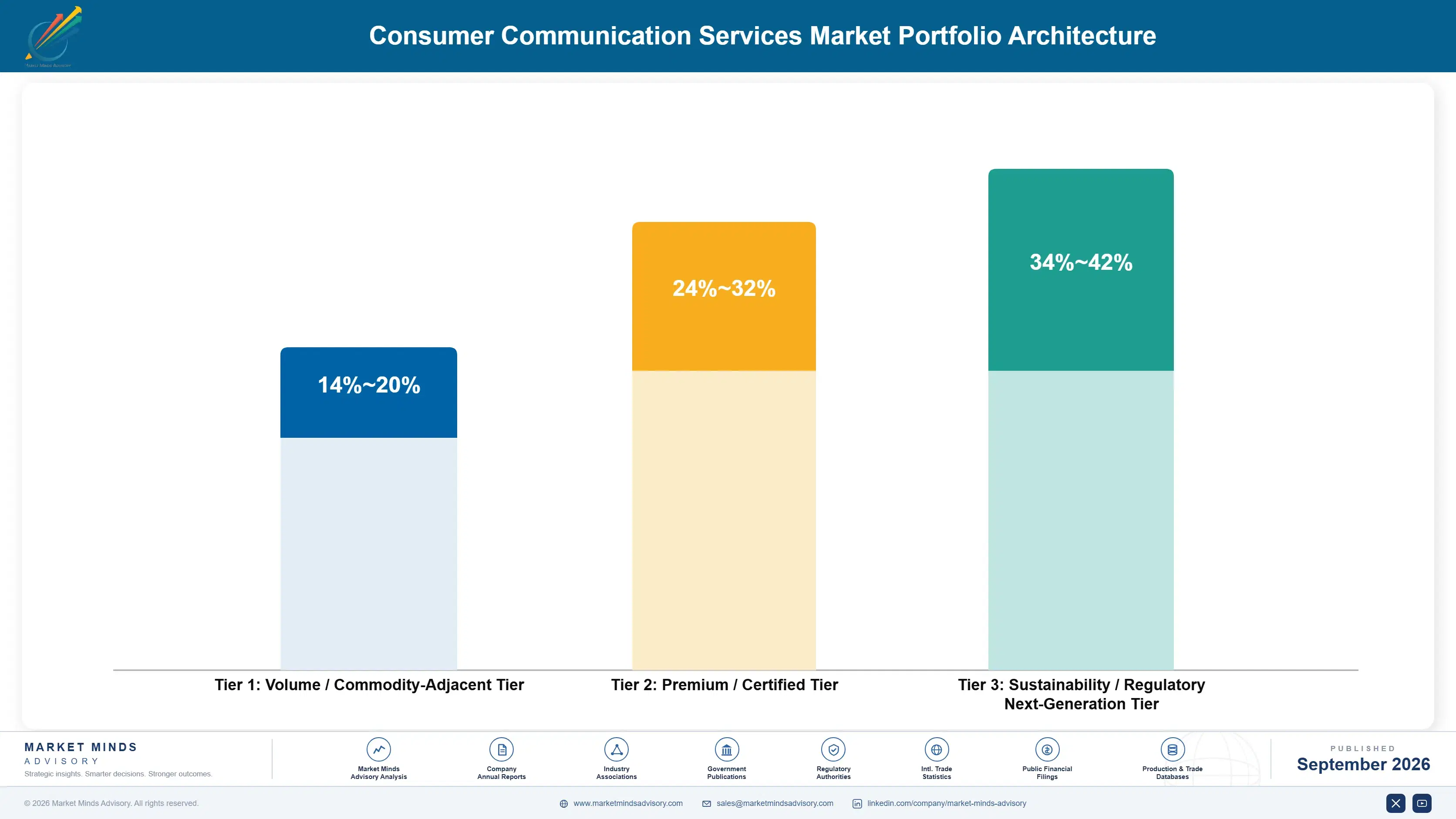
Carrier margin structure runs on three distinct tiers separating on bundling depth and premium service integration rather than raw subscriber volume alone across most household segments. Standalone commodity plans compete almost entirely on unit price, while converged and value-added service platforms command genuine premiums buyers pay for household convenience and proven, validated connectivity performance across services and devices.
The volume tier still serves the most subscribers by count but claims a shrinking share of industry profit pools, increasingly squeezed between rising network capital cost and price-sensitive subscribers treating basic connectivity as commoditized. Premium and next-generation tiers absorb heavier bundling and network investment upfront but return it through longer household relationships and materially stronger renewal pricing power across multi-year contracts. Buyers increasingly reward proven integration track records.

High-value pools concentrate heavily in converged household bundles and value-added service attach, where integration depth and genuine switching cost together create durable competitive advantage that commodity carriers cannot easily replicate. That concentration is steadily reshaping where carriers deploy capital spending, favoring bundling capability and premium data investment over legacy standalone plan development entirely, a shift accelerating industry-wide. Carriers slow to adapt risk permanent margin erosion.

Volume / Commodity-Adjacent Tier

Standard standalone mobile and prepaid plans sold primarily on price and coverage reliability, with thin margins and intense competition from low-cost regional and virtual network operators chasing subscriber volume each cycle.
Gross Margin: 14-20%

Premium / Certified Tier

Converged household bundles carrying multi-service integration across mobile, broadband, and streaming, validated for reliability requirements with long subscriber relationships and multi-year contract commitments already firmly in place across most households.
Gross Margin: 24-32%

Sustainability / Regulatory / Next-Generation Tier

Premium 5G and fixed wireless access platforms engineered for emerging connectivity demand and next-generation network monitoring architectures that command sustained pricing power over legacy alternatives across most household segments today.
Gross Margin: 34-42%
consumer-communication-services-market-portfolio-architecture-1790011628976

High-value Sub-segments and Strategic Watch-out

Converged and Bundled Household Subscription Services

Fastest-growing and highest-margin segment today, driven by household bundling that pushes carrier revenue well beyond standalone mobile plans into premium, design-in-locked product commanding sustained pricing power throughout the household relationship across every major mature market worldwide today. Vendors here set the pace industry-wide. now. today.
Gross Margin: 36-44%

Mobile Data and Broadband Services

Large, high-value pool growing steadily on 5G and fixed wireless expansion, where data capacity and switching costs sustain durable premium pricing over standard voice-centric plans across most customer segments and regions served by major national carrier networks today. Contract renewal rates stay consistently high. now.
Gross Margin: 28-36%

Fixed Broadband Internet Services

Volume core of the market, supplying baseline household connectivity capability at steady but thinner margins, dependent on large customer bases and reliable delivery windows across multi-year procurement cycles and repeat purchasing patterns from established household customers worldwide. Vendors here compete mostly on price and reliability.
Gross Margin: 18-24%

Mobile Voice and Messaging Services

Strategic watch-out segment facing commoditization as data-centric plans absorb voice and messaging functionality natively, shrinking legacy standalone voice revenue steadily year over year across most major consumer markets and pressuring carriers reliant on that revenue base. Few carriers are reinvesting in this category. now. today.
Gross Margin: 10-16%

Recurring Demand Beneath Carrier Subscriptions

Consumer communication services demand runs closer to a household utility annuity than a discretionary purchase for most subscriber accounts. Once a household commits to a carrier's bundled subscription, contract renewals, device upgrade financing, and value-added service attach flow for years without a fresh competitive shopping process, giving incumbent carriers a durable, multi-cycle revenue stream that new entrants find genuinely hard to interrupt quickly once households are onboarded.
Stickiness varies sharply by service vertical, though. Converged bundle relationships run deepest, anchored by multi-year contract terms and switching costs across multiple integrated services that discourage households from re-shopping their entire connectivity stack. Standalone mobile relationships show comparable depth once a subscriber's number and device financing become tied to a single carrier, though the relationship is more exposed to competitive switching at contract renewal than bundled accounts tend to be. Prepaid relationships sit at the least sticky end, with subscribers switching carriers freely based on short-term pricing.

Buyer profiles are shifting generationally as younger consumers enter the subscriber base. Younger buyers increasingly favor carriers offering flexible, no-contract plans and digital-first service over pure incumbency, a change legacy carriers with strong historical relationships are still adjusting to across multiple regions and customer categories simultaneously.
consumer-communication-services-market-end-use-penetration-index-1790011629467

Where Carrier Strategy Should Focus Next

These are among the four positions where our research anticipates prominent divergence between winners and laggards over the coming forecast period. Each is grounded in the demand model, the regulatory perimeter, and the announced capacity pipeline.
01 / BUNDLING PLATFORM INVESTMENT

Build converged bundling into every core service offering

Converged household bundles are capturing meaningfully higher average revenue per account than standalone plans, and that gap is widening every single quarter as consumers increasingly prefer consolidated billing across mobile, broadband, and streaming services across most demographics. Carriers still selling standalone plans risk losing household accounts to competitors offering bundled capability at comparable network cost and validated service reliability. Building bundling capability now, even at higher upfront systems investment, protects subscriber share before competitors fully standardize on converged offerings entirely.
02 / FIXED WIRELESS EXPANSION

Accelerate fixed wireless access rollout into underserved markets

Fixed wireless broadband demand is outrunning available network capacity as carriers extend coverage into previously underserved suburban and rural markets across the country, and carriers slow to deploy risk ceding the fastest-growing broadband segment to more aggressive competitors. Carriers that expand fixed wireless coverage now position themselves to capture the full range of household broadband contracts available over the coming several years rather than a narrow subset of urban accounts. Carriers that delay risk permanent exclusion from this growth segment.
03 / NETWORK EQUIPMENT SECURITY

Lock in equipment supply ahead of deployment demand spikes

Specialized network equipment capacity remains periodically tight amid broader global infrastructure demand growth, leaving carriers without long-term supply agreements vulnerable to extended deployment timelines during peak 5G expansion periods that recur unpredictably across budget cycles, fiscal years, and multi-year strategic planning horizons. Larger competitors already secure preferential allocation through decade-long vendor relationships that smaller rivals cannot easily replicate on short notice. Establishing multi-year supply reservations now protects deployment reliability through the next inevitable industry-wide capacity crunch and preserves customer trust.
04 / REGIONAL SUBSCRIBER POSITIONING

Expand presence across East Asian and Indian subscriber markets

East Asia anchors both subscriber volume and network infrastructure for this market, while India posts the fastest country-level growth rate on rapid mobile subscriber expansion outpacing most other emerging markets tracked in this report today and well into the foreseeable future. Carriers under-invested in either region face longer growth runways or missed acquisition opportunities relative to competitors already embedded in local subscriber relationships and distribution channels. Building deeper regional presence now secures proximity to both anchor markets available anywhere today.

Engagement Snapshot From the Field

A live engagement with an industry participant carrying material or product regulatory and market exposure ahead of a defining policy shift, showing how our research translates into a defensible multi-year portfolio strategy.
MARKET MINDS ADVISORY · CLIENT ENGAGEMENT SUMMARY
Consumer Communication Services Producer Strategic Portfolio Review and Transition Roadmap 2026·Investment Scenario on Consumer Communication Services Exposure Evaluation 2025-26
CLIENT PROFILE
The client is a regional challenger carrier serving a mid-sized national market, historically competing primarily on price with standalone mobile plans and limited broadband offerings across its footprint. Annual subscriber revenue is approximately eight hundred million dollars (client-reported, unverified by MMA), with average revenue per account trailing the market's larger incumbent carriers by a meaningful margin.
STRATEGIC CHALLENGE
The client's standalone plan strategy was losing subscribers to incumbent carriers offering converged household bundles, and leadership lacked clarity on whether to invest in bundling infrastructure internally or pursue a wholesale partnership approach. A board decision was pending, and the client needed independent market sizing and competitive benchmarking before committing capital to either path.
MMA APPROACH
MMA conducted structured interviews with the client's marketing and network engineering leadership, benchmarked competitor bundling timelines against primary survey data, and modeled subscriber retention outcomes under build versus partner scenarios for leadership review. The engagement combined qualitative expert interviews with MMA's proprietary segment growth forecasts to quantify the subscriber risk of continued inaction.
KEY FINDINGS
  1. Converged bundles commanded roughly 30 percent higher average revenue per account (client-reported, unverified by MMA) than the client's existing standalone mobile plans across comparable tiers.
  2. Subscriber churn to bundled competitors had accelerated over the prior two years, concentrated heavily among higher-value household accounts the client could least afford to lose.
  3. Internal bundling infrastructure development was projected to take 22 months, well past the window competitors were expected to hold design-in advantage across the client's markets.
  4. A wholesale broadband partnership with an established fiber provider could deliver bundling capability within six months at a fraction of internal development cost.
CLIENT PROFILE
The client is a regional challenger carrier serving a mid-sized national market, historically competing primarily on price with standalone mobile plans and limited broadband offerings across its footprint. Annual subscriber revenue is approximately eight hundred million dollars (client-reported, unverified by MMA), with average revenue per account trailing the market's larger incumbent carriers by a meaningful margin.
STRATEGIC CHALLENGE
The client's standalone plan strategy was losing subscribers to incumbent carriers offering converged household bundles, and leadership lacked clarity on whether to invest in bundling infrastructure internally or pursue a wholesale partnership approach. A board decision was pending, and the client needed independent market sizing and competitive benchmarking before committing capital to either path.
MMA APPROACH
MMA conducted structured interviews with the client's marketing and network engineering leadership, benchmarked competitor bundling timelines against primary survey data, and modeled subscriber retention outcomes under build versus partner scenarios for leadership review. The engagement combined qualitative expert interviews with MMA's proprietary segment growth forecasts to quantify the subscriber risk of continued inaction.
KEY FINDINGS
  1. Converged bundles commanded roughly 30 percent higher average revenue per account (client-reported, unverified by MMA) than the client's existing standalone mobile plans across comparable tiers.
  2. Subscriber churn to bundled competitors had accelerated over the prior two years, concentrated heavily among higher-value household accounts the client could least afford to lose.
  3. Internal bundling infrastructure development was projected to take 22 months, well past the window competitors were expected to hold design-in advantage across the client's markets.
  4. A wholesale broadband partnership with an established fiber provider could deliver bundling capability within six months at a fraction of internal development cost.
RECOMMENDED STRATEGY
Phase 1: Phase one: pursue a wholesale broadband partnership with an established fiber provider within four months to close the capability gap fastest. Phase 2: Phase two: launch a converged bundling pilot across the client's highest-churn-risk markets, targeting full national rollout within ten months of launch. Phase 3: Phase three: expand bundling to remaining markets and layer additional value-added services once initial retention results are fully confirmed and validated.
OUTCOME
Within twelve months the client launched converged bundling nationwide and reported (client-reported, unverified by MMA) a meaningful reduction in subscriber churn among targeted household accounts, alongside a measurable increase in average revenue per account across its bundled subscriber base and overall national subscriber portfolio today.

Frequently Asked Questions

Foundational context covering the market sizes, CAGR, scope, country, region and competition that inform every finding below. This section is provided to cover basics and most often pre-purchase conversations, answered from the MMA Primary Research Dataset.

What is the current size of the Consumer Communication Services Market?

The Consumer Communication Services Market reached an estimated 145.0 billion dollars globally in 2025. Converged bundling and 5G upgrade cycles are the primary growth drivers today.

How large will the Consumer Communication Services Market be by 2036?

MMA forecasts the market will reach approximately 237.8 billion dollars by 2036 under the base case scenario. That represents roughly a 1.57 times expansion from 2026 levels.

What is the CAGR for the Consumer Communication Services Market 2026 to 2036?

The base case CAGR is 4.6 percent annually across the forecast period. Bull and bear scenarios range from 5.8 percent down to 3.4 percent respectively.

Which segment is growing fastest?

Converged and Bundled Household Subscription Services is growing fastest at 8.6 percent CAGR, roughly 1.87 times the overall market rate. Household bundling economics drive that pace.

Who are the major companies in the Consumer Communication Services Market?

Leading players include AT&T, Verizon Communications, China Mobile, Deutsche Telekom, and NTT Docomo. Together the top five hold an estimated 34 percent combined share of the market.

Which country is growing fastest?

India leads country-level growth at 7.4 percent CAGR, well ahead of the regional and global averages. Rapid mobile subscriber growth and expanding data consumption are the main contributing factors.

Report Segmentation Architecture

The full report scope spans multiple orthogonal segmentation dimensions, with cross-tabulated demand data provided for each dimension pair. Coverage extends further to regional breakdowns, trend trajectories, and the competitive detail needed to support segment-level decision-making.

By Primary Market Dimension

  • Mobile Voice and Messaging Services
  • Mobile Data and Broadband Services
  • Fixed Broadband Internet Services
  • Converged and Bundled Household Subscription Services
  • Pay-TV and Video Entertainment Bundling Services
  • Value-Added Communication Services

By End-Use Industry

  • Residential Households
  • Prepaid and Value-Conscious Consumers
  • Premium and High-Usage Households
  • Rural and Underserved Communities
  • Urban and Metropolitan Subscribers
  • Multi-Generational Family Accounts

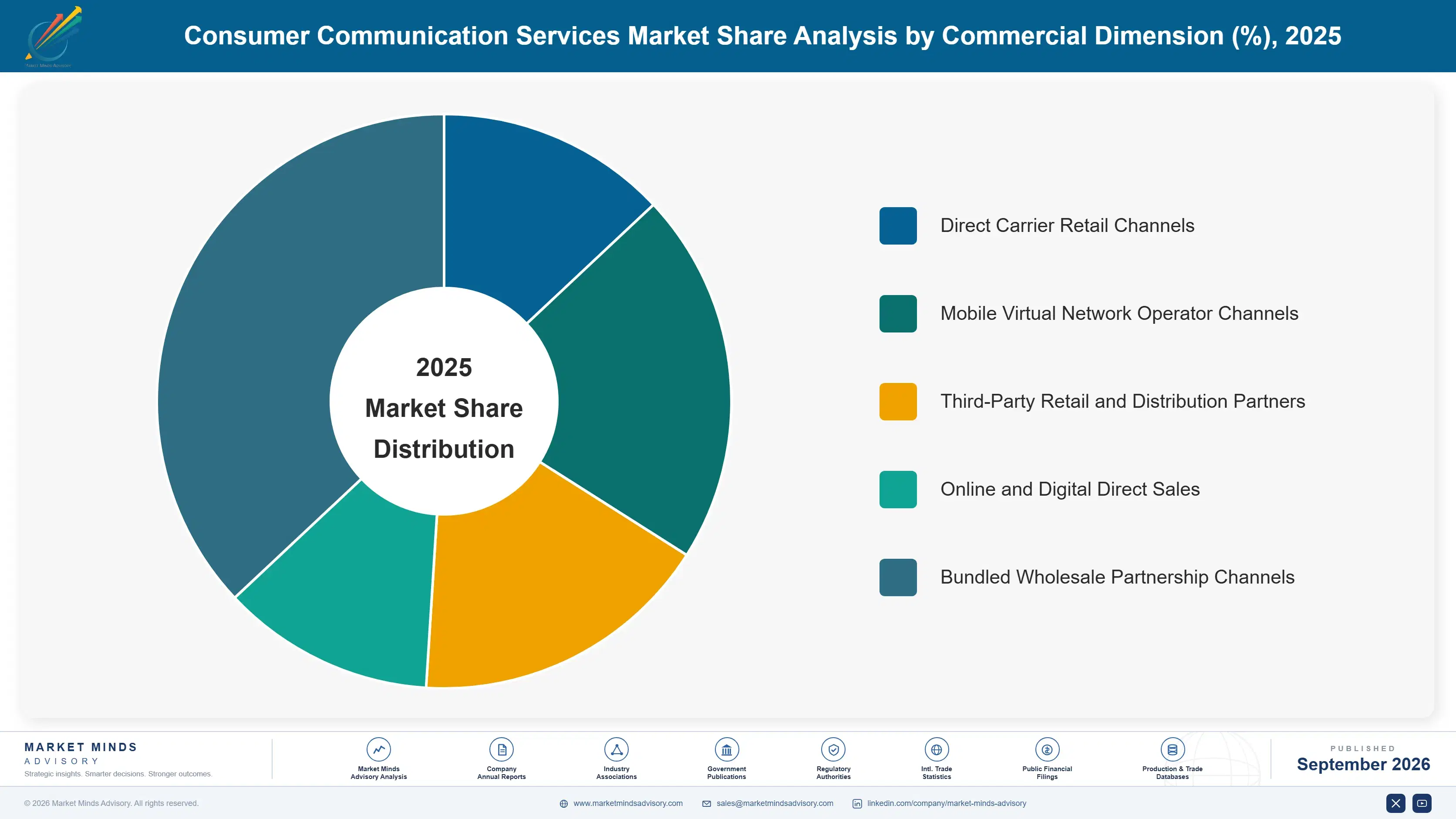
By Commercial Dimension

  • Direct Carrier Retail Channels
  • Mobile Virtual Network Operator Channels
  • Third-Party Retail and Distribution Partners
  • Online and Digital Direct Sales
  • Bundled Wholesale Partnership Channels

By Region

  • North America
  • Western Europe
  • East Asia
  • South Asia and Pacific
  • Latin America
  • Middle East and Africa
  • Eastern Europe

Scope, Methodology, and Coverage

Every figure in this report is reproducible from documented input assumptions. The scope below maps the historical period, the forecast horizon, the segmentation dimensions, and the countries covered, alongside the underlying primary and qualitative methodology.
Historical Period
2020 to 2025
Forecast Period
2026 to 2036
Base Year
2025 (USD billions; MMA Primary Research Dataset, September 2026)
Market Definition
The Consumer Communication Services Market covers voice, messaging, data, and converged connectivity subscription services delivered by telecom operators and communication platform providers to individual and household consumers. It excludes enterprise and business communication services, network equipment sales, and downstream streaming content licensing unrelated to core connectivity subscriptions.
Quantitative Units
USD Billion
Segmentation Dimensions
Service type, end-use household category, and commercial distribution channel
Regions Covered
North America, Western Europe, East Asia, South Asia and Pacific, Latin America, Middle East and Africa, Eastern Europe
Countries Covered
United States, China, Japan, Germany, India, Brazil, United Kingdom, and 14 additional countries
Key Companies Profiled
AT&T Inc., Verizon Communications Inc., China Mobile Limited, Deutsche Telekom AG, NTT Docomo Inc., T-Mobile US Inc, Vodafone Group Plc, China Telecom Corporation Limited, China Unicom (Hong Kong) Limited, Orange S.A., Telefonica S.A., America Movil SAB de CV, SoftBank Corp, KDDI Corporation, Bharti Airtel Limited, Reliance Jio Infocomm Limited, BT Group plc, Telstra Corporation Limited, Rogers Communications Inc, Singapore Telecommunications Limited
Quantitative Methodology
Primary survey, n=3,800 respondents, Q4 2025, six countries; demand-side model with trade association cross-validation
Qualitative Methodology
47 expert interviews, Q4 2025; applied to validate demand model assumptions, identify emerging dynamics, and assess competitive positioning
Report Format
PDF and XLSX data workbook (Word format preview document)
Publisher
Market Minds Advisory
Report Code
MMA-2026-TEC-991
Published
September 2026
Contact
sales@marketmindsadvisory.com | www.marketmindsadvisory.com

Purchase the full Consumer Communication Services Market Report (2026 to 2036).

This report provides a comprehensive assessment of the global Consumer Communication Services Market across all major service categories, household segments, and geographic regions through 2036. It combines MMA's primary survey dataset of 3,800 respondents with 47 expert interviews to quantify segment-level growth, competitive positioning, and regional demand mechanisms. Coverage spans market sizing, segmentation, regional dynamics, competitive benchmarking, input cost exposure, and portfolio economics. The analysis is designed to support product roadmap planning, subscriber strategy, and investment decisions for carriers, equipment vendors, and investors evaluating this space.
Ten-year quantitative forecast by service segment
Seven-region demand and pricing breakdown analysis
Competitive benchmarking of top twenty carriers
Network equipment cost exposure and mitigation analysis
Margin tier and portfolio economics mapping
Primary survey and expert interview data

Built For The People Who Decide

From boardroom strategy to bench-side execution, this report is read cover-to-cover by leaders shaping the next decade of their industry, turning demand scenarios, market dynamics and valuation benchmarks into decisions.
CXOs/ Presidents/ VPs/ Managers
M&A and Corporate Development
Strategy Teams and R&D Heads
Procurement and Product Directors
Regulatory and Compliance Leaders
Investor Relations and Equity Analysts