Market Minds Advisory
Construction Risk Assessment Software Market

Construction Risk Assessment Software Market: Construction Risk Assessment Software Market. Jobsite Safety and Project Risk Management Platforms

Rising insurance premiums and mounting jobsite liability exposure are pushing contractors toward AI-powered risk platforms as manual safety inspection processes prove insufficient for increasingly complex multi-site project portfolios across most regions nationwide.

Lead Analyst

Published

September 2026

Make Smarter Decisions with Customized Research Insights

Request a free sample report and evaluate market opportunities, growth trends, and competitive dynamics relevant to your business needs.

2025 MARKET VALUE$1.6BMarket Size 2025
2036 FORECAST VALUE$5.3BBase Case , 2026 to 2036
CAGR 2026 TO 203611.5 %Bull 12.8% / Bear 10.2%
INCREMENTAL OPPORTUNITY$3.5BNet 10- year value creation
EXPANSION MULTIPLE2.97x2036 value over 2026 base
Strategic Levers
M&A Pipeline
Regional Outlook
Country Rankings
Competitive Intelligence
Segmental Deep-dive
Call-Us : 91 93563 13602

Executive Snapshot and Market Trajectory.

Rising insurance premiums and mounting jobsite liability exposure are pushing contractors toward AI-powered risk platforms as manual inspection processes prove insufficient for increasingly complex multi-site project portfolios across most large construction firms currently active nationwide. Insurers increasingly treat platform adoption as a formal underwriting factor across most commercial construction accounts.
Jobsite safety monitoring built on computer vision and wearable sensor data increasingly dominates new platform purchasing decisions, since insurers now offer meaningful premium discounts to contractors demonstrating documented proactive risk management practices across their project portfolios and safety programs. General contractors drive a substantial share of total platform adoption nationally, followed closely by specialty subcontractors managing their own liability exposure and insurance requirements.
Competitive dynamics favor established construction management platforms with existing project data integration over newer standalone safety-only entrants, since general contractors increasingly favor unified platforms over point solutions requiring separate data reconciliation. Climate volatility and expanding weather-related project delay claims are reshaping near-term risk platform specification priorities across most major construction markets globally. Suppliers investing early in weather risk integration are positioned to capture share as delay claims continue climbing across climate-exposed project categories.
Market Definition
The Construction Risk Assessment Software Market covers cloud-based platforms that identify, monitor, and document jobsite safety, project schedule, subcontractor, and environmental risk across commercial and infrastructure construction projects. It excludes general project management software lacking dedicated risk assessment functionality and standalone building information modeling tools.
Base Year Value
$1.6B in 2025 (MMA Primary Research Dataset, September 2026)
Forecast Period
2026 to 2036, eleven discrete annual values
CAGR
11.5% base case. Bull 12.8%. Bear 10.2%.
Fastest Growth Segment
Jobsite Safety and Hazard Risk Platforms: 17.2% CAGR
Fastest Growth Country
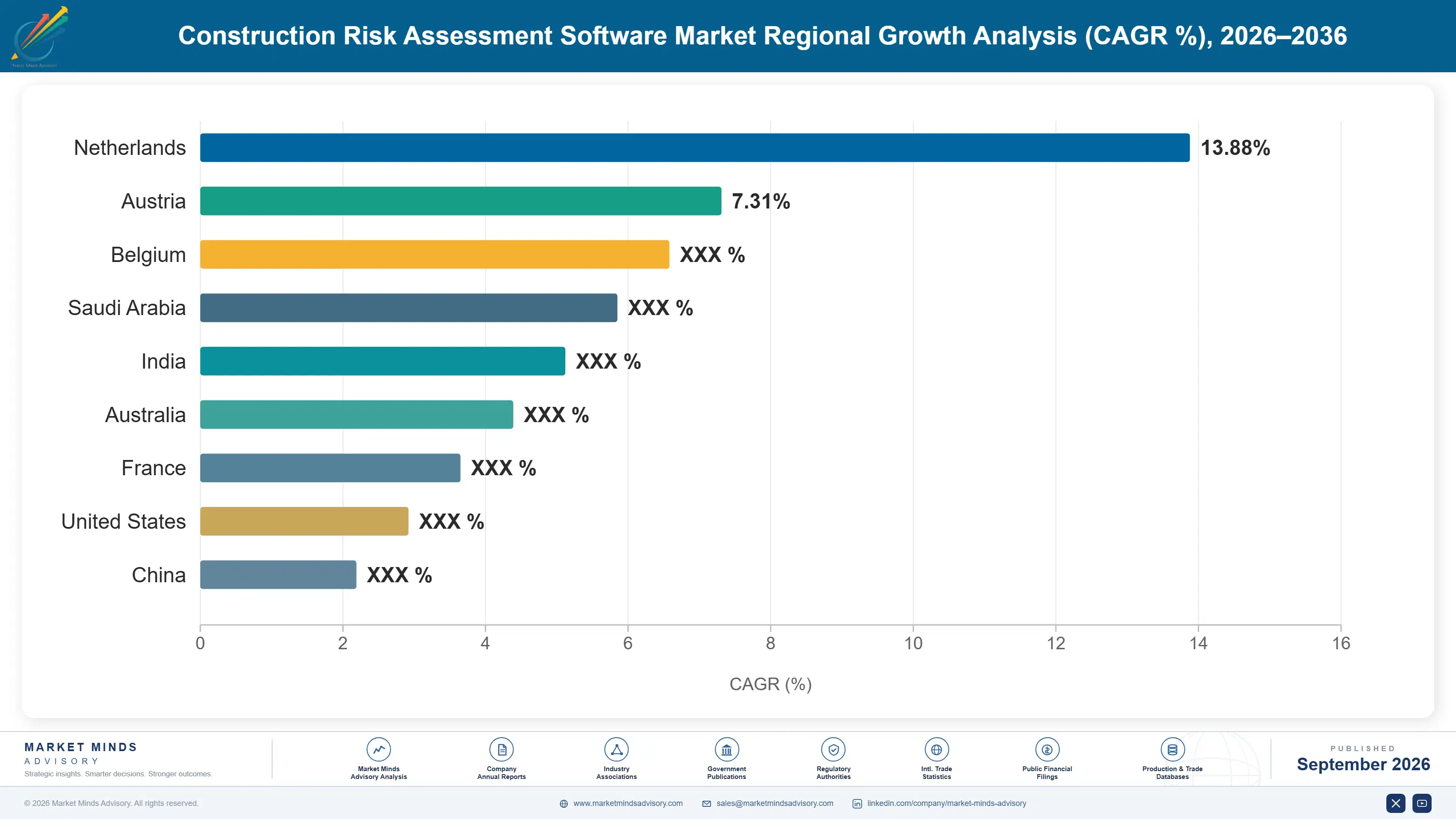
India: 13.5% CAGR
Fastest Growth Region
South Asia and Pacific: 13.5% CAGR
Largest Region
North America: 31% of 2025 global value
Market Leaders
Procore Technologies, Autodesk, Oracle Construction and Engineering, HCSS, and SafetyCulture lead the market. Source: MMA Analysis, July 2026.
Primary Survey
n=3,800 procurement and R&D decision-makers, Q4 2025, six countries
Methodology
Demand-side build-up, cross-validated against public data, 47 expert interviews

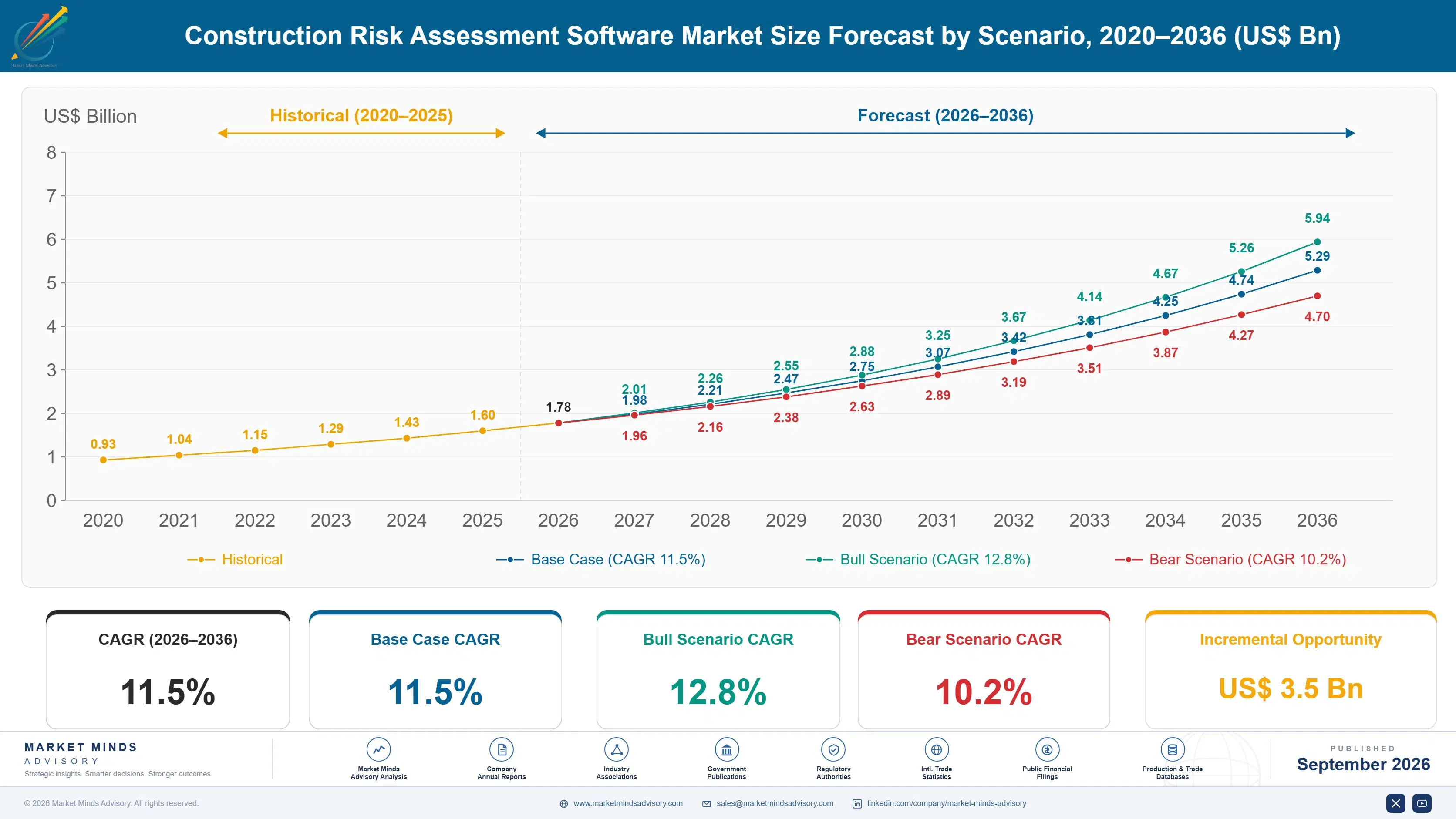
Construction Risk Assessment Software Market Forecast Scenarios

construction-risk-assessment-software-market-size-forecast-scenario-1788420567589
Between 2020 and 2025, construction risk software demand grew steadily as insurers began linking premium pricing to documented safety technology adoption and contractors faced mounting litigation exposure following several high-profile jobsite incidents, with a historical CAGR near 10.5 percent driven largely by general contractor platform standardization across large project portfolios. Growth accelerated meaningfully after 2023 as insurers formalized technology-linked premium discount programs across most commercial lines.
The base case assumes continued insurer-linked premium discount programs, expanding computer vision safety monitoring adoption across large jobsites, and growing subcontractor risk screening requirements tied to prime contractor liability exposure management. These three mechanisms together sustain steady growth through 2036, reinforced by rising climate volatility affecting project schedules. Vendors with strong project data integration capture a disproportionate share of this demand. Growing regulatory documentation requirements across most major construction markets worldwide add further demand support.
A stronger bull case emerges if insurers accelerate premium discount programs industry-wide following continued safety technology effectiveness data, pulling forward platform adoption meaningfully. The bear risk centers on construction industry budget cyclicality, where a broader construction slowdown would directly compress software spending across contractors dependent on discretionary technology budgets. Suppliers diversifying across risk categories weather adoption cycle volatility better.

Insurer Partnerships Reshape Platform Purchasing Decisions

Insurers increasingly partner directly with software vendors to formalize premium discount programs, since documented proactive risk management practices demonstrably reduce claims frequency across large commercial construction accounts and portfolios. Vendors participating in these formal insurer partnership programs increasingly displace competitors lacking comparable data-sharing agreements, since insurers now steer new policyholders toward preferred technology platforms directly during underwriting conversations. This trend continues broadly.
MARKET CONCENTRATIONCR5 38%top five vendors hold notable but fragmented market share
AVERAGE CONTRACT VALUE$45Ktypical annual enterprise platform subscription spend range currently
GENERAL CONTRACTOR SHARE62%share of total platform spend from general contractors nationally
INSURANCE DISCOUNT RATE12%typical premium discount for documented safety technology adoption
COMPUTER VISION ADOPTION31%share of jobsites using computer vision safety monitoring currently
RENEWAL RETENTION RATE84%typical net dollar retention among platform incumbents nationally
General contractors increasingly extend platform access to subcontractors as a condition of project participation, since unified risk visibility across the entire project team reduces liability exposure more effectively than contractor-only monitoring alone. This dynamic favors vendors with flexible multi-tier pricing over those charging uniform per-seat fees, since project teams often span dozens of subcontractor organizations with widely varying platform usage needs and budgets.
Vendors bundling computer vision safety monitoring with traditional documentation tools increasingly win competitive evaluations, since procurement officers weight proactive hazard detection capability over passive record-keeping functionality during formal bid processes. This shift favors established platforms with existing project data integration over newer standalone entrants lacking comparable breadth, since procurement teams increasingly prefer consolidated vendor relationships over managing multiple point solutions separately across projects.
"Contractors aren't buying software anymore. They're buying a lower insurance premium that happens to come with a dashboard attached."
Practice Lead, Construction Technology and Risk Management · MMA Jobsite Safety and Project Risk Analytics Software Practice · September 2026

Market Trends

Computer Vision Safety Monitoring Becomes Jobsite Standard

Construction firms increasingly deploy computer vision cameras across active jobsites to automatically detect hazard conditions such as missing personal protective equipment, unsafe equipment proximity, and fall risk exposure without requiring dedicated human monitoring staff. Roughly 31 percent of surveyed jobsites now use computer vision safety monitoring, up meaningfully from levels reported just several years earlier as camera hardware costs decline. Vendors offering integrated computer vision and traditional risk documentation increasingly win competitive evaluations against suppliers still relying primarily on manual inspection checklists requiring substantial dedicated safety staff time and travel between sites.
Market Impact: 48 percent cite litigation as driver

Insurer-Linked Premium Discount Programs Expand Rapidly

Commercial insurers increasingly formalize partnerships with risk software vendors to offer documented premium discounts for contractors demonstrating proactive safety technology adoption, treating platform usage data as genuine underwriting input rather than a marketing claim. Roughly 42 percent of surveyed contractors now report accessing insurance premium discounts tied to documented platform usage, reflecting genuine underwriting integration rather than simple vendor promotion. Vendors with established insurer data-sharing agreements increasingly win competitive evaluations against suppliers without comparable formal partnership arrangements and premium discount program access for policyholders. This trend shows no sign of slowing across most commercial insurance lines.
Market Impact: 36 percent require subcontractor risk screening

Market Opportunities and Growth Drivers

Litigation Exposure Drives Documented Risk Management Adoption

General contractors increasingly adopt formal risk assessment software following several high-profile jobsite litigation cases where inadequate documentation weakened defense positions, creating direct commercial incentive for comprehensive digital record-keeping across active project portfolios. Roughly 48 percent of surveyed general contractors report litigation exposure concern as a primary driver behind recent risk software investment decisions, a meaningfully higher share than reported five years earlier. Vendors with strong legal documentation and audit trail capability increasingly win contracts among firms managing large complex commercial projects where litigation risk runs highest across multiple jurisdictions. This trend continues broadly.
Market Impact: 29 percent report subcontractor adoption resistance

Subcontractor Risk Screening Requirements Expand Platform Adoption

General contractors increasingly require subcontractor risk screening and safety documentation as a formal condition of project participation, extending platform adoption beyond direct employer organizations into the broader project supply chain across most large commercial developments. Roughly 36 percent of surveyed general contractors report formal subcontractor risk screening requirements compared with prior years, reflecting rising demand for supply chain-wide risk visibility. This demand provides vendors with expanded seat count opportunities beyond traditional general contractor accounts alone, smoothing overall platform adoption across project team compositions that vary considerably by contract structure. This shift continues broadly.
Market Impact: 26 percent cite cost as barrier

Market Restraints and Challenges

Fragmented Project Team Structures Slow Platform Standardization

Construction projects routinely involve dozens of subcontractor organizations each with different existing software preferences, making platform-wide standardization genuinely difficult compared with single-organization enterprise software deployments common in other industries. The root cause traces to the industry itself: project teams reassemble for each new job rather than persisting as stable organizational units. Roughly 29 percent of surveyed general contractors report subcontractor resistance to adopting a mandated platform as a meaningful adoption barrier. Some contractors are offering financial incentives to accelerate subcontractor platform onboarding and reduce this friction. This friction eases gradually.
Market Impact: 31 percent of jobsites use vision

Smaller Contractor Budget Constraints Limit Platform Reach

Many smaller general contractors and specialty subcontractors face genuine budget constraints that push comprehensive risk platform adoption beyond immediate financial reach, extending reliance on manual documentation processes and delaying revenue recognition for vendors dependent on broader market penetration. The underlying cause traces to thin operating margins common across smaller construction firms, not vendor pricing specifically. Roughly 26 percent of surveyed smaller contractors report cost as the primary barrier preventing platform adoption in the past year. Some vendors are introducing simplified lower-cost tiers to capture this underserved segment. Costs drop meaningfully overall.
Market Impact: 42 percent access insurance premium discounts
4 additional market trends, 3 additional growth drivers, and 3 additional restraints and challenges are covered in the full report. Contact sales@marketmindsadvisory.com to access the complete intelligence.

Segment CAGR and Growth Architecture

The market spans six risk platform categories organized by assessment function, from jobsite safety monitoring through project schedule and environmental risk analytics. Adoption pace varies sharply by category as insurer partnerships and litigation exposure reshape which platforms see the fastest near-term growth across contractors. Vendors increasingly design roadmaps around this functional divide rather than treating risk category breadth as secondary.
Section default visual

Jobsite Safety and Hazard Risk Platforms

This segment covers computer vision, wearable sensor, and manual inspection platforms that identify and document jobsite hazards including personal protective equipment compliance, equipment proximity, and fall risk exposure in real time. Adoption is concentrated among general contractors managing large commercial and infrastructure projects, where insurer premium discount eligibility directly rewards documented proactive safety technology deployment. Growth is outpacing every other segment as computer vision hardware costs decline and insurer data-sharing partnerships expand across most major commercial insurance carriers. Vendors here compete heavily on detection accuracy and insurer integration depth rather than dashboard breadth alone. Program adoption is accelerating fastest among firms with the highest historical claims exposure facing imminent insurer renewal negotiations across most commercial project categories nationally.
CAGR 17.2%

Environmental and Weather Risk Monitoring Systems

This segment covers platforms that track weather forecasts, site conditions, and climate-related project delay risk, increasingly integrating predictive analytics to help contractors proactively adjust schedules ahead of severe weather events rather than reacting after disruption occurs. Adoption is concentrated among infrastructure and large commercial projects with substantial weather exposure, where delay claims and schedule risk carry meaningful financial consequences across multi-year construction timelines. Rising climate volatility and expanding severe weather frequency continue driving demand for this specialized risk category. Growth here trails only jobsite safety platforms, reflecting similarly strong insurer and litigation-driven demand momentum. Suppliers investing early in predictive analytics depth are positioned to capture disproportionate share as climate volatility continues expanding across most major construction markets globally.
CAGR 12.6%
Full segment breakdown across 6 segments available in the complete report.

Regional Architecture and Country Demand Map

North America anchors global demand given concentrated construction technology spending and mature insurer partnership programs across large contractor accounts. South Asia and Pacific expands fastest as regional infrastructure investment accelerates digital risk platform adoption across rapidly growing construction markets. East Asia follows closely behind, anchored by expanding infrastructure investment.

North America

The United States accounts for the large majority of regional demand, reflecting concentrated construction technology spending and the presence of major platform vendors including Procore Technologies and Autodesk within domestic headquarters. Insurer partnership programs are most mature here, with several major commercial carriers formally linking premium discounts to documented platform usage across large contractor accounts nationwide. Canada contributes a smaller but meaningful share through comparable insurer relationships and construction technology adoption patterns. Established litigation exposure concerns give United States contractors particularly strong incentive to adopt comprehensive documentation platforms relative to international peers. This certification advantage compounds over successive insurer renewal cycles. Enterprise buyers also increasingly favor domestic vendor support networks.
Share: 31% | CAGR: 12.0% (2026 to 2036)

Western Europe

Germany, the United Kingdom, and France drive the bulk of regional demand, with construction safety regulation and infrastructure investment paralleling trends observed in the United States market though insurer-linked discount programs remain somewhat less formalized currently. Growth trails North America and East Asia somewhat, reflecting a more mature construction technology installed base and correspondingly longer platform replacement cycles across established contractors. Nordic countries show disproportionately high per-capita adoption relative to construction market size, reflecting strong digital infrastructure maturity. European Union construction safety directives continue supporting steady baseline demand across member states broadly. EU-wide construction safety targets support continued investment growth. Multinational contractors standardize procurement across subsidiary operations broadly. Insurer product innovation continues expanding across most markets.
Share: 22% | CAGR: 10.0% (2026 to 2036)
Regional intelligence for 5 additional markets available in the complete report: East Asia, South Asia and Pacific, Latin America, Middle East and Africa, Eastern Europe. Contact sales@marketmindsadvisory.com.
construction-risk-assessment-software-market-market-share-analysis-1788420568152

Where Risk Software Vendors Can Defend Margin

Vendors face mounting pressure to prove insurer integration value as contractors scrutinize platform ROI more closely than in prior technology adoption cycles. Four commercial levers separate vendors sustaining premium pricing from those competing purely on unit seat cost and basic documentation feature parity alone across most segments. Insurer integration depth remains the biggest differentiator separating durable winners from commodity competitors.

Deepen Computer Vision Detection Accuracy Investment

Vendors investing in mature computer vision hazard detection capture disproportionate share of the 31 percent of jobsites now using this technology, since detection accuracy directly addresses the false-positive concerns dominating early platform evaluations. This capability commands measurable pricing premiums over vendors offering only manual inspection checklists during competitive bids. Vendors slow to build this depth risk losing large general contractor accounts entirely to better-positioned competitors with proven detection accuracy track records across comparable jobsite conditions. Contractors evaluating multiple vendors increasingly treat detection accuracy as a baseline requirement rather than a differentiating premium feature.
Market Impact: Captures share of the 31 percent using vision

Build Formal Insurer Data-Sharing Partnerships Now

Vendors establishing formal insurer data-sharing partnerships address the 42 percent of contractors now accessing premium discounts tied to platform usage, positioning themselves ahead of competitors lacking comparable underwriting integration arrangements. This differentiation increasingly determines which vendors win large enterprise contract awards during competitive evaluations. Vendors without established insurer relationships struggle to match the value proposition of competitors already integrated with multiple major commercial carriers across comparable geographic markets and project categories. Contractors evaluating multiple vendors increasingly weight demonstrated insurer integration heavily during formal multi-year contract negotiations. Referrals within regional insurer networks amplify this reputation advantage further.
Market Impact: Addresses the 42 percent accessing insurance discounts now

Strengthen Legal Documentation and Audit Trails

Vendors building strong legal documentation and audit trail capability address the 48 percent of general contractors citing litigation exposure as a primary driver behind platform investment, capturing share from competitors offering only basic record-keeping functionality. This positioning increasingly determines procurement outcomes among firms managing large complex commercial projects where litigation risk runs highest. Vendors building this capability expand addressable market meaningfully beyond safety-focused buyers toward broader legal and risk management technology budgets. Corporate legal teams increasingly involve themselves directly in these procurement decisions given the litigation exposure involved. This trend is expected to strengthen as litigation exposure remains elevated.
Market Impact: Addresses the 48 percent citing litigation exposure directly

Expand Subcontractor Onboarding Support Programs Broadly

Vendors offering dedicated subcontractor onboarding support address the 36 percent of general contractors now requiring formal risk screening across their project supply chain, reducing the adoption friction that otherwise slows platform-wide standardization considerably. This support builds genuine platform stickiness that extends well beyond the initial general contractor relationship into broader subcontractor network effects. Vendors building this capability expand addressable market among fragmented project teams lacking dedicated technology onboarding staff or prior platform experience. Smaller subcontractors increasingly favor vendors demonstrating this capability during initial platform relationship evaluations. Word-of-mouth referrals within regional contractor networks amplify this advantage meaningfully.
Market Impact: Addresses the 36 percent requiring risk screening broadly

Who Controls the Margin Pool

Market concentration sits at roughly 38 percent among the top five vendors on a revenue basis, reflecting a genuinely fragmented field where construction management platform incumbents compete alongside numerous specialized safety-only point solutions. The gap between leaders and mid-tier challengers has narrowed as smaller vendors match feature parity on core documentation capability. This dynamic pressures margin across most competitive evaluations.
Current competitive activity centers on computer vision detection accuracy, formal insurer partnership expansion, and subcontractor onboarding capability, with most major vendors racing to close gaps in whichever dimension they trail competitors most visibly. Platform consolidation deals remain common as construction management vendors acquire smaller specialized safety tools. Insurer-preferred platform status increasingly determines competitive outcomes among the field's largest enterprise account renewals currently.

Emerging pressure comes from insurance technology specialists extending into construction risk platforms directly, gaining share among contractors prioritizing formal underwriting integration over broader project management functionality. Rankings could shift meaningfully if insurance-native entrants successfully replicate construction workflow depth at comparable scale across large enterprise accounts. This convergence could meaningfully reshape the competitive field over the coming several years as adjacent categories continue merging.
construction-risk-assessment-software-market-country-cagr-analysis-1788420568675

Competitive Moat and Risk Dimensions

PROCORE TECHNOLOGIES

Moat: Broad Construction Platform Integration

Procore Technologies offers one of the widest integrated construction management platforms spanning project, financial, and risk functionality under a single billing relationship, reducing procurement complexity for contractors consolidating previously fragmented tool stacks. This breadth compounds into a durable advantage that competitors cannot shortcut through capital investment alone.
PROCORE TECHNOLOGIES

Risk: Insurer Partnership Depth Lags Specialists

Procore Technologies' broad platform focus occasionally slows its pace of specialized insurer data-sharing integration relative to smaller risk-focused specialists able to iterate faster on emerging underwriting partnership arrangements and formats. Nimbler competitors increasingly win early insurer partnerships before Procore fully integrates comparable arrangements. Faster iteration favors focused rivals.
SAFETYCULTURE

Moat: Deep Frontline Safety Adoption

SafetyCulture's mobile-first inspection platform, built through years of dedicated frontline safety focus, gives it genuine adoption depth among field workers that broader construction management platforms with less specialized interfaces struggle to replicate. This adoption depth increasingly determines competitive outcomes as contractors prioritize field usability above nearly every other specification.
SAFETYCULTURE

Risk: Limited Insurer Partnership Scale

SafetyCulture's smaller scale relative to broader construction management platforms leaves it comparatively less positioned to negotiate large formal insurer data-sharing partnerships that increasingly determine competitive outcomes among large enterprise accounts. Diversifying into broader platform functionality remains a genuine strategic priority for sustained long-term growth. Broader functionality attracts larger accounts.

Players Tracked

Prominent Players

Procore Technologies
Autodesk
Oracle Construction and Engineering
HCSS
SafetyCulture

Other Key Players

Fieldwire
Assignar
Raken
eSUB
Intelex Technologies
HammerTech
Rhumbix
Kahua
InEight
ConstructConnect
GoCanvas
Trimble
Bentley Systems
Newforma
Riskonnect

Recent Developments

JANUARY 2026

Procore Technologies Expands Insurer Partnership Program

Procore Technologies announced an expanded formal partnership program with several major commercial insurance carriers, integrating platform usage data directly into underwriting decisions for policyholders using the platform. Observers view the expansion as reinforcing Procore's position as the insurer-preferred platform choice. The expansion targets contractors evaluating vendors on underwriting relationship depth.
Signal: Signals insurer integration depth continues determining which vendors win the largest enterprise accounts. Rivals lacking comparable partnerships face a gap.
SEPTEMBER 2025

SafetyCulture Launches Computer Vision Module

SafetyCulture launched a new computer vision hazard detection module targeting general contractors managing large multi-site project portfolios, building on its existing mobile inspection platform strength. The launch reflects continued investment in the fastest-growing risk assessment technology category currently. Analysts view the launch as reinforcing SafetyCulture's field usability leadership position.
Signal: Signals product investment continues concentrating around the fastest-growing technology category broadly. This category remains the field's most contested battleground currently.
MAY 2025

HCSS Acquires Subcontractor Risk Screening Startup

HCSS acquired a smaller subcontractor risk screening startup to strengthen its supply chain risk visibility product line ahead of an anticipated wave of formal subcontractor screening requirements across large commercial developments. The acquisition reflects growing supplier consolidation around specialized capability. The deal reflects growing demand for supply chain risk visibility.
Signal: Signals consolidation is accelerating as platforms acquire specialized risk screening capability directly. Expect further consolidation moves among mid-tier vendors soon.

Cloud Infrastructure and Engineering Talent Exposure

Cloud compute, storage, and computer vision processing costs represent roughly 28 to 36 percent of platform COGS for construction risk software vendors, sourced primarily from major hyperscale cloud providers including Amazon Web Services, Microsoft Azure, and Google Cloud. Skilled machine learning engineering talent represents a second major cost category for vendors building detection capability. Data storage costs, embedded within provider pricing, add further pressure regionally.
Cloud compute and machine learning inference pricing rose meaningfully during 2024 as hyperscale providers adjusted enterprise contract terms, with the effect documented in several major cloud providers' annual reports citing rising data center capital expenditure. Vendors with older infrastructure contracts locked in favorable multi-year pricing terms absorbed less of this cost increase. Analysts estimate the resulting compute cost increase added roughly two to four percentage points of margin pressure for vendors unable to lock favorable terms.

Smaller vendors lacking negotiating scale with hyperscale cloud providers face a genuine cost disadvantage relative to larger incumbents able to commit to substantial multi-year cloud spending guarantees for discounted rates. This gap is widening as computer vision processing volume climbs, since inference costs scale directly with camera feed volume processed daily. Vendors serving small contractors feel this most acutely.
construction-risk-assessment-software-market-company-positioning-matrix-1788420568871

Negotiate Multi-Year Hyperscale Cloud Commitments

Vendors committing to multi-year cloud spending guarantees secure meaningfully discounted compute and storage rates from hyperscale providers, offsetting rising infrastructure costs directly and preserving margin as computer vision processing volume continues climbing across enterprise accounts. Vendors locking in favorable terms early gain a durable cost advantage over competitors renegotiating during periods of rising pricing.

Optimize Video Processing at the Edge

Vendors implementing edge-based video pre-processing reduce raw footage sent to cloud inference services, meaningfully lowering per-camera processing cost without sacrificing detection accuracy for the hazard events that matter most operationally. This approach also accelerates inference response times meaningfully, since processed footage requires less bandwidth to transmit. This preserves platform responsiveness broadly for field teams.

Portfolio Architecture for Margin Defence

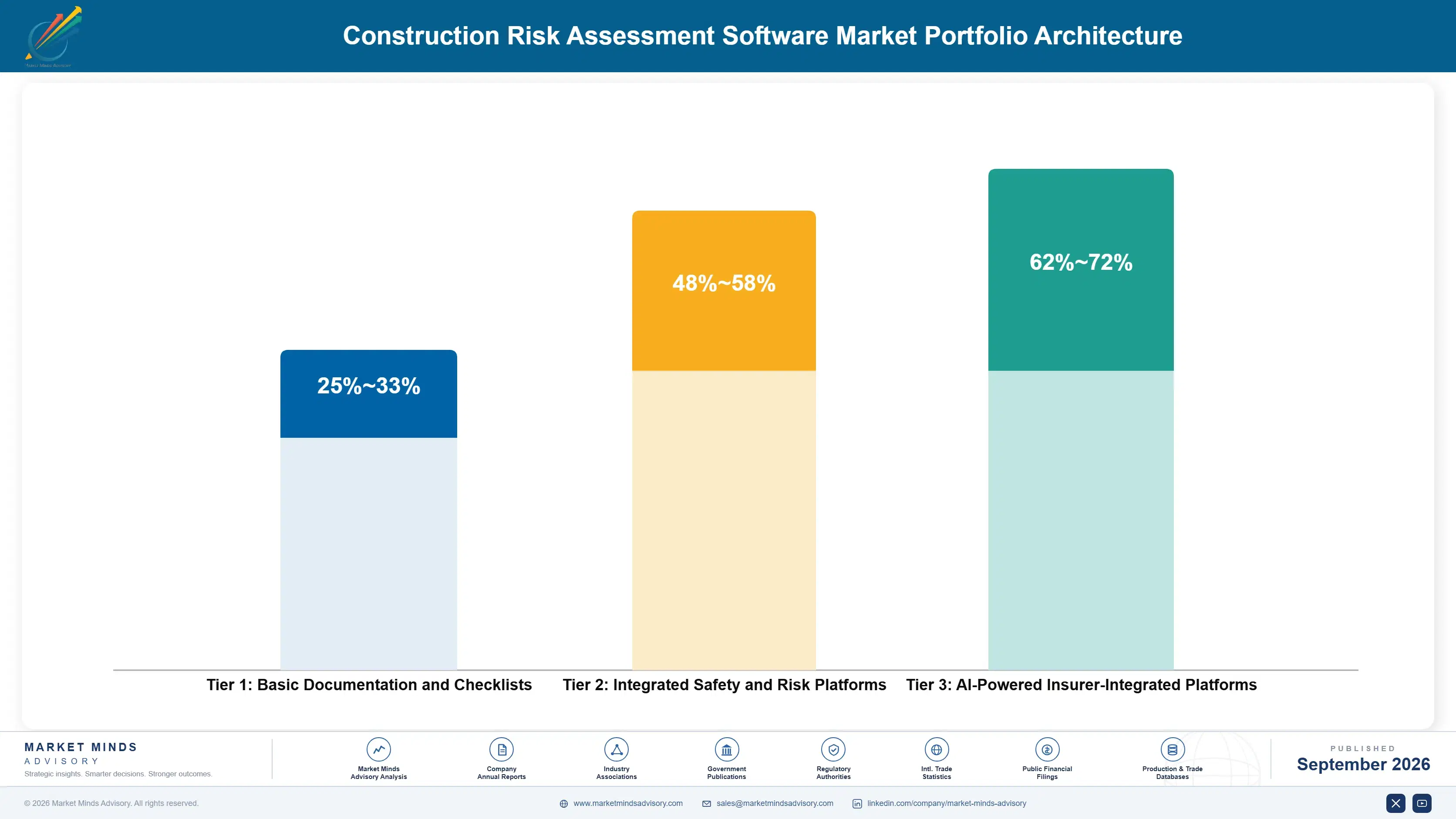
Vendors architect their portfolios around three distinct tiers separating basic documentation tools from premium AI-powered detection and formal insurer-integrated platforms commanding substantially higher margins tied to underwriting partnership depth and detection accuracy across product lines. Tier boundaries increasingly reflect insurer integration depth rather than raw feature count, a shift favoring established vendors over newer commodity-focused entrants. This shift is reshaping vendor investment priorities industry-wide.
Volume tier products generate steady revenue at comparatively thin margins, while premium and next-generation certified tiers command substantially higher gross margins reflecting genuine insurer partnership barriers rather than pure feature bundling alone across most vendor product lines currently offered. This tension between volume scale and premium margin defines much of current vendor investment strategy, since serving both segments well requires genuinely different partnership and engineering investment.

High-value margin pools concentrate heavily among enterprises requiring formal insurer integration, computer vision detection depth, and comprehensive legal documentation not offered within lower-priced basic product tiers across the broader vendor product catalog currently available. Vendors increasingly steer sales investment toward these higher-margin categories specifically, since the margin differential between basic and premium tiers has widened considerably as insurer integration matures. This trend is expected to continue through the forecast period.

Basic Documentation and Checklists

Entry-level digital forms and checklist tools for smaller contractors with limited insurer integration needs and modest project portfolio complexity. These customers typically operate on tight per-project budgets and prioritize cost predictability over advanced feature depth.
Gross Margin: 25-33%

Integrated Safety and Risk Platforms

Combined safety monitoring, documentation, and subcontractor screening platforms for mid-size to large contractors managing moderately complex project portfolios. These customers increasingly represent the largest volume category of new contractor procurement activity currently.
Gross Margin: 48-58%

AI-Powered Insurer-Integrated Platforms

Full-stack platforms with mature computer vision detection and formal insurer data-sharing for the largest enterprise contractor accounts requiring documented compliance. These accounts typically represent the highest lifetime value within vendor customer portfolios given multi-year contracts.
Gross Margin: 62-72%
construction-risk-assessment-software-market-cost-volatility-analysis-1788420569365

High-value Sub-segments and Strategic Watch-out

Computer Vision Safety Platforms

High-value and high-growth category as detection maturity improves, commanding premium pricing among vendors with proven hazard identification accuracy and insurer partnership depth. This segment consistently outpaces every other product category in both revenue growth and new contractor adoption. Investment compounds quickly across most contractor segments and project categories.
Gross Margin: 58-68%

Insurer-Integrated Risk Platforms

High-value with moderate growth as underwriting integration matures, commanding sustained premium pricing tied to demonstrated claims reduction and premium discount outcomes. Vendors with mature underwriting partnerships increasingly command meaningful renewal pricing power within this maturing category. This gap keeps widening steadily across most competitive evaluations currently underway.
Gross Margin: 55-65%

Basic Safety Documentation Tools

Volume core category generating steady revenue at thinner margins, remaining the entry point for smaller contractors before eventual platform upgrade paths emerge. Vendors increasingly view this segment as a customer relationship channel feeding eventual upgrades toward premium tiers. This funnel effect matters greatly for long-term vendor customer relationship value.
Gross Margin: 28-36%

Legacy Paper-Based Inspection Systems

Strategic watch-out category facing steady decline as digital documentation platforms displace older manual processes across most contractor modernization programs currently underway. Vendors are monitoring this segment closely for signs of accelerating decline as remaining holdout contractors eventually upgrade. This transition remains gradual though inevitable across most contractor segments nationally.
Gross Margin: 10-18%

Insurer Cycles Build Recurring Platform Revenue

Construction risk platforms generate genuine annuity economics once embedded within a contractor's insurer relationship, since switching platforms mid-policy risks disrupting documented premium discount eligibility that insurers now formally verify during renewal underwriting. This dynamic keeps established vendors embedded across a contractor's full multi-year insurance relationship, generating recurring subscription revenue well beyond any single project. Vendors establishing this early enjoy compounding revenue as contractors expand portfolios.
Adoption depth and stickiness vary meaningfully by end-use vertical: general contractors managing large commercial projects embed platform relationships deepest given formal insurer integration and litigation exposure, while smaller residential builders show comparatively shallower integration, often adopting basic documentation tools rather than comprehensive risk platforms during initial technology adoption phases. Litigation-driven adoption tends to persist through budget cycles that might otherwise prompt cost cuts.

A generational shift in buyer profile is underway as corporate risk management and legal teams increasingly drive platform specification decisions previously owned by field safety managers, favoring vendors with strong insurer integration and audit trail credentials over pure field usability that earlier generations of buyers prioritized during evaluations. This shift carries real commercial implications for vendor go-to-market strategy, pushing suppliers toward legal-grade documentation and audit trail credibility.
Section default visual

Where MMA Sees Risk Software Heading

These are among the four positions where our research anticipates prominent divergence between winners and laggards over the coming forecast period. Each is grounded in the demand model, the regulatory perimeter, and the announced capacity pipeline.
01 / COMPUTER VISION PRIORITY

Computer vision detection depth deserves priority as adoption accelerates

Roughly 31 percent of jobsites now use computer vision safety monitoring, making detection accuracy a genuine competitive moat rather than an optional capability most vendors historically treated as secondary to basic documentation features. Vendors that build this depth now win the largest general contractor accounts before slower competitors catch up, since replicating years of detection accuracy data is not something capital alone can shortcut. This gap widens further as camera hardware costs continue declining and insurer data-sharing partnerships expand across most major carriers nationwide.
02 / INSURER PARTNERSHIP STRATEGY

Formal insurer integration captures premium discount program access

Roughly 42 percent of surveyed contractors now access insurance premium discounts tied to documented platform usage, positioning vendors with formal insurer data-sharing partnerships well ahead of competitors lacking comparable underwriting integration arrangements. Vendors with this capability differentiate meaningfully from suppliers still relying on standalone documentation tools increasingly out of step with underwriting expectations. This positioning advantage increasingly determines which vendors win large enterprise contract renewals across most commercial insurance lines and expanding geographic markets served by the largest national commercial carriers.
03 / LEGAL DOCUMENTATION FOCUS

Audit trail depth captures growing litigation exposure demand

Roughly 48 percent of surveyed general contractors cite litigation exposure as a primary driver behind recent risk software investment decisions, representing genuine opportunity for vendors with strong legal documentation and audit trail capability over competitors offering only basic record-keeping. Vendors that deepen this capability capture disproportionate share of procurement decisions increasingly driven by corporate legal teams rather than field safety managers alone. This capability increasingly separates vendors winning enterprise accounts from those confined to smaller residential builders lacking comparable litigation exposure concerns.
04 / SUBCONTRACTOR ONBOARDING STRATEGY

Onboarding support addresses fragmented project team adoption barriers

Roughly 36 percent of surveyed general contractors now require formal subcontractor risk screening, reflecting a persistent adoption barrier that fragmented project teams reassembling for each new job face when standardizing on a mandated platform independently. Vendors offering dedicated subcontractor onboarding support build genuine platform stickiness extending well beyond the initial general contractor relationship into broader network effects. This capability increasingly separates vendors capturing supply chain-wide adoption from those confined to single-organization deployments lacking comparable network effects and growing referral momentum.

Engagement Snapshot From the Field

A live engagement with an industry participant carrying material or product regulatory and market exposure ahead of a defining policy shift, showing how our research translates into a defensible multi-year portfolio strategy.
MARKET MINDS ADVISORY · CLIENT ENGAGEMENT SUMMARY
Construction Risk Assessment Software Producer Strategic Portfolio Review and Transition Roadmap 2026·Investment Scenario on Construction Risk Assessment Software Exposure Evaluation 2025-26
CLIENT PROFILE
The client is a mid-size regional general contractor managing commercial and light industrial projects across a multi-state footprint, operating with a fragmented mix of paper-based inspection forms and basic spreadsheet safety tracking across its active jobsites. The engagement followed a significant year-over-year insurance premium increase that leadership attributed partly to inadequate documented safety practices. Annual insurance costs reportedly exceeded 2.4 million dollars (client-reported, unverified by MMA) across active projects.
STRATEGIC CHALLENGE
The client faced rising insurance costs and mounting litigation exposure concern following a jobsite incident at a competitor firm, but lacked internal expertise to evaluate which risk platform would deliver genuine premium discount eligibility given its insurer relationship and existing project management technology stack already in use. Leadership needed a defensible business case before committing capital to a firm-wide platform rollout.
MMA APPROACH
MMA conducted primary interviews with the client's safety director and insurance broker, and benchmarked three platforms offering formal insurer data-sharing partnerships against detection accuracy, implementation timeline, and documented premium discount eligibility with the client's specific commercial carrier relationship and jobsite conditions. The engagement also weighed field worker adoption risk explicitly given prior technology rollout resistance.
KEY FINDINGS
  1. Platform adoption combined with computer vision safety monitoring could plausibly reduce the client's insurance premium by roughly eight percent within one renewal cycle.
  2. Two of the three benchmarked platforms offered formal data-sharing agreements directly with the client's existing commercial insurance carrier relationship. This alignment shortened the underwriting integration timeline considerably.
  3. Field worker adoption resistance emerged as the primary implementation risk based on comparable contractor deployments reviewed during the engagement. Comparable firms mitigated this through phased training programs.
  4. Phased rollout starting with the highest-risk jobsites reduced both implementation cost and field worker adoption resistance meaningfully overall. This sequencing built internal confidence before broader rollout.
CLIENT PROFILE
The client is a mid-size regional general contractor managing commercial and light industrial projects across a multi-state footprint, operating with a fragmented mix of paper-based inspection forms and basic spreadsheet safety tracking across its active jobsites. The engagement followed a significant year-over-year insurance premium increase that leadership attributed partly to inadequate documented safety practices. Annual insurance costs reportedly exceeded 2.4 million dollars (client-reported, unverified by MMA) across active projects.
STRATEGIC CHALLENGE
The client faced rising insurance costs and mounting litigation exposure concern following a jobsite incident at a competitor firm, but lacked internal expertise to evaluate which risk platform would deliver genuine premium discount eligibility given its insurer relationship and existing project management technology stack already in use. Leadership needed a defensible business case before committing capital to a firm-wide platform rollout.
MMA APPROACH
MMA conducted primary interviews with the client's safety director and insurance broker, and benchmarked three platforms offering formal insurer data-sharing partnerships against detection accuracy, implementation timeline, and documented premium discount eligibility with the client's specific commercial carrier relationship and jobsite conditions. The engagement also weighed field worker adoption risk explicitly given prior technology rollout resistance.
KEY FINDINGS
  1. Platform adoption combined with computer vision safety monitoring could plausibly reduce the client's insurance premium by roughly eight percent within one renewal cycle.
  2. Two of the three benchmarked platforms offered formal data-sharing agreements directly with the client's existing commercial insurance carrier relationship. This alignment shortened the underwriting integration timeline considerably.
  3. Field worker adoption resistance emerged as the primary implementation risk based on comparable contractor deployments reviewed during the engagement. Comparable firms mitigated this through phased training programs.
  4. Phased rollout starting with the highest-risk jobsites reduced both implementation cost and field worker adoption resistance meaningfully overall. This sequencing built internal confidence before broader rollout.
RECOMMENDED STRATEGY
Phase 1: Phase one: deploy the selected platform across the three highest-risk active jobsites first, prioritizing sites with prior incident history. This sequencing captured the largest risk reduction fastest. Phase 2: Phase two: expand deployment across the remaining project portfolio over twelve months, aligned with new project mobilization schedules already planned. This pacing minimized disruption to active project schedules. Phase 3: Phase three: formalize the insurer data-sharing agreement and track premium impact annually to validate projected savings over time. This tracking supports future premium negotiation leverage annually.
OUTCOME
The client selected a platform and completed initial jobsite deployment within four months of the engagement's conclusion. Early data suggests the client's renewed insurance premium fell by roughly seven percent (client-reported, unverified by MMA), with full portfolio deployment expected to complete within the next year.

Frequently Asked Questions

Foundational context covering the market sizes, CAGR, scope, country, region and competition that inform every finding below. This section is provided to cover basics and most often pre-purchase conversations, answered from the MMA Primary Research Dataset.

What is the current size of the Construction Risk Assessment Software Market?

The global construction risk assessment software market reached approximately 1.6 billion dollars in 2025. Rising insurance premiums and mounting litigation exposure are the primary drivers behind current market scale.

How large will the Construction Risk Assessment Software Market be by 2036?

MMA projects the market will reach approximately 5.30 billion dollars by 2036, expanding roughly 2.97 times from its 2026 base. Computer vision safety platform adoption accounts for the largest share of this growth.

What is the CAGR for the Construction Risk Assessment Software Market 2026 to 2036?

The market is projected to grow at a compound annual growth rate of 11.5 percent between 2026 and 2036. Bull and bear scenarios range from 10.2 percent to 12.8 percent depending on insurer adoption pace.

Which segment is growing fastest?

Jobsite safety and hazard risk platforms are the fastest-growing segment, projected at a 17.2 percent CAGR, roughly 1.50 times the overall market rate. Insurer premium discount programs drive this pace.

Who are the major companies in the Construction Risk Assessment Software Market?

Leading vendors include Procore Technologies, Autodesk, Oracle Construction and Engineering, HCSS, and SafetyCulture. The top five vendors together hold approximately 38 percent of the market on a revenue basis.

Which country is growing fastest?

India is the fastest-growing country market, projected at a 13.5 percent CAGR through 2036. Massive ongoing infrastructure investment and expanding formal construction sector digitization underpin this pace of growth.

Report Segmentation Architecture

The full report scope spans multiple orthogonal segmentation dimensions, with cross-tabulated demand data provided for each dimension pair. Coverage extends further to regional breakdowns, trend trajectories, and the competitive detail needed to support segment-level decision-making.

By Risk Assessment Category

    By End-Use Project Type

      By Deployment Model

        By Region

        • North America
        • Western Europe
        • East Asia
        • South Asia and Pacific
        • Latin America
        • Middle East and Africa
        • Eastern Europe

        Scope, Methodology, and Coverage

        Every figure in this report is reproducible from documented input assumptions. The scope below maps the historical period, the forecast horizon, the segmentation dimensions, and the countries covered, alongside the underlying primary and qualitative methodology.
        Historical Period
        2020 to 2025
        Forecast Period
        2026 to 2036
        Base Year
        2025 (USD billions; MMA Primary Research Dataset, September 2026)
        Market Definition
        The Construction Risk Assessment Software Market covers cloud-based platforms that identify, monitor, and document jobsite safety, project schedule, subcontractor, and environmental risk across commercial and infrastructure construction projects. It excludes general project management software lacking dedicated risk assessment functionality, standalone building information modeling tools, and general accounting software.
        Quantitative Units
        USD billions, market share in percent, CAGR in percent
        Segmentation Dimensions
        Risk assessment category, end-use project type, deployment model, region
        Regions Covered
        North America, Western Europe, East Asia, South Asia and Pacific, Latin America, Middle East and Africa, Eastern Europe
        Countries Covered
        United States, Germany, China, India, Brazil, Australia, and 18 additional countries across seven regions
        Key Companies Profiled
        Procore Technologies, Autodesk, Oracle Construction and Engineering, HCSS, SafetyCulture, and 15 additional participants
        Quantitative Methodology
        Primary survey, n=3,800 respondents, Q4 2025, six countries; demand-side model with trade association cross-validation
        Qualitative Methodology
        47 expert interviews, Q4 2025; applied to validate demand model assumptions, identify emerging dynamics, and assess competitive positioning
        Report Format
        PDF and XLSX data workbook (Word format preview document)
        Publisher
        Market Minds Advisory
        Report Code
        MMA-2026-CON-297
        Published
        September 2026
        Contact
        sales@marketmindsadvisory.com | www.marketmindsadvisory.com

        Purchase the full Construction Risk Assessment Software Market Report (2026 to 2036).

        This report provides a comprehensive assessment of the global construction risk assessment software market, covering segmentation, regional dynamics, competitive positioning, and input cost exposure through 2036. It draws on primary survey data from 3,800 respondents and 47 expert interviews conducted across six countries in the fourth quarter of 2025. Analysts detail computer vision safety adoption, insurer partnership integration, and margin economics across three distinct product tiers. The report also includes a detailed client case study illustrating a real insurance premium reduction engagement and its measured outcomes.
        Segment-level CAGR and market share forecasts
        Seven-region demand and pricing trend analysis
        Competitive positioning across twenty profiled vendors
        Input cost exposure and mitigation pathways
        Portfolio tier margin economics and watch segments
        Anonymized client engagement case study review

        Built For The People Who Decide

        From boardroom strategy to bench-side execution, this report is read cover-to-cover by leaders shaping the next decade of their industry, turning demand scenarios, market dynamics and valuation benchmarks into decisions.
        CXOs/ Presidents/ VPs/ Managers
        M&A and Corporate Development
        Strategy Teams and R&D Heads
        Procurement and Product Directors
        Regulatory and Compliance Leaders
        Investor Relations and Equity Analysts