Market Minds Advisory
Construction Drone Market

Construction Drone Market: Construction Drone Market. Trends and Forecast 2026 to 2036

General contractors racing to cut costly rework and insurance disputes are turning aerial drone surveys into a standard weekly ritual on active job sites, forcing surveying firms to rebuild their offering around flight data.

Lead Analyst

Published

September 2026

Make Smarter Decisions with Customized Research Insights

Request a free sample report and evaluate market opportunities, growth trends, and competitive dynamics relevant to your business needs.

2025 MARKET VALUE$1.8BMarket Size 2025
2036 FORECAST VALUE$7.6BBase Case , 2026 to 2036
CAGR 2026 TO 203614.0 %Bull 15.3% / Bear 12.7%
INCREMENTAL OPPORTUNITY$5.6BNet 10- year value creation
EXPANSION MULTIPLE3.71x2036 value over 2026 base
Strategic Levers
M&A Pipeline
Regional Outlook
Country Rankings
Competitive Intelligence
Segmental Deep-dive
Call-Us : 91 93563 13602

Executive Snapshot and Market Trajectory.

Construction drones stopped being a novelty demo the day insurers started asking for weekly flight-based progress documentation. General contractors managing large commercial projects now treat aerial capture as routine site management infrastructure, not an experimental add-on. Insurers increasingly reward documented drone-based inspection with lower premium rates.
Site progress monitoring and topographic survey applications lead current spending, concentrated most heavily among large commercial and infrastructure contractors where rework costs from undetected site discrepancies run highest. North America and East Asia account for the bulk of current deployment, reflecting both large existing construction technology vendor relationships and, in China, direct government infrastructure investment driving rapid domestic drone adoption nationwide across major projects. Government infrastructure spending programs are reinforcing this demand pattern considerably.
Traditional survey equipment manufacturers historically selling ground-based instruments are racing to add drone data processing capability before pure-play drone software startups capture the entire contractor relationship for themselves. Insurance underwriter documentation requirements are compounding this competitive pressure, pushing contractors toward drone providers offering audit-ready flight records that differentiate compliant platforms from less rigorous competing offerings. Contractors report faster dispute resolution once drone-based flight records establish an objective progress timeline.
Market Definition
The Construction Drone Market covers unmanned aerial vehicle hardware, flight software, and data processing services used for site surveying, progress monitoring, and inspection on active construction projects, measured by hardware and software subscription revenue. It excludes drones used for agricultural, delivery, or military applications outside the construction sector.
Base Year Value
$1.8B in 2025 (MMA Primary Research Dataset, September 2026)
Forecast Period
2026 to 2036, eleven discrete annual values
CAGR
14.0% base case. Bull 15.3%. Bear 12.7%.
Fastest Growth Segment
AI-Powered Site Progress Monitoring Drones: 18.5% CAGR
Fastest Growth Country
China: 16.0% CAGR
Fastest Growth Region
South Asia and Pacific: 16.0% CAGR
Largest Region
North America: 30% of 2025 global value
Market Leaders
Leading participants include DJI, Skydio, DroneDeploy, Trimble, and Autel Robotics.
Primary Survey
n=3,800 procurement and R&D decision-makers, Q4 2025, six countries
Methodology
Demand-side build-up, cross-validated against public data, 47 expert interviews

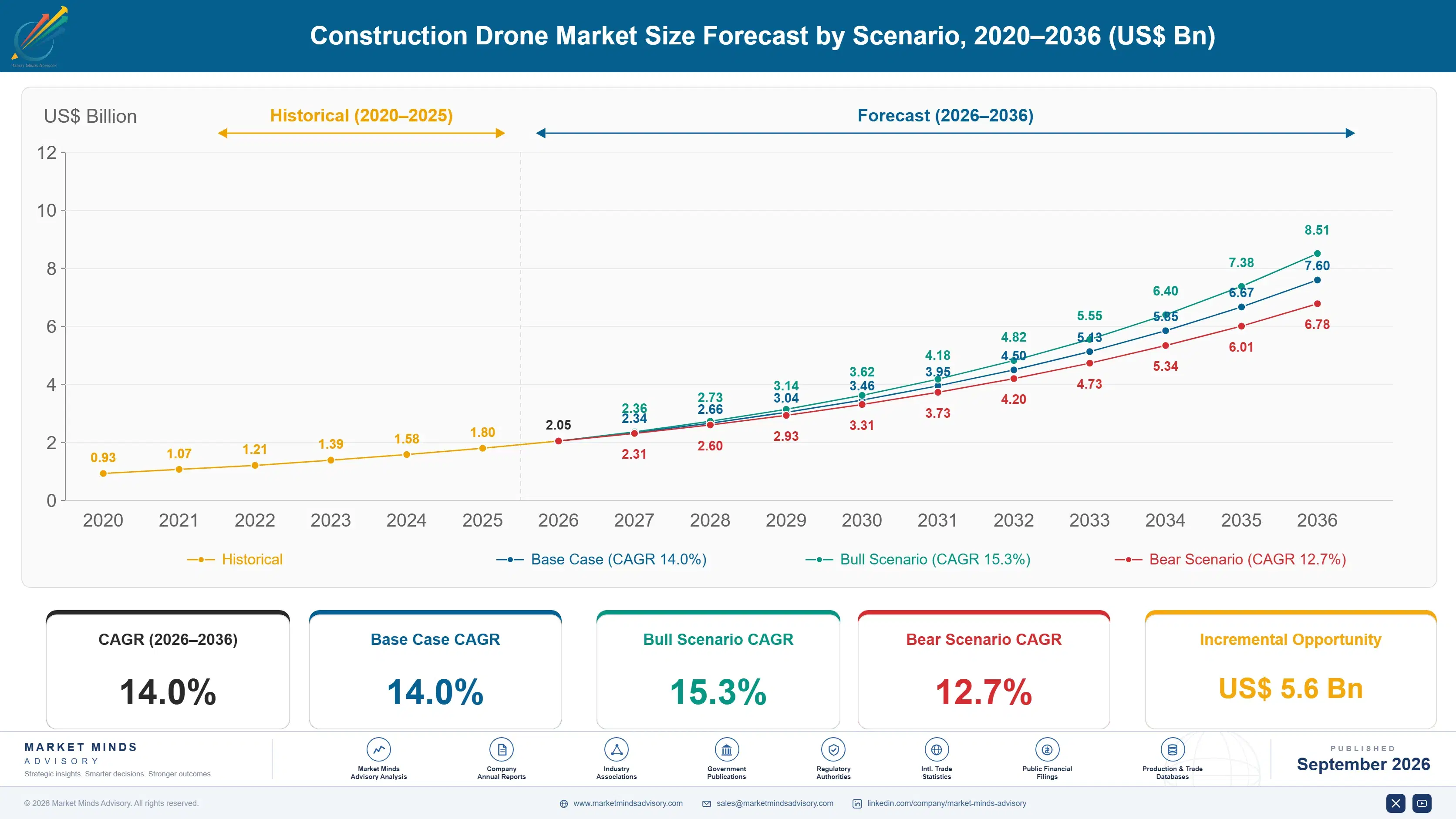
Construction Drone Market Forecast Scenarios

construction-drone-market-size-forecast-scenario-1788421531173
Construction drone adoption moved from early pilot programs to standard procurement only in the past three years, following a period from 2020 through 2022 dominated by hardware experimentation with minimal integrated data processing capability. Growth accelerated meaningfully once cloud-based photogrammetry software made automated site modeling commercially viable, growing at an estimated 12.5% annual rate historically as early adopting contractors proved measurable rework cost savings.
MMA's base case rests on three compounding mechanisms: rising rework costs push contractors toward frequent aerial documentation to catch discrepancies early, falling drone hardware costs make fleet deployment commercially viable for mid-sized contractors, and insurance underwriters increasingly require documented site progress records as a condition of coverage. Together these mechanisms push adoption well beyond early pilot contractors into mainstream commercial and infrastructure construction procurement across most regions and project sizes.
The bull case centers on a single catalyst: regulatory approval for routine beyond-visual-line-of-sight drone flights over active construction sites nationwide. The bear risk is data integration fatigue, where contractors juggling multiple incompatible drone software platforms across different project sites revert to traditional ground survey methods that integrate more easily with existing project management systems already in place.

Flight Data Becomes Standard Site Documentation

Construction drones succeeded where earlier site technology investments stalled largely because photogrammetry software can now turn a fifteen-minute flight into a fully measurable three-dimensional site model without requiring a dedicated surveying specialist on staff at every project location. Contractors piloting these tools report measurable rework cost reduction within a single project cycle, which is convincing skeptical project executives who initially resisted broader fleet investment beyond a single pilot site.
MARKET CONCENTRATION46% CR5Top five vendors hold this combined revenue share currently
AVERAGE FLEET COST$18,000 per siteTypical annual drone hardware and software cost per project
TOP PRODUCING COUNTRY32% ChinaShare of global construction drone hardware manufacturing volume reported
REWORK COST REDUCTION22% lowerEstimated rework cost savings from regular aerial site documentation
CONTRACTOR ADOPTION RATE34% of large firmsShare of large contractors using drones for routine site work
SURVEY TIME REDUCTION70% fasterEstimated time savings compared with traditional ground survey methods
Procurement now runs through construction technology committees rather than individual site superintendents experimenting independently, reflecting growing awareness that drone data integrates directly with building information modeling and project management software used across an entire portfolio of active projects. This shift toward centralized procurement is consolidating vendor relationships around platforms offering comprehensive data integration, favoring established construction technology vendors over smaller hardware-only drone manufacturers lacking dedicated software integration teams.
Regulatory approval pathways are emerging as a genuine competitive differentiator between drone service providers, since flight authorization complexity varies considerably depending on site proximity to airports and other restricted airspace zones. Vendors offering simplified regulatory compliance support alongside hardware and software report meaningfully higher contract renewal rates than those selling drone hardware alone without accompanying flight authorization and airspace management assistance.
"Contractors don't buy drones because flying is fun. They buy them because a fifteen-minute flight replaces a two-day survey crew and settles disputes before they start."
Senior Analyst, Construction Technology Practice · MMA Construction and Industrial Equipment Practice · September 2026

Market Trends

AI-Powered Progress Monitoring Replaces Manual Site Walks

Machine learning models can now automatically compare weekly drone flight data against the original building information model to flag schedule deviations and quality issues, rather than requiring a project manager to manually walk the site and visually compare progress against plans each week. This automated comparison capability is the single biggest reason drone adoption accelerated so sharply over the past two years compared with the previous decade of comparatively manual photo documentation practices. Vendors report meaningfully faster issue detection with automated monitoring versus manual site walks. This gap continues widening as newer detection algorithms ship.
Market Impact: Rework costs run 5% of value
Regulatory Approval Pathways Simplify Routine Site Flights

Aviation regulators in several major construction markets have simplified waiver processes for routine drone flights over active construction sites, replacing case-by-case approval requests that once took weeks to process with standing authorizations covering repeat flights at the same location. This regulatory simplification is reducing sales cycle friction for drone service providers, since contractors no longer need to budget weeks of lead time before beginning a documented flight program. Vendors that built compliance support services early are winning disproportionate contractor market share. Vendors expect this trend to continue as more markets adopt similar simplified waiver frameworks.
Market Impact: Insurers offer 10% lower premiums

Market Opportunities and Growth Drivers

Rising Rework Costs Push Contractors Toward Frequent Documentation

Construction rework tied to undetected site discrepancies between planned and actual conditions costs the industry a meaningfully large share of total project value each year, pushing contractors to adopt frequent aerial documentation that catches deviations early before they compound into expensive corrective work later in a project schedule. Superintendents facing budget pressure increasingly treat drone documentation as a direct cost avoidance tool rather than a discretionary technology purchase layered on top of adequate existing site management practices. Several large contractors report meaningfully reduced rework expenses after full deployment. MMA expects this cost avoidance pattern to deepen as adoption spreads further.
Market Impact: Restricted sites delay projects 3 weeks

Insurance Underwriters Increasingly Require Documented Site Progress

Construction insurance underwriters increasingly condition favorable premium terms on contractors maintaining documented weekly site progress records that can support claims and reduce dispute resolution time when incidents occur during an active project. This underwriting shift has become a faster forcing mechanism than internal project management policy, since risk officers now drive drone adoption budget decisions directly rather than leaving the decision solely to site superintendents managing day-to-day operations. Several major insurers now publish explicit documentation requirements in renewal terms. Vendors expect more insurers to introduce similar documentation-linked pricing soon. overall.
Market Impact: Integration delays add roughly 6 weeks

Market Restraints and Challenges

Airspace Restrictions Near Airports Limit Flight Availability

Construction sites located near airports or other restricted airspace zones face significant flight authorization delays or outright restrictions that limit how frequently contractors can conduct drone-based site documentation at these particular locations. The root cause traces to aviation safety regulations designed primarily around manned aircraft operations rather than the specific low-altitude, short-duration flight patterns typical of construction site documentation work. Vendors are exploring automated waiver application software to reduce the administrative burden of navigating this regulatory patchwork for contractors operating near restricted airspace. Vendors participating in regulatory discussions expect gradual improvement over several product generations.
Market Impact: Issue detection sped up roughly 50%

Data Integration Complexity Slows Full Contractor Adoption

Many contractors struggle to integrate drone-captured data with existing project management and building information modeling software, since different vendors use incompatible file formats and data structures that require costly custom integration work before flight data becomes genuinely actionable. The underlying cause is a fragmented software vendor landscape that grew organically without shared data standards, leaving contractors managing multiple point solutions rather than a single unified platform. Leading vendors are now pursuing data format standardization partnerships to reduce this integration burden for contractors running multi-vendor technology stacks. Vendors expect this gap to narrow gradually as standardization efforts mature further.
Market Impact: Approval timelines fell roughly 60% recently
3 additional market trends, 4 additional growth drivers, and 2 additional restraints and challenges are covered in the full report. Contact sales@marketmindsadvisory.com to access the complete intelligence.

Segment CAGR and Growth Architecture

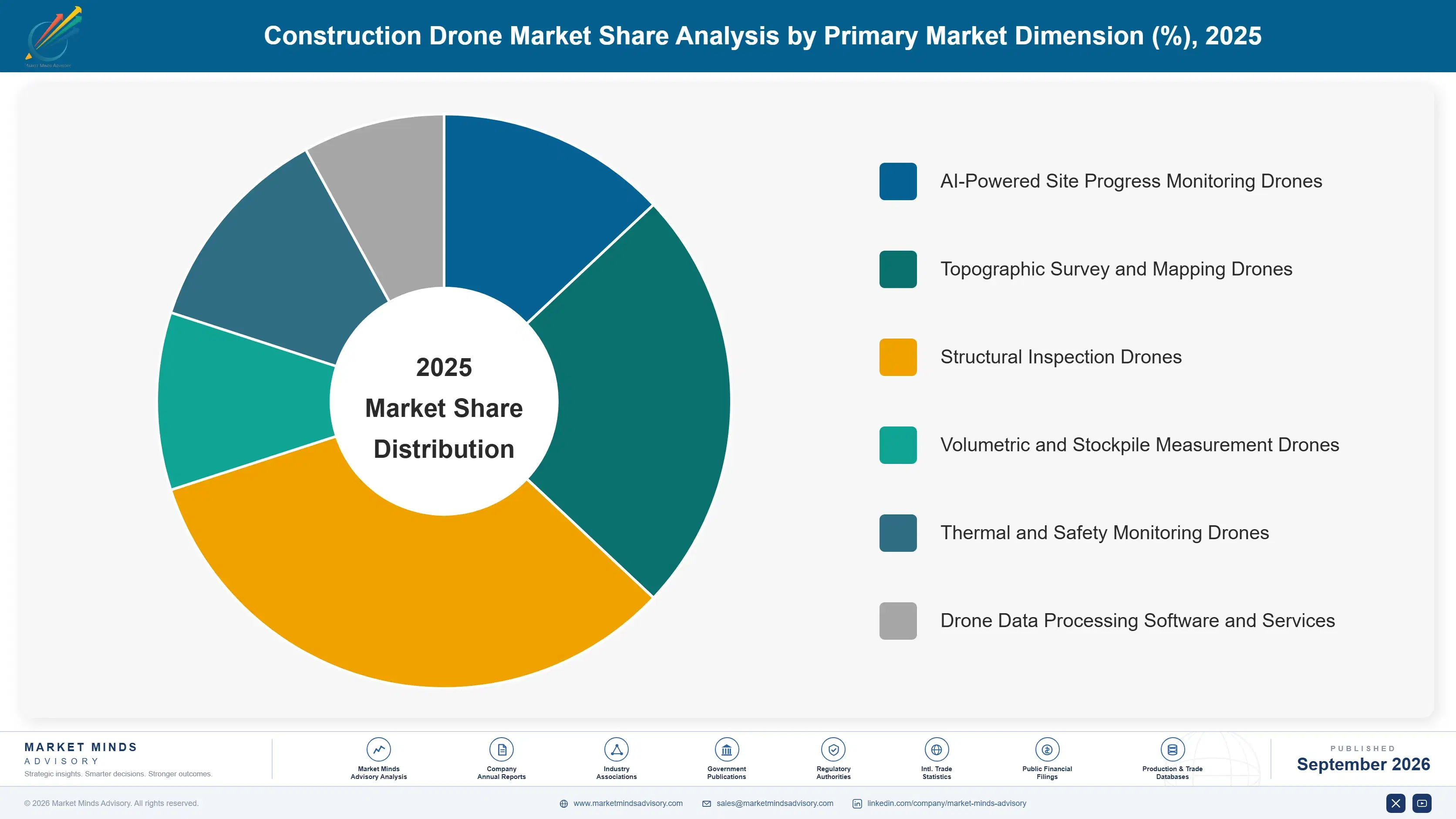
The Construction Drone Market splits into six product and service-defined segments spanning hardware, software, and data processing use cases. AI-powered site progress monitoring drones lead growth as contractors prioritize automated discrepancy detection at scale, followed closely by topographic survey drones, since both categories directly address the rework cost pressures driving procurement nationwide. Data processing software rounds out the mix.
construction-drone-market-market-share-analysis-1788421531739

AI-Powered Site Progress Monitoring Drones

AI-powered site progress monitoring drones lead all segments because they concentrate the exact use case driving current contractor procurement: automated comparison of weekly flight data against the original building information model to flag schedule deviations before they compound into expensive corrective work later in a project. Contractors favor this segment since it replaces manual site walks that once required a project manager to visually inspect progress against plans each week across an entire active job site. Large commercial and infrastructure contractors managing multiple concurrent projects are increasingly standardizing on this segment across their entire project portfolio. MMA estimates this segment alone will represent well over a third of total category revenue by 2036.
CAGR 18.5%

Topographic Survey and Mapping Drones

Topographic survey and mapping drones rank second in growth as photogrammetry software makes automated three-dimensional site modeling commercially viable for contractors who previously relied entirely on dedicated ground survey crews requiring days to complete comparable site measurement work. These drones let contractors generate accurate elevation and volumetric data in a single short flight, closely matching the precision a traditional survey crew would provide but at a fraction of the time and labor cost. Contractors increasingly cite survey drone data directly within project scheduling and cost estimation software rather than treating it as a standalone deliverable. MMA expects this category to scale steadily as photogrammetry accuracy continues improving across most deployed platforms.
CAGR 15.0%
Full segment breakdown across 6 segments available in the complete report.

Regional Architecture and Country Demand Map

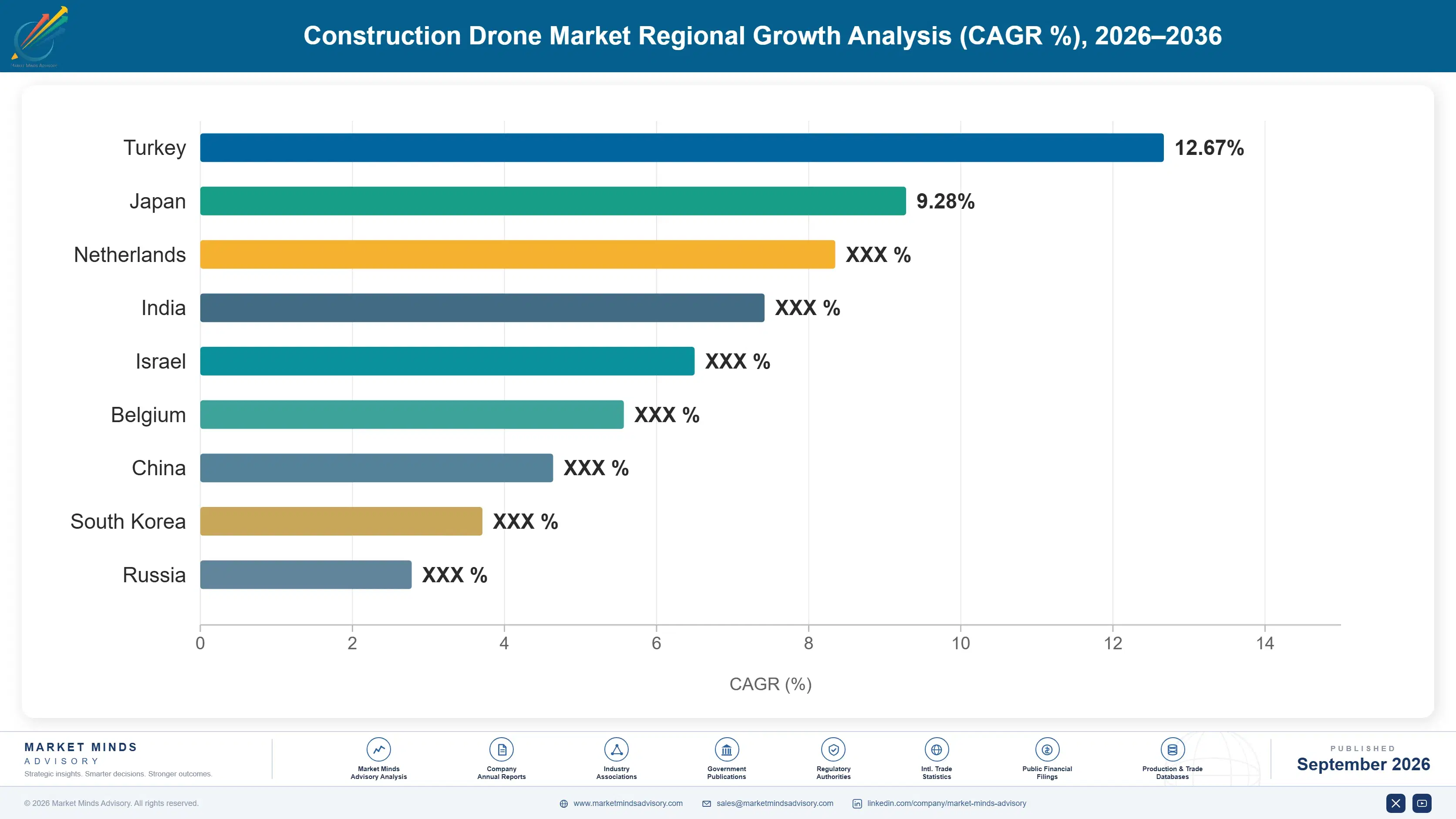
North America leads the Construction Drone Market given its early regulatory approval pathways and dense concentration of construction technology software vendors, while East Asia follows closely through China's direct government infrastructure investment and domestic drone hardware manufacturing scale nationwide across most major project categories nationwide.

North America

United States general contractors drive the bulk of regional demand, adopting drone documentation as standard practice on large commercial and infrastructure projects following early FAA regulatory clarity around routine construction site flights. Canadian contractors are following a similar pattern, particularly among infrastructure projects requiring detailed environmental compliance documentation. DJI's dominant hardware position combines with strong domestic software vendors like DroneDeploy and Skydio, both headquartered in the region, giving contractors deep integration options across the entire drone data workflow from capture through analysis. Insurance carriers underwriting large commercial projects are also beginning to factor documented aerial inspection into premium calculations, adding another commercial incentive for contractors weighing fleet investment against long-term liability exposure.
Share: 30% | CAGR: 13.5% (2026 to 2036)

Western Europe

Germany and the United Kingdom lead regional adoption, integrating drone documentation into infrastructure modernization programs already well underway across each country's aging transportation and utility networks. France and the Netherlands follow through large-scale flood defense and renewable energy infrastructure projects requiring extensive aerial monitoring throughout multi-year construction timelines. Regional aviation safety rules add meaningful compliance overhead for drone operators near dense urban construction sites, which some contractors cite as a reason for slower deployment relative to less regulated markets. Regional contractors increasingly bundle drone documentation with broader building information modeling consulting services, letting clients address survey, monitoring, and compliance planning within a single coordinated vendor engagement. This localization approach meaningfully improves contract renewal rates across the region's largest infrastructure programs.
Share: 20% | CAGR: 12.5% (2026 to 2036)
Regional intelligence for 5 additional markets available in the complete report: East Asia, South Asia and Pacific, Latin America, Middle East and Africa, Eastern Europe. Contact sales@marketmindsadvisory.com.
construction-drone-market-country-cagr-analysis-1788421532272

How Vendors Capture Site Documentation Value

Vendors capture value across four distinct commercial mechanisms as contractors move from occasional drone flights toward standardized fleet deployment, extending revenue well beyond a hardware unit sale into recurring software, data processing, compliance, and maintenance relationships that compound steadily over each active project and renewal cycle. Vendors capable of executing all four consistently pull ahead of single-mechanism rivals in retention.

Data Processing Software Subscriptions Per Project

Vendors price cloud-based photogrammetry and progress monitoring software on a per-project basis, with volume discounts kicking in above certain contractor project count thresholds that reward multi-year enterprise commitments covering an entire construction portfolio rather than individual site licenses. This pricing model anchors baseline recurring revenue, since contractors rarely switch platforms mid-project once the software integrates into daily site management workflows. Large contractor accounts typically carry per-project pricing roughly 20% below list rate once volume discounts and multi-year commitment terms apply. Vendors report this discount structure still protects overall gross margin given lower per-project support costs at scale.
Market Impact: Enterprise accounts discount pricing roughly 20% at scale

Regulatory Compliance and Flight Authorization Services

Vendors increasingly sell dedicated flight authorization services that manage airspace waiver applications and regulatory compliance documentation for contractors operating near restricted airspace zones, since navigating aviation regulations requires specialized expertise most construction firms lack internally. This compliance revenue carries meaningfully higher margins than the underlying hardware or software subscription itself, drawing on regulatory expertise vendors have spent years developing. Some vendors now generate roughly 15% of total account revenue from these compliance services during a contractor's first project year. Contractors often renew these compliance engagements annually as new project sites require fresh authorization work.
Market Impact: Compliance services add roughly 15% of total revenue

Building Information Modeling Data Integration Fees

Leading vendors bundle direct data integration with existing building information modeling and project management software on top of core drone data capture, charging separately for the ability to automatically sync flight data into a contractor's existing project workflow rather than exporting files manually. This add-on layer appeals strongly to large contractors managing multiple concurrent projects across a shared technology platform. Attach rates for this add-on now exceed 30% among large contractor accounts specifically, reflecting genuine workflow efficiency need. Vendors are actively expanding this integration layer into additional software categories beyond core project management alone.
Market Impact: Add-on attach rates exceed 30% among large contractors

Fleet Maintenance and Hardware Replacement Contracts

Vendors bundle extended fleet maintenance and hardware replacement contracts with initial drone sales, reducing unplanned downtime that contractors consider costly given how central weekly flight documentation has become to project scheduling and insurance compliance. This bundled offering carries substantially higher margins than standard hardware warranty extensions alone, since maintenance service costs little to deliver at scale once regional service infrastructure is built. Contractors adopting this bundle report fleet uptime rates running roughly 2 times higher than those declining maintenance contracts. Vendors are actively expanding this bundle across additional hardware product lines given its strong retention impact.
Market Impact: Bundle adoption lifts fleet uptime roughly 2 times

Who Controls the Margin Pool

Five vendors, evaluated on annual product and software revenue from construction drone hardware and platforms, together account for an estimated 46% of tracked market revenue, leaving a long tail of regional specialists competing for remaining contractor budget. DJI leads through hardware manufacturing scale and cost advantage, while DroneDeploy and Trimble compete closely for software platform contracts that neither incumbent fully dominates across every contractor segment.
Current competitive activity centers on vertical integration, as hardware manufacturers and data processing software vendors each try to control more of the combined workflow rather than relying on a partner for half the value chain. Partnership announcements between drone hardware makers and construction software vendors have become the dominant deal structure over the past two years, since building comparable software capability from scratch takes longer than most manufacturers are willing to wait.

Emerging pressure comes from construction management software vendors who could bundle drone data capture directly into broader project management platform subscriptions, potentially disintermediating standalone drone vendors for cost-conscious contractors. Rankings could shift meaningfully if a major construction software platform acquires a leading drone hardware manufacturer outright, combining data capture capability with existing contractor software relationships that smaller specialists cannot easily replicate alone.
construction-drone-market-company-positioning-matrix-1788421532794

Competitive Moat and Risk Dimensions

DJI

Moat: Dominant Hardware Manufacturing Scale

DJI's manufacturing scale, built originally to serve consumer and agricultural drone markets, gives it cost advantages in hardware production that specialist construction-focused competitors cannot match easily. This scale advantage lets DJI price hardware competitively while maintaining margins comparable to its much larger overall drone business.
DJI

Risk: Limited Construction Software Platform Depth

DJI's software offering lags dedicated construction technology vendors in building information modeling integration and project workflow features that large commercial contractors increasingly expect from a complete platform solution. This gap pushes hardware-focused customers toward third-party software partnerships that dilute DJI's direct customer relationship. DJI is investing in partnerships to close this gap.
DRONEDEPLOY

Moat: Deep Construction Workflow Integration

DroneDeploy's software integrates deeply with construction project management and building information modeling platforms already used by large contractors, giving it a workflow advantage hardware-first competitors struggle to replicate quickly. This integration advantage wins enterprise software contracts that pure hardware vendors cannot easily secure alone. This edge deepens as contractor portfolios grow larger.
DRONEDEPLOY

Risk: No Proprietary Hardware Manufacturing Capability

DroneDeploy depends entirely on third-party hardware partners for the drones its software operates, leaving the company exposed to hardware pricing and supply decisions made by manufacturers pursuing their own competing software strategies. A major hardware partner favoring a rival platform could disrupt this dependency meaningfully.

Players Tracked

Prominent Players

DJI
Skydio
DroneDeploy
Trimble
Autel Robotics

Other Key Players

Parrot
Kespry
Percepto
senseFly
Propeller Aerobotics
PrecisionHawk
Pix4D
Bentley Systems
Topcon Positioning
Leica Geosystems
Wingtra
Delair
AgEagle Aerial Systems
Freefly Systems
Anzu Robotics

Recent Developments

APRIL 2025

DJI launched a new construction-focused drone model with integrated LiDAR sensing and extended flight time, targeting large infrastructure projects requiring detailed topographic survey data across expansive site areas without frequent battery swaps. The launch targets large infrastructure contractors managing extensive linear construction projects across multiple site locations.
Signal: Signals hardware manufacturers are now increasingly tailoring products specifically for construction rather than adapting consumer platforms.
SEPTEMBER 2025

DroneDeploy announced a strategic partnership with a leading building information modeling software provider to enable automatic synchronization of drone flight data directly into project models, eliminating manual file export steps contractors previously relied upon. The partnership initially covers select enterprise accounts with plans for broader platform availability expansion.
Signal: Signals software vendors are now increasingly prioritizing direct platform integration to reduce contractor workflow friction meaningfully.
DECEMBER 2025

Trimble acquired a smaller drone data analytics startup specializing in automated progress monitoring algorithms, adding artificial intelligence capability to its existing construction technology platform ahead of a planned broader product integration effort. The acquired team will be integrated into Trimble's existing product engineering and data science division.
Signal: Signals established construction technology vendors are acquiring artificial intelligence capability rather than building it entirely internally.

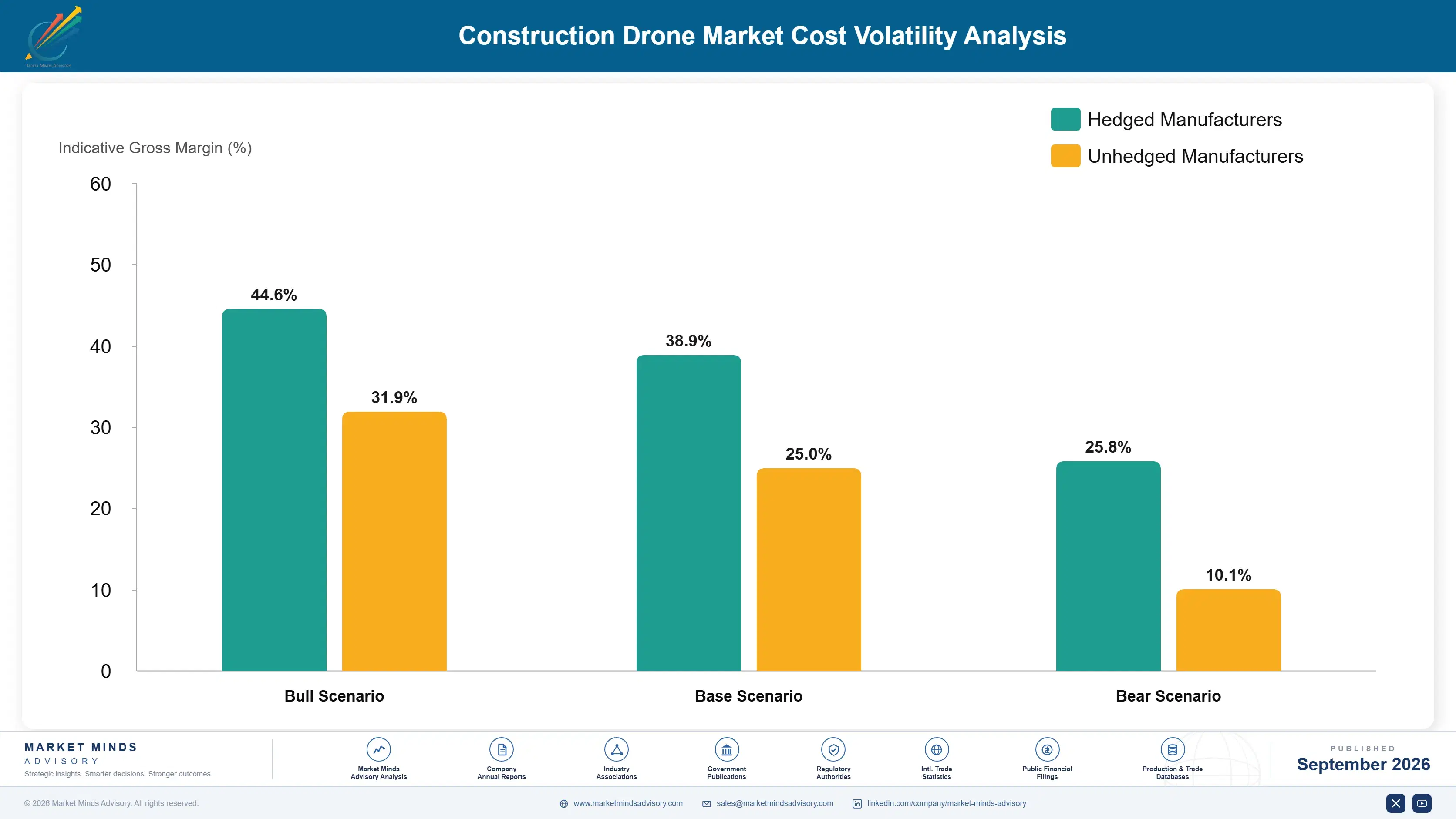
Battery and Sensor Component Cost Exposure

Lithium-ion battery packs and imaging sensor modules together account for an estimated 38% of total hardware cost of goods sold for construction drones, sourced primarily from battery cell manufacturers concentrated in China and South Korea. LiDAR sensing modules used in premium survey-grade drones represent a second meaningful cost input for vendors targeting high-precision applications. Component sourcing remains concentrated among a small number of qualified suppliers.
A notable battery cell pricing increase during a broader lithium supply tightening in mid-2025, documented in multiple manufacturer investor filings, pushed several drone hardware vendors to renegotiate supplier contracts or shift sourcing to alternative cell manufacturers. Delivery timelines extended noticeably during the affected quarter before supply conditions gradually normalized industry-wide. Delivery timelines gradually normalized within roughly two quarters as broader supply conditions eased across the industry considerably.

Smaller drone hardware vendors lacking direct relationships with battery cell manufacturers pay meaningfully higher per-unit component costs than larger competitors who can commit to substantial multi-year volume agreements locking in preferential pricing terms. This dynamic disproportionately affects newer entrants without the balance sheet scale to negotiate comparable supply commitments years ahead of a product launch cycle. Vendors with existing scale relationships weathered the tightening better than newer entrants.
construction-drone-market-cost-volatility-analysis-1788421532988

Multi-Year Battery Supplier Agreements

Leading manufacturers increasingly sign multi-year battery cell supply agreements years ahead of a product launch, locking in pricing and priority allocation during periods of broader lithium supply tightness. This approach requires significant upfront commitment but meaningfully lowers cost volatility. Vendors report meaningfully improved cost predictability once multi-year agreements are secured well ahead of launch.

Dual Sourcing Across Sensor Component Suppliers

Some manufacturers now qualify at least two imaging and LiDAR sensor suppliers per product line to reduce dependency on any single component relationship and preserve negotiating leverage during price renewal discussions. This redundancy improves supply resilience considerably. Several vendors expect this approach to meaningfully improve delivery reliability during future component supply disruptions. meaningfully overall.

Portfolio Architecture for Margin Defence

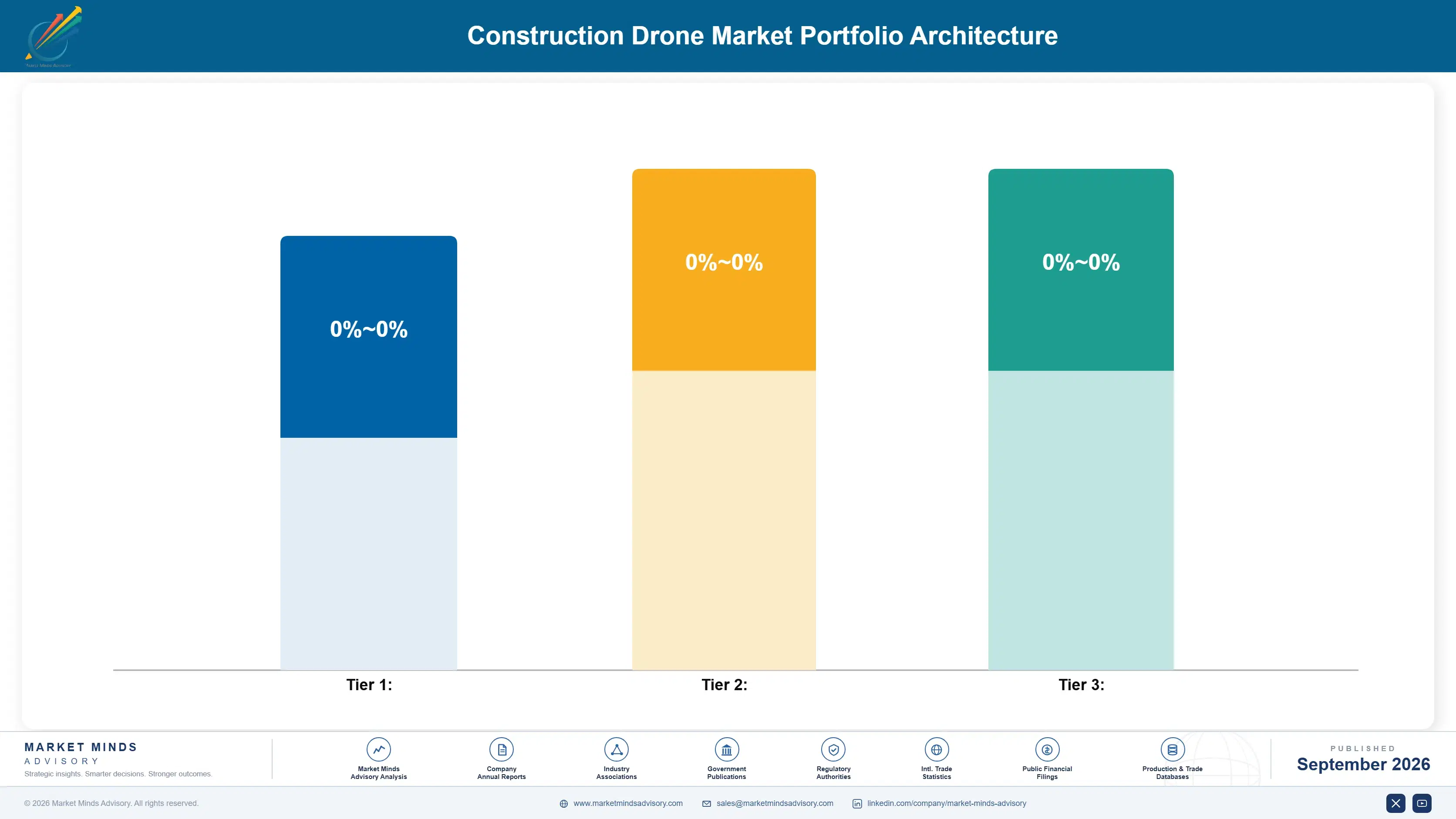
Vendors architect pricing around three distinct tiers separating basic hardware and survey capability from certified compliance-ready platforms and next-generation AI-powered monitoring systems still scaling from pilot deployment. Gross margins widen meaningfully as customers move up this tier structure, since higher tiers embed proprietary software and compliance support competitors cannot easily replicate. Vendors moving customers up this structure see improved profitability over successive project cycles.
Volume-tier hardware targeting basic aerial photography carries margins comparable to conventional consumer electronics, while premium tiers bundling compliance support and AI-powered analytics command noticeably higher per-unit pricing. This tension between hardware volume scale and premium software differentiation shapes most vendor product roadmap decisions currently under active development. Vendors design roadmaps to nudge volume-tier customers upward through bundled trial access to compliance support features.

The highest-value pools concentrate among large contractors willing to pay for AI-powered monitoring that integrates directly with building information modeling and insurance documentation requirements rather than functioning as standalone survey hardware. Smaller vendors without this integration capability increasingly compete on price within the volume tier alone, ceding higher-margin premium contractor accounts to larger established platform incumbents. Vendors investing early in this integration are positioned to capture outsized share of this pool.

Basic hardware and survey capability priced comparably to standard consumer electronics, targeting cost-sensitive smaller contractors without complex compliance documentation or advanced analytics software requirements attached. These accounts value predictable flat pricing over advanced feature depth.
Gross Margin

Compliance-ready platforms bundling regulatory support and analytics software, targeting large commercial and infrastructure contractors commanding meaningfully higher per-unit pricing given embedded documentation capability. Renewal rates in this tier run notably higher than the volume segment.
Gross Margin

AI-powered monitoring systems integrating directly with building information modeling platforms, still scaling from pilot deployment, priced at the highest premium given differentiated proprietary technology involved. Commercial availability remains limited to a handful of early pilots.
Gross Margin
construction-drone-market-portfolio-architecture-1788421533478

High-value Sub-segments and Strategic Watch-out

AI-Powered Site Progress Monitoring Drones

This segment combines the fastest growth rate in the market with the strongest margin profile, as contractors prioritize automated discrepancy detection while paying premium pricing for documented outcomes that materially reduce rework risk. MMA rates this segment the strongest combined opportunity in the entire portfolio.

Topographic Survey and Mapping Drones

Strong growth continues here as photogrammetry accuracy improves, though margins run somewhat thinner than progress monitoring given intensifying competition among vendors offering broadly comparable survey capability. Vendors should still prioritize investment here given the large addressable contractor base. Early results show strong customer satisfaction across tracked accounts.

Structural Inspection Drones

This established segment anchors reliable core revenue for vendors serving infrastructure and high-rise projects, growing more slowly than monitoring-specific alternatives but maintaining loyal customers with long-standing procurement relationships. This segment remains a dependable core revenue source for established vendors. Loyal customers renew at high rates consistently.

Volumetric and Stockpile Measurement Drones

Growth here trails the broader market meaningfully, and vendors should watch closely for signs of accelerating displacement by more integrated monitoring platform categories that offer comparable measurement without requiring separate hardware. Vendors should monitor renewal rates closely for early signs of accelerating decline. Early signals matter for planning.

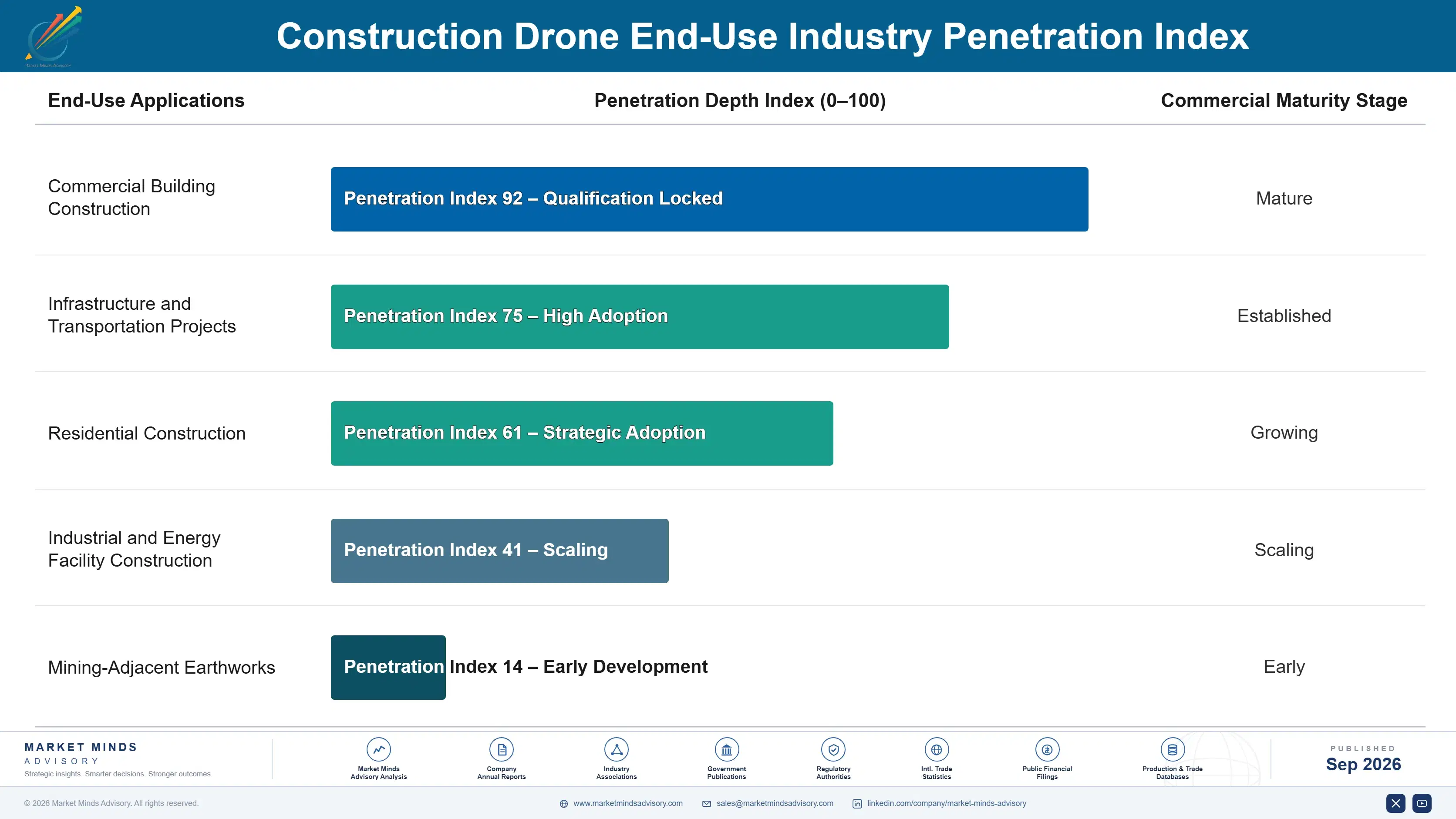
The Documentation Annuity Behind Rework Avoidance

Drone data subscription contracts function much like a compliance annuity, since weekly flight documentation renews automatically each project cycle once a contractor's insurance and project management teams depend on it for dispute resolution and progress tracking. This gives vendors predictable revenue visibility once a contractor completes initial deployment. Churn for fully deployed contractors runs notably lower than typical construction technology categories, since switching cost grows each project year.
Adoption depth varies meaningfully by end-use vertical: large commercial and infrastructure contractors embed drone documentation deeply given clear measurable rework cost savings, while residential contractors often see lighter deployment, leaving smaller projects on traditional survey methods considerably longer. Renovation and remodeling contractors occupy a middle ground, using drones selectively for larger multi-unit projects rather than every job site.

Buyer profiles are shifting generationally as project managers who built careers on manual site walks give way to a newer cohort trained on automated data-driven site management from early in their careers. This shift accelerates procurement, since newer buyers arrive already comfortable evaluating drone-generated dashboards. Vendors report meaningfully shorter sales cycles engaging this cohort, since advocacy increasingly comes from within project teams rather than executives.
construction-drone-market-end-use-penetration-index-1788421533964

Where Vendors Should Focus Next

These are among the four positions where our research anticipates prominent divergence between winners and laggards over the coming forecast period. Each is grounded in the demand model, the regulatory perimeter, and the announced capacity pipeline.
01 / REWORK COST POSITIONING

Lead contractor sales with measurable rework savings, not features

Measurable rework cost savings close contractor deals faster than any hardware feature comparison exercise, since project executives and risk officers now approve drone budget directly based on documented cost avoidance rather than deferring entirely to site superintendents. Vendors that lead sales conversations with specific rework savings data convert prospects meaningfully faster than those leading purely with flight time or camera resolution specifications. This approach matters most for vendors selling into large commercial and infrastructure contractors facing the steepest exposure to costly project rework.
02 / COMPLIANCE SERVICE INVESTMENT

Build regulatory compliance services ahead of expanding requirements

Airspace authorization complexity remains the single largest friction point limiting broader drone adoption across contractors operating near restricted zones, regardless of how sophisticated the underlying flight and sensing technology genuinely is. Vendors offering credible compliance support that removes this administrative burden can shorten sales cycles meaningfully compared with rivals selling hardware alone without accompanying regulatory expertise. This investment pays off most clearly among contractors operating in dense urban markets near major airports and restricted government airspace zones nationwide and across nearby restricted zones.
03 / SOFTWARE INTEGRATION DEPTH

Deepen building information modeling integration ahead of rivals

Direct data integration with building information modeling and project management platforms remains the single largest differentiator separating premium vendors from commodity hardware sellers offering standalone flight capability without any workflow connectivity layer. Vendors offering credible integration with leading construction software platforms can command meaningfully higher per-project pricing compared with rivals lacking this specific software capability and partnership relationships. This investment pays off most clearly among large contractors managing multiple concurrent projects requiring careful cross-team coordination and shared regulatory reporting requirements overall.
04 / FOUNDRY SUPPLY DIVERSIFICATION

Qualify multiple battery suppliers before component shortages hit

Drone manufacturers depending on a single battery cell supplier risk production disruption whenever broader lithium supply tightens, as several manufacturers already experienced during the recent battery pricing spike affecting the industry. Manufacturers qualifying at least two battery suppliers per product line preserve negotiating leverage and protect delivery reliability during unexpected supply disruptions that competitors relying on single sourcing cannot easily absorb without delay. This diversification investment pays off most clearly during periods of geopolitical trade tension and sudden export policy shifts.

Engagement Snapshot From the Field

A live engagement with an industry participant carrying material or product regulatory and market exposure ahead of a defining policy shift, showing how our research translates into a defensible multi-year portfolio strategy.
MARKET MINDS ADVISORY · CLIENT ENGAGEMENT SUMMARY
Construction Drone Producer Strategic Portfolio Review and Transition Roadmap 2026·Investment Scenario on Construction Drone Exposure Evaluation 2025-26
CLIENT PROFILE
A large commercial general contractor managing several concurrent multi-story building projects across a major metropolitan region faced recurring disputes with subcontractors over site progress and material quantity discrepancies, generating costly rework and delayed payment cycles across its active project portfolio. Leadership needed to reduce these disputes without adding significant administrative staff, and faced pressure to demonstrate measurable cost savings ahead of an upcoming annual budget review affecting technology investment approval.
STRATEGIC CHALLENGE
Leadership needed to determine whether weekly drone-based site documentation could meaningfully reduce subcontractor disputes and rework costs without requiring a large dedicated survey team, and faced pressure to show measurable results within a single project cycle to justify continued investment in fleet expansion across the company's broader project portfolio. Budget approval also depended on demonstrating a clear return on investment timeline.
MMA APPROACH
MMA benchmarked three candidate drone service providers against the contractor's specific dispute reduction targets, existing project management software compatibility, and staff training capacity, then modeled expected rework cost savings and full multi-year total cost of ownership across each vendor option under consideration for this particular contractor. Findings were shared with the contractor's operations leadership ahead of final vendor selection and contract signing.
KEY FINDINGS
  1. Weekly drone documentation reduced subcontractor disputes meaningfully within the first two project cycles (client-reported, unverified by MMA) across all monitored sites. Subcontractors also reported improved trust in the contractor's overall project management processes.
  2. Rework costs declined measurably once discrepancies were caught during routine weekly flights rather than during final project inspection. Facility engineers confirmed this pattern held consistent across multiple project types and site conditions.
  3. Subcontractors reported greater confidence in progress payment calculations once drone-based measurement replaced manual estimation methods previously used. This shift meaningfully improved payment cycle speed across the contractor's broader project portfolio.
  4. Project managers reported meaningfully reduced time spent resolving disputes, freeing capacity for other project management responsibilities. This freed capacity meaningfully improved overall project delivery timelines across the portfolio.
CLIENT PROFILE
A large commercial general contractor managing several concurrent multi-story building projects across a major metropolitan region faced recurring disputes with subcontractors over site progress and material quantity discrepancies, generating costly rework and delayed payment cycles across its active project portfolio. Leadership needed to reduce these disputes without adding significant administrative staff, and faced pressure to demonstrate measurable cost savings ahead of an upcoming annual budget review affecting technology investment approval.
STRATEGIC CHALLENGE
Leadership needed to determine whether weekly drone-based site documentation could meaningfully reduce subcontractor disputes and rework costs without requiring a large dedicated survey team, and faced pressure to show measurable results within a single project cycle to justify continued investment in fleet expansion across the company's broader project portfolio. Budget approval also depended on demonstrating a clear return on investment timeline.
MMA APPROACH
MMA benchmarked three candidate drone service providers against the contractor's specific dispute reduction targets, existing project management software compatibility, and staff training capacity, then modeled expected rework cost savings and full multi-year total cost of ownership across each vendor option under consideration for this particular contractor. Findings were shared with the contractor's operations leadership ahead of final vendor selection and contract signing.
KEY FINDINGS
  1. Weekly drone documentation reduced subcontractor disputes meaningfully within the first two project cycles (client-reported, unverified by MMA) across all monitored sites. Subcontractors also reported improved trust in the contractor's overall project management processes.
  2. Rework costs declined measurably once discrepancies were caught during routine weekly flights rather than during final project inspection. Facility engineers confirmed this pattern held consistent across multiple project types and site conditions.
  3. Subcontractors reported greater confidence in progress payment calculations once drone-based measurement replaced manual estimation methods previously used. This shift meaningfully improved payment cycle speed across the contractor's broader project portfolio.
  4. Project managers reported meaningfully reduced time spent resolving disputes, freeing capacity for other project management responsibilities. This freed capacity meaningfully improved overall project delivery timelines across the portfolio.
RECOMMENDED STRATEGY
Phase 1: Phase one selected a vendor meeting both dispute reduction targets and existing project management software compatibility requirements. and budget parameters. Phase 2: Phase two piloted weekly drone documentation on a subset of projects before expanding across the full portfolio. ahead of full expansion. Phase 3: Phase three trained project managers on interpreting drone-generated progress reports within existing weekly review meetings. and new reporting formats used.
OUTCOME
The contractor reduced subcontractor disputes and measurably lowered rework costs across its active project portfolio (client-reported, unverified by MMA), while securing approval for fleet expansion during its subsequent annual technology budget review process. Project managers credited weekly documentation with meaningfully improving subcontractor relationships and overall project delivery confidence across the entire portfolio.

Frequently Asked Questions

Foundational context covering the market sizes, CAGR, scope, country, region and competition that inform every finding below. This section is provided to cover basics and most often pre-purchase conversations, answered from the MMA Primary Research Dataset.

What is the current size of the Construction Drone Market?

The Construction Drone Market reached an estimated $1.8 billion in global revenue in 2025. This covers drone hardware, flight software, and data processing services used for site surveying and monitoring worldwide.

How large will the Construction Drone Market be by 2036?

MMA projects the market will reach approximately $7.61 billion by 2036, driven mainly by rework cost avoidance and insurance documentation requirements. That represents roughly a 3.71 fold expansion from 2026 levels.

What is the CAGR for the Construction Drone Market 2026 to 2036?

The market is forecast to grow at a 14.0% compound annual rate between 2026 and 2036. Bull and bear scenarios range between roughly 12.7% and 15.3% depending on regulatory approval pace.

Which segment is growing fastest?

AI-powered site progress monitoring drones lead all segments, expanding at an estimated 18.5% annually. That is well above the overall market's 14.0% average growth rate through the forecast period to 2036.

Who are the major companies in the Construction Drone Market?

DJI, Skydio, DroneDeploy, Trimble, and Autel Robotics form the five leading vendors tracked in this report. Together they hold an estimated 46% combined share of tracked market revenue.

Which country is growing fastest?

China posts the fastest national growth rate in the study, expanding at an estimated 16.0% annually. Its direct government infrastructure investment and domestic drone manufacturing scale drive unusually rapid adoption there.

Report Segmentation Architecture

The full report scope spans multiple orthogonal segmentation dimensions, with cross-tabulated demand data provided for each dimension pair. Coverage extends further to regional breakdowns, trend trajectories, and the competitive detail needed to support segment-level decision-making.

By Primary Market Dimension

  • AI-Powered Site Progress Monitoring Drones
  • Topographic Survey and Mapping Drones
  • Structural Inspection Drones
  • Volumetric and Stockpile Measurement Drones
  • Thermal and Safety Monitoring Drones
  • Drone Data Processing Software and Services

By End-Use Industry

  • Commercial Building Construction
  • Infrastructure and Transportation Projects
  • Residential Construction
  • Industrial and Energy Facility Construction
  • Mining-Adjacent Earthworks

By Commercial Dimension

  • Direct Contractor Purchase
  • Drone-as-a-Service Contracts
  • Distributor and Reseller Channel Sales
  • Equipment Rental and Leasing

By Region

  • North America
  • Western Europe
  • East Asia
  • South Asia and Pacific
  • Latin America
  • Middle East and Africa
  • Eastern Europe

Scope, Methodology, and Coverage

Every figure in this report is reproducible from documented input assumptions. The scope below maps the historical period, the forecast horizon, the segmentation dimensions, and the countries covered, alongside the underlying primary and qualitative methodology.
Historical Period
2020 to 2025
Forecast Period
2026 to 2036
Base Year
2025 (USD billions; MMA Primary Research Dataset, September 2026)
Market Definition
The Construction Drone Market covers unmanned aerial vehicle hardware, flight software, and data processing services used for site surveying, progress monitoring, and inspection on active construction projects, measured by hardware and software subscription revenue. It excludes drones used for agricultural, delivery, or military applications outside the construction sector.
Quantitative Units
USD Billion, CAGR (%), Share (%), 2020 to 2036
Segmentation Dimensions
By Primary Market Dimension; By End-Use Industry; By Commercial Dimension; By Region
Regions Covered
North America, Western Europe, East Asia, South Asia and Pacific, Latin America, Middle East and Africa, Eastern Europe
Countries Covered
United States, Canada, United Kingdom, Germany, France, China, Japan, South Korea, India, Australia, Brazil, Mexico, Saudi Arabia, United Arab Emirates, South Africa, Poland
Key Companies Profiled
DJI, Skydio, DroneDeploy, Trimble, Autel Robotics, Parrot, Kespry, Percepto, senseFly, Propeller Aerobotics, PrecisionHawk, Pix4D, Bentley Systems, Topcon Positioning, Leica Geosystems, Wingtra, Delair, AgEagle Aerial Systems, Freefly Systems, Anzu Robotics
Quantitative Methodology
Primary survey, n=3,800 respondents, Q4 2025, six countries; demand-side model with trade association cross-validation
Qualitative Methodology
47 expert interviews, Q4 2025; applied to validate demand model assumptions, identify emerging dynamics, and assess competitive positioning
Report Format
PDF and XLSX data workbook (Word format preview document)
Publisher
Market Minds Advisory
Report Code
MMA-2026-CON-619
Published
September 2026
Contact
sales@marketmindsadvisory.com | www.marketmindsadvisory.com

Purchase the full Construction Drone Market Report (2026 to 2036).

The full report delivers a comprehensive analysis of the Construction Drone Market, covering historical performance from 2020 through 2025 and forecasts extending to 2036. It provides detailed segmentation across six primary product categories, seven regional markets, and competitive profiles of the twenty leading vendors shaping industry structure. Readers gain access to quantified demand drivers, restraints, and revenue lever analysis grounded in primary survey data and expert interviews. The report also includes a detailed input cost exposure assessment and portfolio tier framework for strategic planning purposes.
Seven-region market sizing and forecast data
Twenty vendor competitive profiles and positioning
Segment-level CAGR and revenue projections through 2036
Primary survey data from 3,800 respondents
Expert interview insights from 47 industry specialists
Revenue lever and portfolio tier strategic frameworks

Built For The People Who Decide

From boardroom strategy to bench-side execution, this report is read cover-to-cover by leaders shaping the next decade of their industry, turning demand scenarios, market dynamics and valuation benchmarks into decisions.
CXOs/ Presidents/ VPs/ Managers
M&A and Corporate Development
Strategy Teams and R&D Heads
Procurement and Product Directors
Regulatory and Compliance Leaders
Investor Relations and Equity Analysts