Market Minds Advisory
Construction Design Software Market

Construction Design Software Market: Construction Design Software Market. Generative AI Tools Compress Design Iteration Cycles Across a Consolidating Vendor Landscape

Architecture and engineering firms racing to compress design iteration timelines are pulling generative AI tools into building information modelling workflows, forcing established CAD and BIM vendors to defend platform lock-in.

Lead Analyst

Published

September 2026

Make Smarter Decisions with Customized Research Insights

Request a free sample report and evaluate market opportunities, growth trends, and competitive dynamics relevant to your business needs.

2025 MARKET VALUE$12.5BMarket Size 2025
2036 FORECAST VALUE$36.4BBase Case , 2026 to 2036
CAGR 2026 TO 203610.2 %Bull 11.5% / Bear 8.9%
INCREMENTAL OPPORTUNITY$22.6BNet 10- year value creation
EXPANSION MULTIPLE2.64x2036 value over 2026 base
Strategic Levers
M&A Pipeline
Regional Outlook
Country Rankings
Competitive Intelligence
Segmental Deep-dive
Call-Us : 91 93563 13602

Executive Snapshot and Market Trajectory.

Architecture and engineering firms racing to compress design iteration timelines are pulling generative AI tools directly into building information modelling workflows, and that integration is now the dominant force reshaping vendor product roadmaps and licensing conversations across this category this year.
Demand is concentrated among architecture, engineering, and construction firms standardising on building information modelling as their primary design methodology, while AI-assisted generative design tools are growing fastest as firms seek to explore more design options within compressed project timelines. North America and East Asia hold the deepest current deployment, reflecting concentrated software vendor headquarters and large-scale construction activity respectively.. Colocation of design and AI functions is increasingly common among leading vendors.
Competitive structure remains moderately concentrated among a handful of established platform vendors defending decades-long customer relationships against newer entrants building AI-native design tools from the ground up. Firms increasingly expect vendors to demonstrate genuine cloud collaboration and generative design capability rather than accepting legacy desktop-only software, reshaping procurement conversations faster than several established vendors anticipated eighteen months ago. Several smaller specialist vendors are pursuing acquisition discussions with larger platform companies to secure distribution reach. now.
Market Definition
This market covers software applications used by architecture, engineering, and construction professionals to create, analyse, and coordinate building and infrastructure designs, including building information modelling authoring tools, computer-aided design drafting software, structural analysis software, and associated collaboration platforms. It excludes construction project management and scheduling software without dedicated design authoring capability, and general-purpose graphic design software not built specifically for architecture, engineering, or construction workflows.
Base Year Value
$12.5B in 2025 (MMA Primary Research Dataset, September 2026)
Forecast Period
2026 to 2036, eleven discrete annual values
CAGR
10.2% base case. Bull 11.5%. Bear 8.9%.
Fastest Growth Segment
AI-Assisted Generative Design Tools: 19.0% CAGR
Fastest Growth Country
India: 14.0% CAGR
Fastest Growth Region
South Asia and Pacific: 12.5% CAGR
Largest Region
North America: 30% of 2025 global value
Market Leaders
Autodesk Inc., Trimble Inc., Nemetschek SE, Bentley Systems Inc., Dassault Systèmes SE. Source: MMA Analysis based on company annual reports and investor filings.
Primary Survey
n=3,800 procurement and R&D decision-makers, Q4 2025, six countries
Methodology
Demand-side build-up, cross-validated against public data, 47 expert interviews

Construction Design Software Market Forecast Scenarios

construction-design-software-market-size-forecast-scenario-1788423414464
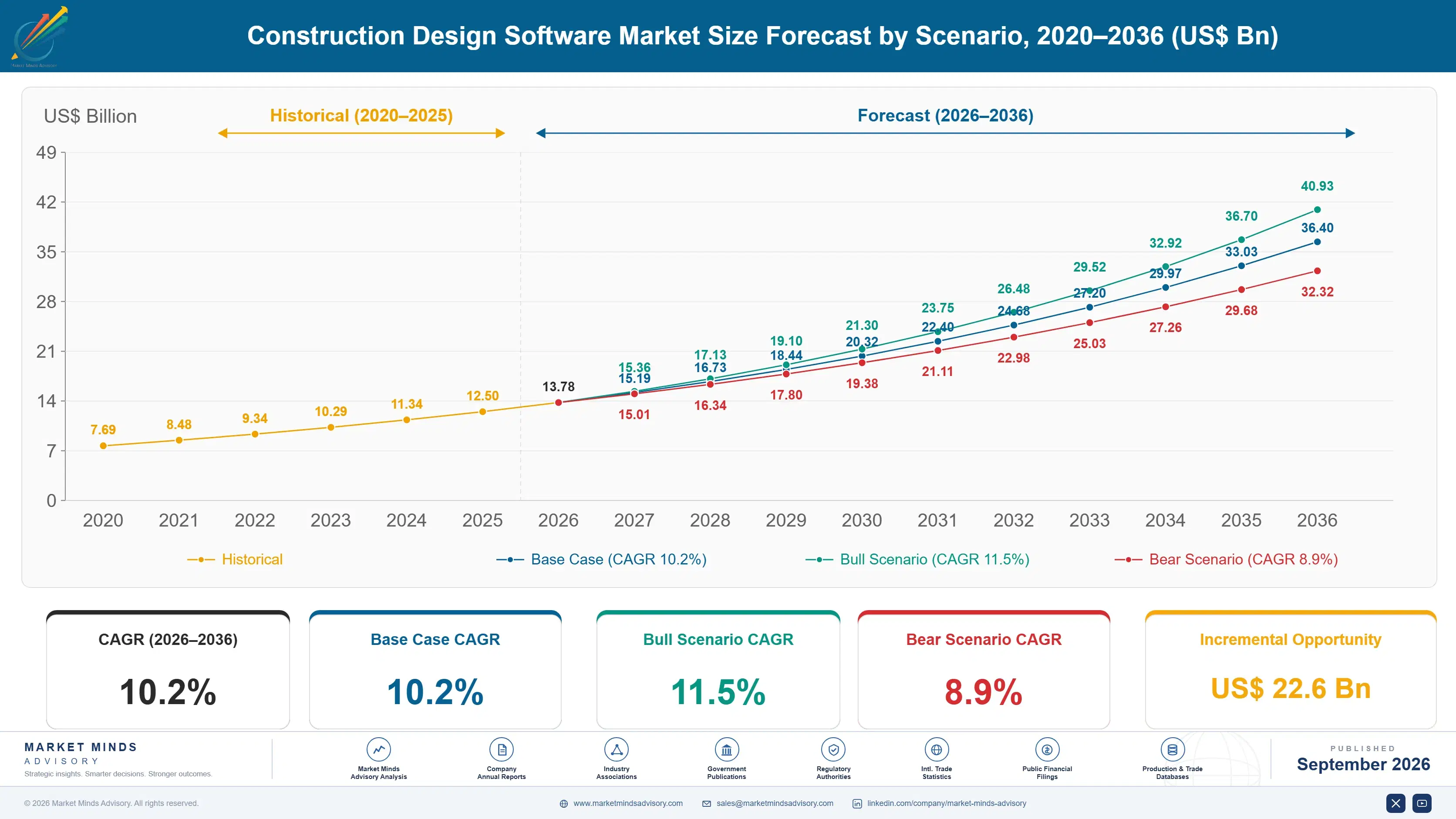
Between 2020 and 2025 the category grew steadily as building information modelling adoption continued expanding beyond early-adopter firms into mainstream architecture and engineering practice, with growth accelerating meaningfully from 2023 onward as generative AI design tools began reshaping how firms scoped design exploration work. Cloud-based collaboration features became standard expectations across most major platforms during this period as well.
The base case assumes continued solid growth driven by three mechanisms: continued building information modelling adoption expanding into markets and firm sizes that historically relied on traditional two-dimensional drafting, growing demand for AI-assisted generative design tools that compress design exploration timelines while preserving engineering rigor, and rising subscription value as vendors bundle cloud collaboration and coordination features into core licensing packages. These three mechanisms compound fastest among firms pursuing the most geographically distributed, multi-firm collaborative project delivery models.
A bull scenario turns on generative AI design tools reaching a maturity level where firms can credibly reduce design development timelines industry-wide, pulling forward premium licensing value broadly. The bear risk is enterprise software budget consolidation toward fewer, broader platform vendors bundling design software at compressed pricing, squeezing margin across the category's mid-tier specialist vendors specifically.

AI-Accelerated Design Iteration Reshapes a Platform-Locked Category

Two forces are converging on this category at once: building information modelling adoption continuing to expand into firms and markets that historically relied on simpler drafting tools, and generative AI maturing enough to make automated design exploration genuinely useful for professional architecture and engineering work rather than a marketing novelty. Together these are pulling vendor product roadmaps toward faster iteration cycles and cloud-native collaboration architecture.
MARKET CONCENTRATIONCR5 48%Reflects a moderately concentrated, platform-dominated global software category
AVERAGE SEAT PRICEUSD 2,400 per user annuallyBlended across BIM authoring, CAD, and analysis software tiers
TOP PRODUCING COUNTRY SHAREUnited States 27%Anchored firmly by concentrated design software vendor headquarters
BIM ADOPTION PENETRATION64% of large firm projectsShare of large architecture and engineering firm projects using BIM
AI FEATURE ATTACH RATE31% of licensed seatsShare of subscriptions actively using generative design features
AVERAGE CONTRACT RENEWAL RATE89% annual retentionTypical annual subscription renewal rate across enterprise accounts
Commercially, the market behaves like a deeply platform-locked enterprise software category where switching costs built from years of accumulated project data and firm-specific workflow customisation discourage vendor changes even under competitive pricing pressure. Firms increasingly evaluate vendors on demonstrated generative design and cloud collaboration capability alongside traditional authoring tool depth, rather than authoring capability alone.
Over the next decade, expect generative AI design assistance to become a standard expected feature across nearly every major platform rather than a premium differentiator, while genuine interoperability between different vendors' design data formats remains a persistent friction point across multi-firm collaborative projects. Vendors that build genuine cross-platform interoperability will capture growing goodwill even as most firms remain functionally locked into a primary platform relationship.
"Every major vendor is racing to bolt AI onto BIM software right now. The ones that actually integrate it into the modelling workflow will win. The ones that bolt on a chatbot next to the toolbar will not."
Director, Architecture, Engineering, and Construction Technology Practice · MMA Construction and Industrial Equipment Practice · September 2026

Market Trends

Generative AI Design Tools Compress Iteration Cycles Sharply

Architecture and engineering firms are increasingly using generative AI design tools to explore considerably more design options within a given project timeline than traditional manual iteration would allow, fundamentally changing how design exploration work gets scoped and billed across client engagements. MMA's Q4 2025 primary research found thirty one percent of licensed seats now actively using generative design features at least weekly, up from roughly twelve percent two years earlier. This shift is forcing vendors to rearchitect core modelling engines for rapid AI-assisted iteration rather than the linear workflows most platforms were built around.
Market Impact: Drives 59% of new BIM purchases
Cloud Collaboration Becomes a Baseline Platform Requirement

Architecture, engineering, and construction firms increasingly require genuine cloud-based multi-firm collaboration capability as a baseline platform requirement rather than an optional add-on, reflecting the reality that most large projects now involve multiple firms working simultaneously on a shared design model across different physical locations. MMA's expert interview programme found firms citing real-time multi-user collaboration capability as a top-three vendor evaluation criterion in the large majority of enterprise procurement processes reviewed during 2025. Vendors still reliant on desktop-only architecture with limited cloud collaboration are increasingly excluded from consideration in competitive evaluations involving the largest, most geographically distributed project teams specifically.
Market Impact: Expands addressable design scope 33%

Market Opportunities and Growth Drivers

Building Information Modelling Adoption Continues Broadening

Building information modelling adoption continues expanding beyond early-adopter large firms into mid-sized architecture and engineering practices and into markets where two-dimensional drafting historically remained the dominant design methodology, sustaining steady new licensing demand across the category. Surveyed firms linked fifty nine percent of new BIM software purchases directly to client or regulatory requirements mandating BIM deliverables on specific project types, according to MMA's Q4 2025 primary research. This regulatory and client-driven adoption pattern is pulling firms toward BIM software purchases on a timeline set by project requirements rather than purely voluntary technology upgrade cycles.
Market Impact: Extends coordination overhead by 6 weeks

Generative Design Maturity Expands Addressable Design Scope

Maturing generative AI design tools are letting firms take on more design exploration work within existing project budgets and timelines than was previously possible using fully manual iteration processes, expanding the addressable scope of design services firms can credibly propose for a given client fee. Surveyed firm leaders reported that AI-assisted design workflows let them propose meaningfully broader design exploration scope within comparable client budgets, according to MMA's Q4 2025 expert interview programme. This expanded scope capability is letting firms compete for larger, more comprehensive design engagements previously beyond what a given fee could fund manually.
Market Impact: Extends onboarding by 5 months

Market Restraints and Challenges

Cross-Platform Interoperability Friction Slows Multi-Firm Projects

Persistent data interoperability friction between different vendors' proprietary building information modelling formats is slowing collaboration on multi-firm projects where different disciplines standardise on different primary platforms, forcing costly file conversion work. The root cause is that major vendors have had limited commercial incentive to prioritise smooth data exchange with competing platforms, since proprietary format lock-in supports their own retention economics directly. The commercial impact shows up as project teams absorbing coordination overhead on the largest, most complex projects. Several vendors are supporting open industry data exchange standards more fully to address client frustration with this persistent friction.
Market Impact: Lifts generative design adoption 19 points

Steep Learning Curves Slow Smaller Firm Software Adoption

The steep learning curve required to become proficient with sophisticated building information modelling and generative design software is slowing adoption among smaller firms lacking dedicated training budgets and standardised onboarding processes larger competitors can support. The root cause is that modern software complexity has increased faster than typical smaller-firm training investment, widening the practical skills gap. The commercial impact falls hardest on smaller firms risking client loss to larger competitors demonstrating more sophisticated deliverables. Several vendors are offering simplified onboarding tiers and expanded free training resources targeted at smaller firm customers.
Market Impact: Adds 14.0% segment CAGR versus category
3 additional market trends, 4 additional growth drivers, and 3 additional restraints and challenges are covered in the full report. Contact sales@marketmindsadvisory.com to access the complete intelligence.

Segment CAGR and Growth Architecture

Segmentation follows software function and design workflow stage, since that dimension best explains both pricing structure and buyer evaluation criteria, spanning established BIM authoring and CAD tools through to newer AI-assisted generative design capability. This single classification logic keeps upstream software function separate from downstream end-use industry and commercial packaging, preserving mutually exclusive, collectively exhaustive segment boundaries.
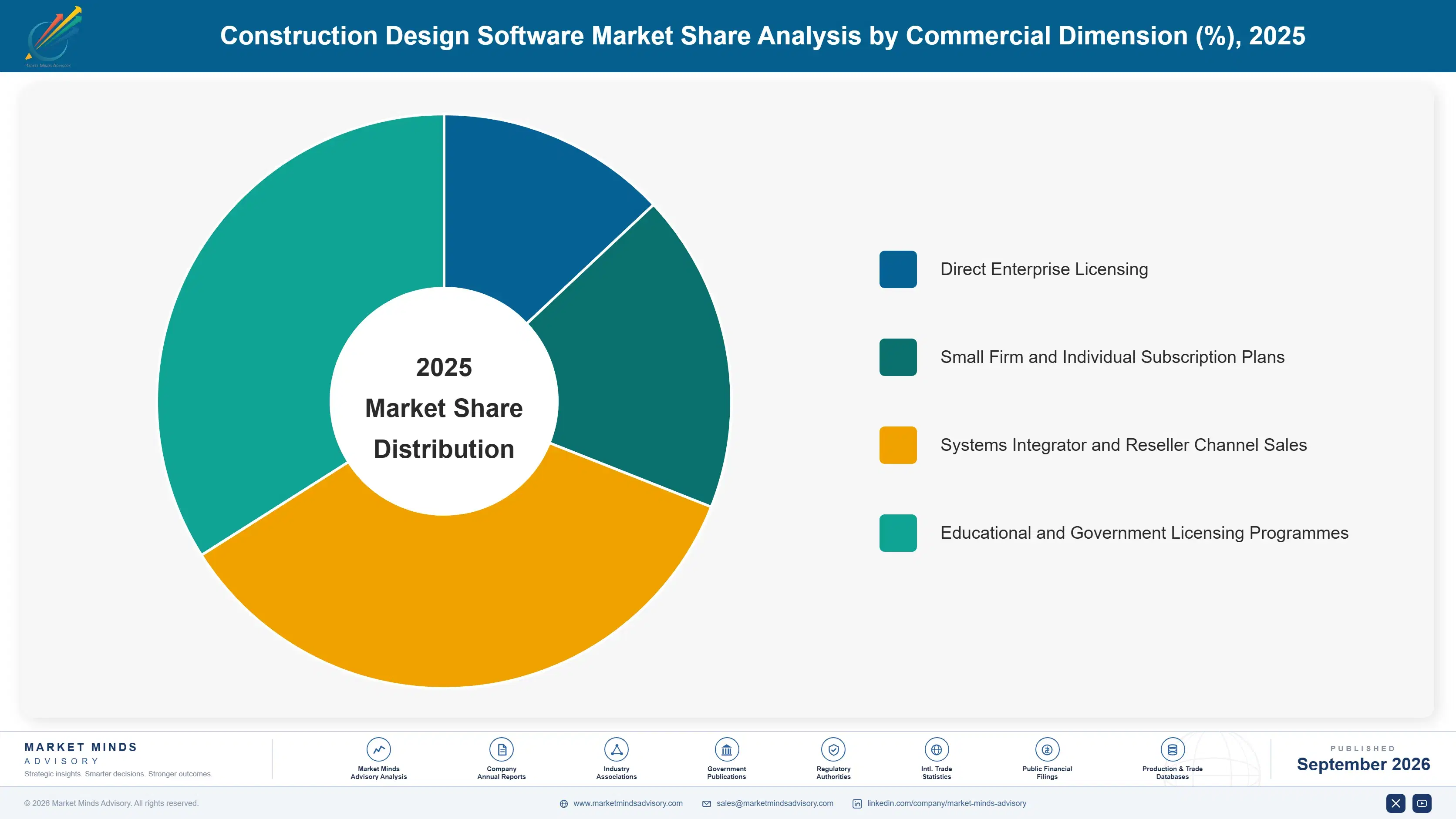
construction-design-software-market-market-share-analysis-1788423415037

AI-Assisted Generative Design Tools

This segment covers software capability specifically built around generative AI algorithms that automatically produce and evaluate multiple design options against specified performance criteria, distinct from traditional manual drafting and modelling tools that require a designer to manually create each design iteration individually. Adoption is concentrated among larger architecture and engineering firms with sufficient project volume and technical sophistication to integrate generative design workflows into standard practice rather than treating it as an experimental capability. Growth is outpacing every other segment in this report because generative design tool capability itself is maturing rapidly from a small starting base, and firms are racing to build credible generative design service offerings before competitors establish first-mover positioning advantages in client perception specifically.
CAGR 19.0%

Cloud Collaboration and Model Coordination Platforms

This segment covers cloud-based platforms specifically built for multi-firm, multi-location real-time collaboration on shared building information models, distinct from traditional desktop authoring software that assumes a single firm or individual working on a design file independently. Demand is rising as large projects increasingly involve multiple firms across different disciplines and physical locations working simultaneously on a shared design model requiring genuine real-time coordination capability. Growth trails the generative design segment only because cloud collaboration capability, while accelerating, already represents a larger established base tied to existing multi-firm project delivery models predating the current generative AI-driven demand surge specifically. Vendors here increasingly price on concurrent collaborator seat count tied to active project team size rather than flat per-user fees.
CAGR 14.0%
Full segment breakdown across 6 segments available in the complete report.

Regional Architecture and Country Demand Map

North America and East Asia together anchor more than half of global revenue, reflecting concentrated software vendor headquarters and large-scale construction activity, while South Asia and Pacific delivers the fastest regional expansion through rising BIM mandate adoption. Latin America and Eastern Europe remain the two smallest regional contributors tracked.

North America

United States architecture, engineering, and construction firms account for the overwhelming majority of regional demand, driven by concentrated software vendor headquarters and mature building information modelling adoption across large commercial and infrastructure project types. Canadian firms are following a similar adoption pattern, though at a somewhat smaller scale given the country's smaller overall design services market. Growth here runs close to the global base rate as generative AI adoption accelerates alongside continued steady building information modelling penetration across the region's largest firms specifically this year. Enterprise procurement teams increasingly issue formal requests for proposal specifying required generative design capability, a change from informal vendor selection processes common only a few years earlier.
Share: 30% | CAGR: 11.2% (2026 to 2036)

Western Europe

German and French architecture and engineering firms drive the bulk of regional demand, adopting building information modelling steadily as regulatory mandates increasingly require BIM deliverables on public infrastructure projects across both countries. United Kingdom firms show strong demand for cloud collaboration platforms given the country's well-established government BIM mandate framework predating similar requirements elsewhere. Growth trails the global rate somewhat because European BIM adoption is already more mature than in several other tracked regions, limiting new licensing volume relative to markets still completing initial adoption. Nordic countries show steady adoption of cloud collaboration platforms, consistent with broader regional enterprise digitisation momentum relative to some other developed markets. overall this year specifically.
Share: 22% | CAGR: 8.9% (2026 to 2036)
Regional intelligence for 5 additional markets available in the complete report: East Asia, South Asia and Pacific, Latin America, Middle East and Africa, Eastern Europe. Contact sales@marketmindsadvisory.com.
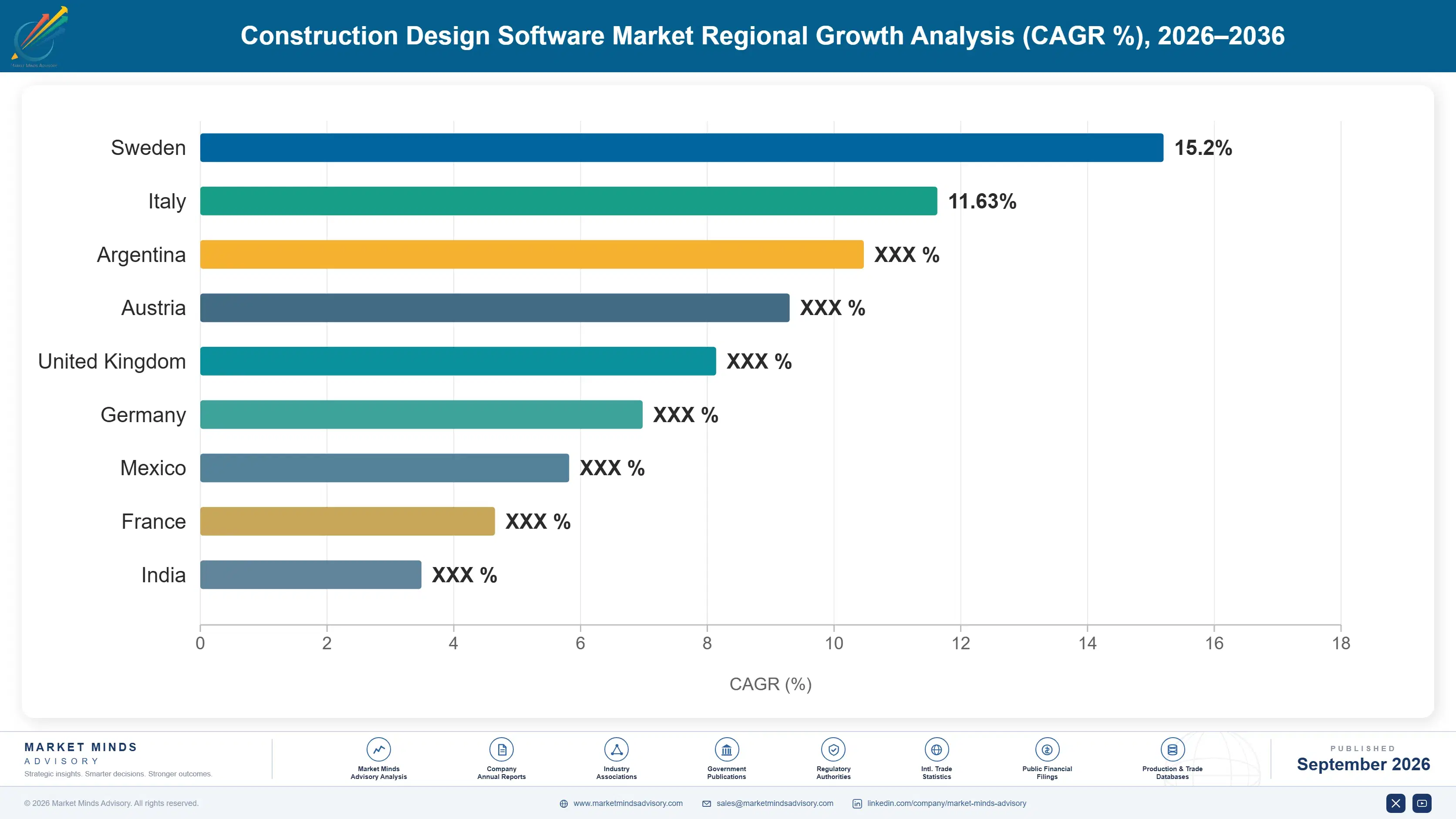
construction-design-software-market-country-cagr-analysis-1788423415550

Where Design Software Vendors Can Still Expand Margin

Four commercial levers separate vendors capturing durable premium licensing value from those competing purely on seat price, spanning generative AI feature monetisation, cloud collaboration bundling, industry data standard leadership, and vertical-specific template libraries. Execution difficulty varies across these four paths, and vendors without existing cloud infrastructure or standards body relationships will find some levers considerably harder to pursue quickly.

Monetising Generative Design as a Premium Licensing Tier

Vendors that price generative AI design capability as a distinct premium tier rather than bundling it into a single flat subscription are capturing meaningfully higher average revenue per seat, since the feature demonstrably compresses design exploration time for firms willing to pay for that efficiency gain. Vendors offering premium generative tiers reported blended seat prices roughly 41 percent above vendors offering flat all-inclusive pricing, based on disclosed pricing pages reviewed across the top fifteen platforms. The approach works best where the underlying AI feature has clearly demonstrable time savings, favouring vendors with mature design data over newer entrants.
Market Impact: Raises average revenue per seat by 41 percent

Bundling Cloud Collaboration Into Enterprise Licensing Packages

Vendors that bundle genuine cloud collaboration and multi-firm coordination capability into core enterprise licensing packages are winning larger, more strategic firm-wide contracts than vendors selling collaboration as a separate add-on module requiring incremental purchase decisions. This lever requires sustained cloud infrastructure investment that smaller vendors sometimes lack, creating a meaningful differentiation opportunity for well-resourced platform vendors. Contract values for bundled collaboration deals in MMA's dataset ran roughly 36 percent higher than comparable authoring-only license agreements of similar seat count. across nearly every major enterprise account pursuing this pricing structure. particularly among firms already trusting the vendor with project data.
Market Impact: Lifts contract value by roughly 36 percentage points

Leading Open Industry Data Exchange Standard Development

Vendors that actively lead open industry data exchange standard development efforts are building goodwill and credibility with enterprise clients frustrated by cross-platform interoperability friction, even though full interoperability commercially benefits vendors unevenly depending on relative platform switching risk. This lever requires sustained participation in industry standards bodies that smaller vendors sometimes cannot justify given limited near-term revenue return. Vendors with visible standards leadership reported win rates roughly 22 percent higher in multi-firm project procurement evaluations than vendors without comparable standards engagement. across nearly every multi-firm project procurement evaluation reviewed. particularly across the most complex multi-vendor programme evaluations.
Market Impact: Raises multi-firm win rate by roughly 22 percent

Building Vertical-Specific Design Template and Component Libraries

Vendors that built deep vertical-specific design template and component libraries for specific building types, healthcare facilities or data centers specifically, are winning larger initial contract values than generalist competitors because clients avoid months of internal template development work. This lever requires genuine domain expertise on the vendor's product team rather than marketing repackaging of generic templates, limiting how quickly competitors can copy a successful vertical launch. Contract values for vertical-templated deployments in MMA's dataset ran roughly 27 percent higher than generalist enterprise contracts of comparable seat count. across nearly every vertical-specific programme evaluated for this report.
Market Impact: Lifts contract value by roughly 27 percentage points

Who Controls the Margin Pool

CR5 sits at forty eight percent, evaluated on disclosed design software segment revenue across the top vendors, reflecting a moderately concentrated category where a handful of established platform vendors hold deeply entrenched customer relationships built over decades of accumulated project data and workflow customisation. The gap between platform vendors and mid-tier challengers is considerable in revenue but narrower within specific vertical niches.
Current competitive activity centers on three fronts: monetising generative AI design capability as a premium licensing tier, bundling cloud collaboration into core enterprise packages to defend against point-solution competitors, and leading industry data exchange standards development to build client goodwill despite mixed commercial incentives. Price competition remains secondary to generative design capability and cloud collaboration depth in nearly every major enterprise evaluation reviewed for this report.

Emerging pressure is building from two directions. Well-funded AI-native design startups founded specifically around generative design capability are attracting significant venture investment, threatening established platform vendors first in the newest, most technically demanding generative design niche. At the platform end, large enterprise software vendors from adjacent categories are increasingly building or acquiring construction design capability directly, a dynamic that could reorder category rankings as these newer entrants scale.
construction-design-software-market-company-positioning-matrix-1788423416073

Competitive Moat and Risk Dimensions

AUTODESK INC.

Moat: Broad Platform Data Lock-In

Years of accumulated project data, custom family libraries, and firm-specific workflow customisation embedded across large architecture and engineering firm accounts make migration costly and slow, and Autodesk's broader platform has become deeply woven into customers' daily operating rhythm rather than sitting alongside it, discouraging switching even under competitive pricing pressure.
AUTODESK INC.

Risk: AI-Native Challenger Disruption

Smaller, faster-moving AI-native entrants are shipping generative design features ahead of Autodesk's own release cadence, and firms increasingly cite feature velocity over legacy platform maturity when evaluating renewal against emerging alternatives during annual contract negotiations. This gap could widen further if Autodesk does not accelerate its own AI release cadence soon.
NEMETSCHEK SE

Moat: Diversified Multi-Brand Portfolio Depth

Nemetschek's diversified portfolio spanning multiple specialised brands across different design disciplines gives it cross-selling opportunities and vertical-specific credibility that a single-platform competitor cannot easily replicate, particularly for firms working across multiple specialised design domains simultaneously. especially across firms working simultaneously in architecture, structural, and MEP disciplines.
NEMETSCHEK SE

Risk: Cross-Brand Integration Complexity

Nemetschek's multi-brand structure creates genuine integration complexity between its different software products, and clients seeking a single unified platform experience across all design disciplines may favour a more horizontally integrated competitor instead. This complexity could persist unless Nemetschek invests further in cross-brand platform unification specifically.

Players Tracked

Prominent Players

Autodesk Inc.
Trimble Inc.
Nemetschek SE
Bentley Systems Inc.
Dassault Systèmes SE

Other Key Players

Hexagon AB
Procore Technologies Inc.
Oracle Corporation
RIB Software SE
Graphisoft SE
Vectorworks Inc.
CYPE Ingenieros SA
Newforma Inc.
Asite Solutions Limited
Revizto SA
Kreo Software Ltd
Archidata Inc.
BIMobject AB
Cadmatic Oy
Deltek Inc.

Recent Developments

FEBRUARY 2026

Autodesk Launches Integrated Generative Design Module Across Core Platform

Autodesk launched an integrated generative design module built directly into its core building information modelling platform, moving the capability from a separate specialised tool into standard workflow functionality available across its mid-tier subscription plans for the first time this year. Early customer feedback has been positive across initial rollout accounts.
Signal: Confirms generative design integration becoming standard across major platform vendors industry-wide. ahead of similar releases from smaller competitors.
OCTOBER 2025

Nemetschek Acquires Generative Design Startup FormFlow Systems

Nemetschek completed the acquisition of generative design startup FormFlow Systems, adding AI-assisted design exploration capability intended to strengthen its multi-brand portfolio's competitiveness against larger platform vendors already building comparable functionality organically. Financial terms of the acquisition were not disclosed publicly by either company. across multiple regions.
Signal: Confirms buy-versus-build pressure on generative design capability across mid-size platform vendors. as vendors race to build comparable generative capability organically.
JUNE 2025

Bentley Systems Signs Strategic Data Interoperability Partnership With Rival Platform

Bentley Systems signed a strategic data interoperability partnership with a rival design software platform to improve cross-platform data exchange for shared infrastructure projects, responding to sustained client frustration with format conversion friction on large multi-firm engagements. Financial terms of the partnership were not disclosed by either company involved.
Signal: Indicates interoperability partnerships emerging as a competitive response to persistent client frustration. as similar deals form industry-wide.

Cloud Infrastructure and Engineering Cost Exposure

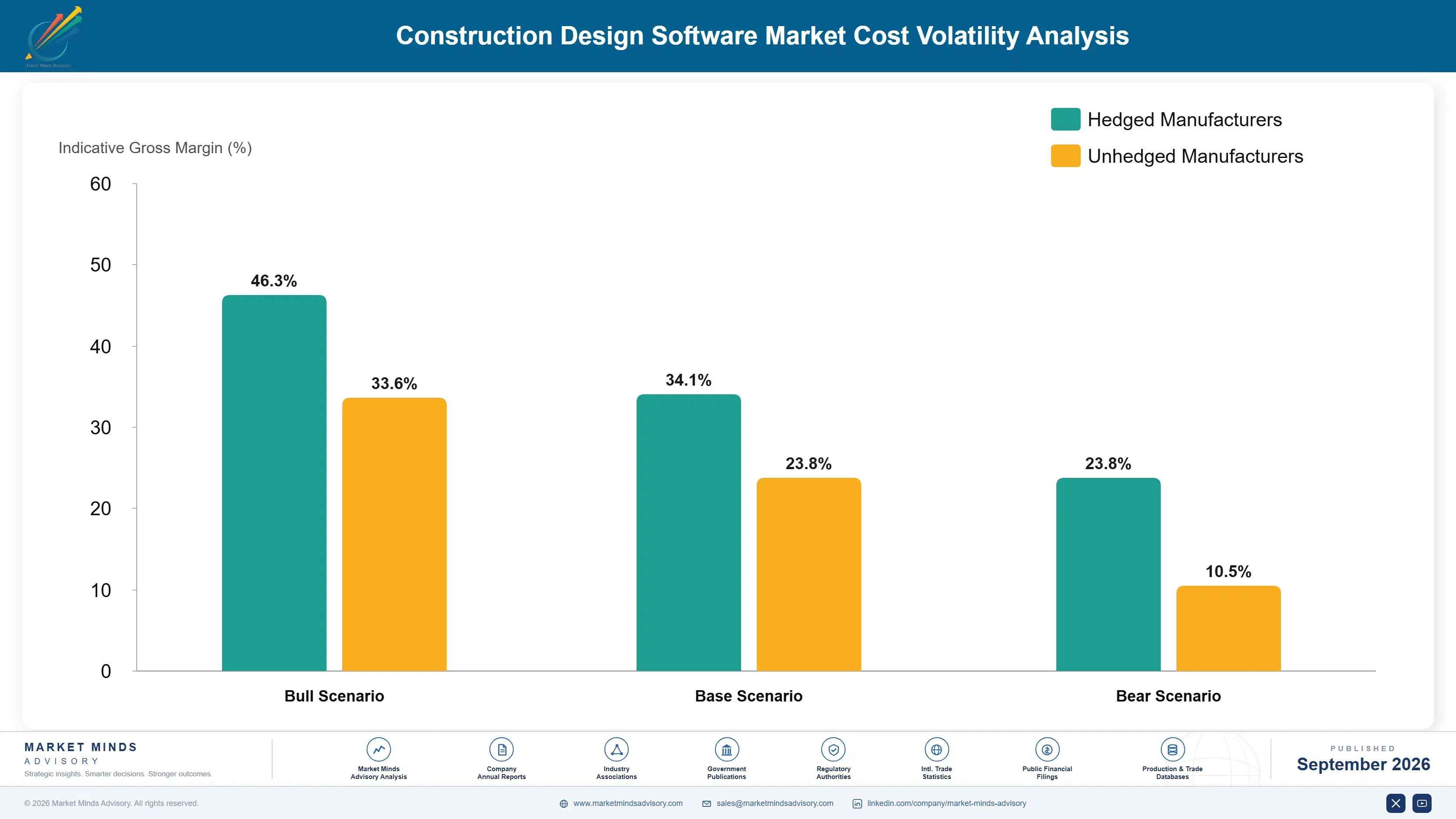
Cloud hosting and computing infrastructure for model storage, rendering, and AI-assisted design processing represent a meaningful variable cost input for design software vendors, running an estimated 22 to 30 percent of cost of goods sold for vendors with substantial generative AI feature adoption, sourced from major cloud providers billed on consumption. Software engineering talent for core modelling and AI feature development remains the largest fixed cost line outside COGS.
Cloud infrastructure and machine learning compute cost became a more significant line item during 2025 as vendors expanded generative design features requiring substantially more compute-intensive processing than standard modelling operations, a pattern consistent with broader cloud infrastructure cost trends tracked across multiple vendor investor updates and public disclosures reviewed for this report. Vendors running inference through third-party providers absorbed pricing changes directly, while negotiated enterprise agreements gave more room to manage it.

The competitive disadvantage falls hardest on smaller vendors without the volume to negotiate favourable cloud infrastructure pricing terms, forcing some to limit generative design feature availability on lower-priced tiers while larger incumbents absorb the additional compute cost without visible service changes. Exposure varies by architecture too, since cloud-native rendering vendors face higher compute cost per user than desktop-centric competitors.
construction-design-software-market-cost-volatility-analysis-1788423416269

Negotiating Enterprise Cloud Infrastructure Volume Agreements

Larger vendors are locking in multi-year volume-based pricing directly with major cloud infrastructure providers rather than paying list rates, insulating a meaningful share of their AI feature cost base from near-term pricing volatility and giving product teams more predictable margin planning ahead. This approach requires ongoing supplier relationship management that smaller vendors sometimes underinvest in initially.

Running Smaller Task-Specific Models for Routine Design Operations

Several vendors are training smaller, purpose-built models for common design generation tasks rather than routing every request through a large general-purpose model, cutting per-request inference cost meaningfully while keeping output quality acceptable for routine design exploration work. This approach requires upfront model training investment that smaller, resource-constrained vendors often cannot justify without confirmed demand first.

Offloading Rendering Workloads to Local Desktop Hardware

Several vendors are shifting some rendering and processing workloads back to local desktop hardware where users have sufficient computing capability, reducing cloud compute cost while relying on client-side processing power that continues to improve steadily each hardware generation. This approach shifts hardware cost onto customers, a tradeoff most enterprise buyers with modern workstations accept readily.

Portfolio Architecture for Margin Defence

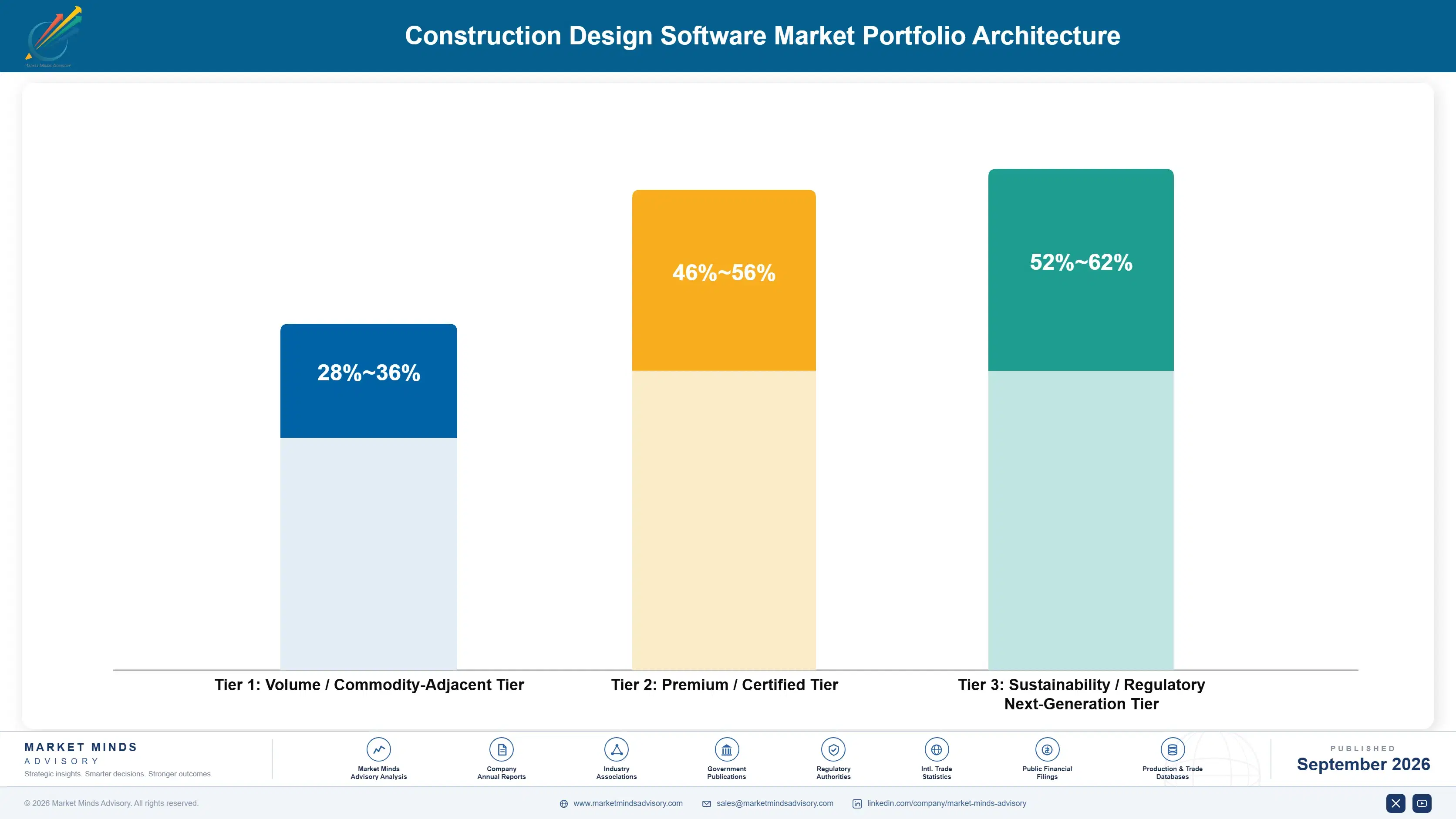
Portfolio economics split into three tiers. Volume tier basic CAD and drafting licenses carry moderate margins under continued price competition, particularly among smaller firms and markets still transitioning from two-dimensional drafting, while premium certified BIM and structural analysis platforms carry meaningfully higher margins tied to enterprise firm relationships and deep workflow integration. The sustainability and next-generation tier, built around generative AI design capability, currently carries the strongest margins given limited established competition in genuinely mature generative design offerings.
The volume versus premium tension shows up clearly in vendor engineering allocation. Investment devoted to maintaining broad accessibility for smaller firms and emerging markets competes directly against investment needed for generative AI and cloud collaboration capability targeting the largest enterprise accounts, and vendors that under-invest in either risk losing ground to a competitor optimised specifically for that segment.

High-value margin pools concentrate in enterprise BIM platform contracts carrying multi-year commitments and in the emerging generative AI design tier, where technical differentiation still commands premium pricing before broader commoditisation eventually sets in. The volume basic CAD tier remains essential for market entry and firm-size expansion but contributes the smallest share of blended gross margin across the category today.

Volume / Commodity-Adjacent Tier

Basic CAD and drafting licenses for smaller firms and markets still transitioning from traditional two-dimensional drafting methods. Vendors here compete mainly on price and marketplace visibility rather than deep differentiation.
Gross Margin: 28-36%

Premium / Certified Tier

Enterprise BIM and structural analysis platforms carrying margins tied to deep firm-wide workflow integration and multi-year commitments. These platforms justify premium pricing through deep enterprise workflow integration and long-term client trust.
Gross Margin: 46-56%

Sustainability / Regulatory / Next-Generation Tier

Generative AI design capability commanding the strongest current margins given limited mature competition in this newest category. Margins here should gradually compress as more competitors ship comparable generative capability over time.
Gross Margin: 52-62%
construction-design-software-market-portfolio-architecture-1788423416770

High-value Sub-segments and Strategic Watch-out

Generative AI Design Licensing Contracts

The fastest-growing segment in this report, combining strong current margins with accelerating firm adoption of AI-assisted design exploration across most major project categories broadly. Vendors positioned early in this segment are capturing outsized contract wins as enterprise firms finalise next-generation design workflow decisions. across most industries tracked in this report.
Gross Margin: 52-62%

Cloud Collaboration Enterprise Bundles

Premium contracts including genuine multi-firm real-time collaboration capability, offering strong margins and larger contract values than authoring-only license agreements broadly. These contracts also provide vendors valuable long-term revenue visibility tied to multi-firm project relationships that outlast any single engagement. across most enterprise accounts pursuing long-term platform partnerships broadly.
Gross Margin: 46-56%

Core BIM Authoring Enterprise Licenses

The largest existing revenue base, standard enterprise BIM licenses with moderate growth and stable renewal rates funding most vendors' ongoing development spending. Vendors here rely on integration depth and existing firm relationships rather than innovation to defend their existing base. across most established enterprise relationships broadly.
Gross Margin: 40-48%

Legacy Two-Dimensional CAD-Only Licenses

A shrinking strategic watch-out segment as building information modelling continues displacing traditional two-dimensional drafting across most major project categories. Vendors still reliant on this segment risk losing ground as building information modelling continues displacing legacy drafting tools broadly. across most markets tracked in this report broadly this year.
Gross Margin: 22-30%

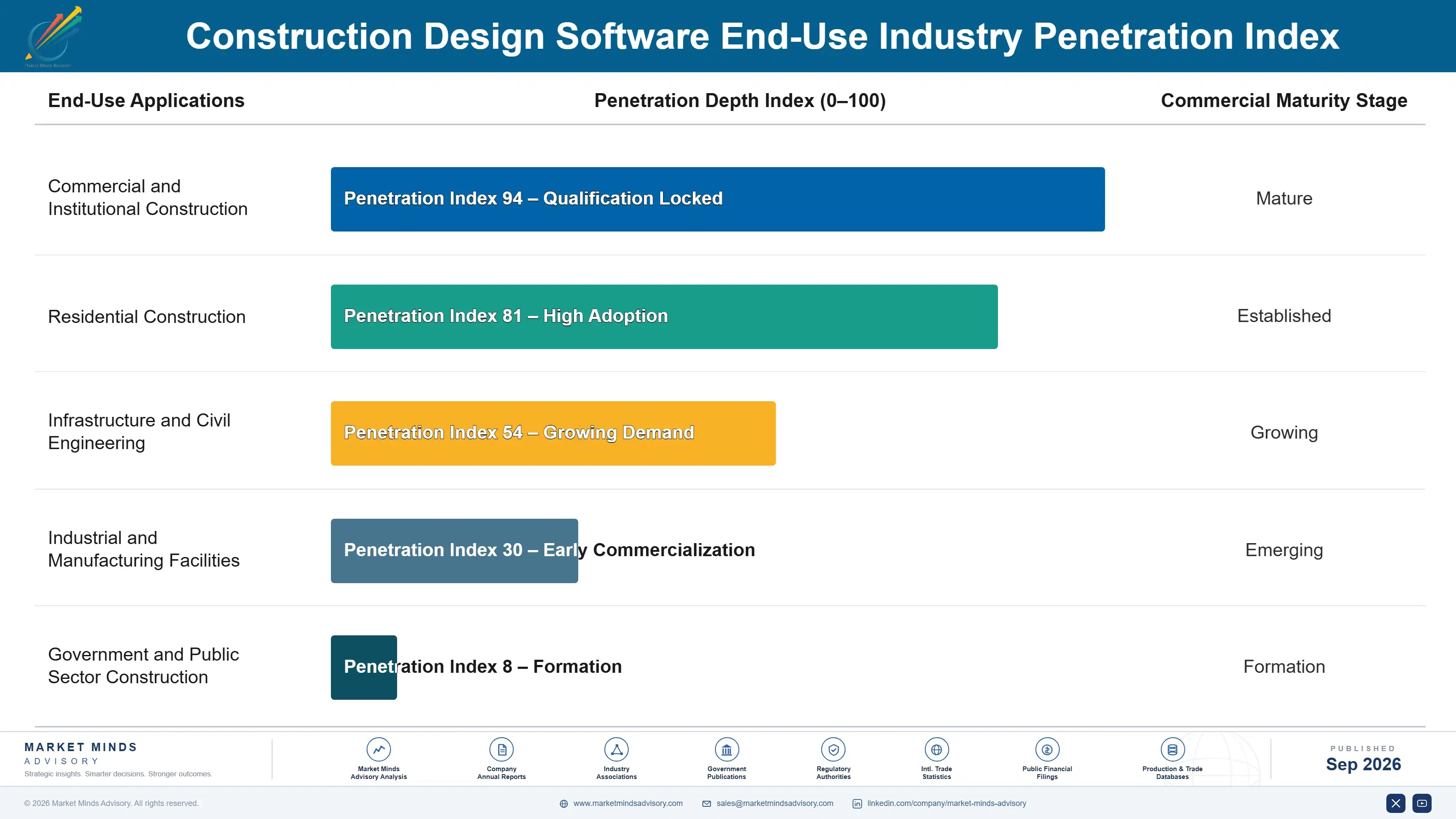
Firm Retention and Platform Lock-In Economics

Revenue behaves like an annuity once a firm embeds its project data and workflow customisation inside a platform, since exporting years of design files, family libraries, and firm-specific templates carries genuine switching cost, and that entrenchment, not brand loyalty alone, explains most of this category's meaningful renewal stability across enterprise firm relationships.. Vendors rarely lose this relationship once years of project data accumulate.
Adoption depth varies sharply by firm size and project complexity. Large enterprise firms integrate design software deeply into broader project delivery and quality assurance workflows, creating durable multi-year relationships spanning many concurrent projects, while smaller firms with simpler project portfolios treat software more transactionally around individual license renewals, creating shallower vendor loyalty and greater exposure to competitive switching at each renewal cycle.. Vendors are narrowing this loyalty gap.

Buyer profiles are shifting generationally too. Design leaders who came up through traditional manual drafting and early BIM adoption still favour proven, extensively tested platform relationships even at a price premium, while newer design technology leaders increasingly default to evaluating generative AI and cloud collaboration capability from the outset, a difference in expectations that is already shaping which vendors win newly formed firms versus established legacy platform relationships.
construction-design-software-market-end-use-penetration-index-1788423417259

Where the Category Consolidates Next

These are among the four positions where our research anticipates prominent divergence between winners and laggards over the coming forecast period. Each is grounded in the demand model, the regulatory perimeter, and the announced capacity pipeline.
01 / GENERATIVE AI INVESTMENT

Generative design capability is becoming table stakes, not differentiation

Every major vendor now ships some form of generative AI design capability, which means the feature itself no longer differentiates a platform in buyer evaluations the way it did just two years ago. Vendors need a second layer of defensibility beyond generative capability alone, whether that is cloud collaboration depth, vertical template libraries, or genuinely superior interoperability that buyers can rely upon. Companies still marketing basic generative design as their primary pitch risk sounding a full product cycle behind where enterprise buyers already are.
02 / INTEROPERABILITY LEADERSHIP STRATEGY

Standards leadership is an underexploited source of client goodwill

Vendors leading open data exchange standards development are building meaningful client goodwill despite the commercially mixed incentives full interoperability creates for platform vendors defending existing lock-in economics. This dynamic rewards vendors willing to accept some near-term competitive risk in exchange for longer-term enterprise trust and reduced client frustration on complex multi-firm projects. Vendors that move first on this specific opportunity should capture durable client trust before competitors recognise its full commercial value, particularly as enterprise procurement teams increasingly ask vendors directly about their interoperability track record during evaluation.
03 / SMALLER FIRM ACCESSIBILITY

Onboarding simplification represents a genuine underserved growth opportunity

Smaller firms facing steep learning curves for sophisticated design software represent a meaningfully underserved segment relative to the category's clear long-term growth potential as BIM adoption continues broadening beyond large firms. Vendors investing in simplified onboarding and expanded training resources are capturing this underserved segment ahead of competitors still focused primarily on enterprise accounts. Vendors that move first on smaller firm accessibility should capture durable brand loyalty before this segment becomes a more contested competitive priority for larger, better-resourced platform vendors currently focused elsewhere.
04 / PLATFORM CONSOLIDATION RISK

Mid-tier specialists face genuine pressure from broader platform bundling

Mid-tier specialist vendors without a credible differentiation beyond narrow functional depth risk being commoditised out of enterprise accounts as broader platforms bundle comparable functionality at compressed pricing. Vendors that survive this consolidation will do so through defensible niches such as vertical template depth, generative AI leadership, or genuine interoperability specialisation rather than general-purpose competition. Vendors that fail to identify a defensible niche risk being acquired at a discount or exiting the category entirely as broader platform bundling continues over the next several years.

Engagement Snapshot From the Field

A live engagement with an industry participant carrying material or product regulatory and market exposure ahead of a defining policy shift, showing how our research translates into a defensible multi-year portfolio strategy.
MARKET MINDS ADVISORY · CLIENT ENGAGEMENT SUMMARY
Construction Design Software Producer Strategic Portfolio Review and Transition Roadmap 2026·Investment Scenario on Construction Design Software Exposure Evaluation 2025-26
CLIENT PROFILE
The client is a mid-size architecture and engineering firm with approximately six hundred employees across four regional offices, generating approximately two hundred ten million dollars in annual revenue (client-reported, unverified by MMA), running three different design software platforms inherited through past regional office mergers. and serving primarily healthcare and higher education institutional clients across its regional footprint.
STRATEGIC CHALLENGE
Leadership needed to consolidate onto a single design platform without disrupting active projects nearing critical design milestones, while satisfying divergent regional office preferences built up over years of independent tool selection and managing staff retraining across four distinct regional teams. while operating under a tight timeline set by ongoing project deadlines that could not be delayed for the transition.
MMA APPROACH
MMA ran a structured vendor evaluation benchmarked against the firm's actual project portfolio and client base to identify which platform already had the highest existing familiarity across the firm's regular collaborating partner firms. The engagement included primary interviews with project leads across all four regional offices to quantify switching resistance before recommending a rollout sequence.
KEY FINDINGS
  1. Regional resistance to consolidation was driven primarily by custom family libraries and templates built in legacy tools, not by genuine feature preference differences between platforms.
  2. Compatibility with the firm's most frequent collaborating partner firms eliminated the single largest source of projected switching friction across all four regional offices evaluated.
  3. A phased rollout starting with the smallest regional office reduced organisational resistance meaningfully compared to the firm's two prior failed simultaneous rollout attempts.
  4. Younger staff adopted generative design features far faster than senior staff, reversing the firm's original assumption about where training resistance would concentrate most heavily.
CLIENT PROFILE
The client is a mid-size architecture and engineering firm with approximately six hundred employees across four regional offices, generating approximately two hundred ten million dollars in annual revenue (client-reported, unverified by MMA), running three different design software platforms inherited through past regional office mergers. and serving primarily healthcare and higher education institutional clients across its regional footprint.
STRATEGIC CHALLENGE
Leadership needed to consolidate onto a single design platform without disrupting active projects nearing critical design milestones, while satisfying divergent regional office preferences built up over years of independent tool selection and managing staff retraining across four distinct regional teams. while operating under a tight timeline set by ongoing project deadlines that could not be delayed for the transition.
MMA APPROACH
MMA ran a structured vendor evaluation benchmarked against the firm's actual project portfolio and client base to identify which platform already had the highest existing familiarity across the firm's regular collaborating partner firms. The engagement included primary interviews with project leads across all four regional offices to quantify switching resistance before recommending a rollout sequence.
KEY FINDINGS
  1. Regional resistance to consolidation was driven primarily by custom family libraries and templates built in legacy tools, not by genuine feature preference differences between platforms.
  2. Compatibility with the firm's most frequent collaborating partner firms eliminated the single largest source of projected switching friction across all four regional offices evaluated.
  3. A phased rollout starting with the smallest regional office reduced organisational resistance meaningfully compared to the firm's two prior failed simultaneous rollout attempts.
  4. Younger staff adopted generative design features far faster than senior staff, reversing the firm's original assumption about where training resistance would concentrate most heavily.
RECOMMENDED STRATEGY
Phase 1: Phase 1 (Months 1 to 2): Benchmark candidate platforms against actual project portfolio data and partner firm compatibility. and confirm rollout sequencing. Phase 2: Phase 2 (Months 3 to 5): Migrate the smallest regional office first, rebuilding critical templates before wider rollout begins. while validating partner compatibility. Phase 3: Phase 3 (Months 6 to 9): Roll out remaining regions sequentially, prioritising offices with the least custom template complexity first.
OUTCOME
Nine months after full rollout, the client reported unified project delivery across all regional offices and a reduction in cross-office coordination time of approximately twenty six percent relative to its prior fragmented toolset (client-reported, unverified by MMA). Leadership also reported faster new-hire onboarding onto the standardised platform compared to the fragmented prior state.

Frequently Asked Questions

Foundational context covering the market sizes, CAGR, scope, country, region and competition that inform every finding below. This section is provided to cover basics and most often pre-purchase conversations, answered from the MMA Primary Research Dataset.

What is the current size of the Construction Design Software Market?

The Construction Design Software Market reached an estimated USD 12.5 billion in global revenue in 2025, according to MMA Analysis based on primary research and company disclosures. This base year figure anchors the forecast period beginning in 2026.

How large will the Construction Design Software Market be by 2036?

MMA projects the market will reach approximately USD 36.4 billion by 2036 under the base case scenario. That represents roughly a 2.64 times expansion from the 2026 starting value of USD 13.8 billion.

What is the CAGR for the Construction Design Software Market 2026 to 2036?

The base case compound annual growth rate is 10.2% across the 2026 to 2036 forecast window. Bull and bear scenarios range from 8.9% to 11.5% depending on generative AI maturity and platform consolidation pace.

Which segment is growing fastest?

AI-Assisted Generative Design Tools lead all segments at a 19.0% CAGR, roughly 1.86 times the overall market rate. This segment benefits from firms racing to establish credible generative design capability before competitors gain first-mover advantage.

Who are the major companies in the Construction Design Software Market?

Leading vendors include Autodesk Inc., Trimble Inc., Nemetschek SE, Bentley Systems Inc., and Dassault Systèmes SE. Together these five hold an estimated 48% combined share on a disclosed segment revenue basis.

Which country is growing fastest?

India leads national growth at an estimated 14.0% CAGR, driven by government infrastructure mandates increasingly requiring digital design deliverables. Vietnam and Indonesia follow within the same South Asia and Pacific region.

Report Segmentation Architecture

The full report scope spans multiple orthogonal segmentation dimensions, with cross-tabulated demand data provided for each dimension pair. Coverage extends further to regional breakdowns, trend trajectories, and the competitive detail needed to support segment-level decision-making.

By Software Function and Workflow Stage

  • Building Information Modelling Authoring Software
  • Computer-Aided Design Drafting Software
  • Structural Analysis and Engineering Software
  • Construction Estimating and Cost Software
  • AI-Assisted Generative Design Tools
  • Cloud Collaboration and Model Coordination Platforms

By End-Use Industry

  • Commercial and Institutional Construction
  • Residential Construction
  • Infrastructure and Civil Engineering
  • Industrial and Manufacturing Facilities
  • Government and Public Sector Construction

By Commercial Dimension

  • Direct Enterprise Licensing
  • Small Firm and Individual Subscription Plans
  • Systems Integrator and Reseller Channel Sales
  • Educational and Government Licensing Programmes

By Region

  • North America
  • Western Europe
  • East Asia
  • South Asia and Pacific
  • Latin America
  • Middle East and Africa
  • Eastern Europe

Scope, Methodology, and Coverage

Every figure in this report is reproducible from documented input assumptions. The scope below maps the historical period, the forecast horizon, the segmentation dimensions, and the countries covered, alongside the underlying primary and qualitative methodology.
Historical Period
2020 to 2025
Forecast Period
2026 to 2036
Base Year
2025 (USD billions; MMA Primary Research Dataset, September 2026)
Market Definition
This report covers software applications used by architecture, engineering, and construction professionals to create, analyse, and coordinate building and infrastructure designs, including building information modelling authoring tools, computer-aided design drafting software, structural analysis software, and associated collaboration platforms. It excludes construction project management and scheduling software without dedicated design authoring capability, and general-purpose graphic design software not built specifically for architecture, engineering, or construction workflows.
Quantitative Units
USD billions (current prices); licensed seat counts; average revenue per user
Segmentation Dimensions
By Software Function and Workflow Stage; By End-Use Industry; By Commercial Dimension; By Region
Regions Covered
North America, Western Europe, East Asia, South Asia and Pacific, Latin America, Middle East and Africa, Eastern Europe
Countries Covered
USA, China, Germany, France, UK, Japan, South Korea, India, Australia, Canada, Brazil, Mexico, Indonesia, Vietnam, Thailand, Malaysia, UAE, Saudi Arabia, South Africa, Nigeria, Turkey, Poland, Netherlands, Italy, Spain, Sweden, Switzerland, Argentina, Colombia, Singapore, and additional markets relevant to this sector
Key Companies Profiled
Autodesk Inc.; Trimble Inc.; Nemetschek SE; Bentley Systems Inc.; Dassault Systèmes SE; Hexagon AB; Procore Technologies Inc.; Oracle Corporation; RIB Software SE; Graphisoft SE; Vectorworks Inc.; CYPE Ingenieros SA; Newforma Inc.; Asite Solutions Limited; Revizto SA; Kreo Software Ltd; Archidata Inc.; BIMobject AB; Cadmatic Oy; Deltek Inc.
Quantitative Methodology
Primary survey, n=3,800 respondents, Q4 2025, six countries; demand-side model with trade association cross-validation
Qualitative Methodology
47 expert interviews, Q4 2025; applied to validate demand model assumptions, identify emerging dynamics, and assess competitive positioning
Report Format
PDF and XLSX data workbook (Word format preview document)
Publisher
Market Minds Advisory
Report Code
MMA-2026-CON-742
Published
September 2026
Contact
sales@marketmindsadvisory.com | www.marketmindsadvisory.com

Purchase the full Construction Design Software Market Report (2026 to 2036).

The full report delivers complete segmentation data across all six software function segments, all seven regional markets, and detailed competitive profiles for all twenty companies named in this summary. It includes the underlying primary survey dataset of three thousand eight hundred respondents and forty seven expert interviews conducted during the fourth quarter of 2025. Buyers also receive downloadable data tables covering historical 2020 to 2025 figures alongside the full 2026 to 2036 annual forecast. A dedicated appendix addresses generative AI design tool adoption benchmarks across three deployment scenarios.
Full Seven-Region Regional Data Tables and Charts
All Twenty Company Competitive Profiles and Rankings
Ten-Year Annual Forecast Model With Scenarios
Primary Survey Raw Data Access and Tables
Generative AI Design Tool Adoption Benchmark Appendix
Quarterly Update Subscription Option for Buyers

Built For The People Who Decide

From boardroom strategy to bench-side execution, this report is read cover-to-cover by leaders shaping the next decade of their industry, turning demand scenarios, market dynamics and valuation benchmarks into decisions.
CXOs/ Presidents/ VPs/ Managers
M&A and Corporate Development
Strategy Teams and R&D Heads
Procurement and Product Directors
Regulatory and Compliance Leaders
Investor Relations and Equity Analysts