Market Minds Advisory
Construction Anchors Market

Construction Anchors Market: Seismic Retrofit Demand and Infrastructure Investment Growth

Structural engineers are specifying certified chemical and seismic-rated anchor systems over legacy mechanical anchors as building codes and infrastructure retrofit mandates make documented load performance a project approval requirement rather than a discretionary specification choice.

Lead Analyst

David Horsley

Published

September 2026

Make Smarter Decisions with Customized Research Insights

Request a free sample report and evaluate market opportunities, growth trends, and competitive dynamics relevant to your business needs.

2025 MARKET VALUE$6.8BMarket Size 2025
2036 FORECAST VALUE$12.9BBase Case , 2026 to 2036
CAGR 2026 TO 20366.0 %Bull 7.3% / Bear 4.7%
INCREMENTAL OPPORTUNITY$5.7BNet 10- year value creation
EXPANSION MULTIPLE1.79x2036 value over 2026 base
Strategic Levers
M&A Pipeline
Regional Outlook
Country Rankings
Competitive Intelligence
Segmental Deep-dive
Call-Us : 91 93563 13602

Executive Snapshot and Market Trajectory

Structural engineers are converting legacy mechanical anchor specifications into certified chemical and seismic-rated anchor systems faster than contractor training programmes can keep pace, and contractors that secured certified installer training two years ago are winning bids that uncertified competitors cannot qualify for. That certification gap keeps widening every project cycle.
East Asia anchors global demand, home to the largest construction volume in the world led by China's continued infrastructure and building investment, even as Hilti, Simpson Strong-Tie, and Fischer Group compete for the same structural engineering specification contracts. Chemical and adhesive anchors are among the fastest-growing product classes, still smaller in installed volume than mechanical expansion anchors today but increasingly the preferred specification for high-load and seismic-rated structural applications. Contractors report similar wins after certification.
Five suppliers, Hilti, Simpson Strong-Tie, Fischer Group, Illinois Tool Works, and Wurth Group, hold roughly 48 percent of global construction anchor revenue, a concentration built on decades of testing and certification infrastructure that newer entrants cannot easily replicate. Tightening seismic building codes and infrastructure retrofit mandates are pulling certified anchor specification forward on structural engineering projects beyond what routine construction volume growth would have justified.
Market Definition
The construction anchors market covers mechanical expansion, chemical/adhesive, undercut, and screw anchor systems used to fasten structural and non-structural elements into concrete and masonry substrates. It excludes wood and drywall fasteners, structural steel connections, and general-purpose hand tools.
Base Year Value
$6.8B in 2025 (MMA Primary Research Dataset, August 2026)
Forecast Period
2026 to 2036, eleven discrete annual values
CAGR
6.0% base case. Bull 7.3%. Bear 4.7%.
Fastest Growth Segment
Seismic-Rated Anchor Systems: 9.4% CAGR
Fastest Growth Country
China: 8.4% CAGR
Fastest Growth Region
South Asia and Pacific: 8.2% CAGR
Largest Region
East Asia: 30% of 2025 global value
Market Leaders
Hilti, Simpson Strong-Tie, Fischer Group, Illinois Tool Works, Wurth Group. Source: MMA Analysis based on company annual reports and investor filings.
Primary Survey
n=3,800 procurement and R&D decision-makers, Q4 2025, six countries
Methodology
Demand-side build-up, cross-validated against public data, 47 expert interviews

Construction Anchors Market Forecast Scenarios

construction-anchors-market-size-forecast-scenario-1787301486028
Construction anchor demand grew steadily from 2020 through 2025 as global construction activity recovered from pandemic disruption and infrastructure investment programmes expanded across major economies. Growth accelerated meaningfully after several major seismic building code updates mandated certified anchor specification for critical structural applications, and the segment grew at roughly a 5.3 percent historical compound rate.
MMA's base case assumes 6.0 percent compound growth through 2036, anchored in three mechanisms. First, expanding infrastructure investment across developing regions is pulling certified anchor demand forward across an increasing number of construction projects. Second, tightening seismic building codes increasingly favour certified chemical and seismic-rated anchor systems over legacy mechanical alternatives. Third, aging building stock across mature markets is extending anchor specification into retrofit and renovation applications that historically relied on simpler fastening methods.
A bull scenario near 7.3 percent follows if additional jurisdictions mandate seismic retrofit programmes ahead of current regulatory timelines. The bear case near 4.7 percent materialises if construction capital spending tightens enough that developers delay non-critical anchor upgrades, extending reliance on legacy mechanical anchor specifications longer than currently expected. Suppliers monitor both scenarios closely when planning manufacturing capacity investment for the years ahead.

Seismic Codes Drive Certified Anchor Specification

Construction anchors have moved from a routine fastening commodity into a documented structural compliance category faster than most contractors expected a decade ago, and that shift is reshaping how construction firms plan project specification. Anchors that would have stayed mechanical for another project cycle are converting to certified chemical and seismic-rated systems early because structural engineering sign-off has become harder to obtain with uncertified equipment than the incremental
MARKET CONCENTRATION48%Five suppliers hold a meaningful but fragmented combined share
AVERAGE ANCHOR SYSTEM COST$8.40/unitReflects a standard certified chemical anchor unit configuration
CHINA CONSTRUCTION SHARE31%Chinese construction volume leads global anchor demand overall
RESIN COST SHARE41%Epoxy and vinyl ester resins dominate chemical anchor cost
CERTIFIED INSTALLER ATTACH RATE29%Share of projects specifying certified installer documentation requirements
ANCHOR DESIGN LIFE25-50 yearsTypical certified service life before structural reassessment required
Commercial activity concentrates in chemical and mechanical expansion anchors, where testing infrastructure and certification documentation give the five largest suppliers durable advantages. Seismic-rated anchor systems remain a smaller but fast-scaling category, increasingly specified directly by structural engineers rather than left to contractors to recommend after a code review finding.
The next decade will be shaped less by incremental fastener material innovation than by how fast suppliers can document load performance and certification data across an expanding range of substrate and seismic conditions. Suppliers that can bundle anchors, testing documentation, and installer training into a single certified specification programme capture disproportionate share of new structural engineering contracts.
"Nobody specifies an anchor because it's cheap anymore. They specify it because the load documentation survives the structural engineer's stamp."
Director, Construction Fastening and Structural Systems Practice · MMA Concrete

Market Trends

Seismic Building Code Updates Mandate Certified Anchor Specification

Seismic building codes across major construction markets increasingly require documented, third-party-tested anchor load performance as a condition of structural engineering approval, making certified chemical and seismic-rated anchors the default specification rather than a discretionary upgrade contractors can defer indefinitely. Structural engineers in jurisdictions with the most rigorous seismic code updates report that certified anchor specification now happens automatically during structural design rather than as a late-stage compliance retrofit. Hilti and Simpson Strong-Tie both report that seismic certification compliance, not unit cost alone, is now the primary factor cited in new structural specification negotiations, a shift from years of cost-led procurement.
Market Impact: Sustains a 64% infrastructure-linke
Infrastructure Retrofit Programmes Expand Chemical Anchor Demand

Aging bridge, highway, and public infrastructure across mature construction markets is driving expanding retrofit and rehabilitation programmes that increasingly specify chemical anchors for their superior load capacity in existing concrete substrates compared with mechanical alternatives. Fischer Group and Illinois Tool Works both report that infrastructure retrofit chemical anchor orders are growing meaningfully faster than standard new-construction mechanical anchor orders, reflecting the underlying infrastructure investment cycle. This retrofit-driven demand growth provides suppliers a revenue stream that moves somewhat independently of the new-construction cycle reshaping standard mechanical anchor specification across the wider industry.
Market Impact: Adds 11pp to addressable retrofit m

Market Opportunities and Growth Drivers

Global Infrastructure Investment Sustains Baseline Demand

Government infrastructure investment programmes across major economies are sustaining baseline construction anchor demand regardless of broader private construction capital spending cycles, since public infrastructure projects rarely defer structural fastening specifications even during private-sector construction slowdowns. Contractors working on publicly funded infrastructure projects report that certified anchor specification requirements are typically stricter and more consistently enforced than comparable private construction projects overall. This public-investment-driven demand gives suppliers unusually predictable baseline revenue compared with other construction product categories that depend more heavily on private capital spending cycles and discretionary developer budget allocation decisions.
Market Impact: Compresses margins by roughly 8pp

Aging Building Stock Expands Addressable Retrofit Market

Building stock across mature construction markets is aging steadily, and structures approaching the end of their original anchor design life generally require retrofit or replacement anchoring as part of broader renovation and life-extension programmes. Building owners managing aging structures report that anchor specification decisions now weigh remaining structural life as heavily as routine maintenance budgets when evaluating renovation scope. This aging-driven expansion is pulling smaller regional contractors, previously reliant on simple mechanical anchoring due to budget constraints, toward certified chemical anchor specification earlier in project planning than historical patterns would have predicted.
Market Impact: Limits smaller-firm bidding to roug

Market Restraints and Challenges

Resin Price Volatility Compresses Chemical Anchor Margins

Epoxy and vinyl ester resins represent the dominant input cost for chemical anchor manufacturing, and the root cause of margin pressure is petrochemical market exposure: resin prices track crude oil and natural gas feedstock markets that chemical anchor manufacturers have limited ability to hedge given contract pricing commitments to distributor and contractor customers. That cost volatility compresses manufacturer margins during resin price spikes, since long-term distribution contracts rarely include full pass-through pricing clauses. Suppliers including Fischer Group are mitigating the gap by negotiating tiered pricing agreements that share resin volatility risk with large distributor customers.
Market Impact: Adds 9pp to certified anchor specif

Contractor Certification Requirements Slow Adoption Among Smaller Firms

Certified chemical and seismic-rated anchor installation increasingly requires documented installer training and certification, and the root cause of adoption friction is a genuine training gap: smaller regional contractors often lack the resources to certify installation crews at the pace larger national contractors can manage. That certification gap slows how quickly smaller contractors can bid on projects requiring certified anchor specification, periodically forcing them to subcontract certified installation work to larger competitors. Suppliers including Hilti are mitigating the gap by expanding low-cost online certification training programmes that reduce the resource barrier for smaller contractor certification.
Market Impact: Adds 12% more retrofit anchor order
2 additional market trends, 3 additional growth drivers, and 2 additional restraints and challenges are covered in the full report. Contact sales@marketmindsadvisory.com to access the complete intelligence.

Segment CAGR and Growth Architecture

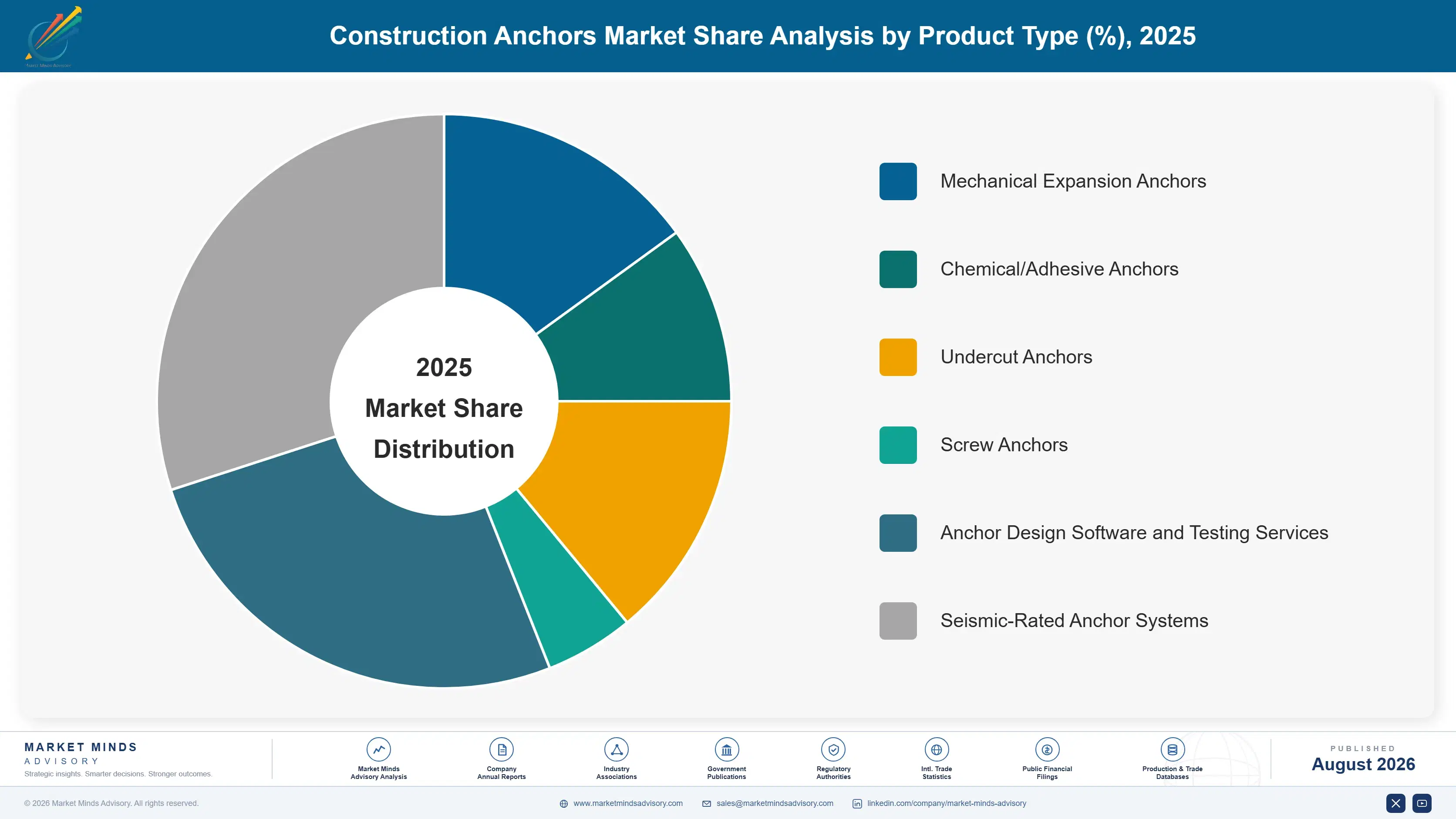
MMA segments the construction anchors market by product type, the classification structural engineers and contractors actually specify and procure against. Six categories cover the addressable market, each with distinct load certification requirements, substrate compatibility, and commercial dynamics spanning mechanical, chemical, and seismic-rated anchoring applications across every major construction sector and geography worldwide today and going forward.
construction-anchors-market-market-share-analysis-1787301486561

Seismic-Rated Anchor Systems

Seismic-rated anchor systems are growing fastest because they directly address the documented cyclic load performance requirements that standard mechanical and chemical anchors cannot always satisfy under tightening seismic building codes. Hilti and Simpson Strong-Tie both dominate this segment given their seismic testing infrastructure and the certification track record that newer entrants find difficult to replicate quickly. Substrate compatibility remains a genuine consideration, since seismic-rated performance must be validated across cracked concrete conditions that standard anchor testing protocols do not always address. Growth here is expected to broaden considerably as seismic code updates extend certification requirements across additional jurisdictions and structure types, treating seismic-rated specification as a general default rather than a narrow requirement confined to high-seismic-zone construction alone.
CAGR 9.4%

Chemical/Adhesive Anchors

Chemical and adhesive anchors are the second-fastest-growing category as structural engineers increasingly specify systems offering higher load capacity and closer edge-distance placement than mechanical expansion anchors can achieve in comparable concrete substrates. Fischer Group and Illinois Tool Works both dominate this segment given their resin formulation expertise and the certification track record that newer entrants find difficult to match at comparable load performance levels. Smaller regional suppliers without dedicated chemical anchor manufacturing capability face growing pressure to partner or cede this category to larger competitors with established production capacity. Growth here tracks closely with how fast structural engineers convert legacy mechanical specifications to chemical systems during renovation and retrofit project planning cycles.
CAGR 8.2%
Full segment breakdown across 6 segments available in the complete report.

Regional Architecture and Country Demand Map

East Asia leads global construction anchor demand, home to the largest construction volume in the world led by China's continued infrastructure investment. North America and Western Europe retain the deepest seismic certification and testing infrastructure, while South Asia and Pacific grows fastest behind India's expanding construction sector.

North America

The United States' mature seismic building code framework, among the most rigorous globally in high-seismic-zone states, anchors North American demand through structural engineering specification requirements that increasingly favour certified chemical and seismic-rated systems. Hilti and Simpson Strong-Tie's American operations both maintain the deepest testing and certification infrastructure in the region, giving domestic contractors faster access to certified anchor specifications than smaller regional suppliers can typically offer. Canadian construction anchor demand is expanding steadily behind infrastructure investment programmes, while California and Washington's stringent seismic requirements continue to anchor a disproportionate share of new certified anchor orders within the broader North American market, reinforcing the region's leading position. Florida's hurricane-resistant building code standards are adding further incremental demand for certified anchor systems.
Share: 24% | CAGR: 6.0% (2026 to 2036)

Western Europe

Germany and the UK anchor Western European demand, both home to mature construction sectors and national building codes that increasingly specify certified anchor performance documentation for structural applications. The EU's regulatory framework gives suppliers with established European testing infrastructure a large, relatively homogeneous compliance market to serve compared with the more fragmented regulatory landscape in other regions. The Nordic region's advanced building code enforcement, among the most stringent globally, gives Nordic suppliers a demonstrated compliance advantage other markets increasingly reference. France's growing infrastructure retrofit sector is accelerating chemical anchor adoption behind updated national seismic guidance. Italy and Spain's smaller but growing construction sectors round out the region's demand base beyond its three largest markets.
Share: 20% | CAGR: 4.5% (2026 to 2036)
Regional intelligence for 5 additional markets available in the complete report: East Asia, South Asia and Pacific, Latin America, Middle East and Africa, Eastern Europe. Contact sales@marketmindsadvisory.com.
construction-anchors-market-country-cagr-analysis-1787301487069

Certification Documentation and Installer Training

Suppliers extract value less through raw anchor unit pricing than through building certification documentation capability, deepening installer training programmes across contractor networks, and bundling design software support into long-term distribution agreements. The levers below describe how each part of the value chain captures its share of the certification-driven transition now underway across structural and infrastructure construction applications.

Certification Documentation Investment Captures Structural Specification

Suppliers that build comprehensive load testing and certification documentation fastest capture a disproportionate share of new structural engineering specifications, since engineers rarely switch anchor suppliers once a working certified specification relationship has been fully established. Hilti and Simpson Strong-Tie both report that jurisdictions where they achieved certification earliest carry meaningfully higher specification win rates, roughly 27 percent higher than jurisdictions where certification arrived later. This first-mover dynamic makes documentation capability a strategic priority that can outweigh incremental unit price differences between competing anchor suppliers targeting the same structural specification opportunity.
Market Impact: Wins roughly 27% higher specificati

Installer Training Programmes Anchor Contractor Loyalty

Suppliers that build widely accessible installer certification training programmes capture years of predictable contractor loyalty that anchor sales alone cannot match, since certified installers rarely switch to a competing supplier's system once trained and certified on a specific installation protocol. Hilti and Fischer Group have both prioritised training programme investment specifically because certified contractor loyalty now represents a growing share of total account lifetime value, exceeding the initial training investment within roughly 3 years of certification. Suppliers without strong training programmes find it increasingly difficult to match the lifetime account value that leading competitors generate from their certified contractor base.
Market Impact: Recoups training investment within

Design Software Bundling Deepens Engineering Relationships

Suppliers that bundle anchor design and load calculation software into distribution agreements capture deeper structural engineering relationships than product-only competitors, since engineers increasingly value integrated design tools for specification documentation and code compliance verification purposes. Simpson Strong-Tie and Illinois Tool Works have both expanded design software capability specifically because bundled offerings raise average contract value by roughly 16 percent compared with product-only sales, giving suppliers a stronger position during contract renewal negotiations. This bundling strategy requires sustained software development investment, but it creates switching costs that meaningfully raise engineering firm retention above product-only competitors' typical account longevity.
Market Impact: Raises average contract value by ro

Regional Testing Lab Investment Reduces Certification Delay

Suppliers that maintain regional testing laboratory capability cut certification delay by roughly 21 percent compared with suppliers relying on centralized or third-party testing facilities, a difference that matters considerably to contractors managing time-sensitive structural project schedules. Fischer Group and Wurth Group have both invested in expanding regional testing lab footprints specifically to capture this speed value, recognising that certification delay carries direct commercial cost for contractors running committed project timelines. Suppliers without comparable regional testing capability find it increasingly difficult to compete for large structural specification contracts regardless of unit pricing competitiveness.
Market Impact: Cuts certification delay by roughly

Who Controls the Margin Pool

Five suppliers, Hilti, Simpson Strong-Tie, Fischer Group, Illinois Tool Works, and Wurth Group, hold roughly 48 percent of global construction anchor revenue, a concentration built on decades of testing infrastructure and certification documentation expertise. The gap to challengers like DeWALT and Powers Fasteners is narrower than the headline share suggests, since much of the unconcentrated remainder sits with regional distributors rather than identifiable global rivals.
Current competitive activity centres on three fronts: building certification documentation capability to win structural specifications ahead of competitors, deepening installer training programmes across contractor networks, and bundling design software support into long-term distribution agreements. Suppliers are also expanding regional testing laboratory capability to reduce certification delay and strengthen contract renewal positioning.

Emerging pressure comes from regional chemical anchor specialists expanding capability to serve narrower, higher-growth retrofit and infrastructure applications rather than competing across the full mechanical anchor spectrum. Rankings are most likely to shift in seismic-rated systems, where testing infrastructure and certification speed rather than raw manufacturing scale determine competitive position, leaving meaningful room for suppliers that move fastest on certification capability to gain share from slower-moving incumbents across the industry.
construction-anchors-market-company-positioning-matrix-1787301487585

Competitive Moat and Risk Dimensions

HILTI

Moat: Broadest Certification and Testing Infrastructure

Hilti operates the broadest network of certification and testing laboratories spanning more jurisdictions than any single competitor, giving it faster specification approval advantages that narrower regional specialists cannot match. That infrastructure breadth, built over decades of dedicated development investment, is difficult for newer entrants to replicate quickly.
HILTI

Risk: Premium Pricing Limits Cost-Sensitive Segments

Hilti's premium pricing strategy creates genuine exposure in cost-sensitive construction segments where contractors prioritise unit price over certification depth, occasionally leaving the company vulnerable to lower-cost regional competitors in price-driven bidding situations. Narrower cost-focused competitors can sometimes win volume contracts that Hilti's pricing structure makes less attractive to pursue.
SIMPSON STRONG-TIE

Moat: Deep North American Structural Relationships

Simpson Strong-Tie's decades-deep relationships with North American structural engineers give it specification advantages that competitors without comparable regional engineering account history cannot match, letting it win specification decisions on relationship strength as much as technical differentiation, particularly across residential and light-commercial structural accounts built over many years.
SIMPSON STRONG-TIE

Risk: Narrower International Distribution Presence

Simpson Strong-Tie's international distribution network remains narrower than fully globalized competitors like Hilti, leaving it more dependent on North American revenue than producers with broader international revenue diversification. A slowdown in North American construction would disproportionately affect Simpson Strong-Tie relative to more diversified global rivals carrying broader regional exposure.

Players Tracked

Prominent Players

Hilti
Simpson Strong-Tie
Fischer Group
Illinois Tool Works
Wurth Group

Other Key Players

DeWALT
Powers Fasteners
MKT Fastening
Sika AG
Adhesives Technology Corporation
Cobra Anchors
Mungo Befestigungstechnik
Rawlplug
Sormat
Spit
Concrete Fastening Systems Inc
EJOT
nVent Electric
Wej-It Fastening Systems
USP Structural Connectors

Recent Developments

FEBRUARY 2026

Hilti Launches Expanded Seismic Certification Testing Laboratory

Hilti commissioned an expanded seismic certification testing laboratory in February 2026, adding dedicated cyclic load testing capacity separate from its existing regional facilities. The laboratory addresses growing structural engineering demand for seismic performance documentation ahead of expanding building code enforcement across major global construction markets.
Signal: Confirms that seismic testing infrastructu
SEPTEMBER 2025

Simpson Strong-Tie and Major Infrastructure Contractor Sign Certification Agreement

Simpson Strong-Tie signed a multi-year certification documentation and installer training agreement with a major infrastructure contractor in September 2025, committing to provide certified anchor systems across the contractor's expanding project pipeline. The agreement covers multiple regional projects and represents one of the largest certification commitments recorded.
Signal: Signals that major infrastructure contract
JUNE 2025

Fischer Group Expands Chemical Anchor Manufacturing Capacity

Fischer Group commissioned expanded chemical anchor manufacturing capacity in June 2025, adding dedicated resin formulation production lines serving growing infrastructure retrofit demand across Europe. The expansion positions Fischer Group to capture growing demand from contractors converting legacy mechanical specifications to certified chemical anchor systems industry-wide.
Signal: Marks continued investment in chemical anc

Epoxy Resin and Steel Component Cost

Epoxy and vinyl ester resins, along with corrosion-resistant steel components, represent the largest cost inputs for construction anchor manufacturing, accounting for roughly 41 percent of total production cost, sourced from a global petrochemical feedstock market subject to crude oil price volatility. Certification testing and third-party validation add a distinct and growing cost category for suppliers expanding seismic-rated product lines, sourced from a specialized testing services market.
Petrochemical feedstock prices spiked meaningfully through 2022 as global supply chains faced disruption amid geopolitical volatility, and Hilti's fiscal year 2022 annual report cited elevated resin and steel input costs as a direct constraint on fastening systems segment margins despite steady underlying construction demand. Suppliers responded by qualifying additional resin suppliers and, in some cases, redesigning formulations around more readily available feedstock grades, reducing exposure to prior petrochemical price volatility.

Vertically integrated suppliers with captive resin formulation capability, including Hilti and Fischer Group, absorb feedstock price volatility more predictably than smaller regional anchor manufacturers who purchase resin at market prices during periods of tight availability. That gap gives integrated suppliers a durable cost-stability advantage over smaller specialty fastener manufacturers, particularly during the feedstock price cycles that squeeze margins across the broader construction products industry.
construction-anchors-market-cost-volatility-analysis-1787301487780

Qualifying Additional Resin Supplier Relationships

Leading suppliers are qualifying additional epoxy and vinyl ester resin suppliers to reduce reliance on single-source procurement, converting a variable supply exposure into a more predictable, diversified sourcing chain across their manufacturing base. This qualification strategy requires sustained formulation validation investment but has historically proven most valuable during periods of feedstock shortage that squeeze non-diversified competitors' delivery timelines hardest.

Redesigning Formulations Around Available Feedstock Grades

Suppliers are redesigning chemical anchor formulations around more readily available resin feedstock grades to reduce exposure to single-source petrochemical shortages that have periodically delayed production timelines across the wider industry. This redesign investment requires sustained certification revalidation resources but reduces long-term exposure to feedstock scarcity that has repeatedly constrained supplier profitability across the broader industry.

Vertically Integrating Resin Formulation Capability

Larger suppliers are acquiring or expanding their own resin formulation capacity to reduce dependence on third-party petrochemical suppliers, trading some flexibility for supply certainty and cost predictability across their installed product line overall. Smaller regional manufacturers without comparable formulation scale remain more exposed to feedstock supply volatility during periods of tight global market availability.

Portfolio Architecture for Margin Defence

Construction anchor suppliers operate across three margin tiers built around certification complexity and testing depth rather than simple unit volume. Commodity-adjacent standard mechanical expansion anchors sit at the volume base, certified chemical and screw anchors occupy the middle at meaningfully firmer margins, and next-generation seismic-rated and infrastructure-grade systems sit at the top, commanding premium pricing that few standard anchor suppliers can currently match. Most establish
The volume-premium tension plays out most visibly in how suppliers allocate scarce testing and certification resources: every certification project dedicated to a standard mechanical anchor formulation is a project not available for higher-margin seismic-rated and chemical anchor formulations, so suppliers increasingly prioritise premium allocation even when it means directing standard anchor customers toward longer lead times.

High-value margin pools concentrate in seismic-rated and chemical anchor systems, both of which command pricing closer to specialized structural engineering economics than to standard commodity fastener manufacturing. Suppliers that can move a customer from standard mechanical anchor supply into a certified chemical or seismic-rated relationship capture meaningfully more of total account value.

Volume / Commodity-Adjacent Tier

Standard mechanical expansion anchors sold at scale into routine non-structural and light-duty applications, priced close to established commodity fastener benchmarks with limited technical differentiation between qualified suppliers competing on service.
Gross Margin: 12-18%

Premium / Certified Tier

Certified chemical and screw anchor systems requiring extensive load testing and certification investment, commanding a defensible premium given the technical investment behind each qualified formulation. Buyers weigh documentation reliability heavily.
Gross Margin: 20-28%

Sustainability / Regulatory / Next-Generation Tier

Next-generation seismic-rated and infrastructure-grade systems carrying the deepest engineering and certification investment, sold primarily into structural engineers' highest-visibility compliance programmes. Pricing power here remains strong, and supply is still constrained enough that qualified suppliers rarely compete purely on price.
Gross Margin: 28-38%
construction-anchors-market-portfolio-architecture-1787301488280

From Commodity Fastener to Structural System

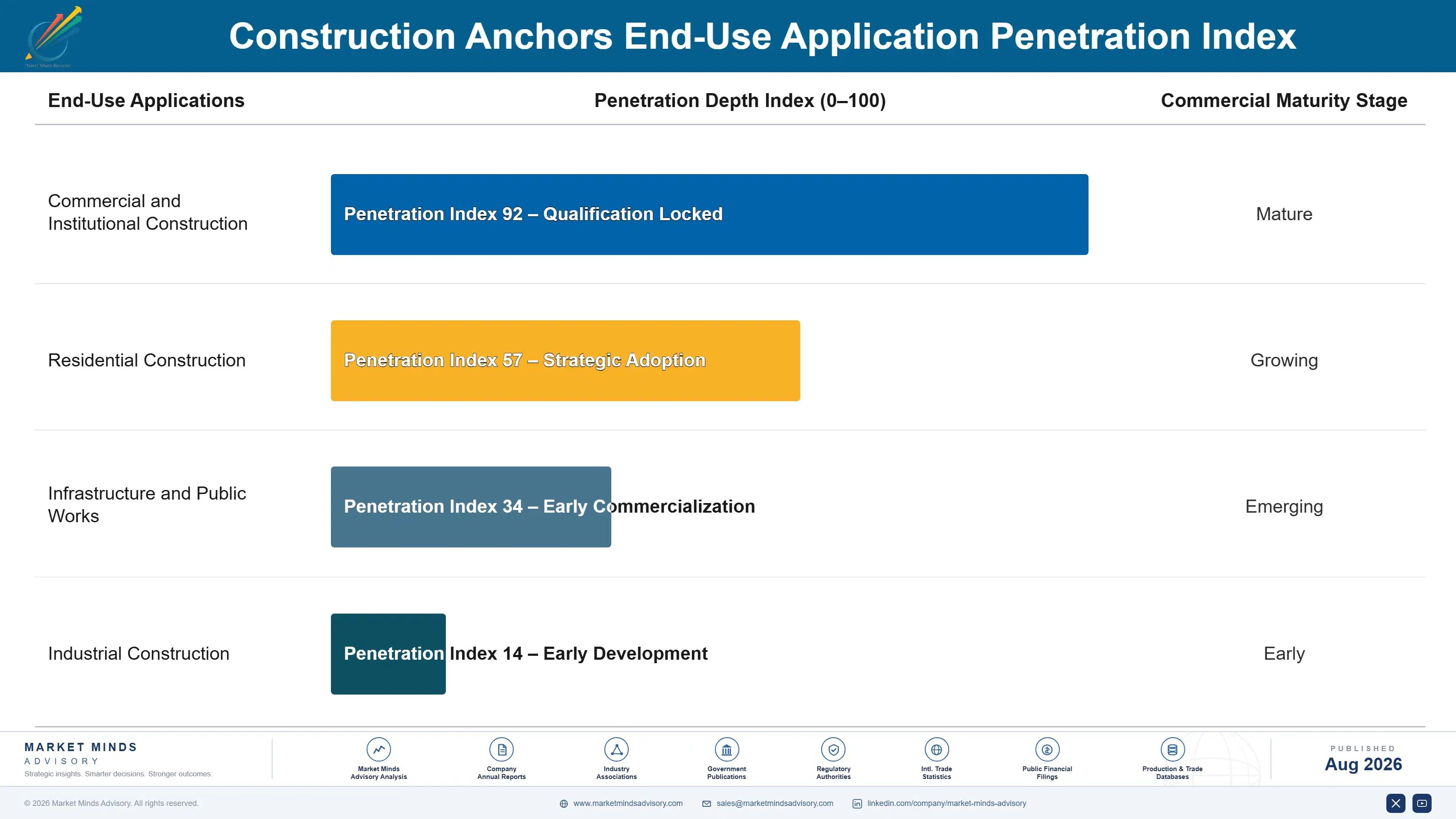
Construction anchor procurement is shifting from a commodity, price-driven fastener purchase toward a structural compliance relationship that resembles an ongoing certification partnership more than a series of one-time product transactions. Suppliers that embed certification documentation and installer training into standard distribution agreements lock in renewal revenue automatically, while structural engineers increasingly treat certified anchor specification as the starting assumption for n
Adoption depth varies sharply by project type. Critical structural and infrastructure applications show the deepest reliance on certified, seismic-rated systems, since code enforcement and public safety consequences are most acute in categories facing direct structural engineering oversight. Non-structural and light-duty applications show steadier, less certification-driven demand, since specification decisions there track budget and convenience considerations more than structural-code-specific documentation requirements.

A generational shift among structural engineers is reinforcing the trend. Younger engineers trained during the recent seismic code modernization wave treat certified-anchor-first specification as standard practice, while veteran engineers accustomed to informal, cost-driven procurement are adapting more slowly, occasionally defaulting to familiar mechanical specifications until forced by a code review finding or seismic retrofit mandate.
construction-anchors-market-end-use-penetration-index-1787301488768

Where MMA Sees the Real Opportunity

These are among the four positions where our research anticipates prominent divergence between winners and laggards over the coming forecast period. Each is grounded in the demand model, the regulatory perimeter, and the announced capacity pipeline.
01 / CERTIFICATION DOCUMENTATION INVESTMENT

Build load certification capability ahead of code updates

Suppliers that build comprehensive load testing and certification documentation capability now are positioned to capture new structural specifications meaningfully faster than suppliers dependent entirely on standard, uncertified products competing for the same code-driven specification decisions. This positioning matters more than competing purely on unit pricing, since certification capability, not raw manufacturing scale alone, increasingly determines which supplier wins large structural engineering contracts. MMA recommends prioritising certification platform investment over incremental product feature expansion in the current three-year window, particularly for suppliers serving high-seismic-zone construction markets.
02 / INSTALLER TRAINING EXPANSION

Build accessible installer certification programmes now

Suppliers that build widely accessible installer certification training programmes ahead of confirmed demand capture a disproportionate share of contractor loyalty that follows every certification event, since certified installers rarely switch to a competing supplier's system once trained on a specific protocol. Suppliers still relying on limited or costly training programmes are ceding contractor loyalty to competitors already investing in accessible certification pathways. MMA views training programme investment as the highest-return near-term opportunity available within the category over the next three years, particularly for suppliers serving smaller regional contractor networks.
03 / DESIGN SOFTWARE DEVELOPMENT

Build integrated design software capability ahead of demand

Suppliers that build integrated anchor design and load calculation software ahead of confirmed demand capture deeper account penetration and higher margins than product-only competitors, providing a durable differentiation advantage that pure hardware suppliers cannot easily replicate. Suppliers concentrated purely in product sales face meaningfully more price-competitive dynamics than software-bundled competitors carrying broader account value and stronger renewal leverage across their installed base. MMA recommends building or acquiring design software capability as a durable differentiation strategy for suppliers currently overexposed to product-only competition.
04 / REGIONAL TESTING LAB INVESTMENT

Build regional testing laboratory capacity now

Contractors managing time-sensitive structural project schedules increasingly require guaranteed certification speed, and suppliers with established regional testing laboratory capability face a genuinely lower-risk competitive position than competitors relying purely on centralized or third-party testing facilities. Competitors that moved early on regional testing investment are capturing differentiated, multi-year specification advantages years ahead of suppliers still exposed to centralized testing delays today. MMA recommends prioritising regional testing laboratory investment as a durable, relatively capital-efficient differentiation strategy available to suppliers of every size.

Engagement Snapshot From the Field

A live engagement with an industry participant carrying material or product regulatory and market exposure ahead of a defining policy shift, showing how our research translates into a defensible multi-year portfolio strategy.
MARKET MINDS ADVISORY · CLIENT ENGAGEMENT SUMMARY
Construction Anchors Producer Strategic Portfolio Review and Transition Roadmap 2026·Investment Scenario on Construction Anchors Exposure Evaluation 2025-26
CLIENT PROFILE
The client is a mid-sized regional infrastructure contractor operating across several US states, facing an upcoming seismic retrofit programme without a system-wide certified anchor specification strategy. The contractor reported annual project revenue in the low hundreds of millions of dollars (client-reported, unverified by MMA) and had historically relied on standard mechanical anchoring without a coordinated certification programme.
STRATEGIC CHALLENGE
The client faced seismic retrofit deadlines across multiple project sites simultaneously, but limited certified installer capacity meant a phased certification rollout was unavoidable, requiring a defensible framework for prioritising which project sites to certify first. Management needed a strategy that balanced code compliance risk, project cost, and installer training timeline across a multi-year retrofit programme.
MMA APPROACH
MMA's engagement team benchmarked available anchor suppliers against the client's specific project scope and certification requirements, interviewed leading suppliers to assess testing capacity and training programme track record, and modelled retrofit cost and risk across three prioritisation scenarios. The team recommended a phased certification strategy that prioritised the client's highest-code-risk project sites first while securing supplier training support commitments ahead of the retrofit deadline.
KEY FINDINGS
  1. Two of the client's four priority project sites had a qualified certified installer partnership already available (client-reported, unverified by MMA), while the remaining two required dedicated supplier training investment.
  2. Suppliers offering direct certification training support delivered meaningfully faster compliance readiness timelines than suppliers expecting the client to manage training entirely on its own.
  3. Certified anchor costs for the client's highest-complexity project site exceeded standard mechanical anchor budgeting assumptions by a wider margin than initially anticipated by the planning team.
  4. Early supplier engagement during the certification design process reduced total retrofit cost compared with the client's historical practice of finalising specifications before requesting supplier bids.
CLIENT PROFILE
The client is a mid-sized regional infrastructure contractor operating across several US states, facing an upcoming seismic retrofit programme without a system-wide certified anchor specification strategy. The contractor reported annual project revenue in the low hundreds of millions of dollars (client-reported, unverified by MMA) and had historically relied on standard mechanical anchoring without a coordinated certification programme.
STRATEGIC CHALLENGE
The client faced seismic retrofit deadlines across multiple project sites simultaneously, but limited certified installer capacity meant a phased certification rollout was unavoidable, requiring a defensible framework for prioritising which project sites to certify first. Management needed a strategy that balanced code compliance risk, project cost, and installer training timeline across a multi-year retrofit programme.
MMA APPROACH
MMA's engagement team benchmarked available anchor suppliers against the client's specific project scope and certification requirements, interviewed leading suppliers to assess testing capacity and training programme track record, and modelled retrofit cost and risk across three prioritisation scenarios. The team recommended a phased certification strategy that prioritised the client's highest-code-risk project sites first while securing supplier training support commitments ahead of the retrofit deadline.
KEY FINDINGS
  1. Two of the client's four priority project sites had a qualified certified installer partnership already available (client-reported, unverified by MMA), while the remaining two required dedicated supplier training investment.
  2. Suppliers offering direct certification training support delivered meaningfully faster compliance readiness timelines than suppliers expecting the client to manage training entirely on its own.
  3. Certified anchor costs for the client's highest-complexity project site exceeded standard mechanical anchor budgeting assumptions by a wider margin than initially anticipated by the planning team.
  4. Early supplier engagement during the certification design process reduced total retrofit cost compared with the client's historical practice of finalising specifications before requesting supplier bids.
RECOMMENDED STRATEGY
Phase 1: Phase 1 (Months 1 to 5): Certify installer crews at the two already-partnered project sites immediately, securing early compliance readiness and supplier relationship depth. Phase 2: Phase 2 (Months 6 to 14): Secure training support commitments for the two remaining project sites, sequencing by code compliance deadline urgency. Phase 3: Phase 3 (Months 15 to 20): Complete certification rollout and full compliance readiness across the contractor's project portfolio, consolidating supplier relationships system-wide.
OUTCOME
Following the engagement, the client reported passing seismic retrofit inspection across all four priority project sites without a certification finding, avoiding the compliance disruption it had initially feared (client-reported, unverified by MMA). The phased certification rollout reduced total retrofit cost relative to the client's budget and established supplier relationships the client has since extended across its broader project portfolio.

Frequently Asked Questions

Foundational context covering the market sizes, CAGR, scope, country, region and competition that inform every finding below. This section is provided to cover basics and most often pre-purchase conversations, answered from the MMA Primary Research Dataset.

What is the current size of the Construction Anchors Market?

The global market reached approximately $7.2 billion in 2026. Demand is concentrated in mechanical expansion and chemical anchors, with seismic certification compliance emerging as the primary growth driver.

How large will the Construction Anchors Market be by 2036?

MMA projects the market will reach approximately $12.9 billion by 2036. That represents roughly a 1.79 times increase in 2026 revenue across the ten-year forecast period.

What is the CAGR for the Construction Anchors Market 2026 to 2036?

The base case compound annual growth rate is 6.0 percent. Bull and bear scenarios range from roughly 4.7 percent to 7.3 percent depending on seismic regulation and infrastructure spending developments.

Which segment is growing fastest?

Seismic-rated anchor systems are growing fastest, at roughly 1.57 times the overall market rate. Tightening seismic building codes and infrastructure retrofit mandates are the primary drivers behind that outperformance.

Who are the major companies in the Construction Anchors Market?

Five global suppliers, led by Hilti, Simpson Strong-Tie, and Fischer Group, dominate the market. Together the top five hold roughly 48 percent of global construction anchor revenue.

Which country is growing fastest?

China is among the fastest-growing markets, driven by continued large-scale infrastructure and residential construction investment. Its construction anchor demand is expanding at roughly 8.4 percent annually.

Report Segmentation Architecture

The full report scope spans multiple orthogonal segmentation dimensions, with cross-tabulated demand data provided for each dimension pair. Coverage extends further to regional breakdowns, trend trajectories, and the competitive detail needed to support segment-level decision-making.

By Product Type

  • Mechanical Expansion Anchors
  • Chemical/Adhesive Anchors
  • Undercut Anchors
  • Screw Anchors
  • Anchor Design Software and Testing Services
  • Seismic-Rated Anchor Systems

By End-Use Application

  • Commercial and Institutional Construction
  • Residential Construction
  • Infrastructure and Public Works
  • Industrial Construction

By Commercial Dimension

  • Product and Anchor Sales
  • Certification and Testing Services
  • Installer Training Programmes
  • Design Software Licensing

By Region

  • North America
  • Western Europe
  • East Asia
  • South Asia and Pacific
  • Latin America
  • Middle East and Africa
  • Eastern Europe

Scope, Methodology, and Coverage

Every figure in this report is reproducible from documented input assumptions. The scope below maps the historical period, the forecast horizon, the segmentation dimensions, and the countries covered, alongside the underlying primary and qualitative methodology.
Historical Period
2020 to 2025
Forecast Period
2026 to 2036
Base Year
2025 (USD billions; MMA Primary Research Dataset, August 2026)
Market Definition
The construction anchors market covers mechanical expansion, chemical/adhesive, undercut, and screw anchor systems used to fasten structural and non-structural elements into concrete and masonry substrates. It excludes wood and drywall fasteners, structural steel connections, and general-purpose hand tools.
Quantitative Units
USD billions (current prices); installed unit volume where applicable
Segmentation Dimensions
By Product Type; By End-Use Application; By Commercial Dimension; By Region
Regions Covered
North America, Western Europe, East Asia, South Asia and Pacific, Latin America, Middle East and Africa, Eastern Europe
Countries Covered
USA, Canada, Mexico, Germany, France, UK, Italy, Spain, Sweden, China, South Korea, Japan, India, Australia, Indonesia, Vietnam, Brazil, Argentina, Chile, Saudi Arabia, UAE, Egypt, South Africa, Poland, Czech Republic, Hungary, Romania, and additional markets relevant to this sector
Key Companies Profiled
Hilti, Simpson Strong-Tie, Fischer Group, Illinois Tool Works, Wurth Group, DeWALT, Powers Fasteners, MKT Fastening, Sika AG, Adhesives Technology Corporation, Cobra Anchors, Mungo Befestigungstechnik, Rawlplug, Sormat, Spit, Concrete Fastening Systems Inc, EJOT, nVent Electric, Wej-It Fastening Systems, USP Structural Connectors
Quantitative Methodology
Primary survey, n=3,800 respondents, Q4 2025, six countries; demand-side model with trade association cross-validation
Qualitative Methodology
47 expert interviews, Q4 2025; applied to validate demand model assumptions, identify emerging dynamics, and assess competitive positioning
Report Format
PDF and XLSX data workbook (Word format preview document)
Publisher
Market Minds Advisory
Report Code
MMA-2026-CON-347
Published
August 2026
Contact
sales@marketmindsadvisory.com | www.marketmindsadvisory.com

Purchase the full Construction Anchors Market Report (2026 to 2036).

The full report delivers a complete quantitative and qualitative assessment of the global construction anchors market across all seven regions. It includes detailed country-level sizing for the fifteen largest construction markets, full profiles of all twenty companies named in the competitive landscape, and a complete database of corporate developments tracked over the trailing eighteen months. Analysts provide segment-by-segment margin benchmarking derived from primary interviews with forty-seven construction fastening and structural systems experts, alongside a seismic code tracker covering major jurisdictions. Buyers receive access to underlying data tables and a ninety-minute analyst briefing call included with purchase.
Country-level sizing for fifteen major construction markets
Full profiles of all twenty companies profiled
Seismic code compliance tracker across major jurisdictions
Segment-level margin benchmarking from primary expert interviews
Eighteen-month corporate development and capacity expansion database
Ninety-minute analyst briefing call included with purchase

Built For The People Who Decide

From boardroom strategy to bench-side execution, this report is read cover-to-cover by leaders shaping the next decade of their industry, turning demand scenarios, market dynamics and valuation benchmarks into decisions.
CXOs/ Presidents/ VPs/ Managers
M&A and Corporate Development
Strategy Teams and R&D Heads
Procurement and Product Directors
Regulatory and Compliance Leaders
Investor Relations and Equity Analysts