Market Minds Advisory
Connected Diagnostics Market

Connected Diagnostics Market: Connected Diagnostics Market. Remote Monitoring Demand Reshapes Diagnostic Device Connectivity Standards

Health systems managing chronic disease populations at scale while patients demand at-home testing convenience are colliding as diagnostic manufacturers embed cellular and Bluetooth connectivity into devices once designed purely as standalone instruments.

Lead Analyst

Published

September 2026

Make Smarter Decisions with Customized Research Insights

Request a free sample report and evaluate market opportunities, growth trends, and competitive dynamics relevant to your business needs.

2025 MARKET VALUE$4.5BMarket Size 2025
2036 FORECAST VALUE$19.9BBase Case , 2026 to 2036
CAGR 2026 TO 203614.5 %Bull 15.8% / Bear 13.2%
INCREMENTAL OPPORTUNITY$14.8BNet 10- year value creation
EXPANSION MULTIPLE3.87x2036 value over 2026 base
Strategic Levers
M&A Pipeline
Regional Outlook
Country Rankings
Competitive Intelligence
Segmental Deep-dive
Call-Us : 91 93563 13602

Executive Snapshot and Market Trajectory.

Health systems managing chronic disease populations at scale are pushing diagnostic manufacturers to embed connectivity into devices once designed purely as standalone instruments, since manual result transcription genuinely cannot keep pace with the volume of testing modern population health programs require across most care settings and clinical workflows nationwide today.
Connected home diagnostic devices are scaling fastest, as consumers increasingly expect at-home testing convenience with results transmitted automatically to healthcare providers rather than requiring manual reporting through phone calls or portal uploads. Connected companion diagnostics are close behind, driven by precision medicine programs requiring real-time biomarker data transmission to guide targeted therapy decisions across increasingly personalized treatment protocols nationwide. Vendors on both sides are racing to close interoperability standard gaps quickly.
Established diagnostic giants, specialized connected device startups, and consumer health technology companies all compete for connectivity-enabled device budgets, with laboratory giants increasingly bundling connectivity directly into complete diagnostic platforms rather than selling it as an add-on feature separately. Independent connectivity specialists are responding by building deeper interoperability standards that bundled offerings genuinely cannot match today, defending premium positioning through specialized integration capability and clinical workflow expertise.
Market Definition
This report covers medical diagnostic devices embedding cellular, Wi-Fi, or Bluetooth connectivity to transmit test results directly to clinical systems or patient applications, spanning point-of-care, laboratory, and home testing categories, measured on a global vendor revenue basis. It excludes standalone diagnostic devices without integrated connectivity and general remote patient monitoring devices that do not perform diagnostic testing.
Base Year Value
$4.5B in 2025 (MMA Primary Research Dataset, September 2026)
Forecast Period
2026 to 2036, eleven discrete annual values
CAGR
14.5% base case. Bull 15.8%. Bear 13.2%.
Fastest Growth Segment
Connected Home Diagnostic Devices: 19.5% CAGR
Fastest Growth Country
India: 22.0% CAGR
Fastest Growth Region
South Asia and Pacific: 16.5% CAGR
Largest Region
North America: 32% of 2025 global value
Market Leaders
Abbott, Roche Diagnostics, Siemens Healthineers, QuidelOrtho, Becton Dickinson
Primary Survey
n=3,800 procurement and R&D decision-makers, Q4 2025, six countries
Methodology
Demand-side build-up, cross-validated against public data, 47 expert interviews

Connected Diagnostics Market Forecast Scenarios

connected-diagnostics-market-size-forecast-scenario-1788422963296
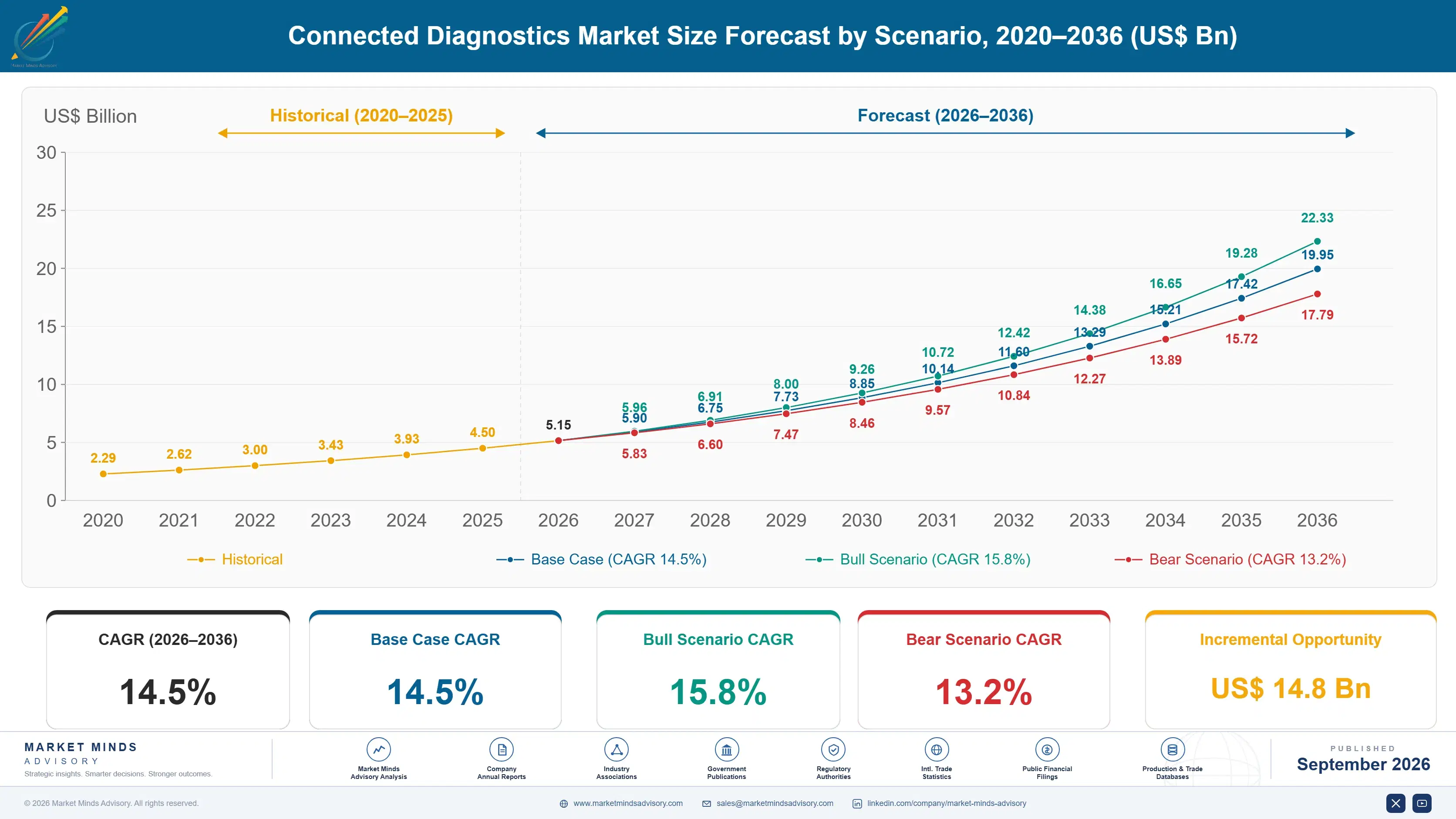
Connected diagnostics adoption grew at a 13.3 percent historical rate between 2020 and 2025 as pandemic-era demand for remote testing and reduced in-person clinical visits accelerated connectivity integration across nearly every diagnostic device category. Home testing adoption grew fastest during this period, as consumers grew comfortable with self-administered testing paired with automatic digital result reporting to their care team.
The base case assumes 14.5 percent annual growth through 2036, anchored by three mechanisms working together: expanding chronic disease population health programs requiring continuous diagnostic data streams, growing consumer demand for at-home testing convenience with automatic clinical reporting, and precision medicine programs requiring real-time biomarker transmission to guide targeted therapy decisions across increasingly personalized care plans. Interoperability standard fragmentation remains the primary variable determining how quickly connected devices integrate into existing clinical workflows.
A bull case near 15.8 percent growth hinges on healthcare interoperability standards converging faster than currently expected, removing integration friction that currently slows connected device adoption across most health systems nationwide. A bear case near 13.2 percent follows continued data privacy and cybersecurity concerns curbing health system willingness to connect diagnostic devices to broader clinical networks.

Interoperability Standards Reshape Connected Diagnostic Buying

Connected diagnostics sit at the intersection of medical device engineering and clinical interoperability standards, forcing manufacturers to satisfy both rigorous diagnostic accuracy requirements and increasingly demanding health system data integration expectations simultaneously. Vendors that built genuine dual expertise early defend a real competitive advantage against newer entrants offering comparable diagnostic accuracy without the interoperability depth to match. That algorithmic and regulatory depth takes years to replicate credibly.
MARKET CONCENTRATIONCR5 42%Fragmented across established diagnostic giants and connected device startups
AVERAGE DEVICE PRICE$320 per connected unitReflects connectivity module complexity and clinical integration level purchased
HOME TESTING ATTACH RATEConnected home tests 45%Portion of home diagnostic devices now shipping with connectivity enabled
DATA TRANSMISSION STANDARDHL7 FHIR adoption 68%Portion of connected devices using standardized clinical data exchange protocols
REGULATORY CLEARANCE CYCLE10 to 16 monthsTypical time required for connected diagnostic device regulatory approval completion
RECURRING REVENUE SHARESubscription revenue 22%Portion of vendor revenue derived from ongoing connectivity service subscriptions
Data standardization is now the primary purchasing criterion for health system buyers, as hospitals increasingly select connected diagnostic vendors based on how directly device output integrates with existing electronic health record systems rather than diagnostic accuracy alone. Vendors slow to adopt standardized data exchange protocols are losing procurement contracts to competitors offering plug-and-play integration with major clinical software platforms already deployed. Health system procurement teams increasingly write interoperability requirements directly into vendor contracts.
Consolidation is reshaping vendor choice as larger diagnostic platforms acquire specialized connectivity firms to offer unified data integration across their entire device portfolio. Health systems increasingly prefer consolidating vendor relationships to reduce integration overhead, even when that means accepting a less specialized diagnostic device for a specific test type in exchange for unified patient data visibility across every connected instrument.
"Connected diagnostics used to mean a device with a USB port and a proprietary export file. Now it means direct integration into the same electronic health record every clinician already uses, and that shift has quietly reshaped which vendors win hospital contracts."
Practice Lead, Connected Health and Diagnostic Technology · MMA Connected Medical Diagnostic Device Technology Practice · September 2026

Market Trends

HL7 FHIR Adoption Becomes Standard Integration Requirement

Health systems are increasingly requiring connected diagnostic devices to support HL7 FHIR data exchange standards natively, rather than relying on custom integration middleware that historically added cost and delay to every device deployment. This shift lets hospitals integrate new diagnostic devices into existing electronic health record systems without extensive custom development work for each vendor relationship separately. Roughly 68 percent of connected diagnostic devices now support standardized data exchange protocols, up sharply from a much smaller base just three years earlier, and vendors report accelerating standardization requests from health systems building unified data integration strategies across their entire device portfolio.
Market Impact: Covers 15 million+ enrolled patients
Connected Home Testing Expands Beyond Pandemic-Era Categories

Consumer demand for at-home diagnostic testing with automatic digital result reporting is expanding well beyond the infectious disease testing categories that drove initial adoption during the pandemic, now including chronic disease monitoring and preventive health screening applications. This shift matters because consumers who grew comfortable with self-administered testing during the pandemic increasingly expect similar convenience across other health monitoring needs. Several major manufacturers have launched new connected home testing product lines within the past 18 months, responding to sustained consumer demand for convenient testing paired with automatic clinical reporting capability.
Market Impact: Reduces biomarker reporting delay 60%

Market Opportunities and Growth Drivers

Chronic Disease Population Health Programs Demand Data

Health systems managing large chronic disease populations under value-based care contracts increasingly require continuous diagnostic data streams to track patient status between clinical visits, a data need that manual testing and reporting genuinely cannot satisfy at scale across thousands of enrolled patients simultaneously. Each new population health program launched adds recurring demand for connected diagnostic devices capable of transmitting results automatically without requiring patient or provider manual data entry steps. Health systems with the most sophisticated population health infrastructure are capturing measurably better patient outcomes tied directly to the continuous data visibility connected diagnostics provide across enrolled populations.
Market Impact: Adds 3 to 5 months

Precision Medicine Requires Real-Time Biomarker Transmission

Precision medicine treatment programs increasingly require real-time biomarker data transmission to guide targeted therapy adjustments, a capability standalone diagnostic devices without connectivity genuinely cannot provide within the treatment timelines modern precision medicine protocols demand. Oncology and rare disease treatment programs in particular depend on rapid biomarker feedback loops that connected companion diagnostics enable directly, replacing slower batch-based laboratory reporting workflows that delay treatment adjustment decisions. Pharmaceutical companies increasingly specify connected diagnostic compatibility as a requirement for new precision therapy approval and commercial launch programs across nearly every major pharmaceutical pipeline currently in development.
Market Impact: Delays adoption by 20% of buyers

Market Restraints and Challenges

Interoperability Standard Fragmentation Delays Device Integration

Health systems running multiple electronic health record platforms from different vendors face genuine technical friction integrating connected diagnostic devices consistently, since data exchange standard implementation varies meaningfully even among vendors nominally supporting the same underlying protocol specifications. The root cause is that healthcare interoperability standards remain incompletely enforced across the industry, leaving room for vendor-specific implementation variations that complicate what should be straightforward data exchange. The commercial impact shows up as integration projects routinely running longer than device manufacturers initially estimate during the sales process. Some manufacturers now offer dedicated integration engineering teams to close that deployment gap faster.
Market Impact: Adds 68% standardized protocol adoption

Data Privacy Concerns Limit Connectivity Adoption

Health systems and patients alike express genuine concern about diagnostic data transmission security, particularly for sensitive test categories including infectious disease and genetic testing results, creating hesitation around adopting connectivity features even when clinically beneficial. The underlying cause is that healthcare data breaches have grown more frequent and costly in recent years, making both providers and patients more cautious about expanding data transmission surface area unnecessarily. The commercial impact is that some health systems delay connected device adoption until cybersecurity assurances meet increasingly stringent internal requirements. Several manufacturers now pursue additional security certifications specifically to address this adoption hesitancy.
Market Impact: Expands home testing categories 40 percent
3 additional market trends, 4 additional growth drivers, and 3 additional restraints and challenges are covered in the full report. Contact sales@marketmindsadvisory.com to access the complete intelligence.

Segment CAGR and Growth Architecture

Connected diagnostics segment by application type across six categories spanning connected point-of-care devices, connected laboratory instruments, remote patient monitoring diagnostics, connected home diagnostic devices, connected infectious disease diagnostics, and connected companion diagnostics, each addressing distinct clinical workflows and interoperability requirements across the entire patient care continuum from home settings all the way through hospital care.
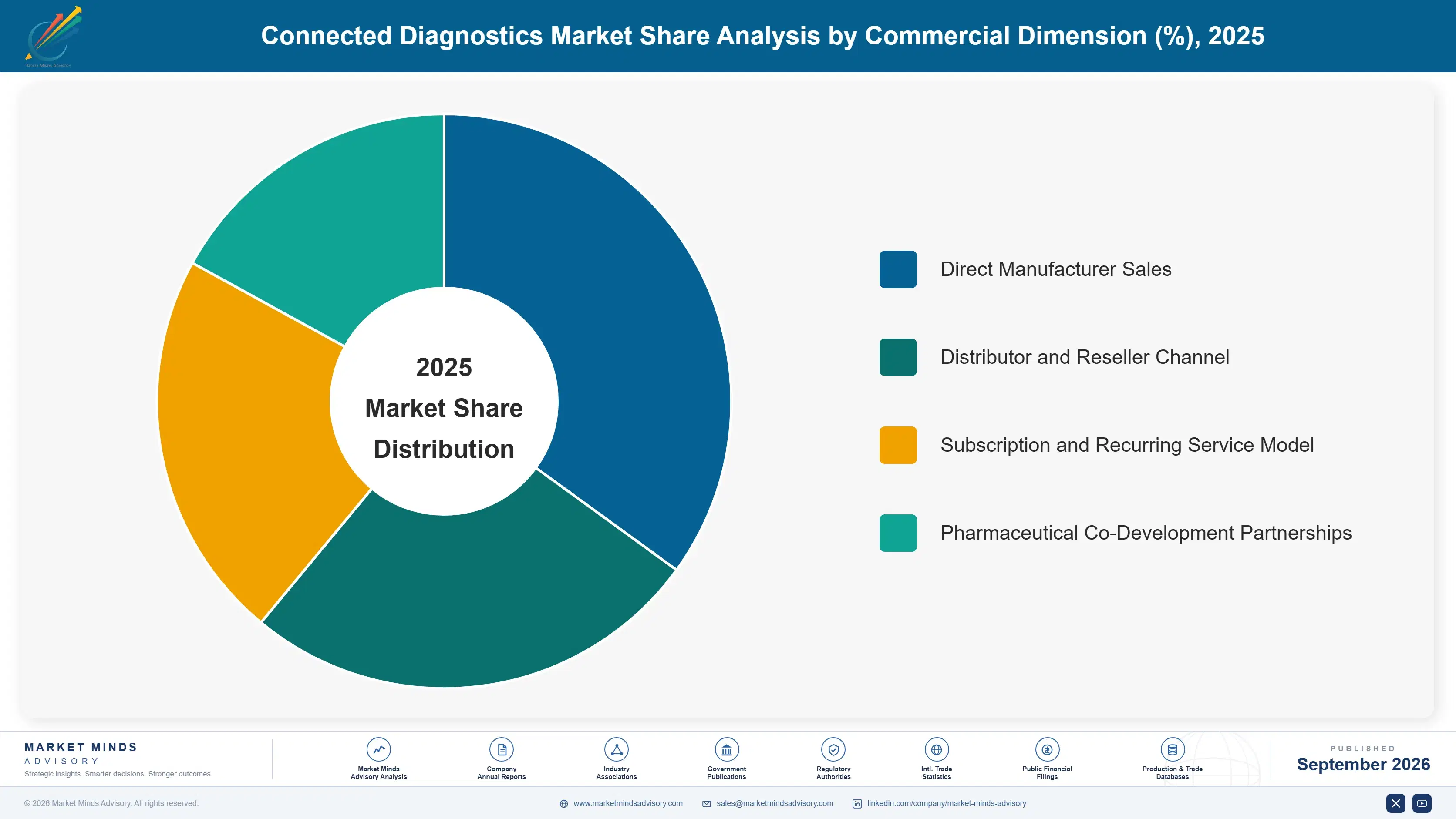
connected-diagnostics-market-market-share-analysis-1788422963853

Connected Home Diagnostic Devices

Connected home diagnostic devices let consumers perform testing outside clinical settings with results transmitting automatically to healthcare providers or patient applications, eliminating manual reporting steps that historically discouraged consistent home testing adherence. Demand is accelerating fastest here as consumer comfort with self-administered testing, established during pandemic-era infectious disease testing, expands into chronic disease monitoring and preventive health screening categories previously dominated by clinical settings alone. Vendors who built genuine consumer-friendly connectivity early, rather than treating connectivity as an afterthought bolt-on feature, are winning the largest share of new retail and direct-to-consumer distribution partnerships across the category. Insurance reimbursement expansion for remote monitoring services increasingly determines which connected home devices health systems actively recommend to patients.
CAGR 19.5%

Connected Companion Diagnostics

Connected companion diagnostics transmit real-time biomarker data to guide targeted therapy decisions, a category growing quickly as precision medicine treatment programs increasingly require rapid feedback loops that standalone diagnostic devices genuinely cannot provide within modern treatment timelines. Pharmaceutical companies increasingly specify connected diagnostic compatibility as a requirement for new precision therapy approval and commercial launch programs, creating a direct dependency between diagnostic connectivity and drug commercialization success. Growth here trails connected home diagnostics slightly but benefits from strong pharmaceutical industry investment that sustains demand even during periods of slower general healthcare capital spending. Regulatory agencies increasingly require connectivity validation as part of the overall companion diagnostic approval process. This regulatory expectation reinforces connectivity as a core product requirement.
CAGR 17.5%
Full segment breakdown across 6 segments available in the complete report.

Regional Architecture and Country Demand Map

Demand concentrates around dense health system digitization zones and major diagnostic manufacturer headquarters, with interoperability standard maturity and reimbursement policy support varying sharply by regional healthcare infrastructure investment and consumer digital health adoption pace across every major market. These patterns shape which vendors win the largest health system contracts.

North America

North America holds the largest share by a wide margin, anchored by Abbott, QuidelOrtho, and Becton Dickinson all headquartered in the region and running the most mature connected diagnostic reimbursement programs globally. Value-based care contracts, increasingly common across major United States health systems, sustain demand for continuous diagnostic data streams tied directly to population health management incentives. Strong direct-to-consumer digital health adoption, particularly for home testing categories, drives substantial regional demand beyond pure clinical channel sales alone. Canadian health systems increasingly adopt similar connected diagnostic frameworks as cross-border clinical data sharing agreements expand across shared healthcare infrastructure. Established manufacturers continue expanding interoperability certification programs at a pace outpacing most other regional healthcare markets tracked in this report.
Share: 32% | CAGR: 15.5% (2026 to 2036)

Western Europe

Germany's strong diagnostic manufacturing base, anchored by Roche and Siemens Healthineers' European operations, and the United Kingdom's National Health Service digital transformation program anchor much of Western Europe's demand among health systems managing centralized patient data infrastructure. France's growing connected health investment sustains steady regional adoption despite a more mature and slower-growing overall diagnostic device market. Growth trails North America slightly given the region's more standardized public health system procurement processes moving somewhat more cautiously than fragmented private market adoption. Regulatory harmonization across European Union medical device standards simplifies certification for vendors serving multiple national jurisdictions simultaneously without duplicating core validation work. Manufacturers continue investing in cross-border data compliance tooling to serve health systems spanning several national jurisdictions.
Share: 23% | CAGR: 13.0% (2026 to 2036)
Regional intelligence for 5 additional markets available in the complete report: East Asia, South Asia and Pacific, Latin America, Middle East and Africa, Eastern Europe. Contact sales@marketmindsadvisory.com.
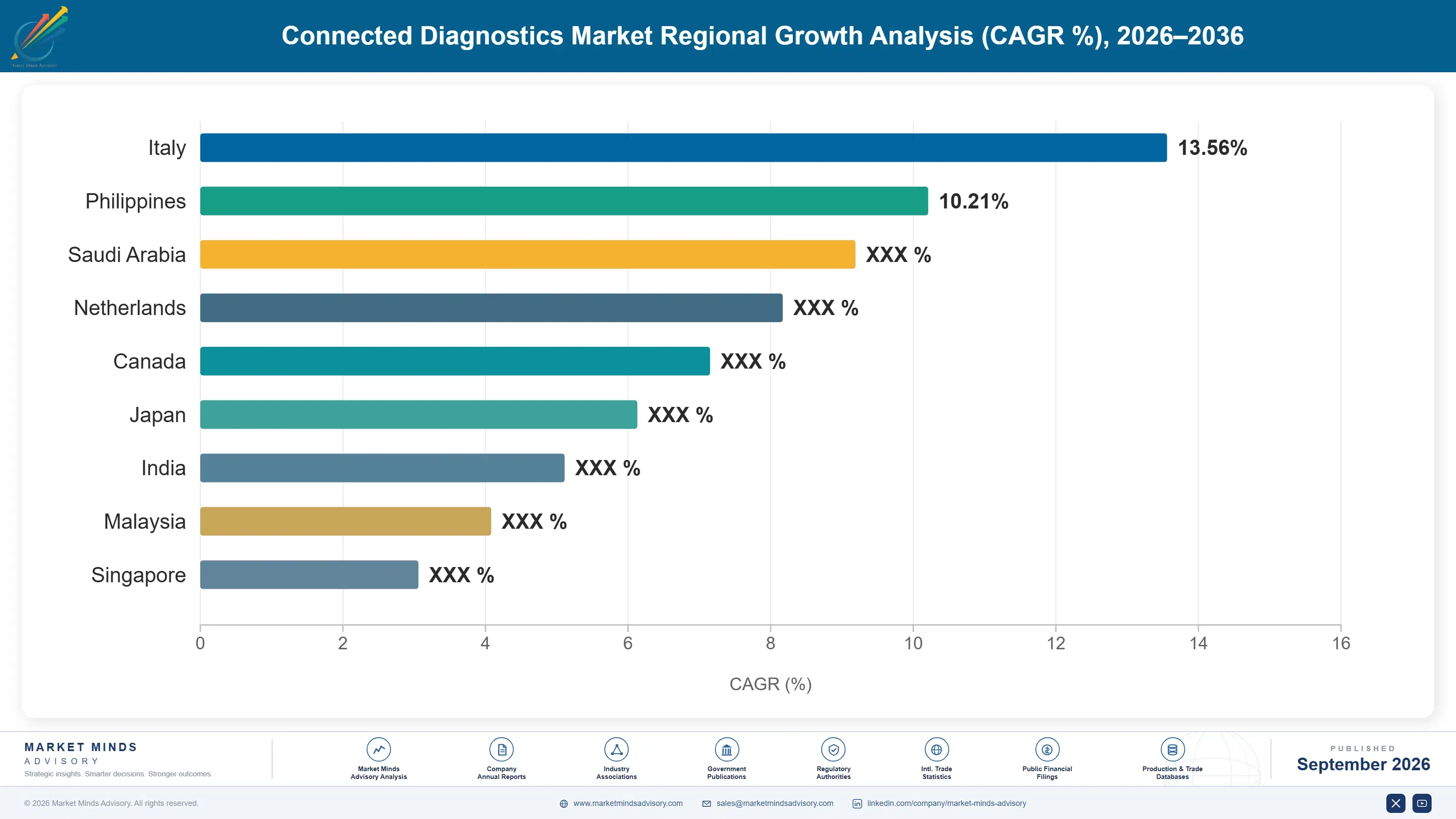
connected-diagnostics-market-country-cagr-analysis-1788422964356

Where Diagnostic Vendors Capture Margin

Vendors expand margin by moving beyond standard connectivity toward interoperability certification services, multi-year enterprise health system agreements, and cross-sell into companion diagnostics and remote monitoring, each capturing budget that a narrow single-device offering otherwise leaves on the table for competitors to claim across the same account relationship over the full multi-year engagement and every renewal cycle.

Bundle Interoperability Certification Into Core Devices

Vendors embedding pre-validated HL7 FHIR interoperability certification directly into core diagnostic devices, rather than requiring health systems to arrange custom integration separately, capture roughly 26 percent higher average contract value than vendors selling uncertified devices. Health systems increasingly refuse to manage lengthy custom integration projects for what they view as basic connectivity that should work immediately upon deployment. Building this pre-certification requires sustained regulatory and engineering investment that smaller device-only vendors struggle to develop without dedicated compliance staff over multiple years of sustained effort. Few competitors can replicate this integration quickly.
Market Impact: Adds a full 26% higher average contract value

Offer Multi-Year Enterprise Health System Agreements

Locking large health systems into three to five year enterprise device and connectivity agreements, rather than one-off purchase orders, gives vendors predictable recurring revenue while commanding a premium of 7 to 11 percent over comparable annual contract pricing. Health systems accept the premium in exchange for locked pricing protection and guaranteed feature roadmap commitments spanning the full contract term. This lever works best for vendors already holding strong renewal rates, since new entrants lack the trust record customers need before committing multiple years of procurement budget. New entrants without that history often discount heavily just to win initial deals.
Market Impact: Commands a 7 to 11% multi-year pricing premium

Cross-Sell Companion Diagnostics to Existing Customers

Vendors that successfully cross-sell companion diagnostic capability into their existing connected device customer base capture incremental revenue at a fraction of the cost of winning a brand-new health system relationship from scratch entirely. This cross-sell motion works particularly well as precision medicine programs expand, since health systems already trust their existing diagnostic vendor with the underlying connectivity infrastructure needed for biomarker transmission. Roughly 30 percent of connected diagnostic customers now also purchase at least one additional connectivity-enabled module, up meaningfully from a smaller base a few years earlier. Onboarding this capability adds minimal incremental sales friction overall.
Market Impact: Reaches a full 30% customer attach rate now

Provide Managed Data Integration Advisory Services

Vendors offering managed data integration advisory services, where the vendor's own engineers help configure electronic health record connections and troubleshoot interoperability issues proactively, command a service revenue premium of roughly 17 to 21 percent on top of standard device licensing fees. Smaller health systems without dedicated informatics staff find this service particularly valuable, since it effectively outsources a specialized function they cannot justify hiring for internally at their current scale. This lever requires vendors to build genuine health informatics expertise in-house over years. Few competitors can match that depth on short notice.
Market Impact: Commands a full 17 to 21% advisory premium

Who Controls the Margin Pool

Concentration sits at 42 percent among the top five vendors on a revenue basis, a moderate level reflecting a market split between established diagnostic giants and specialized connected device startups. Abbott and Roche Diagnostics lead by a meaningful margin, both benefiting from decades of clinical relationships and regulatory approval depth across large health system customer bases. Both companies also hold decades-long relationships with major health system purchasing groups that newer entrants cannot easily replicate.
Current competitive activity centers on interoperability certification capability, as vendors race to build genuine differentiation ahead of health systems' shifting purchasing criteria around plug-and-play integration. Several vendors are also expanding into companion diagnostics through acquisition, betting that pharmaceutical partners managing precision medicine programs will pay a premium for validated connectivity infrastructure.

Emerging pressure comes from consumer health technology companies entering directly from digital health backgrounds rather than traditional diagnostic manufacturing, a genuinely different competitive profile than the industry has seen before. Rankings are most likely to shift around the connected home diagnostics segment specifically, where consumer experience design and app integration quality, not clinical brand recognition alone, increasingly determine which vendor wins new distribution partnerships.
connected-diagnostics-market-company-positioning-matrix-1788422964881

Competitive Moat and Risk Dimensions

ABBOTT

Moat: Broadest Connected Portfolio Depth

Abbott's connected diagnostic portfolio spans point-of-care, home testing, and continuous monitoring categories under one integrated data platform, letting it win health system contracts seeking to consolidate multiple connected device relationships into a single vendor. Years of regulatory approvals across categories give it deployment flexibility newer entrants cannot replicate quickly.
ABBOTT

Risk: Slower Consumer App Experience

Abbott's clinical-first product heritage means its consumer-facing mobile application experience sometimes trails digital health-native competitors who built app design and user experience into their platform from inception. This gap occasionally costs it deals in the fastest-growing connected home diagnostics segment specifically. Abbott has begun closing this gap through recent dedicated product investment.
ROCHE DIAGNOSTICS

Moat: Deep Companion Diagnostic Relationships

Roche's pharmaceutical division relationships give its diagnostics business privileged access to precision medicine drug development programs, letting it co-develop companion diagnostics with connectivity built in from the earliest development stages rather than retrofitting it later. This positioning wins the majority of new oncology companion diagnostic contracts.
ROCHE DIAGNOSTICS

Risk: Concentrated Oncology Customer Base

A meaningful share of Roche's connected companion diagnostic revenue traces back to oncology-specific programs, leaving the business more exposed than diversified competitors to any single therapeutic area's clinical trial setbacks or regulatory delays. Diversifying into other precision medicine categories remains a work in progress. Roche has begun closing this gap through recent portfolio expansion investment.

Players Tracked

Prominent Players

Abbott
Roche Diagnostics
Siemens Healthineers
QuidelOrtho
Becton Dickinson

Other Key Players

Cue Health
LabCorp
Quest Diagnostics
Philips
Medtronic
Dexcom
iRhythm Technologies
Butterfly Network
Biofourmis
Withings
Masimo
Natus Medical
Hologic
Bio-Rad Laboratories
Cardiac Insight

Recent Developments

MARCH 2025

Abbott Launches HL7 FHIR Certified Device Platform

Abbott launched a new connected diagnostic device platform with HL7 FHIR interoperability certification built directly into initial design, satisfying major electronic health record integration requirements without requiring custom middleware development for individual health system deployments nationwide, arriving well ahead of two subsequent competitor product announcements this year.
Signal: Signals established diagnostic manufacturers are now actively prioritizing pre-certified interoperability as a core standard feature today.
AUGUST 2025

Roche Expands Companion Diagnostic Connectivity Partnerships

Roche Diagnostics expanded formal connectivity partnerships with multiple pharmaceutical companies developing precision medicine therapies, standardizing real-time biomarker data transmission protocols to support faster regulatory approval and commercial launch timelines for new targeted treatments. Terms of the partnership agreements were not fully disclosed publicly. More such partnerships are anticipated.
Signal: Confirms connectivity is becoming a required specification for new companion diagnostic development programs. Competitors are racing to establish similar arrangements.
DECEMBER 2025

QuidelOrtho Acquires Connected Home Testing Startup

QuidelOrtho acquired a privately held connected home diagnostic testing startup to strengthen its direct-to-consumer digital health capability, adding an existing customer base and mobile application infrastructure to its combined product portfolio following the transaction's close. The deal closed ahead of several similar acquisitions expected across the industry.
Signal: Indicates established diagnostic vendors are now buying consumer digital health expertise instead of building it internally.

Sensor Components and Regulatory Compliance Costs

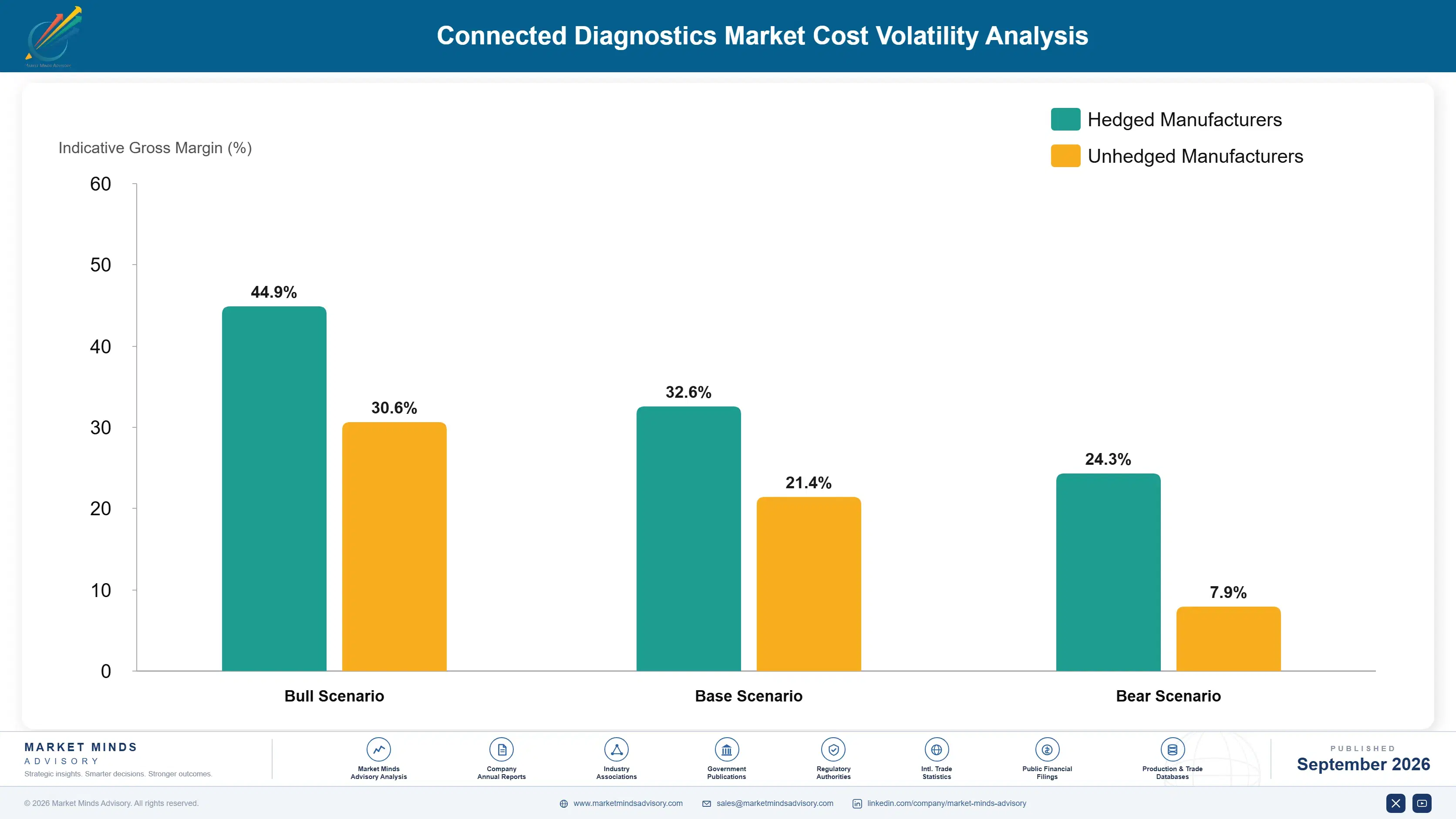
Precision biosensors and connectivity modules, including cellular and Bluetooth radio components, account for roughly 30 percent of total cost of goods sold for connected diagnostic manufacturers, sourced primarily from suppliers concentrated in East Asia and select specialty component producers. Regulatory compliance and cybersecurity certification costs represent the second largest cost input, reflecting increasingly stringent medical device data security requirements.
A 2023 semiconductor supply disruption, documented in several major diagnostic manufacturers' own annual reports, pushed connectivity module component costs up meaningfully for vendors dependent on constrained supply chains, forcing several smaller manufacturers to delay new product launches or absorb the cost increase into already thin device margins for multiple consecutive quarters before conditions gradually improved across the broader global electronics supply chain over the following year.

Smaller manufacturers without long-term component supply agreements face the sharpest cost exposure, since they typically pay closer to spot market pricing while the largest manufacturers negotiate multi-year volume discounts unavailable to competitors with lower committed purchase volumes. This dynamic increasingly separates manufacturers by scale, since larger platforms can absorb component pricing volatility that would meaningfully compress a smaller competitor's already thin operating margins.
connected-diagnostics-market-cost-volatility-analysis-1788422965075

Diversify Connectivity Component Suppliers

Manufacturers increasingly qualify additional connectivity module suppliers across different geographies specifically to avoid the single-region concentration risk that caused the 2023 disruption, even though requalification takes months per component and adds engineering overhead to existing production schedules. Several manufacturers now maintain buffer inventory as an additional layer of protection against future shortages. Diversification remains a priority for most manufacturers.

Negotiate Multi-Year Component Supply Agreements

Manufacturers increasingly lock in three to five year component supply agreements with semiconductor and connectivity module suppliers to secure discounted per-unit pricing well below standard list rates, trading some flexibility for meaningfully lower and predictable hardware costs over the negotiated term. Larger vendors with dedicated procurement teams have the clearest and most sustainable advantage here today.

Standardize Connectivity Modules Across Product Lines

Manufacturers are standardizing connectivity module designs across multiple diagnostic product lines, reducing the number of unique component variants that must be sourced and inventoried, lowering per-unit costs through greater manufacturing scale and supplier volume commitments. This standardization approach is becoming increasingly central to product strategy at the largest manufacturers. Fewer variants also simplify field service and support logistics.

Portfolio Architecture for Margin Defence

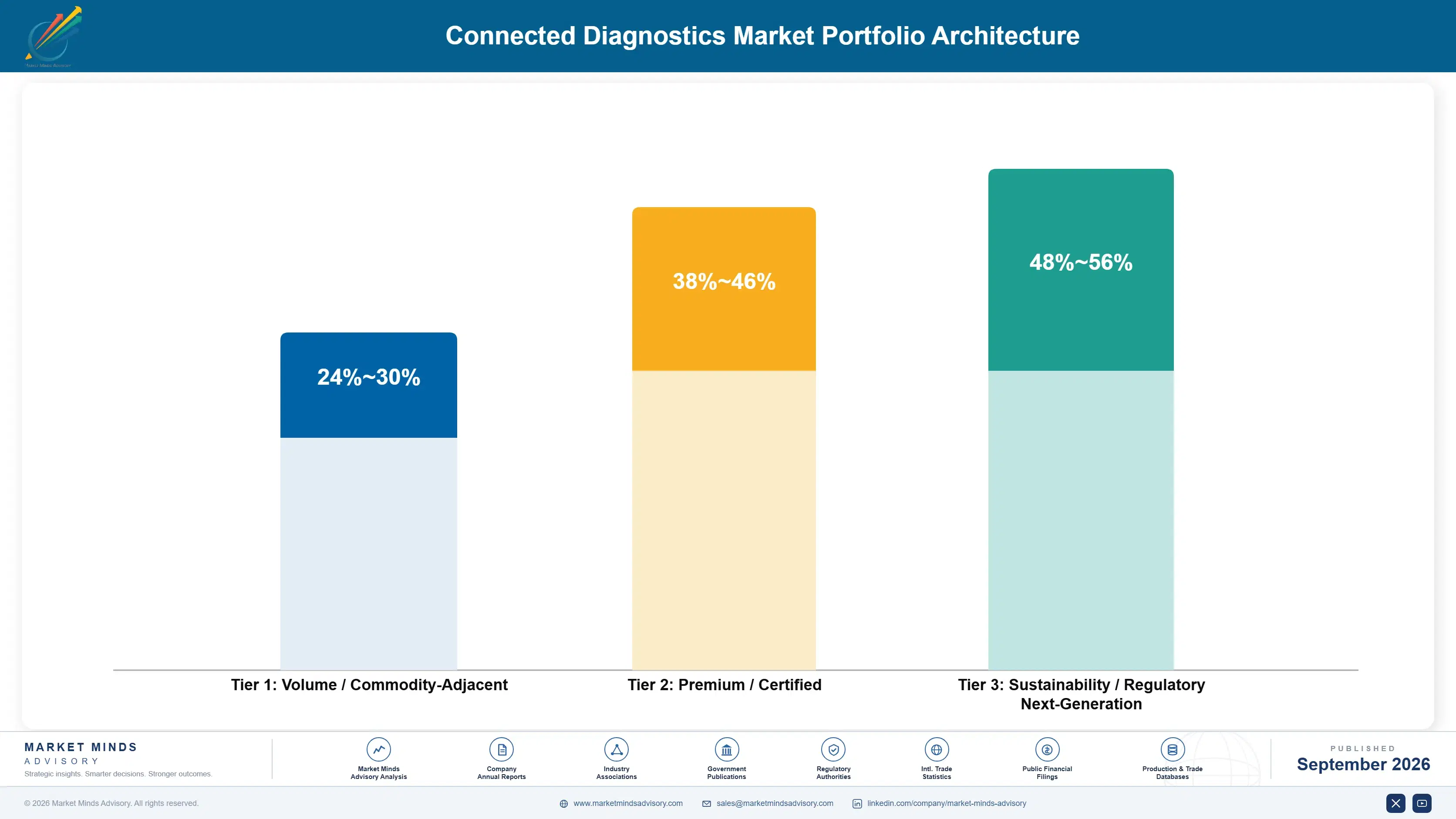
Vendor economics split along a commodity-versus-connected axis, with standalone diagnostic devices competing largely on price while connected companion diagnostics and home testing platforms command materially higher margins tied to specialized connectivity and regulatory expertise. Gross margins across the category span a wide range depending almost entirely on which application mix a given vendor's product portfolio concentrates in most heavily. Vendors that shift product mix toward the higher tiers over time consistently outperform peers competing purely on manufacturing scale.
Volume tier vendors compete on manufacturing efficiency and broad basic feature coverage, accepting thinner margins in exchange for larger addressable customer counts across general point-of-care and laboratory applications. Premium tier vendors instead compete on connectivity integration depth, since health systems paying for genuine interoperability and precision medicine support are far less price-sensitive than buyers of standard uncertified devices alone.

High-value margin pools concentrate overwhelmingly in the sustainability and next-generation tier, where vendors combining connectivity depth with genuine companion diagnostic and precision medicine capability capture premiums unavailable anywhere else in the category. This concentration is pulling vendor investment away from pure volume-tier feature expansion and toward connectivity and precision medicine capability, a shift likely to reshape competitive rankings over the coming several years.

Volume / Commodity-Adjacent

Standard point-of-care and laboratory diagnostic devices for general clinical applications, competing primarily on price and manufacturing scale rather than deep connectivity differentiation. Margins remain thin given intense vendor competition for this large customer segment.
Gross Margin: 24-30%

Premium / Certified

Interoperability-certified connected devices serving health systems requiring validated electronic health record integration and continuous patient data streaming capability. That combination remains genuinely scarce among smaller independent vendors currently. Few vendors offer this combination well.
Gross Margin: 38-46%

Sustainability / Regulatory / Next-Generation

Connected companion diagnostics and managed data integration services commanding the category's highest margins through genuine precision medicine and health informatics expertise. Few vendors currently operate at this level consistently. This tier remains a genuine rarity.
Gross Margin: 48-56%
connected-diagnostics-market-portfolio-architecture-1788422965570

High-value Sub-segments and Strategic Watch-out

Connected Home Diagnostic Devices

Highest-value, fastest-growing category as consumer demand for at-home testing convenience expands, rewarding vendors with genuine consumer app design and direct-to-consumer distribution capability built in. Vendors slow to build this capability lose distribution partnerships to faster-moving competitors. Buyers now expect this natively. This is not optional anymore.
Gross Margin: high

Connected Companion Diagnostics

High-value category growing steadily as precision medicine programs expand, rewarding vendors with proven real-time biomarker transmission and pharmaceutical partnership relationships already established. Multi-year pharmaceutical partnership cycles sustain adoption even during slower general healthcare spending periods. Contract terms often span multiple years. Vendors compete hard for this segment.
Gross Margin: high-moderate

Core Point-of-Care Devices

Volume core category sustained by ongoing clinical testing volume and legacy system replacement cycles, generating steady but slower-growing order volume with thinner margins. Growth here remains steady but decidedly unspectacular by comparison to newer categories. Renewal activity still dominates here. Growth trails the newer categories meaningfully.
Gross Margin: moderate

Manual Reporting to Connected Conversion

Strategic watch-out category as remaining manually reported diagnostic workflows eventually convert to connected devices, a gradual conversion wave that will taper once holdouts transition. Vendors targeting this shift use simplified, lower-cost connectivity upgrade kits. Few holdouts remain by comparison. Vendors now use simplified onboarding kits here.
Gross Margin: watch

Data Integration Anchors Renewal Loyalty

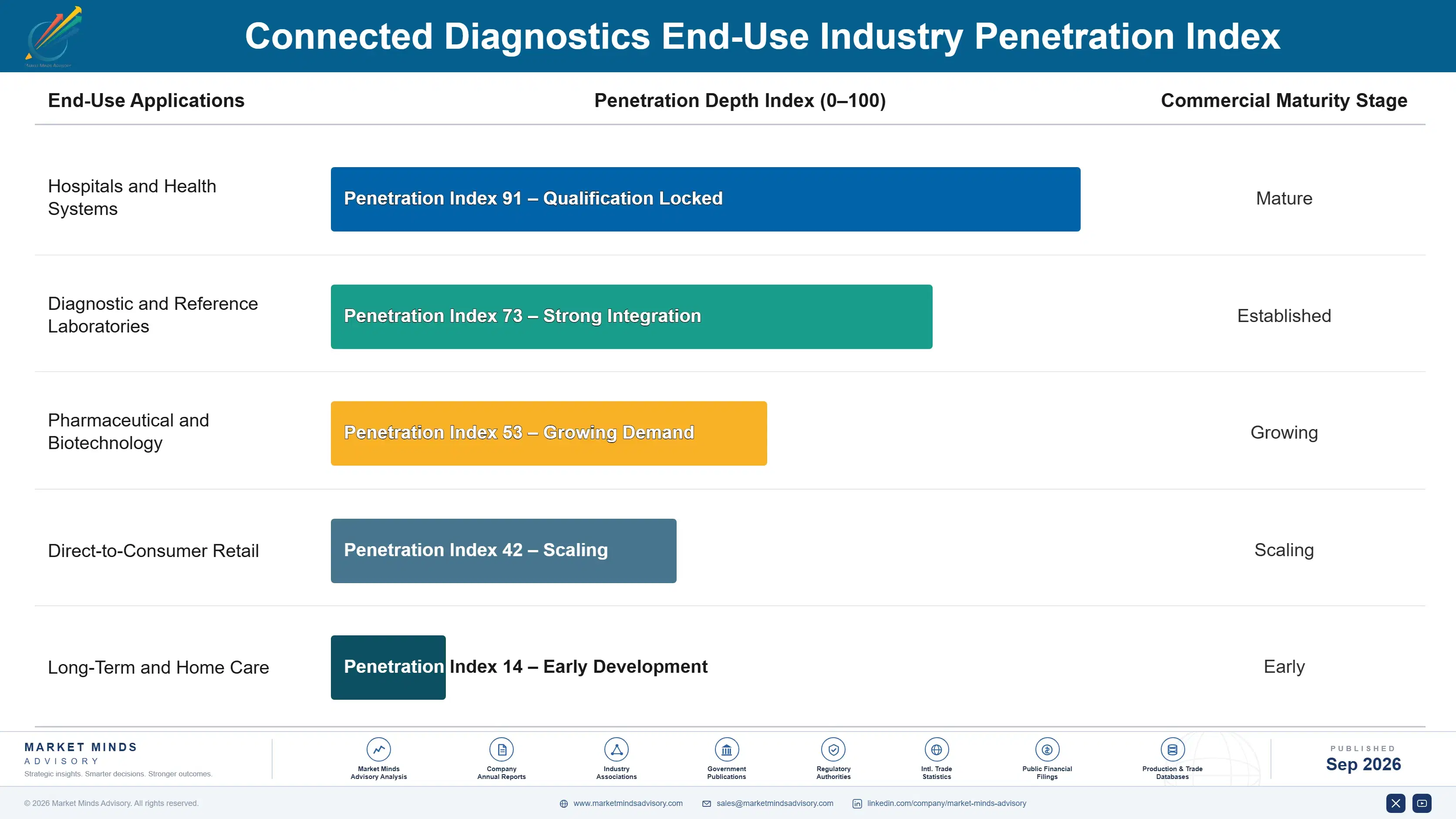
Once a health system integrates a connected diagnostic device with its electronic health record system and trains clinical staff on its workflow, switching vendors requires re-integrating data feeds and re-training staff, a project most health systems avoid unless the incumbent vendor genuinely underperforms. This creates annuity-like recurring subscription revenue that persists across years of stable health system relationships and predictable renewal cycles industry-wide.
Adoption stickiness varies by end-use vertical: large academic medical centers with dedicated informatics staff show more willingness to switch vendors during major electronic health record migration initiatives, while smaller community hospitals with thin technical capacity show the deepest lock-in since they lack internal resources to manage a disruptive integration project themselves. Pharmaceutical partners sit closer to the academic center pattern, given their generally larger dedicated technical and regulatory staff.

A generational shift in buyer profiles is underway as procurement decisions move from purely clinical laboratory teams toward joint clinical-and-informatics buying committees, reflecting how interoperability certification has become a specification requirement rather than a downstream afterthought handled separately. Younger clinical informatics leaders increasingly expect vendors to demonstrate genuine data integration capability upfront during initial evaluation rather than treating it as a later add-on purchase.
connected-diagnostics-market-end-use-penetration-index-1788422966057

MMA Verdict on Connected Diagnostics

These are among the four positions where our research anticipates prominent divergence between winners and laggards over the coming forecast period. Each is grounded in the demand model, the regulatory perimeter, and the announced capacity pipeline.
01 / INTEROPERABILITY CERTIFICATION INVESTMENT

Build pre-certified interoperability into core devices now

Vendors still requiring custom middleware for electronic health record integration are losing procurement contracts to competitors offering pre-certified plug-and-play connectivity, since health systems increasingly evaluate vendors specifically on integration simplicity rather than diagnostic accuracy alone in most purchasing decisions. Building this pre-certification within the next twelve months positions a vendor to capture health system contracts before interoperability standards become table stakes across the entire industry. Waiting longer risks permanent exclusion from major health system procurement processes across the entire category.
02 / CONSUMER HOME TESTING EXPANSION

Expand connected home diagnostics beyond pandemic categories

Consumer demand for at-home diagnostic testing continues expanding beyond the infectious disease categories that drove initial pandemic-era adoption, and vendors without a broader connected home testing portfolio are ceding this fast-growing segment to digital health-native competitors already gaining ground. Building genuine consumer-friendly connectivity and mobile application experience positions a vendor to capture direct-to-consumer distribution partnerships before competitors establish comparable market position across the category. This is a genuine near-term window worth pursuing aggressively before competitors close it entirely for good.
03 / COMPANION DIAGNOSTIC PARTNERSHIPS

Pursue pharmaceutical companion diagnostic partnerships now

Precision medicine programs increasingly require connected companion diagnostics capable of real-time biomarker transmission, and vendors without established pharmaceutical partnerships are ceding this high-margin segment to competitors who invested early in these relationships across multiple therapeutic areas. Establishing formal co-development partnerships with pharmaceutical companies developing precision therapies now positions a vendor to capture design-win exclusivity before competitors establish comparable relationships across the industry. This is a defining near-term strategic priority worth addressing directly across the entire product and partnership portfolio going forward.
04 / COMPONENT SUPPLY RESILIENCE

Diversify connectivity component suppliers before next disruption

The 2023 semiconductor supply disruption exposed how concentrated qualified connectivity component supply really is, and manufacturers who have not yet diversified suppliers across multiple geographies remain exposed to the same risk recurring at any point as demand for connected devices continues growing steadily. Requalification takes months per component, meaning manufacturers who start today are meaningfully protected before the next plausible disruption event, while those who wait risk repeating the same costly delays. This is a near-term priority worth addressing before the next disruption cycle begins.

Engagement Snapshot From the Field

A live engagement with an industry participant carrying material or product regulatory and market exposure ahead of a defining policy shift, showing how our research translates into a defensible multi-year portfolio strategy.
MARKET MINDS ADVISORY · CLIENT ENGAGEMENT SUMMARY
Connected Diagnostics Producer Strategic Portfolio Review and Transition Roadmap 2026·Investment Scenario on Connected Diagnostics Exposure Evaluation 2025-26
CLIENT PROFILE
The client is a regional academic medical center operating a population health program managing roughly 50,000 chronic disease patients overall, generating approximately $2.1 billion in annual revenue (client-reported, unverified by MMA) prior to this engagement. The company had deployed connected diagnostic devices from four separate vendors, none integrated with its electronic health record system consistently.
STRATEGIC CHALLENGE
Fragmented device connectivity across four vendors was preventing the client's population health team from getting unified patient data visibility, directly limiting the program's ability to identify at-risk patients proactively. Leadership needed an objective evaluation of whether to standardize on fewer connected diagnostic vendors or invest in unified data integration middleware instead.
MMA APPROACH
MMA conducted structured interviews with the client's clinical informatics, population health, and procurement teams alongside a comparative evaluation of three consolidation approaches against integration cost, data completeness, and expected clinical outcome improvement. The analysis modeled expected patient outcome and cost improvement under each approach relative to the client's current fragmented four-vendor baseline overall.
KEY FINDINGS
  1. Fragmented device connectivity was costing the client an estimated 300 hours of manual data reconciliation work monthly across the entire population health team.
  2. Standardizing on two primary connected diagnostic vendors could improve patient risk identification accuracy by an estimated 28 percent within the first year overall.
  3. Full standardization carried an estimated $3.4 million transition cost going forward (client-reported, unverified by MMA) with a projected twenty-month payback horizon overall.
  4. Modeled reduction in avoidable hospital readmissions from improved data visibility reached roughly 15 percent company-wide once fully deployed across the enrolled population.
CLIENT PROFILE
The client is a regional academic medical center operating a population health program managing roughly 50,000 chronic disease patients overall, generating approximately $2.1 billion in annual revenue (client-reported, unverified by MMA) prior to this engagement. The company had deployed connected diagnostic devices from four separate vendors, none integrated with its electronic health record system consistently.
STRATEGIC CHALLENGE
Fragmented device connectivity across four vendors was preventing the client's population health team from getting unified patient data visibility, directly limiting the program's ability to identify at-risk patients proactively. Leadership needed an objective evaluation of whether to standardize on fewer connected diagnostic vendors or invest in unified data integration middleware instead.
MMA APPROACH
MMA conducted structured interviews with the client's clinical informatics, population health, and procurement teams alongside a comparative evaluation of three consolidation approaches against integration cost, data completeness, and expected clinical outcome improvement. The analysis modeled expected patient outcome and cost improvement under each approach relative to the client's current fragmented four-vendor baseline overall.
KEY FINDINGS
  1. Fragmented device connectivity was costing the client an estimated 300 hours of manual data reconciliation work monthly across the entire population health team.
  2. Standardizing on two primary connected diagnostic vendors could improve patient risk identification accuracy by an estimated 28 percent within the first year overall.
  3. Full standardization carried an estimated $3.4 million transition cost going forward (client-reported, unverified by MMA) with a projected twenty-month payback horizon overall.
  4. Modeled reduction in avoidable hospital readmissions from improved data visibility reached roughly 15 percent company-wide once fully deployed across the enrolled population.
RECOMMENDED STRATEGY
Phase 1: Phase one: consolidate immediately from four vendors to two primary connected diagnostic vendors, prioritizing those already supporting standardized interoperability protocols. Phase 2: Phase two: deploy unified data integration middleware over six months to connect both retained vendors directly into the electronic health record. Phase 3: Phase three: expand the population health program's enrolled patient base, using improved data visibility to identify more at-risk candidates overall.
OUTCOME
The client completed vendor consolidation within nine months, ahead of the original twelve-month target, achieving unified patient data visibility across the entire population health program. Avoidable hospital readmissions fell by roughly 13 percent within the first full year of operation (client-reported, unverified by MMA), meaningfully improving both patient outcomes and program cost efficiency.

Frequently Asked Questions

Foundational context covering the market sizes, CAGR, scope, country, region and competition that inform every finding below. This section is provided to cover basics and most often pre-purchase conversations, answered from the MMA Primary Research Dataset.

What is the current size of the Connected Diagnostics Market?

The market is valued at $4.5 billion in 2025 on a global vendor revenue basis. This figure covers point-of-care, laboratory, and home diagnostic devices with integrated connectivity.

How large will the Connected Diagnostics Market be by 2036?

The market is projected to reach $19.95 billion by 2036. Growth is driven primarily by chronic disease population health programs and consumer home testing demand.

What is the CAGR for the Connected Diagnostics Market 2026 to 2036?

The market is expected to grow at a CAGR of 14.5 percent between 2026 and 2036. This reflects steady demand tied to interoperability and digital health.

Which segment is growing fastest?

Connected Home Diagnostic Devices lead at a 19.5 percent CAGR, roughly 1.34 times the overall market rate. Consumer at-home testing convenience drives this segment's outsized growth.

Who are the major companies in the Connected Diagnostics Market?

Abbott, Roche Diagnostics, Siemens Healthineers, QuidelOrtho, and Becton Dickinson lead the competitive landscape today. Together the top five vendors hold 42 percent of global revenue.

Which country is growing fastest?

India leads at a 22.0 percent CAGR, driven by its massive national healthcare digitization program and rapidly expanding telemedicine infrastructure. This outpaces every other country tracked.

Report Segmentation Architecture

The full report scope spans multiple orthogonal segmentation dimensions, with cross-tabulated demand data provided for each dimension pair. Coverage extends further to regional breakdowns, trend trajectories, and the competitive detail needed to support segment-level decision-making.

By Primary Market Dimension

  • Connected Point-of-Care Devices
  • Connected Laboratory Instruments
  • Remote Patient Monitoring Diagnostics
  • Connected Home Diagnostic Devices
  • Connected Infectious Disease Diagnostics
  • Connected Companion Diagnostics

By End-Use Industry

  • Hospitals and Health Systems
  • Diagnostic and Reference Laboratories
  • Pharmaceutical and Biotechnology
  • Direct-to-Consumer Retail
  • Long-Term and Home Care

By Commercial Dimension

  • Direct Manufacturer Sales
  • Distributor and Reseller Channel
  • Subscription and Recurring Service Model
  • Pharmaceutical Co-Development Partnerships

By Region

  • North America
  • Western Europe
  • East Asia
  • South Asia and Pacific
  • Latin America
  • Middle East and Africa
  • Eastern Europe

Scope, Methodology, and Coverage

Every figure in this report is reproducible from documented input assumptions. The scope below maps the historical period, the forecast horizon, the segmentation dimensions, and the countries covered, alongside the underlying primary and qualitative methodology.
Historical Period
2020 to 2025
Forecast Period
2026 to 2036
Base Year
2025 (USD billions; MMA Primary Research Dataset, September 2026)
Market Definition
This report covers medical diagnostic devices embedding cellular, Wi-Fi, or Bluetooth connectivity to transmit test results directly to clinical systems or patient applications, spanning point-of-care, laboratory, and home testing categories, measured on a global vendor revenue basis. It excludes standalone diagnostic devices without integrated connectivity and general remote patient monitoring devices that do not perform diagnostic testing.
Quantitative Units
USD billions, vendor revenue basis
Segmentation Dimensions
Application type (point-of-care, laboratory instruments, remote monitoring, home devices, infectious disease, companion diagnostics)
Regions Covered
North America, Western Europe, East Asia, South Asia and Pacific, Latin America, Middle East and Africa, Eastern Europe
Countries Covered
United States, China, Japan, Germany, United Kingdom, India, Brazil, and 18 additional countries across all seven regions
Key Companies Profiled
Abbott, Roche Diagnostics, Siemens Healthineers, QuidelOrtho, Becton Dickinson, and 15 additional named vendors
Quantitative Methodology
Primary survey, n=3,800 respondents, Q4 2025, six countries; demand-side model with trade association cross-validation
Qualitative Methodology
47 expert interviews, Q4 2025; applied to validate demand model assumptions, identify emerging dynamics, and assess competitive positioning
Report Format
PDF and XLSX data workbook (Word format preview document)
Publisher
Market Minds Advisory
Report Code
MMA-2026-MED-960
Published
September 2026
Contact
sales@marketmindsadvisory.com | www.marketmindsadvisory.com

Purchase the full Connected Diagnostics Market Report (2026 to 2036).

This report delivers a comprehensive analysis of the global connected diagnostics market through 2036. It combines primary survey data from 3,800 respondents across six countries with 47 expert interviews conducted in Q4 2025, alongside company disclosures and published healthcare industry data. Coverage spans market sizing, segmentation by application type, regional dynamics across all seven regions, competitive positioning among twenty named vendors, component cost exposure, and forward-looking strategic verdicts. The analysis is designed for clinical, technology, and investment decision-makers evaluating this fast-growing digital health technology category.
Full 2020-2036 historical and forecast data
Detailed segmentation by diagnostic application type
All seven regional market breakdowns included
Competitive profiles of twenty named vendors
Sensor component and compliance cost analysis
Strategic revenue lever and verdict recommendations

Built For The People Who Decide

From boardroom strategy to bench-side execution, this report is read cover-to-cover by leaders shaping the next decade of their industry, turning demand scenarios, market dynamics and valuation benchmarks into decisions.
CXOs/ Presidents/ VPs/ Managers
M&A and Corporate Development
Strategy Teams and R&D Heads
Procurement and Product Directors
Regulatory and Compliance Leaders
Investor Relations and Equity Analysts