Market Minds Advisory
Conference Microphone Market

Conference Microphone Market: Conference Microphone Market. Hybrid Meeting Standardization Drives Beamforming Array Adoption Across Enterprise Rooms

Sustained hybrid meeting adoption and enterprise room standardization mandates are pushing conference microphone demand toward beamforming array systems that integrate directly with unified communications platforms across most global markets today.

Lead Analyst

Published

September 2026

Make Smarter Decisions with Customized Research Insights

Request a free sample report and evaluate market opportunities, growth trends, and competitive dynamics relevant to your business needs.

2025 MARKET VALUE$1.9BMarket Size 2025
2036 FORECAST VALUE$4.7BBase Case , 2026 to 2036
CAGR 2026 TO 20368.5 %Bull 9.8% / Bear 7.2%
INCREMENTAL OPPORTUNITY$2.6BNet 10- year value creation
EXPANSION MULTIPLE2.26x2036 value over 2026 base
Strategic Levers
M&A Pipeline
Regional Outlook
Country Rankings
Competitive Intelligence
Segmental Deep-dive
Call-Us : 91 93563 13602

Executive Snapshot and Market Trajectory.

Conference microphone demand is shifting from basic tabletop and gooseneck models toward beamforming array systems that automatically track and isolate speaker voices across larger meeting rooms across most enterprise procurement categories today. Manufacturers report growing enterprise expectation for verifiable voice tracking even in mid-tier price segments across most retail channels.
North America and East Asia concentrate the bulk of both enterprise procurement and manufacturing, with the United States and China driving unified communications platform certification standards that premium integrators increasingly reference in specifications. Ceiling-mounted beamforming arrays grow fastest as enterprises standardize larger conference rooms previously served by multiple tabletop units requiring manual placement. Manufacturers investing early in unified communications certification are capturing disproportionate premium segment share.
Competition spans dedicated professional audio manufacturers building enterprise-grade beamforming technology and larger unified communications hardware vendors bundling microphones with broader room system packages, each competing under somewhat different procurement and integration dynamics entirely. Software-defined audio processing is becoming a meaningful differentiator as room systems increasingly rely on algorithmic voice isolation rather than purely mechanical microphone placement. Integrators report growing procurement interest in systems demonstrating verifiable voice isolation performance. This is reshaping legacy manufacturer budgets.
Market Definition
This report covers the global market for microphones designed for enterprise conference room and meeting space applications, including tabletop, gooseneck, ceiling-mounted, and wireless boundary microphones. It excludes consumer-grade USB microphones and broadcast studio microphones without conference room integration features.
Base Year Value
$1.9B in 2025 (MMA Primary Research Dataset, September 2026)
Forecast Period
2026 to 2036, eleven discrete annual values
CAGR
8.5% base case. Bull 9.8%. Bear 7.2%.
Fastest Growth Segment
Ceiling-Mounted Beamforming Array Microphones: 12.5% CAGR
Fastest Growth Country
India: 11.0% CAGR
Fastest Growth Region
South Asia and Pacific: 10.5% CAGR
Largest Region
North America: 32% of 2025 global value
Market Leaders
Shure, Sennheiser, Yamaha, Poly, ClearOne. Source: MMA Primary Research Dataset, July 2026.
Primary Survey
n=3,800 procurement and R&D decision-makers, Q4 2025, six countries
Methodology
Demand-side build-up, cross-validated against public data, 47 expert interviews

Conference Microphone Market Forecast Scenarios

conference-microphone-market-size-forecast-scenario-1790018552813
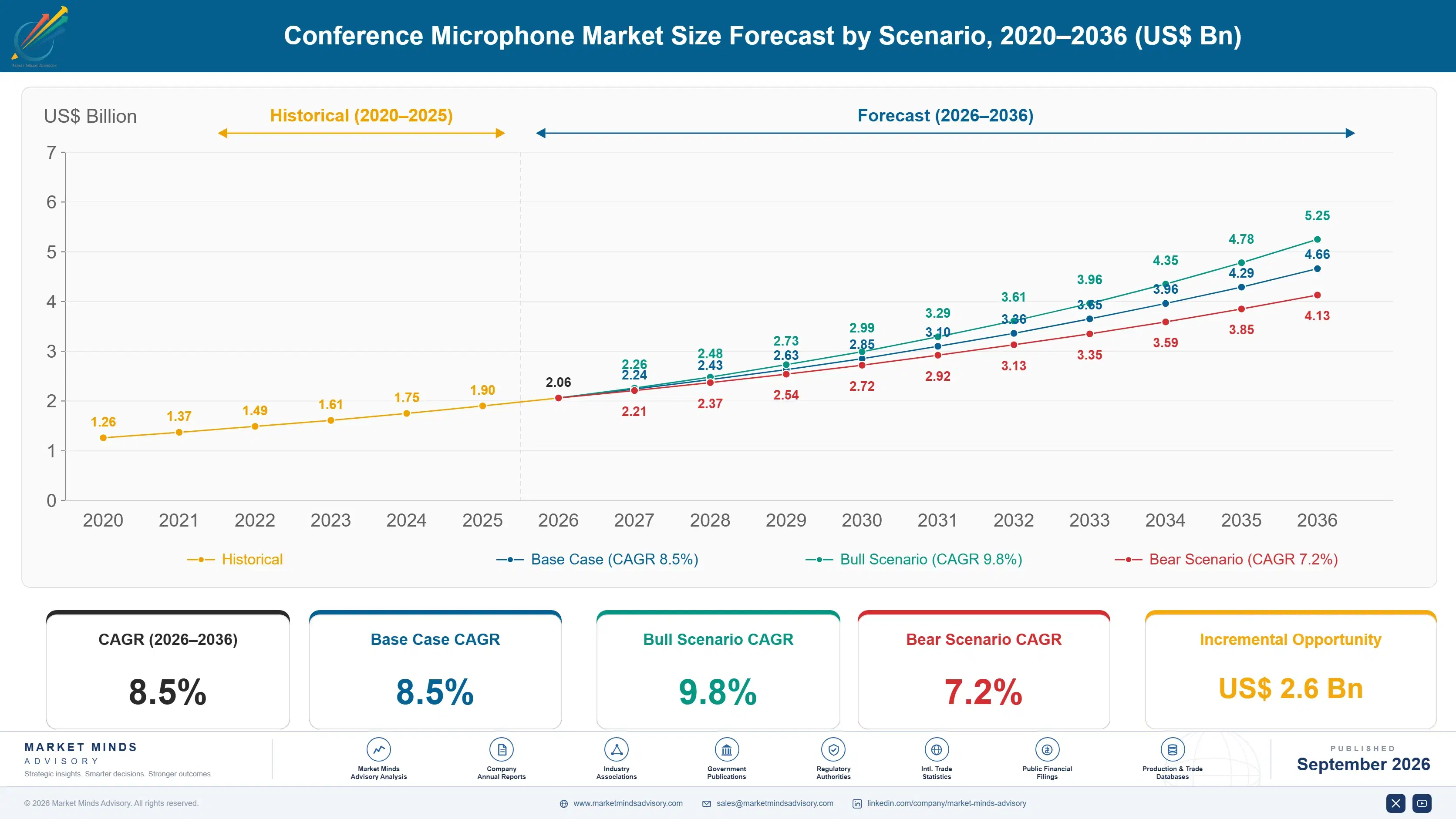
Between 2020 and 2025 conference microphone demand grew steadily as hybrid meeting adoption accelerated and enterprises standardized meeting room technology across corporate campuses, supporting a historical CAGR near 7.0 percent across the tracked historical period overall. Manufacturers used this period to invest in updated beamforming algorithm development and expanded certification testing across major unified communications platforms.
The base case assumes continued beamforming array adoption across mid-tier and premium enterprise room categories, sustained unified communications platform certification expansion among major hardware vendors, and gradual manufacturer investment in software-defined audio processing responding to sustained demand for reliable voice isolation across the full ten-year forecast period tracked in this analysis. Retail partnership expansion in several developed markets further reinforces this reformulation trend among mid-tier enterprise buyers seeking standardized room experiences.
The bull case assumes accelerated hybrid work standardization and enterprise room renovation cycles drive faster premium segment conversion than currently expected. The bear case assumes broader corporate real estate contraction and remote work normalization slow conference room investment meaningfully, particularly affecting premium beamforming systems competing against basic tabletop alternatives on price. Currency volatility in several producing markets adds further uncertainty to component sourcing costs for smaller manufacturers.

Beamforming Arrays Redefine Conference Room Value

Conference microphones have moved beyond passive sound pickup devices into intelligent room systems that combine array-based voice tracking, noise cancellation, and increasingly, direct integration with unified communications software platforms. Manufacturers report growing procurement conversations that begin with software integration requirements rather than acoustic specification alone.
MARKET CONCENTRATION46% CR5Top five manufacturers hold nearly half of global share
AVERAGE UNIT PRICE$650.00Per beamforming array system across major enterprise procurement markets
TOP PRODUCING COUNTRYChina 32%Leads global production by total manufacturing facility output
BEAMFORMING PENETRATION RATE28%Share of unit sales featuring automatic voice tracking currently
ROOM RENOVATION CYCLE LENGTH6 to 8 yearsTypical span before enterprises replace conference room audio systems
COMPONENT COST SHARE36% of COGSReflects microphone array and processing chip sourcing complexity
Beamforming array systems capable of automatically isolating and tracking speaker voices across larger conference rooms now anchor premium enterprise procurement, since IT departments value the reduced setup complexity relative to multiple tabletop units requiring manual placement and cabling. Hardware vendors increasingly bundle software licensing and cloud management subscriptions with microphone hardware sales, shifting revenue mix toward recurring streams. This shift mirrors broader enterprise hardware industry trends toward outcomes-linked service contracts rather than one-time capital sales.
Manufacturing remains concentrated in China, where established supply chains for microphone arrays, digital signal processing chips, and enclosure components support both branded and private label production for international integrators. Rising semiconductor costs and geopolitical trade tensions are prompting some manufacturers to diversify production across additional Southeast Asian manufacturing hubs. Local assembly partnerships are also emerging as a way to reduce import costs and satisfy domestic content procurement preferences.
"A conference microphone used to be judged on pickup range. Now it is judged on whether the software actually knows who is talking, and most systems still get that wrong."
Practice Lead, Enterprise Audio and Unified Communications · MMA Boundary Practice · September 2026

Market Trends

Beamforming Array Systems Displace Standalone Tabletop Units

Enterprises increasingly favor beamforming array systems combining multiple microphone elements with software-based voice tracking, avoiding the manual placement and cable management associated with deploying multiple standalone tabletop or gooseneck microphones across larger conference rooms. Manufacturers report array systems now representing a growing share of new procurement orders in enterprise rooms, with adoption spreading into smaller huddle rooms as unit pricing gradually declines with manufacturing scale. Several established manufacturers have discontinued standalone tabletop product lines entirely in favor of array-only new product development going forward. Retrofit packages are also emerging for enterprises unable to justify full replacement.
Market Impact: Adds 1.4 million rooms annual renovation
Unified Communications Platform Certification Becomes Procurement Requirement

Enterprise IT procurement teams increasingly specify certified compatibility with major unified communications platforms as a baseline requirement for new conference microphone purchases, reflecting broader enterprise software standardization and IT department demand for guaranteed interoperability without custom integration work. Manufacturers without established certification partnerships face exclusion from an increasing share of tender processes at large enterprise accounts. This requirement is reshaping competitive dynamics in favor of manufacturers with software development capability alongside traditional hardware engineering expertise. Smaller regional manufacturers are forming software partnerships to remain competitive in this changing landscape. Compliance timelines vary.
Market Impact: Adds 2.6 million huddle room units

Market Opportunities and Growth Drivers

Hybrid Meeting Standardization Drives Room Modernization

Enterprises standardizing hybrid meeting technology across corporate campuses are directly translating into larger conference room audio system procurement as IT departments replace legacy microphone systems unable to deliver consistent remote participant experiences. Several major employers have publicly committed to hybrid work policies specifically citing meeting room technology investment as a stated priority following pandemic-era remote work adoption that permanently changed baseline employee expectations. Manufacturers with certified enterprise-grade product lines are securing multi-room contracts well ahead of previous procurement cycles, reflecting this heightened urgency across corporate IT procurement agencies. Budget approvals continue rising steadily.
Market Impact: Cuts gross margin 5 points

Software-Defined Audio Processing Widens Application Access

Advances in software-defined audio processing are widening beamforming array applications beyond large boardrooms into smaller huddle rooms and open-plan collaboration spaces previously served only by basic tabletop microphones lacking directional tracking capability. New algorithm-driven noise cancellation and voice isolation features are broadening the participant base beyond dedicated conference rooms, adding incremental demand from informal meeting spaces entering the category. Integrators report consistent replenishment purchasing from established enterprise accounts, providing manufacturers with a demand floor that persists through broader capital spending downturns. Indoor collaboration space construction in urban markets is also broadening year-round access for teams.
Market Impact: Adds 3 to 5 hours

Market Restraints and Challenges

Semiconductor Price Volatility Pressures Manufacturing Margins

Digital signal processing chip prices fluctuate with broader semiconductor commodity cycles largely outside manufacturer control, squeezing margins during periods of rising input costs that cannot always be passed through to enterprise customers with fixed multi-year procurement pricing already negotiated. The root cause traces to conference microphone manufacturers competing for the same processing chips that consumer electronics, automotive, and telecommunications industries also depend on heavily. Manufacturers are mitigating exposure through longer-term chip supply contracts and increased use of alternative processing architectures requiring less specialized silicon. Recycling programs are expanding steadily across major production facilities.
Market Impact: Lifts array adoption 24 percent

Room Acoustic Variability Limits Universal Performance

Beamforming array performance varies considerably across different room acoustics, ceiling heights, and furniture layouts, requiring costly on-site tuning and calibration that basic tabletop microphones with simpler pickup patterns do not typically require during installation. The root cause lies in beamforming algorithms being optimized for controlled testing environments that rarely match the acoustic complexity of real-world enterprise conference rooms with variable dimensions. Manufacturers are mitigating this by developing automated self-calibration software and expanding certified installer training programs across regional integrator networks. These partnerships remain a slow but growing alternative pathway. Adoption continues gradually.
Market Impact: Excludes 21 percent of uncertified bids
3 additional market trends, 4 additional growth drivers, and 3 additional restraints and challenges are covered in the full report. Contact sales@marketmindsadvisory.com to access the complete intelligence.

Segment CAGR and Growth Architecture

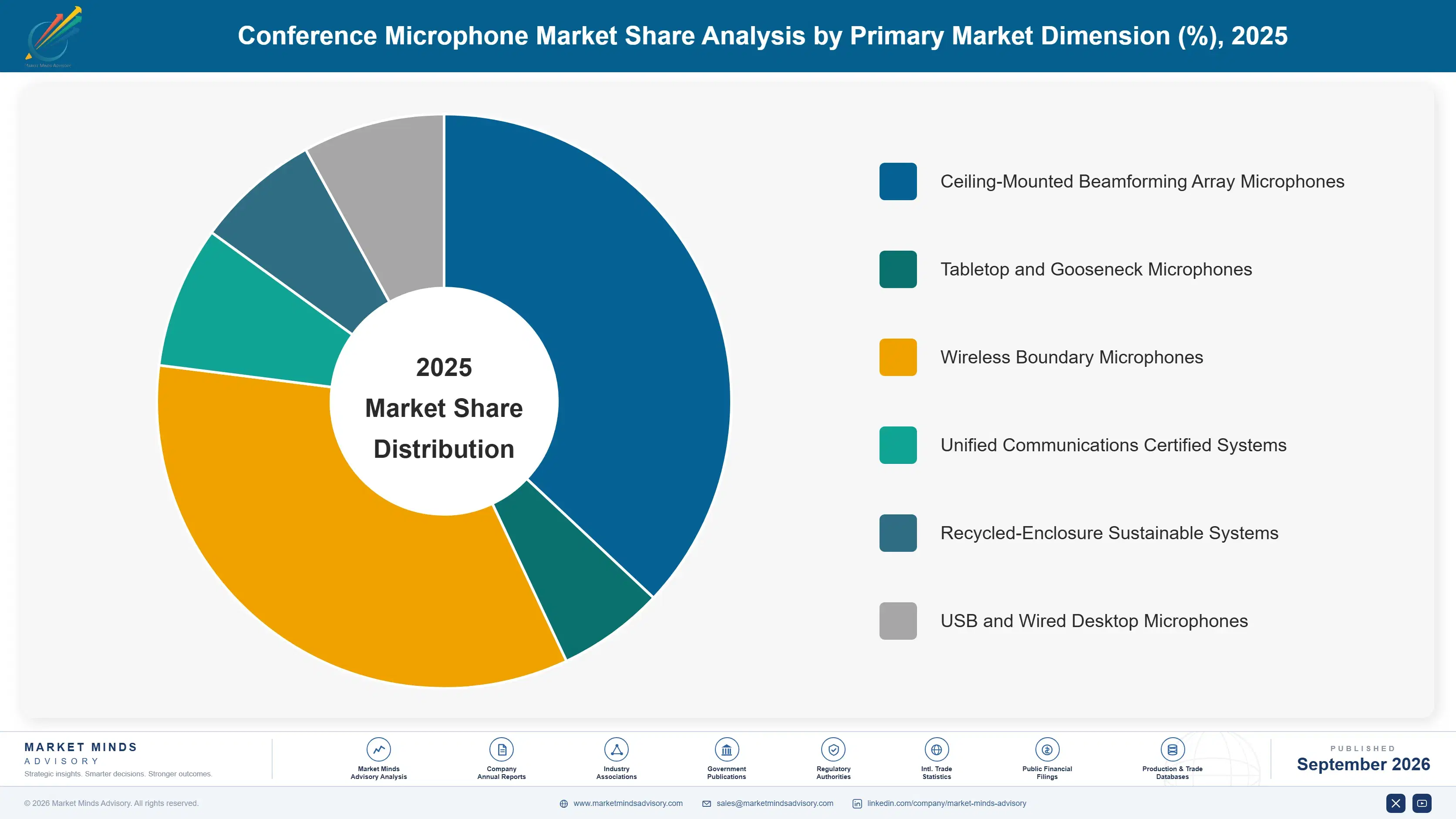
Conference microphones segment by product type across tabletop, gooseneck, ceiling-mounted, and wireless boundary formats, with ceiling-mounted beamforming arrays increasingly differentiating premium enterprise rooms from basic huddle spaces across most global procurement channels, price tiers, enterprise account sizes, and integration formats served worldwide today across every major regional, vertical, and industry market currently tracked closely.
conference-microphone-market-market-share-analysis-1790018553353

Ceiling-Mounted Beamforming Array Microphones

Ceiling-mounted beamforming array microphones combining multiple pickup elements with software-based voice tracking represent the fastest-growing segment, driven by enterprise demand for consistent audio coverage across larger conference rooms without visible tabletop hardware cluttering the meeting space. Manufacturers command meaningfully higher per-unit pricing for ceiling arrays than standard tabletop equivalents, since integrators value the reduced installation complexity and cleaner room aesthetics these systems provide. Several established manufacturers have launched dedicated ceiling array product lines, treating this segment as a genuine growth priority rather than a marginal side business alongside core tabletop product development. This premium positioning is reshaping how established manufacturers allocate research and development spending across their broader product portfolios going forward.
CAGR 12.5%

Tabletop and Gooseneck Microphones

Tabletop and gooseneck microphones remain the largest segment by installed base, serving both legacy conference rooms and cost-sensitive smaller huddle spaces across most global enterprise markets. Production runs at high volume with tighter margins than beamforming variants, since standard tabletop units compete primarily on price and reliable basic pickup performance rather than advanced tracking capability. Enterprise replacement cycles for existing tabletop installations provide the steadiest revenue visibility in this segment, while new construction demand fluctuates more with broader corporate real estate investment and periodic office renovation cycles across major consumer markets. This dual-channel demand structure gives tabletop production a resilience that more narrowly focused segments lack during cyclical downturns in either channel.
CAGR 5.5%
Full segment breakdown across 6 segments available in the complete report.

Regional Architecture and Country Demand Map

North America commands the largest regional share on the strength of dense enterprise corporate campus infrastructure and concentrated unified communications platform development, while South Asia and Pacific accelerates fastest on expanding office construction and technology sector growth nationwide. Enterprises across most sectors are prioritizing this infrastructure investment steadily.

North America

North America commands the largest regional share through dense enterprise corporate campus infrastructure and the concentrated presence of major unified communications platform developers headquartered domestically. The United States hosts the largest concentration of Fortune 500 corporate real estate undergoing hybrid meeting room modernization, supporting sustained replacement demand as older audio systems reach end of service life. Canadian enterprises increasingly mirror American procurement patterns, importing similar certified beamforming array assortments. Growing enterprise adoption of software-defined room management platforms continues expanding the region's addressable premium buyer base each year. Retail replenishment demand adds further stability. Domestic capacity investment continues expanding steadily across multiple qualified facilities. Growth momentum continues steadily. Retailers report consistent demand.
Share: 32% | CAGR: 8.5% (2026 to 2036)

Western Europe

Western European demand reflects a mature but steady replacement market, with Germany, France, and the United Kingdom maintaining well-established enterprise office infrastructure that requires periodic audio system modernization rather than greenfield capacity expansion. Regulatory harmonization across the European Union simplifies market access for manufacturers compared with fragmented approval processes elsewhere, though growth trails North America and East Asia since market penetration for beamforming arrays is already comparatively advanced in flagship corporate headquarters. Nordic markets show particular enthusiasm for software-defined audio processing aligned with broader digital workplace investment priorities. Ongoing standardization efforts across the alliance continue shaping procurement priorities region-wide. National sourcing preferences occasionally complicate cross-border supplier qualification timelines. Growth momentum continues steadily.
Share: 22% | CAGR: 7.0% (2026 to 2036)
Regional intelligence for 5 additional markets available in the complete report: East Asia, South Asia and Pacific, Latin America, Middle East and Africa, Eastern Europe. Contact sales@marketmindsadvisory.com.
conference-microphone-market-country-cagr-analysis-1790018553882

Beamforming Platform Margin Expansion Playbook

Manufacturers capture disproportionate margin by shifting production mix toward beamforming array systems across most enterprise categories served worldwide today, by bundling recurring software licensing and cloud management revenue with hardware sales across the full equipment lifecycle, and by securing certified integration partnerships with unified communications platforms that lock in enterprise procurement pipeline volume over time.

Shifting Product Mix Toward Beamforming Arrays

Manufacturers shifting production and sales focus toward beamforming array systems capture meaningfully higher per-unit margins than standard tabletop equipment allows, since enterprises pay a substantial premium for automatic voice tracking and reduced installation complexity that simplifies room deployment. This requires investment in software development and array engineering capability beyond traditional acoustic hardware design, but establishes a durable pricing advantage over competitors still selling primarily standard tabletop devices. Manufacturers with mature array product lines report gross margins running roughly 17 percentage points above legacy tabletop equipment across comparable unit volume sold. Retail partners also allocate more shelf space to these offerings.
Market Impact: Lifts beamforming segment gross margin by 17 points

Bundling Software Licensing and Cloud Management

Bundling software update subscriptions and cloud-based room management licensing with hardware sales converts what was historically a one-time capital transaction into a recurring revenue relationship extending across the equipment's full service life. This structure also deepens the enterprise IT relationship, since ongoing service touchpoints create natural opportunities to introduce additional connected features or upsell fleet-wide software upgrades as new capabilities become available. Manufacturers offering bundled subscriptions report lifetime revenue per installed unit roughly 39 percent higher than those selling hardware alone without ongoing service attachment. Smaller manufacturers without qualification history often struggle to compete for this contract tier.
Market Impact: Raises per-unit lifetime revenue by roughly 39 percent

Securing Unified Communications Certification Partnerships Broadly

Securing certified integration partnerships with major unified communications platform providers makes premium beamforming equipment eligible for enterprise procurement processes that increasingly require guaranteed interoperability as a baseline specification. This expands addressable market considerably into large enterprise accounts previously limited to hardware from certified vendors on approved technology lists maintained by corporate IT departments. Manufacturers with established certification partnership programs report unit volume roughly 31 percent higher in enterprise procurement channels than competitors requiring custom integration validation for each deployment. IT procurement teams increasingly favor vendors already present on these approved technology lists over untested alternatives.
Market Impact: Expands addressable enterprise volume by roughly 31 percent

Building Regional Integrator Training and Support Networks

Establishing certified integrator training programs in high-growth emerging markets reduces installation quality variability and satisfies enterprise procurement preferences that increasingly favor vendors with proven local support capability in public tender evaluation criteria across several corporate procurement processes. This approach also shortens deployment timelines and simplifies after-sales service logistics relative to relying entirely on manufacturer-direct support teams based in distant headquarters. Manufacturers with established regional integrator networks report winning roughly 26 percent more enterprise tenders in markets with local support requirements than fully centralized competitors. Building these partnerships requires patience but pays off over multiple contract cycles.
Market Impact: Wins roughly 26 percent more regional support tenders

Who Controls the Margin Pool

Conference microphone competition is fairly concentrated, with the top five manufacturers holding roughly 46 percent combined share on a global revenue basis across enterprise procurement channels. Shure and Sennheiser lead through decades of established acoustic engineering credibility and enterprise retail distribution, while Yamaha and Poly hold particular strength in bundled room system integration. The gap between qualified enterprise-grade manufacturers and smaller regional producers remains substantial and difficult to close quickly. Retail partners report growing enthusiasm for this narrower gap.
Current competitive activity centers on securing unified communications certification partnerships, expanding beamforming array product lines, and investing in software-defined audio processing capacity rather than pure price competition among established players. Companies are racing to achieve certification status across additional major platforms before rivals establish similar credentials, since certification barriers are substantial and time-consuming to overcome for new entrants.

Emerging pressure is coming from Chinese manufacturers offering lower-cost beamforming array equipment to enterprise buyers previously served entirely by premium Western brands. This threatens established manufacturers' pricing power in price-sensitive procurement channels across emerging markets. Expect further reshuffling as unified communications software vendors expand their own branded hardware lines, competing directly against traditional dedicated microphone manufacturers.
conference-microphone-market-company-positioning-matrix-1790018554416

Competitive Moat and Risk Dimensions

SHURE

Moat: Acoustic Engineering Credibility Depth

Shure's decades-long reputation for acoustic engineering quality across professional audio categories gives it brand recognition and enterprise IT trust that smaller competitors lacking comparable engineering heritage cannot easily replicate, particularly in flagship boardroom deployments where audio quality is scrutinized closely. That footprint spans thousands of enterprise IT relationships built over decades.
SHURE

Risk: Premium Pricing Limits Volume

Shure's premium positioning and pricing structure limits access to budget-constrained huddle room and smaller enterprise procurement, where lower-cost regional manufacturers increasingly win tenders on price alone, potentially ceding volume growth in the fastest-growing smaller-room segments over time. Inventory management discipline becomes especially critical during these periods.
POLY

Moat: Unified Communications Integration Depth

Poly's deep integration partnerships across multiple major unified communications platforms give it certification credentials and bundled hardware-software packaging that smaller competitors lacking comparable software partnerships cannot easily match, particularly in enterprise accounts standardizing on a single platform. Competitors must invest years and substantial capital to catch up.
POLY

Risk: Platform Dependency Concentration Risk

Heavy reliance on partnership relationships with a concentrated set of major unified communications platform providers leaves Poly more exposed to shifts in platform vendor strategy or certification requirements than competitors with more diversified standalone hardware revenue streams to fall back on. Diversification into standalone hardware remains a longer-term strategic consideration.

Players Tracked

Prominent Players

Shure
Sennheiser
Yamaha
Poly
ClearOne

Other Key Players

Biamp
QSC
Bose Professional
Audio-Technica
Nureva
Jabra
Logitech
AVer Information
MXL Microphones
Phoenix Audio Technologies
Beyerdynamic
Konftel
Sony Professional
Panasonic Professional
Extron

Recent Developments

JANUARY 2026

Shure Expands Beamforming Array Production

Shure announced expanded production capacity for beamforming array microphones at its domestic facility, responding to growing demand from both large enterprise deployments and expanding huddle room installations across corporate markets. The expansion represents a capital investment in existing facilities rather than a new site or acquisition.
Signal: Established manufacturers are investing directly in expanded beamforming array production capacity across their existing facilities nationwide
SEPTEMBER 2025

Poly Signs Enterprise Supply Agreement

Poly signed a multi-year supply agreement with a major North American enterprise technology reseller for conference microphone and room system production, securing predictable revenue visibility ahead of planned facility modernization investments over the coming several years. The agreement was structured as a supply contract rather than a joint venture.
Signal: Major manufacturers are securing long-term reseller supply agreements ahead of significant planned capacity investment cycles nationwide
APRIL 2025

Yamaha Acquires Audio Processing Software Firm

Yamaha acquired a specialized audio processing software firm to secure proprietary beamforming algorithm technology and reduce dependence on third-party software licensing affecting production costs across its enterprise audio operations. The acquisition was structured as a full outright purchase rather than a minority stake or licensing deal.
Signal: Manufacturers are acquiring upstream software capability to secure proprietary technology advantages against future market shifts nationwide

Component and Processing Cost Exposure

Digital signal processing chips, microphone array elements, and enclosure materials together represent roughly 36 percent of cost of goods sold for a typical beamforming array system. These components source primarily from Chinese and Taiwanese semiconductor and precision manufacturing facilities, with specialty-grade acoustic elements sourced increasingly from Japanese and German suppliers serving premium enterprise formulators. Currency fluctuations add further budgeting complexity.
Semiconductor supply tightness during 2024, tracked by industry reporting and trade commentary, constrained availability of specific processing chip families widely used across enterprise audio categories, delaying production schedules at several manufacturers by multiple weeks. Manufacturers without diversified component sourcing saw electronics input costs rise an estimated 11 to 15 percent during the tightest supply window, compressing margins on multi-year enterprise contract pricing. Manufacturers dependent on a single component supplier report the steepest cost increases during these disruption windows.

Manufacturers without diversified semiconductor sourcing or long-term supply agreements face a meaningful competitive disadvantage relative to larger diversified technology companies like Yamaha and Sony, which can use broader corporate purchasing scale across multiple product categories to secure component allocation priority during periods of industry-wide tightness. Regional manufacturers without comparable scale often face longer component lead times during shortages, further compounding the disadvantage.
conference-microphone-market-cost-volatility-analysis-1790018554619

Diversifying Semiconductor Component Sourcing

Manufacturers are qualifying additional processing chip and acoustic element suppliers across multiple geographies to reduce dependence on any single component family facing potential allocation constraints during industry-wide semiconductor tightness. This diversification also shortens qualification timelines for future component substitutions across product lines. This diversification also strengthens relationships with regional distributors supplying critical components. Costs improve gradually.

Long-Term Component Supply Agreements

Larger manufacturers are locking in multi-year supply agreements with semiconductor and acoustic component suppliers to secure allocation priority during periods of tightness, trading pricing flexibility for guaranteed component availability. Smaller manufacturers without comparable purchasing scale often struggle to secure similarly favorable priority terms from these same suppliers. This negotiating gap widens as demand grows.

Modular Design Reducing Component Specificity

Manufacturers are redesigning electronics architecture toward modular components that can substitute between multiple qualified suppliers without full product recertification, reducing exposure to any single supplier's availability constraints. This flexibility also shortens development timelines for future product generations across the broader portfolio. Engineering teams report faster time to market under this new modular approach overall.

Portfolio Architecture for Margin Defence

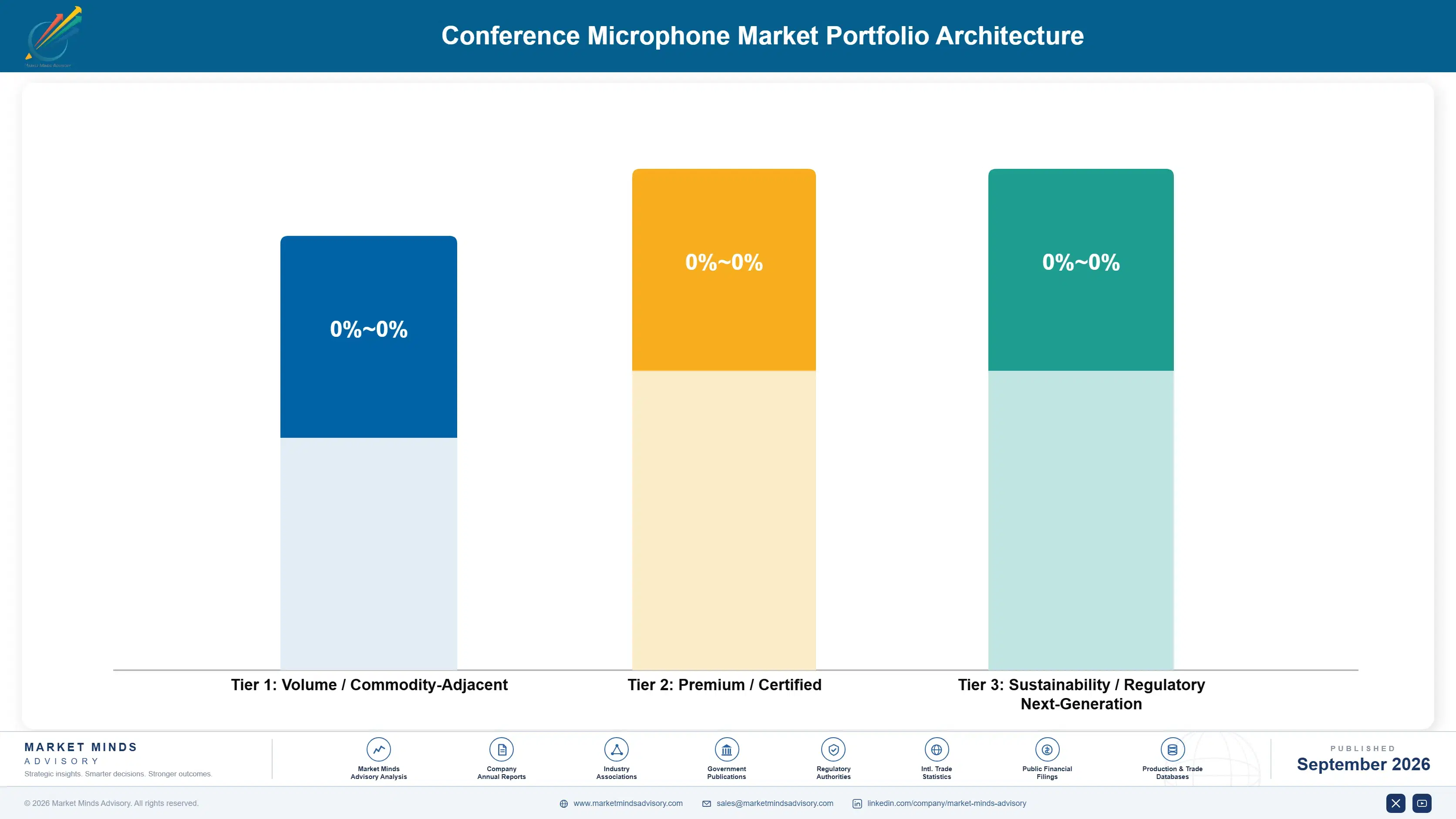
Conference microphone margin architecture splits across three tiers, with volume-oriented standard tabletop and gooseneck models competing on price and reliable basic pickup performance while premium beamforming array and certified enterprise-qualified variants command far wider margins on software integration and documented voice tracking accuracy. The gap between mass commercial tabletop production and premium specialty variants keeps widening as hybrid meeting standardization expands.
Volume and premium tiers pull manufacturing strategy in different directions across the category. Standard tabletop production rewards high-volume efficiency and consistent per-unit cost control, while premium beamforming production rewards software integration depth and documented voice tracking credentials that justify premium pricing. Manufacturers straddling both risk diluting the operational focus that either strategy requires, which is why most successful players commit resources deliberately across both lanes rather than treating them identically.

The highest-value margin pools concentrate in beamforming array systems and specialized enterprise-certified variants requiring documented interoperability, where manufacturers capture premium pricing unavailable in mass commercial channels. Sustainability and software-driven production is smaller today but growing as recycled-material enclosure programs mature and environmental considerations increasingly factor into procurement evaluation criteria at several enterprise accounts. Insurance-adjacent warranty programs increasingly factor into total cost of ownership evaluations.

Volume / Commodity-Adjacent

Standard tabletop and gooseneck microphones sold at high volume on price and reliable consistent performance rather than documented voice tracking credentials. Government fixed-price contracts and mass commercial retail dominate this tier's revenue mix.
Gross Margin: 20 to 28 percent

Premium / Certified

Beamforming array systems and certified enterprise-qualified variants manufactured to tighter software integration standards, commanding meaningfully higher per-unit pricing than standard production. Dedicated tooling investment and quality control processes support this pricing power.
Gross Margin: 36 to 46 percent

Sustainability / Regulatory / Next-Generation

Recycled-enclosure-content systems and energy-efficient processing formulations developed to satisfy environmental procurement criteria increasingly adopted by enterprise accounts. Adoption remains uneven across jurisdictions with differing environmental standards. Adoption continues expanding steadily nationwide.
Gross Margin: 30 to 40 percent
conference-microphone-market-portfolio-architecture-1790018555119

High-value Sub-segments and Strategic Watch-out

Ceiling-Mounted Beamforming Array Microphones

The fastest-growing and highest-value segment, manufactured to tighter software integration standards for enterprise voice tracking, commanding premium pricing across most specialty retail and direct sales channels currently expanding. Manufacturers increasingly dedicate specialized production lines to this segment alone. Growth momentum here shows no sign of slowing soon.
Gross Margin: 38 to 48 percent

Unified Communications Certified Systems

A large and steadily growing segment anchored by multi-year enterprise procurement contracts, providing manufacturers with the steadiest revenue visibility of any segment across most large corporate customer relationships. Interoperability standards keep this segment relatively stable across cycles. Multi-year contracts provide unusually strong revenue predictability here.
Gross Margin: 24 to 32 percent

Standard Tabletop Microphones

The volume core of the category, sold at accessible price points through mass retail, sustaining category awareness even as growth concentrates elsewhere in premium and certified enterprise segments. Retail promotional activity heavily influences purchasing timing in this tier. Scale efficiency remains the primary competitive differentiator here.
Gross Margin: 20 to 26 percent

Recycled-Enclosure Sustainable Systems

A strategic watch-out segment growing on environmental and procurement regulatory pressure, currently small but positioned to gain share fastest as procurement criteria mature across major enterprise accounts. Early movers are building credibility with environmentally focused procurement officers. Regulatory tailwinds should accelerate adoption over coming years.
Gross Margin: 28 to 38 percent

Contract Renewal and Retention Dynamics

Conference microphones behave like an annuity relationship on the enterprise side of the business, since multi-year technology refresh contracts routinely renew based on continued platform certification status and demonstrated reliability rather than competitive rebidding every cycle. Manufacturers holding existing unified communications qualification and established enterprise relationships retain that revenue for years, and this dynamic is what makes certification investment and software support commercially durable across the sector.
Adoption depth varies meaningfully by end-use vertical. Large enterprise and technology sector procurement shows the deepest stickiness, anchored by certification requirements and established supplier qualification that new entrants struggle to match quickly. Smaller business buyers show shallower loyalty, often switching brands based on price and availability during periods of retail scarcity, though larger enterprises develop stronger brand preference tied to documented reliability performance over repeated deployment cycles.

Generational buyer shifts are reshaping enterprise demand architecture specifically. Younger IT procurement officers entering the role increasingly research interoperability data and manufacturer reputation online before purchasing, a behavior far less common among earlier generations of buyers. Veteran facilities managers still favor established reliable brands with long track records. Manufacturers serving both cohorts need distinctly different marketing approaches rather than a single unified retail strategy.
conference-microphone-market-end-use-penetration-index-1790018555645

Where to Compete Next

These are among the four positions where our research anticipates prominent divergence between winners and laggards over the coming forecast period. Each is grounded in the demand model, the regulatory perimeter, and the announced capacity pipeline.
01 / BEAMFORMING SEGMENT INVESTMENT

Prioritize beamforming array capability over standard tabletop expansion

Beamforming array microphones are growing at roughly 12.5 percent annually, well above the overall category rate, driven by enterprise demand for automatic voice tracking and reduced installation complexity across larger conference rooms. Manufacturers still organized purely around standard tabletop production are ceding the highest-margin segment to competitors investing early in array engineering and software integration capability. The window to establish credible beamforming positioning before enterprise procurement solidifies around established leaders is closing steadily across most major enterprise procurement categories tracked.
02 / CERTIFICATION PURSUIT STRATEGY

Pursue certification across additional unified communications platforms

Unified communications certification provides enterprise procurement eligibility that smaller manufacturers lacking certification cannot access, and the certification process itself takes several months to complete given required interoperability testing across multiple platform providers simultaneously across regions. Companies pursuing certification now position themselves for the next wave of enterprise procurement driven by sustained hybrid meeting technology investment commitments across most corporate accounts. Waiting until certification becomes commercially urgent means competing directly against manufacturers who invested in credentials and platform relationships years earlier already.
03 / SOFTWARE DEVELOPMENT INVESTMENT

Build software capability ahead of hardware-only competitors

Competitive differentiation is shifting toward software capability and interoperability standards compliance rather than traditional acoustic hardware engineering and pickup pattern specifications that historically defined the category for decades. Manufacturers without in-house software development capacity increasingly rely on external partnerships that slow product development cycles relative to competitors with integrated engineering teams working under one unified roadmap. Building this capability now positions manufacturers to compete on the dimension increasingly deciding enterprise procurement outcomes across most developed and emerging markets served today.
04 / REGIONAL SUPPORT EXPANSION

Build regional integrator networks before competitors close gap

Enterprise procurement increasingly favors vendors with proven local installation and support capability, and manufacturers relying entirely on centralized support face longer deployment timelines that frustrate corporate IT departments managing multi-site rollouts. Companies building regional integrator training programs now capture tender share in markets requiring local support before competitors establish comparable regional presence and credibility across those same markets and adjacent territories. Delaying this investment means competing against manufacturers who already built trusted regional partner networks and durable market reputation over many years.

Engagement Snapshot From the Field

A live engagement with an industry participant carrying material or product regulatory and market exposure ahead of a defining policy shift, showing how our research translates into a defensible multi-year portfolio strategy.
MARKET MINDS ADVISORY · CLIENT ENGAGEMENT SUMMARY
Conference Microphone Producer Strategic Portfolio Review and Transition Roadmap 2026·Investment Scenario on Conference Microphone Exposure Evaluation 2025-26
CLIENT PROFILE
A mid-sized enterprise technology reseller serving corporate clients across the southeastern United States, generating roughly $58 million in annual revenue (client-reported, unverified by MMA), with conference room technology historically limited to standard tabletop microphones sold through basic hardware resale rather than integrated room system deployment. The reseller had grown steadily over fifteen years but had not diversified beyond basic hardware resale services.
STRATEGIC CHALLENGE
Leadership observed clients increasingly requesting beamforming array systems bundled with unified communications software integration, an offering the reseller lacked technical capability to deliver in-house. The reseller needed to decide whether to invest in staff training and certification, partner with an integration specialist, or continue referring these deals to competitors and accept the associated revenue loss.
MMA APPROACH
MMA conducted primary interviews with the reseller's sales team and a client survey across their top twenty accounts to quantify demand for integrated room system offerings. The engagement combined competitive benchmarking against five regional integration specialists with capability investment modeling across three partnership scenarios, benchmarked against category-wide beamforming adoption data from MMA's primary research dataset.
KEY FINDINGS
  1. Client survey data showed 61 percent of surveyed accounts had considered switching providers specifically to access integrated beamforming room systems (client-reported, unverified by MMA).
  2. Competitive benchmarking revealed that four of five regional integration specialists offered certified training programs the reseller could access without prohibitive upfront investment.
  3. Capability investment modeling showed that certifying two senior technicians broke even within fourteen months given the reseller's existing client relationship base. This exceeded initial leadership expectations considerably.
  4. Sales team interviews identified certification credibility, more than technical complexity itself, as the primary barrier clients cited when evaluating the reseller's capability.
CLIENT PROFILE
A mid-sized enterprise technology reseller serving corporate clients across the southeastern United States, generating roughly $58 million in annual revenue (client-reported, unverified by MMA), with conference room technology historically limited to standard tabletop microphones sold through basic hardware resale rather than integrated room system deployment. The reseller had grown steadily over fifteen years but had not diversified beyond basic hardware resale services.
STRATEGIC CHALLENGE
Leadership observed clients increasingly requesting beamforming array systems bundled with unified communications software integration, an offering the reseller lacked technical capability to deliver in-house. The reseller needed to decide whether to invest in staff training and certification, partner with an integration specialist, or continue referring these deals to competitors and accept the associated revenue loss.
MMA APPROACH
MMA conducted primary interviews with the reseller's sales team and a client survey across their top twenty accounts to quantify demand for integrated room system offerings. The engagement combined competitive benchmarking against five regional integration specialists with capability investment modeling across three partnership scenarios, benchmarked against category-wide beamforming adoption data from MMA's primary research dataset.
KEY FINDINGS
  1. Client survey data showed 61 percent of surveyed accounts had considered switching providers specifically to access integrated beamforming room systems (client-reported, unverified by MMA).
  2. Competitive benchmarking revealed that four of five regional integration specialists offered certified training programs the reseller could access without prohibitive upfront investment.
  3. Capability investment modeling showed that certifying two senior technicians broke even within fourteen months given the reseller's existing client relationship base. This exceeded initial leadership expectations considerably.
  4. Sales team interviews identified certification credibility, more than technical complexity itself, as the primary barrier clients cited when evaluating the reseller's capability.
RECOMMENDED STRATEGY
Phase 1: Phase one: certify two senior technicians through a major manufacturer's beamforming integration training program within the first quarter. for improved deal capability. Phase 2: Phase two: launch bundled room system offerings marketed directly to the existing top twenty account base first. to maximize early adoption. Phase 3: Phase three: evaluate expansion to additional certified technicians based on initial adoption data and updated revenue benchmarks. over the following year.
OUTCOME
Within twelve months of certification, the reseller reported securing several previously at-risk accounts and generating meaningfully higher per-deal revenue from bundled room system sales (client-reported, unverified by MMA). The reseller expanded its certified technician team based on early results. Leadership credited certification credibility with directly influencing several client retention decisions during the review period.

Frequently Asked Questions

Foundational context covering the market sizes, CAGR, scope, country, region and competition that inform every finding below. This section is provided to cover basics and most often pre-purchase conversations, answered from the MMA Primary Research Dataset.

What is the current size of the Conference Microphone Market?

The global conference microphone market was valued at $1.9 billion in 2025. Growth is driven by sustained hybrid meeting adoption and enterprise room standardization mandates.

How large will the Conference Microphone Market be by 2036?

The market is projected to reach approximately $4.66 billion by 2036. This represents a 2.26 times expansion driven primarily by beamforming array adoption and software integration.

What is the CAGR for the Conference Microphone Market 2026 to 2036?

The market is forecast to grow at an 8.5 percent CAGR between 2026 and 2036. Bull and bear scenarios range from 7.2 to 9.8 percent depending on enterprise spending trends.

Which segment is growing fastest?

Ceiling-Mounted Beamforming Array Microphones lead growth at a 12.5 percent CAGR, roughly 1.47 times the overall market rate. This reflects enterprise preference for integrated voice tracking approaches.

Who are the major companies in the Conference Microphone Market?

Leading players include Shure, Sennheiser, Yamaha, Poly, and ClearOne, spanning both dedicated audio manufacturers and unified communications hardware vendors. Together they hold roughly 46 percent combined market share.

Which country is growing fastest?

India leads country-level growth at an 11.0 percent CAGR. Expanding corporate office construction and technology sector growth are driving faster adoption than in most Western markets.

Report Segmentation Architecture

The full report scope spans multiple orthogonal segmentation dimensions, with cross-tabulated demand data provided for each dimension pair. Coverage extends further to regional breakdowns, trend trajectories, and the competitive detail needed to support segment-level decision-making.

By Primary Market Dimension

  • Ceiling-Mounted Beamforming Array Microphones
  • Tabletop and Gooseneck Microphones
  • Wireless Boundary Microphones
  • Unified Communications Certified Systems
  • Recycled-Enclosure Sustainable Systems
  • USB and Wired Desktop Microphones

By End-Use Industry

  • Corporate Enterprise Offices
  • Technology Sector Campuses
  • Government and Public Sector
  • Education and Higher Learning

By Commercial Dimension

  • Direct Enterprise Procurement
  • Value-Added Reseller Distribution
  • Unified Communications Platform Bundling
  • Systems Integrator Channel Sales

By Region

  • North America
  • Western Europe
  • East Asia
  • South Asia and Pacific
  • Latin America
  • Middle East and Africa
  • Eastern Europe

Scope, Methodology, and Coverage

Every figure in this report is reproducible from documented input assumptions. The scope below maps the historical period, the forecast horizon, the segmentation dimensions, and the countries covered, alongside the underlying primary and qualitative methodology.
Historical Period
2020 to 2025
Forecast Period
2026 to 2036
Base Year
2025 (USD billions; MMA Primary Research Dataset, September 2026)
Market Definition
This report covers the global market for microphones designed for enterprise conference room and meeting space applications, including tabletop, gooseneck, ceiling-mounted, and wireless boundary microphones. It excludes consumer-grade USB microphones and broadcast studio microphones without conference room integration features.
Quantitative Units
USD billions, market share percentages, CAGR percentages
Segmentation Dimensions
Product type, end-use industry, commercial distribution channel, region
Regions Covered
North America, Western Europe, East Asia, South Asia and Pacific, Latin America, Middle East and Africa, Eastern Europe
Countries Covered
United States, Canada, Germany, United Kingdom, France, China, Japan, South Korea, India, Australia, Brazil, Mexico, Saudi Arabia, United Arab Emirates, Poland
Key Companies Profiled
Shure, Sennheiser, Yamaha, Poly, ClearOne, Biamp, QSC, Bose Professional, Audio-Technica, Nureva, Jabra, Logitech, AVer Information, MXL Microphones, Phoenix Audio Technologies, Beyerdynamic, Konftel, Sony Professional, Panasonic Professional, Extron
Quantitative Methodology
Primary survey, n=3,800 respondents, Q4 2025, six countries; demand-side model with trade association cross-validation
Qualitative Methodology
47 expert interviews, Q4 2025; applied to validate demand model assumptions, identify emerging dynamics, and assess competitive positioning
Report Format
PDF and XLSX data workbook (Word format preview document)
Publisher
Market Minds Advisory
Report Code
MMA-2026-TEC-447
Published
September 2026
Contact
sales@marketmindsadvisory.com | www.marketmindsadvisory.com

Purchase the full Conference Microphone Market Report (2026 to 2036).

This report delivers a comprehensive analysis of the global conference microphone market and its shifting technology landscape. It covers product segmentation, regional demand patterns, and competitive dynamics across the full forecast period from 2026 through 2036 in careful detail. The analysis combines primary survey data from 3,800 respondents across six countries with 47 expert interviews to quantify beamforming adoption trends and unified communications certification progress across the category. Analysts examine input cost exposure, margin architecture, and revenue lever strategy across enterprise and reseller channels. Recommendations target both hardware manufacturers and channel partners.
Seven-region demand share and CAGR breakdown
Five to six segment competitive positioning analysis
Twenty-company competitive landscape and moat assessment
Input cost exposure and mitigation strategy review
Revenue growth lever and margin expansion playbook
Anonymized client engagement case study analysis

Built For The People Who Decide

From boardroom strategy to bench-side execution, this report is read cover-to-cover by leaders shaping the next decade of their industry, turning demand scenarios, market dynamics and valuation benchmarks into decisions.
CXOs/ Presidents/ VPs/ Managers
M&A and Corporate Development
Strategy Teams and R&D Heads
Procurement and Product Directors
Regulatory and Compliance Leaders
Investor Relations and Equity Analysts