Market Minds Advisory
Conductive Fiber Market

Conductive Fiber Market: coating durability, silver exposure and the shift toward intrinsic conductivity

Silver-coated yarn costs more per kilogram than the garment it ends up inside, yet wearable electronics, automotive shielding and antistatic industrial textiles keep specifying it because nothing cheaper survives repeated laundering and abrasion.

Lead Analyst

Bilal Shaikh

Published

September 2026

Make Smarter Decisions with Customized Research Insights

Request a free sample report and evaluate market opportunities, growth trends, and competitive dynamics relevant to your business needs.

2025 MARKET VALUE$2.4BMarket Size 2025
2036 FORECAST VALUE$6.0BBase Case , 2026 to 2036
CAGR 2026 TO 20368.6 %Bull 9.9% / Bear 7.3%
INCREMENTAL OPPORTUNITY$3.4BNet 10- year value creation
EXPANSION MULTIPLE2.28x2036 value over 2026 base
Strategic Levers
M&A Pipeline
Regional Outlook
Country Rankings
Competitive Intelligence
Segmental Deep-dive
Call-Us : 91 93563 13602

Executive Snapshot and Market Trajectory

Conductive fiber sells on a promise that is genuinely hard to keep: metallic conductivity in something that still behaves like textile, and that still behaves like textile after fifty wash cycles. Most failures in the field are coating adhesion failures rather than shortfalls in the bulk conductivity of the material.
Growth concentrates in intrinsically conductive polymer fibers, expanding at 12.9%, where conductivity sits inside the polymer itself rather than in a surface coating that can crack, abrade or oxidise away. East Asia holds 38% of value, well above the share any single region normally takes, because Japanese and Korean specialty fiber producers hold the coating and spinning technology and because Chinese textile conversion capacity sits alongside the electronics assembly that consumes most shielded fabric.
The supplier base is moderately concentrated, with the top five holding 41% of revenue, and it divides between large integrated fiber producers and small coating specialists who never spin any filament themselves. Competition runs on durability data rather than on initial surface resistance. Restriction proposals covering silver released from textiles are the regulatory question now sitting over the largest single product class, and the answers will not arrive quickly.
Market Definition
Conductive fiber comprises textile-form filaments, staple and yarns engineered to conduct current or dissipate static charge, whether by metal coating, carbon loading, metal filament drawing, intrinsic polymer conductivity or nanocarbon assembly. Sizing covers fiber and yarn sold to converters and fabric mills at realised delivered price. Finished shielded fabrics, printed electronic inks, conductive coatings applied to woven goods after manufacture, and the garments or devices into which the fiber is ultimately built all fall outside scope.
Base Year Value
$2.4B in 2025 (MMA Primary Research Dataset, August 2026)
Forecast Period
2026 to 2036, eleven discrete annual values
CAGR
8.6% base case. Bull 9.9%. Bear 7.3%.
Fastest Growth Segment
Intrinsically Conductive Polymer Fibers: 12.9% CAGR
Fastest Growth Country
India: 11.4% CAGR
Fastest Growth Region
South Asia and Pacific: 10.7% CAGR
Largest Region
East Asia: 38% of 2025 global value
Market Leaders
Toray Industries, Teijin, Bekaert, Kuraray and Statex lead on shipment volume across coated, filament and specialty conductive fiber classes. Source: MMA Primary Research Dataset, July 2026.
Primary Survey
n=3,800 procurement and R&D decision-makers, Q4 2025, six countries
Methodology
Demand-side build-up, cross-validated against public data, 47 expert interviews

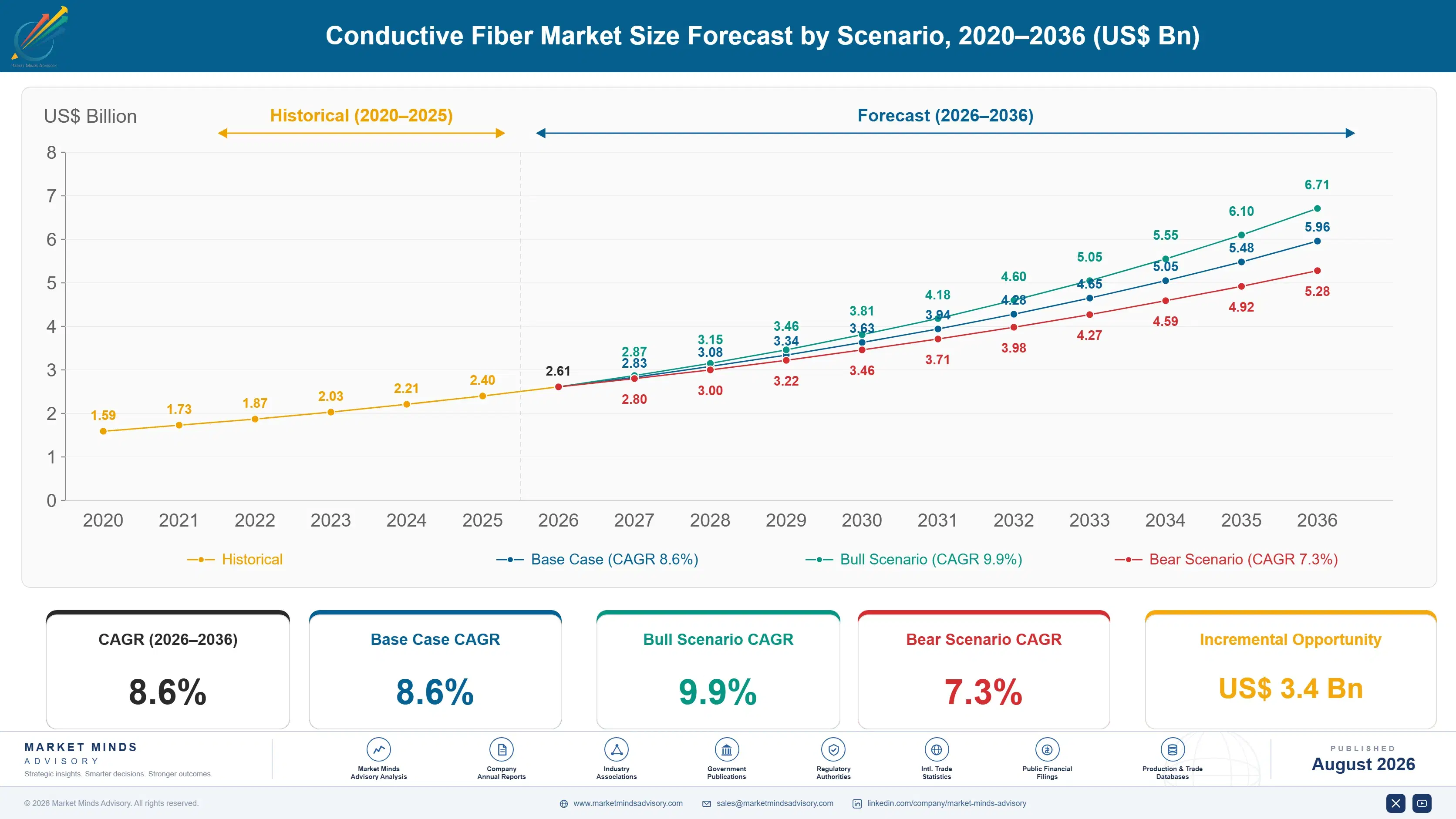
Conductive Fiber Market Forecast Scenarios

conductive-fiber-market-trends-size-forecast-scenario-1787310633425
Growth of 7.4% across 2020 to 2025 was steadier than the applications suggest. Antistatic industrial textiles and electromagnetic shielding carried the base through 2020 and 2021 while wearable programmes stalled, and silver prices climbed hard enough to push several converters toward nickel-copper coatings. Automotive shielding demand then accelerated from 2023 as vehicle electrical architectures moved to higher voltages and interference budgets tightened considerably.
The base case at 8.6% rests on three mechanisms. Vehicle electrification raises shielding content per vehicle because high-voltage cabling, inverters and charging harnesses all radiate interference that low-voltage architectures never produced. Medical and industrial wearables move from pilot volumes into series production, and every one of them needs electrodes and interconnect that survive laundering. And antistatic requirements in cleanroom, pharmaceutical and explosive-atmosphere textiles keep tightening as insurers and regulators both push specification upward.
The bull case at 9.9% turns on wearable medical monitoring reaching reimbursed scale faster than currently modelled, since textile electrodes replace disposable adhesive sensors entirely at that point. The bear case at 7.3% turns on silver. Restriction of biocidal and released silver in textiles would strand the largest coated product class, and nickel-copper alternatives do not match its conductivity or its corrosion behaviour.

Conductive fiber: coating cost against durability economics

Conductive fiber is a coating business pretending to be a fiber business, and the distinction matters commercially more than almost anything else in the sector. Roughly 34% of delivered cost sits in the coating metal, mostly silver at around USD 1,180 per kilogram, which means the substrate polymer is close to a rounding error measured against the value of the metal deposited onto it.
TOP FIVE CONCENTRATION41%Share of global conductive fiber revenue held collectively
SILVER COATING INPUTUSD 1,180/kgCoating metal price dominates finished yarn delivered cost
COATING METAL SHARE34% of COGSPortion of delivered cost tied to the coating metal
SHIELDING APPLICATION SHARE29% of volumeLargest single application by consumed fiber tonnage globally
WASH DURABILITY REQUIREMENT50 cyclesLaundering endurance typically demanded by wearable textile buyers
QUALIFICATION LEAD TIME14 monthsTypical automotive approval cycle before any series supply
That cost structure explains why the competitive fight happens over deposition rather than over spinning. Adhesion, coating uniformity and post-laundering resistance are what buyers actually test, and they are what small coating houses with no fiber capacity of their own compete on successfully against integrated producers many times their size. Initial surface resistance is easy for anybody to achieve and tells a buyer almost nothing useful.
Applications divide sharply by how much abuse the fiber takes. Electromagnetic shielding in enclosures and cable wrap consumes 29% of volume and asks relatively little of durability. Wearable and medical textiles ask for everything, which is why they pay four to six times more per kilogram and why so few suppliers are able to serve them properly at all.
"Everybody in this market quotes surface resistance at day zero, which is the one number that never predicts a field failure. The suppliers making real money are the ones who publish resistance after fifty wash cycles and then contract against it."
Director, Advanced Materials and Technical Textiles Practice · MMA Chemicals and

Market Trends

Intrinsic conductivity displacing coated constructions in wearables

Coated fibers fail where they are flexed and laundered hardest, because the coating and the substrate move differently and the bond between them eventually gives up. Intrinsically conductive polymer fibers, mostly based on PEDOT:PSS and polyaniline blends spun as the filament itself, carry conductivity throughout the cross-section, so abrasion exposes more conductor rather than removing it entirely. Conductivity remains well below silver-coated equivalents, which confines the material to sensing and interconnect rather than shielding. Wearable medical electrode programmes are adopting it first, since biocompatibility and wash durability matter far more there than raw conductivity ever does.
Market Impact: Covers 29% of industrial textile vo
Automotive shielding content rising with higher voltage architectures

Vehicle electrical architectures moving to 800-volt systems generate interference that earlier 12-volt designs simply never produced, and the switching frequencies in modern inverters put energy exactly where sensitive electronics sit. Shielded cable wrap, connector gaskets and enclosure textiles all consume conductive fiber, and content per vehicle in electrified platforms runs roughly three times what a comparable combustion vehicle required. Qualification runs around 14 months and covers thermal cycling, vibration, salt spray and shielding effectiveness across frequency bands. Once a supplier clears that, the position holds for the platform life, typically seven years or more.
Market Impact: Commands 5 times industrial fiber p

Market Opportunities and Growth Drivers

Electrostatic discharge rules tightening across regulated manufacturing environments

Cleanroom garments, pharmaceutical manufacturing textiles and workwear for explosive atmospheres all carry electrostatic dissipation requirements that have tightened progressively, and the IEC 61340 and EN 1149 test regimes now demand performance retained after repeated industrial laundering rather than measured once on new fabric. That retention requirement is what pulls specification toward conductive fiber woven into the fabric and away from topical antistatic finishes that wash out after a handful of cycles. Semiconductor and pharmaceutical facility expansion drives the volume directly, and insurers auditing explosive-atmosphere sites have become considerably more demanding about documented compliance in recent years.
Market Impact: Exposes 34% of revenue to restricti

Wearable medical monitoring moving beyond pilot scale production

Textile electrodes replace disposable adhesive sensors in continuous cardiac, respiratory and neonatal monitoring, and the commercial case rests on avoiding both the consumable cost and the skin irritation that adhesive electrodes cause over multi-day wear periods. Regulatory clearances for garment-integrated monitoring have accumulated steadily across several jurisdictions, and reimbursement decisions are beginning to follow behind them. Each garment consumes relatively little fiber by weight but pays several times industrial pricing, because biocompatibility, cytotoxicity testing and wash durability documentation all sit behind the specification and very few suppliers hold that whole package.
Market Impact: Limits durability to 50 wash cycles

Market Restraints and Challenges

Silver restriction proposals threaten the largest coated product class

Silver-coated fiber carries the largest share of conductive fiber revenue, and regulatory attention on silver released from textiles during laundering has intensified across European and North American jurisdictions. The root cause is that silver migrates: the same ionic release giving antimicrobial performance also puts silver into wastewater, and biocidal registration regimes treat that release as the regulated event regardless of whether antimicrobial function was intended. Commercially this leaves the highest-value product class exposed to a decision nobody controls. Participants are exploring encapsulated coatings, nickel-copper substitution and intrinsically conductive alternatives, though none matches silver on conductivity and corrosion behaviour together.
Market Impact: Reaches 12.9% annual growth through

Coating durability limits addressable applications despite adequate initial conductivity

Coated fiber conducts beautifully when new and degrades unpredictably in service, which is why so many wearable programmes stall between prototype and production. The root cause is mechanical: metal coatings and polymer substrates have very different moduli, so flexing concentrates strain at the interface until the coating cracks and delaminates. Commercially this caps what the material can address, since designers who cannot predict end-of-life resistance design around the fiber entirely. Producers are responding with intermediate tie layers, plasma surface activation before deposition and bicomponent substrates engineered to reduce the modulus mismatch at the interface itself.
Market Impact: Triples shielding content, roughly
4 additional market trends, 2 additional growth drivers, and 3 additional restraints and challenges are covered in the full report. Contact sales@marketmindsadvisory.com to access the complete intelligence.

Segment CAGR and Growth Architecture

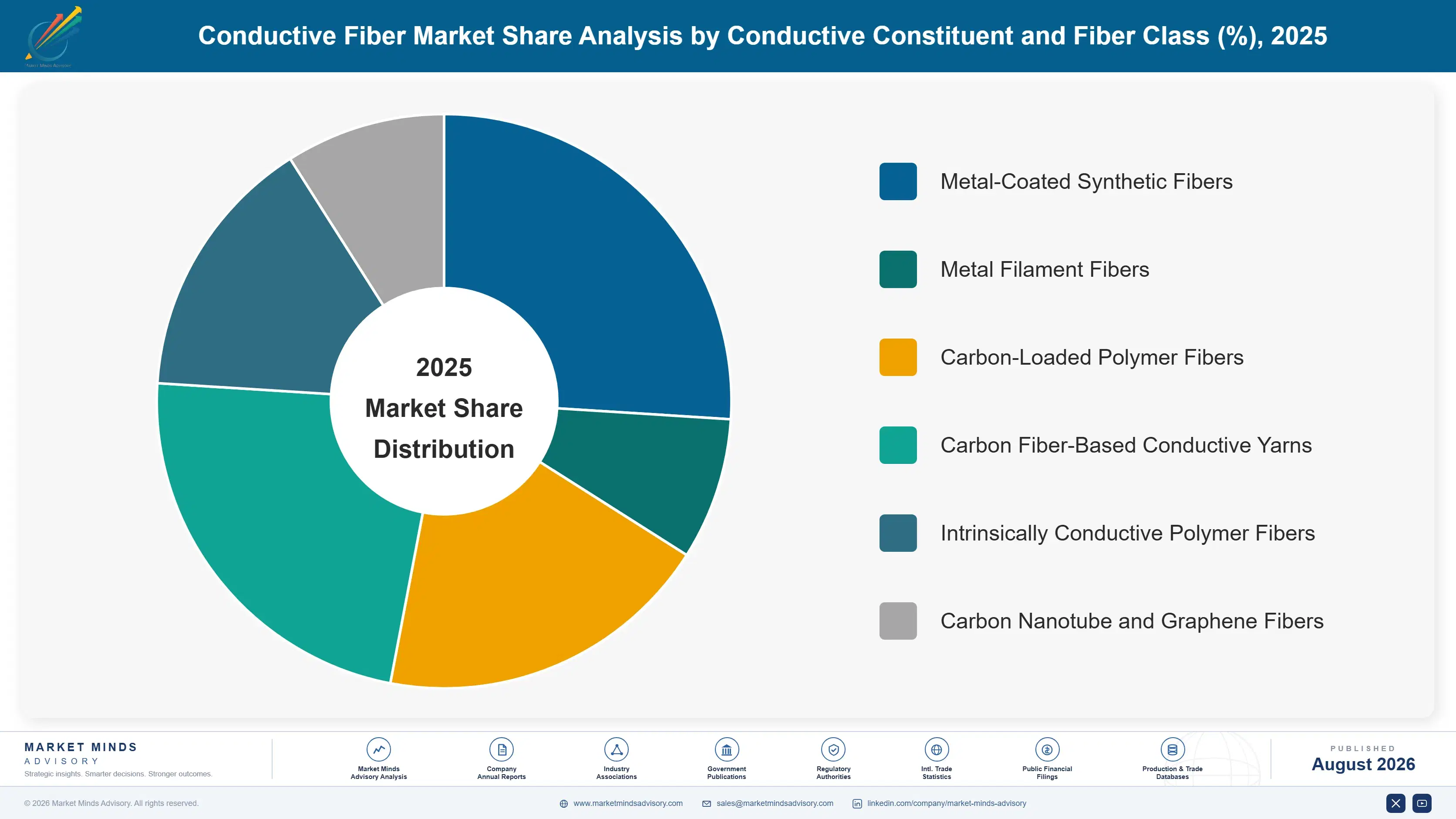
Segmentation follows the conductive constituent and how conductivity is delivered into the filament, because that single decision governs cost, durability, achievable conductivity and regulatory exposure simultaneously. Six classes cover the whole market, running from drawn metal filament and coated synthetics through carbon-loaded constructions to intrinsically conductive polymers and nanocarbon assemblies at the emerging edge.
conductive-fiber-market-trends-market-share-analysis-1787310633964

Intrinsically Conductive Polymer Fibers

Expanding at 12.9%, a full 1.50 times the market rate, on filaments where conductivity belongs to the polymer itself rather than to anything deposited on the surface afterwards. PEDOT:PSS and polyaniline systems, spun neat or blended into a carrier polymer, conduct throughout the cross-section, so abrasion and flexing expose fresh conductor instead of destroying a coating. Conductivity remains several orders below silver-coated fiber, which rules the material out of any serious electromagnetic shielding duty entirely. Wearable medical electrodes, textile sensing and soft circuit interconnect are where the material wins commercially, because wash durability and biocompatibility govern selection there and silver carries regulatory questions that intrinsic polymer systems avoid completely and permanently.
CAGR 12.9%

Carbon Nanotube and Graphene Fibers

Growing at 11.2% on continuous filaments assembled from carbon nanotubes or graphene sheets, spun wet or drawn directly from aerogel, delivering conductivity approaching metals at roughly a fifth of the density and with no corrosion behaviour whatsoever. Aerospace data and power cabling is the anchor application, where mass saved carries a value per kilogram that ordinary textile economics never approaches. Production remains slow and expensive, with output measured in tonnes rather than in thousands of tonnes, and yield consistency across production runs is still the principal constraint on wider adoption. Defence and space qualification is accumulating steadily across several programmes, which is usually what precedes broader commercial availability in materials of this kind.
CAGR 11.2%
Full segment breakdown across 6 segments available in the complete report.

Regional Architecture and Country Demand Map

Conductive fiber production concentrates far more tightly than the applications consuming it ever do, because coating and specialty spinning technology sits in relatively few hands, while shielding, antistatic and wearable demand turns up wherever electronics assembly and regulated manufacturing happen to have been built out.

East Asia

Thirty-eight percent of global value, the largest regional share by a wide margin, because Japanese and Korean producers hold most of the specialty spinning and metal deposition technology while Chinese textile conversion capacity sits directly alongside the electronics assembly consuming shielded fabric. Note: this exceeds the standard regional band because conductive fiber production and its principal consuming industry are colocated here to a degree no other region approaches. Toray, Teijin, Kuraray and Toyobo between them run coating and specialty spinning capability developed over several decades of investment. Growth of 9.5% runs above the global rate, supported by regional electric vehicle manufacture and by wearable device assembly expanding together at pace.
Share: 38% | CAGR: 9.5% (2026 to 2036)

North America

Twenty-four percent of global value, weighted heavily toward defence, aerospace and medical applications where qualification barriers are highest and pricing reflects it. Military electromagnetic shielding specifications drive demand for the most capable coated fibers commercially available anywhere, and suppliers named in those specifications hold commercial positions that survive procurement cycles for many years. Medical wearable development is concentrated here, with regulatory clearances and reimbursement pathways further advanced here than anywhere else in the world. Domestic coating and deposition capability is genuinely strong, even though substrate fiber itself is largely imported from Asia. Growth of 8.2% reflects steady defence consumption alongside medical wearable programmes moving from pilot volumes into series production.
Share: 24% | CAGR: 8.2% (2026 to 2036)
Regional intelligence for 5 additional markets available in the complete report: Western Europe, South Asia and Pacific, Latin America, Middle East and Africa, Eastern Europe. Contact sales@marketmindsadvisory.com.
conductive-fiber-market-trends-country-cagr-analysis-1787310634506

Where conductive fiber margin actually sits

Four commercial positions separate the suppliers earning genuine specialty economics from those selling coated yarn by the kilogram. Each of them rests on something a competitor cannot copy quickly: durability evidence, a qualified platform position, coating chemistry that removes real cost, or capability built well before regulation eventually forces everybody else to build it.

Contract on post-laundering resistance rather than initial

Every supplier quotes surface resistance as delivered, and that number has almost no relationship to whether a garment still works after thirty wash cycles. Suppliers publishing resistance retention curves across fifty cycles, and contracting against the retained figure rather than the initial one, realise roughly 35% above competitors quoting as-delivered performance. The testing costs very little and takes months rather than capital. Most producers avoid it because the data would expose how quickly their coatings actually degrade in real laundering conditions, which is precisely why the evidence is worth so much commercially.
Market Impact: Realises roughly 35% above as-deliv

Qualify into automotive platforms before design freeze

Automotive shielding qualification runs around 14 months and covers thermal cycling, vibration, salt spray and shielding effectiveness across the frequency bands the vehicle actually generates. The supplier written into the platform specification captures roughly 4 times the lifetime revenue of one bidding for annual tenders afterwards, because platforms run seven years or more and substitution requires requalifying the whole shielding system. Engagement has to begin with the harness and enclosure designers years before any purchase order exists. Most fiber suppliers are still selling to converters and never meet the vehicle engineers at all.
Market Impact: Captures roughly 4 times the lifeti

Substitute nickel-copper coatings where silver is unnecessary

Silver at around USD 1,180 per kilogram is specified across a great deal of shielding duty that nickel-copper coating would serve perfectly adequately, because the specification was written once and nobody has revisited it since. Suppliers reformulating non-medical shielding grades onto nickel-copper systems cut coating metal cost by roughly 45% per kilogram while holding shielding effectiveness within the specified band. The work involved is coating chemistry and requalification rather than capital investment of any size. It also reduces exposure to silver restriction proposals, which makes the same project defensive and margin-accretive simultaneously.
Market Impact: Cuts coating metal cost by roughly

Build intrinsic conductivity capability ahead of restriction

Silver-coated fiber carries 34% of conductive fiber revenue and faces restriction proposals covering exactly the ionic release that ordinary laundering inevitably produces. Suppliers developing intrinsically conductive polymer and nanocarbon capability now hold roughly 3 times the addressable position of those relying wholly on silver coating under an adverse ruling. Nothing available anywhere today matches silver on conductivity and corrosion resistance together, which is exactly why the development work has to start well before anybody considers it urgent. Spinning and formulation development cycles here run to several years rather than to months.
Market Impact: Holds roughly 3 times the addressab

Who Controls the Margin Pool

Concentration is moderate, with the top five holding 41% of conductive fiber shipment volume, the basis on which every participant here is assessed. Toray and Teijin lead through integrated positions running from polymer through spinning to metal deposition, while the challenger group divides between metal filament specialists such as Bekaert and coating houses like Statex that buy substrate and compete purely on deposition quality.
Competition currently runs on durability evidence, application qualification and coating chemistry rather than on price per kilogram. Automotive and medical qualification positions are where the value concentrates, since both take over a year to establish and neither is easily displaced afterwards. Coating specialists compete successfully against integrated producers many times their size, because deposition quality does not require owning a spinning line at all.

Emerging pressure comes from two directions at once. Silver restriction would reset positions built entirely on coated silver products, favouring anybody holding nickel-copper or intrinsic capability. And intrinsically conductive polymer producers are entering from the specialty chemicals side rather than from textiles, which means rankings in wearable applications may shift toward companies that have never spun conventional fiber.
conductive-fiber-market-trends-company-positioning-matrix-1787310635046

Competitive Moat and Risk Dimensions

TORAY INDUSTRIES

Moat: Integrated polymer to deposition

Control from polymer synthesis through spinning to metal deposition lets Toray engineer the substrate specifically for the coating it will carry, which is how the modulus mismatch driving coating failure gets reduced at source. Competitors buying substrate on the open market cannot do that, and the resulting durability difference is measurable across laundering cycles.
TORAY INDUSTRIES

Risk: Silver exposure across portfolio

A large share of Toray's conductive fiber revenue sits in silver-coated constructions, which concentrates regulatory exposure precisely where the current margins are best. Restriction covering silver release from textiles would force rapid reformulation across multiple product families at once, and the scale that normally helps becomes a liability when the whole portfolio needs requalifying simultaneously.
TEIJIN

Moat: Medical and aramid qualification depth

Teijin's position in medical textiles and high-performance aramid fiber gives it qualification documentation, biocompatibility data and regulatory experience that newer entrants into wearable conductive fiber simply do not hold. In medical applications that documentation package is most of what buyers are actually paying for, and it takes years rather than months to assemble properly.
TEIJIN

Risk: Limited intrinsic conductivity position

Teijin's strength sits in coated and filament constructions rather than intrinsically conductive polymer systems, which is the fastest growing class and the least exposed to silver restriction. Specialty chemical companies entering from the conducting polymer side arrive with formulation capability Teijin would need to build or buy, and the wearable applications involved are exactly where its medical position should win.

Players Tracked

Prominent Players

Toray Industries
Teijin
Bekaert
Kuraray
Statex Produktions- und Vertriebs GmbH

Other Key Players

Toyobo
Mitsubishi Chemical Group
Asahi Kasei
Hyosung Advanced Materials
Kolon Industries
Shakespeare Company
Marktek Inc.
Swicofil AG
Coats Group
Nanocyl
Jiangsu Hengshen
Zhongfu Shenying Carbon Fiber
SGL Carbon
Formosa Plastics
V Technical Textiles

Recent Developments

FEBRUARY 2025

Conductive fiber producer completes automotive shielding qualification

A specialty fiber producer completed full qualification of a coated conductive yarn range for high-voltage vehicle shielding applications, covering thermal cycling, salt spray corrosion resistance, vibration endurance and shielding effectiveness measured right across the frequency bands that traction inverters and charging systems actually generate in normal service.
Signal: Automotive qualification positions are bei
JUNE 2025

Regulatory consultation examines silver release from treated textiles

Regulatory consultation on biocidal and released silver in textile applications explicitly considered metal-coated conductive fibers within its scope, with detailed industry submissions arguing that shielding and antistatic uses present a release profile entirely different in kind from the deliberately antimicrobial consumer textiles driving the concern.
Signal: The regulatory outcome will decide whether
OCTOBER 2025

Medical device maker adopts textile electrodes for monitoring

A medical device manufacturer moved its garment-integrated cardiac monitoring product from clinical evaluation into series production using intrinsically conductive polymer fiber electrodes throughout, citing measured wash durability across extended wear periods and the absence of the skin irritation that adhesive disposable sensors reliably cause in practice.
Signal: Intrinsic conductivity is now displacing c

Coating metal exposure and substrate cost

Coating metal accounts for roughly 34% of finished conductive fiber cost, overwhelmingly silver at around USD 1,180 per kilogram, sourced through precious metal refiners concentrated in Europe, North America and Japan. Substrate polymer contributes about 16%, deposition energy and process chemicals around 14%, spinning and texturising 12%, testing and qualification 11%, with packaging, logistics and yield loss making up the balance.
Silver moved sharply through the forecast history. Prices climbed steeply across 2024 and into 2025 on industrial demand from photovoltaics competing with every other silver-consuming application, and coated fiber producers absorbed much of it before pricing caught up. Toray Industries Annual Report 2024 recorded raw material cost pressure across its advanced fiber businesses, and Bekaert Annual Report 2023 noted metal input cost recovery lagging contractual pricing across several product lines.

The competitive disadvantage mechanism runs through coating chemistry rather than through scale. Producers locked into silver formulations cannot substitute quickly, because every qualified application would need requalifying against the original specification. Those with nickel-copper and intrinsic capability move cost down and regulatory exposure down together. Small coating houses buying silver in modest quantities pay materially more per kilogram than integrated producers hedging annual volumes, which compounds the disadvantage further.
conductive-fiber-market-trends-cost-volatility-analysis-1787310635241

Develop nickel-copper coating systems for non-medical duty

A great deal of shielding specification calls for silver where nickel-copper would perform adequately, simply because nobody has revisited the specification since it was first written. Reformulating those particular grades cuts coating metal cost substantially and reduces regulatory exposure at the same time, which makes the project both defensive and margin-accretive at the same time.

Hedge silver on contracted annual volumes

Small coating houses buying silver spot pay materially more per kilogram than integrated producers contracting annual requirements forward, and that gap on its own can decide who wins a competitive shielding tender. Establishing forward purchase arrangements against committed customer volumes costs nothing beyond ordinary treasury discipline, and it removes a genuinely avoidable cost disadvantage.

Build intrinsic conductivity capability before restriction forces it

Silver-coated products carry a third of conductive fiber revenue and face restriction proposals with no equivalent substitute currently available anywhere. Beginning intrinsically conductive polymer and nanocarbon development work now costs only a fraction of what scrambling after an adverse ruling would, and the spinning and formulation cycles involved run to years rather than to months.

Portfolio Architecture for Margin Defence

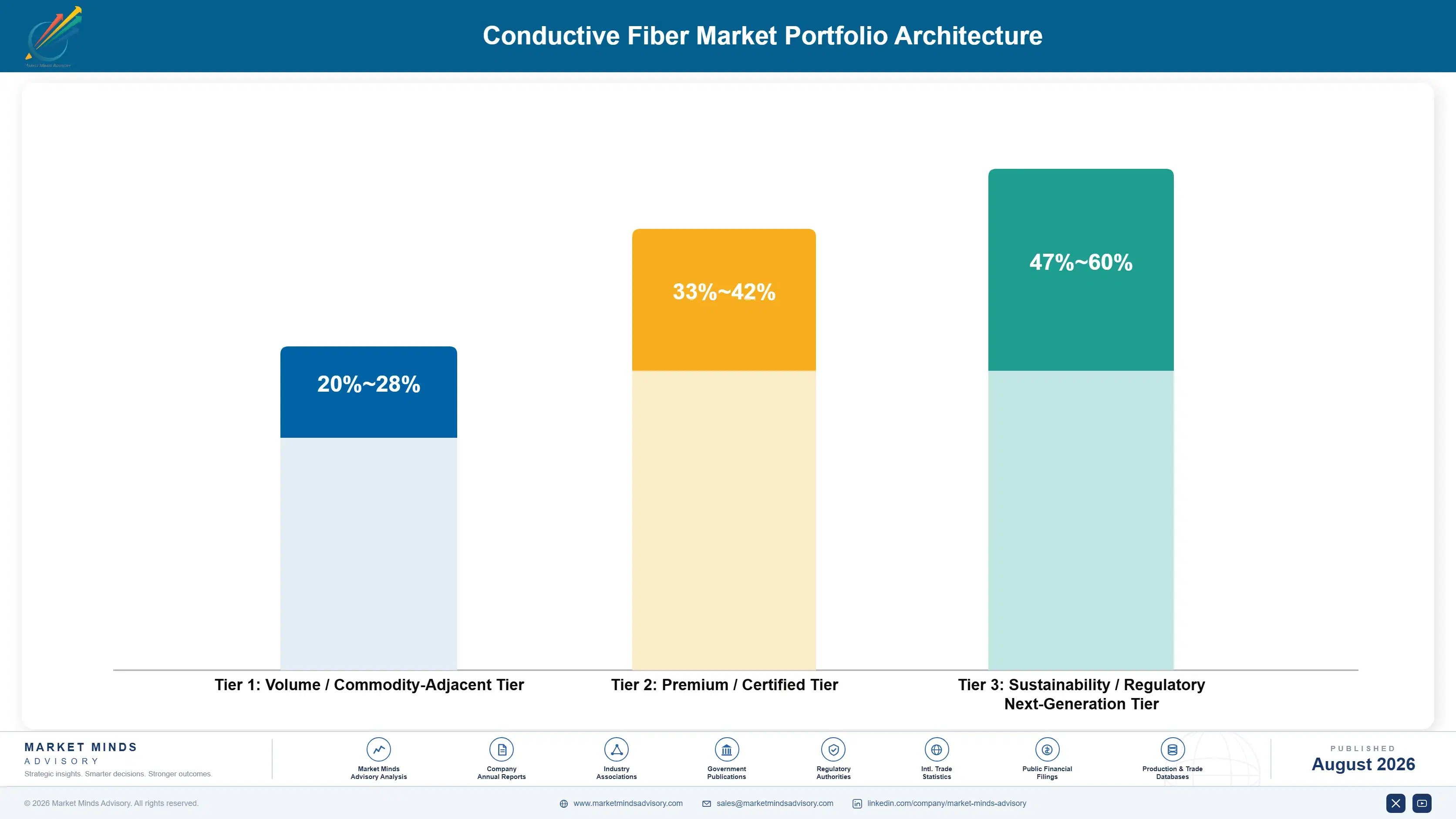
Margin architecture separates by durability evidence and qualification burden rather than by conductivity, which is not the same thing at all. Antistatic yarns and basic carbon-loaded fibers earn whatever regional conversion competition allows, because the performance requirement is loose enough that many suppliers can meet it against exactly the same written specification.
Value climbs steeply where a fiber has been qualified into an automotive platform or a medical device, because both take over a year to establish and neither is displaced without requalifying the system around it. Coated shielding grades sit in the middle, defended by deposition quality and durability data rather than by anything a competitor could not eventually replicate given enough time and effort.

The highest value pools concentrate in wearable medical and aerospace applications, where documentation packages, biocompatibility testing and mass-saving economics all support pricing that ordinary textile markets never approach. Those pools are small in tonnage terms and very large in margin terms. The commercial tension is that volume shielding business keeps coating lines loaded while contributing almost nothing toward the qualification work that actually opens the premium tiers above it.

Volume / Commodity-Adjacent Tier

Antistatic yarns, carbon-loaded fibers and basic dissipative constructions supplied against loose performance specifications through textile distribution, where many regional producers can meet the requirement and price decides the outcome nearly every time.
Gross Margin: 20-28%

Premium / Certified Tier

Coated shielding grades and metal filament fibers qualified into automotive, industrial and defence applications. Deposition quality and durability evidence defend pricing here. The nine-point range reflects catalogue supply against qualified platform positions.
Gross Margin: 33-42%

Sustainability / Regulatory / Next-Generation Tier

Intrinsically conductive polymer fibers, nanocarbon filaments and medical-grade constructions carrying biocompatibility documentation. Qualification barriers and absent substitutes defend pricing strongly. The thirteen-point range reflects established medical positions against emerging nanocarbon economics.
Gross Margin: 47-60%
conductive-fiber-market-trends-portfolio-architecture-1787310635734

High-value Sub-segments and Strategic Watch-out

Medical wearable electrode and sensing fibers

High value and high growth together here, because biocompatibility documentation, wash durability evidence and regulatory clearance all sit behind the specification and remarkably few suppliers anywhere hold that whole documentation package in one place today. Growth and realised margin move together here, which is unusual.
Gross Margin: 47-60%

Automotive high-voltage shielding qualified grades

Strong realised value on genuinely durable growth, because qualification runs a full fourteen months and the position then holds for a platform life of seven years or more. Substitution requires requalifying the entire shielding system built around the fiber, which almost nobody chooses to do.
Gross Margin: 36-46%

Antistatic and dissipative industrial yarns

The volume core here, keeping coating and spinning lines loaded while earning whatever regional conversion competition permits against specifications loose enough that many producers can satisfy them. Necessary for basic manufacturing scale, but this tier will never fund the qualification work that opens anything above it.
Gross Margin: 20-28%

Silver coating exposure across the portfolio

The strategic watch-out, given that silver-coated constructions carry fully 34% of conductive fiber revenue and face restriction proposals that no alternative coating chemistry currently answers on conductivity and corrosion behaviour together. Exposure concentrates precisely where the best margins in the portfolio happen to sit today.
Gross Margin: 28-58%

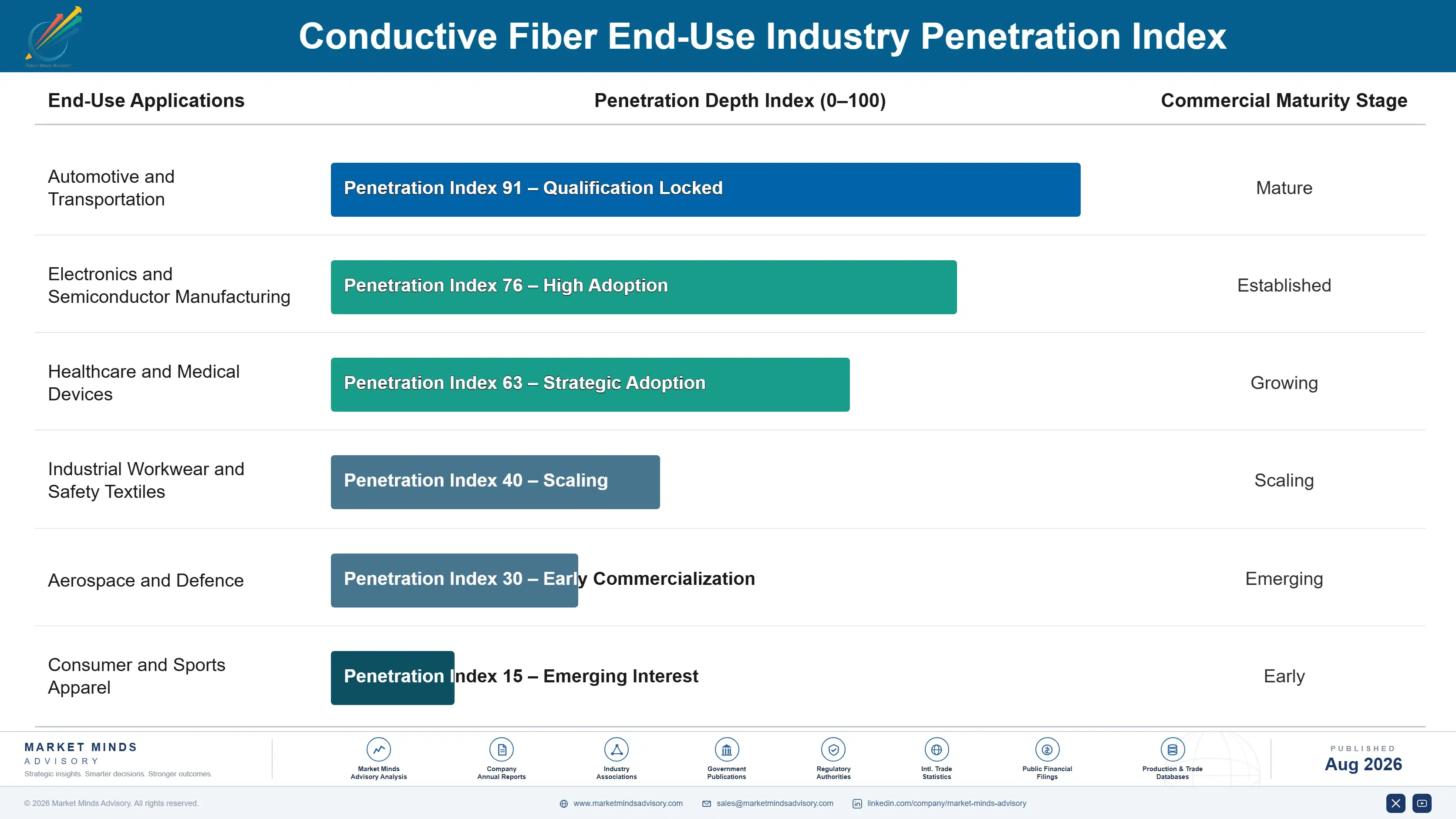
How conductive fiber demand behaves

Demand is specification-locked with a long consumption tail behind it. A fiber qualified into an automotive shielding system or a medical garment is consumed continuously through the production life of that product, which in vehicles runs seven years and in medical devices often longer. Winning the qualification is slow, technical and expensive; holding the volume afterwards costs very little beyond consistent supply and unchanged process control.
Stickiness varies enormously with what the qualification actually covers. Antistatic industrial yarn is loosest, bought against a performance number from whichever supplier quotes best, with nothing preventing substitution at all. Automotive shielding sits far tighter, because changing fiber means requalifying the harness and enclosure system around it. Medical wearable fiber is stickiest of all, since substitution touches a regulatory submission nobody wants to reopen.

The buyer profile splits in a way that defeats any single commercial model. Industrial antistatic yarn is bought by textile procurement against price and delivery. Automotive and medical fiber is specified by device and harness engineers evaluating durability and biocompatibility data long before commercial discussion begins, and reaching them needs technical people who can discuss coating adhesion mechanisms credibly.
conductive-fiber-market-trends-end-use-penetration-index-1787310636221

What we would actually do here

These are among the four positions where our research anticipates prominent divergence between winners and laggards over the coming forecast period. Each is grounded in the demand model, the regulatory perimeter, and the announced capacity pipeline.
01 / DURABILITY-LINKED COMMERCIAL CONTRACTING

Sell retained resistance, not the day-zero measurement

Every supplier in this market quotes surface resistance as delivered, and that number has almost no relationship to whether a garment still functions after thirty laundering cycles. Suppliers publishing retention curves across fifty cycles, and then contracting against the retained figure, realise roughly 35% above competitors quoting as-delivered performance. The testing costs very little and takes months rather than capital, which is why the widespread reluctance to publish it is about the evidence itself rather than about the expense involved.
02 / AUTOMOTIVE PLATFORM DESIGN-IN

Reach vehicle engineers, not just the fabric converters

Automotive shielding qualification runs around fourteen months from first sample, and the supplier written into the platform specification captures roughly 4 times the lifetime revenue that anybody bidding for annual tenders afterwards will ever see. Platforms typically run seven years or more in production, and substitution requires requalifying the entire shielding system built around the fiber itself. Engagement therefore has to begin with the harness and enclosure designers years before any purchase order exists anywhere in the commercial process at all.
03 / COATING METAL SUBSTITUTION

Reformulate silver out where nothing requires it

Silver at around USD 1,180 per kilogram is specified across shielding duty that nickel-copper coating would serve perfectly adequately, because nobody has gone back and revisited the specification since it was first written down years ago. Reformulating those non-medical grades cuts coating metal cost by roughly 45% per kilogram while holding shielding effectiveness comfortably inside the specified band. The same project also reduces exposure to silver restriction, which makes it simultaneously defensive and margin-accretive rather than merely one or the other.
04 / INTRINSIC CONDUCTIVITY DEVELOPMENT

Build the alternative before the ruling arrives

Silver-coated fiber carries 34% of all conductive fiber revenue and faces restriction proposals covering exactly the kind of ionic release that ordinary domestic laundering produces. Suppliers developing intrinsically conductive polymer and nanocarbon capability now would hold roughly 3 times the addressable position of competitors relying wholly on silver coating chemistry under an adverse ruling. Nothing available today matches silver on conductivity and corrosion behaviour together, which is precisely why waiting for the ruling itself is not a serious option for anybody.

Engagement Snapshot From the Field

A live engagement with an industry participant carrying material or product regulatory and market exposure ahead of a defining policy shift, showing how our research translates into a defensible multi-year portfolio strategy.
MARKET MINDS ADVISORY · CLIENT ENGAGEMENT SUMMARY
Conductive Fiber Producer Strategic Portfolio Review and Transition Roadmap 2026·Investment Scenario on Conductive Fiber Exposure Evaluation 2025-26
CLIENT PROFILE
A technical fiber producer operating spinning and metal deposition capacity across Western Europe and East Asia, supplying antistatic yarns, coated shielding grades and specialty conductive constructions to textile converters and a smaller group of direct industrial accounts. Conductive fiber revenue approached EUR 140 million annually (client-reported, unverified by MMA), roughly two thirds of it in antistatic and general shielding grades sold to converters against loose performance specifications.
STRATEGIC CHALLENGE
Margins had compressed for three consecutive years and management attributed it entirely to Asian coating competition, responding with a proposed deposition line upgrade at the European site. Medical and automotive opportunities were being lost without anybody establishing why they were lost. Silver exposure across the portfolio had never been quantified against the restriction proposals then in consultation.
MMA APPROACH
We assessed the portfolio by qualification barrier rather than by product family, quantified silver content and regulatory exposure grade by grade, and reconstructed twelve lost medical and automotive opportunities through interviews with the specifying engineers rather than with the procurement contacts the client normally dealt with. Coating durability data was benchmarked against three competitor products independently.
KEY FINDINGS
  1. Margin compression traced to product mix drifting toward antistatic yarn, not to competitor pricing, which had moved barely at all across the period.
  2. Eleven of twelve lost opportunities failed on absent wash durability documentation rather than on price, conductivity or delivery performance in any case.
  3. Silver-coated grades carried 61% of revenue and the client had no nickel-copper substitution or intrinsic conductivity development programme running anywhere in the business.
  4. The proposed deposition upgrade would have added capacity in exactly the product tier where competition was fiercest and where realised margins were already lowest.
CLIENT PROFILE
A technical fiber producer operating spinning and metal deposition capacity across Western Europe and East Asia, supplying antistatic yarns, coated shielding grades and specialty conductive constructions to textile converters and a smaller group of direct industrial accounts. Conductive fiber revenue approached EUR 140 million annually (client-reported, unverified by MMA), roughly two thirds of it in antistatic and general shielding grades sold to converters against loose performance specifications.
STRATEGIC CHALLENGE
Margins had compressed for three consecutive years and management attributed it entirely to Asian coating competition, responding with a proposed deposition line upgrade at the European site. Medical and automotive opportunities were being lost without anybody establishing why they were lost. Silver exposure across the portfolio had never been quantified against the restriction proposals then in consultation.
MMA APPROACH
We assessed the portfolio by qualification barrier rather than by product family, quantified silver content and regulatory exposure grade by grade, and reconstructed twelve lost medical and automotive opportunities through interviews with the specifying engineers rather than with the procurement contacts the client normally dealt with. Coating durability data was benchmarked against three competitor products independently.
KEY FINDINGS
  1. Margin compression traced to product mix drifting toward antistatic yarn, not to competitor pricing, which had moved barely at all across the period.
  2. Eleven of twelve lost opportunities failed on absent wash durability documentation rather than on price, conductivity or delivery performance in any case.
  3. Silver-coated grades carried 61% of revenue and the client had no nickel-copper substitution or intrinsic conductivity development programme running anywhere in the business.
  4. The proposed deposition upgrade would have added capacity in exactly the product tier where competition was fiercest and where realised margins were already lowest.
RECOMMENDED STRATEGY
Phase 1: Phase one: establish laundering durability testing and publish retention curves across fifty cycles for every shielding grade and every medical candidate grade in the portfolio. Phase 2: Phase two: reformulate non-medical shielding onto nickel-copper systems and then requalify with the five largest converter accounts across both operating regions. Phase 3: Phase three: begin intrinsically conductive polymer development and pursue medical wearable qualification with two device manufacturers already evaluating textile electrodes.
OUTCOME
The client deferred the deposition upgrade and redirected the capital into testing capability and coating reformulation. Two medical wearable qualifications were underway within nine months, and realised pricing on reformulated shielding grades improved by 14% (client-reported, unverified by MMA) against the prior year on comparable volume.

Frequently Asked Questions

Foundational context covering the market sizes, CAGR, scope, country, region and competition that inform every finding below. This section is provided to cover basics and most often pre-purchase conversations, answered from the MMA Primary Research Dataset.

What is the current size of the Conductive Fiber Market?

The market is valued at USD 2.4 billion in 2025, rising to USD 2.61 billion in 2026. Sizing covers conductive fiber and yarn sold to converters at realised delivered price.

How large will the Conductive Fiber Market be by 2036?

The market reaches USD 5.96 billion by 2036, an increase of USD 3.35 billion over the forecast period. That represents an expansion multiple of 2.28 times the 2026 base.

What is the CAGR for the Conductive Fiber Market 2026 to 2036?

The base case CAGR is 8.6% across 2026 to 2036. The bull case reaches 9.9% on faster wearable medical adoption, while the bear case sits at 7.3% under silver restriction.

Which segment is growing fastest?

Intrinsically conductive polymer fibers grow fastest at 12.9%, a full 1.50 times the market rate. Conductivity sits in the polymer itself, so abrasion exposes fresh conductor rather than destroying a coating.

Who are the major companies in the Conductive Fiber Market?

Toray Industries, Teijin, Bekaert, Kuraray and Statex lead on shipment volume, holding 41% collectively. The remaining field divides between metal filament specialists and independent coating houses buying substrate externally.

Which country is growing fastest?

India grows fastest at 11.4%, driven by technical textile manufacture moving up the value chain alongside electronics assembly expanding under national incentive schemes and a growing regulated manufacturing base.

Report Segmentation Architecture

The full report scope spans multiple orthogonal segmentation dimensions, with cross-tabulated demand data provided for each dimension pair. Coverage extends further to regional breakdowns, trend trajectories, and the competitive detail needed to support segment-level decision-making.

By Conductive Constituent and Fiber Class

  • Metal-Coated Synthetic Fibers
  • Metal Filament Fibers
  • Carbon-Loaded Polymer Fibers
  • Carbon Fiber-Based Conductive Yarns
  • Intrinsically Conductive Polymer Fibers
  • Carbon Nanotube and Graphene Fibers

By End-Use Industry

  • Automotive and Transportation
  • Electronics and Semiconductor Manufacturing
  • Healthcare and Medical Devices
  • Industrial Workwear and Safety Textiles
  • Aerospace and Defence
  • Consumer and Sports Apparel

By Customer Type and Channel

  • Fabric Mills and Textile Converters
  • Automotive Tier One Suppliers
  • Medical Device Manufacturers
  • Industrial Workwear Producers
  • Distribution and Technical Yarn Traders
  • Research and Prototyping Accounts

By Region

  • North America
  • Western Europe
  • East Asia
  • South Asia and Pacific
  • Latin America
  • Middle East and Africa
  • Eastern Europe

Scope, Methodology, and Coverage

Every figure in this report is reproducible from documented input assumptions. The scope below maps the historical period, the forecast horizon, the segmentation dimensions, and the countries covered, alongside the underlying primary and qualitative methodology.
Historical Period
2020 to 2025
Forecast Period
2026 to 2036
Base Year
2025 (USD billions; MMA Primary Research Dataset, August 2026)
Market Definition
The market comprises textile-form conductive filaments, staple fibers and yarns, spanning metal-coated synthetic fibers, drawn metal filament fibers, carbon-loaded polymer fibers, carbon fiber-based conductive yarns, intrinsically conductive polymer fibers, and carbon nanotube and graphene fibers. Sizing captures fiber and yarn revenue at realised delivered price across automotive and transportation, electronics and semiconductor manufacturing, healthcare and medical devices, industrial workwear and safety textiles, aerospace and defence, and consumer apparel applications. Finished shielded and dissipative fabrics, printed electronic inks, conductive coatings applied to woven goods after manufacture, conductive polymer compounds not in fiber form, and the garments or devices into which the fiber is built all fall outside scope.
Quantitative Units
USD billions (current prices); conductive fiber shipped annually in thousands of tonnes; USD per kilogram at realised delivered price
Segmentation Dimensions
By Conductive Constituent and Fiber Class; By End-Use Industry; By Customer Type and Channel; By Region
Regions Covered
North America, Western Europe, East Asia, South Asia and Pacific, Latin America, Middle East and Africa, Eastern Europe
Countries Covered
USA, Canada, Mexico, UK, Germany, France, Italy, Spain, Belgium, Netherlands, Switzerland, Sweden, Poland, Czech Republic, Romania, Turkey, China, Japan, South Korea, Taiwan, India, Singapore, Malaysia, Thailand, Vietnam, Indonesia, Australia, Brazil, Argentina, Saudi Arabia, UAE, South Africa, and additional markets relevant to this sector
Key Companies Profiled
Toray Industries, Teijin, Bekaert, Kuraray, Statex Produktions- und Vertriebs GmbH, Toyobo, Mitsubishi Chemical Group, Asahi Kasei, Hyosung Advanced Materials, Kolon Industries, Shakespeare Company, Marktek Inc., Swicofil AG, Coats Group, Nanocyl, Jiangsu Hengshen, Zhongfu Shenying Carbon Fiber, SGL Carbon, Formosa Plastics, V Technical Textiles.
Quantitative Methodology
Primary survey, n=3,800 respondents, Q4 2025, six countries; demand-side model with trade association cross-validation
Qualitative Methodology
47 expert interviews, Q4 2025; applied to validate demand model assumptions, identify emerging dynamics, and assess competitive positioning
Report Format
PDF and XLSX data workbook (Word format preview document)
Publisher
Market Minds Advisory
Report Code
MMA-2026-CHM-536
Published
August 2026
Contact
sales@marketmindsadvisory.com | www.marketmindsadvisory.com

Purchase the full Conductive Fiber Market Report (2026 to 2036).

The full report sizes the conductive fiber market across six constituent and fiber classes, six end-use industries, six customer channels and seven regions, with annual forecasts to 2036 in revenue and tonnage shipped. It benchmarks coating durability across competing products by measured resistance retention through laundering cycles, which is the analysis that establishes what a qualification position is genuinely worth. Twenty participants are assessed on a consistent shipment volume basis, with qualification positions mapped separately from coating capacity. Silver restriction exposure is quantified grade by grade across every supplier profiled.
Six constituent and fiber classes sized and forecast annually
Coating durability benchmarked by measured resistance retention curves
Twenty participants assessed on consistent shipment volume basis
Qualification positions mapped separately from installed coating capacity
Silver restriction exposure quantified grade by grade throughout
Automotive and medical qualification tracked supplier by supplier

Built For The People Who Decide

From boardroom strategy to bench-side execution, this report is read cover-to-cover by leaders shaping the next decade of their industry, turning demand scenarios, market dynamics and valuation benchmarks into decisions.
CXOs/ Presidents/ VPs/ Managers
M&A and Corporate Development
Strategy Teams and R&D Heads
Procurement and Product Directors
Regulatory and Compliance Leaders
Investor Relations and Equity Analysts