Market Minds Advisory
Conducting Polymer Market

Conducting Polymer Market: Capacitor Volume, Electronic Grade Purity, and the Narrow Monomer Base Behind PEDOT

Forty years of promised applications finally resolved into one that pays the bills, and solid polymer capacitors now consume nearly half of everything produced while purity specifications keep most chemical suppliers out.

Lead Analyst

Bilal Shaikh

Published

September 2026

Make Smarter Decisions with Customized Research Insights

Request a free sample report and evaluate market opportunities, growth trends, and competitive dynamics relevant to your business needs.

2025 MARKET VALUE$5.2BMarket Size 2025
2036 FORECAST VALUE$13.0BBase Case , 2026 to 2036
CAGR 2026 TO 20368.7 %Bull 10.0% / Bear 7.5%
INCREMENTAL OPPORTUNITY$7.4BNet 10- year value creation
EXPANSION MULTIPLE2.30x2036 value over 2026 base
Strategic Levers
M&A Pipeline
Regional Outlook
Country Rankings
Competitive Intelligence
Segmental Deep-dive
Call-Us : 91 93563 13602

Executive Snapshot and Market Trajectory

Conducting polymers spent decades as a laboratory curiosity with a Nobel Prize and no market. That changed when solid polymer electrolytic capacitors replaced liquid ones across consumer and automotive electronics, and a single application now consumes almost half of everything produced. Everything else promised remains a rounding error beside it.
Commercial power sits with producers holding electronic grade purity capability rather than polymerisation know-how, which is widely published. PEDOT and its polystyrene sulphonate dispersions grow fastest at 11.8%, roughly 1.36 times the market, and already dominate the capacitor application outright. East Asia holds 30% of global value, carried by Japanese, Taiwanese, and Korean capacitor and display manufacturing that buys most of the high-purity output.
Concentration is high at roughly 44% for the top five, and one producer holds a position in PEDOT dispersions that competitors have struggled for years to challenge. Metal ion specifications below the parts-per-million range separate electronic grade from antistatic grade, and pricing between the two differs by more than an order of magnitude. Monomer supply is narrow. One monomer with no market outside this industry sits behind the whole PEDOT chain.
Market Definition
The market comprises intrinsically conducting polymers supplied as powders, dispersions, and formulated inks, covering PEDOT and PEDOT:PSS, polythiophene derivatives, polypyrrole, polyaniline, and polyacetylene and polyphenylene vinylene chemistries. Value is measured at producer level across electronic, antistatic, coating, and research grades. Conductive filler composites using carbon black, graphene, or metal particles, finished capacitors and devices, semiconducting small molecules, and electrolyte salts fall outside scope.
Base Year Value
$5.2B in 2025 (MMA Primary Research Dataset, August 2026)
Forecast Period
2026 to 2036, eleven discrete annual values
CAGR
8.7% base case. Bull 10.0%. Bear 7.5%.
Fastest Growth Segment
PEDOT and PEDOT:PSS: 11.8% CAGR
Fastest Growth Country
India: 11.6% CAGR
Fastest Growth Region
South Asia and Pacific: 11.0% CAGR
Largest Region
East Asia: 30% of 2025 global value
Market Leaders
Heraeus Holding, Agfa-Gevaert, Merck KGaA, Nagase ChemteX, and Sumitomo Chemical lead on conducting polymer supply. Source: company annual reports and MMA Analysis, July 2026.
Primary Survey
n=3,800 procurement and R&D decision-makers, Q4 2025, six countries
Methodology
Demand-side build-up, cross-validated against public data, 47 expert interviews

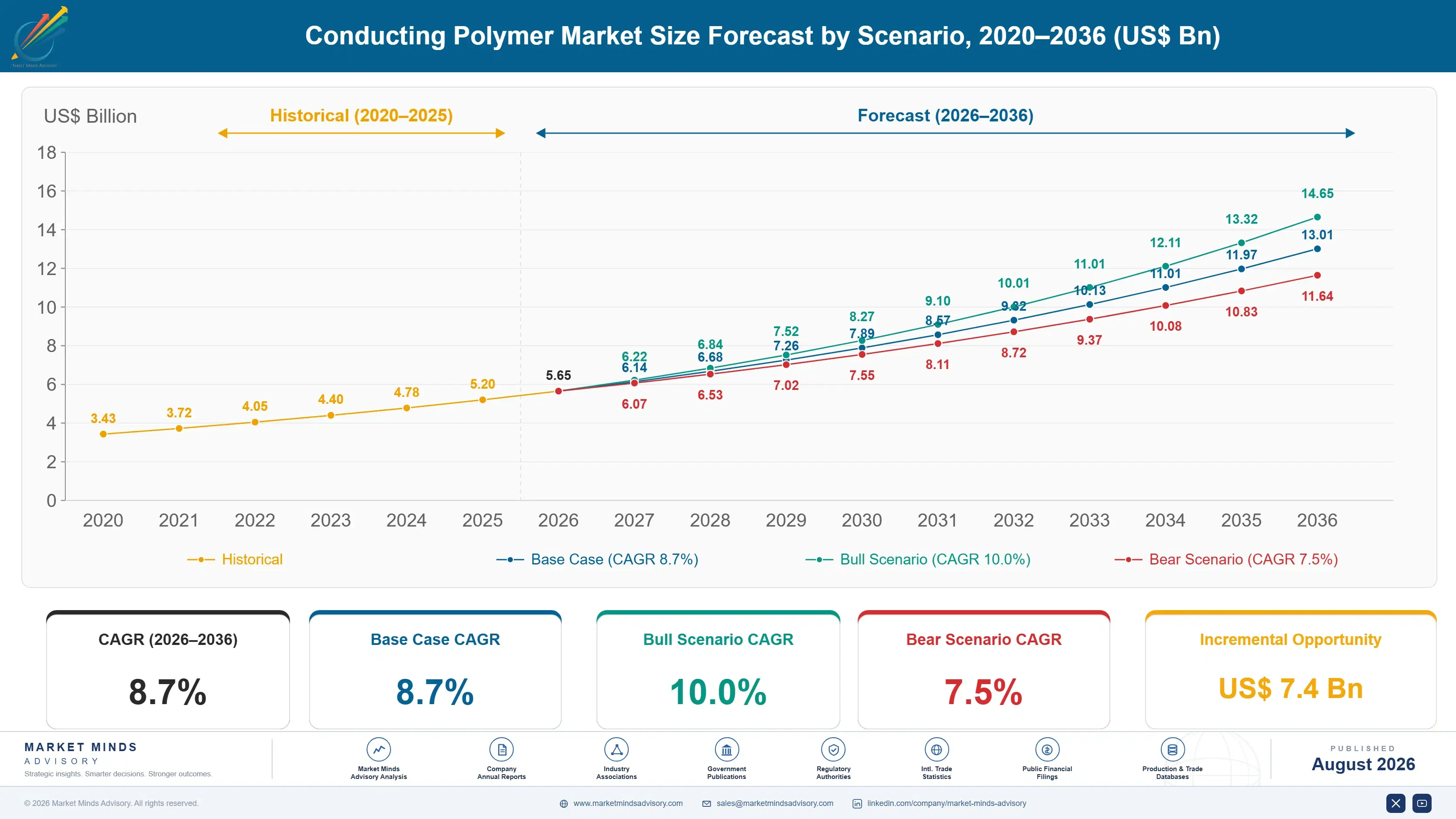
Conducting Polymer Market Forecast Scenarios

conducting-polymer-market-size-forecast-scenario-1787548971708
Between 2020 and 2025 growth came almost entirely from capacitors and from purity rather than from new applications. Solid polymer capacitors kept displacing liquid electrolytic types across automotive electronics, servers, and consumer devices, and each conversion raised polymer content per board. Electronic grade pricing held while antistatic grades commoditised. The 7.3% historical growth describes a market consolidating around one demanding application rather than broadening.
The 8.7% base case rests on three mechanisms. Automotive electrification raises capacitor count per vehicle sharply, and polymer types are specified where temperature stability and ripple current matter most. Flexible and foldable display production needs transparent conductive layers that indium tin oxide cannot survive bending, which finally gives PEDOT a display application with volume behind it. And bioelectronic sensing, though small, prices at levels that make even modest volumes commercially meaningful for producers.
The 10.0% bull case assumes foldable display volumes scale and that neural and biosensing interfaces move from research into clinical production. The 7.5% bear case reflects capacitor demand tracking a weak consumer electronics cycle, continued failure of transparent electrode applications to displace incumbent materials, and Chinese producers compressing electronic grade pricing. Application breadth, rather than capacitor volume, separates the two cases.

One Application Pays for Forty Years of Research

Three things set the commercial shape of this market. Purity comes first, because metal ion contamination that would be irrelevant in a coating destroys a capacitor dielectric or poisons a display stack. Application concentration comes second, since solid polymer capacitors take 46% of volume and everything else divides the remainder. Monomer supply comes third, and it is narrower than most buyers realise.
TOP-FIVE CONCENTRATION44%Share of global conducting polymer supply held by leading producers
AVERAGE SELLING PRICEUSD 340 per kgBlended dispersion and powder pricing across mainstream electronic grades
CAPACITOR DEMAND SHARE46%Portion of volume consumed by solid polymer capacitor production
MONOMER COST SHARE33%Monomer and dopant input within total production cost
ELECTRONIC GRADE PURITY99.9%Metal ion specification required for semiconductor and display use
CAPACITY UTILISATION72%Average loading across dedicated dispersion and polymerisation lines
The purity point deserves emphasis. Antistatic grade polyaniline sells for tens of dollars per kilogram and electronic grade PEDOT dispersion for several hundred, and the difference is contamination control, batch consistency, and dispersion stability rather than the polymer itself. Producers who cannot hold those specifications compete in a commodity market they would rather not be in. Scale alone does not close that gap, and several large chemical companies have discovered it expensively.
Dispersion stability is the operational headache nobody writes about. PEDOT:PSS ships as an aqueous dispersion that settles, agglomerates, and loses conductivity over time, so shelf life is measured in months and cold chain handling is routine. That makes distance from customer a real commercial factor and partly explains why supply positions cluster near the electronics manufacturing base. Distributors carry the inventory risk and price for it.
"This industry spent forty years promising to replace copper, silicon, and indium tin oxide, and it ended up making capacitors better. That is not a failure. One demanding application with genuine volume built more commercial capability than a hundred prototypes ever did, and it funded the purity infrastructure everything else now depends on."
Practice Director, Electronic Materials and Specialty Polymers · MMA Chemicals and Materials Practice · August 2026

Market Trends

Automotive Electrification Multiplies Polymer Capacitor Content Per Vehicle

A battery electric vehicle carries several times the capacitor count of a combustion equivalent, spread across inverters, onboard chargers, battery management, and domain controllers. Polymer types win where ripple current handling and temperature stability matter, and automotive qualification locks the material in for the platform life. Capacitors already take 46% of conducting polymer volume, and the automotive share of that keeps climbing. What matters commercially is that automotive qualification runs years and rarely reopens, so the positions being set now on current vehicle programmes will hold through most of the forecast period.
Market Impact: Conversion covers 46% of volume
Foldable Displays Revive the Transparent Electrode Application

Indium tin oxide cracks when bent, which was always the argument for polymer transparent electrodes and never quite enough to displace an incumbent that performed better on flat glass. Foldable and rollable panels change that calculation because the incumbent physically fails. PEDOT:PSS formulations now appear in production display stacks rather than only in prototypes, and Korean and Chinese panel makers are qualifying suppliers. Volumes remain modest against capacitor demand. The significance is that a second genuine high-purity application reduces the industry's dependence on a single end market. Concentration risk falls as a result.
Market Impact: Prices at 5 times electronic grade

Market Opportunities and Growth Drivers

Solid Polymer Capacitors Keep Displacing Liquid Electrolytic Types

Polymer capacitors offer lower equivalent series resistance, better ripple handling, and no electrolyte to dry out, which is why server, automotive, and premium consumer boards keep converting. Each conversion raises conducting polymer content, and the switching is one-directional because circuit designs get optimised around the improved characteristics. Japanese and Taiwanese capacitor makers drive most of this demand and specify polymer suppliers tightly. The conversion still has considerable distance to run in industrial and cost-sensitive consumer segments where liquid types remain standard for price reasons alone. Cost, not performance, is what keeps liquid types alive in those segments.
Market Impact: Shelf life below 12 months

Bioelectronic Sensing Creates Small Volumes at Exceptional Pricing

PEDOT:PSS conducts both electronically and ionically, which makes it unusually well suited to interfacing with living tissue, and neural electrodes, electrochemical biosensors, and organic electrochemical transistors all exploit that. Volumes are tiny against capacitor demand and always will be. Pricing is the point: medical grade material sells at many multiples of electronic grade, and regulatory qualification creates the same supplier lock-in that pharmaceutical ingredients enjoy. Producers treat this as an option on a future market rather than a current profit centre, and the option looks increasingly worth holding. Nothing else interfaces with tissue as cleanly.
Market Impact: Monomer is 33% of cost

Market Restraints and Challenges

Dispersion Instability Limits Shelf Life and Complicates Logistics

PEDOT:PSS ships as an aqueous dispersion whose particles settle and agglomerate over time, taking conductivity with them. The root cause is colloidal: the polymer is not truly dissolved but suspended, and thermodynamics works against the suspension continuously. Shelf life runs to months rather than years, refrigerated transport is common, and customers cannot stockpile against supply disruption. Producers mitigate through surfactant and co-solvent formulation, redispersible powder grades, and regional filling operations closer to customers. None of these fully solves a problem rooted in the material's physical form. Customers hold weeks of stock, not quarters.
Market Impact: Capacitors take 46% of volume

Monomer Supply Concentration Exposes the Whole PEDOT Chain

Ethylenedioxythiophene monomer comes from a handful of producers, and monomer plus dopant already accounts for 33% of production cost. The root cause is scale: the monomer has essentially no market outside conducting polymers, so nobody builds capacity speculatively. Any disruption propagates immediately to every downstream user, and the 2021 chemical supply disruptions demonstrated it. Producers mitigate through backward integration, multi-year monomer contracts, and qualification of alternative thiophene chemistries. Backward integration is the only approach that genuinely removes the exposure, and it demands real capital. Few producers have committed to it so far.
Market Impact: Adds a second application above 10%
4 additional market trends, 3 additional growth drivers, and 2 additional restraints and challenges are covered in the full report. Contact sales@marketmindsadvisory.com to access the complete intelligence.

Segment CAGR and Growth Architecture

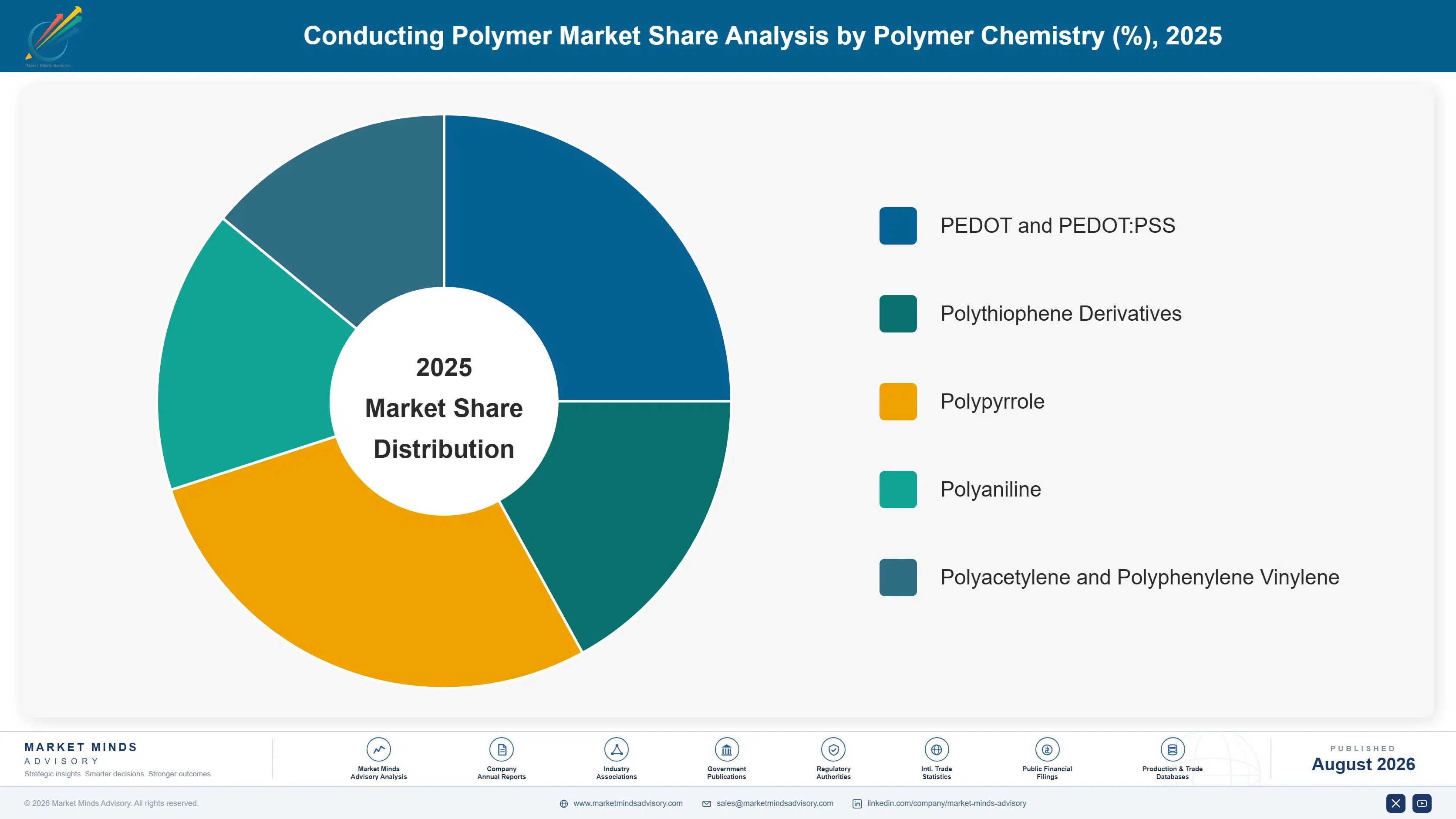
Segmentation follows polymer chemistry, because the backbone determines conductivity ceiling, processing form, environmental stability, achievable purity, and therefore which applications the material can serve at all. Five chemistries cover commercial supply, and they compete far less than the literature suggests, since each has settled into applications the others handle poorly. Substitution between chemistries is rare in practice.
conducting-polymer-market-market-share-analysis-1787548972263

PEDOT and PEDOT:PSS

The fastest-growing chemistry at 11.8%, roughly 1.36 times the market, and the largest by value by a wide margin. PEDOT combines high conductivity, genuine environmental stability, and optical transparency in thin films, a combination no other conducting polymer manages. Solid polymer capacitors consume most of it, with display transparent electrodes and bioelectronic sensing taking the high-value remainder. Heraeus holds a position here through its Clevios range that competitors have spent years attempting to challenge on both purity and dispersion consistency. The commercial constraints are dispersion shelf life and monomer supply concentration rather than anything to do with the polymer's performance. Automotive qualification is extending those positions well past the current decade, which makes present programme wins unusually valuable.
CAGR 11.8%

Polythiophene Derivatives

Second fastest at 9.2%, covering substituted polythiophenes other than PEDOT, principally poly-3-hexylthiophene and related soluble chemistries. Solubility in organic solvents is the commercial advantage, since it permits solution processing, printing, and blending in ways aqueous dispersions cannot match. Organic photovoltaics, printed sensors, and organic thin film transistors are the applications, and research consumption remains a meaningful share of volume. Environmental stability is weaker than PEDOT, which limits outdoor and long-life use without encapsulation. Pricing runs high because batch sizes are small and regioregularity control is demanding, and that pricing supports producers serving specialist volumes profitably. Volumes stay small, and producers plan capacity accordingly rather than chasing scale that the applications cannot yet absorb.
CAGR 9.2%
Full segment breakdown across 5 segments available in the complete report.

Regional Architecture and Country Demand Map

Regional shares follow electronics manufacturing rather than chemical production capability. Capacitor and display assembly concentrates heavily in East Asia, and dispersion shelf life makes proximity to those customers a genuine commercial factor rather than a logistical convenience. Purity capability, however, still sits mostly with European and Japanese producers.

North America

Research intensity rather than manufacturing volume explains much of this position, and the region buys a disproportionate share of high-value grades relative to the tonnage it consumes. Bioelectronic and medical device development is concentrated here, and medical grade material prices at many multiples of electronic grade. Automotive electronics manufacturing across the southern states adds capacitor-linked demand that grows with electrification. Defence and aerospace applications take specialty grades under qualification requirements that few suppliers meet. Domestic polymer production is limited, so most material is imported from European and Japanese producers under distribution and technical support arrangements. Growth of 9.2% reflects application value rather than volume, and the mix is unusually profitable for suppliers serving it.
Share: 25% | CAGR: 9.2% (2026 to 2036)

Western Europe

Heraeus in Germany and Agfa in Belgium anchor global supply from this region, and both built their positions on purity and dispersion consistency rather than on cost. That makes Western Europe a production centre serving customers who are mostly somewhere else, which is unusual in electronic materials. Regional demand itself is moderate, driven by automotive electronics in Germany, organic photovoltaic research, and printed electronics development across several national programmes. Energy and regulatory costs weigh on production economics against Asian competition. Growth of 7.0% is the slowest among major regions and reflects a mature demand base rather than any erosion of the technical position these producers hold. Export orientation makes the position unusually resilient to local demand.
Share: 21% | CAGR: 7.0% (2026 to 2036)
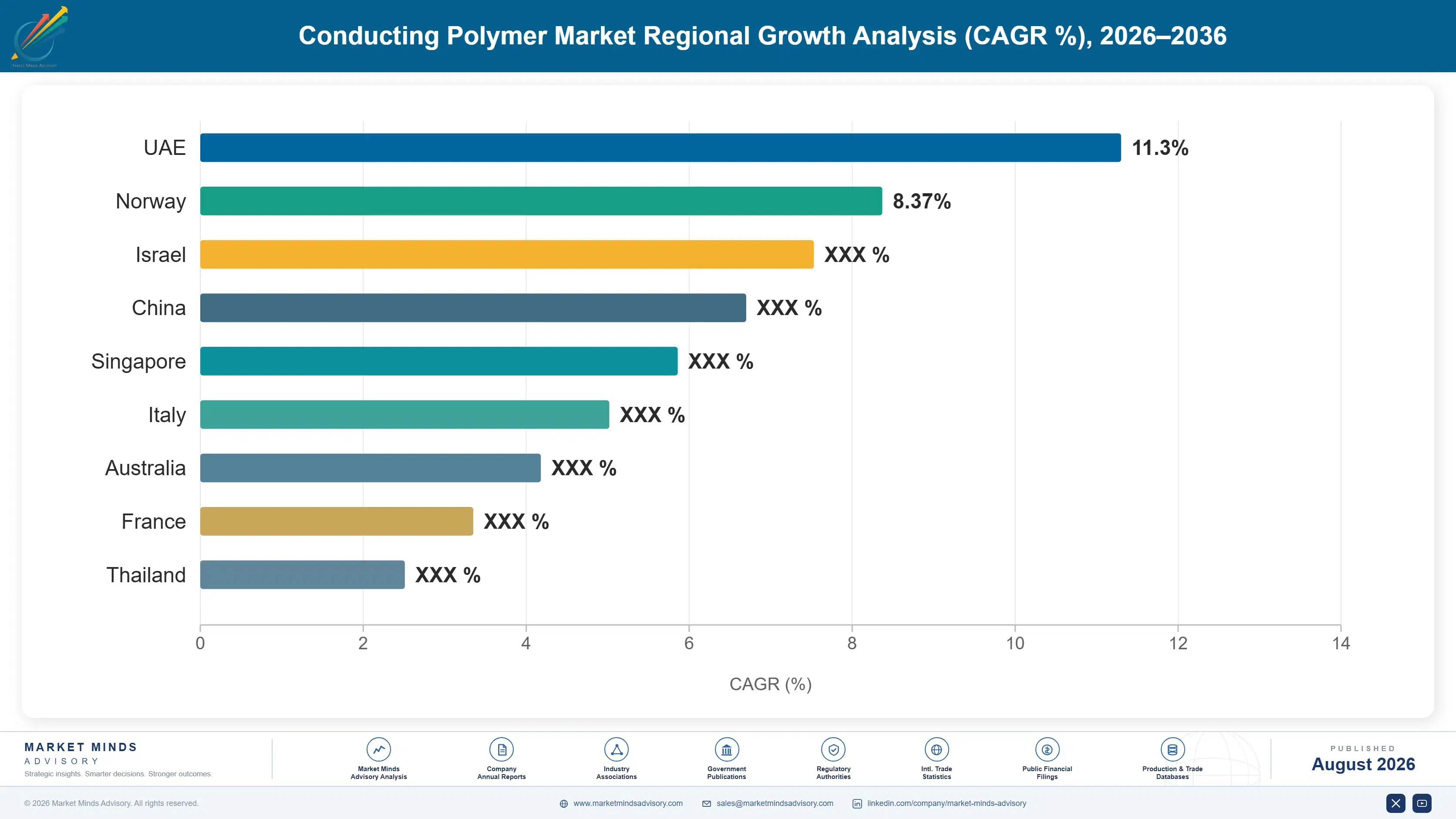
Regional intelligence for 5 additional markets available in the complete report: East Asia, South Asia and Pacific, Latin America, Middle East and Africa, Eastern Europe. Contact sales@marketmindsadvisory.com.
conducting-polymer-market-country-cagr-analysis-1787548972787

Four Moves That Change the Economics

Advantage here comes from purity infrastructure, monomer security, and application qualification rather than from polymerisation chemistry, which has been published for decades. Four moves are worth capital and management attention across the forecast period, and two of them address supply risks that most producers currently carry unhedged. Neither risk shows in a normal trading year, which is why both persist.

Integrate backward into monomer production capacity

Ethylenedioxythiophene comes from a handful of producers and represents most of a 33% monomer and dopant cost line, and it has no market outside this industry to justify speculative capacity. That leaves every downstream producer exposed to a supply base narrower than their customers understand. Backward integration costs perhaps $40 million to $70 million for meaningful scale, and it converts the largest input line from a market price into a manufacturing cost. It also becomes a competitive weapon during any disruption, which this chain has already demonstrated it can produce.
Market Impact: Secures a 33% share of total input cost

Sell medical grade into bioelectronic development programmes

PEDOT:PSS conducts ionically as well as electronically, which makes it genuinely difficult to substitute in tissue-interfacing devices. Medical grade material prices at roughly five times electronic grade, or above USD 1,700 per kilogram, and regulatory qualification creates supplier lock-in comparable to pharmaceutical ingredients once a device reaches approval. Volumes are trivial today and will stay small. The commercial logic is optionality: the qualification work costs little now and cannot be done retrospectively once a device design is fixed, so producers who engage at development stage hold positions nobody can bid against later. Engagement costs technical service rather than capital.
Market Impact: Prices at 5 times electronic grade material pricing

Solve shelf life through redispersible powder grades

Aqueous dispersions settle, lose conductivity, and force refrigerated logistics that customers dislike and distributors price for. Redispersible powder forms that reconstitute on site would remove the constraint entirely, extend shelf life beyond two years, and cut logistics cost 20 to 30% on export shipments. Several producers have partial answers and none has a complete one. Whoever does will win the geographically distant customers that dispersion shelf life currently makes uneconomic to serve properly, which is most of South Asia and Latin America. The engineering problem is reconstitution rather than drying, and it has resisted several serious attempts.
Market Impact: Cuts export logistics cost by 20 to 30%

Qualify on automotive platforms before designs freeze

Automotive capacitor qualification takes years and holds for the platform life, which typically runs seven years or more, and covers volumes worth USD 30 million or more, before any redesign reopens the specification. That makes the current electrification programmes a one-time allocation of positions rather than an ongoing competition. Producers engaging with capacitor makers during design rather than bidding afterwards capture volumes that competitors cannot subsequently touch. The engagement costs technical service and sampling rather than capital, and the window on the present generation of vehicle platforms is closing over the next few years.
Market Impact: Holds positions across full 7 year vehicle platforms

Who Controls the Margin Pool

Concentration is high: the top five hold roughly 44% of global conducting polymer supply, and in PEDOT dispersions specifically the position is considerably more concentrated than that figure suggests. Heraeus leads on purity, dispersion consistency, and capacitor qualification depth built over two decades. Agfa competes with a genuine alternative dispersion technology aimed at coating and display applications, while Merck, Nagase ChemteX, and Sumitomo hold positions built on specific application relationships rather than broad supply.
Competitive activity runs on three fronts. Purity capability is the first, because metal ion specifications exclude most chemical producers before any commercial discussion begins. Application qualification is the second, and capacitor and automotive programmes lock suppliers in for years once specified. Formulation and technical service is the third, and it decides whether a customer can actually make the material work in their process.

Pressure is building from two directions. Chinese producers are moving up from antistatic and coating grades toward electronic purity, which compresses pricing at the lower end first. And several capacitor manufacturers have explored internal polymer capability to reduce dependence on a supply base they consider uncomfortably narrow. Neither pressure has yet changed the ranking at the top.
conducting-polymer-market-company-positioning-matrix-1787548973314

Competitive Moat and Risk Dimensions

HERAEUS HOLDING

Moat: Purity and dispersion consistency

Two decades of capacitor qualification history combined with dispersion consistency that competitors have repeatedly failed to match makes the Clevios position closer to a standard than a preference. Capacitor makers design their processes around specific dispersion behaviour, and requalifying an alternative means revalidating production lines rather than simply swapping a raw material.
HERAEUS HOLDING

Risk: Single application concentration risk

The position depends heavily on solid polymer capacitors, which take 46% of industry volume and follow a consumer and automotive electronics cycle nobody controls. A prolonged downturn in that demand, or a capacitor technology shift toward alternative dielectric approaches, would expose a concentration that has so far only worked in the company's favour.
AGFA-GEVAERT

Moat: Alternative dispersion formulation technology

Coating and film expertise carried over from imaging gives Agfa genuine capability in formulating conducting polymer dispersions for web coating and display processes rather than for capacitor impregnation. That difference in technical orientation gives customers a real second source in applications where the dominant supplier's formulations were optimised for something else entirely.
AGFA-GEVAERT

Risk: Scale disadvantage in electronics

Conducting polymers sit inside a much larger business whose priorities lie elsewhere, which limits how aggressively the position can be funded against a competitor for whom this is a core electronics franchise. Winning purity-critical qualifications requires sustained investment that a smaller internal business case struggles to justify year after year.

Players Tracked

Prominent Players

Heraeus Holding
Agfa-Gevaert
Merck KGaA
Nagase ChemteX
Sumitomo Chemical

Other Key Players

Ossila
Rieke Metals
Solvay
Lubrizol
3M
Celanese
MacDermid Alpha Electronics Solutions
Tosoh Corporation
TDK Corporation
Panasonic Corporation
KEMET Electronics
Nissan Chemical
Shin-Etsu Polymer
Avient Corporation
Premix Oy

Recent Developments

FEBRUARY 2025

Heraeus expands electronic grade dispersion capacity

Additional high-purity PEDOT dispersion capacity entered service to serve capacitor and display customers, extending an existing production position rather than establishing a new one. The expansion responds to automotive capacitor demand that electrification has raised faster than the previous capacity plan anticipated across the region.
Signal: Automotive electrification is pulling electronic materials capacity forward much faster than consumer electronics cycles ever did
JUNE 2025

Display maker qualifies polymer transparent electrode

A Korean panel manufacturer moved a PEDOT-based transparent conductive layer into foldable display production after several years of qualification work. Indium tin oxide cracking under repeated folding was the technical driver, and the material now appears in a commercial product stack rather than only in engineering samples.
Signal: The transparent electrode application finally has real production volume behind it rather than another prototype announcement
SEPTEMBER 2025

Japanese producer expands specialty polythiophene supply

Nagase ChemteX increased supply of soluble polythiophene grades aimed at printed electronics and sensor applications, targeting customers who need solution processing rather than aqueous dispersion. Volumes remain small against capacitor demand and pricing reflects the demanding regioregularity control these grades require. Customer concentration remains high in this grade family.
Signal: Soluble chemistries are carving out printed and sensor applications that aqueous dispersions handle poorly or not at all

What Sets the Cost Base

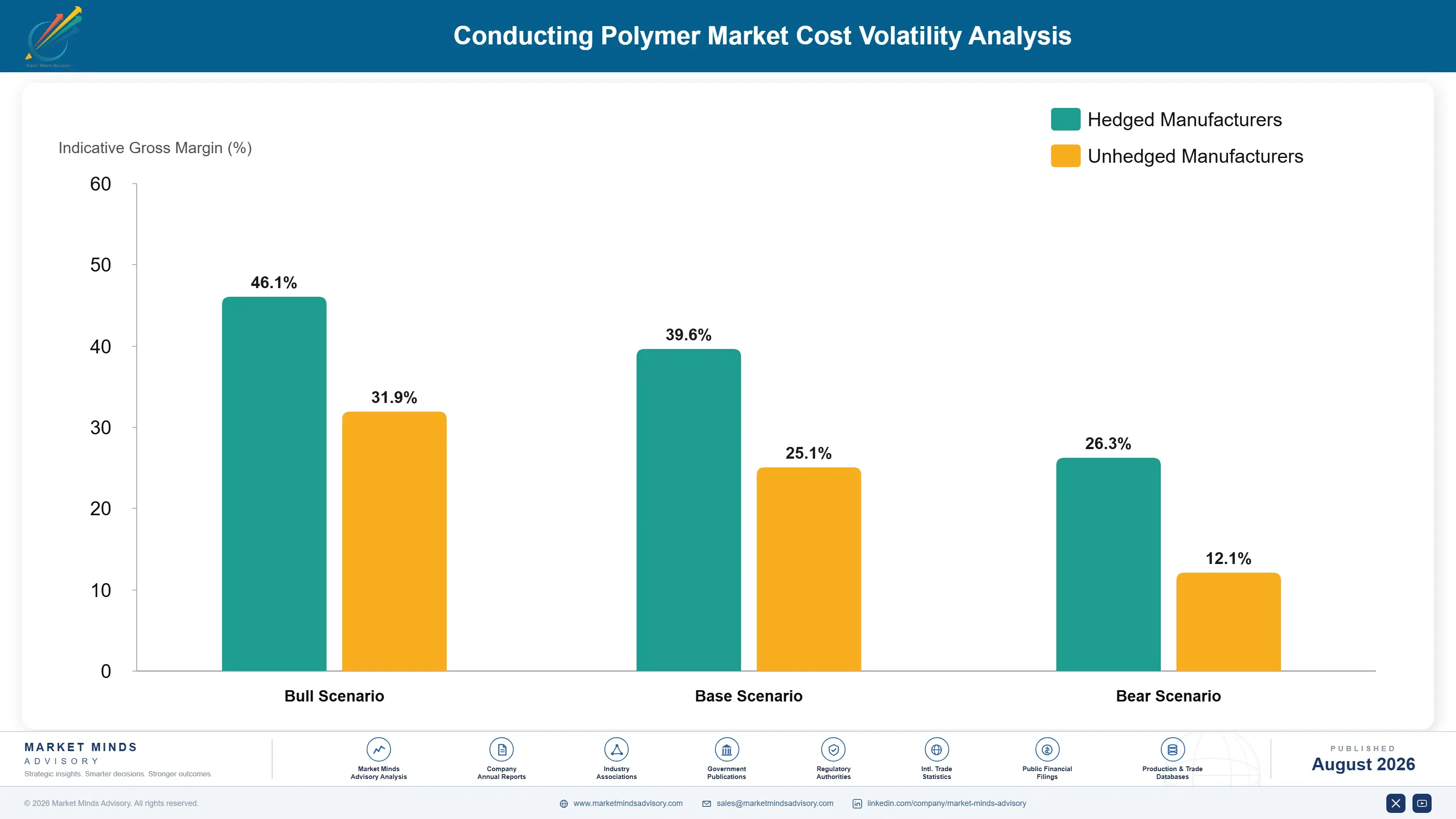
Monomer and dopant dominate at roughly 33% of production cost, with ethylenedioxythiophene and polystyrene sulphonate the principal inputs and both sourced from narrow supplier bases. Purification, ion exchange, and filtration consumables take a further 21%, a share that reflects what electronic grade specifications actually demand. Energy for polymerisation and dispersion processing contributes 11%. Quality control, controlled packaging, and refrigerated logistics absorb the balance.
Chemical supply disruptions through 2021 and 2022 exposed the monomer concentration clearly. Specialty thiophene intermediates went on allocation as European chemical output fell under energy pressure documented in IEA reporting, and downstream producers who held no contracted monomer position simply queued. Merck and Heraeus both referenced raw material availability across their reporting then. Lead times that normally ran weeks extended to months, and customers holding short shelf life inventory could not buffer it.

Exposure divides on backward integration rather than on scale or geography. Producers making their own monomer held cost and delivery position while purchasers absorbed whatever the market asked. Purification creates a second divide: electronic grade producers can retreat into commodity grades during weak demand, while commodity producers cannot move upward at all. European operations carry higher energy and regulatory cost than Asian competitors.
conducting-polymer-market-cost-volatility-analysis-1787548973510

Contract monomer supply on multi-year volume terms

Ethylenedioxythiophene has no market outside this industry, so producers build capacity only against committed demand. Multi-year contracts with volume commitment secure both allocation priority and pricing during tight periods. The cost is commitment through soft demand, which is uncomfortable in a market following consumer electronics cycles. It remains far cheaper than losing a qualified capacitor position to a supply failure.

Recover and recycle ion exchange and purification media

Purification consumables are 21% of cost and largely treated as single-use across the industry. Regeneration of ion exchange resin and filtration media cuts that materially where contamination profiles permit, and the engineering is well understood from adjacent electronic chemical processes. Validation work is the obstacle, since any change to purification risks the metal ion specification customers qualified against originally.

Develop powder grades to remove refrigerated logistics cost

Refrigerated shipping and limited shelf life add cost to every export consignment and prevent customers from holding buffer stock. Redispersible powder forms would remove both. Several producers hold partial solutions, and the reconstitution behaviour rather than the drying step is the difficult part. Solving it converts distant markets from marginal to genuinely serviceable at reasonable cost.

Portfolio Architecture for Margin Defence

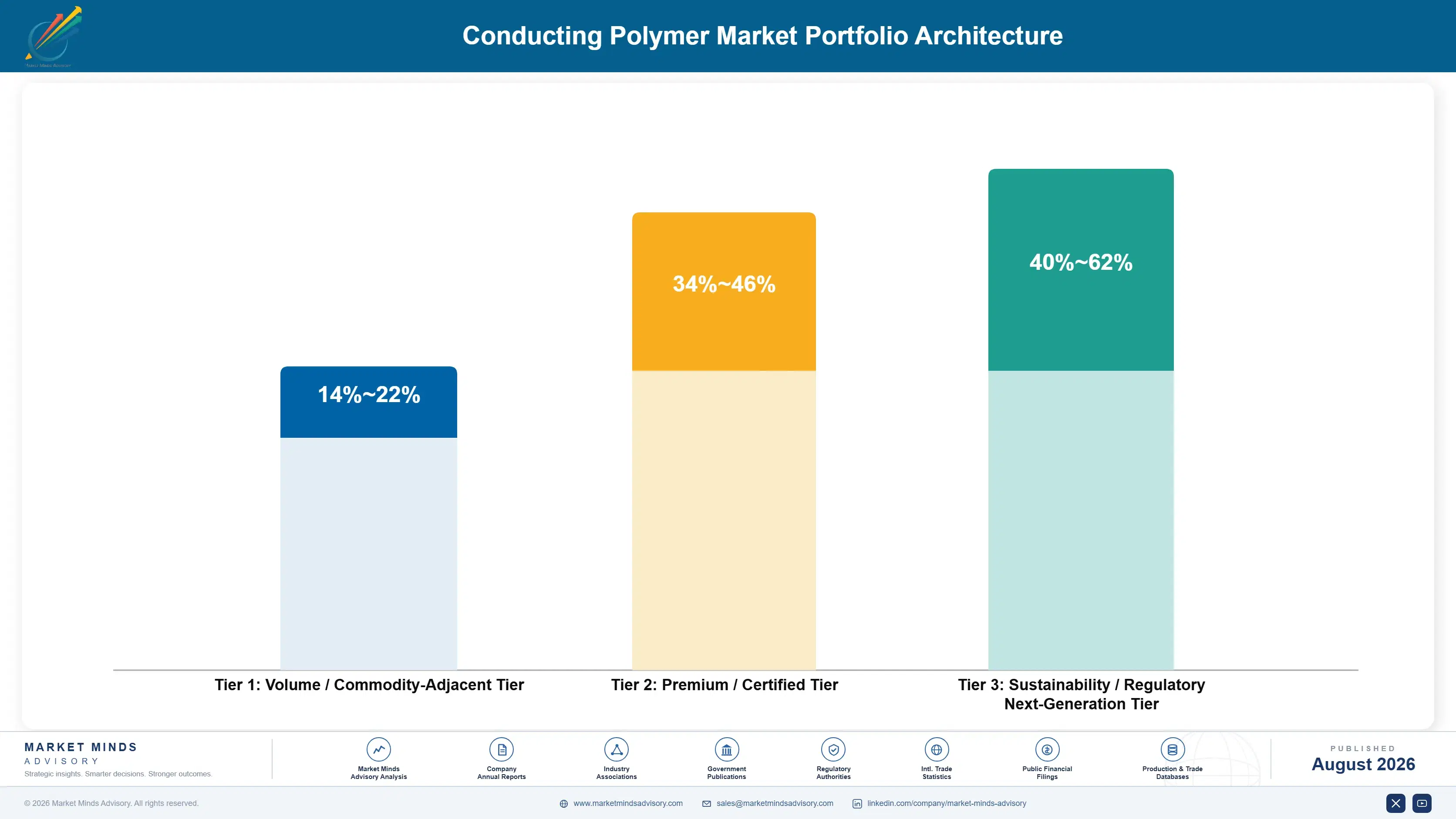
Margin follows purity grade rather than volume, and the spread is wider than in almost any adjacent materials market. Antistatic and coating grades sell at tens of dollars per kilogram against commodity competition and earn modest returns. Electronic grade dispersions qualified into capacitor production sell for several hundred and earn several times the margin, because requalification costs the customer a production line validation rather than a purchase order change.
The volume and premium tension is unusual because the same polymerisation capacity feeds both, but the purification trains do not. Producers can always retreat from electronic into commodity grades when demand weakens, and commodity producers cannot move the other way without building purification infrastructure they have never had. That asymmetry is the whole competitive structure of the industry in a sentence.

High-value pools concentrate in three places: qualified capacitor grade dispersions, medical and bioelectronic grades, and specialty soluble polythiophenes for printed applications. Each is defended by qualification, regulatory position, or process difficulty rather than by price. Price competition arrives in each only when a competitor matches the purity infrastructure, the regulatory position, or the process control, and none of those is a purchase decision that any board can simply approve.

Volume / Commodity-Adjacent Tier

Antistatic polyaniline and polypyrrole grades for packaging, flooring, and coating applications where purity requirements are undemanding. Competes on price against Chinese supply. The range reflects large differences in scale and monomer sourcing position.
Gross Margin: 14%-22%

Premium / Certified Tier

Electronic grade PEDOT dispersions qualified into capacitor and display production. The customer purchases process consistency and qualification history rather than a polymer, and switching means revalidating a production line. Requalification means revalidating a production line.
Gross Margin: 34%-46%

Sustainability / Regulatory / Next-Generation Tier

Medical and bioelectronic grades, soluble polythiophenes, and formulated printing inks sold into development and regulated applications. Small volumes at exceptional pricing. The range is wide because medical qualification premiums vary enormously.
Gross Margin: 40%-62%
conducting-polymer-market-portfolio-architecture-1787548974015

High-value Sub-segments and Strategic Watch-out

Qualified Capacitor Grade Dispersions

The commercial foundation of the whole industry, taking 46% of volume at premium pricing. Capacitor makers design processes around specific dispersion behaviour, which makes substitution a line revalidation rather than a purchasing decision. Automotive qualification extends the lock-in further. Defend these positions before pursuing anything else.
Gross Margin: 35%-47%

Medical and Bioelectronic Grades

The highest-margin pool, priced at roughly five times electronic grade with regulatory lock-in once a device wins approval. Volumes are trivial and will remain so. Value lies in optionality, since qualification cannot be done retrospectively after a design freezes. Treat the spend as an option premium, not revenue.
Gross Margin: 45%-65%

Antistatic and Coating Grades

The utilisation engine rather than the profit engine. Polymerisation capacity must run, and this business keeps it loaded through electronics cycles that would otherwise leave lines idle. Chinese competition sets the price and will keep doing so. Price it for contribution and plant loading only.
Gross Margin: 14%-21%

Transparent Electrode Display Supply

The strategic watch-out. Foldable panels finally gave the application production volume, but panel programmes concentrate risk in very few customers and indium tin oxide still wins wherever the display does not bend. Qualify early, forecast conservatively. Customer concentration is the risk to manage here. Contracts run short.
Gross Margin: 30%-42%

How Demand Actually Reaches Producers

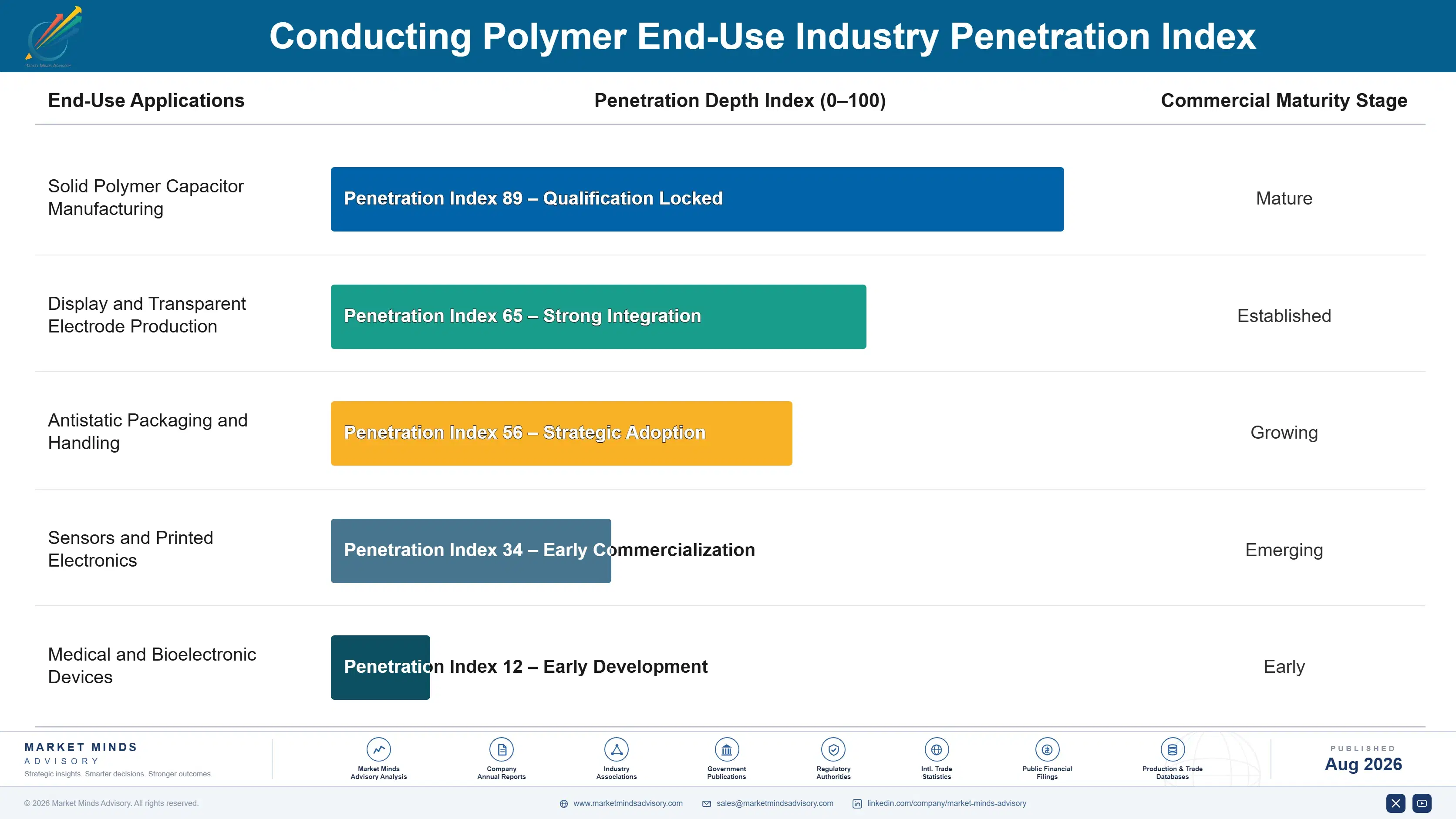
The annuity here comes from qualification rather than from replacement. Nothing wears out and gets reordered; instead a capacitor maker qualifies a dispersion into a production process, designs the process around its behaviour, and then buys it for as long as that product line runs. Automotive programmes extend this further, holding for seven years or more before any redesign reopens the specification. Revenue is therefore highly predictable once won and almost impossible to win back once lost.
Adoption depth varies sharply by vertical. Capacitor manufacturers are the deepest and most demanding customers, specifying dispersion behaviour to a level that makes substitution a process revalidation. Display makers sit close behind. Medical device developers create the tightest lock-in of all through regulatory filings. Antistatic packaging converters are the opposite entirely, buying on price and switching between suppliers without any technical consequence.

The buyer has shifted toward process engineers and away from purchasing. What gets evaluated now is how a dispersion behaves on a specific coating line, not what a data sheet claims. A dispersion that performs perfectly in a laboratory and unpredictably on a slot die coater is worthless commercially, and that distinction decides more supplier selections than pricing ever does.
conducting-polymer-market-end-use-penetration-index-1787548974507

Where the Money Sits

These are among the four positions where our research anticipates prominent divergence between winners and laggards over the coming forecast period. Each is grounded in the demand model, the regulatory perimeter, and the announced capacity pipeline.
01 / MONOMER SUPPLY SECURITY

Integrate backward, because nobody else will build the capacity

Ethylenedioxythiophene has no application outside conducting polymers, so no producer builds capacity speculatively and the whole downstream industry depends on a supplier list short enough to count on one hand. Monomer and dopant already run 33% of production cost, and the 2021 disruptions showed how quickly that exposure becomes an allocation problem. Integration costs perhaps $40 million to $70 million and it converts the single largest input line from an uncontrollable market price into something management can actually plan around.
02 / CAPACITOR QUALIFICATION DEPTH

Defend the capacitor position, because it funds everything else

Solid polymer capacitors take 46% of industry volume at premium pricing, and the customers design their production processes around specific dispersion behaviour rather than around a specification sheet. That makes each qualified position close to permanent, and each loss almost impossible to reverse afterwards at any price. Automotive programmes holding seven years or more extend the lock-in further, which means the positions now being set on current electrification platforms will effectively define competitive standing for most of the forecast period ahead.
03 / MEDICAL GRADE OPTIONALITY

Qualify into bioelectronics now, because designs freeze permanently

Material that conducts both ionically and electronically is genuinely hard to substitute in tissue-interfacing devices, and medical grade prices at roughly five times electronic grade once a device reaches approval. Volumes today are trivial and the temptation to defer engagement is obvious to any finance function reviewing it. The qualification work cannot be done retrospectively after a device design freezes, so deferring the modest cost today means forfeiting the position entirely rather than merely delaying the revenue by a few years.
04 / SHELF LIFE ENGINEERING

Fix dispersion stability and the distant markets open up

Aqueous dispersions settle and lose conductivity within months, which forces refrigerated logistics, prevents customers holding buffer stock, and makes geographically distant markets uneconomic to serve properly. Redispersible powder grades would extend shelf life beyond two years and cut export logistics cost 20 to 30% at the same time. Several producers hold partial answers and none a complete one, so whoever first solves the reconstitution behaviour takes South Asian and Latin American demand that no supplier currently serves properly at all.

Engagement Snapshot From the Field

A live engagement with an industry participant carrying material or product regulatory and market exposure ahead of a defining policy shift, showing how our research translates into a defensible multi-year portfolio strategy.
MARKET MINDS ADVISORY · CLIENT ENGAGEMENT SUMMARY
Conducting Polymer Producer Strategic Portfolio Review and Transition Roadmap 2026·Investment Scenario on Conducting Polymer Exposure Evaluation 2025-26
CLIENT PROFILE
An Asian specialty chemical manufacturer producing antistatic polyaniline and polypyrrole grades for packaging and coating customers, with revenue near USD 65 million (client-reported, unverified by MMA). The business held solid polymerisation capability, no electronic grade purification infrastructure, and no qualified position with any capacitor or display customer anywhere in the region. Customers sat within a short shipping radius of the plant.
STRATEGIC CHALLENGE
Antistatic grade pricing had fallen for nine consecutive quarters under competition from newer Chinese entrants, while the electronic grade market the client could not serve was growing at several times the rate on far better margins. Management needed to know whether purification investment could realistically win qualified positions, and how long that would take.
MMA APPROACH
MMA mapped capacitor and display qualification requirements against the client's existing capability, modelled purification investment cost and timelines, and assessed where incumbency was weakest across application segments. Forty-seven expert interviews with capacitor process engineers, display material buyers, and formulators established what actually determines qualification outcomes. Published qualification data reveals none of this.
KEY FINDINGS
  1. Capacitor qualification required dispersion consistency the client could not achieve without purification investment, and incumbent positions there proved effectively closed to any new entrant within five years.
  2. Printed electronics and sensor customers accepted wider specification tolerance while paying three times antistatic pricing, offering a realistic first step toward electronic grade capability.
  3. Refrigerated logistics and shelf life prevented the client from serving customers beyond a short shipping radius, quietly limiting the addressable market to roughly a third of regional demand.
  4. Medical and research grade volumes were small enough to be dismissed internally, yet carried gross margins more than double anything else the client could realistically pursue near term.
CLIENT PROFILE
An Asian specialty chemical manufacturer producing antistatic polyaniline and polypyrrole grades for packaging and coating customers, with revenue near USD 65 million (client-reported, unverified by MMA). The business held solid polymerisation capability, no electronic grade purification infrastructure, and no qualified position with any capacitor or display customer anywhere in the region. Customers sat within a short shipping radius of the plant.
STRATEGIC CHALLENGE
Antistatic grade pricing had fallen for nine consecutive quarters under competition from newer Chinese entrants, while the electronic grade market the client could not serve was growing at several times the rate on far better margins. Management needed to know whether purification investment could realistically win qualified positions, and how long that would take.
MMA APPROACH
MMA mapped capacitor and display qualification requirements against the client's existing capability, modelled purification investment cost and timelines, and assessed where incumbency was weakest across application segments. Forty-seven expert interviews with capacitor process engineers, display material buyers, and formulators established what actually determines qualification outcomes. Published qualification data reveals none of this.
KEY FINDINGS
  1. Capacitor qualification required dispersion consistency the client could not achieve without purification investment, and incumbent positions there proved effectively closed to any new entrant within five years.
  2. Printed electronics and sensor customers accepted wider specification tolerance while paying three times antistatic pricing, offering a realistic first step toward electronic grade capability.
  3. Refrigerated logistics and shelf life prevented the client from serving customers beyond a short shipping radius, quietly limiting the addressable market to roughly a third of regional demand.
  4. Medical and research grade volumes were small enough to be dismissed internally, yet carried gross margins more than double anything else the client could realistically pursue near term.
RECOMMENDED STRATEGY
Phase 1: Phase one: invest in intermediate purification capability targeting printed electronics and sensor customers, where specification tolerance permits entry without full electronic grade infrastructure. Phase 2: Phase two: develop redispersible powder grades to extend shelf life and open customers beyond the current shipping radius that logistics constraints have effectively excluded. Phase 3: Phase three: pursue medical and research grade qualification, accepting small volumes for the margin and the technical credibility both provide.
OUTCOME
The client commissioned purification capability within fourteen months and qualified with four printed electronics customers the following year. Specialty grade revenue reached 26% of the total by the second year at gross margin 17 percentage points above the antistatic base, and powder grade development opened two export markets (client-reported, unverified by MMA).

Frequently Asked Questions

Foundational context covering the market sizes, CAGR, scope, country, region and competition that inform every finding below. This section is provided to cover basics and most often pre-purchase conversations, answered from the MMA Primary Research Dataset.

What is the current size of the Conducting Polymer Market?

The market was valued at USD 5.2 billion in 2025, rising to an estimated USD 5.65 billion in 2026. East Asia holds the largest regional share at 30% of global value.

How large will the Conducting Polymer Market be by 2036?

MMA forecasts USD 13.02 billion by 2036 under the base case, an expansion multiple of 2.30 times the 2026 value. That represents USD 7.37 billion of incremental value across the forecast period.

What is the CAGR for the Conducting Polymer Market 2026 to 2036?

The base case CAGR is 8.7%, with a bull case of 10.0% and a bear case of 7.5%. The spread reflects uncertainty over foldable display volumes and consumer electronics cycles.

Which segment is growing fastest?

PEDOT and PEDOT:PSS grow fastest at 11.8%, roughly 1.36 times the market rate. Polythiophene derivatives follow at 9.2%, serving printed electronics and sensor applications that need solution processing.

Who are the major companies in the Conducting Polymer Market?

Heraeus Holding, Agfa-Gevaert, Merck KGaA, Nagase ChemteX, and Sumitomo Chemical lead on conducting polymer supply. The top five hold roughly 44% of global value between them.

Which country is growing fastest?

India grows fastest at 11.6%, driven by electronics manufacturing incentive schemes pulling component assembly into the country. The base is small, which flatters the growth rate considerably.

Report Segmentation Architecture

The full report scope spans multiple orthogonal segmentation dimensions, with cross-tabulated demand data provided for each dimension pair. Coverage extends further to regional breakdowns, trend trajectories, and the competitive detail needed to support segment-level decision-making.

By Polymer Chemistry

  • PEDOT and PEDOT:PSS
  • Polythiophene Derivatives
  • Polypyrrole
  • Polyaniline
  • Polyacetylene and Polyphenylene Vinylene

By End-Use Industry

  • Solid Polymer Capacitor Manufacturing
  • Display and Transparent Electrode Production
  • Antistatic Packaging and Handling
  • Sensors and Printed Electronics
  • Medical and Bioelectronic Devices

By Customer Type

  • Electronic Component Manufacturers
  • Display and Panel Producers
  • Formulators and Ink Producers
  • Packaging and Coating Converters
  • Research and Development Purchasers

By Region

  • North America
  • Western Europe
  • East Asia
  • South Asia and Pacific
  • Latin America
  • Middle East and Africa
  • Eastern Europe

Scope, Methodology, and Coverage

Every figure in this report is reproducible from documented input assumptions. The scope below maps the historical period, the forecast horizon, the segmentation dimensions, and the countries covered, alongside the underlying primary and qualitative methodology.
Historical Period
2020 to 2025
Forecast Period
2026 to 2036
Base Year
2025 (USD billions; MMA Primary Research Dataset, August 2026)
Market Definition
The market comprises intrinsically conducting polymers supplied as powders, aqueous and solvent dispersions, and formulated inks, covering PEDOT and PEDOT:PSS, polythiophene derivatives, polypyrrole, polyaniline, and polyacetylene and polyphenylene vinylene chemistries. Value is measured at producer level across electronic, medical, antistatic, coating, and research grades. Conductive composites filled with carbon black, graphene, or metal particles, finished capacitors and electronic devices, semiconducting small molecules, and electrolyte salts fall outside scope.
Quantitative Units
USD billions (current prices); metric tonnes of conducting polymer shipped annually on solids basis; USD per kilogram by grade
Segmentation Dimensions
By Polymer Chemistry; By End-Use Industry; By Customer Type; By Region
Regions Covered
North America, Western Europe, East Asia, South Asia and Pacific, Latin America, Middle East and Africa, Eastern Europe
Countries Covered
United States, Canada, Mexico, Germany, Belgium, United Kingdom, France, Italy, Netherlands, Poland, Czechia, Hungary, Japan, China, South Korea, Taiwan, India, Australia, Singapore, Vietnam, Malaysia, Brazil, Israel, Saudi Arabia, South Africa
Key Companies Profiled
Heraeus Holding, Agfa-Gevaert, Merck KGaA, Nagase ChemteX, Sumitomo Chemical, Ossila, Rieke Metals, Solvay, Lubrizol, 3M, Celanese, MacDermid Alpha Electronics Solutions, Tosoh Corporation, TDK Corporation, Panasonic Corporation, KEMET Electronics, Nissan Chemical, Shin-Etsu Polymer, Avient Corporation, Premix Oy
Quantitative Methodology
Primary survey, n=3,800 respondents, Q4 2025, six countries; demand-side model with trade association cross-validation
Qualitative Methodology
47 expert interviews, Q4 2025; applied to validate demand model assumptions, identify emerging dynamics, and assess competitive positioning
Report Format
PDF and XLSX data workbook (Word format preview document)
Publisher
Market Minds Advisory
Report Code
MMA-2026-CHM-118
Published
August 2026
Contact
sales@marketmindsadvisory.com | www.marketmindsadvisory.com

Purchase the full Conducting Polymer Market Report (2026 to 2036).

The full report sizes conducting polymer demand across five chemistries, five end-use categories, and seven regions with 2026 to 2036 forecasts under base, bull, and bear cases. It separates electronic grade value from commodity antistatic volume, which behave as different markets despite sharing a production base. Competitive profiles cover twenty producers assessed consistently on conducting polymer supply, purity capability, and application qualification depth. Cost analysis traces monomer concentration and purification consumable exposure through recent supply disruptions. Commercial guidance addresses backward integration, capacitor qualification defence, medical grade optionality, and dispersion shelf life engineering.
Five polymer chemistries sized separately by region
Electronic grade value separated from commodity antistatic volume
Capacitor qualification depth assessed across twenty producers
Monomer supply concentration modelled as a downstream risk
Medical and bioelectronic grade pricing premiums quantified
Dispersion shelf life mapped against addressable export markets

Built For The People Who Decide

From boardroom strategy to bench-side execution, this report is read cover-to-cover by leaders shaping the next decade of their industry, turning demand scenarios, market dynamics and valuation benchmarks into decisions.
CXOs/ Presidents/ VPs/ Managers
M&A and Corporate Development
Strategy Teams and R&D Heads
Procurement and Product Directors
Regulatory and Compliance Leaders
Investor Relations and Equity Analysts