Market Minds Advisory
Computer-Assisted Anesthesia Systems Market

Computer-Assisted Anesthesia Systems Market: Closed-Loop Delivery Challenges the Anesthesiologist's Manual Titration

Closed-loop delivery systems that automatically titrate anesthetic depth based on continuous physiological feedback are moving into commercial operating rooms, forcing manufacturers built around manual infusion to defend workstation share against a more automated alternative.

Lead Analyst

Alice Ballenger

Published

September 2026

Make Smarter Decisions with Customized Research Insights

Request a free sample report and evaluate market opportunities, growth trends, and competitive dynamics relevant to your business needs.

2025 MARKET VALUE$1.8BMarket Size 2025
2036 FORECAST VALUE$4.9BBase Case , 2026 to 2036
CAGR 2026 TO 20369.5 %Bull 10.8% / Bear 8.2%
INCREMENTAL OPPORTUNITY$2.9BNet 10- year value creation
EXPANSION MULTIPLE2.48x2036 value over 2026 base
Strategic Levers
M&A Pipeline
Regional Outlook
Country Rankings
Competitive Intelligence
Segmental Deep-dive
Call-Us : 91 93563 13602

Executive Snapshot and Market Trajectory

Closed-loop anesthesia delivery, which automatically adjusts drug infusion based on continuous depth-of-anesthesia feedback rather than an anesthesiologist's manual titration, is moving from research protocols into commercial operating rooms, threatening to reshape a workflow that has depended on clinician judgment for decades.
Demand concentrates around three system categories: target-controlled infusion systems still anchoring the largest installed base, anesthesia information management systems increasingly integrated with automated dosing support, and closed-loop delivery systems representing the newest automation frontier. Closed-loop systems, still a small share of total installed volume, are growing fastest as clinical evidence accumulates supporting both safety and efficiency benefits over manual titration. North America holds the largest share on concentrated surgical volume and operating room technology investment.
Competitive intensity concentrates among large medical device companies with established anesthesia workstation franchises, while newer entrants compete specifically on closed-loop algorithm sophistication and clinical validation depth. Anesthesiologist trust, built over years of clinical experience with manual titration, remains a genuine adoption barrier that pure technical specification comparisons cannot fully overcome. Manufacturers without comparable clinical validation increasingly struggle to win academic center adoption regardless of hardware specifications alone. That gap keeps widening.
Market Definition
The computer-assisted anesthesia systems market covers hardware and software systems that use computerized algorithms to support or automate anesthetic drug delivery during surgical and procedural sedation, including target-controlled infusion systems, closed-loop delivery systems, anesthesia information management systems with automated dosing integration, and depth-of-anesthesia monitoring-integrated delivery platforms. It excludes conventional manually operated anesthesia machines without computerized dosing support, standalone physiological monitors without delivery integration, and anesthetic drugs themselves.
Base Year Value
$1.8B in 2025 (MMA Primary Research Dataset, August 2026)
Forecast Period
2026 to 2036, eleven discrete annual values
CAGR
9.5% base case. Bull 10.8%. Bear 8.2%.
Fastest Growth Segment
Closed-Loop Anesthesia Delivery Systems: 16.5% CAGR
Fastest Growth Country
China: 15.8% CAGR
Fastest Growth Region
South Asia and Pacific: 11.5% CAGR
Largest Region
North America: 30% of 2025 global value
Market Leaders
GE HealthCare, Drägerwerk AG, Mindray Medical International, Fresenius Kabi AG, Medtronic plc. Source: MMA Analysis based on company annual reports.
Primary Survey
n=3,800 procurement and R&D decision-makers, Q4 2025, six countries
Methodology
Demand-side build-up, cross-validated against public data, 47 expert interviews

Computer-Assisted Anesthesia Systems Market Forecast Scenarios

computer-assisted-anesthesia-systems-market-size-forecast-scenario-1787307038774
Between 2020 and 2025 the market grew at roughly 8.6% a year, steady rather than volatile, as surgical volume recovered from pandemic-era deferrals and hospitals gradually resumed operating room technology upgrade cycles deferred during the worst disruption period. That recovery period also gave hospitals time to evaluate closed-loop pilot programs before committing to broader capital investment.
The base case carries the market to a 9.5% CAGR on three mechanisms. First, closed-loop delivery systems keep expanding as clinical evidence accumulates supporting both safety and operating room efficiency benefits over manual titration. Second, anesthesia information management system adoption keeps growing as hospitals digitize perioperative documentation and seek integrated dosing decision support. Third, rising surgical volume globally, tracked through national hospital procedure statistics, keeps expanding the installed base of operating rooms requiring modern anesthesia delivery technology.
The bull case reaches 10.8% if closed-loop systems achieve broader clinical validation and regulatory clearance fast enough to displace manual titration across a meaningfully wider set of procedure types. The bear case falls to 8.2% if anesthesiologist adoption resistance and liability concerns slow closed-loop deployment beyond early-adopter academic medical centers meaningfully. That divergence rests largely on how quickly institutional trust and liability clarity both develop.

Automation Confidence Is Becoming the Real Purchasing Criterion

Three forces converge on this market at once. Closed-loop delivery technology keeps closing the clinical evidence gap with manual titration, hospitals keep digitizing perioperative workflow through integrated anesthesia information management systems, and rising surgical volume keeps expanding the installed operating room base needing modern technology. Manufacturers unable to demonstrate genuine safety and efficiency advantage risk losing share to better-validated competitors. Manufacturers una
MARKET CONCENTRATION (CR5)58%Top five manufacturers hold a clear majority position
AVERAGE SYSTEM PRICE$95,000/unitClosed-loop systems command notable premium over standard workstations
TOP PRODUCING COUNTRY SHARE24%United States leads global anesthesia system manufacturing volume
CLOSED-LOOP ADOPTION RATE12%Eligible operating rooms using automated delivery climbed steadily
TRADE INTENSITY31%Nearly a third of system volume crosses national borders
COMPONENT COST SHARE35% of COGSSensor and infusion pump components dominate manufacturing cost
Commercially, the market splits between conventional target-controlled infusion systems, priced competitively and sold largely on established clinical familiarity, and closed-loop delivery systems, priced at meaningful premium and sold on demonstrated automation performance that manual titration cannot match consistently. That closed-loop category commands disproportionate margin relative to its unit volume share of the overall market. That margin gap is widening as hospitals increasingly prioritize documented automation performance over pure hardware familiarity.
Over the next decade the defining question is whether closed-loop delivery becomes the standard approach across most procedure types, or whether anesthesiologist judgment and liability considerations keep automated delivery reserved for specific lower-risk procedures where the clinical and commercial case is clearest. Hospitals positioned on both sides face very different capital and clinical investment choices ahead.
"Anesthesiologists spent their entire training learning to titrate by feel and physiological signal, and asking them to trust an algorithm instead is a much bigger cultural shift than most manufacturers building this technology seem to appreciate. The clinical data increasingly supports closed-loop delivery, but data alone does not change decades of trained clinical instinct overnight."
Director, Anesthesia and Perioperative Technology Practice · MMA Medical Devices

Market Trends

Closed-Loop Systems Demonstrate Measurable Efficiency and Safety Gains

Clinical studies published since 2022 increasingly document that closed-loop anesthesia delivery achieves more stable anesthetic depth and reduces both overdose and underdose episodes compared to manual titration, evidence that is gradually shifting anesthesiologist skepticism toward cautious clinical interest. Several academic medical centers have adopted closed-loop systems for lower-complexity procedures specifically, using the accumulated experience to build institutional comfort before considering broader deployment across more complex surgical cases. Manufacturers with the strongest published comparative outcomes data are capturing disproportionate early-adopter interest relative to competitors offering comparable hardware without equivalent clinical validation.
Market Impact: Adds 2,000+ new operating rooms yea

Anesthesia Information Management Systems Integrate Automated Dosing Support

Hospitals digitizing perioperative documentation through anesthesia information management systems increasingly demand integrated dosing decision support rather than purely passive record-keeping functionality, reflecting a broader shift toward treating the anesthesia workstation as an active clinical decision partner rather than a documentation tool alone. GE HealthCare and Drägerwerk have both expanded software capability specifically supporting this integration, letting anesthesiologists access real-time dosing recommendations alongside the documentation functionality hospitals originally purchased these systems to provide. Hospitals increasingly evaluate this integration capability alongside broader electronic health record purchasing decisions rather than as an isolated anesthesia-specific software feature.
Market Impact: Extends clinical capacity 15% to 25

Market Opportunities and Growth Drivers

Rising Surgical Volume Expands the Installed Base Requirement

Global surgical procedure volume continues rising steadily according to national hospital statistics across most major markets, driven by aging populations requiring more procedures and expanding access to surgical care in previously underserved regions. Each new operating room commissioned or existing room upgraded represents recurring anesthesia system demand tied directly to procedure volume growth rather than any single technology adoption cycle, giving manufacturers a demographic and infrastructure-driven growth driver considerably more durable than one dependent purely on closed-loop technology adoption speed alone. Manufacturers with strong hospital relationships increasingly capture this recurring demand first.
Market Impact: Adds 8 to 14 months delay

Anesthesiologist Workforce Constraints Support Automation Investment

Anesthesiologist workforce shortages persist across most major markets relative to growing surgical demand, and hospitals facing this constraint increasingly view automation-supported delivery systems as a way to extend clinical capacity, letting experienced anesthesiologists oversee multiple procedures or delegate more routine titration to automated systems under appropriate supervision protocols. This workforce pressure gives hospital administrators a genuine operational efficiency argument for automation investment that goes beyond the direct clinical outcomes case alone, broadening the constituency supporting purchasing decisions beyond anesthesiology departments specifically. Hospital administrators increasingly cite this capacity argument directly to budget committees.
Market Impact: Adds 6 to 12 months delay

Market Restraints and Challenges

Anesthesiologist Trust in Automated Delivery Remains Genuinely Limited

Anesthesiologists trained extensively on manual titration through years of clinical practice reasonably hesitate to cede direct control over a physiological process with serious consequences if automation fails or behaves unexpectedly during a procedure, and the root cause is that clinical trust in automated systems takes far longer to build than raw technical performance data alone can establish. This trust barrier slows closed-loop adoption even where clinical evidence increasingly supports safety and efficiency benefits, since clinician comfort determines whether a purchased system gets used as intended. Manufacturers are mitigating the barrier through hands-on training programs and gradual, procedure-specific deployment protocols.
Market Impact: Cuts depth variability 30% to 40%

Liability Uncertainty Complicates Closed-Loop Deployment Decisions

Legal liability frameworks for automated clinical decision-making remain genuinely unsettled in most jurisdictions, and the root cause is that existing malpractice and product liability law was developed around clear clinician control rather than shared human-algorithm decision-making, leaving hospitals and manufacturers uncertain how liability would be assigned if a closed-loop system contributed to an adverse outcome. This uncertainty makes hospital risk management and legal teams cautious about closed-loop deployment even when clinical departments are enthusiastic. Manufacturers are mitigating the barrier by developing clear supervisory protocols that preserve documented clinician override authority throughout every procedure.
Market Impact: Reaches 5,000 operating rooms
3 additional market trends, 4 additional growth drivers, and 3 additional restraints and challenges are covered in the full report. Contact sales@marketmindsadvisory.com to access the complete intelligence.

Segment CAGR and Growth Architecture

Segmentation follows system type, a single technical logic distinguishing how each platform supports or automates anesthetic delivery. Clinical specialty and procedure type are treated as separate commercial dimensions, not parallel segments within this system-based framework. Each system carries its own automation level, clinical validation requirement, and regulatory pathway, so commercial position tracks technical sophistication rather than end procedure type.
computer-assisted-anesthesia-systems-market-market-share-analysis-1787307039311

Closed-Loop Anesthesia Delivery Systems

Closed-loop delivery systems grow fastest at 16.5%, about 1.74 times the overall rate, as clinical evidence accumulates supporting automated titration based on continuous physiological feedback rather than manual anesthesiologist adjustment throughout a procedure. These systems command substantial premium pricing that reflects genuine algorithmic sophistication and the extensive clinical validation required before regulatory approval and institutional adoption. Drägerwerk and Medtronic both lead commercial development, having invested in dedicated closed-loop technology programs since 2023. Adoption remains concentrated at academic medical centers and specific lower-complexity procedure types where institutional comfort has developed furthest, with broader mainstream hospital adoption still building steadily as clinical trust accumulates. Institutional legal and risk management review timelines increasingly determine adoption pace as much as clinical evidence quality itself.
CAGR 16.5%

Depth-of-Anesthesia Monitoring-Integrated Delivery Systems

Monitoring-integrated delivery systems, which combine continuous depth-of-anesthesia sensing with delivery systems that provide real-time dosing guidance without full automation, grow at 13.0%, the second-fastest category, as hospitals seek a middle path between conventional manual titration and full closed-loop automation. These systems appeal to anesthesiologists wanting enhanced decision support while retaining direct control over final dosing decisions, a positioning that addresses much of the trust barrier limiting full closed-loop adoption specifically. GE HealthCare and Mindray both maintain substantial monitoring-integrated product lines serving this transitional adoption pathway. Growth here reflects genuine appetite for incremental automation rather than the more disruptive full-automation shift closed-loop systems represent. Hospitals adopting this format often view it as a natural bridge toward eventual full closed-loop deployment later.
CAGR 13.0%
Full segment breakdown across 6 segments available in the complete report.

Regional Architecture and Country Demand Map

North America leads on concentrated surgical volume and operating room technology investment, East Asia grows fastest among major regions on expanding Chinese hospital modernization, and Western Europe holds a steady second position. Latin America and the Middle East grow steadily off smaller current installed bases relative to global averages.

North America

United States academic medical centers anchor the world's largest concentration of closed-loop anesthesia clinical research and early commercial deployment, supported by well-established reimbursement pathways for operating room technology investment that most other markets have not yet matched at comparable scale. GE HealthCare and Medtronic both run substantial domestic manufacturing and clinical research operations, maintaining close relationships with the academic anesthesiology departments driving early closed-loop adoption. Canada's smaller but stable surgical technology market follows similar adoption patterns to its southern neighbor, though generally trailing the pace of American academic center investment specifically. Growth trails East Asia and South Asia and Pacific because the region's operating room infrastructure is already extensively modernized, leaving incremental technology upgrade as the primary driver going forward.
Share: 30% | CAGR: 8.7% (2026 to 2036)

Western Europe

Germany and the United Kingdom both maintain well-developed anesthesia technology manufacturing and clinical research infrastructure, with Drägerwerk's German headquarters anchoring deep engineering expertise built over decades of anesthesia workstation development across the continent. National health system procurement processes have moved somewhat more cautiously than the more fragmented, faster-moving American hospital market on closed-loop specifically, reflecting more centralized technology assessment protocols. France and the Nordic countries both maintain strong academic anesthesiology research sectors contributing steady closed-loop clinical evidence generation. Growth trails East Asia and South Asia and Pacific as the region's operating room infrastructure and technology adoption are both already comparatively mature relative to faster-growing markets. That combination of engineering depth and cautious procurement keeps the region a steady, methodical adopter.
Share: 25% | CAGR: 8.0% (2026 to 2036)
Regional intelligence for 5 additional markets available in the complete report: East Asia, South Asia and Pacific, Latin America, Middle East and Africa, Eastern Europe. Contact sales@marketmindsadvisory.com.
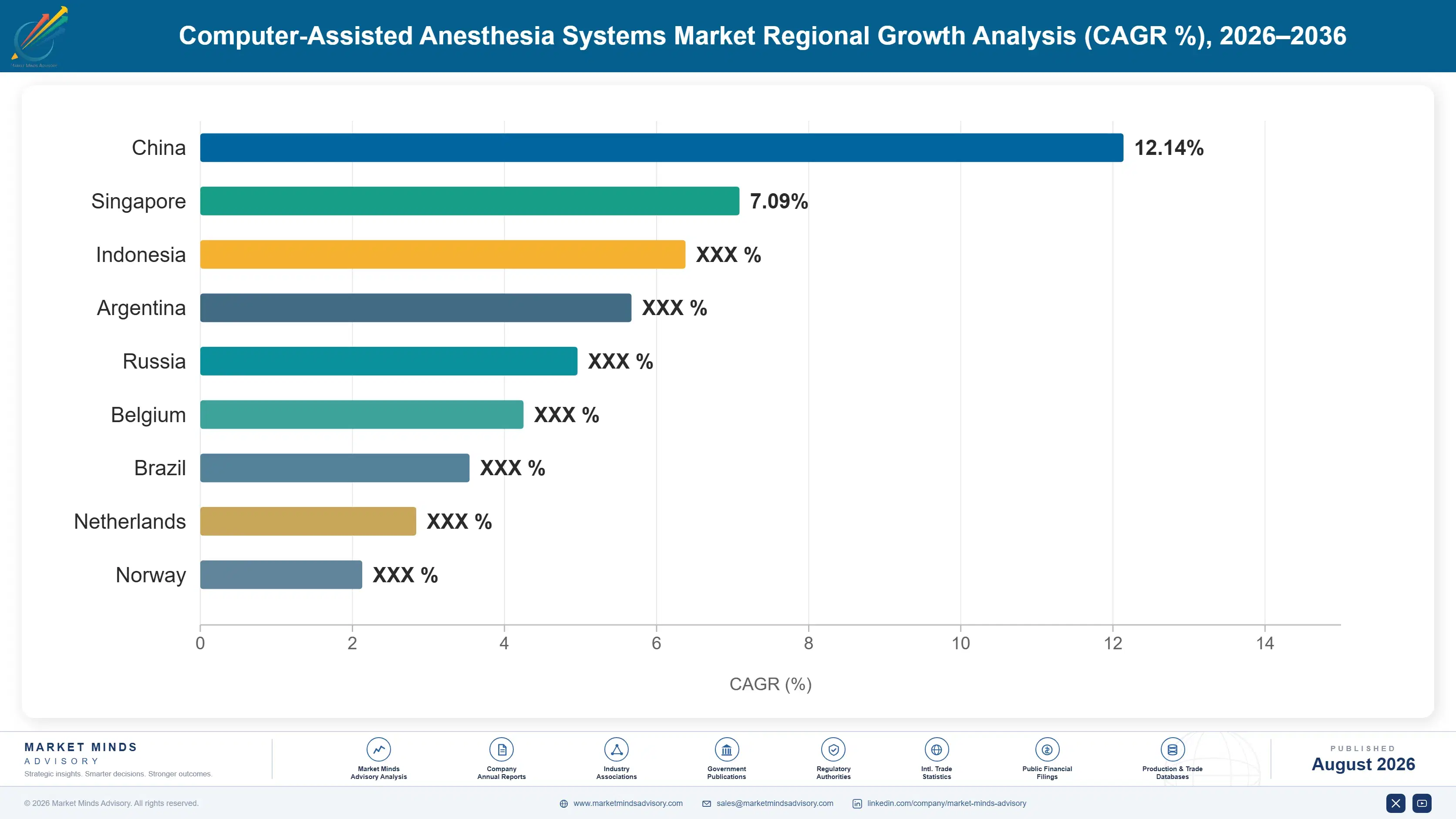
computer-assisted-anesthesia-systems-market-country-cagr-analysis-1787307039834

Where Anesthesia System Makers Can Defend Margin

Four commercial moves separate manufacturers capturing durable closed-loop premium share from those competing purely on conventional workstation pricing: clinical evidence investment, gradual deployment protocol development, workforce efficiency positioning, and liability risk mitigation support. Each move converts a clinical or institutional advantage into a defensible commercial position competitors without matching evidence depth or deployment support cannot easily replicate quickly.

Fund Clinical Outcomes Data to Build Anesthesiologist Trust

Anesthesiologist adoption of closed-loop delivery depends fundamentally on clinical trust that raw technical specifications cannot establish alone, and manufacturers investing in rigorous, published comparative outcomes studies build the evidence base that drives genuine clinical confidence rather than skeptical, limited trial use. Companies with the strongest published safety and efficiency data increasingly win academic medical center adoption that competitors offering comparable hardware but weaker validation evidence cannot secure. Companies with the strongest published data report cutting institutional adoption decision time by 25% to 35% relative to less-documented competitors consistently across institutions.
Market Impact: Cuts institutional adoption decisio

Develop Gradual, Procedure-Specific Hospital Deployment Protocols

Hospitals adopting closed-loop technology respond far better to structured, procedure-specific deployment protocols that build institutional comfort incrementally than to an expectation of immediate comprehensive adoption across all procedure types simultaneously. Manufacturers offering structured deployment frameworks, starting with lower-complexity procedures and expanding based on documented institutional experience, reduce the perceived risk that otherwise slows purchasing committee approval and clinical department buy-in across the broader hospital organization. Hospitals following this structured approach report institutional approval rates improving by 20% to 30% relative to unstructured attempts. That improvement compounds as more institutions publish their own deployment experience.
Market Impact: Improves institutional approval rat

Position Automation as Workforce Capacity Extension

Hospital administrators facing anesthesiologist workforce shortages respond strongly to automation positioned as clinical capacity extension rather than purely a clinical outcomes improvement, and manufacturers building this operational efficiency case into their commercial pitch reach budget decision-makers beyond anesthesiology department clinical leadership alone. This broader constituency support meaningfully improves purchasing committee approval odds compared to a purely clinical outcomes-focused sales approach that engages only the anesthesiology department directly. Manufacturers building this operational case report purchasing committee approval rates improving by 20% to 30% beyond clinical-only approaches. That advantage compounds as more budget committees weigh operational efficiency claims directly.
Market Impact: Extends clinical capacity by 15% to

Build Liability Risk Mitigation Support Into Commercial Offering

Hospital legal and risk management teams remain genuinely cautious about closed-loop deployment given unsettled liability frameworks, and manufacturers offering clear supervisory protocol documentation, override authority preservation, and liability risk consultation as part of the commercial relationship reduce institutional approval friction meaningfully beyond what pure clinical sales conversations can address alone. Manufacturers offering this support report shortening institutional legal review timelines by 6 to 12 months relative to those leaving hospitals to navigate liability questions independently without structured guidance or documentation support. This support increasingly differentiates manufacturers competing for the same institutional accounts.
Market Impact: Shortens institutional legal review

Who Controls the Margin Pool

Concentration sits at a high CR5 of 58%, with a real gap separating large diversified medical device companies from smaller specialist closed-loop technology developers. GE HealthCare and Drägerwerk compete on workstation breadth and clinical distributor relationship depth, while Mindray and Medtronic anchor strong positions in Asian manufacturing scale and closed-loop technology development respectively. Smaller manufacturers compete on price for conventional target-controlled infusion systems.
Current competitive activity runs along three lines: closed-loop clinical evidence generation, where Drägerwerk and Medtronic race to prove superior safety and efficiency outcomes; anesthesia information management system integration, increasingly central to hospital digitization strategy; and workforce efficiency positioning, as manufacturers reach budget decision-makers beyond anesthesiology departments. All participants are assessed on one consistent basis, annual revenue from computer-assisted anesthesia system products.

Pressure is building from two directions. Closed-loop specialists are winning academic medical center adoption through superior clinical evidence, a dynamic conventional workstation manufacturers cannot easily counter through pricing alone. Meanwhile Chinese manufacturers are scaling both price-competitive and increasingly technically capable conventional systems, pressuring Western incumbents in cost-sensitive segments. Rankings over the next five years will shift toward manufacturers combining closed-loop clinical evidence with genuine manufacturing scale.
computer-assisted-anesthesia-systems-market-company-positioning-matrix-1787307040358

Competitive Moat and Risk Dimensions

GE HEALTHCARE

Moat: Deep hospital data integration platform

GE HealthCare's broad hospital information technology portfolio lets it integrate anesthesia delivery data directly into comprehensive electronic health record and perioperative workflow systems, a data integration advantage narrower anesthesia-only competitors cannot match, particularly valuable as hospitals increasingly prioritize consolidated technology vendor relationships. That data integration advantage compounds as hospitals increasingly consolidate technology purchasing around fewer vendor relationships overall.
GE HEALTHCARE

Risk: Broad portfolio complexity dilutes focus

GE HealthCare's vast product portfolio spanning far beyond anesthesia delivery means closed-loop-specific innovation competes internally for capital and management attention against many other business lines, potentially slowing its response to focused closed-loop competitors able to dedicate their entire organization to a single technology category. This dilution risk could intensify as closed-loop competitors dedicate resources exclusively to this category.
DRÄGERWERK AG

Moat: Engineering-led anesthesia workstation reputation

Drägerwerk's decades-long engineering reputation specifically in anesthesia and respiratory technology has built deep anesthesiologist trust that newer entrants must work years to replicate, particularly valuable as closed-loop adoption depends fundamentally on clinical trust that a company's broader engineering credibility can meaningfully reinforce. That reputational trust advantage becomes increasingly valuable as closed-loop adoption depends on clinical confidence.
DRÄGERWERK AG

Risk: Family ownership limits capital access

As a family-controlled public company, Drägerwerk's capital allocation priorities balance family ownership interests against pure growth investment in ways that could constrain how aggressively it can match publicly traded competitors on acquisition-driven expansion or capital-intensive closed-loop research investment during periods of intensifying competition. This capital constraint could widen further if well-capitalized competitors accelerate closed-loop research investment meaningfully faster.

Players Tracked

Prominent Players

GE HealthCare
Drägerwerk AG
Mindray Medical International
Fresenius Kabi AG
Medtronic plc

Other Key Players

Baxter International Inc.
Smiths Medical
Getinge AB
Spacelabs Healthcare
Nihon Kohden Corporation
Mennen Medical
Ambu A/S
Vyaire Medical
Philips Healthcare
Penlon Limited
Acutronic Medical Systems
Chirana Medical
Comen Medical Instruments
Aeon Medical
Shenzhen Ruicheng

Recent Developments

MARCH 2025

Draegerwerk launches next-generation closed-loop anesthesia delivery platform

Draegerwerk introduced an updated closed-loop anesthesia delivery platform featuring improved algorithm precision and expanded procedure-type clinical validation. This was an organic product launch, not an acquisition or partnership, developed through internal research and development investment over several years of clinical collaboration. Early reception has reportedly been positive among sites.
Signal: A major incumbent refreshing its closed-lo
SEPTEMBER 2024

GE HealthCare signs supply agreement for hospital network AIMS integration

GE HealthCare signed a multi-year supply agreement with a major hospital network to integrate its anesthesia information management system with automated dosing decision support across multiple facilities. This was a commercial supply agreement, not a joint venture or acquisition, securing recurring software and service revenue network-wide.
Signal: Network-level AIMS integration deals show
JANUARY 2025

Medtronic acquires closed-loop anesthesia technology start-up

Medtronic completed the acquisition of a privately held company developing closed-loop anesthesia delivery algorithm technology, adding complementary capability to its existing perioperative product portfolio. This was an acquisition, not a joint venture or minority investment, giving Medtronic full ownership and control of the acquired technology and development team.
Signal: Continued acquisition activity in closed-l

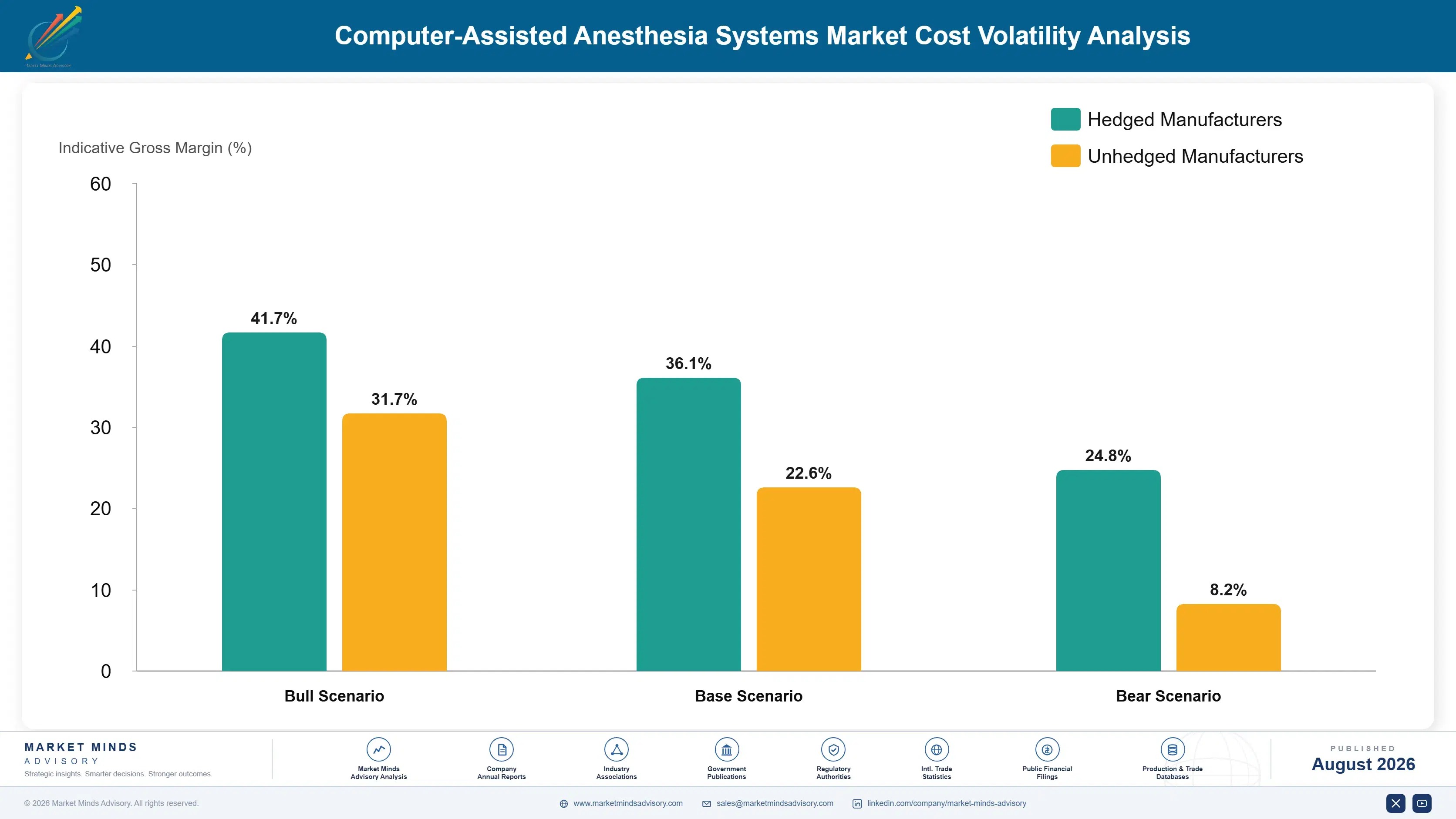
Sensors and Infusion Pumps Drive Production Cost

Precision physiological sensors, infusion pump mechanisms, and embedded processing components together account for roughly thirty-five percent of production COGS, sourced from a concentrated group of specialty medical electronics manufacturers with meaningful barriers to entry given the precision and reliability requirements involved. Software development and clinical algorithm validation costs add a further significant and growing cost layer specific to closed-loop system development.
The clearest recent volatility event traces to the 2021 and 2022 global semiconductor shortage, which the United States Department of Commerce documented as extending lead times across precision sensor and embedded processing component categories broadly. Several anesthesia system manufacturers reported multi-month order backlogs during the worst of the shortage, as automotive and consumer electronics buyers with larger order volumes crowded out smaller-volume medical device categories for available component manufacturing capacity industry-wide.

Exposure varies by manufacturer scale and sourcing relationships. Larger manufacturers with direct long-term component supply agreements weathered the shortage with less production disruption than smaller specialist makers dependent on distributor inventory and spot purchasing. Closed-loop-focused companies faced a different exposure profile, since their primary cost driver, software and clinical algorithm development talent, faced its own separate competitive labor market pressure during the same period specifically.
computer-assisted-anesthesia-systems-market-cost-volatility-analysis-1787307040554

Secure Direct Component Supply Agreements With Manufacturers

Larger manufacturers are increasingly bypassing distributors to negotiate direct multi-year supply agreements with sensor and component fabricators, securing priority allocation during future shortage events and more predictable pricing than spot market purchasing allows for a critical, concentrated component category. This mirrors sourcing discipline already standard across other precision medical electronics manufacturing categories facing comparable demand concentration risk.

Qualify Multiple Sensor and Component Suppliers Across Regions

Manufacturers are qualifying second and third sourcing options for precision sensor and embedded processing components across different geographic regions rather than relying on single-supplier relationships, reducing exposure to any one facility disruption or capacity allocation decision favoring larger buyers. Smaller manufacturers are increasingly pooling purchasing volume through industry consortia to negotiate comparable allocation priority overall.

Build Internal Algorithm Development Capability Rather Than Outsourcing

Closed-loop-focused companies are increasingly building internal clinical algorithm development teams rather than depending entirely on external contractors, reducing cost volatility tied to competitive external talent markets while building proprietary technical capability that compounds over successive product generations. That internal capability increasingly differentiates companies able to iterate quickly on algorithm accuracy from those depending entirely on external contractors.

Portfolio Architecture for Margin Defence

The portfolio splits into three tiers with real margin separation. Volume conventional target-controlled infusion systems compete on price and clinical track record for standard anesthesia delivery, earning solid margins defended through brand reputation and service networks. Certified premium closed-loop and monitoring-integrated systems earn substantially more because hospitals pay for demonstrated automation performance few competitors can match. That gap widens as hospitals demand documented
The tension between conventional hardware volume and closed-loop premium positioning shapes manufacturer strategy directly: conventional systems build broad hospital relationships and steady baseline revenue, but manufacturers that let conventional volume crowd out closed-loop investment risk losing the fastest-growing, highest-margin category to more automation-focused competitors. Manufacturers that manage this balance well capture both the volume and the margin. Manufacturers that manage this balance well capture both broad hospital presence and premium margin across their combined portfolio.

High-value pools concentrate in closed-loop delivery systems and AIMS software integration, where technical differentiation and clinical evidence justify premium pricing few conventional-only competitors can match. The emerging fully autonomous delivery tier currently earns nothing commercially as manufacturers absorb regulatory and validation investment against still-distant potential clearance. That unevenness should ease as platforms mature.

Volume / Commodity-Adjacent Tier

Standard target-controlled infusion systems sold on price and clinical track record to hospitals and surgical centers., where brand reputation and service network reach determine which manufacturers can sustain acceptable margin against price competition.
Gross Margin: 24-38%

Premium / Certified Tier

Closed-loop and monitoring-integrated delivery systems commanding premium pricing from hospitals prioritizing demonstrated automation performance., who pay durable premiums for demonstrated automation performance rather than risk inconsistent anesthetic depth management manually.
Gross Margin: 42-58%

Sustainability / Regulatory / Next-Generation Tier

Fully autonomous delivery platforms still absorbing regulatory and validation investment against distant potential commercial clearance., where manufacturers are betting regulatory and validation capital on platforms they expect hospitals to demand as standard within several years.
Gross Margin: 0-48%
computer-assisted-anesthesia-systems-market-portfolio-architecture-1787307041053

High-value Sub-segments and Strategic Watch-out

Closed-Loop Delivery Systems

High value and high growth as clinical evidence accumulates, commanding durable premium pricing once anesthesiologist trust fully supports broader procedure-type deployment across institutions. Manufacturers with the strongest published evidence increasingly win institutional accounts that competitors relying on hardware specifications alone simply cannot secure today overall.
Gross Margin: 45-58%

Monitoring-Integrated Delivery Systems

High value with strong current growth as hospitals seek incremental automation, priced above conventional systems while remaining accessible to mainstream hospital technology budgets. Adoption is broadening steadily beyond academic institutions into mainstream community hospitals seeking comparable decision support without full automation commitment consistently across the sector.
Gross Margin: 38-52%

Standard Target-Controlled Infusion Systems

The volume core, sold on price to hospitals and surgical centers, defended mainly through brand reputation and thin per-unit margin discipline across facilities. Competitive pressure here concentrates on brand reputation and service reach rather than the automation differentiation reshaping premium and closed-loop tiers specifically overall today.
Gross Margin: 24-38%

Legacy Manual-Only Delivery Systems

The strategic watch-out, facing continued displacement as computerized and monitoring-integrated alternatives increasingly outperform on both consistency and clinical documentation. Manufacturers still dependent on this declining tier should be actively redirecting investment toward computerized and monitoring-integrated alternatives rather than defending systems hospitals increasingly find inadequate for modern clinical documentation requirements.
Gross Margin: 12-30%

How Anesthesia System Demand Actually Recurs

Demand here runs on a long capital replacement cycle typical of major operating room equipment. A hospital purchases an anesthesia system and operates it for eight to twelve years before replacement, meaning a single sale represents a durable relationship spanning service contracts, software upgrades, and eventual replacement rather than recurring per-unit consumable purchase. That long cycle gives manufacturers a durable relationship.
Adoption depth varies sharply by institution type. Academic medical centers integrate closed-loop systems deeply into research and clinical protocols once validated, making switching costly and rare absent a compelling clinical reason. Community hospitals, by contrast, evaluate anesthesia technology more conservatively based on proven track record and vendor relationship history, creating a more cautious but ultimately durable purchasing pattern once trust is established. That difference forces manufacturers to split strategy accordingly.

Buyer profiles are shifting generationally as younger anesthesiologists, trained during residency on closed-loop and monitoring-integrated technology, increasingly expect automation-supported delivery as standard practice rather than an experimental capability. Older anesthesiologists trained primarily on manual titration are adapting more gradually, but that generational shift is accelerating steadily as training programs increasingly incorporate automated delivery technology into standard curriculum.
computer-assisted-anesthesia-systems-market-end-use-penetration-index-1787307041548

Where Anesthesia System Value Concentrates Next

These are among the four positions where our research anticipates prominent divergence between winners and laggards over the coming forecast period. Each is grounded in the demand model, the regulatory perimeter, and the announced capacity pipeline.
01 / CLINICAL EVIDENCE INVESTMENT

Fund outcomes data before broader adoption becomes expected

Anesthesiologist trust in closed-loop delivery depends fundamentally on published clinical evidence that raw technical specifications cannot establish alone, and manufacturers investing in rigorous outcomes studies now are building the credibility that drives sustained institutional adoption rather than limited pilot use. This is a multi-year investment with a payoff that compounds as published evidence accumulates and academic medical centers increasingly cite specific validated performance in purchasing decisions. Companies moving slowly here will find themselves permanently behind competitors who built trust first.
02 / DEPLOYMENT PROTOCOL DEVELOPMENT

Build structured, incremental adoption pathways for hospitals

Hospitals respond far better to structured, procedure-specific deployment protocols than to an expectation of immediate comprehensive closed-loop adoption, and manufacturers offering this incremental pathway reduce the institutional risk perception that otherwise slows purchasing committee approval considerably. This structured approach also builds a natural expansion pathway as institutional comfort grows procedure by procedure. Manufacturers without a clear deployment framework are asking hospitals to take a bigger leap than most institutions are currently willing to make., a leap most institutions remain unwilling to make without that structured pathway in place first.
03 / WORKFORCE EFFICIENCY POSITIONING

Reach budget decision-makers beyond the anesthesiology department

Hospital administrators facing anesthesiologist workforce shortages respond strongly to automation positioned as capacity extension, and manufacturers building this broader operational case into their commercial pitch reach decision-makers beyond clinical leadership alone. This broader constituency support meaningfully improves approval odds compared to a purely clinical outcomes-focused sales approach. Companies still selling purely on clinical merit are missing a genuinely persuasive commercial argument sitting directly in front of them., and that broader constituency support increasingly determines which manufacturers win purchasing committee approval fastest across competitive hospital bids.
04 / LIABILITY RISK MITIGATION SUPPORT

Address legal and risk management concerns directly

Hospital legal and risk management teams remain genuinely cautious about closed-loop deployment given unsettled liability frameworks, and manufacturers offering clear supervisory protocol documentation and liability consultation as part of the commercial relationship reduce institutional approval friction meaningfully. Companies treating this as a purely clinical sales conversation are missing an institutional approval barrier that clinical evidence alone cannot resolve. This support becomes a genuine competitive differentiator as liability frameworks remain unsettled., and that support increasingly becomes the deciding factor once clinical evidence alone no longer differentiates competing systems meaningfully.

Engagement Snapshot From the Field

A live engagement with an industry participant carrying material or product regulatory and market exposure ahead of a defining policy shift, showing how our research translates into a defensible multi-year portfolio strategy.
MARKET MINDS ADVISORY · CLIENT ENGAGEMENT SUMMARY
Computer-Assisted Anesthesia Systems Producer Strategic Portfolio Review and Transition Roadmap 2026·Investment Scenario on Computer-Assisted Anesthesia Systems Exposure Evaluation 2025-26
CLIENT PROFILE
A regional academic medical center operating fourteen operating rooms approached MMA while evaluating closed-loop anesthesia delivery deployment ahead of a planned surgical volume expansion. The client reported an approved technology budget of roughly USD 4.5 million for the initiative, with limited prior closed-loop clinical experience across its anesthesiology department (client-reported, unverified by MMA). Leadership had not previously commissioned an external review of closed-loop readiness across the department.
STRATEGIC CHALLENGE
Clinical leadership wanted to begin closed-loop deployment but faced internal division between anesthesiologists eager to adopt automation and colleagues expressing genuine reservations about ceding titration control, alongside institutional legal team caution about liability exposure under existing malpractice frameworks. The department wanted a defensible deployment plan before the surgical volume expansion began, not another year of internal disagreement.
MMA APPROACH
MMA benchmarked clinical evidence and total cost of ownership across three closed-loop system manufacturers against the client's specific procedure mix and anesthesiologist survey feedback, modeled a phased deployment protocol addressing both clinical and legal concerns, and assessed each manufacturer's liability support and training program depth. We also interviewed anesthesiology staff directly to confirm real-world clinical concerns the quantitative model alone could not capture.
KEY FINDINGS
  1. A phased deployment approach starting with lower-complexity procedures, rather than immediate comprehensive adoption, addressed the majority of clinical staff reservations while still capturing meaningful early efficiency benefits.
  2. One manufacturer's documented supervisory protocol and liability consultation support significantly eased the institutional legal team's approval concerns compared to competitors offering less structured liability guidance.
  3. Anesthesiologist survey data revealed that hands-on training exposure, more than published clinical data alone, most strongly predicted individual physician willingness to adopt the technology.
  4. Sequencing deployment by procedure complexity rather than department-wide rollout reduced projected implementation risk while still achieving most of the targeted efficiency gains within the first year (client-reported, unverified by MMA).
CLIENT PROFILE
A regional academic medical center operating fourteen operating rooms approached MMA while evaluating closed-loop anesthesia delivery deployment ahead of a planned surgical volume expansion. The client reported an approved technology budget of roughly USD 4.5 million for the initiative, with limited prior closed-loop clinical experience across its anesthesiology department (client-reported, unverified by MMA). Leadership had not previously commissioned an external review of closed-loop readiness across the department.
STRATEGIC CHALLENGE
Clinical leadership wanted to begin closed-loop deployment but faced internal division between anesthesiologists eager to adopt automation and colleagues expressing genuine reservations about ceding titration control, alongside institutional legal team caution about liability exposure under existing malpractice frameworks. The department wanted a defensible deployment plan before the surgical volume expansion began, not another year of internal disagreement.
MMA APPROACH
MMA benchmarked clinical evidence and total cost of ownership across three closed-loop system manufacturers against the client's specific procedure mix and anesthesiologist survey feedback, modeled a phased deployment protocol addressing both clinical and legal concerns, and assessed each manufacturer's liability support and training program depth. We also interviewed anesthesiology staff directly to confirm real-world clinical concerns the quantitative model alone could not capture.
KEY FINDINGS
  1. A phased deployment approach starting with lower-complexity procedures, rather than immediate comprehensive adoption, addressed the majority of clinical staff reservations while still capturing meaningful early efficiency benefits.
  2. One manufacturer's documented supervisory protocol and liability consultation support significantly eased the institutional legal team's approval concerns compared to competitors offering less structured liability guidance.
  3. Anesthesiologist survey data revealed that hands-on training exposure, more than published clinical data alone, most strongly predicted individual physician willingness to adopt the technology.
  4. Sequencing deployment by procedure complexity rather than department-wide rollout reduced projected implementation risk while still achieving most of the targeted efficiency gains within the first year (client-reported, unverified by MMA).
RECOMMENDED STRATEGY
Phase 1: Phase 1 (0 to 4 months): Deploy the selected closed-loop system for lower-complexity procedures with structured hands-on training for all participating anesthesiologists. Phase 2: Phase 2 (4 to 12 months): Expand deployment to additional procedure types based on documented clinical experience and staff comfort levels. Phase 3: Phase 3 (12 to 24 months): Evaluate outcomes data against the planned surgical volume expansion and consider broader department-wide adoption.
OUTCOME
The academic medical center began Phase 1 deployment on schedule, reporting an estimated reduction in anesthetic depth variability of roughly 32% for procedures using the closed-loop system. Physician survey feedback following the training program showed meaningfully improved comfort with the technology compared to pre-training baseline levels (client-reported, unverified by MMA).

Frequently Asked Questions

Foundational context covering the market sizes, CAGR, scope, country, region and competition that inform every finding below. This section is provided to cover basics and most often pre-purchase conversations, answered from the MMA Primary Research Dataset.

What is the current size of the Computer-Assisted Anesthesia Systems Market?

The computer-assisted anesthesia systems market was valued at USD 1.8 billion in 2025. Growth is driven by closed-loop clinical evidence accumulation, rising surgical volume, and anesthesiologist workforce constraints.

How large will the Computer-Assisted Anesthesia Systems Market be by 2036?

The market is projected to reach USD 4.88 billion by 2036 under the base case scenario. That reflects an expansion multiple of roughly 2.48 times the 2026 value.

What is the CAGR for the Computer-Assisted Anesthesia Systems Market 2026 to 2036?

The base case CAGR is 9.5%, with a bull case of 10.8% and a bear case of 8.2%. Closed-loop clinical validation speed is the main swing factor between scenarios.

Which segment is growing fastest?

Closed-loop anesthesia delivery systems grow fastest at 16.5% CAGR, roughly 1.74 times the overall market rate. Depth-of-anesthesia monitoring-integrated delivery systems follow as the second-fastest segment at 13.0%.

Who are the major companies in the Computer-Assisted Anesthesia Systems Market?

Leading manufacturers include GE HealthCare, Draegerwerk AG, Mindray Medical International, Fresenius Kabi AG, and Medtronic plc. The top five hold a combined 58% of the market.

Which country is growing fastest?

China is the fastest-growing country at 15.8% CAGR, driven by rapid hospital modernization and rising surgical volume. Domestic and international manufacturers both compete for this growing procurement demand.

Report Segmentation Architecture

The full report scope spans multiple orthogonal segmentation dimensions, with cross-tabulated demand data provided for each dimension pair. Coverage extends further to regional breakdowns, trend trajectories, and the competitive detail needed to support segment-level decision-making.

By System Type

  • Target-Controlled Infusion Systems
  • Closed-Loop Anesthesia Delivery Systems
  • Anesthesia Information Management Systems
  • Computer-Assisted Personalized Sedation Devices
  • Pharmacokinetic and Pharmacodynamic Dosing Software
  • Depth-of-Anesthesia Monitoring-Integrated Delivery Systems

By End-Use Setting

  • Hospital Operating Rooms
  • Academic Medical Centers
  • Ambulatory Surgical Centers
  • Procedural Sedation Suites

By Commercial Dimension

  • Direct Hospital Capital Equipment Purchase
  • Group Purchasing Organization Contracts
  • Software Licensing and Service Agreements
  • Distributor and International Channel

By Region

  • North America
  • Western Europe
  • East Asia
  • South Asia and Pacific
  • Latin America
  • Middle East and Africa
  • Eastern Europe

Scope, Methodology, and Coverage

Every figure in this report is reproducible from documented input assumptions. The scope below maps the historical period, the forecast horizon, the segmentation dimensions, and the countries covered, alongside the underlying primary and qualitative methodology.
Historical Period
2020 to 2025
Forecast Period
2026 to 2036
Base Year
2025 (USD billions; MMA Primary Research Dataset, August 2026)
Market Definition
The computer-assisted anesthesia systems market comprises hardware and software systems that use computerized algorithms to support or automate anesthetic drug delivery during surgical and procedural sedation, including target-controlled infusion systems, closed-loop delivery systems, anesthesia information management systems with automated dosing integration, and depth-of-anesthesia monitoring-integrated delivery platforms. Conventional manually operated anesthesia machines without computerized dosing support, standalone physiological monitors without delivery integration, and anesthetic drugs themselves are excluded.
Quantitative Units
USD billions (current prices); installed system units where applicable
Segmentation Dimensions
By System Type; By End-Use Setting; By Commercial Dimension; By Region
Regions Covered
North America, Western Europe, East Asia, South Asia and Pacific, Latin America, Middle East and Africa, Eastern Europe
Countries Covered
USA, China, Germany, France, UK, Japan, South Korea, India, Australia, Canada, Brazil, Mexico, Indonesia, Vietnam, Thailand, Malaysia, UAE, Saudi Arabia, South Africa, Nigeria, Turkey, Poland, Netherlands, Italy, Spain, Sweden, Switzerland, Argentina, Colombia, Singapore, and additional markets relevant to this sector
Key Companies Profiled
GE HealthCare, Draegerwerk AG, Mindray Medical International, Fresenius Kabi AG, Medtronic plc, Baxter International Inc., Smiths Medical, Getinge AB, Spacelabs Healthcare, Nihon Kohden Corporation, Mennen Medical, Ambu A/S, Vyaire Medical, Philips Healthcare, Penlon Limited, Acutronic Medical Systems, Chirana Medical, Comen Medical Instruments, Aeon Medical, Shenzhen Ruicheng
Quantitative Methodology
Primary survey, n=3,800 respondents, Q4 2025, six countries; demand-side model with trade association cross-validation
Qualitative Methodology
47 expert interviews, Q4 2025; applied to validate demand model assumptions, identify emerging dynamics, and assess competitive positioning
Report Format
PDF and XLSX data workbook (Word format preview document)
Publisher
Market Minds Advisory
Report Code
MMA-2026-MED-601
Published
August 2026
Contact
sales@marketmindsadvisory.com | www.marketmindsadvisory.com

Purchase the full Computer-Assisted Anesthesia Systems Market Report (2026 to 2036).

The full MMA Computer-Assisted Anesthesia Systems Market report sizes demand across six system types, four end-use settings, four commercial dimensions, and seven regions through 2036. It profiles twenty companies on a consistent revenue basis, scoring each on closed-loop clinical evidence, deployment protocol maturity, and manufacturing scale. Scenario models quantify how closed-loop clinical validation and liability framework clarity move both demand and realizable pricing. The report includes delivered-cost modeling by system type and a manufacturer clinical-readiness screen built for hospital procurement and clinical strategy teams. Regional surgical volume tracking rounds out the coverage for capital planning teams.
System type cost-curve modeling across all major categories
Closed-loop clinical evidence and validation tracking by manufacturer
Anesthesiologist workforce and capacity forecasts by region
Deployment protocol and institutional approval benchmarking
Regional surgical volume and manufacturing capacity tracking
Closed-loop adoption scenarios under bull and bear cases

Built For The People Who Decide

From boardroom strategy to bench-side execution, this report is read cover-to-cover by leaders shaping the next decade of their industry, turning demand scenarios, market dynamics and valuation benchmarks into decisions.
CXOs/ Presidents/ VPs/ Managers
M&A and Corporate Development
Strategy Teams and R&D Heads
Procurement and Product Directors
Regulatory and Compliance Leaders
Investor Relations and Equity Analysts