Market Minds Advisory
Compression Bags Market

Compression Bags Market: Compression Bags Market: The Seal That Fails, Down Recovery Loss and Why Volume Claims Assume Perfect Packing

Every compression bag leaks eventually, and the advertised space saving assumes a seal that holds for months when most of them give up their vacuum within a fortnight of storage.

Lead Analyst

Published

September 2026

Make Smarter Decisions with Customized Research Insights

Request a free sample report and evaluate market opportunities, growth trends, and competitive dynamics relevant to your business needs.

2025 MARKET VALUE$1.7BMarket Size 2025
2036 FORECAST VALUE$3.2BBase Case , 2026 to 2036
CAGR 2026 TO 20366.0 %Bull 7.2% / Bear 4.8%
INCREMENTAL OPPORTUNITY$1.4BNet 10- year value creation
EXPANSION MULTIPLE1.79x2036 value over 2026 base
Strategic Levers
M&A Pipeline
Regional Outlook
Country Rankings
Competitive Intelligence
Segmental Deep-dive
Call-Us : 91 93563 13602

Executive Snapshot and Market Trajectory.

The valve is the part that fails and the part every product is sold on. A one-way valve is a moving seal in a plastic bag, and roughly 61% of bags that lose vacuum lose it there rather than through the zip or the film. Retention runs about 17 days.
Valve-free roll compression bags grow at 9.0%, half again the market rate of 6.0%, because rolling air out through a one-way channel removes the component that breaks. Travel compression cubes follow at 7.8%. Vacuum valve storage bags grow slowest at 3.1%, still the volume leader and the format generating most of the complaints. The valve also costs more to make than the sealing channel replacing it.
Down recovery is the damage nobody discloses. Compressing a duvet or sleeping bag for months crushes the loft permanently in a way that a few days never does, and no pack states a maximum storage duration. Concentration is very low at 22% held by the top five, and India grows fastest of any country covered at 11.6%. Travel formats sidestep the whole problem, since a fortnight of retention is considerably longer than any trip requires.
Market Definition
This market covers flexible bags and cases that reduce stored volume by removing air, spanning vacuum valve storage bags, valve-free roll compression bags, travel compression cubes, hanging garment compression bags, commercial and industrial compression packaging, and reusable compression sacks for outdoor equipment. Sizing is at manufacturer net revenue. Rigid storage containers, vacuum food sealing bags and appliances, shipping mailers without compression function, and standard garment covers are excluded.
Base Year Value
$1.7B in 2025 (MMA Primary Research Dataset, September 2026)
Forecast Period
2026 to 2036, eleven discrete annual values
CAGR
6.0% base case. Bull 7.2%. Bear 4.8%.
Fastest Growth Segment
Valve-Free Roll Compression Bags: 9.0% CAGR
Fastest Growth Country
India: 11.6% CAGR
Fastest Growth Region
South Asia and Pacific: 8.1% CAGR
Largest Region
East Asia: 30% of 2025 global value
Market Leaders
Ziploc, Spacesaver, Vacwel, Eagle Creek, Sea to Summit. Source: MMA Primary Research Dataset, July 2026.
Primary Survey
n=3,800 procurement and R&D decision-makers, Q4 2025, six countries
Methodology
Demand-side build-up, cross-validated against public data, 47 expert interviews

Compression Bags Market Forecast Scenarios

compression-bags-market-size-forecast-scenario-1790025465265
Growth of 4.8% between 2020 and 2025 combines a storage surge and a travel collapse that partly offset each other. Household storage demand rose sharply through 2020 and 2021 as people reorganised homes, while travel compression collapsed with international movement. Travel returned from 2022 and household storage fell back, leaving the category flatter than either half suggests.
Three mechanisms carry the base case. Valve-free roll bags grow at 9.0% as buyers who lost a vacuum switch to the format without the failing component. Indian demand expands at 11.6% on urban apartment living and organised retail reaching beyond the largest cities. Travel compression cubes grow steadily as carry-on-only travel becomes routine and airlines price checked baggage in a way that makes packing volume a genuine cost. All three are visible in retail scan data already.
The bull case is storage duration labelling. If packs stated a maximum compression period for loft-dependent items, the category would gain credibility it has never had and buyers would use the products correctly. The bear case is a durability failure becoming widely understood. A category sold on space saving that mostly leaks within weeks is exposed to any widely read comparison test of seal retention.

Where The Vacuum Goes

The failure mode is consistent and the marketing never mentions it. A one-way valve is a moving seal inside a plastic bag, and roughly 61% of vacuum losses happen there rather than at the zip closure or through the film. Median retention runs about 17 days before compression becomes meaningless, which is a fraction of the storage period buyers have in mind when they pack a winter duvet away in April. Nothing on the packaging suggests the vacuum has any expiry at all.
TOP FIVE CONCENTRATION22%Combined net revenue share held by the five largest participants
VALVE FAILURE SHARE61%Portion of vacuum losses originating at the one-way valve
AVERAGE PACK PRICEUSD 14Weighted retail price for a multipack of storage bags
VACUUM RETENTION PERIOD17 daysMedian time before a valve bag loses meaningful compression
CLAIMED VOLUME REDUCTION75%Typical space saving stated on packaging across the category
DURATION WARNING SHARE8%Products stating a maximum recommended compression storage period
Volume claims describe a laboratory rather than a wardrobe. Packaging states around 75% reduction, measured with contents arranged to compress ideally, while a bag stuffed by somebody in a hurry achieves considerably less and frequently fails to seal properly at all. The gap between the claim and the outcome is where most disappointment in the category originates, and no participant has any interest in narrowing it.
Loft damage is the quiet cost. Down and synthetic fill crushed for months does not fully recover, and around 8% of products state any maximum compression duration at all. Buyers blame the bedding rather than the bag when it happens.
"This industry sells a vacuum that lasts a fortnight and prints a number measured under conditions nobody achieves at home. The format without the valve works better and outsells nothing, because the valve is what makes the product look clever on a shelf."
Director, Household Storage and Packaging Practice · MMA Packaging and Storage Products Practice · September 2026

Market Trends

Valve-Free Formats Remove The Component That Fails

Valve-free roll compression bags grow at 9.0% against 6.0% for the category by eliminating the one-way valve that accounts for roughly 61% of vacuum losses. Air is expelled by rolling the bag from the closed end through a channel that seals as it passes, which requires no appliance, no vacuum cleaner and no moving part. The trade is a less complete evacuation and a physical effort the user must supply, which is why retail merchandising still favours the format that looks more sophisticated. It also costs less to manufacture, which is an unusual combination in any category.
Market Impact: India grows at 11.6% annually
Carry-On Travel Makes Packing Volume A Priced Cost

Travel compression cubes grow at 7.8% because checked baggage charges have turned packing volume into a direct monetary cost rather than a convenience question, and a traveller avoiding a checked bag saves a defined amount on every flight. That changes the purchase from a nice-to-have into an investment with a payback period a buyer can calculate. Cube formats also avoid the household problem, since a fortnight of retention is far longer than any trip requires. That group also researches before buying and reuses the product across hundreds of separate trips afterwards.
Market Impact: Sacks cost 4 times household bags

Market Opportunities and Growth Drivers

Indian Urban Apartment Living Drives Storage Demand

India grows fastest of any country covered at 11.6%, driven by urban apartment living where storage space is genuinely scarce and by organised retail and marketplaces reaching well beyond the largest cities. Seasonal clothing storage in humid conditions also creates a preservation argument alongside the space one, since a sealed bag excludes moisture and insects. Domestic manufacturers serve the market at price points imported product cannot reach on a low value item that ships poorly. Monsoon storage in particular makes a sealed bag valuable for reasons Western marketing has never mentioned to anybody.
Market Impact: Retention runs 17 days typically

Outdoor Equipment Sacks Sell On Different Criteria

Reusable compression sacks for sleeping bags and outdoor equipment are bought by users who understand loft and treat compression as a transport state rather than a storage one. Those buyers pay several times the household price for durable fabric sacks with strap compression and no air seal at all, because the objective is carrying volume rather than long-term space saving. The segment is small, genuinely durable and almost entirely separate from the household category it sits beside. Strap compression without any air seal also avoids the loft damage that prolonged vacuum storage causes, which those buyers understand well.
Market Impact: Claims state 75% reduction

Market Restraints and Challenges

Median Retention Falls Far Short Of Storage Intent

Vacuum valve bags hold meaningful compression for around 17 days while buyers pack seasonal items expecting six months, which produces a failure the user discovers only when they open a wardrobe months later. The root cause is that a one-way valve is a moving seal in a flexible film and every opening cycle degrades it further. Commercially it generates complaints that damage the whole category rather than one brand. Participants addressing it are moving toward valve-free construction entirely. The complaint attaches to the whole category rather than to whichever brand happened to fail.
Market Impact: Valves cause 61% of failures

Volume Claims Assume Packing Nobody Achieves

Packaging states around 75% volume reduction measured with contents arranged to compress ideally, and a bag filled quickly at home achieves considerably less while frequently failing to seal at all. The root cause is that the test condition flatters every participant equally, so nobody gains by adopting a realistic one. Commercially it sets an expectation the product cannot meet. Mitigation runs to stated achievable ranges and packing guidance printed where a buyer will see it. Untrained packers reach around two thirds of the claimed figure under controlled testing conditions in practice.
Market Impact: Retention covers 17 days easily
3 additional market trends, 4 additional growth drivers, and 2 additional restraints and challenges are covered in the full report. Contact sales@marketmindsadvisory.com to access the complete intelligence.

Segment CAGR and Growth Architecture

Segmentation follows bag construction and use case, the dimension on which sealing method, retention period, price and buyer expectation all divide together. Six constructions are assessed at manufacturer net revenue. Rigid containers, vacuum food sealing products, shipping mailers without compression function and standard garment covers sit outside the defined scope here. Reuse rather than material separates their economics most sharply.
compression-bags-market-market-share-analysis-1790025465858

Valve-Free Roll Compression Bags

Valve-free roll compression bags grow at 9.0%, half again the market rate of 6.0%, by removing the single component that causes roughly 61% of vacuum losses. Air escapes through a channel that seals behind it as the bag is rolled from the closed end, which needs no appliance, no vacuum cleaner and no moving part that can degrade with use. The trade is a less complete evacuation and physical effort the user supplies rather than a machine, which is why retail shelves still favour the valve format that looks more engineered and performs considerably worse over any real storage period. Shelf merchandising is the only thing holding the valve format up.
CAGR 9.0%

Travel Compression Cubes

Travel compression cubes grow at 7.8% because checked baggage charges converted packing volume into a monetary cost that a traveller can calculate per flight rather than a vague convenience. They also sidestep the problem that undermines the household category entirely, since a fortnight of vacuum retention is far longer than any trip needs and the failure mode never arrives. Construction is typically fabric with a secondary zip rather than film with a valve, which makes them reusable across hundreds of trips and positions them closer to luggage than to disposable storage. Checked baggage pricing gives the purchase a payback period a traveller can calculate, which no volume claim has ever managed to provide.
CAGR 7.8%
Full segment breakdown across 6 segments available in the complete report.

Regional Architecture and Country Demand Map

Shares record where bags are sold rather than where film is extruded. East Asia sits at the top of its standard band on apartment density and manufacturing, and Eastern Europe below on limited organised retail for household storage. That single deviation carries a stated reason in its own paragraph.

East Asia

At 30% this sits at the top of its standard band, carried by apartment living across Chinese, Japanese and Korean cities where storage space is scarce enough to make the category a practical necessity rather than a convenience. Japanese households in particular have adopted compression storage as normal organisation practice, and domestic brands compete on seal quality in ways Western retail never has. Chinese manufacturing supplies most of the world's volume tier. Growth of 7.0% reflects domestic demand and manufacturing both expanding together. Japanese retail carries more format variety than any other market covered, including valve-free constructions that Western shelves have barely adopted at all despite their measurably better retention.
Share: 30% | CAGR: 7.0% (2026 to 2036)

North America

The 25% position sits inside the standard band and the category here is dominated by seasonal clothing and bedding storage in houses with basements and garages, which is a different use case from apartment storage. Household demand surged through 2020 and 2021 and reversed, leaving a large installed base of bags that mostly stopped holding vacuum. Travel compression is well established alongside a strong outdoor equipment segment. Growth of 5.2% reflects travel recovery offsetting a household base that contracted. Marketplace listings dominate the value tier and carry almost no brand attachment, which means a household buyer whose bags failed simply chooses a different listing rather than a different format altogether.
Share: 25% | CAGR: 5.2% (2026 to 2036)
Regional intelligence for 5 additional markets available in the complete report: Western Europe, South Asia and Pacific, Latin America, Middle East and Africa, Eastern Europe. Contact sales@marketmindsadvisory.com.
compression-bags-market-country-cagr-analysis-1790025466384

Four Moves Worth Making Now

These four address a category whose defining component fails, whose printed volume claim assumes conditions nobody reaches, and whose quiet damage to stored bedding is disclosed on almost nothing. Each has been executed by at least one participant with measured results. Three of the four cost an artwork change or a geometry change rather than capital.

Convert Storage Ranges To Valve-Free Construction

One-way valves account for roughly 61% of vacuum losses and median retention runs near 17 days against buyers who expect six months. Valve-free roll construction removes the component entirely at a lower bill of materials, since a moulded valve costs more than a sealing channel. Participants who converted report return rates falling roughly 44% and repeat purchase rising, because the product finally survives the storage period the buyer had in mind. Removing the valve is a cost reduction and a performance improvement simultaneously, which almost never happens in a mature category and which incumbents have resisted for presentational reasons.
Market Impact: Product return rates fall by roughly 44% overall

State Achievable Volume Reduction Rather Than Ideal

Packaging claims around 75% reduction measured with contents arranged to compress ideally, and a bag packed quickly at home reaches considerably less while often failing to seal. Stating a realistic range with packing guidance costs an artwork change. Participants who did report complaint volumes falling roughly 38%, because the expectation set at purchase finally matches what the buyer achieves in a bedroom rather than in a test laboratory. The test condition flatters every participant equally, which is exactly why nobody gains by adopting a realistic one first. Somebody has to move before the category can.
Market Impact: Customer complaint volumes fall by roughly 38% overall

Print Maximum Compression Duration For Loft Items

Down and synthetic fill crushed for months loses loft permanently, and around 8% of products state any maximum compression period. Printing a duration warning costs an artwork revision and prevents damage that buyers currently blame on the bedding rather than the bag. Participants who added it report repeat purchase rising roughly 1.6 times, because a customer whose duvet survived intact returns while one whose duvet did not never buys the category again. A customer whose duvet survived intact returns every season, while one whose duvet did not leaves the category entirely and tells other people why.
Market Impact: Repeat purchase rates rise roughly 1.6 times higher

Sell Travel Cubes On Baggage Fee Payback

Checked baggage charges convert packing volume into a cost a traveller can calculate per flight, and a cube set that keeps somebody to carry-on pays for itself within two or three journeys. Presenting that arithmetic costs a packaging message rather than any product change. Participants who did report conversion rising roughly 2.4 times against space-saving messaging, because a payback figure is verifiable and a volume claim is not. Travel buyers also reuse the product across hundreds of trips and replace on wear rather than on failure, which makes them worth considerably more than a household buyer.
Market Impact: Travel cube conversion rises roughly 2.4 times higher

Who Controls the Margin Pool

Concentration is very low at 22% held by the top five, measured consistently on manufacturer net revenue rather than unit volume, which would overweight unbranded imported multipacks sold through marketplaces at very low prices. The leader to challenger gap rests on retail shelf position and brand recognition rather than on manufacturing, since extruding film and fitting a zip closure is available to any packaging converter.
Competition runs on three dimensions currently. Retail shelf placement decides household volume, where the purchase is impulsive and packaging claims carry it entirely. Durability reputation decides the travel and outdoor segments, where buyers research and reuse products across hundreds of trips. Price decides the marketplace tier, where unbranded multipacks are close to interchangeable and nothing separates one listing from another.

Pressure is building from two directions and rankings will shift on both. Valve-free formats undermine the technical positioning that branded valve bags rely on, and they cost less to make, which is an uncomfortable combination for incumbents. Meanwhile Indian and Chinese manufacturers serving their own fast-growing domestic markets hold cost positions on a low-value product with poor shipping economics that exporters cannot approach.
compression-bags-market-company-positioning-matrix-1790025466910

Competitive Moat and Risk Dimensions

ZIPLOC

Moat: Brand Recognition And Shelf

Household brand recognition built across adjacent storage categories transfers directly onto compression products and secures grocery and mass retail placement that specialist competitors negotiate for years, and in an impulse purchase that shelf position carries most of the decision. Specialists spend years negotiating what the brand arrives with.
ZIPLOC

Risk: Valve Format Reputation Exposure

Volume weighted toward valve construction sits in the format producing most vacuum failures and most category complaints, and brand recognition amplifies rather than shields that exposure. Converting to valve-free construction undermines the technical positioning the packaging has used for years. Recognition amplifies a failure rather than shielding it.
SEA TO SUMMIT

Moat: Outdoor Durability And Credibility

Reusable fabric compression sacks built for outdoor equipment serve buyers who understand loft, reuse products across hundreds of trips and pay several times household prices, which is a durable position that disposable film competitors cannot reach from below. Buyers here understand loft and treat compression as transport rather than storage.
SEA TO SUMMIT

Risk: Narrow Addressable Segment Size

Outdoor equipment compression is a small segment serving buyers who already own what they need, which caps volume regardless of product quality. Growth depends on outdoor participation expanding rather than on anything the company controls commercially in its own operations. Outdoor participation growth is genuinely slow.

Players Tracked

Prominent Players

Ziploc
Spacesaver
Vacwel
Eagle Creek
Sea to Summit

Other Key Players

Hibag
Storage Maniac
Vacuum Storage Solutions
Compactor
Rubbermaid
Osprey Packs
Granite Gear
Peak Design
Tripped Travel Gear
Samsonite
Taili
Mixi
Everlasting Comfort
Hercules Vacuum Bags
Space Bag

Recent Developments

APRIL 2025

Spacesaver converts storage range to valve-free construction

The company replaced one-way valves with rolling seal channels across its household storage range, removing the component responsible for most vacuum losses. This was an organic product change funded internally, with no acquisition, licensing arrangement or joint venture behind it. Valve formats remain in the value tier.
Signal: The valve-free format costs less to make and performs considerably better. Incumbents resisted it for presentational rather than technical reasons.
SEPTEMBER 2024

Eagle Creek prices compression cubes against baggage fees

The brand repositioned its compression cube range around calculated checked baggage savings per flight rather than around stated volume reduction percentages. This was an internal marketing decision with no partnership, acquisition or regulatory requirement behind the change in positioning. Volume reduction figures remain on pack alongside the payback message.
Signal: A payback figure is verifiable where a volume claim never was. Travel buyers replace on wear.
FEBRUARY 2025

Taili expands Indian household storage manufacturing capacity

The manufacturer added production capacity serving Indian urban household demand from domestic rather than imported supply on a low value product with poor shipping economics. This was organic capital investment with no joint venture, acquisition or licensing arrangement involved anywhere. Export supply from existing facilities continued without change.
Signal: Freight on bulky low-value film is decisive in price-sensitive markets. Bulk before use makes the freight cost disproportionate to value.

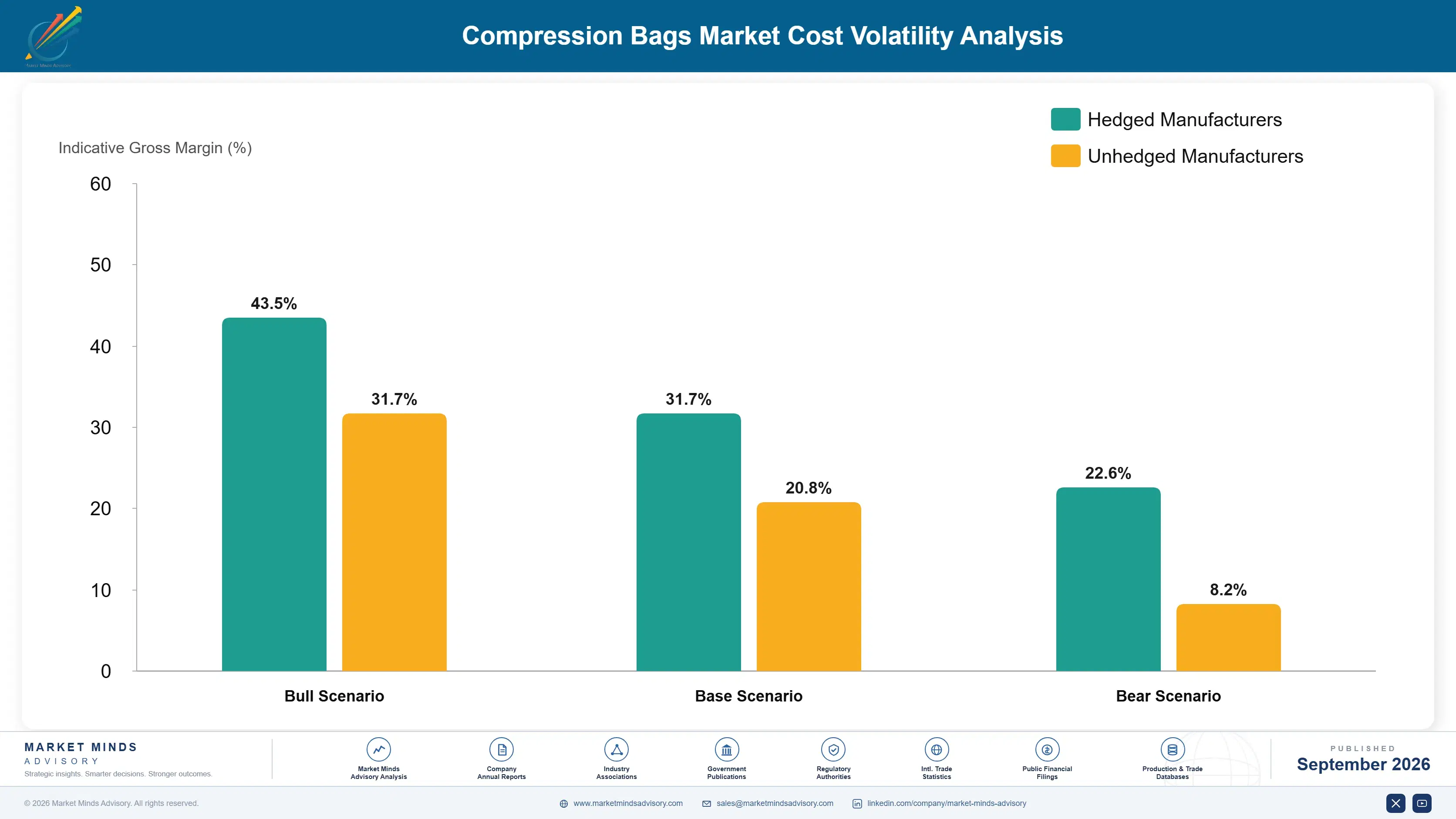
What The Bag Costs

Film and closure dominate and the valve costs more than it looks. Multilayer barrier film runs roughly 41% of manufacturing cost, the zip closure about 16%, and a moulded one-way valve around 11% on the formats that carry one. Printing and packaging take a further 14%, which is high because the pack must communicate a claim the product cannot demonstrate. Freight absorbs most of the remainder.
Polyethylene and nylon resin prices rose sharply through 2021 and 2022 on petrochemical feedstock and energy costs together, a movement the EIA documents across its feedstock reporting for that period, while sea freight on bulky low-density goods climbed steeply in the very same window. Several participants responded by reducing film gauge rather than raising shelf prices, which shortened vacuum retention further on formats that were already struggling badly with it.

Exposure divides by format and by manufacturing location rather than by company size. Valve formats carry a moulded component that valve-free construction avoids entirely, which inverts the usual relationship between technical sophistication and cost. Fabric cube producers carry textile exposure on a different cycle. Manufacturers producing in India and China for domestic demand avoid freight on a product that ships volume.
compression-bags-market-cost-volatility-analysis-1790025467107

Convert formats away from moulded valve components

A moulded one-way valve adds around a ninth of manufacturing cost and causes most vacuum failures, which makes removing it a saving and a performance improvement at the very same time. The obstacle is that retail packaging has sold the valve as the defining technology for two decades and buyers now look for it.

Maintain film gauge rather than thinning under cost pressure

Reducing film gauge is the fastest available saving and it directly shortens vacuum retention on a product that is already failing most buyer expectations rather badly. Holding gauge protects the only genuine performance property the whole category has to offer anybody at all. The requirement is absorbing resin movements through margin rather than specification.

Manufacture regionally for bulky low-density products

Compression bags ship volume rather than weight before they are used, which makes freight a meaningful share of landed cost on any long route into a price-sensitive market. Producing closer to demand removes it along with duty. The constraint is that film extrusion and converting capacity must be built before regional volumes justify the investment.

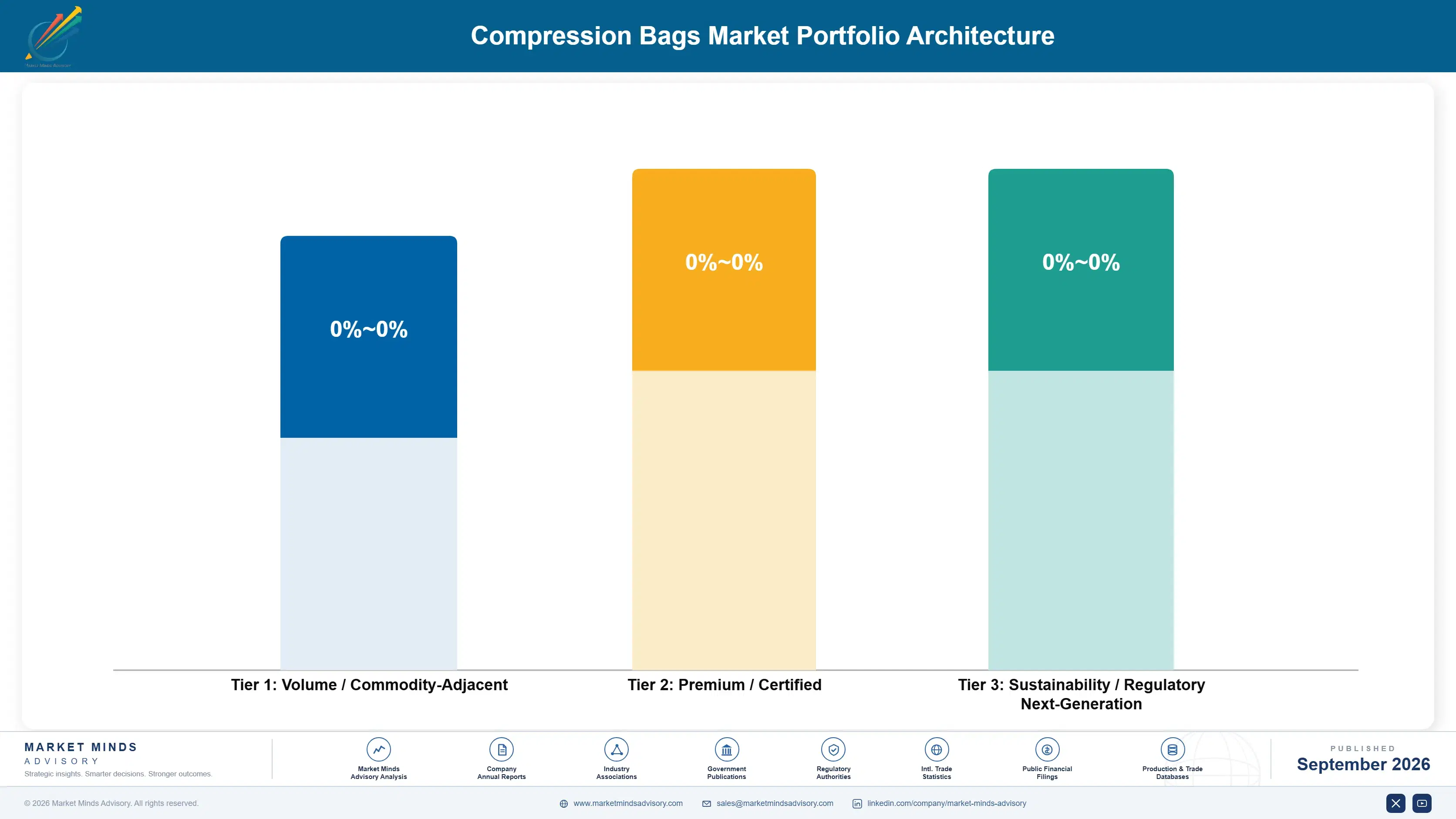
Portfolio Architecture for Margin Defence

Margin architecture divides by whether the product is reused or discarded, which the category name conceals completely. Unbranded imported storage multipacks sold through marketplaces run at gross margins in the high teens to high twenties, competing purely on price per bag against interchangeable listings where nothing distinguishes one from another at all. Nothing about a marketplace listing distinguishes one from the next.
Branded household storage bags and hanging garment formats hold gross margins in the low thirties to low forties. The spread reflects how differently grocery and marketplace channels carry brand and packaging cost. Hanging garment formats earn a premium because they solve a problem boxes cannot, keeping tailoring uncrushed while still reducing wardrobe depth, which buyers value more than raw volume reduction.

The highest-value pool is travel compression cubes and reusable outdoor sacks, at margins in the mid forties to mid fifties. Those buyers reuse the product across hundreds of trips, research durability and pay several times household prices. Unbranded multipacks carry unit volume and marketplace presence. They defend nothing against the next identical listing. Shelf and listing presence is the argument for keeping that tier, and it is a genuinely real one.

Volume / Commodity-Adjacent

Unbranded imported storage multipacks through marketplaces, competing purely on price per bag against interchangeable listings. The ten point range reflects how differently importers negotiate freight and volume. Brand attachment here is effectively zero.
Gross Margin: 18 to 28%

Premium / Certified

Branded household storage and hanging garment formats. Hanging formats earn a premium by keeping tailoring uncrushed while reducing wardrobe depth, which buyers value above raw volume reduction. Retention still limits what the storage formats deliver.
Gross Margin: 32 to 42%

Sustainability / Regulatory / Next-Generation

Travel compression cubes and reusable outdoor sacks. These buyers reuse the product across hundreds of trips, research durability properly and pay several times household prices for it. The retention weakness never becomes visible on a trip.
Gross Margin: 45 to 55%
compression-bags-market-portfolio-architecture-1790025467611

High-value Sub-segments and Strategic Watch-out

Valve-Free Roll Compression Bags

Fastest growth at 9.0% and lower manufacturing cost than the valve format it replaces, which is an unusual combination. Retail merchandising still favours the valve because it looks more engineered on a shelf. A cost reduction and a performance improvement rarely arrive together like this.
Gross Margin: 36 to 45%

Travel Compression Cubes

Highest value and strong growth at 7.8%, sold increasingly on calculated baggage fee payback rather than volume claims. The retention limitation that undermines household storage never becomes visible on a trip. These buyers research before purchase and reuse the product across hundreds of separate journeys.
Gross Margin: 46 to 55%

Vacuum Valve Storage Bags

Volume core and the format generating most of the category's complaints, with median retention near 17 days against buyers expecting seasonal storage. The valve costs more to make than the channel replacing it. Shelf merchandising rather than measured performance is what sustains the format now.
Gross Margin: 26 to 36%

Reusable Outdoor Compression Sacks

Strategic watch-out. High margin and genuinely durable, but serving a small segment of buyers who already own what they need. The sixteen point range reflects how widely fabric and hardware specification varies. Strap compression also avoids the loft damage that prolonged vacuum storage reliably causes.
Gross Margin: 42 to 58%

How Buyers Actually Return

Repeat purchase here depends entirely on whether the first use worked, and the category makes that outcome unusually unlikely. A buyer who packed a duvet in April and found it flat in October does not buy compression bags again. One whose bags held returns and buys more, because the storage problem recurs every season. The category recruits continuously and loses much of what it recruits.
Stickiness varies sharply by use case rather than by brand. Travel buyers who reuse cubes across hundreds of trips form genuine attachment and replace on wear rather than on failure. Outdoor sack buyers are similar and even more durable. Household storage buyers have no attachment and choose again from whatever a shelf offers, which makes shelf position the only real asset there.

Buyer profiles have shifted toward travel since 2022. Carry-on-only travel became routine as checked baggage pricing rose, which moved a meaningful share of demand into a use case where the product's central weakness never appears. That group also researches before buying and reuses afterwards, which is a considerably better customer than the household storage buyer who purchases once on a claim and rarely returns.
compression-bags-market-end-use-penetration-index-1790025468117

Where The Seal Decides

These are among the four positions where our research anticipates prominent divergence between winners and laggards over the coming forecast period. Each is grounded in the demand model, the regulatory perimeter, and the announced capacity pipeline.
01 / VALVE REMOVAL CONVERSION

Take out the part that fails

One-way valves account for roughly 61% of vacuum losses and median retention runs near seventeen days against buyers who packed expecting six months of storage. Valve-free rolling construction removes the component entirely at a lower bill of materials, since a moulded valve costs more than a sealing channel does. Participants who converted report return rates falling roughly 44% alongside rising repeat purchase, because the product finally survives the period the buyer had in mind, and removing it is a cost reduction and an improvement at once.
02 / VOLUME CLAIM REALISM

Print the number people actually achieve

Packaging claims around 75% volume reduction measured with contents arranged to compress ideally, while a bag packed quickly at home reaches considerably less and frequently fails to seal at all. Stating a realistic achievable range with packing guidance costs an artwork change rather than any product work. Participants who did it report complaint volumes falling roughly 38%, because the expectation set at purchase finally matches what happens in a bedroom, though somebody has to move first before the category can follow.
03 / COMPRESSION DURATION WARNING

Tell people when to let it breathe

Down and synthetic fill crushed for months loses loft permanently, and around 8% of products in this category state any maximum compression period on the packaging. Printing a duration warning costs an artwork revision and prevents damage that buyers currently blame on the bedding rather than on the bag. Participants who added it report repeat purchase rising roughly 1.6 times, because a customer whose duvet survived returns and one whose did not never will, and a disappointed buyer tells other people exactly what happened.
04 / BAGGAGE PAYBACK POSITIONING

Price the cubes against the airline

Checked baggage charges have converted packing volume into a cost a traveller can calculate per flight, and a cube set keeping somebody to carry-on pays for itself within two or three journeys at typical fee levels. Presenting that arithmetic costs a packaging message rather than any change to the product. Participants who did it report conversion rising roughly 2.4 times against space-saving messaging, because a payback figure is verifiable and a volume claim never was, and those buyers reuse the product across hundreds of subsequent trips.

Engagement Snapshot From the Field

A live engagement with an industry participant carrying material or product regulatory and market exposure ahead of a defining policy shift, showing how our research translates into a defensible multi-year portfolio strategy.
MARKET MINDS ADVISORY · CLIENT ENGAGEMENT SUMMARY
Compression Bags Producer Strategic Portfolio Review and Transition Roadmap 2026·Investment Scenario on Compression Bags Exposure Evaluation 2025-26
CLIENT PROFILE
A household storage products brand with compression bag revenue near USD 31 million (client-reported, unverified by MMA), weighted approximately 83% to vacuum valve storage bags and 17% to travel formats. All packaging claimed 80% volume reduction. No product carried a compression duration warning and film gauge had been reduced twice since 2021. Retention had never been tested internally.
STRATEGIC CHALLENGE
Repeat purchase had fallen for three consecutive years while marketplace ratings declined, and management attributed the position to unbranded import competition. A price reduction had been approved to defend share. Nobody had tested how long the bags actually held vacuum, or read what the negative reviews were describing. Neither question had been put to anybody.
MMA APPROACH
MMA coded 4,600 marketplace reviews by stated failure mode rather than by star rating. Vacuum retention was measured across the client's range and nine competitor products over ninety days. Achievable volume reduction was measured with untrained packers, and valve versus channel construction cost was compared directly. Findings were reconciled against returns records.
KEY FINDINGS
  1. Coded reviews showed 64% of negative comments described loss of vacuum within weeks, and 11% described crushed bedding that did not recover afterwards.
  2. Measured retention averaged 12 days on the client's range against 31 days for the best competitor product, with the gap tracing to gauge reductions made since 2021.
  3. Untrained packers achieved 51% volume reduction against the 80% claimed on packaging, and four of twelve attempts failed to seal at all on the first try.
  4. Valve-free channel construction costed 9% below the valve format at identical film specification, while measuring longer retention in every test conducted. under identical storage conditions.
CLIENT PROFILE
A household storage products brand with compression bag revenue near USD 31 million (client-reported, unverified by MMA), weighted approximately 83% to vacuum valve storage bags and 17% to travel formats. All packaging claimed 80% volume reduction. No product carried a compression duration warning and film gauge had been reduced twice since 2021. Retention had never been tested internally.
STRATEGIC CHALLENGE
Repeat purchase had fallen for three consecutive years while marketplace ratings declined, and management attributed the position to unbranded import competition. A price reduction had been approved to defend share. Nobody had tested how long the bags actually held vacuum, or read what the negative reviews were describing. Neither question had been put to anybody.
MMA APPROACH
MMA coded 4,600 marketplace reviews by stated failure mode rather than by star rating. Vacuum retention was measured across the client's range and nine competitor products over ninety days. Achievable volume reduction was measured with untrained packers, and valve versus channel construction cost was compared directly. Findings were reconciled against returns records.
KEY FINDINGS
  1. Coded reviews showed 64% of negative comments described loss of vacuum within weeks, and 11% described crushed bedding that did not recover afterwards.
  2. Measured retention averaged 12 days on the client's range against 31 days for the best competitor product, with the gap tracing to gauge reductions made since 2021.
  3. Untrained packers achieved 51% volume reduction against the 80% claimed on packaging, and four of twelve attempts failed to seal at all on the first try.
  4. Valve-free channel construction costed 9% below the valve format at identical film specification, while measuring longer retention in every test conducted. under identical storage conditions.
RECOMMENDED STRATEGY
Phase 1: Phase one: cancel the price reduction, restore film gauge and convert the storage range to valve-free channel construction. The conversion saves more than it costs. Phase 2: Phase two: restate volume claims at achievable levels and add compression duration warnings for loft items. Both changes are artwork rather than product. Phase 3: Phase three: expand travel formats and position them on calculated checked baggage payback per flight. That buyer researches and reuses afterwards.
OUTCOME
Marketplace ratings recovered within two quarters of the valve-free conversion reaching shelves, and repeat purchase returned to growth (client-reported, unverified by MMA). Gross margin improved despite the restored film gauge, because removing the valve saved more than the gauge cost, and travel formats reached 29% of revenue.

Frequently Asked Questions

Foundational context covering the market sizes, CAGR, scope, country, region and competition that inform every finding below. This section is provided to cover basics and most often pre-purchase conversations, answered from the MMA Primary Research Dataset.

What is the current size of the Compression Bags Market?

The market was valued at USD 1.7 billion in 2025, rising to USD 1.8 billion in 2026. Sizing is at manufacturer net revenue across six bag constructions.

How large will the Compression Bags Market be by 2036?

MMA forecasts USD 3.2 billion by 2036, an increase of USD 1.4 billion over the 2026 base. That represents expansion of 1.79 times across the forecast period.

What is the CAGR for the Compression Bags Market 2026 to 2036?

The base case CAGR is 6.0%, with a bull case of 7.2% and a bear case of 4.8%. Historical growth between 2020 and 2025 ran at 4.8%.

Which segment is growing fastest?

Valve-free roll compression bags grow at 9.0%, half again the market rate, by removing the component causing most failures. Travel compression cubes follow at 7.8%.

Who are the major companies in the Compression Bags Market?

Ziploc, Spacesaver, Vacwel, Eagle Creek and Sea to Summit lead on manufacturer net revenue, holding a combined 22%. Retail shelf position rather than manufacturing separates them.

Which country is growing fastest?

India grows fastest at 11.6%, on urban apartment living where storage is scarce and humidity adds a preservation argument alongside the space one. Organised retail is also reaching well beyond the largest cities.

Report Segmentation Architecture

The full report scope spans multiple orthogonal segmentation dimensions, with cross-tabulated demand data provided for each dimension pair. Coverage extends further to regional breakdowns, trend trajectories, and the competitive detail needed to support segment-level decision-making.

By Bag Construction

  • Vacuum Valve Storage Bags
  • Valve-Free Roll Compression Bags
  • Travel Compression Cubes
  • Hanging Garment Compression Bags
  • Commercial and Industrial Compression Packaging
  • Reusable Outdoor Compression Sacks

By End-Use Occasion

  • Seasonal Clothing Storage
  • Bedding and Duvet Storage
  • Travel and Luggage Packing
  • House Moving and Relocation
  • Outdoor and Expedition Equipment
  • Commercial Textile Shipping

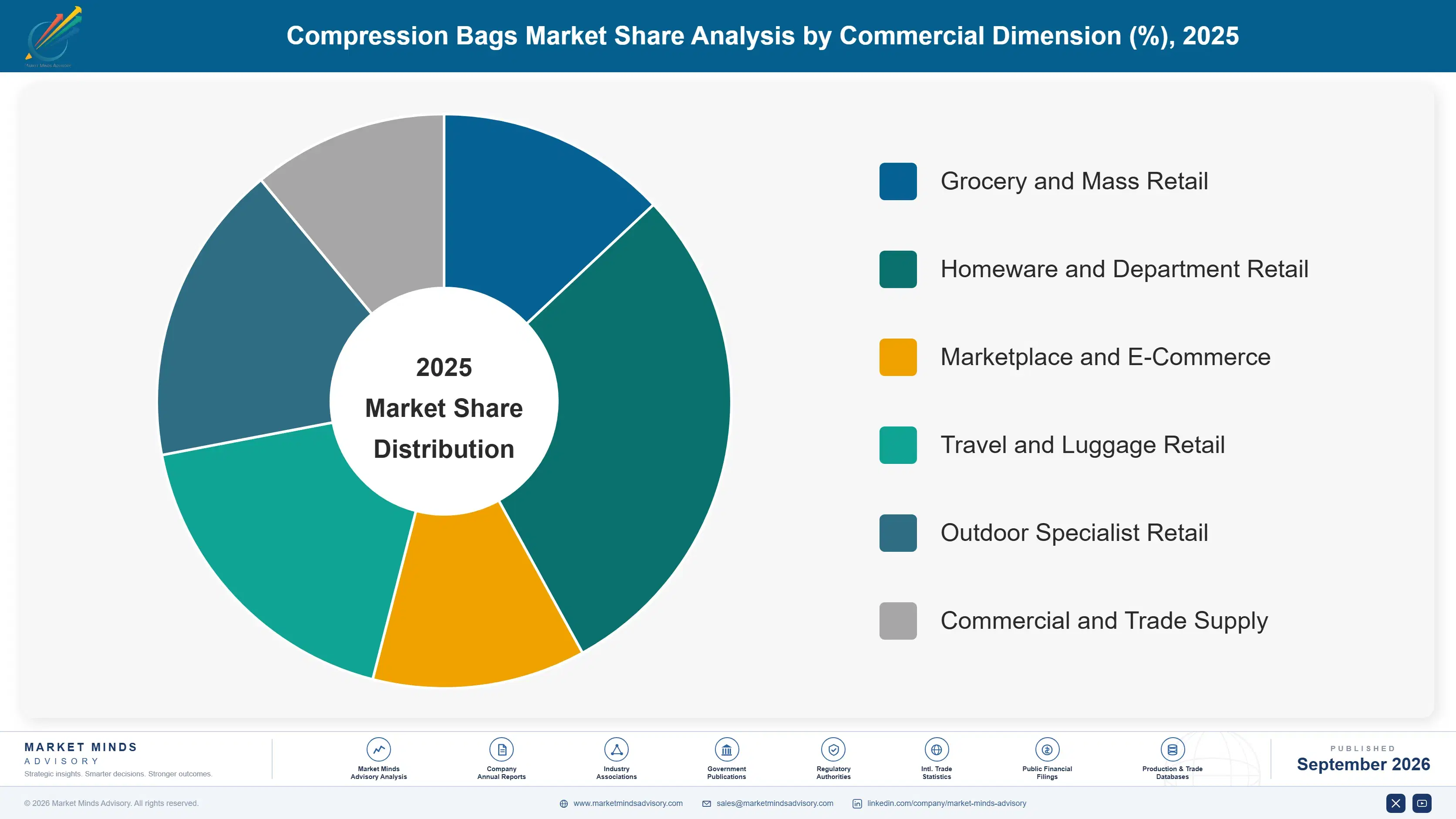
By Commercial Dimension

  • Grocery and Mass Retail
  • Homeware and Department Retail
  • Marketplace and E-Commerce
  • Travel and Luggage Retail
  • Outdoor Specialist Retail
  • Commercial and Trade Supply

By Region

  • East Asia
  • North America
  • Western Europe
  • South Asia and Pacific
  • Latin America
  • Middle East and Africa
  • Eastern Europe

Scope, Methodology, and Coverage

Every figure in this report is reproducible from documented input assumptions. The scope below maps the historical period, the forecast horizon, the segmentation dimensions, and the countries covered, alongside the underlying primary and qualitative methodology.
Historical Period
2020 to 2025
Forecast Period
2026 to 2036
Base Year
2025 (USD billions; MMA Primary Research Dataset, September 2026)
Market Definition
This market covers flexible bags and cases that reduce stored volume by removing air, spanning vacuum valve storage bags, valve-free roll compression bags, travel compression cubes, hanging garment compression bags, commercial and industrial compression packaging, and reusable compression sacks for outdoor equipment. Sizing is at manufacturer net revenue across grocery, homeware, marketplace, travel retail, outdoor specialist and trade channels. Rigid storage containers, vacuum food sealing bags and appliances, shipping mailers without compression function, and standard garment covers are excluded throughout.
Quantitative Units
USD billions at manufacturer net revenue; volume in millions of units shipped; performance in days of vacuum retention.
Segmentation Dimensions
Bag construction, end-use occasion, commercial dimension, and geographic region.
Regions Covered
East Asia, North America, Western Europe, South Asia and Pacific, Latin America, Middle East and Africa, Eastern Europe
Countries Covered
China, India, United States, Japan, Germany, Brazil
Key Companies Profiled
Ziploc, Spacesaver, Vacwel, Eagle Creek, Sea to Summit, Hibag, Storage Maniac, Vacuum Storage Solutions, Compactor, Rubbermaid, Osprey Packs, Granite Gear, Peak Design, Tripped Travel Gear, Samsonite, Taili, Mixi, Everlasting Comfort, Hercules Vacuum Bags, Space Bag
Quantitative Methodology
Primary survey, n=3,800 respondents, Q4 2025, six countries; demand-side model with trade association cross-validation
Qualitative Methodology
47 expert interviews, Q4 2025; applied to validate demand model assumptions, identify emerging dynamics, and assess competitive positioning
Report Format
PDF and XLSX data workbook (Word format preview document)
Publisher
Market Minds Advisory
Report Code
MMA-2026-PAC-818
Published
September 2026
Contact
sales@marketmindsadvisory.com | www.marketmindsadvisory.com

Purchase the full Compression Bags Market Report (2026 to 2036).

The full report sizes the compression bags market across six bag constructions, six end-use occasions and six commercial dimensions for all seven global regions through 2036. It measures vacuum retention across competing products over extended periods rather than relying on packaging claims. Marketplace reviews are coded by stated failure mode rather than by star rating, isolating valve loss from film and closure problems. Achievable volume reduction is measured with untrained packers against the figures printed on packaging. Competitive assessment covers 20 participants on a consistent manufacturer net revenue basis.
Vacuum retention measured across competing products over ninety days
Reviews coded by stated failure mode not star rating
Achievable volume reduction measured with untrained packers
Valve and channel construction costs compared at identical film
Six bag constructions sized through 2036
Twenty participants assessed on manufacturer net revenue

Built For The People Who Decide

From boardroom strategy to bench-side execution, this report is read cover-to-cover by leaders shaping the next decade of their industry, turning demand scenarios, market dynamics and valuation benchmarks into decisions.
CXOs/ Presidents/ VPs/ Managers
M&A and Corporate Development
Strategy Teams and R&D Heads
Procurement and Product Directors
Regulatory and Compliance Leaders
Investor Relations and Equity Analysts