Market Minds Advisory
Compressed Air Energy Storage (CAES) Market

Compressed Air Energy Storage (CAES) Market: Compressed Air Energy Storage Market: A Geological Map In Disguise

The cheapest place to put the air is a salt cavern, and salt is where it is. This market is a geological map wearing an energy policy costume over the top.

Lead Analyst

Published

September 2026

Make Smarter Decisions with Customized Research Insights

Request a free sample report and evaluate market opportunities, growth trends, and competitive dynamics relevant to your business needs.

2025 MARKET VALUE$0.7BMarket Size 2025
2036 FORECAST VALUE$3.0BBase Case , 2026 to 2036
CAGR 2026 TO 203614.0 %Bull 15.3% / Bear 12.7%
INCREMENTAL OPPORTUNITY$2.2BNet 10- year value creation
EXPANSION MULTIPLE3.71x2036 value over 2026 base
Strategic Levers
M&A Pipeline
Regional Outlook
Country Rankings
Competitive Intelligence
Segmental Deep-dive
Call-Us : 91 93563 13602

Executive Snapshot and Market Trajectory.

There are nine plants above utility scale generating anywhere in the world, and the reason is geology rather than engineering. A salt cavern absorbs 34% of capital and costs a fraction of a pressure vessel, so the addressable market is a map of where the salt is.
Advanced adiabatic cavern systems grow at 21.0%, half again the market rate of 14.0%, because storing the compression heat and reusing it on expansion reaches 68% round trip without burning any fuel, which the original diabatic plants could not. East Asia holds 44% of demand, far outside any normal band, because China has built essentially every modern plant now operating anywhere. Operating experience in this technology is now almost entirely Chinese in origin.
Concentration is high at 59% of contracted capacity, which describes a technology before deployment rather than a consolidated industry. The commercial window is genuinely narrow and worth stating plainly: below eight hours batteries win outright, above about a hundred hours hydrogen becomes the sensible answer, and this sits in between. That window is real and it is not large, and everybody selling into it should probably say so.
Market Definition
The compressed air energy storage market covers grid-connected systems that store electrical energy by compressing air into a reservoir and recover it by expansion through a turbine, spanning diabatic cavern systems, advanced adiabatic cavern systems, liquid air energy storage, isothermal and near-isothermal systems, above-ground vessel systems, and depleted field and porous media systems. Scope is measured as contracted and operating storage capacity. Excluded are pumped hydro storage, all electrochemical battery systems, flywheel and gravity storage, industrial compressed air supply for process use, and hydrogen storage of any kind.
Base Year Value
$0.7B in 2025 (MMA Primary Research Dataset, September 2026)
Forecast Period
2026 to 2036, eleven discrete annual values
CAGR
14.0% base case. Bull 15.3%. Bear 12.7%.
Fastest Growth Segment
Advanced Adiabatic Cavern Systems: 21.0% CAGR
Fastest Growth Country
India: 16.2% CAGR
Fastest Growth Region
South Asia and Pacific: 16.2% CAGR
Largest Region
East Asia: 44% of 2025 global value
Market Leaders
China Energy Engineering Corporation, Highview Power, Hydrostor, Siemens Energy and Zhongchu Guoneng. Source: MMA Analysis, July 2026.
Primary Survey
n=3,800 procurement and R&D decision-makers, Q4 2025, six countries
Methodology
Demand-side build-up, cross-validated against public data, 47 expert interviews

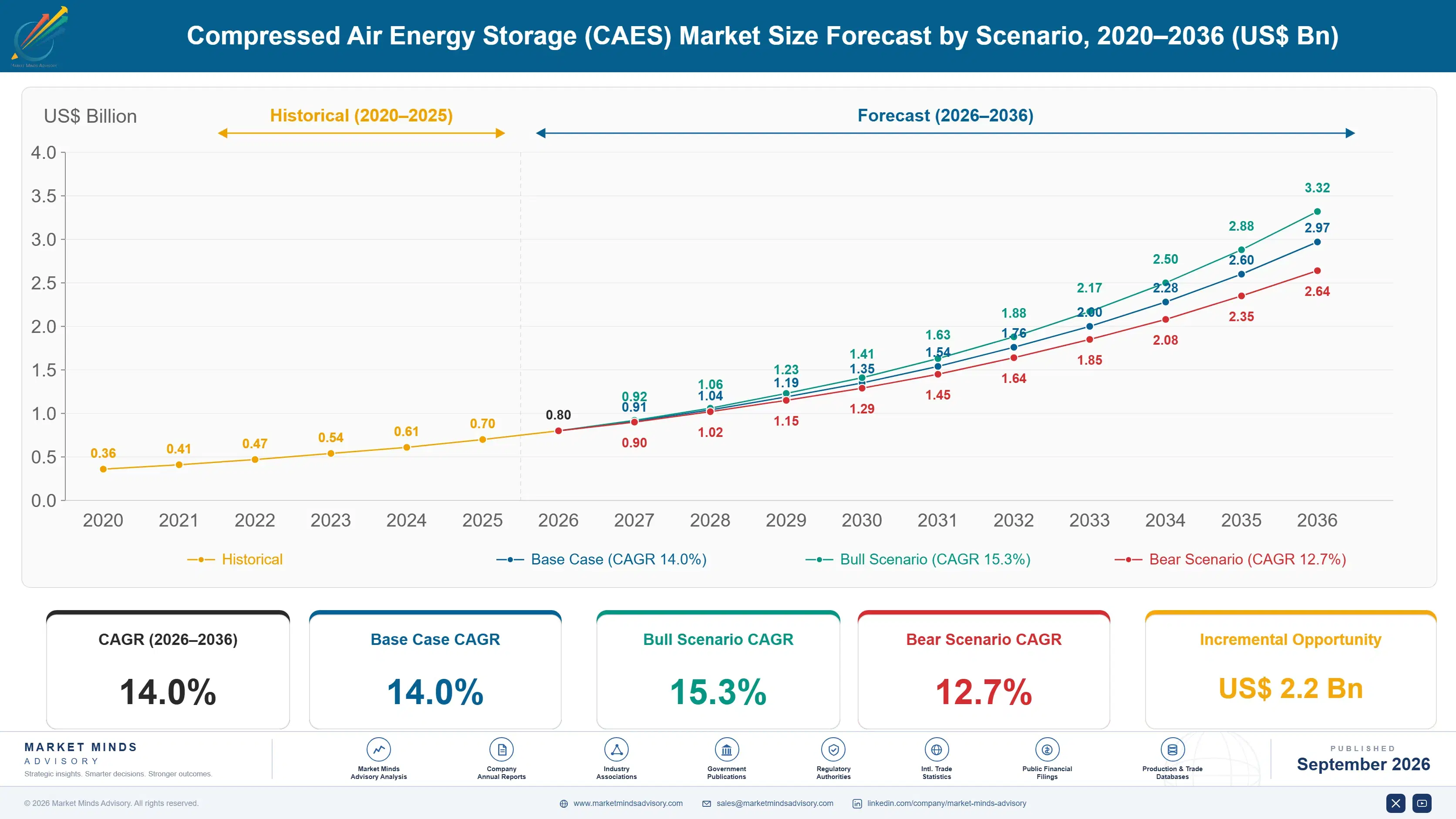
Compressed Air Energy Storage (CAES) Market Forecast Scenarios

compressed-air-energy-storage-caes-market-size-forecast-scenario-1788410772545
Between 2020 and 2025 the sector compounded at 12.4% and almost all of it happened in one country. Chinese projects moved from demonstration to hundreds of megawatts of operating adiabatic capacity while Western developments advanced through permitting and financing without commissioning much. The two original diabatic plants continued running as they have for decades, burning gas on expansion exactly as designed.
The 14.0% base case rests on three mechanisms. Chinese deployment continues at a scale nobody else approaches, on salt formations the country has mapped and a state programme that funds long duration storage explicitly. Adiabatic designs removed the fuel requirement that made earlier plants awkward to justify on emissions grounds. And duration requirements are lengthening past where batteries remain economic. None of the three depends on Western projects reaching construction.
The bull case at 15.3% turns on a Western adiabatic plant reaching commercial operation and producing performance data that financiers can underwrite, which would reprice every project currently held up on technology risk. The bear case at 12.7% is battery duration economics improving further, since every extension of the range where lithium is cheapest pushes this technology's already narrow window further out.

Nine Plants In The World

Geology rather than engineering explains why nine plants exist. Air must be stored somewhere at pressure, and a solution-mined salt cavern does that at a cost per stored kilowatt hour that no manufactured vessel approaches, which means a project either sits on suitable salt or it does not happen. The cavern absorbs 34% of capital even where the geology cooperates, and takes six years from site selection to commissioning.
TOP FIVE CONCENTRATION59%Share of contracted capacity held by five largest developers
ROUND-TRIP EFFICIENCY68%Energy recovered by an adiabatic system without any fuel
CAVERN COST SHARE34%Portion of capital absorbed by creating the air reservoir
OPERATING FLEET WORLDWIDE9 plantsSystems above utility scale currently generating on any grid
ECONOMIC DURATION FLOOR8 hoursPoint below which batteries win the comparison outright
CAVERN DEVELOPMENT TIME6 yearsTime from site selection to a commissioned air reservoir
The technical history of this technology is a sequence of attempts to deal with heat. Compressing air heats it, and the two original plants threw that heat away and burned gas to reheat the air on expansion, which worked and produced a storage system with a fuel bill and an emissions profile. Adiabatic designs store the compression heat and return it, reaching 68% round trip with no fuel at all.
The commercial window between competing technologies is genuinely narrow. Below around eight hours of duration lithium batteries win comprehensively on cost, response and siting flexibility. Above roughly a hundred hours the energy volumes favour hydrogen or thermal storage instead. This technology occupies the space between those two, which is real and considerably smaller than most presentations of it suggest.
"Every discussion of this technology I have sat through debated efficiency and none of them started with whether there is salt under the site. The map of suitable geology is the actual market and it was drawn by the Permian sea rather than by any energy policy."
Director, Long Duration Storage Practice · MMA Energy Practice · September 2026

Market Trends

Storing the compression heat removed the fuel bill

The original plants compressed air, discarded the resulting heat and then burned natural gas to reheat the air on expansion, which delivered storage with a fuel requirement and an emissions profile that made it awkward to describe as clean. Adiabatic designs capture that heat in a thermal store and return it during expansion, reaching around 68% round trip efficiency with no combustion at all. That single change moved the technology from a gas peaker with storage attached into something a decarbonisation programme can fund, and adiabatic systems now grow at 21.0% against a market rate of 14.0%.
Market Impact: Wins above 8 hours duration
China built the fleet while everybody else permitted

Chinese developers have taken projects from demonstration through to hundreds of megawatts of operating adiabatic capacity across several sites, supported by a state programme that funds long duration storage explicitly and by salt formations that have been mapped and characterised for decades. Western projects have meanwhile advanced through permitting, financing and technology risk assessment without commissioning very much at all. Operating data, construction experience and equipment supply chains are consequently concentrated in one country, which every project elsewhere now has to reference. Every project outside China now has to reference plants it did not build and cannot visit easily.
Market Impact: Cuts 6 years of appraisal

Market Opportunities and Growth Drivers

Duration requirements are lengthening past battery economics

Grid procurement is moving from two and four hour storage products toward eight, twelve and longer durations as renewable penetration rises and evening ramps extend, and lithium costs scale with energy stored because adding hours means adding cells. A compressed air system adds hours by adding cavern volume, which is close to free once the cavern exists. That crossover sits around eight hours and moves further in this technology's favour with every extension of the duration requirement. That crossover moves further in this technology's favour with every extension of the duration requirement anybody specifies.
Market Impact: Loses below 8 hours entirely

Salt formations exist in more places than anybody uses

Bedded and domal salt suitable for solution mining is present across substantial areas of North America, Northern Europe, China and parts of the Middle East, and the gas storage industry has already characterised much of it for entirely different purposes. That existing geological knowledge shortens site selection considerably and reduces the appraisal risk that would otherwise stop projects. Very few developers have systematically mapped where suitable formations coincide with grid connection and with a market that values long duration storage. Existing characterisation shortens site selection enormously and almost nobody has mapped it systematically against grid access.
Market Impact: Absorbs 34% of project capital

Market Restraints and Challenges

The window between batteries and hydrogen is narrow

Below around eight hours of duration lithium batteries beat this technology on capital cost, round trip efficiency, response time and siting flexibility simultaneously, and above roughly a hundred hours the energy volumes involved favour hydrogen or thermal storage instead. The root cause is that compressed air is a moderate energy density store with moderate efficiency, which makes it a compromise rather than a winner at either extreme. Commercial impact is a genuinely limited addressable duration band. Participants are responding by targeting that band explicitly, by improving efficiency and by pursuing sites where geology makes the economics exceptional.
Market Impact: Reaches 68% without any fuel

No cavern means no economics at all

A solution-mined salt cavern stores air at a cost per kilowatt hour that manufactured pressure vessels cannot approach, and a project without suitable geology faces vessel costs that remove the technology's entire cost advantage over batteries. The root cause is that storing a gas at pressure is expensive unless the ground does the containment for you. Commercial impact is an addressable market defined by a geological map. Mitigation runs through hard rock cavern designs, depleted gas field storage, above-ground systems accepting the cost penalty and site selection driven by geology first.
Market Impact: Holds 44% of world demand
3 additional market trends, 4 additional growth drivers, and 2 additional restraints and challenges are covered in the full report. Contact sales@marketmindsadvisory.com to access the complete intelligence.

Segment CAGR and Growth Architecture

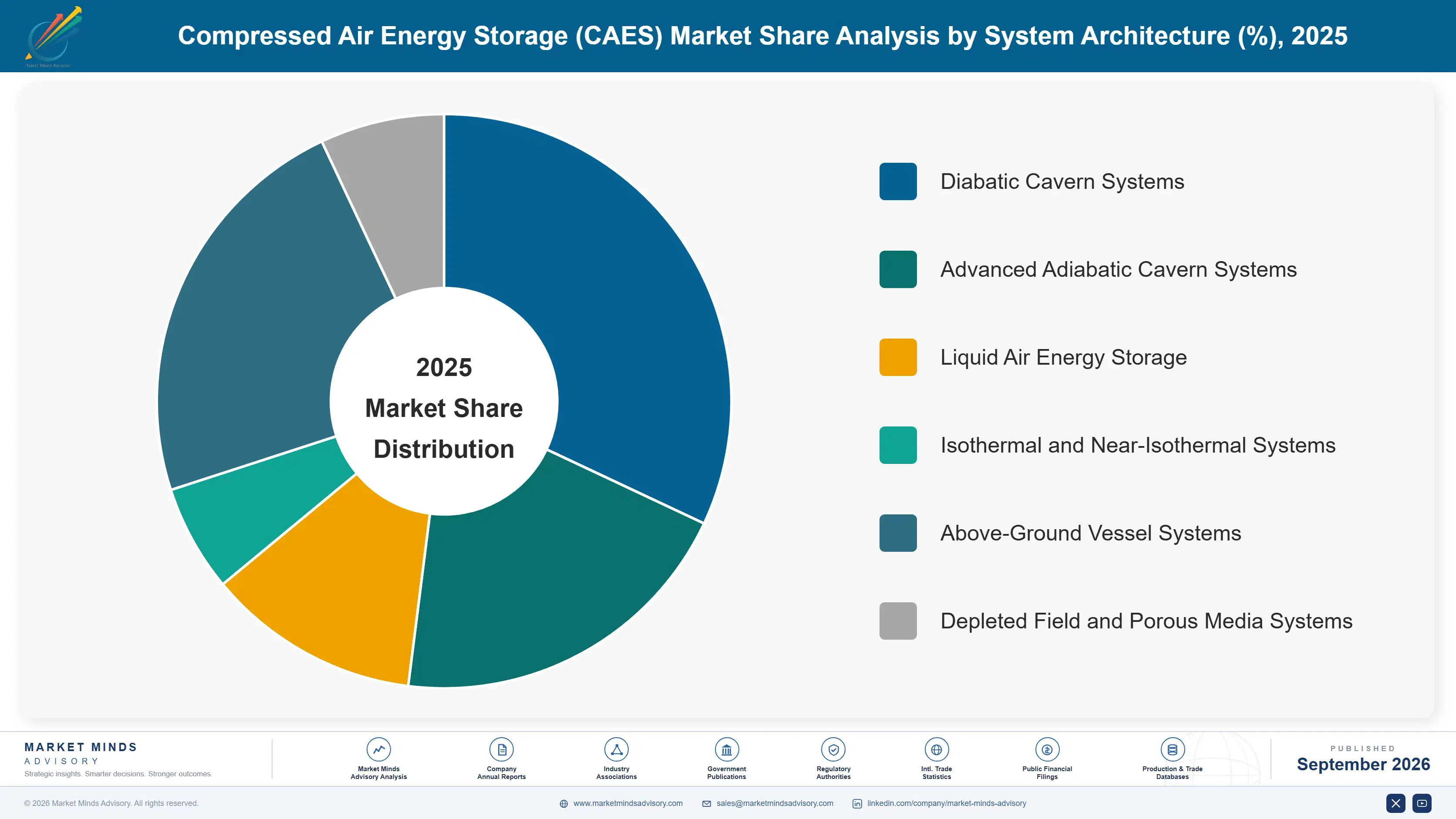
Segmentation follows system architecture, the dimension on which efficiency, fuel requirement and siting constraint all move together. Diabatic and porous media systems carry the operating legacy on designs that burn fuel or depend on specific reservoirs. Adiabatic and liquid air systems carry the growth, because one removed the fuel and the other removed the cavern.
compressed-air-energy-storage-caes-market-market-share-analysis-1788410773077

Advanced Adiabatic Cavern Systems

Advanced adiabatic cavern systems grow at 21.0%, half again the market rate of 14.0%, and a thermal store rather than any improvement in the air handling created that growth. Capturing the heat of compression in a solid or molten medium and returning it during expansion removes the natural gas that earlier plants burned, which lifts round trip efficiency to around 68% and converts the technology from a peaker with storage into something a decarbonisation budget can fund. Chinese projects have proven the architecture at hundreds of megawatts while Western equivalents remain in development. The thermal store is where the remaining engineering difficulty sits, and it is where the operating data everybody needs is being generated.
CAGR 21.0%

Liquid Air Energy Storage

Liquid air energy storage at 16.8% solves the problem that limits everything else in this category, which is that a project needs suitable geology or it does not proceed. Liquefying air to store it in insulated tanks at atmospheric pressure removes the cavern entirely and makes the technology sitable anywhere with land and a grid connection. The cost is efficiency, since liquefaction consumes considerable energy and round trip performance sits below cavern systems as a result. Industrial gas plant equipment is mature and available, which shortens development considerably, and the trade being made is a well understood energy penalty against a geological constraint that stops most projects dead. The trade is well understood and rarely presented.
CAGR 16.8%
Full segment breakdown across 6 segments available in the complete report.

Regional Architecture and Country Demand Map

East Asia takes 44%, far outside any normal band, because China has built essentially every modern plant operating anywhere. Western positions reflect permitting rather than any lack of geology. Salt geology and state programme decisions decide these positions, and neither follows the shape of an energy market.

East Asia

A 44% share far outside any normal band exists because one country decided to build and everybody else decided to study. Chinese developers have commissioned adiabatic plants at hundreds of megawatts across several sites, supported by a state long duration storage programme, salt formations characterised over decades by the gas storage industry and a domestic equipment supply chain covering compressors, turbines and thermal stores. Operating data from those plants is now the reference every project elsewhere cites. Japanese and Korean interest is technical rather than deployed. The gap between Chinese operating experience and everybody else's is widening rather than closing. The gap in operating experience is widening rather than closing.
Share: 44% | CAGR: 15.0% (2026 to 2036)

Western Europe

The 18% share sits below the usual band and permitting rather than geology explains it, since Northern European salt formations are among the best characterised anywhere from decades of gas storage. German, Dutch, Danish and British projects have advanced through development, grid connection and financing over years without much reaching construction, held up variously by technology risk assessment, market design uncertainty and the pace of consenting. Huntorf has operated since the 1970s and remains the longest running plant in existence. Growth at 12.4% is the slowest of the seven regions and reflects a pipeline that is genuine and stubbornly slow to convert. Huntorf still runs after five decades. The pipeline converts stubbornly slowly.
Share: 18% | CAGR: 12.4% (2026 to 2036)
Regional intelligence for 5 additional markets available in the complete report: North America, South Asia and Pacific, Latin America, Middle East and Africa, Eastern Europe. Contact sales@marketmindsadvisory.com.
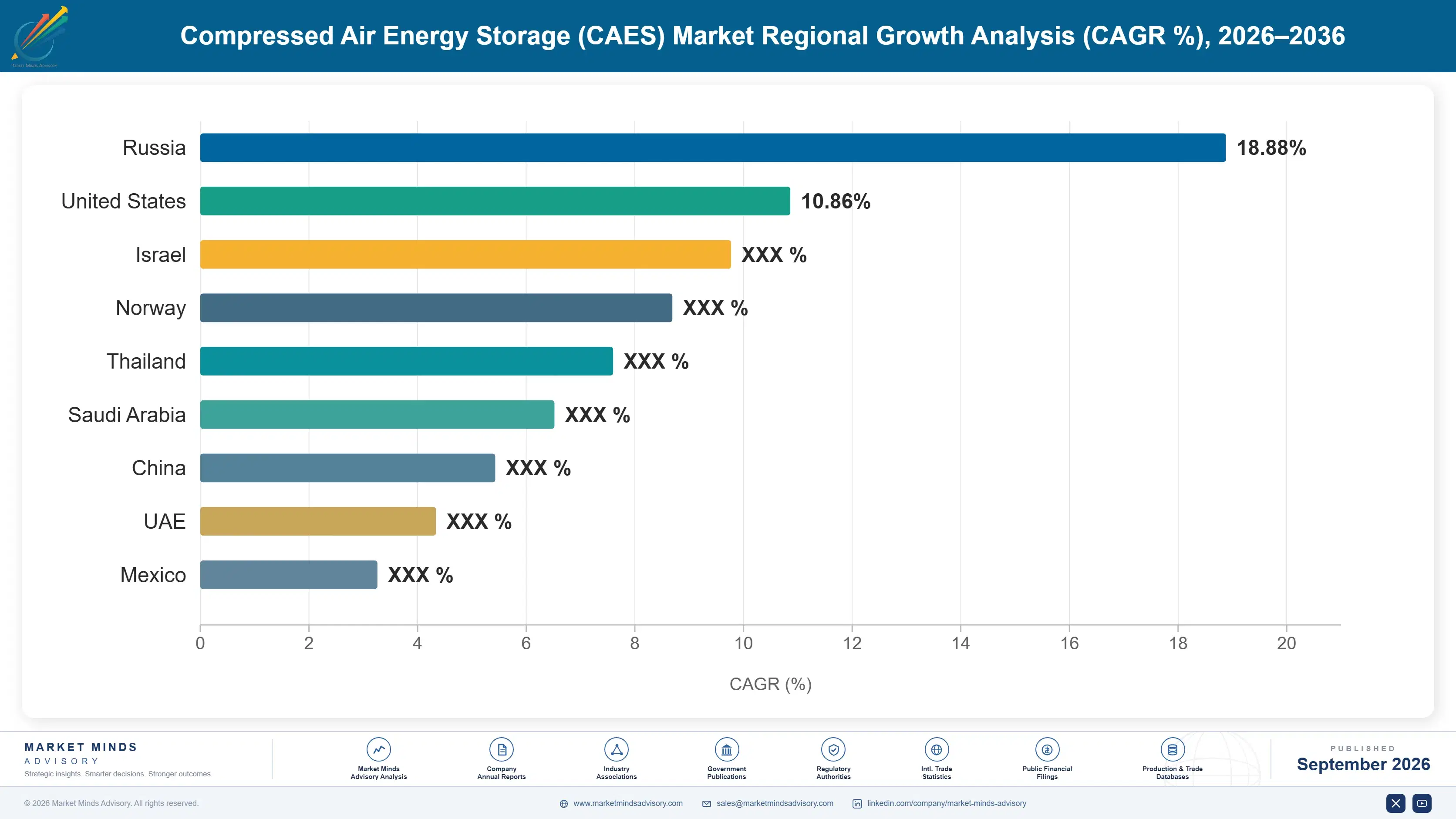
compressed-air-energy-storage-caes-market-country-cagr-analysis-1788410773598

Four Moves Before The Geology Runs Out

None of these four is about efficiency, because the difference between competing designs is smaller than the difference between having a cavern and not having one. Each works on the actual constraints: suitable geology, a financier who has never seen one of these built, and a duration band that is narrower than the brochures suggest.

Map the geology against the grid first

A salt cavern absorbs 34% of project capital and takes 6 years from site selection to commissioning, and the gas storage industry has already characterised much of the suitable formation across North America, Northern Europe and China for entirely different purposes. Overlaying that existing data against grid connection capacity and against markets that pay for long duration storage identifies the small number of sites where this technology genuinely works. It costs analysis rather than drilling. Most developers select sites from a market map instead. Most select sites from a market map.
Market Impact: Removes 6 years of appraisal risk from projects

Buy access to the Chinese operating data

Only 9 plants operate above utility scale worldwide and Chinese adiabatic units account for most of the recent ones, which means the performance data that Western financiers need in order to underwrite technology risk already exists somewhere. Licensing arrangements, technical partnerships and equipment supply relationships all provide routes to that evidence. Western developers arguing first-of-a-kind risk to lenders while comparable plants run elsewhere are making an argument they do not need to make. Very few have pursued the relationship at all. Very few have even tried to build that relationship.
Market Impact: References all 9 of the world's operating plants

State the duration window entirely honestly

Below 8 hours lithium wins on cost, efficiency, response and siting together, and above roughly a hundred hours hydrogen and thermal storage take over, which leaves a genuine but limited band in between. Developers presenting this technology as a general storage solution invite a comparison they lose, while those defining the duty precisely compete where they are genuinely best. Procurement bodies increasingly specify duration explicitly, which makes honesty commercially useful rather than merely admirable. Most presentations still claim a range the technology does not hold. Honesty is commercially useful here.
Market Impact: Competes only above the 8 hour duration floor

Take liquid air where the salt is not

Liquid air storage removes the cavern requirement entirely by keeping air in insulated tanks at atmospheric pressure, which makes the technology sitable anywhere with land and a connection, at an efficiency cost against cavern systems. That trade is worth making across India, Southeast Asia, Japan and much of Africa where suitable geology simply does not exist and the storage requirement does. It grows at 16.8% for exactly that reason. Industrial gas plant equipment is mature, which shortens development considerably against cavern projects. Development runs considerably shorter than any cavern project.
Market Impact: Serves markets that lack the 34% cavern option

Who Controls the Margin Pool

CR5 stands at 59% of contracted and operating storage capacity, which is the only sensible basis given that most participants generate no meaningful revenue from this activity yet. Concentration describes a technology before deployment rather than a consolidated industry, and the largest position belongs to the organisation that has actually built plants rather than to any established energy equipment group. The lead belongs to whoever built something.
Competition runs on geological position, demonstrated operating data and financing capability. Geology decides which projects are economic at all. Operating data decides whether a lender will fund one, which is why Chinese experience matters far beyond China. Financing capability decides who survives a six year development before any revenue. Turbomachinery and thermal store engineering differentiate considerably less than the technical presentations imply. Nine plants reassures nobody.

Rankings will move on the first Western plant to reach commercial operation and produce a year of performance data, because everything in this sector outside China is currently priced on an absence of evidence. The pressure comes from financiers rather than from competitors, and the participant that closes that gap sets the terms for everybody who follows afterwards. Everything outside China is priced on missing evidence.
compressed-air-energy-storage-caes-market-company-positioning-matrix-1788410774126

Competitive Moat and Risk Dimensions

CHINA ENERGY ENGINEERING CORPORATION

Moat: Built plants and operating data

Delivering adiabatic plants at hundreds of megawatts through to commercial operation gives the group construction experience, supply chain relationships and performance data that no competitor anywhere can match, in a technology where nine plants exist worldwide. That evidence is the scarcest asset in this sector. Accumulating an equivalent record requires building plants, which takes years and cannot be shortened.
CHINA ENERGY ENGINEERING CORPORATION

Risk: Reach limited outside home market

Commercial, financing and political considerations limit how far the group's capability travels into Western markets where projects are stalled precisely for want of the evidence it holds. Technical partnership and licensing are the available routes and both are slower than building. Holding the world's operating experience matters considerably less if the projects that need it cannot contract with you.
HYDROSTOR

Moat: Hard rock cavern engineering

Developing systems using purpose-excavated hard rock caverns with a hydrostatic compensation column extends the technology to geology far more widely available than solution-mined salt, which enlarges the addressable map substantially. That design capability is genuinely differentiated and protected by development work spanning years. Competitors restricted to salt formations compete for a much smaller set of sites.
HYDROSTOR

Risk: Capital intensity before any revenue

Excavating a cavern and building a plant consumes very large capital across a six year development before a single megawatt hour is delivered, and financing that without operating performance data means accepting terms that reflect first-of-a-kind risk. A single project delay reaches the whole business. Scale resolves it and reaching scale needs the capital the risk premium makes expensive.

Players Tracked

Prominent Players

China Energy Engineering Corporation
Highview Power
Hydrostor
Siemens Energy
Zhongchu Guoneng

Other Key Players

Corre Energy
Storelectric
Augwind Energy
Apex Compressed Air Energy Storage
MAN Energy Solutions
Sumitomo SHI FW
Baker Hughes
Mitsubishi Heavy Industries
State Power Investment Corporation
Sinopec
Atlas Copco
Ingersoll Rand
Burckhardt Compression
Linde
Tsinghua Sichuan Energy Internet Research Institute

Recent Developments

JANUARY 2025

Chinese adiabatic plant completed a full operating year

A Chinese advanced adiabatic installation completed a full year of commercial operation and its round trip efficiency and availability data entered the technical record, providing the first extended performance dataset for a fuel-free system at that scale. Developers elsewhere began citing it directly in financing discussions with lenders.
Signal: One year of real operating data in China is now doing work in European financing rooms.
MAY 2025

Long duration procurement specified eight hour minimum durations

Storage procurement programmes in several markets introduced minimum duration requirements at eight hours and above, explicitly separating long duration products from the shorter battery applications that had previously competed against them. Compressed air proposals became genuinely competitive in tenders that they had consistently lost on cost before.
Signal: Defining the duration band honestly turned out to help this technology rather than to harm it.
SEPTEMBER 2025

Liquid air project advanced without any geological constraint

A liquid air storage development progressed toward construction on a site selected for grid connection and land availability rather than for subsurface geology, demonstrating the siting freedom that distinguishes the architecture. Efficiency sits below cavern systems and the site would not have supported any cavern approach at all.
Signal: Trading efficiency for siting freedom opens far more of the world than the salt map does.

Caverns, Turbomachinery And Thermal Stores

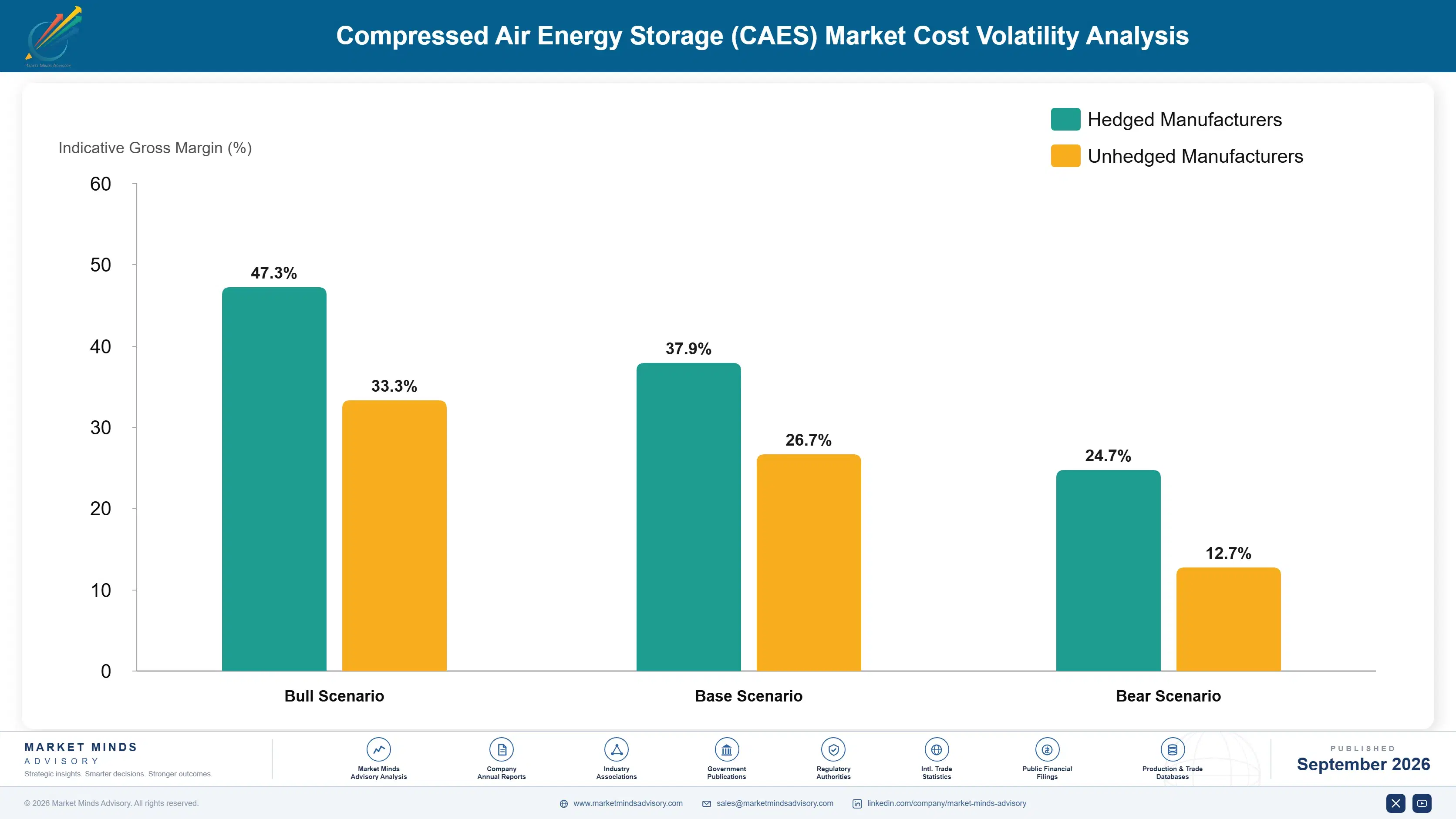
Cavern development including solution mining, brine disposal and wellhead completion accounts for roughly 34% of project capital, compressors and expansion turbomachinery around 29%, and the thermal store on adiabatic designs a further 14%. Grid connection, civil works and controls make up the remainder. The cavern figure varies enormously with geology and rises steeply where salt is thin, deep or absent altogether.
Steel and turbomachinery pricing moved through the European energy crisis in ways that reached this sector directly, as the International Energy Agency documented industrial energy cost movement across that period and compressor and turbine suppliers repriced accordingly. Projects holding fixed-price equipment contracts kept their budgets. Those pricing equipment at tender absorbed increases that pushed several developments past the point where a lender would proceed with them.

The disadvantage falls on geology rather than on procurement. A project on thick bedded salt at accessible depth develops a cavern at a cost that one on thin, faulted or absent salt simply cannot approach, on an otherwise identical plant above ground. No purchasing improvement addresses a difference created several hundred million years ago. That single variable explains more about which projects proceed than any equipment decision anybody makes.
compressed-air-energy-storage-caes-market-cost-volatility-analysis-1788410774320

Select sites on geology before anything else

Cavern development is 34% of capital and varies enormously with salt thickness, depth and quality, which makes geology the largest single determinant of whether a project is economic at all. Using existing gas storage characterisation data to screen sites costs analysis rather than drilling. Developers screening from market maps and testing geology afterwards abandon projects late and expensively.

Fix turbomachinery pricing before financial close

Compressors and expansion turbines are 29% of capital and both repriced sharply through the last industrial energy cycle, while project budgets are frequently set well before equipment is ordered. Fixed-price supply agreements cost a contingency premium and remove the line most likely to push a development past what a lender will accept. Several projects learned this expensively during that period.

Reference operating plants rather than models

Financing terms reflect first-of-a-kind risk in a technology with nine operating plants worldwide, and most of the recent ones run in China with performance data that exists and is obtainable. Technical partnership and licensing arrangements provide access to it at modest cost. Developers arguing from simulation while comparable plants operate elsewhere are accepting a risk premium they need not.

Portfolio Architecture for Margin Defence

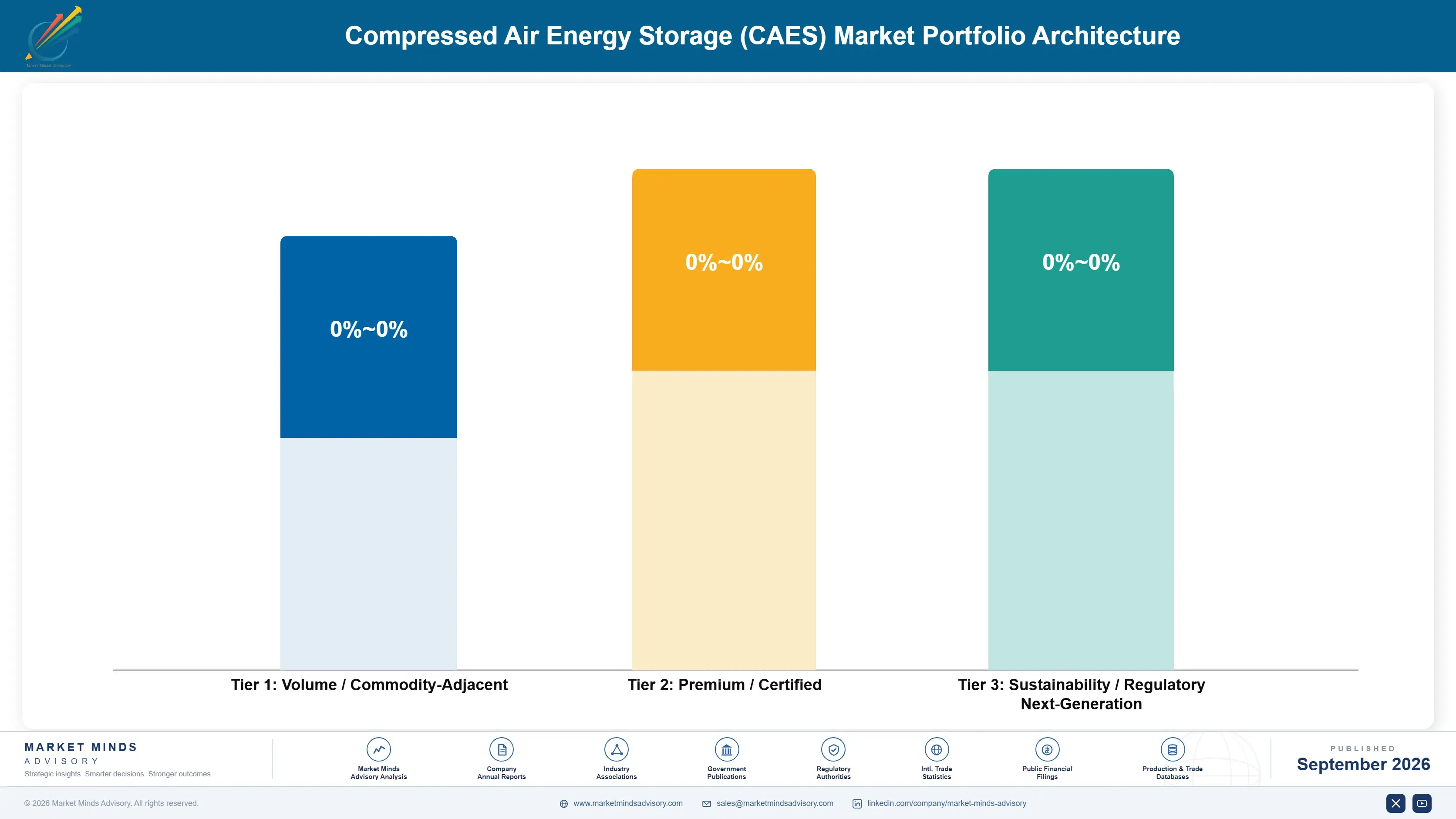
Margin here follows geology rather than technology, which no developer presentation is organised around. A plant on excellent salt at accessible depth returns well above cost of capital on the same equipment that returns nothing on marginal geology, because the cavern absorbs 34% of capital and its cost varies by a multiple. Participants selecting sites geologically rather than commercially run a completely different portfolio from the rest.
Volume and premium pull against each other through development capability rather than the plant. Cavern projects on good geology earn the returns and there are very few such sites, while liquid air and above-ground systems can be built almost anywhere at thinner margins. A developer holding only the exceptional sites has a pipeline of two or three projects, which does not sustain an engineering organisation between them.

High-value pools sit in adiabatic cavern systems on good geology, in liquid air where salt is absent and in operating data itself, which nobody treats as a product. The third is genuinely scarce: nine plants exist, Chinese units generate most of the recent performance record, and access to that evidence changes financing terms on every project that can cite it.

Volume / Commodity-Adjacent

Above-ground vessel systems and small-scale installations competing directly against batteries on cost per stored kilowatt hour. Economics are marginal because vessel cost replaces cheap cavern volume. The 9 point spread reflects whether vessels are standard industrial equipment or purpose-engineered.
Gross Margin: 8 to 17%

Premium / Certified

Cavern systems on characterised salt geology with grid connection and a long duration revenue mechanism already established. Geology rather than engineering supports the return. The 9 point spread reflects salt quality, depth and whether existing characterisation data was available.
Gross Margin: 24 to 33%

Sustainability / Regulatory / Next-Generation

Advanced adiabatic systems, liquid air developments in unserved geographies and technology licensing to regional partners. Margins are high because qualified alternatives barely exist anywhere. The 18 point spread separates project development returns from licensing and technical service income.
Gross Margin: 34 to 52%
compressed-air-energy-storage-caes-market-portfolio-architecture-1788410774815

High-value Sub-segments and Strategic Watch-out

Advanced Adiabatic Cavern Systems

High value and high growth at 21.0%. Storing compression heat removed the fuel requirement and reached 68% round trip, which changed what kind of budget can fund the technology. The 8 point spread reflects thermal store design and whether operating data supports the performance claimed.
Gross Margin: 36 to 44%

Liquid Air Energy Storage

High value with strong growth at 16.8%. Removing the cavern requirement makes the technology sitable anywhere, at an efficiency cost that the siting freedom frequently justifies. The 8 point spread reflects whether liquefaction equipment is purchased standard or engineered for the application. Siting freedom is the product.
Gross Margin: 28 to 36%

Diabatic Cavern Systems

The volume core of the operating fleet. It earns modestly and it carries the only multi-decade operating record this technology has anywhere in the world. The 8 point spread reflects fuel cost exposure, which now decides these economics more than anything about the plant. Fuel cost now decides.
Gross Margin: 14 to 22%

Depleted Field and Porous Media Systems

The strategic watch-out. Porous reservoirs leak, react with the air and behave unpredictably in ways solution-mined salt caverns simply do not at all. The 22 point spread separates well-characterised depleted fields from formations where the containment behaviour remains genuinely uncertain. Containment behaviour stays uncertain. Salt caverns simply do not.
Gross Margin: 6 to 28%

Six Years Then Forty

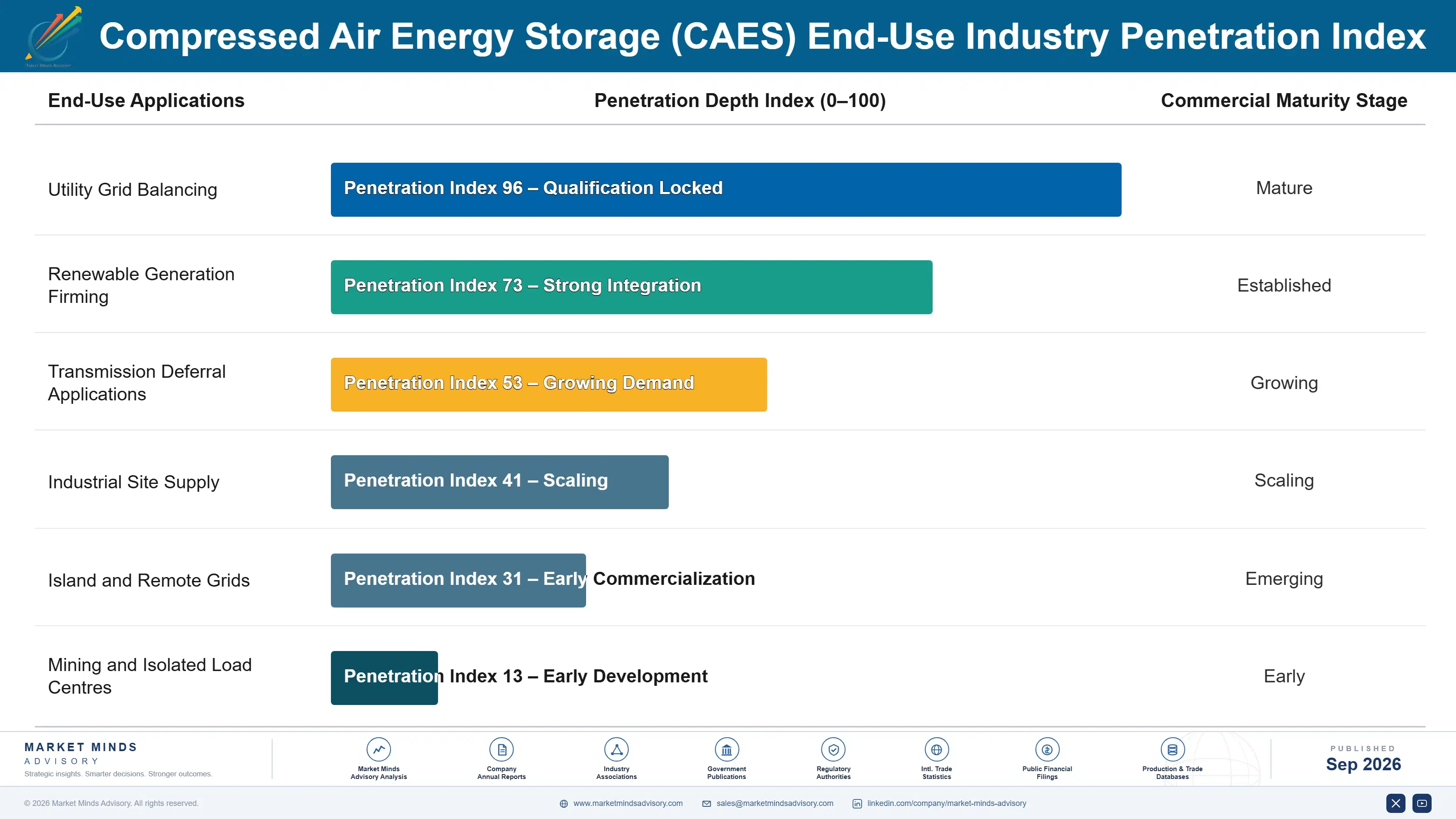
The annuity here is unusually long and unusually slow to start. A cavern takes six years to commission and then stores air for decades, since a maintained cavern outlasts the plant above it comfortably. The revenue that follows is a capacity payment or an arbitrage position running the asset's whole life, and none of it arrives until the six years have passed.
Stickiness varies enormously by whether the site is replicable. A developer holding rights over characterised salt with grid access controls something a competitor cannot obtain nearby, and that position lasts as long as the lease. A liquid air site can be replicated by anybody with land and a connection, which makes the competitive position rest on the technology and the operating record rather than on the location.

Buyer profiles have shifted from utility engineering toward system operators and increasingly toward project financiers, and presentations have not entirely followed. An engineer compared round trip efficiency and response time. A system operator asks what duration it holds, and a financier asks how many have been built and where the performance data comes from. The last question stops most conversations.
compressed-air-energy-storage-caes-market-end-use-penetration-index-1788410775305

What Decides A Project

These are among the four positions where our research anticipates prominent divergence between winners and laggards over the coming forecast period. Each is grounded in the demand model, the regulatory perimeter, and the announced capacity pipeline.
01 / GEOLOGY FIRST SCREENING

Look under the site before anything else

A solution-mined cavern absorbs 34% of project capital and takes 6 years from site selection to commissioning, and its cost varies by a large multiple with salt thickness, depth and quality across otherwise identical projects. The gas storage industry has already characterised much of the suitable formation across North America, Northern Europe and China for entirely unrelated purposes. Overlaying that existing data against grid capacity and long duration revenue mechanisms costs analysis rather than drilling, and most developers still screen sites from a market map instead.
02 / OPERATING EVIDENCE ACCESS

Cite a plant that exists somewhere

Only nine plants operate above utility scale anywhere in the world and Chinese adiabatic units account for most of the recent ones, which means the performance evidence that Western financiers need to underwrite technology risk already exists in somebody's control room. Licensing arrangements, technical partnerships and equipment supply relationships all provide routes to that data at modest cost. Developers arguing first-of-a-kind risk from simulation while comparable plants run elsewhere are accepting a financing premium they simply do not need to.
03 / DURATION BAND HONESTY

Say where you lose before somebody else does

Below around 8 hours of duration lithium batteries beat this technology on capital cost, efficiency, response time and siting flexibility all at once, and above roughly a hundred hours hydrogen and thermal storage take over the energy volumes involved. Developers presenting compressed air as a general storage solution invite exactly the comparison they lose, while those defining the duty band precisely compete on ground where they are genuinely best. Procurement bodies now specify duration explicitly, which makes that honesty commercially useful.
04 / CAVERN FREE EXPANSION

Take liquid air where the geology stops

Liquid air storage removes the cavern requirement completely by holding air in insulated tanks at atmospheric pressure, which makes the technology sitable anywhere with land and a grid connection at a genuine efficiency cost against cavern systems. That trade is worth making across India, Southeast Asia, Japan and much of Africa, where the storage requirement is real and suitable salt geology simply does not exist. The segment grows at 16.8% for exactly that reason and industrial gas equipment is mature enough to shorten development considerably.

Engagement Snapshot From the Field

A live engagement with an industry participant carrying material or product regulatory and market exposure ahead of a defining policy shift, showing how our research translates into a defensible multi-year portfolio strategy.
MARKET MINDS ADVISORY · CLIENT ENGAGEMENT SUMMARY
Compressed Air Energy Storage (CAES) Producer Strategic Portfolio Review and Transition Roadmap 2026·Investment Scenario on Compressed Air Energy Storage (CAES) Exposure Evaluation 2025-26
CLIENT PROFILE
A European long duration storage developer holding several compressed air projects in development across three countries, with no plant in construction and cumulative development spending in the tens of millions of euros across six years (client-reported, unverified by MMA). Every project was stalled at financing rather than at permitting. Nobody had ever questioned the pipeline itself.
STRATEGIC CHALLENGE
Lenders assessing the client's projects priced first-of-a-kind technology risk severely and no amount of engineering documentation had moved those terms, because the underlying objection was that almost nobody had built one. Management needed to know whether the pipeline was financeable at all or whether the business model itself was wrong.
MMA APPROACH
MMA assessed each project against geology, grid access and available revenue mechanism, then examined what specifically lenders required before funding. Forty-seven expert interviews with project financiers, system operators, equipment suppliers, geologists and operators of existing plants established what evidence would actually change financing terms and where it existed. The answer was consistent.
KEY FINDINGS
  1. Of 5 projects in development, 2 sat on salt geology that would have absorbed well above the typical 34% of capital, and both were unfinanceable regardless of anything else.
  2. Every lender interviewed named operating performance data as the decisive requirement, and every one accepted Chinese plant data as evidence if properly documented.
  3. The client had no relationship with any operator of an existing plant, and had never approached the Chinese developers holding the only recent operating record.
  4. Two projects sat in markets with no long duration revenue mechanism at all, and the client had assumed one would be introduced during development.
CLIENT PROFILE
A European long duration storage developer holding several compressed air projects in development across three countries, with no plant in construction and cumulative development spending in the tens of millions of euros across six years (client-reported, unverified by MMA). Every project was stalled at financing rather than at permitting. Nobody had ever questioned the pipeline itself.
STRATEGIC CHALLENGE
Lenders assessing the client's projects priced first-of-a-kind technology risk severely and no amount of engineering documentation had moved those terms, because the underlying objection was that almost nobody had built one. Management needed to know whether the pipeline was financeable at all or whether the business model itself was wrong.
MMA APPROACH
MMA assessed each project against geology, grid access and available revenue mechanism, then examined what specifically lenders required before funding. Forty-seven expert interviews with project financiers, system operators, equipment suppliers, geologists and operators of existing plants established what evidence would actually change financing terms and where it existed. The answer was consistent.
KEY FINDINGS
  1. Of 5 projects in development, 2 sat on salt geology that would have absorbed well above the typical 34% of capital, and both were unfinanceable regardless of anything else.
  2. Every lender interviewed named operating performance data as the decisive requirement, and every one accepted Chinese plant data as evidence if properly documented.
  3. The client had no relationship with any operator of an existing plant, and had never approached the Chinese developers holding the only recent operating record.
  4. Two projects sat in markets with no long duration revenue mechanism at all, and the client had assumed one would be introduced during development.
RECOMMENDED STRATEGY
Phase 1: Phase one: abandon the 2 projects on marginal geology immediately, since cavern cost alone makes them unfinanceable whatever else improves around them. Phase 2: Phase two: establish a technical relationship with an operator of an existing adiabatic plant, since lenders accept that data and the client holds none. Phase 3: Phase three: stop developing in markets without a long duration revenue mechanism rather than assuming one arrives during the development period.
OUTCOME
Within five quarters two projects had been abandoned, a technical partnership was signed with an existing plant operator, and financing discussions on the remaining projects reopened on materially better terms (client-reported, unverified by MMA). Nothing is yet in construction. Development spending fell substantially. Two projects remain in active financing discussion.

Frequently Asked Questions

Foundational context covering the market sizes, CAGR, scope, country, region and competition that inform every finding below. This section is provided to cover basics and most often pre-purchase conversations, answered from the MMA Primary Research Dataset.

What is the current size of the Compressed Air Energy Storage (CAES) Market?

The global compressed air energy storage market was valued at USD 0.7 billion in 2025, covering grid-connected systems storing energy by compressing air. The 2026 figure reaches USD 0.80 billion.

How large will the Compressed Air Energy Storage (CAES) Market be by 2036?

MMA forecasts USD 2.97 billion by 2036, an increase of USD 2.17 billion over the 2026 base. That represents an expansion multiple of 3.71 times across the forecast period.

What is the CAGR for the Compressed Air Energy Storage (CAES) Market 2026 to 2036?

The base case compound annual growth rate is 14.0%, with a bull case at 15.3% and a bear case at 12.7%. Historical growth between 2020 and 2025 ran at 12.4%.

Which segment is growing fastest?

Advanced adiabatic cavern systems grow at 21.0%, half again the market rate of 14.0%, because storing compression heat removes the fuel requirement. Liquid air follows at 16.8%.

Who are the major companies in the Compressed Air Energy Storage (CAES) Market?

China Energy Engineering Corporation, Highview Power, Hydrostor, Siemens Energy and Zhongchu Guoneng lead on contracted capacity, with combined CR5 of 59%. Concentration reflects a technology before deployment.

Which country is growing fastest?

India grows fastest at 16.2%, on long duration storage requirements arising as solar capacity outpaced balancing capability. South Asia and Pacific leads regionally at 16.2%.

Report Segmentation Architecture

The full report scope spans multiple orthogonal segmentation dimensions, with cross-tabulated demand data provided for each dimension pair. Coverage extends further to regional breakdowns, trend trajectories, and the competitive detail needed to support segment-level decision-making.

By System Architecture

  • Diabatic Cavern Systems
  • Advanced Adiabatic Cavern Systems
  • Liquid Air Energy Storage
  • Isothermal and Near-Isothermal Systems
  • Above-Ground Vessel Systems
  • Depleted Field and Porous Media Systems

By End-Use Industry

  • Utility Grid Balancing
  • Renewable Generation Firming
  • Transmission Deferral Applications
  • Industrial Site Supply
  • Island and Remote Grids
  • Mining and Isolated Load Centres

By Commercial Dimension

  • Utility Owned Assets
  • Independent Power Producer Ownership
  • Technology Licensing Agreements
  • Engineering and Construction Contracts
  • Capacity Market Participation
  • Storage as a Service Contracts

By Region

  • North America
  • Western Europe
  • East Asia
  • South Asia and Pacific
  • Latin America
  • Middle East and Africa
  • Eastern Europe

Scope, Methodology, and Coverage

Every figure in this report is reproducible from documented input assumptions. The scope below maps the historical period, the forecast horizon, the segmentation dimensions, and the countries covered, alongside the underlying primary and qualitative methodology.
Historical Period
2020 to 2025
Forecast Period
2026 to 2036
Base Year
2025 (USD billions; MMA Primary Research Dataset, September 2026)
Market Definition
The compressed air energy storage market covers grid-connected systems that store electrical energy by compressing air into a reservoir and recover it by expansion through a turbine, spanning diabatic cavern systems, advanced adiabatic cavern systems, liquid air energy storage, isothermal and near-isothermal systems, above-ground vessel systems, and depleted field and porous media systems. Scope is measured as contracted and operating storage capacity. Excluded are pumped hydro storage, all electrochemical battery systems, flywheel and gravity storage, industrial compressed air supply for process use, and hydrogen storage of any kind.
Quantitative Units
USD billion, 2025 base year, 2026 to 2036 forecast period
Segmentation Dimensions
System architecture, grid application, commercial model, region
Regions Covered
North America, Western Europe, East Asia, South Asia and Pacific, Latin America, Middle East and Africa, Eastern Europe
Countries Covered
United States, Canada, Germany, United Kingdom, Netherlands, Denmark, Poland, Romania, China, Japan, South Korea, India, Australia, Brazil, Chile, Saudi Arabia, United Arab Emirates, South Africa
Key Companies Profiled
20 companies across storage developers, equipment suppliers and engineering contractors
Quantitative Methodology
Primary survey, n=3,800 respondents, Q4 2025, six countries; demand-side model with trade association cross-validation
Qualitative Methodology
47 expert interviews, Q4 2025; applied to validate demand model assumptions, identify emerging dynamics, and assess competitive positioning
Report Format
PDF and XLSX data workbook (Word format preview document)
Publisher
Market Minds Advisory
Report Code
MMA-2026-ENE-461
Published
September 2026
Contact
sales@marketmindsadvisory.com | www.marketmindsadvisory.com

Purchase the full Compressed Air Energy Storage (CAES) Market Report (2026 to 2036).

The full MMA report on the compressed air energy storage market runs to detailed architecture and regional models across the 2026 to 2036 forecast period, with capital cost benchmarks separated by reservoir type and thermal store design. It profiles 20 companies on a consistent contracted capacity basis, covering storage developers, equipment suppliers and engineering contractors. Suitable salt geology is mapped against grid connection capacity and long duration revenue mechanisms by market. Regional chapters cover the seven MMA regions with country-level detail on the eighteen markets surveyed. Primary research draws on a quantitative survey of 3,800 respondents across six countries and 47 expert interviews conducted in Q4 2025.
Capital cost benchmarks by reservoir type and thermal store
Suitable salt geology mapped against grid connection and revenue
Operating plant performance data compiled across the global fleet
Twenty company profiles on consistent contracted capacity basis
Duration economics compared against battery and hydrogen alternatives
Seven regional chapters with eighteen country detail tables

Built For The People Who Decide

From boardroom strategy to bench-side execution, this report is read cover-to-cover by leaders shaping the next decade of their industry, turning demand scenarios, market dynamics and valuation benchmarks into decisions.
CXOs/ Presidents/ VPs/ Managers
M&A and Corporate Development
Strategy Teams and R&D Heads
Procurement and Product Directors
Regulatory and Compliance Leaders
Investor Relations and Equity Analysts