Market Minds Advisory
Compost Turning Machine Market

Compost Turning Machine Market: Diversion Mandates Set the Order Book

A commercial reading of compost turning machines, where organic waste diversion mandates pull municipal composting capacity forward, self-propelled turners displace tractor-pulled units, and tightening odor regulation reshapes equipment specification considerably.

Lead Analyst

David Horsley

Published

September 2026

Make Smarter Decisions with Customized Research Insights

Request a free sample report and evaluate market opportunities, growth trends, and competitive dynamics relevant to your business needs.

2025 MARKET VALUE$0.8BMarket Size 2025
2036 FORECAST VALUE$1.8BBase Case , 2026 to 2036
CAGR 2026 TO 20366.8 %Bull 7.9% / Bear 5.4%
INCREMENTAL OPPORTUNITY$0.8BNet 10- year value creation
EXPANSION MULTIPLE1.93x2036 value over 2026 base
Strategic Levers
M&A Pipeline
Regional Outlook
Country Rankings
Competitive Intelligence
Segmental Deep-dive
Call-Us : 91 93563 13602

Executive Snapshot and Market Trajectory

A municipality that bans organic waste from landfills does not simply create a policy line item, it creates immediate demand for the equipment that turns yard trimmings and food scraps into finished compost, and that regulatory trigger now drives more purchase orders than any trade show ever could today.
The market stands at USD 0.85 billion in 2025 and reaches USD 1.75 billion by 2036 at a 6.8% CAGR. Self-propelled windrow turners grow fastest at 9.2%, about 1.35 times the overall rate, pulled forward by growing commercial facility scale requiring higher-throughput equipment. North America holds 30% of value on established diversion mandates, while India posts the fastest growth at 8.8% on infrastructure investment.
Concentration sits at a moderate 42% among the top five, led by Komptech's windrow turner engineering breadth and Backhus' large-scale facility equipment depth built over decades of trusted municipal and commercial relationships. Two forces reshape the field now. Organic waste diversion mandates are expanding municipal composting capacity across more jurisdictions, and self-propelled turners are displacing tractor-pulled units at large facilities where throughput and labor efficiency increasingly matter more than upfront equipment cost.
Market Definition
The compost turning machine market covers mechanical equipment used to aerate and mix organic material windrows during the composting process, including self-propelled, tractor-pulled, elevating face, in-vessel, and compact turning systems sold to municipal, commercial, and agricultural composting operations. Standalone shredders, screening equipment, and manual turning tools are excluded.
Base Year Value
$0.8B in 2025 (MMA Primary Research Dataset, August 2026)
Forecast Period
2026 to 2036, eleven discrete annual values
CAGR
6.8% base case. Bull 7.9%. Bear 5.4%.
Fastest Growth Segment
Self-Propelled Windrow Turners: 9.2% CAGR
Fastest Growth Country
India: 8.8% CAGR
Fastest Growth Region
South Asia and Pacific: 8.3% CAGR
Largest Region
North America: 30% of 2025 global value
Market Leaders
Komptech, Backhus, Scarab International, Vermeer Corporation, Wildcat Manufacturing. Source: MMA Analysis based on company annual reports and industry association data.
Primary Survey
n=3,800 procurement and R&D decision-makers, Q4 2025, six countries
Methodology
Demand-side build-up, cross-validated against public data, 47 expert interviews

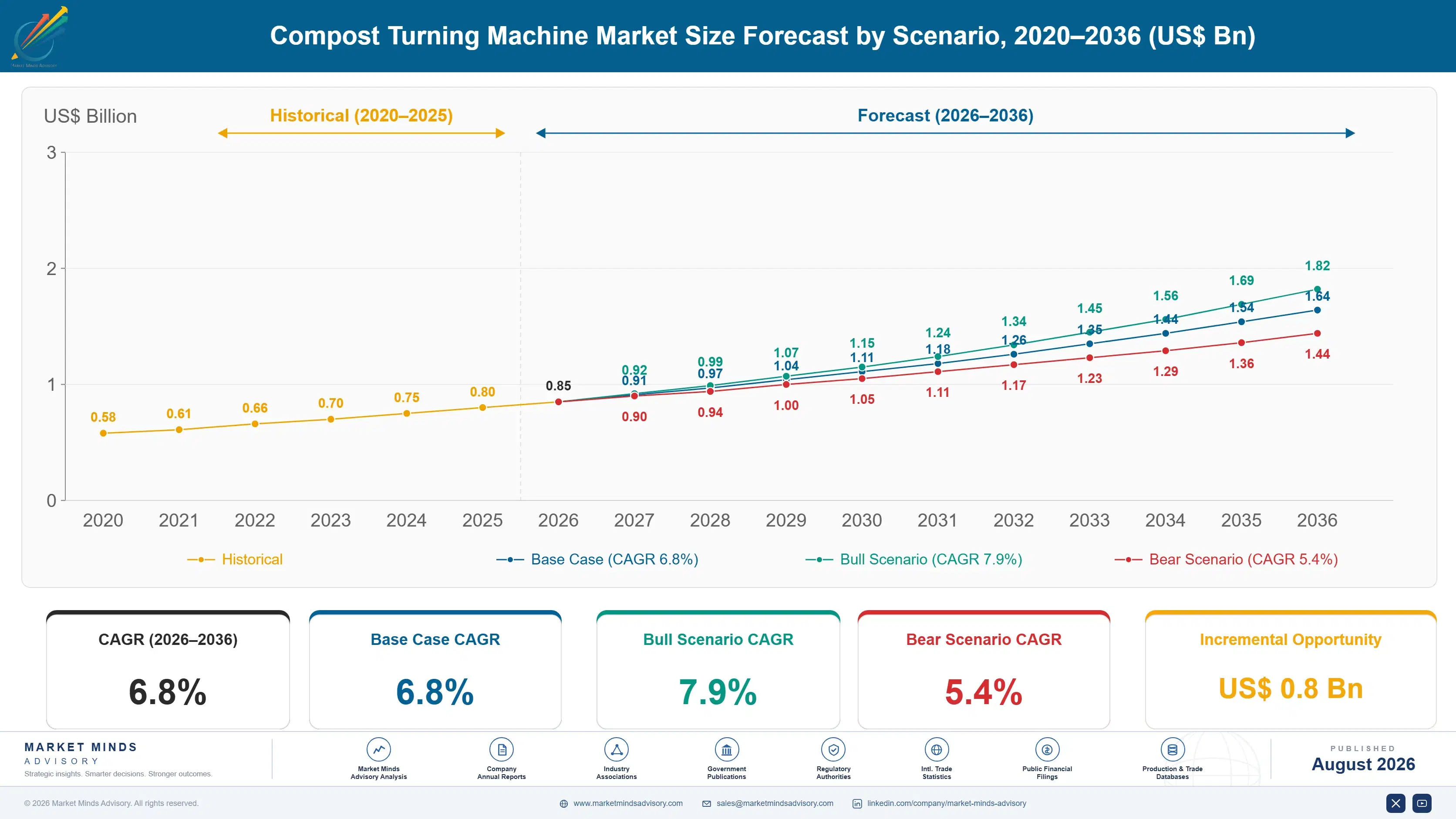
Compost Turning Machine Market Forecast Scenarios

compost-turning-machine-market-size-forecast-scenario-1787332339452
Growth from 2020 to 2025 compounded near 6.0%, supported by steady municipal and commercial composting facility expansion before accelerating from 2023 onward as organic waste diversion regulation expanded considerably and commercial facility scale grew faster than the broader waste management category overall across most major global markets tracked closely by analysts, operators, and regulators alike.
Three mechanisms carry the base case to 6.8%. First, rising landfill diversion regulation, which mandates organic waste separation and composting across an expanding number of jurisdictions and municipal waste systems tracked. Second, growing commercial composting facility scale, which drives self-propelled turner adoption as throughput requirements exceed tractor-pulled equipment capability. Third, odor and emissions regulation, which is pushing facilities toward more controlled turning technology across most major urban-adjacent operations tracked closely.
The bull case at 7.9% assumes organic waste diversion regulation expands faster than current municipal policy timelines suggest and commercial facility consolidation accelerates self-propelled equipment adoption more quickly across most jurisdictions. The bear case at 5.4% assumes high equipment cost continues limiting adoption among smaller-scale operations and odor and emissions regulations keep complicating windrow turning operations near urban areas globally.

Why Diversion Policy Now Sets the Equipment Cycle

Three forces set demand. Municipal composting facility investment provides the steadiest layer, since organic waste diversion mandates require dedicated processing infrastructure regardless of broader economic conditions. Commercial facility scale expansion adds a fast-growing second layer, as larger operations increasingly specify self-propelled turners over tractor-pulled equipment to meet rising throughput requirements. Odor and emissions regulation adds a third layer, pushing operations near
MARKET CONCENTRATIONCR5: 42%Moderately fragmented across specialized equipment manufacturers worldwide currently
AVERAGE SELLING PRICEUSD 45,000 to 850,000 per unitVaries considerably by turner technology and processing throughput capacity
TOP CONSUMING REGIONNorth America: 30% of global valueReflects established organic waste diversion mandates and facility infrastructure
SELF-PROPELLED ADOPTION RATERoughly 35% of new unitsRising steadily as commercial facility scale and throughput requirements grow
REPLACEMENT CYCLE LENGTH8 to 12 years typicalReflects durable equipment with periodic engine and component servicing
COGS FEEDSTOCK SHAREAbout 38 to 50%Reflects steel, engine, and hydraulic component input costs by specification
The commercial character rewards processing throughput and reliability over price competition alone at commercial scale. A facility operator choosing a turner increasingly weighs tons-per-hour processing capacity and uptime reliability as heavily as unit price, since equipment downtime during active composting cycles risks odor complaints and regulatory non-compliance that cost considerably more than any price difference between suppliers. Komptech's engineering breadth and Backhus' large-scale equipment depth give both a trust advantage newer entrants must earn.
The next decade turns on two things. Whether self-propelled turner adoption expands quickly enough across mid-sized facilities beyond the largest commercial operations where it currently concentrates. And whether in-vessel and enclosed turning technology can scale cost-effectively enough to serve urban-adjacent facilities facing tightening odor and emissions regulation without pricing out smaller municipal operators entirely.
"Nobody budgets for a compost turner until the state tells them landfilling food waste is illegal. Then it becomes the most urgent capital purchase on the facility manager's list."
Director, Organic Waste Processing Equipment Practice · MMA Agriculture / Organi

Market Trends

Diversion Mandates Expand Municipal Composting Capacity

Organic waste diversion mandates, which prohibit landfilling of food waste and yard trimmings, continue expanding across more state, provincial, and national jurisdictions, directly requiring municipalities to build or expand dedicated composting processing capacity. This matters commercially because each new jurisdiction adopting diversion regulation creates a defined procurement cycle for turning equipment sized to that municipality's projected organic waste volume. Vermeer Corporation and Scarab International have both expanded municipal-focused equipment lines considerably to capture this regulatory-driven demand specifically. The commercial consequence is that equipment manufacturers with established municipal relationships and regulatory compliance expertise increasingly win specification over generalist agricultural equipment suppliers.
Market Impact: Diversion mandates cover 35% of res
Self-Propelled Turners Displace Tractor-Pulled Units Broadly

Large-scale commercial composting facilities increasingly specify self-propelled windrow turners over tractor-pulled, power take-off driven equipment given considerably higher processing throughput and operator efficiency at facilities processing substantial daily material volumes. Self-propelled adoption has reached roughly 35 percent of new units, a share that has risen steadily as facility consolidation concentrates volume among larger operators seeking efficiency gains. Komptech and Backhus have both invested heavily in self-propelled product line expansion specifically to capture this shift toward larger, more efficient facility operations. The commercial consequence is that manufacturers without competitive self-propelled offerings increasingly lose specification at the largest, fastest-growing commercial facilities.
Market Impact: Facility throughput rose 25% since

Market Opportunities and Growth Drivers

Rising Diversion Regulation Drives Facility Investment

Landfill diversion regulation prohibiting organic waste disposal continues expanding across an increasing share of the population covered by such mandates, directly requiring new or expanded composting processing capacity in each newly regulated jurisdiction. Every jurisdiction adopting diversion regulation must build sufficient composting infrastructure to handle its diverted organic waste volume, creating a direct and predictable equipment procurement cycle tied to policy adoption timelines. California, several other American states, and multiple European Union member countries have all expanded diversion mandates considerably in recent years. This driver continues strengthening as more jurisdictions adopt comparable organic waste diversion policy globally.
Market Impact: Units cost USD 45,000 to 850,000

Growing Facility Scale Drives Self-Propelled Adoption

Commercial composting facility consolidation continues concentrating processing volume among larger operators capable of achieving economies of scale that smaller, fragmented facilities historically could not access reliably. These larger facilities increasingly specify self-propelled turning equipment capable of processing considerably more material per operating hour than tractor-pulled alternatives can reliably achieve at comparable cost. Facility operators report meaningfully higher throughput per labor hour after transitioning to self-propelled equipment across several documented case studies tracked closely. This driver continues strengthening as facility consolidation trends persist across most major composting markets currently tracked worldwide.
Market Impact: In-vessel systems cost 40% more

Market Restraints and Challenges

High Equipment Cost Limits Small-Scale Adoption

Compost turning machines cost USD 45,000 to 850,000 per unit depending on technology and throughput capacity, a capital outlay that remains genuinely difficult for smaller municipal and agricultural composting operations to justify against limited processing volume and constrained budgets. The root cause is the specialized hydraulic and mechanical engineering these machines require to reliably process abrasive, variable organic material over extended service lives. Commercially this concentrates adoption among larger municipal and commercial operators, leaving smaller facilities dependent on manual methods or shared arrangements. Manufacturers are responding with rental and leasing programmes that spread capital cost across a longer payment period.
Market Impact: Diversion mandates cover 35% of pop

Odor Regulations Complicate Windrow Turning Operations

Tightening odor and bioaerosol emissions regulation near urban-adjacent composting facilities genuinely complicates conventional open windrow turning operations, since the turning process itself releases odor compounds that regulators increasingly restrict near residential areas. The root cause is that active composting inherently generates volatile organic compounds and bioaerosols that open-air turning technology cannot fully contain during the mixing and aeration process. Commercially this pushes urban-adjacent facilities toward considerably more expensive in-vessel and enclosed turning technology or forces relocation to more remote sites entirely. Manufacturers are responding with enclosed and in-vessel turning system designs specifically engineered to contain odor and emissions during processing.
Market Impact: Self-propelled units reach 35% shar
3 additional market trends, 4 additional growth drivers, and 3 additional restraints and challenges are covered in the full report. Contact sales@marketmindsadvisory.com to access the complete intelligence.

Segment CAGR and Growth Architecture

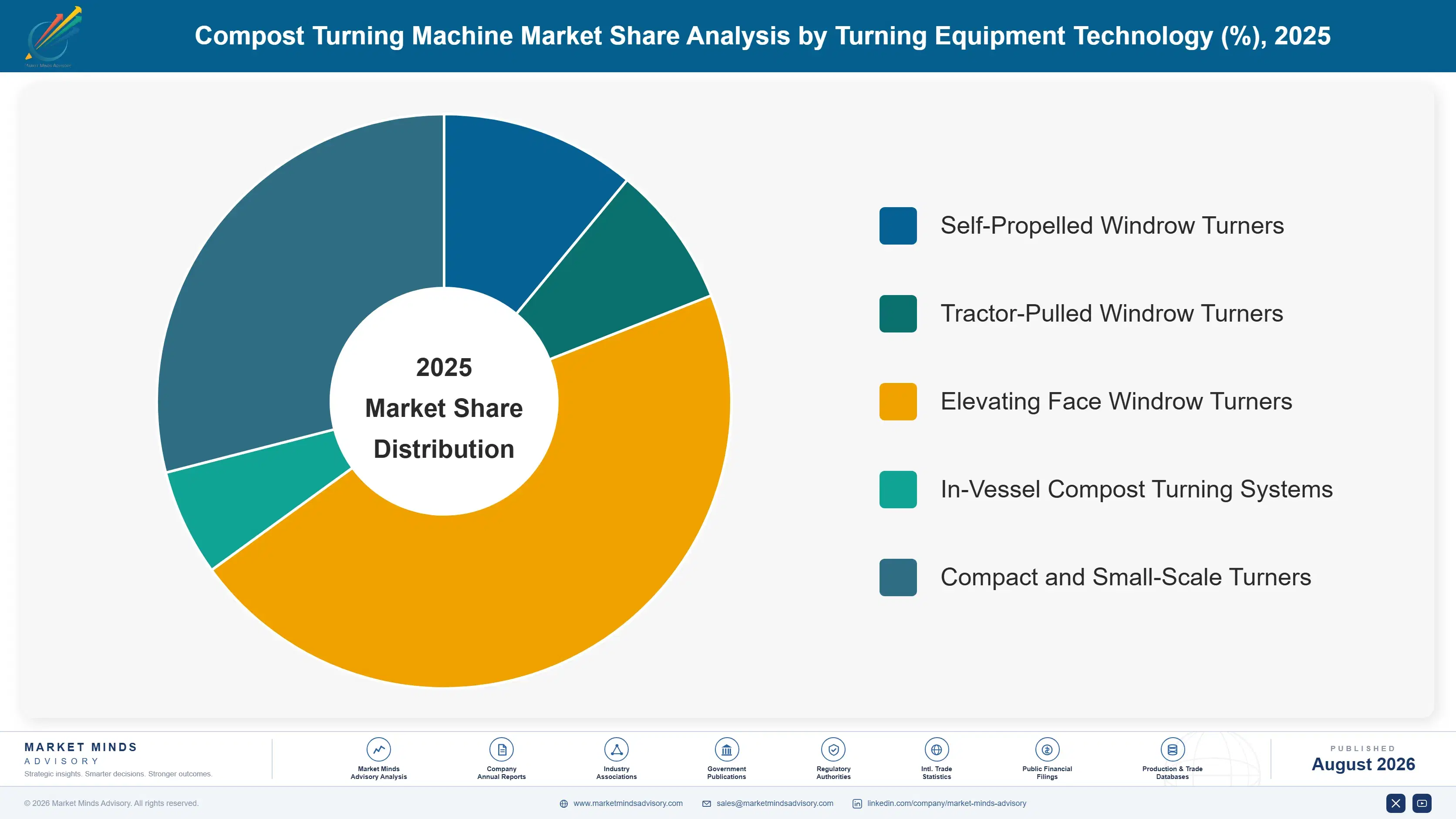
Segmentation follows turning equipment technology and configuration, a single product logic describing the specific mechanical approach each machine type uses to aerate compost material across most facility types. Each configuration carries distinct throughput capacity and facility suitability, so commercial position tracks technology rather than end-use facility type, which appears separately within the framework below.
compost-turning-machine-market-market-share-analysis-1787332339984

Self-Propelled Windrow Turners

Self-propelled windrow turners grow fastest at 9.2%, about 1.35 times the overall 6.8% rate, pulled forward by growing commercial composting facility scale requiring higher-throughput equipment than tractor-pulled alternatives can reliably deliver. This category requires integrated engine, hydraulic, and drivetrain engineering that tractor-pulled equipment manufacturers historically did not need to develop, a technical distinction that favours manufacturers with genuine self-propelled platform depth over generalist agricultural equipment producers. Komptech and Backhus have both invested heavily in self-propelled product line expansion specifically to capture this shift toward larger, more efficient facility operations. Large commercial and municipal facilities increasingly specify this category first when expanding processing capacity given its clear throughput advantage over conventional alternatives.
CAGR 9.2%

In-Vessel Compost Turning Systems

In-vessel compost turning systems grow at 8.3%, the second-fastest category, as tightening odor and bioaerosol emissions regulation near urban-adjacent facilities increasingly requires enclosed processing technology that conventional open windrow turning cannot provide reliably at comparable operating cost or scale. This category benefits from expanding urban-adjacent composting facility development, since in-vessel systems contain odor and emissions during the turning process considerably better than open-air alternatives can achieve at comparable throughput. Scarab International and Wildcat Manufacturing both maintain meaningful positions here given established relationships with municipal facilities operating under strict environmental permits and inspection regimes. Urban and suburban composting facility development increasingly requires this technology given proximity to residential areas and tightening local permitting standards.
CAGR 8.3%
Full segment breakdown across 5 segments available in the complete report.

Regional Architecture and Country Demand Map

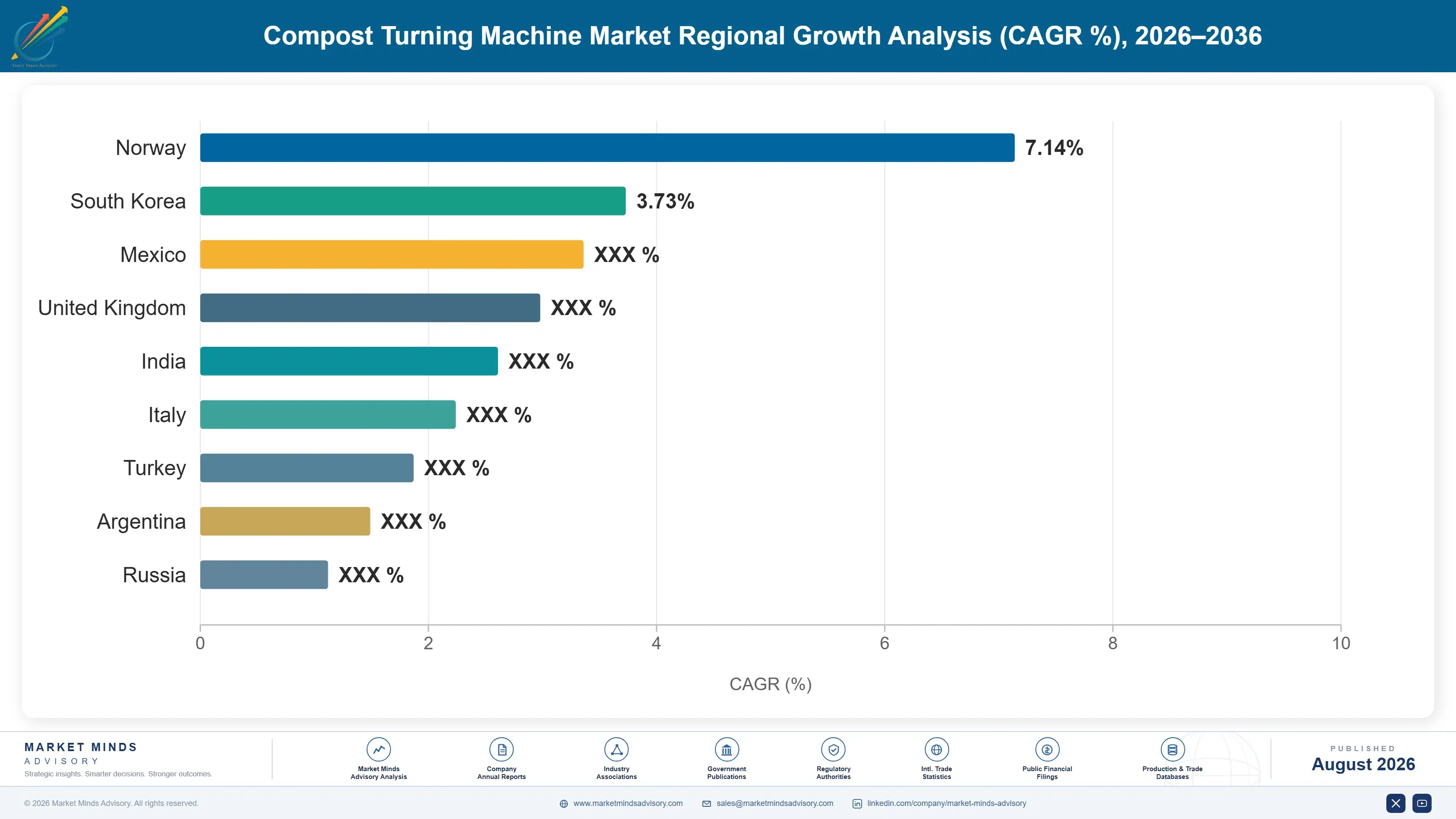
Organic waste diversion regulation and facility infrastructure investment together set this distribution, since equipment demand tracks closely where composting mandates and commercial facility scale concentrate most heavily today and steadily. North America leads on established mandates, while South Asia and Pacific posts the fastest regional growth.

North America

Established organic waste diversion mandates and municipal composting infrastructure anchor North American demand more than any other single factor. North America holds 30% of value, the largest single share, with California and several other American states enforcing landfill diversion regulation that directly drives municipal equipment procurement nationwide and steadily each year. Commercial composting facility consolidation has expanded self-propelled turner adoption considerably across the region's largest operators and networks. Canadian provincial diversion mandates follow similar policy patterns, though implementation timelines vary meaningfully by province. Growth of 6.2% reflects mature market dynamics tempered by continued diversion mandate expansion across more jurisdictions. Regional facility investment continues expanding to serve growing organic waste volumes nationally.
Share: 30% | CAGR: 6.2% (2026 to 2036)

Western Europe

European Union circular economy policy and established municipal waste infrastructure together define this market above any other single factor. Western Europe holds 24% of value, with German, British, and French national policies mandating organic waste separation and composting across most municipal waste systems specifically. Odor and emissions regulation runs considerably stricter here than in most other regions, pushing facilities toward in-vessel and enclosed turning technology earlier than elsewhere. Municipal procurement frameworks here tend toward slower but more comprehensive adoption decisions once new regulation takes effect. Growth of 5.5%, the slowest of the seven, reflects mature market penetration in the region's largest municipal waste systems specifically. Scandinavian countries lead in per-capita composting infrastructure investment given strong environmental policy commitments.
Share: 24% | CAGR: 5.5% (2026 to 2036)
Regional intelligence for 5 additional markets available in the complete report: East Asia, South Asia and Pacific, Latin America, Middle East and Africa, Eastern Europe. Contact sales@marketmindsadvisory.com.
compost-turning-machine-market-country-cagr-analysis-1787332340504

Where Compost Turner Manufacturer Margin Concentrates

Competing purely on unit price per machine concentrates margin in exactly the standard tractor-pulled segment where regional producers undercut established manufacturers easily and repeatedly. The four moves below shift value toward positions engineering depth and regulatory relationships genuinely protect: self-propelled platform engineering, in-vessel and odor control technology, municipal regulatory relationships, and aftermarket service programmes.

Build Self-Propelled Platform Engineering Depth Now

Self-propelled adoption has reached roughly 35 percent of new units, a share that has risen steadily as commercial facility consolidation concentrates volume among larger operators seeking throughput and efficiency gains over tractor-pulled alternatives available today across most major markets. Manufacturers with genuine self-propelled engineering capability capture specification that tractor-pulled equipment producers increasingly cannot match as facilities prioritize processing throughput per operating hour above all else. Building this capability requires sustained investment in integrated engine, hydraulic, and drivetrain engineering beyond conventional tractor-pulled equipment expertise entirely, a multi-year commitment most smaller competitors avoid.
Market Impact: Self-propelled units now reach roug

Develop In-Vessel and Odor Control Technology

Tightening odor and bioaerosol emissions regulation near urban-adjacent facilities increasingly requires in-vessel systems that cost roughly 40 percent more than open windrow equipment but deliver the emissions containment regulation increasingly demands from operators nationwide and internationally each year, quarter, and permitting cycle. Manufacturers with genuine in-vessel engineering capability capture specification on urban-adjacent facilities that conventional open windrow equipment producers increasingly cannot access as environmental permitting tightens further each year across most jurisdictions. This capability requires sustained investment in enclosed processing and emissions containment engineering beyond conventional open windrow turning expertise entirely.
Market Impact: In-vessel systems now command rough

Deepen Municipal Regulatory and Procurement Relationships

Municipal composting equipment procurement increasingly depends on demonstrated regulatory compliance expertise and established relationships with public works departments navigating diversion mandate implementation, since municipalities favour suppliers who understand their specific regulatory and permitting environment thoroughly and consistently. Manufacturers investing in dedicated municipal relationship and compliance support capture specification that generalist agricultural equipment sellers increasingly cannot match as diversion mandates now cover roughly 35 percent of the population across major markets tracked. This relationship depth compounds over years as municipalities default to trusted, regulation-literate suppliers across expansion projects and renewal cycles.
Market Impact: Diversion mandates now cover roughl

Build Aftermarket Service and Rental Programmes

High equipment cost genuinely limits adoption among smaller municipal and agricultural operations, and manufacturers offering rental and leasing programmes that spread capital cost across a longer payment period capture volume that outright purchase requirements increasingly exclude entirely, cutting effective entry cost by roughly 30 percent for smaller buyers. This aftermarket and service layer, once established, generates considerably higher margin than transactional equipment sales alone and deepens the operator relationship over the equipment's full service life spanning years. Manufacturers should treat rental and service programmes as genuine revenue streams worth building deliberately.
Market Impact: Rental programmes cut entry cost by

Who Controls the Margin Pool

Concentration sits at a moderate 42% among the top five, led by Komptech's windrow turner engineering breadth and Backhus' large-scale facility equipment depth built over decades of municipal and commercial relationships. The gap between leaders and challengers is throughput engineering and regulatory compliance expertise rather than raw price, which regional producers undercut easily. All participants are assessed on global equipment unit shipment volume as disclosed in company reports, held co
Competition runs along four lines. First, self-propelled platform engineering depth, increasingly the fastest-growing purchase consideration among large commercial facilities. Second, in-vessel and odor control technology that serves urban-adjacent facility requirements. Third, municipal regulatory relationships built across diversion mandate implementation cycles. Fourth, aftermarket service and rental programmes that expand access among smaller operators.

Pressure is building from two directions. Regional manufacturers in China and India have built meaningful manufacturing scale and are converting cost advantages into share gains in price-sensitive standard tractor-pulled segments domestically. Meanwhile established leaders continue defending position through sustained self-propelled and in-vessel technology investment that smaller competitors struggle to match. Rankings should favour manufacturers combining throughput engineering with genuine municipal regulatory expertise over those competing on standard equipment price alone.
compost-turning-machine-market-company-positioning-matrix-1787332341025

Competitive Moat and Risk Dimensions

KOMPTECH

Moat: Windrow turner engineering breadth

Komptech maintains one of the broadest windrow turner product portfolios in the category, spanning self-propelled, tractor-pulled, and specialized configurations serving diverse facility scales. Its established relationships with municipal and commercial composting operators across multiple regions provide considerable specification advantage. Strong engineering investment across product generations sustains its position at the higher-throughput end of the market specifically.
KOMPTECH

Risk: Regional manufacturers scaling quickly

Regional manufacturers in China and India increasingly offer comparable standard equipment specifications at meaningfully lower prices, eroding the premium Komptech has historically commanded in cost-sensitive emerging markets specifically. Its broad portfolio approach sometimes slows decision-making on niche technical requirements that focused competitors address more quickly. Newer entrants with in-vessel expertise are moving faster on next-generation odor control technology currently.
BACKHUS

Moat: Large-scale facility equipment depth

Backhus built its position around large-scale self-propelled equipment engineering specifically serving the highest-throughput commercial composting facilities globally. Its established relationships with major commercial composting operators provide considerable specification advantage at the largest facility scale where throughput matters most. Strong engineering reputation for reliability sustains premium pricing power among large commercial customers specifically.
BACKHUS

Risk: Narrower small-facility market presence

Backhus' concentration in large-scale equipment leaves it less positioned to capture smaller municipal and agricultural facility demand where tractor-pulled alternatives remain genuinely competitive on price. Capital constraints relative to larger diversified industrial equipment competitors limit its research and development pace somewhat. Regional manufacturers increasingly compete directly for mid-sized facility specification decisions specifically.

Players Tracked

Prominent Players

Komptech
Backhus
Scarab International
Vermeer Corporation
Wildcat Manufacturing

Other Key Players

Sittler Bros
Midwest Bio-Systems
Brown Bear Corporation
Frontier Industries
Doppstadt
Willibald GmbH
Menart
Compost Systems GmbH
SEKO Industries
McCloskey International
Farmax
Sandberg
Global Environmental Products
Green Mountain Technologies
Renn Mill Center

Recent Developments

MARCH 2025

Backhus expands self-propelled manufacturing capacity

Backhus expanded manufacturing capacity for its self-propelled windrow turner product line to meet rising demand from large commercial composting facilities across multiple regions and municipal contracts nationwide. This was an organic capacity expansion rather than any acquisition, reflecting confidence in sustained commercial facility demand growth.
Signal: Established large-scale equipment leaders
OCTOBER 2024

Scarab International signs municipal supply agreement

Scarab International signed a multi-year supply agreement with a major municipal waste management authority to provide in-vessel turning systems across an expanding organic waste diversion programme through the end of the decade. This was a supply agreement rather than a joint venture, securing volume without shared ownership.
Signal: Established suppliers are locking in munic
JANUARY 2025

Komptech acquires odor control technology firm

Komptech acquired a specialist odor control and emissions containment technology firm to strengthen its in-vessel and enclosed turning system capability across its existing product line and future roadmap. This was an acquisition rather than a joint venture, adding proprietary emissions control technology directly into its existing organization.
Signal: Established manufacturers are buying odor

Structural Steel and Hydraulic Components

Structural steel, hydraulic pumps and cylinders, and diesel engines together account for 38% to 50% of cost of goods sold, reflecting the heavy-duty mechanical engineering compost turners require for reliable operation processing abrasive organic material. These components are sourced predominantly from specialty steel and hydraulic equipment suppliers in North America, Europe, and East Asia directly.
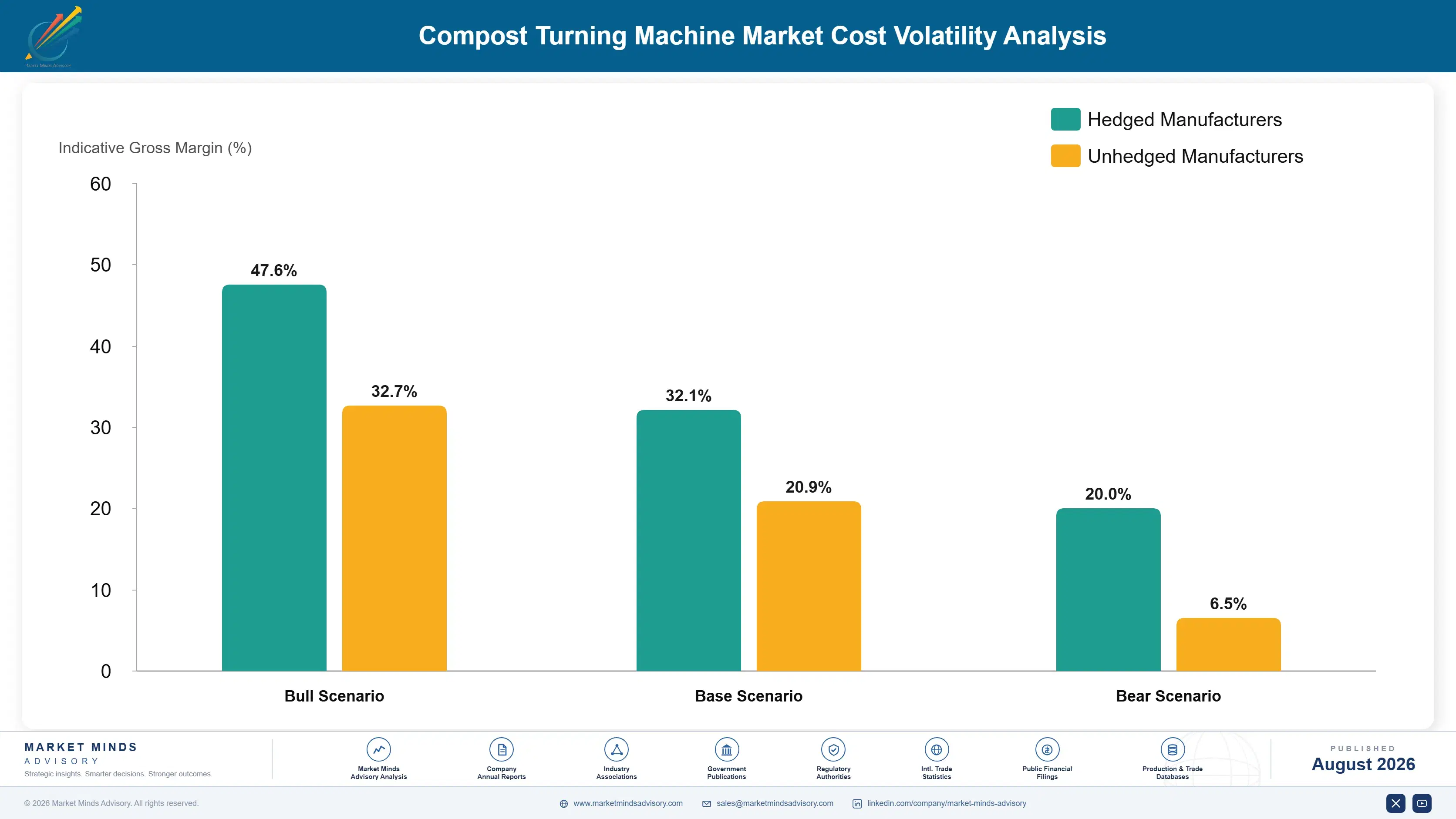
Steel and engine component prices rose considerably through 2021 and 2022 amid broader commodity and supply chain volatility, with several equipment manufacturers disclosing meaningfully higher input costs during that period, per company annual report commentary and industry association data covering that cycle. Several manufacturers passed through a portion of this cost increase to municipal and commercial customers with a lag of several months. Prices have since moderated somewhat, though hydraulic components remain elevated.

Exposure separates clearly by manufacturer scale and component sourcing strategy. Larger manufacturers with diversified steel and hydraulic component supplier relationships absorbed less disruption than smaller competitors dependent on single-source suppliers during the tightest volatility periods specifically. Manufacturers with in-house fabrication capability faced considerably less exposure to the external supply constraints that affected smaller assemblers more heavily during recent shortages.
compost-turning-machine-market-cost-volatility-analysis-1787332341221

Diversify steel and hydraulic component sourcing

Single-source component dependence exposed several manufacturers to meaningful cost spikes during the 2021 and 2022 volatility period specifically and repeatedly across the industry. Qualifying multiple steel and hydraulic suppliers reduces this concentration risk considerably across future disruption cycles ahead. The trade-off is additional qualification and testing cost that smaller manufacturers sometimes cannot justify economically at current volumes.

Pursue in-house fabrication capability

Larger manufacturers with in-house fabrication capability faced meaningfully less disruption than smaller competitors dependent on external suppliers during recent shortages and price spikes across the sector. Vertical integration reduces exposure to cross-border supply disruption considerably over time and across cycles. This requires manufacturing investment that only larger, well-capitalized manufacturers can typically justify given current production volumes.

Pass through costs via indexed municipal contracts

Multi-year municipal supply agreements increasingly include indexed pricing clauses tied to underlying steel and component costs, reducing the margin compression manufacturers previously absorbed during volatility periods entirely and predictably. This shifts commodity price risk more transparently onto the broader municipal procurement process rather than concentrating it entirely on equipment manufacturers alone or their smaller suppliers.

Portfolio Architecture for Margin Defence

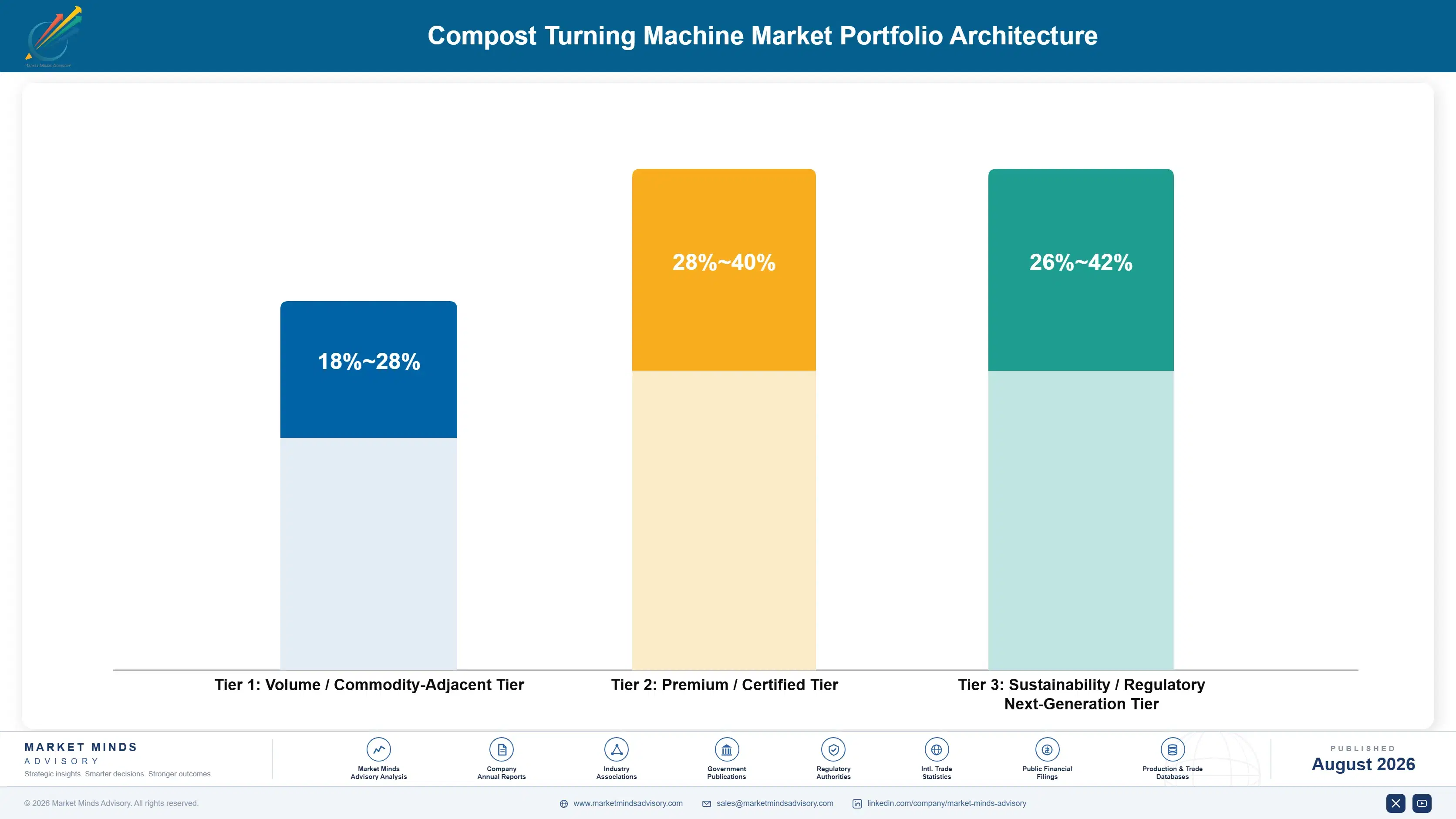
The portfolio splits into three tiers with distinct economics. Standard tractor-pulled turners form the volume tier, competing increasingly on price against regional producers with margin set by component cost and production efficiency. Self-propelled and in-vessel systems earn considerably more since throughput engineering depth and emissions control breadth deter competitors lacking comparable technical investment. Municipal service agreements and rental programmes are priced against lifecycle
The tension runs between standard tractor-pulled revenue that funds the business today and self-propelled and in-vessel investment that positions it for the next decade of regulation-driven demand. A manufacturer defending tractor-pulled volume too aggressively against regional competition cedes the highest-margin self-propelled and in-vessel segments to competitors investing there directly. Companies managing this well use tractor-pulled cash flow to fund engineering research rather than treating them as competing priorities.

High-value pools concentrate where throughput engineering depth, emissions control technology, or municipal relationships limit competition: self-propelled turners, in-vessel odor-controlled systems, and municipal service and rental programmes. Standard tractor-pulled turners sold without differentiated capability sit at the other end, competing almost entirely on price against every regional producer now serving cost-sensitive smaller operators.

Volume / Commodity-Adjacent Tier

Standard tractor-pulled turners competing increasingly on price against regional producers, with margin set overwhelmingly by component cost and production efficiency across most conventional categories tracked and monitored closely across the industry.
Gross Margin: 18-28%

Premium / Certified Tier

Self-propelled and elevating face turners supporting meaningfully stronger margin than standard tractor-pulled production, reflecting genuine throughput engineering differentiation earned over years of facility validation, testing, field trials, and repeated use.
Gross Margin: 28-40%

Sustainability / Regulatory / Next-Generation Tier

In-vessel odor-controlled systems, municipal service and rental programmes, and next-generation emissions containment designs developed ahead of tightening environmental regulation across multiple jurisdictions currently under active regulatory review and ongoing revision.
Gross Margin: 26-42%
compost-turning-machine-market-portfolio-architecture-1787332341733

High-value Sub-segments and Strategic Watch-out

Self-Propelled Windrow Turners

High value and high growth at 9.2%, the fastest category in the market, driven by growing commercial composting facility scale requiring higher-throughput equipment across most major municipal and commercial operations currently expanding worldwide and consistently each year across most regions, countries, facility networks, and operators.
Gross Margin: 28-40%

In-Vessel Compost Turning Systems

High value with strong growth at 8.3%, the second-fastest category, driven by tightening odor and bioaerosol emissions regulation near urban-adjacent facilities across most major municipal waste systems and environmental permitting frameworks worldwide today and increasingly across most regions, jurisdictions, permitting authorities, municipalities, and inspection bodies.
Gross Margin: 26-42%

Tractor-Pulled Windrow Turners

The volume core by revenue, growing near 5.0% as this remains a well-established category across nearly every small and mid-sized composting facility tracked currently worldwide, though growth has moderated meaningfully as self-propelled alternatives gain share steadily each year across most established markets and facility types.
Gross Margin: 18-28%

Compact and Small-Scale Turners

The strategic watch-out, growing near 5.5% and facing commoditization pressure from regional producers offering comparable specifications across most standard small-facility procurement categories currently under sustained budget pressure everywhere globally and regionally today across most channels, buying groups, distributors, regional agents, wholesalers, municipal cooperatives, and purchasing consortiums.
Gross Margin: 18-28%

How Regulatory Timing Locks In Procurement

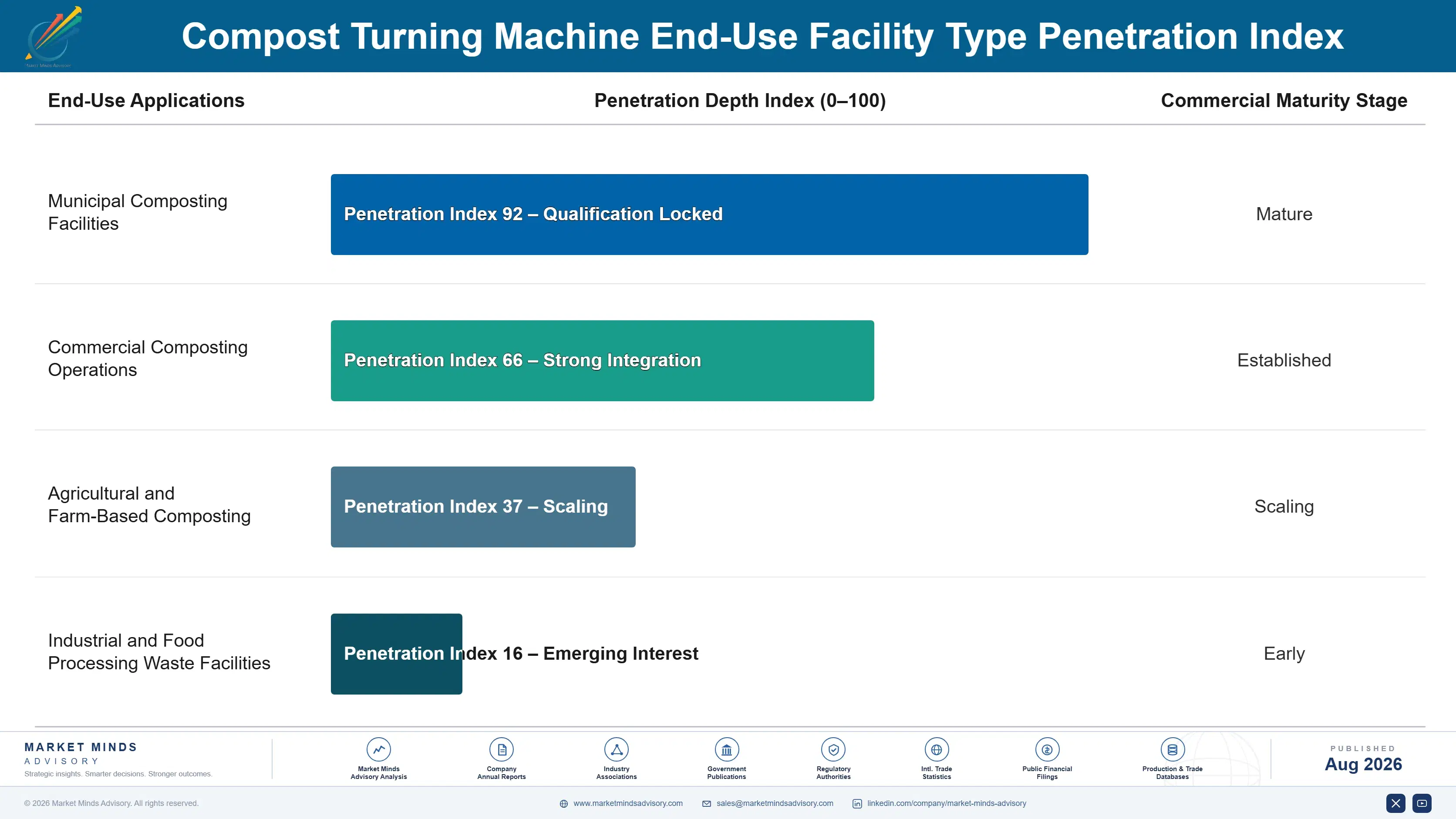
Revenue depends on municipal diversion mandate implementation timing and facility specification loyalty, and a manufacturer's default status with a municipal waste authority generates years of repeat procurement across every facility expansion that authority undertakes. Switching suppliers requires requalification against municipal procurement and environmental compliance standards, a cost and delay that deters displacement even when a competitor offers marginally better pricing upfront.
Adoption depth varies sharply by facility type. Self-propelled equipment buyers commit hardest, given the throughput integration complexity and facility workflow interdependence once specified and validated for production use. In-vessel system buyers sit in the middle, balancing established supplier relationships against periodic competitive retendering during permit renewal cycles. Standard tractor-pulled buyers switch most readily, since specification differentiation between qualified manufacturers remains genuinely minimal across comparable conventional products.

Buyer profiles have shifted from procurement officers evaluating unit price alone toward facility engineering teams weighing throughput capacity, emissions compliance, and multi-year reliability together. Odor and emissions regulation has introduced a new buyer consideration around environmental permitting risk that conventional throughput economics never required previously. Younger facility managers also weigh service and rental program flexibility more heavily than predecessors did.
compost-turning-machine-market-end-use-penetration-index-1787332342225

Our Call on Compost Turning Machines

These are among the four positions where our research anticipates prominent divergence between winners and laggards over the coming forecast period. Each is grounded in the demand model, the regulatory perimeter, and the announced capacity pipeline.
01 / SELF-PROPELLED PLATFORM ENGINEERING

Facility scale now dictates equipment choice

Self-propelled adoption has reached roughly 35 percent of new units, a share that has risen steadily as commercial facility consolidation concentrates volume among larger operators seeking throughput and efficiency gains over tractor-pulled alternatives available currently across most markets and facility categories tracked. Manufacturers with genuine self-propelled engineering capability capture specification that tractor-pulled equipment producers increasingly cannot match as facilities prioritize processing throughput over upfront cost. Companies should build this capability now, since it increasingly gates access to the fastest-growing facility category available today.
02 / IN-VESSEL ODOR CONTROL

Odor regulation rewards containment engineering

Tightening odor and bioaerosol emissions regulation near urban-adjacent facilities increasingly requires in-vessel systems that cost roughly 40 percent more than open windrow equipment but deliver the emissions containment regulation increasingly demands from operators across most jurisdictions tracked closely. Manufacturers with genuine in-vessel engineering capability capture specification on urban-adjacent facilities that conventional open windrow producers increasingly cannot access as environmental permitting tightens further each year. Companies should invest in this capability deliberately, since it increasingly determines specification near populated areas nationwide.
03 / MUNICIPAL REGULATORY DEPTH

Regulatory literacy decides diversion contracts

Municipal composting equipment procurement increasingly depends on demonstrated regulatory compliance expertise and established relationships with public works departments navigating diversion mandate implementation across jurisdictions covering roughly 35 percent of the population already regulated under such organic waste mandates and policies. Manufacturers investing in dedicated municipal relationship and compliance support capture specification that generalist agricultural equipment sellers increasingly cannot match as more jurisdictions adopt comparable rules over time. Companies should prioritise these relationships deliberately, since regulatory literacy increasingly determines contract award outcomes.
04 / AFTERMARKET SERVICE GROWTH

Rental programmes expand smaller-operator access

High equipment cost genuinely limits adoption among smaller municipal and agricultural operations, and manufacturers offering rental and leasing programmes that spread capital cost across a longer payment period capture volume that outright purchase requirements increasingly exclude entirely from the market and its smaller buyers. This aftermarket and service layer, once established, generates considerably higher margin than transactional equipment sales alone over the equipment's full service life spanning years and decades. Companies should treat rental programmes as a genuine revenue stream worth building deliberately and consistently.

Engagement Snapshot From the Field

A live engagement with an industry participant carrying material or product regulatory and market exposure ahead of a defining policy shift, showing how our research translates into a defensible multi-year portfolio strategy.
MARKET MINDS ADVISORY · CLIENT ENGAGEMENT SUMMARY
Compost Turning Machine Producer Strategic Portfolio Review and Transition Roadmap 2026·Investment Scenario on Compost Turning Machine Exposure Evaluation 2025-26
CLIENT PROFILE
A regional municipal waste authority serving twelve member municipalities engaged MMA ahead of a capital decision covering compost turner procurement to comply with newly enacted state organic waste diversion regulation across its full jurisdiction. The client reported needing to expand composting processing capacity considerably within an eighteen-month regulatory compliance deadline set by the state (client-reported, unverified by MMA).
STRATEGIC CHALLENGE
Leadership faced a choice between purchasing self-propelled equipment for a new centralized regional facility or distributing smaller tractor-pulled units across several existing municipal sites. The board worried that a centralized approach could create transportation logistics costs across the authority's service area, while a distributed approach risked insufficient throughput capacity at any single site to meet the regulatory compliance deadline within budget.
MMA APPROACH
MMA modelled processing throughput requirements and transportation logistics costs under both centralized and distributed equipment deployment scenarios across the authority's twelve-municipality service area. We benchmarked equipment lead times against the regulatory compliance deadline to assess deployment feasibility for each scenario considered. We then assessed financing structures that could accelerate deployment without straining the authority's broader capital budget significantly.
KEY FINDINGS
  1. A centralized facility with two self-propelled turners could meet the full service area's projected organic waste volume within the regulatory deadline set.
  2. Distributed deployment across four sites would have required smaller tractor-pulled equipment at each location, delaying full compliance by approximately six months overall.
  3. Equipment financing through a vendor leasing programme reduced upfront capital requirements by roughly 35 percent compared with outright purchase decisions made previously.
  4. Transportation logistics costs for the centralized approach were manageable given the service area's existing municipal waste collection routes already established and operating.
CLIENT PROFILE
A regional municipal waste authority serving twelve member municipalities engaged MMA ahead of a capital decision covering compost turner procurement to comply with newly enacted state organic waste diversion regulation across its full jurisdiction. The client reported needing to expand composting processing capacity considerably within an eighteen-month regulatory compliance deadline set by the state (client-reported, unverified by MMA).
STRATEGIC CHALLENGE
Leadership faced a choice between purchasing self-propelled equipment for a new centralized regional facility or distributing smaller tractor-pulled units across several existing municipal sites. The board worried that a centralized approach could create transportation logistics costs across the authority's service area, while a distributed approach risked insufficient throughput capacity at any single site to meet the regulatory compliance deadline within budget.
MMA APPROACH
MMA modelled processing throughput requirements and transportation logistics costs under both centralized and distributed equipment deployment scenarios across the authority's twelve-municipality service area. We benchmarked equipment lead times against the regulatory compliance deadline to assess deployment feasibility for each scenario considered. We then assessed financing structures that could accelerate deployment without straining the authority's broader capital budget significantly.
KEY FINDINGS
  1. A centralized facility with two self-propelled turners could meet the full service area's projected organic waste volume within the regulatory deadline set.
  2. Distributed deployment across four sites would have required smaller tractor-pulled equipment at each location, delaying full compliance by approximately six months overall.
  3. Equipment financing through a vendor leasing programme reduced upfront capital requirements by roughly 35 percent compared with outright purchase decisions made previously.
  4. Transportation logistics costs for the centralized approach were manageable given the service area's existing municipal waste collection routes already established and operating.
RECOMMENDED STRATEGY
Phase 1: Phase 1 (0 to 4 months): Finalize centralized facility site selection and equipment procurement through vendor leasing very quickly indeed. Phase 2: Phase 2 (4 to 12 months): Install and commission two self-propelled turners at the centralized facility location entirely and fully. Phase 3: Phase 3 (12 to 18 months): Achieve full regulatory compliance and evaluate expansion capacity for future volume growth needs identified.
OUTCOME
The client selected the centralized facility approach with vendor-leased self-propelled equipment, achieving regulatory compliance within the eighteen-month deadline across its full service area and jurisdiction exactly as planned and budgeted. Processing throughput and transportation logistics both performed within projected parameters following commissioning (client-reported, unverified by MMA).

Frequently Asked Questions

Foundational context covering the market sizes, CAGR, scope, country, region and competition that inform every finding below. This section is provided to cover basics and most often pre-purchase conversations, answered from the MMA Primary Research Dataset.

What is the current size of the Compost Turning Machine Market?

The global compost turning machine market is valued at USD 0.85 billion in 2025, covering self-propelled, tractor-pulled, elevating face, in-vessel, and compact turning systems. Standalone shredders and screening equipment are excluded.

How large will the Compost Turning Machine Market be by 2036?

The market is forecast to reach USD 1.75 billion by 2036 in the base case, about 1.93 times the 2026 level. That represents incremental value of roughly USD 0.84 billion across the decade.

What is the CAGR for the Compost Turning Machine Market 2026 to 2036?

The market grows at a 6.8% CAGR in the base case, with bull and bear scenarios at 7.9% and 5.4%. The spread turns mainly on diversion mandate expansion and equipment cost pressure.

Which segment is growing fastest?

Self-propelled windrow turners grow fastest at 9.2%, about 1.35 times the overall rate, pulled forward by growing commercial composting facility scale. In-vessel compost turning systems follow at 8.3%.

Who are the major companies in the Compost Turning Machine Market?

Leading companies include Komptech, Backhus, Scarab International, Vermeer Corporation, and Wildcat Manufacturing. Concentration sits at a moderate 42%, led by Komptech's engineering breadth and reach.

Which country is growing fastest?

India grows fastest at an 8.8% CAGR, driven by rapid municipal solid waste management modernization and rising diversion policy. China follows on national waste management modernization policy.

Report Segmentation Architecture

The full report scope spans multiple orthogonal segmentation dimensions, with cross-tabulated demand data provided for each dimension pair. Coverage extends further to regional breakdowns, trend trajectories, and the competitive detail needed to support segment-level decision-making.

By Turning Equipment Technology

  • Self-Propelled Windrow Turners
  • Tractor-Pulled Windrow Turners
  • Elevating Face Windrow Turners
  • In-Vessel Compost Turning Systems
  • Compact and Small-Scale Turners

By End-Use Facility Type

  • Municipal Composting Facilities
  • Commercial Composting Operations
  • Agricultural and Farm-Based Composting
  • Industrial and Food Processing Waste Facilities

By Commercial Dimension

  • Direct Equipment Purchase
  • Rental and Leasing Programmes
  • Municipal Tender and Contract Supply
  • Aftermarket Service and Parts Agreements

By Region

  • North America
  • Western Europe
  • East Asia
  • South Asia and Pacific
  • Latin America
  • Middle East and Africa
  • Eastern Europe

Scope, Methodology, and Coverage

Every figure in this report is reproducible from documented input assumptions. The scope below maps the historical period, the forecast horizon, the segmentation dimensions, and the countries covered, alongside the underlying primary and qualitative methodology.
Historical Period
2020 to 2025
Forecast Period
2026 to 2036
Base Year
2025 (USD billions; MMA Primary Research Dataset, August 2026)
Market Definition
The compost turning machine market comprises mechanical equipment used to aerate and mix organic material windrows during the composting process, valued at manufacturer revenue for self-propelled, tractor-pulled, elevating face, in-vessel, and compact turning systems sold to municipal, commercial, and agricultural composting operations. Standalone shredders, screening equipment, and manual turning tools are excluded from this scope.
Quantitative Units
USD billions (current prices); unit shipment volume by technology where applicable
Segmentation Dimensions
By Turning Equipment Technology; By End-Use Facility Type; By Commercial Dimension; By Region
Regions Covered
North America, Western Europe, East Asia, South Asia and Pacific, Latin America, Middle East and Africa, Eastern Europe
Countries Covered
USA, Canada, Germany, UK, France, Italy, Spain, China, Japan, South Korea, India, Australia, Vietnam, Indonesia, Brazil, Mexico, Argentina, Saudi Arabia, UAE, Turkey, South Africa, Nigeria, Poland, Romania, Czech Republic, Sweden, Netherlands, Switzerland, Singapore, Philippines, and additional markets relevant to this sector
Key Companies Profiled
Komptech, Backhus, Scarab International, Vermeer Corporation, Wildcat Manufacturing, Sittler Bros, Midwest Bio-Systems, Brown Bear Corporation, Frontier Industries, Doppstadt, Willibald GmbH, Menart, Compost Systems GmbH, SEKO Industries, McCloskey International, Farmax, Sandberg, Global Environmental Products, Green Mountain Technologies, Renn Mill Center
Quantitative Methodology
Primary survey, n=3,800 respondents, Q4 2025, six countries; demand-side model with trade association cross-validation
Qualitative Methodology
47 expert interviews, Q4 2025; applied to validate demand model assumptions, identify emerging dynamics, and assess competitive positioning
Report Format
PDF and XLSX data workbook (Word format preview document)
Publisher
Market Minds Advisory
Report Code
MMA-2026-AGR-306
Published
August 2026
Contact
sales@marketmindsadvisory.com | www.marketmindsadvisory.com

Purchase the full Compost Turning Machine Market Report (2026 to 2036).

The full MMA Compost Turning Machine report sizes the market across five turning equipment technologies, four end-use facility types, four commercial channels, and seven regions through 2036. It profiles 20 companies on a consistent unit shipment volume basis, scoring each on self-propelled platform engineering, in-vessel and odor control technology, municipal regulatory relationships, and aftermarket service programmes. Scenario models quantify how diversion regulation, facility consolidation, and odor control trends move both unit demand and achievable margin by technology. The report also includes diversion mandate mapping and municipal procurement benchmarking for manufacturer and investor strategy teams.
Five-technology and four-channel market sizing to 2036
Twenty-company benchmark on unit shipment volume basis
Self-propelled platform engineering competitive positioning analysis
In-vessel and odor control technology benchmarking review
Organic waste diversion mandate and regulation mapping
Municipal procurement and rental programme analysis

Built For The People Who Decide

From boardroom strategy to bench-side execution, this report is read cover-to-cover by leaders shaping the next decade of their industry, turning demand scenarios, market dynamics and valuation benchmarks into decisions.
CXOs/ Presidents/ VPs/ Managers
M&A and Corporate Development
Strategy Teams and R&D Heads
Procurement and Product Directors
Regulatory and Compliance Leaders
Investor Relations and Equity Analysts