Market Minds Advisory
Composite Door and Window Market

Composite Door and Window Market: Fiberglass, PVC, and Smart-Integrated System Demand Through 2036

A fiberglass entry door dents a homeowner's decision the moment it survives its first hailstorm without a scratch, and that durability story is what is pulling composite systems out of wood's shadow.

Lead Analyst

Bilal Shaikh

Published

September 2026

Make Smarter Decisions with Customized Research Insights

Request a free sample report and evaluate market opportunities, growth trends, and competitive dynamics relevant to your business needs.

2025 MARKET VALUE$24.8BMarket Size 2025
2036 FORECAST VALUE$51.1BBase Case , 2026 to 2036
CAGR 2026 TO 20366.8 %Bull 8.0% / Bear 5.6%
INCREMENTAL OPPORTUNITY$24.6BNet 10- year value creation
EXPANSION MULTIPLE1.93x2036 value over 2026 base
Strategic Levers
M&A Pipeline
Regional Outlook
Country Rankings
Competitive Intelligence
Segmental Deep-dive
Call-Us : 91 93563 13602

Executive Snapshot and Market Trajectory

Composite doors and windows have moved from a niche premium alternative into the default replacement choice across major renovation markets, as durability and energy efficiency claims increasingly outweigh wood's traditional aesthetic advantage, a shift accelerating as building codes tighten insulation and durability expectations nationwide.
Smart sensor-integrated composite door systems are now the fastest-growing segment, expanding near 11.5% annually as homeowners specify connected locking and monitoring hardware directly into new fiberglass and composite entry systems, well over 65% faster than the wider market's pace. North America anchors close to three tenths of global value through its large residential renovation and new construction base, while India's expanding residential construction activity and rising renovation spending pull South Asian demand higher each year.
Competitive intensity concentrates around five established door and window majors that hold decades of composite fabrication expertise and dealer distribution relationships, even as regional manufacturers compete aggressively on cost for standard PVC window formats. Energy efficiency certification and smart hardware integration increasingly determine which manufacturers capture premium renovation contracts beyond commodity replacement volume, particularly as hardware becomes a genuine differentiator reshaping dealer rankings within a few short years.
Market Definition
The composite door and window market covers commercial production and sale of fiberglass composite entry doors, PVC and vinyl composite windows, wood-polymer composite profiles, aluminum-composite hybrid systems, composite garage and patio doors, and smart sensor-integrated composite door systems for residential and light commercial construction. It excludes solid wood, pure aluminum, and pure steel door and window products carrying no composite material content, which the industry classifies as separate product categories.
Base Year Value
$24.8B in 2025 (MMA Primary Research Dataset, August 2026)
Forecast Period
2026 to 2036, eleven discrete annual values
CAGR
6.8% base case. Bull 8.0%. Bear 5.6%.
Fastest Growth Segment
Smart Sensor-Integrated Composite Door Systems: 11.5% CAGR
Fastest Growth Country
India: 10.8% CAGR
Fastest Growth Region
South Asia and Pacific: 8.9% CAGR
Largest Region
North America: 28% of 2025 global value
Market Leaders
Therma-Tru Corp, Andersen Corporation, Pella Corporation, VEKA AG, Deceuninck NV. Source: MMA Analysis based on company annual reports.
Primary Survey
n=3,800 procurement and R&D decision-makers, Q4 2025, six countries
Methodology
Demand-side build-up, cross-validated against public data, 47 expert interviews

Composite Door and Window Market Forecast Scenarios

composite-door-and-window-market-trends-size-forecast-scenario-1787465683938
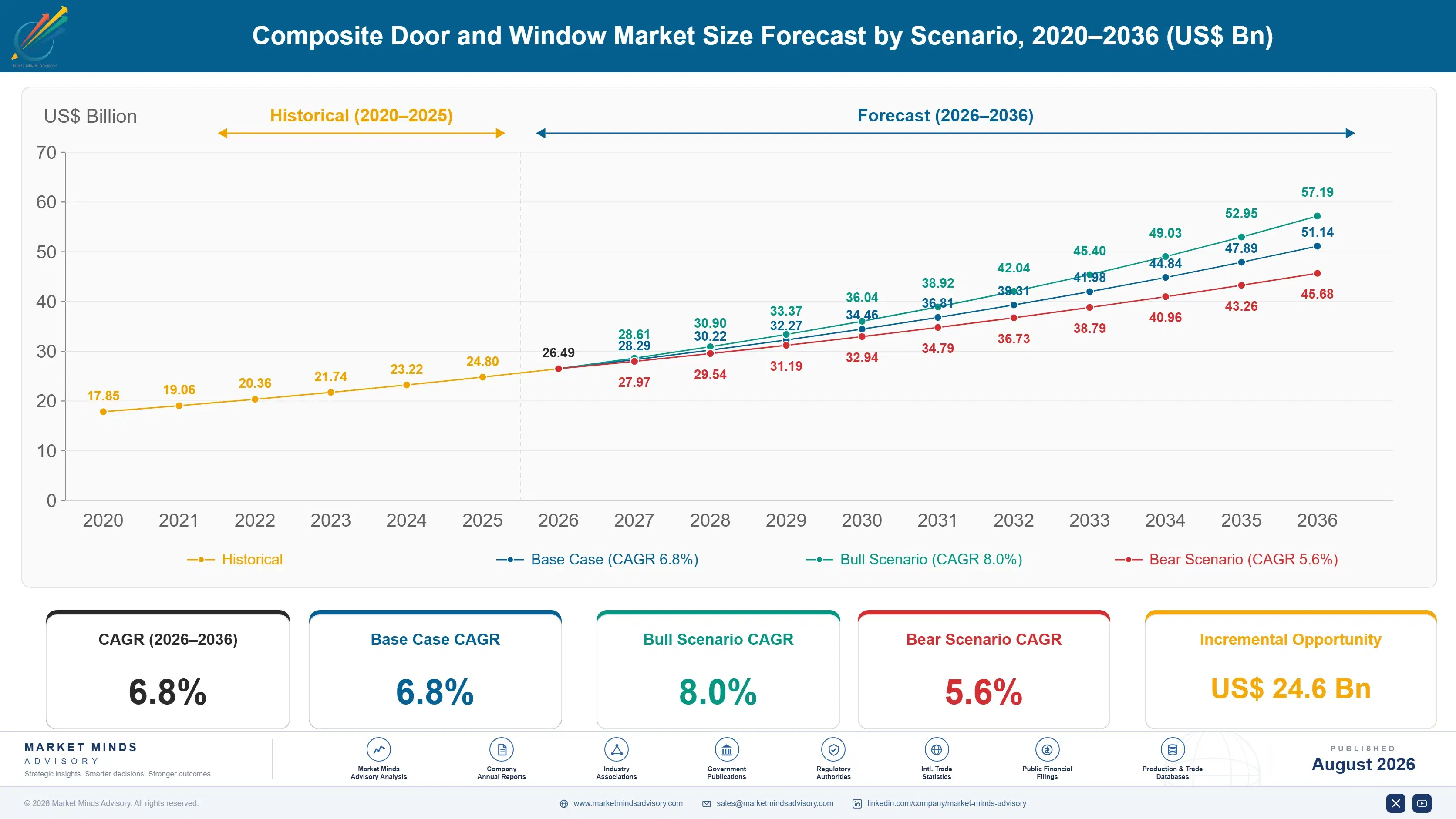
Composite door and window demand grew unevenly from 2020 to 2025, as a pandemic-era home renovation boom lifted volume before smart hardware integration accelerated growth further from 2023 onward. Chinese and North American manufacturing capacity expanded steadily across the period. The market grew at a 5.9% historical CAGR, slower than the forecast pace as smart-integrated demand only scaled meaningfully in the final two years.
The base case carries composite doors and windows to a 6.8% CAGR through 2036 on three mechanisms. First, homeowners keep replacing wood and standard aluminum systems with fiberglass and PVC composites for documented durability and energy efficiency gains. Second, building energy codes keep tightening insulation requirements across major renovation and construction markets. Third, smart sensor integration keeps adding incremental value through connected locking and monitoring hardware that traditional systems never offered.
The bull case, 8.0%, assumes smart-integrated and premium composite adoption accelerates faster than currently projected as more mainstream renovation segments specify the technology across a wider range of renovation project sizes than currently addressed. The bear case, 5.6%, assumes raw material cost inflation and homeowner budget constraints cap premium system specification, keeping growth concentrated in standard replacement formats tied to baseline renovation cycle volume alone.

Composites Displace Wood as the Default Replacement Choice

Composite doors and windows now split along a durability and integration line rather than a purely commodity one. Standard PVC windows and fiberglass doors, the volume backbone of the category, deliver reliable performance at pricing closer to conventional building materials. Smart-integrated and premium composite systems instead serve as a differentiated renovation upgrade, commanding meaningfully higher pricing for documented energy efficiency and connected hardware engineering across the full renovation lifecycle.
MARKET CONCENTRATIONCR5: 38%Top five manufacturers hold well under half of global sales
AVERAGE SELLING PRICEUSD 1,450 per composite entry doorPricing varies sharply between standard and smart-integrated formats
TOP PRODUCING COUNTRYChina: 24% of global production volumeDominant PVC extrusion and window manufacturing base anchors output
EXPORT TRADE INTENSITY34% of output crosses a borderCross border trade links manufacturing hubs to global renovation markets
RAW MATERIAL COST SHARE44% to 56% of COGSResin and fiberglass pricing drives significant cost volatility
REPLACEMENT CYCLE LENGTH18 to 25 years per installationCycle length shapes recurring renovation demand timing directly
Buyers split sharply by construction segment and sourcing sophistication. Homeowners renovating premium properties specify smart-integrated composite doors as a differentiated upgrade to capture measurable security and energy efficiency gains, requiring hardware integration and certification expertise that standard door makers struggle to match consistently. Production builders instead specify standard composite windows, competing largely on cost per unit rather than deep technology integration across their broader renovation programs.
Over the next decade, smart-integrated and premium composite systems should keep pulling value toward higher-margin renovation tiers, while Chinese and North American manufacturing keeps driving the largest underlying volume base for standard replacement formats. Building energy code tightening, not renovation activity alone, increasingly looks like the most durable driver of category-wide composite upgrades across construction segments and international geographic markets worldwide.
"A composite door used to sell on the promise that it wouldn't rot. Now it is selling on the promise that it will text you when someone tries the handle."
Director, Building Products and Construction Materials Practice · MMA Construction Materials and Building Products Practice · August 2026

Market Trends

Smart Hardware Becomes Standard on Premium Entry Systems

Composite entry door manufacturers have increasingly specified smart locking, monitoring, and access hardware as standard original equipment on premium product lines, treating connected security as a defining renovation differentiator rather than a separate aftermarket accessory purchase handled by homeowners independently. Several premium manufacturers now require factory-integrated smart hardware rather than accepting generic bolt-on retrofit fitment common across earlier composite door generations. Suppliers including Therma-Tru and Andersen have invested in dedicated smart hardware development partnerships, recognizing that dealer contracts increasingly hinge on demonstrated connected feature integration rather than traditional durability metrics alone.
Market Impact: Code tightening adds 9.2 million units
Wood-Polymer Composite Profiles Expand Beyond Decking

Wood-polymer composite technology, historically concentrated almost entirely in decking applications, has expanded meaningfully into door and window profile manufacturing, since improved formulation durability and falling production costs have made the material commercially viable across a considerably broader range of construction applications than earlier generations supported. Several manufacturers have already launched wood-polymer composite window profile lines priced within reach of mainstream renovation buyers, reflecting genuine material diffusion rather than incremental feature addition. Suppliers with established formulation expertise are capturing these contracts well ahead of competitors still building comparable material engineering capability.
Market Impact: Security-conscious demand grows 10.4% annually

Market Opportunities and Growth Drivers

Building Energy Codes Keep Tightening Insulation Standards

Building code authorities across major markets continue tightening minimum insulation and air infiltration standards required for door and window installations, forcing manufacturers to specify high-performance composite formulations across their full regional product range rather than offering energy-efficient systems as a premium option. Several major jurisdictions have signaled further code tightening through the current forecast period specifically, giving manufacturers a durable, quantified compliance timeline that shapes multi-year production capacity investment rather than one-off regulatory response. That regulatory durability distinguishes composite demand from more discretionary premium renovation purchasing elsewhere in the building products category.
Market Impact: Resin volatility compresses margins 13%

Home Security Concern Lifts Smart-Integrated Demand

Persistent homeowner concern over residential security continues lifting demand for premium composite entry systems marketed explicitly on connected monitoring and access control, a purchase driver largely absent from traditional door buying decisions historically. Manufacturers have responded by publishing security feature data directly in retail marketing materials, a practice that barely existed before 2022 and now shapes renovation purchasing decisions among premium homeowners specifically. Several manufacturers have expanded smart-integrated production capacity to meet this security-conscious demand segment, particularly across suburban markets where property crime concern has risen measurably in recent years, prompting broader adoption of connected entry systems among mainstream homeowners.
Market Impact: Price sensitivity caps uptake at 36%

Market Restraints and Challenges

Raw Material Cost Volatility Compresses Margins

Resin and fiberglass together account for over half of production cost for composite doors and windows, and both inputs face significant price volatility tied to petrochemical and glass fiber manufacturing markets that composite makers cannot easily hedge through long-term contracts alone. The underlying cause is that composite resin production competes directly against broader plastics and construction material demand for the same limited petrochemical feedstock capacity, giving makers limited alternative sourcing options during supply shortfalls. That volatility compresses margins hardest for makers without vertically integrated resin production. Several manufacturers are responding by expanding recycled and bio-based material substitution research.
Market Impact: Smart hardware demand grows 11.5% annually

Premium Pricing Limits Production Builder Adoption

Composite systems carry meaningful pricing premiums over standard vinyl and aluminum alternatives, and many production builders, in price-sensitive new construction segments, continue choosing conventional materials despite documented durability and efficiency savings that composite systems offer over the building's service life. The underlying cause is that production builders typically weigh upfront construction cost more heavily than lifecycle homeowner savings, especially where competitive bidding on new development pricing takes priority over material performance. That price sensitivity limits how quickly composite penetration can grow in cost-conscious new construction markets. Manufacturers are responding by developing tiered composite options priced closer to standard materials.
Market Impact: Wood-polymer profile demand grows 9.8% yearly
3 additional market trends, 4 additional growth drivers, and 3 additional restraints and challenges are covered in the full report. Contact sales@marketmindsadvisory.com to access the complete intelligence.

Segment CAGR and Growth Architecture

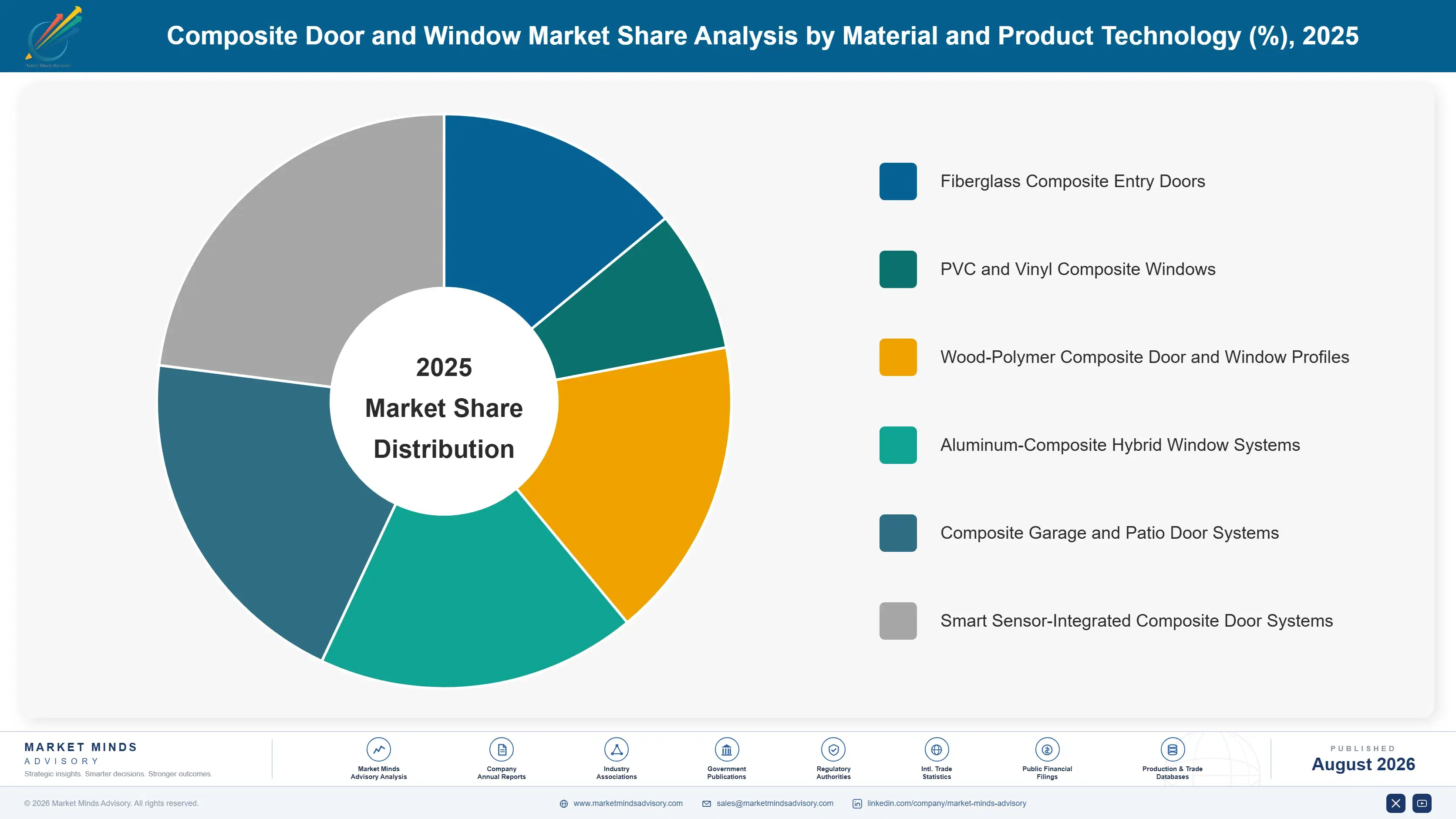
Segmentation follows material and product technology, a single classification logic separating composite systems by fabrication approach rather than by sales channel or customer type. Fiberglass, PVC, wood-polymer, aluminum-hybrid, garage and patio, and smart-integrated formats each carry distinct manufacturing requirements and buyer occasions, keeping upstream material chemistry and downstream installation channels from blurring together across renovation tiers.
composite-door-and-window-market-trends-market-share-analysis-1787465684481

Smart Sensor-Integrated Composite Door Systems

Smart sensor-integrated composite door systems are growing at 11.5% annually, well over 65% faster than the wider market's 6.8% pace, as homeowners specify connected locking and monitoring hardware directly into new fiberglass and composite entry systems rather than retrofitting standalone smart locks after installation. This format requires hardware integration and firmware engineering expertise distinct from conventional composite fabrication, since connected door systems must coordinate mechanical locking mechanisms with wireless communication protocols. Retail and builder pricing for smart-integrated doors runs well above standard composite formats, reflecting both hardware investment and homeowner willingness to pay for documented connected security value. Therma-Tru and Andersen have both prioritized capital investment in dedicated smart hardware production, positioning the segment to capture continuing premium renovation growth.
CAGR 11.5%

Wood-Polymer Composite (WPC) Door and Window Profiles

Wood-polymer composite door and window profiles grow at 9.8% annually, driven by manufacturers substituting recycled wood fiber and polymer blends for virgin PVC and fiberglass to meet sustainability commitments and increasingly documented builder sourcing requirements. This segment commands meaningful premium pricing over conventional composites, reflecting both material cost and the genuine formulation complexity involved in matching wood-polymer compound performance to established fiberglass and PVC benchmarks across durability and weathering testing. Several major builders have expanded wood-polymer sourcing requirements across their supplier qualification criteria specifically, extending a niche sustainability pilot into mainstream renovation specification. Capacity expansion has proceeded steadily among established wood-polymer suppliers, though feedstock scaling constraints limit how quickly production can expand to meet accelerating demand.
CAGR 9.8%
Full segment breakdown across 6 segments available in the complete report.

Regional Architecture and Country Demand Map

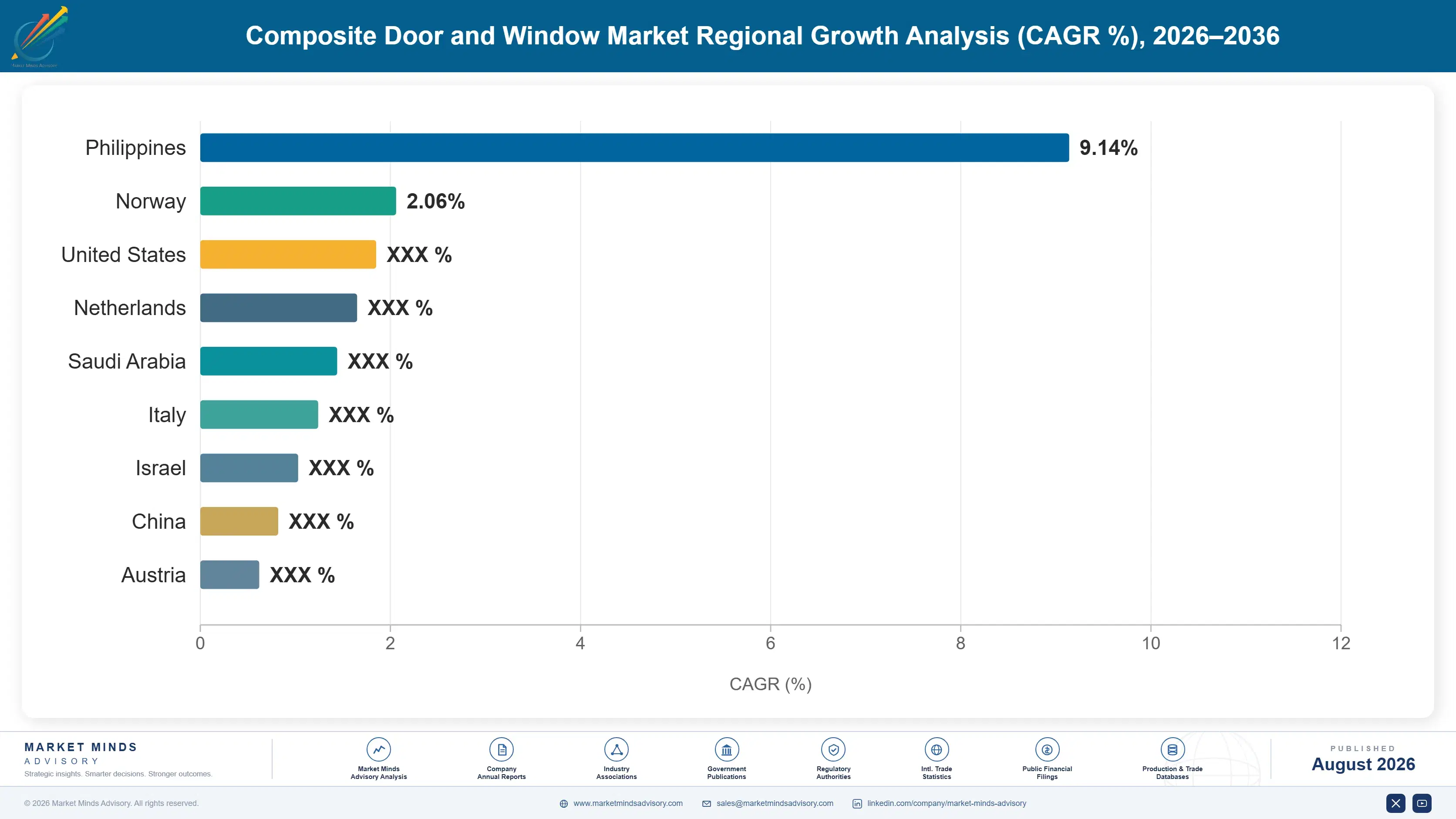
Composite door and window production and consumption concentrate in North America, anchored by the region's large residential renovation and new construction base. India carries the fastest country-level growth, as its expanding residential construction activity pulls South Asian demand higher. Established renovation demand continues reinforcing this pattern.

North America

United States demand anchors North American composite door and window consumption, split between a large residential renovation channel and steady new construction fitment across suburban and exurban housing markets nationwide. Therma-Tru and Andersen maintain substantial domestic manufacturing capacity serving both channels simultaneously across entry-level and premium product tiers. Canada follows a similar consumption pattern at smaller scale, with comparable renovation and new construction trends. Mexico's growing cross-border component manufacturing role adds further regional production capacity supporting both domestic and export fitment demand. Growth here tracks close to the global average, reflecting a mature, diversified buyer base spanning both premium smart-integrated fitment and steady standard replacement demand. Growing smart-home retrofit demand among suburban homeowners adds further incremental volume.
Share: 28% | CAGR: 7.2% (2026 to 2036)

Western Europe

Western Europe's composite demand centers on Germany, the United Kingdom, and France, where VEKA and Deceuninck maintain deep regional PVC extrusion and manufacturing presence built around decades of European window replacement market leadership. The European Union's tightening building energy efficiency regulation forces manufacturers to maintain comprehensive high-performance product coverage rather than offering premium insulation as a niche option. Italy and Spain contribute additional demand tied to expanding residential renovation activity across southern European markets specifically. Growth trails East Asia and South Asia and Pacific as the region's building stock renovation cycle is already mature, with incremental efficiency tightening representing gradual product upgrades rather than underlying market expansion. Poland's growing manufacturing role adds modest additional supporting demand.
Share: 23% | CAGR: 5.5% (2026 to 2036)
Regional intelligence for 5 additional markets available in the complete report: East Asia, South Asia and Pacific, Latin America, Middle East and Africa, Eastern Europe. Contact sales@marketmindsadvisory.com.
composite-door-and-window-market-trends-country-cagr-analysis-1787465685009

Where Manufacturers Can Capture Margin

Margin defense in composite doors and windows increasingly depends on moving beyond commodity replacement pricing toward positioning that lets a manufacturer charge for documented smart hardware integration, wood-polymer sourcing, or energy efficiency certification. The four moves below target the fastest-growing buyer segments most willing to pay well above standard pricing for genuine differentiation across renovation and new construction channels.

Build Smart Hardware Integration Capability Now

Smart-integrated composite doors command retail and builder pricing running well above standard composite formats, and demand from premium renovation buyers has grown faster than the industry's dedicated hardware integration capability currently available across major composite manufacturers. Manufacturers that invest in firmware and wireless engineering now capture premium dealer contracts before competitors establish comparable technical capability, since homeowners increasingly specify connected security as a baseline renovation requirement. The engineering investment requires meaningful capital capacity, but the roughly 27% margin uplift over standard formats justifies the cost for most established manufacturers, across multiple premium dealer segments simultaneously.
Market Impact: Hardware integration typically commands roughly a 27% premium

Expand Wood-Polymer Sourcing Partnerships Broadly Now

Wood-polymer composite systems command meaningful premium pricing over conventional formats, and demand from sustainability-focused builders and renovation buyers has grown faster than the industry's dedicated wood-polymer feedstock supply currently available across established manufacturers. Manufacturers that secure recycled fiber sourcing partnerships now capture premium contracts before competitors establish comparable feedstock access, since builders increasingly favor documented sustainable sourcing in supplier qualification criteria. The sourcing investment requires meaningful supply partnership development, but the roughly 21% pricing premium and reduced virgin material exposure it provides justifies the cost for makers pursuing sustainability-linked growth.
Market Impact: Wood-polymer sourcing typically commands roughly a 21% premium

Develop Energy Efficiency Certification Capability Now

Manufacturers with established energy efficiency certification capability command substantial premium pricing over competitors lacking documented compliance infrastructure, and demand from builders navigating tightening building energy codes has grown faster than the industry's dedicated certification capacity currently available across established makers. Manufacturers that invest in certification testing infrastructure now capture contracts from builders specifying code-compliant systems as standard equipment across expanding renovation and new construction programs. The certification investment requires meaningful capital and specialized testing infrastructure, but the roughly 24% margin premium this segment commands justifies the cost for makers serving code-sensitive markets well ahead of broader category adoption.
Market Impact: Certification capability typically adds roughly a 24% premium

Secure Long-Term Dealer Distribution Contracts Now

Building products dealers increasingly prefer multi-year composite supply commitments over spot purchasing across new construction and renovation programs, since supply disruption during peak renovation season carries business continuity risk that dealers cannot easily absorb given coordinated installation scheduling. Manufacturers that secure these contracts now lock in demand and pricing before competitors capture dealer networks, since dealers rarely switch composite suppliers once a product line has been validated for a market segment. The contracting investment requires meaningful engineering capacity, but the multi-year revenue visibility, typically locking in roughly 19% more contracted volume than spot sourcing, justifies the cost for established manufacturers.
Market Impact: Long-term contracts typically lock in 19% more volume

Who Controls the Margin Pool

Competitive concentration sits at a moderate CR5 of 38%, reflecting a market split between large global door and window majors competing on smart hardware integration and dealer distribution relationships, and regional Chinese and Eastern European manufacturers competing on cost for standard PVC formats. The gap between category leaders and mid-tier challengers remains meaningful, built on decades of dealer relationships and fabrication engineering expertise.
Competitive activity currently runs along three lines. Global door and window majors compete on smart hardware integration depth and dealer program breadth, applying engineering expertise smaller competitors cannot easily replicate. Regional Chinese and Eastern European manufacturers compete on cost and proximity to expanding domestic construction activity. Wood-polymer material specialists compete on sourcing partnerships and sustainability documentation, since access to verified feedstock relationships increasingly determines who wins premium builder contracts.

Pressure is building from two directions. Chinese domestic manufacturers are moving upmarket into premium smart-integrated systems, challenging established global majors on territory defensible through decades of hardware investment. Wood-polymer sourcing is becoming a differentiator, rewarding manufacturers willing to fund material partnerships over those competing on generic composite pricing. Rankings over the next five years will favor whoever combines smart hardware depth with credible sustainable sourcing presence.
composite-door-and-window-market-trends-company-positioning-matrix-1787465685538

Competitive Moat and Risk Dimensions

THERMA-TRU CORP

Moat: Established fiberglass fabrication scale

Therma-Tru holds decades of fiberglass composite fabrication research and dealer distribution relationships across major North American builders and renovation retailers that newer entrants, domestic or international, cannot replicate on any reasonable timeline, giving it program access and fabrication credibility that smaller specialized competitors genuinely struggle to match across entry-level and premium segments alike.
THERMA-TRU CORP

Risk: Exposed to standard margin pressure

Therma-Tru's substantial standard composite door revenue base remains exposed to continuing pricing pressure from Chinese and regional manufacturers, and the company must increasingly rely on smart-integrated segment growth to offset that persistent margin headwind facing its largest historical revenue category over the next several years.
VEKA AG

Moat: Deep European PVC extrusion scale

VEKA maintains substantial PVC extrusion manufacturing capacity and vertically integrated resin sourcing built through decades of European window replacement market presence, giving it cost credibility and program access that competitors lacking comparable manufacturing footprint cannot easily replicate across similarly demanding fitment programs spanning multiple European markets and building types.
VEKA AG

Risk: Slower smart hardware transition pace

VEKA's more conservative smart hardware transition relative to smaller specialized competitors limits how quickly it can capture premium connected-system contracts, potentially constraining its ability to capture the full smart-integrated growth surge without additional hardware investment or a strategic partner across multiple European markets and product categories simultaneously.

Players Tracked

Prominent Players

Therma-Tru Corp
Andersen Corporation
Pella Corporation
VEKA AG
Deceuninck NV

Other Key Players

Masonite International Corporation
JELD-WEN Holding Inc
ProVia LLC
Simonton Windows & Doors
Cornerstone Building Brands Inc
Marvin Windows and Doors
Reynaers Aluminium NV
Rehau Group
Profine Group
Internorm International GmbH
Weru GmbH
Salamander Industrie-Produkte GmbH
LIXIL Corporation
Fenesta Building Systems
Wanhua Chemical Group Co Ltd

Recent Developments

APRIL 2024

Therma-Tru launches factory-integrated smart lock platform

Therma-Tru launched a new composite entry door platform featuring factory-integrated smart locking and monitoring hardware, responding to sustained premium homeowner demand for connected security features across North America. The launch was an organic product introduction, not a joint venture or acquisition of any competing manufacturer.
Signal: Signals established door majors investing directly in smart hardware integration ahead of confirmed builder specification requirements.
SEPTEMBER 2024

Wanhua Chemical expands composite resin production capacity in China

Wanhua Chemical announced expanded composite resin production capacity at its Chinese facilities, responding directly to growing manufacturer demand for domestic feedstock supply ahead of continued PVC window production growth. The expansion was an organic capacity investment, not a joint venture or acquisition of any regional manufacturer.
Signal: Signals Chinese domestic producers scaling upstream feedstock capability well ahead of continued domestic manufacturing growth trajectory.
JANUARY 2025

Andersen acquires minority stake in wood-polymer material venture

Andersen acquired a minority equity stake in a recycled wood-polymer composite material venture to strengthen its direct sustainable feedstock sourcing presence across North America ahead of anticipated sustainability-driven demand growth. The transaction was a minority equity investment, not a full acquisition, merger, or joint venture arrangement.
Signal: Signals established composite majors building agricultural and recycled feedstock presence rather than relying entirely on virgin material suppliers alone.

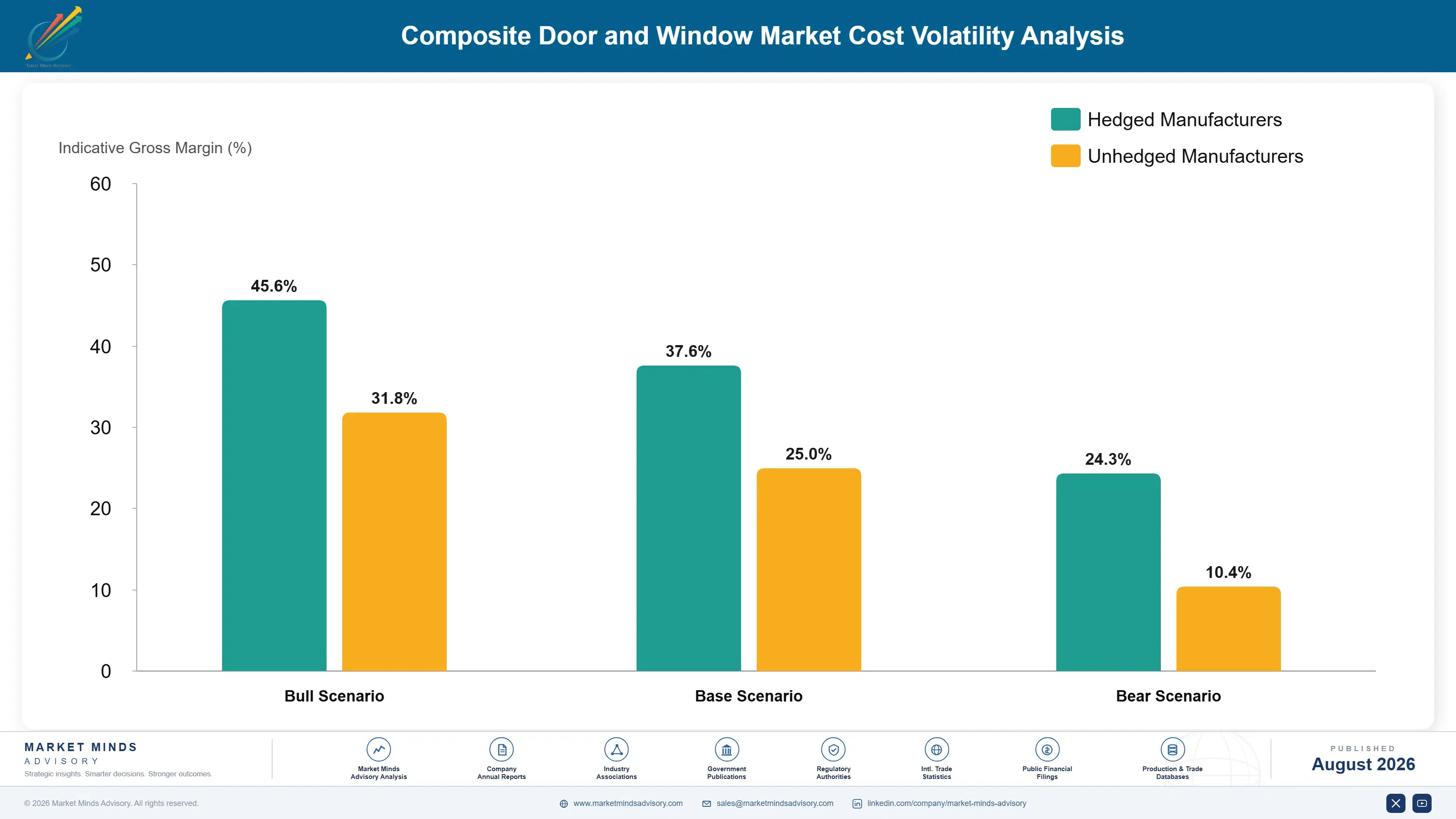
Resin and Fiberglass Costs Set The Floor

Resin and fiberglass account for 44% to 56% of production cost for composite doors and windows, sourced from traded petrochemical and glass fiber supply chains whose pricing tracks plastics and construction material markets rather than any composite-specific supply and demand pattern. Smart-integrated production carries a higher material cost share than standard formats, reflecting the hardware and firmware components needed for connected functionality.
The 2022 resin price spike illustrated input cost exposure directly. EIA and commodity market data recorded polyvinyl chloride and glass fiber prices reaching multi-year highs through 2022 as petrochemical supply chains tightened following pandemic-era disruption and geopolitical supply constraints. Manufacturers without hedged contracts or diversified sourcing absorbed cost increases, passing some of that cost through to dealer and builder customers who had few alternative sourcing options at the time.

Exposure falls hardest on smaller regional manufacturers without long-term resin contracts or diversified sourcing relationships, who must buy petrochemical and glass fiber inputs closer to spot pricing and absorb whatever margin compression results from commodity market volatility. Larger diversified door and window majors with established resin hedging and geographic sourcing diversification smooth that volatility considerably better than smaller, less capitalized regional competitors currently exposed to full commodity market swings.
composite-door-and-window-market-trends-cost-volatility-analysis-1787465685736

Lock Long-Term Resin Supply Contracts

Manufacturers negotiating multi-year resin and fiberglass supply agreements convert volatile spot pricing into a planned input cost, protecting downstream dealer pricing that resists frequent adjustments across long renovation season cycles. This favors larger established manufacturers with existing purchasing relationships, but smaller manufacturers can access similar terms through regional purchasing consortia rather than negotiating individually.

Diversify Resin Sourcing Across Suppliers

Manufacturers reduce single-source commodity exposure by sourcing petrochemical and glass fiber components across multiple regional suppliers rather than depending entirely on any single relationship for the majority of material volume. That diversification smooths input availability across different regional commodity cycles, though it adds supplier qualification complexity across each additional sourcing relationship a manufacturer incorporates into its network.

Accelerate Recycled Material Substitution

Manufacturers reduce virgin resin dependence by substituting recycled PVC and wood-polymer blends into composite formulations, capturing input diversification that pure petrochemical sourcing cannot achieve at comparable scale. This substitution strategy suits larger manufacturers with dedicated research capacity best, but delivers durable cost stability that persists regardless of future resin market volatility across multiple production facilities.

Portfolio Architecture for Margin Defence

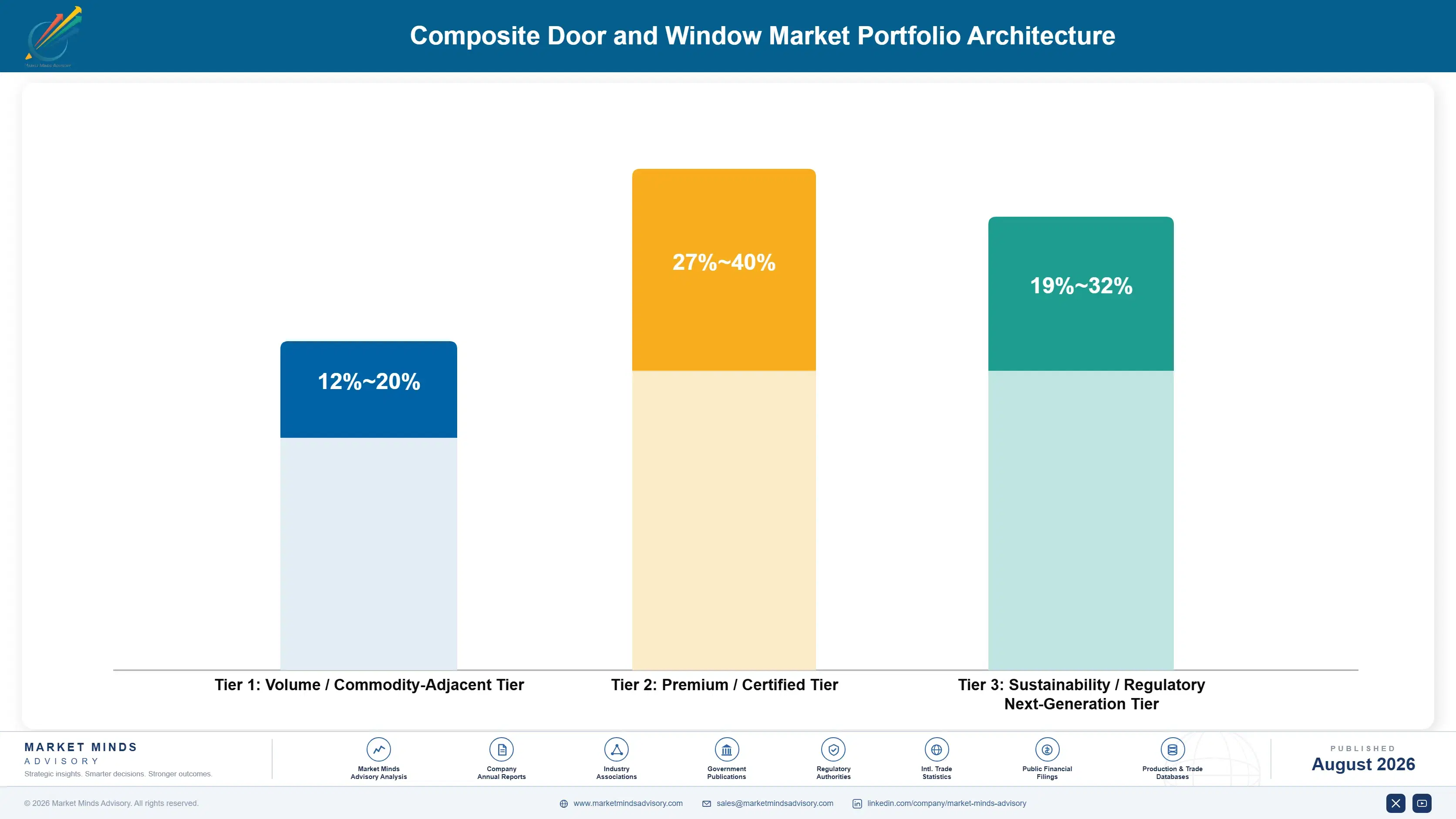
Composite doors and windows' portfolio splits into three tiers with meaningfully different margin economics. Volume standard PVC windows and fiberglass doors, sold through established dealer and builder channels on price and delivered volume, compete on cost and earn steady but thin margins. Smart-integrated and wood-polymer premium systems earn substantially more, since documented hardware and material differentiation create switching costs commodity manufacturers cannot replicate quickly.
The tension for manufacturers is capital allocation between two economics. Volume standard composite production generates dependable cash flow that funds operations and engineering research, while smart-integrated and wood-polymer capacity requires meaningful engineering and specialized material investment before generating comparable returns at much higher margin. Manufacturers leaning entirely on standard volume risk losing share to faster-growing differentiated competitors, while those chasing premium investment too aggressively risk underutilized capacity if smart-integrated demand proves slower than currently projected.

High-value margin pools concentrate in smart-integrated and wood-polymer systems carrying genuine hardware or material differentiation that standard formats cannot match. Frontier opportunity sits in combining verified wood-polymer sourcing with credible smart hardware integration capability, letting manufacturers capture premium pricing from both renovation and new construction channels while retaining steady standard system revenue simultaneously.

Volume / Commodity-Adjacent Tier

Standard PVC windows and fiberglass doors sold through established dealer and builder channels on price and delivered volume, priced close to comparable building materials with minimal differentiation between competing regional manufacturers nationwide.
Gross Margin: 12-20%

Premium / Certified Tier

Smart-integrated and wood-polymer composite systems carrying documented hardware and material construction that commands sustained premiums over standard formats across premium builders and renovation buyers worldwide, reflecting genuine engineering and material differentiation across the category.
Gross Margin: 27-40%

Sustainability / Regulatory / Next-Generation Tier

Emerging fully recycled and next-generation biobased composite formats designed to serve increasingly demanding sustainability sourcing requirements ahead of continued building code tightening, though feedstock scale-up economics remain largely unproven at full commercial volume today.
Gross Margin: 19-32%
composite-door-and-window-market-trends-portfolio-architecture-1787465686232

High-value Sub-segments and Strategic Watch-out

Smart Sensor-Integrated Composite Door Systems

Smart-integrated demand grows fastest at 11.5% annually and already commands pricing well above conventional composite formats. Global majors investing in hardware capability and builders expanding premium programs both continue growing, and rising security focus should keep margin strong through the forecast period ahead, across nearly every regional market currently tracked.
Gross Margin: 27-40%

Wood-Polymer Composite (WPC) Door and Window Profiles

Wood-polymer demand grows at a healthy 9.8% annually, driven by sustainability-linked builder sourcing requirements, though feedstock scaling constraints and specialized formulation expertise limit how quickly new entrants can credibly compete in this technically demanding and quality-critical segment currently commanding strong margins near the upper end of the category's premium range.
Gross Margin: 22-35%

PVC and Vinyl Composite Windows

PVC windows remain the largest format by volume, anchored by decades of established replacement market specification across mainstream residential construction globally. Margins stay steady but modest, competing on price and delivered volume rather than differentiation, but the segment anchors baseline category revenue across nearly every replacement market worldwide.
Gross Margin: 12-20%

Aluminum-Composite Hybrid Window Systems

Aluminum-composite hybrid demand faces gradual competitive pressure as pure PVC and fiberglass formats increasingly specify comparable performance at lower material cost, narrowing the addressable market for hybrid construction. Producers concentrated purely in this segment risk volume erosion absent diversification into premium formats, across nearly every regional hybrid segment tracked.
Gross Margin: 16-24%

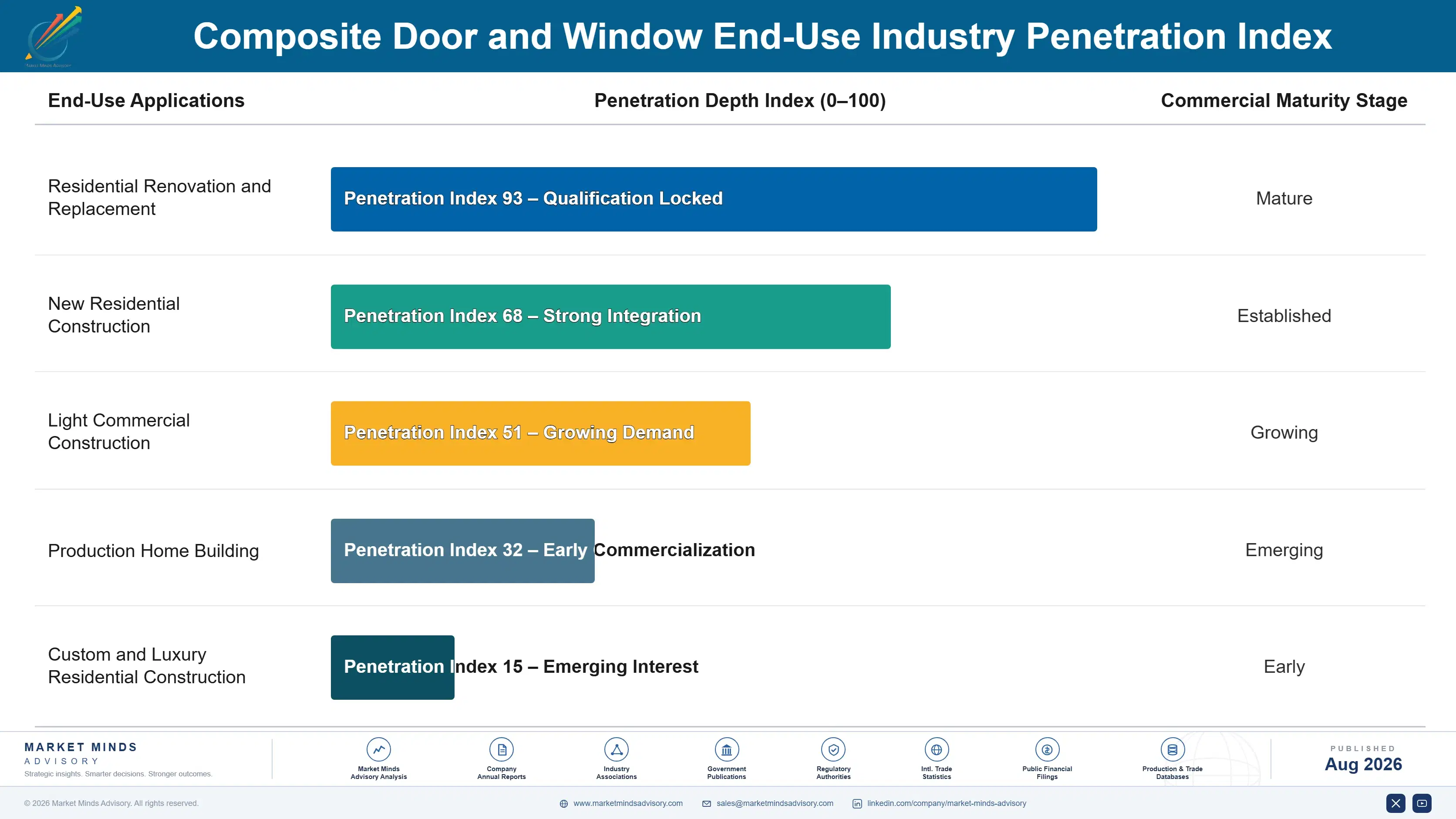
Why Dealer Relationships Run Long

Composite door and window demand behaves like an annuity within dealer distribution relationships, since dealers validate a specific manufacturer through extended quality and installation qualification and then source against that qualified relationship for the entire multi-year distribution agreement lifecycle rather than re-tendering routinely, given the training and warranty risk of switching mid-relationship. New construction builders behave considerably less predictably, since purchasing decisions follow individual project bidding cycles rather than any long-term supply commitment.
Stickiness varies sharply by buyer type and market segment. Dealers rarely switch composite suppliers once a distribution relationship has been established, given the installer training and warranty support exposure involved in switching mid-relationship across a multi-year cycle. New construction builders show considerably less loyalty, actively comparing competing suppliers on price and delivery reliability for each individual project bid. Renovation contractors sit in between, valuing established product quality without the same rigid single-supplier commitment new construction bidding lacks entirely.

Buyer profiles are shifting generationally within both dealer and builder channels specifically. Younger homeowners increasingly treat smart home integration as a standard renovation expectation rather than a niche technology purchase, a shift that favors manufacturers offering connected and sustainable material options over those competing purely on generic price alone.
composite-door-and-window-market-trends-end-use-penetration-index-1787465686896

Where Manufacturers Should Bet

These are among the four positions where our research anticipates prominent divergence between winners and laggards over the coming forecast period. Each is grounded in the demand model, the regulatory perimeter, and the announced capacity pipeline.
01 / SMART HARDWARE PRIORITY

Build hardware integration before premium demand outpaces supply

Smart-integrated demand is growing well over 65% faster than the wider market's pace, and already commands pricing well above standard composite formats, yet most manufacturers still lack dedicated hardware integration capability at meaningful commercial scale. Manufacturers that invest now in firmware and wireless engineering position ahead of continuing premium renovation demand growth across every major dealer network. Waiting risks ceding the category's fastest-growing and highest-margin segment permanently to competitors currently building that integration capability well ahead of broader industry adoption at meaningful commercial scale.
02 / WOOD-POLYMER SOURCING STRATEGY

Secure sustainable material partnerships before demand accelerates further

Wood-polymer composite systems command meaningful premium pricing, and demand from sustainability-focused builders has grown considerably faster than the industry's dedicated feedstock supply currently available across established manufacturers. Manufacturers that secure recycled fiber sourcing partnerships now capture premium contracts before competitors establish comparable feedstock access, since builders increasingly favor documented sustainable sourcing in supplier qualification. Every manufacturer without a sourcing strategy today risks losing this genuine differentiation opportunity to competitors already locking in material partnerships, leaving significant pricing power on the table.
03 / CERTIFICATION CAPABILITY DEVELOPMENT

Build energy efficiency certification before code tightening accelerates further

Manufacturers with established energy efficiency certification capability command substantial premium pricing, and demand from builders navigating tightening building codes across major markets has grown considerably faster than the industry's dedicated certification capacity currently available across established makers. Manufacturers that invest now in certification testing capture contracts from builders before competitors establish comparable specialized capability. Every manufacturer relying purely on uncertified standard formats risks missing this fast-growing, technically differentiated revenue opportunity entirely, ceding ground to competitors already scaling capability across multiple regional programs.
04 / LONG-TERM DEALER CONTRACTS

Lock dealers into multi-year distribution agreements now

Building products dealers increasingly prefer multi-year composite supply commitments over spot purchasing across new construction and renovation programs, since supply disruption during peak renovation season carries genuine business continuity risk that dealers cannot comfortably absorb given tightly coordinated installation scheduling. Manufacturers that secure these contracts now lock in demand and pricing before competitors capture the same dealer networks, since dealers rarely switch composite suppliers once a product line has been validated. Every manufacturer relying purely on spot sales risks missing the category's most durable and valuable revenue opportunity entirely.

Engagement Snapshot From the Field

A live engagement with an industry participant carrying material or product regulatory and market exposure ahead of a defining policy shift, showing how our research translates into a defensible multi-year portfolio strategy.
MARKET MINDS ADVISORY · CLIENT ENGAGEMENT SUMMARY
Composite Door and Window Producer Strategic Portfolio Review and Transition Roadmap 2026·Investment Scenario on Composite Door and Window Exposure Evaluation 2025-26
CLIENT PROFILE
A mid-sized North American home improvement retailer specializing in composite door and window renovation installation approached MMA while evaluating whether to invest in dedicated smart hardware sourcing relationships ahead of anticipated premium demand growth. The client reported annual composite installation revenue near USD 78 million, with smart-integrated products accounting for roughly 15% of current volume and growing rapidly among premium customers (client-reported, unverified by MMA).
STRATEGIC CHALLENGE
Management faced a strategic decision between securing exclusive smart hardware sourcing relationships with a single established supplier or pursuing a multi-supplier strategy to preserve negotiating flexibility across its expanding premium product lineup. The procurement team worried a single-supplier relationship would limit product differentiation, while the installation team worried a multi-supplier approach would complicate technician training and warranty support.
MMA APPROACH
MMA benchmarked sourcing structures and total integration cost across comparable renovation retailers that had expanded smart-integrated product lines, assessed the client's installation team capability relative to hardware integration requirements, and evaluated which supplier relationships offered the most commercially attractive terms given the client's regional footprint and target customer segment, and assessed how comparable retailers structured warranty support across multi-supplier arrangements.
KEY FINDINGS
  1. Comparable retailers that pursued single-supplier hardware relationships achieved faster technician training but reported meaningfully less pricing negotiating leverage over the program's multi-year lifecycle.
  2. Integration costs for a multi-supplier approach, while higher initially, were substantially offset by improved component pricing achieved through competitive sourcing across the product lineup.
  3. The client's existing installation team possessed limited smart hardware integration experience, favoring an initial single-supplier relationship to reduce launch risk before diversifying further.
  4. A phased sourcing approach starting with one supplier for the flagship product line allowed validation of the integration model before expanding to a broader supplier base.
CLIENT PROFILE
A mid-sized North American home improvement retailer specializing in composite door and window renovation installation approached MMA while evaluating whether to invest in dedicated smart hardware sourcing relationships ahead of anticipated premium demand growth. The client reported annual composite installation revenue near USD 78 million, with smart-integrated products accounting for roughly 15% of current volume and growing rapidly among premium customers (client-reported, unverified by MMA).
STRATEGIC CHALLENGE
Management faced a strategic decision between securing exclusive smart hardware sourcing relationships with a single established supplier or pursuing a multi-supplier strategy to preserve negotiating flexibility across its expanding premium product lineup. The procurement team worried a single-supplier relationship would limit product differentiation, while the installation team worried a multi-supplier approach would complicate technician training and warranty support.
MMA APPROACH
MMA benchmarked sourcing structures and total integration cost across comparable renovation retailers that had expanded smart-integrated product lines, assessed the client's installation team capability relative to hardware integration requirements, and evaluated which supplier relationships offered the most commercially attractive terms given the client's regional footprint and target customer segment, and assessed how comparable retailers structured warranty support across multi-supplier arrangements.
KEY FINDINGS
  1. Comparable retailers that pursued single-supplier hardware relationships achieved faster technician training but reported meaningfully less pricing negotiating leverage over the program's multi-year lifecycle.
  2. Integration costs for a multi-supplier approach, while higher initially, were substantially offset by improved component pricing achieved through competitive sourcing across the product lineup.
  3. The client's existing installation team possessed limited smart hardware integration experience, favoring an initial single-supplier relationship to reduce launch risk before diversifying further.
  4. A phased sourcing approach starting with one supplier for the flagship product line allowed validation of the integration model before expanding to a broader supplier base.
RECOMMENDED STRATEGY
Phase 1: Phase 1 (0 to 9 months): Launch the flagship smart-integrated product line with a single established hardware supplier to minimize integration risk. Phase 2: Phase 2 (9 to 24 months): Introduce a second hardware supplier for mid-tier products to improve pricing leverage and design flexibility. Phase 3: Phase 3 (24 to 42 months): Expand the smart-integrated lineup across price tiers with a formalized multi-supplier sourcing strategy and long-term volume commitments.
OUTCOME
The client launched its flagship smart-integrated product line on schedule with its selected supplier and reported meaningfully positive early sales performance within the first year. The client is now evaluating expansion to a second hardware supplier based on the initial launch's documented performance (client-reported, unverified by MMA).

Frequently Asked Questions

Foundational context covering the market sizes, CAGR, scope, country, region and competition that inform every finding below. This section is provided to cover basics and most often pre-purchase conversations, answered from the MMA Primary Research Dataset.

What is the current size of the Composite Door and Window Market?

The global composite door and window market reached USD 26.49 billion in 2026, based on MMA Primary Research Dataset findings. Growth increasingly reflects smart hardware and wood-polymer demand rather than standard replacement volume alone.

How large will the Composite Door and Window Market be by 2036?

MMA's base case projects the market reaching USD 51.14 billion by 2036, an incremental opportunity of roughly USD 24.65 billion over the 2026 to 2036 forecast period.

What is the CAGR for the Composite Door and Window Market 2026 to 2036?

The base case CAGR is 6.8%, with a bull case of 8.0% and a bear case of 5.6% depending on smart-integrated adoption pace and raw material cost conditions.

Which segment is growing fastest?

Smart sensor-integrated composite door systems lead at an 11.5% CAGR, well over 65% faster than the overall market rate, as homeowners specify connected hardware, ahead of every other product category tracked.

Who are the major companies in the Composite Door and Window Market?

Leading participants include Therma-Tru Corp, Andersen Corporation, Pella Corporation, VEKA AG, and Deceuninck NV, assessed on fabrication and hardware integration program breadth across residential and light commercial construction segments worldwide.

Which country is growing fastest?

India leads country-level growth at 10.8% annually, driven by its rapidly expanding residential construction activity and rising demand for durable, low-maintenance materials, ahead of every other emerging construction materials market.

Report Segmentation Architecture

The full report scope spans multiple orthogonal segmentation dimensions, with cross-tabulated demand data provided for each dimension pair. Coverage extends further to regional breakdowns, trend trajectories, and the competitive detail needed to support segment-level decision-making.

By Material and Product Technology

  • Fiberglass Composite Entry Doors
  • PVC and Vinyl Composite Windows
  • Wood-Polymer Composite Door and Window Profiles
  • Aluminum-Composite Hybrid Window Systems
  • Composite Garage and Patio Door Systems
  • Smart Sensor-Integrated Composite Door Systems

By End-Use Industry

  • Residential Renovation and Replacement
  • New Residential Construction
  • Light Commercial Construction
  • Production Home Building
  • Custom and Luxury Residential Construction

By Commercial Dimension

  • Dealer and Distributor Contract Supply
  • Retail Renovation Sales Channels
  • Builder Direct Supply Contracts
  • Wood-Polymer Feedstock Sourcing Partnerships

By Region

  • North America
  • Western Europe
  • East Asia
  • South Asia and Pacific
  • Latin America
  • Middle East and Africa
  • Eastern Europe

Scope, Methodology, and Coverage

Every figure in this report is reproducible from documented input assumptions. The scope below maps the historical period, the forecast horizon, the segmentation dimensions, and the countries covered, alongside the underlying primary and qualitative methodology.
Historical Period
2020 to 2025
Forecast Period
2026 to 2036
Base Year
2025 (USD billions; MMA Primary Research Dataset, August 2026)
Market Definition
The composite door and window market covers commercial production and sale of fiberglass composite entry doors, PVC and vinyl composite windows, wood-polymer composite profiles, aluminum-composite hybrid systems, composite garage and patio doors, and smart sensor-integrated composite door systems for residential and light commercial construction. It excludes solid wood, pure aluminum, and pure steel door and window products carrying no composite material content, which the industry classifies as separate product categories.
Quantitative Units
USD billions (current prices); units of door and window systems produced and sold where applicable
Segmentation Dimensions
By Material and Product Technology; By End-Use Industry; By Commercial Dimension; By Region
Regions Covered
North America, Western Europe, East Asia, South Asia and Pacific, Latin America, Middle East and Africa, Eastern Europe
Countries Covered
USA, China, Germany, France, UK, Japan, South Korea, India, Australia, Canada, Brazil, Mexico, Indonesia, Vietnam, Thailand, Malaysia, UAE, Saudi Arabia, South Africa, Nigeria, Turkey, Poland, Netherlands, Italy, Spain, Sweden, Switzerland, Argentina, Colombia, Singapore, and additional markets relevant to this sector
Key Companies Profiled
Therma-Tru Corp, Andersen Corporation, Pella Corporation, VEKA AG, Deceuninck NV, Masonite International Corporation, JELD-WEN Holding Inc, ProVia LLC, Simonton Windows & Doors, Cornerstone Building Brands Inc, Marvin Windows and Doors, Reynaers Aluminium NV, Rehau Group, Profine Group, Internorm International GmbH, Weru GmbH, Salamander Industrie-Produkte GmbH, LIXIL Corporation, Fenesta Building Systems, Wanhua Chemical Group Co Ltd
Quantitative Methodology
Primary survey, n=3,800 respondents, Q4 2025, six countries; demand-side model with trade association cross-validation
Qualitative Methodology
47 expert interviews, Q4 2025; applied to validate demand model assumptions, identify emerging dynamics, and assess competitive positioning
Report Format
PDF and XLSX data workbook (Word format preview document)
Publisher
Market Minds Advisory
Report Code
MMA-2026-CON-101
Published
August 2026
Contact
sales@marketmindsadvisory.com | www.marketmindsadvisory.com

Purchase the full Composite Door and Window Market Report (2026 to 2036).

The full MMA Composite Door and Window report sizes the market across six material and product technology segments, five end-use industries, four commercial supply models, and seven regions through 2036. It profiles twenty participants on a consistent basis of fabrication and hardware integration program breadth across standard, smart-integrated, and wood-polymer formats, scoring each on smart hardware investment, sustainable sourcing depth, and certification testing readiness. Scenario models quantify how smart hardware adoption, building code tightening, and material cost conditions move both category volume and pricing. The report includes resin cost modeling, a smart hardware benchmark, and wood-polymer sourcing pathway assessment built for building products and investment strategy teams.
Six-technology demand model with feature-adjusted pricing
Resin and fiberglass cost volatility modeling
Smart hardware integration pathway benchmarking model
Twenty-company competitive profiling on consistent program basis
Seven-region demand map with country-level growth detail
Wood-polymer sourcing and certification pathway assessment

Built For The People Who Decide

From boardroom strategy to bench-side execution, this report is read cover-to-cover by leaders shaping the next decade of their industry, turning demand scenarios, market dynamics and valuation benchmarks into decisions.
CXOs/ Presidents/ VPs/ Managers
M&A and Corporate Development
Strategy Teams and R&D Heads
Procurement and Product Directors
Regulatory and Compliance Leaders
Investor Relations and Equity Analysts