Market Minds Advisory
Complicated Urinary Tract Infections (cUTI) Treatment Market

Complicated Urinary Tract Infections (cUTI) Treatment Market: Resistance Coverage Depth and Formulary Access Analysis 2026 to 2036

Complicated urinary tract infection treatment is shifting toward siderophore cephalosporins and novel combination therapies as multidrug-resistant gram-negative pathogens outpace fluoroquinolone efficacy, forcing hospitals to adopt costlier last-resort antibiotics earlier than stewardship protocols once recommended.

Lead Analyst

Alice Ballenger

Published

August 2026

Make Smarter Decisions with Customized Research Insights

Request a free sample report and evaluate market opportunities, growth trends, and competitive dynamics relevant to your business needs.

2025 MARKET VALUE$4.6BMarket Size 2025
2036 FORECAST VALUE$12.3BBase Case , 2026 to 2036
CAGR 2026 TO 20369.4 %Bull 10.7% / Bear 8.1%
INCREMENTAL OPPORTUNITY$7.3BNet 10- year value creation
EXPANSION MULTIPLE2.45x2036 value over 2026 base
Strategic Levers
M&A Pipeline
Regional Outlook
Country Rankings
Competitive Intelligence
Segmental Deep-dive
Call-Us : 91 93563 13602

Executive Snapshot and Market Trajectory


Complicated urinary tract infection treatment demand is shifting toward siderophore cephalosporins and novel combination therapies, as multidrug-resistant gram-negative pathogens expand beyond the fluoroquinolone-responsive infections that historically anchored first-line prescribing, pushing manufacturers to invest in documented resistance coverage data that smaller generic vendors cannot easily match today given constrained R&D budgets.
Siderophore cephalosporins and novel antimicrobial combination therapies capture the fastest growth as hospitals increasingly require documented efficacy against carbapenem-resistant gram-negative organisms that older drug classes cannot reliably treat. North America leads demand given its accelerated regulatory pathway for novel antibiotics and dense hospitalization volume, supplying roughly three in ten units sold, while South Asia and Pacific grows fastest as expanding antimicrobial resistance burden broadens treatment demand beyond mature developed-market replacement volume.
Competitive intensity centers on five manufacturers holding roughly half of unit volume, most having built franchises through hospital formulary relationships and clinical trial depth. Documented resistance coverage and regulatory clearance breadth separate manufacturers positioned for premium hospital contracts from competitors dependent on generic fluoroquinolone configurations. Outpatient step-down adjacent applications are opening a smaller but fast-growing niche that established hospital-focused manufacturers are only beginning to pursue.
Market Definition
This report covers pharmaceutical therapies used to treat complicated urinary tract infections associated with structural or functional urinary tract abnormalities, catheterization, or resistant organisms, including beta-lactam and beta-lactamase inhibitor combinations, fluoroquinolones, aminoglycosides, siderophore cephalosporins, novel antimicrobial combination therapies, and oral step-down formulations. It excludes uncomplicated cystitis treatments and non-antimicrobial urinary tract supportive care products. Scope covers global sales revenue of finished cUTI treatment pharmaceuticals.
Base Year Value
$4.6B in 2025 (MMA Primary Research Dataset, August 2026)
Forecast Period
2026 to 2036, eleven discrete annual values
CAGR
9.4% base case. Bull 10.7%. Bear 8.1%.
Fastest Growth Segment
Siderophore Cephalosporins: 15.8% CAGR
Fastest Growth Country
India: 12.4% CAGR
Fastest Growth Region
South Asia and Pacific: 11.6% CAGR
Largest Region
North America: 29% of 2025 global value
Market Leaders
Pfizer, Merck & Co, Shionogi, Menarini Group, and Paratek Pharmaceuticals. Source: MMA Analysis based on company annual reports and investor filings.
Primary Survey
n=3,800 procurement and R&D decision-makers, Q4 2025, six countries
Methodology
Demand-side build-up, cross-validated against public data, 47 expert interviews

Complicated Urinary Tract Infections (cUTI) Treatment Market Forecast Scenarios

complicated-urinary-tract-infections-cuti-treatmen-size-forecast-scenario-1787307085342
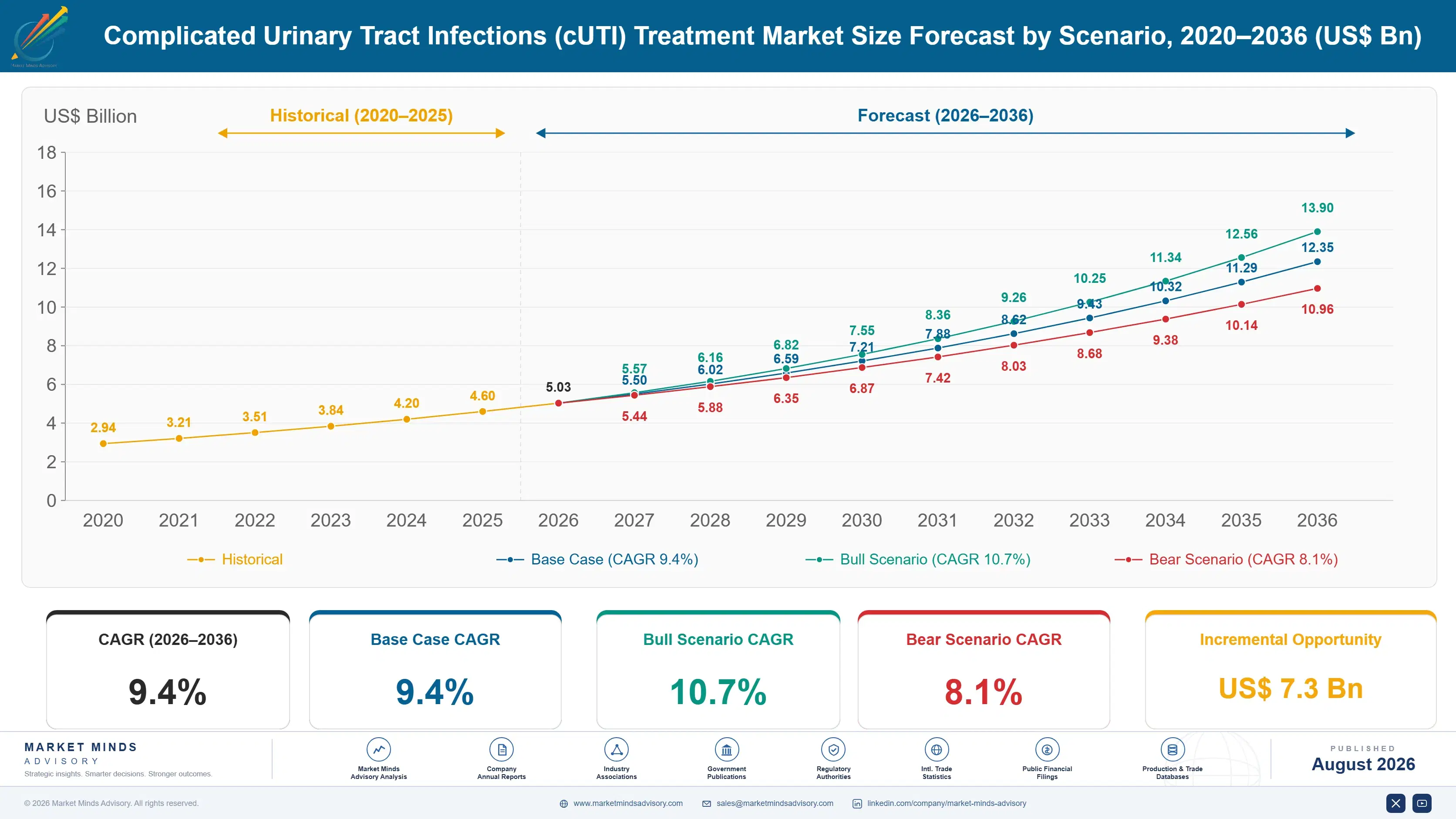
Complicated urinary tract infection treatment demand grew through 2020 and 2021 as hospitalization volumes normalized following pandemic-related care disruption, accelerated through 2022 and 2023 as multidrug-resistant gram-negative infection rates climbed across care settings. Shipments grew at an 8.4% historical rate, with siderophore cephalosporins accelerating fastest as hospitals sought documented resistance coverage for carbapenem-resistant organisms. This shift has accelerated markedly since 2023.
The base case assumes 9.4% growth through 2036, anchored by three mechanisms. First, expanding multidrug-resistant gram-negative infection prevalence is pulling demand toward siderophore cephalosporins and away from the fluoroquinolone-only prescribing that dominated early treatment protocols. Second, growing novel combination therapy adoption is expanding treatment cost as hospitals prefer documented resistance coverage data over empiric therapy. Third, expanding hospital infrastructure and stewardship program investment across markets is broadening the addressable treatment base beyond the acute-care-only demand that dominated cUTI prescribing.
The bull case rests on faster resistance prevalence growth and accelerated novel therapy adoption, which could pull forward treatment demand and push growth toward 10.7%. The bear case centers on payer cost discipline: if hospitals and insurers tighten formulary access for costlier novel antibiotics, treatment volume could soften and drag growth toward 8.1% as prescribers default to generic alternatives instead.

Resistance Coverage Depth and Formulary Access Economics

Complicated urinary tract infection treatment demand sits at the intersection of two forces: a resistance coverage shift that keeps pulling hospitals from legacy fluoroquinolone prescribing toward documented siderophore cephalosporin and combination therapy protocols faster than conventional drug manufacturers were designed to convert, and a hospitalization expansion that pulls demand into acute-care formats previously served by outpatient-only treatment infrastructure. Manufacturers that invest
CR5 CONCENTRATION46%Top five manufacturers hold roughly half of units
AVERAGE TREATMENT COST$4,200 per courseNovel combination therapies command a premium over generics
TOP PRESCRIBING COUNTRY SHARE23%United States accounts for the largest single prescribing share
RESISTANCE COVERAGE ADOPTION RATE34%Prescriptions using novel resistance-coverage therapies rather than legacy classes
HOSPITAL FORMULARY INCLUSION RATE61%Acute care hospitals with novel antibiotics on standard formulary
GENERIC SUBSTITUTION COST SHARE42%Share of prescription volume filled through generic substitution
Commercial character is defined by evidence-driven procurement: manufacturers with strong clinical evidence depth and formulary committee reach capture disproportionate hospital trust as purchasing decisions standardize around therapies proven against documented resistance benchmarks. Legacy fluoroquinolone and generic beta-lactam prescribing remains a large but slower-growing volume base, priced across established distribution channels, while siderophore cephalosporin and combination platforms command premium pricing tied to resistance data smaller entrants struggle to match.
Over the next decade, expect procurement to keep consolidating around manufacturers with proven resistance coverage and documented clinical evidence capability, rewarding early movers in R&D investment. Consolidation among smaller generic-only manufacturers is likely as clinical trial costs outpace what niche vendors can fund alone across most acute-care markets.
"Fluoroquinolones used to be the default. Now they're the drug you use only after you've confirmed the organism isn't going to laugh at it. That single shift rewrote the entire formulary."
Director, Infectious Disease and Antimicrobial Resistance Practice · MMA Infecti

Market Trends

Siderophore Cephalosporins Steadily Displace Fluoroquinolone Prescribing

Hospitals are increasingly requiring siderophore cephalosporin protocols for infections caused by carbapenem-resistant gram-negative organisms, beyond what conventional fluoroquinolone-based empiric therapy historically provided. Manufacturers have expanded resistance coverage data and clinical trial capability significantly over the past several years, and infectious disease specialists increasingly specify siderophore cephalosporin protocols by default when culture results confirm resistant organisms. Major hospital systems report siderophore cephalosporin adoption now covers over a third of resistant-organism prescriptions, up sharply from a small base less than a decade ago. This shift has accelerated markedly since 2023, and industry surveys suggest the pace is still building.
Market Impact: Adds 480 new hospital formulary lis
Novel Combination Therapies Reshape Empiric Prescribing

Hospitals are increasingly requiring novel antimicrobial combination therapies that provide broader resistance coverage than single-agent regimens, rather than the sequential single-drug trials that historically anchored empiric treatment. Manufacturers have expanded combination formulation and clinical validation capability significantly over the past two years, letting physicians treat high-risk patients without requiring the diagnostic delay that slowed care historically. High-acuity, immunocompromised patients report the fastest uptake, since combination therapy removes the treatment-failure risk that limited outcome confidence for years. Several major manufacturers expanded combination therapy offerings further in late 2025, citing strong physician demand.
Market Impact: Adds 22-32% ASP premium overall

Market Opportunities and Growth Drivers

Antimicrobial Resistance Growth Broadens Treatment Base

Expanding multidrug-resistant gram-negative infection prevalence across developed and emerging markets is broadening the addressable treatment base beyond the historically fluoroquinolone-responsive demand that relied on first-line empiric therapy for limited-scope adoption. Several major health authorities have expanded antimicrobial resistance surveillance meaningfully across markets over the past few years, and each new resistance report increasingly specifies novel antibiotic protocols alongside other stewardship technology rather than legacy prescribing alone. Manufacturers that built strong hospital infectious disease education and clinical support networks early are winning most new contracts signed across the past two years. This advantage is compounding fastest in multi-facility hospital system programs.
Market Impact: Limits broader adoption to 34 perce

Clinical Evidence Investment Sustains Formulary Confidence

Hospital procurement decisions increasingly specify documented resistance coverage data that conventional generic fluoroquinolones cannot always demonstrate without a supplementary clinical trial investment. Several major manufacturers have expanded clinical evidence scope meaningfully over the past several years, and each new drug generation increasingly treats documented resistance coverage as a formulary-inclusion compliance requirement rather than an optional add-on. Manufacturers with the strongest clinical evidence platforms are winning the large majority of new hospital contracts, since purchasing committees treat documented coverage data as a near-mandatory requirement across most acute-care categories nationwide today. This preference is only strengthening as resistance data accumulates.
Market Impact: Limits novel adoption to 29 percent

Market Restraints and Challenges

Development Cost Limits Smaller Manufacturer Adoption

Novel antibiotic development and clinical trial validation carries meaningfully higher cost than conventional generic manufacturing, putting full adoption out of reach for smaller manufacturers even where documented resistance coverage already justifies the premium. The root cause is that novel antibiotics require specialized clinical trial and regulatory validation investment that conventional generic manufacturers never needed to fund. This restricts adoption to well-funded pharmaceutical companies and established hospital networks even where novel antibiotics offer clear resistance coverage advantages. Manufacturers mitigate the gap by pursuing government development grants. This gap is widest across smaller regional manufacturers with limited capital budgets.
Market Impact: Lifts resistance coverage adoption

Stewardship Restrictions Slow Novel Antibiotic Adoption

Hospital antimicrobial stewardship programs restrict novel antibiotic prescribing that differs meaningfully from conventional generic access, and the root cause is that stewardship committees reserve novel resistance-coverage antibiotics for confirmed resistant organisms to preserve long-term efficacy. This restricts adoption pace even where novel antibiotics already demonstrate measurable outcome improvement over legacy approaches. Physicians report stewardship approval requirements as their single largest constraint on expanding novel antibiotic adoption further. Manufacturers mitigate the gap by supporting rapid diagnostic testing partnerships and physician education programs. This gap is widest across smaller hospitals with limited stewardship staff capacity.
Market Impact: Cuts treatment failure rates by 28%
4 additional market trends, 4 additional growth drivers, and 4 additional restraints and challenges are covered in the full report. Contact sales@marketmindsadvisory.com to access the complete intelligence.

Segment CAGR and Growth Architecture

Segmentation follows drug class, the primary driver of resistance coverage, dosing format, and price point across beta-lactam combination, fluoroquinolone, aminoglycoside, siderophore cephalosporin, novel combination, and oral step-down formats. Siderophore cephalosporins and novel antimicrobial combination therapies carry the fastest growth as hospitals increasingly prioritize documented resistance coverage over the fluoroquinolone-based prescribing that dominated cUTI treatment for decades.
complicated-urinary-tract-infections-cuti-treatmen-market-share-analysis-1787307085919

Siderophore Cephalosporins

Siderophore cephalosporins are the fastest-growing segment as hospitals increasingly require documented efficacy against carbapenem-resistant gram-negative organisms that conventional fluoroquinolone therapy alone cannot fully address given rising resistance prevalence and clinical outcome expectations. Manufacturers have expanded resistance coverage data and clinical trial capability significantly over the past two years, letting infectious disease specialists select therapies with documented resistant-organism efficacy data rather than relying on empiric prescribing under increasing stewardship scrutiny. High-acuity ICU and transplant patients report the fastest uptake among hospitals where documented resistance coverage directly affects treatment outcome and formulary decisions. Pricing carries a substantial premium over conventional generic therapy, reflecting the clinical trial and regulatory investment increasingly built into new siderophore cephalosporin product lines across most major markets today.
CAGR 15.8%

Novel Antimicrobial Combination Therapies

Novel antimicrobial combination therapies rank second-fastest as physicians increasingly require broader resistance coverage that conventional single-agent regimens alone cannot provide without sequential treatment trials. Combination therapies give hospitals a treatment pathway that reduces treatment-failure risk while maintaining the resistance coverage depth that single-agent competitors cannot always match, a capability increasingly valued as multidrug resistance prevalence increases across most acute-care systems nationwide. Manufacturers report the fastest adoption among high-acuity, immunocompromised patient categories where documented combination efficacy directly affects treatment decisions. Average treatment cost is rising modestly as combination platforms expand from basic dual-agent regimens to full-featured triple-combination protocols, adding extended-spectrum coverage that broadens the clinical value proposition beyond a single resistant pathogen class.
CAGR 13.6%
Full segment breakdown across 6 segments available in the complete report.

Regional Architecture and Country Demand Map

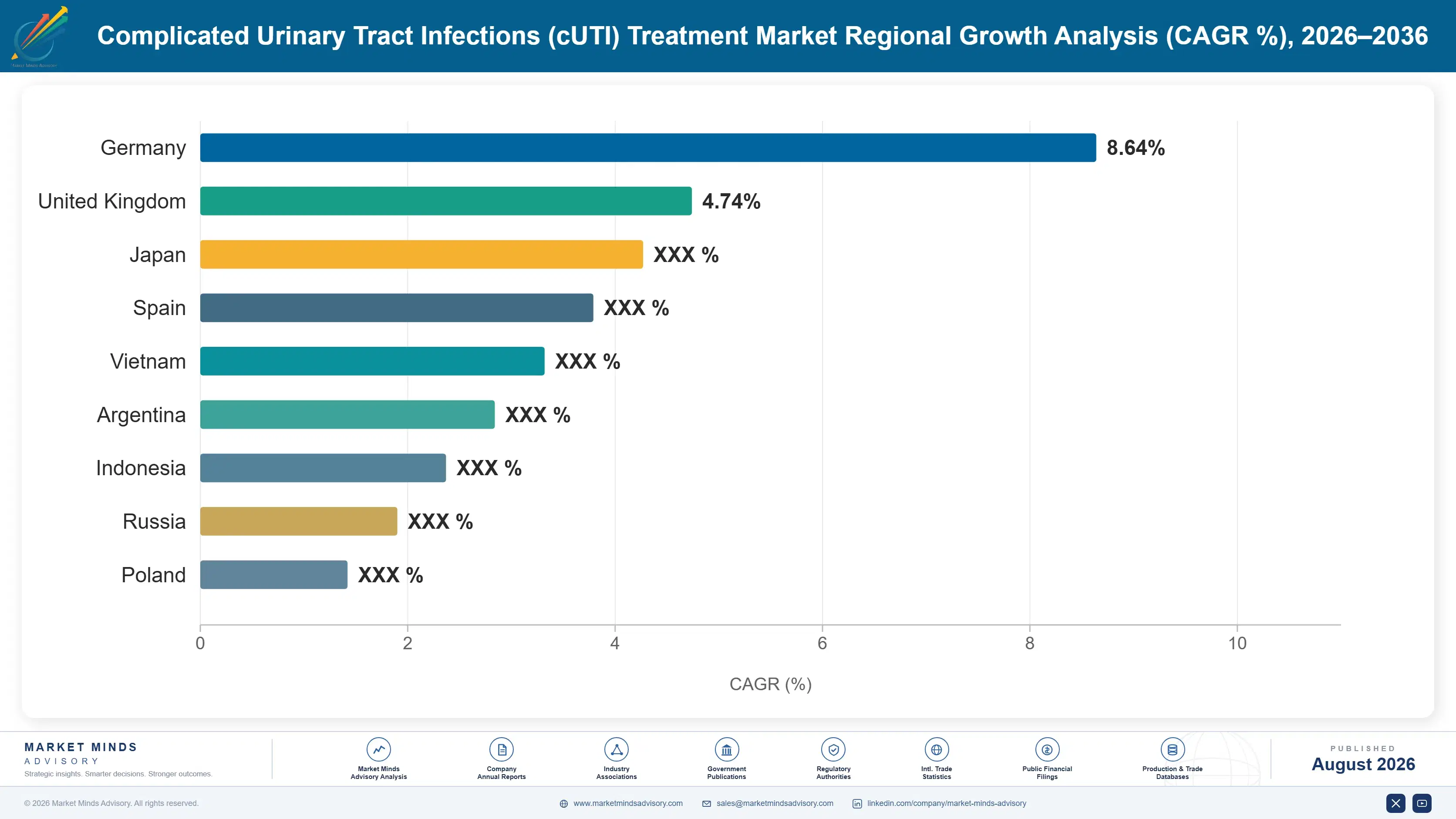
Demand concentrates where hospitalization volume and antimicrobial resistance prevalence diverge most sharply. North America leads on accelerated regulatory pathway for novel antibiotics and dense hospitalization volume, East Asia follows on expanding resistance surveillance investment, and South Asia and Pacific posts the fastest growth as expanding resistance burden broadens demand.

North America

The United States' accelerated regulatory pathway for novel antibiotics and dense hospitalization volume anchor North American demand, as hospitals standardize purchasing around siderophore cephalosporin and combination therapy protocols ahead of most other regions given sophisticated antimicrobial stewardship infrastructure and FDA priority review incentives. Major hospital systems are converting fluoroquinolone-dependent prescribing into resistance-validated treatment protocols, replacing conventional empiric therapy with documented resistance coverage formulations. Stewardship program network expansion adds a second demand pool, since hospital systems increasingly incorporate novel antibiotic access into broader infection control bundle programs. Distributors report growing interest in oral step-down formulations, since discharge planning committees increasingly require documented outpatient transition data before approving new treatment protocols each quarter.
Share: 29% | CAGR: 8.6% (2026 to 2036)

East Asia

China's expanding resistance surveillance investment anchors East Asian demand, and the region's growth reflects both rising multidrug-resistant infection prevalence and increasing government investment in antimicrobial resistance containment programs. Chinese hospitals are scaling standardized resistance surveillance protocols that increasingly meet international accreditation requirements, a clinical practice pattern more established than in most other emerging regions. South Korean and Japanese hospitals maintain sophisticated novel antibiotic adoption patterns closer to Western practice, contributing a fast-growing demand pool distinct from China's volume-driven expansion base. Southeast Asian hospital infrastructure is expanding steadily as regional resistance burden grows, adding a further demand pool across newly built acute-care facilities. Taiwan follows a similar adoption trajectory, with steady accreditation-driven upgrades underway.
Share: 24% | CAGR: 10.6% (2026 to 2036)
Regional intelligence for 5 additional markets available in the complete report: Western Europe, South Asia and Pacific, Latin America, Middle East and Africa, Eastern Europe. Contact sales@marketmindsadvisory.com.
complicated-urinary-tract-infections-cuti-treatmen-country-cagr-analysis-1787307086436

Where cUTI Manufacturers Can Expand Margin Fast

Complicated UTI treatment manufacturers face a choice: compete on price for commodity generic fluoroquinolones, or build defensible margin through resistance coverage engineering leadership, clinical evidence depth, and hospital formulary contracting reach. The levers below identify where manufacturers are converting the resistance coverage shift into durable pricing power rather than treating cUTI therapies as an undifferentiated commodity.

Lead Resistance Coverage Engineering Ahead of Demand

Manufacturers that develop and validate resistance coverage data 12 to 18 months ahead of major hospital formulary cycles win first access to premium formulary placement before competitors catch up, since hospital procurement decisions typically finalize therapy selection a year or more before contract renewal dates. Early engineering leadership also lets manufacturers charge a 20 to 30 percent premium over conventional generic fluoroquinolones, since documented resistance coverage directly reduces hospital liability exposure and treatment-failure risk. Manufacturers that under-invested in resistance coverage engineering during the prior demand cycle are now losing hospital contracts to competitors with proven validated platforms.
Market Impact: Captures a 20-30% price premium eac

Expand Combination Therapy and Clinical Validation Capability

Dedicated combination formulation and clinical validation programs that document actual treatment-failure reduction and outcome improvement convert a commodity generic relationship into a differentiated trusted platform worth roughly 18 to 28 percent more per course than standard single-agent alternatives. Hospitals increasingly require documented combination efficacy as a purchasing condition, since undocumented treatment failure creates liability exposure that infectious disease teams actively scrutinize during facility review. Manufacturers that invest in combination capability early are converting standard generic volume into premium hospital relationships that competitors without comparable capability cannot easily replicate. This advantage compounds further as resistance prevalence expectations increase.
Market Impact: Adds an 18-28% premium for combinat

Expand Emerging-Market Hospital Distribution Reach and Depth

Building dedicated clinical training and infectious disease education capability across South Asia and Latin America, rather than treating those markets as a secondary outlet for developed-market drug export surplus, captures a demand pool growing roughly 24 percent even as developed-market volume growth moderates. Hospitals in expanding infrastructure markets increasingly favor manufacturers with established local training and distribution support, since clinical reliability and local regulatory documentation outweigh brand recognition for budget-constrained procurement decisions. Manufacturers committed to this distribution depth are capturing multi-year hospital relationships that competitors focused on developed markets cannot easily replicate without local investment.
Market Impact: Captures an emerging-market segment

Expand Manufacturing Precision and Quality Control Systems

Building dedicated high-precision formulation manufacturing and quality control capability, rather than requiring manual calibration and inspection between production runs, lifts average hospital contract retention by roughly 19 percent through the resistance coverage consistency reliability that manual processes cannot deliver. Hospitals increasingly favor manufacturers who can support consistent antimicrobial potency performance directly, since inconsistent products translate into the variable-outcome incidents that infectious disease teams actively work to avoid. Manufacturers already committed to this precision investment are winning multi-year hospital agreements with major acute-care networks ahead of manual-process competitors. This advantage compounds further as hospital system consolidation continues nationwide overall.
Market Impact: Lifts average hospital contract ret

Who Controls the Margin Pool

The top five manufacturers, Pfizer, Merck & Co, Shionogi, Menarini Group, and Paratek Pharmaceuticals, hold roughly forty-six percent of unit volume, leaving a fragmented tail of generic and specialized manufacturers to compete for the remainder. The gap between the leading two manufacturers and the next tier is widening as clinical trial costs outpace what smaller manufacturers can justify funding.
Current activity centers on three fronts: resistance coverage engineering development aimed at hospital formulary cycles, combination therapy expansion aimed at capturing high-acuity demand, and emerging-market distribution capability aimed at capturing hospital infrastructure growth ahead of undertrained competitors. American and European manufacturers are also expanding export capacity as domestic production scales past what local emerging-market demand alone can absorb.

Emerging pressure comes from two directions. Well-funded resistance coverage specialists with strong clinical trial and regulatory capability are gaining hospital share from diversified generic-focused manufacturers slower to build documented resistance technology. At the premium end, combination therapy specialists with strong infectious disease consulting relationships are winning large multi-country distribution contracts that established generic-focused manufacturers have historically held, and rankings among the top ten manufacturers could shift within three to four years if that trend continues.
complicated-urinary-tract-infections-cuti-treatmen-company-positioning-matrix-1787307086962

Competitive Moat and Risk Dimensions

PFIZER

Moat: Broad Antimicrobial Manufacturing Scale

Pfizer's decades of antimicrobial and hospital drug manufacturing scale and formulary distribution relationships give the company a product portfolio spanning conventional through fully-resistance-validated formats that few competitors can match in breadth. That scale lets the company fund resistance coverage engineering and clinical evidence investment that smaller specialized manufacturers cannot service alone.
PFIZER

Risk: Slower Niche Combination Innovation Pace

Pfizer's broad antimicrobial portfolio approach means specialized combination therapy innovation moves more slowly than at focused infectious-disease competitors, a gap that specialized providers could exploit as hospitals increasingly favor deep application-specific expertise over general antimicrobial breadth. Competitors that built dedicated combination capability earlier are capturing premium hospital placement faster than the company's broader model currently allows.
MERCK & CO

Moat: Deep Resistance Coverage Engineering Expertise

Merck & Co built resistance coverage engineering expertise over years that translates directly into hospital trust few generalist competitors can replicate quickly. That engineering depth lets the company win high-volume ICU-facility treatment decisions based on documented resistance reliability, positioning it well for the segment of demand prioritizing resistance specialization over broad antimicrobial portfolio breadth.
MERCK & CO

Risk: Narrower Oral Step-Down Portfolio

Merck & Co's comparatively narrow oral step-down portfolio limits its ability to offer expanding outpatient transition customers a fully integrated product line spanning inpatient and outpatient categories in a single procurement relationship. As hospitals increasingly prefer integrated vendor relationships, this narrower scope could become a bigger competitive disadvantage than it represents today.

Players Tracked

Prominent Players

Pfizer
Merck & Co
Shionogi
Menarini Group
Paratek Pharmaceuticals

Other Key Players

GSK
Sanofi
Bayer
Sandoz
Teva Pharmaceutical
Fresenius Kabi
Cipla
Sun Pharmaceutical
Lupin Limited
Wockhardt
Entasis Therapeutics
Spero Therapeutics
Venatorx Pharmaceuticals
Innoviva
Melinta Therapeutics

Recent Developments

FEBRUARY 2025

Pfizer Expands Resistance Coverage Clinical Trial Portfolio

Pfizer launched a new clinical trial program for its existing siderophore cephalosporin product line, adding capability aimed at hospitals specifying documented resistance coverage data for procurement decisions. The move is an organic expansion, not an acquisition, following rising hospital demand for validated resistance options. Infectious disease committees requested this capability.
Signal: Signals hospital demand for resistance cov
JUNE 2025

Merck & Co Acquires Combination Therapy Specialist

Merck & Co acquired a small biotechnology company specializing in novel antimicrobial combination therapy development, folding it into its existing infectious disease division. The acquisition brings combination therapy capability in-house rather than continuing to partner externally, and the deal closed for an undisclosed sum. Terms were not otherwise disclosed.
Signal: Confirms leading cUTI manufacturers are ac
OCTOBER 2025

Shionogi Signs Distribution Agreement With Indian Hospital Network

Shionogi signed a multi-year distribution agreement with a major Indian hospital network to supply siderophore cephalosporin therapies across several regional facilities. The arrangement is a distribution agreement, not a joint venture or equity stake, and covers several years of treatment supply activity. Financial terms were not disclosed.
Signal: Indicates global cUTI manufacturers are wi

API Synthesis and Clinical Trial Cost Exposure

Active pharmaceutical ingredient synthesis accounts for roughly thirty-two percent of cUTI drug production cost, clinical trial and regulatory validation another thirty-nine percent, and formulation and packaging seventeen percent depending on drug class and resistance coverage scope. Active pharmaceutical ingredients source from Indian, Chinese, and European specialty chemical manufacturers, while clinical trial capability remains concentrated among specialized pharmaceutical R&D firms.
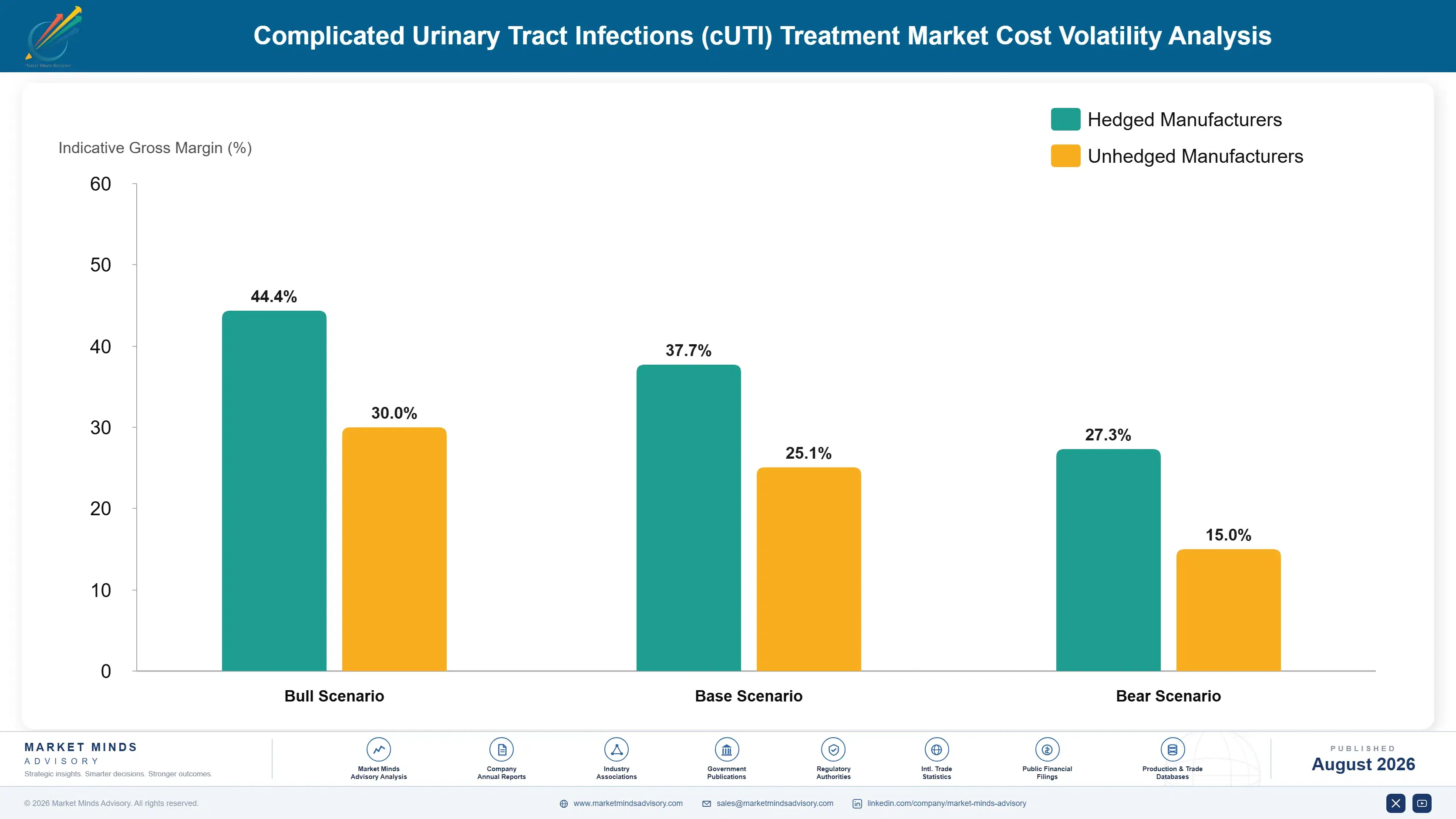
Active pharmaceutical ingredient and clinical trial costs swung in 2024, with the FDA and European Commission noting manufacturing supply volatility tied to competitive raw material demand that pushed component costs higher across the antimicrobial drug manufacturing industry. Manufacturers with long-term API supply contracts locked in before the volatility absorbed quarters of stable cost before facing higher sourcing costs, while competitors relying on spot-market purchasing faced cost pass-through, showing how contract structure determines which manufacturers protect margin during a volatility cycle.

Smaller specialized manufacturers without long-term API supply contracts absorb cost volatility into gross margin, while the top five use multi-year supplier agreements and sourcing to smooth exposure. Geography compounds the gap: manufacturers with Indian or European chemical supply bases sit closer to component supply and cost-competitive sourcing markets, giving them a cost advantage over competitors sourcing through additional channels.
complicated-urinary-tract-infections-cuti-treatmen-cost-volatility-analysis-1787307087161

Lock In Multi-Year API Supply Contracts

Manufacturers with balance sheet capacity to lock in multi-year API supply contracts two to three years forward smooth raw material cost volatility far better than competitors relying on reactive spot-market purchasing. This requires capital commitment smaller specialized manufacturers often lack, but it is close to standard practice among the top five manufacturers protecting production schedules reliably.

Diversify API Sourcing Across Suppliers

Sourcing active pharmaceutical ingredients from more than one qualified chemical manufacturer reduces exposure to single-region supply allocation shortfalls, though qualifying alternate API sources requires additional validation investment and carries its own consistency tradeoffs manufacturers must confirm before deploying diversified sourcing across multiple regional supply relationships each year. Larger manufacturers manage this tradeoff more easily than smaller competitors.

Invest in Domestic API Manufacturing Capacity

Domestic API manufacturing capacity reduces exposure to single-region supply cost volatility directly, while also improving production continuity during periods of regional supply market tightness that have disrupted smaller competitors. This requires meaningful upfront capital investment, but manufacturers that made this shift early are largely insulated from the API cost spikes squeezing single-region-dependent competitors across the industry today.

Portfolio Architecture for Margin Defence

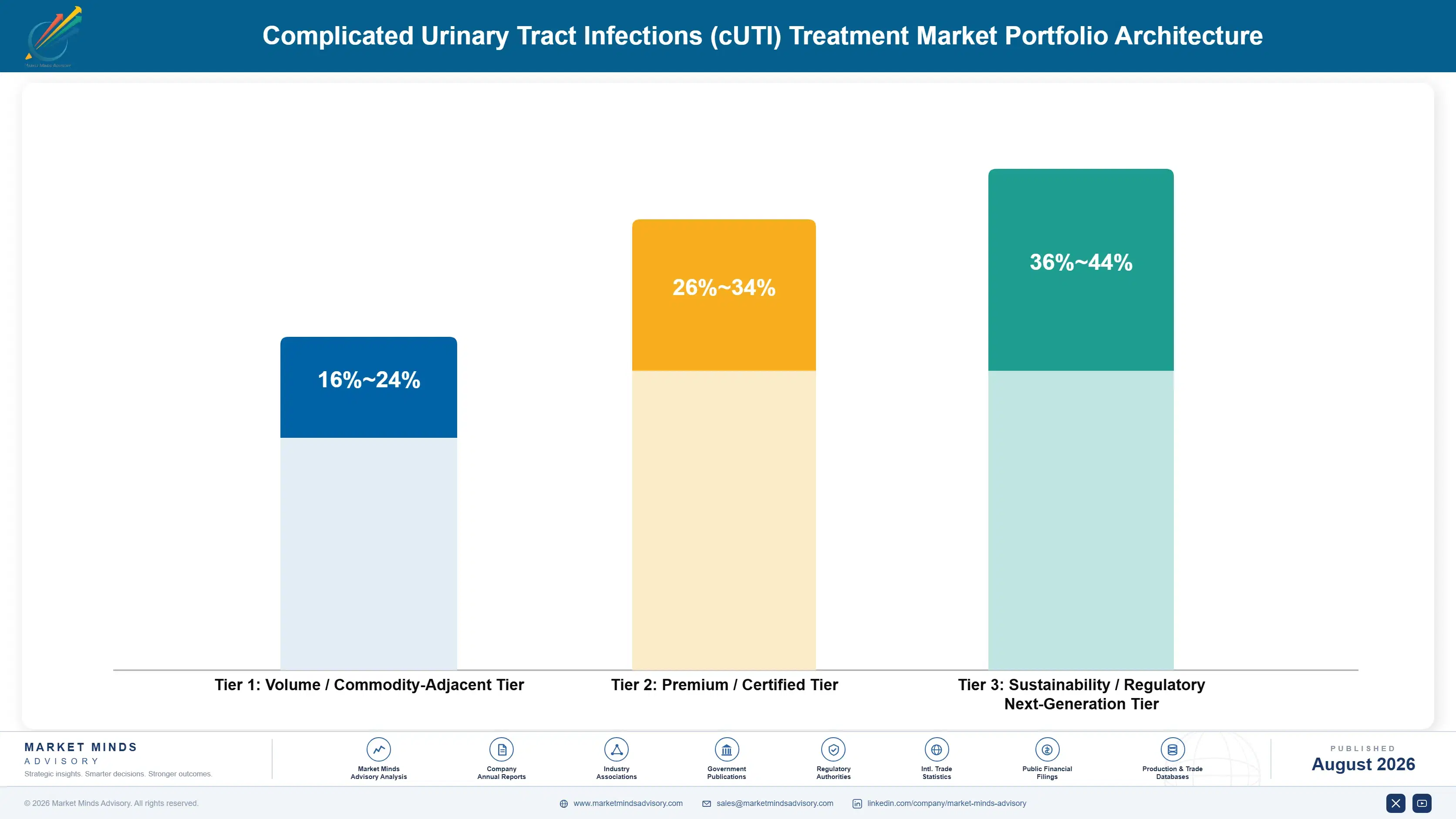
cUTI treatment portfolios split into three margin tiers. Generic fluoroquinolones and beta-lactam combinations compete on price with gross margins in the high teens to twenties given established manufacturer competition, mid-tier aminoglycoside and branded beta-lactam formats command higher margins in the low to mid-thirties, and siderophore cephalosporin and combination premium platforms sit at the top of the stack as the smallest but fastest-expanding tier.
The volume-premium tension plays out most visibly in generic fluoroquinolone categories, where established manufacturers keep pushing prices down even as resistance coverage investment costs rise across the category, squeezing mid-tier competitors that lack scale to compete on clinical trial cost. Premium siderophore cephalosporin categories face a different tension: manufacturers must recoup clinical trial and regulatory investment through volume before technology becomes commoditized, a window narrowing as more competitors launch comparable validated platforms.

High-value margin pools concentrate in two places: siderophore cephalosporins sold into hospitals managing high-volume resistant-organism treatment decisions, and combination therapy platforms that command premium pricing regardless of the broader generic fluoroquinolone pricing pressure cycle. Both pools reward manufacturers willing to invest in clinical trial and regulatory capability ahead of demand rather than reacting once hospital requirements become standard practice across a procurement segment.

Volume / Commodity-Adjacent Tier

Generic fluoroquinolones and beta-lactam combinations sold primarily on price into cost-sensitive outpatient and general ward channels, where established manufacturers compete aggressively on price and resistance coverage requirements remain comparatively modest across most account types, reflecting the category's largely commoditized manufacturing dynamics.
Gross Margin: 16-24%

Premium / Certified Tier

Mid-tier aminoglycoside and branded beta-lactam formats sold to hospitals requiring documented efficacy performance and manufacturing reliability as increasingly standard procurement terms across most acute-care programs. These buyers increasingly weigh resistance coverage alongside price when comparing manufacturers.
Gross Margin: 26-34%

Sustainability / Regulatory / Next-Generation Tier

Siderophore cephalosporin and combination premium platforms sold into hospitals that prioritize documented resistance coverage and formulary compliance over near-term treatment cost savings, reflecting where clinical policy is steering long-term development investment.
Gross Margin: 36-44%
complicated-urinary-tract-infections-cuti-treatmen-portfolio-architecture-1787307087671

High-value Sub-segments and Strategic Watch-out

Siderophore Cephalosporins for High-Volume Resistant-Organism Decisions

Hospitals are standardizing on siderophore cephalosporins for high-volume resistant-organism treatment decisions, and this segment combines the fastest unit growth with a high margin tier, making it the single most attractive pool for manufacturers with strong clinical trial capability already in place right now. Demand shows no sign of slowing.
Gross Margin: 37-45%

Combination Therapies for High-Acuity Treatment Demand

Hospitals are steadily expanding combination therapy adoption for high-acuity treatment demand, a segment growing faster than standard generic demand but from a smaller base, commanding premium pricing well above standard therapy sales across most account types, with adoption accelerating steadily each fiscal year across most regional markets.
Gross Margin: 31-39%

Standard Generic Fluoroquinolones for Core Volume Demand

The largest segment by unit volume remains generic fluoroquinolones and beta-lactam combinations sold into established outpatient and hospital channels, where major manufacturers compete primarily on price and resistance coverage requirements stay comparatively predictable across most channels worldwide today. This volume base anchors most manufacturers' recurring revenue even as growth moderates.
Gross Margin: 16-24%

Legacy Broad-Spectrum Empiric Therapy Facing Displacement

Legacy broad-spectrum empiric therapy without documented resistance coverage data faces a shrinking addressable hospital market as physicians increasingly require documented resistant-organism efficacy data, and manufacturers that fail to diversify into siderophore cephalosporin and combination categories risk losing hospital relationships within the next several years without a clear pivot plan.
Gross Margin: 9-15%

Hospital Formulary Contract Economics

cUTI treatment revenue behaves like a long annuity once a manufacturer wins placement on a hospital's standard antimicrobial formulary: a placement decision can generate repeat therapy, service, and adjacent-product revenue across years of formulary coverage over a relationship spanning many years, plus renewal demand as resistance coverage and clinical evidence requirements tighten with each drug refresh cycle. This annuity quality is what makes hospital relationships and clinical trial depth v
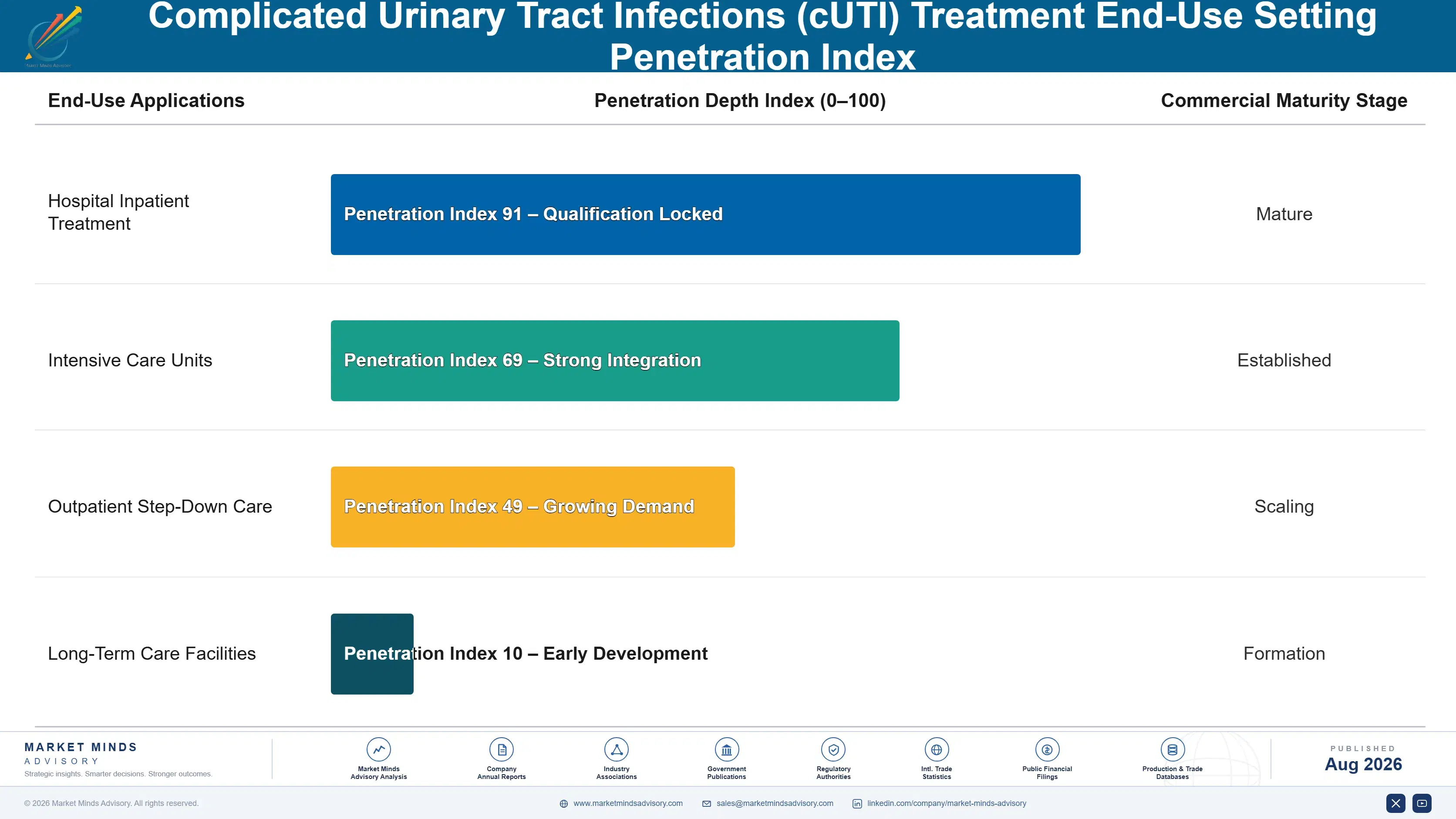
Adoption depth varies by end-use vertical. Hospitals managing high-acuity, ICU-heavy resistant-organism populations adopt siderophore cephalosporin and combination platforms fastest because resistance coverage accuracy and treatment-failure exposure threaten hospital reimbursement standing, making therapy upgrades an easy budget justification. Mid-size general acute-care hospitals follow behind on cost efficiency requirements. Legacy outpatient applications without high-acuity complexity adopt more slowly, continuing with conventional generic fluoroquinolone therapy rather than upgrading, stretching adoption timing beyond the technology transition.

Buyer profiles are shifting as purchasing moves from individual-physician decisions toward centralized, evidence-based hospital planning. Younger infectious disease specialists expect documented resistance coverage and clinical evidence validation as a default requirement rather than an optional upgrade, and purchasing decisions are shifting from individual budgets toward centralized hospital procurement platforms, changing who cUTI manufacturers need to sell to.
complicated-urinary-tract-infections-cuti-treatmen-end-use-penetration-index-1787307088173

Where Resistance Coverage Wins Hospital Placement

These are among the four positions where our research anticipates prominent divergence between winners and laggards over the coming forecast period. Each is grounded in the demand model, the regulatory perimeter, and the announced capacity pipeline.
01 / RESISTANCE COVERAGE ENGINEERING INVESTMENT

Validate resistance coverage engineering ahead of hospital formulary cycles

Manufacturers that develop and validate resistance coverage data 12 to 18 months ahead of major hospital formulary cycles capture a meaningful pricing premium during the transition window before competitors catch up. This is not a marginal advantage. Companies that under-invest in engineering speed risk losing formulary placements entirely once hospitals standardize purchasing around already-validated suppliers, a mistake that took years for some legacy manufacturers to recover from during prior demand transitions, and hospital procurement committees have not forgotten that lesson at all.
02 / COMBINATION THERAPY INVESTMENT STRATEGY

Build combination capability before competitors lock in premium hospital accounts

Combination therapy capability is shifting from an optional differentiator to a strategic requirement as more hospitals standardize purchasing around manufacturers offering verified treatment-failure reduction data, and manufacturers that build capability early capture disproportionate remaining share as competitors wait for reactive combination decisions instead while hospital loyalty across multi-year contracts keeps strengthening steadily. This is not a marginal advantage. Companies still treating combination therapy as secondary to standard generic sales are already behind competitors actively winning contracts on this basis today, and the gap is widening each quarter.
03 / MANUFACTURING PRECISION INVESTMENT PRIORITY

Build precision capacity before rivals lock in hospital relationships

Precision investment captures the resistance coverage consistency advantage that manual-process manufacturers cannot match once hospitals concentrate purchasing decisions around fewer preferred, reliably consistent manufacturers, and hospital networks increasingly specify consistency guarantees by default in new therapy partnership agreements. This growing preference is only strengthening across every major regional market today. Manufacturers without precision capability are locked out of the most reliable hospital relationships entirely, and specialists that moved early are securing partnerships that manual-process competitors will find difficult to unwind once established.
04 / REGIONAL DISTRIBUTION FOOTPRINT

Localize hospital distribution in South Asia before rivals lock in access

India and South Asia are generating the fastest unit growth in the entire ten-year forecast, and manufacturers without local hospital distribution face meaningful market access delays plus clinical training gaps that hospital infrastructure networks in faster-moving markets will not tolerate for long. Regional hospital networks are already signing multi-year therapy agreements with whichever manufacturers can deliver reliably at scale. Waiting for demand to fully mature before committing capital risks ceding these valuable relationships permanently to competitors willing to invest well ahead of confirmed volume growth today.

Engagement Snapshot From the Field

A live engagement with an industry participant carrying material or product regulatory and market exposure ahead of a defining policy shift, showing how our research translates into a defensible multi-year portfolio strategy.
MARKET MINDS ADVISORY · CLIENT ENGAGEMENT SUMMARY
Complicated Urinary Tract Infections (cUTI) Treatment Producer Strategic Portfolio Review and Transition Roadmap 2026·Investment Scenario on Complicated Urinary Tract Infections (cUTI) Treatment Exposure Evaluation 2025-26
CLIENT PROFILE
The client operates a regional acute-care hospital network spanning eight facilities across India, managing an annual cUTI admission volume exceeding 36,000 cases (client-reported, unverified by MMA). Facing rising multidrug-resistant infection rates and constrained infectious disease staffing, the client's clinical operations team sought an independent assessment of resistance coverage adoption strategy before committing to a network-wide formulary upgrade.
STRATEGIC CHALLENGE
The client's existing formulary relied predominantly on generic fluoroquinolones with limited resistance coverage, creating elevated treatment-failure rates across several facilities. Clinical leadership needed to select among competing novel antibiotic vendors, determine which facilities to prioritize for transition first, and justify the formulary investment to a board concerned about drug cost exposure.
MMA APPROACH
MMA benchmarked candidate novel antibiotic vendors against resistance coverage data and clinical support capability, modeling treatment-failure rate and cost impact by facility. The engagement combined primary interviews with four cUTI drug manufacturers, review of eighteen months of the client's resistance and outcome data, and a facility-by-facility prioritization framework ranking transition readiness against expected outcome improvement.
KEY FINDINGS
  1. Resistance coverage transition reduced treatment-failure rates by twenty-four percent across the client's highest-volume facility, exceeding what the client's internal clinical team had modeled (client-reported, unverified by MMA).
  2. The client's existing generic-only formulary lacked adequate resistance coverage, since limited novel antibiotic access was already driving elevated treatment-failure rates across several facilities each quarter.
  3. Standardizing on a validated resistance-coverage vendor reduced projected readmission rates by roughly eighteen percent across the client's highest-priority facilities (client-reported, unverified by MMA).
  4. A phased one-year formulary transition program prioritizing highest-volume facilities first freed enough clinical capacity to fund broader network transition in its second year overall.
CLIENT PROFILE
The client operates a regional acute-care hospital network spanning eight facilities across India, managing an annual cUTI admission volume exceeding 36,000 cases (client-reported, unverified by MMA). Facing rising multidrug-resistant infection rates and constrained infectious disease staffing, the client's clinical operations team sought an independent assessment of resistance coverage adoption strategy before committing to a network-wide formulary upgrade.
STRATEGIC CHALLENGE
The client's existing formulary relied predominantly on generic fluoroquinolones with limited resistance coverage, creating elevated treatment-failure rates across several facilities. Clinical leadership needed to select among competing novel antibiotic vendors, determine which facilities to prioritize for transition first, and justify the formulary investment to a board concerned about drug cost exposure.
MMA APPROACH
MMA benchmarked candidate novel antibiotic vendors against resistance coverage data and clinical support capability, modeling treatment-failure rate and cost impact by facility. The engagement combined primary interviews with four cUTI drug manufacturers, review of eighteen months of the client's resistance and outcome data, and a facility-by-facility prioritization framework ranking transition readiness against expected outcome improvement.
KEY FINDINGS
  1. Resistance coverage transition reduced treatment-failure rates by twenty-four percent across the client's highest-volume facility, exceeding what the client's internal clinical team had modeled (client-reported, unverified by MMA).
  2. The client's existing generic-only formulary lacked adequate resistance coverage, since limited novel antibiotic access was already driving elevated treatment-failure rates across several facilities each quarter.
  3. Standardizing on a validated resistance-coverage vendor reduced projected readmission rates by roughly eighteen percent across the client's highest-priority facilities (client-reported, unverified by MMA).
  4. A phased one-year formulary transition program prioritizing highest-volume facilities first freed enough clinical capacity to fund broader network transition in its second year overall.
RECOMMENDED STRATEGY
Phase 1: Phase 1 (Months 1-6): Add resistance-coverage antibiotic protocols at the two highest-volume facilities, prioritizing sites with the highest resistant-organism rates. Phase 2: Phase 2 (Months 7-12): Roll out the standardized formulary platform across the full facility network, formalizing resistance coverage documentation requirements for all sites. Phase 3: Phase 3 (Months 13-18): Complete remaining facility transition and formalize a rolling annual vendor performance review tied to treatment-failure and readmission metrics.
OUTCOME
Within twelve months of the phased rollout beginning, the client reported a twenty percent reduction in treatment-failure rates across transitioned facilities and reduced readmission incidents by an estimated fifteen percent (client-reported, unverified by MMA). The client has since extended the MMA-designed prioritization framework to two additional acute-care hospital networks.

Frequently Asked Questions

Foundational context covering the market sizes, CAGR, scope, country, region and competition that inform every finding below. This section is provided to cover basics and most often pre-purchase conversations, answered from the MMA Primary Research Dataset.

What is the current size of the Complicated Urinary Tract Infections (cUTI) Treatment Market?

The cUTI treatment market reached an estimated $4.6 billion in 2025. This figure covers beta-lactam combinations, fluoroquinolones, aminoglycosides, siderophore cephalosporins, novel combination therapies, and oral step-down formulations globally.

How large will the Complicated Urinary Tract Infections (cUTI) Treatment Market be by 2036?

MMA projects the market will reach approximately $12.35 billion by 2036, roughly 2.45 times its 2026 value. Growth is driven primarily by antimicrobial resistance prevalence and expanding novel antibiotic adoption.

What is the CAGR for the Complicated Urinary Tract Infections (cUTI) Treatment Market 2026 to 2036?

The base case CAGR is 9.4% annually through 2036. Bull and bear scenarios range from 10.7% to 8.1% depending on resistance prevalence growth and payer cost discipline.

Which segment is growing fastest?

Siderophore cephalosporins are the fastest-growing segment at a 15.8% CAGR, roughly 1.7 times the overall market rate. Novel antimicrobial combination therapies follow closely as the second-fastest segment at 13.6%.

Who are the major companies in the Complicated Urinary Tract Infections (cUTI) Treatment Market?

Pfizer, Merck & Co, Shionogi, Menarini Group, and Paratek Pharmaceuticals are the five leading manufacturers by unit volume. Together they hold roughly forty-six percent of global market share.

Which country is growing fastest?

India is the fastest-growing major market, with a CAGR near 12.4%, driven by its enormous antimicrobial-resistant infection burden and expanding hospital infrastructure. Strong generic drug manufacturing capacity is supporting continued treatment access there.

Report Segmentation Architecture

The full report scope spans multiple orthogonal segmentation dimensions, with cross-tabulated demand data provided for each dimension pair. Coverage extends further to regional breakdowns, trend trajectories, and the competitive detail needed to support segment-level decision-making.

By Drug Class

  • Beta-Lactam and Beta-Lactamase Inhibitor Combinations
  • Fluoroquinolones
  • Aminoglycosides
  • Siderophore Cephalosporins
  • Novel Antimicrobial Combination Therapies
  • Oral Step-Down Therapy Formulations

By End-Use Setting

  • Hospital Inpatient Treatment
  • Intensive Care Units
  • Outpatient Step-Down Care
  • Long-Term Care Facilities

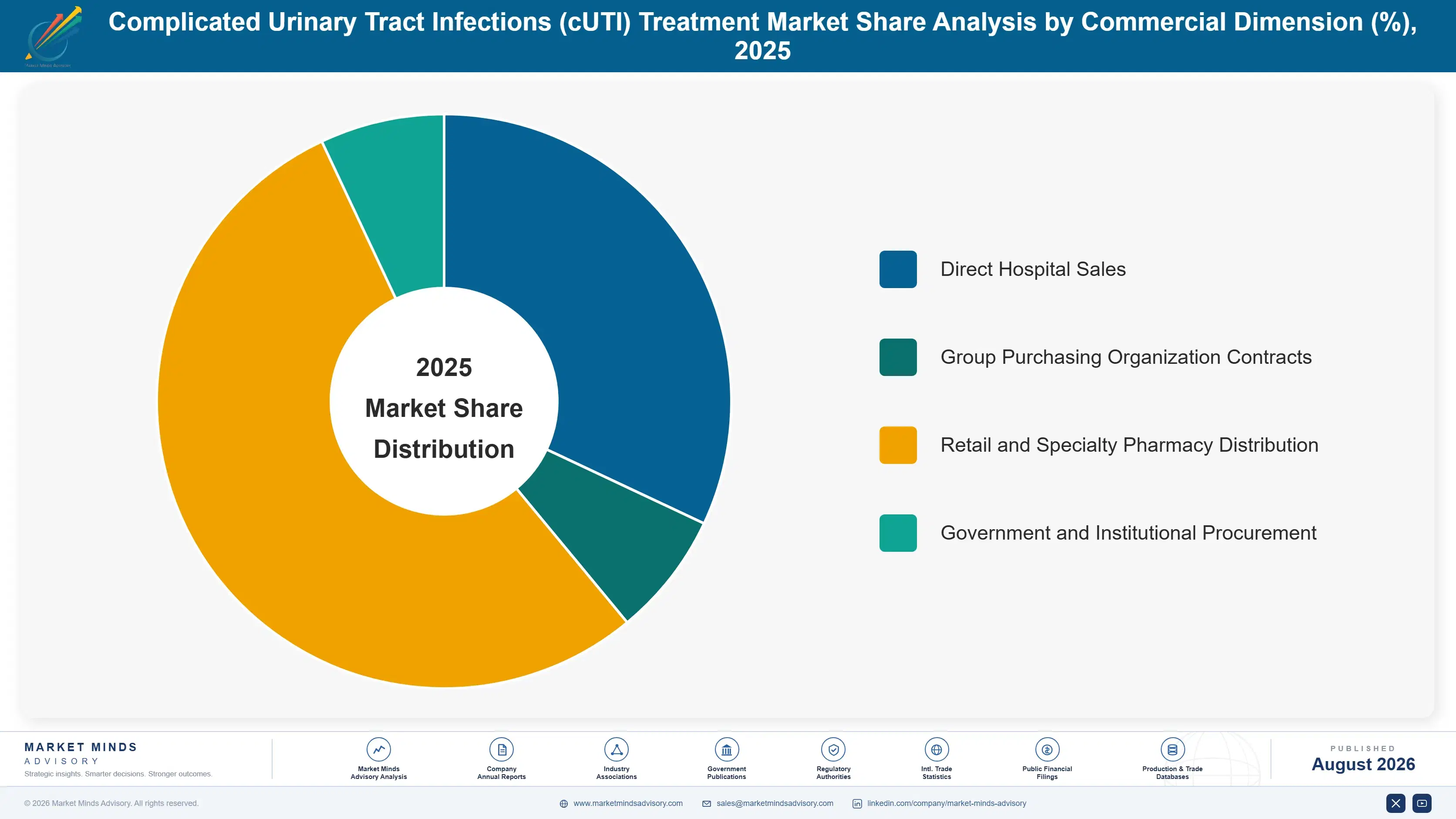
By Commercial Dimension

  • Direct Hospital Sales
  • Group Purchasing Organization Contracts
  • Retail and Specialty Pharmacy Distribution
  • Government and Institutional Procurement

By Region

  • North America
  • Western Europe
  • East Asia
  • South Asia and Pacific
  • Latin America
  • Middle East and Africa
  • Eastern Europe

Scope, Methodology, and Coverage

Every figure in this report is reproducible from documented input assumptions. The scope below maps the historical period, the forecast horizon, the segmentation dimensions, and the countries covered, alongside the underlying primary and qualitative methodology.
Historical Period
2020 to 2025
Forecast Period
2026 to 2036
Base Year
2025 (USD billions; MMA Primary Research Dataset, August 2026)
Market Definition
This report covers pharmaceutical therapies used to treat complicated urinary tract infections associated with structural or functional urinary tract abnormalities, catheterization, or resistant organisms, including beta-lactam and beta-lactamase inhibitor combinations, fluoroquinolones, aminoglycosides, siderophore cephalosporins, novel antimicrobial combination therapies, and oral step-down formulations. It excludes uncomplicated cystitis treatments and non-antimicrobial urinary tract supportive care products. Scope covers global sales revenue of finished cUTI treatment pharmaceuticals.
Quantitative Units
USD billions (current prices); prescription volume where disclosed
Segmentation Dimensions
By Drug Class; By End-Use Setting; By Commercial Dimension; By Region
Regions Covered
North America, Western Europe, East Asia, South Asia and Pacific, Latin America, Middle East and Africa, Eastern Europe
Countries Covered
USA, Canada, Germany, UK, France, Italy, China, Japan, South Korea, Taiwan, India, Pakistan, Bangladesh, Australia, Brazil, Argentina, Colombia, Mexico, Chile, Peru, Saudi Arabia, UAE, South Africa, Egypt, Poland, Czech Republic, Hungary, Romania, and additional markets relevant to this sector
Key Companies Profiled
Pfizer, Merck & Co, Shionogi, Menarini Group, Paratek Pharmaceuticals, GSK, Sanofi, Bayer, Sandoz, Teva Pharmaceutical, Fresenius Kabi, Cipla, Sun Pharmaceutical, Lupin Limited, Wockhardt, Entasis Therapeutics, Spero Therapeutics, Venatorx Pharmaceuticals, Innoviva, Melinta Therapeutics
Quantitative Methodology
Primary survey, n=3,800 respondents, Q4 2025, six countries; demand-side model with trade association cross-validation
Qualitative Methodology
47 expert interviews, Q4 2025; applied to validate demand model assumptions, identify emerging dynamics, and assess competitive positioning
Report Format
PDF and XLSX data workbook (Word format preview document)
Publisher
Market Minds Advisory
Report Code
MMA-2026-HLT-146
Published
August 2026
Contact
sales@marketmindsadvisory.com | www.marketmindsadvisory.com

Purchase the full Complicated Urinary Tract Infections (cUTI) Treatment Market Report (2026 to 2036).

The full report delivers a complete market model spanning 2020 through 2036, with detailed segmentation by drug class, end-use setting, and commercial dimension across all seven global regions. It includes company profiles for the top twenty manufacturers, covering resistance coverage capability, combination therapy technology, and recent corporate developments. Buyers receive access to MMA's underlying primary survey dataset of 3,800 respondents and 47 expert interviews conducted in the fourth quarter of 2025. The report also includes a dedicated API and clinical trial input cost assessment, plus a case study illustrating a real-world resistance coverage adoption engagement.
Full segmentation model across six drug classes
Company profiles for twenty manufacturers with development tracking
Full regional coverage across all seven global markets
Resistance coverage and combination therapy trend assessment
API and clinical trial cost analysis
Ten-year forecast with bull, base, and bear scenarios

Built For The People Who Decide

From boardroom strategy to bench-side execution, this report is read cover-to-cover by leaders shaping the next decade of their industry, turning demand scenarios, market dynamics and valuation benchmarks into decisions.
CXOs/ Presidents/ VPs/ Managers
M&A and Corporate Development
Strategy Teams and R&D Heads
Procurement and Product Directors
Regulatory and Compliance Leaders
Investor Relations and Equity Analysts