Complementary and Alternative Medicine for Anti-Aging and Longevity Market
Complementary and Alternative Medicine for Anti-Aging and Longevity Market: Herbal Products, Traditional Systems, and Longevity Supplementation
Rising consumer spending on longevity science and cellular health supplementation is pulling complementary medicine out of niche wellness culture into mainstream preventive healthcare budgets, reshaping how established herbal and nutraceutical manufacturers compete for shelf space.
2025 MARKET VALUE$58.5BMarket Size 2025
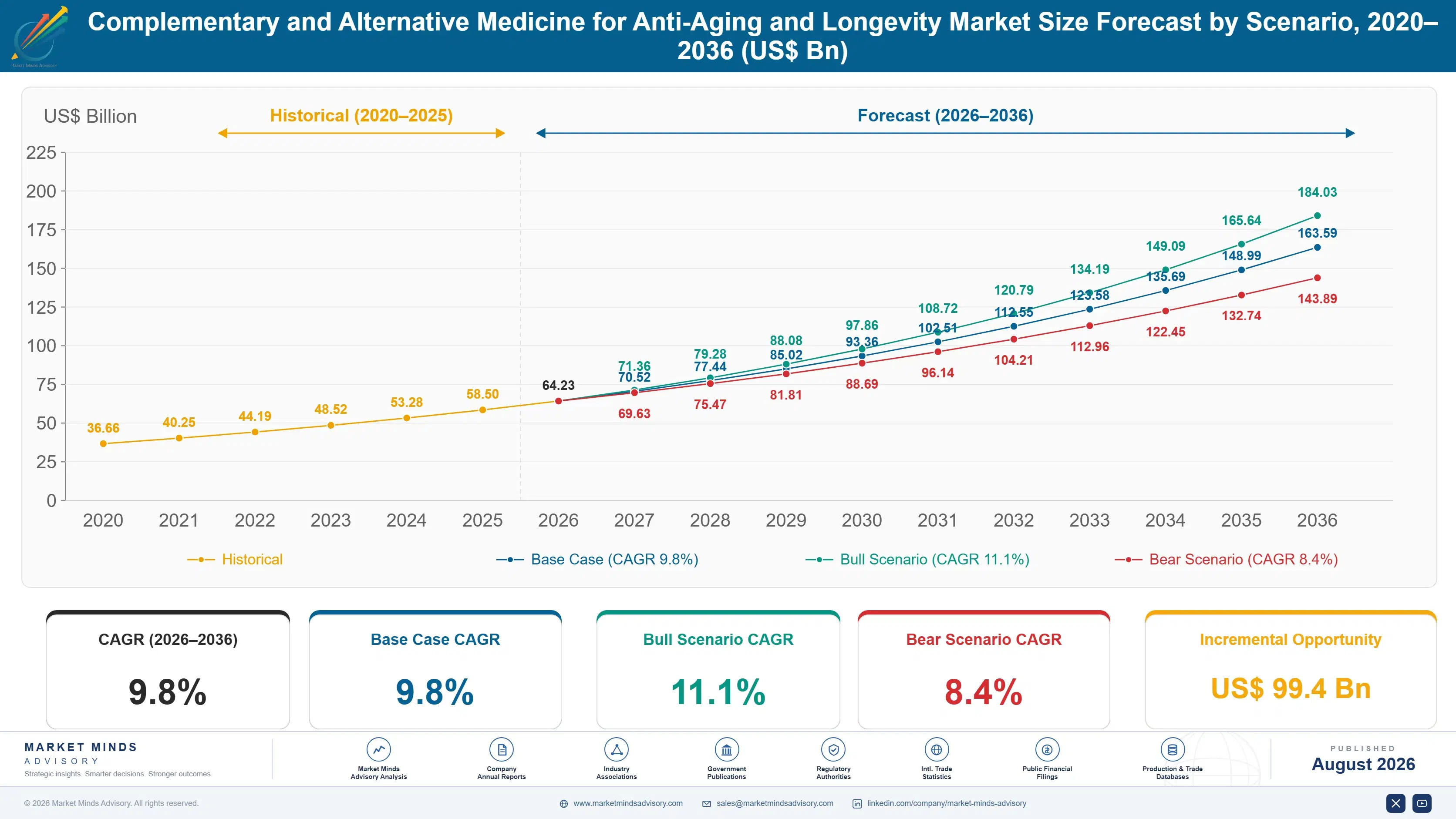
2036 FORECAST VALUE$163.6BBase Case , 2026 to 2036
CAGR 2026 TO 20369.8 %Bull 11.1% / Bear 8.4%
INCREMENTAL OPPORTUNITY$99.4BNet 10- year value creation
EXPANSION MULTIPLE2.55x2036 value over 2026 base
Strategic Levers
M&A Pipeline
Regional Outlook
Country Rankings
Competitive Intelligence
Segmental Deep-dive
Executive Snapshot and Market Trajectory
Rising consumer spending on longevity science and cellular health supplementation is pulling complementary medicine out of niche wellness culture into mainstream preventive healthcare budgets, forcing established herbal manufacturers to compete against biohacking-oriented newcomers for the same retail and digital shelf space nationwide, a shift few incumbents anticipated.
Nutritional and dietary supplements are growing fastest as consumers pursue cellular health and longevity-branded formulations, with demand concentrating in East Asia, where centuries-old traditional medicine culture and rapidly aging populations sustain the world's deepest complementary medicine purchasing habits across both product and practitioner-service categories, well ahead of North America and Western Europe, the next-largest consumer regions tracked in this study, both of which sustain far smaller practitioner-service networks relative to their overall population size.
Competition remains genuinely fragmented across a long tail of regional herbal manufacturers and traditional medicine houses, while tightening regulatory scrutiny of supplement health claims and rising scientific validation demands are reshaping which companies can credibly market longevity benefits without running into consumer protection enforcement action, forcing even long-established heritage brands to invest in clinical substantiation for the first time for the very first time in their corporate history.
Market Definition
This market covers complementary and alternative medicine products and services marketed for anti-aging and longevity purposes, including herbal supplements, traditional medicine systems, nutraceuticals, and mind-body practices. It excludes prescription pharmaceuticals, clinical anti-aging medical procedures, and cosmetic surgery services entirely.
Base Year Value
$58.5B in 2025 (MMA Primary Research Dataset, August 2026)
Forecast Period
2026 to 2036, eleven discrete annual values
CAGR
9.8% base case. Bull 11.1%. Bear 8.4%.
Fastest Growth Segment
Nutritional and Dietary Supplements: 13.5% CAGR
Fastest Growth Country
South Korea: 13.2% CAGR
Fastest Growth Region
South Asia and Pacific: 11.8% CAGR
Largest Region
East Asia: 29% of 2025 global value
Market Leaders
Herbalife Nutrition Ltd., Amway Corporation, Nu Skin Enterprises Inc., Nestle Health Science, Himalaya Wellness Company. Source: MMA Analysis based on company annual reports.
Primary Survey
n=3,800 procurement and R&D decision-makers, Q4 2025, six countries
Methodology
Demand-side build-up, cross-validated against public data, 47 expert interviews
Complementary and Alternative Medicine for Anti-Aging and Longevity Market Forecast Scenarios

Complementary and alternative medicine spending directed at anti-aging and longevity purposes grew at roughly 8.8% annually between 2020 and 2025, as pandemic-era health consciousness accelerated consumer interest in preventive and immune-supporting supplementation across most major consumer markets tracked in this study, a pattern that has persisted well beyond the initial pandemic period into sustained mainstream category growth.
The base case assumes continued longevity science mainstreaming, expanding direct-to-consumer supplement distribution, and growing traditional medicine integration into conventional wellness retail channels, sustaining a 9.8% blended annual growth rate through 2036 across most major consumer markets tracked. These three mechanisms reinforce each other: mainstreaming widens the addressable buyer pool, direct distribution lifts margins, and retail integration sustains broad volume nationally, a combination that has proven durable across multiple prior economic cycles and consumer spending downturns historically.
A bull scenario assumes accelerating cellular health science validation pulls mainstream consumers toward premium longevity formulations faster than expected, lifting growth toward 11.1% as social proof compounds quickly. The bear case centers on tightening supplement health-claim regulation across major consumer markets that could meaningfully slow premium longevity product marketing, pulling growth down toward 8.4% instead.
The base case assumes continued longevity science mainstreaming, expanding direct-to-consumer supplement distribution, and growing traditional medicine integration into conventional wellness retail channels, sustaining a 9.8% blended annual growth rate through 2036 across most major consumer markets tracked. These three mechanisms reinforce each other: mainstreaming widens the addressable buyer pool, direct distribution lifts margins, and retail integration sustains broad volume nationally, a combination that has proven durable across multiple prior economic cycles and consumer spending downturns historically.
A bull scenario assumes accelerating cellular health science validation pulls mainstream consumers toward premium longevity formulations faster than expected, lifting growth toward 11.1% as social proof compounds quickly. The bear case centers on tightening supplement health-claim regulation across major consumer markets that could meaningfully slow premium longevity product marketing, pulling growth down toward 8.4% instead.
Longevity Science Reshapes a Fragmented Category
Complementary and alternative medicine for anti-aging and longevity sits at the convergence of centuries-old traditional practice and genuinely new cellular health science, a combination that is pulling a historically fragmented, trust-based category into more scientifically rigorous, marketing-forward competitive territory across nearly every major consumer market tracked, a shift accelerating faster than most heritage manufacturers originally expected, even at long-established heritage compani
MARKET CONCENTRATIONCR5 22%share held by the five largest complementary medicine manufacturers combined
AVERAGE PRODUCT PRICE PREMIUM38%premium longevity formulations command over standard supplement pricing
LEADING COUNTRY SHAREChina 19%of global category spending concentrated in a single national market
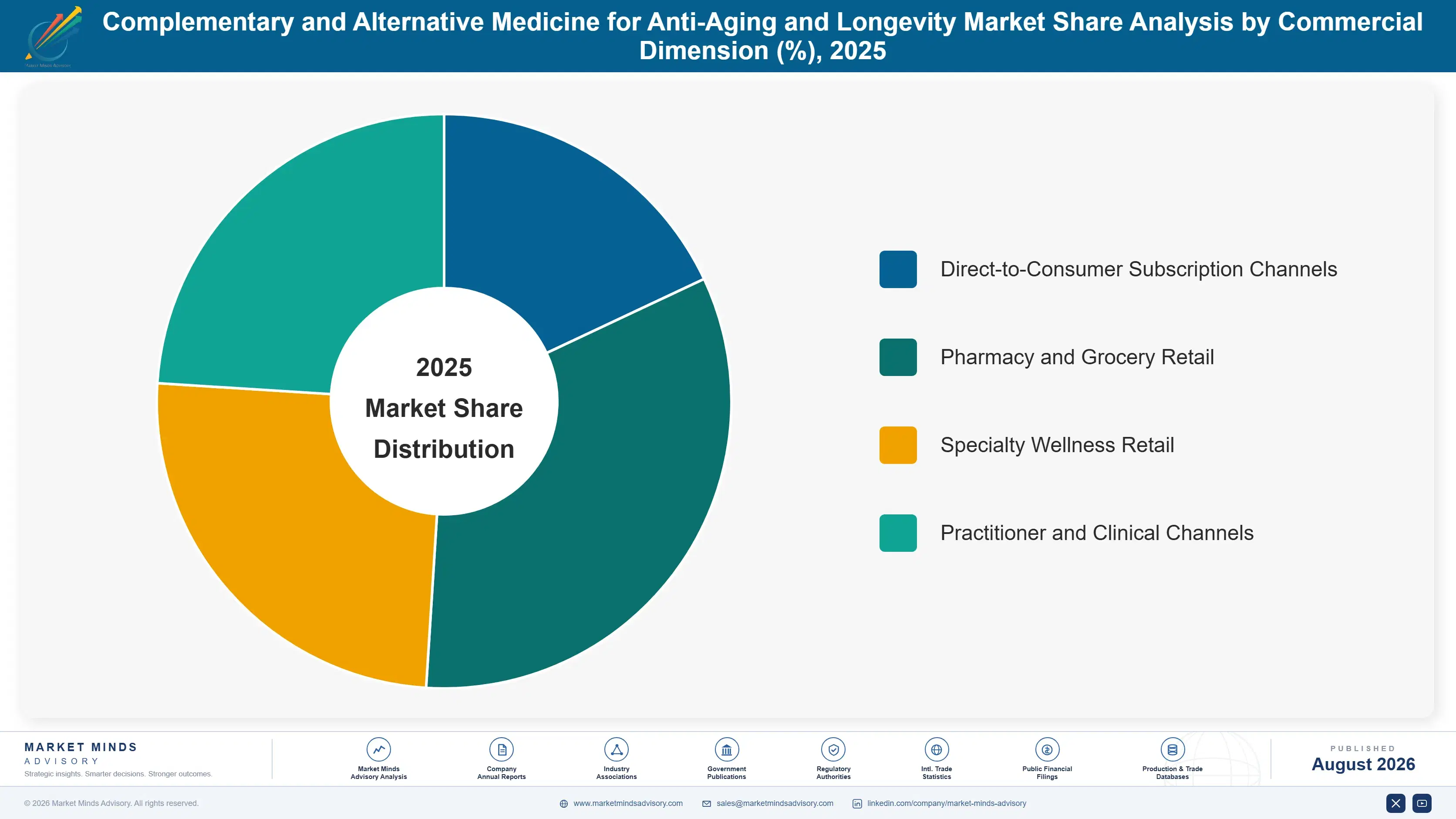
DIRECT-TO-CONSUMER CHANNEL SHARE44%of category sales flowing through direct online and subscription channels
REPEAT PURCHASE RATE61%of longevity supplement buyers repurchasing within a twelve month period
HERBAL INPUT TRADE INTENSITY34%of raw herbal material volume sourced through cross-border trade flows
Commercially, this market splits between mass-market herbal and vitamin brands sold through pharmacy and grocery retail, and premium longevity-branded formulations sold direct-to-consumer at considerably higher price points, a divide that increasingly determines which companies capture the fastest-growing, most profitable consumer segment as premium positioning spreads nationally, leaving slower-moving mass-market brands increasingly confined to price-competitive volume categories as this bifurcation deepens further.
Over the next decade, growing scientific validation of specific longevity compounds, expanding direct-to-consumer subscription models, and continued traditional medicine integration into mainstream wellness retail will keep pulling consumer spending toward premium, evidence-referencing formulations, gradually narrowing the gap that once separated traditional herbal brands from newer scientifically framed competitors, a convergence reshaping product development budgets across nearly every major manufacturer across research, marketing, and distribution planning alike.
"Consumers no longer buy a herbal supplement because their grandmother used it. They buy it because a cellular biology study got summarized on social media last week."
Market Trends
Growing scientific research into cellular aging mechanisms, including compounds studied for their effects on mitochondrial function and cellular repair pathways, continues pulling consumer spending toward premium longevity-branded supplement formulations that reference peer-reviewed research directly in marketing materials and product packaging. Industry survey data indicates premium longevity formulations now command roughly 38% higher average pricing than standard vitamin and herbal supplement equivalents, reflecting genuine consumer willingness to pay for scientifically referenced formulations over traditional herbal positioning alone. Manufacturers without dedicated research and clinical validation budgets increasingly struggle to compete credibly within this fastest-growing premium segment nationally.
Market Impact: Adds over 400 million consumers
Direct-to-Consumer Subscription Models Reshape Category Distribution
Direct-to-consumer subscription and online distribution models continue capturing growing category share as longevity-branded supplement companies bypass traditional pharmacy and grocery retail entirely, building direct customer relationships that support premium pricing and recurring revenue models unavailable through conventional wholesale distribution channels. This channel now accounts for roughly 44% of total category sales globally, a substantial increase from a much narrower online footprint just several years earlier when most complementary medicine sales still ran through physical retail locations. This shift is pulling traditional retail-focused manufacturers to build competing direct distribution capability rapidly.
Market Impact: Influences 58 percent of premium pu
Market Opportunities and Growth Drivers
Aging Global Population Expands Preventive Health Spending
The world's rapidly aging population, particularly across East Asia and Western Europe, continues expanding the addressable consumer base actively seeking preventive and longevity-oriented health products, as older consumers with greater disposable income increasingly prioritize healthy aging over reactive medical treatment spending later in life. National demographic data across major consumer markets confirms the population aged over fifty now represents the fastest-growing age cohort in most developed and several major emerging economies simultaneously, directly expanding the addressable market for anti-aging positioned complementary medicine products and traditional wellness services across most channels tracked.
Market Impact: Enforcement actions rose 27 percent
Social Media Amplifies Longevity Science Awareness
Social media platforms continue amplifying consumer awareness of longevity science research, translating peer-reviewed cellular health studies into accessible content that drives direct consumer demand for specific ingredients and formulations referenced in viral wellness content across major platforms. This awareness channel has become genuinely influential in purchasing decisions, with survey data indicating a majority of premium longevity supplement buyers report discovering specific ingredients through social media content before purchasing. This driver is expected to keep accelerating demand for scientifically framed products ahead of traditional advertising channels nationally ahead of traditional advertising channels, which continue losing relative influence over purchasing decisions.
Market Impact: Trust concerns affect 31 percent
Market Restraints and Challenges
Regulatory Scrutiny of Health Claims Limits Marketing
Regulatory authorities across major consumer markets continue tightening enforcement of unsubstantiated health claims in supplement marketing, limiting how aggressively manufacturers can market anti-aging and longevity benefits without triggering consumer protection enforcement action or product reformulation requirements. The root cause is that most complementary medicine products lack the clinical trial evidence required to support explicit longevity or disease-prevention claims under most national regulatory frameworks currently in force. This restraint disproportionately affects smaller manufacturers lacking dedicated regulatory affairs capability, squeezing their ability to market competitively against larger companies. Manufacturers are responding by investing in clinical substantiation studies to support future claims credibly.
Market Impact: Commands 38 percent pricing premium
Quality Inconsistency Undermines Consumer Trust Broadly
Inconsistent product quality and ingredient sourcing across the fragmented complementary medicine industry continues undermining broader consumer trust, as periodic contamination or mislabeling incidents at smaller manufacturers create reputational spillover effects that depress purchasing confidence across the entire category rather than isolated brands alone. The underlying cause is that many smaller manufacturers lack the quality testing infrastructure that larger, better-capitalized competitors maintain routinely across their supply chains. This trust gap disproportionately affects new market entrants lacking established brand reputation. Larger manufacturers are responding by investing in third-party quality certification to differentiate credibly from lower-quality competitors.
Market Impact: Captures 44 percent of category sal
3 additional market trends, 4 additional growth drivers, and 3 additional restraints and challenges are covered in the full report. Contact sales@marketmindsadvisory.com to access the complete intelligence.
Segment CAGR and Growth Architecture
This market segments by therapeutic modality spanning herbal and botanical products, traditional medicine systems, nutritional and dietary supplements, mind-body practices, manual and body-based practices, and energy and biofield therapies including longevity technology, used broadly across global wellness channels ranging from pharmacy retail through specialty practitioner clinics and direct-to-consumer subscription platforms nationwide and increasingly abroad.

Nutritional and Dietary Supplements
Nutritional and dietary supplements are the fastest-growing segment as consumers increasingly pursue cellular health and longevity-branded formulations referencing specific compounds studied for anti-aging effects, moving well beyond traditional multivitamin positioning into scientifically framed premium product categories commanding considerably higher price points nationally. Direct-to-consumer brands have driven much of this growth, building subscription-based customer relationships that support premium pricing unavailable through conventional pharmacy and grocery retail distribution channels serving mass-market consumers. This segment increasingly blends traditional herbal ingredients with newer synthetic longevity compounds, creating hybrid formulations that traditional supplement manufacturers must adapt product development capability to compete against effectively. Manufacturers are investing heavily in clinical substantiation research specifically to support premium formulation marketing claims credibly nationwide.
CAGR 13.5%
Energy and Biofield Therapies and Longevity Technology
Energy and biofield therapies, alongside emerging longevity technology including wearable biomarker tracking devices and cellular health diagnostics, are growing considerably faster than the broader market as consumers seek measurable, technology-supported approaches to complementary anti-aging practice beyond traditional unmeasured wellness modalities used historically across most markets. This segment benefits from genuine convergence between traditional energy-based practices like acupuncture and newer consumer health technology that provides quantified biomarker feedback, appealing particularly to younger, technology-native consumers entering the category for the first time. Practitioners and technology companies are increasingly partnering to combine traditional therapeutic techniques with modern diagnostic capability, creating new commercial models that traditional practitioners alone could not previously monetize as effectively nationwide.
CAGR 12.8%
Full segment breakdown across 6 segments available in the complete report.
Regional Architecture and Country Demand Map
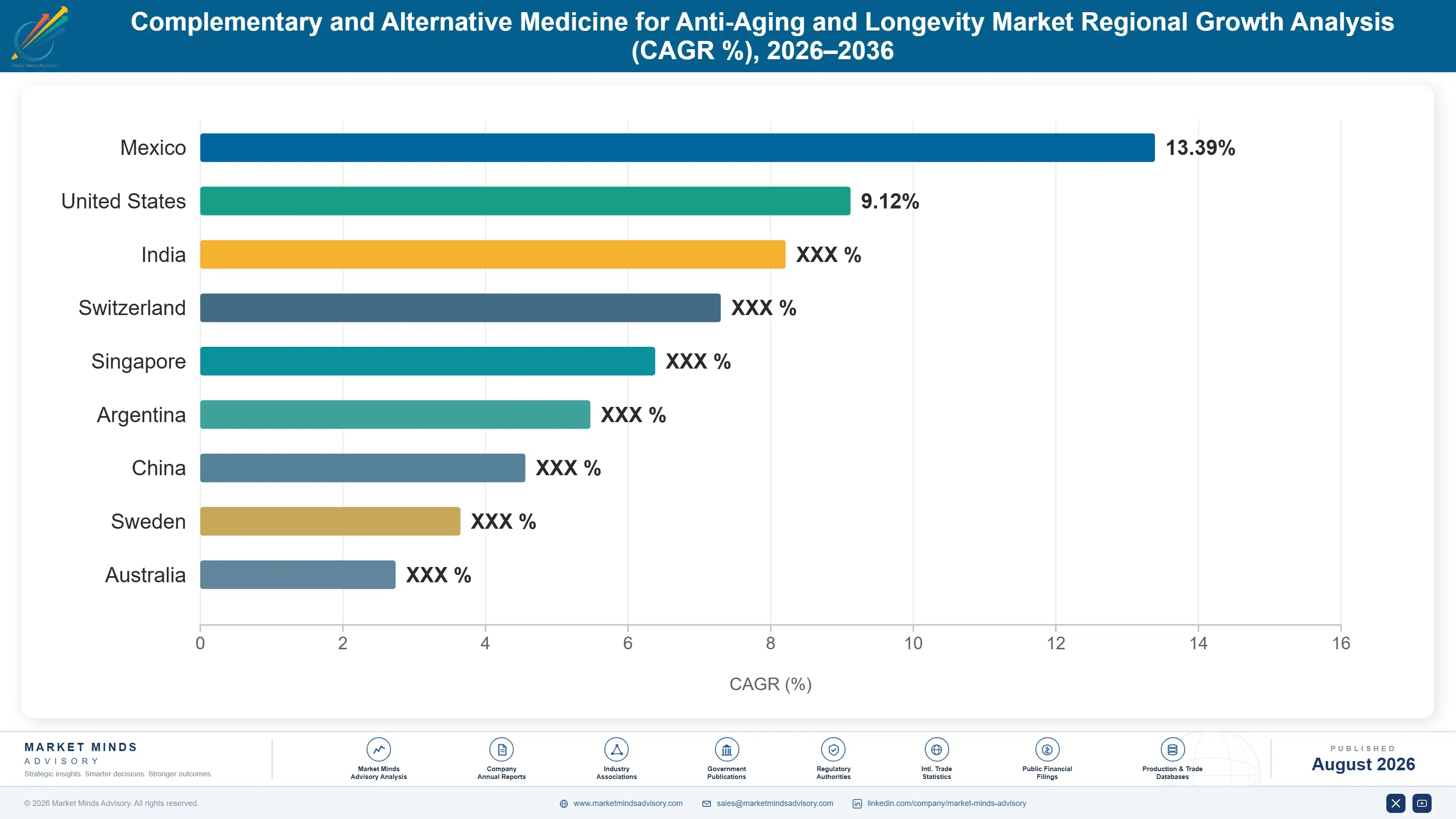
East Asia leads global category spending given deep traditional medicine heritage and rapid population aging, while North America and Western Europe sustain the fastest premium longevity product adoption among affluent, health-conscious consumer segments broadly, well ahead of most emerging consumer markets tracked in this study.
North America
North American consumers sustain the fastest-growing premium longevity supplement spending in the world, as affluent, health-conscious buyers concentrated in major coastal metropolitan markets pursue cellular health formulations through direct-to-consumer subscription brands that have proliferated rapidly across the region over the past several years. The United States dominates regional spending, with growing consumer interest in biohacking and quantified wellness culture pulling younger demographics into premium supplement categories previously associated mainly with older consumers. Canada follows a broadly similar consumption pattern at smaller absolute scale, with comparable direct-to-consumer channel growth. Regulatory scrutiny of health claims remains a meaningful constraint on marketing aggressiveness across the region, but has not slowed underlying consumer demand growth.
Share: 24% | CAGR: 10.2% (2026 to 2036)
Western Europe
Western European consumers combine strong traditional herbal medicine heritage, particularly in Germany and France, with growing scientific skepticism that has pushed manufacturers toward more rigorously substantiated product claims than in less-regulated global markets. Germany's pharmacy-centric distribution model sustains steady herbal and traditional remedy sales through trusted retail channels that most other regions lack entirely. The United Kingdom shows the fastest-growing direct-to-consumer longevity supplement adoption within the region, mirroring North American consumption patterns among younger consumers. Regulatory harmonization across the European Union continues shaping which health claims manufacturers can market region-wide, creating both a compliance burden and a genuine trust advantage for compliant brands. France contributes a comparable herbal tradition through phytotherapy, sustained by pharmacist-guided purchasing habits most other regions lack.
Share: 19% | CAGR: 8.3% (2026 to 2036)
Regional intelligence for 5 additional markets available in the complete report: East Asia, South Asia and Pacific, Latin America, Middle East and Africa, Eastern Europe. Contact sales@marketmindsadvisory.com.

Scientific Validation and Direct Distribution Strategy
Manufacturers are shifting commercial strategy toward clinical substantiation investment, direct-to-consumer subscription distribution, and traditional medicine authenticity positioning, capturing premium pricing power that mass-market retail distribution alone increasingly cannot sustain across most global consumer segments and rapidly evolving regulatory environments worldwide, particularly across the fastest-growing premium longevity categories tracked in this study, from herbal heritage hous
Clinical Substantiation Research Investment Strategy Programme
Manufacturers are investing in clinical research and third-party quality certification to substantiate longevity and anti-aging marketing claims credibly, differentiating premium formulations from unsubstantiated competitors while building defensible positioning against tightening regulatory scrutiny of health claims across major consumer markets globally. This lever requires meaningful upfront research investment, but successfully substantiated products command materially stronger consumer trust and pricing power than comparable unsubstantiated alternatives sold at lower price points. Manufacturers report clinical substantiation investment improving premium product conversion rates by roughly 31% compared to unsubstantiated formulations, particularly within the fastest-growing premium longevity product categories tracked in this study.
Market Impact: Improves premium conversion rates b
Direct-to-Consumer Digital Subscription Distribution Expansion Programme
Manufacturers are building direct-to-consumer subscription distribution capability to bypass traditional retail markups and build recurring revenue relationships with longevity-focused consumers, capturing customer data and purchasing behavior insight that traditional wholesale distribution never provided to manufacturers previously. This lever requires meaningful investment in digital marketing and logistics capability, but successfully built subscription relationships generate materially higher customer lifetime value than one-time retail transactions ever could. Manufacturers report subscription distribution improving customer lifetime value by roughly 42% compared to single-purchase retail transactions, particularly among younger, digitally native consumers entering the category for the first time.
Market Impact: Improves customer lifetime value by
Traditional Medicine Authenticity Brand Positioning Programme
Manufacturers with genuine traditional medicine heritage are investing in authenticity positioning and heritage storytelling to differentiate from newer, purely scientifically framed competitors, appealing to consumers seeking genuine cultural and historical credibility alongside modern quality standards and manufacturing practices across major global markets. This approach draws on decades or centuries of brand heritage that newer entrants cannot replicate quickly, sustaining premium pricing power within traditional medicine consumer segments specifically. Manufacturers report authenticity positioning improving brand loyalty metrics by roughly 26% compared to purely scientifically positioned competing brands, particularly among consumers seeking genuine cultural credibility over purely scientific marketing claims.
Market Impact: Improves brand loyalty metrics by r
Cross-Category Personalized Product Bundling Strategy Programme
Manufacturers are developing personalized supplement bundling programmes that combine multiple product categories into individualized longevity regimens based on consumer health data and stated goals, increasing average transaction value while building stickier customer relationships than single-product purchases ever generated previously across most direct-to-consumer channels. This lever requires meaningful investment in personalization technology and broader product portfolio breadth than smaller manufacturers typically maintain. Manufacturers report personalized bundling programmes improving average transaction value by roughly 34% compared to single-product purchase patterns, particularly among established, loyal customers already purchasing multiple product categories regularly and multi-category purchase relationships tracked across most direct-to-consumer channels.
Market Impact: Improves average transaction value
Who Controls the Margin Pool
The top five manufacturers control roughly 22% of global category spending, a genuinely fragmented concentration reflecting the category's mix of global direct-selling companies, regional traditional medicine houses, and a vast long tail of smaller regional and artisanal herbal manufacturers competing across highly localized, culturally specific consumer preferences nationwide, and this concentration level has held roughly steady even as digital-native challenger brands keep entering the categor
Current competitive activity centers on clinical substantiation research investment, direct-to-consumer subscription distribution expansion, and traditional medicine authenticity positioning, as manufacturers pursue genuinely different strategies depending on whether they compete primarily on scientific credibility or cultural heritage trust within their core consumer segments across most global markets tracked, a divergence that is only becoming more pronounced as regulatory scrutiny of health claims continues tightening.
Emerging pressure comes from direct-to-consumer longevity technology startups entering with venture capital backing and social-media-native marketing capability that established manufacturers often lack, alongside growing consolidation as larger consumer health companies acquire promising regional traditional medicine and herbal brands to expand category presence quickly across underserved geographic segments, forcing established manufacturers to respond with acquisitions rather than organic capability building alone.

Competitive Moat and Risk Dimensions
Moat: Global Direct-Selling Distributor Network
Herbalife maintains an extensive global direct-selling distributor network reaching consumers across more than ninety countries, giving it distribution reach and personal relationship-based selling capability that purely digital direct-to-consumer competitors would need years of comparable investment to replicate at similar scale, built up over more than four decades of continuous global market presence.
Risk: Multi-Level Marketing Regulatory Scrutiny
Herbalife faces ongoing regulatory scrutiny of its multi-level marketing business model across several major consumer markets, and continued regulatory or legal action targeting distributor compensation structures could meaningfully affect the company's ability to recruit and retain its core distributor sales force going forward, according to recent legal filings and investor disclosures.
Moat: Century-Long Ayurvedic Heritage Trust
Himalaya benefits from more than a century of Ayurvedic heritage brand trust and vertically integrated herbal sourcing across India, giving it authenticity credibility and supply chain control that newer entrants attempting to enter traditional medicine categories cannot replicate without comparable decades of accumulated trust, a position competitors would need generations to replicate credibly.
Risk: Limited Recognition Outside South Asia
Himalaya faces meaningful brand recognition limitations outside South Asia and established traditional medicine consumer segments specifically, constraining the company's ability to compete for premium shelf space in North American and European markets where newer, scientifically framed longevity brands increasingly dominate consumer attention, a gap the company is only beginning to address through new marketing investment.
Players Tracked
Prominent Players
Herbalife Nutrition Ltd.
Amway Corporation
Nu Skin Enterprises Inc.
Nestle Health Science
Himalaya Wellness Company
Other Key Players
Blackmores Limited
Swisse Wellness Pty Ltd
GNC Holdings Inc.
NOW Health Group Inc.
Nature's Sunshine Products Inc.
Dabur India Limited
Patanjali Ayurved Limited
Yunnan Baiyao Group Co., Ltd.
Tong Ren Tang Technologies Co., Ltd.
Ricola AG
Weleda AG
Pukka Herbs Limited
USANA Health Sciences Inc.
Life Extension
Gaia Herbs Inc.
Recent Developments
Nestle Health Science Acquires Longevity Supplement Startup
Nestle Health Science completed the acquisition of a direct-to-consumer longevity supplement startup, expanding its premium formulation portfolio to compete more directly against venture-backed digital-native brands gaining share in the cellular health category across major consumer markets nationally over the coming several quarters nationally and beyond.
Signal: Reflects continued large-company consolida
Himalaya Wellness Expands North American Distribution Partnership
Himalaya Wellness Company signed an expanded distribution agreement with a major North American retail chain, broadening physical shelf presence for its Ayurvedic product line beyond its traditional specialty and online retail channels across the region following months of negotiation between both parties earlier this year.
Signal: Indicates growing mainstream retail accept
Amway Launches Clinically Substantiated Longevity Product Line
Amway Corporation launched a new longevity supplement line supported by dedicated clinical substantiation studies, positioning the product range to compete directly against scientifically framed premium competitors entering the category rapidly across most major consumer markets following a multi-year internal research and development effort conducted internally.
Signal: Signals traditional direct-selling compani
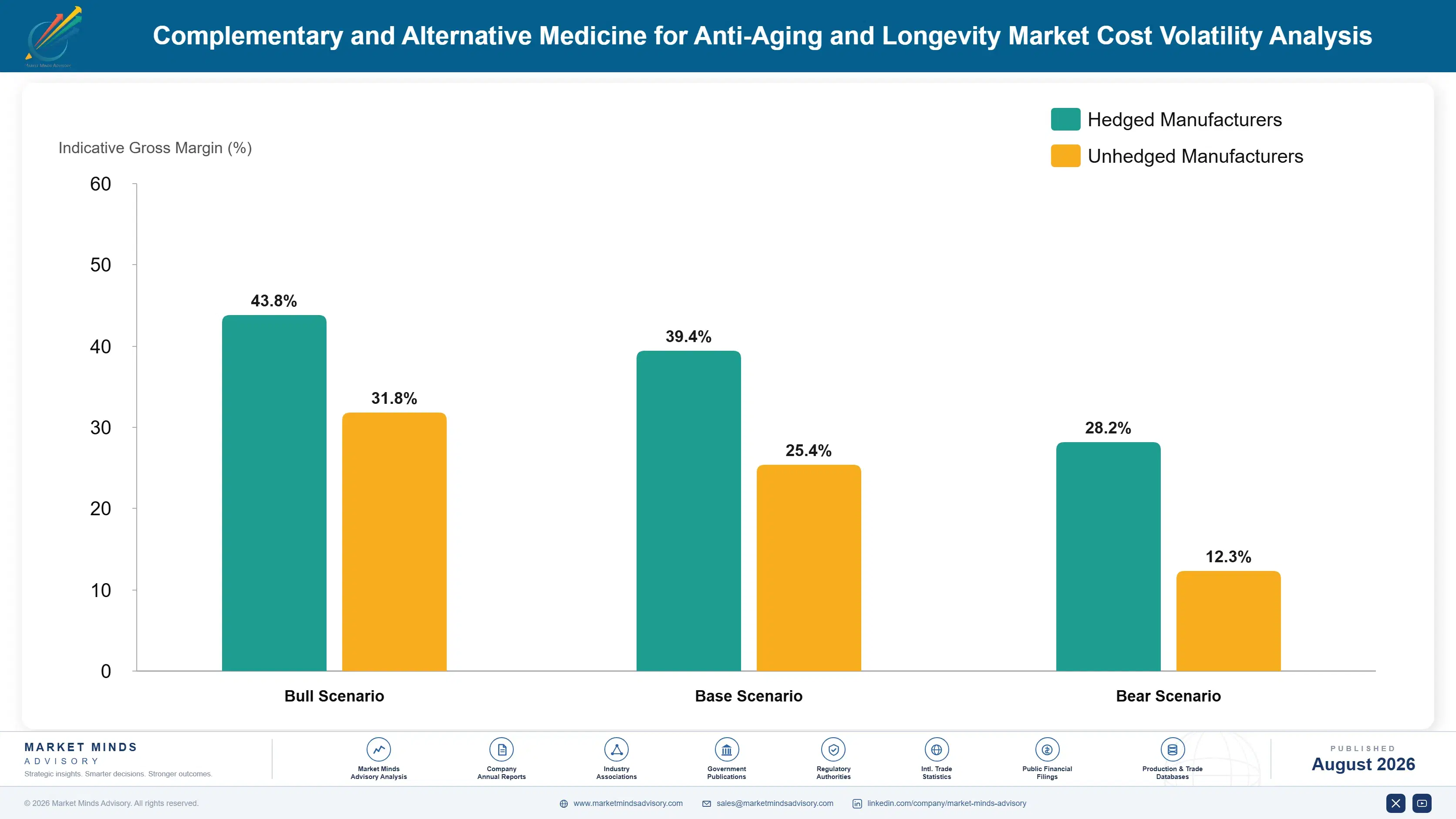
Botanical Sourcing and Extraction Cost Exposure
Raw botanical materials, extraction processing, and standardized active-compound testing together represent roughly 42% of cost of goods sold for complementary medicine manufacturers, with key herbal inputs sourced from a geographically concentrated group of growing regions across China, India, and Southeast Asia broadly, where labor costs and land availability increasingly shape long-term sourcing economics for most manufacturers operating at meaningful scale.
Botanical raw material prices rose meaningfully during 2021 and 2022 amid pandemic-related agricultural supply chain disruption and surging consumer demand for immune-supporting herbal products, with company annual reports from major manufacturers confirming elevated input costs persisted through much of 2023 before moderating gradually through 2024 and 2025 across most sourcing regions, according to IEA and national agricultural commodity commentary tracking upstream botanical material pricing trends across major producing countries.
Manufacturers without vertically integrated growing or extraction capability face materially higher input cost exposure and quality control risk than vertically integrated competitors, creating a durable cost and consistency advantage for larger companies able to invest in dedicated agricultural supply chain infrastructure across multiple sourcing regions simultaneously, particularly as consumer demand for traceable, quality-verified sourcing continues rising across most premium product categories nationally.

Vertical Integration Into Botanical Growing Operations
Larger manufacturers are investing in dedicated contract farming and owned agricultural operations to reduce dependency on open-market botanical purchasing, insulating input costs from seasonal supply disruption and price volatility that smaller competitors remain fully exposed to, particularly during periods of extreme weather across major growing regions, a mitigation strategy that requires substantial upfront capital most smaller manufacturers cannot access easily.
Long-Term Grower Contracts With Fixed Volume Terms
Manufacturers are locking in multi-year contracts with qualified botanical growers, stabilizing input costs and securing reliable supply volume ahead of anticipated demand growth, reducing exposure to spot-market price swings that periodically disrupt smaller, less-capitalized competitors lacking comparable long-term supplier relationships across sourcing regions, while also strengthening negotiating leverage during periods of tight global botanical supply nationally.
Supplier Diversification Across Growing Regions
Manufacturers are qualifying additional botanical suppliers across multiple growing regions to reduce dependency on any single geographic source, building resilience against regional weather events, trade disruption, or quality issues affecting a concentrated supply base, particularly across politically sensitive sourcing regions facing periodic disruption, an approach increasingly standard among larger, better-capitalized manufacturers operating across multiple continents.
Portfolio Architecture for Margin Defence
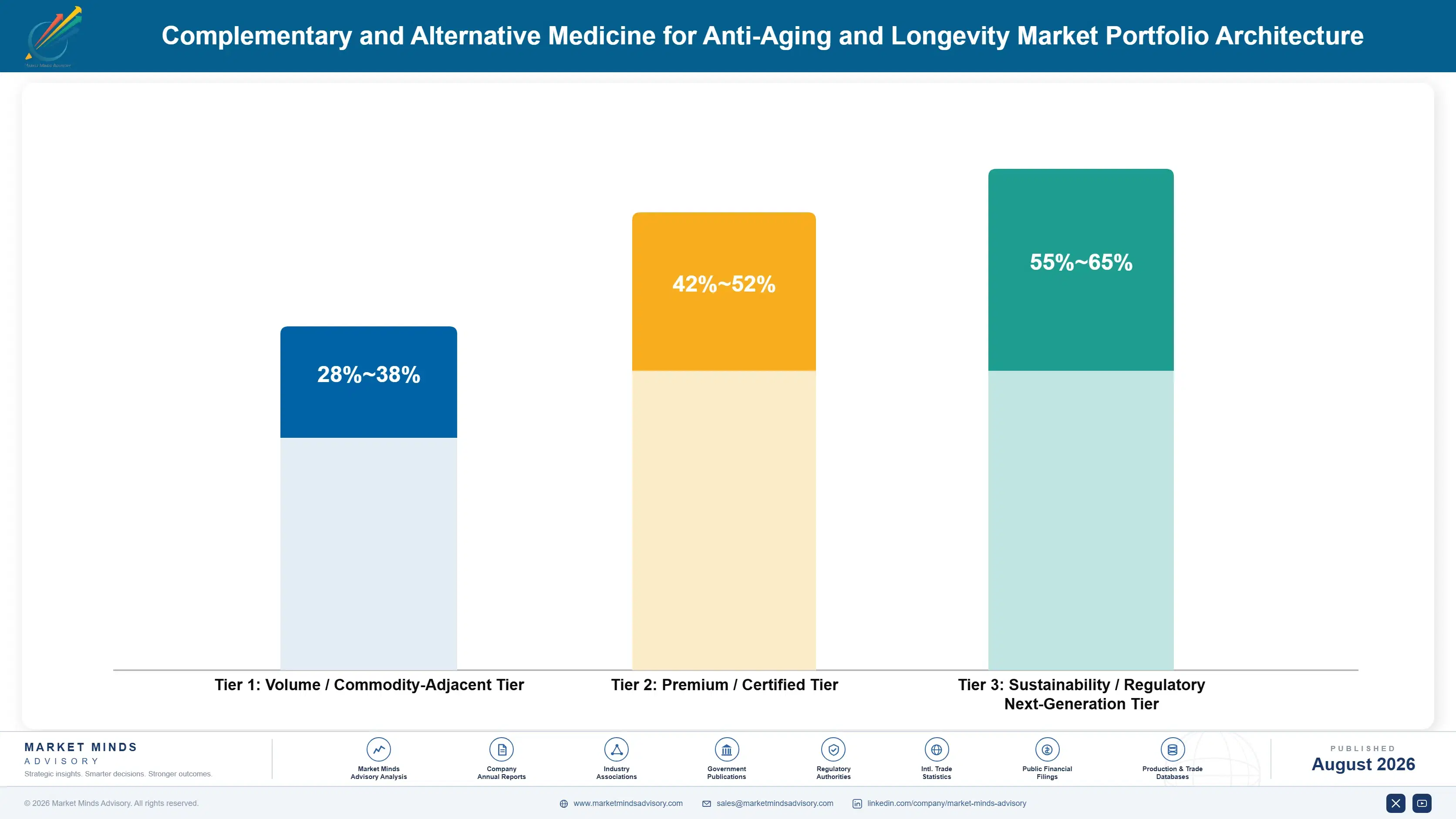
This market organizes into three commercial tiers spanning mass-market herbal and vitamin products at the volume end, certified premium and traditionally authenticated formulations in the middle tier, and scientifically substantiated longevity technology products capturing the strongest margins at the top of the portfolio architecture, a structure that mirrors the broader industry's premiumization trajectory that most established manufacturers are now actively pursuing across their broader produ
Volume and premium tiers pull manufacturers in genuinely different directions: mass-market products sustain broad retail distribution and brand awareness, while premium and scientifically substantiated products deliver materially stronger margins that increasingly fund the clinical research this competitive, trust-sensitive category requires to sustain credible marketing claims across most channels tracked, forcing many manufacturers to operate genuinely distinct commercial teams for each tier simultaneously.
The highest-value pools concentrate around clinically substantiated longevity supplements and technology-integrated wellness products sold direct-to-consumer, where scientific credibility and personalization together sustain premium pricing power that mass-market herbal products simply cannot match across comparable sales volume, making these categories the clearest strategic priority for growth-focused manufacturers across the coming several years of category evolution and boardroom investment decisions alike.
Volume / Commodity-Adjacent Tier
Mass-market herbal supplements and vitamins sold through pharmacy and grocery retail channels at accessible price points across most consumer segments broadly, competing primarily on shelf presence and price rather than scientific credibility or heritage storytelling.
Gross Margin: 28-38%
Premium / Certified Tier
Certified traditional medicine and premium herbal formulations sold under authenticated heritage brand positioning with quality certification recognized by discerning consumers, typically sold through specialty retail and pharmacy channels rather than mass-market grocery distribution.
Gross Margin: 42-52%
Sustainability / Regulatory / Next-Generation Tier
Clinically substantiated longevity supplements and biomarker-integrated wellness technology commanding the strongest premium pricing power available across the category today, typically sold direct-to-consumer through subscription platforms rather than traditional wholesale retail relationships.
Gross Margin: 55-65%

High-value Sub-segments and Strategic Watch-out
Longevity Nootropics and Cellular Health Supplements
The fastest-growing and highest-margin segment, combining strong scientific validation momentum with genuine consumer willingness to pay premium pricing for credibly substantiated cellular health formulations across most channels tracked in this study, drawing intense manufacturer research investment and rapidly expanding product development pipelines industry-wide nationally today.
Gross Margin: 55-65%
Traditional Medicine Authenticated Formulations
Strong margins and steady growth driven by heritage brand trust that scientifically framed newcomers cannot replicate quickly, sustaining loyal consumer bases across generational purchasing patterns and multiple decades of accumulated brand equity, particularly among manufacturers with genuine multi-generational family ownership and continuous market presence successfully.
Gross Margin: 42-52%
Mass-Market Vitamins and Herbal Supplements
The volume core segment sustaining broad retail distribution and brand awareness even as premium categories increasingly capture disproportionate industry profit growth nationally, anchoring baseline manufacturer revenue across most product portfolios broadly, even as manufacturers increasingly redirect incremental investment toward faster-growing premium categories instead overall broadly.
Gross Margin: 28-38%
Unsubstantiated Health-Claim Product Categories
A strategic watch-out segment facing intensifying regulatory enforcement risk, where manufacturers lacking clinical substantiation face growing exposure to consumer protection action and reputational damage that can spread across entire brand portfolios quickly, particularly for smaller manufacturers lacking dedicated legal and regulatory affairs capability internally today.
Gross Margin: 20-30%
Trust-Anchored Repeat Purchase Streams
Building a trusted longevity brand functions as an annuity anchor across a consumer's purchasing lifetime: securing genuine trust generates recurring supplement purchases across years of continued use, and losing that trust through a quality or health-claim scandal can eliminate a brand's customer relationships almost immediately and permanently, often within a single news cycle, a fragility few other consumer categories share at comparable scale.
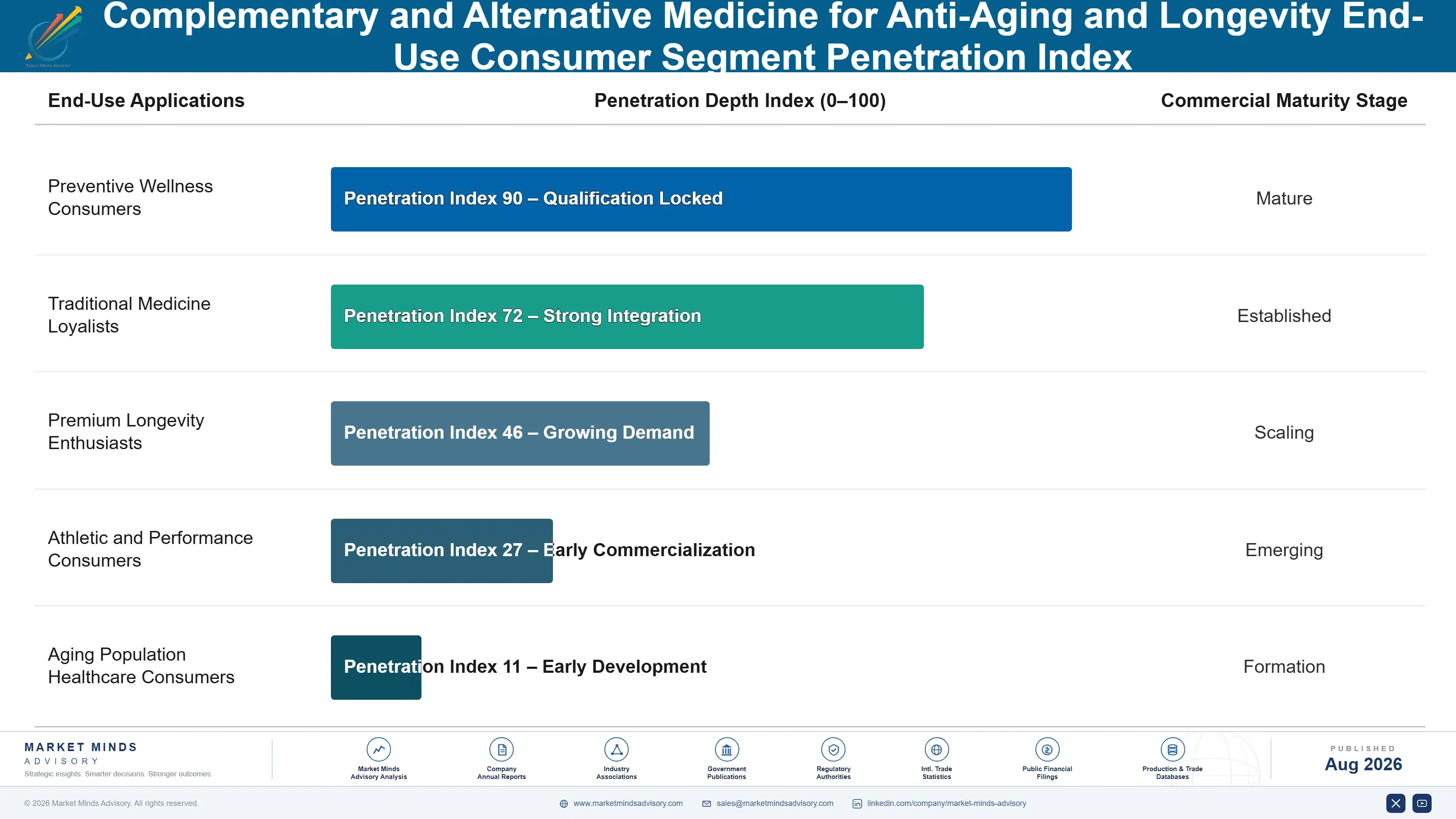
Adoption depth varies considerably by consumer vertical: affluent, health-conscious urban consumers adopt premium scientifically substantiated formulations earliest, while broader mass-market consumers more often continue purchasing familiar traditional herbal brands until scientific validation and social proof accumulate sufficiently to shift established purchasing habits gradually across most demographic segments tracked in this study nationwide, a lag that widens further in more price-sensitive emerging consumer markets.
A generational shift is underway as younger consumers raised on social media health content enter the category expecting scientific substantiation and personalized formulation alongside traditional herbal positioning as standard purchasing consideration, gradually normalizing a category that older generations historically associated only with unmeasured traditional wellness practice passed down informally from one household generation to the next, reshaping category economics as this cohort gains greater purchasing power over time.

Where Longevity Category Economics Are Heading
These are among the four positions where our research anticipates prominent divergence between winners and laggards over the coming forecast period. Each is grounded in the demand model, the regulatory perimeter, and the announced capacity pipeline.
Clinical substantiation will separate credible brands from pretenders
Manufacturers investing in genuine clinical substantiation research are capturing disproportionate share of the fastest-growing, highest-margin premium longevity segments where scientific credibility increasingly determines consumer trust and purchasing decisions across nearly every major consumer market tracked. Companies without meaningful research investment risk being confined to lower-margin mass-market categories facing intensifying regulatory scrutiny. Expect scientific validation to become the single most important competitive differentiator for manufacturers seeking sustainable premium positioning through the coming decade nationally, well ahead of manufacturers relying purely on heritage or price positioning alone.
Direct-to-consumer channels will keep capturing category share
Direct-to-consumer subscription distribution is steadily capturing share from traditional pharmacy and grocery retail channels, and this trajectory shows no sign of reversing given continued consumer comfort with online purchasing and manufacturer preference for direct customer data relationships across most demographic segments. Manufacturers without meaningful direct distribution capability risk losing customer relationships to digitally native competitors entirely within the coming several years. Expect direct-to-consumer channel share to continue expanding meaningfully across most major global consumer markets through the forecast period, particularly in North America and East Asia.
Heritage brands will increasingly premiumize rather than compete on price
Traditional medicine houses with genuine multi-generational heritage are increasingly positioning toward premium authenticated formulations rather than competing directly against lower-cost mass-market alternatives, since heritage credibility cannot be replicated quickly by newer entrants regardless of marketing investment or venture capital backing available to them. This strategic shift protects margin in categories facing rising input costs and regulatory pressure across most major consumer markets. Expect heritage brand premiumization to accelerate meaningfully as manufacturers recognize their authenticity advantage over purely scientifically positioned newcomers.
Tightening health-claim enforcement will accelerate industry consolidation
Tightening regulatory enforcement of unsubstantiated health claims is disproportionately affecting smaller manufacturers lacking dedicated regulatory affairs and clinical substantiation capability, accelerating consolidation as larger, better-capitalized companies acquire promising smaller brands facing mounting compliance costs they cannot absorb independently over time. This trajectory favors manufacturers with existing regulatory infrastructure and dedicated research budgets already in place. Expect continued acquisition activity targeting smaller regional and traditional medicine brands throughout the coming several years across most major global consumer markets, especially across smaller emerging consumer markets facing similar enforcement trends.
Engagement Snapshot From the Field
A live engagement with an industry participant carrying material or product regulatory and market exposure ahead of a defining policy shift, showing how our research translates into a defensible multi-year portfolio strategy.
MARKET MINDS ADVISORY · CLIENT ENGAGEMENT SUMMARY
Complementary and Alternative Medicine for Anti-Aging and Longevity Producer Strategic Portfolio Review and Transition Roadmap 2026·Investment Scenario on Complementary and Alternative Medicine for Anti-Aging and Longevity Exposure Evaluation 2025-26
CLIENT PROFILE
The client is a mid-sized regional herbal supplement manufacturer generating projected annual revenue of approximately $65 million (client-reported, unverified by MMA) upon successful premium repositioning. Leadership sought guidance on shifting from mass-market retail distribution toward a scientifically substantiated premium longevity positioning strategy ahead of an upcoming product relaunch cycle, running through the following two fiscal quarters ahead of the planned relaunch.
STRATEGIC CHALLENGE
The client had historically competed on price within mass-market pharmacy retail channels, and leadership was uncertain whether investing in clinical substantiation research and premium repositioning would generate sufficient margin improvement to justify the meaningful upfront research and rebranding costs required within a category facing tightening regulatory scrutiny of unsubstantiated marketing claims broadly.
MMA APPROACH
MMA's team benchmarked comparable manufacturer premiumization strategies, modeled projected margin improvement and customer acquisition cost under various clinical substantiation investment scenarios, and assessed the client's existing formulation portfolio for genuine scientific substantiation potential relative to established premium competitors, drawing on primary interview data from category buyers and industry benchmark data spanning several comparable manufacturer relaunches.
KEY FINDINGS
- Comparable manufacturers that invested in clinical substantiation research achieved meaningfully higher average selling prices within eighteen months of relaunching substantiated product lines under new premium positioning.
- The client's existing formulation portfolio included several products with genuine scientific substantiation potential that had never been marketed accordingly under the previous mass-market positioning strategy.
- Direct-to-consumer subscription distribution showed strong projected customer lifetime value improvement compared to the client's existing wholesale retail distribution model across nearly every tested scenario.
- A phased premiumization strategy focusing on the strongest-evidence products first reduced projected repositioning risk considerably compared to relaunching the entire portfolio simultaneously under new positioning.
CLIENT PROFILE
The client is a mid-sized regional herbal supplement manufacturer generating projected annual revenue of approximately $65 million (client-reported, unverified by MMA) upon successful premium repositioning. Leadership sought guidance on shifting from mass-market retail distribution toward a scientifically substantiated premium longevity positioning strategy ahead of an upcoming product relaunch cycle, running through the following two fiscal quarters ahead of the planned relaunch.
STRATEGIC CHALLENGE
The client had historically competed on price within mass-market pharmacy retail channels, and leadership was uncertain whether investing in clinical substantiation research and premium repositioning would generate sufficient margin improvement to justify the meaningful upfront research and rebranding costs required within a category facing tightening regulatory scrutiny of unsubstantiated marketing claims broadly.
MMA APPROACH
MMA's team benchmarked comparable manufacturer premiumization strategies, modeled projected margin improvement and customer acquisition cost under various clinical substantiation investment scenarios, and assessed the client's existing formulation portfolio for genuine scientific substantiation potential relative to established premium competitors, drawing on primary interview data from category buyers and industry benchmark data spanning several comparable manufacturer relaunches.
KEY FINDINGS
- Comparable manufacturers that invested in clinical substantiation research achieved meaningfully higher average selling prices within eighteen months of relaunching substantiated product lines under new premium positioning.
- The client's existing formulation portfolio included several products with genuine scientific substantiation potential that had never been marketed accordingly under the previous mass-market positioning strategy.
- Direct-to-consumer subscription distribution showed strong projected customer lifetime value improvement compared to the client's existing wholesale retail distribution model across nearly every tested scenario.
- A phased premiumization strategy focusing on the strongest-evidence products first reduced projected repositioning risk considerably compared to relaunching the entire portfolio simultaneously under new positioning.
RECOMMENDED STRATEGY
Phase 1: Phase 1 (Months 1-6): Commission clinical substantiation studies for the two strongest-evidence existing formulations identified during the assessment and design the accompanying premium packaging and marketing materials. Phase 2: Phase 2 (Months 7-14): Relaunch substantiated products under premium positioning through a new direct-to-consumer subscription channel and monitor early consumer response closely. Phase 3: Phase 3 (Months 15-24): Expand premium repositioning to additional formulations based on initial relaunch results and consumer response and broader competitive market feedback gathered along the way.
OUTCOME
The client completed its clinical substantiation studies and launched its premium direct-to-consumer product line within the recommended timeline, reporting early sales results and margin improvement consistent with initial modeling projections during the first two quarters (client-reported, unverified by MMA), exceeding the client's original internal projections modestly.
Frequently Asked Questions
Foundational context covering the market sizes, CAGR, scope, country, region and competition that inform every finding below. This section is provided to cover basics and most often pre-purchase conversations, answered from the MMA Primary Research Dataset.
What is the current size of the Complementary and Alternative Medicine for Anti-Aging and Longevity Market?
The market was valued at approximately $58.5 billion in 2025. This includes herbal supplements, traditional medicine systems, and nutraceutical products marketed specifically for longevity purposes worldwide.
How large will the Complementary and Alternative Medicine for Anti-Aging and Longevity Market be by 2036?
The market is projected to reach approximately $163.6 billion by 2036, up from about $64.2 billion in 2026. This reflects continued mainstreaming of longevity science globally.
What is the CAGR for the Complementary and Alternative Medicine for Anti-Aging and Longevity Market 2026 to 2036?
The market is expected to grow at a compound annual growth rate of 9.8% between 2026 and 2036. This reflects steady mainstreaming of preventive, longevity-oriented consumer spending.
Which segment is growing fastest?
Nutritional and dietary supplements are the fastest-growing segment, expanding at approximately 13.5% annually, well above the overall market's 9.8% blended growth rate. This reflects strong cellular health demand.
Who are the major companies in the Complementary and Alternative Medicine for Anti-Aging and Longevity Market?
Leading companies include Herbalife Nutrition, Amway, Nu Skin Enterprises, Nestle Health Science, and Himalaya Wellness. Together they account for roughly 22% of global category spending.
Which country is growing fastest?
South Korea is the fastest-growing major country at an estimated 13.2% CAGR, driven by rapid consumer adoption of scientifically framed longevity formulations among younger demographics.
Report Segmentation Architecture
The full report scope spans multiple orthogonal segmentation dimensions, with cross-tabulated demand data provided for each dimension pair. Coverage extends further to regional breakdowns, trend trajectories, and the competitive detail needed to support segment-level decision-making.
By Therapeutic Modality
- Herbal and Botanical Products
- Traditional Medicine Systems
- Nutritional and Dietary Supplements
- Mind-Body Practices
- Manual and Body-Based Practices
- Energy and Biofield Therapies and Longevity Technology
By End-Use Consumer Segment
- Preventive Wellness Consumers
- Traditional Medicine Loyalists
- Premium Longevity Enthusiasts
- Athletic and Performance Consumers
- Aging Population Healthcare Consumers
By Commercial Dimension
- Direct-to-Consumer Subscription Channels
- Pharmacy and Grocery Retail
- Specialty Wellness Retail
- Practitioner and Clinical Channels
By Region
- North America
- Western Europe
- East Asia
- South Asia and Pacific
- Latin America
- Middle East and Africa
- Eastern Europe
Scope, Methodology, and Coverage
Every figure in this report is reproducible from documented input assumptions. The scope below maps the historical period, the forecast horizon, the segmentation dimensions, and the countries covered, alongside the underlying primary and qualitative methodology.
Historical Period
2020 to 2025
Forecast Period
2026 to 2036
Base Year
2025 (USD billions; MMA Primary Research Dataset, August 2026)
Market Definition
This report covers complementary and alternative medicine products and services marketed specifically for anti-aging and longevity purposes, including herbal supplements, traditional medicine systems, nutraceuticals, and mind-body practices. It excludes prescription pharmaceuticals, clinical anti-aging medical procedures, and cosmetic surgery services entirely.
Quantitative Units
USD billions (current prices); consumer spending volume; average selling price by product category
Segmentation Dimensions
By Therapeutic Modality; By End-Use Consumer Segment; By Commercial Dimension; By Region
Regions Covered
North America, Western Europe, East Asia, South Asia and Pacific, Latin America, Middle East and Africa, Eastern Europe
Countries Covered
USA, China, Germany, France, UK, Japan, South Korea, India, Australia, Canada, Brazil, Mexico, Indonesia, Vietnam, Thailand, Malaysia, UAE, Saudi Arabia, South Africa, Nigeria, Turkey, Poland, Netherlands, Italy, Spain, Sweden, Switzerland, Argentina, Colombia, Singapore, and additional markets relevant to this sector
Key Companies Profiled
Herbalife Nutrition Ltd., Amway Corporation, Nu Skin Enterprises Inc., Nestle Health Science, Himalaya Wellness Company, Blackmores Limited, Swisse Wellness Pty Ltd, GNC Holdings Inc., NOW Health Group Inc., Nature's Sunshine Products Inc., Dabur India Limited, Patanjali Ayurved Limited, Yunnan Baiyao Group Co., Ltd., Tong Ren Tang Technologies Co., Ltd., Ricola AG, Weleda AG, Pukka Herbs Limited, USANA Health Sciences Inc., Life Extension, Gaia Herbs Inc.
Quantitative Methodology
Primary survey, n=3,800 respondents, Q4 2025, six countries; demand-side model with trade association cross-validation
Qualitative Methodology
47 expert interviews, Q4 2025; applied to validate demand model assumptions, identify emerging dynamics, and assess competitive positioning
Report Format
PDF and XLSX data workbook (Word format preview document)
Publisher
Market Minds Advisory
Report Code
MMA-2026-HLT-131
Published
August 2026
Contact
sales@marketmindsadvisory.com | www.marketmindsadvisory.com
Purchase the full Complementary and Alternative Medicine for Anti-Aging and Longevity Market Report (2026 to 2036).
The full report provides detailed modality-level segmentation, country-level consumer spending analysis, and channel distribution tracking across major global consumer markets covered in this study. It includes manufacturer-level competitive benchmarking based on clinical substantiation investment and direct-to-consumer capability, alongside detailed regulatory pathway commentary relevant to product launch planning. Subscribers receive quarterly updates tracking new product launches and regulatory enforcement actions as they occur throughout the year. A companion dataset provides consumer spending estimates by country for detailed market sizing purposes, including scenario modeling for premium repositioning and direct-to-consumer channel expansion strategies.
Modality-level segmentation breakdown by product category
Country-level consumer spending pattern trend analysis
Distribution channel tracking and benchmarking service
Manufacturer competitive benchmarking scorecards and overview
Quarterly regulatory enforcement update and alert service
Consumer spending dataset segmented by country region
Built For The People Who Decide
From boardroom strategy to bench-side execution, this report is read cover-to-cover by leaders shaping the next decade of their industry, turning demand scenarios, market dynamics and valuation benchmarks into decisions.
CXOs/ Presidents/ VPs/ Managers
M&A and Corporate Development
Strategy Teams and R&D Heads
Procurement and Product Directors
Regulatory and Compliance Leaders
Investor Relations and Equity Analysts