Market Minds Advisory
Companion Animal Vaccines Market

Companion Animal Vaccines Market: Pet Humanization Pushes Vaccination Past the Core Schedule

Rising pet humanization spending is pushing owners past the mandatory core schedule toward lifestyle vaccines for regional disease risk, forcing manufacturers to defend share against a more discretionary purchasing pattern.

Lead Analyst

Alice Ballenger

Published

September 2026

Make Smarter Decisions with Customized Research Insights

Request a free sample report and evaluate market opportunities, growth trends, and competitive dynamics relevant to your business needs.

2025 MARKET VALUE$2.9BMarket Size 2025
2036 FORECAST VALUE$6.2BBase Case , 2026 to 2036
CAGR 2026 TO 20367.2 %Bull 8.5% / Bear 5.9%
INCREMENTAL OPPORTUNITY$3.1BNet 10- year value creation
EXPANSION MULTIPLE2.00x2036 value over 2026 base
Strategic Levers
M&A Pipeline
Regional Outlook
Country Rankings
Competitive Intelligence
Segmental Deep-dive
Call-Us : 91 93563 13602

Executive Snapshot and Market Trajectory

Pet humanization spending is pushing companion animal vaccination past the mandatory core schedule toward discretionary lifestyle vaccines, a genuine shift from compliance-driven purchasing toward owner-initiated demand that changes how manufacturers must sell and price their broader vaccine portfolios. That shift changes how manufacturers must sell their broader vaccine portfolios entirely.
Demand concentrates around three categories: core canine vaccines, the largest volume base, core feline vaccines, a smaller stable population, and non-core lifestyle vaccines increasingly recommended based on regional risk and owner lifestyle. Novel platform vaccines are growing fastest as recombinant and next-generation technology reaches commercial veterinary use. North America holds the largest share on concentrated pet ownership and veterinary care spending. Regional risk education increasingly shapes purchasing decisions at the point of care.
Competitive intensity concentrates among a small number of large animal health companies with broad companion animal vaccine portfolios spanning core and lifestyle categories, while smaller regional manufacturers compete on price in emerging markets with lower veterinary infrastructure. Veterinary distributor relationships remain a genuine competitive moat, since most companion animal vaccines still reach clinics through established distribution networks few new entrants can replicate quickly. Smaller manufacturers compete for price-driven accounts.
Market Definition
The companion animal vaccines market covers prophylactic vaccines administered to dogs and cats to prevent infectious disease, including core vaccines recommended for all animals and non-core lifestyle vaccines recommended based on regional risk and exposure, sold through veterinary clinics and animal health distributors. It excludes vaccines for livestock and production animals, therapeutic and diagnostic veterinary products, and vaccines for companion animal species other than dogs and cats specifically.
Base Year Value
$2.9B in 2025 (MMA Primary Research Dataset, August 2026)
Forecast Period
2026 to 2036, eleven discrete annual values
CAGR
7.2% base case. Bull 8.5%. Bear 5.9%.
Fastest Growth Segment
Novel Platform Vaccines: 15.5% CAGR
Fastest Growth Country
China: 13.8% CAGR
Fastest Growth Region
South Asia and Pacific: 9.2% CAGR
Largest Region
North America: 31% of 2025 global value
Market Leaders
Zoetis Inc., Boehringer Ingelheim Animal Health, Merck Animal Health, Elanco Animal Health, Virbac S.A. Source: MMA Analysis based on company annual reports.
Primary Survey
n=3,800 procurement and R&D decision-makers, Q4 2025, six countries
Methodology
Demand-side build-up, cross-validated against public data, 47 expert interviews

Companion Animal Vaccines Market Forecast Scenarios

companion-animal-vaccines-market-size-forecast-scenario-1787307031834
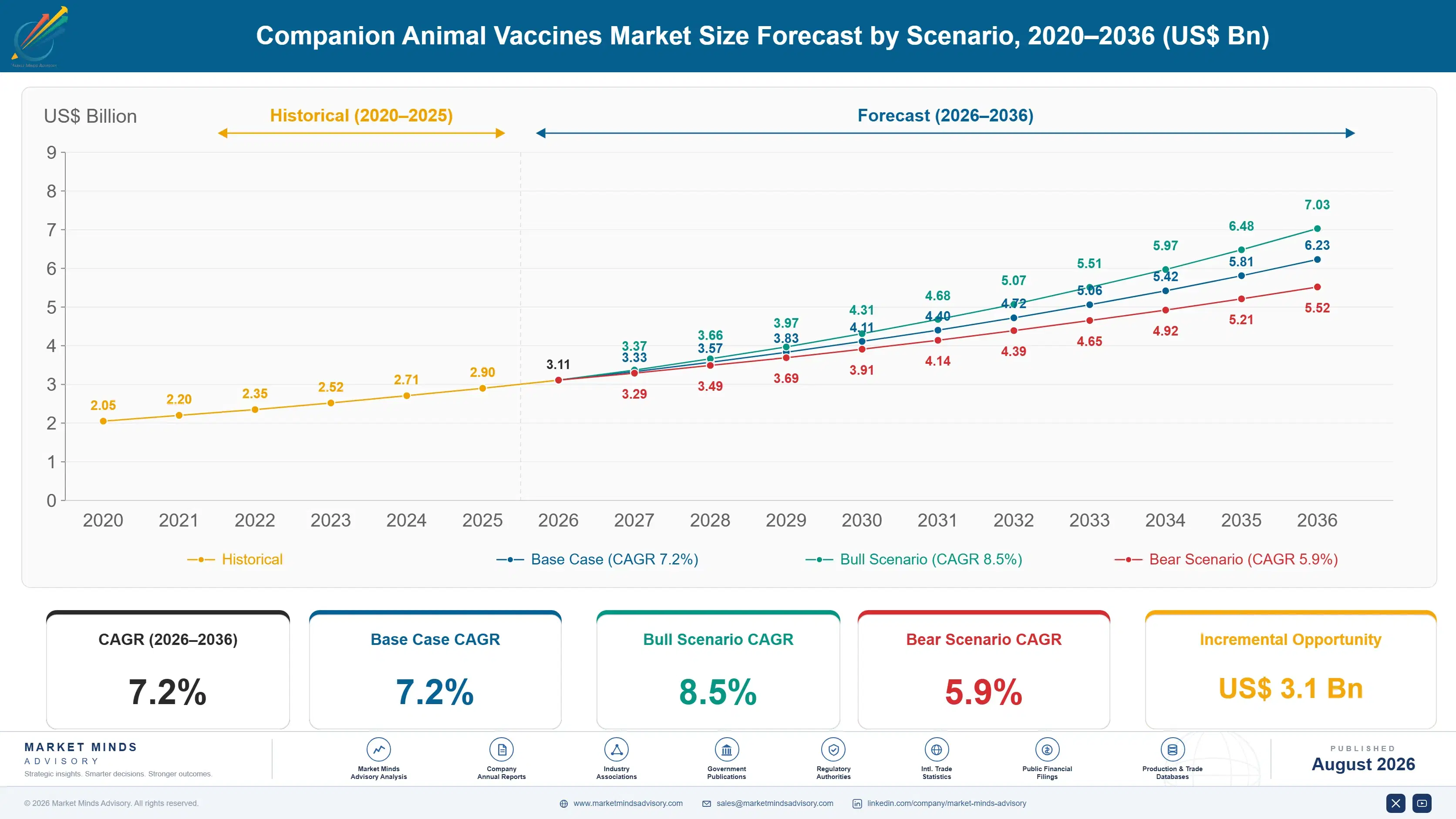
Between 2020 and 2025 the market grew at roughly 6.6% a year, steady rather than volatile, as pandemic-era pet adoption surges expanded the vaccinated population while veterinary visit frequency normalized gradually afterward across most developed markets. That steady expansion reflected mature, well-established vaccination infrastructure already embedded across most developed veterinary markets globally, even as emerging markets began their own adoption curve.
The base case carries the market to a 7.2% CAGR on three mechanisms. First, pet humanization spending keeps rising as owners increasingly treat companion animals as family members deserving comprehensive preventive care. Second, non-core lifestyle vaccine recommendations keep expanding as veterinarians increasingly tailor vaccination protocols to individual risk rather than one-size-fits-all schedules. Third, emerging market pet ownership keeps rising as disposable income growth expands the addressable population beyond markets where ownership rates are already near-saturated.
The bull case reaches 8.5% if novel platform vaccines achieve broader veterinary adoption faster than modeled, expanding both efficacy and owner willingness to pay for premium protection. The bear case falls to 5.9% if veterinary visit frequency softens under broader economic pressure enough to slow both core and lifestyle vaccine administration across major markets simultaneously.

Lifestyle Vaccines Are Becoming a Genuine Growth Category

Three forces converge on this market at once. Pet humanization spending keeps rising as owners treat companion animals as family, veterinarians keep tailoring vaccination protocols toward individual lifestyle risk rather than uniform schedules, and emerging market pet ownership keeps expanding the addressable population. Manufacturers unable to demonstrate genuine lifestyle vaccine value risk losing share to competitors with stronger veterinary education programs. Manufacturers unable to satisfy
MARKET CONCENTRATION (CR5)68%Top five companies hold a dominant combined position
AVERAGE VACCINE PRICE$28/doseLifestyle vaccines command meaningful premium over core schedule
TOP PRODUCING COUNTRY SHARE26%United States leads global companion animal vaccine manufacturing volume
VACCINATION COMPLIANCE RATE71%Core vaccine compliance remains high across developed veterinary markets
TRADE INTENSITY24%Roughly a quarter of vaccine volume crosses national borders
MANUFACTURING COST SHARE39% of COGSAntigen production and cold-chain packaging dominate production cost
Commercially, the market splits between core vaccines, priced competitively and sold largely on regulatory mandate and established veterinary protocol, and non-core lifestyle vaccines, priced at meaningful premium and sold on regional risk education and owner willingness to pay for comprehensive protection. That lifestyle category commands disproportionate margin relative to its unit volume share of the overall market. That margin gap is widening as veterinary practices increasingly prioritize comprehensive risk-based recommendations over pure compliance.
Over the next decade the defining question is whether lifestyle vaccine recommendations become standard veterinary practice across most companion animal visits, or whether cost sensitivity keeps them reserved for owners in higher-risk regions or with greater discretionary veterinary spending capacity specifically. Manufacturers positioned on both sides face different investment choices ahead.
"The core vaccine business in this category is basically mature, regulatory-mandate volume that grows with the pet population and not much faster. Lifestyle vaccines are where the real commercial story is, because that is a purchase decision owners actually make, not one regulation makes for them, and that changes everything about how you sell it."
Director, Animal Health and Veterinary Products Practice · MMA Agriculture / Ani

Market Trends

Veterinarians Increasingly Tailor Vaccination Protocols to Individual Risk

Veterinary professional guidelines have shifted meaningfully since 2022 toward risk-based lifestyle vaccination recommendations rather than uniform schedules applied to every patient regardless of individual exposure, reflecting accumulating evidence that regional disease prevalence and lifestyle factors genuinely change which non-core vaccines deliver meaningful protective value. Zoetis and Boehringer Ingelheim have both expanded veterinary education programs specifically supporting this individualized approach, training clinic staff to have more sophisticated risk conversations with pet owners rather than defaulting to either universal recommendation or omission entirely. Practices adopting this approach report stronger owner engagement overall.
Market Impact: Spending rose 25% to 35%
Novel Platform Technology Reaches Commercial Veterinary Use

Recombinant and next-generation vaccine platforms, offering improved safety profiles and in some cases faster development timelines than traditional attenuated or inactivated vaccine technology, have moved from research settings into commercial companion animal vaccine launches since 2023. Several manufacturers have begun exploring mRNA-based platforms specifically for companion animal applications, following the broader validation this technology received during human vaccine development, though veterinary-specific regulatory pathways and commercial infrastructure remain considerably earlier stage than in human vaccine markets. Regulatory pathways for these newer platforms remain considerably less mature than established human vaccine frameworks, slowing commercial timelines somewhat across most major veterinary markets tracked.
Market Impact: Trails by 15 to 25 points

Market Opportunities and Growth Drivers

Pet Humanization Spending Continues Rising Across Major Markets

Pet owner spending on veterinary care, tracked through national veterinary association data across most major markets, continues rising faster than general consumer spending growth as owners increasingly treat companion animals as family members deserving comprehensive preventive healthcare rather than basic maintenance alone. Each incremental increase in average per-pet veterinary spending represents recurring demand for both core compliance and discretionary lifestyle vaccination, giving the broader market a demographic and cultural tailwind considerably more durable than one dependent on any single vaccine technology cycle specifically. That spending pattern shows little sign of reversing across most tracked markets.
Market Impact: Cuts uptake 20% to 30%

Emerging Market Pet Ownership Expands the Addressable Population

Pet ownership rates in several large emerging markets, including China and parts of Southeast Asia, remain meaningfully below developed-market levels, and rising disposable income combined with active urbanization trends continues expanding the addressable vaccinated population steadily across these markets. Each incremental percentage point of pet ownership growth in a market with substantial population represents genuinely new vaccine demand, giving manufacturers serving these markets a demographic tailwind largely independent of the premiumization dynamics driving developed-market value growth specifically. Manufacturers with established regional distribution capability increasingly capture this growth ahead of competitors still concentrated primarily in mature Western markets.
Market Impact: Adds 2 to 4 weeks delay

Market Restraints and Challenges

Cost Sensitivity Limits Lifestyle Vaccine Adoption in Some Markets

Non-core lifestyle vaccines carry meaningful additional cost beyond the core mandatory schedule, and the root cause is that owners in price-sensitive markets or with limited discretionary veterinary budget reasonably prioritize mandatory core vaccination over optional lifestyle protection when household budgets are constrained. This cost sensitivity limits lifestyle vaccine adoption disproportionately in emerging markets and among lower-income pet owners even in developed markets, creating uneven category growth across different owner segments. Manufacturers are mitigating the barrier through tiered pricing and bundled wellness plan programs that spread cost across regular veterinary visits.
Market Impact: Recommendations rose 15 to 20 point

Veterinary Workforce Shortages Constrain Vaccination Capacity

Veterinary workforce shortages persist across most major markets relative to growing companion animal population and rising per-pet visit frequency, and the root cause is that veterinary school capacity has not expanded proportionally with rising pet ownership and demand for more comprehensive preventive care services. This capacity constraint limits how many vaccination appointments clinics can actually schedule, indirectly capping vaccine volume growth regardless of underlying owner demand or vaccine manufacturer marketing investment. Manufacturers are mitigating the constraint by supporting veterinary technician-administered vaccination programs that expand clinic throughput capacity. Some clinics are expanding weekend hours.
Market Impact: Reaches over 8,000 veterinary clini
3 additional market trends, 4 additional growth drivers, and 3 additional restraints and challenges are covered in the full report. Contact sales@marketmindsadvisory.com to access the complete intelligence.

Segment CAGR and Growth Architecture

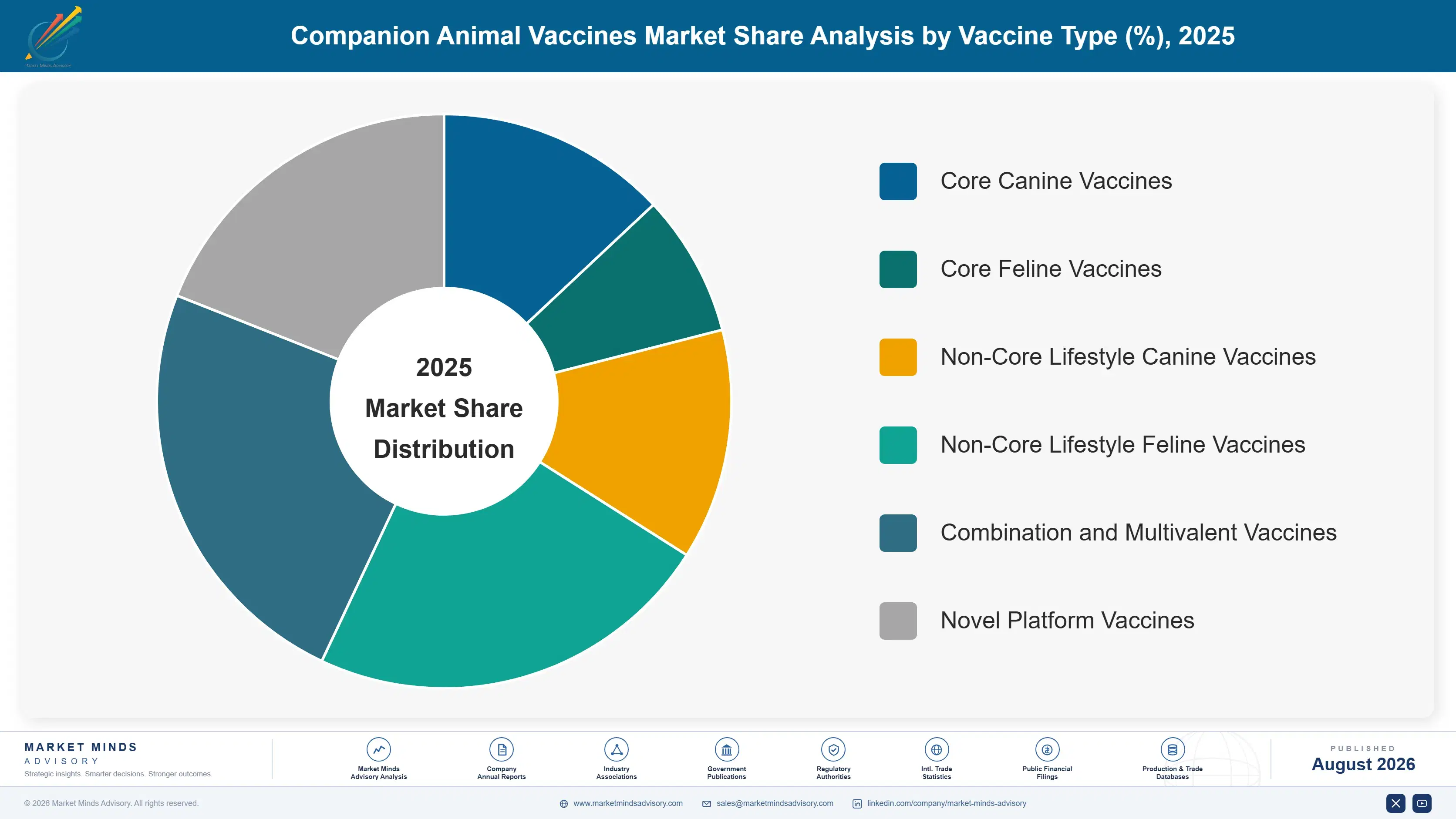
Segmentation follows vaccine type, a single immunological logic distinguishing core mandatory protection from discretionary lifestyle vaccination. Species and distribution channel are treated as separate commercial dimensions, not parallel segments within this vaccine-based framework. Each vaccine carries its own immunological role, regulatory status, and administration frequency, so commercial position tracks protection type rather than species alone.
companion-animal-vaccines-market-market-share-analysis-1787307032367

Novel Platform Vaccines

Novel platform vaccines grow fastest at 15.5%, about 2.15 times the overall rate, from a small commercial base as recombinant and next-generation technology reaches broader veterinary adoption following validation the underlying platforms received during human vaccine development. These vaccines command premium pricing that reflects genuine manufacturing sophistication and, in several cases, improved safety and duration-of-immunity profiles over traditional vaccine technology. Zoetis and Merck Animal Health both lead commercial development, having invested in dedicated platform technology since 2023. Adoption remains concentrated among veterinary specialty practices and owners willing to pay premium pricing for demonstrated safety or efficacy advantages, with broader mainstream clinic adoption still developing steadily. Regulatory pathways for this technology remain earlier stage currently.
CAGR 15.5%

Combination and Multivalent Vaccines

Combination vaccines, which bundle protection against multiple pathogens into a single injection, grow at 8.5%, the second-fastest category, as veterinarians and owners both increasingly favor reduced visit frequency and injection count over administering separate vaccines individually. These products command meaningful premium pricing over equivalent single-antigen vaccines purchased separately, reflecting genuine formulation complexity and the convenience value veterinary clinics and owners both recognize directly. Zoetis and Boehringer Ingelheim both maintain broad combination vaccine portfolios spanning core and lifestyle antigens together. Growth here reflects genuine format preference shift rather than pure new demand creation, since much of this volume represents conversion from previously separate vaccine purchases. Manufacturers offering both formats increasingly win broader clinic contracts.
CAGR 8.5%
Full segment breakdown across 6 segments available in the complete report.

Regional Architecture and Country Demand Map

North America leads on concentrated pet ownership and veterinary care spending, East Asia grows fastest among major regions on expanding Chinese pet ownership, and Western Europe holds a steady second position. Latin America and the Middle East grow steadily off smaller current ownership bases, while Eastern Europe trails slightly.

North America

United States pet ownership rates and veterinary care spending, among the highest in the world on a per-capita basis, anchor sustained vaccine demand across tens of thousands of veterinary clinics administering both core and lifestyle vaccines routinely. Zoetis, headquartered domestically, runs substantial manufacturing and research operations, maintaining close relationships with the veterinary schools and clinic networks that shape prescribing patterns nationally. Canada's smaller but stable companion animal market follows similar demand patterns to its southern neighbor, with lifestyle vaccine adoption tracking closely alongside American veterinary practice trends. Growth trails East Asia and South Asia and Pacific because the region's pet ownership and vaccination infrastructure are both already extensively developed, leaving lifestyle vaccine adoption as the primary growth driver.
Share: 31% | CAGR: 6.5% (2026 to 2036)

Western Europe

Germany and the United Kingdom both maintain well-developed veterinary care infrastructure, with pet insurance penetration considerably higher than in the United States supporting steady demand for both core and lifestyle vaccination across a broad owner base. Boehringer Ingelheim, headquartered in Germany, anchors substantial regional manufacturing capacity and veterinary research investment serving both domestic and export markets across the continent. France's strong companion animal culture and comprehensive veterinary care tradition supports consistently high vaccination compliance rates across the country. Growth trails East Asia and South Asia and Pacific as the region's pet ownership and veterinary infrastructure are both already comparatively mature relative to faster-growing markets. That combination of insurance penetration and veterinary tradition keeps the region a stable, mature demand base.
Share: 24% | CAGR: 5.8% (2026 to 2036)
Regional intelligence for 5 additional markets available in the complete report: East Asia, South Asia and Pacific, Latin America, Middle East and Africa, Eastern Europe. Contact sales@marketmindsadvisory.com.
companion-animal-vaccines-market-country-cagr-analysis-1787307032891

Where Vaccine Manufacturers Can Defend Margin

Four commercial moves separate manufacturers capturing durable lifestyle vaccine growth from those competing purely on core vaccine commodity pricing: veterinary education investment, combination format development, emerging market distribution, and wellness plan bundling partnerships. Each move converts a clinical or distribution advantage into a defensible commercial position competitors without matching education depth or emerging market reach cannot easily replicate quickly.

Invest in Veterinary Education Supporting Risk-Based Recommendations

Veterinarians need confidence and clinical evidence to recommend lifestyle vaccines beyond the core mandatory schedule, and manufacturers investing directly in veterinary education programs, including regional disease risk data and continuing education content, build the clinical foundation that drives sustained lifestyle vaccine recommendation rather than one-time promotional campaigns that fade quickly. Companies with the strongest veterinary education investment increasingly see their lifestyle vaccines recommended more consistently across clinic visits than competitors relying on pure sales promotion alone. Practices with the strongest education support report lifting lifestyle vaccine recommendation rates by 15% to 25% within a single year.
Market Impact: Lifts lifestyle vaccine recommendat

Develop Combination Formats Bundling Core and Lifestyle Antigens

Owners and veterinarians both favor reduced injection count, and manufacturers developing combination vaccines that bundle lifestyle antigens alongside core vaccination capture lifestyle vaccine revenue that might otherwise be declined as a separate, additional purchase decision requiring its own conversation and injection. This bundling approach converts a discretionary add-on decision into a default inclusion within the standard visit, meaningfully improving lifestyle vaccine attachment rates compared to standalone product offerings requiring separate owner opt-in. Manufacturers deploying this format report improving lifestyle vaccine attachment by 20% to 30% compared to standalone product offerings requiring separate opt-in.
Market Impact: Improves lifestyle vaccine attachme

Build Dedicated Emerging Market Distribution Capability

Emerging markets with rapidly expanding pet ownership represent substantial future volume, and manufacturers building dedicated distribution and veterinary education capability in these markets ahead of competitors capture disproportionate share of the addressable population as vaccination infrastructure matures. This early investment also builds brand loyalty among the veterinary clinics establishing prescribing habits during a market's formative growth period, a relationship advantage that compounds over years as the market continues expanding. Early movers building this capability report capturing 40% to 55% of new market volume as vaccination infrastructure matures around established relationships.
Market Impact: Early movers capture 40% to 55% of

Partner With Veterinary Wellness Plans to Bundle Vaccination Cost

Veterinary wellness plans that bundle preventive care costs, including vaccination, into predictable monthly payments meaningfully reduce the price sensitivity that limits lifestyle vaccine adoption among cost-conscious owners, and manufacturers partnering directly with wellness plan providers to ensure lifestyle vaccines are included capture volume that pure fee-for-service pricing would otherwise lose to owner cost hesitation at the point of decision. Wellness plan enrollees show meaningfully higher lifestyle vaccine uptake, typically 25% to 35% above owners paying fee-for-service, converting a point-of-sale price objection into a pre-committed monthly decision made well before any specific vaccination conversation occurs.
Market Impact: Wellness enrollees show 25% to 35%

Who Controls the Margin Pool

Concentration sits at a high CR5 of 68%, with a real gap separating large diversified animal health companies from smaller regional manufacturers. Zoetis and Boehringer Ingelheim compete on portfolio breadth and veterinary distributor relationship depth, while Merck Animal Health and Elanco anchor strong positions in specific vaccine categories and geographic markets respectively. Smaller regional manufacturers compete on price for core vaccines in emerging markets.
Current competitive activity runs along three lines: lifestyle vaccine veterinary education investment, where large manufacturers race to build clinical confidence supporting risk-based recommendations; novel platform technology development, increasingly central to next-generation product differentiation; and emerging market distribution expansion, as manufacturers compete for share in rapidly growing pet ownership markets. All participants are assessed on one consistent basis, annual revenue from companion animal vaccine products.

Pressure is building from two directions. Manufacturers with strong veterinary education programs are capturing disproportionate lifestyle vaccine share, a dynamic price-focused competitors cannot easily counter through discounting alone. Meanwhile regional manufacturers in emerging markets are scaling both price-competitive and increasingly technically capable core vaccine production, pressuring Western incumbents in cost-sensitive segments. Rankings over the next five years will shift toward companies combining education depth with emerging market reach.
companion-animal-vaccines-market-company-positioning-matrix-1787307033411

Competitive Moat and Risk Dimensions

ZOETIS INC.

Moat: Broadest companion animal vaccine portfolio

Zoetis's vaccine portfolio spans the broadest range of core and lifestyle antigens across both canine and feline species in the industry, giving it the ability to serve veterinary clinics as a comprehensive single-vendor relationship few narrower competitors can match, particularly valuable as clinics increasingly prefer consolidated purchasing relationships.
ZOETIS INC.

Risk: Patent expiry generic competition exposure

Several of Zoetis's established core vaccine products face increasing generic and biosimilar-adjacent competition as patents expire, exposing a meaningful share of its foundational vaccine revenue to price competition that its broader premium lifestyle and novel platform portfolio must increasingly offset to sustain overall category margin performance.
BOEHRINGER INGELHEIM ANIMAL HEALTH

Moat: Deep veterinary distributor relationship network

Boehringer Ingelheim's decades-long veterinary distributor relationships, built across both developed and emerging markets, give it distribution reach and clinic-level trust that newer entrants must work years to replicate, particularly valuable in markets where personal distributor relationships still meaningfully influence which vaccine brands clinics stock and recommend.
BOEHRINGER INGELHEIM ANIMAL HEALTH

Risk: Private ownership limits capital flexibility

As a privately held family company, Boehringer Ingelheim's expansion capital comes from retained earnings rather than public market access, potentially constraining how quickly it can match publicly traded competitors on acquisition-driven growth or aggressive research and development spending during periods of intensifying competitive pressure. That capital constraint could widen further if competitors accelerate acquisition-driven expansion broadly.

Players Tracked

Prominent Players

Zoetis Inc.
Boehringer Ingelheim Animal Health
Merck Animal Health
Elanco Animal Health
Virbac S.A.

Other Key Players

Ceva Sante Animale
Heska Corporation
Phibro Animal Health
Vetoquinol S.A.
Hester Biosciences
Biogenesis Baco
Indian Immunologicals Limited
Hipra
Bimeda
Neogen Corporation
Bioveta
Kyoritsu Seiyaku
China Animal Husbandry Industry Co.
Colorado Serum Company
Vaxxinova

Recent Developments

MARCH 2025

Zoetis launches next-generation feline leukemia vaccine with extended duration

Zoetis introduced an updated feline leukemia vaccine featuring extended duration of immunity, reducing required booster frequency compared to its prior generation product. This was an organic product launch, not an acquisition or partnership, developed through internal research and development investment over several years. Early clinical reception has reportedly been positive.
Signal: A major incumbent refreshing a core lifest
SEPTEMBER 2024

Boehringer Ingelheim signs distribution agreement expanding Southeast Asian access

Boehringer Ingelheim signed a distribution agreement with a regional veterinary products distributor to expand companion animal vaccine access across several Southeast Asian markets. This was a commercial distribution agreement, not a joint venture or acquisition, extending market reach without altering ownership or manufacturing structure. Both parties expect further expansion.
Signal: Emerging market distribution investment su
JANUARY 2025

Merck Animal Health acquires veterinary vaccine biotech start-up

Merck Animal Health completed the acquisition of a privately held company developing novel platform vaccine technology for companion animal applications. This was an acquisition, not a joint venture or minority investment, giving Merck full ownership and control of the acquired technology and development team. Early reception has reportedly been favorable.
Signal: Continued acquisition activity in novel pl

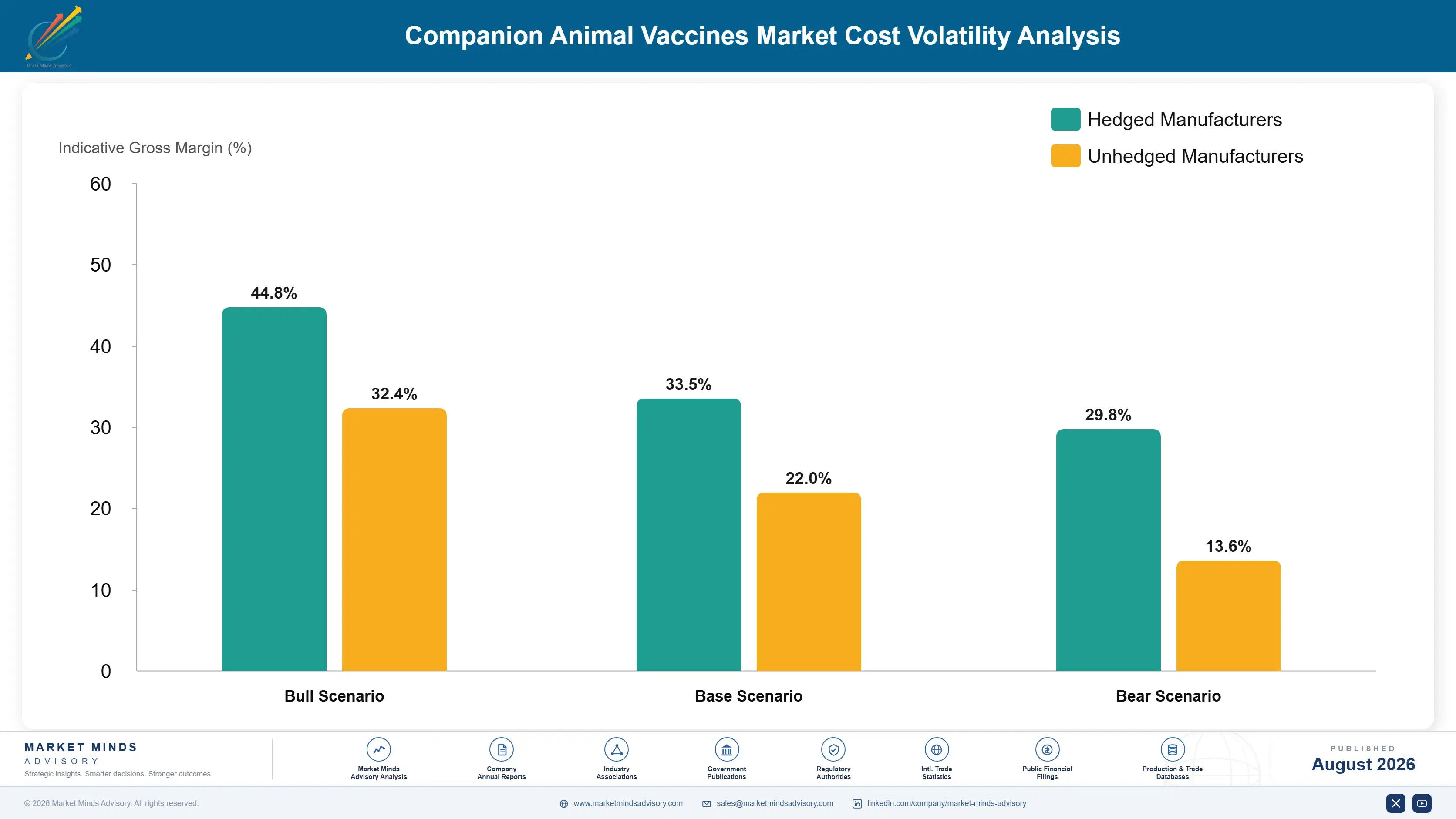
Antigen Production and Cold-Chain Drive Cost

Antigen production, cell culture media, and cold-chain packaging together account for roughly thirty-nine percent of production COGS, sourced from a concentrated group of specialty biological manufacturers with meaningful barriers to entry given the biosafety and quality control expertise required. Novel platform vaccine manufacturing carries a distinct cost structure weighted toward specialized synthesis and formulation processes beyond traditional attenuated vaccine production. Packaging compl
The clearest recent volatility event traces to 2021 and 2022, when the Biotechnology Innovation Organization documented widespread cell culture media and single-use bioprocessing shortages industry-wide, driven by surging pandemic-era human vaccine manufacturing demand competing for the same limited global supplier capacity. Several animal health manufacturers reported multi-month production delays during the worst of the shortage, directly constraining vaccine availability across the industry during that period.

Exposure varies by manufacturer scale and sourcing relationships. Large diversified manufacturers with direct, long-term supplier agreements weathered the shortage with meaningfully less disruption than smaller specialist manufacturers dependent on distributor inventory and spot purchasing. Manufacturers producing novel platform vaccines faced particular exposure, since fewer qualified specialty component suppliers could meet precision requirements during the tightest supply period specifically. Diversified manufacturers generally recover faster once constrained capacity eases.
companion-animal-vaccines-market-cost-volatility-analysis-1787307033606

Secure Direct Supplier Agreements for Critical Inputs

Larger manufacturers are increasingly negotiating direct multi-year supply agreements with cell culture media and bioprocessing component producers, securing priority allocation and more predictable pricing ahead of future shortage events rather than relying on spot market purchasing during periods of industry-wide constraint. This mirrors sourcing discipline already standard across other biologics manufacturing categories facing comparable seasonal demand concentration risk.

Qualify Multiple Component Suppliers Across Regions

Manufacturers are qualifying second and third sourcing options for critical biological and packaging components across different geographic regions rather than relying on single-supplier relationships, reducing exposure to any one facility disruption or capacity allocation decision favoring larger human health buyers. Smaller manufacturers are increasingly pooling purchasing volume through industry consortia to negotiate comparable allocation priority overall.

Invest in Manufacturing Efficiency to Reduce Input Volume

Several manufacturers are optimizing antigen production processes to reduce media and bioprocessing volume required per dose without compromising vaccine potency, cutting raw material exposure per unit even as process optimization requires meaningful upfront engineering investment. That efficiency gain increasingly favors manufacturers with strong process engineering expertise over those relying purely on bulk media purchasing scale alone.

Portfolio Architecture for Margin Defence

The portfolio splits into three tiers with real margin separation. Volume core vaccines compete largely on price and reliable supply to veterinary clinics fulfilling regulatory mandate, earning modest margins defended through production scale. Certified premium lifestyle and combination vaccines earn substantially more because owners and veterinarians pay for demonstrated regional risk protection and convenience over pure compliance requirements. That gap widens as practices demand documented li
The tension between core volume and lifestyle premium positioning shapes manufacturer strategy directly: core vaccines keep production lines running and build broad veterinary clinic relationships, but manufacturers that let core volume crowd out lifestyle vaccine education investment risk losing the highest-margin discretionary category to more education-focused competitors. Manufacturers that manage this balance well capture both the volume and the margin. Manufacturers that manage this balance well capture both broad clinic presence and premium margin across their combined portfolio.

High-value pools concentrate in lifestyle and combination vaccines and novel platform technology, where clinical differentiation and owner willingness to pay justify premium economics few core-only competitors can match. The emerging novel platform tier currently earns unevenly as manufacturers absorb development cost against still-developing commercial adoption. That unevenness should ease as platforms mature.

Volume / Commodity-Adjacent Tier

Standard core canine and feline vaccines sold on price and reliable supply fulfilling regulatory vaccination mandate., where production scale and reliable supply determine which manufacturers can sustain acceptable margin under regulatory-mandate pricing pressure.
Gross Margin: 22-36%

Premium / Certified Tier

Lifestyle and combination vaccines commanding premium pricing from owners and veterinarians prioritizing comprehensive regional risk protection., who pay durable premiums for comprehensive regional risk protection rather than accept gaps in preventive coverage.
Gross Margin: 40-56%

Sustainability / Regulatory / Next-Generation Tier

Novel platform vaccines still absorbing development investment against still-developing commercial and veterinary adoption., where manufacturers are betting development capital on technology they expect veterinary practices to demand as standard within several years.
Gross Margin: 25-52%
companion-animal-vaccines-market-portfolio-architecture-1787307034105

High-value Sub-segments and Strategic Watch-out

Lifestyle and Regional Risk Vaccines

High value and high growth as veterinary risk-based recommendations expand, commanding durable premium pricing once education programs fully support broader owner willingness to pay. Manufacturers with the strongest education programs increasingly win veterinary recommendation share competitors without comparable investment simply cannot secure at all today.
Gross Margin: 42-56%

Combination and Multivalent Formats

High value with strong current growth as reduced injection count preference spreads, priced above single-antigen alternatives while remaining accessible to mainstream veterinary practice budgets. Adoption is broadening steadily beyond premium clinics into mainstream veterinary practices seeking comparable convenience and injection reduction benefits consistently across the sector.
Gross Margin: 38-52%

Standard Core Vaccines

The volume core, sold on price to veterinary clinics fulfilling mandatory vaccination requirements, defended mainly through production scale and thin per-dose margin discipline. Competitive pressure here concentrates on production efficiency and reliable supply rather than the education differentiation reshaping premium and platform tiers specifically overall.
Gross Margin: 22-36%

Legacy Single-Antigen Formulations

The strategic watch-out, facing continued displacement as combination formats and improved single-injection convenience increasingly become the default veterinary preference. Manufacturers still dependent on this declining tier should be actively redirecting investment toward combination formats rather than defending single-antigen products veterinary practices increasingly find inefficient for routine appointment scheduling.
Gross Margin: 15-30%

How Companion Animal Vaccine Demand Recurs

Demand here runs on recurring annual or multi-year booster consumption tied directly to each individual animal's vaccination schedule rather than one-time purchase. A veterinary clinic serving an established patient population generates predictable, recurring vaccine demand tied to that population's booster timing, making a single clinic relationship worth years of recurring volume rather than a standalone transaction. That pattern gives manufacturers predictable revenue visibility.
Adoption depth varies sharply by vaccine category. Core vaccines are integrated deeply into standardized veterinary protocol and regulatory requirement, making the purchasing relationship durable and largely insulated from discretionary budget pressure. Lifestyle vaccines, by contrast, depend on individual owner decision at each visit, creating a more variable, conversation-dependent purchasing pattern that veterinary education and communication quality directly influence. That difference forces manufacturers to split strategy accordingly.

Buyer profiles are shifting generationally as younger pet owners, more willing to invest in comprehensive preventive care and more receptive to veterinarian recommendations for lifestyle vaccination, increasingly drive category growth beyond the compliance-focused purchasing pattern that historically defined the core vaccine business. Younger veterinarians trained on individualized risk-based protocols are similarly more likely to proactively recommend lifestyle vaccination than colleagues trained on older uniform schedule approaches.
companion-animal-vaccines-market-end-use-penetration-index-1787307034594

Where Companion Vaccine Value Concentrates Next

These are among the four positions where our research anticipates prominent divergence between winners and laggards over the coming forecast period. Each is grounded in the demand model, the regulatory perimeter, and the announced capacity pipeline.
01 / VETERINARY EDUCATION INVESTMENT

Fund clinical education to expand your own lifestyle category

Lifestyle vaccine adoption depends entirely on veterinarians having the clinical confidence to recommend it beyond mandatory core vaccination, and manufacturers investing in genuine education infrastructure are building the foundation that drives sustained category growth rather than one-time promotional campaigns that fade quickly. This investment functions as market development for the entire lifestyle category, not just any single manufacturer's product line specifically. Companies moving slowly here will find themselves competing for share of a category built largely by more education-focused competitors.
02 / COMBINATION FORMAT DEVELOPMENT

Bundle lifestyle antigens into default combination products

Converting lifestyle vaccination from a separate, discretionary decision into a default inclusion within combination products meaningfully improves attachment rates compared to standalone offerings requiring explicit owner opt-in at every visit. Manufacturers still selling lifestyle vaccines as standalone add-ons are leaving attachment rate improvement on the table that combination formatting could capture directly. This format shift represents genuine commercial opportunity independent of any underlying antigen innovation., since format shift alone can meaningfully improve category economics without requiring any new antigen development.
03 / EMERGING MARKET DISTRIBUTION TIMING

Build distribution capability ahead of confirmed demand growth

Emerging markets with rapidly expanding pet ownership represent substantial future volume, and manufacturers building dedicated distribution and veterinary education capability now, ahead of fully confirmed demand, capture disproportionate share as vaccination infrastructure matures around whichever brands established relationships first. Waiting for markets to fully mature before investing means competing for share against manufacturers who built veterinary trust during the market's formative growth period specifically. Manufacturers who build this distribution capability early will own veterinary trust relationships competitors arriving later cannot easily displace.
04 / WELLNESS PLAN PARTNERSHIP STRATEGY

Partner with bundled care plans to neutralize price sensitivity

Price sensitivity remains the single biggest barrier to broader lifestyle vaccine adoption among cost-conscious owners, and manufacturers partnering directly with veterinary wellness plan providers to ensure inclusion address that barrier more effectively than pure price discounting ever could. This partnership approach converts a point-of-sale price objection into a pre-committed monthly payment decision made well before any specific vaccination conversation occurs, meaningfully improving uptake among exactly the price-sensitive segment discounting alone struggles to reach. Manufacturers who partner early will own that channel.

Engagement Snapshot From the Field

A live engagement with an industry participant carrying material or product regulatory and market exposure ahead of a defining policy shift, showing how our research translates into a defensible multi-year portfolio strategy.
MARKET MINDS ADVISORY · CLIENT ENGAGEMENT SUMMARY
Companion Animal Vaccines Producer Strategic Portfolio Review and Transition Roadmap 2026·Investment Scenario on Companion Animal Vaccines Exposure Evaluation 2025-26
CLIENT PROFILE
A regional veterinary hospital group operating twelve clinic locations approached MMA while evaluating a structured lifestyle vaccine recommendation program to increase attachment rates across its patient population. The client reported that lifestyle vaccine attachment rates varied considerably across its twelve locations, with no standardized recommendation protocol previously in place (client-reported, unverified by MMA). Leadership had not previously commissioned an external review of vaccination program consistency across the network.
STRATEGIC CHALLENGE
Leadership wanted to increase lifestyle vaccine revenue meaningfully but needed to balance standardized recommendation protocols against individual veterinarian clinical judgment and avoid appearing to prioritize revenue over genuine patient-specific risk assessment. The board wanted a defensible standardization plan before the next fiscal year budget cycle, not another year of inconsistent clinic-by-clinic recommendation practices across the network.
MMA APPROACH
MMA benchmarked lifestyle vaccine attachment rates and veterinary communication approaches across the client's twelve locations, modeled revenue impact under different standardization scenarios, and assessed comparable veterinary group programs that had successfully improved attachment rates while maintaining genuine clinical risk-based decision-making. We also interviewed clinical staff directly at each location to confirm real-world communication constraints the quantitative model alone could not capture.
KEY FINDINGS
  1. Attachment rate variation across the twelve locations correlated more strongly with individual veterinarian communication training than with any measurable difference in actual regional disease risk across the client's service area.
  2. Locations using a structured regional risk discussion framework during appointments achieved meaningfully higher lifestyle vaccine attachment without any evidence of over-recommendation beyond genuine clinical risk factors.
  3. Bundling lifestyle vaccines into the group's existing wellness plan offering, rather than presenting them as separate add-on purchases, improved attachment rates substantially among price-sensitive client segments specifically.
  4. Veterinarian and support staff training on risk communication, rather than pure sales technique, proved the more effective and better-received approach among both clinical staff and pet owners (client-reported, unverified by MMA).
CLIENT PROFILE
A regional veterinary hospital group operating twelve clinic locations approached MMA while evaluating a structured lifestyle vaccine recommendation program to increase attachment rates across its patient population. The client reported that lifestyle vaccine attachment rates varied considerably across its twelve locations, with no standardized recommendation protocol previously in place (client-reported, unverified by MMA). Leadership had not previously commissioned an external review of vaccination program consistency across the network.
STRATEGIC CHALLENGE
Leadership wanted to increase lifestyle vaccine revenue meaningfully but needed to balance standardized recommendation protocols against individual veterinarian clinical judgment and avoid appearing to prioritize revenue over genuine patient-specific risk assessment. The board wanted a defensible standardization plan before the next fiscal year budget cycle, not another year of inconsistent clinic-by-clinic recommendation practices across the network.
MMA APPROACH
MMA benchmarked lifestyle vaccine attachment rates and veterinary communication approaches across the client's twelve locations, modeled revenue impact under different standardization scenarios, and assessed comparable veterinary group programs that had successfully improved attachment rates while maintaining genuine clinical risk-based decision-making. We also interviewed clinical staff directly at each location to confirm real-world communication constraints the quantitative model alone could not capture.
KEY FINDINGS
  1. Attachment rate variation across the twelve locations correlated more strongly with individual veterinarian communication training than with any measurable difference in actual regional disease risk across the client's service area.
  2. Locations using a structured regional risk discussion framework during appointments achieved meaningfully higher lifestyle vaccine attachment without any evidence of over-recommendation beyond genuine clinical risk factors.
  3. Bundling lifestyle vaccines into the group's existing wellness plan offering, rather than presenting them as separate add-on purchases, improved attachment rates substantially among price-sensitive client segments specifically.
  4. Veterinarian and support staff training on risk communication, rather than pure sales technique, proved the more effective and better-received approach among both clinical staff and pet owners (client-reported, unverified by MMA).
RECOMMENDED STRATEGY
Phase 1: Phase 1 (0 to 3 months): Deploy the structured regional risk discussion framework and staff training across all twelve clinic locations. Phase 2: Phase 2 (3 to 9 months): Integrate lifestyle vaccines into the group's existing wellness plan offering as a standard included component. Phase 3: Phase 3 (9 to 18 months): Track attachment rate and client satisfaction data to refine the program and identify further improvement opportunities.
OUTCOME
The veterinary group deployed the structured framework on schedule, reporting an estimated improvement in lifestyle vaccine attachment rates of roughly 18 percentage points across the network within the first six months. Client satisfaction scores related to vaccination conversations also improved measurably following staff training (client-reported, unverified by MMA).

Frequently Asked Questions

Foundational context covering the market sizes, CAGR, scope, country, region and competition that inform every finding below. This section is provided to cover basics and most often pre-purchase conversations, answered from the MMA Primary Research Dataset.

What is the current size of the Companion Animal Vaccines Market?

The companion animal vaccines market was valued at USD 2.9 billion in 2025. Growth is driven by pet humanization spending, expanding lifestyle vaccine recommendations, and rising emerging market pet ownership.

How large will the Companion Animal Vaccines Market be by 2036?

The market is projected to reach USD 6.23 billion by 2036 under the base case scenario. That reflects an expansion multiple of roughly 2.00 times the 2026 value.

What is the CAGR for the Companion Animal Vaccines Market 2026 to 2036?

The base case CAGR is 7.2%, with a bull case of 8.5% and a bear case of 5.9%. Novel platform vaccine adoption speed is the main swing factor between scenarios.

Which segment is growing fastest?

Novel platform vaccines grow fastest at 15.5% CAGR, roughly 2.15 times the overall market rate. Combination and multivalent vaccines follow as the second-fastest segment at 8.5%.

Who are the major companies in the Companion Animal Vaccines Market?

Leading companies include Zoetis Inc., Boehringer Ingelheim Animal Health, Merck Animal Health, Elanco Animal Health, and Virbac S.A. The top five hold a combined 68% of the market.

Which country is growing fastest?

China is the fastest-growing country at 13.8% CAGR, driven by rapidly expanding pet ownership and rising urban disposable income. Domestic and international manufacturers both compete for this growing demand.

Report Segmentation Architecture

The full report scope spans multiple orthogonal segmentation dimensions, with cross-tabulated demand data provided for each dimension pair. Coverage extends further to regional breakdowns, trend trajectories, and the competitive detail needed to support segment-level decision-making.

By Vaccine Type

  • Core Canine Vaccines
  • Core Feline Vaccines
  • Non-Core Lifestyle Canine Vaccines
  • Non-Core Lifestyle Feline Vaccines
  • Combination and Multivalent Vaccines
  • Novel Platform Vaccines

By Species

  • Canine
  • Feline

By Commercial Dimension

  • Direct Veterinary Clinic Supply
  • Distributor and Wholesale Channel
  • Wellness Plan Bundled Contracts
  • Emerging Market Distribution Partnerships

By Region

  • North America
  • Western Europe
  • East Asia
  • South Asia and Pacific
  • Latin America
  • Middle East and Africa
  • Eastern Europe

Scope, Methodology, and Coverage

Every figure in this report is reproducible from documented input assumptions. The scope below maps the historical period, the forecast horizon, the segmentation dimensions, and the countries covered, alongside the underlying primary and qualitative methodology.
Historical Period
2020 to 2025
Forecast Period
2026 to 2036
Base Year
2025 (USD billions; MMA Primary Research Dataset, August 2026)
Market Definition
The companion animal vaccines market comprises prophylactic vaccines administered to dogs and cats to prevent infectious disease, including core vaccines recommended for all animals and non-core lifestyle vaccines recommended based on regional risk and exposure, sold through veterinary clinics and animal health distributors. Vaccines for livestock and production animals, therapeutic and diagnostic veterinary products, and vaccines for companion animal species other than dogs and cats are excluded.
Quantitative Units
USD billions (current prices); doses administered where applicable
Segmentation Dimensions
By Vaccine Type; By Species; By Commercial Dimension; By Region
Regions Covered
North America, Western Europe, East Asia, South Asia and Pacific, Latin America, Middle East and Africa, Eastern Europe
Countries Covered
USA, China, Germany, France, UK, Japan, South Korea, India, Australia, Canada, Brazil, Mexico, Indonesia, Vietnam, Thailand, Malaysia, UAE, Saudi Arabia, South Africa, Nigeria, Turkey, Poland, Netherlands, Italy, Spain, Sweden, Switzerland, Argentina, Colombia, Singapore, and additional markets relevant to this sector
Key Companies Profiled
Zoetis Inc., Boehringer Ingelheim Animal Health, Merck Animal Health, Elanco Animal Health, Virbac S.A., Ceva Sante Animale, Heska Corporation, Phibro Animal Health, Vetoquinol S.A., Hester Biosciences, Biogenesis Baco, Indian Immunologicals Limited, Hipra, Bimeda, Neogen Corporation, Bioveta, Kyoritsu Seiyaku, China Animal Husbandry Industry Co., Colorado Serum Company, Vaxxinova
Quantitative Methodology
Primary survey, n=3,800 respondents, Q4 2025, six countries; demand-side model with trade association cross-validation
Qualitative Methodology
47 expert interviews, Q4 2025; applied to validate demand model assumptions, identify emerging dynamics, and assess competitive positioning
Report Format
PDF and XLSX data workbook (Word format preview document)
Publisher
Market Minds Advisory
Report Code
MMA-2026-AGR-101
Published
August 2026
Contact
sales@marketmindsadvisory.com | www.marketmindsadvisory.com

Purchase the full Companion Animal Vaccines Market Report (2026 to 2036).

The full MMA Companion Animal Vaccines Market report sizes demand across six vaccine types, two species, four commercial dimensions, and seven regions through 2036. It profiles twenty companies on a consistent revenue basis, scoring each on lifestyle vaccine education investment, combination format breadth, and emerging market distribution reach. Scenario models quantify how pet humanization spending and novel platform adoption move both demand and realizable pricing. The report includes delivered-cost modeling by vaccine type and a manufacturer education-readiness screen built for veterinary and commercial strategy teams. Regional pet ownership tracking rounds out the coverage for distribution and product strategy teams.
Vaccine type cost-curve modeling across all major categories
Lifestyle vaccine recommendation tracking by veterinary market
Novel platform technology adoption forecasts by region
Combination format attachment rate benchmarking across manufacturers
Emerging market pet ownership and distribution tracking
Lifestyle vaccine adoption scenarios under bull and bear cases

Built For The People Who Decide

From boardroom strategy to bench-side execution, this report is read cover-to-cover by leaders shaping the next decade of their industry, turning demand scenarios, market dynamics and valuation benchmarks into decisions.
CXOs/ Presidents/ VPs/ Managers
M&A and Corporate Development
Strategy Teams and R&D Heads
Procurement and Product Directors
Regulatory and Compliance Leaders
Investor Relations and Equity Analysts