Market Minds Advisory
Compact Construction Equipment Market

Compact Construction Equipment Market: Rental Fleet Economics and Electrification Strategy

Rental fleets and urban infrastructure contractors are swapping full-size excavators for compact, battery-electric alternatives as emissions rules tighten, jobsite footprints shrink, and dealers race to build charging networks across every major construction market.

Lead Analyst

David Horsley

Published

September 2026

Make Smarter Decisions with Customized Research Insights

Request a free sample report and evaluate market opportunities, growth trends, and competitive dynamics relevant to your business needs.

2025 MARKET VALUE$24.8BMarket Size 2025
2036 FORECAST VALUE$51.2BBase Case , 2026 to 2036
CAGR 2026 TO 20366.8 %Bull 8.0% / Bear 5.5%
INCREMENTAL OPPORTUNITY$24.7BNet 10- year value creation
EXPANSION MULTIPLE1.93x2036 value over 2026 base
Strategic Levers
M&A Pipeline
Regional Outlook
Country Rankings
Competitive Intelligence
Segmental Deep-dive
Call-Us : 91 93563 13602

Executive Snapshot and Market Trajectory

Compact equipment has become the default jobsite choice, not the budget alternative. Contractors increasingly rent rather than own, and rental fleets favor compact track loaders and mini excavators because they fit tight urban sites, cut daily rental cost, and still handle most everyday earthmoving tasks efficiently across small job sites.
Compact track loaders are growing fastest, pulled by rental demand and versatility across landscaping, utility, and residential construction work, expanding roughly 35% faster than the category average. East Asia now hosts the largest share of global compact equipment production and consumption, as China's infrastructure investment and its domestic manufacturers, led by SANY and XCMG, scale compact excavator output faster than Western OEMs can match on price.
Electrification is reshaping competitive positioning faster than any prior product cycle. Caterpillar, Komatsu, and Deere are all shipping battery-electric compact excavators and loaders, but charging infrastructure and total cost of ownership still favor diesel on most jobsites outside dense urban cores. Regulatory pressure, particularly EU emissions standards and city-level diesel restrictions in Europe and parts of Asia, is forcing dealers to build service and charging capability years ahead of broad customer demand.
Market Definition
The Compact Construction Equipment market covers construction machinery under roughly 10 tonnes operating weight, including mini excavators, skid steer loaders, compact track loaders, compact wheel loaders, compact utility tractors, backhoe loaders, and compact telehandlers sold to contractors, rental companies, and municipalities. It excludes full-size heavy construction equipment and attachments sold separately from a base machine.
Base Year Value
$24.8B in 2025 (MMA Primary Research Dataset, August 2026)
Forecast Period
2026 to 2036, eleven discrete annual values
CAGR
6.8% base case. Bull 8.0%. Bear 5.5%.
Fastest Growth Segment
Compact Track Loaders: 9.2% CAGR
Fastest Growth Country
India: 9.6% CAGR
Fastest Growth Region
South Asia and Pacific: 9.0% CAGR
Largest Region
East Asia: 28% of 2025 global value
Market Leaders
Caterpillar Inc., Komatsu Ltd., Deere & Company, Volvo Construction Equipment, Kubota Corporation. Source: MMA Analysis based on company annual reports.
Primary Survey
n=3,800 procurement and R&D decision-makers, Q4 2025, six countries
Methodology
Demand-side build-up, cross-validated against public data, 47 expert interviews

Compact Construction Equipment Market Forecast Scenarios

compact-construction-equipment-market-size-forecast-scenario-1787301169303
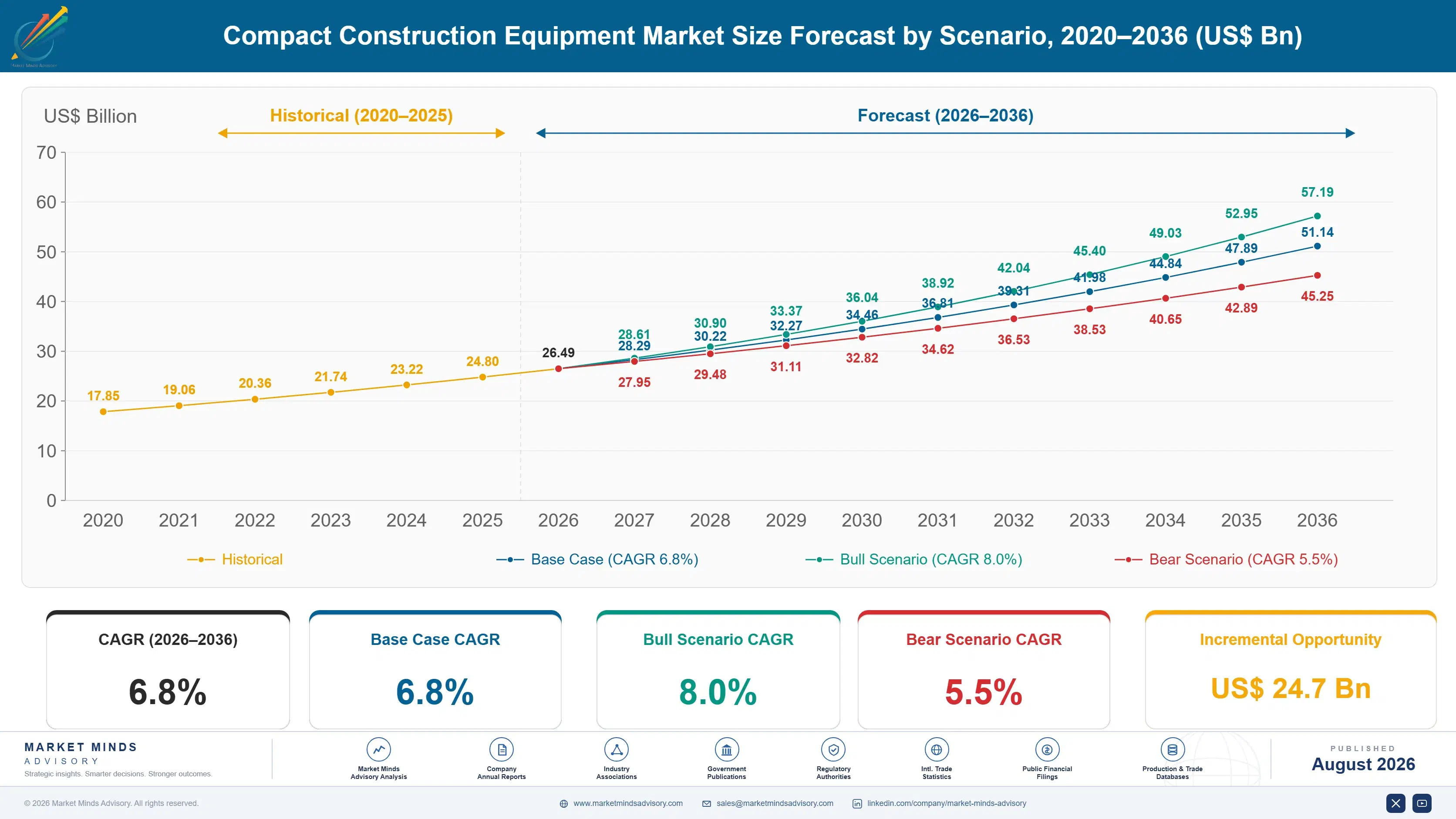
Compact equipment demand surged through 2021 and 2022 as residential construction and infrastructure stimulus spending both ran hot, then cooled in 2023 as interest rates curbed new housing starts regionally. Rental fleet replacement cycles kept unit volume steadier than new-build activity would suggest, producing a historical CAGR of 5.8% across a choppier five-year path than that single number implies.
The base case assumes 6.8% annual growth through 2036, driven by three mechanisms. First, rental penetration keeps rising as contractors prefer flexible fleet access over ownership, and rental companies standardize on compact machines that turn over faster between jobs. Second, urban infill construction and utility work in dense metros favor compact equipment's smaller footprint over full-size alternatives that cannot maneuver tight sites. Third, emissions regulation in the EU and California is accelerating replacement of older diesel units with newer, cleaner compact machines ahead of schedule.
The bull case assumes faster electrification mandates and rental fleet turnover pull growth toward 8.0%. The bear case centers on a prolonged residential construction slowdown across North America and Europe that delays fleet replacement and pushes contractors to keep older diesel machines running longer, pulling growth down toward 5.5% if housing starts stay depressed through 2030.

Rental Penetration and Electrification Economics

Compact equipment sits at the intersection of two major shifts in construction procurement: contractors renting instead of owning, and cities restricting diesel emissions on job sites. Manufacturers that used to compete mainly on bucket capacity and horsepower now compete on rental fleet economics, uptime guarantees, and increasingly on battery range and charging turnaround time.
CR5 CONCENTRATION52%Reflects consolidation among global full-line construction equipment manufacturers
RENTAL FLEET PENETRATION58%Share of compact units accessed through rental rather than ownership
CHINA PRODUCTION SHARE34%Share of global compact equipment units manufactured domestically there
AVERAGE MACHINE UTILISATION RATE62%Typical annual hour utilisation across rental fleet compact machines
STEEL AND COMPONENTS SHARE35-42%Portion of manufacturing cost tied to steel and hydraulics
ELECTRIC MODEL PRICE PREMIUM28-35%Premium buyers pay for battery-electric over diesel equivalent machines
Rental companies including United Rentals, Sunbelt, and Herc now specify compact equipment orders directly with OEMs at a scale that shapes product roadmaps more than individual contractor demand does. That buying power is pushing manufacturers toward standardized platforms that simplify fleet maintenance and parts inventory across dozens of machine variants, trading some customization for lower total fleet operating cost.
The next decade will separate OEMs that can profitably electrify compact equipment from those that cannot. Battery cost, charging infrastructure, and jobsite power access remain the binding constraints, more than customer willingness to pay a premium for cleaner machines. Expect the compact segment to lead full-size equipment into electrification simply because smaller battery packs make the economics work years before they do for heavy machines across nearly every major regional market simultaneously.
"Electrification in compact equipment isn't a sustainability story, it's a total cost of ownership story. Contractors who run the math on fuel and maintenance savings convert faster than the ones waiting for a subsidy."
Director, Industrial Equipment Practice · MMA Construction and Industrial Equipm

Market Trends

Battery-Electric Compact Equipment Reaches Commercial Scale

Caterpillar, Komatsu, Volvo CE, and Bobcat have all moved battery-electric mini excavators and compact loaders from pilot programs into standard dealer catalogs since 2023, with charge times now under two hours for one-to-three-tonne machines. Total cost of ownership studies commissioned by rental fleets show battery-electric compact machines reaching diesel cost parity within four to five years once fuel and maintenance savings are counted, even though upfront price still runs 28 to 35% higher. Urban contractors working under city noise and emissions ordinances are adopting fastest, since electric machines let them work extended hours and indoor sites diesel units cannot access.
Market Impact: Adds utilization rates 15-20% above full-size
Rental Fleet Standardization Reshapes OEM Product Roadmaps

Large rental companies including United Rentals, Sunbelt Rentals, and Herc Holdings now account for a majority of new compact equipment purchases in North America, and their fleet standardization preferences increasingly dictate which machine variants OEMs prioritize for production. Rental buyers favor simplified option packages, common parts across machine families, and telematics-enabled fleets that let them track utilization and schedule maintenance remotely across thousands of units simultaneously. OEMs that align product design with rental fleet specifications win volume orders that dwarf what individual contractor sales could ever generate, reshaping engineering priorities away from niche customization toward standardized, serviceable platforms.
Market Impact: Accelerates fleet turnover by 18 months

Market Opportunities and Growth Drivers

Urban Infill Construction Favors Compact Machine Footprints

Urban infill and brownfield redevelopment projects, which the US Census Bureau reports now account for a growing share of new construction starts in dense metros, require equipment that can maneuver through narrow lot access and occupied adjacent properties that full-size machines cannot navigate safely. Compact track loaders and mini excavators under six tonnes fit through standard gate openings and residential access points, letting contractors avoid the temporary road closures and permit costs full-size equipment often requires. Rental yards in major metros report compact machine utilization running meaningfully above full-size counterparts as a direct result of this access advantage.
Market Impact: Raises upfront cost by 28-35%

Diesel Emissions Regulation Accelerates Fleet Replacement

EU Stage V and US EPA Tier 4 Final emissions standards have progressively tightened particulate and nitrogen oxide limits on off-road diesel engines, and several European cities including London, Amsterdam, and Paris now restrict or surcharge older diesel equipment entering low-emission zones. Contractors working inside these zones must retrofit older machines with costly emissions equipment or replace them outright, and replacement is usually cheaper once retrofit and downtime costs are compared. Rental fleets are retiring pre-Stage V compact machines faster than their normal depreciation schedule to keep fleets eligible for low-emission zone job sites across Western Europe.
Market Impact: Raises manufacturing cost 35 to 42%

Market Restraints and Challenges

Battery and Charging Infrastructure Cost Barriers

Battery-electric compact machines cost 28 to 35% more than diesel equivalents upfront, driven by lithium-ion battery pack costs that have not fallen as fast in off-road equipment as in passenger vehicles, since production volumes remain far smaller. Rental fleets and small contractors without capital budgets to absorb that premium adopt electric machines more slowly than large fleets with balance sheet capacity for a longer payback period. Jobsite charging infrastructure adds a second barrier, since many sites lack grid power access needed to fast-charge multiple machines simultaneously. Several OEMs now offer battery leasing programs that shift the premium into operating cost.
Market Impact: Adds 28-35% upfront price premium

Steel Tariffs Raise Compact Equipment Input Costs

Steel accounts for roughly 35 to 42% of a compact machine's manufacturing cost, and Section 232 tariffs on imported steel into the United States, along with similar EU trade measures, have raised input costs for OEMs sourcing outside their home region. Domestic steel capacity in some regions cannot fully substitute for imports, leaving manufacturers exposed to tariff pass-through even when they would prefer local sourcing. Mid-tier OEMs with less purchasing scale absorb this pressure worse than Caterpillar or Komatsu, which negotiate steel contracts across their full global portfolio. Several manufacturers are now qualifying regional steel suppliers to reduce tariff exposure.
Market Impact: Drives 55%+ share of new orders
4 additional market trends, 3 additional growth drivers, and 3 additional restraints and challenges are covered in the full report. Contact sales@marketmindsadvisory.com to access the complete intelligence.

Segment CAGR and Growth Architecture

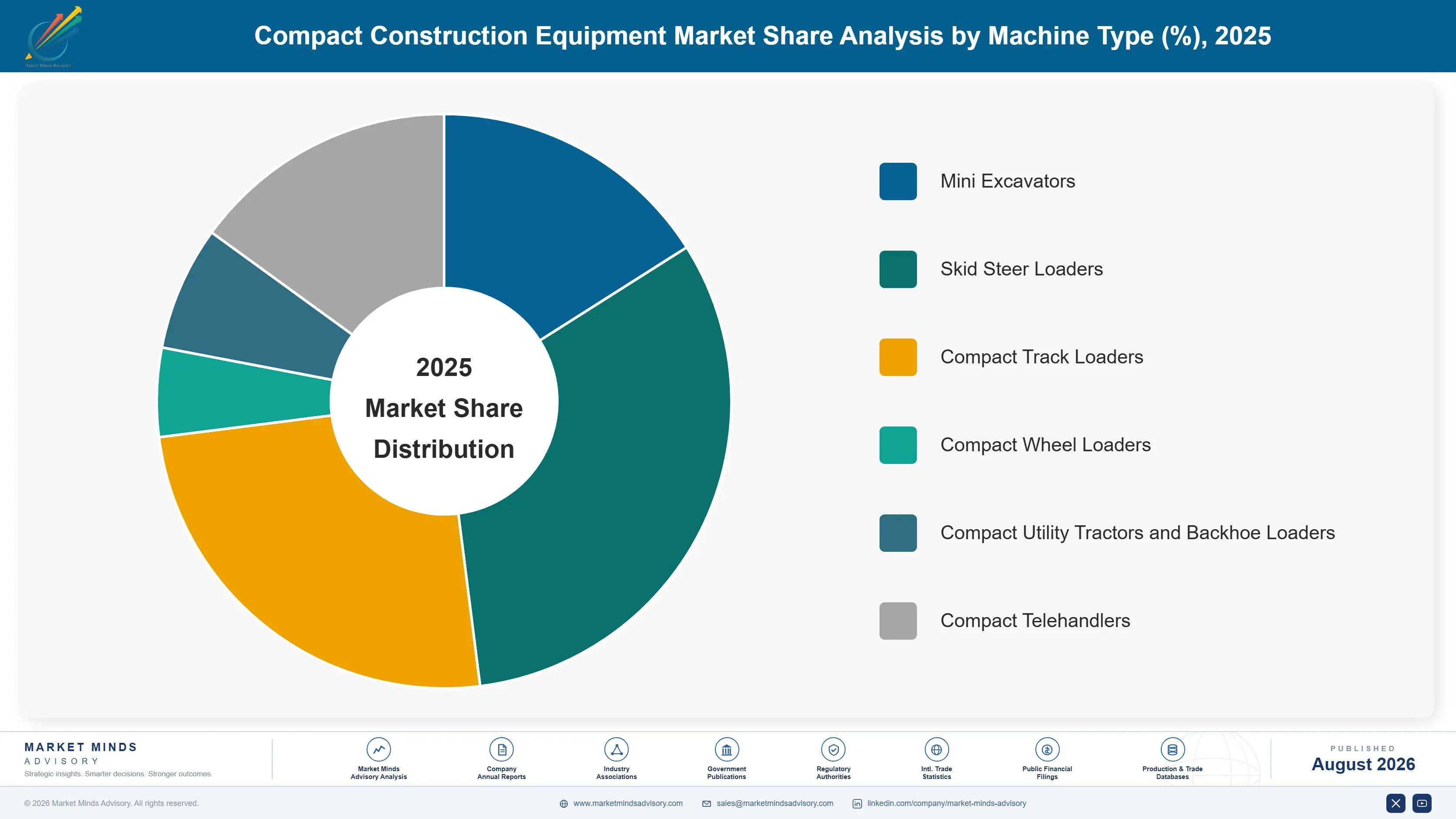
This report segments the compact construction equipment market by machine type across mini excavators, skid steer loaders, compact track loaders, compact wheel loaders, compact utility tractors and backhoe loaders, and compact telehandlers. Machine type was chosen over end-use application because purchasing, financing, and rental fleet decisions follow equipment category rather than the specific jobsite task a contractor ultimately performs.
compact-construction-equipment-market-market-share-analysis-1787301169893

Compact Track Loaders

Compact track loaders are the fastest-growing machine category at 9.2% annually, roughly 35% faster than the market average. Rental fleets favor them over skid steers because rubber tracks handle soft, wet, and uneven ground better, expanding the range of jobsites where a single machine type can work without switching equipment mid-project. Landscaping, utility installation, and residential construction all use compact track loaders as a general-purpose workhorse, which keeps utilization rates high across rental fleets and supports strong resale value. Manufacturers including Bobcat, Caterpillar, and Kubota are expanding compact track loader production capacity faster than any other compact category, and dealer waitlists for popular configurations have persisted through most of 2025 despite that expansion.
CAGR 9.2%

Mini Excavators

Mini excavators, the second-fastest category at 8.4% annually, benefit from urban infill construction and utility work that require precise digging in confined spaces full-size excavators cannot access. Rental penetration in this category runs higher than almost any other compact machine type, since contractors doing occasional utility trenching or foundation work rarely need to own one outright. Battery-electric mini excavators have reached commercial scale fastest within this category, since smaller battery packs make the economics work at a lower price point than larger electric equipment classes. Zero-emission mini excavators are increasingly specified for indoor demolition and confined-space work where diesel exhaust ventilation would otherwise be required, giving electric models a functional advantage beyond emissions compliance alone.
CAGR 8.4%
Full segment breakdown across 6 segments available in the complete report.

Regional Architecture and Country Demand Map

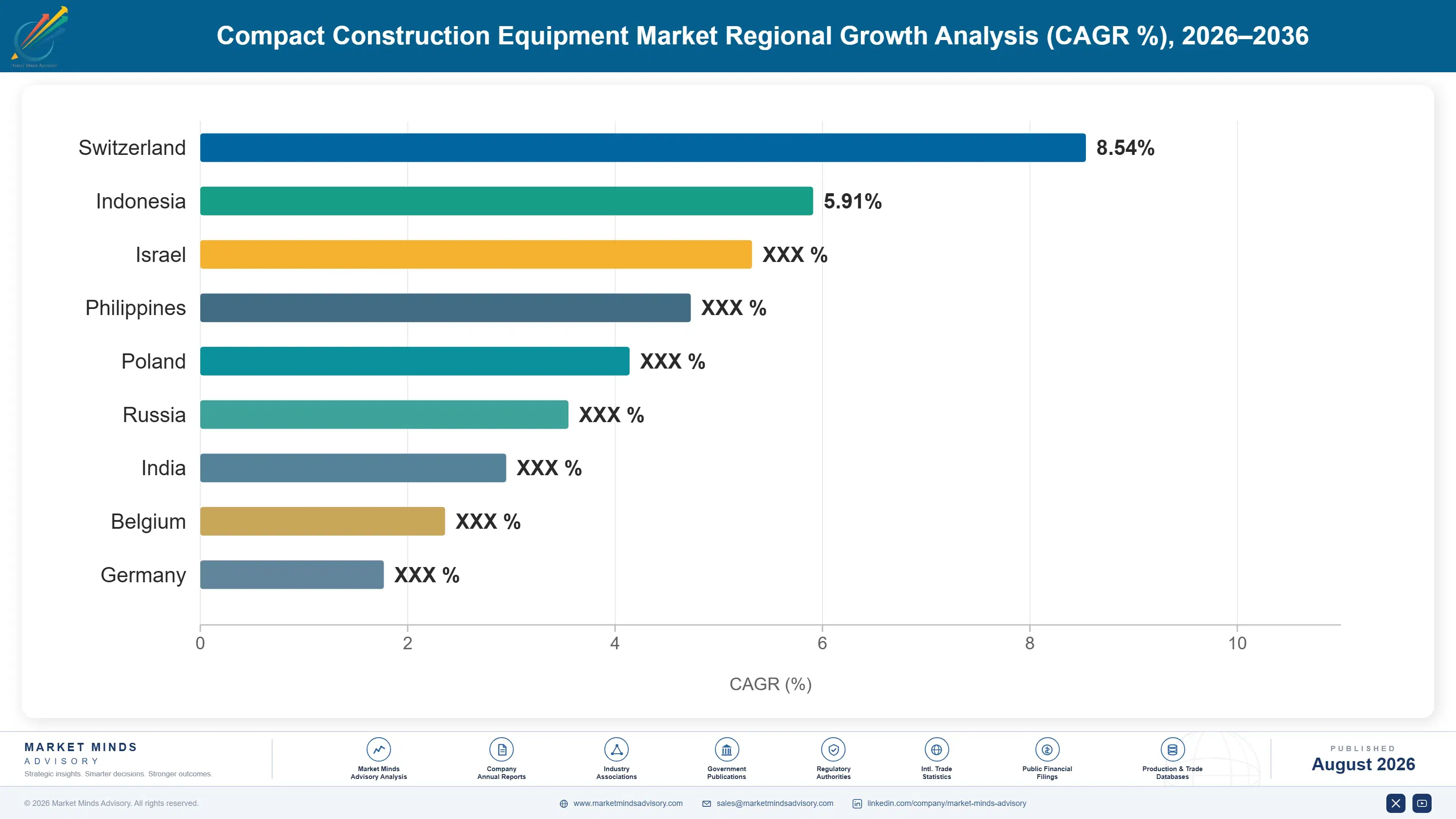
East Asia leads on production scale and domestic construction demand, with North America close behind on rental fleet depth. South Asia and Pacific is expanding fastest off a smaller base as infrastructure investment accelerates, while Latin America, the Middle East and Africa, and Eastern Europe remain import-dependent markets.

North America

United Rentals, Sunbelt, and Herc Holdings dominate compact equipment purchasing decisions here, and their fleet standardization preferences shape which machine variants OEMs prioritize more than individual contractor demand does. US residential construction, despite higher interest rates, keeps generating steady replacement demand as rental fleets retire aging units on fixed depreciation schedules regardless of new-build activity. Canada's infrastructure spending and resource sector construction add a second demand layer less tied to residential housing cycles. Mexico functions increasingly as a manufacturing base for US-bound compact equipment components, given nearshoring trends among several major OEMs relocating supplier capacity closer to their largest end market, particularly for hydraulic components and steel castings used across multiple compact machine platforms.
Share: 23% | CAGR: 6.0% (2026 to 2036)

Western Europe

EU Stage V emissions standards and low-emission zone restrictions in cities including London, Amsterdam, and Paris are forcing faster fleet replacement than underlying construction activity alone would justify. Germany's construction equipment manufacturing base, anchored by Liebherr and Wacker Neuson, gives the region unusual domestic production depth compared to its actual compact equipment demand. France and the UK are advancing electric compact equipment adoption fastest within the region, driven by municipal procurement rules favoring zero-emission machines on public infrastructure projects. Southern European markets including Spain and Italy lag on replacement cycles, since construction activity there recovered more slowly from the post-2008 downturn than in Northern Europe, where replacement budgets remain comparatively stronger.
Share: 19% | CAGR: 5.2% (2026 to 2036)
Regional intelligence for 5 additional markets available in the complete report: East Asia, South Asia and Pacific, Latin America, Middle East and Africa, Eastern Europe. Contact sales@marketmindsadvisory.com.
compact-construction-equipment-market-country-cagr-analysis-1787301170420

Where Compact Equipment Margins Concentrate

Margin in this market increasingly sits in financing, telematics, and aftermarket parts rather than the base machine sale itself. Four levers explain most of the gap between OEMs still competing purely on unit price and those capturing recurring revenue across the full equipment lifecycle from purchase through eventual resale and disposal at end of service life.

Capturing Long-Term Rental Fleet Standardization Contracts

Winning a standardization agreement with a major rental company like United Rentals or Sunbelt locks in volume orders across dozens of branch locations simultaneously, and these agreements typically run three to five years before rebidding. OEMs that win these contracts see 12 to 18% better unit economics than competitors selling into the fragmented independent contractor market, because production planning certainty reduces manufacturing cost variability significantly. Losing a rental standardization contract to a competitor is correspondingly damaging, since the volume lost is difficult to replace through slower-moving direct contractor sales channels within a comparable timeframe.
Market Impact: Adds a 12-18% unit economics advantage over fragmented sales

Monetizing Telematics and Fleet Management Data

OEMs increasingly bundle telematics subscriptions with new equipment sales, charging US$50 to US$150 per machine monthly for utilization tracking, predictive maintenance alerts, and geofencing that rental fleets and large contractors both value for theft prevention and cost allocation across job sites. This recurring subscription revenue carries margins well above the equipment sale itself, and attachment rates are rising as fleet managers increasingly view telematics as standard rather than optional equipment. Caterpillar's and Komatsu's telematics platforms both report subscription renewal rates above 80%, turning a one-time machine sale into a multi-year data relationship with far more predictable revenue.
Market Impact: Telematics subscription renewal rates exceed 80% across major OEM fleets

Expanding Certified Used Equipment Resale Channels

Compact equipment holds resale value unusually well compared to full-size machines, since rental fleets retire units on predictable schedules that feed a steady supply of well-maintained used equipment into certified resale channels. OEMs operating certified pre-owned programs capture 15 to 20% of the machine's original value on resale while also generating parts and service revenue from the used unit's subsequent owner across its remaining service life. Manufacturers without a formal certified used channel lose that resale margin entirely to independent used equipment dealers, who capture the transaction value that would otherwise flow back to the original OEM.
Market Impact: Captures an added 15-20% of original machine resale value

Bundling Attachments and Financing Into Equipment Sales

Compact machines sell with an average of two to three attachments, including buckets, augers, and grapples, and attachment sales carry gross margins meaningfully above the base machine since they require far less capital-intensive manufacturing. OEMs offering in-house financing capture the interest margin on equipment purchases that would otherwise go to a third-party lender, and financing attach rates above 60% are now common among dealers with dedicated captive finance arms. Bundling attachments and financing into a single transaction increases dealer switching costs for repeat customers, since unwinding a financed purchase to switch brands is more disruptive than a simple cash sale.
Market Impact: Financing attach rates exceed 60% at captive-finance dealers

Who Controls the Margin Pool

CR5 concentration sits at 52%, reflecting genuine consolidation among full-line global OEMs. Caterpillar and Komatsu lead on manufacturing scale and dealer network depth, but the gap to challengers including Kubota and Volvo CE has narrowed as compact-specific specialists match their product breadth in the sub-six-tonne classes that matter most to rental fleets.
Competitive activity plays out on three fronts. Electrification is the most visible, with nearly every major OEM now shipping at least one battery-electric compact model. Telematics and fleet management platforms are the second front, where Caterpillar and Komatsu have pulled ahead of smaller competitors lacking comparable software investment. Chinese manufacturers including SANY and XCMG are the third front, undercutting Western OEMs on price in export markets while closing the technology gap faster than expected.

Pressure is building from two directions rankings have not caught up with. Doosan Bobcat has moved from a mid-tier compact specialist into a genuine global leader in track loaders specifically, taking share from both Caterpillar and Deere in North America. Chinese OEMs are simultaneously expanding beyond their home market into Southeast Asia, Africa, and increasingly Latin America, competing on price against established dealer networks that took decades to build.
compact-construction-equipment-market-company-positioning-matrix-1787301170937

Competitive Moat and Risk Dimensions

CATERPILLAR INC.

Moat: Global Dealer Network Depth

Caterpillar's dealer network, the deepest in the industry, gives it service and parts availability that smaller competitors cannot match in most markets worldwide. That network lets Caterpillar guarantee uptime commitments to large rental fleets and contractors that competitors with thinner dealer coverage simply cannot offer credibly.
CATERPILLAR INC.

Risk: Slower Compact-Specific Innovation Pace

Caterpillar's compact equipment lineup has moved more slowly on electrification and compact-specific features than specialists like Bobcat, since compact machines still compete internally for engineering resources against Caterpillar's larger and historically higher-margin full-size equipment lines, which have traditionally received priority in capital budgeting and R&D allocation decisions.
KOMATSU LTD.

Moat: Hydraulics and Engine Efficiency Leadership

Komatsu's decades of hydraulics and engine efficiency engineering give its compact machines a fuel economy and precision control advantage that contractors doing fine-grade excavation work particularly value across demanding jobsite conditions, especially on projects requiring tight tolerance grading work near underground utilities and other buried infrastructure.
KOMATSU LTD.

Risk: Limited North American Dealer Depth

Komatsu's dealer network in North America is thinner than Caterpillar's or Deere's, particularly in secondary markets, limiting its ability to win large rental fleet standardization contracts that require guaranteed service response times nationwide across every branch location a large multi-state fleet operator maintains and services year-round.

Players Tracked

Prominent Players

Caterpillar Inc.
Komatsu Ltd.
Deere & Company
Volvo Construction Equipment
Kubota Corporation

Other Key Players

CNH Industrial N.V.
JCB Ltd.
Hyundai Doosan Infracore Co.
Hitachi Construction Machinery Co.
SANY Group Co.
XCMG Machinery Co.
Liebherr Group
Doosan Bobcat Inc.
Wacker Neuson SE
Yanmar Holdings Co.
Takeuchi Manufacturing Co.
Terex Corporation
Manitou Group
ASV Holdings Inc.
LiuGong Machinery Co.

Recent Developments

APRIL 2025

Caterpillar Expands Compact Electric Equipment Production

Caterpillar completed an organic capacity expansion at its compact equipment manufacturing facility to add dedicated battery-electric mini excavator and compact loader assembly lines, responding to rental fleet demand for zero-emission machines in low-emission zone markets across Europe and North America, where diesel restrictions are already in force.
Signal: Signals Caterpillar is committing manufacturing capital to electrification rather than treating it as a niche product line.
AUGUST 2025

Komatsu Acquires Compact Equipment Telematics Startup

Komatsu acquired a specialist telematics and fleet analytics startup to strengthen its remote monitoring and predictive maintenance capability across its compact equipment lineup, adding software engineering talent it previously lacked in-house for rapid feature development and faster platform iteration across its global dealer network and fleet customers.
Signal: Indicates OEMs are increasingly building telematics capability through acquisition rather than slower internal development timelines alone.
NOVEMBER 2025

Doosan Bobcat Signs Supply Agreement With Battery Cell Manufacturer

Doosan Bobcat signed a multi-year supply agreement with a battery cell manufacturer to secure dedicated cell capacity for its expanding compact electric equipment lineup, reducing exposure to the battery supply constraints affecting smaller compact equipment competitors that lack comparable purchasing scale and negotiating leverage industry-wide.
Signal: Confirms battery cell supply security is becoming a genuine competitive differentiator among electrifying compact equipment OEMs.

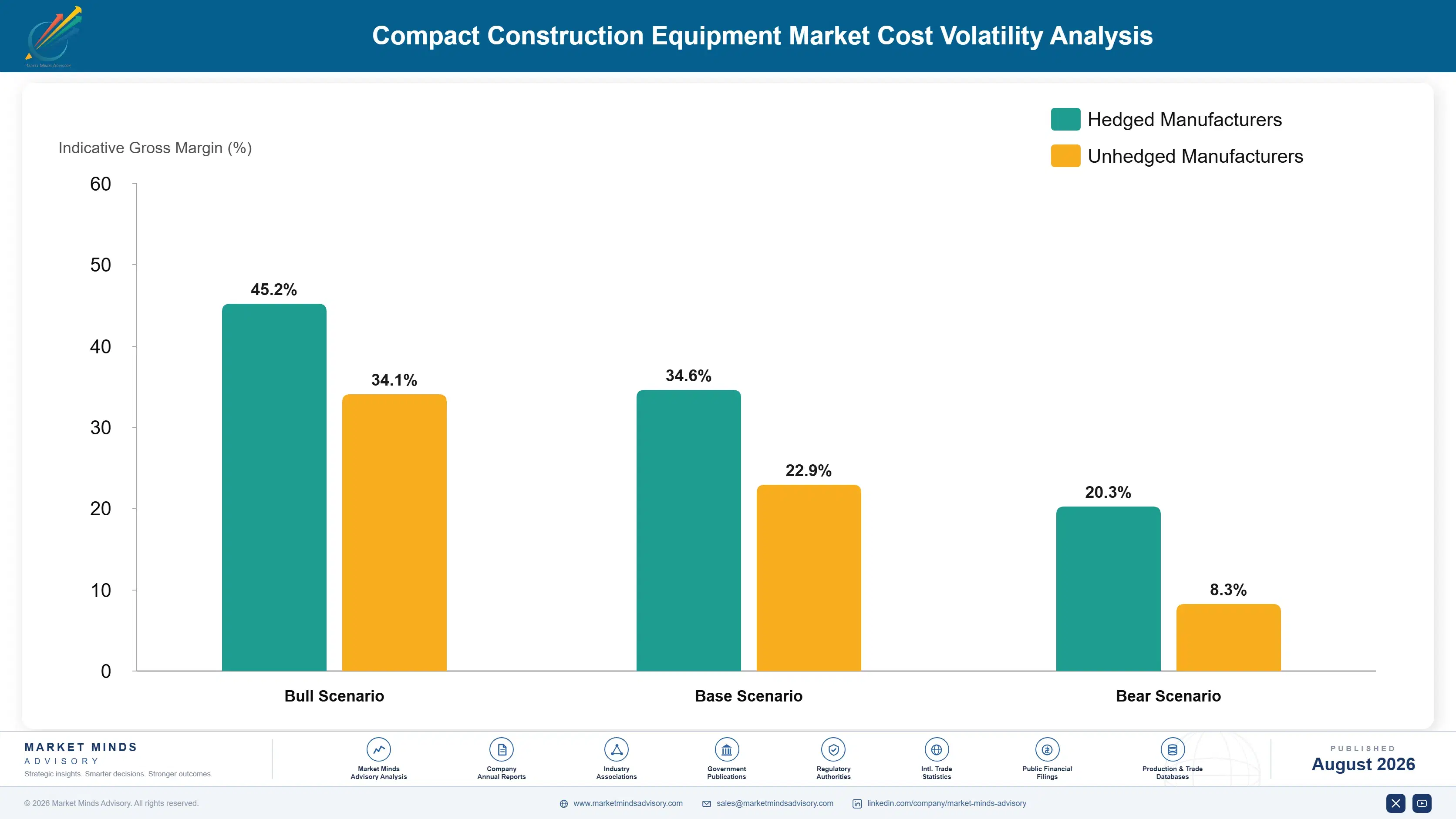
Steel and Component Cost Exposure

Steel accounts for 35 to 42% of compact equipment manufacturing cost, with hydraulic components, engines, and increasingly battery cells making up most of the remainder. Steel is sourced from a mix of domestic mills and imports depending on OEM footprint, while hydraulic components and engines concentrate among a smaller number of specialized suppliers including Bosch Rexroth and Kubota's own engine division.
Global steel prices rose more than 25% within three quarters during 2021 as post-pandemic demand outpaced mill capacity, and Section 232 tariffs on imported steel into the United States added a further cost layer for OEMs sourcing internationally, according to US Census Bureau trade data. That combination forced several manufacturers to implement mid-cycle price increases on new equipment orders, an unusual step in an industry that typically holds pricing steady within a model year.

Scale OEMs like Caterpillar and Komatsu negotiate steel and component supply contracts across their full global equipment portfolio, giving them better pricing than mid-tier manufacturers buying at smaller volumes. Manufacturers sourcing steel domestically within tariff-protected markets carry a durable cost advantage over competitors importing steel into the same market, reshaping where OEMs choose to locate final assembly.
compact-construction-equipment-market-cost-volatility-analysis-1787301171134

Qualifying Regional Steel Suppliers to Reduce Tariff Exposure

OEMs are qualifying steel suppliers within each major tariff jurisdiction rather than sourcing centrally from a single global mill network, reducing exposure to any single country's trade policy shifts. This adds supplier qualification complexity but has measurably reduced the cost volatility passed through to compact equipment pricing during recent tariff cycles and trade policy shifts.

Locking Multi-Year Steel Supply Contracts

Larger manufacturers are negotiating multi-year fixed-price steel supply agreements directly with mills, trading some upside if prices fall for protection against sudden spikes tied to trade policy or demand shocks. Smaller OEMs without comparable purchasing volume typically cannot access these terms and remain more exposed to spot steel pricing swings throughout each fiscal year.

Localizing Final Assembly Near Key Demand Markets

Several OEMs are relocating final assembly closer to major demand markets specifically to qualify for domestic content rules and avoid tariff exposure on finished machines crossing borders. This localization strategy adds capital investment upfront but reduces long-run exposure to trade policy volatility affecting cross-border equipment shipments and finished-goods tariffs on a durable, lasting basis over time.

Portfolio Architecture for Margin Defence

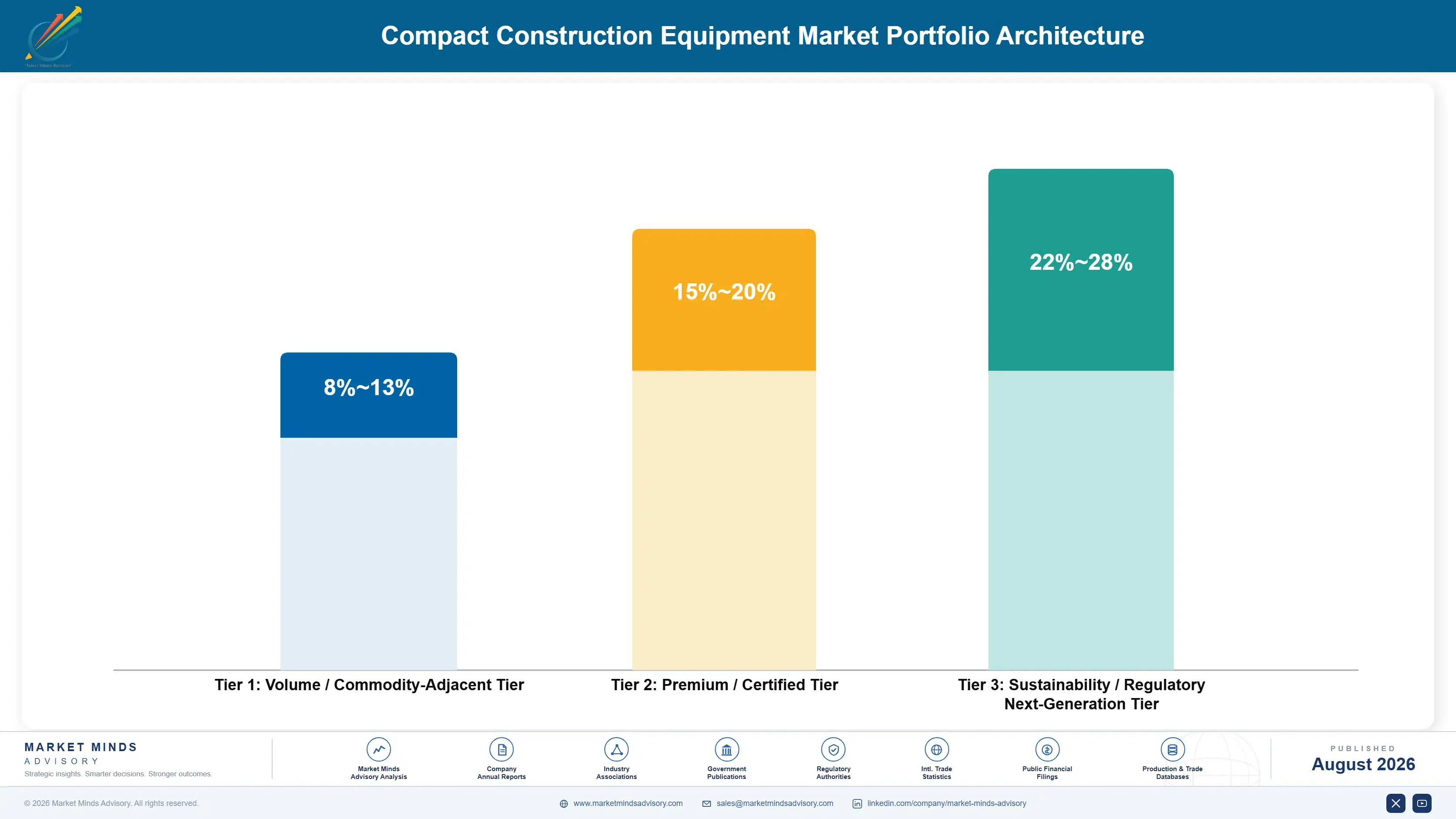
Portfolio economics split into three tiers. Volume commodity-adjacent machines, still the largest unit-volume pool, run on modest margins driven by intense price competition among full-line OEMs and increasingly capable Chinese manufacturers. Premium and certified machines, carrying advanced telematics, extended warranty, and certified pre-owned resale programs, command meaningfully better margins because fleet buyers pay for uptime assurance and total cost of ownership certainty.
The tension between volume and premium runs deep, since rental fleets want the lowest acquisition cost per unit while also demanding the telematics and reliability guarantees that only premium-tier machines deliver consistently across every branch and job site. Caterpillar and Komatsu manage this by segmenting product lines explicitly, offering stripped-down rental-spec machines alongside fully optioned contractor-owned configurations built on the same base platform.

High-value pools concentrate in electrification and telematics-enabled machines, where technology scarcity and rental fleet standardization both support pricing power that ordinary commodity manufacturing cannot replicate. Capital is flowing fastest into battery-electric platform development, as OEMs race to establish the electrification technology position that will define compact equipment competitiveness through the next decade across nearly every major regional market worldwide and product tier.

Volume / Commodity-Adjacent Tier

Standard diesel compact machines without advanced telematics or certified resale programs, priced primarily on unit cost and competing mainly on dealer network reach and basic reliability across high-volume rental and contractor fleets.
Gross Margin: 8-13%

Premium / Certified Tier

Machines bundled with advanced telematics subscriptions, extended warranty coverage, and certified pre-owned resale eligibility that fleet buyers value for total cost of ownership certainty and predictable residual value across the ownership lifecycle.
Gross Margin: 15-20%

Sustainability / Regulatory / Next-Generation Tier

Battery-electric and hybrid compact machines addressing emissions regulation and low-emission zone access requirements, where technology scarcity and early-mover advantage both support the strongest pricing power in the category currently available to manufacturers.
Gross Margin: 22-28%
compact-construction-equipment-market-portfolio-architecture-1787301171643

High-value Sub-segments and Strategic Watch-out

Battery-Electric Mini Excavators

Zero-emission requirements in European low-emission zones and indoor demolition applications make this segment both regulation-driven and functionally necessary, commanding sustained pricing power even as battery costs gradually decline across the broader electric equipment category over the next several years of continued technology maturation and manufacturing scale-up.
Gross Margin: 24-29%

Telematics-Enabled Rental Fleet Machines

Rental fleet standardization demand is growing steadily as large rental companies mandate telematics across their compact equipment portfolios, commanding a durable subscription revenue premium even though base machine volume growth trails the fastest electric segments in the category by a wide and quite meaningful margin.
Gross Margin: 17-22%

Standard Diesel Skid Steer Loaders

Conventional diesel skid steers remain the largest unit-volume segment by far, competing mainly on price and dealer reach rather than technology differentiation, with margins compressed by intense competition among full-line and Chinese manufacturers expanding export volume into nearly every regional market worldwide at growing scale.
Gross Margin: 9-13%

Legacy Pre-Stage V Diesel Machines

Older pre-Stage V diesel machines face rising low-emission zone exclusion risk as European cities tighten access rules, and owners with heavy legacy fleet exposure risk losing resale value faster than they can replace aging units across their fleets on a reasonable and truly affordable timeline.
Gross Margin: 4-8%

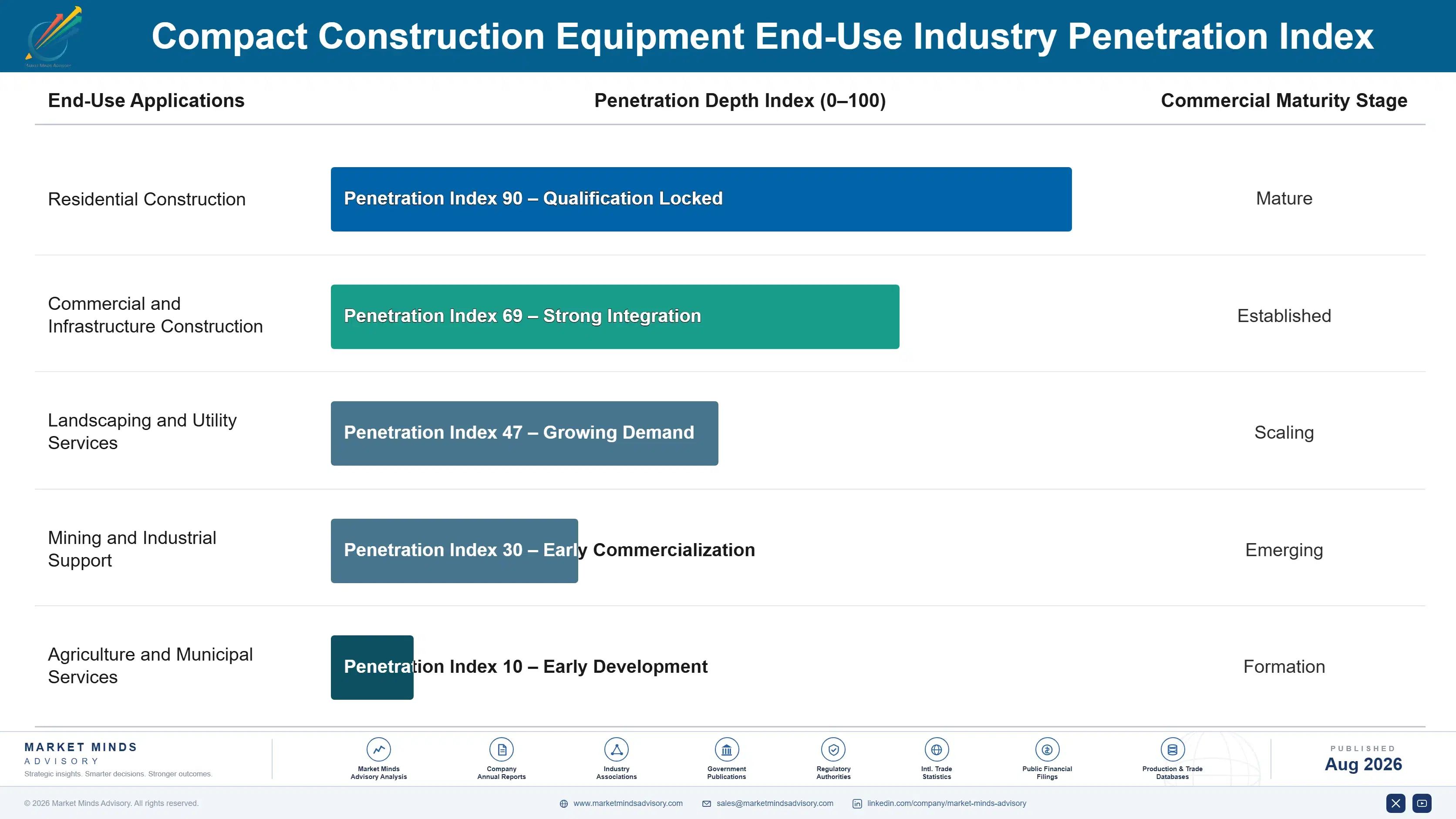
How Compact Equipment Demand Recurs

Compact equipment demand carries a genuine annuity quality through rental relationships and telematics subscriptions layered on top of the physical machine sale. Rental fleets replace units on fixed depreciation schedules regardless of macroeconomic conditions, and telematics subscription renewal rates above 80% give OEMs a recurring revenue stream that persists independent of new machine sales cycles across nearly every fleet segment and region.
Adoption depth varies meaningfully by end-use vertical. Landscaping and utility contractors show the deepest compact track loader adoption, since the machine functions as their primary tool rather than an occasional-use asset. Residential construction adoption is broad but more cyclical, tracking housing starts closely. Mining services and industrial construction adoption remains shallower, since compact machines play a supporting role there rather than the primary earthmoving function on most large-scale projects.

A younger generation of fleet managers and procurement officers, more comfortable with telematics dashboards and data-driven maintenance scheduling than their predecessors, is accelerating the shift toward machines bundled with digital fleet management tools. That generational shift is reshaping which OEMs even get invited into rental fleet standardization negotiations in the first place at all.
compact-construction-equipment-market-end-use-penetration-index-1787301172138

What Wins in Compact Equipment

These are among the four positions where our research anticipates prominent divergence between winners and laggards over the coming forecast period. Each is grounded in the demand model, the regulatory perimeter, and the announced capacity pipeline.
01 / ELECTRIFICATION TIMING STRATEGY

Invest in battery-electric platforms before emissions rules force reactive catch-up

OEMs that invest in battery-electric compact platforms ahead of tightening EU and California emissions rules capture premium pricing and low-emission zone market access before that becomes a baseline requirement. Waiting until regulation forces the issue means competing for scarce battery cell supply against OEMs that locked in capacity years earlier, at a moment when demand is spiking across the entire industry simultaneously. Early movers are also better positioned to win rental fleet standardization contracts that increasingly specify electrification roadmaps as a vendor qualification criterion.
02 / RENTAL FLEET RELATIONSHIP

Win rental standardization contracts before competitors lock in multi-year terms

Rental fleet standardization agreements lock in volume for three to five years and are difficult for a displaced competitor to win back before the next rebidding cycle even opens. OEMs that treat rental buyers as a distinct customer segment, with dedicated pricing, fleet-spec machine variants, and telematics integration, consistently outperform competitors selling the same product line to both contractors and fleets identically. The window to establish these relationships is narrowing as the largest rental companies consolidate their OEM panel down to fewer preferred suppliers.
03 / REGIONAL MANUFACTURING FOOTPRINT

Localize assembly near demand centers to manage tariff and steel cost exposure

Manufacturers that localize final assembly near their largest demand markets avoid much of the tariff exposure and steel cost volatility affecting competitors importing finished machines across borders. This localization also shortens delivery lead times to rental fleets and contractors, which increasingly matters as machine replacement decisions get compressed into shorter windows around regulatory deadlines. OEMs that wait to localize risk losing price-sensitive volume to competitors who made this investment during the current capital cycle already underway across most major demand regions.
04 / TELEMATICS PLATFORM INVESTMENT

Build proprietary telematics capability rather than relying on third-party integration

OEMs building proprietary telematics platforms capture recurring subscription revenue that persists independent of new machine sales cycles, unlike those relying on third-party integration partners who capture much of that margin instead. Caterpillar's and Komatsu's telematics renewal rates above 80% demonstrate how sticky this revenue becomes once fleet managers build maintenance workflows around a specific platform's dashboard and alerts. The window for proprietary telematics to function as genuine differentiation narrows as third-party platforms become cheaper and considerably easier to integrate across the industry.

Engagement Snapshot From the Field

A live engagement with an industry participant carrying material or product regulatory and market exposure ahead of a defining policy shift, showing how our research translates into a defensible multi-year portfolio strategy.
MARKET MINDS ADVISORY · CLIENT ENGAGEMENT SUMMARY
Compact Construction Equipment Producer Strategic Portfolio Review and Transition Roadmap 2026·Investment Scenario on Compact Construction Equipment Exposure Evaluation 2025-26
CLIENT PROFILE
The client is a regional equipment rental company operating more than 40 branch locations across the southeastern United States, with a compact equipment fleet exceeding 3,000 units and annual fleet capital expenditure exceeding US$120 million (client-reported, unverified by MMA). The company was evaluating whether to begin large-scale battery-electric compact equipment procurement ahead of anticipated emissions regulation in several of its operating states.
STRATEGIC CHALLENGE
The client needed to determine which compact equipment categories and branch locations would benefit most from early battery-electric procurement, given a limited capital budget and considerable uncertainty about charging infrastructure costs, customer demand for electric machines, and residual value risk on a still-maturing electric equipment resale market across its operating footprint.
MMA APPROACH
MMA conducted a branch-by-branch demand analysis correlating local emissions regulation timelines, customer industry mix, and utilization patterns with electric equipment total cost of ownership modeling. The engagement combined primary interviews with the client's branch managers and comparative benchmarking against peer rental company electrification rollouts already underway in comparable regional markets.
KEY FINDINGS
  1. Roughly 18% of the client's branch locations, concentrated in metro areas with pending emissions ordinances, accounted for a disproportionate share of projected electric equipment demand over the next three years.
  2. Charging infrastructure costs varied more than threefold across branch locations depending on existing electrical service capacity, making a uniform rollout approach meaningfully less capital-efficient than a phased one.
  3. Customer willingness to pay a rental premium for electric machines was concentrated among contractors working inside low-emission zones, rather than distributed evenly across the client's full customer base.
  4. Peer benchmarking showed electric equipment residual values holding up better than the client's internal projections assumed, reducing the perceived downside risk of early procurement meaningfully.
CLIENT PROFILE
The client is a regional equipment rental company operating more than 40 branch locations across the southeastern United States, with a compact equipment fleet exceeding 3,000 units and annual fleet capital expenditure exceeding US$120 million (client-reported, unverified by MMA). The company was evaluating whether to begin large-scale battery-electric compact equipment procurement ahead of anticipated emissions regulation in several of its operating states.
STRATEGIC CHALLENGE
The client needed to determine which compact equipment categories and branch locations would benefit most from early battery-electric procurement, given a limited capital budget and considerable uncertainty about charging infrastructure costs, customer demand for electric machines, and residual value risk on a still-maturing electric equipment resale market across its operating footprint.
MMA APPROACH
MMA conducted a branch-by-branch demand analysis correlating local emissions regulation timelines, customer industry mix, and utilization patterns with electric equipment total cost of ownership modeling. The engagement combined primary interviews with the client's branch managers and comparative benchmarking against peer rental company electrification rollouts already underway in comparable regional markets.
KEY FINDINGS
  1. Roughly 18% of the client's branch locations, concentrated in metro areas with pending emissions ordinances, accounted for a disproportionate share of projected electric equipment demand over the next three years.
  2. Charging infrastructure costs varied more than threefold across branch locations depending on existing electrical service capacity, making a uniform rollout approach meaningfully less capital-efficient than a phased one.
  3. Customer willingness to pay a rental premium for electric machines was concentrated among contractors working inside low-emission zones, rather than distributed evenly across the client's full customer base.
  4. Peer benchmarking showed electric equipment residual values holding up better than the client's internal projections assumed, reducing the perceived downside risk of early procurement meaningfully.
RECOMMENDED STRATEGY
Phase 1: Phase 1 (Months 1-3): Prioritize electric equipment procurement and charging infrastructure investment at the highest-demand branch locations identified through the regulatory analysis. Phase 2: Phase 2 (Months 4-10): Expand electric fleet gradually to secondary branch locations, sequencing rollout by charging infrastructure readiness and confirmed customer demand signals. Phase 3: Phase 3 (Months 11-18): Evaluate rollout performance against utilization and residual value assumptions, then extend the program to remaining branch locations based on validated results.
OUTCOME
The client's phased electrification rollout achieved higher first-year utilization rates than its internal base case projected at the priority branch locations (client-reported, unverified by MMA). Concentrating charging infrastructure investment at high-demand branches rather than spreading it evenly reduced total capital deployment by roughly a quarter compared to the client's original uniform rollout plan.

Frequently Asked Questions

Foundational context covering the market sizes, CAGR, scope, country, region and competition that inform every finding below. This section is provided to cover basics and most often pre-purchase conversations, answered from the MMA Primary Research Dataset.

What is the current size of the Compact Construction Equipment Market?

The market was valued at US$24.8 billion in 2025 and is projected to reach US$26.5 billion in 2026 as rental fleet replacement and electrification adoption continue.

How large will the Compact Construction Equipment Market be by 2036?

MMA projects the market will reach US$51.2 billion by 2036, roughly 1.93 times its 2026 value, driven by rental penetration, electrification, and emissions-driven fleet replacement cycles.

What is the CAGR for the Compact Construction Equipment Market 2026 to 2036?

The market is projected to grow at a 6.8% CAGR between 2026 and 2036, with a bull case of 8.0% and a bear case of 5.5%.

Which segment is growing fastest?

Compact track loaders are the fastest-growing segment at 9.2% annually, roughly 35% faster than the category average, driven by rental fleet demand and jobsite versatility.

Who are the major companies in the Compact Construction Equipment Market?

Leading manufacturers include Caterpillar, Komatsu, Deere, Volvo Construction Equipment, and Kubota, which together hold roughly half of category revenue on a disclosed-revenue basis across their compact lineups.

Which country is growing fastest?

India leads country-level growth at an estimated 9.6% annually, supported by national infrastructure investment programs and a rapidly formalizing equipment rental market across major metro regions.

Report Segmentation Architecture

The full report scope spans multiple orthogonal segmentation dimensions, with cross-tabulated demand data provided for each dimension pair. Coverage extends further to regional breakdowns, trend trajectories, and the competitive detail needed to support segment-level decision-making.

By Machine Type

  • Mini Excavators
  • Skid Steer Loaders
  • Compact Track Loaders
  • Compact Wheel Loaders
  • Compact Utility Tractors and Backhoe Loaders
  • Compact Telehandlers

By End-Use Industry

  • Residential Construction
  • Commercial and Infrastructure Construction
  • Landscaping and Utility Services
  • Mining and Industrial Support
  • Agriculture and Municipal Services

By Commercial Dimension

  • Contractor Owned
  • Rental Fleet
  • Municipal and Government
  • Distribution Channel

By Region

  • North America
  • Western Europe
  • East Asia
  • South Asia and Pacific
  • Latin America
  • Middle East and Africa
  • Eastern Europe

Scope, Methodology, and Coverage

Every figure in this report is reproducible from documented input assumptions. The scope below maps the historical period, the forecast horizon, the segmentation dimensions, and the countries covered, alongside the underlying primary and qualitative methodology.
Historical Period
2020 to 2025
Forecast Period
2026 to 2036
Base Year
2025 (USD billions; MMA Primary Research Dataset, August 2026)
Market Definition
The Compact Construction Equipment market covers construction machinery under roughly 10 tonnes operating weight, including mini excavators, skid steer loaders, compact track loaders, compact wheel loaders, compact utility tractors, backhoe loaders, and compact telehandlers sold to contractors, rental companies, and municipalities. It excludes full-size heavy construction equipment and attachments sold separately from a base machine.
Quantitative Units
USD billions (current prices); unit shipments in thousands where disclosed by segment
Segmentation Dimensions
By Machine Type; By End-Use Industry; By Commercial Dimension; By Region
Regions Covered
North America, Western Europe, East Asia, South Asia and Pacific, Latin America, Middle East and Africa, Eastern Europe
Countries Covered
USA, China, Germany, France, UK, Japan, South Korea, India, Australia, Canada, Brazil, Mexico, Indonesia, Vietnam, Thailand, Malaysia, UAE, Saudi Arabia, South Africa, Nigeria, Turkey, Poland, Netherlands, Italy, Spain, Sweden, Switzerland, Argentina, Colombia, Singapore, and additional markets relevant to this sector
Key Companies Profiled
Caterpillar Inc., Komatsu Ltd., Deere & Company, Volvo Construction Equipment, Kubota Corporation, CNH Industrial N.V., JCB Ltd., Hyundai Doosan Infracore Co., Hitachi Construction Machinery Co., SANY Group Co., XCMG Machinery Co., Liebherr Group, Doosan Bobcat Inc., Wacker Neuson SE, Yanmar Holdings Co., Takeuchi Manufacturing Co., Terex Corporation, Manitou Group, ASV Holdings Inc., LiuGong Machinery Co.
Quantitative Methodology
Primary survey, n=3,800 respondents, Q4 2025, six countries; demand-side model with trade association cross-validation
Qualitative Methodology
47 expert interviews, Q4 2025; applied to validate demand model assumptions, identify emerging dynamics, and assess competitive positioning
Report Format
PDF and XLSX data workbook (Word format preview document)
Publisher
Market Minds Advisory
Report Code
MMA-2026-CON-115
Published
August 2026
Contact
sales@marketmindsadvisory.com | www.marketmindsadvisory.com

Purchase the full Compact Construction Equipment Market Report (2026 to 2036).

The full report delivers a complete quantitative and qualitative assessment of the compact construction equipment market through 2036, including machine-type and country-level forecasts across all seven MMA-tracked regions. It profiles the twenty leading manufacturers shaping competitive dynamics, with detailed moat and risk analysis for the top two players and a full development timeline of recent corporate activity. The report includes primary survey data from 3,800 respondents and 47 expert interviews conducted in Q4 2025, alongside a dedicated input cost and electrification readiness analysis. Buyers receive segmentation, regional, and competitive datasets formatted for direct integration into internal strategic planning models.
Machine-type and regional forecasts through 2036 inclusive
Competitive profiles of twenty leading global manufacturers
Primary survey data from 3,800 global respondents
Expert interview insights from 47 industry practitioners
Input cost and electrification readiness risk analysis
Editable data tables for internal strategic modeling

Built For The People Who Decide

From boardroom strategy to bench-side execution, this report is read cover-to-cover by leaders shaping the next decade of their industry, turning demand scenarios, market dynamics and valuation benchmarks into decisions.
CXOs/ Presidents/ VPs/ Managers
M&A and Corporate Development
Strategy Teams and R&D Heads
Procurement and Product Directors
Regulatory and Compliance Leaders
Investor Relations and Equity Analysts