

Market Minds Advisory
Commercial Refrigeration Compressors Market

Commercial Refrigeration Compressors Market: The Refrigerant Rules Change Faster Than the Machines Wear Out

A compressor lasts around fifteen years and the refrigerant it was designed around keeps getting phased out inside ten of them, which strands equipment that is still working perfectly well.

Lead Analyst

David Horsley

Published

September 2026

Make Smarter Decisions with Customized Research Insights

Request a free sample report and evaluate market opportunities, growth trends, and competitive dynamics relevant to your business needs.

2025 MARKET VALUE$7.4BMarket Size 2025
2036 FORECAST VALUE$14.3BBase Case , 2026 to 2036
CAGR 2026 TO 20366.2 %Bull 7.4% / Bear 5.0%
INCREMENTAL OPPORTUNITY$6.5BNet 10- year value creation
EXPANSION MULTIPLE1.82x2036 value over 2026 base
Strategic Levers
M&A Pipeline
Regional Outlook
Country Rankings
Competitive Intelligence
Segmental Deep-dive
Call-Us : 91 93563 13602

Executive Snapshot and Market Trajectory

Compressors run about fifteen years and refrigerant phase-down schedules move faster than that. Roughly 31% of the installed base is now operating on refrigerants scheduled for restriction before the equipment reaches end of life, which is a replacement driver nobody in the industry chose.
Growth runs at 6.2% and natural refrigerants lead it. Transcritical CO2 and natural refrigerant compressors grow at 9.3%, exactly 1.50 times the market rate, because they sit outside every phase-down schedule rather than ahead of the next one. East Asia holds the largest share at 30%, on Chinese manufacturing scale plus cold chain construction across the region. Variable speed packages follow at 7.4% as energy regulation reaches the compressor itself.
Concentration reaches 54% across the top five measured on units shipped weighted by cooling capacity. Refrigerant-specific engineering holds it there: a transcritical CO2 compressor operates at pressures conventional designs never approach, and that is a redesign rather than a materials substitution. Chinese manufacturers supply conventional compressors at costs Western producers cannot approach. System packagers are meanwhile capturing the specification relationship from the operators themselves. Contractor skills remain the binding constraint on natural refrigerant adoption.
Market Definition
This market covers compressors used in commercial and light industrial refrigeration systems, spanning hermetic and semi-hermetic reciprocating compressors, scroll compressors for commercial refrigeration, transcritical CO2 and natural refrigerant compressors, screw compressors for larger commercial systems, and variable speed and inverter-driven compressor packages. Domestic refrigerator compressors, air conditioning and heat pump compressors, industrial ammonia plant compressors above commercial capacity ranges, condensing units sold complete, and refrigerant supply fall outside scope.
Base Year Value
$7.4B in 2025 (MMA Primary Research Dataset, August 2026)
Forecast Period
2026 to 2036, eleven discrete annual values
CAGR
6.2% base case. Bull 7.4%. Bear 5.0%.
Fastest Growth Segment
Transcritical CO2 and Natural Refrigerant Compressors: 9.3% CAGR
Fastest Growth Country
India: 8.4% CAGR
Fastest Growth Region
South Asia and Pacific: 8.2% CAGR
Largest Region
East Asia: 30% of 2025 global value
Market Leaders
Bitzer, Emerson Climate Technologies, Danfoss, GEA Group, Dorin. Source: MMA Analysis based on company annual reports.
Primary Survey
n=3,800 procurement and R&D decision-makers, Q4 2025, six countries
Methodology
Demand-side build-up, cross-validated against public data, 47 expert interviews

Commercial Refrigeration Compressors Market Forecast Scenarios

commercial-refrigeration-compressors-market-size-forecast-scenario-1787301856281
The 2020 to 2025 period grew at 5.0% and refrigerant regulation shaped it more than any demand cycle. European phase-down quotas tightened through the period and pushed supermarket operators toward CO2 systems ahead of schedule, while food retail construction was disrupted and recovered unevenly. Cold chain investment across Asia continued regardless of what happened elsewhere in the sector.
Three mechanisms carry the 6.2% base case. Refrigerant phase-down is the largest, since equipment gets replaced on a regulatory timetable rather than a mechanical one. Cold chain construction across Asia and Latin America is the second, adding installations rather than replacing them. And energy regulation on commercial refrigeration is the third, which pulls variable speed compressors into applications that previously ran fixed speed. None of the three depends on food retail construction recovering at all.
The 7.4% bull case rests on phase-down schedules tightening further across Asian and Latin American markets, where large installed bases still run refrigerants that European operators have already abandoned. The 5.0% bear case is food retail capital expenditure weakness combined with phase-down enforcement slipping, which would leave replacement running on mechanical failure rather than regulatory deadline.

Replaced by Regulation, Not by Failure

A commercial refrigeration compressor is engineered for around fifteen years of service and generally delivers it. The refrigerant inside it does not last that long. Phase-down schedules have moved faster than equipment wears out for two decades now, and roughly 31% of the installed base is currently running gases scheduled for restriction before the machinery reaches any mechanical end of life.
STRANDED REFRIGERANT SHARE31%Of installed base running refrigerants scheduled for restriction before wearout
COMPRESSOR SERVICE LIFE15 yearsMechanical life, which now exceeds the regulatory life routinely
TRANSCRITICAL OPERATING PRESSURE120 barWell beyond what conventional refrigerant compressor designs ever approach
VARIABLE SPEED ENERGY SAVING27%Against fixed speed operation across typical commercial load profiles
TOP FIVE CONCENTRATION54%High, held by refrigerant-specific engineering rather than manufacturing scale
AFTERMARKET REVENUE SHARE29%Of total market from replacement compressors and service parts
That produces a replacement market driven by regulation rather than by failure, which is unusual and commercially convenient for manufacturers and deeply irritating for operators. A supermarket chain replacing perfectly functional compressors because the gas is being withdrawn is spending capital it had not planned, and the equipment it installs may face the same problem again inside a decade if the next refrigerant is also transitional.
Natural refrigerants answer that by sitting outside the schedules entirely. Transcritical CO2 operates around 120 bar, which is several times conventional system pressure and requires a genuinely different compressor rather than a modified one, and it is why concentration sits at 54% despite compressor manufacturing being otherwise unremarkable. Ammonia and hydrocarbon systems face their own constraints, and neither faces a phase-down.
"An operator asked me how long the new compressors would last. I said fifteen years mechanically. Then he asked how long the refrigerant would last, and that is a much harder question to answer honestly."
Director, Refrigeration Systems and Cold Chain Practice · MMA Industrial Equipme

Market Trends

Natural Refrigerants Escape The Phase-Down Cycle Entirely

Transcritical CO2, hydrocarbon, and ammonia systems sit outside every phase-down schedule rather than ahead of the next one, which is a different proposition from a lower global warming synthetic that may itself be restricted later. Natural refrigerant compressors grow at 9.3% against 6.2% for the market. Operators who have already replaced equipment once on regulatory grounds specify them precisely to avoid doing it again, and that motivation is considerably stronger than any efficiency argument. Contractor skills rather than equipment availability are the binding constraint on adoption everywhere. Manufacturers running certification programmes are removing that obstacle themselves.
Market Impact: Life runs about 15 years
Variable Speed Moves From Premium Option To Requirement

Energy regulation on commercial refrigeration systems is reaching the compressor rather than stopping at cabinet insulation and door design, which pulls inverter-driven units into applications that ran fixed speed for decades. Variable speed operation saves around 27% against fixed speed across typical commercial load profiles, where demand varies enormously between trading hours and overnight. The saving is genuine and the regulation is what actually moves specification, as it usually is. These packages also reduce starting current and mechanical stress on frequently cycling systems. Service life improves alongside, which matters in convenience retail applications particularly.
Market Impact: Some 31% face restriction

Market Opportunities and Growth Drivers

Cold Chain Construction Adds Installations Rather Than Replacements

Refrigerated warehouse, distribution, and retail construction across Asia and Latin America is creating first-time installations rather than replacing existing equipment, which behaves very differently from the regulation-driven replacement carrying European and North American demand. Those markets also specify refrigerants that European operators have already abandoned, so they are building an installed base that will face its own phase-down transition within roughly a decade of commissioning. Post-harvest loss reduction rather than food retail expansion drives most Indian construction. Refrigerated distribution capacity is being built where almost none previously existed. Growth there is genuinely first-time rather than cyclical.
Market Impact: Systems operate at 120 bar

Supermarket Estate Programmes Buy In Large Batches

Food retail operators replace refrigeration across store estates in programmes rather than store by store, which produces lumpy, negotiated, and highly competitive demand at scale. Those programmes are increasingly specified around natural refrigerants to avoid a second forced replacement inside the same asset life. Winning an estate programme delivers volume no individual installation could approach, and losing one removes a chain from a manufacturer's base for a decade or more. Commercial effort weighted toward estate specification produces entirely different outcomes from contractor selling. International retail groups also carry their standards into markets without domestic regulation.
Market Impact: Around 31% face early replacement

Market Restraints and Challenges

Transcritical Systems Demand Skills Contractors Lack

CO2 operating around 120 bar requires installation, brazing, and service practices that conventional refrigeration contractors have not been trained for, and the root cause is that the pressure regime is genuinely different rather than merely higher. Commercial impact is operators choosing familiar synthetic systems despite knowing full well that they face restriction, because the contractor base cannot support the alternative. Mitigation runs through manufacturer training programmes, certified contractor networks, and packaged systems that reduce the site work required. Manufacturers running their own certification programmes are converting a technology advantage into actual installations.
Market Impact: Natural refrigerants growing at 9.3

Regulatory Replacement Buys Nothing The Operator Wanted

Roughly 31% of the installed base faces refrigerant restriction before mechanical wearout, so operators spend capital replacing equipment that works, and the root cause is a phase-down timetable moving faster than a fifteen year service life. Commercial impact is resistance, deferral, and a search for drop-in alternatives that avoid capital spending entirely. Mitigation runs through natural refrigerant systems that escape future schedules, energy savings that offset capital, and honest advice about which synthetics are transitional. Suppliers who sold an operator the transitional gas are rarely invited back for the replacement. Credibility on that question decides estate programme awards years afterward.
Market Impact: Variable speed saves 27%
3 additional market trends, 4 additional growth drivers, and 2 additional restraints and challenges are covered in the full report. Contact sales@marketmindsadvisory.com to access the complete intelligence.

Segment CAGR and Growth Architecture

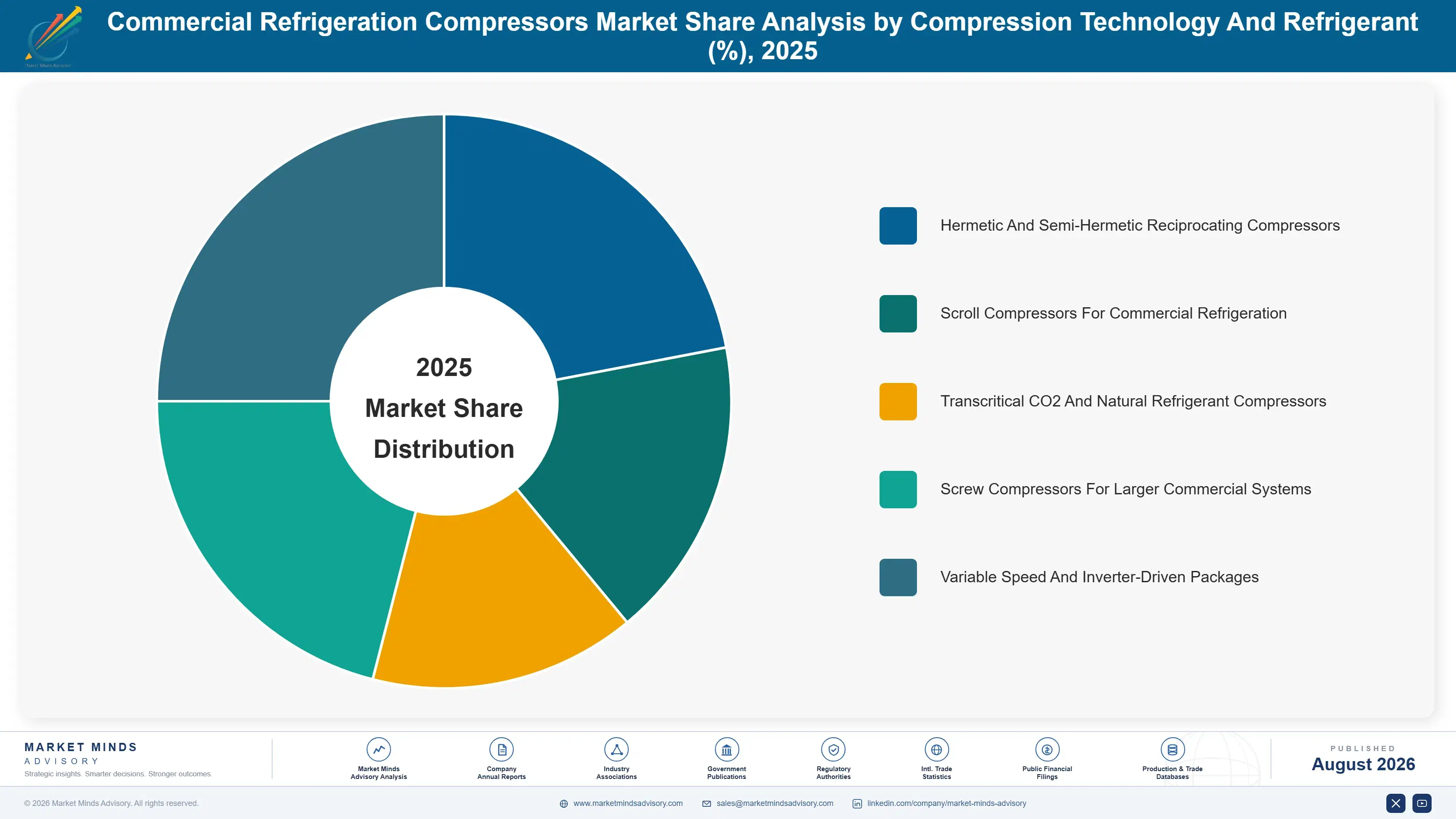
Segmentation follows compression technology and refrigerant compatibility, because those determine operating pressure, regulatory exposure, contractor skill requirements, and achievable efficiency. Cooling capacity and end-use application both cut across every technology rather than separating them, which makes either a considerably weaker primary dimension for this particular market. Refrigerant compatibility decides regulatory exposure outright. Nothing else matters as much commercially.
commercial-refrigeration-compressors-market-market-share-analysis-1787301857106

Transcritical CO2 And Natural Refrigerant Compressors

The fastest category at 9.3%, exactly 1.50 times the market rate, and the only one sitting outside every phase-down schedule rather than ahead of the next one. Transcritical CO2 operates around 120 bar, several times conventional system pressure, which demands a genuinely different compressor rather than a modified one, and it explains why concentration holds where it currently does. Contractor skills rather than equipment availability are the binding constraint on adoption, and manufacturers running training and certification programmes are removing that obstacle themselves. High ambient performance remains the limitation keeping these systems out of several large markets. Parallel compression and ejector arrangements address that at additional cost and considerable system complexity.
CAGR 9.3%

Variable Speed And Inverter-Driven Packages

Second fastest at 7.4%, pulled by energy regulation reaching the compressor rather than stopping at cabinet design. Variable speed saves around 27% against fixed speed across commercial load profiles where demand swings enormously between trading hours and overnight periods. The saving is real and regulation rather than payback is what actually moves specification, as it generally is in commercial refrigeration. These packages also reduce starting current and mechanical stress, which extends service life in applications that cycle frequently. Controls integration content rises alongside, which favours suppliers able to answer a whole system specification. Packagers holding the operator relationship increasingly make that call rather than the manufacturer. Regulation continues tightening steadily.
CAGR 7.4%
Full segment breakdown across 5 segments available in the complete report.

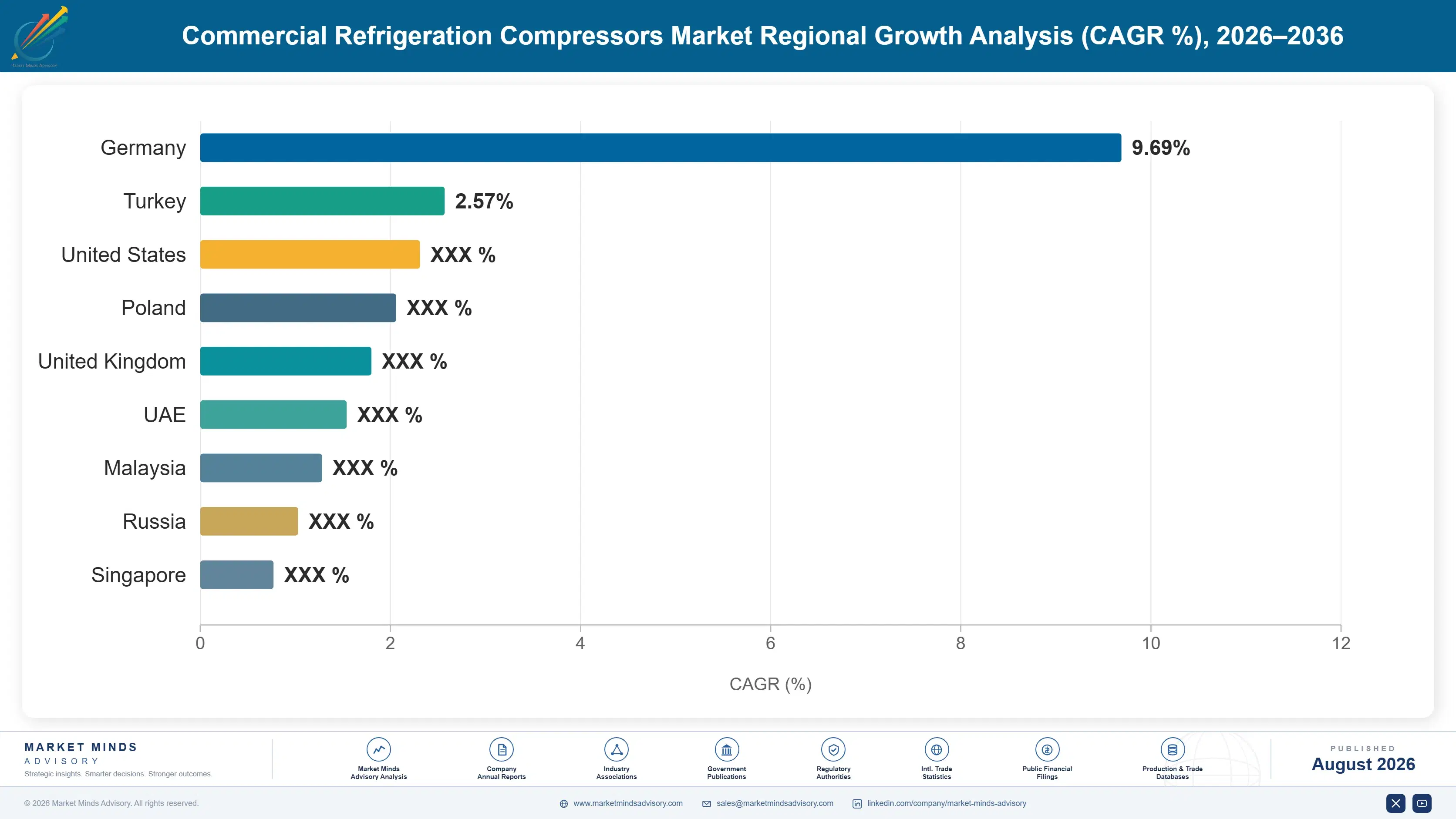
Regional Architecture and Country Demand Map

East Asia leads at 30% on Chinese manufacturing scale combined with cold chain construction across the region. Western Europe follows on phase-down enforcement depth, ahead of North America. South Asia and Pacific grows fastest on Indian cold chain build-out. Phase-down enforcement timing differs sharply between regions.

East Asia

Thirty percent, the largest share, and manufacturing capacity combined with cold chain construction explains it rather than any regulatory pressure. Chinese manufacturers supply compressors globally at costs no other region approaches, while domestic refrigerated warehouse and food retail construction adds first-time installations at considerable scale. Phase-down enforcement is lighter here than in Europe, so synthetic refrigerants that European operators have abandoned remain widely specified. Growth at 7.2% runs above the market rate, driven by cold chain build-out rather than replacement demand. That installed base will face its own phase-down transition within roughly a decade of commissioning. Natural refrigerant adoption remains concentrated in export-facing food processing rather than in domestic retail.
Share: 30% | CAGR: 7.2% (2026 to 2036)

Western Europe

Phase-down enforcement rather than market size carries this 23%. European quota reductions have been the tightest anywhere and have pushed supermarket operators toward transcritical CO2 well ahead of any other region, creating both the equipment demand and the contractor skill base that supports it. Estate replacement programmes across food retail have been by far the dominant demand mechanism here. Growth at 4.6% is the slowest of any region, reflecting a transition already substantially completed rather than any weakness in specification standards. Contractor certification coverage here is the deepest anywhere, which is why adoption proceeded at all. Manufacturers without a full natural refrigerant capacity range have lost estate programmes outright here.
Share: 23% | CAGR: 4.6% (2026 to 2036)
Regional intelligence for 5 additional markets available in the complete report: North America, South Asia and Pacific, Latin America, Middle East and Africa, Eastern Europe. Contact sales@marketmindsadvisory.com.
commercial-refrigeration-compressors-market-country-cagr-analysis-1787301857913

Selling Out of the Phase-Down Cycle

Roughly 31% of the installed base faces restriction before wearout, compressors last fifteen years, transcritical systems run at 120 bar, and variable speed saves 27%. Value comes from selling natural refrigerants honestly, from training contractors, and from winning estate programmes. Regulation rather than mechanical failure now sets the replacement clock. Operators resent that considerably.

Tell Operators Which Synthetics Are Transitional

Roughly 31% of the installed base already faces restriction before mechanical wearout, and an operator replacing on regulatory grounds will not forgive a supplier who sells them the next transitional gas. Natural refrigerants sit outside every schedule rather than ahead of the next one, which is a genuinely different proposition. Honest advice about which of the synthetics have a defined end costs some immediate volume and builds the credibility that decides estate programme awards later. Estate programmes increasingly specify natural refrigerants for exactly this reason rather than any performance one.
Market Impact: Around 31% now face early regulator

Train The Contractor Base Yourself Directly

Transcritical CO2 at around 120 bar requires installation, brazing, and service practices conventional refrigeration contractors have never been trained in, and operators choose familiar synthetic systems specifically because the contractor base cannot support the alternative. Manufacturers running certification programmes remove that obstacle rather than waiting for somebody else to solve it. The investment is substantial and it converts a technology advantage into installations that would otherwise not happen. Specified equipment has gone uninstalled in regions where trained installers were simply unavailable. Certification coverage correlates directly with adoption rates by market.
Market Impact: Transcritical systems operate at ro

Win Estate Programmes Rather Than Individual Installations

Food retail operators replace refrigeration across store estates in programmes rather than store by store, so a single award delivers volume no individual installation approaches and a loss removes a chain for a decade. Those programmes are increasingly specified around natural refrigerants to avoid a second forced replacement inside the same asset life. Commercial effort weighted toward estate specification rather than contractor-level selling produces entirely different outcomes. A compressor life around 15 years means an estate decision holds for that entire period. Contractor-level selling reaches individual sites rather than whole retail chains at once.
Market Impact: Compressor service life runs about

Solve High Ambient Transcritical Performance Properly

Transcritical CO2 performs poorly at sustained high ambient temperatures, which has slowed adoption right across Gulf, South Asian, and much of the Latin American markets regardless of any commercial preference. Parallel compression, ejectors, and adiabatic gas cooling all address that at additional cost and considerable complexity. A manufacturer solving high ambient performance convincingly opens markets where variable speed saving near 27% and phase-down exposure are both already present, but where the technology currently is not. Contractor certification across those regions is effectively absent too, which compounds the constraint considerably further.
Market Impact: Variable speed saves around 27% of

Who Controls the Margin Pool

Concentration reaches 54% across the top five measured on units shipped weighted by cooling capacity, and refrigerant-specific engineering holds it there rather than manufacturing scale. A transcritical CO2 compressor operating around 120 bar is a redesign rather than a modification, and very few manufacturers have made that investment across a full capacity range. The leader to challenger gap is wide in natural refrigerants and considerably narrower in conventional hermetic and scroll products.
Competitive activity runs on three fronts. Natural refrigerant range depth is the first and most decisive, since operators specifying to escape phase-down want a full capacity range from one supplier. Contractor training and certification networks are the second, which determine whether specified equipment can actually be installed. And high ambient performance is the third, currently limiting adoption across several large markets.

Pressure comes from two directions. Chinese manufacturers supply conventional compressors at costs Western producers cannot approach. And system packagers are integrating compressors into complete condensing units and racks, capturing specification. Both pressures attack conventional volume rather than the natural refrigerant position. Packagers are consolidating faster than compressor makers integrate forward.

Rankings shift on estate programme awards rather than product launches.
commercial-refrigeration-compressors-market-company-positioning-matrix-1787301858585

Competitive Moat and Risk Dimensions

BITZER

Moat: Natural refrigerant range depth

Holding a full capacity range in transcritical CO2 and other natural refrigerants lets one supplier serve an entire estate programme rather than part of it, which matters enormously when a food retail group standardises across hundreds of stores. That range took sustained investment ahead of demand, since transcritical designs are redesigns rather than adaptations. Competitors cannot assemble equivalent breadth quickly.
BITZER

Risk: Conventional volume erodes from below

Chinese manufacturers supply hermetic and scroll compressors at costs Western production cannot approach, and those products still carry substantial unit volume in applications where phase-down pressure is light. Natural refrigerant depth defends the regulated markets and contributes nothing in the price-led ones. Volume share erodes even while the technical position strengthens.
EMERSON CLIMATE TECHNOLOGIES

Moat: Controls integration and system breadth

Supplying compressors alongside controls, electronics, and system components lets one company answer a whole refrigeration specification rather than a component tender, which matters as variable speed and monitoring content rises. Estate programmes increasingly specify system performance rather than equipment lists, and that favours suppliers who can be accountable for both parts together.
EMERSON CLIMATE TECHNOLOGIES

Risk: System packagers capture specification

Independent packagers building complete condensing units and refrigeration racks increasingly hold the specification relationship with operators, which reduces a compressor manufacturer to a component supplier inside somebody else's package. Controls breadth helps only where the manufacturer holds that customer relationship directly. Packagers are consolidating faster than compressor makers are integrating forward.

Players Tracked

Prominent Players

Bitzer
Emerson Climate Technologies
Danfoss
GEA Group
Dorin

Other Key Players

Carrier
Johnson Controls
Frascold
Refcomp
Tecumseh Products
Embraco
Panasonic
Mitsubishi Electric
Hitachi
Fusheng Industrial
Snowman Refrigeration
Hanbell Precise Machinery
Mayekawa
Sanhua
Secop

Recent Developments

JANUARY 2025

Supermarket group commits estate conversion to natural refrigerants

A food retail group committed to converting refrigeration across its entire store estate to natural refrigerants, explicitly to avoid a second forced replacement within the same asset life. The commitment was an internal capital planning decision rather than any joint venture, acquisition, or supply arrangement with an equipment manufacturer.
Signal: Operators replaced once on regulation will
APRIL 2025

Manufacturer opens transcritical contractor certification programme

A compressor manufacturer launched a certification programme training refrigeration contractors in transcritical CO2 installation and service practices, addressing a skills constraint limiting adoption independently of equipment supply. The programme was internal investment rather than any joint venture, acquisition, or partnership with a training organisation. Certification covered installation and service.
Signal: Equipment availability was never the const
AUGUST 2025

High ambient transcritical arrangement enters commercial service

A refrigeration system using parallel compression and adiabatic gas cooling entered commercial operation in a high ambient market where transcritical CO2 had previously performed poorly against synthetic alternatives. The installation was a commercial project rather than any joint venture, acquisition, or research partnership between the parties involved.
Signal: High ambient performance is what currently

Castings, Motors and Machining

Cast iron and aluminium housings carry roughly 23% of manufactured cost, electric motors about 21%, precision machining of cylinders, pistons, and rotors near 19%, valves, bearings, and seals around 14%, and electronics, assembly, testing, and overhead the balance. Transcritical designs shift that structure meaningfully, since 120 bar operation demands heavier castings and tighter tolerances throughout.
Steel, aluminium, and copper pricing all moved sharply through 2021 and 2022, and several refrigeration equipment manufacturers disclosed material cost increases and component lead time extension in annual filings covering those years. Electric motor availability was the more acute constraint during that period. Skilled machining labour cost rose alongside and has stayed elevated, which matters most for the transcritical ranges where tolerances are tightest. Casting quality requirements rose alongside.

The competitive disadvantage mechanism runs through transcritical manufacturing capability rather than through commodity purchasing. Producing compressors that operate reliably at 120 bar demands casting quality, machining tolerance, and testing capability that conventional production does not require, and a manufacturer without it cannot enter the fastest-growing category at all. Castings and motors cost broadly the same for everyone; the pressure capability does not.
commercial-refrigeration-compressors-market-cost-volatility-analysis-1787301858782

Build transcritical capability before demand forces it

Operating reliably at around 120 bar demands casting quality, machining tolerance, and pressure testing capability that conventional compressor production simply does not require. A manufacturer without that capability cannot enter the fastest growing category at all, regardless of commercial relationships or cost position. The investment takes years and cannot be made reactively once estate programmes are already specifying.

Secure motor supply through agreements rather than spot buying

Electric motors carry about 21% of manufactured cost and their availability was the binding constraint during the 2021 shortage rather than any casting or machining capacity. Volume agreements and qualified second sources both improve that position materially. Allocation followed established relationships rather than order size, which is worth remembering ahead of the next disruption.

Standardise housings across capacity ranges where possible

Cast iron and aluminium housings carry roughly 23% of manufactured cost, and tooling for each distinct housing is amortised only across that model's volume. Ranges sharing housing families across adjacent capacities spread that tooling considerably wider. Transcritical designs limit how far this can extend, since pressure requirements dictate wall thickness that lower pressure models do not need.

Portfolio Architecture for Margin Defence

Three tiers describe this business and the spread follows refrigerant exposure rather than capacity or technology. Conventional hermetic and scroll compressors sit at the bottom, competing on price where Chinese manufacturing sets terms and phase-down pressure is light. Variable speed and larger semi-hermetic units occupy the middle. Transcritical CO2 and natural refrigerant equipment sits at the top, escaping the schedules entirely.
The tension is that conventional volume funds the manufacturing base while natural refrigerant capability requires investment ahead of demand that only regulated markets have generated so far. A manufacturer weighted toward conventional products competes against Chinese cost positions directly. One that invested early in transcritical carries capacity that only European and North American demand currently loads properly.

High-value pools concentrate where an operator is buying certainty rather than cooling. Estate programmes specifying natural refrigerants outright are the clearest case here, since the purchase is explicitly about avoiding a second forced replacement rather than about any performance characteristic. Variable speed packages pool value similarly wherever energy regulation reaches the compressor directly. Both of those positions rest on regulation rather than on any performance preference at all.

Volume / Commodity-Adjacent Tier

Conventional hermetic and scroll compressors competing on price where Chinese manufacturing sets terms and phase-down pressure remains light. Substantial unit volume with thin margin, and specification frequently sits with a packager rather than the operator.
Gross Margin: 19-26%

Premium / Certified Tier

Variable speed, inverter-driven, and larger semi-hermetic units where energy regulation and controls integration both apply. Saving around 27% against fixed speed operation, and regulation rather than payback is what actually moves the specification.
Gross Margin: 28-36%

Sustainability / Regulatory / Next-Generation Tier

Transcritical CO2 and natural refrigerant compressors sitting outside every phase-down schedule rather than ahead of the next one. Best margin by a clear distance, and defended by 120 bar engineering that very few manufacturers have invested in.
Gross Margin: 38-48%
commercial-refrigeration-compressors-market-portfolio-architecture-1787301859275

Estates, Schedules and Service

Demand arrives through estate programmes, individual installations, and aftermarket replacement, and those behave nothing alike. Estate programmes are lumpy, heavily negotiated, and decisive, delivering volume across hundreds of sites at once. Individual installations follow contractor preference and packager relationships. Aftermarket replacement, at roughly 29% of the market, follows both mechanical failure and refrigerant availability as gases are withdrawn from service.
Stickiness runs through estate standardisation and contractor certification rather than any product attribute. A retail group that standardised its whole estate on one manufacturer holds spares, trains its service contractors, and integrates monitoring, and none of that is revisited casually. Individual installations stick hardly at all, being specified by whichever packager or contractor holds the customer. Transcritical certification adds a further layer.

Buyer profiles shifted as refrigerant regulation moved from a technical matter to a capital planning one. The earlier buyer was a facilities engineer replacing failed equipment. The current decision increasingly sits with a capital planning function asking how long a refrigerant will remain legal before committing to any equipment at all. Those buyers evaluate regulatory horizon before they evaluate any equipment specification at all.
commercial-refrigeration-compressors-market-end-use-penetration-index-1787301859772

What We Would Tell a Board

These are among the four positions where our research anticipates prominent divergence between winners and laggards over the coming forecast period. Each is grounded in the demand model, the regulatory perimeter, and the announced capacity pipeline.
01 / REFRIGERANT SELECTION HONESTY

Never sell an operator the next transitional gas

Roughly 31% of the installed base already faces refrigerant restriction before any mechanical wearout, and an operator forced to replace working equipment on regulatory grounds will not forgive a supplier who sells them the next gas facing the same fate. Natural refrigerants sit outside every phase-down schedule rather than merely ahead of the next one, which is a genuinely different commercial proposition. Honest advice on that point costs some immediate volume and builds exactly the credibility that decides estate programme awards later.
02 / CONTRACTOR SKILLS INVESTMENT

Train the trade or the equipment stays in the warehouse

Transcritical CO2 operating at around 120 bar requires installation, brazing, and service practices that conventional refrigeration contractors have simply never been trained in anywhere. Operators consequently choose familiar synthetic systems despite knowing those face restriction, simply because the available contractor base cannot support the alternative they would actually prefer. Manufacturers running their own certification programmes remove that obstacle rather than waiting for somebody else to, and the investment converts a technology advantage into installations that would not otherwise ever happen.
03 / ESTATE PROGRAMME FOCUS

One retail award beats a year of individual sales

Food retail operators replace refrigeration across whole store estates in programmes rather than store by store, so a single award delivers volume that no quantity of individual installations could ever approach. Losing a single one removes an entire retail chain from a manufacturer's customer base for a decade or more afterward. Those programmes are increasingly specified around natural refrigerants precisely to avoid a second forced replacement, and commercial effort weighted toward estate specification produces entirely different outcomes from contractor selling.
04 / HIGH AMBIENT PERFORMANCE

Solve the heat and several large markets open

Transcritical CO2 performs poorly at high ambient temperatures, which has slowed natural refrigerant adoption right across Gulf, South Asian, and much of the Latin American markets regardless of whatever commercial preference the operators there might actually hold. Parallel compression, ejectors, and adiabatic gas cooling all address that problem at additional cost and considerable system complexity. A manufacturer that solves high ambient performance convincingly would open up markets where phase-down exposure already exists and the technology currently does not reach at all.

Engagement Snapshot From the Field

A live engagement with an industry participant carrying material or product regulatory and market exposure ahead of a defining policy shift, showing how our research translates into a defensible multi-year portfolio strategy.
MARKET MINDS ADVISORY · CLIENT ENGAGEMENT SUMMARY
Commercial Refrigeration Compressors Producer Strategic Portfolio Review and Transition Roadmap 2026·Investment Scenario on Commercial Refrigeration Compressors Exposure Evaluation 2025-26
CLIENT PROFILE
A refrigeration compressor manufacturer with approximately 265 million dollars in annual revenue (client-reported, unverified by MMA), producing hermetic, scroll, and semi-hermetic units across food retail, cold storage, and light industrial customers in three regions. Transcritical CO2 capability was limited to two models, estate programme wins had been rare, and management had proposed a conventional product cost reduction programme.
STRATEGIC CHALLENGE
The board questioned whether cost reduction in conventional compressors could close a gap against Chinese manufacturing, and wanted an independent view on why the company kept losing estate programmes before committing capital to the wrong part of the range entirely. Estate tender outcomes had never been analysed. Specification requirements were poorly understood.
MMA APPROACH
We reviewed lost estate programme tenders against what had actually been specified and by whom. Transcritical capacity range was benchmarked against the manufacturers winning those programmes. Contractor certification coverage was mapped across the client's regions, and conventional cost position was compared against Chinese competitors on identical products. Aftermarket revenue was traced separately.
KEY FINDINGS
  1. Every lost estate programme had specified a full natural refrigerant capacity range, and the client's two transcritical models had covered only part of what was required.
  2. Conventional cost position sat well behind Chinese competitors on identical products, and no plausible reduction programme closed a gap of that size.
  3. Contractor certification coverage was thin in two of three regions, and specified equipment had gone uninstalled where trained installers were unavailable. Adoption stalled without them.
  4. High ambient performance limitations had removed the client from tenders in its fastest growing regional market entirely. No arrangement had been developed. Competitors had begun addressing it.
CLIENT PROFILE
A refrigeration compressor manufacturer with approximately 265 million dollars in annual revenue (client-reported, unverified by MMA), producing hermetic, scroll, and semi-hermetic units across food retail, cold storage, and light industrial customers in three regions. Transcritical CO2 capability was limited to two models, estate programme wins had been rare, and management had proposed a conventional product cost reduction programme.
STRATEGIC CHALLENGE
The board questioned whether cost reduction in conventional compressors could close a gap against Chinese manufacturing, and wanted an independent view on why the company kept losing estate programmes before committing capital to the wrong part of the range entirely. Estate tender outcomes had never been analysed. Specification requirements were poorly understood.
MMA APPROACH
We reviewed lost estate programme tenders against what had actually been specified and by whom. Transcritical capacity range was benchmarked against the manufacturers winning those programmes. Contractor certification coverage was mapped across the client's regions, and conventional cost position was compared against Chinese competitors on identical products. Aftermarket revenue was traced separately.
KEY FINDINGS
  1. Every lost estate programme had specified a full natural refrigerant capacity range, and the client's two transcritical models had covered only part of what was required.
  2. Conventional cost position sat well behind Chinese competitors on identical products, and no plausible reduction programme closed a gap of that size.
  3. Contractor certification coverage was thin in two of three regions, and specified equipment had gone uninstalled where trained installers were unavailable. Adoption stalled without them.
  4. High ambient performance limitations had removed the client from tenders in its fastest growing regional market entirely. No arrangement had been developed. Competitors had begun addressing it.
RECOMMENDED STRATEGY
Phase 1: Phase 1 (months one to twelve): cancel the conventional cost programme, extend the transcritical range across the capacities estate programmes require. Phase 2: Phase 2 (months twelve to twenty-four): build contractor certification capacity in the two regions where coverage was thin. ahead of estate tenders. Phase 3: Phase 3 (months twenty-four to forty-eight): develop high ambient transcritical arrangements for the fastest growing regional market. using parallel compression arrangements.
OUTCOME
The conventional cost programme was cancelled. Transcritical range extension entered development within two quarters, contractor certification began in both underserved regions, and the client was shortlisted on its first full estate programme in three years (client-reported, unverified by MMA). Conventional pricing was left deliberately unchanged. Margin held through the transition.

Frequently Asked Questions

Foundational context covering the market sizes, CAGR, scope, country, region and competition that inform every finding below. This section is provided to cover basics and most often pre-purchase conversations, answered from the MMA Primary Research Dataset.

What is the current size of the Commercial Refrigeration Compressors Market?

The market is valued at USD 7.4 billion in 2025, rising to USD 7.86 billion in 2026. Scope covers compressors for commercial and light industrial refrigeration, not domestic, air conditioning, or large industrial ammonia plant compressors.

How large will the Commercial Refrigeration Compressors Market be by 2036?

MMA forecasts USD 14.34 billion by 2036, an increase of USD 6.48 billion over the 2026 base. That represents an expansion multiple of 1.82 times across the forecast period.

What is the CAGR for the Commercial Refrigeration Compressors Market 2026 to 2036?

The base case CAGR is 6.2%, with a bull case of 7.4% and a bear case of 5.0%. The historical rate from 2020 to 2025 was 5.0%, shaped by refrigerant regulation more than any demand cycle.

Which segment is growing fastest?

Transcritical CO2 and natural refrigerant compressors at 9.3%, exactly 1.50 times the market rate. They sit outside every phase-down schedule rather than merely ahead of the next one.

Who are the major companies in the Commercial Refrigeration Compressors Market?

Bitzer, Emerson Climate Technologies, Danfoss, GEA Group, and Dorin lead on units shipped weighted by cooling capacity. The top five hold 54%, held by refrigerant-specific engineering rather than manufacturing scale.

Which country is growing fastest?

India at 8.4%, where cold chain construction is expanding refrigerated warehousing and food distribution capacity to reduce post-harvest losses. Almost all of that is first-time installation rather than replacement.

Report Segmentation Architecture

The full report scope spans multiple orthogonal segmentation dimensions, with cross-tabulated demand data provided for each dimension pair. Coverage extends further to regional breakdowns, trend trajectories, and the competitive detail needed to support segment-level decision-making.

By Compression Technology And Refrigerant

  • Hermetic And Semi-Hermetic Reciprocating Compressors
  • Scroll Compressors For Commercial Refrigeration
  • Transcritical CO2 And Natural Refrigerant Compressors
  • Screw Compressors For Larger Commercial Systems
  • Variable Speed And Inverter-Driven Packages

By End-Use Industry

  • Food Retail And Supermarket Estates
  • Cold Storage And Refrigerated Distribution
  • Food And Beverage Processing
  • Hospitality, Catering And Convenience Retail
  • Pharmaceutical And Life Science Cold Chain

By Commercial Model

  • Retail Estate Programme Supply Agreements
  • Original Equipment Supply To System Packagers
  • Direct Supply To Refrigeration Contractors
  • Wholesale And Distributor Channels
  • Aftermarket Replacement And Service Parts

By Region

  • East Asia
  • Western Europe
  • North America
  • South Asia and Pacific
  • Latin America
  • Middle East and Africa
  • Eastern Europe

Scope, Methodology, and Coverage

Every figure in this report is reproducible from documented input assumptions. The scope below maps the historical period, the forecast horizon, the segmentation dimensions, and the countries covered, alongside the underlying primary and qualitative methodology.
Historical Period
2020 to 2025
Forecast Period
2026 to 2036
Base Year
2025 (USD billions; MMA Primary Research Dataset, August 2026)
Market Definition
This market comprises compressors used within commercial and light industrial refrigeration systems, measured at manufacturer revenue across original equipment, contractor, distribution, and aftermarket channels. Coverage spans hermetic and semi-hermetic reciprocating compressors, scroll compressors for commercial refrigeration duty, transcritical CO2 and other natural refrigerant compressors, screw compressors within commercial capacity ranges, and variable speed and inverter-driven compressor packages. Domestic refrigerator and freezer compressors, air conditioning and heat pump compressors, large industrial ammonia plant compressors above commercial capacity ranges, condensing units and refrigeration racks sold as complete assemblies, refrigerant gas supply, and refrigerated display cabinets fall outside scope.
Quantitative Units
USD billions (current prices); compressor units shipped weighted by cooling capacity; installed base by refrigerant type; aftermarket against original equipment split
Segmentation Dimensions
By Compression Technology And Refrigerant; By End-Use Industry; By Commercial Model; By Region
Regions Covered
East Asia, Western Europe, North America, South Asia and Pacific, Latin America, Middle East and Africa, Eastern Europe
Countries Covered
China, Japan, South Korea, Taiwan, Germany, Italy, Denmark, France, United Kingdom, Netherlands, Spain, United States, Canada, Mexico, India, Thailand, Australia, Brazil, Argentina, Chile, Saudi Arabia, United Arab Emirates, South Africa, Poland, Czechia, and additional markets relevant to this sector
Key Companies Profiled
Bitzer, Emerson Climate Technologies, Danfoss, GEA Group, Dorin, Carrier, Johnson Controls, Frascold, Refcomp, Tecumseh Products, Embraco, Panasonic, Mitsubishi Electric, Hitachi, Fusheng Industrial, Snowman Refrigeration, Hanbell Precise Machinery, Mayekawa, Sanhua, Secop
Quantitative Methodology
Primary survey, n=3,800 respondents, Q4 2025, six countries; demand-side model with trade association cross-validation
Qualitative Methodology
47 expert interviews, Q4 2025; applied to validate demand model assumptions, identify emerging dynamics, and assess competitive positioning
Report Format
PDF and XLSX data workbook (Word format preview document)
Publisher
Market Minds Advisory
Report Code
MMA-2026-CON-707
Published
August 2026
Contact
sales@marketmindsadvisory.com | www.marketmindsadvisory.com

Purchase the full Commercial Refrigeration Compressors Market Report (2026 to 2036).

The full report sizes commercial refrigeration compressors across five technology and refrigerant categories, five end-use industries, five commercial models, and seven regions, with the installed base analysed by refrigerant against phase-down schedules by jurisdiction. Regulatory replacement demand is separated from mechanical failure replacement throughout, since the two follow entirely different timetables. Contractor certification coverage is mapped against transcritical adoption by market. Competitive profiling covers twenty companies on units shipped weighted by cooling capacity, high ambient performance limitations are assessed by regional climate, and estate programme awards are tracked across food retail groups.
Installed base analysed by refrigerant against phase-down schedules
Regulatory replacement separated from mechanical failure replacement throughout
Contractor certification coverage mapped against transcritical adoption rates
High ambient performance limitations assessed by regional climate conditions
Estate programme awards tracked across food retail groups by market
Variable speed savings quantified across commercial refrigeration load profiles

Built For The People Who Decide

From boardroom strategy to bench-side execution, this report is read cover-to-cover by leaders shaping the next decade of their industry, turning demand scenarios, market dynamics and valuation benchmarks into decisions.
CXOs/ Presidents/ VPs/ Managers
M&A and Corporate Development
Strategy Teams and R&D Heads
Procurement and Product Directors
Regulatory and Compliance Leaders
Investor Relations and Equity Analysts