Market Minds Advisory
Commercial Induction Cooktops Market

Commercial Induction Cooktops Market: Electrification Economics Reshaping Commercial Kitchens

Commercial kitchens are swapping open gas flames for induction as electrification codes, insurance pressure, and chef demand for precise heat converge, forcing equipment makers to prove payback inside eighteen months.

Lead Analyst

David Horsley

Published

September 2026

Make Smarter Decisions with Customized Research Insights

Request a free sample report and evaluate market opportunities, growth trends, and competitive dynamics relevant to your business needs.

2025 MARKET VALUE$2.8BMarket Size 2025
2036 FORECAST VALUE$6.7BBase Case , 2026 to 2036
CAGR 2026 TO 20368.4 %Bull 9.6% / Bear 7.1%
INCREMENTAL OPPORTUNITY$3.7BNet 10- year value creation
EXPANSION MULTIPLE2.23x2036 value over 2026 base
Strategic Levers
M&A Pipeline
Regional Outlook
Country Rankings
Competitive Intelligence
Segmental Deep-dive
Call-Us : 91 93563 13602

Executive Snapshot and Market Trajectory

Gas-to-induction conversion has stopped being a sustainability talking point and become a procurement mandate inside major hotel chains and quick-service chains, as city-level gas restrictions and kitchen insurance underwriters push commercial operators toward electric cooklines faster than manufacturers can restock inventory.
Wok stations, long considered impossible to electrify at restaurant-grade heat, are now the fastest-growing product line as induction coil design closes the gap with gas BTU output, pulling adoption through East and South Asian foodservice chains first. Multi-zone induction suites follow close behind, driven by full-kitchen retrofit contracts. East Asia anchors manufacturing capacity and demand, with China's commercial kitchen equipment base absorbing a disproportionate share of new installed induction capacity across quick-service and hotel segments.
Competitive intensity centers on coil engineering patents and service network reach rather than price, since hotel groups buy from vendors who can guarantee same-week repair. Regulatory pressure compounds the shift: New York City, Los Angeles, and several European capitals now restrict new gas hookups in commercial kitchens, while insurers offer discounts for induction lines. Vendors able to certify fire-risk reduction are winning multi-site contracts ahead of competitors selling gas-hybrid ranges.
Market Definition
The commercial induction cooktops market covers electromagnetic induction-based cooking equipment sold to restaurants, hotels, quick-service chains, and institutional foodservice operators, spanning countertop, drop-in, and built-in configurations. It excludes residential induction ranges, industrial process-heating induction systems, and standalone induction warmers used only for holding rather than active cooking.
Base Year Value
$2.8B in 2025 (MMA Primary Research Dataset, August 2026)
Forecast Period
2026 to 2036, eleven discrete annual values
CAGR
8.4% base case. Bull 9.6%. Bear 7.1%.
Fastest Growth Segment
Induction Wok Stations: 11.2% CAGR
Fastest Growth Country
India: 12.8% CAGR
Fastest Growth Region
South Asia and Pacific: 10.4% CAGR
Largest Region
East Asia: 29% of 2025 global value
Market Leaders
Middleby Corporation, Electrolux Professional AB, Ali Group S.r.l., Rational AG, The Vollrath Company. Source: MMA Analysis based on company annual reports.
Primary Survey
n=3,800 procurement and R&D decision-makers, Q4 2025, six countries
Methodology
Demand-side build-up, cross-validated against public data, 47 expert interviews

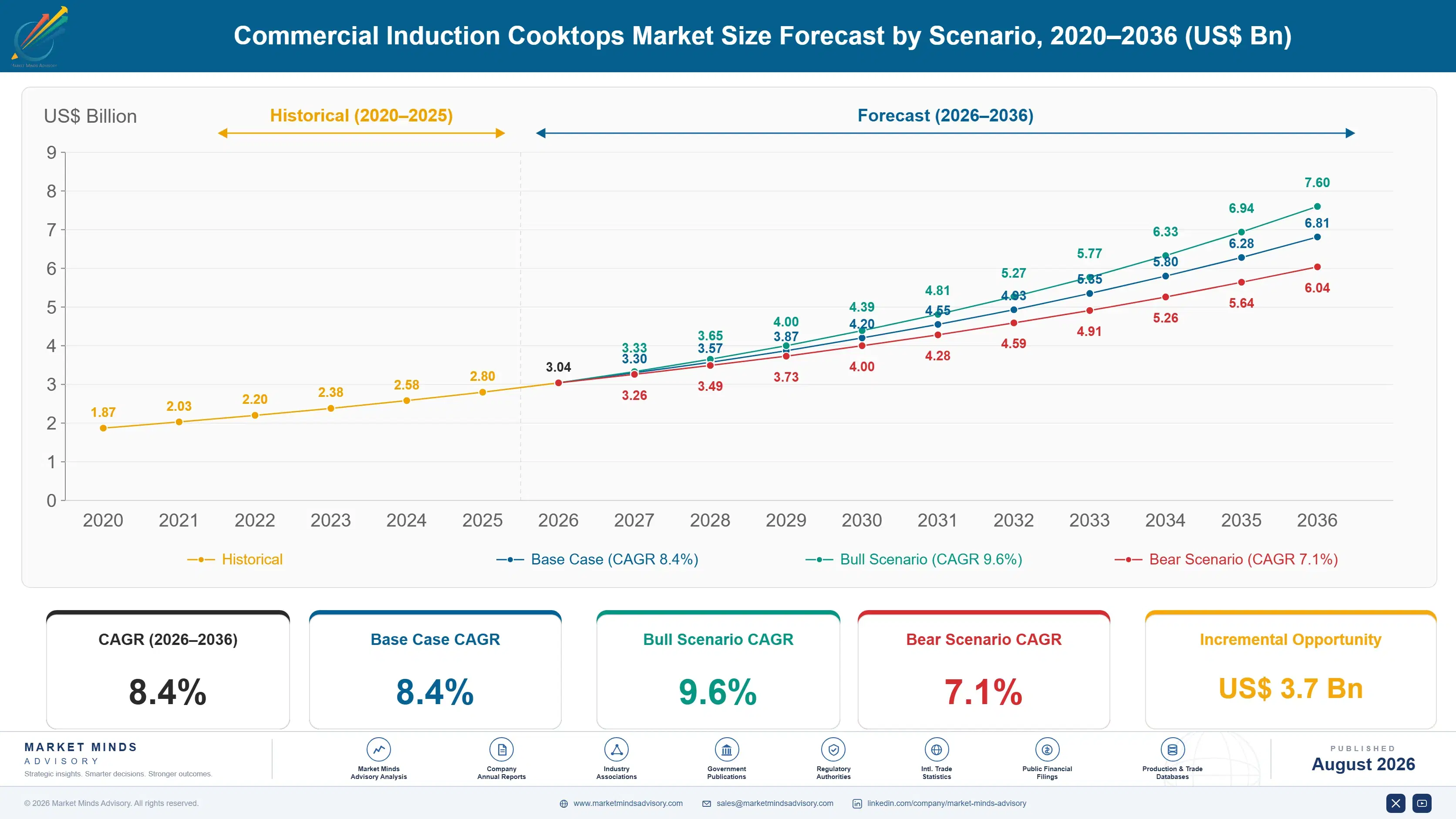
Commercial Induction Cooktops Market Forecast Scenarios

commercial-induction-cooktops-market-size-forecast-scenario-1787301595776
Commercial induction adoption grew unevenly between 2020 and 2025. Pandemic-era kitchen closures froze capital spending through 2021, then a sharp rebound in 2022 and 2023 saw operators rebuild kitchens around energy-efficient equipment as utility costs spiked. Growth over the period compounded at an estimated 6.9%, slower than the forecast years because retrofit financing and coil supply, not demand, capped the pace.
The base case assumes 8.4% annual growth through 2036, anchored on three mechanisms. First, gas-hookup restrictions expand from a handful of cities to dozens, forcing new-build kitchens onto electric lines. Second, insurers price fire risk explicitly, making induction the lower-premium default for chains renewing multi-site policies. Third, coil manufacturing capacity in China and South Korea scales fast enough to cut unit costs roughly a fifth by 2030, closing the price gap that favored gas ranges.
A bull case builds if a major national code body, such as a European Union-wide gas-appliance phase-out, forces conversion on a fixed timeline, pushing growth toward 9.6%. The bear risk is coil chip supply: induction power electronics rely on the same semiconductor lines under pressure from automotive and consumer electronics demand, and a renewed shortage could stretch lead times and cap growth near 7.1%.

Electrification Economics and the Gas-Conversion Cycle

Commercial kitchens are one of the last major built-environment categories still running mostly on gas, and that is changing quickly. Induction's efficiency advantage, low ambient heat, and compatibility with all-electric building codes are converging with insurance economics to make electrification the default specification for new construction and major renovations across quick-service, full-service, and institutional foodservice segments worldwide. Buyers increasingly treat electrification as
MARKET CONCENTRATION38% CR5Top five vendors control roughly two fifths of demand
AVERAGE SELLING PRICE$4,200 per unitBlended price across countertop, drop-in, and built-in configurations
TOP PRODUCING COUNTRYChina, 41%Single country supplies over two fifths of global output
CAPACITY UTILISATION76%Coil assembly lines run near practical ceiling most quarters
TRADE INTENSITY58% export shareMajority of induction units cross a border before installation
INPUT COST SHARE34% of COGSCopper coil windings and power electronics dominate input costs
Vendors compete less on unit price than on total kitchen conversion economics: financing packages, technician training, and coil warranty terms now decide contracts as often as wattage specs. Regional manufacturing clusters in China, South Korea, and northern Italy supply most global volume, while North American and European buyers increasingly demand local service coverage before signing multi-site rollout agreements. Financing terms now shape vendor shortlists as much as coil performance specifications do.
The next decade will be shaped by two forces pulling in the same direction: tightening municipal gas codes and falling coil-electronics costs. Both push adoption further into mid-market restaurants that previously found induction's price premium hard to justify against conventional gas ranges. Vendors slow to close that price gap risk ceding volume to faster-moving regional rivals.
"Operators aren't buying induction because it's trendy anymore, they're buying it because their insurer just told them gas is now the expensive option. That's a procurement conversation, not a sustainability one."
Director, Commercial Foodservice Equipment Practice · MMA Commercial Kitchen Equ

Market Trends

Municipal Gas-Hookup Bans Reach Second-Tier Cities

New York City's Local Law 154 barred gas hookups in most new buildings starting 2024, and more than one hundred US municipalities have adopted similar ordinances since, several extending restrictions to commercial kitchen retrofits rather than new construction only. Berlin, Amsterdam, and Paris are drafting comparable measures targeting restaurant gas connections by 2028. For equipment vendors, this converts a discretionary sustainability upgrade into a compliance purchase with a hard deadline, compressing sales cycles and shifting negotiating leverage toward manufacturers who can guarantee installation within a permitting window rather than a multi-month backlog stretching into the following fiscal year.
Market Impact: Cuts kitchen insurance premiums 12%
Coil Electronics Costs Fall as Semiconductor Scale Improves

Induction cooktops depend on power electronics: IGBT modules and control boards that historically cost more than the coil itself. As China's power semiconductor fabs scale output for electric-vehicle and solar inverters, the same production lines are absorbing induction cooktop orders at falling marginal cost. Component suppliers report unit electronics costs down roughly eighteen percent since 2022, a decline manufacturers are passing through as lower retail prices rather than margin expansion, given how price-sensitive mid-market restaurant buyers remain. That shift is pulling adoption down-market faster than most plans assumed, compressing payback well under two years for high-volume kitchens.
Market Impact: Lifts retrofit approval volume 2x

Market Opportunities and Growth Drivers

Insurance Premium Discounts for Electric Kitchens

Commercial property insurers including major US carriers now offer measurable premium reductions, often five to twelve percent on the kitchen fire-risk line, for operators who remove open gas flames in favor of induction. Grease fires and gas-line failures remain leading causes of restaurant property claims, and underwriters increasingly treat induction conversion the way they once treated sprinkler retrofits: a controllable risk variable worth pricing. For multi-site chains renewing corporate policies, the discount alone can offset a meaningful share of conversion capital cost within the first renewal cycle, turning a sustainability decision into a financed risk-management one.
Market Impact: Slows wok-segment conversion 2 year

Full-Kitchen Retrofit Financing Programs Expand Rapidly

Equipment-as-a-service financing, pioneered by foodservice leasing specialists, now covers full induction retrofits including hood modification and electrical upgrades, spreading the capital cost of conversion across sixty to eighty-four month terms tied to projected utility savings. This removes the single biggest historical barrier: the up-front capital gap between a like-for-like gas range replacement and a full electrification retrofit. Regional restaurant groups that could never justify a lump-sum conversion are now converting kitchen by kitchen as leases roll over, and financing providers report approval volumes for induction-specific packages roughly doubling since 2023 as default rates on these products stayed low.
Market Impact: Adds $15,000 in panel costs

Market Restraints and Challenges

Chef Resistance to Wok-Station Heat Ceilings

Veteran wok chefs in Cantonese and Sichuan kitchens describe induction wok stations as unable to replicate the intense, uneven flame control that produces wok hei, the seared aroma central to high-heat stir-fry cooking. The root cause is physical: even advanced coils cap around five kilowatts per burner, below what a jet-burner gas wok delivers. This slows adoption in the segment vendors are targeting hardest, since word-of-mouth among head chefs shapes multi-unit purchasing decisions more than spec sheets do. Manufacturers are responding with dual-coil high-output burners and chef training programs designed to rebuild confidence before a full-kitchen order is signed.
Market Impact: Adds 4,800 mandated conversions yea

Electrical Panel Upgrade Costs at Older Sites

Many existing restaurant buildings, especially older urban leased space, carry electrical service too small to support a full induction cookline without a panel and sometimes a utility service upgrade. That upgrade routinely costs more than the cooking equipment itself in dense city cores where utility work requires permits and scheduled outages. Landlords in older buildings are frequently unwilling to fund shared electrical infrastructure improvements for a single tenant's kitchen conversion, pushing the cost onto operators with the thinnest margins. Vendors mitigate this by bundling utility-rebate applications and phased circuit-sharing designs that let kitchens convert one cookline at a time.
Market Impact: Cuts unit electronics cost 18%
3 additional market trends, 3 additional growth drivers, and 3 additional restraints and challenges are covered in the full report. Contact sales@marketmindsadvisory.com to access the complete intelligence.

Segment CAGR and Growth Architecture

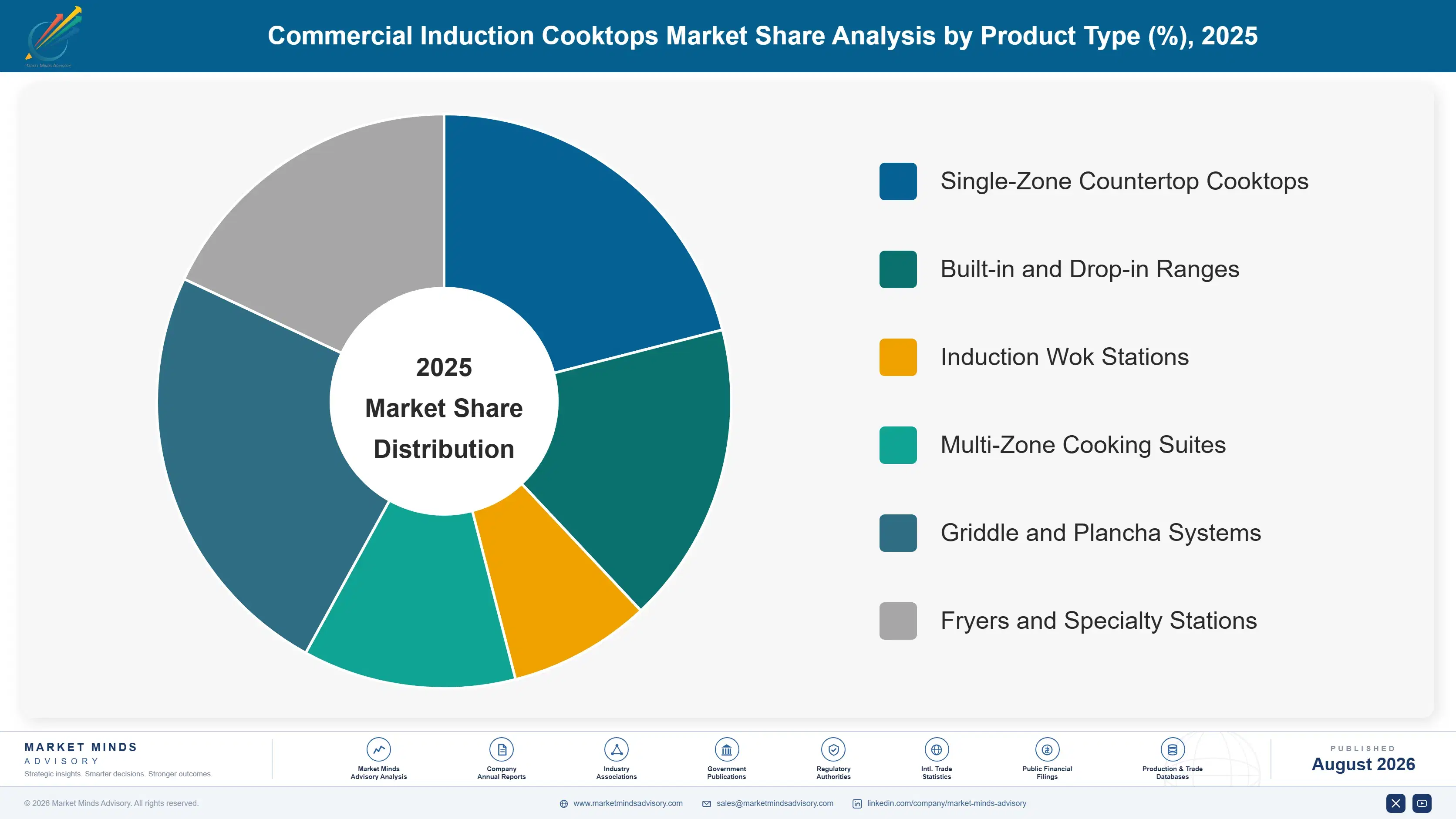
MMA segments the market by cooking-equipment form factor, the classification foodservice buyers actually use when specifying kitchen layouts and comparing vendor catalogs. This avoids blending upstream coil technology, a component-level distinction, with the finished-equipment categories that appear on a kitchen design drawing and a purchase order, keeping the six segments mutually exclusive and directly comparable across vendors.
commercial-induction-cooktops-market-market-share-analysis-1787301596312

Induction Wok Stations

Wok stations are converting from a niche product into the segment vendors compete hardest to win, because Asian foodservice chains that once considered induction unsuitable for high-heat stir-fry are now specifying dual-coil units capable of matching gas-equivalent output. Growth is concentrated in China, greater Southeast Asia, and diaspora restaurant markets in North America and Australia, where regulatory pressure and insurance economics compound the technology case. Vendors including Adventys and MKN have built dedicated wok-coil product lines rather than adapting flat-top hardware, recognizing that chef acceptance depends on burner geometry as much as raw wattage. At an 11.2% forecast CAGR, roughly 1.3 times the market average, wok stations are pulling capital and R&D investment away from slower-growing flat cooktop categories.
CAGR 11.2%

Multi-Zone Induction Cooking Suites

Full-kitchen conversion contracts increasingly specify multi-zone suites rather than individual cooktops, letting operators standardize training, spare-parts inventory, and service contracts across an entire cookline in a single purchase order. Hotel groups and institutional foodservice operators favor this format because it simplifies procurement during large-scale electrification retrofits tied to insurance renewals or new-build codes. Suite pricing bundles installation, electrical coordination, and multi-year service warranties, which raises average order value even as unit economics per burner keep falling. Growth here tracks closely with the pace of full-kitchen retrofit financing rather than individual replacement cycles, giving vendors more predictable, if lumpier, revenue than the replacement-driven single-unit segment. At a 10.1% forecast CAGR, the segment trails only wok stations among all six tracked segments.
CAGR 10.1%
Full segment breakdown across 6 segments available in the complete report.

Regional Architecture and Country Demand Map

Demand concentrates where gas-conversion policy, insurance economics, and foodservice construction activity overlap most tightly. East Asia leads on both manufacturing scale and installed base, North America and Western Europe follow on regulatory-driven retrofit activity, and South Asia and Pacific converts fastest off a small installed base as hospitality construction accelerates.

North America

United States restaurant chains are converting kitchens ahead of any single federal mandate, driven instead by a patchwork of city ordinances and insurer pricing that together function like a mandate. New York, Los Angeles, Seattle, and a growing list of secondary cities restrict new gas hookups in commercial construction, and national chains standardizing equipment specifications across states default to induction rather than maintaining two separate kitchen designs. Canada's provincial building codes are trending the same direction. Insurance carriers active in both countries now factor induction conversion into commercial property underwriting, giving multi-site operators a second financial reason beyond code compliance to move ahead of a renovation cycle rather than wait for a mandate to force the decision.
Share: 25% | CAGR: 8.6% (2026 to 2036)

Western Europe

Regulatory pressure in Western Europe arrives through building energy codes rather than gas-specific bans in most countries, with Germany's and the Netherlands' all-electric new-build standards indirectly pushing commercial kitchens toward induction by making gas infrastructure costlier to install in new construction. France and the United Kingdom layer restaurant-specific fire code updates on top, several referencing induction as a qualifying risk-reduction measure for insurance purposes. Italy's manufacturing base, concentrated in the north, supplies a meaningful share of premium built-in units sold across the region, giving European buyers stronger local service coverage than most other regions outside East Asia. Growth trails East Asia and North America mainly because the installed base of high-end gas equipment in fine-dining kitchens turns over slowly.
Share: 21% | CAGR: 7.0% (2026 to 2036)
Regional intelligence for 5 additional markets available in the complete report: East Asia, South Asia and Pacific, Latin America, Middle East and Africa, Eastern Europe. Contact sales@marketmindsadvisory.com.
commercial-induction-cooktops-market-country-cagr-analysis-1787301596843

Where Induction Vendors Actually Make Margin

Hardware unit sales are becoming commoditized as coil electronics costs fall, so the vendors protecting margin are the ones monetizing the parts of the transaction adjacent to the cooktop itself: financing, installation, training, and multi-year service contracts. The four levers below reflect where MMA's interviews with commercial kitchen equipment buyers show real willingness to pay a premium price.

Bundled Installation and Electrical Coordination Services

Operators converting an existing gas kitchen face a coordination problem vendors are learning to solve: electrical contractors, hood modification crews, and equipment installers worked on separate schedules, adding weeks of downtime. Manufacturers now bundling turnkey installation, including electrical panel assessment and permitting coordination, are capturing an additional 15 to 20% of total project value that previously went to third-party contractors. This is most pronounced in multi-site retrofit programs, where a single vendor managing the full conversion timeline can compress a six-week disruption into ten days, a premium chains are willing to pay given how costly kitchen downtime is.
Market Impact: Adds 15 to 20 percent of project va

Extended Coil and Control Board Warranties

Multi-year extended warranties on coil and control-board components, the two parts most likely to fail under restaurant duty cycles, have become a reliable high-margin attachment sale. Chains renewing fleet-wide service contracts increasingly buy four or five-year extended coverage upfront rather than per-incident repair, giving vendors predictable annuity revenue and operators budget certainty against a failure that can take a cookline offline during peak hours. Vendors report attachment rates above 60% on multi-unit orders when the warranty is bundled into financing rather than sold separately at purchase, since the marginal monthly cost reads as negligible against the lease payment.
Market Impact: Lifts warranty attachment rate abov

Equipment-as-a-Service Financing for Full Kitchen Conversions

Spreading the capital cost of a full induction retrofit across a five to seven year lease tied to projected utility savings converts a difficult one-time capital approval into a recurring operating expense finance committees find easier to approve. Vendors offering in-house or partnered financing close deals faster than those requiring buyers to arrange third-party capital separately, and financing attachment is increasingly a condition chains set before inviting a vendor to bid. MMA interviews suggest financed orders average 22% larger in scope than cash-purchase orders, since bundled financing removes the incentive to phase a conversion project across multiple budget cycles.
Market Impact: Grows average financed order size b

Remote Diagnostics and Predictive Maintenance Subscriptions

Connected induction units that report coil temperature, power draw, and fault codes back to a vendor's service platform let manufacturers sell a recurring monitoring subscription on top of the hardware sale. For multi-site chains, the value proposition is fewer emergency technician visits and less unplanned kitchen downtime during peak service windows, both of which carry a real cost per hour offline. Early adopters report subscription attach rates approaching 30% on new multi-zone suite orders, still small relative to hardware revenue but growing faster than any other line item vendors track, and margin on the subscription runs well above hardware margin.
Market Impact: Reaches nearly 30 percent attach ra

Who Controls the Margin Pool

CR5 sits at 38%, moderate for a category still absorbing entrants from adjacent kitchen equipment lines. Middleby Corporation leads through its CookTek induction subsidiary and broad multi-brand distribution, with Electrolux Professional close behind on European built-in share. The gap between these two leaders and the next tier, including Ali Group and Rational, is narrow enough that one contract win can shift rankings within a fiscal year.
Current activity centers on three dimensions: coil output engineering aimed at closing the gap with gas BTU ratings, service network density that lets vendors guarantee repair windows to multi-site chains, and financing partnerships bundling equipment cost with electrical retrofit expense. Vendors lacking in-house financing are partnering with leasing specialists rather than losing deals on payment terms alone, since chains shortlist based on financing availability before comparing wattage specifications.

Emerging pressure comes from specialist induction manufacturers, particularly Adventys and other pure-play vendors, out-engineering diversified equipment makers on coil performance without matching their distribution scale. If wok-station and multi-zone suite growth keeps outpacing the broader category, expect rankings among the next five challengers to shift by 2028, as specialists convert technical leadership into partnerships with larger, better-capitalized kitchen equipment houses.
commercial-induction-cooktops-market-company-positioning-matrix-1787301597374

Competitive Moat and Risk Dimensions

MIDDLEBY CORPORATION

Moat: Multi-Brand Distribution and Service Scale

Middleby's ownership of CookTek alongside dozens of adjacent foodservice equipment brands gives it a distribution and service network few pure-play induction manufacturers can match, letting it bundle induction conversion into broader kitchen-equipment contracts with national chains. That combined footprint makes Middleby the default vendor for multi-site rollouts requiring a single point of contact across an entire kitchen refit.
MIDDLEBY CORPORATION

Risk: Brand Integration Execution Risk

Managing dozens of acquired brands under one commercial umbrella creates coordination overhead that smaller, focused induction specialists avoid entirely. If service quality or product roadmap coherence slips across the portfolio, multi-site customers who value a single point of accountability have real reason to shift future orders toward more focused competitors.
ELECTROLUX PROFESSIONAL AB

Moat: European Engineering and Certification Depth

Electrolux Professional's decades of European built-in cooking equipment engineering give it certification depth and premium brand recognition that translate directly into hotel and fine-dining specification wins, segments less price-sensitive than quick-service. That reputation lets it command a pricing premium on multi-zone suites that newer entrants struggle to match today.
ELECTROLUX PROFESSIONAL AB

Risk: Revenue Concentration in Europe

A demand base still weighted toward Western Europe leaves Electrolux Professional more exposed than global rivals to any slowdown in European hospitality construction or a delay in the region's gas-restriction code rollout. Expanding share in East Asia and North America requires competing directly against better-distributed rivals on their home ground.

Players Tracked

Prominent Players

Middleby Corporation
Electrolux Professional AB
Ali Group S.r.l.
Rational AG
The Vollrath Company

Other Key Players

Welbilt Inc.
Illinois Tool Works Inc.
Hobart Corporation
Cleveland Range LLC
Star Manufacturing International
Hatco Corporation
Fagor Professional
Alto-Shaam Inc.
Henny Penny Corporation
Atosa Catering Equipment
Adventys SAS
MKN Maschinenfabrik Kurt Neubauer GmbH & Co. KG
Waring Commercial
Globe Food Equipment Company
APW Wyott

Recent Developments

MARCH 2026

Middleby Expands CookTek Coil Manufacturing Capacity

Middleby announced a capacity expansion at its CookTek induction manufacturing facility, adding dedicated production lines for high-output wok-station coils to address backlog from Asian and North American quick-service customers. The expansion targets a reduction in lead times from several months to under six weeks by early 2027.
Signal: Signals Middleby is prioritizing the faste
SEPTEMBER 2025

Electrolux Professional Opens Induction Certification Lab in Italy

Electrolux Professional opened a dedicated induction certification and chef-training facility near its northern Italy manufacturing base, designed to accelerate specification approval for hotel groups requiring documented performance testing before large multi-site orders. The lab also supports third-party fire-safety certification work tied to insurance discount programs.
Signal: Signals Electrolux is positioning certific
JANUARY 2026

Ali Group Acquires Regional Induction Equipment Distributor in Southeast Asia

Ali Group completed the acquisition of a Southeast Asian commercial kitchen equipment distributor, gaining direct service and installation capability across Vietnam, Thailand, and the Philippines rather than relying on third-party representatives. The deal strengthens Ali Group's ability to bid on regional hotel and quick-service multi-site contracts directly.
Signal: Signals Ali Group building direct regional

Copper, Semiconductors, and Coil Assembly Costs

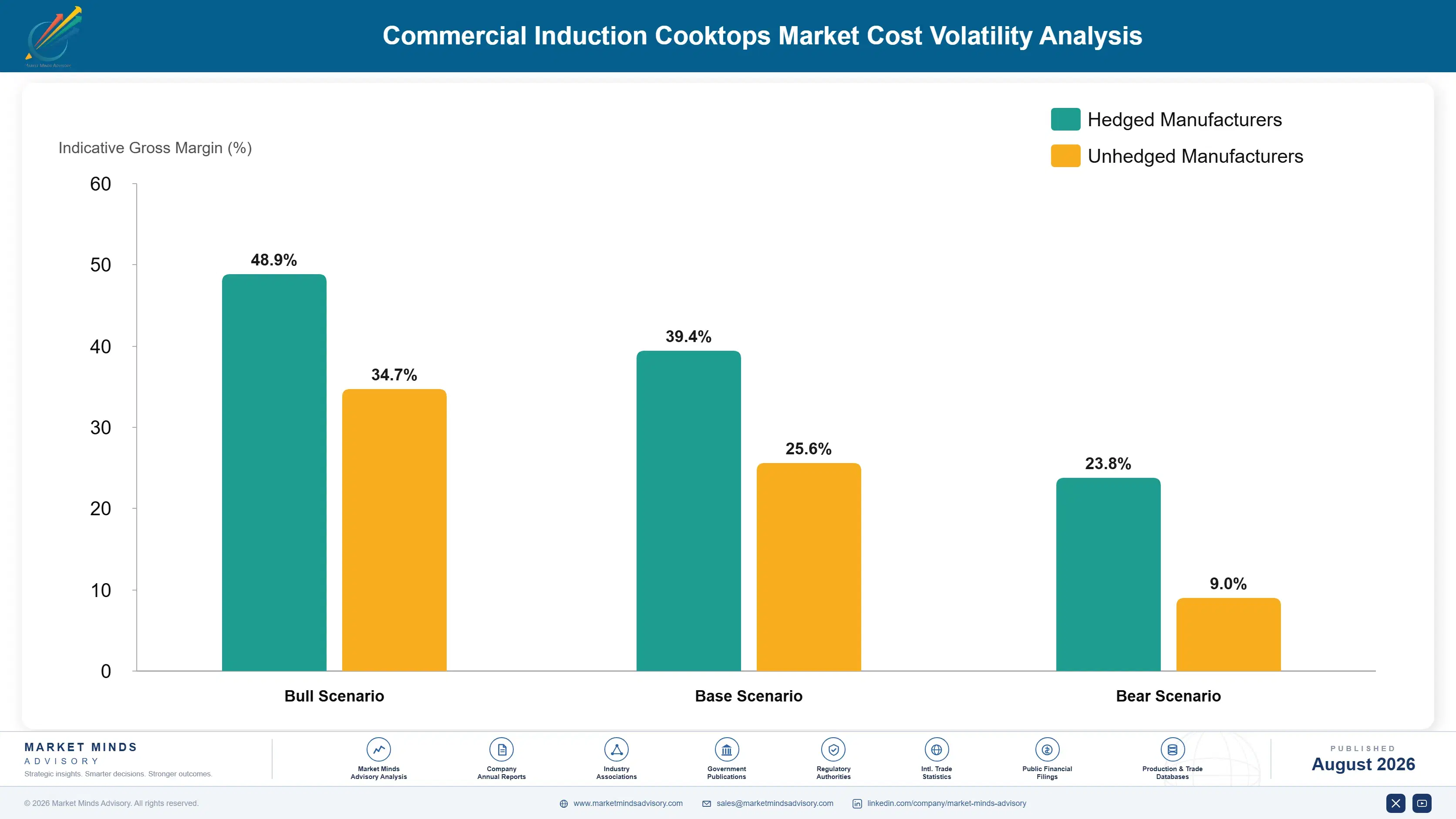
Copper coil windings and power electronics account for roughly 34% of cooktop cost of goods sold, with copper contributing close to half of that share. Copper is sourced globally through commodity exchanges, while power semiconductors, IGBT modules chief among them, come overwhelmingly from fabs concentrated in China, Taiwan, and South Korea, leaving vendors exposed to metal-price swings and regional chip-supply disruption.
Copper prices spiked through 2024 as global electrification demand, including electric vehicles and grid infrastructure, competed directly with appliance manufacturers for the same refined metal supply, according to IEA electrification demand tracking. Vendors without forward contracts saw input costs rise faster than they could pass through to list prices, compressing margins on fixed-price multi-site contracts signed before the spike and forcing manufacturers to add price-escalation clauses to new agreements.

Smaller regional manufacturers without hedging desks or long-term supplier contracts absorb copper volatility directly into margin, while diversified players like Middleby and Electrolux Professional use group-level procurement scale to negotiate forward pricing across product lines. European vendors carry additional exposure to semiconductor import costs given limited domestic chip fabrication, whereas East Asian manufacturers sourcing power electronics locally face lower currency and tariff friction on the same component.
commercial-induction-cooktops-market-cost-volatility-analysis-1787301597572

Forward Copper Purchasing Agreements with Refiners

Larger vendors are locking twelve to eighteen months of copper supply through forward agreements directly with refiners rather than buying spot, smoothing input cost volatility into predictable quarterly budgeting. This reduces exposure to short-term price spikes like the 2024 electrification-driven surge, though it requires balance-sheet capacity smaller regional manufacturers typically lack, reinforcing a scale advantage for diversified players.

Dual-Sourcing Power Electronics Across Regions

Vendors are qualifying second and third power-semiconductor suppliers across different countries rather than depending on a single fab region, reducing single-point-of-failure risk after recent chip-supply disruptions. This adds qualification cost and lead time up front but protects delivery schedules during regional shortages, a tradeoff most multi-site equipment vendors now consider worth making given how disruptive a single shortage can be.

Price-Escalation Clauses in Multi-Year Contracts

Manufacturers increasingly write commodity-indexed price-escalation clauses into multi-site and multi-year supply agreements, passing a defined share of input cost swings through to buyers rather than absorbing them entirely. Chains have largely accepted these terms given the alternative of vendors withdrawing fixed-price bids altogether, a shift procurement teams have adapted to since 2023, when copper volatility first made fixed-price bidding unsustainable.

Portfolio Architecture for Margin Defence

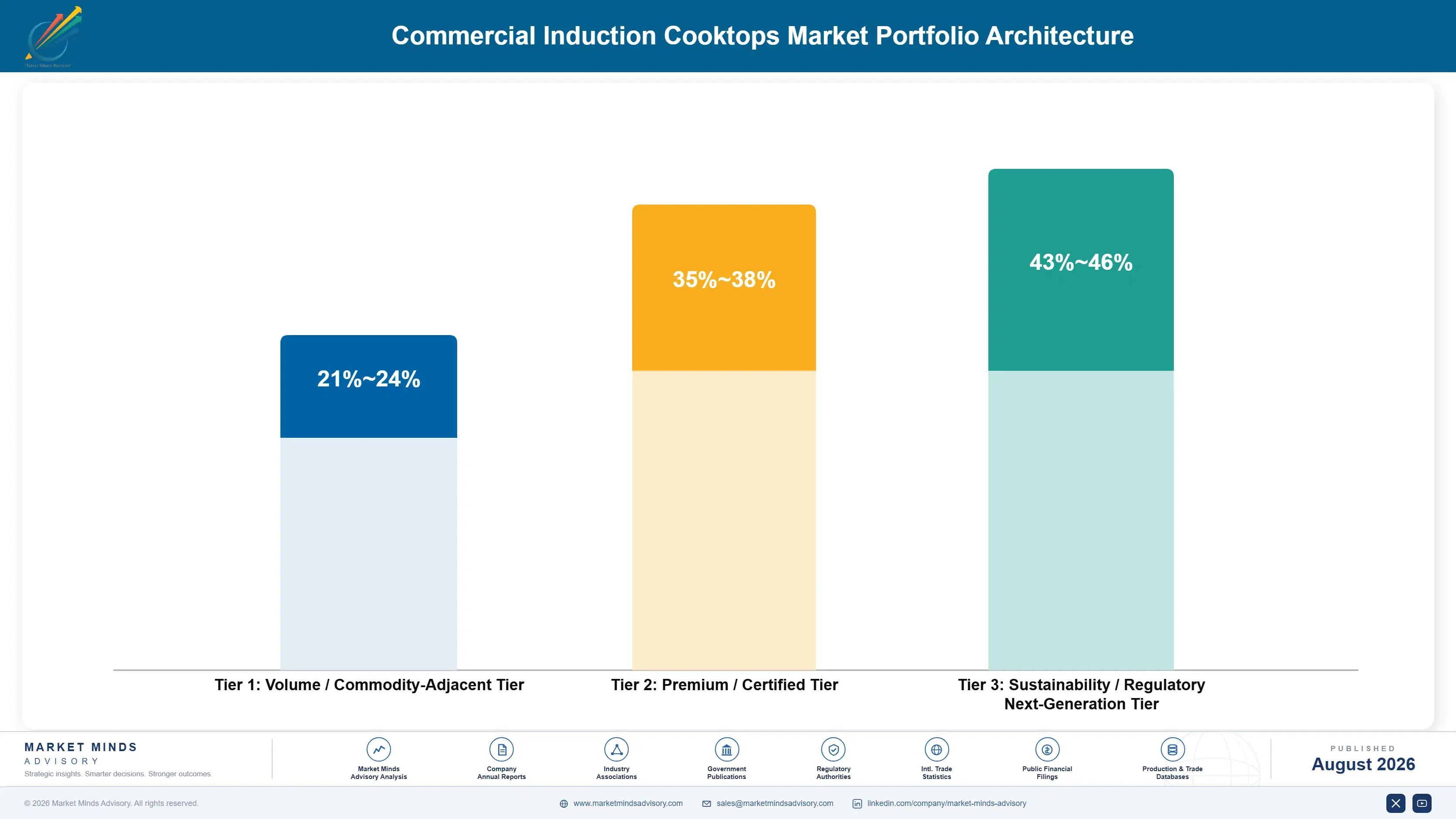
MMA's tier architecture separates the category into three margin bands. Volume and commodity-adjacent countertop units compete on price against imports and carry thin margin, premium and certified built-in and multi-zone suites carry higher margin on brand, service, and certification, and sustainability-linked next-generation lines, including connected diagnostics and ultra-high-output wok coils, command the highest margin as the newest tier. Margin dispersion across tiers has widened over the p
The tension between volume and premium plays out most visibly in mid-market restaurant chains, which want gas-equivalent performance at close to gas-equivalent price and are the segment vendors most want to move up-tier through financing and bundled service rather than compete on hardware price alone. Independent single-location restaurants remain the most price-sensitive buyers and slowest to convert kitchens. Multi-site chains, by contrast, increasingly accept premium pricing once total conversion economics, not sticker price, anchor the negotiation.

High-value margin pools concentrate in multi-zone suite orders bundled with financing, extended warranty, and remote diagnostics subscriptions, where service and software-adjacent revenue increasingly outweighs margin earned on the cooktop hardware itself. That shift is pushing vendors to organize sales teams around total account value rather than unit sales.

Volume / Commodity-Adjacent Tier

Countertop and basic single-zone units sold primarily on price against imported competitors, serving cost-sensitive independent restaurants and food trucks where gross margin stays thin and competition is driven almost entirely by landed unit cost.
Gross Margin: 21%-24%

Premium / Certified Tier

Built-in and multi-zone suites specified by hotel groups and regional chains requiring certification, documented service coverage, and financing options, commanding meaningfully higher margin on brand trust and total-conversion economics rather than hardware price alone.
Gross Margin: 35%-38%

Sustainability / Regulatory / Next-Generation Tier

Connected diagnostic-enabled and ultra-high-output wok and multi-zone lines positioned for chains chasing insurance discounts and compliance deadlines, where technical differentiation and subscription-attached service revenue support the category's highest margin, still a small but fast-growing share of total volume.
Gross Margin: 43%-46%
commercial-induction-cooktops-market-portfolio-architecture-1787301598074

Annuity Economics of Kitchen Conversion

A cooktop sale is rarely a single transaction anymore. Extended warranties, remote diagnostics subscriptions, and multi-year service contracts convert what used to be a one-time hardware purchase into a recurring revenue relationship running five to seven years, matching typical equipment replacement cycles. Vendors that capture the service attachment at time of sale retain more lifetime value per installed unit than those competing on hardware price.
Adoption depth varies sharply by vertical. Quick-service chains convert fastest and most completely, standardizing a single equipment specification across hundreds of locations once a pilot proves out, making them the highest-value account type despite thinner per-unit margin. Fine-dining and independent full-service restaurants convert more slowly, often replacing only the highest-heat-demand stations first while keeping legacy gas equipment elsewhere in the kitchen for years, producing a hybrid installed base that persists longer than vendors projected.

A generational shift in buyers is compounding the technology shift. Facilities and procurement executives now in their thirties and forties, who grew up with electrification and total-cost-of-ownership framing, are replacing an older generation of buyers who defaulted to gas on habit. That shift smooths the sales conversation for vendors even where regulation has not yet forced the decision.
commercial-induction-cooktops-market-end-use-penetration-index-1787301598565

What Matters Most Through 2036

These are among the four positions where our research anticipates prominent divergence between winners and laggards over the coming forecast period. Each is grounded in the demand model, the regulatory perimeter, and the announced capacity pipeline.
01 / WOK SEGMENT INVESTMENT

Prioritize wok-station coil R&D over incremental flat-cooktop refinement

Wok stations are growing at roughly 1.3 times the category average and remain the segment where chef acceptance, not price, decides multi-site contracts. Vendors that solve the heat-ceiling problem first will capture disproportionate share in China, Southeast Asia, and diaspora restaurant markets in North America and Australia before competitors close the technical gap. Continuing to spread R&D evenly across flat cooktop and wok product lines risks ceding the fastest-growing, most defensible segment to focused specialists like Adventys, already out-engineering diversified incumbents on burner geometry and heat output.
02 / FINANCING ATTACHMENT STRATEGY

Bundle financing into every multi-site quote, not just hardware pricing

Chains increasingly shortlist vendors based on financing availability before comparing wattage specifications, and financed orders already average larger scope than cash purchases according to MMA's expert interviews. Vendors without in-house or partnered financing capability are losing deals they would otherwise win on product merit alone, simply because procurement teams cannot get capital approval fast enough without a bundled payment structure in place. Building or acquiring financing capability should now rank ahead of incremental product feature investment for any vendor outside the top two.
03 / INSURANCE PARTNERSHIP DEVELOPMENT

Formalize insurer relationships to convert risk discounts into sales leverage

Insurance premium discounts are now a measurable, quantifiable reason chains convert kitchens ahead of any regulatory deadline, yet most vendors treat this as a background fact rather than an active sales tool. Manufacturers that formalize relationships with major commercial property insurers, providing documented fire-risk reduction data insurers can price directly, will convert a passive market tailwind into a repeatable, quotable sales argument multi-site buyers respond to immediately. This remains underexploited by every player outside the two largest diversified vendors today.
04 / REGIONAL MANUFACTURING POSITIONING

Expand local assembly in South Asia and Pacific ahead of demand

South Asia and Pacific is growing faster than any other region covered in this report, yet regional manufacturing and service capacity remains concentrated in East Asia, leaving a widening gap between demand growth and local support infrastructure. Vendors that establish assembly or major service hubs in India or Southeast Asia now will secure preferred-vendor status with hotel groups and quick-service chains before competitors catch up on lead time and installation responsiveness. Waiting for demand to fully materialize before investing risks losing first-mover advantage in the fastest-growing region tracked.

Engagement Snapshot From the Field

A live engagement with an industry participant carrying material or product regulatory and market exposure ahead of a defining policy shift, showing how our research translates into a defensible multi-year portfolio strategy.
MARKET MINDS ADVISORY · CLIENT ENGAGEMENT SUMMARY
Commercial Induction Cooktops Producer Strategic Portfolio Review and Transition Roadmap 2026·Investment Scenario on Commercial Induction Cooktops Exposure Evaluation 2025-26
CLIENT PROFILE
The client operates several hundred quick-service restaurant locations across the western and southeastern United States on aging kitchen equipment nearing replacement. Facing a mix of state-level gas restrictions in some markets and none in others, the chain's facilities team needed a data-driven framework for sequencing a multi-year kitchen electrification program rather than converting locations reactively, with total planned capital exposure of roughly $340 million (client-reported, unverified by MMA).
STRATEGIC CHALLENGE
Corporate leadership faced pressure from investors to commit to an electrification timeline publicly, but franchise-owned locations controlled their own capital budgets and resisted a mandated conversion schedule without a clear return-on-investment case. The chain needed to sequence conversions by regulatory risk, insurance discount availability, and existing equipment age rather than applying a single uniform rollout schedule across a franchise system with widely varying local economics.
MMA APPROACH
MMA built a location-level scoring model combining local gas-restriction timelines, insurance discount availability, existing equipment age, and projected utility savings, ranking all locations into four conversion-priority tiers. The analysis drew on MMA's primary survey data and expert interviews with commercial kitchen equipment vendors to benchmark realistic conversion costs and financing terms available to a franchise system of this scale and geographic spread.
KEY FINDINGS
  1. Roughly 30% of locations sat in markets with an active or pending gas-restriction code, making them the clear first-priority conversion tier regardless of existing equipment age or condition.
  2. Insurance discount availability varied more by carrier relationship than by location risk profile, meaning centralized insurer negotiation could capture savings faster than waiting for individual franchise renewal cycles.
  3. Locations with equipment already past seventy percent of expected service life offered the strongest standalone financial case for conversion, independent of any regulatory or insurance consideration.
  4. Franchise owners responded far more positively to financed conversion offers bundled with projected utility savings than to any messaging framed primarily around sustainability or corporate policy.
CLIENT PROFILE
The client operates several hundred quick-service restaurant locations across the western and southeastern United States on aging kitchen equipment nearing replacement. Facing a mix of state-level gas restrictions in some markets and none in others, the chain's facilities team needed a data-driven framework for sequencing a multi-year kitchen electrification program rather than converting locations reactively, with total planned capital exposure of roughly $340 million (client-reported, unverified by MMA).
STRATEGIC CHALLENGE
Corporate leadership faced pressure from investors to commit to an electrification timeline publicly, but franchise-owned locations controlled their own capital budgets and resisted a mandated conversion schedule without a clear return-on-investment case. The chain needed to sequence conversions by regulatory risk, insurance discount availability, and existing equipment age rather than applying a single uniform rollout schedule across a franchise system with widely varying local economics.
MMA APPROACH
MMA built a location-level scoring model combining local gas-restriction timelines, insurance discount availability, existing equipment age, and projected utility savings, ranking all locations into four conversion-priority tiers. The analysis drew on MMA's primary survey data and expert interviews with commercial kitchen equipment vendors to benchmark realistic conversion costs and financing terms available to a franchise system of this scale and geographic spread.
KEY FINDINGS
  1. Roughly 30% of locations sat in markets with an active or pending gas-restriction code, making them the clear first-priority conversion tier regardless of existing equipment age or condition.
  2. Insurance discount availability varied more by carrier relationship than by location risk profile, meaning centralized insurer negotiation could capture savings faster than waiting for individual franchise renewal cycles.
  3. Locations with equipment already past seventy percent of expected service life offered the strongest standalone financial case for conversion, independent of any regulatory or insurance consideration.
  4. Franchise owners responded far more positively to financed conversion offers bundled with projected utility savings than to any messaging framed primarily around sustainability or corporate policy.
RECOMMENDED STRATEGY
Phase 1: Phase 1 (Months 1 to 6): Convert all locations in active gas-restriction markets and negotiate a centralized multi-carrier insurance discount program ahead of renewal cycles. Phase 2: Phase 2 (Months 7 to 18): Convert locations with equipment past seventy percent of service life, bundling financing terms validated in phase one to accelerate approval. Phase 3: Phase 3 (Months 19 to 36): Convert remaining locations opportunistically as equipment reaches replacement age, using the financing and insurer relationships built earlier.
OUTCOME
The chain converted its first priority tier within eighteen months of the engagement, ahead of the original three-year target, and reported securing an average insurance premium reduction of 9% across converted locations (client-reported, unverified by MMA). Franchise owner participation in voluntary early conversion exceeded corporate projections once financing and utility-savings data were presented directly rather than framed around sustainability commitments.

Frequently Asked Questions

Foundational context covering the market sizes, CAGR, scope, country, region and competition that inform every finding below. This section is provided to cover basics and most often pre-purchase conversations, answered from the MMA Primary Research Dataset.

What is the current size of the Commercial Induction Cooktops Market?

MMA estimates the global commercial induction cooktops market at $2.8 billion in 2025. Growth is concentrated in East Asia and North America, driven by gas-conversion codes and insurance economics reshaping kitchen procurement.

How large will the Commercial Induction Cooktops Market be by 2036?

MMA forecasts the market reaching $6.7 billion by 2036, up from $3.0 billion in 2026. That represents roughly a 2.23 times expansion over the ten-year forecast period.

What is the CAGR for the Commercial Induction Cooktops Market 2026 to 2036?

MMA's base case forecasts an 8.4% compound annual growth rate, with a bull case of 9.6% and a bear case of 7.1% depending on gas-restriction code adoption pace.

Which segment is growing fastest?

Induction wok stations lead at an 11.2% CAGR, roughly 1.3 times the overall market rate, as coil engineering closes the gap with gas-equivalent heat output for stir-fry cooking.

Who are the major companies in the Commercial Induction Cooktops Market?

Middleby Corporation, Electrolux Professional, Ali Group, Rational AG, and The Vollrath Company lead the category, together holding an estimated 38% combined share on a revenue basis across the top vendors.

Which country is growing fastest?

India leads at an estimated 12.8% CAGR, outpacing the global average as hospitality construction specifies induction from the outset rather than converting existing gas kitchens later.

Report Segmentation Architecture

The full report scope spans multiple orthogonal segmentation dimensions, with cross-tabulated demand data provided for each dimension pair. Coverage extends further to regional breakdowns, trend trajectories, and the competitive detail needed to support segment-level decision-making.

By Product Type

  • Single-Zone Countertop Cooktops
  • Built-in and Drop-in Ranges
  • Induction Wok Stations
  • Multi-Zone Cooking Suites
  • Griddle and Plancha Systems
  • Fryers and Specialty Stations

By End-Use Industry

  • Quick-Service Restaurants
  • Full-Service and Fine Dining
  • Hotels and Hospitality
  • Institutional and Catering Foodservice
  • Cloud Kitchens and Ghost Kitchens

By Commercial Dimension

  • Direct Equipment Purchase
  • Equipment-as-a-Service Financing
  • Distributor and Dealer Channel
  • Multi-Site Retrofit Contracts

By Region

  • North America
  • Western Europe
  • East Asia
  • South Asia and Pacific
  • Latin America
  • Middle East and Africa
  • Eastern Europe

Scope, Methodology, and Coverage

Every figure in this report is reproducible from documented input assumptions. The scope below maps the historical period, the forecast horizon, the segmentation dimensions, and the countries covered, alongside the underlying primary and qualitative methodology.
Historical Period
2020 to 2025
Forecast Period
2026 to 2036
Base Year
2025 (USD billions; MMA Primary Research Dataset, August 2026)
Market Definition
This report covers electromagnetic induction cooking equipment sold to commercial and institutional foodservice operators, spanning countertop, built-in, multi-zone, and specialty configurations across quick-service, full-service, hotel, and institutional channels. It excludes residential induction appliances, industrial process-heating induction systems, and induction warming equipment not used for active cooking.
Quantitative Units
USD billions (current prices); unit shipment volumes where cited
Segmentation Dimensions
By Product Type; By End-Use Industry; By Commercial Dimension; By Region
Regions Covered
North America, Western Europe, East Asia, South Asia and Pacific, Latin America, Middle East and Africa, Eastern Europe
Countries Covered
USA, China, Germany, France, UK, Japan, South Korea, India, Australia, Canada, Brazil, Mexico, Indonesia, Vietnam, Thailand, Malaysia, UAE, Saudi Arabia, South Africa, Nigeria, Turkey, Poland, Netherlands, Italy, Spain, Sweden, Switzerland, Argentina, Colombia, Singapore, and additional markets relevant to this sector
Key Companies Profiled
Middleby Corporation, Electrolux Professional AB, Ali Group S.r.l., Rational AG, The Vollrath Company, Welbilt Inc., Illinois Tool Works Inc., Hobart Corporation, Cleveland Range LLC, Star Manufacturing International, Hatco Corporation, Fagor Professional, Alto-Shaam Inc., Henny Penny Corporation, Atosa Catering Equipment, Adventys SAS, MKN Maschinenfabrik Kurt Neubauer GmbH & Co. KG, Waring Commercial, Globe Food Equipment Company, APW Wyott
Quantitative Methodology
Primary survey, n=3,800 respondents, Q4 2025, six countries; demand-side model with trade association cross-validation
Qualitative Methodology
47 expert interviews, Q4 2025; applied to validate demand model assumptions, identify emerging dynamics, and assess competitive positioning
Report Format
PDF and XLSX data workbook (Word format preview document)
Publisher
Market Minds Advisory
Report Code
MMA-2026-CON-101
Published
August 2026
Contact
sales@marketmindsadvisory.com | www.marketmindsadvisory.com

Purchase the full Commercial Induction Cooktops Market Report (2026 to 2036).

The full report provides detailed market sizing and ten-year forecasts for the global commercial induction cooktops market, broken out across all seven regions and six product segments covered in this summary. It includes complete profiles of the top twenty vendors, including capacity, distribution footprint, and recent corporate developments, along with a detailed input-cost and pricing model calibrated to primary survey data. Buyers receive a full regional data workbook, segment-level forecast tables through 2036, and a competitive benchmarking matrix built on the same commercially consistent basis used throughout this summary. A dedicated chapter addresses gas-restriction regulatory tracking across major markets covered in the report.
Full regional data workbook across all seven regions
Twenty-vendor competitive profiles with capacity benchmarking
Segment-level forecast tables through 2036 by product type
Regulatory tracking chapter on gas-restriction code adoption
Input-cost and pricing sensitivity model with scenarios
Access to MMA analyst inquiry for three months

Built For The People Who Decide

From boardroom strategy to bench-side execution, this report is read cover-to-cover by leaders shaping the next decade of their industry, turning demand scenarios, market dynamics and valuation benchmarks into decisions.
CXOs/ Presidents/ VPs/ Managers
M&A and Corporate Development
Strategy Teams and R&D Heads
Procurement and Product Directors
Regulatory and Compliance Leaders
Investor Relations and Equity Analysts